EP0800810B1 - Couchette de thérapie - Google Patents
Couchette de thérapie Download PDFInfo
- Publication number
- EP0800810B1 EP0800810B1 EP96119517A EP96119517A EP0800810B1 EP 0800810 B1 EP0800810 B1 EP 0800810B1 EP 96119517 A EP96119517 A EP 96119517A EP 96119517 A EP96119517 A EP 96119517A EP 0800810 B1 EP0800810 B1 EP 0800810B1
- Authority
- EP
- European Patent Office
- Prior art keywords
- bed
- link
- component
- support
- frame
- Prior art date
- Legal status (The legal status is an assumption and is not a legal conclusion. Google has not performed a legal analysis and makes no representation as to the accuracy of the status listed.)
- Expired - Lifetime
Links
- 238000002560 therapeutic procedure Methods 0.000 title claims abstract description 32
- 238000006073 displacement reaction Methods 0.000 claims 1
- 230000002349 favourable effect Effects 0.000 description 8
- 238000010276 construction Methods 0.000 description 3
- 239000000654 additive Substances 0.000 description 2
- 230000000996 additive effect Effects 0.000 description 2
- 208000031872 Body Remains Diseases 0.000 description 1
- 229910000831 Steel Inorganic materials 0.000 description 1
- 230000008602 contraction Effects 0.000 description 1
- 238000011161 development Methods 0.000 description 1
- 230000018109 developmental process Effects 0.000 description 1
- 230000008407 joint function Effects 0.000 description 1
- 210000004705 lumbosacral region Anatomy 0.000 description 1
- 238000004519 manufacturing process Methods 0.000 description 1
- 210000003049 pelvic bone Anatomy 0.000 description 1
- 238000004904 shortening Methods 0.000 description 1
- 239000010959 steel Substances 0.000 description 1
Images


Classifications
-
- A—HUMAN NECESSITIES
- A61—MEDICAL OR VETERINARY SCIENCE; HYGIENE
- A61G—TRANSPORT, PERSONAL CONVEYANCES, OR ACCOMMODATION SPECIALLY ADAPTED FOR PATIENTS OR DISABLED PERSONS; OPERATING TABLES OR CHAIRS; CHAIRS FOR DENTISTRY; FUNERAL DEVICES
- A61G13/00—Operating tables; Auxiliary appliances therefor
- A61G13/009—Physiotherapeutic tables, beds or platforms; Chiropractic or osteopathic tables
Definitions
- the invention relates to a therapy couch, with a plurality of hinged couch elements, one of which first lying element over a main joint with a second Bed element is connected, and which bed elements one Experience support.
- Such a therapy couch is from DE 30 16 387 A1 known.
- the therapy couch there has one Height-adjustable center column supporting the main joint on.
- the on the height-adjustable center column over the Main joint connected and articulated couch elements can using two on the height-adjustable center column fixed adjustment elements that support the elements reach under by changing the length of the adjustment elements in their angle to each other and with respect to the support be adjusted.
- the disadvantage is the comparatively high price it is due to the fact that the lounger is elaborately designed is. In addition, it tends to be more intense when the patient is laid on Treatment something to swing, what from the patient and also often considered undesirable by the treating physiotherapist is felt. It has been shown that the relative low natural frequency with this therapy couch and heavy or sick patient occurs, leads to the patient if treated appropriately, become seasick, which is of course undesirable as they tend to stop treatment early.
- the couch known from DE-OS 33 23 310 is basically also relatively adjustable. It also doesn't tend so much about vibrations. However, the construction is also the physiotherapist is quite complex and in particular or therapist due to the side structure on a light Access to the patient prevented. The patient can use this Do not solve certain exercises or only with appropriate ones Perform dislocations, for example when one leg is angled sideways must become. It is therefore not surprising that this couch has not prevailed.
- the invention is based on the object To create therapy couch according to the preamble of claim 1, which is comparatively inexpensive to manufacture and nevertheless has a reduced tendency to vibrate, although the Adjustment options are particularly good.
- the solution according to the invention is characterized by a stable Support from fixed supports, which in their course are not connected to each other, so that mobility is not is limited, but the bedding elements clearly Massively support spaced apart locations.
- the support points are preferably approximately in the middle of each Lying element or even on the one removed from the main joint End attached. Surprisingly, this already results a reduced tendency to vibrate, which is probably due to this is that fixed supports in contrast to adjustment elements have no "play" and in itself - especially if, for example. are designed as square steel tubes - only by overcoming considerable resistance are compressible and expandable.
- power cylinders are used for the adjusting elements can be used with a favorable angle of attack, which is a stable support at a comparatively low level transmitting forces.
- a bottom-side one Adjustment element between a frame and one of the Supports clearly spaced from their bottom joint be attached so that practically a triangle of force spanned becomes extremely stable and torsion and torque resistant forms a support even with one-sided loading.
- the power cylinders can also be telescopic his.
- height adjustability in the frame to support the feet at the ends of the Framework can be integrated, for example Known height adjustment cylinders can be used.
- the configuration of the invention is particularly favorable Lounger with four lying surfaces, each around three joints, namely the main joint and the first and the second lying element joint are pivotable to each other. With this configuration can be almost any position of the patient depending on ensure the desired treatment.
- An advantageous one Training also has a joint for the foot-rest element at the distal end of this bed element. With this embodiment, it is particularly advantageous that a Particularly favorable stretching in the pelvic area is achieved is that the foot-lying element against each other when hiring its frame, which is connected to the second joint, from Body moved away. This will stretch the lumbar spine ensured as desired in most cases is. Nevertheless, this storage is easier than a trapezoidal storage of the foot-rest element, so that with this configuration have several advantages.
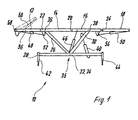
- the therapy couch 10 shown in FIG. 1 has a plurality of lying elements 12, 14, 16, 18, each articulated are interconnected.
- the first lying element 14 is with the second lying element 16 can be pivoted via a main joint 20 connected.
- the first lying element 14 is also with the foot rest element 12 is connected via a rest element joint 22.
- the second lying element 16 is the head lying element 18 connected via a second lying element joint 24.
- the bed elements are flush in the illustrated embodiment aligned with each other and flat so that they are on their Form a flat lying surface on the top. It goes without saying that each bed element has upholstery not shown here.
- the first lying element 14 is attached to a first support 26 supported by a frame 28.
- the second lying element 16 is supported on the frame 28 via a second support 30.
- the Support is provided via frame joints 32, 34.
- the supports 26 and 30 are also via support joints 36, 38 articulated on the first or second lying element 14, 16 connected.
- the adjustment of all lying elements 12 to 18 is via adjustment elements possible as a power cylinder, as manual actuated spindles or in some other way, be it as electrical Encoder, hydraulically or pneumatically operated cylinders or can be formed in any other way.
- the first adjustment element 40 is between the frame 28 and the Support 26 articulated, and clearly spaced from the Frame hinge assembly 35. It is designed that - how it can be seen from the other figures - the entire couch from the extreme right-angled position to the left inclined extreme position can be pivoted. Despite this The adjustment mechanism is completely adjustable integrated under the bed, with the foot clearance of the treating therapists represents a particular advantage, which is due to the fact that the height adjustment over the frame 28 with four adjustable feet, two of which are adjustable feet 42 and 44 are shown.
- a second adjustment element 46 is between the frame joint arrangement 35 and the second lying element 16 articulated.
- this adjustment element can be practically Adjust the setting angle of the main joint 20, that is, the folding angle the entire therapy couch 10. is particularly cheap, that here an adjustment regardless of the operation of the Adjustment element 40, i.e. the total angle of inclination of the therapy couch, he follows.
- the pivot point is the second adjustment element 46 between the main joint 20 and the second support joint 38 is formed. It goes without saying that if necessary, the arrangement can be interchanged or the second adjustment element 46 also exactly on the main joint 20 can attack.
- the support joint 36 is fairly close in the example the first lying element joint 22 attached while the second support joint 38 approximately in the middle of the second lying element 16 is attached.
- This configuration results in a particularly favorable adjustment with automatic adjustment the existing weights and lengths of body parts, especially the upper body is usually the heaviest part of the body, so that it is conveniently centered, i.e., on the second Support joint 38 is supported while the legs are also should be supported approximately in the middle, so that the middle Support approximately in the region of the support joint 36 is optimal.
- Further adjustment elements 48 and 50 are for the adjustment the relative position of the foot-lying element 12 and the head-lying element 18 provided. These are each on a flange 52 or 54 hinged to the adjacent lying element 14 or 16, so that there is a distance from the respective pivot point 22 or 24 results and a simple adjustment is possible.
- This Actuating cylinders only require a comparatively small number Resilience after both the human head as well the lower legs have a comparatively low weight. Side elements, not shown, of the head-lying element 18 can also be lowered.
- the foot-lying element 12 also has a special one Frame 56 on, which allows a separate pivot to make an additional joint 58.
- a pivot position can be seen, which is from the pivot position according to FIG. 1 differs only in that that the second adjusting element 46 in the direction of shortening was pressed. This already leads to the desired buckling and the position according to FIG. 2.
- FIG. 4 shows another position of the therapy couch according to the invention 10 can be seen.
- the head of the The patient is lowered and the legs are raised.
- that specifically trained foot-rest element allows a back extension undertake different stretching positions in Fig. 4 are indicated by dashed lines.
- Fig. 5 differs from that position shown in Fig. 1 only by actuation of the first adjusting element 40 in the stretching direction.
- the position shown in Fig. 6 requires one Actuation of the second adjusting element in the direction of contraction and an actuation of the adjusting elements 48 and 50 in in the same direction.
- Fig. 7 Another of the countless and arbitrary Combinable possibilities of changing positions is out Fig. 7 can be seen.
- each a logically assignable adjustment option is opened up which leads to the fact that the operation by the therapist, which can be done via an electrical control panel, for example is facilitated.
- adjustable lounger a sling treatment.
- This is on the head-lying element 18, and preferably on the latter outer end and on its underside, a bracket attached, on which a frame in the longitudinal direction of the head-rest element 18 is slidably mounted.
- the head-lying element 18 becomes substantially upright set so that the frame as a support frame also extends upright.
- a guide for the movable Storage of a support frame attached which is essentially extends perpendicular to the support frame, in the upright The position of the head-lying element 18 is therefore essentially horizontal.
- Position By swiveling the head-lying element out of the upright position Position can be the unit of support frame and support frame be pivoted overall. At the far end the carrying frame is a hook for taking a sling attached with which the patient in the desired manner forces variable in the manner of a ceiling loop device can be subjected.
- a corresponding arrangement of a sling treatment additive is also possible for the foot rest element 12.
Landscapes
- Health & Medical Sciences (AREA)
- Life Sciences & Earth Sciences (AREA)
- Animal Behavior & Ethology (AREA)
- General Health & Medical Sciences (AREA)
- Physical Education & Sports Medicine (AREA)
- Rehabilitation Therapy (AREA)
- Engineering & Computer Science (AREA)
- Biomedical Technology (AREA)
- Biophysics (AREA)
- Orthopedic Medicine & Surgery (AREA)
- Public Health (AREA)
- Veterinary Medicine (AREA)
- Accommodation For Nursing Or Treatment Tables (AREA)
- Pharmaceuticals Containing Other Organic And Inorganic Compounds (AREA)
- Materials For Medical Uses (AREA)
- Radiation-Therapy Devices (AREA)
- Invalid Beds And Related Equipment (AREA)
Claims (12)
- Couchette de thérapie avec une pluralité d'éléments de couchette articulés les uns avec les autres, dont un premier élément de couchette est relié par l'intermédiaire d'une articulation principale à un deuxième élément de couchette et dont les éléments de couchette sont soutenus, un premier élément de réglage (40) étant prévu entre le cadre (28) et un support (30) et un deuxième élément de réglage (46) et un deuxième élément de réglage (46) étant prévu pour un réglage de l'angle de positionnement de l'articulation principale (20), caractérisée en ce que, pour soutenir le premier et le deuxième élément de couchette (14, 16), est prévu respectivement un support fixe (26, 30), lesquels supports (26, 30) n'étant pas reliés les uns aux autres dans leur extension, qui sont installés à leurs extrémités situées du côté du sol respectivement au moyen d'une articulation (32, 34) sur en particulier un cadre (28) et qui soutiennent le premier et le deuxième élément de couchette (14, 16) en particulier par l'intermédiaire d'articulations de support (36, 38) à des points écartés les uns des autres.
- Couchette de thérapie selon la revendication 1, caractérisée en ce que les articulations (32, 34) convergent à l'extrémité située du côté du sol des supports (26, 30) dans leurs axes de pivotement et que l'axe d'articulation s'étend transversalement au sens longitudinal de la couchette de thérapie (10).
- Couchette de thérapie selon une des revendications précédentes, caractérisée en ce que le premier élément de réglage (40), en particulier un vérin de puissance, est installé entre le cadre (28) et le deuxième support (30) et qu'un deuxième élément de réglage (46) est installé entre le cadre (28) et/ou un des supports (26, 30) à proximité de leur extrémité située du côté du sol et le premier ou le deuxième élément de couchette (14, 16), écarté de l'articulation (38) entre le support (30) et l'élément de couchette (16).
- Couchette de thérapie selon une des revendications précédentes, caractérisée en ce que le premier et le deuxième élément de couchette (14, 16) sont fixés sur le premier (26) et le deuxième (30) support par une première et une deuxième articulation de support (36, 38), et que les axes d'articulation des articulations (36, 38) et en particulier aussi de l'articulation du cadre (32, 34) s'étendent parallèlement les uns aux autres entre le cadre (28) et les supports (26, 30).
- Couchette de thérapie selon une des revendications précédentes, caractérisée en ce qu'un troisième élément extérieur ou élément de pied de couchette et un quatrième élément ou élément de tête de couchette (12, 18) est fixé par une première et une deuxième articulation d'élément de couchette (22, 24) sur le premier ou le deuxième élément de couchette (14, 16) et qu'entre le troisième et le quatrième élément de couchette (12, 18) et le premier ou le deuxième élément de couchette (14, 16) s'étend respectivement un troisième et un quatrième élément de réglage (48, 50), dont le point d'articulation fixe sur le premier ou le deuxième élément de couchette (14, 16) est écarté de la première ou de la deuxième articulation de couchette (22, 24).
- Couchette de thérapie selon une des revendications précédentes, caractérisée en ce que la première et la deuxième articulation du support (36, 38) est installée entre le premier et le deuxième support (26, 30) et le premier et le deuxième élément de couchette (14, 16) respectivement à peu près au centre dans l'extension de l'élément de couchette (14, 16).
- Couchette de thérapie selon une des revendications précédentes, caractérisée en ce que le troisième élément de couchette (12) est conçu comme un élément de pied (58) et présente à son extrémité éloignée une articulation de pied (58) qui permet un pivotement de l'élément de couchette (12) autour de cette articulation de pied (58).
- Couchette de thérapie selon une des revendications précédentes, caractérisée en ce que le premier support (26) est installé à proximité immédiate de la première articulation d'élément de couchette (22).
- Couchette de thérapie selon une des revendications précédentes, caractérisée en ce que le quatrième élément de couchette (18) est conçu comme un élément de tête (18) et est divisé deux fois dans le sens longitudinal de la couchette, les éléments latéraux pouvant être abaissés et/ou retirés.
- Couchette de thérapie selon une des revendications précédentes, caractérisée en ce que les points d'articulation du premier et du deuxième élément de réglage (40, 46) sont choisis de manière à ce que la trajectoire de mouvement des deux éléments de réglage (40, 46) soit globalement identique au réglage maximal souhaité.
- Couchette de thérapie selon une des revendications précédentes, caractérisée en ce que l'articulation principale (20) et la première et la deuxième articulation d'élément de couchette (22, 24) présentent des axes d'articulation parallèles les uns aux autres dans n'importe quel angle et que, grâce à ces trois articulations, les quatre éléments de couchette (12 à 18) sont réglables respectivement indépendamment les uns des autres dans n'importe quel angle.
- Couchette de thérapie selon une des revendications précédentes, caractérisée en ce que le deuxième support (30) et le deuxième élément de réglage forment avec un montant horizontal du cadre (28) un triangle et constituent avec le premier et le deuxième élément de couchette (14, 16) et le premier support (26) un assemblage en particulier dans le style d'une structure de diamant.
Applications Claiming Priority (2)
| Application Number | Priority Date | Filing Date | Title |
|---|---|---|---|
| DE29600903U DE29600903U1 (de) | 1996-01-19 | 1996-01-19 | Therapieliege |
| DE29600903U | 1996-01-19 |
Publications (2)
| Publication Number | Publication Date |
|---|---|
| EP0800810A1 EP0800810A1 (fr) | 1997-10-15 |
| EP0800810B1 true EP0800810B1 (fr) | 2003-01-15 |
Family
ID=8018276
Family Applications (1)
| Application Number | Title | Priority Date | Filing Date |
|---|---|---|---|
| EP96119517A Expired - Lifetime EP0800810B1 (fr) | 1996-01-19 | 1996-12-05 | Couchette de thérapie |
Country Status (3)
| Country | Link |
|---|---|
| EP (1) | EP0800810B1 (fr) |
| AT (1) | ATE230968T1 (fr) |
| DE (2) | DE29600903U1 (fr) |
Families Citing this family (1)
| Publication number | Priority date | Publication date | Assignee | Title |
|---|---|---|---|---|
| DE102017213287A1 (de) * | 2017-08-01 | 2019-02-07 | Suspa Gmbh | Matratzenträger-Verstellanordnung |
Family Cites Families (9)
| Publication number | Priority date | Publication date | Assignee | Title |
|---|---|---|---|---|
| GB1408366A (en) | 1973-06-22 | 1975-10-01 | Ici Ltd | Anchor bolt |
| SE410820C (sv) | 1978-03-28 | 1985-09-09 | Landstingens Inkopscentral | Forlossningsbord |
| DE3016387C2 (de) | 1980-04-29 | 1984-04-19 | Herbert 8190 Wolfratshausen Brustmann | Behandlungsliege |
| DE3323310A1 (de) | 1983-06-28 | 1985-01-10 | Jens 8000 München Therkorn | Neigungsverstellbare liege zur koerperdehnung |
| DE3808408A1 (de) | 1988-03-14 | 1989-09-28 | Stiegelmeyer & Co Gmbh | Krankenbett mit mehrteiliger liegeflaeche |
| DE8803723U1 (de) * | 1988-03-18 | 1988-05-11 | Schwind, Hubert, 7910 Burlafingen | Gerät zum Lagern von Personen |
| GB9020048D0 (en) | 1990-09-13 | 1990-10-24 | Hoskins Ltd | Supporting appliance |
| FR2694883A1 (fr) * | 1992-08-21 | 1994-02-25 | Shermann | Dispositif électrique de proclive-déclive de lit. |
| DE4317208C1 (de) | 1993-05-22 | 1994-06-30 | Arnold L & C | Krankenbett |
-
1996
- 1996-01-19 DE DE29600903U patent/DE29600903U1/de not_active Expired - Lifetime
- 1996-12-05 EP EP96119517A patent/EP0800810B1/fr not_active Expired - Lifetime
- 1996-12-05 AT AT96119517T patent/ATE230968T1/de not_active IP Right Cessation
- 1996-12-05 DE DE59610055T patent/DE59610055D1/de not_active Expired - Fee Related
Also Published As
| Publication number | Publication date |
|---|---|
| DE59610055D1 (de) | 2003-02-20 |
| DE29600903U1 (de) | 1996-03-28 |
| ATE230968T1 (de) | 2003-02-15 |
| EP0800810A1 (fr) | 1997-10-15 |
Similar Documents
| Publication | Publication Date | Title |
|---|---|---|
| DE3016387C2 (de) | Behandlungsliege | |
| WO1993009750A1 (fr) | Lit d'accouchement | |
| EP1498095B1 (fr) | Table de traitement | |
| DE3305692A1 (de) | Verstellbare liege | |
| DE69622204T2 (de) | Stuhl | |
| DE69402978T2 (de) | Bett für intensivtherapie | |
| CH650658A5 (en) | Therapy couch | |
| EP0800810B1 (fr) | Couchette de thérapie | |
| DE2309970A1 (de) | Umwandelbarer stuhl | |
| DE19639477A1 (de) | Therapievorrichtung | |
| DE69716276T2 (de) | Verstellbares möbel | |
| EP1702535B1 (fr) | Table de traitement avec appui pour les genoux | |
| DE2640985A1 (de) | Verfahren und vorrichtung zum problemlosen ueberfuehren eines patienten aus einer liegenden in eine sitzende stellung und umgekehrt | |
| DE10145508C1 (de) | Trimmgerät, insbesondere zum Trainieren der Beinmuskulatur | |
| DE4233606C1 (de) | Wirbelsäulen-Entlastungsstuhl | |
| WO2013029771A1 (fr) | Appareil de thérapie vertébrale | |
| DE4328679C2 (de) | Stuhl, insbesondere zahnärztlicher Arbeitsstuhl | |
| WO2001014017A1 (fr) | Appareil servant notamment a l'extension lombaire | |
| DE3844233A1 (de) | Trainingsgeraet | |
| DE3708007C1 (en) | Device for lifting the lower half of the human body | |
| EP0824908B1 (fr) | Appareil de thérapie pour la colonne vertébrale | |
| DE10103201C2 (de) | Schwenkliege zur Wirbelsäulenentlastung | |
| DE4009712C1 (en) | Cosmetic treatment chair - has foot rest which adjusts relative to seat, with sleeve guides engaged by sliding rods | |
| DE2123081C3 (de) | Sitz vor rieh tu ng | |
| WO2024046565A1 (fr) | Appareil thérapeutique à couplage forcé entre le bras de support d'actionneur et le bras de support d'écran |
Legal Events
| Date | Code | Title | Description |
|---|---|---|---|
| PUAI | Public reference made under article 153(3) epc to a published international application that has entered the european phase |
Free format text: ORIGINAL CODE: 0009012 |
|
| 17P | Request for examination filed |
Effective date: 19970517 |
|
| AK | Designated contracting states |
Kind code of ref document: A1 Designated state(s): AT CH DE GB LI NL SE |
|
| 17Q | First examination report despatched |
Effective date: 20000406 |
|
| GRAG | Despatch of communication of intention to grant |
Free format text: ORIGINAL CODE: EPIDOS AGRA |
|
| GRAG | Despatch of communication of intention to grant |
Free format text: ORIGINAL CODE: EPIDOS AGRA |
|
| GRAH | Despatch of communication of intention to grant a patent |
Free format text: ORIGINAL CODE: EPIDOS IGRA |
|
| GRAH | Despatch of communication of intention to grant a patent |
Free format text: ORIGINAL CODE: EPIDOS IGRA |
|
| GRAA | (expected) grant |
Free format text: ORIGINAL CODE: 0009210 |
|
| AK | Designated contracting states |
Kind code of ref document: B1 Designated state(s): AT CH DE GB LI NL SE |
|
| PG25 | Lapsed in a contracting state [announced via postgrant information from national office to epo] |
Ref country code: NL Free format text: LAPSE BECAUSE OF FAILURE TO SUBMIT A TRANSLATION OF THE DESCRIPTION OR TO PAY THE FEE WITHIN THE PRESCRIBED TIME-LIMIT Effective date: 20030115 Ref country code: GB Free format text: LAPSE BECAUSE OF FAILURE TO SUBMIT A TRANSLATION OF THE DESCRIPTION OR TO PAY THE FEE WITHIN THE PRESCRIBED TIME-LIMIT Effective date: 20030115 |
|
| REG | Reference to a national code |
Ref country code: GB Ref legal event code: FG4D Free format text: NOT ENGLISH Ref country code: CH Ref legal event code: EP |
|
| REF | Corresponds to: |
Ref document number: 59610055 Country of ref document: DE Date of ref document: 20030220 Kind code of ref document: P |
|
| PG25 | Lapsed in a contracting state [announced via postgrant information from national office to epo] |
Ref country code: SE Free format text: LAPSE BECAUSE OF FAILURE TO SUBMIT A TRANSLATION OF THE DESCRIPTION OR TO PAY THE FEE WITHIN THE PRESCRIBED TIME-LIMIT Effective date: 20030415 |
|
| NLV1 | Nl: lapsed or annulled due to failure to fulfill the requirements of art. 29p and 29m of the patents act | ||
| GBV | Gb: ep patent (uk) treated as always having been void in accordance with gb section 77(7)/1977 [no translation filed] |
Effective date: 20030115 |
|
| PLBE | No opposition filed within time limit |
Free format text: ORIGINAL CODE: 0009261 |
|
| STAA | Information on the status of an ep patent application or granted ep patent |
Free format text: STATUS: NO OPPOSITION FILED WITHIN TIME LIMIT |
|
| PG25 | Lapsed in a contracting state [announced via postgrant information from national office to epo] |
Ref country code: LI Free format text: LAPSE BECAUSE OF NON-PAYMENT OF DUE FEES Effective date: 20031231 Ref country code: CH Free format text: LAPSE BECAUSE OF NON-PAYMENT OF DUE FEES Effective date: 20031231 |
|
| 26N | No opposition filed |
Effective date: 20031016 |
|
| REG | Reference to a national code |
Ref country code: CH Ref legal event code: PL |
|
| PGFP | Annual fee paid to national office [announced via postgrant information from national office to epo] |
Ref country code: AT Payment date: 20051115 Year of fee payment: 10 |
|
| PGFP | Annual fee paid to national office [announced via postgrant information from national office to epo] |
Ref country code: DE Payment date: 20061125 Year of fee payment: 11 |
|
| PG25 | Lapsed in a contracting state [announced via postgrant information from national office to epo] |
Ref country code: AT Free format text: LAPSE BECAUSE OF NON-PAYMENT OF DUE FEES Effective date: 20061205 |
|
| PG25 | Lapsed in a contracting state [announced via postgrant information from national office to epo] |
Ref country code: DE Free format text: LAPSE BECAUSE OF NON-PAYMENT OF DUE FEES Effective date: 20080701 |