EP0801963A1 - Appareil d'entraînement, de diagnostique et de rehabilitation de type bicyclette ergonomique - Google Patents
Appareil d'entraînement, de diagnostique et de rehabilitation de type bicyclette ergonomique Download PDFInfo
- Publication number
- EP0801963A1 EP0801963A1 EP97106478A EP97106478A EP0801963A1 EP 0801963 A1 EP0801963 A1 EP 0801963A1 EP 97106478 A EP97106478 A EP 97106478A EP 97106478 A EP97106478 A EP 97106478A EP 0801963 A1 EP0801963 A1 EP 0801963A1
- Authority
- EP
- European Patent Office
- Prior art keywords
- seat
- carrier
- unit
- user
- backrest
- Prior art date
- Legal status (The legal status is an assumption and is not a legal conclusion. Google has not performed a legal analysis and makes no representation as to the accuracy of the status listed.)
- Withdrawn
Links
- 238000003745 diagnosis Methods 0.000 title 1
- 238000000034 method Methods 0.000 claims description 6
- 238000006073 displacement reaction Methods 0.000 claims description 2
- 230000036772 blood pressure Effects 0.000 claims 1
- 238000009434 installation Methods 0.000 claims 1
- 230000003189 isokinetic effect Effects 0.000 description 7
- 230000005540 biological transmission Effects 0.000 description 3
- 238000010276 construction Methods 0.000 description 3
- 210000003205 muscle Anatomy 0.000 description 3
- 241000529895 Stercorarius Species 0.000 description 1
- 230000001133 acceleration Effects 0.000 description 1
- 230000015572 biosynthetic process Effects 0.000 description 1
- 238000005516 engineering process Methods 0.000 description 1
- 230000005484 gravity Effects 0.000 description 1
- 210000000056 organ Anatomy 0.000 description 1
- 230000000284 resting effect Effects 0.000 description 1
Images

Classifications
-
- A—HUMAN NECESSITIES
- A63—SPORTS; GAMES; AMUSEMENTS
- A63B—APPARATUS FOR PHYSICAL TRAINING, GYMNASTICS, SWIMMING, CLIMBING, OR FENCING; BALL GAMES; TRAINING EQUIPMENT
- A63B21/00—Exercising apparatus for developing or strengthening the muscles or joints of the body by working against a counterforce, with or without measuring devices
- A63B21/00178—Exercising apparatus for developing or strengthening the muscles or joints of the body by working against a counterforce, with or without measuring devices for active exercising, the apparatus being also usable for passive exercising
-
- A—HUMAN NECESSITIES
- A61—MEDICAL OR VETERINARY SCIENCE; HYGIENE
- A61H—PHYSICAL THERAPY APPARATUS, e.g. DEVICES FOR LOCATING OR STIMULATING REFLEX POINTS IN THE BODY; ARTIFICIAL RESPIRATION; MASSAGE; BATHING DEVICES FOR SPECIAL THERAPEUTIC OR HYGIENIC PURPOSES OR SPECIFIC PARTS OF THE BODY
- A61H1/00—Apparatus for passive exercising; Vibrating apparatus; Chiropractic devices, e.g. body impacting devices, external devices for briefly extending or aligning unbroken bones
- A61H1/02—Stretching or bending or torsioning apparatus for exercising
- A61H1/0214—Stretching or bending or torsioning apparatus for exercising by rotating cycling movement
-
- A—HUMAN NECESSITIES
- A63—SPORTS; GAMES; AMUSEMENTS
- A63B—APPARATUS FOR PHYSICAL TRAINING, GYMNASTICS, SWIMMING, CLIMBING, OR FENCING; BALL GAMES; TRAINING EQUIPMENT
- A63B21/00—Exercising apparatus for developing or strengthening the muscles or joints of the body by working against a counterforce, with or without measuring devices
- A63B21/00181—Exercising apparatus for developing or strengthening the muscles or joints of the body by working against a counterforce, with or without measuring devices comprising additional means assisting the user to overcome part of the resisting force, i.e. assisted-active exercising
-
- A—HUMAN NECESSITIES
- A63—SPORTS; GAMES; AMUSEMENTS
- A63B—APPARATUS FOR PHYSICAL TRAINING, GYMNASTICS, SWIMMING, CLIMBING, OR FENCING; BALL GAMES; TRAINING EQUIPMENT
- A63B22/00—Exercising apparatus specially adapted for conditioning the cardio-vascular system, for training agility or co-ordination of movements
- A63B22/06—Exercising apparatus specially adapted for conditioning the cardio-vascular system, for training agility or co-ordination of movements with support elements performing a rotating cycling movement, i.e. a closed path movement
- A63B22/0605—Exercising apparatus specially adapted for conditioning the cardio-vascular system, for training agility or co-ordination of movements with support elements performing a rotating cycling movement, i.e. a closed path movement performing a circular movement, e.g. ergometers
-
- A—HUMAN NECESSITIES
- A63—SPORTS; GAMES; AMUSEMENTS
- A63B—APPARATUS FOR PHYSICAL TRAINING, GYMNASTICS, SWIMMING, CLIMBING, OR FENCING; BALL GAMES; TRAINING EQUIPMENT
- A63B22/00—Exercising apparatus specially adapted for conditioning the cardio-vascular system, for training agility or co-ordination of movements
- A63B22/06—Exercising apparatus specially adapted for conditioning the cardio-vascular system, for training agility or co-ordination of movements with support elements performing a rotating cycling movement, i.e. a closed path movement
- A63B22/0605—Exercising apparatus specially adapted for conditioning the cardio-vascular system, for training agility or co-ordination of movements with support elements performing a rotating cycling movement, i.e. a closed path movement performing a circular movement, e.g. ergometers
- A63B2022/0635—Exercising apparatus specially adapted for conditioning the cardio-vascular system, for training agility or co-ordination of movements with support elements performing a rotating cycling movement, i.e. a closed path movement performing a circular movement, e.g. ergometers specially adapted for a particular use
- A63B2022/0652—Exercising apparatus specially adapted for conditioning the cardio-vascular system, for training agility or co-ordination of movements with support elements performing a rotating cycling movement, i.e. a closed path movement performing a circular movement, e.g. ergometers specially adapted for a particular use for cycling in a recumbent position
-
- A—HUMAN NECESSITIES
- A63—SPORTS; GAMES; AMUSEMENTS
- A63B—APPARATUS FOR PHYSICAL TRAINING, GYMNASTICS, SWIMMING, CLIMBING, OR FENCING; BALL GAMES; TRAINING EQUIPMENT
- A63B2230/00—Measuring physiological parameters of the user
- A63B2230/04—Measuring physiological parameters of the user heartbeat characteristics, e.g. ECG, blood pressure modulations
-
- A—HUMAN NECESSITIES
- A63—SPORTS; GAMES; AMUSEMENTS
- A63B—APPARATUS FOR PHYSICAL TRAINING, GYMNASTICS, SWIMMING, CLIMBING, OR FENCING; BALL GAMES; TRAINING EQUIPMENT
- A63B2230/00—Measuring physiological parameters of the user
- A63B2230/04—Measuring physiological parameters of the user heartbeat characteristics, e.g. ECG, blood pressure modulations
- A63B2230/06—Measuring physiological parameters of the user heartbeat characteristics, e.g. ECG, blood pressure modulations heartbeat rate only
-
- A—HUMAN NECESSITIES
- A63—SPORTS; GAMES; AMUSEMENTS
- A63B—APPARATUS FOR PHYSICAL TRAINING, GYMNASTICS, SWIMMING, CLIMBING, OR FENCING; BALL GAMES; TRAINING EQUIPMENT
- A63B71/00—Games or sports accessories not covered in groups A63B1/00 - A63B69/00
- A63B71/0009—Games or sports accessories not covered in groups A63B1/00 - A63B69/00 for handicapped persons
-
- Y—GENERAL TAGGING OF NEW TECHNOLOGICAL DEVELOPMENTS; GENERAL TAGGING OF CROSS-SECTIONAL TECHNOLOGIES SPANNING OVER SEVERAL SECTIONS OF THE IPC; TECHNICAL SUBJECTS COVERED BY FORMER USPC CROSS-REFERENCE ART COLLECTIONS [XRACs] AND DIGESTS
- Y10—TECHNICAL SUBJECTS COVERED BY FORMER USPC
- Y10S—TECHNICAL SUBJECTS COVERED BY FORMER USPC CROSS-REFERENCE ART COLLECTIONS [XRACs] AND DIGESTS
- Y10S482/00—Exercise devices
- Y10S482/908—Adjustable
Definitions
- the invention relates to a training, diagnostic and rehabilitation device in the manner of a bicycle ergometer with a seat or seat-backrest unit arranged on a base frame and a pedal crank unit, the former unit being attached to a carrier and being tiltable relative to the carrier and the carrier being pivotable about a pivot axis directed parallel to the axis of the pedal crank unit and being lockable in the pivot position.
- the pivot axis of a support for the seat-backrest unit is located at a distance behind a pedal crank unit on a base frame.
- the carrier can be determined in a certain position for its use position.
- the seat-backrest unit can be moved lengthways on the carrier in the position of use.
- a pivoting of the carrier to a substantially horizontal position is provided for a medical emergency (e.g. the patient's weakness).
- DE 42 03 917 C2 also discloses a device in the manner of a bicycle ergometer, in which the height of the seat-backrest unit can be adjusted and ascertained with the distance between the seat-backrest unit and the pedal crank unit remaining the same and the seat backrest unit can be moved below the level of the pedal crank unit.
- FISCHER discloses a bicycle ergometer to be used in the medical field with a braking device in the manner of a hysteresis brake.
- EP 0 403 295 A1 discloses a collapsible bicycle trainer with a fixed position of use.
- the pedal crank unit is rigidly attached to the carrier here.
- US Pat. No. 4,700,946 discloses a training device that allows arm and leg muscle movement against the body's own gravity.
- a seat slide is arranged on inclined parallelogram rails, which is pressed against a support for the arms and legs of the user by the slope downforce.
- the device can also be used as a bicycle trainer, the seat carriage then resting in its lowest position.
- a device designed in the manner of a bicycle ergometer in which the seat-backrest unit is vertically adjustable and lockable relative to a carrier, which in turn is horizontally adjustable and adjustable relative to the frame noticeable, but non-pivotably connected to the frame is. Accordingly, when changing the height of the seat-backrest unit to maintain the same distance between the seat-backrest unit and the pedal crank unit, a distance compensation must be carried out.
- EP 0 152 995 (LOREDAN); DD 301 322 A7 (IRMLER et al); AT 397 033 B (WINTERSTEIGER); DE-PS 10 54 204 (JAEGER); DE 93 07 352 U1 (DAUM); U.S. Patent 5,342,265 (CREELMAN); U.S. Patent 5,342,261 (JOHNSTON); J.M.H. Cabri: Isokinetic movements as a diagnostic and rehabilitation principle, Med. Orth. Tech. 114 (1994, pp. 177-181); G. Seibert et al: Isokinetic systems - functional testing and calibration, medical technology, 111th year 5/91, pp. 165-172; and G. Eissing: Calibration device for bicycle ergometers, Biomed. Techn. 27 (1982), pp. 84-86.
- the invention has for its object to provide a training, diagnostic and rehabilitation device that creates expanded training options and is relatively simple.
- a device which is characterized in that different use pivot positions are adjustable, and the pivot axis of the carrier is arranged in or near the axis of the pedal crank unit, so that the average distance of the seat to the axis of the pedal crank unit, the various use pivot positions of the carrier is substantially the same size.
- the seat or seat-backrest unit can advantageously be locked in relation to the carrier, or it is advantageously held in a certain constant inclination by one of the means explained in more detail below, irrespective of the pivoting position.
- the distance from the seat surface to the axis of the pedal crank unit preferably means the distance from the center of the seat surface to the axis when the seat surface position is essentially horizontal.
- the arrangement of the pivot axis "in the vicinity of the axis of the pedal crank unit” means a distance from the axis of the pedal crank unit which is preferably less than 30%, particularly preferably less than 20% of the average distance of the seat surface (averaged over the various use swivel positions) to the axis of the pedal crank unit.
- the average distance remains "essentially the same size" it is meant that the difference between the largest and smallest occurring distance from the seat surface to the axis of the pedal crank unit is preferably less than 20%, particularly preferably less than 10% of the average distance.
- the center of the seat can advantageously be used to define the distances.
- a means is provided that the seat surface in the different use pivot positions automatically in the same inclination or, in other words, automatically holds in parallel.
- this means for keeping the inclination constant is formed by a parallelogram-type steering system.
- an active drive for example an electric motor
- tracks the inclination of the seat so that it remains constant regardless of the inclination of the wearer.
- Claims 5 to 11 relate to means for mechanically pivoting and locking the support of the seat or seat-backrest unit, furthermore to the displaceability of the seat surface relative to the support and to the formation of the outer shape of the device body.
- Claims 16 and 17 relate to configurations using so-called biofeedback methods.
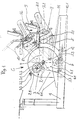
- FIG. 1 a side view of the exemplary embodiment is shown in FIG. 1 and a top view in FIG. 2.
- the device designated overall by G has a base frame which has a flat, approximately cuboid hollow base part 1, the slightly curved top surface 1.1 of which is composed of removable plates.
- the base part 1 continues upwards into a disk body 2, which has a substantially circular outline 2.1 in the side view according to FIG. 1 and an essentially rectangular outline 2.2 in the top view according to FIG. 2 and which acts as a bearing body for a pedal crank unit 3 , a carrier 4 and a handlebar 5 described below is used.
- the pedal crank unit 3 consists, as is customary with bicycles, of a bearing hub 3.1, two crank arms 3.2 projecting diametrically from this and two pedals 3.3 rotatably mounted on the crank arms, the bearing hub 3.1 being arranged in the vicinity of the center Z of the disk body 2. In other embodiments, it is arranged in the center Z.
- the pedal crank unit 3 also includes an organ 6 housed in the base part 1, 1.1, which acts either as a brake or as a drive motor, depending on whether the device is operated as a conventional bicycle ergometer or as a so-called isokinetic bicycle simulator.
- the pedals 3.3 are driven externally via a transmission 6.1, which enables a force-free movement training of the leg muscles.
- the exerciser can also try to move the pedals faster or slower than the external drive. If an external drive with constant speed output is used, the patient can apply braking or acceleration forces at constant speed. With constant power consumption of the engine, however, the exerciser can Accelerate or slow down the rotation of the pedals within a certain speed range.
- Such a bicycle ergometer therefore has the advantage that the exerciser submits work under controlled kinematic conditions. This enables, for example, a continuously increased and at the same time verifiable training course in medical rehabilitation processes.
- the above-mentioned carrier 4 is pivotally supported at one end in the area between the bearing hub 3.1 and the center Z of the disk body 2. Its storage is therefore in the immediate vicinity of the bearing hub 3.1. In other embodiments, the support of the carrier 4 is located in the bearing hub 3.1.
- the carrier 4 carries at its other free end a seat-back unit SL which is designed to be longitudinally displaceable as well as tiltable relative to the carrier 4.
- the pivot angle of the carrier 4 are chosen so that an adjustment from the usual sitting position to a quasl lying position is possible; compare the fully extended or dotted position in Fig. 1. This enables different muscle groups to be trained, depending on whether the seat SL is set high or low.
- the pivoting and locking of the carrier 4 is not done manually, but by machine.
- the carrier 4 is equipped with a rocker arm 11 rigidly connected to it and projecting at an angle therefrom, the shape of which is adapted to the circular curvature 2.1 of the disk body 3.
- Its free end 11.1 is connected in an articulated manner to a motor-operated pull rod drive 12 with a drive 12.1 in such a way that the longitudinal movements of the drive 12.1 are converted into the pivoting movement of the carrier 4, the pull rod drive 12 also serving as a locking device for the carrier 4 when it is at a standstill.
- the tie rod drive 12 is housed together with its drive 12.1 in the base part 1, 1.1.
- the seat backrest unit SL is not attached directly to the free end of the carrier 4, but an extension piece 7 is interposed in such a way that it is articulated on the one hand on the carrier 4 and on the other hand carries the seat backrest unit.
- the extension piece 7 has guides 7.1 for a longitudinal displacement of the seat backrest unit.
- a device 7.2 for height adjustment of the seat-back unit is provided, which also acts as a locking device for the two adjustment processes mentioned.
- the extension piece 7 is also connected at 5.1 to one end of the - here rod-shaped - handlebar 5.
- the handlebar 5 is articulated with its other end at 5.2 on the disc body 2.
- the dimensions of the handlebar 5 and the two articulation points 5.1, 5.2 are chosen so that a parallelogram system is formed with the carrier 4, which ensures a horizontal position of the seat 8 of the seat-backrest unit with all pivoting positions of the carrier, which is a safety measure the user is essential during the operation of the device; see. the dotted representation in Fig. 1st
- the backrest 9 is also made for the backrest 9 to be designed so that it can be pivoted and locked in relation to the seat 8, which is particularly desirable when the user assumes the quasi-lying position mentioned.
- pivotable and lockable armrests 10 which contribute to a safe sitting or lying position of the user.
Landscapes
- Health & Medical Sciences (AREA)
- General Health & Medical Sciences (AREA)
- Physical Education & Sports Medicine (AREA)
- Life Sciences & Earth Sciences (AREA)
- Biophysics (AREA)
- Orthopedic Medicine & Surgery (AREA)
- Epidemiology (AREA)
- Pain & Pain Management (AREA)
- Rehabilitation Therapy (AREA)
- Animal Behavior & Ethology (AREA)
- Public Health (AREA)
- Veterinary Medicine (AREA)
- Cardiology (AREA)
- Vascular Medicine (AREA)
- Rehabilitation Tools (AREA)
Applications Claiming Priority (2)
| Application Number | Priority Date | Filing Date | Title |
|---|---|---|---|
| DE19615392 | 1996-04-18 | ||
| DE19615392A DE19615392C1 (de) | 1996-04-18 | 1996-04-18 | Trainings-, Diagnose- und Rehabilitationsgerät nach Art eines Fahrradergometers |
Publications (1)
| Publication Number | Publication Date |
|---|---|
| EP0801963A1 true EP0801963A1 (fr) | 1997-10-22 |
Family
ID=7791680
Family Applications (1)
| Application Number | Title | Priority Date | Filing Date |
|---|---|---|---|
| EP97106478A Withdrawn EP0801963A1 (fr) | 1996-04-18 | 1997-04-18 | Appareil d'entraînement, de diagnostique et de rehabilitation de type bicyclette ergonomique |
Country Status (3)
| Country | Link |
|---|---|
| US (1) | US5853353A (fr) |
| EP (1) | EP0801963A1 (fr) |
| DE (1) | DE19615392C1 (fr) |
Cited By (1)
| Publication number | Priority date | Publication date | Assignee | Title |
|---|---|---|---|---|
| CZ307852B6 (cs) * | 2017-05-24 | 2019-06-26 | Technická univerzita v Liberci | Rehabilitační ergometr a způsob jeho řízení |
Families Citing this family (17)
| Publication number | Priority date | Publication date | Assignee | Title |
|---|---|---|---|---|
| JPWO2002030521A1 (ja) * | 2000-10-06 | 2004-02-19 | 長谷川 俊幸 | 機能強化訓練機 |
| DE20202383U1 (de) | 2002-02-16 | 2002-07-11 | Royalbeach Spielwaren- und Sportartikel Vertriebs GmbH, 83417 Kirchanschöring | Trainingsgerät, insbesondere Ergometer |
| KR20070061476A (ko) | 2004-02-05 | 2007-06-13 | 모토리카 리미티드 | 신경근 자극 |
| US20060293617A1 (en) * | 2004-02-05 | 2006-12-28 | Reability Inc. | Methods and apparatuses for rehabilitation and training |
| US8112155B2 (en) * | 2004-02-05 | 2012-02-07 | Motorika Limited | Neuromuscular stimulation |
| KR20070054596A (ko) * | 2004-02-05 | 2007-05-29 | 모토리카 리미티드 | 재활훈련 방법 및 장치와 트레이닝 관련 어플리케이션 |
| KR20070054595A (ko) * | 2004-02-05 | 2007-05-29 | 모토리카 리미티드 | 재활 운동 및 훈련을 위한 방법 및 장치 |
| US8888723B2 (en) | 2004-02-05 | 2014-11-18 | Motorika Limited | Gait rehabilitation methods and apparatuses |
| US8938289B2 (en) | 2004-08-25 | 2015-01-20 | Motorika Limited | Motor training with brain plasticity |
| US7381162B2 (en) * | 2004-09-22 | 2008-06-03 | Hai Pin Kuo | Exerciser having adjustable seat |
| DE102006012113A1 (de) * | 2006-03-14 | 2007-09-27 | Lupotron Gmbh | Therapieeinrichtung und Betriebsverfahren |
| US7717824B2 (en) * | 2007-11-08 | 2010-05-18 | Itzhak Pinto | Isokinetic exercise equipment |
| NZ593139A (en) * | 2011-05-30 | 2014-04-30 | Spoke House Ltd | Exercise device |
| US8864628B2 (en) | 2013-03-12 | 2014-10-21 | Robert B. Boyette | Rehabilitation device and method |
| US9573019B2 (en) | 2013-08-13 | 2017-02-21 | Megeriann Corp. | Mobility aid and rehabilitation device and related components |
| JP7030198B2 (ja) * | 2018-08-03 | 2022-03-04 | 三菱電機エンジニアリング株式会社 | 運動療法装置 |
| US12186621B2 (en) * | 2021-11-02 | 2025-01-07 | Apex Ip Holdings, Llc | Gravity resistance trainer |
Citations (7)
| Publication number | Priority date | Publication date | Assignee | Title |
|---|---|---|---|---|
| US2320489A (en) * | 1940-08-26 | 1943-06-01 | Exercycle Corp | Exercising apparatus |
| FR2036818A1 (fr) * | 1969-04-04 | 1970-12-31 | Cuinier Henri | |
| DE2408674A1 (de) * | 1974-02-22 | 1975-08-28 | Hartmut Dipl Ing Schiebler | Gymnastikvorrichtung |
| US4436097A (en) * | 1982-06-07 | 1984-03-13 | Cunningham Patrick J | Cardiovascular exercise apparatus |
| US4577860A (en) * | 1984-07-06 | 1986-03-25 | Rene Matias | Adjustable exercycle for providing simulated running exercises |
| DE4203917A1 (de) * | 1992-02-03 | 1993-08-05 | Joachim Bohn | Tretkurbelergometer zum fahrradfahren, einstellbar auf unterschiedliche koerperhaltungen und verwendbar zur benutzung als beinpresse |
| US5312311A (en) * | 1992-10-05 | 1994-05-17 | Pearson William G | Exercise bicycle |
Family Cites Families (20)
| Publication number | Priority date | Publication date | Assignee | Title |
|---|---|---|---|---|
| DE301322C (fr) * | ||||
| NL106927C (fr) * | 1958-04-03 | 1900-01-01 | ||
| DE2021130A1 (de) * | 1970-03-17 | 1971-09-30 | Oesten Forsman | Muskeluebungs- und Trainiergeraet |
| US4244021A (en) * | 1979-03-02 | 1981-01-06 | Amf Incorporated | Ergometric exerciser |
| US4285515A (en) * | 1979-10-03 | 1981-08-25 | Gezari Daniel Y | Surgical ergometer table |
| DE3042087A1 (de) * | 1980-11-07 | 1982-07-15 | Physia GmbH, 6078 Neu-Isenburg | "ergometer"-geraet" |
| CA1230635A (fr) * | 1983-07-08 | 1987-12-22 | Shinroku Nakao | Ergometre et frein magnetique pour bicyclette d'exercice |
| JPS6068871A (ja) * | 1983-09-27 | 1985-04-19 | ジ−オ−技研株式会社 | ペダル回転式健康運動器具 |
| AT397033B (de) * | 1985-05-24 | 1994-01-25 | Wintersteiger Gmbh & Co | Einrichtung zur erfassung der muskelkraft |
| US4700946A (en) * | 1985-10-11 | 1987-10-20 | Breunig Donald E | Exercise Device |
| IL90626A (en) * | 1989-06-15 | 1992-08-18 | Propel Partnership 1987 | Exercising device |
| US5033736A (en) * | 1989-12-01 | 1991-07-23 | Hirschfeld Scott M | Passive exercise bicycle |
| US5342261A (en) * | 1991-06-05 | 1994-08-30 | Gary Johnston | Adjustable cycling apparatus |
| DE69130979T2 (de) * | 1991-06-12 | 2000-05-04 | Tradotec S.A., Vernier | Ergometrische Vorrichtung |
| US5342265A (en) * | 1993-02-23 | 1994-08-30 | Kevin Creelman | Mogol skiing simulating exercise apparatus with variable resistance |
| DE9307352U1 (de) * | 1993-05-14 | 1993-07-15 | Daum Electronic GmbH, 8501 Veitsbronn | Heimtrainer mit Bio-Feedback |
| US5672141A (en) * | 1993-10-05 | 1997-09-30 | Johnston; Gary Lawrence | Adjustable cycling apparatus |
| US5342269A (en) * | 1994-01-04 | 1994-08-30 | Richard Huang | Arm oscillating exerciser |
| DE4419307A1 (de) * | 1994-06-01 | 1994-12-15 | Fischer Stefan Dipl Ing | Hysteresebremse zur Bremskrafteinstellung bei ortsfesten Trainingsgeräten und Ergometern |
| US5549527A (en) * | 1995-11-08 | 1996-08-27 | Yu; Hui-Nan | Stationary bike |
-
1996
- 1996-04-18 DE DE19615392A patent/DE19615392C1/de not_active Expired - Fee Related
-
1997
- 1997-04-18 US US08/844,300 patent/US5853353A/en not_active Expired - Fee Related
- 1997-04-18 EP EP97106478A patent/EP0801963A1/fr not_active Withdrawn
Patent Citations (7)
| Publication number | Priority date | Publication date | Assignee | Title |
|---|---|---|---|---|
| US2320489A (en) * | 1940-08-26 | 1943-06-01 | Exercycle Corp | Exercising apparatus |
| FR2036818A1 (fr) * | 1969-04-04 | 1970-12-31 | Cuinier Henri | |
| DE2408674A1 (de) * | 1974-02-22 | 1975-08-28 | Hartmut Dipl Ing Schiebler | Gymnastikvorrichtung |
| US4436097A (en) * | 1982-06-07 | 1984-03-13 | Cunningham Patrick J | Cardiovascular exercise apparatus |
| US4577860A (en) * | 1984-07-06 | 1986-03-25 | Rene Matias | Adjustable exercycle for providing simulated running exercises |
| DE4203917A1 (de) * | 1992-02-03 | 1993-08-05 | Joachim Bohn | Tretkurbelergometer zum fahrradfahren, einstellbar auf unterschiedliche koerperhaltungen und verwendbar zur benutzung als beinpresse |
| US5312311A (en) * | 1992-10-05 | 1994-05-17 | Pearson William G | Exercise bicycle |
Cited By (1)
| Publication number | Priority date | Publication date | Assignee | Title |
|---|---|---|---|---|
| CZ307852B6 (cs) * | 2017-05-24 | 2019-06-26 | Technická univerzita v Liberci | Rehabilitační ergometr a způsob jeho řízení |
Also Published As
| Publication number | Publication date |
|---|---|
| DE19615392C1 (de) | 1998-01-15 |
| US5853353A (en) | 1998-12-29 |
Similar Documents
| Publication | Publication Date | Title |
|---|---|---|
| DE19615392C1 (de) | Trainings-, Diagnose- und Rehabilitationsgerät nach Art eines Fahrradergometers | |
| DE68905707T2 (de) | Fahrradaehnliches trainingsgeraet. | |
| EP3541483B1 (fr) | Dispositif d'entraînement des membres inférieurs et/ou supérieurs d'une personne | |
| DE69012220T2 (de) | Elektrisches Übungsgerät. | |
| EP1492597B2 (fr) | Dispositif d'entrainement | |
| DE2919494C2 (de) | Trainingsgerät mit zwei von einem Ständer getragenen Tretkurbeln | |
| EP2435008B1 (fr) | Dispositif pour le traitement thérapeutique et/ou pour l'entraînement des extrémités inférieures d'une personne | |
| DE2449440A1 (de) | Vorrichtung zur durchfuehrung von physiologischen aktiven und passiven uebungen mit abwechselnden und rotierenden bewegungen der vier glieder | |
| DE2113021A1 (de) | Physisches UEbungsgeraet | |
| EP1761428B1 (fr) | Mecanisme de pedalier fonctionnel | |
| DE10133572B4 (de) | Trainingsgerät | |
| DE3443126C2 (fr) | ||
| EP0354555A2 (fr) | Appareil d'entraînement et chaise roulante pour handicapé | |
| EP2744466B1 (fr) | Appareil de rééducation à la marche pour la production d'un mouvement de marche naturelle | |
| DE2021130A1 (de) | Muskeluebungs- und Trainiergeraet | |
| EP1075857B1 (fr) | Appareil d'entraínement | |
| WO1999026579A1 (fr) | Appareil mobile de maintien en position debout pour zone de rehabilitation | |
| DE20319128U1 (de) | Trainingsgerät, insbesondere Crosswalker | |
| EP0963767A2 (fr) | Appareil thérapeutique pour l'entraínement des muscles du dos par simulation des mouvements d'un cheval, et procédé d'entraínement de cet appareil | |
| DE29623281U1 (de) | Trainings-, Diagnose- und Rehabilitationsgerät nach Art eines Fahrradergometers | |
| DE2754978A1 (de) | Vorrichtung zum verschwenken der beinstuetze eines rollstuhles | |
| DE1929340A1 (de) | Beweglicher Sitz,insbesondere Gymnastikgeraet | |
| EP1447071A1 (fr) | Dispositif de thérapie et/ou d'entraínement | |
| EP2403612A1 (fr) | Appareil d'entraînement | |
| DE10316688B4 (de) | Therapie- und/oder Trainingsgerät |
Legal Events
| Date | Code | Title | Description |
|---|---|---|---|
| PUAI | Public reference made under article 153(3) epc to a published international application that has entered the european phase |
Free format text: ORIGINAL CODE: 0009012 |
|
| AK | Designated contracting states |
Kind code of ref document: A1 Designated state(s): AT BE CH DE DK ES FI FR GB GR IT LI NL SE |
|
| 17P | Request for examination filed |
Effective date: 19980402 |
|
| STAA | Information on the status of an ep patent application or granted ep patent |
Free format text: STATUS: THE APPLICATION IS DEEMED TO BE WITHDRAWN |
|
| 18D | Application deemed to be withdrawn |
Effective date: 19991103 |