EP0802069B1 - Film plastique et sa fabrication - Google Patents
Film plastique et sa fabrication Download PDFInfo
- Publication number
- EP0802069B1 EP0802069B1 EP19970302278 EP97302278A EP0802069B1 EP 0802069 B1 EP0802069 B1 EP 0802069B1 EP 19970302278 EP19970302278 EP 19970302278 EP 97302278 A EP97302278 A EP 97302278A EP 0802069 B1 EP0802069 B1 EP 0802069B1
- Authority
- EP
- European Patent Office
- Prior art keywords
- film
- embossed
- microns
- pattern
- plastics
- Prior art date
- Legal status (The legal status is an assumption and is not a legal conclusion. Google has not performed a legal analysis and makes no representation as to the accuracy of the status listed.)
- Expired - Lifetime
Links
- 239000004033 plastic Substances 0.000 title claims description 46
- 229920003023 plastic Polymers 0.000 title claims description 46
- 238000004519 manufacturing process Methods 0.000 title description 2
- 238000004049 embossing Methods 0.000 claims description 61
- 238000000034 method Methods 0.000 claims description 29
- 239000002904 solvent Substances 0.000 claims description 20
- 229920002301 cellulose acetate Polymers 0.000 claims description 15
- 239000011087 paperboard Substances 0.000 claims description 13
- 239000004014 plasticizer Substances 0.000 claims description 13
- 238000004806 packaging method and process Methods 0.000 claims description 12
- 239000005022 packaging material Substances 0.000 claims description 9
- 239000000463 material Substances 0.000 claims description 8
- 239000000123 paper Substances 0.000 claims description 7
- 238000002360 preparation method Methods 0.000 claims description 6
- 239000012780 transparent material Substances 0.000 claims description 5
- 239000000758 substrate Substances 0.000 claims description 4
- 238000012360 testing method Methods 0.000 claims description 4
- 229920001169 thermoplastic Polymers 0.000 claims description 4
- 239000004416 thermosoftening plastic Substances 0.000 claims description 4
- 238000010329 laser etching Methods 0.000 claims description 3
- 239000011888 foil Substances 0.000 claims description 2
- 238000010030 laminating Methods 0.000 claims description 2
- 238000001465 metallisation Methods 0.000 claims 1
- CSCPPACGZOOCGX-UHFFFAOYSA-N Acetone Chemical compound CC(C)=O CSCPPACGZOOCGX-UHFFFAOYSA-N 0.000 description 16
- 238000005266 casting Methods 0.000 description 6
- FLKPEMZONWLCSK-UHFFFAOYSA-N diethyl phthalate Chemical compound CCOC(=O)C1=CC=CC=C1C(=O)OCC FLKPEMZONWLCSK-UHFFFAOYSA-N 0.000 description 4
- 238000001035 drying Methods 0.000 description 4
- 238000003475 lamination Methods 0.000 description 4
- -1 polyethylene Polymers 0.000 description 4
- 238000010438 heat treatment Methods 0.000 description 3
- 229920000098 polyolefin Polymers 0.000 description 3
- 229910001220 stainless steel Inorganic materials 0.000 description 3
- 239000010935 stainless steel Substances 0.000 description 3
- 239000004902 Softening Agent Substances 0.000 description 2
- 239000011248 coating agent Substances 0.000 description 2
- 238000000576 coating method Methods 0.000 description 2
- 238000001125 extrusion Methods 0.000 description 2
- 239000002184 metal Substances 0.000 description 2
- 239000004627 regenerated cellulose Substances 0.000 description 2
- 239000004215 Carbon black (E152) Substances 0.000 description 1
- 206010011469 Crying Diseases 0.000 description 1
- 239000004698 Polyethylene Substances 0.000 description 1
- 239000004743 Polypropylene Substances 0.000 description 1
- 230000002730 additional effect Effects 0.000 description 1
- 239000000654 additive Substances 0.000 description 1
- 229910010293 ceramic material Inorganic materials 0.000 description 1
- 230000001427 coherent effect Effects 0.000 description 1
- 238000001816 cooling Methods 0.000 description 1
- 238000005034 decoration Methods 0.000 description 1
- 230000001419 dependent effect Effects 0.000 description 1
- 239000004744 fabric Substances 0.000 description 1
- 229930195733 hydrocarbon Natural products 0.000 description 1
- 150000002430 hydrocarbons Chemical class 0.000 description 1
- 238000010348 incorporation Methods 0.000 description 1
- 230000006698 induction Effects 0.000 description 1
- 239000002304 perfume Substances 0.000 description 1
- 229920000728 polyester Polymers 0.000 description 1
- 229920006267 polyester film Polymers 0.000 description 1
- 229920000573 polyethylene Polymers 0.000 description 1
- 229920000139 polyethylene terephthalate Polymers 0.000 description 1
- 239000005020 polyethylene terephthalate Substances 0.000 description 1
- 229920001155 polypropylene Polymers 0.000 description 1
- 230000001737 promoting effect Effects 0.000 description 1
- 230000005855 radiation Effects 0.000 description 1
- 239000007858 starting material Substances 0.000 description 1
- 230000003746 surface roughness Effects 0.000 description 1
- 229920002397 thermoplastic olefin Polymers 0.000 description 1
- 239000002023 wood Substances 0.000 description 1
Images
Classifications
-
- B—PERFORMING OPERATIONS; TRANSPORTING
- B29—WORKING OF PLASTICS; WORKING OF SUBSTANCES IN A PLASTIC STATE IN GENERAL
- B29C—SHAPING OR JOINING OF PLASTICS; SHAPING OF MATERIAL IN A PLASTIC STATE, NOT OTHERWISE PROVIDED FOR; AFTER-TREATMENT OF THE SHAPED PRODUCTS, e.g. REPAIRING
- B29C43/00—Compression moulding, i.e. applying external pressure to flow the moulding material; Apparatus therefor
- B29C43/22—Compression moulding, i.e. applying external pressure to flow the moulding material; Apparatus therefor of articles of indefinite length
- B29C43/222—Compression moulding, i.e. applying external pressure to flow the moulding material; Apparatus therefor of articles of indefinite length characterised by the shape of the surface
-
- B—PERFORMING OPERATIONS; TRANSPORTING
- B29—WORKING OF PLASTICS; WORKING OF SUBSTANCES IN A PLASTIC STATE IN GENERAL
- B29C—SHAPING OR JOINING OF PLASTICS; SHAPING OF MATERIAL IN A PLASTIC STATE, NOT OTHERWISE PROVIDED FOR; AFTER-TREATMENT OF THE SHAPED PRODUCTS, e.g. REPAIRING
- B29C59/00—Surface shaping of articles, e.g. embossing; Apparatus therefor
- B29C59/02—Surface shaping of articles, e.g. embossing; Apparatus therefor by mechanical means, e.g. pressing
- B29C59/022—Surface shaping of articles, e.g. embossing; Apparatus therefor by mechanical means, e.g. pressing characterised by the disposition or the configuration, e.g. dimensions, of the embossments or the shaping tools therefor
Definitions
- This invention relates to plastics film useful for example for packaging or for lamination to paper or board to form packaging or promotional material.
- matt or semi-matt film that is film having a 60° gloss of 5 (a full matt film) to 30 (a light semi-matt film) and having surprising additional properties.
- laminated products containing such film as exterior layer to the preparation of such products and of such film and to use of the film in a process for testing the authenticity of packaged goods.
- plastics film for example polyolefin, polyester or regenerated cellulose film
- plastics film is made by extrusion; some, such as cellulose acetate film, is made by casting from solution.
- the process of the present invention is particularly suitable as a treatment of cast film but can also be applied to extruded film.
- cellulose acetate film sold commercially is clear film of 60° gloss greater than 100.
- This clear film is produced by casting a solution of cellulose acetate, generally in acetone as solvent, onto a polished stainless steel endless belt or a chrome-plated drum. The cast film is dried (hardened) on the belt or drum until it is coherent enough to be stripped from the belt or drum, and it is then dried (hardened) further by passage around rollers in an oven to remove substantially all solvent. Matt film can be produced similarly by casting onto a roughened, for example shot-blasted, surface. Some semi-matt film is available commercially; it is believed to be produced by casting onto a lightly roughened surface. Semi-matt film preferably has a 60° gloss in the range 10 to 25, most preferably 12 to 20.
- Embossing of plastics film is known for example from GB-A-2104847, GB-A-1493512, EP-A-604685, GB-A-995591, GB-A-1168490 and US-A-3316825. None of these patents relates to the treatment of cast cellulose acetate film.
- GB Patent Application No 2,104,847 describes and claims an embossed thermoplastic polyolefin film having an embossed matt pattern, the thickness of the film being within the range of about 0.5 to about 1.5 mils and the embossed depth being about 0.5 to about 2.5 mils wherein the embossed pattern comprises a series of embossed lines parallel to free lengthwise edges of the film and a series of embossed transverse lines intersecting the parallel lines to provide an overall general network of the lines surrounding raised bosses on one side of the film, wherein the bosses and lines overlie on the opposite side of the film corresponding depressions and ridges, the embossed lines numbering within the range of about 150 to 300 lines per inch.
- GB Patent No 1,493,512 describes and claims an embossed thermoplastic film wherein one surface thereof is provided with two groups of rows ofprotuberances, the first group of said rows extending substantially perpendicular to the second group of said rows, each of the first group of rows being separated from the next row of said first group by a continuous valley extending from one edge of the film to the opposite edge thereof, each of the second group of rows being separated from the next row of said second group by a plurality of aligned valleys, each of the aligned valleys having a length substantially equal to the dimension of the base of an adjacent protuberance in a direction perpendicular to the direction of the continuous valleys.
- Published PCT Patent Application No WO89/03760 relates to a method of decoration of paper or plastic sheeting by providing a coating and then embossing the coated substrate.
- the coated sheet is heated to soften the coating by use of a heated platen or heated cylinders and infrared heaters.
- the softened sheet surface is then decorated using an embossing member to provide a diffraction pattern or hologram.
- the embossment pattern has a lesser depth than the surface roughness of the sheet before embossing.
- clear plastics film is embossed by an embossing cylinder having a regular embossing pattern of depth 0.5 to 10 microns and repeat distance 20 to 400 microns, and the invention includes laminated products in which such a plastics film is laminated to paper or board substrate.
- the invention also includes the use of a semi-matt plastics film as the outermost layer of laminated packaging on packaged goods, characterised in that the film has a regular embossed pattern of depth 0.5 to 10 microns and repeat distance 20 to 400 microns, the regularity of the embossed pattern being such that when the plastics film is rubbed, for example against itself, it emits a noise of characteristic frequency. Alternatively or additionally, the regularity of the embossed pattern is sufficient that the embossed film is capable of giving rise to a diffraction pattern.
- the invention further includes a process as defined in claim 20 for the preparation of a matt or semi-matt plastics film.
- the noise emitted by the film when rubbed, particularly when rubbed against itself, is highly distinctive and has been variously described as a wailing noise or as a twittering or crying noise.
- the characteristic frequency (pitch) of the noise is dependent on the embossed pattern of the film, most particularly on the repeat distance of the pattern.
- the distinctive noise is repeatable and reproduceable whenever the film is rubbed.
- the characteristic pitch is essentially the same whether the film is rubbed against itself or against other rigid or semi-rigid plastics material, wood, paperboard, metal or similar materials under a range of conditions.
- This distinctive noise means that the film can be used as a security packaging for expensive goods when applied as the exterior layer of the packaging, for example as a laminate over paperboard. If access to the film is restricted to reputable luxury goods manufacturers only, packages of genuine goods can be distinguished from fakes by gently rubbing the package, for example by rubbing two packages together. If supply of a film of particular embossed pattern is limited to one luxury goods manufacturer, the pitch of the noise generated is characteristic of the packaged goods of that manufacturer.
- One or both surfaces of the film can be embossed; usually it is preferred that only one surface is embossed, and this surface is arranged to be the outermost surface of any packaging material incorporating the film.
- a laminated packaging material comprises a reflective layer with the embossed film of the invention being laminated outside the reflective layer so that the reflective layer is visible through the film.
- the reflective layer can for example be a metallised layer. If only one surface of the film is embossed, the opposite surface can be metallised.
- the metallised layer can be a substantially rigid layer such as metallised paperboard.
- the reflective layer can alternatively be a metallic foil, preferably laminated to a substantially rigid layer such as paperboard.
- Diffraction patterns can be seen if a patterned transparent material having a pattern of closely spaced lines, for example 0.5 to 0.02 mm apart, is placed over the package.
- the diffraction pattern observed is characteristic of the plastics film having a particular regular embossed pattern combined with the patterned transparent material used.
- the patterned transparent material can for example be a line grating used to measure the count of fabrics.
- the clear plastics film used as starting material can for example be a cast film such as cast cellulose acetate film or can be an extruded film such as a polyolefin film, for example polyethylene or polypropylene, or a polyester film, for example polyethylene terephthalate, or a regenerated cellulose film.
- the film can contain any of the additives known for incorporation in clear film.
- Cellulose acetate film can for example contain a plasticiser, for example 10 to 25% by weight of a phthalate ester plasticiser such as diethyl phthalate.
- the process of the invention can be carried out as an in-line process following casting or extrusion of the clear film or can be carried out as a separate process on clear film which has been reeled up after production.
- the thickness of the film is generally in the range 5 to 200 microns, more usually 10 or 15 microns up to 50 or 100 microns.
- film for lamination over print e.g. for lamination over paperboard packaging, may have a thickness of 10 to 25 or 40 microns and film for other uses such as labels and seals may have a thickness of 25 to 75 microns.
- the film in its unhardened condition is preferably softened, for example by applying a solvent or volatile plasticiser for the plastics to the film.
- a solvent or volatile plasticiser for the plastics for cellulose acetate film the preferred softener is acetone.
- the acetone content of the film as it is embossed is preferably in the range 1 to 5% by weight, most preferably 1.0 or 1.5% up to 2 or 4% by weight.
- the plastics film in its unhardened condition can alternatively be obtained by retaining sufficient solvent in a cast film so that it is still soft when contacted by the embossing cylinder, but it is generally preferred to dry and thereby harden the cast film and then rewet with solvent or plasticiser since this gives a more manageable process.
- a controlled amount of solvent can for example be sprayed onto the film just before it contacts the embossing cylinder, or the solvent or plasticiser can be carried on the surface of the embossing cylinder before it contacts the film, for example the solvent or plasticiser can be applied by lick roller to that part of the cylinder which is not pressed against the film.
- An extruded film can also be softened by application of a solvent or volatile plasticiser to the film before or just as it contacts the embossing cylinder.
- a polyolefin film for example, can be softened by a hydrocarbon solvent.
- An extruded thermoplastics film can alternatively be softened by heat, for example by radiation heating of the film surface which is to contact the embossing cylinder or by radio-frequency induction heating. Softening may be achieved by a combination of heat treatment and application of solvent or plasticiser.
- the film is usually embossed on only one surface. It is pressed against the embossing cylinder, preferably by one or more rollers forming a nip with the embossing cylinder.
- the film can alternatively be embossed on both surfaces by passing it through a nip between two embossing cylinders.
- the pattern which is embossed on the film is generally a regular pattern.
- the pattern on the embossing cylinder can alternatively be a regular pattern of raised spots such as lines or dots or a geometrical pattern of dots, producing a pattern of circular depressions in the film surface.
- the embossing cylinder can have a regular pattern of pits, for example circular pits, so that the embossing surface of the cylinder is formed by the raised areas between the pits, producing a pattern of raised dots on the film surface.
- the depth of the embossing pattern (the height difference between the embossing members and the lowest surface of the embossing cylinder) is preferably in the range 0.5 to 20 microns, most preferably 1 to 5 or 10 microns, and the depth of pattern embossed on the film surface is preferably in the range 0.5 to 10 microns, most preferably 1 to 5 microns when producing semi-matt film.
- the width of the embossing features is preferably in the range 10 to 200 microns, most preferably 20 to 125 microns, and these features are preferably spaced apart by a centre-to-centre distance of 20 to 400 microns, most preferably 35 to 260 microns.
- the embossing pattern can be a series of raised lines 1 to 10 microns high and 20 to 80 microns wide arranged 35 to 260 microns apart, or it can be a pattern of raised dots or circular depressions 1 to 10 microns high and 20 to 125 microns in diameter arranged in lines 35 to 260 microns apart with the centre-to-centre spacing in each line being 35 to 260 microns.
- the embossing pattern comprises a regular series of raised dots or circular depressions of depth 0.5 to 10 microns and diameter 20 to 125 microns arranged in lines 20 to 260 microns apart, the dots in each line being spaced apart by a centre-to-centre distance of 35 to 260 microns.
- the embossing pattern is a pattern of raised dots or circular depressions (pits)
- pits these can be contiguous, that is with a centre-to-centre distance equal to their diameter, or they can be spaced further apart.
- the circular features can be arranged in a square, rectangular or hexagonal or other regular geometric pattern, which can be arranged on the embossing cylinder surface at any desired angle to the axis of the cylinder.
- the embossing features are preferably sharp-edged, that is the sides of each embossing feature are at a high angle to the surface of the embossing cylinder.
- the surface of the embossing cylinder is preferably of a particularly hard material, for example a hard metal or ceramic material.
- the regular pattern can be formed on the embossing cylinder surface in the required micron dimensions by laser etching, which can be computer controlled to give a very regular pattern.
- the pattern on most of the surface area of the embossing cylinder is the regular pattern which gives rise to the noise when the film is rubbed, specific areas of the roller may carry a different emboss pattern or might even be unembossed.
- the different emboss pattern can for example be a decorative feature or a security mark such as the logo of the perfume house or other luxury goods manufacturer who is to use the film for packaging.
- the film After the film has been embossed it is allowed to harden, for example by drying if it has been softened by solvent or volatile plasticiser or by cooling if it has been softened by heat.
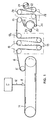
- cellulose acetate solution from a reservoir 11 is passed through a pipe 12 to a manifold 13 from which it is cast on a polished stainless steel endless belt 14 travelling in the direction shown.
- the belt 14 is enclosed within a housing (not shown) from which solvent evaporated from the cast solution can be recovered.
- the cellulose acetate film 16 formed is stripped from the belt 14.
- the film 16 at this stage is clear and transparent.
- the film 16 is passed around transfer rollers 18 enclosed within a drying oven and as it leaves the last transfer roller 18z it is similar to commercially sold clear cellulose acetate film.
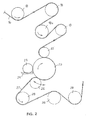
- the film 16 then passes around a counter-balanced tension roller 19 to an embossing cylinder 20, shown in more detail in Figure 2.
- the film 16 passes around a pressure roller 22 which forms a nip with the embossing cylinder 20, rotating in the direction shown.
- a lick roller 23 which rotates in a bath 24 of softening agent, for example acetone solvent, applying a controlled amount of softening agent to the surface of the cylinder 20.
- softening agent for example acetone solvent
- the film 16 is carried around the cylinder 20 in contact with the embossing pattern on its surface until it reaches a stripping roller 26, which does not form a nip with the cylinder 20 but is a swinging roller free to move a short way back and forth around the cylinder 20 in response to changes in tension.
- a stripping roller 26 which does not form a nip with the cylinder 20 but is a swinging roller free to move a short way back and forth around the cylinder 20 in response to changes in tension.
- the film which is now a semi-matt film 27, is lifted off the cylinder and passes to rollers 28, which are enclosed within a drying oven, for hardening the film. After re-drying, the film 27 is wound up on a reel 29.
- the semi-matt plastics film of the invention is particularly suitable for laminating over printed paperboard, with its embossed surface outermost, for use in packaging. It can alternatively be used as a packaging material without lamination or as a label material, for example for pressure-sensitive labels and seals. As well as the distinctive noise which can be used as a security packaging feature as described above, and the ability to generate diffraction patterns when laminated over a reflective layer, the semi-matt plastics film can be written on clearly and easily and is highly resistant to finger marking (much more resistant than the semi-matt film presently sold).
- the pattern on the embossing cylinder 20 comprised rows of circular (frusto-conical) pits each 7 microns deep and 20 microns in diameter at the embossing surface.
- the pits were arranged in rows 40 microns apart in a square pattern.
- the embossing surface of the cylinder is thus the land area between the pits, producing a pattern of raised dots on the film surface.
- the film was re-dried (allowed to harden) to an acetone content of 0.8% by weight before being reeled.
- the resulting semi-matt film had a 60° gloss of 15.
- the film was laminated to paperboard with its embossed surface outermost. The film emitted a characteristic wailing noise of reproduceable pitch when rubbed against itself before and after being laminated and was highly resistant to finger marking.
- Another sample of the embossed film was laminated to metallised paperboard, forming an attractive package material.
- a transparent line grating was placed over the laminated packaging material a distinctive diffraction pattern could be seen. No diffraction pattern was seen when the same line grating was placed over clear film laminated to metallised paperboard or over conventional semi-matt film laminated to metallised paperboard.
Landscapes
- Engineering & Computer Science (AREA)
- Mechanical Engineering (AREA)
- Shaping Of Tube Ends By Bending Or Straightening (AREA)
- Laminated Bodies (AREA)
Claims (29)
- Procédé de préparation d'un produit stratifié comportant une surface qui est très résistante aux marques de doigts, caractérisé en ce qu'un film en matière plastique transparent en condition non durcie est gaufré par un cylindre à gaufrer, puis laissé à durcir, le gaufrage étant fait à une profondeur et à une distance répétée telles que soit le film en matière plastique est capable d'engendrer des motifs de diffraction, soit, si le film en matière plastique est frotté, il émet un bruit de fréquence caractéristique, et le film gaufré durci est stratifié sur du papier ou du carton, sa surface gaufrée constituant la couche extérieure du produit stratifié ainsi obtenu.
- Procédé selon la revendication 1, caractérisé en ce que le film à gaufrer est ramolli par application sur le film d'un solvant ou d'un plastifiant volatil pour la matière plastique.
- Procédé selon la revendication 2, caractérisé en ce que le solvant ou le plastifiant est porté sur la surface du cylindre à gaufrer avant sa mise en contact avec le film, de sorte que le film soit simultanément ramolli et gaufré au moment où il est appuyé contre le cylindre.
- Procédé selon l'une quelconque des revendications 1 à 3, caractérisé en ce que le film en matière plastique transparent est un film coulé.
- Procédé selon la revendication 4, caractérisé en ce que le film en matière plastique transparent est un film d'acétate de cellulose.
- Procédé selon la revendication 1, caractérisé en ce que le film en matière plastique transparent à gaufrer est un film thermoplastique et est ramolli à la chaleur.
- Procédé selon l'une quelconque des revendications 1 à 6, caractérisé en ce que le cylindre à gaufrer possède un motif de gaufrage dont la profondeur est de 1 à 10 microns et dont la distance répétée est de 20 à 260 microns.
- Procédé selon la revendication 7, caractérisé en ce que le motif de gaufrage comprend une série de points en élévation ou de creux circulaires de profondeur 0,5 à 10 microns et de diamètre 20 à 125 microns, placés en lignes distantes de 35 à 260 microns, les points dans chaque ligne étant distants d'une distance centre à centre de 35 à 260 microns.
- Procédé selon l'une quelconque des revendications 1 à 8, caractérisé en ce que le motif sur le cylindre à gaufrer est formé par gravure au laser commandée par ordinateur.
- Utilisation d'un film en matière plastique mat ou semi-mat comme couche extérieure d'un emballage stratifié sur des denrées emballées, caractérisée en ce que le film a un motif gaufré régulier de profondeur 0,5 à 10 microns et une distance répétée de 20 à 400 microns, dans laquelle ou bien la régularité du motif gaufré est telle que, si le film en matière plastique est frotté, il émet un bruit de fréquence caractéristique, ou bien la régularité du motif gaufré est suffisante pour que le film gaufré soit capable d'engendrer un motif de diffraction.
- Utilisation selon la revendication 10, caractérisée en ce que la régularité du motif gaufré est telle que, si le film en matière plastique est frotté, il émet un bruit de fréquence caractéristique et des zones spécifiques du film portent un motif de gaufrage différent ou bien ne sont pas gaufrées pour que ces zones spécifiques forment un attribut décoratif ou une marque de sécurité.
- Utilisation selon la revendication 10, caractérisée en ce que la régularité du motif gaufré est suffisante pour que le film gaufré soit capable d'engendrer un motif de diffraction et une seule surface du film est gaufrée, la surface opposée du film étant métallisée.
- Utilisation selon la revendication 10, caractérisée en ce que la régularité du motif gaufré est suffisante pour que le film gaufré soit capable d'engendrer un motif de diffraction et l'emballage stratifié contient une couche réfléchissante visible à travers le film.
- Utilisation selon l'une quelconque des revendications 10 à 13, caractérisée en ce que la matière plastique est de l'acétate de cellulose.
- Utilisation selon l'une quelconque des revendications 10 à 14, caractérisée en ce que le motif gaufré régulier comprend une série de points en élévation ou de creux circulaires de profondeur 0,5 à 10 microns et de diamètre 20 à 125 microns, placés en lignes distantes de 35 à 260 microns, les points dans chaque ligne étant distants d'une distance centre à centre de 35 à 260 microns.
- Produit stratifié comprend un film en matière plastique stratifié sur un substrat en papier ou en carton, caractérisé en ce que le film possède un motif gaufré dont la profondeur est de 0,5 à 10 microns et dont la distance répétée centre à centre est de 20 à 400 microns et est stratifié sur le substrat de manière que sa surface gaufrée soit la couche extérieure du produit stratifié ainsi obtenu, de telle sorte que, si le film en matière plastique est frotté, il émette un bruit de fréquence caractéristique, et que le produit stratifié soit très résistant aux marques de doigts.
- Produit stratifié selon la revendication 16, caractérisé en ce que la matière plastique est de l'acétate de cellulose.
- Produit stratifié selon la revendication 16 ou la revendication 17, caractérisé en ce que le motif gaufré comprend une série régulière de points en élévation ou de creux circulaires de profondeur 0,5 à 10 microns et de diamètre 20 à 125 microns, placés en lignes distantes de 35 à 260 microns, les points dans chaque ligne étant distants d'une distance centre à centre de 35 à 260 microns.
- Procédé selon la revendication 1 pour la préparation d'un produit stratifié qui est très résistant aux marques de doigts, caractérisé en ce qu'un film en matière plastique transparent est ramolli par de la chaleur et le film ramolli est gaufré au moyen d'un cylindre à gaufrer, le gaufrage étant à motif régulier de profondeur 0,5 à 10 microns et de distance répétée 20 à 400 microns, le film ramolli gaufré est laissé à durcir, moyennant quoi le film gaufré durci est capable d'émettre un bruit de fréquence caractéristique lorsque le film est frotté contre lui-même et le film gaufré durci est très résistant aux marques de doigts, et le film gaufré durci ayant une surface semi-mate est stratifié sur du papier ou du carton de manière que sa surface semi-mate gaufrée soit la couche extérieure du produit stratifié ainsi obtenu.
- Procédé de préparation d'un film en matière plastique mat ou semi-mat, caractérisé en ce que le film en matière plastique transparent est ramolli par application sur le film d'un solvant ou d'un plastifiant volatil pour la matière plastique et est gaufré par un cylindre à gaufrer, puis laissé à durcir, le gaufrage étant fait selon un motif ayant une profondeur, une distance répétée et une régularité telles que le film en matière plastique gaufré soit capable d'engendrer des motifs de diffraction et/ou que, si le film en matière plastique est frotté, il émette un bruit de fréquence caractéristique.
- Procédé selon la revendication 20, caractérisé en ce que le solvant ou le plastifiant est porté sur la surface du cylindre à gaufrer avant sa mise en contact avec le film, de sorte que le film soit simultanément ramolli et gaufré au moment où il est appuyé contre le cylindre.
- Procédé selon la revendication 20 ou la revendication 21, caractérisé en ce que le film en matière plastique transparent est un film coulé.
- Procédé selon la revendication 22, caractérisé en ce que le film en matière plastique transparent est un film d'acétate de cellulose.
- Procédé selon l'une quelconque des revendications 20 à 23, caractérisé en ce que le cylindre à gaufrer a un motif de gaufrage régulier comprenant des points en élévation ou des cratères de profondeur 1 à 10 microns et de diamètre 20 à 125 microns, placés en lignes distantes de 35 à 260 microns, les points ou les cratères dans chaque ligne étant distants d'une distance centre à centre de 35 à 260 microns.
- Procédé selon l'une quelconque des revendications 20 à 24, caractérisé en ce que le motif régulier sur le cylindre de gaufrage est formé par gravure au laser commandée par ordinateur.
- Procédé pour tester l'authenticité de denrées emballées, soit caractérisé en ce que les denrées sont emballées dans un matériau d'emballage stratifié comportant un film en matière plastique mat ou semi-mat comme couche extérieure, le film ayant un motif gaufré régulier de profondeur 0,5 à 10 microns et de distance répétée 20 à 400 microns, et la régularité du motif gaufré étant telle que, si le film en matière plastique est frotté, il émette un bruit de fréquence caractéristique, et l'emballage est frotté pour tester s'il émet le bruit de fréquence caractéristique, soit caractérisé en ce que les denrées sont emballées dans un matériau d'emballage stratifié comprenant une couche réfléchissante et un film en matière plastique mat ou semi-mat à l'extérieur de la couche réfléchissante, le film ayant un motif gaufré régulier de profondeur 0,5 à 10 microns et de distance répétée 20 à 400 microns, et la régularité du motif gaufré étant suffisante pour que le film gaufré soit capable d'engendrer un motif de diffraction, et un matériau transparent à motif ayant un motif formé de lignes rapprochées est placé par dessus l'emballage dans le but d'observer si un motif de diffraction caractéristique du film en matière plastique et du matériau transparent à motifs est visible.
- Procédé selon la revendication 26, caractérisé en ce que le matériau d'emballage stratifié comprend une couche de carton essentiellement rigide.
- Procédé selon la revendication 26, caractérisé en ce que le matériau d'emballage stratifié comprend une couche réfléchissante comprenant une métallisation sur la surface du film opposée à la surface gaufrée.
- Procédé selon la revendication 26, caractérisé en ce que le matériau d'emballage stratifié comprend une couche réfléchissante comprenant du carton métallisé ou une feuille métallique stratifiée sur du carton.
Applications Claiming Priority (2)
| Application Number | Priority Date | Filing Date | Title |
|---|---|---|---|
| GB9607203A GB2311752B (en) | 1996-04-04 | 1996-04-04 | Production and use of plastics film |
| GB9607203 | 1996-04-04 |
Publications (2)
| Publication Number | Publication Date |
|---|---|
| EP0802069A1 EP0802069A1 (fr) | 1997-10-22 |
| EP0802069B1 true EP0802069B1 (fr) | 2003-11-26 |
Family
ID=10791669
Family Applications (1)
| Application Number | Title | Priority Date | Filing Date |
|---|---|---|---|
| EP19970302278 Expired - Lifetime EP0802069B1 (fr) | 1996-04-04 | 1997-04-03 | Film plastique et sa fabrication |
Country Status (4)
| Country | Link |
|---|---|
| EP (1) | EP0802069B1 (fr) |
| DE (1) | DE69726333T2 (fr) |
| ES (1) | ES2212045T3 (fr) |
| GB (2) | GB2343863B (fr) |
Families Citing this family (5)
| Publication number | Priority date | Publication date | Assignee | Title |
|---|---|---|---|---|
| GB2339784A (en) * | 1998-07-21 | 2000-02-09 | Courtaulds Chemicals | Plastics film; identifying goods |
| US6537407B1 (en) | 2000-09-06 | 2003-03-25 | Acordis Acetate Chemicals Limited | Process for the manufacture of an improved laminated material |
| SE541112C2 (en) * | 2016-12-16 | 2019-04-09 | Stora Enso Oyj | Product having micropattern and process for production of said product |
| US12128661B2 (en) | 2020-07-16 | 2024-10-29 | Bixby International Corporation | Micro embossing |
| FI20236374A1 (en) * | 2023-12-14 | 2025-06-15 | Teknologian Tutkimuskeskus Vtt Oy | Moulding of regenerated cellulose films into shaped structures |
Family Cites Families (9)
| Publication number | Priority date | Publication date | Assignee | Title |
|---|---|---|---|---|
| DE1234005B (de) * | 1962-08-20 | 1967-02-09 | Du Pont | Durchsichtige Folie mit guten Gleiteigenschaften |
| US3501363A (en) * | 1966-01-14 | 1970-03-17 | Union Carbide Corp | Packaging film |
| CA1052968A (fr) * | 1974-02-21 | 1979-04-24 | James K. Rutherfoord | Materiau thermoplastique repousse |
| GB1572193A (en) * | 1974-12-13 | 1980-07-23 | Microsonics Corp | Microphonograph records |
| US4376147A (en) * | 1981-08-31 | 1983-03-08 | Clopay Corporation | Plastic film having a matte finish |
| BR8807319A (pt) * | 1987-10-26 | 1990-03-27 | Dennison Mfg Co | Processo de decoracao de banda |
| US5316825A (en) * | 1991-06-19 | 1994-05-31 | Mitsubishi Kasei Vinyl Company | Anti-fogging film made of a transparent synthetic resin |
| JP3225380B2 (ja) * | 1992-08-11 | 2001-11-05 | コニカ株式会社 | プリント写真の樹脂保護膜及びそれを用いた画像形成方法 |
| EP0604865A1 (fr) * | 1992-12-22 | 1994-07-06 | Hoechst Celanese Corporation | Films à cristaux liquides à surface rugueuse et procédé de production |
-
1996
- 1996-04-04 GB GB0004687A patent/GB2343863B/en not_active Revoked
- 1996-04-04 GB GB9607203A patent/GB2311752B/en not_active Revoked
-
1997
- 1997-04-03 DE DE69726333T patent/DE69726333T2/de not_active Expired - Lifetime
- 1997-04-03 EP EP19970302278 patent/EP0802069B1/fr not_active Expired - Lifetime
- 1997-04-03 ES ES97302278T patent/ES2212045T3/es not_active Expired - Lifetime
Also Published As
| Publication number | Publication date |
|---|---|
| EP0802069A1 (fr) | 1997-10-22 |
| ES2212045T3 (es) | 2004-07-16 |
| DE69726333T2 (de) | 2004-09-23 |
| DE69726333D1 (de) | 2004-01-08 |
| GB9607203D0 (en) | 1996-06-12 |
| GB2343863A (en) | 2000-05-24 |
| GB2343863B (en) | 2000-10-18 |
| GB0004687D0 (en) | 2000-04-19 |
| GB2311752B (en) | 2000-09-13 |
| GB2311752A (en) | 1997-10-08 |
Similar Documents
| Publication | Publication Date | Title |
|---|---|---|
| US5164227A (en) | Method for embossing a coated sheet with a diffraction or holographic pattern | |
| CA1324869C (fr) | Mode de production de motifs de finition sur des panneaux de papier ou de plastique | |
| CA2209852C (fr) | Substrat gauffre, dispositif photorecepteur le comprenant et procede d'utilisation | |
| US5464690A (en) | Holographic document and method for forming | |
| US2477300A (en) | Decorative shelf edging | |
| EP0194042A2 (fr) | Articles pourvus d'un marquage en relief | |
| RU2009112394A (ru) | Защитные изделия и устройства, содержащие кодированные голографические микропластины, и способы их изготовления | |
| CA2283766A1 (fr) | Procede de production de motifs en relief a diffraction de la lumiere | |
| US6949290B2 (en) | Producing a textured effect in a plastic film, and plastic films having a relief pattern made by this method | |
| EP0802069B1 (fr) | Film plastique et sa fabrication | |
| US5968636A (en) | Laminate for forming carton blanks | |
| WO1993008084A1 (fr) | Materiau d'emballage avec dessin holographique | |
| KR100939056B1 (ko) | 제품 포장용 박(箔) 및 그의 제조방법 | |
| US4272564A (en) | Flexible reflex-reflective article having undulant surface and method of making the same | |
| JP2002072887A (ja) | 偽造防止ラベル | |
| JP2908467B2 (ja) | インモールド転写シート及びその製造方法 | |
| RU97121833A (ru) | Способ лазерной маркировки | |
| JPH072372B2 (ja) | 凹凸模様を有するプラスチック容器の製造方法 | |
| US20120132351A1 (en) | Method for creating a diffractive optical effect on a target surface and a transfer foil of a diffractive optical element | |
| EP1511635A2 (fr) | Element d'image de securite comprenant au moins deux feuilles | |
| NL8901287A (nl) | Kunststoffoelie voorzien van een teken of dessin, werkwijze voor het aanbrengen van een teken of dessin in een kunststoffoelie, alsmede daarvoor geschikt sjabloon. | |
| JPH0738934Y2 (ja) | 浮出し印刷物 | |
| JPH04113881A (ja) | 転写化粧板の製造方法 | |
| JPH0745256B2 (ja) | 印刷物 | |
| JPH028570B2 (fr) |
Legal Events
| Date | Code | Title | Description |
|---|---|---|---|
| PUAI | Public reference made under article 153(3) epc to a published international application that has entered the european phase |
Free format text: ORIGINAL CODE: 0009012 |
|
| AK | Designated contracting states |
Kind code of ref document: A1 Designated state(s): DE ES FR GB IT |
|
| 17P | Request for examination filed |
Effective date: 19980223 |
|
| 17Q | First examination report despatched |
Effective date: 19981203 |
|
| RAP1 | Party data changed (applicant data changed or rights of an application transferred) |
Owner name: ACORDIS ACETATE CHEMICALS LIMITED |
|
| GRAH | Despatch of communication of intention to grant a patent |
Free format text: ORIGINAL CODE: EPIDOS IGRA |
|
| GRAS | Grant fee paid |
Free format text: ORIGINAL CODE: EPIDOSNIGR3 |
|
| GRAA | (expected) grant |
Free format text: ORIGINAL CODE: 0009210 |
|
| AK | Designated contracting states |
Kind code of ref document: B1 Designated state(s): DE ES FR GB IT |
|
| REG | Reference to a national code |
Ref country code: GB Ref legal event code: FG4D |
|
| REF | Corresponds to: |
Ref document number: 69726333 Country of ref document: DE Date of ref document: 20040108 Kind code of ref document: P |
|
| RAP2 | Party data changed (patent owner data changed or rights of a patent transferred) |
Owner name: ACETATE PRODUCTS LIMITED |
|
| REG | Reference to a national code |
Ref country code: ES Ref legal event code: FG2A Ref document number: 2212045 Country of ref document: ES Kind code of ref document: T3 |
|
| ET | Fr: translation filed | ||
| PLBE | No opposition filed within time limit |
Free format text: ORIGINAL CODE: 0009261 |
|
| STAA | Information on the status of an ep patent application or granted ep patent |
Free format text: STATUS: NO OPPOSITION FILED WITHIN TIME LIMIT |
|
| 26N | No opposition filed |
Effective date: 20040827 |
|
| PGFP | Annual fee paid to national office [announced via postgrant information from national office to epo] |
Ref country code: IT Payment date: 20060430 Year of fee payment: 10 |
|
| PG25 | Lapsed in a contracting state [announced via postgrant information from national office to epo] |
Ref country code: IT Free format text: LAPSE BECAUSE OF NON-PAYMENT OF DUE FEES Effective date: 20070403 |
|
| REG | Reference to a national code |
Ref country code: FR Ref legal event code: PLFP Year of fee payment: 19 |
|
| PGFP | Annual fee paid to national office [announced via postgrant information from national office to epo] |
Ref country code: ES Payment date: 20150310 Year of fee payment: 19 |
|
| PGFP | Annual fee paid to national office [announced via postgrant information from national office to epo] |
Ref country code: GB Payment date: 20150401 Year of fee payment: 19 Ref country code: DE Payment date: 20150331 Year of fee payment: 19 |
|
| PGFP | Annual fee paid to national office [announced via postgrant information from national office to epo] |
Ref country code: FR Payment date: 20150408 Year of fee payment: 19 |
|
| REG | Reference to a national code |
Ref country code: DE Ref legal event code: R119 Ref document number: 69726333 Country of ref document: DE |
|
| GBPC | Gb: european patent ceased through non-payment of renewal fee |
Effective date: 20160403 |
|
| REG | Reference to a national code |
Ref country code: FR Ref legal event code: ST Effective date: 20161230 |
|
| PG25 | Lapsed in a contracting state [announced via postgrant information from national office to epo] |
Ref country code: GB Free format text: LAPSE BECAUSE OF NON-PAYMENT OF DUE FEES Effective date: 20160403 Ref country code: DE Free format text: LAPSE BECAUSE OF NON-PAYMENT OF DUE FEES Effective date: 20161101 Ref country code: FR Free format text: LAPSE BECAUSE OF NON-PAYMENT OF DUE FEES Effective date: 20160502 |
|
| REG | Reference to a national code |
Ref country code: ES Ref legal event code: FD2A Effective date: 20180507 |
|
| PG25 | Lapsed in a contracting state [announced via postgrant information from national office to epo] |
Ref country code: ES Free format text: LAPSE BECAUSE OF NON-PAYMENT OF DUE FEES Effective date: 20160404 |