EP0802158A2 - Oxydes et leur procédé de préparation - Google Patents
Oxydes et leur procédé de préparation Download PDFInfo
- Publication number
- EP0802158A2 EP0802158A2 EP97104688A EP97104688A EP0802158A2 EP 0802158 A2 EP0802158 A2 EP 0802158A2 EP 97104688 A EP97104688 A EP 97104688A EP 97104688 A EP97104688 A EP 97104688A EP 0802158 A2 EP0802158 A2 EP 0802158A2
- Authority
- EP
- European Patent Office
- Prior art keywords
- oxides
- flame
- volatile
- oxygen
- mixture
- Prior art date
- Legal status (The legal status is an assumption and is not a legal conclusion. Google has not performed a legal analysis and makes no representation as to the accuracy of the status listed.)
- Withdrawn
Links
Images

Classifications
-
- C—CHEMISTRY; METALLURGY
- C01—INORGANIC CHEMISTRY
- C01B—NON-METALLIC ELEMENTS; COMPOUNDS THEREOF; METALLOIDS OR COMPOUNDS THEREOF NOT COVERED BY SUBCLASS C01C
- C01B33/00—Silicon; Compounds thereof
- C01B33/113—Silicon oxides; Hydrates thereof
- C01B33/12—Silica; Hydrates thereof, e.g. lepidoic silicic acid
- C01B33/18—Preparation of finely divided silica neither in sol nor in gel form; After-treatment thereof
-
- C—CHEMISTRY; METALLURGY
- C01—INORGANIC CHEMISTRY
- C01B—NON-METALLIC ELEMENTS; COMPOUNDS THEREOF; METALLOIDS OR COMPOUNDS THEREOF NOT COVERED BY SUBCLASS C01C
- C01B13/00—Oxygen; Ozone; Oxides or hydroxides in general
- C01B13/14—Methods for preparing oxides or hydroxides in general
- C01B13/20—Methods for preparing oxides or hydroxides in general by oxidation of elements in the gaseous state; by oxidation or hydrolysis of compounds in the gaseous state
-
- C—CHEMISTRY; METALLURGY
- C01—INORGANIC CHEMISTRY
- C01B—NON-METALLIC ELEMENTS; COMPOUNDS THEREOF; METALLOIDS OR COMPOUNDS THEREOF NOT COVERED BY SUBCLASS C01C
- C01B13/00—Oxygen; Ozone; Oxides or hydroxides in general
- C01B13/14—Methods for preparing oxides or hydroxides in general
- C01B13/20—Methods for preparing oxides or hydroxides in general by oxidation of elements in the gaseous state; by oxidation or hydrolysis of compounds in the gaseous state
- C01B13/22—Methods for preparing oxides or hydroxides in general by oxidation of elements in the gaseous state; by oxidation or hydrolysis of compounds in the gaseous state of halides or oxyhalides
- C01B13/28—Methods for preparing oxides or hydroxides in general by oxidation of elements in the gaseous state; by oxidation or hydrolysis of compounds in the gaseous state of halides or oxyhalides using a plasma or an electric discharge
-
- C—CHEMISTRY; METALLURGY
- C01—INORGANIC CHEMISTRY
- C01F—COMPOUNDS OF THE METALS BERYLLIUM, MAGNESIUM, ALUMINIUM, CALCIUM, STRONTIUM, BARIUM, RADIUM, THORIUM, OR OF THE RARE-EARTH METALS
- C01F7/00—Compounds of aluminium
- C01F7/02—Aluminium oxide; Aluminium hydroxide; Aluminates
- C01F7/30—Preparation of aluminium oxide or hydroxide by thermal decomposition or by hydrolysis or oxidation of aluminium compounds
- C01F7/302—Hydrolysis or oxidation of gaseous aluminium compounds in the gaseous phase
-
- C—CHEMISTRY; METALLURGY
- C01—INORGANIC CHEMISTRY
- C01G—COMPOUNDS CONTAINING METALS NOT COVERED BY SUBCLASSES C01D OR C01F
- C01G23/00—Compounds of titanium
- C01G23/04—Oxides; Hydroxides
- C01G23/047—Titanium dioxide
- C01G23/07—Producing by vapour phase processes, e.g. halide oxidation
-
- C—CHEMISTRY; METALLURGY
- C09—DYES; PAINTS; POLISHES; NATURAL RESINS; ADHESIVES; COMPOSITIONS NOT OTHERWISE PROVIDED FOR; APPLICATIONS OF MATERIALS NOT OTHERWISE PROVIDED FOR
- C09D—COATING COMPOSITIONS, e.g. PAINTS, VARNISHES OR LACQUERS; FILLING PASTES; CHEMICAL PAINT OR INK REMOVERS; INKS; CORRECTING FLUIDS; WOODSTAINS; PASTES OR SOLIDS FOR COLOURING OR PRINTING; USE OF MATERIALS THEREFOR
- C09D7/00—Features of coating compositions, not provided for in group C09D5/00; Processes for incorporating ingredients in coating compositions
- C09D7/40—Additives
- C09D7/43—Thickening agents
-
- C—CHEMISTRY; METALLURGY
- C01—INORGANIC CHEMISTRY
- C01P—INDEXING SCHEME RELATING TO STRUCTURAL AND PHYSICAL ASPECTS OF SOLID INORGANIC COMPOUNDS
- C01P2004/00—Particle morphology
- C01P2004/01—Particle morphology depicted by an image
- C01P2004/04—Particle morphology depicted by an image obtained by TEM, STEM, STM or AFM
-
- C—CHEMISTRY; METALLURGY
- C01—INORGANIC CHEMISTRY
- C01P—INDEXING SCHEME RELATING TO STRUCTURAL AND PHYSICAL ASPECTS OF SOLID INORGANIC COMPOUNDS
- C01P2004/00—Particle morphology
- C01P2004/60—Particles characterised by their size
- C01P2004/62—Submicrometer sized, i.e. from 0.1-1 micrometer
-
- C—CHEMISTRY; METALLURGY
- C01—INORGANIC CHEMISTRY
- C01P—INDEXING SCHEME RELATING TO STRUCTURAL AND PHYSICAL ASPECTS OF SOLID INORGANIC COMPOUNDS
- C01P2004/00—Particle morphology
- C01P2004/90—Other morphology not specified above
-
- C—CHEMISTRY; METALLURGY
- C01—INORGANIC CHEMISTRY
- C01P—INDEXING SCHEME RELATING TO STRUCTURAL AND PHYSICAL ASPECTS OF SOLID INORGANIC COMPOUNDS
- C01P2006/00—Physical properties of inorganic compounds
- C01P2006/11—Powder tap density
-
- C—CHEMISTRY; METALLURGY
- C01—INORGANIC CHEMISTRY
- C01P—INDEXING SCHEME RELATING TO STRUCTURAL AND PHYSICAL ASPECTS OF SOLID INORGANIC COMPOUNDS
- C01P2006/00—Physical properties of inorganic compounds
- C01P2006/12—Surface area
-
- C—CHEMISTRY; METALLURGY
- C01—INORGANIC CHEMISTRY
- C01P—INDEXING SCHEME RELATING TO STRUCTURAL AND PHYSICAL ASPECTS OF SOLID INORGANIC COMPOUNDS
- C01P2006/00—Physical properties of inorganic compounds
- C01P2006/22—Rheological behaviour as dispersion, e.g. viscosity, sedimentation stability
-
- C—CHEMISTRY; METALLURGY
- C01—INORGANIC CHEMISTRY
- C01P—INDEXING SCHEME RELATING TO STRUCTURAL AND PHYSICAL ASPECTS OF SOLID INORGANIC COMPOUNDS
- C01P2006/00—Physical properties of inorganic compounds
- C01P2006/60—Optical properties, e.g. expressed in CIELAB-values
-
- C—CHEMISTRY; METALLURGY
- C01—INORGANIC CHEMISTRY
- C01P—INDEXING SCHEME RELATING TO STRUCTURAL AND PHYSICAL ASPECTS OF SOLID INORGANIC COMPOUNDS
- C01P2006/00—Physical properties of inorganic compounds
- C01P2006/90—Other properties not specified above
-
- C—CHEMISTRY; METALLURGY
- C08—ORGANIC MACROMOLECULAR COMPOUNDS; THEIR PREPARATION OR CHEMICAL WORKING-UP; COMPOSITIONS BASED THEREON
- C08K—Use of inorganic or non-macromolecular organic substances as compounding ingredients
- C08K3/00—Use of inorganic substances as compounding ingredients
- C08K3/18—Oxygen-containing compounds, e.g. metal carbonyls
- C08K3/20—Oxides; Hydroxides
- C08K3/22—Oxides; Hydroxides of metals
Definitions
- the invention relates to oxides, a process for the preparation of the oxides and their use.
- the oxide particles primarily produced by the known methods have an average particle size in the nanometer range. They agglomerate due to the collision of the existing primary particles into secondary structures and are characterized by low bulk densities. The agglomeration of the primary particles and thus the structure of the secondary particles is essentially determined by the substance-specific and also temperature-dependent diffusion of the primary particles.
- the value of A circle / A object can be in the range between 8 and 12 and the value of the derivative length in the range between 10 and 20.
- the oxides according to the invention can be produced, for example, by flame hydrolysis of the compounds titanium tetrachloride, aluminum trichloride, evaporable boron compounds or silicon tetrachloride.
- the corresponding mixed oxides can be prepared by simultaneously hydrolyzing various volatile compounds.
- the invention relates to a process for the preparation of the oxides by hydrolytic conversion of volatile metal and / or metalloid compounds in a flame, the volatile compounds being fed to the flame individually or mixed in a mixture with gases and oxygen which burn with the formation of water, such quantities of oxygen and combustible gas, that the oxygen content of the mixture is at least sufficient to completely burn the combustible gas and that the water thus formed is at least sufficient for hydrolysis of the volatile compound, be mixed homogeneously with the volatile compound and the mixture is then in a laminar or turbulent flow to and in the flame is implemented in this, which is characterized in that externally induced electrical forces are allowed to act during the flame hydrolysis.
- externally induced electrical forces can be allowed to act on the oxide particles formed during the cooling phase.
- externally induced electrical forces can be applied at any point in the laminar or turbulent flow before, during and / or after the formation of the oxide particles.
- Titanium tetrachloride aluminum trichloride, volatile volatile boron compounds such as boron halides or boric acid esters.
- titanium tetrachloride can be used as the volatile metal compound, a titanium dioxide being produced.
- Silicon tetrachloride organic silicon compounds, organosilicon halogen compounds.
- the volatile metal compounds and / or volatile metalloid compounds can also be used in any mixture can be used.
- the oxides obtained then represent mixed oxides.
- Hydrogen, low-boiling alkanes such as methane, ethane, mixture of H 2 and CO.
- the externally induced electrical forces can be generated using the method described in document DE-A 44 00 827 and the device also described in this document DE-A 44 00 827.
- the laminar or turbulent flow which may contain primary particles that have already been generated, is conducted through a closed flow channel.
- an electric field which is suitable for ionizing the gas flowing through the flow channel, is coupled into the flow channel by means of at least one pair of electrodes.
- the electrodes of each pair of electrodes lie opposite each other in the flow channel and can preferably be needle-shaped.
- the electrodes are floating.
- the gas is ionized between electrodes of opposite polarity.
- the agglomeration of the oxide particles formed in the flow channel can take place in areas without an external electric field.
- an external electric field can also be allowed to act during the agglomeration of the oxide particles formed.
- the method according to the invention can preferably be carried out in a device which has the following features:
- Electrodes are insulated from the wall of the flow channel and are additionally connected floating and the corona discharge takes place between electrodes of opposite polarity.
- the method according to the invention can also be used to apply nanoscale metal (oxide?) Particles to the surface of the oxide particles.
- the metal particles are applied by corona discharge to at least one metal electrode which is switched to direct or alternating current potential.
- the particle charging by means of corona discharge is based on the following physical processes:
- the field charge in which the charge carriers drift onto the particles under the effect of the electric field
- the diffusion charge in which the thermally diffusive movement of the charge carriers and particles is decisive for the collision.
- Diffusion charging in which the presence of external electric fields is of secondary importance for charging the particles, dominates in the particle size range below 1.0 ⁇ m which is relevant according to the invention. It follows that the spray electrode is only used to release charge carriers during conditioning during the implementation of the method according to the invention.
- the polarity of the resulting particle charge can be adjusted by varying the electrical potential of the electrodes.
- Two needle-shaped metallic wires which face each other centrally, are used as spray electrodes.
- the needle electrodes are each separately connected to a DC high-voltage power supply unit with positive (U + ) or negative polarity (U - ). If the corona threshold voltage is exceeded, a macroscopically stable corona discharge occurs at the tips of the electrodes.
- symmetrical bipolar wiring potential ratio U + /
- 1
- are negatively charged particles present in the gas space.
- the needle electrodes During the corona discharge, the needle electrodes emit finely dispersed electrode material in addition to ions and free electrons.
- This material which is emitted by the electrodes in the form of nanoscale, electrically charged particles, is immediately deposited on the due to strong, attractive electrical interactions particles present in the flame according to the invention.
- the amount of material emitted depends on the physical properties of the electrode, in particular on its melting point. It is assumed that metals with a low melting point emit more substance than metals with a high melting point The electrode material can thus be influenced in a targeted manner in the amount of electrodes and substance emitted.
- the electrical conditioning by means of corona discharge therefore affects not only the structure of the aggregate but also, to a small extent, the chemical composition of the product.
- the oxides produced according to the invention such as titanium dioxide, have an improved thickening effect.
- Another object of the invention is the use of the oxides according to the invention as thickeners in liquid or pasty systems, such as, for example, paints.
- titanium tetrachloride can be used as the volatile metal compound, a titanium dioxide being produced.
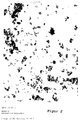
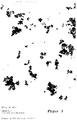
- Another object of the invention is a titanium dioxide, produced by flame hydrolysis, which is characterized in that the structural parameters according to Schulz et al., Published in A new method of agglomerate characterization by image analysis "on PARTEC '95 - 6 th European Symposium Particle Characterization 21 - 23 March 1995, Nuremberg, the following values:
- the value of A circle / A object can be in the range between 8 and 12 and the value of the derivative length in the range between 10 and 20.
- the titanium dioxide can have a Berger whiteness of greater than 93.
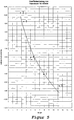
- the surface charge of a 20% aqueous suspension of the titanium dioxide can be determined at pH 3 to be more than 6 C / g and at pH 10 to be less than -5 C / g.
- the viscosity of a 10% aqueous suspension of the titanium dioxide according to the invention can be greater than 5 mPas, preferably greater than 10 mPas.
- the titanium dioxide according to the invention can be doped with very finely divided electrode material and / or its oxides.
- the OH group density on the particle surface of the titanium dioxide according to the invention can be changed compared to the known, pyrogenically produced titanium dioxide.
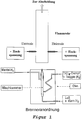
- FIG. 1 Burner arrangement
- the burner is located in a heated part of the furnace, the temperature of the furnace corresponds approximately to the outflow temperature of the gas mixture.
- the burner consists of a mixing chamber to which a nozzle, from which the gas mixture flows, is connected, as well as a second (jacket) nozzle which is ring-shaped around this nozzle and from which, in order to avoid caking (in the nozzle area), an additional (jacket) Hydrogen is blown into the flame.
- the gas mixture flows out of the nozzle opening of the burner at a speed of 31.27 m / sec (based on standard conditions) and burns in a reaction chamber (flame tube).
- the temperature of the gas mixture (TiCl 4 -air-hydrogen, oxygen) is measured at the burner mouth; it is 155 ° C. 0.1 Nm 3 / h of hydrogen (jacket hydrogen, room temperature) are fed into the ring nozzle surrounding the burner mouth.
- the reaction gases and the titanium oxide are sucked through a cooling system by applying a vacuum and thereby cooled to approx. 100 to 160 ° C.
- a filter the solid is removed from the Exhaust gas flow separated.
- the titanium oxide is obtained as a fine white powder.
- the gas mixture flows out of the nozzle opening of the burner at a speed of 31.27 m / sec (based on standard conditions) and burns in a reaction chamber (flame tube).
- the temperature of the gas mixture (TiCl 4 -air-hydrogen, oxygen) is measured at the burner mouth; it is 155 ° C. 0.1 Nm 3 / h of hydrogen (jacket hydrogen, room temperature) are fed into the ring nozzle surrounding the burner mouth.
- a pair of needle electrodes (electrode material: tungsten) is positioned 55 mm above the burner mouth perpendicular to the main flow direction. The distance between the needle tips is 30 mm.
- the potential of the negative electrode is -24,000 V, that of the positive +1,000 V.
- the current is in the range between 0.04 mA and 0.08 mA.
- the reaction gases and the titanium oxide are sucked through a cooling system by applying a negative pressure and thereby cooled to approx. 100 to 160 ° C.
- the solid is separated from the exhaust gas stream in a filter.
- the titanium oxide is obtained as a fine white powder.
- Approx. 3 to 5 g of pyrogenic oxide are sieved directly into a wide-mouth polyethylene bottle (250 ml) using a 0.5 mm sieve with the aid of a powder funnel. If the charge is too high, the sample is left to stand for about 30 minutes. The sample is then homogenized by shaking by hand (30 seconds, the polyethylene bottle is at most half full at the beginning).
- the pyrogenic oxide is allowed to flow freely into the glass cuvette. An exact mass cannot be observed. The amount added should be such that the cuvette would be approximately full after leveling (which is not carried out) the surface.
- the sample is then measured immediately: multiple measurement: 10, after five measurements the sample is rotated further by approx. 90 °.
- the mean is shown with one decimal.
- the sample is stamped 10 times in the glass cuvette by tapping it lightly by hand (underlay: tissue cloth Lifting height: 2-3 cm "). The sample is then measured as described for hydrophobic products.
- the Sears number corresponds to the consumption of 0.1 N NaOH, which is required to adjust a defined suspension of pyrogenic oxides from pH 4 to pH 9.
- a further 25 g of sodium chloride are added to this suspension. Water is pumped through the double jacket of the titration vessel at 25 ° C. In the actual titration that follows, 0.1 N sodium hydroxide solution is first added in rapid succession of drops and towards the end of the titration until the pH value of 9 is reached.
- the Sears number (pH 4 after pH 9) corresponds to the consumption of 0.1 N NaOH / sample within the specified range of the pH value.
- the particle charge detector PCD-03 pH from Mütek is used to detect the charge neutral point.
- the amount of surface charge is given in C / g dry matter.
Landscapes
- Chemical & Material Sciences (AREA)
- Organic Chemistry (AREA)
- Inorganic Chemistry (AREA)
- Life Sciences & Earth Sciences (AREA)
- Engineering & Computer Science (AREA)
- Geology (AREA)
- Physics & Mathematics (AREA)
- Materials Engineering (AREA)
- Wood Science & Technology (AREA)
- Thermal Sciences (AREA)
- Plasma & Fusion (AREA)
- Environmental & Geological Engineering (AREA)
- General Life Sciences & Earth Sciences (AREA)
- Inorganic Compounds Of Heavy Metals (AREA)
- Oxygen, Ozone, And Oxides In General (AREA)
- Physical Or Chemical Processes And Apparatus (AREA)
- Paints Or Removers (AREA)
Applications Claiming Priority (2)
| Application Number | Priority Date | Filing Date | Title |
|---|---|---|---|
| DE19615111 | 1996-04-17 | ||
| DE19615111A DE19615111A1 (de) | 1996-04-17 | 1996-04-17 | Oxide |
Publications (2)
| Publication Number | Publication Date |
|---|---|
| EP0802158A2 true EP0802158A2 (fr) | 1997-10-22 |
| EP0802158A3 EP0802158A3 (fr) | 1998-08-19 |
Family
ID=7791498
Family Applications (1)
| Application Number | Title | Priority Date | Filing Date |
|---|---|---|---|
| EP97104688A Withdrawn EP0802158A3 (fr) | 1996-04-17 | 1997-03-19 | Oxydes et leur procédé de préparation |
Country Status (3)
| Country | Link |
|---|---|
| EP (1) | EP0802158A3 (fr) |
| JP (1) | JPH1045402A (fr) |
| DE (1) | DE19615111A1 (fr) |
Cited By (3)
| Publication number | Priority date | Publication date | Assignee | Title |
|---|---|---|---|---|
| EP1083151A1 (fr) * | 1999-09-10 | 2001-03-14 | Degussa-Hüls Aktiengesellschaft | Alumine préparé par voie pyrogenique |
| WO2005054136A1 (fr) * | 2003-12-03 | 2005-06-16 | Degussa Ag | Poudre de dioxyde de titane obtenue par hydrolyse a la flamme |
| EP1448478A4 (fr) * | 2001-10-01 | 2006-02-08 | Nanogram Corp | Poudres d'oxyde d'aluminium |
Families Citing this family (1)
| Publication number | Priority date | Publication date | Assignee | Title |
|---|---|---|---|---|
| EP2053023A1 (fr) * | 2007-10-23 | 2009-04-29 | Evonik Degussa GmbH | Poudre de bioxyde de zirkonium et dispersion de bioxyde de zirkonium |
Family Cites Families (7)
| Publication number | Priority date | Publication date | Assignee | Title |
|---|---|---|---|---|
| AT195893B (de) * | 1953-12-15 | 1958-02-25 | Degussa | Verfahren zur Herstellung von Mischoxyden |
| BE636306A (fr) * | 1962-09-04 | |||
| GB1111411A (en) * | 1964-06-03 | 1968-04-24 | Laporte Titanium Ltd | Improvements in and relating to the manufacture of titanium dioxide |
| GB1105605A (en) * | 1964-04-29 | 1968-03-06 | British Titan Products | Oxide process |
| NL131994C (fr) * | 1964-10-22 | |||
| DE4400827C1 (de) * | 1994-01-13 | 1995-04-20 | Andreas Dipl Ing Gutsch | Verfahren und Vorrichtung zur elektrisch induzierten Agglomeration gasgetragener Partikeln |
| US5698177A (en) * | 1994-08-31 | 1997-12-16 | University Of Cincinnati | Process for producing ceramic powders, especially titanium dioxide useful as a photocatalyst |
-
1996
- 1996-04-17 DE DE19615111A patent/DE19615111A1/de not_active Ceased
-
1997
- 1997-03-19 EP EP97104688A patent/EP0802158A3/fr not_active Withdrawn
- 1997-04-17 JP JP9099858A patent/JPH1045402A/ja active Pending
Cited By (4)
| Publication number | Priority date | Publication date | Assignee | Title |
|---|---|---|---|---|
| EP1083151A1 (fr) * | 1999-09-10 | 2001-03-14 | Degussa-Hüls Aktiengesellschaft | Alumine préparé par voie pyrogenique |
| EP1448478A4 (fr) * | 2001-10-01 | 2006-02-08 | Nanogram Corp | Poudres d'oxyde d'aluminium |
| WO2005054136A1 (fr) * | 2003-12-03 | 2005-06-16 | Degussa Ag | Poudre de dioxyde de titane obtenue par hydrolyse a la flamme |
| US7686881B2 (en) | 2003-12-03 | 2010-03-30 | Degussa Ag | Flame-hydrolytically produced titanium dioxide powder |
Also Published As
| Publication number | Publication date |
|---|---|
| EP0802158A3 (fr) | 1998-08-19 |
| JPH1045402A (ja) | 1998-02-17 |
| DE19615111A1 (de) | 1997-10-23 |
Similar Documents
| Publication | Publication Date | Title |
|---|---|---|
| DE69509396T2 (de) | Verfahren zur herstellung von keramischen pulvern, insbesondere titandioxid zur verwendung als photokatalysator | |
| EP0595078B1 (fr) | Oxyde mixte à base de dioxyde de titane préparé hydrolyse à la flamme, procédé pour sa préparation et son utilisation | |
| EP0023587B2 (fr) | Oxyde mixte de dioxyde de silicium pyrogénique stable à la température, procédé pour sa production et son utilisation | |
| DE10311645A1 (de) | Nanoskaliges Indium-Zinn-Mischoxidpulver | |
| EP0241647A2 (fr) | Matières premières pour la fabrication de matériaux céramiques | |
| EP1197472A1 (fr) | Mélange d' oxyde de fer de dioxyde de silicium et de dioxyde de titane | |
| EP0609533A1 (fr) | Poudre de bioxyde de titane contenant de l'oxyde de fer | |
| DE3633309C2 (de) | Zusammensetzung auf der Basis von Zirkoniumdioxid und Verfahren zu ihrer Herstellung | |
| DE19650500A1 (de) | Dotierte, pyrogen hergestellte Oxide | |
| DE19857912A1 (de) | Toner und/oder Toner-Mischungen | |
| DE69703083T2 (de) | Verfahren zur Herstellung von feinen kugelförmigen Yttriumoxidteilchen | |
| DE1229988B (de) | Verfahren und Vorrichtung zur Durchfuehrung von Gasphasenreaktionen unter Bildung mindestens eines festen Reaktionsproduktes | |
| DE102005059405A1 (de) | Zinkoxid-Ceroxid-Kompositpartikel | |
| DE2342889A1 (de) | Verfahren zur herstellung eines tio tief 2-pigments nach dem chloridverfahren | |
| DE602005002265T2 (de) | Durch flammenhydrolyse hergestelltes silicium-titan-mischoxidpulver | |
| EP1693343A2 (fr) | Silice pyrogénique | |
| EP1681265A2 (fr) | Pyrogenic silica and dispersion thereof | |
| DE19919635A1 (de) | Silicium-Aluminium-Mischoxid | |
| EP1686093A2 (fr) | Silice obtenue par pyrogénèse | |
| DE1592445A1 (de) | Verfahren und Einrichtung zur Herstellung von Titandioxyd | |
| DE19615111A1 (de) | Oxide | |
| DE1933291C3 (de) | Hochdisperses weißes Siliciumdioxid | |
| DE2854200B1 (de) | Verfahren zur Herstellung von Zirkonoxid aus technischem Calciumzirkonat | |
| DE4422761C1 (de) | Verfahren zur Herstellung von Tantal- und/oder Nioboxidhydrat sowie deren Verwendung | |
| DE69407973T2 (de) | Verfahren zur herstellung weisser mikrokieselsäure |
Legal Events
| Date | Code | Title | Description |
|---|---|---|---|
| PUAI | Public reference made under article 153(3) epc to a published international application that has entered the european phase |
Free format text: ORIGINAL CODE: 0009012 |
|
| AK | Designated contracting states |
Kind code of ref document: A2 Designated state(s): BE DE FR GB NL |
|
| PUAL | Search report despatched |
Free format text: ORIGINAL CODE: 0009013 |
|
| AK | Designated contracting states |
Kind code of ref document: A3 Designated state(s): BE DE FR GB NL |
|
| 17P | Request for examination filed |
Effective date: 19990121 |
|
| RAP1 | Party data changed (applicant data changed or rights of an application transferred) |
Owner name: DEGUSSA-HUELS AKTIENGESELLSCHAFT |
|
| RAP3 | Party data changed (applicant data changed or rights of an application transferred) |
Owner name: DEGUSSA-HUELS AKTIENGESELLSCHAFT |
|
| 17Q | First examination report despatched |
Effective date: 20000210 |
|
| RAP1 | Party data changed (applicant data changed or rights of an application transferred) |
Owner name: DEGUSSA AG |
|
| STAA | Information on the status of an ep patent application or granted ep patent |
Free format text: STATUS: THE APPLICATION IS DEEMED TO BE WITHDRAWN |
|
| 18D | Application deemed to be withdrawn |
Effective date: 20020430 |