EP0802176A1 - Verfahren zur Herstellung von Aminen aus Olefinen an mesoporösen Oxiden mit hoher Oberfläche - Google Patents
Verfahren zur Herstellung von Aminen aus Olefinen an mesoporösen Oxiden mit hoher Oberfläche Download PDFInfo
- Publication number
- EP0802176A1 EP0802176A1 EP97105904A EP97105904A EP0802176A1 EP 0802176 A1 EP0802176 A1 EP 0802176A1 EP 97105904 A EP97105904 A EP 97105904A EP 97105904 A EP97105904 A EP 97105904A EP 0802176 A1 EP0802176 A1 EP 0802176A1
- Authority
- EP
- European Patent Office
- Prior art keywords
- surface area
- preparation
- high surface
- amines
- alkyl
- Prior art date
- Legal status (The legal status is an assumption and is not a legal conclusion. Google has not performed a legal analysis and makes no representation as to the accuracy of the status listed.)
- Granted
Links
- 150000001412 amines Chemical class 0.000 title claims abstract description 33
- 150000001336 alkenes Chemical class 0.000 title claims abstract description 22
- 238000002360 preparation method Methods 0.000 title claims abstract description 18
- 238000000034 method Methods 0.000 title claims description 24
- 230000008569 process Effects 0.000 title claims description 20
- QGZKDVFQNNGYKY-UHFFFAOYSA-N Ammonia Chemical compound N QGZKDVFQNNGYKY-UHFFFAOYSA-N 0.000 claims abstract description 21
- 125000000217 alkyl group Chemical group 0.000 claims abstract description 14
- 239000002638 heterogeneous catalyst Substances 0.000 claims abstract description 12
- 125000003342 alkenyl group Chemical group 0.000 claims abstract description 10
- 229910021529 ammonia Inorganic materials 0.000 claims abstract description 10
- 125000003118 aryl group Chemical group 0.000 claims abstract description 6
- 125000001316 cycloalkyl alkyl group Chemical group 0.000 claims abstract description 6
- 125000003710 aryl alkyl group Chemical group 0.000 claims abstract description 5
- 125000000304 alkynyl group Chemical group 0.000 claims abstract description 4
- VEXZGXHMUGYJMC-UHFFFAOYSA-N Hydrochloric acid Chemical compound Cl VEXZGXHMUGYJMC-UHFFFAOYSA-N 0.000 claims description 14
- 239000000203 mixture Substances 0.000 claims description 12
- -1 B 2 O 3 Inorganic materials 0.000 claims description 10
- 229910004298 SiO 2 Inorganic materials 0.000 claims description 10
- 238000006243 chemical reaction Methods 0.000 claims description 9
- MUBZPKHOEPUJKR-UHFFFAOYSA-N Oxalic acid Chemical compound OC(=O)C(O)=O MUBZPKHOEPUJKR-UHFFFAOYSA-N 0.000 claims description 8
- JRZJOMJEPLMPRA-UHFFFAOYSA-N olefin Natural products CCCCCCCC=C JRZJOMJEPLMPRA-UHFFFAOYSA-N 0.000 claims description 8
- 229910018072 Al 2 O 3 Inorganic materials 0.000 claims description 7
- VYPSYNLAJGMNEJ-UHFFFAOYSA-N Silicium dioxide Chemical compound O=[Si]=O VYPSYNLAJGMNEJ-UHFFFAOYSA-N 0.000 claims description 6
- QAOWNCQODCNURD-UHFFFAOYSA-N Sulfuric acid Chemical compound OS(O)(=O)=O QAOWNCQODCNURD-UHFFFAOYSA-N 0.000 claims description 6
- 239000011230 binding agent Substances 0.000 claims description 6
- KRHYYFGTRYWZRS-UHFFFAOYSA-N Fluorane Chemical compound F KRHYYFGTRYWZRS-UHFFFAOYSA-N 0.000 claims description 5
- 239000002253 acid Substances 0.000 claims description 5
- 239000001257 hydrogen Substances 0.000 claims description 5
- 229910052739 hydrogen Inorganic materials 0.000 claims description 5
- VQTUBCCKSQIDNK-UHFFFAOYSA-N Isobutene Chemical compound CC(C)=C VQTUBCCKSQIDNK-UHFFFAOYSA-N 0.000 claims description 4
- NBIIXXVUZAFLBC-UHFFFAOYSA-N Phosphoric acid Chemical compound OP(O)(O)=O NBIIXXVUZAFLBC-UHFFFAOYSA-N 0.000 claims description 4
- 229910010413 TiO 2 Inorganic materials 0.000 claims description 4
- 125000002877 alkyl aryl group Chemical group 0.000 claims description 4
- 125000005119 alkyl cycloalkyl group Chemical group 0.000 claims description 4
- 125000000753 cycloalkyl group Chemical group 0.000 claims description 4
- 150000003141 primary amines Chemical class 0.000 claims description 4
- 150000003335 secondary amines Chemical class 0.000 claims description 4
- 239000003513 alkali Substances 0.000 claims description 3
- 229920006395 saturated elastomer Polymers 0.000 claims description 3
- 239000007858 starting material Substances 0.000 claims description 3
- 229910052723 transition metal Inorganic materials 0.000 claims description 3
- 150000003624 transition metals Chemical class 0.000 claims description 3
- 229910020203 CeO Inorganic materials 0.000 claims description 2
- 229910005793 GeO 2 Inorganic materials 0.000 claims description 2
- 229910006404 SnO 2 Inorganic materials 0.000 claims description 2
- 229910000147 aluminium phosphate Inorganic materials 0.000 claims description 2
- 235000006408 oxalic acid Nutrition 0.000 claims description 2
- 229910052761 rare earth metal Inorganic materials 0.000 claims description 2
- HGCIXCUEYOPUTN-UHFFFAOYSA-N cyclohexene Chemical compound C1CCC=CC1 HGCIXCUEYOPUTN-UHFFFAOYSA-N 0.000 claims 2
- LPIQUOYDBNQMRZ-UHFFFAOYSA-N cyclopentene Chemical compound C1CC=CC1 LPIQUOYDBNQMRZ-UHFFFAOYSA-N 0.000 claims 2
- FXNDIJDIPNCZQJ-UHFFFAOYSA-N 2,4,4-trimethylpent-1-ene Chemical compound CC(=C)CC(C)(C)C FXNDIJDIPNCZQJ-UHFFFAOYSA-N 0.000 claims 1
- 229910005191 Ga 2 O 3 Inorganic materials 0.000 claims 1
- 229920002367 Polyisobutene Polymers 0.000 claims 1
- 229910001413 alkali metal ion Inorganic materials 0.000 claims 1
- 229910001420 alkaline earth metal ion Inorganic materials 0.000 claims 1
- 125000004435 hydrogen atom Chemical class [H]* 0.000 claims 1
- RGSFGYAAUTVSQA-UHFFFAOYSA-N pentamethylene Natural products C1CCCC1 RGSFGYAAUTVSQA-UHFFFAOYSA-N 0.000 claims 1
- 125000002947 alkylene group Chemical group 0.000 abstract 1
- 239000003054 catalyst Substances 0.000 description 32
- XLYOFNOQVPJJNP-UHFFFAOYSA-N water Chemical compound O XLYOFNOQVPJJNP-UHFFFAOYSA-N 0.000 description 16
- 239000010457 zeolite Substances 0.000 description 16
- 239000011148 porous material Substances 0.000 description 13
- 238000005576 amination reaction Methods 0.000 description 9
- BDAGIHXWWSANSR-UHFFFAOYSA-N methanoic acid Natural products OC=O BDAGIHXWWSANSR-UHFFFAOYSA-N 0.000 description 8
- 229910052751 metal Inorganic materials 0.000 description 7
- 239000002184 metal Substances 0.000 description 7
- 239000000843 powder Substances 0.000 description 7
- LFQSCWFLJHTTHZ-UHFFFAOYSA-N Ethanol Chemical compound CCO LFQSCWFLJHTTHZ-UHFFFAOYSA-N 0.000 description 6
- XEEYBQQBJWHFJM-UHFFFAOYSA-N Iron Chemical compound [Fe] XEEYBQQBJWHFJM-UHFFFAOYSA-N 0.000 description 6
- KFZMGEQAYNKOFK-UHFFFAOYSA-N Isopropanol Chemical compound CC(C)O KFZMGEQAYNKOFK-UHFFFAOYSA-N 0.000 description 6
- 229910052782 aluminium Inorganic materials 0.000 description 6
- 238000009826 distribution Methods 0.000 description 6
- 239000000047 product Substances 0.000 description 6
- 229910021536 Zeolite Inorganic materials 0.000 description 5
- XAGFODPZIPBFFR-UHFFFAOYSA-N aluminium Chemical compound [Al] XAGFODPZIPBFFR-UHFFFAOYSA-N 0.000 description 5
- 230000015572 biosynthetic process Effects 0.000 description 5
- 229910001593 boehmite Inorganic materials 0.000 description 5
- 238000001354 calcination Methods 0.000 description 5
- HNPSIPDUKPIQMN-UHFFFAOYSA-N dioxosilane;oxo(oxoalumanyloxy)alumane Chemical compound O=[Si]=O.O=[Al]O[Al]=O HNPSIPDUKPIQMN-UHFFFAOYSA-N 0.000 description 5
- 238000001035 drying Methods 0.000 description 5
- FAHBNUUHRFUEAI-UHFFFAOYSA-M hydroxidooxidoaluminium Chemical compound O[Al]=O FAHBNUUHRFUEAI-UHFFFAOYSA-M 0.000 description 5
- 238000004519 manufacturing process Methods 0.000 description 5
- 230000004048 modification Effects 0.000 description 5
- 238000012986 modification Methods 0.000 description 5
- OSWFIVFLDKOXQC-UHFFFAOYSA-N 4-(3-methoxyphenyl)aniline Chemical compound COC1=CC=CC(C=2C=CC(N)=CC=2)=C1 OSWFIVFLDKOXQC-UHFFFAOYSA-N 0.000 description 4
- IJGRMHOSHXDMSA-UHFFFAOYSA-N Atomic nitrogen Chemical compound N#N IJGRMHOSHXDMSA-UHFFFAOYSA-N 0.000 description 4
- UFHFLCQGNIYNRP-UHFFFAOYSA-N Hydrogen Chemical compound [H][H] UFHFLCQGNIYNRP-UHFFFAOYSA-N 0.000 description 4
- 230000002902 bimodal effect Effects 0.000 description 4
- 238000001125 extrusion Methods 0.000 description 4
- 235000019253 formic acid Nutrition 0.000 description 4
- 230000007935 neutral effect Effects 0.000 description 4
- 125000001997 phenyl group Chemical group [H]C1=C([H])C([H])=C(*)C([H])=C1[H] 0.000 description 4
- 229910052710 silicon Inorganic materials 0.000 description 4
- 238000003786 synthesis reaction Methods 0.000 description 4
- 229910052684 Cerium Inorganic materials 0.000 description 3
- BOTDANWDWHJENH-UHFFFAOYSA-N Tetraethyl orthosilicate Chemical compound CCO[Si](OCC)(OCC)OCC BOTDANWDWHJENH-UHFFFAOYSA-N 0.000 description 3
- 150000007513 acids Chemical class 0.000 description 3
- 230000003197 catalytic effect Effects 0.000 description 3
- 150000001875 compounds Chemical class 0.000 description 3
- 238000002425 crystallisation Methods 0.000 description 3
- 230000008025 crystallization Effects 0.000 description 3
- JRBPAEWTRLWTQC-UHFFFAOYSA-N dodecylamine Chemical compound CCCCCCCCCCCCN JRBPAEWTRLWTQC-UHFFFAOYSA-N 0.000 description 3
- 238000001914 filtration Methods 0.000 description 3
- 238000005342 ion exchange Methods 0.000 description 3
- 229910052742 iron Inorganic materials 0.000 description 3
- 239000000463 material Substances 0.000 description 3
- 239000010703 silicon Substances 0.000 description 3
- 239000000725 suspension Substances 0.000 description 3
- 125000001637 1-naphthyl group Chemical group [H]C1=C([H])C([H])=C2C(*)=C([H])C([H])=C([H])C2=C1[H] 0.000 description 2
- 125000004343 1-phenylethyl group Chemical group [H]C1=C([H])C([H])=C(C([H])=C1[H])C([H])(*)C([H])([H])[H] 0.000 description 2
- 125000003229 2-methylhexyl group Chemical group [H]C([H])([H])C([H])([H])C([H])([H])C([H])([H])C([H])(C([H])([H])[H])C([H])([H])* 0.000 description 2
- 125000001622 2-naphthyl group Chemical group [H]C1=C([H])C([H])=C2C([H])=C(*)C([H])=C([H])C2=C1[H] 0.000 description 2
- 125000000094 2-phenylethyl group Chemical group [H]C1=C([H])C([H])=C(C([H])=C1[H])C([H])([H])C([H])([H])* 0.000 description 2
- 125000003903 2-propenyl group Chemical group [H]C([*])([H])C([H])=C([H])[H] 0.000 description 2
- 125000001494 2-propynyl group Chemical group [H]C#CC([H])([H])* 0.000 description 2
- 125000004860 4-ethylphenyl group Chemical group [H]C1=C([H])C(=C([H])C([H])=C1*)C([H])([H])C([H])([H])[H] 0.000 description 2
- 125000000590 4-methylphenyl group Chemical group [H]C1=C([H])C(=C([H])C([H])=C1*)C([H])([H])[H] 0.000 description 2
- QTBSBXVTEAMEQO-UHFFFAOYSA-M Acetate Chemical compound CC([O-])=O QTBSBXVTEAMEQO-UHFFFAOYSA-M 0.000 description 2
- NLXLAEXVIDQMFP-UHFFFAOYSA-N Ammonia chloride Chemical compound [NH4+].[Cl-] NLXLAEXVIDQMFP-UHFFFAOYSA-N 0.000 description 2
- ZOXJGFHDIHLPTG-UHFFFAOYSA-N Boron Chemical compound [B] ZOXJGFHDIHLPTG-UHFFFAOYSA-N 0.000 description 2
- KRKNYBCHXYNGOX-UHFFFAOYSA-K Citrate Chemical compound [O-]C(=O)CC(O)(CC([O-])=O)C([O-])=O KRKNYBCHXYNGOX-UHFFFAOYSA-K 0.000 description 2
- GYHNNYVSQQEPJS-UHFFFAOYSA-N Gallium Chemical compound [Ga] GYHNNYVSQQEPJS-UHFFFAOYSA-N 0.000 description 2
- 229910002651 NO3 Inorganic materials 0.000 description 2
- NHNBFGGVMKEFGY-UHFFFAOYSA-N Nitrate Chemical compound [O-][N+]([O-])=O NHNBFGGVMKEFGY-UHFFFAOYSA-N 0.000 description 2
- 238000010306 acid treatment Methods 0.000 description 2
- 229910000323 aluminium silicate Inorganic materials 0.000 description 2
- 125000001797 benzyl group Chemical group [H]C1=C([H])C([H])=C(C([H])=C1[H])C([H])([H])* 0.000 description 2
- 229910052796 boron Inorganic materials 0.000 description 2
- GWXLDORMOJMVQZ-UHFFFAOYSA-N cerium Chemical compound [Ce] GWXLDORMOJMVQZ-UHFFFAOYSA-N 0.000 description 2
- 239000007795 chemical reaction product Substances 0.000 description 2
- 125000000582 cycloheptyl group Chemical group [H]C1([H])C([H])([H])C([H])([H])C([H])([H])C([H])(*)C([H])([H])C1([H])[H] 0.000 description 2
- 125000000113 cyclohexyl group Chemical group [H]C1([H])C([H])([H])C([H])([H])C([H])(*)C([H])([H])C1([H])[H] 0.000 description 2
- 125000000640 cyclooctyl group Chemical group [H]C1([H])C([H])([H])C([H])([H])C([H])([H])C([H])(*)C([H])([H])C([H])([H])C1([H])[H] 0.000 description 2
- 125000001511 cyclopentyl group Chemical group [H]C1([H])C([H])([H])C([H])([H])C([H])(*)C1([H])[H] 0.000 description 2
- 230000009849 deactivation Effects 0.000 description 2
- 239000012153 distilled water Substances 0.000 description 2
- 125000001495 ethyl group Chemical group [H]C([H])([H])C([H])([H])* 0.000 description 2
- 238000000605 extraction Methods 0.000 description 2
- 229910052733 gallium Inorganic materials 0.000 description 2
- 239000007789 gas Substances 0.000 description 2
- 239000000499 gel Substances 0.000 description 2
- 150000004820 halides Chemical class 0.000 description 2
- 150000002431 hydrogen Chemical class 0.000 description 2
- 238000005470 impregnation Methods 0.000 description 2
- 125000000959 isobutyl group Chemical group [H]C([H])([H])C([H])(C([H])([H])[H])C([H])([H])* 0.000 description 2
- 125000004491 isohexyl group Chemical group C(CCC(C)C)* 0.000 description 2
- 125000001972 isopentyl group Chemical group [H]C([H])([H])C([H])(C([H])([H])[H])C([H])([H])C([H])([H])* 0.000 description 2
- 125000001449 isopropyl group Chemical group [H]C([H])([H])C([H])(*)C([H])([H])[H] 0.000 description 2
- 125000000040 m-tolyl group Chemical group [H]C1=C([H])C(*)=C([H])C(=C1[H])C([H])([H])[H] 0.000 description 2
- 150000002739 metals Chemical class 0.000 description 2
- 125000002496 methyl group Chemical group [H]C([H])([H])* 0.000 description 2
- 150000005673 monoalkenes Chemical class 0.000 description 2
- 125000004108 n-butyl group Chemical group [H]C([H])([H])C([H])([H])C([H])([H])C([H])([H])* 0.000 description 2
- 125000003136 n-heptyl group Chemical group [H]C([H])([H])C([H])([H])C([H])([H])C([H])([H])C([H])([H])C([H])([H])C([H])([H])* 0.000 description 2
- 125000001280 n-hexyl group Chemical group C(CCCCC)* 0.000 description 2
- 125000000740 n-pentyl group Chemical group [H]C([H])([H])C([H])([H])C([H])([H])C([H])([H])C([H])([H])* 0.000 description 2
- 125000004123 n-propyl group Chemical group [H]C([H])([H])C([H])([H])C([H])([H])* 0.000 description 2
- 229910052757 nitrogen Inorganic materials 0.000 description 2
- 125000003261 o-tolyl group Chemical group [H]C1=C([H])C(*)=C(C([H])=C1[H])C([H])([H])[H] 0.000 description 2
- 229920000098 polyolefin Polymers 0.000 description 2
- NTHWMYGWWRZVTN-UHFFFAOYSA-N sodium silicate Chemical compound [Na+].[Na+].[O-][Si]([O-])=O NTHWMYGWWRZVTN-UHFFFAOYSA-N 0.000 description 2
- YBRBMKDOPFTVDT-UHFFFAOYSA-N tert-butylamine Chemical compound CC(C)(C)N YBRBMKDOPFTVDT-UHFFFAOYSA-N 0.000 description 2
- 125000000391 vinyl group Chemical group [H]C([*])=C([H])[H] 0.000 description 2
- 229920002554 vinyl polymer Polymers 0.000 description 2
- 238000005406 washing Methods 0.000 description 2
- 0 *N*1CC1 Chemical compound *N*1CC1 0.000 description 1
- 229910002016 Aerosil® 200 Inorganic materials 0.000 description 1
- PNEYBMLMFCGWSK-UHFFFAOYSA-N Alumina Chemical class [O-2].[O-2].[O-2].[Al+3].[Al+3] PNEYBMLMFCGWSK-UHFFFAOYSA-N 0.000 description 1
- QGZKDVFQNNGYKY-UHFFFAOYSA-O Ammonium Chemical group [NH4+] QGZKDVFQNNGYKY-UHFFFAOYSA-O 0.000 description 1
- 125000006539 C12 alkyl group Chemical group [H]C([H])([H])C([H])([H])C([H])([H])C([H])([H])C([H])([H])C([H])([H])C([H])([H])C([H])([H])C([H])([H])C([H])([H])C([H])([H])C([H])([H])* 0.000 description 1
- 229910004631 Ce(NO3)3.6H2O Inorganic materials 0.000 description 1
- 102220500397 Neutral and basic amino acid transport protein rBAT_M41T_mutation Human genes 0.000 description 1
- BPQQTUXANYXVAA-UHFFFAOYSA-N Orthosilicate Chemical compound [O-][Si]([O-])([O-])[O-] BPQQTUXANYXVAA-UHFFFAOYSA-N 0.000 description 1
- 229920003171 Poly (ethylene oxide) Polymers 0.000 description 1
- XBDQKXXYIPTUBI-UHFFFAOYSA-N Propionic acid Substances CCC(O)=O XBDQKXXYIPTUBI-UHFFFAOYSA-N 0.000 description 1
- 229910003902 SiCl 4 Inorganic materials 0.000 description 1
- 229910002796 Si–Al Inorganic materials 0.000 description 1
- 229910008423 Si—B Inorganic materials 0.000 description 1
- 239000004115 Sodium Silicate Substances 0.000 description 1
- 238000005903 acid hydrolysis reaction Methods 0.000 description 1
- 230000002378 acidificating effect Effects 0.000 description 1
- 238000007259 addition reaction Methods 0.000 description 1
- 230000032683 aging Effects 0.000 description 1
- 230000001476 alcoholic effect Effects 0.000 description 1
- 229910052783 alkali metal Inorganic materials 0.000 description 1
- 150000001340 alkali metals Chemical class 0.000 description 1
- 229910052784 alkaline earth metal Inorganic materials 0.000 description 1
- 150000001342 alkaline earth metals Chemical class 0.000 description 1
- 238000005904 alkaline hydrolysis reaction Methods 0.000 description 1
- 150000004703 alkoxides Chemical class 0.000 description 1
- 125000005037 alkyl phenyl group Chemical group 0.000 description 1
- AZDRQVAHHNSJOQ-UHFFFAOYSA-N alumane Chemical group [AlH3] AZDRQVAHHNSJOQ-UHFFFAOYSA-N 0.000 description 1
- SMZOGRDCAXLAAR-UHFFFAOYSA-N aluminium isopropoxide Chemical compound [Al+3].CC(C)[O-].CC(C)[O-].CC(C)[O-] SMZOGRDCAXLAAR-UHFFFAOYSA-N 0.000 description 1
- ANBBXQWFNXMHLD-UHFFFAOYSA-N aluminum;sodium;oxygen(2-) Chemical compound [O-2].[O-2].[Na+].[Al+3] ANBBXQWFNXMHLD-UHFFFAOYSA-N 0.000 description 1
- 150000001408 amides Chemical class 0.000 description 1
- 235000019270 ammonium chloride Nutrition 0.000 description 1
- 150000003863 ammonium salts Chemical class 0.000 description 1
- 125000000129 anionic group Chemical group 0.000 description 1
- 239000003945 anionic surfactant Substances 0.000 description 1
- 230000005540 biological transmission Effects 0.000 description 1
- 150000003842 bromide salts Chemical class 0.000 description 1
- 125000004432 carbon atom Chemical group C* 0.000 description 1
- 238000006555 catalytic reaction Methods 0.000 description 1
- 125000002091 cationic group Chemical group 0.000 description 1
- 239000003093 cationic surfactant Substances 0.000 description 1
- WOWHHFRSBJGXCM-UHFFFAOYSA-M cetyltrimethylammonium chloride Chemical compound [Cl-].CCCCCCCCCCCCCCCC[N+](C)(C)C WOWHHFRSBJGXCM-UHFFFAOYSA-M 0.000 description 1
- 150000001805 chlorine compounds Chemical class 0.000 description 1
- 229910052804 chromium Inorganic materials 0.000 description 1
- 230000000052 comparative effect Effects 0.000 description 1
- 239000008139 complexing agent Substances 0.000 description 1
- 238000007796 conventional method Methods 0.000 description 1
- 150000004696 coordination complex Chemical class 0.000 description 1
- 229910052802 copper Inorganic materials 0.000 description 1
- 238000005336 cracking Methods 0.000 description 1
- 239000013078 crystal Substances 0.000 description 1
- 230000001419 dependent effect Effects 0.000 description 1
- 238000006471 dimerization reaction Methods 0.000 description 1
- 238000004821 distillation Methods 0.000 description 1
- 230000000694 effects Effects 0.000 description 1
- 238000010218 electron microscopic analysis Methods 0.000 description 1
- 238000011156 evaluation Methods 0.000 description 1
- 238000002474 experimental method Methods 0.000 description 1
- 230000002349 favourable effect Effects 0.000 description 1
- 238000007306 functionalization reaction Methods 0.000 description 1
- 238000000227 grinding Methods 0.000 description 1
- 238000005216 hydrothermal crystallization Methods 0.000 description 1
- 238000001027 hydrothermal synthesis Methods 0.000 description 1
- 238000010335 hydrothermal treatment Methods 0.000 description 1
- 238000011065 in-situ storage Methods 0.000 description 1
- 150000002500 ions Chemical class 0.000 description 1
- 229910052746 lanthanum Inorganic materials 0.000 description 1
- 229910052748 manganese Inorganic materials 0.000 description 1
- 230000007246 mechanism Effects 0.000 description 1
- 229910021645 metal ion Inorganic materials 0.000 description 1
- 229910044991 metal oxide Inorganic materials 0.000 description 1
- 150000004706 metal oxides Chemical class 0.000 description 1
- 239000002808 molecular sieve Substances 0.000 description 1
- 229910052750 molybdenum Inorganic materials 0.000 description 1
- 229910052901 montmorillonite Inorganic materials 0.000 description 1
- 238000000465 moulding Methods 0.000 description 1
- QPJSUIGXIBEQAC-UHFFFAOYSA-N n-(2,4-dichloro-5-propan-2-yloxyphenyl)acetamide Chemical compound CC(C)OC1=CC(NC(C)=O)=C(Cl)C=C1Cl QPJSUIGXIBEQAC-UHFFFAOYSA-N 0.000 description 1
- 239000002736 nonionic surfactant Substances 0.000 description 1
- 230000000269 nucleophilic effect Effects 0.000 description 1
- 125000002347 octyl group Chemical group [H]C([*])([H])C([H])([H])C([H])([H])C([H])([H])C([H])([H])C([H])([H])C([H])([H])C([H])([H])[H] 0.000 description 1
- 238000006384 oligomerization reaction Methods 0.000 description 1
- 150000002894 organic compounds Chemical class 0.000 description 1
- 230000003647 oxidation Effects 0.000 description 1
- 238000007254 oxidation reaction Methods 0.000 description 1
- 230000020477 pH reduction Effects 0.000 description 1
- 229920000768 polyamine Polymers 0.000 description 1
- 235000019353 potassium silicate Nutrition 0.000 description 1
- 239000010970 precious metal Substances 0.000 description 1
- 238000001556 precipitation Methods 0.000 description 1
- 239000002243 precursor Substances 0.000 description 1
- 150000002910 rare earth metals Chemical class 0.000 description 1
- 239000000376 reactant Substances 0.000 description 1
- 230000006798 recombination Effects 0.000 description 1
- 238000005215 recombination Methods 0.000 description 1
- 238000010992 reflux Methods 0.000 description 1
- 230000008929 regeneration Effects 0.000 description 1
- 238000011069 regeneration method Methods 0.000 description 1
- 150000003839 salts Chemical class 0.000 description 1
- 125000002914 sec-butyl group Chemical group [H]C([H])([H])C([H])([H])C([H])(*)C([H])([H])[H] 0.000 description 1
- 238000000926 separation method Methods 0.000 description 1
- 238000007493 shaping process Methods 0.000 description 1
- 238000007873 sieving Methods 0.000 description 1
- 239000000377 silicon dioxide Substances 0.000 description 1
- 235000012239 silicon dioxide Nutrition 0.000 description 1
- 229910001388 sodium aluminate Inorganic materials 0.000 description 1
- URGAHOPLAPQHLN-UHFFFAOYSA-N sodium aluminosilicate Chemical compound [Na+].[Al+3].[O-][Si]([O-])=O.[O-][Si]([O-])=O URGAHOPLAPQHLN-UHFFFAOYSA-N 0.000 description 1
- 229910052911 sodium silicate Inorganic materials 0.000 description 1
- 238000003980 solgel method Methods 0.000 description 1
- 238000001179 sorption measurement Methods 0.000 description 1
- 238000003756 stirring Methods 0.000 description 1
- 125000001424 substituent group Chemical group 0.000 description 1
- 125000000999 tert-butyl group Chemical group [H]C([H])([H])C(*)(C([H])([H])[H])C([H])([H])[H] 0.000 description 1
- DDFYFBUWEBINLX-UHFFFAOYSA-M tetramethylammonium bromide Chemical compound [Br-].C[N+](C)(C)C DDFYFBUWEBINLX-UHFFFAOYSA-M 0.000 description 1
- 238000007669 thermal treatment Methods 0.000 description 1
- 229910052719 titanium Inorganic materials 0.000 description 1
- WRECIMRULFAWHA-UHFFFAOYSA-N trimethyl borate Chemical compound COB(OC)OC WRECIMRULFAWHA-UHFFFAOYSA-N 0.000 description 1
- GETQZCLCWQTVFV-UHFFFAOYSA-N trimethylamine Chemical class CN(C)C GETQZCLCWQTVFV-UHFFFAOYSA-N 0.000 description 1
- 229910052727 yttrium Inorganic materials 0.000 description 1
- 229910052725 zinc Inorganic materials 0.000 description 1
- 229910052726 zirconium Inorganic materials 0.000 description 1
Classifications
-
- C—CHEMISTRY; METALLURGY
- C07—ORGANIC CHEMISTRY
- C07C—ACYCLIC OR CARBOCYCLIC COMPOUNDS
- C07C209/00—Preparation of compounds containing amino groups bound to a carbon skeleton
- C07C209/60—Preparation of compounds containing amino groups bound to a carbon skeleton by condensation or addition reactions, e.g. Mannich reaction, addition of ammonia or amines to alkenes or to alkynes or addition of compounds containing an active hydrogen atom to Schiff's bases, quinone imines, or aziranes
Definitions
- the present invention relates to a process for the preparation of amines by reacting ammonia or primary or secondary amines with olefins at elevated temperatures and pressures in the presence of mesoporous oxides with a high surface area.
- the olefin is coordinated through a metal complex. This activated species can be attacked by the nucleophilic amine and form a more highly aminated product. The amine can be chemisorbed on acid centers or on metal centers (via metal amides) and thus reacted with the olefin.
- Zeolites are very suitable catalysts. They are characterized by a large number of catalytically active centers, combined with a large surface. The zeolites described differ in type and in the aftertreatment (e.g. thermal treatment, dealumination, acid treatment, metal ion exchange, etc.). Examples of this can be found in US-A-4 536 602, EP-A-101 921 or DE-A-42 06 992.
- EP-A-133 938 Methods are known from EP-A-133 938, EP-A-431 451 and EP-A-132 736 in which boron, gallium, aluminum and iron silicate zeolites are used for the production of amines from olefins and the possibility the doping of these zeolites with alkali, alkaline earth and transition metals is pointed out.
- CA-A-2 092 964 discloses a process for the preparation of amines from olefins, in which BETA zeolites, which are defined as crystalline aluminosilicates of a particular composition with a pore size of more than 5 ⁇ , are used. Metal or halogen-modified beta zeolites are preferably used.
- a particular disadvantage of zeolites as catalysts is their complex production and thus their high price.
- the selective synthesis of a molecular sieve (e.g. of zeolites) hydrothermal synthesis requires the precise observance of many parameters, such as the crystallization time, the crystallization temperature, the pressure or the aging steps.
- the structure-directing compound (template) usually used in zeolite synthesis must be removed after crystallization.
- the template is usually removed by calcination, the organic compound being degraded by oxidation. This is to be assessed very negatively for ecological and economic reasons.
- Zeolites have a very narrow pore size distribution.
- the pore sizes vary from 4 to about 12 ⁇ depending on the type of zeolite.
- the object of the present invention was therefore to remedy the disadvantages mentioned above, in particular to find catalysts for the amination of olefins, the preparation of which is significantly simpler than that of the zeolite catalysts and which have a favorable pore size distribution even for bulky amine molecules.
- DE-A-44 31 093 discloses oxidic catalysts which are produced via the sol-gel process. With a maximum of 670 m 2 g -1 , the BET surface area of the gels is clearly below the BET surface area of the mesoporous oxides present. In addition, the Formation of gels is a metastable process and therefore it is very difficult to enlarge the scale.
- the object of the present invention was therefore to remedy these disadvantages.
- the method according to the invention can be carried out as follows:
- the olefin II and ammonia or the primary or secondary amine III can at temperatures from 200 to 350 ° C, preferably 220 to 330 ° C, particularly preferably 230 to 320 ° C and pressures of 100 to 300 bar, preferably 120 to 300 bar, particularly preferably 140 to 290 bar in the presence of mesoporous oxides with a high surface area as a catalyst, for example are reacted in a pressure reactor, and preferably the amine obtained is separated off and the unreacted starting materials are returned.
- the present process is distinguished by a very good yield with high selectivity and with a high space-time yield.
- the deactivation of the catalyst has been suppressed.
- the catalysts are produced in a simple and reproducible manner.
- the process according to the invention is characterized in that a high selectivity of the desired reaction product is achieved even with a low excess of ammonia or amine and the dimerization and / or oligomerization of the olefin used is avoided.
- One embodiment of this process consists in that ammonia and / or amines III together with the olefin II are mixed in a molar ratio of 1: 1 to 5: 1 and fed to a fixed bed reactor and at a pressure of 100 to 300 bar and a temperature of 200 to 350 ° C in the gas phase or in the supercritical state.
- the desired product can be obtained from the reaction discharge using known methods, for example distillation or extraction, and, if necessary, brought to the desired purity by means of further separation operations.
- the unreacted input materials are preferably returned to the reactor.
- mono- or polyunsaturated olefins II in particular those having 2 to 10 carbon atoms or their mixtures, and polyolefins as starting materials. Because of the less pronounced tendency to polymerize, monoolefins are more suitable than di- and polyolefins, but these can also be reacted selectively with the aid of higher excesses of ammonia or amine.
- the position of the equilibrium and thus the conversion to the desired amine is very much dependent on the reaction pressure chosen.
- High pressure favors the addition product, but in general the pressure range up to 300 bar is the optimum for technical and economic reasons.
- the selectivity of the reaction - in addition to quantities such as ammonia / amine excess and catalyst - is influenced to a high degree by the temperature.
- the reaction rate of the addition reaction increases sharply with increasing temperature, competing cracking and recombination reactions of the olefin are promoted at the same time.
- an increase in temperature is not advantageous from a thermodynamic point of view.
- the location of the optimum temperature with regard to conversion and selectivity depends on the constitution of the olefin, the amine used and the catalyst and is usually in the range from 200 to 350 ° C.
- the achievable surfaces of the catalysts according to the invention in powder form are 400 to 1400 m 2 g -1 , preferably 500 to 1250 m 2 g -1 , particularly preferably 700 to 1250 m 2 g -1 (according to BET evaluation) , in extruded form, depending on the binder content, from 250 to 900 m 2 g -1 , preferably from 300 to 900 m 2 g -1 , particularly preferably from 350 to 900 m 2 g -1 .
- the mesoporous oxides can be prepared from readily soluble precursors of the oxides, for example by acidic or alkaline hydrolysis of their metal salts or alkoxides with the simultaneous addition of anionic, cationic or nonionic surfactants, for example C 8 to C 16 trimethylammonium salts in the form of the chlorides or bromides, or C 8 to C 16 amines with the addition of HCl (Gontier and Tuel; Zeolites 15 (1995) pages 601 to 610). Neutral amines (Mokaya and Jones, J. Chem. Soc., Chem. Commun. (1996) pp.
- the mesoporous oxides form within a few hours to days at temperatures from room temperature to 180 ° C. After drying, the organic template compounds can by a Calcination step at 350 to 650 ° C removed in air and the mesoporous oxides with high surfaces are obtained.
- the catalysts according to the invention also include mesoporous oxides with a high surface area and regular hexagonal arrangement of the pores, which have become known under the names MCM-41 or M41S.
- a hydrothermal crystallization step can also optionally be carried out for their production.
- Mesoporous oxides for example according to US Pat. No. 5,057,296 or DE-A-44 07 326, which consist of one or more oxides from the group SiO 2 , Al 2 O 3 , B 2 O 3 , Ga 2 O are advantageous 3 , In 2 O 3 , TiO 2 , ZrO 2 , Nb 2 O 5 , Fe 2 O 3 , GeO 2 , SnO 2 , CeO 2 or ThO 2 are composed, in particular from the group SiO 2 , Al 2 O 3 , B 2 O 3 and TiO 2 , particularly preferred is SiO 2 as the sole oxide or main component of the mesoporous oxides.
- the mesoporous oxides according to the invention with a high surface area can be shaped as such, or else with a binder in a ratio of 98: 2 to 40:60% by weight to extrudates or tablets.
- Various aluminum oxides preferably boehmite, amorphous aluminosilicates with an SiO 2 / Al 2 O 3 ratio of 25:75 to 95: 5, silicon dioxide, preferably highly disperse SiO 2 , mixtures of highly disperse SiO 2 and highly disperse Al 2 O 3 are suitable as binders , highly disperse TiO 2 and clays.
- the extrudates or compacts are expediently dried at 110 ° C./16 h and calcined at 200 to 500 ° C./2 for 16 h, the calcination also being able to take place directly (in situ) in the amination reactor.
- a modification of the catalysts is that the undeformed or the deformed mesoporous oxides with high surface area with transition metals such as e.g. Ti, Zr, Mn, Fe, Mo, Cu, Zn, Cr, precious metals and / or rare earth metals such as Can exchange or dope La, Ce or Y ions.
- transition metals such as e.g. Ti, Zr, Mn, Fe, Mo, Cu, Zn, Cr, precious metals and / or rare earth metals such as Can exchange or dope La, Ce or Y ions.
- An advantageous embodiment consists in that the deformed mesoporous oxides according to the invention having a high surface area are placed in a flow tube and, for example, a halide, an acetate, an oxalate, a citrate or a nitrate of the metals described above is passed over them in dissolved form at 20 to 100.degree .
- a halide, an acetate, an oxalate, a citrate or a nitrate of the metals described above is passed over them in dissolved form at 20 to 100.degree .
- Such an ion exchange can take place at the hydrogen, Ammonium and alkali form of the mesoporous oxides according to the invention can be carried out with a high surface area.
- Another way of applying metal to the high surface area mesoporous oxides of the present invention is to mix the material e.g. impregnated with a halide, a nitrate, an acetate, an oxalate, a citrate or an oxide of the metals described above in aqueous or alcoholic solution.
- Both ion exchange and impregnation can be followed by drying or, alternatively, repeated calcination.
- an aftertreatment with hydrogen and / or with water vapor can be advantageous.
- mesoporous oxides according to the invention with a high surface area - deformed or undeformed - are treated with acids such as hydrochloric acid (HCl), hydrofluoric acid (HF), sulfuric acid (H 2 SO 4 ), oxalic acid (HO 2 C-CO 2 H), phosphoric acid (H 3 PO 4 ) or mixtures thereof.
- acids such as hydrochloric acid (HCl), hydrofluoric acid (HF), sulfuric acid (H 2 SO 4 ), oxalic acid (HO 2 C-CO 2 H), phosphoric acid (H 3 PO 4 ) or mixtures thereof.
- a particular embodiment consists in treating the mesoporous oxides according to the invention with a high surface area before the deformation with one of the acids mentioned 0.001 n to 2 n, preferably 0.05 to 0.5 n, for 1 to 100 hours under reflux. After filtering off and washing out, it is generally dried at 100 to 160 ° C. and calcined at 200 to 600 ° C.
- Another special embodiment is an acid treatment of the mesoporous oxides according to the invention with a high surface area after their deformation with binder.
- the mesoporous oxide according to the invention is generally treated for 1 to 3 hours between 60 and 80 ° C.
- the calcination can be carried out directly in the amination reactor.
- mesoporous oxide deformed with the binder is generally exchanged continuously at 60 to 80 ° C. with 10 to 25%, preferably 20%, NH 4 Cl solution for 2 hours in a weighted oxide / ammonium chloride solution of 1:15 and then dried at 100 to 120 ° C.
- a further modification that can be made to the mesoporous oxides according to the invention with a high surface area is dealuminization, in which a part of the aluminum atoms which may be present is replaced by silicon or the aluminum content of the oxides is reduced by, for example, hydrothermal treatment.
- a hydrothermal dealumination advantageously is followed by extraction with acids or complexing agents in order to remove non-lattice aluminum formed.
- Aluminum can be replaced by silicon, for example using (NH 4 ) 2 SiF 6 or SiCl 4 . Examples of dealuminations can be found in Corma et al., Stud. Surf. Sci. Catal. 37 (1987) pages 495 to 503. In the same way, other trivalent elements such as boron, iron or gallium can be depleted in their content.
- the catalysts can be used as strands with diameters of e.g. 1 to 4 mm as balls or as tablets with e.g. Use 3 to 5 mm diameter for the amination of the olefins.
- Other moldings are also possible.
- a fluidized material in the size of 0.1 to 0.8 mm can be obtained from the catalyst, which has been shaped into strands, for example, by grinding and sieving.
- the finished strands had a BET surface area of 794 m 2 g -1 and a clearly bimodal pore distribution with maxima at approx. 23 ⁇ and approx. 60 ⁇ .
- the finished strands had a BET surface area of 661 m 2 g -1 and a clearly bimodal pore distribution with maxima at approx. 25 ⁇ and 80 to 90 ⁇ .
- Catalyst C Ce / Si-MPO
- the finished strands contained 1.9% by weight of cerium.
- Catalyst D Si-Al-MPO
- the finished strands had a BET surface area of 641 m 2 g -1 and a clearly bimodal pore distribution with maxima at approx. 30 ⁇ and 60 to 200 ⁇ .
- Catalyst E SiO 2 , low surface area (comparative example)
- SiO 2 was precipitated from water glass by acidification with sulfuric acid. After filtering, the powder was spray-dried, extruded into 3 mm strands and calcined at 650 ° C. The surface of the calcined strands was 173 m 2 g -1 .
- MCM-41 previously prepared powder
- 67 g of boehmite and 3 g of formic acid compacted in a kneader and kneaded for 45 minutes with the addition of water (150 ml).
- Strands of 2 mm were produced in an extrusion press at a pressure of 80 bar and these were dried at 110 ° C. for 16 hours and calcined at 500 ° C. for 16 hours.
- the experiments were carried out in a tubular reactor (6 mm inside diameter) under isothermal conditions at 260 to 300 ° C and a pressure of 280 bar with a mixture of isobutene and ammonia in a molar ratio of 1: 1.5.
- the reaction products were analyzed in a gas chromatograph.
Landscapes
- Chemical & Material Sciences (AREA)
- Organic Chemistry (AREA)
- Chemical Kinetics & Catalysis (AREA)
- Organic Low-Molecular-Weight Compounds And Preparation Thereof (AREA)
- Catalysts (AREA)
- Low-Molecular Organic Synthesis Reactions Using Catalysts (AREA)
Abstract

- R1,R2,R3,R4,R5,R6
- Wasserstoff, C1- bis C20-Alkyl, C2- bis C20-Alkenyl, C2- bis C20-Alkinyl, C3- bis C20-Cycloalkyl, C4- bis C20-Alkyl-cycloalkyl, C4- bis C20-Cycloalkyl-alkyl, Aryl, C7- bis C20-Alkylaryl oder C7- bis C20-Aralkyl,
- R1 und R2
- gemeinsam eine gesättigte oder ungesättigte C3-bis C9-Alkylendikette und
- R3 oder R5
- C21- bis C200-Alkyl, C21- bis C200-Alkenyl oder gemeinsam eine C2- bis C12-Alkylendikette

Description
- Die vorliegende Erfindung betrifft ein Verfahren zur Herstellung von Aminen durch Umsetzung von Ammoniak oder primären oder sekundären Aminen mit Olefinen bei erhöhten Temperaturen und Drücken in Gegenwart von mesoporösen Oxiden mit hoher Oberfläche.
- Eine Übersicht über die Methoden zur Aminierung von Olefinen wird in "Functionalisation of Alkenes: Catalytic Amination of Monoolefins", J.J. Brunet et al. J.Mol.Catal., 49 (1989), Seiten 235 bis 259 gegeben.
- Grundsätzlich gibt es zwei Katalysemechanismen. Das Olefin wird über einen Metallkomplex koordiniert. Diese aktivierte Spezies kann von dem nucleophilen Amin angegriffen werden und ein höher aminiertes Produkt bilden. Das Amin kann an Säurezentren oder an Metallzentren (via Metallamide) chemisorbiert werden und so aktiviert mit dem Olefin umgesetzt werden.
- Gut geeignete Katalysatoren sind Zeolithe. Sie zeichnen sich durch eine hohe Anzahl an katalytisch aktiven Zentren aus, kombiniert mit einer großen Oberfläche. Die beschriebenen Zeolithe unterscheiden sich im Typ und in der Nachbehandlung (z.B. thermische Behandlung, Dealuminierung, Säurebehandlung, Metallioneneintausch, etc.). Beispiele hierfür finden sich in US-A-4 536 602, EP-A-101 921 oder DE-A-42 06 992.
- Aus EP-A-133 938, EP-A-431 451 und EP-A-132 736 sind Verfahren bekannt, bei denen Bor-, Gallium-, Alumino- und Eisensilikatzeolithe für die Herstellung von Aminen aus Olefinen verwendet werden und auf die Möglichkeit der Dotierung dieser Zeolithe mit Alkali-, Erdalkali- und Übergangsmetallen hingewiesen wird.
- Aus CA-A-2 092 964 ist ein Verfahren zur Herstellung von Aminen aus Olefinen bekannt, bei dem BETA-Zeolithe, die als kristalline Aluminosilikate bestimmter Zusammensetzung mit einer Porengröße von mehr als 5 Å definiert sind, eingesetzt werden. Bevorzugt werden metall- oder halogenmodifizierte Beta-Zeolithe eingesetzt.
- Ein besonderer Nachteil der Zeolithe als Katalysatoren liegt in ihrer aufwendigen Herstellung und damit in ihrem hohem Preis. Die selektive Synthese eines Molekularsiebs (z.B von Zeolithen) durch Hydrothermalsynthese erfordert die genaue Einhaltung vieler Parameter, wie etwa der Kristallisationszeit, der Kristallisationstemperatur, des Druckes oder der Alterungsschritte. Die bei einer Zeolithsynthese üblicherweise eingesetzte strukturdirigierende Verbindung (Templat) muß nach der Kristallisation entfernt werden. Die Entfernung des Templats geschieht in der Regel durch Calcinierung, wobei die organische Verbindung oxidativ abgebaut wird. Aus ökologischen und ökonomischen Gründen ist dies sehr negativ zu bewerten.
- Die Herstellung von Kristallen bestimmter Größe oder Morphologie sowie die Präparation geträgerter Zeolithe, welche als Katalysatoren aufgrund verfahrenstechnischer Vorteile oft wünschenswert wäre, ist in der Regel nicht oder nur mit viel Aufwand möglich. Zeolithe besitzen eine sehr enge Porengrößenverteilung. Die Porengrößen variieren je nach Zeolithtyp von 4 bis ca. 12 Å.
- Bei einer Zeolith-katalysierten Reaktion haben nur solche Moleküle Zugang zu den katalytisch aktiven Zentren im Inneren des Zeoliths, welche kleiner sind als die Porendimensionen. Reaktanden mit größeren Abmessungen sind vom Inneren der Poren ausgeschlossen.
- Für die oben genannte Aminierungsreaktionen bedeutet dies, daß die katalytischen Zentren im Inneren des Zeolithen zur Herstellung von Aminen, welche größer sind als der Porendurchmesser, nicht zur Verfügung stehen.
- Der vorliegenden Erfindung lag daher die Aufgabe zugrunde, den zuvor genannten Nachteilen abzuhelfen, insbesondere Katalysatoren für die Aminierung von Olefinen zu finden, deren Präparation deutlich einfacher ist als die der Zeolith-Katalysatoren und die eine günstige Porengrößenverteilung auch für voluminösere Aminmoleküle haben.
- Der Einsatz von säuremodifizierten Montmorilloniten wird in EP-A-469 719 beschrieben. Die Verwendung von Fällkatalysatoren unter Kombination von zwei oder mehreren Metalloxiden ausgenommen der Kombination Si und Al wird in JP-04082864 dargestellt.
- Aus der DE-A-44 31 093 sind oxidische Katalysatoren bekannt, die über den Sol-Gel-Prozess hergestellt werden. Die BET-Oberfläche der Gele liegt mit maximal 670 m2g-1 jedoch deutlich unter der BET-Oberfläche der vorliegenden mesoporösen Oxide. Zudem ist die Bildung von Gelen ein metastabiler Vorgang und daher eine Maßstabsvergrößerung sehr schwierig.
- Alle Verfahren zur Synthese von Aminen aus Olefinen an nichtzeolithischen Katalysatoren zeichnen sich durch eine geringe Amin-Ausbeute oder geringe Raum-Zeit-Ausbeute aus, oder führen zu einer raschen Desaktivierung der Katalysatoren.
- Der vorliegenden Erfindung lag daher die Aufgabe zugrunde, diesen Nachteilen abzuhelfen.
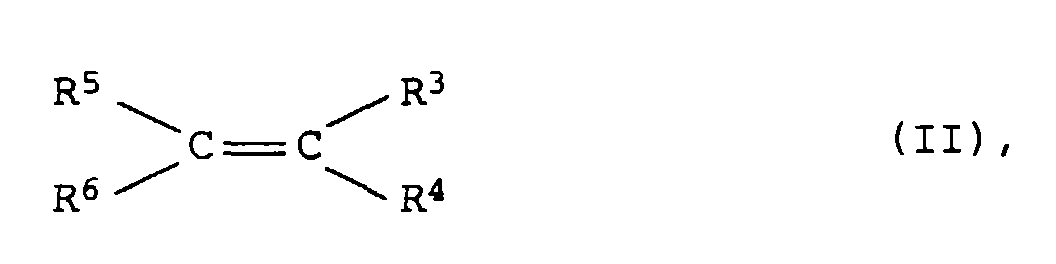
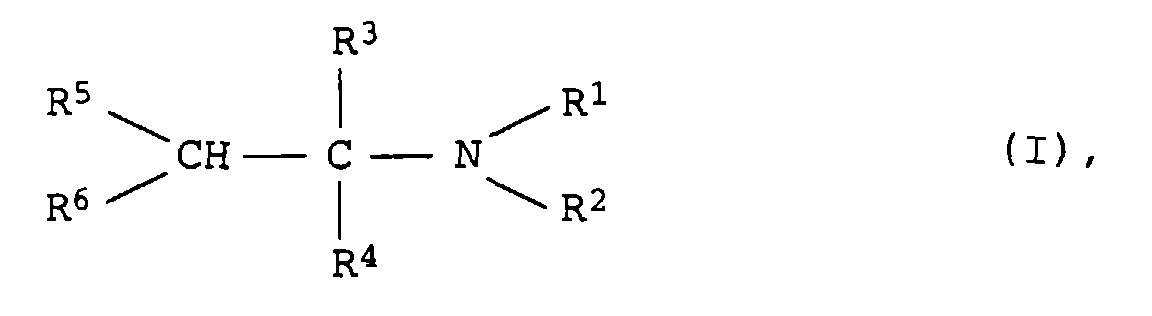
- Demgemäß wurde ein neues und verbessertes Verfahren zur Herstellung von Aminen der allgemeinen Formel I

- R1,R2,R3,R4,R5,R6
- Wasserstoff, C1- bis C20-Alkyl, C2- bis C20-Alkenyl, C2- bis C20-Alkinyl, C3- bis C20-Cycloalkyl, C4- bis C20-Alkyl-cycloalkyl, C4- bis C20-Cycloalkyl-alkyl, Aryl, C7- bis C20-Alkylaryl oder C7- bis C20-Aralkyl,
- R1 und R2
- gemeinsam eine gesättigte oder ungesättigte C3-bis C9-Alkylendikette und
- R3 oder R5
- C21- bis C200-Alkyl, C21- bis C200-Alkenyl oder gemeinsam eine C2- bis C12-Alkylendikette
- Das erfindungsgemäße Verfahren kann wie folgt durchgeführt werden:
- Das Olefin II und Ammoniak oder das primäre oder sekundären Amin III kann bei Temperaturen von 200 bis 350°C, bevorzugt 220 bis 330°C, besonders bevorzugt 230 bis 320°C und Drücken von 100 bis 300 bar, bevorzugt 120 bis 300 bar, besonders bevorzugt 140 bis 290 bar in Gegenwart von mesoporösen Oxiden mit hoher Oberfläche als Katalysator z.B. in einem Druck-Reaktor umsetzt werden, und bevorzugt das erhaltene Amin abgetrennt und die nichtumgesetzten Einsatzstoffe zurückführt werden.
- Das vorliegende Verfahren zeichnet sich durch eine sehr gute Ausbeute bei hoher Selektivität und bei hoher Raum-Zeit-Ausbeute aus. Zudem ist die Desaktivierung des Katalysators zurückgedrängt worden. Die Herstellung der Katalysatoren erfolgt in einfacher und gut reproduzierbarer Art und Weise.
- Das erfindungsgemäße Verfahren zeichnet sich dadurch aus, daß bereits mit niedrigem Ammoniak- bzw. Amin- Überschuß eine hohe Selektivität an gewünschtem Reaktionsprodukt erzielt und die Dimerisierung und/oder Oligomerisierung des eingesetzten Olefins vermieden wird.
- Eine Ausführungsform dieses Verfahrens besteht darin, daß man Ammoniak und/oder Amine III zusammen mit dem Olefin II im molaren Verhältnis von 1:1 bis 5:1 gemischt einem Festbettreaktor zuführt und bei einem Druck von 100 bis 300 bar und einer Temperatur von 200 bis 350°C in der Gasphase oder im überkritischen Zustand umsetzt.
- Aus dem Reaktionsaustrag kann das gewünschte Produkt mit Hilfe bekannter Methoden, beispielsweise Destillation oder Extraktion, erhalten und nötigenfalls mittels weiterer Trennoperationen auf die gewünschte Reinheit gebracht werden. Die nichtumgesetzten Eingangsstoffe werden in der Regel bevorzugt in den Reaktor zurückgeführt.
- Man kann einfach oder mehrfach ungesättigte Olefine II, insbesondere solche mit 2 bis 10 C-Atomen bzw. deren Mischungen und Polyolefine als Ausgangsstoffe verwenden. Wegen der geringer ausgeprägten Polymerisationsneigung eignen sich Monoolefine besser als Di- und Polyolefine, doch können diese mit Hilfe höherer Ammoniak- bzw. Aminüberschüsse ebenso selektiv umgesetzt werden.
- Die Lage des Gleichgewichts und damit der Umsatz zum gewünschten Amin ist sehr stark vom gewählten Reaktionsdruck abhängig. Hoher Druck begünstig das Additionsprodukt, doch stellt im allgemeinen aus technischen und wirtschaftlichen Gründen der Druckbereich bis 300 bar das Optimum dar. Die Selektivität der Reaktion wird - neben Größen wie Ammoniak-/Amin-Überschuß und Katalysator - in hohem Maß durch die Temperatur beeinflußt. Zwar nimmt die Reaktionsgeschwindigkeit der Additionsreaktion mit steigender Temperatur stark zu, doch werden konkurrierende Crack- und Rekombinationsreaktionen des Olefins gleichzeitig gefördert. Zudem ist eine Temperaturerhöhung aus thermodynamischer Sicht nicht vorteilhaft. Die Lage des Temperaturoptimums bezüglich Umsatz und Selektivität ist von der Konstitution des Olefins, des eingesetzten Amins und des Katalysators abhängig und liegt meist im Bereich von 200 bis 350°C.
- Als Katalysatoren für die Aminierung von Olefinen eignen sich mesoporöse Oxide mit hoher Oberfläche. Diese zeichnen sich dadurch aus, daß sie bei einer mittels Stickstoffadsorption (77 K) gemessenen Isotherme eine charakteristische Stufe im Relativdruck-Bereich von p/p° = 0,2 bis 0,4 aufweisen. Mittels transmissionselektronenmikroskopischer Analyse werden Mesoporen im Bereich von 2 bis 6 nm nachgewiesen und zudem röntgenographisch Reflexe im Winkelbereich 2 bis 6o 2Theta beobachtet. Neben Mesoporen können die erfindungsgemäßen Katalysatoren auch noch Mikroporen enthalten, die gemessene Porenverteilung, z.B. mittels der Stickstoffisotherme, ist dann bimodal. Die erzielbaren Oberflächen liegen bei den erfindungsgemäßen Katalysatoren in Pulverform bei 400 bis zu 1400 m2g-1, bevorzugt bei 500 bis zu 1250 m2g-1, besonders bevorzugt 700 bis zu 1250 m2g-1 (gemäß BET-Auswertung), in verstrangter Form, je nach Binderanteil, bei 250 bis zu 900 m2g-1, bevorzugt bei 300 bis zu 900 m2g-1, besonders bevorzugt 350 bis zu 900 m2g-1.
- Hergestellt werden können die mesoporösen Oxide aus leicht löslichen Vorstufen der Oxide, z.B. durch saure oder alkalische Hydrolyse ihrer Metallsalze oder Alkoxide unter gleichzeitigem Zusatz von anionischen, kationischen oder nichtionischen Tensiden, etwa C8 bis C16-Trimethylammoniumsalze in Form der Chloride oder Bromide, oder C8- bis C16-Amine unter Zusatz von HCl (Gontier und Tuel; Zeolites 15 (1995) Seite 601 bis 610). Ebenso können als Template neutrale Amine (Mokaya und Jones, J. Chem. Soc., Chem. Commun. (1996) S. 981-982) oder Polyethylenoxide genommen werden (Bagshaw et al., Science 269 (1995) Seite 1242 bis 1244). Dabei bilden sich die mesoporösen Oxide innerhalb weniger Stunden bis Tage bei Temperaturen von Raumtemperatur bis 180°C. Nach dem Trocknen können die organischen Schablonenverbindungen durch einen Kalzinierschritt bei 350 bis 650°C unter Luft entfernt und die mesoporösen Oxide mit hohen Oberflächen erhalten werden.
- Auch unter dem Namen MCM-41 oder M41S bekanntgewordenen mesoporösen Oxide mit hoher Oberfläche und regelmäßiger hexagonaler Anordnung der Poren zählen zu den erfindungsgemäßen Katalysatoren. Zu ihrer Herstellung kann auch wahlweise ein hydrothermaler Kristallisationsschritt durchgeführt werden.
- Vorteilhaft sind mesoporöse Oxide, z.B. nach der US-A-5 057 296 oder der DE-A-44 07 326, die aus einem oder mehreren Oxiden aus der Gruppe SiO2, Al2O3, B2O3, Ga2O3, In2O3, TiO2, ZrO2, Nb2O5, Fe2O3, GeO2, SnO2, CeO2 oder ThO2 zusammengesetzt sind, insbesondere aus der Gruppe SiO2, Al2O3, B2O3 und TiO2, besonders bevorzugt ist SiO2 als alleiniges Oxid oder Hauptbestandteil der mesoporösen Oxide.
- Die erfindungsgemäßen mesoporösen Oxide mit hoher Oberfläche können als solche verformt werden, oder aber auch mit einem Bindemittel im Verhältnis 98:2 bis 40:60 Gew.-% zu Strängen oder Tabletten. Als Bindemittel eignen sich verschiedene Aluminiumoxide, bevorzugt Boehmit, amorphe Aluminosilikate mit einem SiO2/Al2O3-Verhältnis von 25:75 bis 95:5, Siliciumdioxid, bevorzugt hochdisperses SiO2, Gemische aus hochdispersem SiO2 und hochdispersem Al2O3, hochdisperses TiO2 sowie Tone. Nach der Verformung werden die Extrudate oder Preßlinge zweckmäßig bei 110°C/16 h getrocknet und bei 200 bis 500°C/2 bis 16 h calciniert, wobei die Calcinierung auch direkt (in situ) im Aminierungsreaktor erfolgen kann.
- Zur Erhöhung der Selektivität, der Standzeit und der Anzahl der möglichen Regenerierungen kann man verschiedene Modifizierungen an den erfindungsgemäßen mesoporösen Oxiden mit hoher Oberfläche vornehmen.
- Eine Modifizierung der Katalysatoren besteht darin, daß man die unverformten oder die verformten mesoporösen Oxide mit hoher Oberfläche mit Übergangsmetallen wie z.B. Ti, Zr, Mn, Fe, Mo, Cu, Zn, Cr, Edelmetallen und/oder seltenen Erdmetallen wie z.B. La, Ce oder Y ionenaustauschen bzw. dotieren kann.
- Eine vorteilhafte Ausführungsform besteht darin, daß man die verformten erfindungsgemäßen mesoporösen Oxide mit hoher Oberfläche in einem Strömungsrohr vorlegt und bei 20 bis 100°C z.B. ein Halogenid, ein Acetat, ein Oxalat, ein Citrat oder ein Nitrat der oben beschriebenen Metalle in gelöster Form darüberleitet. Ein derartiger Ionenaustausch kann z.B. an der Wasserstoff-, Ammonium- und Alkaliform der erfindungsgemäßen mesoporösen Oxide mit hoher Oberfläche vorgenommen werden.
- Eine weitere Möglichkeit der Metallaufbringung auf die erfindungsgemäßen mesoporösen Oxide mit hoher Oberfläche besteht darin, daß man das Material z.B. mit einem Halogenid, einem Nitrat, einem Acetat, einem Oxalat, einem Citrat oder einem Oxid der oben beschriebenen Metalle in wäßriger oder alkoholischer Lösung imprägniert.
- Sowohl an einen Ionenaustausch als auch an eine Imprägnierung kann man eine Trocknung, wahlweise eine abermalige Calcination anschließen. Bei metalldotierten mesoporösen Oxiden mit hoher Oberfläche kann eine Nachbehandlung mit Wasserstoff und/oder mit Wasserdampf günstig sein.
- Eine weitere Möglichkeit der Modifizierung besteht darin, daß man die erfindungsgemäßen mesoporösen Oxide mit hoher Oberfläche - verformt oder unverformt - einer Behandlung mit Säuren, wie Salzsäure (HCl), Flußsäure (HF), Schwefelsäure (H2SO4), Oxalsäure (HO2C-CO2H), Phosphorsäure (H3PO4) oder deren Gemischen unterwirft.
- Eine besondere Ausführungsform besteht darin, daß man die erfindungsgemäßen mesoporösen Oxide mit hoher Oberfläche vor der Verformung mit einer der genannten Säuren 0,001 n bis 2 n, bevorzugt 0,05 bis 0,5 n 1 bis 100 Stunden unter Rückfluß behandelt. Nach Abfiltrieren und Auswaschen wird in der Regel bei 100 bis 160°C getrocknet und bei 200 bis 600°C calciniert. Eine weitere besondere Ausführungsform liegt in einer Säure-Behandlung der erfindungsgemäßen mesoporösen Oxide mit hoher Oberfläche nach ihrer Verformung mit Bindemittel. Hierbei wird das erfindungsgemäße mesoporöse Oxid in der Regel 1 bis 3 Stunden zwischen 60 und 80°C mit einer 3 bis 25%igen, insbesondere mit einer 12 bis 20%igen Säure behandelt, anschließend ausgewaschen, bei 100 bis 160°C getrocknet und bei 200 bis 600°C calciniert. Auch hier kann die Calcinierung wieder direkt im Aminierungsreaktor erfolgen.
- Eine andere Möglichkeit der Modifizierung ist gegeben durch einen Austausch mit Ammonsalzen, z.B. mit NH4Cl oder mit Mono-, Di- oder Polyaminen. Hierbei wird das mit Bindemittel verformte mesoporöse Oxid in der Regel bei 60 bis 80°C mit 10 bis 25%iger, bevorzugt 20%iger NH4Cl-Lösung 2 h kontinuierlich in gewichtsmäßiger Oxid/Ammonchlorid-Lösung von 1:15 ausgetauscht und danach bei 100 bis 120°C getrocknet.
- Eine weitere Modifikation, die an den erfindungsgemäßen mesoporösen Oxiden mit hoher Oberfläche vorgenommen werden kann, ist eine Dealuminierung, bei der ein Teil der gegebenenfalls vorhandenen Aluminiumatome durch Silicium ersetzt wird oder die Oxide durch beispielsweise hydrothermale Behandlung in ihrem Aluminiumgehalt abgereichert werden. An eine hydrothermale Dealuminierung schließt sich vorteilhafterweise eine Extraktion mit Säuren oder Komplexbildnern an, um gebildetes Nichtgitteraluminium zu entfernen. Der Ersatz von Aluminium durch Silicium kann beispielsweise mit Hilfe von (NH4)2SiF6 oder SiCl4 erfolgen. Beispiele für Dealuminierungen finden sich in Corma et al., Stud. Surf. Sci. Catal. 37 (1987) Seiten 495 bis 503. In gleicher Weise können andere dreiwertige Elemente wie Bor, Eisen oder Gallium in ihrem Gehalt abgereichert werden.
- Die Katalysatoren kann man als Stränge mit Durchmessern von z.B. 1 bis 4 mm als Kugeln oder als Tabletten mit z.B. 3 bis 5 mm Durchmesser für die Aminierung der Olefine einsetzen. Andere Formkörper sind ebenfalls möglich.
- Aus dem beispielsweise zu Strängen verformten Katalysator kann man durch Mahlen und Sieben ein Wirbelgut in der Größe von 0,1 bis 0,8 mm erhalten.
- Die Substituenten R1, R2, R3, R4, R5 und R6 in den Verbindungen I, II und III haben folgende Bedeutungen:
- R1,R2,R3,R4,R5,R6
-
- Wasserstoff,
- C1- bis C20-Alkyl, bevorzugt C1- bis C12-Alkyl, besonders bevorzugt C1- bis C8-Alkyl wie Methyl, Ethyl, n-Propyl, iso-Propyl, n-Butyl, iso-Butyl, sec.-Butyl, tert.-Butyl, n-Pentyl, iso-Pentyl, n-Hexyl, iso-Hexyl, n-Heptyl, iso-Heptyl, n-Octyl und iso-Octyl,
- C2- bis C20-Alkenyl, bevorzugt C2- bis C12-Alkenyl, besonders bevorzugt C2- bis C8-Alkenyl wie Vinyl und Allyl,
- C2- bis C20-Alkinyl, bevorzugt C2- bis C8-Alkinyl, insbesondere C2H und Propargyl,
- C3- bis C20-Cycloalkyl, bevorzugt C3- bis C12-Cycloalkyl, besonders bevorzugt C5- bis C8-Cycloalkyl wie Cyclopentyl, Cyclohexyl, Cycloheptyl und Cyclooctyl,
- C4- bis C20-Alkyl-cycloalkyl, bevorzugt C4- bis C12-Alkyl-cycloalkyl, besonders bevorzugt C5- bis C10-Alkyl-cycloalkyl,
- C4- bis C20-Cycloalkyl-alkyl, bevorzugt C4- bis C12-Cycloalkyl-alkyl, besonders bevorzugt C5- bis C10-Cycloalkyl-alkyl,
- Aryl wie Phenyl, 1-Naphthyl und 2-Naphthyl, bevorzugt Phenyl,
- C7- bis C20-Alkylaryl, bevorzugt C7- bis C16-Alkylaryl, bevorzugt C7- bis C12-Alkylphenyl wie 2-Methylphenyl, 3-Methylphenyl, 4-Methylphenyl, 2-Ethylphenyl, 3-Ethylphenyl und 4-Ethylphenyl,
- C7- bis C20-Aralkyl, bevorzugt C7- bis C16-Aralkyl, bevorzugt C7- bis C12-Phenalkyl wie Phenylmethyl, 1-Phenylethyl, 2-Phenylethyl,
- R1 und R2
-
- gemeinsam eine gesättigte oder ungesättigte C3- bis C9-Alkylendikette, bevorzugt -(CH2)4-, -(CH2)5-, -(CH2)7- und -CH=CH-CH=CH-,
- R3 oder R5
-
- C21- bis C200-Alkyl, bevorzugt C40- bis C200-Alkyl, wie Polybutyl, Polyisobutyl, Polypropyl, Polyisopropyl und Polyethyl, besonders bevorzugt Polybutyl und Polyisobutyl,
- C21- bis C200-Alkenyl, bevorzugt C40- bis C200-Alkenyl, besonders bevorzugt C70- bis C170-Alkenyl,
- R3 und R5
-
- gemeinsam eine C2- bis C12-Alkylendikette, bevorzugt eine C3-bis C8-Alkylendikette, besonders bevorzugt -(CH2)3-, -(CH2)4-, -(CH2)5-, -(CH2)6- und -(CH2)7-, insbesondere -(CH2)3- und -(CH2)4-.
- In einem 10 l Kolben wurden 504 g Tetraethylorthosilikat (Si(OC2H5)4), 3,24 g Borsäuretrimethylester (B(OCH3)3), 146,4 g Isopropanol und 720 g Ethanol vorgelegt und 30 min homogenisiert. Innerhalb von 30 min wurde langsam unter Rühren eine Mischung aus 120 g Dodecylamin, 1560 g dest. Wasser und 17,5 g 10 %-iger Salzsäure zugetropft. Die entstandene weiße Suspension wurde 20 h bei ca. 300 U/min gerührt, abfiltriert und mit dest. Wasser neutralgewaschen. Nach 24 h Trocknung bei 60°C wurde das Produkt bei 500°C für 10 h kalziniert. Das Pulver hatte eine BET-Oberfläche von 1084 m2g-1.
- 60 g des Si-B-Oxids wurden mit 40 g Boehmit und 2 g Ameisensäure im Kneter kompaktiert und unter Wasserzusatz (124 ml) 45 min verknetet. In einer Strangpresse wurden mit einem Pressdruck von 40 bar 2 mm Stränge erzeugt und diese 4 h bei 120°C getrocknet und 16 h bei 500°C kalziniert.
- Die fertigen Stränge hatten eine BET-Oberfäche von 794 m2g-1 und eine deutlich bimodale Porenverteilung mit Maxima bei ca. 23 Å und ca. 60 Å.
- In einem 10 l Kolben wurden 505 g Tetraethylorthosilikat (Si(OC2H5)4), 146,4 g Isopropanol und 720 g Ethanol vorgelegt und 30 min homogenisiert. Innerhalb von 30 min wurde langsam unter Rühren eine Mischung aus 120 g Dodecylamin, 1560 g dest. Wasser und 17,5 g 10 %-iger Salzsäure zugetropft. Die entstandene weiße Suspension wurde 20 h bei ca. 300 U/min gerührt, abfiltriert und mit dest. Wasser neutralgewaschen. Nach 24 h Trocknung bei 60°C wurde das Produkt bei 500°C für 5 h kalziniert. Das Pulver hatte eine BET-Oberfläche von 920 m2g-1.
- 70 g des Si-Oxids wurden mit 46 g Boehmit und 2 g Ameisensäure im Kneter kompaktiert und unter Wasserzusatz (136 ml) 60 min verknetet. In einer Strangpresse wurden mit einem Pressdruck von 50 bar 2 mm Stränge erzeugt und diese 4 h bei 120°C getrocknet und 16 h bei 500°C kalziniert.
- Die fertigen Stränge hatten eine BET-Oberfäche von 661 m2g-1 und eine deutlich bimodale Porenverteilung mit Maxima bei ca. 25 Å und 80 bis 90 Å.
- 40 g Katalysator B in Strangform wurden über Nacht bei 120°C getrocknet und anschließend mit einer Lösung aus 2,5 g Ce(NO3)3·6H2O in 48 ml dest. Wasser versetzt. Nach einer halben Stunde Stehen lassen wurde das Wasser bei 80°C abgezogen, 2 h bei 120°C getrocknet und 2 h bei 540°C kalziniert.
- Die fertigen Stränge enthielten 1,9 Gew.-% Cer.
- In einem 10 l Kolben wurden 505 g Tetraethylorthosilikat (Si(OC2H5)4), 6,34 g Aluminiumisopropylat (Al(O-isoC3H7)3), 146,4 g Isopropanol und 720 g Ethanol vorgelegt und 30 min homogenisiert. Innerhalb von 30 min wurde langsam unter Rühren eine Mischung aus 120 g Dodecylamin, 1560 g dest. Wasser und 17,5 g 10 %-iger Salzsäure zugetropft. Die entstandene weiße Suspension wurde 20 h bei ca. 300 U/min gerührt, abfiltriert und mit dest. Wasser neutralgewaschen. Nach 24 h Trocknung bei 60°C wurde das Produkt bei 500°C für 5 h kalziniert. Das Pulver hatte eine BET-Oberfläche von 990 m2g-1 und enthielt 43 Gew.-% Silicium sowie 0,53 % Aluminium.
- 70 g des Si-Al-Oxides wurden mit 46 g Boehmit und 2 g Ameisensäure versetzt, im Kneter kompaktiert und unter Wasserzusatz 120 min verknetet. In einer Strangpresse wurden mit einem Pressdruck von 40 bar 2 mm Stränge erzeugt und diese 16 h bei 110°C getrocknet und 16 h bei 500°C kalziniert.
- Die fertigen Stränge hatten eine BET-Oberfäche von 641 m2g-1 und eine deutlich bimodale Porenverteilung mit Maxima bei ca. 30 Å und 60 bis 200 Å.
- Aus Wasserglas wurde durch Ansäuern mit Schwefelsäure SiO2 ausgefällt. Nach Filtrieren wurde das Pulver sprühgetrocknet, zu 3 mm Strängen extrudiert und diese bei 650°C kalziniert. Die Oberfläche der kalzinierten Stränge betrug 173 m2g-1.
- 115,5 g Tetramethylammoniumbromid wurden zu 1500 ml Cetyltrimethylammoniumchlorid-Lösung [25 Gew.-% C16H33N(CH3)3Cl] gegeben, 30 Minuten gerührt und anschließend 272,6 g Natriumsilikat, 30 g Natriumaluminat, 187,5 g Aerosil® 200 und 1500 ml Wasser langsam zugegeben. Die Mischung wurde in einen Autoklaven überführt und bei Raumtemperatur 16 Stunden gerührt. Ohne Rühren wurde auf 160°C erhitzt und 3 Tage kristallisiert. Nach Abfiltrieren und Waschen wurde 12 Stunden bei 500°C kalziniert. Das Pulver besaß eine BET-Oberfläche von 640 m2g-1, ein SiO2/Al2O3-Verhältnis von 30:1 und Poren von ca. 43 Å.
- 100 g MCM-41 (zuvor hergestelltes Pulver) wurden mit 67 g Boehmit und 3 g Ameisensäure besetzt, im Kneter kompaktiert und unter Wasserzusatz (150 ml) 45 Minuten verknetet. In einer Strangpresse wurden mit einem Pressdruck von 80 bar Stränge von 2 mm erzeugt und diese 16 Stunden bei 110°C getrocknet und 16 Stunden bei 500°C kalziniert.
- Die Versuche wurden in einem Rohrreaktor (6 mm Innendurchmesser) unter isothermen Bedingungen bei 260 bis 300°C und einem Druck von 280 bar mit einem Gemisch aus Isobuten und Ammoniak im molaren Verhältnis von 1:1,5 durchgeführt. Die Reaktionsprodukte wurden im Gaschromatographen analysiert.
- Die Ergebnisse sind in Tabelle 1 zusammengestellt und zeigen, daß die erfindungsgemäßen Katalysatoren deutlich höhere Ausbeuten als nach konventionellen Methoden hergestellte Katalysatoren auf Basis von Oxiden liefern und daß insbesondere die Aktivität durch Cer-Imprägnierung noch gesteigert werden kann.
Tabelle 1 tert.-Butylamin (NH3: C4H8 = 1,5) Katalysator Druck Temperatur tert.-Butylamin-Ausbeute [Gew.-%] Litergewicht Nr. Al2O3 [Gew.-%] [bar] [°C] WHSV 0,7 [g/g·h] WHSV 1,5 [g/g·h] WHSV 3 [g/g·h] [kg/l] A 40 280 300 12,24 11,47 9,60 0,39 B 40 280 300 12,48 11,75 9,61 0,42 C 40 280 300 12,17 12,18 11,44 0,42 D 40 280 300 11,88 11,46 10,27 0,28 E 280 300 2,01 0,92 0,52 0,37 F 40 280 300 12,86 11,20 0,54


Claims (11)
- Verfahren zur Herstellung von Aminen der allgemeinen Formel I
 R1,R2,R3,R4,R5,R6 Wasserstoff, C1- bis C20-Alkyl, C2- bis C20-Alkenyl, C2- bis C20-Alkinyl, C3- bis C20-Cycloalkyl, C4- bis C20-Alkyl-cycloalkyl, C4- bis C20-Cycloalkyl-alkyl, Aryl, C7- bis C20-Alkylaryl oder C7- bis C20-Aralkyl,R1 und R2 gemeinsam eine gesättigte oder ungesättigte C3- bis C9-Alkylendikette undR3 oder R5 C21- bis C200-Alkyl, C21- bis C200-Alkenyl oder gemeinsam eine C2- bis C12-Alkylendikettebedeuten, durch Umsetzung von Olefinen der allgemeinen Formel II

- Verfahren zur Herstellung von Aminen I nach Anspruch 1, dadurch gekennzeichnet, daß man das gebildete Amin I abtrennt und die nichtumgesetzten Einsatzstoffe II und III zurückführt.
- Verfahren zur Herstellung von Aminen nach den Ansprüchen 1 bis 2, dadurch gekennzeichnet, daß man als Olefin II Isobuten, Diisobuten, Cyclopenten, Cyclohexen oder Polyisobuten einsetzt.
- Verfahren zur Herstellung von Aminen nach den Ansprüchen 1 bis 3, dadurch gekennzeichnet, daß man mesoporöse Oxide mit hoher Oberfläche als Heterogenkatalysatoren einsetzt, die aus einem oder mehreren Oxiden der Gruppe SiO2, Al2O3, B2O3, Ga2O3, In2O3, TiO2, ZrO2, Nb2O5, Fe2O3, GeO2, SnO2, CeO2 oder ThO2 zusammengesetzt sind.
- Verfahren zur Herstellung von Aminen nach den Ansprüchen 1 bis 4, dadurch gekennzeichnet, daß man mesoporöse Oxide mit hoher Oberfläche als Heterogenkatalysatoren einsetzt, die im wesentlichen frei von Alkali- oder Erdalkali-Ionen sind.
- Verfahren zur Herstellung von Aminen nach den Ansprüchen 1 bis 5, dadurch gekennzeichnet, daß man mesoporöse Oxide mit hoher Oberfläche als Heterogenkatalysatoren einsetzt, die mit einem oder mehreren Übergangsmetallen dotiert sind.
- Verfahren zur Herstellung von Aminen nach den Ansprüchen 1 bis 6, dadurch gekennzeichnet, daß man mesoporöse Oxide mit hoher Oberfläche als Heterogenkatalysatoren einsetzt, die mit einem oder mehreren Elementen der Seltenen Erden dotiert sind.
- Verfahren zur Herstellung von Aminen nach den Ansprüchen 1 bis 7, dadurch gekennzeichnet, daß man mesoporöse Oxide mit hoher Oberfläche als Heterogenkatalysatoren einsetzt, die mit einer Säure, insbesondere einer aus der Gruppe Salzsäure, Flußsäure, Schwefelsäure, Phosphorsäure, Oxalsäure oder deren Gemischen behandelt sind.
- Verfahren zur Herstellung von Aminen nach den Ansprüchen 1 bis 8, dadurch gekennzeichnet, daß man mesoporöse Oxide mit hoher Oberfläche enthaltende Heterogenkatalysatoren einsetzt, die mit einem Bindemittel verformt und bei Temperaturen von 200 bis 600°C calciniert sind.
- Verfahren zur Herstellung von Aminen nach den Ansprüchen 1 bis 9, dadurch gekennzeichnet, daß man mesoporose Oxide mit einer Oberfläche von 400 bis zu 1400 m2g-1, insbesondere mehr als 600 m2g-1, gemessen nach BET, als Heterogenkatalysatoren einsetzt.
- Verfahren zur Herstellung von Aminen nach den Ansprüchen 1 bis 10, dadurch gekennzeichnet, daß man als mesoporöse Oxide mit hoher Oberfläche MCM-41 Typen einsetzt.
Applications Claiming Priority (2)
| Application Number | Priority Date | Filing Date | Title |
|---|---|---|---|
| DE19615482 | 1996-04-19 | ||
| DE19615482A DE19615482A1 (de) | 1996-04-19 | 1996-04-19 | Verfahren zur Herstellung von Aminen aus Olefinen an mesoporösen Oxiden mit hoher Oberfläche |
Publications (2)
| Publication Number | Publication Date |
|---|---|
| EP0802176A1 true EP0802176A1 (de) | 1997-10-22 |
| EP0802176B1 EP0802176B1 (de) | 2000-07-19 |
Family
ID=7791739
Family Applications (1)
| Application Number | Title | Priority Date | Filing Date |
|---|---|---|---|
| EP97105904A Expired - Lifetime EP0802176B1 (de) | 1996-04-19 | 1997-04-10 | Verfahren zur Herstellung von Aminen aus Olefinen an mesoporösen Oxiden mit hoher Oberfläche |
Country Status (6)
| Country | Link |
|---|---|
| US (1) | US5780680A (de) |
| EP (1) | EP0802176B1 (de) |
| JP (1) | JP4243360B2 (de) |
| CZ (1) | CZ291226B6 (de) |
| DE (2) | DE19615482A1 (de) |
| SK (1) | SK282255B6 (de) |
Cited By (1)
| Publication number | Priority date | Publication date | Assignee | Title |
|---|---|---|---|---|
| EP0846675A1 (de) * | 1996-12-03 | 1998-06-10 | Basf Aktiengesellschaft | Verfahren zur Herstellung von Aminen aus Olefinen an Zeolithen des Typs MCM-49 oder MCM-56 |
Families Citing this family (6)
| Publication number | Priority date | Publication date | Assignee | Title |
|---|---|---|---|---|
| JP3489475B2 (ja) | 1998-03-20 | 2004-01-19 | 日産自動車株式会社 | 駆動力制御装置 |
| CN100351006C (zh) * | 2001-05-14 | 2007-11-28 | 沃特海尔斯国际公司 | 强力消毒溶液装置 |
| WO2005059973A2 (en) * | 2003-12-12 | 2005-06-30 | Yale University | Controlled growth of gallium nitride nanostructures |
| WO2009053275A1 (de) * | 2007-10-24 | 2009-04-30 | Basf Se | Verfahren zur herstellung eines primären amins mit tertiärem alpha-c-atom durch umsetzung eines tertiären alkohols mit ammoniak |
| FR3038851B1 (fr) * | 2015-07-13 | 2019-11-08 | IFP Energies Nouvelles | Catalyseur a base de tantale depose sur silice pour la transformation de l'ethanol en butadiene |
| CN118384927B (zh) * | 2024-04-19 | 2025-01-14 | 浙江工业大学 | 一种复合氧化物载体的制备方法和应用 |
Citations (6)
| Publication number | Priority date | Publication date | Assignee | Title |
|---|---|---|---|---|
| WO1991011390A2 (en) * | 1990-01-25 | 1991-08-08 | Mobil Oil Corp | Synthetic porous crystalline material its synthesis and use |
| EP0469719A1 (de) * | 1990-08-01 | 1992-02-05 | Huntsman Corporation | Alkylaminsynthese in Gegenwart von Montmorillonittonen |
| JPH0482864A (ja) * | 1990-07-24 | 1992-03-16 | Mitsui Toatsu Chem Inc | ターシャリーブチルアミンの製造方法 |
| EP0670286A1 (de) * | 1994-03-04 | 1995-09-06 | Basf Aktiengesellschaft | Mesoporöse Molekularsiebe |
| EP0699653A1 (de) * | 1994-09-01 | 1996-03-06 | BASF Aktiengesellschaft | Verfahren zur Herstellung von Aminen |
| EP0752409A2 (de) * | 1995-07-04 | 1997-01-08 | Basf Aktiengesellschaft | Verfahren zur Herstellung von Aminen aus Gemischen, die man bei der Spaltung von Erdölfraktionen erhält, an Zeolithen, Aluminosilikaten, hydrothermal hergestellten Phosphaten, hochoberflächigen Oxiden, Pillared Clays oder säurebehandelten Schichtsilikaten |
Family Cites Families (10)
| Publication number | Priority date | Publication date | Assignee | Title |
|---|---|---|---|---|
| US4375002A (en) * | 1980-05-09 | 1983-02-22 | Air Products And Chemicals, Inc. | Amines via the amination of olefins |
| MX157137A (es) * | 1982-07-30 | 1988-10-28 | Air Prod & Chem | Procedimiento mejorado para la obtencion de alquilaminas |
| DE3326579A1 (de) * | 1983-07-23 | 1985-01-31 | Basf Ag, 6700 Ludwigshafen | Verfahren zur herstellung von aminen |
| DE3327000A1 (de) * | 1983-07-27 | 1985-02-07 | Basf Ag, 6700 Ludwigshafen | Verfahren zur herstellung von aminen |
| US4536602A (en) * | 1984-06-01 | 1985-08-20 | Air Products And Chemicals, Inc. | Amination of olefins using organic acid catalysts |
| DE3940349A1 (de) * | 1989-12-06 | 1991-06-13 | Basf Ag | Verfahren zur herstellung von aminen |
| US5057296A (en) * | 1990-12-10 | 1991-10-15 | Mobil Oil Corp. | Method for synthesizing mesoporous crystalline material |
| DE4206992A1 (de) * | 1992-03-05 | 1993-09-09 | Akzo Nv | Verfahren zur herstellung von tertiaerem butylamin |
| US5648546A (en) * | 1992-03-05 | 1997-07-15 | Akzo Nobel, N.V. | Method for manufacturing tert-butylamine |
| CA2092964A1 (en) * | 1992-12-03 | 1994-06-04 | John Frederick Knifton | Tert-butylamine synthesis over zeolite beta |
-
1996
- 1996-04-19 DE DE19615482A patent/DE19615482A1/de not_active Withdrawn
-
1997
- 1997-04-10 DE DE59702041T patent/DE59702041D1/de not_active Expired - Lifetime
- 1997-04-10 EP EP97105904A patent/EP0802176B1/de not_active Expired - Lifetime
- 1997-04-18 CZ CZ19971184A patent/CZ291226B6/cs not_active IP Right Cessation
- 1997-04-18 US US08/839,800 patent/US5780680A/en not_active Expired - Lifetime
- 1997-04-18 JP JP10115797A patent/JP4243360B2/ja not_active Expired - Fee Related
- 1997-04-18 SK SK489-97A patent/SK282255B6/sk not_active IP Right Cessation
Patent Citations (8)
| Publication number | Priority date | Publication date | Assignee | Title |
|---|---|---|---|---|
| WO1991011390A2 (en) * | 1990-01-25 | 1991-08-08 | Mobil Oil Corp | Synthetic porous crystalline material its synthesis and use |
| JPH0482864A (ja) * | 1990-07-24 | 1992-03-16 | Mitsui Toatsu Chem Inc | ターシャリーブチルアミンの製造方法 |
| EP0469719A1 (de) * | 1990-08-01 | 1992-02-05 | Huntsman Corporation | Alkylaminsynthese in Gegenwart von Montmorillonittonen |
| EP0670286A1 (de) * | 1994-03-04 | 1995-09-06 | Basf Aktiengesellschaft | Mesoporöse Molekularsiebe |
| DE4407326A1 (de) * | 1994-03-04 | 1995-09-21 | Basf Ag | Mesoporöse Molekularsiebe |
| EP0699653A1 (de) * | 1994-09-01 | 1996-03-06 | BASF Aktiengesellschaft | Verfahren zur Herstellung von Aminen |
| DE4431093A1 (de) * | 1994-09-01 | 1996-03-07 | Basf Ag | Verfahren zur Herstellung von Aminen |
| EP0752409A2 (de) * | 1995-07-04 | 1997-01-08 | Basf Aktiengesellschaft | Verfahren zur Herstellung von Aminen aus Gemischen, die man bei der Spaltung von Erdölfraktionen erhält, an Zeolithen, Aluminosilikaten, hydrothermal hergestellten Phosphaten, hochoberflächigen Oxiden, Pillared Clays oder säurebehandelten Schichtsilikaten |
Non-Patent Citations (1)
| Title |
|---|
| PATENT ABSTRACTS OF JAPAN vol. 016, no. 298 (C - 0958) 2 July 1992 (1992-07-02) * |
Cited By (2)
| Publication number | Priority date | Publication date | Assignee | Title |
|---|---|---|---|---|
| EP0846675A1 (de) * | 1996-12-03 | 1998-06-10 | Basf Aktiengesellschaft | Verfahren zur Herstellung von Aminen aus Olefinen an Zeolithen des Typs MCM-49 oder MCM-56 |
| US5840988A (en) * | 1996-12-03 | 1998-11-24 | Basf Aktiengesellschaft | Preparation of amines from olefins on zeolites of the MCM-49 or MCM-56 type |
Also Published As
| Publication number | Publication date |
|---|---|
| US5780680A (en) | 1998-07-14 |
| SK282255B6 (sk) | 2001-12-03 |
| JPH1072409A (ja) | 1998-03-17 |
| CZ118497A3 (cs) | 1998-03-18 |
| DE59702041D1 (de) | 2000-08-24 |
| DE19615482A1 (de) | 1997-10-23 |
| SK48997A3 (en) | 1998-05-06 |
| JP4243360B2 (ja) | 2009-03-25 |
| CZ291226B6 (cs) | 2003-01-15 |
| EP0802176B1 (de) | 2000-07-19 |
Similar Documents
| Publication | Publication Date | Title |
|---|---|---|
| EP0170182B1 (de) | Verfahren zur Gewinnung von 2-Butenen aus 1-Buten und gegebenenfalls 2-Butene enthaltenden C4-Kohlenwasserstoffgemischen | |
| EP0431451B1 (de) | Verfahren zur Herstellung von Aminen | |
| EP0822179B1 (de) | Verfahren zur Herstellung von Aminen aus Olefinen an Zeolithen mit NES-Struktur | |
| EP0802176B1 (de) | Verfahren zur Herstellung von Aminen aus Olefinen an mesoporösen Oxiden mit hoher Oberfläche | |
| EP0860424B1 (de) | Verfahren zur Herstellung von Aminen aus Olefinen an NU-85 Zeolithen | |
| EP0752409B1 (de) | Verfahren zur Herstellung von Aminen aus Gemischen, die man bei der Spaltung von Erdölfraktionen erhält, an Zeolithen. | |
| EP0754676B1 (de) | Verfahren zur Herstellung von Aminen aus Olefinen an Zeolithen des Typs PSH-3, MCM-22, SSZ-25 oder deren Gemischen | |
| EP0846677B1 (de) | Verfahren zur Herstellung von Aminen aus Olefinen an Bor-MCM-22 oder ERB-1 Zeolithen | |
| EP0844991B1 (de) | Verfahren zur herstellung von aminen aus olefinen an bor-beta-zeolithen | |
| EP0814075B1 (de) | Verfahren zur Herstellung von Aminen aus Olefinen | |
| EP0699653B1 (de) | Verfahren zur Herstellung von Aminen | |
| EP0846675B1 (de) | Verfahren zur Herstellung von Aminen aus Olefinen an Zeolithen des Typs MCM-49 oder MCM-56 | |
| EP0786449B1 (de) | Verfahren zur Herstellung von Aminen aus Olefinen an hexagonalen Faujasiten | |
| EP0876326B1 (de) | Verfahren zur herstellung von aminen aus olefinen an zeolithen des typs ssz-26, ssz-33, cit-1 oder deren gemischen | |
| EP0752411A2 (de) | Verfahren zur Herstellung von Aminen aus Olefinen an Pillared Clays | |
| EP0778259B1 (de) | Verfahren zur Herstellung von Aminen aus Olefinen an Zeolithen des Typs SSZ-37 | |
| EP0785185B1 (de) | Verfahren zur Herstellung von Aminen aus Olefinen an kristallinen Oxiden auf der Basis von Alumophosphaten mit Faujasit-Struktur | |
| EP0752410A2 (de) | Verfahren zur Herstellung von Aminen aus Olefinen an übergangsmetallfreien, ohne Halogenbehandlung hergestellten Aluminium-BETA-Zeolithen |
Legal Events
| Date | Code | Title | Description |
|---|---|---|---|
| PUAI | Public reference made under article 153(3) epc to a published international application that has entered the european phase |
Free format text: ORIGINAL CODE: 0009012 |
|
| AK | Designated contracting states |
Kind code of ref document: A1 Designated state(s): BE DE FR GB NL |
|
| 17P | Request for examination filed |
Effective date: 19970908 |
|
| 17Q | First examination report despatched |
Effective date: 19980604 |
|
| GRAG | Despatch of communication of intention to grant |
Free format text: ORIGINAL CODE: EPIDOS AGRA |
|
| GRAG | Despatch of communication of intention to grant |
Free format text: ORIGINAL CODE: EPIDOS AGRA |
|
| GRAH | Despatch of communication of intention to grant a patent |
Free format text: ORIGINAL CODE: EPIDOS IGRA |
|
| GRAH | Despatch of communication of intention to grant a patent |
Free format text: ORIGINAL CODE: EPIDOS IGRA |
|
| GRAA | (expected) grant |
Free format text: ORIGINAL CODE: 0009210 |
|
| AK | Designated contracting states |
Kind code of ref document: B1 Designated state(s): BE DE FR GB NL |
|
| GBT | Gb: translation of ep patent filed (gb section 77(6)(a)/1977) |
Effective date: 20000728 |
|
| REF | Corresponds to: |
Ref document number: 59702041 Country of ref document: DE Date of ref document: 20000824 |
|
| ET | Fr: translation filed | ||
| PLBE | No opposition filed within time limit |
Free format text: ORIGINAL CODE: 0009261 |
|
| STAA | Information on the status of an ep patent application or granted ep patent |
Free format text: STATUS: NO OPPOSITION FILED WITHIN TIME LIMIT |
|
| 26N | No opposition filed | ||
| REG | Reference to a national code |
Ref country code: GB Ref legal event code: IF02 |
|
| PGFP | Annual fee paid to national office [announced via postgrant information from national office to epo] |
Ref country code: DE Payment date: 20110630 Year of fee payment: 15 |
|
| PGFP | Annual fee paid to national office [announced via postgrant information from national office to epo] |
Ref country code: NL Payment date: 20120501 Year of fee payment: 16 |
|
| PGFP | Annual fee paid to national office [announced via postgrant information from national office to epo] |
Ref country code: BE Payment date: 20120531 Year of fee payment: 16 Ref country code: GB Payment date: 20120430 Year of fee payment: 16 Ref country code: FR Payment date: 20120611 Year of fee payment: 16 |
|
| REG | Reference to a national code |
Ref country code: DE Ref legal event code: R119 Ref document number: 59702041 Country of ref document: DE Effective date: 20121101 |
|
| BERE | Be: lapsed |
Owner name: *BASF A.G. Effective date: 20130430 |
|
| REG | Reference to a national code |
Ref country code: NL Ref legal event code: V1 Effective date: 20131101 |
|
| GBPC | Gb: european patent ceased through non-payment of renewal fee |
Effective date: 20130410 |
|
| PG25 | Lapsed in a contracting state [announced via postgrant information from national office to epo] |
Ref country code: BE Free format text: LAPSE BECAUSE OF NON-PAYMENT OF DUE FEES Effective date: 20130430 Ref country code: GB Free format text: LAPSE BECAUSE OF NON-PAYMENT OF DUE FEES Effective date: 20130410 |
|
| REG | Reference to a national code |
Ref country code: FR Ref legal event code: ST Effective date: 20131231 |
|
| PG25 | Lapsed in a contracting state [announced via postgrant information from national office to epo] |
Ref country code: FR Free format text: LAPSE BECAUSE OF NON-PAYMENT OF DUE FEES Effective date: 20130430 Ref country code: NL Free format text: LAPSE BECAUSE OF NON-PAYMENT OF DUE FEES Effective date: 20131101 |
|
| PG25 | Lapsed in a contracting state [announced via postgrant information from national office to epo] |
Ref country code: DE Free format text: LAPSE BECAUSE OF NON-PAYMENT OF DUE FEES Effective date: 20121101 |