EP0802441A2 - Lentille de lunettes multifocale - Google Patents
Lentille de lunettes multifocale Download PDFInfo
- Publication number
- EP0802441A2 EP0802441A2 EP97104911A EP97104911A EP0802441A2 EP 0802441 A2 EP0802441 A2 EP 0802441A2 EP 97104911 A EP97104911 A EP 97104911A EP 97104911 A EP97104911 A EP 97104911A EP 0802441 A2 EP0802441 A2 EP 0802441A2
- Authority
- EP
- European Patent Office
- Prior art keywords
- dpt
- reference point
- lens according
- sight
- add
- Prior art date
- Legal status (The legal status is an assumption and is not a legal conclusion. Google has not performed a legal analysis and makes no representation as to the accuracy of the status listed.)
- Granted
Links
Images



Classifications
-
- G—PHYSICS
- G02—OPTICS
- G02C—SPECTACLES; SUNGLASSES OR GOGGLES INSOFAR AS THEY HAVE THE SAME FEATURES AS SPECTACLES; CONTACT LENSES
- G02C7/00—Optical parts
- G02C7/02—Lenses; Lens systems ; Methods of designing lenses
- G02C7/06—Lenses; Lens systems ; Methods of designing lenses bifocal; multifocal ; progressive
- G02C7/061—Spectacle lenses with progressively varying focal power
- G02C7/063—Shape of the progressive surface
- G02C7/065—Properties on the principal line
-
- G—PHYSICS
- G02—OPTICS
- G02C—SPECTACLES; SUNGLASSES OR GOGGLES INSOFAR AS THEY HAVE THE SAME FEATURES AS SPECTACLES; CONTACT LENSES
- G02C7/00—Optical parts
- G02C7/02—Lenses; Lens systems ; Methods of designing lenses
- G02C7/06—Lenses; Lens systems ; Methods of designing lenses bifocal; multifocal ; progressive
-
- G—PHYSICS
- G02—OPTICS
- G02C—SPECTACLES; SUNGLASSES OR GOGGLES INSOFAR AS THEY HAVE THE SAME FEATURES AS SPECTACLES; CONTACT LENSES
- G02C7/00—Optical parts
- G02C7/02—Lenses; Lens systems ; Methods of designing lenses
- G02C7/06—Lenses; Lens systems ; Methods of designing lenses bifocal; multifocal ; progressive
- G02C7/061—Spectacle lenses with progressively varying focal power
Definitions
- the present invention relates to a multifocal spectacle lens with regionally sliding refractive power according to the preamble of the first claim.
- Such spectacle lenses are also generally referred to as varifocal lenses (e.g. EP 0 562 336 or EP 0 452 802).
- the surface of the spectacle lens that causes the desired sliding refractive index curve of the lens is also called the progressive surface.
- a usage situation is determined for the calculation of the varifocal lens.
- One of these is given, for example, in DIN 58 208 Part 2 in Figure 6.
- the fulcrum distance b 'from the apex of the varifocal lens on the eye side to the optical focal point Z' is assumed to be 0.00 dpt at 28 mm in the case of ametropia.
- the frame is generally inclined so that the ground varifocal lens is inclined by an average of about 9 ° to the vertical. This defines the relative position of the progressive lens to the eye. In this use situation, all beam calculations can be carried out correctly with the spectacle wearer, in other words exactly as they occur when the spectacle lens is worn in front of the wearer's eye.
- Progressive lenses have been known for many years and are offered by several manufacturers.
- An example is the progressive lens offered by the applicant under the name "Gradal HS", which is described in DE-PS 30 16 935 (EP-A-0 039 497).
- the distance vision zone should have the least possible spherical and astigmatic deviations for the spectacle wearer (since the greatest possible visual acuity is required when looking into the distance), the near vision zone should be sufficiently high so that no too strong, unnatural subsidence should be necessary for proximity and the usable area should be sufficiently wide.
- the area in the progression zone on both sides of the main line of sight, in which clear vision is possible, is also called the progression channel.
- the glasses wearer wants this progression channel as wide as possible so that he is not always forced to move his head when looking at objects at medium distances.
- the acceptance of each varifocal lens depends largely on this width.
- Binocular vision arises from the interaction of the pair of eyes. Binocular lens properties are therefore properties of the pair of lenses.
- Equivalent image quality enables the same visual acuity on the right and left, equivalent prismatic direction reversal ensures undisturbed fusion when viewing an object point (in direct vision) and familiar perception in the object environment (in indirect vision).
- a certain deficiency of all varifocal lenses is that astigmatic deviations, which prevent clear vision, are inevitable, especially in the progression zone to the side of the main line of sight.
- the eye-brain system tolerates the above-mentioned aberrations within certain limits. These limits differ depending on the distance to the object and the viewing direction.
- the in the DE-PS 30 16 935 (EP-A-0 039 497) described progressive lens can be regarded as a successful compromise.
- the special feature of the multifocal spectacle lens according to the invention is the optimally balanced combination of the most important properties of a progressive lens for the spectacle wearer: an extraordinary width of the progression channel with a gentle increase in the astigmatism on the side of the progression channel, and a harmonic, not too strong decrease in the mean effect on the side of the progression channel and the near part. It also has a convergence-correct location of the entire progression channel.
- the combination of features according to the invention thus defines a multifocal spectacle lens with the highest wearing quality.
- the invention has a particularly advantageous effect in the case of short progression zones, a low maximum value for the astigmatic deviations in the central regions of the spectacle lens being advantageous.
- the progressive lens shown in the figures has a far vision zone in its upper part and a near vision zone in its lower part.
- the progression zone lies between these two zones.
- stH describes the absolutely strongest main section of the effect in the distance reference point for the spectacle wearer.
- the eyeglass lenses have a tilt of 9 degrees in one version.
- the distance of the eye-side surface of the spectacle lens from the optical eye pivot is 28 - 0.2 ⁇ average effect (mm).
- the predetermined refractive power curve determines the distance of the sharply imaged object at every inclination of the gaze. A corresponding inward movement of the pair of eyes belongs to each object distance.
- the varifocal lens has a distance reference point, in which the dioptric effect (sphere, cylinder, axis) determined for vision into the distance is realized and a near reference point, in which the effect necessary for comfortable close vision is available.
- Progressive lenses are usually delivered with a stamped cross, the so-called centering cross. This is preferably 3 mm vertically below the distance reference point.
- the optician then grinds the varifocal lens into the spectacle frame so that the centering cross sits in front of the middle of the pupil with the eye looking straight ahead (see Fig. 5).
- the progressive lens is usually provided with a so-called thickness reduction prism, the size of which depends on the addition and the base position of which is 270 °.
- the following table is preferably used when determining the values to be used: Add (dpt) 1.00 1.25 1.50u. 1.75 2.0 2.25u. 2.50 2.75 3.00 Prism (cm / m) 0.50 0.75 1.00 1.25 1.50 1.75 2.00
- This prism is not used for the correction of an ametropia, but is to ensure that the edge thicknesses above and below become approximately the same.
- the invention is limited to multifocal spectacle lenses, the spherical effect of which in the distance reference point is between -4.00 dpt and +4.00 dpt and the astigmatic effect (cylinder) is between 0.00 dpt and +4.00 dpt. In addition, neither of the two main cuts may be greater than 4.00 dpt.
- the axial position of the cylinder can be between 0 and 180 degrees.
- the range of addition ranges from 1.00 D to 3.00 D
- the addition is here according to ISO / DIS 8980-2 no. 5.1.1 selected in the beam path correct for the glasses (as-worn position).
- At least one of the two surfaces of the progressive lens is an aspherical surface which can be continuously differentiated at least twice and which contains a far vision zone in the upper part, a near vision zone in the lower part and a progression zone in between.
- the distance from the far reference point to the near reference point is at most 21 mm.
- the near reference point is ideally on the main line of sight to take into account the convergence of the pair of eyes for close objects, but is preferably nasally offset with all effects and additions by 2.5 mm in order to have a uniform position of the measuring point for the near measurement values (see Fig. 5).
- the width of the progression channel essentially depends on the length of the progression zone.
- a progression zone that is too long pushes the near vision zone too far down so that it can no longer be used in a comfortable head and body position, and a progression zone that is too short unnecessarily narrows the progression channel.
- an optimum arises if the effect increases linearly by 75% of the addition over a length of at most 11 mm along the main line of sight.
- the linear increase means that the progression channel remains uniformly wide and no narrow points arise.
- the width of the progression channel i.e. the area with clear vision, is given by the area in which the astigmatic deviation is less than 0.75 dpt. Such an astigmatic deviation somewhat reduces visual acuity, but only in such a way that no impairment is felt in most visual tasks. It is known that e.g. a visual acuity of 0.5 is sufficient to read newspaper print.
- the minimum width of the progression channel depends on the addition (ADD) and the effect in the stronger main section at the long-distance reference point (stH).
- the compatibility of a progressive lens depends, among other things, on the maximum astigmatic deviation in the lateral areas.
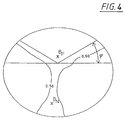
- This area is described by an ellipse with an extension of 50 mm in the horizontal and 40 mm in the vertical, specifically around a point that is 4 mm perpendicular to the centering cross. Outside of this ellipse there are only points that are either ground away when grinding into the socket or are used extremely rarely when viewed directly.
- An advantageous embodiment of the concept of the invention is achieved if it is ensured in the viewing points corresponding to binocular vision that spherical and astigmatic deviations have approximately the same values. It was found in internal wear tests that the spectacle wearer finds it pleasant when the right and left eyes have equivalent visual impressions.
- the binocular vision is impaired as little as possible in the area delimited by the above-mentioned ellipse.
- 0.5 cm / m is e.g. specified in RAL-RG 915 as permissible prismatic deviation for binocular vision.
- the astigmatic deviations are limited depending on the addition.
- the Restrictions are kept very small; With larger additions, it is advantageous to accept somewhat larger restrictions in order not to noticeably affect the other requirements.
- Another advantageous embodiment is to allow such an astigmatic deviation along the main line of sight that does not noticeably impair clear vision.
- the measured values can be read more easily and more precisely, the less the spherical and astigmatic deviations vary within the measuring circuits.
- measurements are usually made with a bundle diameter of about 7 mm, in the local measuring circle with a bundle diameter of about 4 mm.
- the multifocal spectacle lens has an advantageous embodiment if the prescribed near effect is already reached 1 mm above the near measuring point. The spherical deviations within the local measuring circle thus remain small.
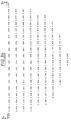
- FIGS. 1 to 3 An example according to the invention is shown in FIGS. 1 to 3.
- the long-range effect is 0.00 D and the addition is 2.00 D
- the material has a refractive index of 1,600, the center thickness is 2.5 mm and the thickness reduction prism is 1.25 cm / m with a base of 270 °.
- FIG. 1 shows the astigmatic deviations
- FIG. 2 shows the increase in the effect starting from the distance reference point
- FIG. 3 shows the arrow heights of the front surface, which produces the sliding effect, in a grid of 3 to 3 mm.
- the progressive lenses according to the invention can be calculated and executed in silicate or in organic material (e.g. CR39) with the refractive indices available in each case.
- the front, back or both surfaces of the progressive lens can be designed as progressive surfaces.
Landscapes
- Health & Medical Sciences (AREA)
- Ophthalmology & Optometry (AREA)
- Physics & Mathematics (AREA)
- General Health & Medical Sciences (AREA)
- General Physics & Mathematics (AREA)
- Optics & Photonics (AREA)
- Eyeglasses (AREA)
- Materials For Medical Uses (AREA)
- Prostheses (AREA)
Applications Claiming Priority (2)
| Application Number | Priority Date | Filing Date | Title |
|---|---|---|---|
| DE19612284 | 1996-03-28 | ||
| DE19612284A DE19612284A1 (de) | 1996-03-28 | 1996-03-28 | Multifokale Brillenlinse |
Publications (3)
| Publication Number | Publication Date |
|---|---|
| EP0802441A2 true EP0802441A2 (fr) | 1997-10-22 |
| EP0802441A3 EP0802441A3 (fr) | 1999-07-28 |
| EP0802441B1 EP0802441B1 (fr) | 2005-05-11 |
Family
ID=7789687
Family Applications (1)
| Application Number | Title | Priority Date | Filing Date |
|---|---|---|---|
| EP97104911A Expired - Lifetime EP0802441B1 (fr) | 1996-03-28 | 1997-03-22 | Lentille de lunettes multifocale |
Country Status (8)
| Country | Link |
|---|---|
| US (1) | US5784144A (fr) |
| EP (1) | EP0802441B1 (fr) |
| JP (1) | JPH1031198A (fr) |
| AT (1) | ATE295552T1 (fr) |
| AU (1) | AU717888B2 (fr) |
| CA (1) | CA2201391C (fr) |
| DE (2) | DE19612284A1 (fr) |
| ES (1) | ES2241013T3 (fr) |
Cited By (1)
| Publication number | Priority date | Publication date | Assignee | Title |
|---|---|---|---|---|
| US6709106B2 (en) | 2000-04-28 | 2004-03-23 | Carl-Zeiss-Stiftung | Method for the manufacture of a spectacle lens, spectacle lens and spectacle lens family |
Families Citing this family (17)
| Publication number | Priority date | Publication date | Assignee | Title |
|---|---|---|---|---|
| US6256098B1 (en) | 1998-11-23 | 2001-07-03 | Inray Ltd. | Method for determining and designing optical elements |
| US6661523B1 (en) | 1998-11-23 | 2003-12-09 | Inray Ltd. | Method for determining and designing optical elements |
| US6142627A (en) * | 1998-12-01 | 2000-11-07 | Sola International, Inc. | Short-corridor progressive lens |
| FR2788861B1 (fr) * | 1999-01-22 | 2001-03-30 | Essilor Int | Lentille ophtalmique multifocale progressive |
| ATE438880T1 (de) * | 1999-02-12 | 2009-08-15 | Hoya Corp | Brille und ihre herstellung |
| WO2001081982A2 (fr) * | 2000-04-25 | 2001-11-01 | Optische Werke G. Rodenstock | Verre de lunette progressif a faible effet de bascule |
| AU2001273857B9 (en) * | 2000-04-25 | 2005-07-07 | Rodenstock Gmbh | Progressive spectacle glass |
| ES2260233T3 (es) * | 2000-04-25 | 2006-11-01 | Rodenstock Gmbh | Metodo para calcular un cristal de gafas progresivo y metodo para la fabricacion de un cristal de gafas de este tipo. |
| US6655803B1 (en) | 2000-06-01 | 2003-12-02 | Inray Ltd. | Wavefront method for designing optical elements |
| JP4243335B2 (ja) * | 2002-10-17 | 2009-03-25 | セイコーオプティカルプロダクツ株式会社 | 累進屈折力レンズ |
| JP4229118B2 (ja) * | 2005-03-09 | 2009-02-25 | セイコーエプソン株式会社 | 累進屈折力レンズの設計方法 |
| DE102005023126B4 (de) * | 2005-05-19 | 2022-06-30 | Rodenstock Gmbh | Serie von Brillengläsern, Verfahren zur Herstellung |
| FR2895092B1 (fr) * | 2005-12-16 | 2008-02-29 | Essilor Int | Procede de determination d'une lentille ophtalmique. |
| FR2898993B1 (fr) * | 2006-03-24 | 2008-08-01 | Essilor Int | Procede de determination d'une lentille ophtalmique progressive |
| EP2075622A3 (fr) | 2007-11-27 | 2010-01-13 | Optofinanz AG | Lentilles ophtalmiques multifocales progressives à distribution constante |
| CN101952767B (zh) * | 2008-02-20 | 2014-04-02 | 瑞士风尼克斯股份有限公司 | 对于宽范围的折射率、基曲线和附加值同一地最优化的渐进多焦点眼镜片 |
| JP6294466B2 (ja) | 2014-03-31 | 2018-03-14 | ホヤ レンズ タイランド リミテッドHOYA Lens Thailand Ltd | 累進屈折力レンズの設計方法および製造方法、ならびに累進屈折力レンズ製造システム |
Family Cites Families (4)
| Publication number | Priority date | Publication date | Assignee | Title |
|---|---|---|---|---|
| DE3016935C2 (de) * | 1980-05-02 | 1991-01-24 | Fa. Carl Zeiss, 7920 Heidenheim | Multifokale Brillenlinse mit gebietsweise gleitendem Brechwert |
| DE4012609A1 (de) * | 1990-04-19 | 1991-10-24 | Zeiss Carl Fa | Gleitsichtflaeche fuer eine gleitsichtbrillenlinse |
| FR2683642B1 (fr) * | 1991-11-12 | 1994-01-14 | Essilor Internal Cie Gle Optique | Lentille ophtalmique multifocale progressive. |
| DE4210008A1 (de) * | 1992-03-27 | 1993-09-30 | Zeiss Carl Fa | Brillenlinse |
-
1996
- 1996-03-28 DE DE19612284A patent/DE19612284A1/de not_active Ceased
-
1997
- 1997-03-14 US US08/818,778 patent/US5784144A/en not_active Expired - Lifetime
- 1997-03-22 AT AT97104911T patent/ATE295552T1/de not_active IP Right Cessation
- 1997-03-22 ES ES97104911T patent/ES2241013T3/es not_active Expired - Lifetime
- 1997-03-22 EP EP97104911A patent/EP0802441B1/fr not_active Expired - Lifetime
- 1997-03-22 DE DE59712301T patent/DE59712301D1/de not_active Expired - Lifetime
- 1997-03-25 AU AU16531/97A patent/AU717888B2/en not_active Expired
- 1997-03-27 CA CA002201391A patent/CA2201391C/fr not_active Expired - Lifetime
- 1997-03-28 JP JP9092736A patent/JPH1031198A/ja active Pending
Cited By (1)
| Publication number | Priority date | Publication date | Assignee | Title |
|---|---|---|---|---|
| US6709106B2 (en) | 2000-04-28 | 2004-03-23 | Carl-Zeiss-Stiftung | Method for the manufacture of a spectacle lens, spectacle lens and spectacle lens family |
Also Published As
| Publication number | Publication date |
|---|---|
| ES2241013T3 (es) | 2005-10-16 |
| US5784144A (en) | 1998-07-21 |
| CA2201391C (fr) | 2006-07-25 |
| EP0802441A3 (fr) | 1999-07-28 |
| JPH1031198A (ja) | 1998-02-03 |
| ATE295552T1 (de) | 2005-05-15 |
| DE19612284A1 (de) | 1997-10-02 |
| DE59712301D1 (de) | 2005-06-16 |
| AU1653197A (en) | 1997-10-02 |
| AU717888B2 (en) | 2000-04-06 |
| EP0802441B1 (fr) | 2005-05-11 |
| CA2201391A1 (fr) | 1997-09-28 |
Similar Documents
| Publication | Publication Date | Title |
|---|---|---|
| DE3016935C2 (de) | Multifokale Brillenlinse mit gebietsweise gleitendem Brechwert | |
| EP0802441B1 (fr) | Lentille de lunettes multifocale | |
| DE69626797T2 (de) | Gleitsichtglas mit progressiver fläche und astigmatismuskorrektur auf der rückseite | |
| DE3430334C2 (de) | Progressives Brillenglas mit zwei asphärischen Flächen | |
| DE69737931T2 (de) | Progressive Linsen und Verfahren zu deren Entwurf und Verwendung | |
| DE69813803T3 (de) | Linse mit starker Krümmung für eine Brille | |
| DE60209114T2 (de) | Progressive additionslinsen | |
| DE102010007267B4 (de) | Linsenelement mit verbesserter prismatischer Wirkung sowie Verfahren zur Herstellung eines Linsenelements | |
| DE69931768T2 (de) | Dezentrierte schutzbrille | |
| EP0452802B1 (fr) | Surface progressive pour une lentille progressive | |
| DE4414106B4 (de) | Gleitsichtbrillenlinse | |
| DE3622757A1 (de) | Progressive mehrstaerkenlinse und diese verwendende brille | |
| DE3151766C2 (de) | Brillenglas mit einer Fern- und Nahsichtzone | |
| EP0165950B1 (fr) | Verre de lunettes a foyer progressif dote d'une focale positive elevee | |
| DE10247766B4 (de) | Gleitsichtbrillenglas | |
| DE8104023U1 (de) | Brillenglas mit zunehmender brennpunktverstaerkung | |
| DE60121667T2 (de) | Multifokal-Linse mit progressiver Brechkraft | |
| DE3433916A1 (de) | Brillenglas fuer eine halbbrille | |
| EP1091233B1 (fr) | Verre de lunettes à action progressive | |
| EP1488274B1 (fr) | Verre de lunettes progressif presentant deux surfaces aspheriques, notamment deux surfaces progressives | |
| EP1277077A2 (fr) | Verre de lunette progressif a faible effet de bascule | |
| DE69133517T2 (de) | Progressive linse | |
| EP1570309B1 (fr) | Procede de fabrication d'une paire de verres pour lunettes | |
| DE102006025398B4 (de) | Brillenglas und Brille | |
| EP1939668B1 (fr) | Verre de lunette progressif avec des différences d'agrandissement réduites |
Legal Events
| Date | Code | Title | Description |
|---|---|---|---|
| PUAI | Public reference made under article 153(3) epc to a published international application that has entered the european phase |
Free format text: ORIGINAL CODE: 0009012 |
|
| AK | Designated contracting states |
Kind code of ref document: A2 Designated state(s): AT CH DE ES FR GB IT LI NL SE |
|
| PUAL | Search report despatched |
Free format text: ORIGINAL CODE: 0009013 |
|
| AK | Designated contracting states |
Kind code of ref document: A3 Designated state(s): AT CH DE ES FR GB IT LI NL SE |
|
| 17P | Request for examination filed |
Effective date: 19991208 |
|
| 17Q | First examination report despatched |
Effective date: 20030327 |
|
| RAP1 | Party data changed (applicant data changed or rights of an application transferred) |
Owner name: CARL-ZEISS-STIFTUNG TRADING AS CARL ZEISS Owner name: CARL ZEISS |
|
| GRAP | Despatch of communication of intention to grant a patent |
Free format text: ORIGINAL CODE: EPIDOSNIGR1 |
|
| RAP1 | Party data changed (applicant data changed or rights of an application transferred) |
Owner name: CARL ZEISS AG |
|
| GRAS | Grant fee paid |
Free format text: ORIGINAL CODE: EPIDOSNIGR3 |
|
| GRAA | (expected) grant |
Free format text: ORIGINAL CODE: 0009210 |
|
| AK | Designated contracting states |
Kind code of ref document: B1 Designated state(s): AT CH DE ES FR GB IT LI NL SE |
|
| REG | Reference to a national code |
Ref country code: GB Ref legal event code: FG4D Free format text: NOT ENGLISH |
|
| REG | Reference to a national code |
Ref country code: CH Ref legal event code: EP |
|
| REF | Corresponds to: |
Ref document number: 59712301 Country of ref document: DE Date of ref document: 20050616 Kind code of ref document: P |
|
| REG | Reference to a national code |
Ref country code: SE Ref legal event code: TRGR |
|
| GBT | Gb: translation of ep patent filed (gb section 77(6)(a)/1977) |
Effective date: 20050719 |
|
| REG | Reference to a national code |
Ref country code: ES Ref legal event code: FG2A Ref document number: 2241013 Country of ref document: ES Kind code of ref document: T3 |
|
| PLBE | No opposition filed within time limit |
Free format text: ORIGINAL CODE: 0009261 |
|
| STAA | Information on the status of an ep patent application or granted ep patent |
Free format text: STATUS: NO OPPOSITION FILED WITHIN TIME LIMIT |
|
| ET | Fr: translation filed | ||
| 26N | No opposition filed |
Effective date: 20060214 |
|
| PGFP | Annual fee paid to national office [announced via postgrant information from national office to epo] |
Ref country code: SE Payment date: 20070313 Year of fee payment: 11 Ref country code: NL Payment date: 20070313 Year of fee payment: 11 Ref country code: AT Payment date: 20070313 Year of fee payment: 11 |
|
| EUG | Se: european patent has lapsed | ||
| PG25 | Lapsed in a contracting state [announced via postgrant information from national office to epo] |
Ref country code: NL Free format text: LAPSE BECAUSE OF NON-PAYMENT OF DUE FEES Effective date: 20081001 Ref country code: AT Free format text: LAPSE BECAUSE OF NON-PAYMENT OF DUE FEES Effective date: 20080322 |
|
| NLV4 | Nl: lapsed or anulled due to non-payment of the annual fee |
Effective date: 20081001 |
|
| PG25 | Lapsed in a contracting state [announced via postgrant information from national office to epo] |
Ref country code: SE Free format text: LAPSE BECAUSE OF NON-PAYMENT OF DUE FEES Effective date: 20080323 |
|
| REG | Reference to a national code |
Ref country code: FR Ref legal event code: PLFP Year of fee payment: 20 |
|
| PGFP | Annual fee paid to national office [announced via postgrant information from national office to epo] |
Ref country code: CH Payment date: 20160323 Year of fee payment: 20 Ref country code: ES Payment date: 20160309 Year of fee payment: 20 Ref country code: DE Payment date: 20160321 Year of fee payment: 20 |
|
| PGFP | Annual fee paid to national office [announced via postgrant information from national office to epo] |
Ref country code: GB Payment date: 20160321 Year of fee payment: 20 Ref country code: FR Payment date: 20160321 Year of fee payment: 20 |
|
| PGFP | Annual fee paid to national office [announced via postgrant information from national office to epo] |
Ref country code: IT Payment date: 20160324 Year of fee payment: 20 |
|
| REG | Reference to a national code |
Ref country code: DE Ref legal event code: R071 Ref document number: 59712301 Country of ref document: DE |
|
| REG | Reference to a national code |
Ref country code: CH Ref legal event code: PL |
|
| REG | Reference to a national code |
Ref country code: GB Ref legal event code: PE20 Expiry date: 20170321 |
|
| PG25 | Lapsed in a contracting state [announced via postgrant information from national office to epo] |
Ref country code: GB Free format text: LAPSE BECAUSE OF EXPIRATION OF PROTECTION Effective date: 20170321 |
|
| REG | Reference to a national code |
Ref country code: ES Ref legal event code: FD2A Effective date: 20170629 |
|
| PG25 | Lapsed in a contracting state [announced via postgrant information from national office to epo] |
Ref country code: ES Free format text: LAPSE BECAUSE OF EXPIRATION OF PROTECTION Effective date: 20170323 |