EP0802491B1 - Documents structurés sur le web - Google Patents
Documents structurés sur le web Download PDFInfo
- Publication number
- EP0802491B1 EP0802491B1 EP97302483A EP97302483A EP0802491B1 EP 0802491 B1 EP0802491 B1 EP 0802491B1 EP 97302483 A EP97302483 A EP 97302483A EP 97302483 A EP97302483 A EP 97302483A EP 0802491 B1 EP0802491 B1 EP 0802491B1
- Authority
- EP
- European Patent Office
- Prior art keywords
- page
- code
- hypertext page
- hypertext
- name
- Prior art date
- Legal status (The legal status is an assumption and is not a legal conclusion. Google has not performed a legal analysis and makes no representation as to the accuracy of the status listed.)
- Expired - Lifetime
Links
Images



Classifications
-
- G—PHYSICS
- G06—COMPUTING OR CALCULATING; COUNTING
- G06F—ELECTRIC DIGITAL DATA PROCESSING
- G06F16/00—Information retrieval; Database structures therefor; File system structures therefor
- G06F16/90—Details of database functions independent of the retrieved data types
- G06F16/95—Retrieval from the web
- G06F16/958—Organisation or management of web site content, e.g. publishing, maintaining pages or automatic linking
- G06F16/986—Document structures and storage, e.g. HTML extensions
Definitions
- the present invention relates to the presentation of structured documents in a hypertext browsing system and more particularly to the presentation of context information for a hypertext page.
- structured document viewing interfaces have been developed that display two panes, a first pane showing information desired by the user and a second pane showing a table of contents.
- the location of the information shown in the first pane is highlighted in the table of contents.
- the highlighted location must of course be updated every time new information is displayed in the first pane. Since the table of contents must be generated in advance for each page of information displayable in the first pane, it is normally very simplified, showing only the largest divisions of the structured document.
- a computer-implemented method for presenting hypertext page context information comprising retrieving a selected hypertext page of a structured document, for automatically developing information showing a context of said selected hypertext page within said structured document including extracting information identifying a parent of said selected hypertext page from a selected tag within said hypertext page.
- This information showing a context may include a table of contents showing the location of the selected hypertext page in relationship to other hypertext pages.
- this context information is inserted into the hypertext page.
- the so-modified hypertext page may then be transmitted to a remote location for display. Since the context information is automatically developed after retrieval, it need not be manually generated and maintained. For WWW applications, the hypertext page with the context information inserted remains in the HTML format viewable by standard browsers. The present innovation thus provides a powerful and convenient system for browsing through structured documents.
- the table-of-contents information is presented in a "fisheye" view at the top of the hypertext page.
- the system concatenates the HTML source for that page with a fisheye view of the table-of-contents.
- the resulting string of HTML text is sent over a network to the user's web browser where it may be displayed.
- the table-of-contents display may include the names of other pages of the structured document.
- the present invention provides many possible techniques for obtaining these names.
- a table-of-contents database may be maintained including these names. The names could be retrieved from the HTML title or heading tags of the pages. Also, the filename of a page could be used as a name.
- the structured document has a tree structure.
- a single root page has one or more children and so on.
- the fisheye table-of-contents view shows up the names of each parent of the presently displayed page up until the root page as well as the names of "sibling" pages, i.e., pages that share a common first generation parent.
- the present invention also provides many further techniques for determining the parents of a selected page. For example, the parents of a particular page may be determined by consulting a table-of-contents database. If the pages are stored within a hierarchical file system, the parent could be defined as the file stored in the same directory as the page with a special filename such as "index.html". If there is no such file, the parent directory of the directory holding the selected page is searched for such a file. If the parent directory has no such file, the first file in the parent directory having a particular suffix, such as ".html" is identified as the parent page. Otherwise, the selected page is determined to be the root page.
- Fig. 1A depicts a block diagram of a host computer system suitable for implementing the present invention.
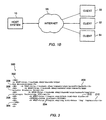
- Fig. 1B depicts the interconnection of the host computer system to remote clients.
- Fig. 2 is a hypertext page display modified in accordance with one embodiment of the present invention to include a "fisheye" table-of-contents.
- Fig. 3 is a segment of HTML code inserted to generate the table-of-contents of Fig. 2.
- Fig. 4 is a flowchart describing steps of identifying a parent of a selected page of a structured document in accordance with one embodiment of the present invention.
- Fig. 5 is a flowchart describing steps of obtaining a name of a selected page of a structured document in accordance with one embodiment of the present invention.
- Fig. 1A depicts a block diagram of a host computer system 10 suitable for implementing the present invention.
- Host computer system 10 includes a bus 12 which interconnects major subsystems such as a central processor 14, a system memory 16 (typically RAM), an input/output (I/O) controller 18, an external device such as a display screen 24 via display adapter 26, serial ports 28 and 30, a keyboard 32, a storage interface 34, a floppy disk drive 36 operative to receive a floppy disk 38, and a CD-ROM player 40 operative to receive a CD-ROM 42.
- Storage interface 34 may connect to a fixed disk drive 44. Fixed disk drive 44 may be a part of host computer system 10 or may be separate and accessed through other interface systems.
- Network interface 48 may provide a direct connection to a remote server via a telephone link or to the Internet via a POP (point of presence). Many other devices or subsystems (not shown) may be connected in a similar manner.
- Fig. 1A it is not necessary for all of the devices shown in Fig. 1A to be present to practice the present invention, as discussed below.
- the devices and subsystems may be interconnected in different ways from that shown in Fig. 1A.
- the operation of a computer system such as that shown in Fig. 1A is readily known in the art and is not discussed in detail in this application.
- Code to implement the present invention may be operably disposed or stored in computer-readable storage media such as system memory 16, fixed disk 44, CD-ROM 42, or floppy disk 38.
- Fig. 1B depicts the interconnection of host computer system 10 to client systems 50, 52, and 54.
- Fig. 1B depicts the Internet 56 interconnecting client systems 50, 52, and 54.
- Modem 48 or some other network interface provides the connection from host computer system 10 to the Internet 56.
- Protocols for exchanging data via the Internet are well known and need not be discussed herein.
- Fig. 1B depicts the use of the Internet for exchanging data, the present invention is not limited to the Internet or any network-based environment for that matter.
- host computer system 10 has access to a structured document via storage interface 34.
- the structured document includes many pages, each typically stored in a separate file.
- an HTTP server operates on host computer system 10 and these files are typically in HTML format.
- the document has a tree structure with a single root page that has one or more child pages. Each child page in turn may have one or more children of its own. Thus, each page in the structured document can trace its ancestry to the root through one or more parents. Many pages in the structured document may have siblings, that is other pages that share a common first generation parent.
- This structure is merely representative and other structures may be accommodated within the scope of the present invention.
- Client systems 50, 52, and 54 operate hypertext browsers configured to access host computer system 10 over the Internet 56 and to retrieve selected pages of the structured document for local display.
- One aspect of the present invention provides automatic generation of context information at host system 10 for a selected page. The context information may then be inserted into the page prior to transmission to the requesting client system.
- FIG. 2 is a hypertext page display 200 modified in accordance with one embodiment of the present invention to include a fisheye table-of-contents 202.
- Display 200 shows the inventor's home page on the WWW which is one page in a structured document.
- Table-of-contents 202 includes a list of names including a name 204 of the currently displayed page, names 208 of parent pages of the currently displayed page, and names 210 of other pages having the same first generation parent as the currently displayed page, i.e., sibling pages.
- Name 204 appears in bold print to signify that it represents the currently displayed page.
- Names 208 and 210 appear as highlighted links that when activated take the user to the identified pages.
- Table-of-contents 202 is thus an extremely useful tool for understanding the overall structure of the document and navigating through it.
- the user shifts to a new page in the structured document, he or she sees an updated table-of-contents display that reflects the context of the newly displayed page.
- Table-of-contents 202 represents only one possible arrangement of context information within the scope of the present invention.
- an alternative arrangement is to display only the chain of ancestry to the root and not the sibling pages.
- Another alternative arrangement is to display only a portion of the chain of ancestry but to also display all descendants of the second generation parent of the selected page.
- table-of-contents 202 may be substituted for table-of-contents 202.
- the present invention may provide a display listing other buildings near the location of the particular building as well as other buildings designed by the same architect.
- Host system 10 automatically generates table-of-contents 202 by concatenating appropriate HTML code with a requested page prior to transmission to the requesting client.
- Fig. 3 shows a segment 300 of HTML code inserted to generate table-of-contents display 202 of Fig. 2. Subsegments of segment 300 are identified with the reference designators of Fig. 2 pointing to the corresponding text produced for display.
- ⁇ PRE> tag 302 and ⁇ /PRE> tag 304 identify the HTML code of Fig. 3 as being preformatted text. Name 204 denoting the currently displayed page is marked for ⁇ STRONG> formatting which typically appears as bold text. The remainder of the names are given within link anchor tags which include URLs of the identified pages.
- An explanation of HTML format for encoding web pages is found in Morris, HTML for Fun and Profit , (SunSoft Press 1995).
- a document structure database accessible to host system 10 facilitates automatic generation of the HTML code of Fig. 3.
- the document structure database includes for each page, information about its name, information about its parent or the fact that it is a root page, and information about its children.
- Information about the parent and children of a page may also be embedded within a special HTML tag within the page.
- Fig. 4 is a flowchart describing steps of identifying a parent of a selected page of a structured document in accordance with one embodiment of the present invention.
- the document structure database is checked to see if the parent is identified there. If the parent is identified in the document structure database, the identity of the parent is extracted from the database at step 404. If the parent is not identified in the document structure database (or if there is no such database available), the selected page is scanned for the special META tag described above at step 406. If such a tag is available, the identity of the parent is extracted from the tag at step 408.
- the next step 410 is to search for a file with a special filename, preferably "index.html" in the same directory as the selected page.
- This file is normally the master file of the directory (it typically contains home page or index information) and thus may serve as a parent. If such a file is found in the same directory as the selected page, this file is identified to be the parent at step 412. If such a file is not found, at step 414, the directory of the selected page is checked to see if it is in fact the root directory of the hypertext documents served by the HTTP server at host system 10.
- the current page is determined at step 416 to have no parent page. If the directory of the selected page is not the root directory, searching for the parent page continues at step 418 where the parent directory of the directory containing the selected page is also checked for the file with the special filename. If this file is found, it is identified to be the parent of the selected page at step 420. If no such file is found, as a fallback the parent directory is searched for any file having a special suffix, preferably ".html", at step 422. If one or more such files are found in the parent directory, the one first in alphabetical order is identified to be the parent at step 424. If no such file is found, the selected page is determined to have no parent page at step 426.
- the procedure of Fig. 4 is constructed to maximize the chances of identifying a page that can be said to represent the parent of the selected page even when the document structure is not precisely defined.
- the procedure for identifying a child page is similar to steps 402 through 406 of Fig. 4. Children are identified from the database if possible, and otherwise from the "child" meta tags if available or as the other files in the same directory as the "index.html" file. In this last case (other files in the same directory), the files are scanned for the presence of a "parent" meta tag. A file is considered to be a child if it either does not have a parent meta tag or has a "parent" meta tag with the value equal to the parent file. Once a first generation parent of a selected page is found, children of the first generation parent are identified in this way to find the siblings of the selected page.
- Fig. 5 is a flowchart describing steps of obtaining a name of a selected page of a structured document in accordance with one embodiment of the present invention.
- the document structure database is searched for the name. If the name is found, it is extracted from the database at step 504. If the name is not found (or if there is no such database in the embodiment), the HTML source code for the selected page is searched for a ⁇ TITLE> tag at step 506. If the name is found in the ⁇ TITLE> tag, it is extracted at step 508. If the name is not found in the database, the HTML source is searched for a first level heading tag, i.e., an ⁇ Hl> tag at step 510.
- a first level heading tag i.e., an ⁇ Hl> tag
- the name is extracted from it at step 512. If such a tag is not found, the HTML source is searched for a heading tag of any level, i.e., an ⁇ Hn> tag at step 514. If any such tag is found, the user's name is extracted from the first one in the source at step 516. If no such tag is found, the selected page's file name is identified to be the name at step 518. This procedure maximizes the chances of obtaining a name that characterizes the contents of the page.
- host system 10 may construct a code segment as in Fig. 3 and concatenate it to the HTML source of the selected page. Host system 10 may then transmit the selected page to a requesting client where it is viewable by any HTML browser. Prior to transmission, host system 10 may remove any special META tags from the HTML source.
- routines include one or more steps performed by software routines executing in a computer system.
- the routines may be implemented by any means as is known in the art.
- any number of computer programming languages such as Java, "C”, Pascal, FORTRAN, assembly language, etc.
- various programming approaches such as procedural, object oriented or artificial intelligence techniques may be employed.
Landscapes
- Engineering & Computer Science (AREA)
- Databases & Information Systems (AREA)
- Theoretical Computer Science (AREA)
- Data Mining & Analysis (AREA)
- Physics & Mathematics (AREA)
- General Engineering & Computer Science (AREA)
- General Physics & Mathematics (AREA)
- Information Retrieval, Db Structures And Fs Structures Therefor (AREA)
- Information Transfer Between Computers (AREA)
- Computer And Data Communications (AREA)
Claims (30)
- Procédé mis en oeuvre par ordinateur pour présenter une information de contexte de page d'hypertexte, comprenant :caractérisé en ce quela restitution d'une page d'hypertexte sélectionnée d'un document structuré, etle développement automatique d'une information (202) représentant un contexte de la page d'hypertexte sélectionnée à l'intérieur du document structuré,
l'étape de développement automatique comprend :l'extraction d'une information identifiant un parent de la page d'hypertexte sélectionnée, à partir d'une étiquette sélectionnée à l'intérieur de la page d'hypertexte sélectionnée. - Procédé selon la revendication 1,
caractérisé en ce que
le document structuré comprend un certain nombre de pages se présentant sous la forme de fichiers HTML, les pages étant dans une structure d'arbre dans laquelle chaque page descend d'une page d'origine par l'intermédiaire d'un ou plusieurs parents ; et l'étape de développement automatique comprend :le développement automatique d'une information (208) identifiant les parents de la page d'hypertexte sélectionnée. - Procédé selon la revendication 2,
caractérisé en ce que
le développement automatique comprend en outre :l'extraction d'une information identifiant un parent de la page d'hypertexte sélectionnée provenant d'une base de données de structure de document du document structuré. - Procédé selon la revendication 2,
caractérisé en ce que
la page d'hypertexte est stockée sous la forme d'un fichier à l'intérieur d'une structure de répertoire ; et l'étape de développement automatique comprend en outre :la recherche d'un fichier d'indices à l'intérieur de la structure de répertoire commençant par un répertoire du fichier de page d'hypertexte, et le déplacement vers le haut de la structure de répertoire jusqu'à ce que le fichier d'indices soit trouvé, etl'identification du fichier d'indices comme étant un parent de la page d'hypertexte. - Procédé selon la revendication 1,
caractérisé en ce que
le document structuré comprend un certain nombre de pages se présentant sous la forme de fichiers HTML, les pages étant dans une structure d'arbre dans laquelle chaque page descend d'une page d'origine par l'intermédiaire d'un ou plusieurs parents ; et l'étape de développement automatique comprend :le développement automatique d'une information (202) identifiant d'autres pages d'hypertexte étant descendues d'un parent de la page d'hypertexte sélectionnée. - Procédé selon la revendication 1,
caractérisé en ce que
le développement automatique comprend :le développement d'un nom (208) d'une autre page d'hypertexte à l'intérieur du document structuré. - Procédé selon la revendication 6,
caractérisé en ce que
le nom (208) est obtenu par :restitution (504) du nom à partir d'une base de données de structure de document du document structuré. - Procédé selon la revendication 6,
caractérisé en ce que
le nom (208) est obtenu par :extraction (508) d'un titre dans l'autre page d'hypertexte. - Procédé selon la revendication 6,
caractérisé en ce que
le nom (208) est obtenu par :extraction (518) d'un nom de fichier de l'autre page d'hypertexte. - Procédé selon la revendication 6,
caractérisé en ce que
l'autre page d'hypertexte est en format HTML et le nom (208) est obtenu par :extraction (516) du nom à partir d'une étiquette d'en-tête dans l'autre page d'hypertexte. - Procédé selon la revendication 1,
caractérisé en ce qu'
il comprend en outre:l'insertion de l'information (202) dans le haut de la page d'hypertexte sélectionnée. - Procédé selon la revendication 11,
caractérisé en ce qu'
il comprend en outre:la transmission, par l'intermédiaire d'un réseau, de la page d'hypertexte sélectionnée (200) telle que modifiée dans l'étape d'insertion. - Procédé selon la revendication 1,
caractérisé en ce qu'
il comprend en outre:la création d'un code HTML décrivant le contexte, etl'annexion du code HTML à un fichier HTML décrivant la page d'hypertexte. - Procédé selon la revendication 1,
caractérisé en ce que
le document structuré est une page sur le web (toile informatique) mondial. - Procédé selon l'une quelconque des revendications 1 à 14,
caractérisé en ce que
la page d'hypertexte est en format HTML. - Procédé selon l'une quelconque des revendications 1 à 15,
caractérisé en ce que
l'étape de développement automatique de l'information (202) comprend en outre l'étape consistant à :retirer l'étiquette sélectionnée de la page d'hypertexte sélectionnée. - Produit de programme d'ordinateur pour présenter une information de contexte de page d'hypertexte, ce produit comprenant :caractérisé en ce qu'un support lisible par ordinateur, qui stocke le code,un code qui restitue une page d'hypertexte sélectionnée d'un document structuré, etun code qui développe automatiquement une information (202) représentant un contexte de la page d'hypertexte sélectionnée à l'intérieur du document structuré,
il comprend un code qui extrait une information identifiant un parent de la page d'hypertexte sélectionnée à partir d'une étiquette sélectionnée à l'intérieur de la page d'hypertexte sélectionnée. - Produit selon la revendication 17,
caractérisé en ce que
le document structuré comprend une structure d'arbre dans laquelle chaque page descend d'une page d'origine par l'intermédiaire d'un ou plusieurs parents, et le code se développant automatiquement comprend :un code qui développe automatiquement l'information identifiant les parents de la page d'hypertexte sélectionnée. - Produit selon la revendication 18,
caractérisé en ce que
le code se développant automatiquement comprend en outre :un code qui extrait l'information i'dentifiant un parent de la page d'hypertexte sélectionnée à partir d'une base de données de table de contenu du document structuré. - Produit selon la revendication 18,
caractérisé en ce que
la page d'hypertexte est stockée sous la forme d'un fichier à l'intérieur d'une structure de répertoire, et le code se développant automatiquement comprend en outre :un code qui recherche (410) un fichier d'indices à l'intérieur de la structure de répertoire en commençant par un répertoire du fichier de page d'hypertexte et en se déplaçant vers le haut de la structure de répertoire jusqu'à ce que le fichier d'indices soit trouvé, etun code qui identifie (412) le fichier d'indices comme étant un parent de la page d'hypertexte. - Produit selon la revendication 18,
caractérisé en ce que
le document structuré comprend une structure d'arbre dans laquelle chaque page descend d'une page d'origine par l'intermédiaire d'un ou plusieurs parents, et le code se développant automatiquement comprend :un code qui développe automatiquement l'information identifiant d'autres pages d'hypertexte descendues d'un parent de la page d'hypertexte sélectionnée. - Produit selon la revendication 17,
caractérisé en ce que
le code se développant automatiquement comprend:un code qui obtient un nom (208) d'une autre page d'hypertexte à l'intérieur du document structuré. - Produit selon la revendication 22,
caractérisé en ce que
le code d'obtention de nom comprend :un code qui retrouve (508) le nom (208) à partir d'une base de données de structure de document du document structuré. - Produit selon la revendication 22,
caractérisé en ce que
le code d'obtention de nom comprend :un code qui extrait (508) un titre dans l'autre page d'hypertexte. - Produit selon la revendication 22,
caractérisé en ce que
le code d'obtention de nom comprend :un code qui extrait un nom de fichier de l'autre page d'hypertexte. - Produit selon la revendication 22,
caractérisé en ce que
l'autre page d'hypertexte est en format HTML et le code d'obtention de nom comprend :un code qui extrait (516) une étiquette d'en-tête dans l'autre page d'hypertexte. - Produit selon la revendication 17,
caractérisé en ce qu'
il comprend en outre un code qui insère l'information dans le haut de la page d'hypertexte sélectionnée. - Produit selon la revendication 27,
caractérisé en ce qu'
il comprend en outre un code qui transmet la page d'hypertexte sélectionnée (200) telle que modifiée par le code d'insertion, la transmission se faisant par l'intermédiaire d'un réseau. - Produit selon l'une quelconque des revendications 17 à 28,
caractérisé en ce que
la page d'hypertexte sélectionnée est en format HTML. - Produit selon l'une quelconque des revendications 17 à 29,
caractérisé en ce que
le code qui développe automatiquement l'information (202) comprend un code qui retire l'étiquette sélectionnée de la page d'hypertexte sélectionnée.
Applications Claiming Priority (2)
| Application Number | Priority Date | Filing Date | Title |
|---|---|---|---|
| US633915 | 1990-12-26 | ||
| US08/633,915 US6003046A (en) | 1996-04-15 | 1996-04-15 | Automatic development and display of context information in structured documents on the world wide web |
Publications (3)
| Publication Number | Publication Date |
|---|---|
| EP0802491A2 EP0802491A2 (fr) | 1997-10-22 |
| EP0802491A3 EP0802491A3 (fr) | 1999-06-16 |
| EP0802491B1 true EP0802491B1 (fr) | 2005-03-16 |
Family
ID=24541668
Family Applications (1)
| Application Number | Title | Priority Date | Filing Date |
|---|---|---|---|
| EP97302483A Expired - Lifetime EP0802491B1 (fr) | 1996-04-15 | 1997-04-11 | Documents structurés sur le web |
Country Status (4)
| Country | Link |
|---|---|
| US (1) | US6003046A (fr) |
| EP (1) | EP0802491B1 (fr) |
| JP (1) | JPH10116221A (fr) |
| DE (1) | DE69732733D1 (fr) |
Families Citing this family (58)
| Publication number | Priority date | Publication date | Assignee | Title |
|---|---|---|---|---|
| GB2300991B (en) * | 1995-05-15 | 1997-11-05 | Andrew Macgregor Ritchie | Serving signals to browsing clients |
| US5940834A (en) * | 1997-03-13 | 1999-08-17 | Mitel Corporation | Automatic web page generator |
| US6353824B1 (en) | 1997-11-18 | 2002-03-05 | Apple Computer, Inc. | Method for dynamic presentation of the contents topically rich capsule overviews corresponding to the plurality of documents, resolving co-referentiality in document segments |
| US7865546B1 (en) * | 1998-01-26 | 2011-01-04 | New York University | Method and appartus for monitor and notification in a network |
| US6085188A (en) * | 1998-03-30 | 2000-07-04 | International Business Machines Corporation | Method of hierarchical LDAP searching with relational tables |
| US7770123B1 (en) * | 1998-05-08 | 2010-08-03 | Apple Inc. | Method for dynamically generating a “table of contents” view of a HTML-based information system |
| US6665836B1 (en) * | 1998-06-17 | 2003-12-16 | Siemens Corporate Research, Inc. | Method for managing information on an information net |
| US6757868B1 (en) * | 1998-06-22 | 2004-06-29 | International Business Machines Corporation | Programmatic switching of arbitrary HTML forms |
| CA2241836A1 (fr) * | 1998-06-29 | 1999-12-29 | Object Technology International Inc. | Transformations du langage naturel pour la propagation de changements aux references hypertextes |
| JP3715444B2 (ja) * | 1998-06-30 | 2005-11-09 | 株式会社東芝 | 構造化文書保存方法及び構造化文書保存装置 |
| JP4095739B2 (ja) * | 1999-04-16 | 2008-06-04 | インターナショナル・ビジネス・マシーンズ・コーポレーション | ウェブサイト閲覧方法、ウェブサイト閲覧システム、コンピュータ、および記憶媒体 |
| US6434738B1 (en) * | 1999-04-22 | 2002-08-13 | David Arnow | System and method for testing computer software |
| WO2000079435A1 (fr) * | 1999-06-23 | 2000-12-28 | The Brodia Group | Systeme d'identification d'un site |
| WO2001024053A2 (fr) * | 1999-09-28 | 2001-04-05 | Xmlexpress, Inc. | Systeme et procede permettant la creation automatique de contextes destines a des documents electroniques |
| US7523158B1 (en) * | 2000-05-12 | 2009-04-21 | Oracle International Corporation | System and method for partial page updates using a proxy element |
| US6654737B1 (en) * | 2000-05-23 | 2003-11-25 | Centor Software Corp. | Hypertext-based database architecture |
| US7822735B2 (en) * | 2000-05-29 | 2010-10-26 | Saora Kabushiki Kaisha | System and method for saving browsed data |
| US6675202B1 (en) * | 2000-05-30 | 2004-01-06 | Cary D. Perttunen | Methods, articles and apparatus for providing a browsing session |
| US7328275B1 (en) * | 2000-05-30 | 2008-02-05 | Perttunen Cary D | Wirelessly retrieving and locally caching child and sibling items in a browsing session |
| US6606102B1 (en) | 2000-06-02 | 2003-08-12 | Gary Odom | Optimizing interest potential |
| US7210099B2 (en) | 2000-06-12 | 2007-04-24 | Softview Llc | Resolution independent vector display of internet content |
| US7136880B2 (en) * | 2000-07-20 | 2006-11-14 | Market Models, Inc. | Method and apparatus for compiling business data |
| US6625596B1 (en) * | 2000-07-24 | 2003-09-23 | Centor Software Corporation | Docubase indexing, searching and data retrieval |
| US6826555B2 (en) * | 2000-07-24 | 2004-11-30 | Centor Software Corporation | Open format for file storage system indexing, searching and data retrieval |
| US8397163B1 (en) | 2000-08-14 | 2013-03-12 | Deep Sran | Device, method, and system for providing an electronic reading environment |
| JP2002108756A (ja) * | 2000-09-28 | 2002-04-12 | Hitachi Ltd | ユーザインタフェース統合方法 |
| US20020059458A1 (en) * | 2000-11-10 | 2002-05-16 | Deshpande Sachin G. | Methods and systems for scalable streaming of images with server-side control |
| US7206804B1 (en) | 2000-11-10 | 2007-04-17 | Sharp Laboratories Of America, Inc. | Methods and systems for transmitting digital images |
| US7260614B2 (en) * | 2000-11-10 | 2007-08-21 | Sharp Laboratories Of America | Methods and systems for scalable streaming of images with client-side control |
| WO2002046878A2 (fr) * | 2000-12-06 | 2002-06-13 | American Express Travel Related Services Company, Inc. | Systeme et procede de creation de mise en page |
| US20020083096A1 (en) * | 2000-12-18 | 2002-06-27 | Hsu Liang Hua | System and method for generating structured documents and files for network delivery |
| US20020169803A1 (en) * | 2000-12-18 | 2002-11-14 | Sudarshan Sampath | System and user interface for generating structured documents |
| US6963930B2 (en) * | 2001-02-15 | 2005-11-08 | Centric Software, Inc. | Automatic transfer and expansion of application-specific data for display at a website |
| JP3475186B2 (ja) * | 2001-03-21 | 2003-12-08 | 株式会社ニチベイ | ブラインド、ブラインド用スラット、その製造方法及びその成形加工機 |
| US20020147775A1 (en) * | 2001-04-06 | 2002-10-10 | Suda Aruna Rohra | System and method for displaying information provided by a provider |
| US20040240642A1 (en) * | 2001-06-18 | 2004-12-02 | Crandell Jeffrey L. | Apparatus, systems and methods for managing incoming and outgoing communication |
| US20030131314A1 (en) * | 2002-01-04 | 2003-07-10 | Lin Pin Feng | Method of open selected files by converting paths of the files into addresses |
| US7120641B2 (en) * | 2002-04-05 | 2006-10-10 | Saora Kabushiki Kaisha | Apparatus and method for extracting data |
| US20030195896A1 (en) * | 2002-04-15 | 2003-10-16 | Suda Aruna Rohra | Method and apparatus for managing imported or exported data |
| US20030225858A1 (en) * | 2002-05-30 | 2003-12-04 | International Business Machines Corporation | Method and apparatus for traversing Web pages in a network data processing system |
| US20040061717A1 (en) * | 2002-09-30 | 2004-04-01 | Menon Rama R. | Mechanism for voice-enabling legacy internet content for use with multi-modal browsers |
| US7689902B1 (en) | 2002-10-30 | 2010-03-30 | Siemens Product Lifecycle Management Software Inc. | Unified management of contextual information for a user interaction in an HTML interface |
| DE10316663A1 (de) * | 2003-04-10 | 2004-11-04 | Wittkötter, Erland, Dr. | Vorrichtung und Verfahren zur kontextabhängigen Verwaltung von Internet Ressourcen |
| JP4602650B2 (ja) * | 2003-07-31 | 2010-12-22 | インターナショナル・ビジネス・マシーンズ・コーポレーション | ナビゲーション生成装置およびプログラム |
| US7650324B2 (en) * | 2005-08-25 | 2010-01-19 | Sap Ag. | Methods and systems for providing context-based reference information |
| US8775194B2 (en) * | 2005-10-07 | 2014-07-08 | Hewlett-Packard Development Company, L.P. | System, method, and computer program product for context-based business process management |
| CN101042694B (zh) * | 2006-03-21 | 2011-06-08 | 松下电器产业株式会社 | 在浏览网页时访问父页面的方法 |
| US20080059429A1 (en) * | 2006-09-05 | 2008-03-06 | Go Kojima | Integrated search processing method and device |
| WO2008121986A1 (fr) * | 2007-03-30 | 2008-10-09 | Google Inc. | Traitement de documents pour dispositifs mobiles |
| US7870484B2 (en) * | 2007-06-04 | 2011-01-11 | Microsoft Corporation | Page flow framework |
| EP2096561B1 (fr) | 2008-02-28 | 2012-06-06 | The European Union, represented by the European Commission | Procédé pour l'extraction d'un contenu pertinent à partir d'un fichier de langage de marquage, en particulier à partir d'un fichier HTML |
| US8156419B2 (en) * | 2008-07-17 | 2012-04-10 | International Business Machines Corporation | Intelligent preloads of views and asynchronous loading of models using the MVC design pattern |
| US9251281B2 (en) * | 2008-07-29 | 2016-02-02 | International Business Machines Corporation | Web browsing using placemarks and contextual relationships in a data processing system |
| JP5071470B2 (ja) * | 2009-12-18 | 2012-11-14 | コニカミノルタビジネステクノロジーズ株式会社 | 電子文書管理装置およびプログラム |
| US8707393B2 (en) * | 2011-05-09 | 2014-04-22 | Cleversafe, Inc. | Providing dispersed storage network location information of a hypertext markup language file |
| US8402375B1 (en) * | 2011-09-19 | 2013-03-19 | Google Inc. | System and method for managing bookmark buttons on a browser toolbar |
| WO2015141101A1 (fr) * | 2014-03-20 | 2015-09-24 | 日本電気株式会社 | Dispositif, procédé et programme de traitement d'informations |
| KR20150111221A (ko) * | 2014-03-25 | 2015-10-05 | 삼성전자주식회사 | 페이지 구성 방법 및 이를 지원하는 전자장치 |
Family Cites Families (19)
| Publication number | Priority date | Publication date | Assignee | Title |
|---|---|---|---|---|
| US5072412A (en) * | 1987-03-25 | 1991-12-10 | Xerox Corporation | User interface with multiple workspaces for sharing display system objects |
| CA2048039A1 (fr) * | 1991-07-19 | 1993-01-20 | Steven Derose | Systeme et methode de traitement de donnees pour produire une representation de documents electroniques et consulter ces derniers |
| US5632022A (en) * | 1991-11-13 | 1997-05-20 | The United States Of America As Represented By The Administrator Of The National Aeronautics And Space Administration | Encyclopedia of software components |
| US5499329A (en) * | 1992-04-30 | 1996-03-12 | Ricoh Company, Ltd. | Method and system to handle context of interpretation in a document processing language |
| US5619632A (en) * | 1994-09-14 | 1997-04-08 | Xerox Corporation | Displaying node-link structure with region of greater spacings and peripheral branches |
| US5615325A (en) * | 1994-09-29 | 1997-03-25 | Intel Corporation | Graphical viewer for heirarchical datasets |
| US5546517A (en) * | 1994-12-07 | 1996-08-13 | Mitsubishi Electric Information Technology Center America, Inc. | Apparatus for determining the structure of a hypermedia document using graph partitioning |
| US5530852A (en) * | 1994-12-20 | 1996-06-25 | Sun Microsystems, Inc. | Method for extracting profiles and topics from a first file written in a first markup language and generating files in different markup languages containing the profiles and topics for use in accessing data described by the profiles and topics |
| US5801702A (en) * | 1995-03-09 | 1998-09-01 | Terrabyte Technology | System and method for adding network links in a displayed hierarchy |
| US5793966A (en) * | 1995-12-01 | 1998-08-11 | Vermeer Technologies, Inc. | Computer system and computer-implemented process for creation and maintenance of online services |
| US5749080A (en) * | 1995-06-05 | 1998-05-05 | Shigeru Matsumoto | Data retrieval method and link-information adding method |
| US5649186A (en) * | 1995-08-07 | 1997-07-15 | Silicon Graphics Incorporated | System and method for a computer-based dynamic information clipping service |
| US5745360A (en) * | 1995-08-14 | 1998-04-28 | International Business Machines Corp. | Dynamic hypertext link converter system and process |
| US5758361A (en) * | 1996-03-20 | 1998-05-26 | Sun Microsystems, Inc. | Document editor for linear and space efficient representation of hierarchical documents |
| JP3108015B2 (ja) * | 1996-05-22 | 2000-11-13 | 松下電器産業株式会社 | ハイパーテキスト検索装置 |
| US5724595A (en) * | 1996-06-19 | 1998-03-03 | Sun Microsystems, Inc. | Simple method for creating hypertext links |
| US5845299A (en) * | 1996-07-29 | 1998-12-01 | Rae Technology Llc | Draw-based editor for web pages |
| US5826258A (en) * | 1996-10-02 | 1998-10-20 | Junglee Corporation | Method and apparatus for structuring the querying and interpretation of semistructured information |
| US5818446A (en) * | 1996-11-18 | 1998-10-06 | International Business Machines Corporation | System for changing user interfaces based on display data content |
-
1996
- 1996-04-15 US US08/633,915 patent/US6003046A/en not_active Expired - Lifetime
-
1997
- 1997-04-11 EP EP97302483A patent/EP0802491B1/fr not_active Expired - Lifetime
- 1997-04-11 DE DE69732733T patent/DE69732733D1/de not_active Expired - Fee Related
- 1997-04-15 JP JP9111753A patent/JPH10116221A/ja active Pending
Also Published As
| Publication number | Publication date |
|---|---|
| EP0802491A3 (fr) | 1999-06-16 |
| JPH10116221A (ja) | 1998-05-06 |
| US6003046A (en) | 1999-12-14 |
| EP0802491A2 (fr) | 1997-10-22 |
| DE69732733D1 (de) | 2005-04-21 |
Similar Documents
| Publication | Publication Date | Title |
|---|---|---|
| EP0802491B1 (fr) | Documents structurés sur le web | |
| US6055544A (en) | Generation of chunks of a long document for an electronic book system | |
| US6199098B1 (en) | Method and apparatus for providing an expandable, hierarchical index in a hypertextual, client-server environment | |
| US6792475B1 (en) | System and method for facilitating the design of a website | |
| US8359550B2 (en) | Method for dynamically generating a “table of contents” view of the HTML-based information system | |
| US6167409A (en) | Computer system and method for customizing context information sent with document fragments across a computer network | |
| US6148311A (en) | Web site construction by inferring navigational structure from physical file structure | |
| US6546406B1 (en) | Client-server computer system for large document retrieval on networked computer system | |
| US8181102B2 (en) | Creating bookmark symlinks | |
| US6061700A (en) | Apparatus and method for formatting a web page | |
| US6226655B1 (en) | Method and apparatus for retrieving data from a network using linked location identifiers | |
| US8826121B2 (en) | Magnifying the text of a link while still retaining browser function in the magnified display | |
| US6516312B1 (en) | System and method for dynamically associating keywords with domain-specific search engine queries | |
| US6191786B1 (en) | Navigational file system | |
| US8554786B2 (en) | Document information management system | |
| US6654737B1 (en) | Hypertext-based database architecture | |
| US7058944B1 (en) | Event driven system and method for retrieving and displaying information | |
| US7428705B2 (en) | Web map tool | |
| US20090094327A1 (en) | Method and apparatus for mapping a site on a wide area network | |
| US20040221006A1 (en) | Method and apparatus for marking of web page portions for revisiting the marked portions | |
| JP2001117948A (ja) | インタネットベースのアプリケーション・プログラム・インタフェース(api)文書インタフェース | |
| WO2001082041A2 (fr) | Affichage d'informations graphiques et proprietes selectionnees par un utilisateur sur une interface informatique | |
| JP2001043244A (ja) | ブラウザ上で検索選択ツールを実施する方法および装置 | |
| US7191400B1 (en) | Methods for generating and viewing hyperlinked pages | |
| EP1148427A1 (fr) | Procédé et système pour la création d'un bouton de signet dans un navigateur Web representant une partie du fichier correspondant choisie par l'utilisateur |
Legal Events
| Date | Code | Title | Description |
|---|---|---|---|
| PUAI | Public reference made under article 153(3) epc to a published international application that has entered the european phase |
Free format text: ORIGINAL CODE: 0009012 |
|
| AK | Designated contracting states |
Kind code of ref document: A2 Designated state(s): DE FR GB IT SE |
|
| PUAL | Search report despatched |
Free format text: ORIGINAL CODE: 0009013 |
|
| AK | Designated contracting states |
Kind code of ref document: A3 Designated state(s): DE FR GB IT SE |
|
| 17P | Request for examination filed |
Effective date: 19991214 |
|
| 17Q | First examination report despatched |
Effective date: 20030904 |
|
| GRAP | Despatch of communication of intention to grant a patent |
Free format text: ORIGINAL CODE: EPIDOSNIGR1 |
|
| GRAA | (expected) grant |
Free format text: ORIGINAL CODE: 0009210 |
|
| GRAS | Grant fee paid |
Free format text: ORIGINAL CODE: EPIDOSNIGR3 |
|
| AK | Designated contracting states |
Kind code of ref document: B1 Designated state(s): DE FR GB IT SE |
|
| PG25 | Lapsed in a contracting state [announced via postgrant information from national office to epo] |
Ref country code: IT Free format text: LAPSE BECAUSE OF FAILURE TO SUBMIT A TRANSLATION OF THE DESCRIPTION OR TO PAY THE FEE WITHIN THE PRE;WARNING: LAPSES OF ITALIAN PATENTS WITH EFFECTIVE DATE BEFORE 2007 MAY HAVE OCCURRED AT ANY TIME BEFORE 2007. THE CORRECT EFFECTIVE DATE MAY BE DIFFERENT FROM THE ONE RECORDED.SCRIBED TIME-LIMIT Effective date: 20050316 |
|
| REG | Reference to a national code |
Ref country code: GB Ref legal event code: FG4D |
|
| PGFP | Annual fee paid to national office [announced via postgrant information from national office to epo] |
Ref country code: GB Payment date: 20050406 Year of fee payment: 9 |
|
| REF | Corresponds to: |
Ref document number: 69732733 Country of ref document: DE Date of ref document: 20050421 Kind code of ref document: P |
|
| PG25 | Lapsed in a contracting state [announced via postgrant information from national office to epo] |
Ref country code: DE Free format text: LAPSE BECAUSE OF NON-PAYMENT OF DUE FEES Effective date: 20051101 |
|
| PLBE | No opposition filed within time limit |
Free format text: ORIGINAL CODE: 0009261 |
|
| STAA | Information on the status of an ep patent application or granted ep patent |
Free format text: STATUS: NO OPPOSITION FILED WITHIN TIME LIMIT |
|
| 26N | No opposition filed |
Effective date: 20051219 |
|
| PG25 | Lapsed in a contracting state [announced via postgrant information from national office to epo] |
Ref country code: GB Free format text: LAPSE BECAUSE OF NON-PAYMENT OF DUE FEES Effective date: 20060411 |
|
| EN | Fr: translation not filed | ||
| GBPC | Gb: european patent ceased through non-payment of renewal fee |
Effective date: 20060411 |
|
| PG25 | Lapsed in a contracting state [announced via postgrant information from national office to epo] |
Ref country code: SE Free format text: LAPSE BECAUSE OF FAILURE TO SUBMIT A TRANSLATION OF THE DESCRIPTION OR TO PAY THE FEE WITHIN THE PRESCRIBED TIME-LIMIT Effective date: 20050616 |
|
| PG25 | Lapsed in a contracting state [announced via postgrant information from national office to epo] |
Ref country code: FR Free format text: LAPSE BECAUSE OF NON-PAYMENT OF DUE FEES Effective date: 20050430 |
|
| PG25 | Lapsed in a contracting state [announced via postgrant information from national office to epo] |
Ref country code: FR Free format text: LAPSE BECAUSE OF NON-PAYMENT OF DUE FEES Effective date: 20050316 |