EP0802513A2 - Dispositif pour exécuter des transactions dans le circuit de paiement électronique - Google Patents
Dispositif pour exécuter des transactions dans le circuit de paiement électronique Download PDFInfo
- Publication number
- EP0802513A2 EP0802513A2 EP97106343A EP97106343A EP0802513A2 EP 0802513 A2 EP0802513 A2 EP 0802513A2 EP 97106343 A EP97106343 A EP 97106343A EP 97106343 A EP97106343 A EP 97106343A EP 0802513 A2 EP0802513 A2 EP 0802513A2
- Authority
- EP
- European Patent Office
- Prior art keywords
- terminal
- data
- fee collection
- central computer
- fee
- Prior art date
- Legal status (The legal status is an assumption and is not a legal conclusion. Google has not performed a legal analysis and makes no representation as to the accuracy of the status listed.)
- Granted
Links
Images


Classifications
-
- G—PHYSICS
- G07—CHECKING-DEVICES
- G07B—TICKET-ISSUING APPARATUS; FARE-REGISTERING APPARATUS; FRANKING APPARATUS
- G07B15/00—Arrangements or apparatus for collecting fares, tolls or entrance fees at one or more control points
- G07B15/06—Arrangements for road pricing or congestion charging of vehicles or vehicle users, e.g. automatic toll systems
-
- G—PHYSICS
- G06—COMPUTING OR CALCULATING; COUNTING
- G06Q—INFORMATION AND COMMUNICATION TECHNOLOGY [ICT] SPECIALLY ADAPTED FOR ADMINISTRATIVE, COMMERCIAL, FINANCIAL, MANAGERIAL OR SUPERVISORY PURPOSES; SYSTEMS OR METHODS SPECIALLY ADAPTED FOR ADMINISTRATIVE, COMMERCIAL, FINANCIAL, MANAGERIAL OR SUPERVISORY PURPOSES, NOT OTHERWISE PROVIDED FOR
- G06Q20/00—Payment architectures, schemes or protocols
- G06Q20/04—Payment circuits
- G06Q20/047—Payment circuits using payment protocols involving electronic receipts
-
- G—PHYSICS
- G07—CHECKING-DEVICES
- G07F—COIN-FREED OR LIKE APPARATUS
- G07F17/00—Coin-freed apparatus for hiring articles; Coin-freed facilities or services
- G07F17/0014—Coin-freed apparatus for hiring articles; Coin-freed facilities or services for vending, access and use of specific services not covered anywhere else in G07F17/00
-
- G—PHYSICS
- G09—EDUCATION; CRYPTOGRAPHY; DISPLAY; ADVERTISING; SEALS
- G09F—DISPLAYING; ADVERTISING; SIGNS; LABELS OR NAME-PLATES; SEALS
- G09F3/00—Labels, tag tickets, or similar identification or indication means; Seals; Postage or like stamps
- G09F3/08—Fastening or securing by means not forming part of the material of the label itself
- G09F3/10—Fastening or securing by means not forming part of the material of the label itself by an adhesive layer
-
- G—PHYSICS
- G09—EDUCATION; CRYPTOGRAPHY; DISPLAY; ADVERTISING; SEALS
- G09F—DISPLAYING; ADVERTISING; SIGNS; LABELS OR NAME-PLATES; SEALS
- G09F7/00—Signs, name or number plates, letters, numerals, or symbols; Panels or boards
- G09F7/02—Signs, plates, panels or boards using readily-detachable elements bearing or forming symbols
- G09F7/12—Signs, plates, panels or boards using readily-detachable elements bearing or forming symbols the elements being secured or adapted to be secured by self-adhesion, moisture, suction, slow-drying adhesive or the like
Definitions
- the invention relates to a device for carrying out transactions in electronic payment transactions, in particular for paying road user fees, according to the preamble of claim 1.
- this certificate must guarantee the greatest possible security against counterfeiting, but on the other hand, it must be possible to obtain it as easily as possible from a wide network of delivery points.
- the certificates are sold at central locations that are easily accessible for truck traffic, e.g. petrol stations, rest areas, depots, etc. Not only in Germany, but also near the border abroad, conveniently located sales outlets have been set up.
- the fee certificates are created at the certificate delivery points using a fee collection device.
- These devices each include a terminal, which is at least temporarily connected to a central computer via data lines, in which a central evaluation of the transactions carried out is carried out.
- the fee collection device includes, among other things, a compact terminal as mentioned above with a hybrid card reader (magnetic card and chip card reader), a keyboard, a display, a printer for the fee certificate, a modem with postal approval and a device holder with a lockable paper compartment for the certificate forms.
- the fee collection devices are operated by an operator of the fee certification bodies. So that no unauthorized person can misuse the fee collection device, an operator must identify himself by means of an operator card before he can put the fee collection device into operation. These operator cards are equipped with a magnetic strip that is read in the card reader of the compact terminal.
- the aim of the invention is to propose a device for carrying out transactions in electronic payment transactions, in particular for collecting and certifying road charges as set out above, in which misuse or falsification of such operator cards is largely ruled out.
- means for initializing a fee collection device are provided on certain occasions in a device according to the invention.
- Such an initialization process can be provided, for example, for a daily closing, a shift change of the operating personnel, after a power failure, after a certain time interval without using the fee collection agency or similar occasions.
- the initialization means comprise characteristic data for each fee collection agency and for the corresponding operator card or the corresponding operator cards. Means are also provided for identifying an association of the characteristic data of each fee collection agency with the characteristic data of one or more operator cards, means for establishing this association of characteristic data being provided in the central computer.
- the assignment of the named data from the fee collection device and the operator card is carried out in the Central computer only carried out when commissioning a fee collection device for the first time.
- a large number of operator cards and fee collection devices can be put into circulation, with the exception of permissible test runs that no abuse is possible. Only after the initial start-up, ie after the identification of certain operator cards with the identification of the corresponding fee collection devices, will it be possible to initialize the fee collection devices in such a way that the above-mentioned bookings and certificates can be made.
- the assignment of the characteristic data is effected in that a precoded operator card is inserted into the corresponding terminal when a fee collection device is started up for the first time.
- the characteristics of the operator card are then transmitted from the fee collection device to the central computer.
- This generates characteristic data for a terminal identity based on a specific algorithm.
- This terminal identity is then loaded into the memory of the charging device.
- the terminal is able to recognize the assignment required for initialization based on the terminal identity generated in this way and the characteristics of the operator card.
- the fee collection device can be operated on site in offline mode, i. H. without establishing a connection to the central computer.
- Another security factor can be achieved in a particular embodiment in that a so-called master-slave principle is strictly observed in the communication between the terminals and the central computer. This means that a terminal, possibly with the exception of establishing a connection to the central computer, cannot take any initiative towards the central computer. Every action of the terminal (slave) is initiated by the central computer (master).
- the terminal does not provide any data that, as already mentioned, can mean a high monetary value.
- a basic requirement for querying data from a terminal is knowledge of the telegram structure that is set up for communication between the terminals and the central computer.
- Another advantage of the master-slave principle is that in times of increased online operation, ie when the central computer is busy with regard to communication with various terminals, host computers etc., the central computer can regulate its own load. For example, he can instruct a terminal that connects to him to terminate the connection, limit the number of transactions to be transmitted, whereby the booked transactions remaining at the terminal can be read out at a later time, and overall his time utilization in the Check communication with the terminals.
- a paper form in a tamper-proof design is preferably used for printing out the fee certificates, similarly to banknotes.
- a closed housing for the fee collection device is advantageously provided, i.e. Both the paper chute and the paper feed to the printer are preferably secured against unauthorized removal of such paper forms via a closable flap.
- two printers are preferably provided in a fee collection device according to the invention.
- one of the printers serves to print out the actual fee certificate, which is why a dot matrix printer is preferably used here.
- the Printer made no additional demands on the nature of the paper forms.
- the second printer serves to print out a control document for the fee collection agency, so that each transaction in a fee collection agency can be traced by a controller. To avoid incorrect transaction postings, it is advisable to post the actual postings only after the two documents have been fully printed, i.e. the fee certificate and the control document.
- a fee collection device has to ask the central computer for authorization to issue such a fee certificate if a limit for a monetary amount of a fee to be certified is exceeded.
- a limit for a monetary amount of a fee to be certified is exceeded.
- Such an amount limit can be present, for example, in the form of a card limit if payment is made with a credit card, a fuel card or the like, or also in the form of a balance limit, the balance being determined by offsetting all transactions within a certain period of time, for example one day using a Card on a fee collection device results.
- the data transmission between the fee collection device and the central computer advantageously takes place with the aid of appropriate encryption.
- the fee collection devices call the central computer at predetermined times. This has the advantage that the fee collection devices can be connected in parallel to the telephone of the fee collection point. In the event of a call to the central computer, the telephone would ring with this type of switching. After making one The transmission line then runs a corresponding recognition protocol between the central computer and the fee collection device and then the transactions made since the last data transmission are transmitted to the central computer.
- the fee collection devices can be provided with different peripheral devices.
- EPROM uniform program module
- this module is programmed so that the central processor unit (CPU) is able to automatically recognize the respective configuration on peripheral devices each time it is started up.
- a mobile version of the fee collection device is proposed as a special embodiment.
- a handset includes all the components necessary to save the transactions. For example, it can be carried by a controller of the Federal Office for Freight Transport, the Federal Border Guard or other control persons. It enables a fee certificate to be issued immediately if a truck driver is found without a valid certificate. The handset for entering all the necessary data can be used immediately respective trucks are carried. In the case of such mobile parts in particular, a necessary initialization is provided after certain time intervals without interim use.
- a particularly long-life backup battery is preferably provided in addition to a conventional rechargeable battery. Corresponding energy-saving switching states when the battery is empty to protect this battery are also advantageous.
- control means are advantageously provided which ensure that the handset is well supported on its base station.
- this serves to reliably charge the battery of the mobile device via a charger integrated in the base station, but above all to ensure stable data transmission between the handset and base station.
- This data transmission preferably takes place via infrared interfaces.
- a light-sensitive resistor can be used to determine, for example, whether the handset lies well on the base station. The scattered light reaching between the handset and the base station can be used as a measurement variable.
- payment by means of magnetic cards can be provided as a means of payment for printing out a fee certificate in addition to the payment of cash in the fee collection agencies.
- Various credit cards American Express, Visa, Eurocard, Dinerscard, etc.
- the direct debit can also be debited with the help of EC cards from banks and savings banks using the fee collection devices.
- the debiting and billing for the respective buyer of the fee certificates to the various issuers of the chip and / or magnetic cards mentioned is carried out via the central computer, which receives all transaction data of all fee collection devices at regular intervals.
- a storage space for a so-called blacklist is preferably also provided in the fee collection device.
- each fee collection device can already operate automatically, i.e. in the so-called off-line mode, identify blocked cards and refuse to print a fee certificate.
- the block list in the fee collection devices is not constantly updated, but is updated in the rhythm of the regular data transmission to the central computer (for example, on a daily basis), it is recommended, as already mentioned, for online transactions with high-quality transactions to check against one make a central blacklist in the central computer. The operator only notices such a check in a longer response time of the fee collection device.
- the fee collection devices are preferably designed so that those necessary for the operation according to the invention Programs and / or all data can be downloaded at any time from the central computer to the fee collection devices in a download process. This enables, for example, problem-free updating of blacklists, fee tables, etc.
- the terminal for issuing fee certificates is connected to one or more databases which contain data about the road network to be recorded, vehicle data of vehicles subject to tolls and / or fee data.
- the vehicle-specific data include, for example, the number of axles, the total weight, the suspension type, the engine power, the exhaust gas emission, the noise emission and much more.
- these parameters can be called up on the basis of the existing database as soon as the vehicle type has been identified by an entry.
- the vehicle type can be entered, for example, by the vehicle number in the vehicle registration document or other abbreviations, for example in the form of insurance numbers, etc.
- road categories come into question, in which the traffic volume to be managed by the respective road, the number of towns to be driven through, the nature of the passing landscape, for example. From an ecological point of view, etc. are used.
- the fees to be used for the respective route sections and vehicle types are available as fee data.
- the fees are also determined as a function of time and depending on the type of load, in particular in the case of trucks.
- the at least partial utilization of the above-mentioned data to determine a road toll makes it possible to control certain types of traffic in a targeted manner. For example, dangerous goods can be guided through less ecologically sensitive landscapes or through less populated areas. Depending on the time, for example, peak times in certain areas of the route network can be taken into account in order to shift to less traveled roads. Further examples of controlling intervention in the use of the road network by means of a charging system of the type described are readily conceivable.
- Combinations of the various parameters for determining a fee class are also conceivable. For example, it could be achieved that transports of dangerous cargoes through landscape conservation areas are charged with particularly high fees.
- the necessary entries to create a fee certificate must be reduced as much as possible.
- it is sufficient to specify the starting location which can also be specified as a so-called default value. This value is preferably overwritable, so that at each terminal for each any route a certificate of fees can be created.
- a vehicle route can optionally be entered by specifying one or more place names to be traversed or other route markings.
- the vehicle type results from an abbreviation, for example the vehicle number from the vehicle registration document. Another entry consists in the specification of the vehicle registration number for later checks.
- the dangerous goods class and the time validity must be entered in freight transport. In an advantageous embodiment, the time validity can also be determined and used automatically by the terminal depending on the selected route.
- the route is preferably printed on the certificate so that it can be checked easily (similar to train tickets). Any necessary additional payments when leaving the route can be recorded and collected directly using mobile devices.
- the database or the databases are provided locally at each terminal.
- the database or the databases are provided locally at each terminal.
- the operating software of the terminal is stored on the same data carrier as the database or databases of the parameters listed above.
- the software of the fee collection device can be updated with each update of the database.
- a device for issuing so-called adhesive vignettes is additionally provided, which attaches validity features to a vignette template for issuing these adhesive vignettes.
- Adhesive vignettes of this type are already known, for example for the toll fees in Switzerland. Such adhesive vignettes have also been used in Austria since 1997.
- the vignettes For a flexible output of such adhesive vignettes, for example with regard to the validity period, the vignettes must be marked accordingly. Since at the same time high security requirements must be guaranteed, certain validity features according to the invention, for example the period of validity or the period of validity, are preferably only applied when the vignette is issued on a forgery-proof vignette template.
- a device according to the invention for dispensing adhesive vignettes can be used, for example, in conjunction with the devices described above for charging road tolls, but can also be implemented in a manner that is detached from them.
- means are provided for punching the validity features into the vignette template.
- the vignette template can be prepared completely with adhesive and a cover film, the validity features not being stamped out until the issue as stated above.
- a device according to the invention is advantageously designed in such a way that different validity features (for example days, weeks, months, regions, etc.) can be attached in a controllable manner.
- the desired features are attached, e.g. B. stamped.
- At least one type wheel for punching alphanumeric punch images is provided.
- Such a type wheel is an example of a device for controllable punching of different validity features.
- At least one punch pin is preferably provided for punching out specific identification fields.
- Identifier fields of this type which can symbolically denote, for example, days of the month or numbers of the month, are printed out prepared on the vignette template. After punching out with the punch pen, they are valid for the respective period or in any other meaning and ready to be issued.
- additional means for sticking a film on after applying the validity features provided on the back of the vignette can be highlighted in color.
- means are preferably provided for electronically recording coded vignette data located on the vignette template.
- Such data can be provided in a serial number, for example.
- Such means for recording such vignette data can be used to check which vignette templates have been issued in total.
- the means for electronic recording can, for example, be in the form of a barcode reader which reads a corresponding barcode on the vignette template.
- Means are preferably provided for assigning an identifier provided on the vignette template to the validity features attached when the vignette is issued. This means that both the specific vignette template, for example based on a serial number, and the corresponding validity features, for example months, weeks or days, on which the vignette is valid are assigned. This means that complete control is possible both with regard to the issued vignettes and the validity range of a vignette.
- the assignment data i.e. H. the specific vignette data (e.g. serial number) and the validity data, centrally recorded and available for retrieval.
- the specific vignette data e.g. serial number
- the validity data centrally recorded and available for retrieval.
- Such central recording and retrieval facilitates the control mentioned above.
- means are provided for entering selected validity features to be applied to a vignette template. In this way it can be specified for which period of time or if necessary also for which type of vehicle, for which route area etc. the vignette is to be validated.
- the keyboard of a terminal and / or a handset is used as described above to enter the desired validity features. This makes the arrangement of separate input means unnecessary.
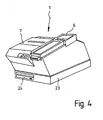
- peripheral devices 4a-g comprise a CPU 2, a memory 3 and various peripheral devices 4a-g.
- the peripheral devices consist of a display 4a, serial interfaces 4b, a chip interface 4c, a magnetic card interface 4d, a keyboard 4e, a clock 4f and two printers 4g.
- a program stored in an EPROM 5 is used for automatic hardware detection, for example to distinguish whether a mobile terminal 6 or a stationary terminal 7 is present.
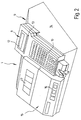
- the compact terminal 8 comprises a compact terminal 8, which is located on a base station 9.
- the compact terminal 8 could be both a mobile terminal 6 and a stationary terminal 7 according to FIG. 1.
- the compact terminal 8 would be connected to the base station via plug connections, for example via an RS 232 interface.
- an infrared interface for optical data transmission and support contacts for charging the battery are located on the underside of the compact terminal 8.
- a previously mentioned battery management system would also be integrated in the compact terminal 8.
- the compact terminal 8 further comprises an alphanumeric keyboard 10, a hybrid card reader, the card slot 11 of which can be seen in the front area of the compact terminal 8.
- a display 12 At the opposite end of the compact terminal 8 there is a display 12 and a printer, not shown.
- the paper output slot 13 can be seen below the display 12.
- the base station 9 surrounds a fixed housing 14, a charge certificate printer 15 being located to the left of the compact terminal 8. On the back of the housing 14 in the illustration according to FIG. 2, there is a closable flap through which the paper chute of the printer 15 is accessible.
- the printer is a conventional printer model that can be operated via a keypad 16.
- the certificate issue 17 is located on the top of the printer 15.
- the fee collection device is filled with pre-printed and pre-printed certificate forms.
- pre-printed and pre-printed certificate forms there is a paper chute for the printer 15 on the back of the housing 14.
- a certificate number of the certificate form is first entered into the terminal, so that it is immediately understandable which paper form was issued to whom and with which fee certificate .
- canceled certificates or otherwise unused certificate forms e.g. torn-off forms for inserting the paper
- a central location for recording which contains both the forms issued to the fee certification offices and the printed forms via the central computer based on the certificate number controlled.
- To check the certificate number a check digit and / or multiple entries are provided in order to check the correct entry.
- the keyboard field 10 In the case of payment by credit card or fuel card or a Euro check card is inserted into the card slot 11 of the card reader. In the case of a fuel card, the vehicle registration number is automatically recorded and checked on the display. In the case of another credit card, the vehicle registration number is entered directly via the keyboard 10, which not only includes numeric keys but also, as mentioned above, letter keys.
- the data After completing the data entry and confirming this data entry, the data is checked for plausibility and the fee to be paid is displayed. After confirmation, the fee certificate is printed out in the printer 15 and the control document in the compact terminal 8. If necessary, the above-mentioned online request takes place at the central computer if the fee exceeds a certain threshold amount. After the certificate or control document has been printed out in full, the transaction is booked. The fee can then only be reversed by canceling within a certain time, for example an hour.
- the fee certificates are given to the truck driver, while the control documents are signed by the truck driver and kept at the fee collection agency.
- the fee collection devices 1 are connected to a central computer 18 via a modem (see FIG. 3).
- This central computer 18 in turn communicates with a central accounting office 19 and data collection sites 20 of the final recipient of the fees, in Germany the Federal Ministry of Transport.
- the central clearing house 19 in turn communicates with the individual host computers of the various credit or fuel card companies 21. Furthermore, the clearing house 19 is connected to the host 22 of a company for debiting euro check card transactions.
- Each fee collection device 1 calls the central computer 18 at predetermined times. After exchanging a recognition protocol, the transactions that have taken place are transmitted in encrypted form to the central computer. In the opposite direction, the data stocks required for operation, such as blacklists, fee tables, etc. are updated from the central computer.
- the central computer collects the results of all fee collection devices 1 and forwards the corresponding data on the one hand to the recipient address 20 and on the other hand to the billing office 19 for further initiation. Since transactions of considerable monetary values take place in the system described, it is essential to take appropriate security measures against misuse of a fee collection device.
- the assignment of the characteristic data between the fee collection device 1 and the corresponding operator card only takes place when the respective fee collection device 1 is started up for the first time.
- the installer of the fee collection device selects any operator card from a large number of pre-coded operator cards and registers the fee collection device 1 with the central computer 18 for the initial start-up.
- the latter receives the characteristic data of the inserted randomly selected operator card from the fee collection device and establishes the assignment to the corresponding fee collection device in its data memory by generating characteristic data for the terminal identity from the characteristic data of the operator card in the embodiment described here.
- This terminal identity is subsequently loaded into the terminal's memory. From now on, this special fee collection device can be initialized with this particular operator card.
Landscapes
- Physics & Mathematics (AREA)
- General Physics & Mathematics (AREA)
- Business, Economics & Management (AREA)
- Engineering & Computer Science (AREA)
- Theoretical Computer Science (AREA)
- Finance (AREA)
- Accounting & Taxation (AREA)
- Strategic Management (AREA)
- General Business, Economics & Management (AREA)
- Devices For Checking Fares Or Tickets At Control Points (AREA)
- Debugging And Monitoring (AREA)
- Control Of Vending Devices And Auxiliary Devices For Vending Devices (AREA)
Priority Applications (1)
| Application Number | Priority Date | Filing Date | Title |
|---|---|---|---|
| EP01105996A EP1110751A3 (fr) | 1996-04-20 | 1997-04-17 | Vignette adhésive pour la perception de péages routiers et dispositif pour l'émission de ces vignettes |
Applications Claiming Priority (4)
| Application Number | Priority Date | Filing Date | Title |
|---|---|---|---|
| DE19615834 | 1996-04-20 | ||
| DE19615834 | 1996-04-20 | ||
| DE19654847A DE19654847A1 (de) | 1996-04-20 | 1996-12-23 | Vorrichtung zur Vornahme von Transaktionen im elektronischen Zahlungsverkehr |
| DE19654847 | 1996-12-23 |
Related Child Applications (1)
| Application Number | Title | Priority Date | Filing Date |
|---|---|---|---|
| EP01105996.1 Division-Into | 2001-03-10 |
Publications (3)
| Publication Number | Publication Date |
|---|---|
| EP0802513A2 true EP0802513A2 (fr) | 1997-10-22 |
| EP0802513A3 EP0802513A3 (fr) | 1999-03-10 |
| EP0802513B1 EP0802513B1 (fr) | 2002-01-30 |
Family
ID=26024982
Family Applications (1)
| Application Number | Title | Priority Date | Filing Date |
|---|---|---|---|
| EP97106343A Expired - Lifetime EP0802513B1 (fr) | 1996-04-20 | 1997-04-17 | Dispositif pour lever péages |
Country Status (2)
| Country | Link |
|---|---|
| EP (1) | EP0802513B1 (fr) |
| AT (1) | ATE212745T1 (fr) |
Cited By (2)
| Publication number | Priority date | Publication date | Assignee | Title |
|---|---|---|---|---|
| EP1447778A1 (fr) * | 2003-02-13 | 2004-08-18 | Matsushita Electric Industrial Co., Ltd. | Appareil pour l'emission de reçus |
| US10417834B2 (en) | 2012-02-20 | 2019-09-17 | Toll Collect Gmbh | Booking and cancellation method, and method for collecting tolls in a toll collection system |
Family Cites Families (7)
| Publication number | Priority date | Publication date | Assignee | Title |
|---|---|---|---|---|
| DE3113175A1 (de) * | 1980-04-09 | 1982-01-28 | Ricardo Buenos Aires Cibert | "einrichtung zur ausgabe von fahrscheinen" |
| US4381705A (en) * | 1980-12-01 | 1983-05-03 | Cubic Western Data | Modularized ticket handling system for use in automatic ticket preparation system |
| JPH0682427B2 (ja) * | 1985-03-22 | 1994-10-19 | サンデン株式会社 | 自動販売機 |
| CH669687A5 (en) * | 1985-11-22 | 1989-03-31 | Zellweger Uster Ag | Laser-readable vignette for motor vehicle - has reflection strip(s) returning beam with elliptical cross=section |
| GB8619188D0 (en) * | 1986-08-06 | 1986-09-17 | Control Systems Ltd | Ticket issuing machines |
| ATE160039T1 (de) * | 1986-09-02 | 1997-11-15 | Pitney Bowes Inc | Automatisiertes transaktionssystem mit einsteckbaren karten zum fernladen von gebühren oder dienstprogammdaten |
| NO912310L (no) * | 1990-06-14 | 1991-12-16 | State Transit Authority Of New | System for billettsalg. |
-
1997
- 1997-04-17 AT AT97106343T patent/ATE212745T1/de active
- 1997-04-17 EP EP97106343A patent/EP0802513B1/fr not_active Expired - Lifetime
Cited By (2)
| Publication number | Priority date | Publication date | Assignee | Title |
|---|---|---|---|---|
| EP1447778A1 (fr) * | 2003-02-13 | 2004-08-18 | Matsushita Electric Industrial Co., Ltd. | Appareil pour l'emission de reçus |
| US10417834B2 (en) | 2012-02-20 | 2019-09-17 | Toll Collect Gmbh | Booking and cancellation method, and method for collecting tolls in a toll collection system |
Also Published As
| Publication number | Publication date |
|---|---|
| EP0802513B1 (fr) | 2002-01-30 |
| ATE212745T1 (de) | 2002-02-15 |
| EP0802513A3 (fr) | 1999-03-10 |
Similar Documents
| Publication | Publication Date | Title |
|---|---|---|
| DE69509721T2 (de) | Chipkartentechniken zur Verwaltung von Kraftfahrzeugdaten | |
| DE60222631T2 (de) | Verfahren zum bezahlen eines parkplatzes | |
| DE68928147T2 (de) | Automatisches system zur kassierung von gebühren und ausgabe von belegen | |
| DE69013180T4 (de) | Elektronisches Chipkartenzahlungssystem für öffentliche Transport- oder Dienstleistungen. | |
| EP1105848B1 (fr) | Appareil de decompte pour debiter des taxes d'utilisation | |
| EP0780801B1 (fr) | Procédé et dispositifs pour l'utilisation et la facturation de moyens de paiement électroniques dans un système ouvert et interopérable pour la taxation automatique de frais | |
| DE69022484T2 (de) | Zahlsystem mit bimodularer Chipkarte. | |
| DE60017247T2 (de) | Verfahren zur verwaltung des parkens von fahrzeugen | |
| EP1103922A2 (fr) | Réservation à l'aide d'un ticket d'accès virtuel | |
| EP0608197A1 (fr) | Méthode, conçue comme concept de sécurité, contre l'utilisation inautorisée d'un moyen de paiement, lors du réglement comptant à un office de paiement | |
| EP0855068A2 (fr) | Procede et systeme permettant de simplifier des operations d'ordre administratif et la gestion d'une pluralite de vehicules | |
| DE4243851A1 (de) | Verfahren zum Transferieren von Buchgeldbeträgen auf und von Chipkarten | |
| WO1999000773A1 (fr) | Procede de transaction mis en oeuvre au moyen d'un appareil mobile | |
| DE69625717T2 (de) | Eine in einem fahrzeug angeordnete vorrichtung und system zur fernübertragung in einer anlage | |
| DE3423355A1 (de) | Datenverarbeitungsvorrichtung fuer das transportwesen | |
| DE19711521A1 (de) | Vorrichtung zur Vereinfachung von Verwaltungs- und Steuerungsaufgaben im Zusammenhang mit wenigstens einem mobilen Objekt, insbesondere von Fahrzeugen, sowie Verfahren zum Betreiben der Vorrichtung | |
| EP0713188A2 (fr) | Procédé et carte intelligente pour la documentation d'une autorisation acquise | |
| DE102004063600B4 (de) | Verfahren zur Erfassung von Leistungsentgelten für Reisen in öffentlichen Verkehrsmitteln | |
| EP0802513B1 (fr) | Dispositif pour lever péages | |
| DE19654847A1 (de) | Vorrichtung zur Vornahme von Transaktionen im elektronischen Zahlungsverkehr | |
| DE19825845A1 (de) | Mobile Parkuhr | |
| DE10046166A1 (de) | Mehrteilige Vorrichtung zur Abrechnung von Entgelt für die Benutzung mautpflichtiger Verkehrswege | |
| DE29621439U1 (de) | Datenerfassungs- und Kartenbearbeitungssystem | |
| DE69708279T2 (de) | Verfahren zum abrechnen von parkgebühren mit hilfe von bezahlautomaten | |
| WO2023186914A1 (fr) | Véhicule motorisé et procédé pour la fourniture d'un permis de stationnement numérique |
Legal Events
| Date | Code | Title | Description |
|---|---|---|---|
| PUAI | Public reference made under article 153(3) epc to a published international application that has entered the european phase |
Free format text: ORIGINAL CODE: 0009012 |
|
| AK | Designated contracting states |
Kind code of ref document: A2 Designated state(s): AT BE CH DE DK LI LU NL SE |
|
| PUAL | Search report despatched |
Free format text: ORIGINAL CODE: 0009013 |
|
| AK | Designated contracting states |
Kind code of ref document: A3 Designated state(s): AT BE CH DE DK LI LU NL SE |
|
| RHK1 | Main classification (correction) |
Ipc: G07B 1/00 |
|
| 17P | Request for examination filed |
Effective date: 19990426 |
|
| 17Q | First examination report despatched |
Effective date: 20000720 |
|
| GRAG | Despatch of communication of intention to grant |
Free format text: ORIGINAL CODE: EPIDOS AGRA |
|
| RTI1 | Title (correction) |
Free format text: DEVICE FOR CHARGING ROAD TOLLS |
|
| RTI1 | Title (correction) |
Free format text: DEVICE FOR CHARGING ROAD TOLLS |
|
| GRAG | Despatch of communication of intention to grant |
Free format text: ORIGINAL CODE: EPIDOS AGRA |
|
| GRAH | Despatch of communication of intention to grant a patent |
Free format text: ORIGINAL CODE: EPIDOS IGRA |
|
| GRAH | Despatch of communication of intention to grant a patent |
Free format text: ORIGINAL CODE: EPIDOS IGRA |
|
| GRAA | (expected) grant |
Free format text: ORIGINAL CODE: 0009210 |
|
| AK | Designated contracting states |
Kind code of ref document: B1 Designated state(s): AT BE CH DE DK LI LU NL SE |
|
| REF | Corresponds to: |
Ref document number: 212745 Country of ref document: AT Date of ref document: 20020215 Kind code of ref document: T |
|
| REG | Reference to a national code |
Ref country code: CH Ref legal event code: EP |
|
| REF | Corresponds to: |
Ref document number: 59706208 Country of ref document: DE Date of ref document: 20020314 |
|
| PG25 | Lapsed in a contracting state [announced via postgrant information from national office to epo] |
Ref country code: LU Free format text: LAPSE BECAUSE OF NON-PAYMENT OF DUE FEES Effective date: 20020417 |
|
| PG25 | Lapsed in a contracting state [announced via postgrant information from national office to epo] |
Ref country code: DK Free format text: LAPSE BECAUSE OF FAILURE TO SUBMIT A TRANSLATION OF THE DESCRIPTION OR TO PAY THE FEE WITHIN THE PRESCRIBED TIME-LIMIT Effective date: 20020430 Ref country code: BE Free format text: LAPSE BECAUSE OF NON-PAYMENT OF DUE FEES Effective date: 20020430 |
|
| REG | Reference to a national code |
Ref country code: CH Ref legal event code: NV Representative=s name: KELLER & PARTNER PATENTANWAELTE AG |
|
| PLBE | No opposition filed within time limit |
Free format text: ORIGINAL CODE: 0009261 |
|
| STAA | Information on the status of an ep patent application or granted ep patent |
Free format text: STATUS: NO OPPOSITION FILED WITHIN TIME LIMIT |
|
| 26N | No opposition filed | ||
| REG | Reference to a national code |
Ref country code: CH Ref legal event code: PUE Owner name: BZA AG Free format text: GSI GESELLSCHAFT FUER SYSTEMTECHNIK UND INFORMATIK MBH#WEIHERSTRASSE 5#88682 SALEM (DE) -TRANSFER TO- BZA AG#ZUERICHSTRASSE 263#8500 FRAUENFELD (CH) |
|
| NLS | Nl: assignments of ep-patents |
Owner name: BZA AG |
|
| REG | Reference to a national code |
Ref country code: CH Ref legal event code: PUE Owner name: PAPST LICENSING GMBH & CO. KG Free format text: BZA AG#ZUERICHSTRASSE 263#8500 FRAUENFELD (CH) -TRANSFER TO- PAPST LICENSING GMBH & CO. KG#BAHNHOFSTRASSE 33#78112 ST. GEORGEN (DE) |
|
| REG | Reference to a national code |
Ref country code: CH Ref legal event code: NV Representative=s name: KELLER & PARTNER PATENTANWAELTE AG |
|
| NLS | Nl: assignments of ep-patents |
Owner name: PAPST LICENSING GMBH & CO. KG Effective date: 20090617 |
|
| REG | Reference to a national code |
Ref country code: NL Ref legal event code: VD3 Effective date: 20110211 |
|
| REG | Reference to a national code |
Ref country code: DE Ref legal event code: R097 Ref document number: 59706208 Country of ref document: DE |
|
| REG | Reference to a national code |
Ref country code: DE Ref legal event code: R040 Ref document number: 59706208 Country of ref document: DE Effective date: 20111026 |
|
| REG | Reference to a national code |
Ref country code: CH Ref legal event code: PCAR Free format text: NEW ADDRESS: EIGERSTRASSE 2 POSTFACH, 3000 BERN 14 (CH) |
|
| PGFP | Annual fee paid to national office [announced via postgrant information from national office to epo] |
Ref country code: NL Payment date: 20160422 Year of fee payment: 20 |
|
| PGFP | Annual fee paid to national office [announced via postgrant information from national office to epo] |
Ref country code: DE Payment date: 20160421 Year of fee payment: 20 Ref country code: CH Payment date: 20160422 Year of fee payment: 20 |
|
| PGFP | Annual fee paid to national office [announced via postgrant information from national office to epo] |
Ref country code: SE Payment date: 20160422 Year of fee payment: 20 Ref country code: AT Payment date: 20160420 Year of fee payment: 20 |
|
| REG | Reference to a national code |
Ref country code: DE Ref legal event code: R071 Ref document number: 59706208 Country of ref document: DE |
|
| REG | Reference to a national code |
Ref country code: NL Ref legal event code: MK Effective date: 20170416 |
|
| REG | Reference to a national code |
Ref country code: CH Ref legal event code: PL |
|
| REG | Reference to a national code |
Ref country code: AT Ref legal event code: MK07 Ref document number: 212745 Country of ref document: AT Kind code of ref document: T Effective date: 20170417 |