EP0802567A2 - Dispositif semi-conducteur et procédé de fabrication - Google Patents
Dispositif semi-conducteur et procédé de fabrication Download PDFInfo
- Publication number
- EP0802567A2 EP0802567A2 EP97106103A EP97106103A EP0802567A2 EP 0802567 A2 EP0802567 A2 EP 0802567A2 EP 97106103 A EP97106103 A EP 97106103A EP 97106103 A EP97106103 A EP 97106103A EP 0802567 A2 EP0802567 A2 EP 0802567A2
- Authority
- EP
- European Patent Office
- Prior art keywords
- region
- well
- semiconductor
- drain
- source
- Prior art date
- Legal status (The legal status is an assumption and is not a legal conclusion. Google has not performed a legal analysis and makes no representation as to the accuracy of the status listed.)
- Granted
Links
Images














Classifications
-
- H—ELECTRICITY
- H10—SEMICONDUCTOR DEVICES; ELECTRIC SOLID-STATE DEVICES NOT OTHERWISE PROVIDED FOR
- H10D—INORGANIC ELECTRIC SEMICONDUCTOR DEVICES
- H10D30/00—Field-effect transistors [FET]
- H10D30/60—Insulated-gate field-effect transistors [IGFET]
- H10D30/64—Double-diffused metal-oxide semiconductor [DMOS] FETs
- H10D30/65—Lateral DMOS [LDMOS] FETs
-
- H—ELECTRICITY
- H10—SEMICONDUCTOR DEVICES; ELECTRIC SOLID-STATE DEVICES NOT OTHERWISE PROVIDED FOR
- H10D—INORGANIC ELECTRIC SEMICONDUCTOR DEVICES
- H10D30/00—Field-effect transistors [FET]
- H10D30/60—Insulated-gate field-effect transistors [IGFET]
- H10D30/601—Insulated-gate field-effect transistors [IGFET] having lightly-doped drain or source extensions, e.g. LDD IGFETs or DDD IGFETs
- H10D30/603—Insulated-gate field-effect transistors [IGFET] having lightly-doped drain or source extensions, e.g. LDD IGFETs or DDD IGFETs having asymmetry in the channel direction, e.g. lateral high-voltage MISFETs having drain offset region or extended drain IGFETs [EDMOS]
-
- H—ELECTRICITY
- H10—SEMICONDUCTOR DEVICES; ELECTRIC SOLID-STATE DEVICES NOT OTHERWISE PROVIDED FOR
- H10D—INORGANIC ELECTRIC SEMICONDUCTOR DEVICES
- H10D30/00—Field-effect transistors [FET]
- H10D30/60—Insulated-gate field-effect transistors [IGFET]
- H10D30/64—Double-diffused metal-oxide semiconductor [DMOS] FETs
-
- H—ELECTRICITY
- H10—SEMICONDUCTOR DEVICES; ELECTRIC SOLID-STATE DEVICES NOT OTHERWISE PROVIDED FOR
- H10D—INORGANIC ELECTRIC SEMICONDUCTOR DEVICES
- H10D30/00—Field-effect transistors [FET]
- H10D30/60—Insulated-gate field-effect transistors [IGFET]
- H10D30/64—Double-diffused metal-oxide semiconductor [DMOS] FETs
- H10D30/65—Lateral DMOS [LDMOS] FETs
- H10D30/657—Lateral DMOS [LDMOS] FETs having substrates comprising insulating layers, e.g. SOI-LDMOS transistors
-
- H—ELECTRICITY
- H10—SEMICONDUCTOR DEVICES; ELECTRIC SOLID-STATE DEVICES NOT OTHERWISE PROVIDED FOR
- H10D—INORGANIC ELECTRIC SEMICONDUCTOR DEVICES
- H10D84/00—Integrated devices formed in or on semiconductor substrates that comprise only semiconducting layers, e.g. on Si wafers or on GaAs-on-Si wafers
- H10D84/01—Manufacture or treatment
- H10D84/0107—Integrating at least one component covered by H10D12/00 or H10D30/00 with at least one component covered by H10D8/00, H10D10/00 or H10D18/00, e.g. integrating IGFETs with BJTs
- H10D84/0109—Integrating at least one component covered by H10D12/00 or H10D30/00 with at least one component covered by H10D8/00, H10D10/00 or H10D18/00, e.g. integrating IGFETs with BJTs the at least one component covered by H10D12/00 or H10D30/00 being a MOS device
-
- H—ELECTRICITY
- H10—SEMICONDUCTOR DEVICES; ELECTRIC SOLID-STATE DEVICES NOT OTHERWISE PROVIDED FOR
- H10D—INORGANIC ELECTRIC SEMICONDUCTOR DEVICES
- H10D84/00—Integrated devices formed in or on semiconductor substrates that comprise only semiconducting layers, e.g. on Si wafers or on GaAs-on-Si wafers
- H10D84/01—Manufacture or treatment
- H10D84/02—Manufacture or treatment characterised by using material-based technologies
- H10D84/03—Manufacture or treatment characterised by using material-based technologies using Group IV technology, e.g. silicon technology or silicon-carbide [SiC] technology
- H10D84/038—Manufacture or treatment characterised by using material-based technologies using Group IV technology, e.g. silicon technology or silicon-carbide [SiC] technology using silicon technology, e.g. SiGe
-
- H—ELECTRICITY
- H10—SEMICONDUCTOR DEVICES; ELECTRIC SOLID-STATE DEVICES NOT OTHERWISE PROVIDED FOR
- H10D—INORGANIC ELECTRIC SEMICONDUCTOR DEVICES
- H10D84/00—Integrated devices formed in or on semiconductor substrates that comprise only semiconducting layers, e.g. on Si wafers or on GaAs-on-Si wafers
- H10D84/40—Integrated devices formed in or on semiconductor substrates that comprise only semiconducting layers, e.g. on Si wafers or on GaAs-on-Si wafers characterised by the integration of at least one component covered by groups H10D12/00 or H10D30/00 with at least one component covered by groups H10D10/00 or H10D18/00, e.g. integration of IGFETs with BJTs
- H10D84/401—Combinations of FETs or IGBTs with BJTs
-
- H—ELECTRICITY
- H10—SEMICONDUCTOR DEVICES; ELECTRIC SOLID-STATE DEVICES NOT OTHERWISE PROVIDED FOR
- H10D—INORGANIC ELECTRIC SEMICONDUCTOR DEVICES
- H10D84/00—Integrated devices formed in or on semiconductor substrates that comprise only semiconducting layers, e.g. on Si wafers or on GaAs-on-Si wafers
- H10D84/80—Integrated devices formed in or on semiconductor substrates that comprise only semiconducting layers, e.g. on Si wafers or on GaAs-on-Si wafers characterised by the integration of at least one component covered by groups H10D12/00 or H10D30/00, e.g. integration of IGFETs
- H10D84/82—Integrated devices formed in or on semiconductor substrates that comprise only semiconducting layers, e.g. on Si wafers or on GaAs-on-Si wafers characterised by the integration of at least one component covered by groups H10D12/00 or H10D30/00, e.g. integration of IGFETs of only field-effect components
-
- H—ELECTRICITY
- H10—SEMICONDUCTOR DEVICES; ELECTRIC SOLID-STATE DEVICES NOT OTHERWISE PROVIDED FOR
- H10D—INORGANIC ELECTRIC SEMICONDUCTOR DEVICES
- H10D89/00—Aspects of integrated devices not covered by groups H10D84/00 - H10D88/00
- H10D89/60—Integrated devices comprising arrangements for electrical or thermal protection, e.g. protection circuits against electrostatic discharge [ESD]
- H10D89/601—Integrated devices comprising arrangements for electrical or thermal protection, e.g. protection circuits against electrostatic discharge [ESD] for devices having insulated gate electrodes, e.g. for IGFETs or IGBTs
-
- H—ELECTRICITY
- H10—SEMICONDUCTOR DEVICES; ELECTRIC SOLID-STATE DEVICES NOT OTHERWISE PROVIDED FOR
- H10P—GENERIC PROCESSES OR APPARATUS FOR THE MANUFACTURE OR TREATMENT OF DEVICES COVERED BY CLASS H10
- H10P90/00—Preparation of wafers not covered by a single main group of this subclass, e.g. wafer reinforcement
- H10P90/19—Preparing inhomogeneous wafers
- H10P90/1904—Preparing vertically inhomogeneous wafers
- H10P90/1906—Preparing SOI wafers
-
- H—ELECTRICITY
- H10—SEMICONDUCTOR DEVICES; ELECTRIC SOLID-STATE DEVICES NOT OTHERWISE PROVIDED FOR
- H10W—GENERIC PACKAGES, INTERCONNECTIONS, CONNECTORS OR OTHER CONSTRUCTIONAL DETAILS OF DEVICES COVERED BY CLASS H10
- H10W10/00—Isolation regions in semiconductor bodies between components of integrated devices
- H10W10/01—Manufacture or treatment
- H10W10/011—Manufacture or treatment of isolation regions comprising dielectric materials
- H10W10/014—Manufacture or treatment of isolation regions comprising dielectric materials using trench refilling with dielectric materials, e.g. shallow trench isolations
-
- H—ELECTRICITY
- H10—SEMICONDUCTOR DEVICES; ELECTRIC SOLID-STATE DEVICES NOT OTHERWISE PROVIDED FOR
- H10W—GENERIC PACKAGES, INTERCONNECTIONS, CONNECTORS OR OTHER CONSTRUCTIONAL DETAILS OF DEVICES COVERED BY CLASS H10
- H10W10/00—Isolation regions in semiconductor bodies between components of integrated devices
- H10W10/01—Manufacture or treatment
- H10W10/061—Manufacture or treatment using SOI processes together with lateral isolation, e.g. combinations of SOI and shallow trench isolations
-
- H—ELECTRICITY
- H10—SEMICONDUCTOR DEVICES; ELECTRIC SOLID-STATE DEVICES NOT OTHERWISE PROVIDED FOR
- H10W—GENERIC PACKAGES, INTERCONNECTIONS, CONNECTORS OR OTHER CONSTRUCTIONAL DETAILS OF DEVICES COVERED BY CLASS H10
- H10W10/00—Isolation regions in semiconductor bodies between components of integrated devices
- H10W10/10—Isolation regions comprising dielectric materials
- H10W10/17—Isolation regions comprising dielectric materials formed using trench refilling with dielectric materials, e.g. shallow trench isolations
-
- H—ELECTRICITY
- H10—SEMICONDUCTOR DEVICES; ELECTRIC SOLID-STATE DEVICES NOT OTHERWISE PROVIDED FOR
- H10W—GENERIC PACKAGES, INTERCONNECTIONS, CONNECTORS OR OTHER CONSTRUCTIONAL DETAILS OF DEVICES COVERED BY CLASS H10
- H10W10/00—Isolation regions in semiconductor bodies between components of integrated devices
- H10W10/10—Isolation regions comprising dielectric materials
- H10W10/181—Semiconductor-on-insulator [SOI] isolation regions, e.g. buried oxide regions of SOI wafers
-
- H—ELECTRICITY
- H10—SEMICONDUCTOR DEVICES; ELECTRIC SOLID-STATE DEVICES NOT OTHERWISE PROVIDED FOR
- H10D—INORGANIC ELECTRIC SEMICONDUCTOR DEVICES
- H10D62/00—Semiconductor bodies, or regions thereof, of devices having potential barriers
- H10D62/10—Shapes, relative sizes or dispositions of the regions of the semiconductor bodies; Shapes of the semiconductor bodies
- H10D62/102—Constructional design considerations for preventing surface leakage or controlling electric field concentration
- H10D62/103—Constructional design considerations for preventing surface leakage or controlling electric field concentration for increasing or controlling the breakdown voltage of reverse-biased devices
- H10D62/105—Constructional design considerations for preventing surface leakage or controlling electric field concentration for increasing or controlling the breakdown voltage of reverse-biased devices by having particular doping profiles, shapes or arrangements of PN junctions; by having supplementary regions, e.g. junction termination extension [JTE]
-
- H—ELECTRICITY
- H10—SEMICONDUCTOR DEVICES; ELECTRIC SOLID-STATE DEVICES NOT OTHERWISE PROVIDED FOR
- H10W—GENERIC PACKAGES, INTERCONNECTIONS, CONNECTORS OR OTHER CONSTRUCTIONAL DETAILS OF DEVICES COVERED BY CLASS H10
- H10W10/00—Isolation regions in semiconductor bodies between components of integrated devices
- H10W10/01—Manufacture or treatment
- H10W10/031—Manufacture or treatment of isolation regions comprising PN junctions
-
- H—ELECTRICITY
- H10—SEMICONDUCTOR DEVICES; ELECTRIC SOLID-STATE DEVICES NOT OTHERWISE PROVIDED FOR
- H10W—GENERIC PACKAGES, INTERCONNECTIONS, CONNECTORS OR OTHER CONSTRUCTIONAL DETAILS OF DEVICES COVERED BY CLASS H10
- H10W10/00—Isolation regions in semiconductor bodies between components of integrated devices
- H10W10/30—Isolation regions comprising PN junctions
Definitions
- the present invention relates to a semiconductor device with a reduced surface field strength type MOS transistor, a method of manufacturing the same semiconductor device, and a semiconductor device with a load driving semiconductor element such as an LDMOS (Lateral Diffused MOS) transistor (which will be referred hereinafter to as an LDMOS), and further an LDMOS (Lateral Double Diffused) transistor such as a power transistor serving as a large-current type switching element.
- LDMOS Lateral Diffused MOS
- LDMOS Longeral Double Diffused transistor
- this LDMOS has been known an element with a structure as shown in Fig. 50.
- this LDMOS has an N-type substrate 1, an N well 2 deposited on the N-type substrate 1, a channel P well 3 formed in the N well 2, an N-type diffused layer 4 formed in the channel P well 3 and a different N-type diffused layer 5 provided in the said N well 2.
- a gate electrode 7 is located on a substrate surface in a state that a gate oxide film 6 is interposed therebetween while a channel region 8 is formed in a surface area of the channel P well 3 right under the gate electrode 7.
- the N-type diffused layer 4 servers as a source region
- the N-type diffused layer 5 acts as a drain region
- the N well 2 under an LOCOS oxide film 9 functions as a drift region.
- numerals 10 and 11 represent a source electrode and a drain electrode
- numeral 12 designates a diffused layer for taking the electric potential of the channel P well 3
- numeral 13 denotes an inter-layer insulating film.
- RESURF REduced SURface Field
- the drain electrode 11 and the P-type substrate 14 are in an electrically connected relation to each other, and hence, in cases where as shown in Fig. 52 an L load such as a coil 15 is electrically coupled to the drain electrode 11 so that the L load gets into a driven condition, when the voltage applied to the gate electrode 7 comes into the OFF condition, a reverse voltage of the L load 15 has an influence on the drain electrode 11. This reverse voltage can frequently assume an extremely high value.
- the PN junction between the channel P well 3 and the N well 2 comes into breakdown at the application of the reverse voltage to cause a current to flow from the channel P well 3 through a P + diffused layer 12 to the source electrode 10 so that the electric potential of the channel P well 3 exceeds the electric potential of the N-type diffused layer 4, with the result that a parasitic (incidental) transistor comprising the N-type diffused layer 4 acting as the emitter, the channel P well 3 serving as the base and the N well 2 functioning as the collector comes into operation to cause a large current to flow through a narrow area in an arrow direction. Because of the occurrence of the large current passing through the narrow area, the elements are easy to heat so that the breakdown of the elements takes place irrespective of a low reverse voltage, thus resulting in impairing the breakdown proof of the elements.
- the aforesaid reduced surface field strength type LDMOS is situated on the P-type substrate 14, and hence, in the case that a V-NPN transistor (which will be referred hereinafter to as an NPNTr) superior in current characteristic to a PNP transistor and the aforesaid reduced surface field strength type LDMOS are formed on the same substrate, since an N layer serving as a collector layer in the NPNTr is made to take a deep position, difficulty is actually experienced to form both the transistors on the same substrate.
- the LDMOS, together with the NPNTr can be formed on the same substrate, the compatibility of a high breakdown voltage and a low ON resistance as described before become impossible.
- a load is driven by a low side switch type where the load is connected to the power supply side and the LDMOS is coupled to the GND side, in response to the switching of the LDMOS, the drain electric potential varies from the potential of the GND to the potential of the power supply (or more), and the potential of the N-type substrate 1 varies accordingly.
- Another object of this invention is to form a reduced surface field strength type LDMOS and an NPNTr on the same substrate.
- a further object of this invention is to suppress the occurrence of the switching noises when a load driving semiconductor element is provided in an insulated and separated element region.
- a further object of this invention is to realize a power MOS transistor having a high surge current withstand.
- a semiconductor device having a reduced surface field strength type MOS transistor in which a semiconductor layer (1) of a first conductivity type supports a first well (16) of a second conductivity type which accommodates a second well (2) of a first conductivity type at a shallower position than the first well (16), and further the second well (2) has a source region (4), a channel region (8) and a drain region (5) therein and a gate electrode (7) is disposed on the channel region (8) so that the second well (2) serves as a drift region, wherein, when a voltage for causing the MOS transistor to be in a non-actuating condition is applied to the gate electrode (7) and a high voltage exceeding a given value is exerted to the drain region, a current-carrying path from the second well (2) through the first well (16) and the semiconductor layer (1) takes place.
- the source region (4) and the semiconductor layer (1) are set to be equal in potential to each other.
- a parasitic bipolar transistor (18) is formed among the second well (2), the first well (16) and the semiconductor layer (1) to establish the current path. Further, a punchthrough occurs between the second well (2) and the semiconductor layer (1) to establish the current path. Still further, a base region (17) is formed to include the source region (4) and to reach the first well (16).
- a semiconductor device including a MOS transistor having a source region (4), a channel region (8) and a drain region (5) so that a gate electrode (7) is formed on the channel region and a drift region is set up between the channel region (8) and the drain region (5), wherein a semiconductor layer (1) of a first conductivity type bears a second conductive type first well (16) which in turn accommodates a first conductive type second well (2) at a shallower position than the first well (16), and at least the second well (2) has the drift region and the drain region (5) therein and the source region (4) and the semiconductor region (1) are set to be equal in potential to each other.
- the second conductivity type first well and the first conductivity type second well are formed in the first conductivity type semiconductor layer to establish a double-well structure, and the drift region and drain region of the MOS transistor is provided in the second well.
- a reverse voltage is applied to the drain region, a current-carrying path is provided in a wide area extending from through the first well and the semiconductor layer. Accordingly, even if such an application of a reverse voltage occurs, this current-carrying path can prevent the breakdown of the elements at the channel formation portions.
- a semiconductor device in which an N-type first semiconductor layer (21a) is divided into first and second element areas so that a reduced surface field strength type MOS transistor (LDMOS) is formed in the first element area while a bipolar transistor (NPNTr) is formed in the second element area in a state that the first semiconductor layer (21a) serves as its collector layer, wherein in the first element area a P-type first well (16) is formed in the first semiconductor layer (21a), an N-type second well (2) is formed in the first well (16) to be shallower than the first well (16) to further accommodate a source region (4), a channel region (8) and a drain region (5), and a gate electrode (7) is located on the channel region (8), so that the reduced surface field strength type MOS transistor is made in a state that the second well (2) acts as a drift region.
- LDMOS reduced surface field strength type MOS transistor
- NPNTr bipolar transistor
- an N-type second semiconductor layer (21b) is formed under the first semiconductor layer (21a) and an N-type deep layer (26) is formed which extends from a surface of a substrate to the second semiconductor layer (21b), with the source region (4) and the first semiconductor layer (21a) being set to be equal in potential to each other in such a manner that the potential depends upon the deep layer (26) and the second semiconductor layer (21b).
- the P-type first well and the N-type second well are formed in the N-type semiconductor layer to make a double-well structure, thus establishing a reduced surface field strength type MOS transistor. Accordingly, this MOS transistor, together with the NPNTr using the N-type semiconductor layer as the collector layer, can be situated on one substrate.
- a method of manufacturing a semiconductor device so that in a semiconductor substrate including an N-type semiconductor layer (21a) divided into first and second element areas a reduced surface field strength type MOS transistor (LDMOS) is formed in the first element area while a bipolar transistor (NPNTr) is formed in the second element area, which comprises the steps of performing ion-implantation for the semiconductor layer (21a) to form a P-type first well and an N-type second well (2), performing simultaneous diffusion to form the first well (16) and to form the second well (2) in the first well (16) so that it takes a shallower position than the first well (16), forming a source region (4), a channel region (8) and a drain region (5) within the second well (2), and forming a gate electrode (7) on the channel region (8) to form the MOS transistor (LDMOS) in which the second well (2) serves as a drift region.
- the bipolar transistor (NPNTr) is formed in the second element area in a state that the
- the first and second wells are produced by the simultaneous diffusion, with the result that only one mask is required for the formations of the first and second wells.
- a semiconductor device in which a load driving semiconductor element is formed in a insulated and separated element region and an electric potential fixing region for surrounding the semiconductor element is defined between the semiconductor element and an insulating film. Because of surrounding the semiconductor element by the electric potential fixing region, the electric potential variation at the load driving is suppressible to control the occurrence of the switching noises.
- a semiconductor device in which, when a reverse voltage is applied to a drain region, a current-carrying path is formed to extend from a second well through a first well, a first semiconductor layer and an electric potential fixing region.
- the formation of this current-carrying path can prevent the breakdown of the elements in the channel formation section at the application of the reverse voltage.
- the first well is set to be equal in electric potential to the source. This enables further suppressing the occurrence of the switching noises at the electric potential variation.
- the electric potential fixing region is connected to the power supply, and when the MOS transistor is used for the low side switch type, the electric potential fixing region is coupled to the ground. In this case, if the electric potential fixing region is made to be selectively coupled to one of the power supply and the ground, one of the low side switch type and the high side switch type can freely undergo selection.
- a surface portion of a second conductive well region adjacent to source and drain cells is connected as a surge current absorption section to a drain terminal, and a surface portion of a first conductive well region adjacent to the surge current absorption section is connected as a surge current draw (extraction) section to a source terminal, wherein the resistance between the surge current absorption section and the surge current draw section is set to be lower than the resistance between the source and drain cells and the surge current absorption section.
- the surge current brought from the output terminal (drain) flows laterally through a parasitic diode D3 produced by both the well regions and discharges to the source terminal side after passing through the first conductive well region (the surge current draw section).
- the surge current does not flow in the source region present on a surface of the source and drain cells so that the protection of a MOS channel section is possible to enhance the withstand against the surge such as static electricity, with the result that a power MOS transistor with a high surge withstand is realizable.
- a second conductive impurity diffusion region is formed in the surge current absorption section of the second conductive well region with a higher impurity concentration than that of the second conductive well region and at a position deeper than that of a second conductive impurity diffusion region in a drain cell so that a break voltage lower than an element breakdown voltage is obtainable, at a voltage lower than the element breakdown voltage the surge current can discharge to the source terminal side through the first conductive well region.
- second conductive deep semiconductor regions extending in a depth direction from the surface side of a semiconductor substrate are made to scatter in the interior of a source and drain cell formation region so that the deep semiconductor regions define a surge current path.
- the surge current coming from the output terminal (drain) discharges through the scattering deep semiconductor regions (226a, 226b, 226c) in addition to the parasitic diode due to both the well regions. That is why all the surge currents dispersedly or separately flow without gathering at the drain, and hence no surge current flow in the source region present on the surface, thus protecting the MOS channel section to improve the withstand against the surge such as static electricity. This allows a power MOS transistor with a high surge withstand.
- a second conductive semiconductor buried layer is formed under a first conductive well region in a semiconductor substrate and further second conductive deep semiconductor regions extending in the depth direction from the surface side of the semiconductor substrate and reaching the semiconductor buried layer are made to scatter in the interior of source and drain cells so that a surge current path is defined by the semiconductor buried layer and the dep semiconductor regions.
- the surge current brought from the output terminal (drain) discharges through the scattering deep semiconductor regions (226a, 226b, 226c) in addition to the parasitic diode developed by both the well regions, so that the surge current dispersedly flows without all concentrating in the drain. That is why no surge current flows in the source region in the surface, and the protection of the MOS channel section is possible, thus enhancing the withstand against the surge such as static electricity, which realizes a power MOS transistor with a high surge withstand.
- the aforesaid deep semiconductor regions are disposed around the source and drain cell formation region grouped into a plurality of blocks. Further, the deep semiconductor regions are disposed in the form of islands within the source-drain cell formation region. Still further, preferably, the source and drain cell formation region interposed between the deep semiconductor regions is below 200 mm in width. Besides, the deep semiconductor regions are made to have plane structures producing band (or strip)-like configurations, and are provided within the source and drain cell formation region to extend in parallel to each other at a given interval.
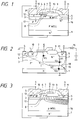
- Fig. 1 is a cross-sectional view showing a structure of a reduced surface field strength type LDMOS according to a first embodiment of the present invention.
- a P well 16 is disposed on an N-type Substrate and an N well 2 is formed in the P well 16 to thereby produce a double-well structure, with a source electrode 10 and the N-type substrate 1 being made to be equal in electric potential to each other.
- the dopant concentration is set to satisfy the so-called RESURF condition.
- parts marked with the same reference numerals as those in Figs. 8 and 9 have the same or corresponding structures.
- the reduced surface field strength type LDMOS as shown in Fig. 1 has a high breakdown voltage and a low ON resistance and can prevent the breakdown of the channel formation portions at the time of the application of a reverse voltage occurring when an L load comes into connection with a drain electrode, as will be described with reference to Fig. 2.
- the drain electrode 11 is subjected to a reverse voltage.
- the parasitic diode VZ1 first gets into breakdown. That is, this application of the reverse voltage establishes the electric potential distribution in the N well 2 and the P well 16 as shown in Fig. 3 where the electric potential gradient in the vertical direction, i.e., toward the substrate becomes greater than that in the horizontal direction from the drain region 5 to the source region 4, and that is why the breakdown of the parasitic diode VZ1 first occurs.
- the voltage within the P well 16 rises due to the presence of a resistor R2 so that a parasitic diode VZ3 between the P well 16 and the N-type substrate 1 comes into its ON state and a parasitic bipolar transistor 18 made up of the N well 2, the P well 16 and the N-type substrate 1 takes its ON state, thus making a current flow in the direction of the substrate with a wide area.
- the current can be dispersed to suppress the heating due to the current flow, with the result that the breakdown of the elements at the channel formation portions having a low breakdown voltage characteristic is avoidable, besides the breakdown voltage characteristic of the elements improves.
- a base 17 is provided to include the source region 4 and to reach the P well 16 so that a current I flows from the P well 16 to the source side. This further makes the current hard to flow at the channel formation portions. Incidentally, in cases where a sufficient current can flow through a current-carrying path toward the substrate, the base 17 does not need to be provided.
- the current is made to flow toward the substrate by means of the parasitic bipolar transistor 18, if the P well 16 has a sufficiently thin configuration in the direction of the substrate, the current can flow toward the substrate by the punchthrough without depending on the parasitic bipolar operation.
- Fig. 4 shows a structure where the above-mentioned reduced surface field strength type LDMOS, together with a CMOS and an NPNTr, is formed on one substrate.
- the Fig. 4 structure is an SOI (Silicon On Insulator) structure. More specifically, an N-type substrate 21 made by forming an N - layer (corresponding to the N-type substrate 1 in Fig.
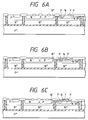
- the trench grooves 23 are made in the above-mentioned adhered substrate prepared so that the oxide films are formed within the trench grooves 23 and further a polycrystalline silicon 24 is buried therein. In this state, an oxide film 25 appears on the N-type substrate 21 surface. Further, as shown in Fig. 5A, a deep N + layer 26 is formed in the LDMOS formation area, and subsequently the ion implantation is done to produce the P well 16 and the N well 2, moreover the simultaneous diffusion is carried out.
- a boron (B) is employed for the P well, while arsenic (As) is used for the N well. Owing to the difference between the diffusion coefficients thereof, the P well reaches a deep position whereas the N well remains at a shallow position. In this step, since the simultaneous diffusion of the boron and the arsenic takes place, the number of the masks necessary therefor is one.
- the boron dose is 3 ⁇ 10 12 to 1 ⁇ 10 13 atom/cm 2
- the arsenic dose is 3 ⁇ 10 12 to 1 ⁇ 10 13 atom/cm 2
- the drive-in is done at a temperature of 1200°C for approximately 600 minutes.
- the impurity concentration in the depth direction from the N well layer 2 surface to the PN junction made together with the P well layer 16 is expressed according to the following equation (1).
- Nd(x)dx represents an impurity concentration per unit volume
- x designates the depth
- xj depicts the PN junction depth of the N well layer 2 and the P well layer 16.
- a base 17 is also provided in the LDMOS formation area in like manner.
- the operation comes into the LOCOS oxidization whereby an LOCOS oxide film 9 is formed in the LDMOS formation area, and subsequently the oxidization of the substrate surface is carried out to produce a gate oxide film 6 of the LDMOS (Fig. 6B).
- Poly Si is formed in the substrate surface and phosphorus is doped, and further the photoetching processing for the patterning is performed to form a gate electrode 7 of the LDMOS (Fig. 8C).
- the LDMOS, the CMOS and NPNTr are successively formed through common element formation steps, finally obtaining the structure as shown in Fig. 4.
- the gate is used as a mask so that the channel P well 8 and the source region 4 are diffusion-formed in the N well 2.
- the breakdown voltage between the source and the drain could assume approximately 70 to 80V and the breakdown voltage between the N well 2 and the P well 16 could result in being approximately 65V.
- the P-type first well and the N-type second well are formed in the N-type semiconductor layer 21 to produce a double well structure, with the result that the reduced surface field strength LDMOS, together with the NPNTr using the N-type semiconductor layer 21 as its collector layer, can be formed on the same substrate.
- the breakdown current is made to flow from the substrate surface to the ground, the N-type layer is provided under the P well 16 to produce the parasitic transistor toward the substrate and the current flow is established using a conductivity type N layer different from the channel P well.
- the breakdown current does not flow through the channel P well, and hence the breakdown of the elements due to the heat in the vicinity of the substrate surface is avoidable.
- the electrode on the substrate surface there is a bump electrode used for flip chips or the like. This can exhibit the same effects.
- Fig. 8 is a cross-sectional view showing the structure of the reduced surface field strength type LDMOS according to this embodiment, where the portion other than a deep N + diffused layer 126 and an N+ substrate 121b corresponds to the reduced surface field strength type LDMOS shown in Fig. 1.
- a P well 129 and a base 130 are provided in order to fix the electric potential of a P well 116 to the source electric potential.
- Fig. 9 is a plan view showing the structure shown in Fig. 8.
- a cell region 131 in which a plurality of LDMOS each described above are formed (more specifically, source regions and drain regions are alternately disposed to form a grating-like configuration and gates are located therebetween).
- the P well 129 for fixing the electric potential of the P well 116 to the source electric potential.
- the deep N + diffused layer 126 is provided around the P well 129 to come into contact with the oxide film 123.
- a bottom electrode B is connected to the deep N + diffused layer 126, and the electric potential of this bottom electrode B is fixed to fix the electric potentials of the deep N + diffused layer 126 and the N + substrate 121b.
- an insulating film 122 as shown in Fig. 8 there exists a parasitic capacitor 132, while fixing the electric potentials of the deep N + diffused layer 126 and the N + substrate 121b can suppress the variation of the electric potential of a P-type substrate 120 even if the LDMOS performs its switching operation.
- the bottom electrode B is connected to the GND.
- a reverse voltage is applied to a drain electrode 111
- a current flows toward the substrate. This current passes through the N + substrate 121b and the deep N + diffused layer 126 and exits from the bottom electrode B.
- the bottom electrode B is connected to the power supply. Accordingly, even with the low side switch type or the high side switch type, the electric potential of the bottom electrode B is fixed so that the occurrence of the switching noises is suppressible.
- the bottom electrode B is connected to the power supply.
- the pattern of the bottom electrode B is designed so that the bottom electrode B is previously connected to the electrode pattern of the power supply or the GND.
- the LDMOS can freely selected between the low side switch type and the high side switch type. That is, for example, as shown in Fig. 11 an electrode pattern 134 of a bottom electrode B is formed to be connected to an electrode pad 135 of a source electrode and further to an electrode pad 136 of a drain electrode.
- one of the low side switch type and the high side switch type can be selected in such a manner that a portion is cut by the trimming along one of dotted lines X and Y.
- the bottom electrode B is connected to the drain side, i.e., the power supply to establish the high side switch type.
- the bottom electrode B is connected to the source side, i.e., the GND to produce the low side switch type.
- the electrode pattern 134 of the bottom electrode B is previously coupled through fuses to the electrode pads 135, 136 of the source electrode and the drain electrode and then one of the fuses is melted to be cut to select one of the high side switch type and the low side switch type. Further, it is also appropriate that as shown in Fig.
- an electrode pad 134a of the bottom electrode B is wire-bonded through a wire 137 or 138 to an electrode pad 135 of a source electrode or an electrode pad 136 of a drain electrode to establish the low side switch type or the high side switch type.
- electric potential selection MOS transistors 139 to 142 are provided as shown in Fig. 13 so that the MOS transistors 139 and 142 are brought into the ON states while the MOS transistors 140 and 141 are set to the OFF conditions.
- the bottom electrode B of the LDMOS in the high side can be connected to the power supply whereas the LDMOS in the low side can be connected to the GND.
- a bipolar transistor can also be used as the transistor for the selection of the electric potential.
- the bottom electrode B is illustrated like a back gate.
- the P-type substrate 120 there exists a substrate resistor 133 as shown in Fig. 8.
- the impurity concentration of the P-type substrate 120 is heightened (approximately 1 ⁇ 10 18 cm -3 to 1 ⁇ 10 20 cm -3 ) to lower the substrate resistance so that the current can easily flow from the P-type substrate 20 to the GND, the influence of the switching noises is reducible.
- the above-described embodiment uses the reduced surface field strength type LDMOS as shown in Fig. 1, this invention is applicable to the LDMOSs shown in Figs. 14 and 15 and other power semiconductor elements.
- the LDMOS is not limited to the N-channel type but can be of the P-channel type.
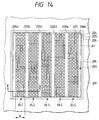
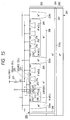
- Fig. 14 is a plan view showing a structure of a power MOS transistor according to this embodiment and Fig. 15 is a cross-sectional view taken along a line II-II of Fig. 14, that is, shows a cross section of a silicon chip 1 serving as a semiconductor substrate.
- islands are produced and defined through an SOI (Silicon On Insulator) structure and a separation structure based on a trench oxide film.
- SOI Silicon On Insulator
- a separation structure based on a trench oxide film Formed within an island is a lateral power MOS transistor which is of the n-channel type.
- a device incorporating this transistor is applicable to a controller for motor vehicles and a battery (18V) mounted on a motor vehicle is used as a power supply therefor.
- a p silicon substrate 202 and an n-type silicon substrate 203 are joined with each other by lamination in a state where a silicon oxide film (buried oxide film) 204 is interposed therebetween, thus producing an SOI structure.
- a trench oxide film 205 is formed to extend from its surface to the buried oxide film 204, and a silicon region surrounded by the trench oxide film 205 and the silicon oxide film (buried oxide film) 204 is defined as a transistor formation island 206.
- an n - epitaxial layer 208 is formed on an n buried layer 207. More specifically, the n buried layer 207 is formed using antimony (Sb) to have a thickness of approximately 207 mm while the n - epitaxial layer 208 is formed to have a carrier concentration of approximately 10 15 cm -3 and the corresponding region constitutes a device formation region.
- the silicon chip 201 has a laminated structure comprising the buried oxide film 204, the n buried layer 207 and the n - epitaxial layer 208 piled up in order on the p silicon substrate 202.
- a p well region is generated in a surface section of the n - epitaxial layer 208 and further an n well region 210 is created in the p well region 209.
- both the well regions 209, 210 are created by the double diffusion so that the n well region 210 has a depth of approximately 1 mm and the p well region 209 has a depth of approximately 4 mm.
- An LOCOS oxide film(s) 211 is generated in a given area(s) of the surface section of the substrate and a poly silicon gate electrode(s) 212 is placed thereon.
- a silicon oxide film 213 serving as a gate insulating film.
- a channel formation p well region 14 and an n source region 215 are generated by double diffusion in a manner that boron (B) and arsenic (As) are dosed through the use of the poly silicon gate electrode 212 as a diffusion window.
- a p region 216 is formed in the channel formation p well region 14.
- an n region 217 is created in a surface layer section of the n well region 210.
- a BPSG film 218 is located on the LOCOS oxide film 211 and the poly silicon gate electrode 212, and a source electrode 219 are disposed to come into contact with the n source region 215 and the p region 216, with the source electrode 219 being made of aluminium.
- a drain electrode 220 is disposed to come into contact with the n region 217, with the drain electrode 220 being also made of aluminium.
- the source electrode 219 and the drain electrode 220 organize a first aluminium layer.
- a second aluminium layer 222 is placed on the first aluminium layer (219, 220) in a state where a TEOS layer 221 is put therebetween.
- the second aluminium layer 222 is covered with a silicon nitride film 223 acting as a passivation film.
- a drain current ID flows from the drain terminal to the source terminal under the silicon oxide film 213 being the gate insulating film, as indicated by a two-dot chain line in Fig. 16.
- the area for the formation of the p well region 214 works as a source cell 224 whereas the area for the formation of the n well region 210 serves as a drain cell 225, with the result that a number of source cells 224 and a number of drain cells 225 are disposed vertically and horizontally in an island 206 of the silicon chip 201.
- the number of cells (the total sum of source cells and drain cells) in the island 206 is set to be approximately 10000 cells. More specifically, in Fig. 14 the source cells 224 and the drain cells 225 have plane structure to produce square configurations and are alternately arranged to make so-called checkers.
- the area A1 for the formation of the source and drain cells 224, 225 is divided into a first block BL1, a second block BL2, a third block BL3, a fourth block BL4 and a fifth block BL5, each of which has a rectangular configuration.
- each of the source cells 224 and the drain cells 225 has a plane structure to produce a rectangular configuration.
- the p well region (the first conductive well region present at the outside position) 209 and the n well region (the second conductive well region present at the inside position) 210 are formed on the surface layer of the silicon chip (the semiconductor substrate) 201 through the use of the double diffusion, and many source and drain cells 224, 225 are produced on the surface of the silicon chip 201.
- the n - epitaxial layer (the second conductive semiconductor layer) 208 is formed on the surface layer side of the silicon chip 201, and the p well region (the first conductive well region present at the outside position) 209 and the n well region (the second conductive well region present at the inside position) 210 are formed in the n - epitaxial layer 208 according to the double diffusion technique, and further many source and drain cells 224, 225 are created on the surface of the n - epitaxial layer 208.
- the source and drain cells 224, 225 are simplified and limited in number for a better understanding thereof.
- n diffusion regions (which will be referred hereinafter to as deep n regions) 226a, 226b, 226c, 226d, 226e, 226f formed to have great diffusion depths and to reach the buried layer 207.
- deep n regions 226a to 226f are disposed to surround the blocked source and drain cell formation areas BL1 to BL5. Further, in the formation of the deep n regions 226a to 226f the diffusion of phosphorus (P) is deeply made by approximately 7 mm in width and approximately 11 mm in depth in order to reduce the resistance.
- the width W of each of the source and drain cell blocks BL1 to BL5 is below 200 mm which makes the surge current (which will be described later) easily flow.
- the cells of a power element with a prior structure broken due to the static electricity distribute within the range of at most 100 mm from the boundaries between the source and drain cell formation area and the deep n region.
- this figure shows a distribution the positions of the cells broken due to static electricity where the horizontal axis represents the broken cell position while the vertical axis denotes the breakdown frequency.
- Fig. 26 It is found from Fig. 26 that the cells are broken within the range up to 100 mm in cell position but not broken when exceeding 100 mm. That is, if the width W of each of the source and drain cell formation areas is determined to be below 200 mm, the breakdown of the cells is preventable.
- a load for example, an inductance such as a motor
- the deep n regions 226a to 226f are connected to the source to be used as the ground. That is, the substrate potential is grounded together with the source and the power MOS transistor is placed on the ground side with respect to the load 227 disposed between the high potential Vcc (18V) and the ground.
- each drain electrode 220 is electrically connected (wired) and further each source electrode 219 is electrically connected.
- a via hole is made in the first aluminium layer with respect to the TEOS layer 221 and the second aluminium layer 222 is used in a state with being separated into the source and the drain.
- the entire chip area can absorb the surge current. Accordingly, a given amount of energy disperses, thereby suppressing the rise of the grating temperature. As a result, the surge withstand can improve.
- the surge current brought from the output terminal (train) due to the discharge of static electricity tends to flow through a laterally formed parasitic npn transistor Tr2 toward the source electrode, which causes the permanent breakdown.
- the surface current flows in the vertical direction within the source and drain cell formation area (power element area) but not flowing in the source region present in the surface, thus protecting the MOS channel section to enhance the withstand against the surge such as static electricity.
- the p region (209) of the source and the n region (210) of the drain constitute a pn diode D1, and this diode D1 gets into the ON state in the forward direction by the surge appearing from the source so that the surge current flows through this diode D1. Accordingly, the temperature rise resulting from the surge is suppressible and it is safely absorbable.
- the gate is connected to a gate drive circuit within the IC circuit equipped with an LDMOS transistor. Since it is not singly connected to a terminal of the IC, there is particularly no need to take the surge into consideration.
- the deep n region 235 is formed only around the source and drain cell formation area A1 containing 100 cells in the vertical directions and 100 cells in the horizontal directions as shown in Fig. 23. In this case, as shown in Fig.
- the surge current brought from the output terminal (the drain) due to the discharge of static electricity goes through a vertically formed npn transistor (drain/source/n-type substrate) in the vertical direction of the substrate and further advances to the ground after passing through the deep n region 235 provided to surround the cell formation area A1.
- the deep n region 235 exists only around the power MOS area, the area for discharging the surge current undergoes restriction. For this reason, the surge current focuses on an area close to the deep n region 235 without being absorbed in the whole island area. In consequence, even in the case of the occurrence of a relatively low surge, the energy concentration increases around the island 206 and the power MOS transistor can be broken due to local heating.
- the deep n regions 226a to 226f have a plane structure to define a band (or strip)-like configuration and are arranged to run in parallel to each other at a given interval within the formation area of the source and drain cells 224, 225f.
- the deep n regions 226a to 226f have a plane structure to define a band (or strip)-like configuration and are arranged to run in parallel to each other at a given interval within the formation area of the source and drain cells 224, 225f.
- 18 band-like deep n regions 236, 237 are formed to extend in both longitudinal and transverse directions within the source and drain cell formation area, the corner portions in the source and drain cell formation area becomes high-concentration regions due to the longitudinally diffused layer 236 and the transversally diffused layer 237 and the electrical resistance of each of the high-concentration regions decreases so that the current tends to easily flow from these portions (the cells present at the corner portions), with the result that the cells at the corner portions are subject to breakdown.
- the solution of this problem results in difficulty being encountered to form the cells at the corner portions in the source and drain cell formation area, which causes the increase in ON resistance.
- the corner portions in the source and drain cell formation area do not come into high concentration conditions, so that the formation of the cells at the corner portions are possible and the increase in the ON resistance does not occur.
- the layout of the deep n regions is possible with the shortest distance, and further the occupying area of the deep n regions is reducible and it is possible to suppress the decrease in the number of cells to the utmost.
- this embodiment provides the features mentioned in (1) to (4).
- this embodiment takes a high side switch structure where the load 227 is connected to the source side. That is, a power MOS transistor is disposed on the power supply side (high potential side) with respect to the load 227 placed between the high potential side Vcc and the ground side. In this case, the deep n regions 226a to 226f are connected to the drain side.
- the p well region 209 and the n well region 210 develop the parasitic diode D1.
- This diode breaks due to the surge current introduced from the drain.
- the surge current can flow from the deep n region 226a to 226f periodically and scatteringly existing within the chip in addition to flowing through the diode D1 (dispersedly flowing). That is, since the deep n regions 226a to 226f are evenly disposed in the whole chip, the current also dspersedly flows to suppress the rise of the grating temperature, so that the surge withstand can improve.
- the surge applied from the source also operates the diode produced by the drain or the deep n regions 226a to 226f, thus absorbing the surge.
- the description of the operation and effects thereof will be taken hereinbelow in comparison with the structure shown in Figs. 23 and 25.
- the deep n region 235 for the formation of the surge current path is formed only around the source and drain cell formation area A1 and the high side switch structure is made as shown in Fig. 25.
- the current coming from the output terminal (drain) is also branched partially to the substrate side.
- the deep n region 35 exists only around the cell formation area A1, the dispersion of the surge energy is unsatisfactory and the surge withstand is low.
- this embodiment can provide the following features. That is, as shown in Fig. 20 the surge current brought from the output terminal (drain) discharges through the scattered deep n regions 226a to 226f in addition to the parasitic diode D1 developed by both the well regions 209, 210, with the result that the surge current separately flows without all concentrating at the drain. That is why the surge current does not flow in the source region in the surface to protect the MOS channel section and the withstand against the surge such as static electricity can improve. This allows a power MOS transistor with a high surge withstand to be realizable.
- the surge current can evenly disperse, thus carrying out the dispersion of the surge energy.
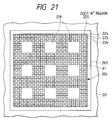
- Fig. 21 is a plan view showing a power MOS transistor (chip 201) according to this embodiment.
- a number of deep n regions 228 are disposed as second conductive deep semiconductor regions in the form of islands. These deep n regions 228 also extend from the surface side of the n - epitaxial layer 208 (low-concentration semiconductor layer) to reach the n buried layer 207 (high-concentration semiconductor layer) as shown in Fig. 15.
- a surge current path is developed by the n + buried layer 207 and the deep n + region 228, and the surge discharge area (in the case of the low side switch structure) or the surge absorption area (in the case of the high side switch structure) created by the deep n + region 228 is scatteringly disposed as evenly as possible within the power element area, so that the surge current is equally divided to accomplish the dispersion of the surge energy. Accordingly, although the breakdown of the power element occurs due to the concentration of the surge energy at a place, according to this embodiment a power element with a high surge withstand is realizable because of no concentration of the surge energy.
- the protection of the MOS channel section is achieved in a manner that the discharging region for drawing the surge current brought from the output terminal (drain) is scattered in the cell area or the surge absorption area for separating the surge current to make it flow through the source region so as not to all concentrate at the drain, thus enhancing the withstand against the surge such as static electricity.
- deep n + regions 231 are scatteringly formed to have an island-like configuration, and the scattered deep n + regions 231 and cell formation regions similarly scattered are alternately arranged vertically and horizontally.
- the strip-like disposition can suppress the decrease in the source cells and the drain cells determining the ON resistance and improve the surge withstand without heightening the ON resistance of the LDMOS.
- drain cells and the source cells have a square (or rectangular) configuration, it is also possible that they have an elongated strip-like configuration or a hexagonal configuration.
- the deep n + regions are periodically disposed, it is not always required to strictly produce the periodic pattern, and even in the case of the randomly scattering disposition within the LDMOS section, the surge is absorbable. However, in this case, the layout wiring becomes troublesome.
- the above-mentioned embodiments include the n + buried layer 207 and the scattered deep n + regions, it is also possible to provide only the deep n+ regions (the surge current path is made using only the scattered deep n + regions). That is, in the case of using with only the high side switch structure, the use of only the deep n+ regions is possible.
- Fig. 27 is a plan view showing a power MOS transistor according to this embodiment
- Fig. 28 is a longitudinal cross-sectional view taken along a line XV-XV of Fig. 27.
- a source and drain cell formation area A1 is defined in a silicon chip 201 serving as a semiconductor substrate and has a square configuration.
- the source and drain cell formation area A1 has the source cells and drain cells formed as shown in Fig. 16. That is, the substrate assumes the SOI structure and has, at its surface layer section, the p well region 209 and n well region 210 generated by the double diffusion. Further, an LOCOS oxide film 211 is formed in a given region on the surface section of this substrate, and a poly silicon gate electrode 212 is placed thereon in a state where a silicon oxide film 213 acting as a gate insulating film is interposed therebetween.
- the substrate surface section has a p well region 214, n + source region 215, p + region 216 and n + region 217 formed thereon.
- the BPSG film 218, the source electrode 219, the drain electrode 220, the TEOS layer 221, the second aluminium layer 222, the silicon nitride film 223 (passivation film) and others in Fig. 16 are omitted for convenience in description.
- a ring-like surge absorption area A2 is adjacently formed around the source and drain cell formation area A1.
- the surge absorption area A2 is an area for receiving the surge current coining from the drain.
- the end portion of the n well region 210 is extended into the surge absorption area A2, and formed in its surface section is an n ++ region 241 which is a second conductive impurity diffusion region and further formed extendedly within the n ++ region 241 is a contact n + region 242.
- the surface section of the n + region 242 is connected as the surge current absorption section to the drain terminal through aluminium wiring (not shown) as shown in Fig. 28.
- the source and drain cell formation area A1 and the surge absorption area A2 are separated by an LOCOS oxide film (field oxide film) 243.
- the diffusion depth of the n ++ region 241 is made to be greater than the depth of the n + region 217 in the drain cell, and its break voltage BV2 is made to be lower than the element breakdown voltage BV1. That is, a parasitic diode D3 developed by the n ++ region 241, the n well region 210 and the p well region 209 comes into breakdown with the voltage BV2 lower than the element breakdown voltage BV1, and the drain breakdown voltage depends upon the voltage BV2 of the surge absorption area A2 but not relying on the element breakdown voltage BV1.
- a ring-like surge draw area A3 is adjacently formed around the surge absorption area A2.
- the surge draw area A3 is for the purpose of drawing the surge current flowing out from the surge absorption area A2.
- the end portion of the p well region 209 is extended into the surge draw area A3 and a contact p + region 244 is formed in its surface layer section.
- the surface section of the p + region 244 is connected as a surge current draw section to the source terminal through aluminium wiring (not shown), with the source terminal being fixed to the ground potential.
- the surge absorption area A2 and the surge draw area A3 are separated by an LOCOS oxide film (field oxide film) 245, and an LOCOS oxide film 246 is formed around the surge draw area A3.
- the LOCOS oxide film 243 is made to be longer than the LOCOS oxide film 245, and as compared with a resistance R1 between the source and drain cells (the formation area A1 therefor) and the surge absorption area A2, a resistance R2 between the surge absorption area A2 and the surge draw area A3 is lower. That is, the relationship between the resistance R1 from the surge absorption area A2 to the source and drain cells (the formation area A1 therefor) and the resistance R2 from the surge absorption area A2 to the surge draw area A3 assumes R1 > R2. In addition, in terms of the relationship between R1 and R2, it is desirable that R2 is set to be as low as possible.
- the n well region 210 is set to be 1.2 ⁇ 10 15 cm -3 in surface carrier concentration and approximately 1.5 mm in depth, whereas the n ++ region 241 is set to be 6 ⁇ 10 19 cm -3 in surface carrier concentration and approximately 2 mm in depth. Further, the n + regions 242, 217 have a surface carrier concentration of 1.2 ⁇ 10 18 cm -3 and a depth of approximately 0.5 mm. In this case, it is preferable that the depth of the n ++ region 241 is larger than that of the n well region 210 as described in this embodiment or is equal thereto.
- the resistance R2 between the surge absorption area A2 and the surge draw area A3 is set to be lower than the resistance R1 between the source and drain cell formation area A1 and the surge absorption area A2, it is possible to prevent the surge current from flowing from the surge absorption area A2 to the source and drain formation area A1.
- the diffusion depth of the n ++ region 241 is set to be larger than the depth of the n + region 217 in the drain cell and its break voltage BV2 is set to be lower than the element breakdown voltage BV1, with the voltage BV2 lower than the element breakdown voltage BV1 the surge current is discharged through the p well region 209 toward the source terminal side.
- the surge countermeasure areas A2, A3 are formed to be uniform and have large areas with respect to the source and drain cell formation area A1, with the result that the surge current does not locally concentrate but can evenly flow in a large energy.
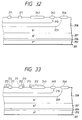
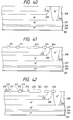
- a laminated substrate is prepared which is produced by placing the silicon oxide film 204, the n + buried layer 207 and the n - epitaxial layer 208 in order and in piles on the p + silicon substrate 202. Subsequently, as shown in Fig. 30 the p well region 209 is formed in the n - epitaxial layer 208 by the ion implantation, and further as shown in Fig. 31 the n well region 210 is formed in the p well region 209 by the ion implantation. Following this, as shown in Fig.
- the LOCOS oxide films 211, 243, 245 and 246 are placed at given regions on the surface of the substrate 201, and as shown in Fig. 33 the silicon oxide film (gate insulating film) 213 is placed and the poly silicon gate electrode 212 is further located on the silicon oxide film 213.
- the p well region 214 is generated by the ion implantation to penetrate the n well region 210 and then reach the p well region 209.
- the n ++ region 241 is formed by the ion implantation.
- the n + source regions 215, the n + region 217 and the n + region 242 are formed simultaneously.
- This embodiment provides the following features.
- the break voltage BV2 of the surge absorption area A2 is set to be lower than the element breakdown voltage BV1 of the source and drain cell formation area A1, it is also appropriate that the break voltage BV2 and the element breakdown voltage BV1 is equal to each other. Also in this instance, the improvement of the withstand is possible as long as R1 > R2.
- Fig. 36 is a longitudinal cross-sectional view showing a power MOS transistor according to this embodiment, substituting for Fig. 28 (the longitudinal cross-sectional view taken along a line XV-XV of Fig. 27).
- a ring-like surge absorption area A2 is formed around a source and drain cell formation area A1
- a surge draw area A3 is formed around the surge absorption area A2.
- a deep n + region 250 serving as a second conductive deep semiconductor region is made at an outer circumference of an LOCOS oxide film 246 in the surge draw region A3.
- the deep n + region 250 penetrates an n - epitaxial layer 208 and then reaches an n + buried layer 207.
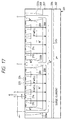
- the power MOS transistor according to this embodiment has the low side switch structure as well as the case as shown in Fig. 15, where the deep n region 250 is connected through aluminium wiring (not shown) to the source terminal (ground) for fixing the substrate potential. More specifically, the n buried layer 207, extending under the source and drain cells, is coupled through the deep n region 250 to the source terminal (ground). Moreover, a number of semiconductor elements including the power MOS transistor shown in Fig. 36 are formed in a plurality of islands produced through the SOI structure and the separation structure based upon the trench oxide film.
- a parasitic capacitor C1 exists as shown in Fig. 36, due to the fixing of the potentials of the n + buried layer 207 and the deep n + region 250 the variation of the potential of the p + silicon substrate 202 is suppressible even if the DMOS transistor gets into the switching operation. That is, in the case that the switching noises are not introduced into the p + silicon substrate 202 and the element separation is made through the use of an insulating film, the switching noises does not propagate to other element regions, thus preventing the malfunction of the other semiconductor elements.
- the deep n + region 250 in Fig. 36 may be connected to the drain terminal (the power supply terminal) for the fixing of the substrate potential.
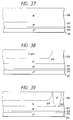
- the power MOS transistor with this structure is manufactured in accordance with the manufacturing processes shown in Figs. 37 to 44. That is, as shown in Fig. 37 a laminated substrate is prepared which is constructed by piling the silicon oxide film 204, the n + buried layer 207 and the n - epitaxial layer 208 in order on the p + silicon substrate 202. Further, as shown in Fig. 38 the p well region 209 is made in the n - epitaxial layer 208 by the ion implantation, and as shown in Fig. 39 the deep n + region 250 is further made thereby by the ion implantation, and as shown in Fig. 40 the n well region 210 is formed in the p well region 209 by the ion implantation.
- the LOCOS oxide films 211, 243, 245, 246 are formed at given regions on the surface of the substrate 201.
- the silicon oxide film (gate insulating film) 213 is disposed and the poly silicon gate electrode 212 is located thereon.
- the p well region 214 is generated by the ion implantation to penetrate the n well region 210 and reaches the p well region 209.
- the n ++ region 241 is made by the ion implantation.
- the n + source region 215, the n + region 217 and the n + region 242 are concurrently formed after the formation of the p + regions 216 and 244.
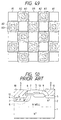
- drain cells 225 and the source cells 224 are alternately arranged in the longitudinal and transverse directions (checkers) as shown in Fig. 45, it is also appropriate that as shown in Fig. 46 cells adjacent to the surge absorption area A2 in the source and drain cell formation area A1 are disposed as dummy source cells 256. That is, a second surge draw area comprising the dummy source cells 256 is placed between the source and drain cell formation area A1 and the surge absorption area A2. Whereupon, a portion of the surge current is drawn through the dummy source cells 256. In this case, it is possible to enlarge the area for the surge current draw, thereby more improving the withstand.
- a second surge draw area A3' is made between the source and drain cell formation area A1 and the surge absorption area A2.
- a ring-like surge absorption area A2 is formed around source and drain cell formation areas A1a, A1b and further a surge draw area A3 is formed around the surge absorption area A2.
- source and drain cell formation areas A1 are formed into island-like configurations, ring-like surge absorption area A2 are formed between the island-like cell formation areas A1 and even a square surge draw area A3 is made inside the surge absorption area A2.
- the third to seventh embodiments described above are based upon the use of the joined SOI wafer substrate, even the common mere epitaxial wafer can provide the similar effects.
- the above-described third to seventh embodiments are applied to the n channel LDMOS, it is also appropriate that the embodiments are also applicable to a p channel LDMOS. That is, the conductive types (p, n) of the n channel MOS are interchangeable.
Landscapes
- Insulated Gate Type Field-Effect Transistor (AREA)
- Metal-Oxide And Bipolar Metal-Oxide Semiconductor Integrated Circuits (AREA)
Applications Claiming Priority (9)
| Application Number | Priority Date | Filing Date | Title |
|---|---|---|---|
| JP9276996 | 1996-04-15 | ||
| JP92769/96 | 1996-04-15 | ||
| JP9276996 | 1996-04-15 | ||
| JP21167596A JP3282512B2 (ja) | 1996-04-15 | 1996-08-09 | パワーmosトランジスタ |
| JP211675/96 | 1996-08-09 | ||
| JP21167596 | 1996-08-09 | ||
| JP25029996A JP3543508B2 (ja) | 1996-01-22 | 1996-09-20 | 半導体装置 |
| JP250299/96 | 1996-09-20 | ||
| JP25029996 | 1996-09-20 |
Publications (3)
| Publication Number | Publication Date |
|---|---|
| EP0802567A2 true EP0802567A2 (fr) | 1997-10-22 |
| EP0802567A3 EP0802567A3 (fr) | 2000-07-05 |
| EP0802567B1 EP0802567B1 (fr) | 2007-08-29 |
Family
ID=27307115
Family Applications (1)
| Application Number | Title | Priority Date | Filing Date |
|---|---|---|---|
| EP97106103A Expired - Lifetime EP0802567B1 (fr) | 1996-04-15 | 1997-04-14 | Dispositif semi-conducteur avec transistor de puissance |
Country Status (2)
| Country | Link |
|---|---|
| EP (1) | EP0802567B1 (fr) |
| DE (1) | DE69738058T2 (fr) |
Cited By (12)
| Publication number | Priority date | Publication date | Assignee | Title |
|---|---|---|---|---|
| WO2000017938A1 (fr) * | 1998-09-23 | 2000-03-30 | Koninklijke Philips Electronics N.V. | Dispositif a semi-conducteurs |
| US6207518B1 (en) * | 1999-03-12 | 2001-03-27 | Sanyo Electric Co., Ltd. | Method of manufacturing semiconductor device |
| US6365932B1 (en) | 1999-08-20 | 2002-04-02 | Denso Corporation | Power MOS transistor |
| US6614633B1 (en) | 1999-03-19 | 2003-09-02 | Denso Corporation | Semiconductor device including a surge protecting circuit |
| DE102006038874A1 (de) * | 2006-08-18 | 2008-03-20 | Infineon Technologies Austria Ag | Halbleitervorrichtung mit gemeinsamen Bezugspotential über Deep-Trench-Isolation |
| RU2444086C2 (ru) * | 2010-05-17 | 2012-02-27 | Государственное образовательное учреждение высшего профессионального образования "Московский государственный институт электроники и математики (технический университет)" | Полупроводниковая структура логического элемента и-не |
| CN102456605A (zh) * | 2010-10-20 | 2012-05-16 | 新加坡商格罗方德半导体私人有限公司 | 自行对准本体完全隔绝器件 |
| CN102130170B (zh) * | 2010-01-20 | 2013-02-13 | 上海华虹Nec电子有限公司 | 高压隔离n型晶体管及高压隔离p型晶体管 |
| CN104425489A (zh) * | 2013-08-20 | 2015-03-18 | 上海华虹宏力半导体制造有限公司 | 高压器件和低压器件集成结构和集成方法 |
| CN105097903A (zh) * | 2009-11-09 | 2015-11-25 | 苏州博创集成电路设计有限公司 | 绝缘体上硅的横向n型绝缘栅双极晶体管 |
| CN107910359A (zh) * | 2017-11-08 | 2018-04-13 | 南京邮电大学 | 一种具有扩大e‑soa区域的ldmos器件及其制造方法 |
| CN120545244A (zh) * | 2025-07-01 | 2025-08-26 | 北京超玮微电子有限公司 | 一种驱动芯片的半导体结构 |
Family Cites Families (11)
| Publication number | Priority date | Publication date | Assignee | Title |
|---|---|---|---|---|
| EP0110320B1 (fr) * | 1982-11-27 | 1987-03-11 | Nissan Motor Co., Ltd. | Transistor de type MOS |
| JPS6265382A (ja) * | 1985-09-17 | 1987-03-24 | Agency Of Ind Science & Technol | サ−ジ吸収素子 |
| EP0267768A1 (fr) * | 1986-11-10 | 1988-05-18 | SILICONIX Incorporated | Transistor MOS à drain dérivé à tension de claquage élevée |
| US4929991A (en) * | 1987-11-12 | 1990-05-29 | Siliconix Incorporated | Rugged lateral DMOS transistor structure |
| US5156989A (en) * | 1988-11-08 | 1992-10-20 | Siliconix, Incorporated | Complementary, isolated DMOS IC technology |
| IT1235843B (it) * | 1989-06-14 | 1992-11-03 | Sgs Thomson Microelectronics | Dispositivo integrato contenente strutture di potenza formate con transistori ldmos complementari, strutture cmos e pnp verticali con aumentata capacita' di supportare un'alta tensione di alimentazione. |
| JP2835116B2 (ja) * | 1989-09-29 | 1998-12-14 | 株式会社東芝 | 電力用icおよびその製造方法 |
| EP0566262A2 (fr) * | 1992-04-15 | 1993-10-20 | National Semiconductor Corporation | Transistor à effet de champ avec un contact d'une zone P profonde par l'électrode de source |
| US5286995A (en) * | 1992-07-14 | 1994-02-15 | Texas Instruments Incorporated | Isolated resurf LDMOS devices for multiple outputs on one die |
| JP3252569B2 (ja) * | 1993-11-09 | 2002-02-04 | 株式会社デンソー | 絶縁分離基板及びそれを用いた半導体装置及びその製造方法 |
| JP3186405B2 (ja) * | 1994-03-08 | 2001-07-11 | 富士電機株式会社 | 横型mosfet |
-
1997
- 1997-04-14 DE DE69738058T patent/DE69738058T2/de not_active Expired - Lifetime
- 1997-04-14 EP EP97106103A patent/EP0802567B1/fr not_active Expired - Lifetime
Cited By (17)
| Publication number | Priority date | Publication date | Assignee | Title |
|---|---|---|---|---|
| WO2000017938A1 (fr) * | 1998-09-23 | 2000-03-30 | Koninklijke Philips Electronics N.V. | Dispositif a semi-conducteurs |
| US6207518B1 (en) * | 1999-03-12 | 2001-03-27 | Sanyo Electric Co., Ltd. | Method of manufacturing semiconductor device |
| US6614633B1 (en) | 1999-03-19 | 2003-09-02 | Denso Corporation | Semiconductor device including a surge protecting circuit |
| US6888711B2 (en) | 1999-03-19 | 2005-05-03 | Denso Corporation | Semiconductor device including a surge protecting circuit |
| US6365932B1 (en) | 1999-08-20 | 2002-04-02 | Denso Corporation | Power MOS transistor |
| DE102006038874A1 (de) * | 2006-08-18 | 2008-03-20 | Infineon Technologies Austria Ag | Halbleitervorrichtung mit gemeinsamen Bezugspotential über Deep-Trench-Isolation |
| DE102006038874B4 (de) * | 2006-08-18 | 2011-02-10 | Infineon Technologies Austria Ag | Halbleitervorrichtung mit gemeinsamen Bezugspotential über Deep-Trench-Isolation und Messanordnung |
| CN105097903A (zh) * | 2009-11-09 | 2015-11-25 | 苏州博创集成电路设计有限公司 | 绝缘体上硅的横向n型绝缘栅双极晶体管 |
| CN105097903B (zh) * | 2009-11-09 | 2020-07-03 | 苏州博创集成电路设计有限公司 | 绝缘体上硅的横向n型绝缘栅双极晶体管 |
| CN102130170B (zh) * | 2010-01-20 | 2013-02-13 | 上海华虹Nec电子有限公司 | 高压隔离n型晶体管及高压隔离p型晶体管 |
| RU2444086C2 (ru) * | 2010-05-17 | 2012-02-27 | Государственное образовательное учреждение высшего профессионального образования "Московский государственный институт электроники и математики (технический университет)" | Полупроводниковая структура логического элемента и-не |
| CN102456605A (zh) * | 2010-10-20 | 2012-05-16 | 新加坡商格罗方德半导体私人有限公司 | 自行对准本体完全隔绝器件 |
| CN102456605B (zh) * | 2010-10-20 | 2014-10-08 | 新加坡商格罗方德半导体私人有限公司 | 自行对准本体完全隔绝器件 |
| CN104425489A (zh) * | 2013-08-20 | 2015-03-18 | 上海华虹宏力半导体制造有限公司 | 高压器件和低压器件集成结构和集成方法 |
| CN104425489B (zh) * | 2013-08-20 | 2017-03-01 | 上海华虹宏力半导体制造有限公司 | 高压器件和低压器件集成结构和集成方法 |
| CN107910359A (zh) * | 2017-11-08 | 2018-04-13 | 南京邮电大学 | 一种具有扩大e‑soa区域的ldmos器件及其制造方法 |
| CN120545244A (zh) * | 2025-07-01 | 2025-08-26 | 北京超玮微电子有限公司 | 一种驱动芯片的半导体结构 |
Also Published As
| Publication number | Publication date |
|---|---|
| EP0802567B1 (fr) | 2007-08-29 |
| DE69738058D1 (de) | 2007-10-11 |
| DE69738058T2 (de) | 2008-05-21 |
| EP0802567A3 (fr) | 2000-07-05 |
Similar Documents
| Publication | Publication Date | Title |
|---|---|---|
| US6831331B2 (en) | Power MOS transistor for absorbing surge current | |
| US6242787B1 (en) | Semiconductor device and manufacturing method thereof | |
| US6064086A (en) | Semiconductor device having lateral IGBT | |
| JP2932429B2 (ja) | Mos電界効果トランジスタ及びその製造方法 | |
| US5349225A (en) | Field effect transistor with a lightly doped drain | |
| US5525824A (en) | Semiconductor device with isolation regions | |
| EP0760529B1 (fr) | IGBT latéral | |
| JP5261927B2 (ja) | 半導体装置 | |
| US20010038125A1 (en) | Insulated gate field effect transistor and semiconductor integrated circuit | |
| JP3114592B2 (ja) | 半導体装置およびその製造方法 | |
| JP3168763B2 (ja) | 半導体装置及びその製造方法 | |
| US5903032A (en) | Power device integration for built-in ESD robustness | |
| EP0802567B1 (fr) | Dispositif semi-conducteur avec transistor de puissance | |
| KR100668545B1 (ko) | 반도체 장치 | |
| CN101807599B (zh) | 半导体装置及其制造方法 | |
| KR19990024638A (ko) | 소이 트랜지스터 및 그의 제조 방법 | |
| US5869850A (en) | Lateral insulated gate bipolar transistor | |
| KR100683102B1 (ko) | 반도체 장치 | |
| KR0159141B1 (ko) | 다수의 불순물층을 포함하고 있는 반도체장치 및 그 제조방법 | |
| US5604369A (en) | ESD protection device for high voltage CMOS applications | |
| JP4800566B2 (ja) | 半導体装置及びその製造方法 | |
| JP3543508B2 (ja) | 半導体装置 | |
| JPH08186254A (ja) | 絶縁ゲート型半導体装置およびその製造方法 | |
| JP3282512B2 (ja) | パワーmosトランジスタ | |
| US7026705B2 (en) | Semiconductor device with surge protection circuit capable of preventing current leakage |
Legal Events
| Date | Code | Title | Description |
|---|---|---|---|
| PUAI | Public reference made under article 153(3) epc to a published international application that has entered the european phase |
Free format text: ORIGINAL CODE: 0009012 |
|
| AK | Designated contracting states |
Kind code of ref document: A2 Designated state(s): DE FR IT |
|
| RIC1 | Information provided on ipc code assigned before grant |
Free format text: 7H 01L 27/02 A, 7H 01L 27/06 B, 7H 01L 21/8249 B, 7H 01L 29/78 B, 7H 01L 27/12 B, 7H 01L 21/84 B, 7H 01L 27/07 B |
|
| PUAL | Search report despatched |
Free format text: ORIGINAL CODE: 0009013 |
|
| AK | Designated contracting states |
Kind code of ref document: A3 Designated state(s): DE FR IT |
|
| 17P | Request for examination filed |
Effective date: 20001024 |
|
| 17Q | First examination report despatched |
Effective date: 20040820 |
|
| GRAP | Despatch of communication of intention to grant a patent |
Free format text: ORIGINAL CODE: EPIDOSNIGR1 |
|
| RTI1 | Title (correction) |
Free format text: SEMICONDUCTOR DEVICE HAVING A POWER TRANSISTOR STRUCTURE |
|
| GRAS | Grant fee paid |
Free format text: ORIGINAL CODE: EPIDOSNIGR3 |
|
| GRAA | (expected) grant |
Free format text: ORIGINAL CODE: 0009210 |
|
| AK | Designated contracting states |
Kind code of ref document: B1 Designated state(s): DE FR IT |
|
| REF | Corresponds to: |
Ref document number: 69738058 Country of ref document: DE Date of ref document: 20071011 Kind code of ref document: P |
|
| ET | Fr: translation filed | ||
| PLBE | No opposition filed within time limit |
Free format text: ORIGINAL CODE: 0009261 |
|
| STAA | Information on the status of an ep patent application or granted ep patent |
Free format text: STATUS: NO OPPOSITION FILED WITHIN TIME LIMIT |
|
| 26N | No opposition filed |
Effective date: 20080530 |
|
| PGFP | Annual fee paid to national office [announced via postgrant information from national office to epo] |
Ref country code: FR Payment date: 20140422 Year of fee payment: 18 Ref country code: DE Payment date: 20140418 Year of fee payment: 18 Ref country code: IT Payment date: 20140430 Year of fee payment: 18 |
|
| REG | Reference to a national code |
Ref country code: DE Ref legal event code: R119 Ref document number: 69738058 Country of ref document: DE |
|
| PG25 | Lapsed in a contracting state [announced via postgrant information from national office to epo] |
Ref country code: DE Free format text: LAPSE BECAUSE OF NON-PAYMENT OF DUE FEES Effective date: 20151103 Ref country code: IT Free format text: LAPSE BECAUSE OF NON-PAYMENT OF DUE FEES Effective date: 20150414 |
|
| REG | Reference to a national code |
Ref country code: FR Ref legal event code: ST Effective date: 20151231 |
|
| PG25 | Lapsed in a contracting state [announced via postgrant information from national office to epo] |
Ref country code: FR Free format text: LAPSE BECAUSE OF NON-PAYMENT OF DUE FEES Effective date: 20150430 |