EP0803279A1 - Autothermisches katalytisches Verfahren zur Desodorierung und Denitrierung von Schadstoffen - Google Patents
Autothermisches katalytisches Verfahren zur Desodorierung und Denitrierung von Schadstoffen Download PDFInfo
- Publication number
- EP0803279A1 EP0803279A1 EP97400797A EP97400797A EP0803279A1 EP 0803279 A1 EP0803279 A1 EP 0803279A1 EP 97400797 A EP97400797 A EP 97400797A EP 97400797 A EP97400797 A EP 97400797A EP 0803279 A1 EP0803279 A1 EP 0803279A1
- Authority
- EP
- European Patent Office
- Prior art keywords
- stage
- catalyst
- liquid
- reactor
- oxidation
- Prior art date
- Legal status (The legal status is an assumption and is not a legal conclusion. Google has not performed a legal analysis and makes no representation as to the accuracy of the status listed.)
- Granted
Links
- 238000000034 method Methods 0.000 title claims abstract description 38
- 230000008569 process Effects 0.000 title claims abstract description 23
- 230000003197 catalytic effect Effects 0.000 title claims description 10
- 230000001877 deodorizing effect Effects 0.000 title description 2
- 239000002699 waste material Substances 0.000 title 1
- QGZKDVFQNNGYKY-UHFFFAOYSA-N Ammonia Chemical compound N QGZKDVFQNNGYKY-UHFFFAOYSA-N 0.000 claims abstract description 46
- 239000003054 catalyst Substances 0.000 claims abstract description 34
- 239000007789 gas Substances 0.000 claims abstract description 27
- 238000007254 oxidation reaction Methods 0.000 claims abstract description 24
- 229910021529 ammonia Inorganic materials 0.000 claims abstract description 23
- 230000003647 oxidation Effects 0.000 claims abstract description 21
- RWSOTUBLDIXVET-UHFFFAOYSA-N Dihydrogen sulfide Chemical compound S RWSOTUBLDIXVET-UHFFFAOYSA-N 0.000 claims abstract description 20
- 239000007788 liquid Substances 0.000 claims abstract description 20
- 238000002485 combustion reaction Methods 0.000 claims abstract description 15
- 150000001875 compounds Chemical class 0.000 claims abstract description 11
- KWYUFKZDYYNOTN-UHFFFAOYSA-M potassium hydroxide Substances [OH-].[K+] KWYUFKZDYYNOTN-UHFFFAOYSA-M 0.000 claims abstract description 11
- 150000001412 amines Chemical class 0.000 claims abstract description 8
- 235000008733 Citrus aurantifolia Nutrition 0.000 claims abstract description 6
- 235000011941 Tilia x europaea Nutrition 0.000 claims abstract description 6
- QVGXLLKOCUKJST-UHFFFAOYSA-N atomic oxygen Chemical compound [O] QVGXLLKOCUKJST-UHFFFAOYSA-N 0.000 claims abstract description 6
- 230000005587 bubbling Effects 0.000 claims abstract description 6
- 230000008030 elimination Effects 0.000 claims abstract description 6
- 238000003379 elimination reaction Methods 0.000 claims abstract description 6
- 239000004571 lime Substances 0.000 claims abstract description 6
- 239000001301 oxygen Substances 0.000 claims abstract description 6
- 229910052760 oxygen Inorganic materials 0.000 claims abstract description 6
- 235000014113 dietary fatty acids Nutrition 0.000 claims abstract description 4
- 239000000194 fatty acid Substances 0.000 claims abstract description 4
- 229930195729 fatty acid Natural products 0.000 claims abstract description 4
- 150000004665 fatty acids Chemical class 0.000 claims abstract description 4
- BVKZGUZCCUSVTD-UHFFFAOYSA-L Carbonate Chemical compound [O-]C([O-])=O BVKZGUZCCUSVTD-UHFFFAOYSA-L 0.000 claims abstract description 3
- 238000007084 catalytic combustion reaction Methods 0.000 claims abstract description 3
- 239000011368 organic material Substances 0.000 claims abstract description 3
- WMFOQBRAJBCJND-UHFFFAOYSA-M Lithium hydroxide Chemical compound [Li+].[OH-] WMFOQBRAJBCJND-UHFFFAOYSA-M 0.000 claims abstract 5
- 150000003568 thioethers Chemical class 0.000 claims abstract 2
- XEEYBQQBJWHFJM-UHFFFAOYSA-N iron Substances [Fe] XEEYBQQBJWHFJM-UHFFFAOYSA-N 0.000 claims description 14
- 210000003608 fece Anatomy 0.000 claims description 9
- 229910052742 iron Inorganic materials 0.000 claims description 9
- VYPSYNLAJGMNEJ-UHFFFAOYSA-N Silicium dioxide Chemical compound O=[Si]=O VYPSYNLAJGMNEJ-UHFFFAOYSA-N 0.000 claims description 8
- 239000000446 fuel Substances 0.000 claims description 6
- 238000010438 heat treatment Methods 0.000 claims description 6
- 239000010871 livestock manure Substances 0.000 claims description 6
- 229910052723 transition metal Inorganic materials 0.000 claims description 5
- 150000003624 transition metals Chemical class 0.000 claims description 5
- XLYOFNOQVPJJNP-UHFFFAOYSA-N water Substances O XLYOFNOQVPJJNP-UHFFFAOYSA-N 0.000 claims description 5
- MCMNRKCIXSYSNV-UHFFFAOYSA-N Zirconium dioxide Chemical compound O=[Zr]=O MCMNRKCIXSYSNV-UHFFFAOYSA-N 0.000 claims description 4
- PNEYBMLMFCGWSK-UHFFFAOYSA-N aluminium oxide Inorganic materials [O-2].[O-2].[O-2].[Al+3].[Al+3] PNEYBMLMFCGWSK-UHFFFAOYSA-N 0.000 claims description 4
- 229910052802 copper Inorganic materials 0.000 claims description 4
- 239000010949 copper Substances 0.000 claims description 4
- 238000004064 recycling Methods 0.000 claims description 4
- 239000000377 silicon dioxide Substances 0.000 claims description 4
- 229910052720 vanadium Inorganic materials 0.000 claims description 4
- 241001465754 Metazoa Species 0.000 claims description 3
- 239000004113 Sepiolite Substances 0.000 claims description 3
- GWEVSGVZZGPLCZ-UHFFFAOYSA-N Titan oxide Chemical compound O=[Ti]=O GWEVSGVZZGPLCZ-UHFFFAOYSA-N 0.000 claims description 3
- 229960000892 attapulgite Drugs 0.000 claims description 3
- 239000011324 bead Substances 0.000 claims description 3
- KZHJGOXRZJKJNY-UHFFFAOYSA-N dioxosilane;oxo(oxoalumanyloxy)alumane Chemical compound O=[Si]=O.O=[Si]=O.O=[Al]O[Al]=O.O=[Al]O[Al]=O.O=[Al]O[Al]=O KZHJGOXRZJKJNY-UHFFFAOYSA-N 0.000 claims description 3
- 229910052737 gold Inorganic materials 0.000 claims description 3
- 229910052748 manganese Inorganic materials 0.000 claims description 3
- 229910052751 metal Inorganic materials 0.000 claims description 3
- 239000002184 metal Substances 0.000 claims description 3
- 239000000203 mixture Substances 0.000 claims description 3
- 229910052863 mullite Inorganic materials 0.000 claims description 3
- 229910052625 palygorskite Inorganic materials 0.000 claims description 3
- 229910052624 sepiolite Inorganic materials 0.000 claims description 3
- 235000019355 sepiolite Nutrition 0.000 claims description 3
- 229910052709 silver Inorganic materials 0.000 claims description 3
- OGIDPMRJRNCKJF-UHFFFAOYSA-N titanium oxide Inorganic materials [Ti]=O OGIDPMRJRNCKJF-UHFFFAOYSA-N 0.000 claims description 3
- 230000009466 transformation Effects 0.000 claims description 3
- 238000011144 upstream manufacturing Methods 0.000 claims description 3
- 229910021536 Zeolite Inorganic materials 0.000 claims description 2
- 239000000919 ceramic Substances 0.000 claims description 2
- 229910052878 cordierite Inorganic materials 0.000 claims description 2
- 238000004332 deodorization Methods 0.000 claims description 2
- JSKIRARMQDRGJZ-UHFFFAOYSA-N dimagnesium dioxido-bis[(1-oxido-3-oxo-2,4,6,8,9-pentaoxa-1,3-disila-5,7-dialuminabicyclo[3.3.1]nonan-7-yl)oxy]silane Chemical compound [Mg++].[Mg++].[O-][Si]([O-])(O[Al]1O[Al]2O[Si](=O)O[Si]([O-])(O1)O2)O[Al]1O[Al]2O[Si](=O)O[Si]([O-])(O1)O2 JSKIRARMQDRGJZ-UHFFFAOYSA-N 0.000 claims description 2
- HNPSIPDUKPIQMN-UHFFFAOYSA-N dioxosilane;oxo(oxoalumanyloxy)alumane Chemical compound O=[Si]=O.O=[Al]O[Al]=O HNPSIPDUKPIQMN-UHFFFAOYSA-N 0.000 claims description 2
- 239000010791 domestic waste Substances 0.000 claims description 2
- 238000001125 extrusion Methods 0.000 claims description 2
- 229910000037 hydrogen sulfide Inorganic materials 0.000 claims description 2
- 150000002739 metals Chemical class 0.000 claims description 2
- 229910052680 mordenite Inorganic materials 0.000 claims description 2
- 229910017464 nitrogen compound Inorganic materials 0.000 claims description 2
- 150000002830 nitrogen compounds Chemical class 0.000 claims description 2
- 150000002894 organic compounds Chemical class 0.000 claims description 2
- 229910052763 palladium Inorganic materials 0.000 claims description 2
- 230000000737 periodic effect Effects 0.000 claims description 2
- 229910052697 platinum Inorganic materials 0.000 claims description 2
- 244000144977 poultry Species 0.000 claims description 2
- 238000003303 reheating Methods 0.000 claims description 2
- 150000003464 sulfur compounds Chemical class 0.000 claims description 2
- 239000002351 wastewater Substances 0.000 claims description 2
- 239000010457 zeolite Substances 0.000 claims description 2
- CDBYLPFSWZWCQE-UHFFFAOYSA-L Sodium Carbonate Chemical compound [Na+].[Na+].[O-]C([O-])=O CDBYLPFSWZWCQE-UHFFFAOYSA-L 0.000 claims 1
- HEMHJVSKTPXQMS-UHFFFAOYSA-M Sodium hydroxide Chemical compound [OH-].[Na+] HEMHJVSKTPXQMS-UHFFFAOYSA-M 0.000 abstract description 6
- NINIDFKCEFEMDL-UHFFFAOYSA-N Sulfur Chemical class [S] NINIDFKCEFEMDL-UHFFFAOYSA-N 0.000 abstract description 3
- 238000000855 fermentation Methods 0.000 abstract description 2
- 230000004151 fermentation Effects 0.000 abstract description 2
- 239000003513 alkali Substances 0.000 abstract 1
- 229910052783 alkali metal Inorganic materials 0.000 abstract 1
- 150000001340 alkali metals Chemical class 0.000 abstract 1
- IJGRMHOSHXDMSA-UHFFFAOYSA-N Atomic nitrogen Chemical compound N#N IJGRMHOSHXDMSA-UHFFFAOYSA-N 0.000 description 9
- 238000006243 chemical reaction Methods 0.000 description 7
- MWUXSHHQAYIFBG-UHFFFAOYSA-N Nitric oxide Chemical compound O=[N] MWUXSHHQAYIFBG-UHFFFAOYSA-N 0.000 description 6
- 208000019698 Cutaneous collagenous vasculopathy Diseases 0.000 description 5
- 201000009911 cataract 8 multiple types Diseases 0.000 description 5
- 229910052757 nitrogen Inorganic materials 0.000 description 3
- 239000012071 phase Substances 0.000 description 3
- BWHMMNNQKKPAPP-UHFFFAOYSA-L potassium carbonate Chemical compound [K+].[K+].[O-]C([O-])=O BWHMMNNQKKPAPP-UHFFFAOYSA-L 0.000 description 3
- 229910052717 sulfur Inorganic materials 0.000 description 3
- 239000011593 sulfur Substances 0.000 description 3
- 239000012855 volatile organic compound Substances 0.000 description 3
- OKTJSMMVPCPJKN-UHFFFAOYSA-N Carbon Chemical compound [C] OKTJSMMVPCPJKN-UHFFFAOYSA-N 0.000 description 2
- CURLTUGMZLYLDI-UHFFFAOYSA-N Carbon dioxide Chemical compound O=C=O CURLTUGMZLYLDI-UHFFFAOYSA-N 0.000 description 2
- RTAQQCXQSZGOHL-UHFFFAOYSA-N Titanium Chemical compound [Ti] RTAQQCXQSZGOHL-UHFFFAOYSA-N 0.000 description 2
- HIGRAKVNKLCVCA-UHFFFAOYSA-N alumine Chemical compound C1=CC=[Al]C=C1 HIGRAKVNKLCVCA-UHFFFAOYSA-N 0.000 description 2
- 239000000567 combustion gas Substances 0.000 description 2
- 239000003517 fume Substances 0.000 description 2
- 229910052500 inorganic mineral Inorganic materials 0.000 description 2
- 239000011572 manganese Substances 0.000 description 2
- 239000011707 mineral Substances 0.000 description 2
- 235000010755 mineral Nutrition 0.000 description 2
- QJGQUHMNIGDVPM-UHFFFAOYSA-N nitrogen group Chemical group [N] QJGQUHMNIGDVPM-UHFFFAOYSA-N 0.000 description 2
- IEQIEDJGQAUEQZ-UHFFFAOYSA-N phthalocyanine Chemical compound N1C(N=C2C3=CC=CC=C3C(N=C3C4=CC=CC=C4C(=N4)N3)=N2)=C(C=CC=C2)C2=C1N=C1C2=CC=CC=C2C4=N1 IEQIEDJGQAUEQZ-UHFFFAOYSA-N 0.000 description 2
- 239000010970 precious metal Substances 0.000 description 2
- 239000002002 slurry Substances 0.000 description 2
- 229910052665 sodalite Inorganic materials 0.000 description 2
- 230000007480 spreading Effects 0.000 description 2
- 230000007704 transition Effects 0.000 description 2
- 241000272525 Anas platyrhynchos Species 0.000 description 1
- 241000271566 Aves Species 0.000 description 1
- OYPRJOBELJOOCE-UHFFFAOYSA-N Calcium Chemical compound [Ca] OYPRJOBELJOOCE-UHFFFAOYSA-N 0.000 description 1
- RYGMFSIKBFXOCR-UHFFFAOYSA-N Copper Chemical compound [Cu] RYGMFSIKBFXOCR-UHFFFAOYSA-N 0.000 description 1
- 241000287828 Gallus gallus Species 0.000 description 1
- LSDPWZHWYPCBBB-UHFFFAOYSA-N Methanethiol Chemical compound SC LSDPWZHWYPCBBB-UHFFFAOYSA-N 0.000 description 1
- ZLMJMSJWJFRBEC-UHFFFAOYSA-N Potassium Chemical compound [K] ZLMJMSJWJFRBEC-UHFFFAOYSA-N 0.000 description 1
- 239000013543 active substance Substances 0.000 description 1
- 150000001299 aldehydes Chemical class 0.000 description 1
- 229940053200 antiepileptics fatty acid derivative Drugs 0.000 description 1
- 230000008901 benefit Effects 0.000 description 1
- 230000033228 biological regulation Effects 0.000 description 1
- 239000011575 calcium Substances 0.000 description 1
- 229910052791 calcium Inorganic materials 0.000 description 1
- 229910052799 carbon Inorganic materials 0.000 description 1
- 239000001569 carbon dioxide Substances 0.000 description 1
- 229910002092 carbon dioxide Inorganic materials 0.000 description 1
- 239000013522 chelant Substances 0.000 description 1
- 229910000428 cobalt oxide Inorganic materials 0.000 description 1
- IVMYJDGYRUAWML-UHFFFAOYSA-N cobalt(ii) oxide Chemical compound [Co]=O IVMYJDGYRUAWML-UHFFFAOYSA-N 0.000 description 1
- -1 des mercaptans Chemical class 0.000 description 1
- 238000010586 diagram Methods 0.000 description 1
- 150000002019 disulfides Chemical class 0.000 description 1
- 230000000694 effects Effects 0.000 description 1
- 230000007613 environmental effect Effects 0.000 description 1
- 239000003344 environmental pollutant Substances 0.000 description 1
- 230000004907 flux Effects 0.000 description 1
- 239000003673 groundwater Substances 0.000 description 1
- XLYOFNOQVPJJNP-UHFFFAOYSA-M hydroxide Chemical compound [OH-] XLYOFNOQVPJJNP-UHFFFAOYSA-M 0.000 description 1
- 230000006872 improvement Effects 0.000 description 1
- 238000009434 installation Methods 0.000 description 1
- 159000000014 iron salts Chemical class 0.000 description 1
- 239000007791 liquid phase Substances 0.000 description 1
- 230000014759 maintenance of location Effects 0.000 description 1
- WPBNNNQJVZRUHP-UHFFFAOYSA-L manganese(2+);methyl n-[[2-(methoxycarbonylcarbamothioylamino)phenyl]carbamothioyl]carbamate;n-[2-(sulfidocarbothioylamino)ethyl]carbamodithioate Chemical compound [Mn+2].[S-]C(=S)NCCNC([S-])=S.COC(=O)NC(=S)NC1=CC=CC=C1NC(=S)NC(=O)OC WPBNNNQJVZRUHP-UHFFFAOYSA-L 0.000 description 1
- 235000019645 odor Nutrition 0.000 description 1
- 239000005416 organic matter Substances 0.000 description 1
- 125000002524 organometallic group Chemical group 0.000 description 1
- 239000003208 petroleum Substances 0.000 description 1
- ISWSIDIOOBJBQZ-UHFFFAOYSA-N phenol group Chemical group C1(=CC=CC=C1)O ISWSIDIOOBJBQZ-UHFFFAOYSA-N 0.000 description 1
- 150000002989 phenols Chemical class 0.000 description 1
- 231100000719 pollutant Toxicity 0.000 description 1
- 229940072033 potash Drugs 0.000 description 1
- 239000011591 potassium Substances 0.000 description 1
- 229910052700 potassium Inorganic materials 0.000 description 1
- 235000015320 potassium carbonate Nutrition 0.000 description 1
- 229910000027 potassium carbonate Inorganic materials 0.000 description 1
- 235000011181 potassium carbonates Nutrition 0.000 description 1
- 239000000843 powder Substances 0.000 description 1
- 238000010926 purge Methods 0.000 description 1
- 239000000376 reactant Substances 0.000 description 1
- 150000003839 salts Chemical class 0.000 description 1
- 159000000000 sodium salts Chemical class 0.000 description 1
- 229910052979 sodium sulfide Inorganic materials 0.000 description 1
- GRVFOGOEDUUMBP-UHFFFAOYSA-N sodium sulfide (anhydrous) Chemical compound [Na+].[Na+].[S-2] GRVFOGOEDUUMBP-UHFFFAOYSA-N 0.000 description 1
- 239000011949 solid catalyst Substances 0.000 description 1
- 229910001220 stainless steel Inorganic materials 0.000 description 1
- 239000010935 stainless steel Substances 0.000 description 1
- 239000000126 substance Substances 0.000 description 1
- 238000006277 sulfonation reaction Methods 0.000 description 1
- 239000002352 surface water Substances 0.000 description 1
- 239000000725 suspension Substances 0.000 description 1
- 235000018553 tannin Nutrition 0.000 description 1
- 229920001864 tannin Polymers 0.000 description 1
- 239000001648 tannin Substances 0.000 description 1
- GPPXJZIENCGNKB-UHFFFAOYSA-N vanadium Chemical compound [V]#[V] GPPXJZIENCGNKB-UHFFFAOYSA-N 0.000 description 1
- 239000003039 volatile agent Substances 0.000 description 1
Images
Classifications
-
- C—CHEMISTRY; METALLURGY
- C02—TREATMENT OF WATER, WASTE WATER, SEWAGE, OR SLUDGE
- C02F—TREATMENT OF WATER, WASTE WATER, SEWAGE, OR SLUDGE
- C02F1/00—Treatment of water, waste water, or sewage
- C02F1/72—Treatment of water, waste water, or sewage by oxidation
- C02F1/725—Treatment of water, waste water, or sewage by oxidation by catalytic oxidation
-
- B—PERFORMING OPERATIONS; TRANSPORTING
- B01—PHYSICAL OR CHEMICAL PROCESSES OR APPARATUS IN GENERAL
- B01D—SEPARATION
- B01D53/00—Separation of gases or vapours; Recovering vapours of volatile solvents from gases; Chemical or biological purification of waste gases, e.g. engine exhaust gases, smoke, fumes, flue gases, aerosols
- B01D53/34—Chemical or biological purification of waste gases
- B01D53/74—General processes for purification of waste gases; Apparatus or devices specially adapted therefor
- B01D53/86—Catalytic processes
- B01D53/8603—Removing sulfur compounds
-
- B—PERFORMING OPERATIONS; TRANSPORTING
- B01—PHYSICAL OR CHEMICAL PROCESSES OR APPARATUS IN GENERAL
- B01D—SEPARATION
- B01D53/00—Separation of gases or vapours; Recovering vapours of volatile solvents from gases; Chemical or biological purification of waste gases, e.g. engine exhaust gases, smoke, fumes, flue gases, aerosols
- B01D53/34—Chemical or biological purification of waste gases
- B01D53/74—General processes for purification of waste gases; Apparatus or devices specially adapted therefor
- B01D53/86—Catalytic processes
- B01D53/8621—Removing nitrogen compounds
- B01D53/8634—Ammonia
-
- B—PERFORMING OPERATIONS; TRANSPORTING
- B01—PHYSICAL OR CHEMICAL PROCESSES OR APPARATUS IN GENERAL
- B01D—SEPARATION
- B01D53/00—Separation of gases or vapours; Recovering vapours of volatile solvents from gases; Chemical or biological purification of waste gases, e.g. engine exhaust gases, smoke, fumes, flue gases, aerosols
- B01D53/34—Chemical or biological purification of waste gases
- B01D53/74—General processes for purification of waste gases; Apparatus or devices specially adapted therefor
- B01D53/86—Catalytic processes
- B01D53/8668—Removing organic compounds not provided for in B01D53/8603 - B01D53/8665
-
- C—CHEMISTRY; METALLURGY
- C05—FERTILISERS; MANUFACTURE THEREOF
- C05F—ORGANIC FERTILISERS NOT COVERED BY SUBCLASSES C05B, C05C, e.g. FERTILISERS FROM WASTE OR REFUSE
- C05F3/00—Fertilisers from human or animal excrements, e.g. manure
-
- B—PERFORMING OPERATIONS; TRANSPORTING
- B01—PHYSICAL OR CHEMICAL PROCESSES OR APPARATUS IN GENERAL
- B01D—SEPARATION
- B01D2257/00—Components to be removed
- B01D2257/30—Sulfur compounds
- B01D2257/306—Organic sulfur compounds, e.g. mercaptans
-
- Y—GENERAL TAGGING OF NEW TECHNOLOGICAL DEVELOPMENTS; GENERAL TAGGING OF CROSS-SECTIONAL TECHNOLOGIES SPANNING OVER SEVERAL SECTIONS OF THE IPC; TECHNICAL SUBJECTS COVERED BY FORMER USPC CROSS-REFERENCE ART COLLECTIONS [XRACs] AND DIGESTS
- Y02—TECHNOLOGIES OR APPLICATIONS FOR MITIGATION OR ADAPTATION AGAINST CLIMATE CHANGE
- Y02A—TECHNOLOGIES FOR ADAPTATION TO CLIMATE CHANGE
- Y02A40/00—Adaptation technologies in agriculture, forestry, livestock or agroalimentary production
- Y02A40/10—Adaptation technologies in agriculture, forestry, livestock or agroalimentary production in agriculture
- Y02A40/20—Fertilizers of biological origin, e.g. guano or fertilizers made from animal corpses
-
- Y—GENERAL TAGGING OF NEW TECHNOLOGICAL DEVELOPMENTS; GENERAL TAGGING OF CROSS-SECTIONAL TECHNOLOGIES SPANNING OVER SEVERAL SECTIONS OF THE IPC; TECHNICAL SUBJECTS COVERED BY FORMER USPC CROSS-REFERENCE ART COLLECTIONS [XRACs] AND DIGESTS
- Y02—TECHNOLOGIES OR APPLICATIONS FOR MITIGATION OR ADAPTATION AGAINST CLIMATE CHANGE
- Y02P—CLIMATE CHANGE MITIGATION TECHNOLOGIES IN THE PRODUCTION OR PROCESSING OF GOODS
- Y02P20/00—Technologies relating to chemical industry
- Y02P20/141—Feedstock
- Y02P20/145—Feedstock the feedstock being materials of biological origin
Definitions
- the present invention relates to an autothermal process for treating organic matter in fermentation and more particularly pig manure which contains smelly sulfur and nitrogen products.
- the present invention also applies to the treatment of duck manure, to the treatment of chicken droppings and other volatiles, to the treatment of other animal excrement, to the treatment of leachates of household waste and to the treatment of all similar or equivalent products.
- the process according to the invention makes it possible to remove hydrogen sulfide, mercaptans, ammonia and organic compounds, for example volatile and / or nitrogenous, in amines, light amines, fatty acid derivatives, in fermented organic materials. or fatty acids, phenols, aldehydes ....
- the presence of these more or less volatile products poses spreading environmental problems: problems related to odors and problems related to the sudden supply of nitrogenous products including ammonia which contribute to the pollution of surface water and groundwater.
- the invention therefore essentially relates to a catalytic process for deodorizing and denitrogenating polluting discharges, in particular polluting and foul-smelling effluents, the operation of which is autothermal from a minimum content of ammonia and volatile products.
- the invention relates in particular to a two-stage autothermal process allowing, for example, in a retention pit or in a device called SMELOX, in a first step, the chemical elimination in a first reaction zone of the most smelly, air stripping of a fraction of the most volatile organic compounds and ammonia; and in a second step carried out in a second reaction zone, the combustion of the stripped products and the oxidation of the ammonia to nitrogen and to water which are conducted in a catalytic reactor.
- the energy addition if it turns out to be necessary, is carried out in a conventional manner, for example by an oil or gas burner, or by an electric battery or by the supply of steam.
- the additional energy can be achieved in another way, by injecting a certain quantity of liquid or gaseous fuel at the level of the catalytic bed. It is the heat of combustion of the stripped products, in particular ammonia, which ensures the heating of the gases admitted to the catalytic bed of the second reaction zone, by means of an exchanger placed upstream. It is the hot fumes emitted by the catalytic bed which heat the first reaction zone, via a submerged exchanger located at the bottom of the column.
- the mercaptans and more particularly the light mercaptans are the mercaptans and more particularly the light mercaptans; their oxidation in the form of sodium salts, potassium or calcium, for example, makes it possible to transform them into disulphides whose recognition threshold expressed in volume per million is much higher and which have the advantage of being much less volatile.
- the oxygen supply takes place by an energetic bubbling of air in the liquid medium possibly added with an alkaline or strong base (potassium hydroxide or lime preferably or sodium hydroxide or hydroxide or a carbonate of said strong or alkaline base).
- This oxidation which is carried out between pH 8 and 10, can be catalyzed by various types of active agents, either organic, such as compounds of the tannin family, or organometallic of the chelate type, including the phthalocyanines of the transition metals, or even minerals. , such as SODALITE with a high sulfur radical content known in the trade under the name of OVERSEAS blue.
- active agents either organic, such as compounds of the tannin family, or organometallic of the chelate type, including the phthalocyanines of the transition metals, or even minerals.
- SODALITE with a high sulfur radical content known in the trade under the name of OVERSEAS blue.
- These catalysts can be used either in water-soluble form or in the form of suspended powders, such as powdery overseas blue. What has been described above is the first step in the process.
- the bubbling air used for the oxidation brings out of storage a greater or lesser quantity of volatile compounds which are essentially volatile organic compounds and ammonia.
- this air loaded with ammonia and volatile chemical compounds (CCV). passes mainly and preferably completely over a combustion catalyst where the CCVs are mainly transformed into carbon dioxide CO 2 , the ammonia being transformed by oxidation to molecular nitrogen and the sulfur of the sulfur compounds to SO 2 .
- the invention thus relates to a 2-step process for treating in particular pig manure or other effluents described above so as to make them both less smelly and less polluting at the time of their spreading.
- This sequence of two specific stages makes it possible to eliminate or retain in the liquid phase all of the mercaptans, to entrain and then to oxidize part of the volatile chemical compounds which leave with the major part of the ammonia free ie gaseous.
- the energy released in the oxidation reactions is used for heating the gases sent to the catalytic reactor and for bringing the effluent to be treated to temperature.
- the oxidation of mercaptans to disulphides takes place in basic medium at ordinary temperature, basicity being provided, if necessary, for example by adding potassium hydroxide or lime (preferably used) or potassium carbonate at a rate of 0.1 at 10 kg per m 3 of effluent to be treated.
- the catalysts used can be metal complexes of the phthalocyanine family, preferably iron, either made soluble by sulfonation, or insoluble but deposited on activated carbon which exerts a cocatalytic effect on the transformation of mercaptans into disulfides.
- catalysts which activate this selective oxidation of mercaptans include also tannic derivatives in the presence of iron salts [1- (2 Thiazolylazo)] - 2 - napthol and variously substituted phenolic analogs.
- Certain mineral compounds derived from sodalite also show good catalytic activity insofar as they have been treated at high temperature in the presence of sodium sulfide (Overseas blue).
- the combustion catalyst can be based on precious metals with very low contents promoted or not by copper, iron, rare earths. More common catalysts based on cobalt oxide, manganese, vanadium can also be used but at temperatures higher from 100 to 150 ° C, i.e. from 400 ° C instead of 250-300 ° C for precious metals.
- the supports used will preferably be aluminas with a low specific surface or better still titanium oxide.
- the reactor must therefore be optionally preheated before the combustion reaction can start. Once the reaction has started, the exothermicity linked to the combustion of ammonia and VOCs makes it possible to stop the preheating.
- the space velocity is, for example, between 10,000 and 100,000 h -1 and preferably between 20,000 and 50,000 h -1, that is to say between 20,000 and 50,000 liters of total gas per liter of catalyst and per hour.
- the solid catalysts are placed in the reactors so as to create the smallest pressure drop possible to reduce the power of the air circulation equipment.
- the envisaged beds can therefore be radial or axial; in the case of axial reactors, the catalyst can advantageously be placed in stainless steel envelopes (tetrahedra, cylinders).
- the support best suited to an operation carried out at atmospheric pressure is the honeycomb structure, which makes it possible to minimize the pressure losses.
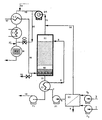
- FIG. 1 illustrates the invention.
- the effluent to be treated arrives, at ambient temperature, of the order of 5 to 40 ° C., through line 1 and the pump P 3 in a phase separator S 3 , which eliminates the dry matter and most of the suspended matter.
- the pump P 4 assumes the dosage of the SMELOX mercaptan oxidation catalyst, introduced into the unit, and brought in via line 2. Via line 4, the dry matter (MS) and the suspended matter (MES) are drawn off.
- the clarified liquid effluent travels through line 6, the pump P 1 and line 7 through an exchanger E 1 , then through lines 8 and 9 enters with the catalyst in the reaction zone R 1 .
- the hot slurry is therefore introduced at the head of the reactor.
- hot fumes from reactor R 2 are introduced via line 16, which via a submerged diffuser are cooled by the liquid from the bottom of the column in zone 10. This removes slurry, by stripping, NH 3 , amines, and CCV.
- the reactor R 1 also occurs the oxidation of the mercaptans to disulphides which are entrained by the liquid towards the bottom 10 of the reactor, then leave the installation through the charge-effluent exchanger E 1 , using of pump P 2 .
- the temperature of the stripping column and of zone 10 is generally between 40 and 90 ° C. Any type of reactor is suitable.
- a reactor comprising, in its lower part, a zone of bubbling of the gas in the liquid and, in its upper part, a gas-liquid contact zone against the current in the presence of a lining.
- R 1 is supplied via line 16 with 1200 kg / h of oxygen-containing gas. and via line 9 with 4 tonnes / h of pig manure.
- a deodorized and nitrogen-free liquid is drawn off via line 11, at the bottom of the reactor, which, through the pump P 2 , crosses the exchanger E 1 .
- Line 12 is used to recover a deodorized and nitrogen-free liquid.
- Line 20 is a bypass line of the exchanger E 1 , which, equipped with a regulation system, regulates the temperature of the catalytic bed.
- the ammonia and volatile chemical compounds are oxidized.
- the combustion gases, which are hot, are drawn off through line 17 and will, through the exchanger E 2 , heat the gases coming from V 1 and through line 16, heat the reactor R 1 , by means of the bottom diffuser column. If the ammonia and CCV content is insufficient to maintain the autothermal operation, an additional fuel or gaseous fuel can be sent to the reactor R 2 , either directly by line 20, or by line 13 through the exchangers E 2 and E 3 .
- a gas purge from the reactor R 2 is carried out by line 22, so as to maintain the desired oxygen content in the gas supplying the reactor R 1 by an equivalent supply of air through line 14.
- the content oxygen at the inlet of reactor R 2 is maintained at a value corresponding to approximately twice the stoichiometry of the oxidation reaction of the reactants supplied by the stripping gas and possibly introduced via line 13.
- the present invention therefore also relates to the apparatus used to operate the method of the invention.
- the potash from the first stage is replaced by lime.
- the top-up oxidation catalyst is generally carried out at the same time as the alkaline base, in the form of a solution or a suspension containing the two products.
- the gases sent to the reactor R2 are preheated to a temperature of 200 to 500 ° C, preferably 180 to 250 ° C.
- the catalyst beds in beads or in extrusions, are radial to reduce the pressure drop.
- the catalyst can be inserted in volumes of 5 to 10 cm 3 , for example, to reduce the pressure losses and especially their increase over time.
- the catalyst bed is constituted by a ceramic or metallic honeycomb structure, coated with an adequate support phase.
- the method according to the invention can therefore be applied to pig manure but also can be applied to other smelly effluents loaded with ammonia insofar as they are previously suspended in water: poultry droppings or d '' other birds as well as other animal excrement, various wastewater etc.
- the operations of deodorization and elimination of volatile nitrogen compounds can be carried out for example continuously or preferably periodically.
Landscapes
- Engineering & Computer Science (AREA)
- Chemical & Material Sciences (AREA)
- Environmental & Geological Engineering (AREA)
- Chemical Kinetics & Catalysis (AREA)
- Biomedical Technology (AREA)
- Analytical Chemistry (AREA)
- General Chemical & Material Sciences (AREA)
- Oil, Petroleum & Natural Gas (AREA)
- Health & Medical Sciences (AREA)
- Organic Chemistry (AREA)
- Hydrology & Water Resources (AREA)
- Water Supply & Treatment (AREA)
- Life Sciences & Earth Sciences (AREA)
- Exhaust Gas Treatment By Means Of Catalyst (AREA)
- Catalysts (AREA)
- Treating Waste Gases (AREA)
- Disinfection, Sterilisation Or Deodorisation Of Air (AREA)
Applications Claiming Priority (2)
| Application Number | Priority Date | Filing Date | Title |
|---|---|---|---|
| FR9605398 | 1996-04-26 | ||
| FR9605398A FR2747936B1 (fr) | 1996-04-26 | 1996-04-26 | Procede catalytique de desodorisation et desazotation de rejets polluants a fonctionnement autothermique |
Publications (2)
| Publication Number | Publication Date |
|---|---|
| EP0803279A1 true EP0803279A1 (de) | 1997-10-29 |
| EP0803279B1 EP0803279B1 (de) | 2003-03-05 |
Family
ID=9491696
Family Applications (1)
| Application Number | Title | Priority Date | Filing Date |
|---|---|---|---|
| EP97400797A Expired - Lifetime EP0803279B1 (de) | 1996-04-26 | 1997-04-08 | Autothermisches katalytisches Verfahren zur Desodorierung und Denitrierung von Schadstoffen |
Country Status (4)
| Country | Link |
|---|---|
| EP (1) | EP0803279B1 (de) |
| DE (1) | DE69719398T2 (de) |
| DK (1) | DK0803279T3 (de) |
| FR (1) | FR2747936B1 (de) |
Cited By (2)
| Publication number | Priority date | Publication date | Assignee | Title |
|---|---|---|---|---|
| CN108698867A (zh) * | 2016-02-15 | 2018-10-23 | 威立雅水务技术支持公司 | 用于从水和废水减少硫化物的方法 |
| US10632423B2 (en) | 2008-11-03 | 2020-04-28 | Basf Corporation | Bimetallic catalysts for selective ammonia oxidation |
Citations (1)
| Publication number | Priority date | Publication date | Assignee | Title |
|---|---|---|---|---|
| FR2701220A1 (fr) * | 1993-02-08 | 1994-08-12 | Inst Francais Du Petrole | Procédé de désodorisation catalytique et de réduction de la teneur en azote des effluents de cuve à lisier. |
-
1996
- 1996-04-26 FR FR9605398A patent/FR2747936B1/fr not_active Expired - Fee Related
-
1997
- 1997-04-08 EP EP97400797A patent/EP0803279B1/de not_active Expired - Lifetime
- 1997-04-08 DK DK97400797T patent/DK0803279T3/da active
- 1997-04-08 DE DE69719398T patent/DE69719398T2/de not_active Expired - Lifetime
Patent Citations (1)
| Publication number | Priority date | Publication date | Assignee | Title |
|---|---|---|---|---|
| FR2701220A1 (fr) * | 1993-02-08 | 1994-08-12 | Inst Francais Du Petrole | Procédé de désodorisation catalytique et de réduction de la teneur en azote des effluents de cuve à lisier. |
Cited By (4)
| Publication number | Priority date | Publication date | Assignee | Title |
|---|---|---|---|---|
| US10632423B2 (en) | 2008-11-03 | 2020-04-28 | Basf Corporation | Bimetallic catalysts for selective ammonia oxidation |
| CN108698867A (zh) * | 2016-02-15 | 2018-10-23 | 威立雅水务技术支持公司 | 用于从水和废水减少硫化物的方法 |
| US11008240B2 (en) | 2016-02-15 | 2021-05-18 | Veolia Water Solutions & Technologies Support | Process for reduction of sulfide from water and wastewater |
| CN108698867B (zh) * | 2016-02-15 | 2021-11-23 | 威立雅水务技术支持公司 | 用于从水和废水减少硫化物的方法 |
Also Published As
| Publication number | Publication date |
|---|---|
| DK0803279T3 (da) | 2003-06-02 |
| DE69719398D1 (de) | 2003-04-10 |
| EP0803279B1 (de) | 2003-03-05 |
| DE69719398T2 (de) | 2003-08-21 |
| FR2747936B1 (fr) | 1998-07-24 |
| FR2747936A1 (fr) | 1997-10-31 |
Similar Documents
| Publication | Publication Date | Title |
|---|---|---|
| EP0682973B1 (de) | Verfahren zur katalytischen Desodorisierung und zur Reduktion des Stickstoffgehaltes von Abgasen aus einem Güllegefäss | |
| US4405587A (en) | Process for reduction of oxides of nitrogen | |
| FR2540092A1 (fr) | Procede catalytique de production de soufre a partir d'un gaz renfermant h2s | |
| US4251486A (en) | Method and apparatus for decomposing injurious substances | |
| CA2185907C (fr) | Procede et installation de traitement d'effluents charges en matiere organique, notamment par oxydation en milieu humide, avec recyclage interne des residus solides, et station d'epuration correspondante | |
| PL179607B1 (pl) | sposób katalitycznego krakowania wsadu weglowodorowego zawierajacego azot i urzadzenie do regenerowania weglowodorowego katalizatora krakujacego PL PL PL PL PL PL PL PL PL | |
| RU92004545A (ru) | Способ окисления этана до уксусной кислоты | |
| FR2527472A1 (fr) | Procede pour eliminer les constituants acides (oxydes du soufre et oxydes de l'azote) de gaz brules | |
| US4014982A (en) | Combined process for upgrading spent alkylation acid and reducing noxious gas content of waste gaseous streams | |
| US10472582B2 (en) | Process and apparatus for hydrogen sulfide removal | |
| GB1569679A (en) | Mercaptan extraction process | |
| EP0803279B1 (de) | Autothermisches katalytisches Verfahren zur Desodorierung und Denitrierung von Schadstoffen | |
| CA2514087A1 (fr) | Procede de capture des mercaptans contenus dans une charge gazeuse | |
| EP0793996A1 (de) | Katalytisches Verfahren zum Desodorieren und Entsticken von Schmutzrückständen | |
| JPS6367090B2 (de) | ||
| CN1230158A (zh) | 从含so2气流中回收硫的方法 | |
| JP2003534897A (ja) | 熱発生器排煙処理で発生する使用済み吸収剤を再生する方法および装置 | |
| JP2004168663A (ja) | 硫黄化合物の酸化方法および脱硫油の製造方法 | |
| KR100454641B1 (ko) | 오염성폐기물을탈취및탈질소처리하기위한자열식촉매방법 | |
| EA026172B1 (ru) | Поэтапное сжигание сернистых горючих отходящих потоков с извлечением серы по способу клауса | |
| CN1882499B (zh) | 从含有硫化氢的气流回收硫的方法和实现它的设备 | |
| FR2461684A1 (fr) | Procede pour l'epuration d'eaux residuaires a forte pollution organique et contenant des sulfates | |
| JPH0696145B2 (ja) | Nh▲下3▼含有廃水の処理方法 | |
| JP3924823B2 (ja) | メルカプタン類含有ガスの処理方法 | |
| FR2710853A1 (fr) | Procédé d'élimination de composés organiques odorants. |
Legal Events
| Date | Code | Title | Description |
|---|---|---|---|
| PUAI | Public reference made under article 153(3) epc to a published international application that has entered the european phase |
Free format text: ORIGINAL CODE: 0009012 |
|
| AK | Designated contracting states |
Kind code of ref document: A1 Designated state(s): DE DK GB IT NL |
|
| 17P | Request for examination filed |
Effective date: 19980429 |
|
| 17Q | First examination report despatched |
Effective date: 20020129 |
|
| GRAH | Despatch of communication of intention to grant a patent |
Free format text: ORIGINAL CODE: EPIDOS IGRA |
|
| GRAH | Despatch of communication of intention to grant a patent |
Free format text: ORIGINAL CODE: EPIDOS IGRA |
|
| GRAA | (expected) grant |
Free format text: ORIGINAL CODE: 0009210 |
|
| AK | Designated contracting states |
Designated state(s): DE DK GB IT NL |
|
| REG | Reference to a national code |
Ref country code: GB Ref legal event code: FG4D Free format text: NOT ENGLISH |
|
| REF | Corresponds to: |
Ref document number: 69719398 Country of ref document: DE Date of ref document: 20030410 Kind code of ref document: P |
|
| GBT | Gb: translation of ep patent filed (gb section 77(6)(a)/1977) |
Effective date: 20030417 |
|
| REG | Reference to a national code |
Ref country code: DK Ref legal event code: T3 |
|
| PLBE | No opposition filed within time limit |
Free format text: ORIGINAL CODE: 0009261 |
|
| STAA | Information on the status of an ep patent application or granted ep patent |
Free format text: STATUS: NO OPPOSITION FILED WITHIN TIME LIMIT |
|
| 26N | No opposition filed |
Effective date: 20031208 |
|
| PGFP | Annual fee paid to national office [announced via postgrant information from national office to epo] |
Ref country code: GB Payment date: 20100324 Year of fee payment: 14 |
|
| PGFP | Annual fee paid to national office [announced via postgrant information from national office to epo] |
Ref country code: DK Payment date: 20100419 Year of fee payment: 14 |
|
| PGFP | Annual fee paid to national office [announced via postgrant information from national office to epo] |
Ref country code: NL Payment date: 20100422 Year of fee payment: 14 Ref country code: IT Payment date: 20100419 Year of fee payment: 14 Ref country code: DE Payment date: 20100511 Year of fee payment: 14 |
|
| REG | Reference to a national code |
Ref country code: DE Ref legal event code: R081 Ref document number: 69719398 Country of ref document: DE Owner name: IFP ENERGIES NOUVELLES, FR Free format text: FORMER OWNER: INSTITUT FRANCAIS DU PETROLE, RUEIL-MALMAISON, HAUTS-DE-SEINE, FR Effective date: 20110331 |
|
| REG | Reference to a national code |
Ref country code: DE Ref legal event code: R119 Ref document number: 69719398 Country of ref document: DE |
|
| REG | Reference to a national code |
Ref country code: DE Ref legal event code: R119 Ref document number: 69719398 Country of ref document: DE |
|
| REG | Reference to a national code |
Ref country code: NL Ref legal event code: V1 Effective date: 20111101 |
|
| GBPC | Gb: european patent ceased through non-payment of renewal fee |
Effective date: 20110408 |
|
| PG25 | Lapsed in a contracting state [announced via postgrant information from national office to epo] |
Ref country code: NL Free format text: LAPSE BECAUSE OF NON-PAYMENT OF DUE FEES Effective date: 20111101 |
|
| REG | Reference to a national code |
Ref country code: DK Ref legal event code: EBP |
|
| PG25 | Lapsed in a contracting state [announced via postgrant information from national office to epo] |
Ref country code: IT Free format text: LAPSE BECAUSE OF NON-PAYMENT OF DUE FEES Effective date: 20110408 Ref country code: GB Free format text: LAPSE BECAUSE OF NON-PAYMENT OF DUE FEES Effective date: 20110408 |
|
| PG25 | Lapsed in a contracting state [announced via postgrant information from national office to epo] |
Ref country code: DK Free format text: LAPSE BECAUSE OF NON-PAYMENT OF DUE FEES Effective date: 20110430 |
|
| PG25 | Lapsed in a contracting state [announced via postgrant information from national office to epo] |
Ref country code: DE Free format text: LAPSE BECAUSE OF NON-PAYMENT OF DUE FEES Effective date: 20111031 |