EP0803620A1 - Dispositif d'alignement - Google Patents
Dispositif d'alignement Download PDFInfo
- Publication number
- EP0803620A1 EP0803620A1 EP97201219A EP97201219A EP0803620A1 EP 0803620 A1 EP0803620 A1 EP 0803620A1 EP 97201219 A EP97201219 A EP 97201219A EP 97201219 A EP97201219 A EP 97201219A EP 0803620 A1 EP0803620 A1 EP 0803620A1
- Authority
- EP
- European Patent Office
- Prior art keywords
- profile
- alignment element
- element according
- guide line
- elements
- Prior art date
- Legal status (The legal status is an assumption and is not a legal conclusion. Google has not performed a legal analysis and makes no representation as to the accuracy of the status listed.)
- Withdrawn
Links
- 210000003414 extremity Anatomy 0.000 claims description 16
- 238000004873 anchoring Methods 0.000 claims description 12
- 241000397426 Centroberyx lineatus Species 0.000 claims description 6
- 239000004411 aluminium Substances 0.000 claims description 4
- 229910052782 aluminium Inorganic materials 0.000 claims description 4
- XAGFODPZIPBFFR-UHFFFAOYSA-N aluminium Chemical compound [Al] XAGFODPZIPBFFR-UHFFFAOYSA-N 0.000 claims description 4
- 210000001364 upper extremity Anatomy 0.000 claims description 4
- 238000004804 winding Methods 0.000 claims description 3
- 210000003141 lower extremity Anatomy 0.000 claims description 2
- 229910052751 metal Inorganic materials 0.000 claims description 2
- 239000002184 metal Substances 0.000 claims description 2
- XEEYBQQBJWHFJM-UHFFFAOYSA-N Iron Chemical compound [Fe] XEEYBQQBJWHFJM-UHFFFAOYSA-N 0.000 description 2
- 229910000831 Steel Inorganic materials 0.000 description 2
- 239000011449 brick Substances 0.000 description 2
- 239000010959 steel Substances 0.000 description 2
- 238000003466 welding Methods 0.000 description 2
- 238000001125 extrusion Methods 0.000 description 1
- 238000003780 insertion Methods 0.000 description 1
- 230000037431 insertion Effects 0.000 description 1
- 229910052742 iron Inorganic materials 0.000 description 1
Images



Classifications
-
- E—FIXED CONSTRUCTIONS
- E04—BUILDING
- E04G—SCAFFOLDING; FORMS; SHUTTERING; BUILDING IMPLEMENTS OR AIDS, OR THEIR USE; HANDLING BUILDING MATERIALS ON THE SITE; REPAIRING, BREAKING-UP OR OTHER WORK ON EXISTING BUILDINGS
- E04G21/00—Preparing, conveying, or working-up building materials or building elements in situ; Other devices or measures for constructional work
- E04G21/14—Conveying or assembling building elements
- E04G21/16—Tools or apparatus
- E04G21/18—Adjusting tools; Templates
- E04G21/1808—Holders for bricklayers' lines, bricklayers' bars; Sloping braces
-
- E—FIXED CONSTRUCTIONS
- E04—BUILDING
- E04G—SCAFFOLDING; FORMS; SHUTTERING; BUILDING IMPLEMENTS OR AIDS, OR THEIR USE; HANDLING BUILDING MATERIALS ON THE SITE; REPAIRING, BREAKING-UP OR OTHER WORK ON EXISTING BUILDINGS
- E04G21/00—Preparing, conveying, or working-up building materials or building elements in situ; Other devices or measures for constructional work
- E04G21/14—Conveying or assembling building elements
- E04G21/16—Tools or apparatus
- E04G21/18—Adjusting tools; Templates
- E04G21/1808—Holders for bricklayers' lines, bricklayers' bars; Sloping braces
- E04G21/1816—Adjustable positioning means between line-holder bars and construction
Definitions
- This invention relates to an alignment element which, in first instance, is intended for the application during bricklaying but which, more generally, can also be used in other applications.
- the invention relates to an alignment element in the form of a profile.
- the aforementioned profile is positioned upright by means of additional supports, which is relatively cumbersome. As a result, the exact adjustment of the profile is rendered rather difficult.
- the invention aims at an alignment element with which, among others, the aforementioned disadvantage can be excluded.
- the invention consists of an alignment element which is characterized in that it is composed of a profile and adjustment means which are provided at this profile and allow, when this profile is placed against a wall, to adjust this profile, or eventually a part of this profile, in respect to this wall.
- the adjustment means consist of adjustment elements provided locally at one or more locations.
- the profile shall be provided at least at two places with such adjustment elements. More particularly it is preferred that two adjustment elements, situated one above the other at a well-defined distance, are present in the lower part of the profile, at least when the latter is positioned upright, and this in the lower third, seen in respect to the total length.
- the adjustment means preferably consist of one or more elements, preferably screw elements which are attached turnable in or at the profile and which can be brought with their foremost extremity up to outside a face of the profile.
- an alignment element is made available which can easily be attached against an already existing part of a wall and which can be adjusted very precisely in order to finish the upper part of the wall.
- the profile at the side which is intended to be placed against a wall, and eventually at several sides, is provided with one or more anchoring elements allowing for an anchoring in a wall, more particularly in the joints thereof.
- the alignment element according to the invention can also be provided with a support element, adjustable in height, for example, for supporting a casing, support beam or similar.
- the invention also aims at an alignment element, more particularly a profile, with which a masonry guide line can be attached easily at the exact height, with the characteristic that this element to this aim comprises one or both of the following auxiliary accessories for tensioning a masonry guide line:
- the profile in the most preferred form of embodiment, preferably is provided with the adjustment means as well as with both aforementioned auxiliary accessories, the invention does not exclude the forms of embodiment whereby the profile is provided exclusively with adjustment means or exclusively with one or both of aforementioned auxiliary accessories.
- the alignment element 1 substantially consists of a profile 2 which is provided with adjustment means, more particularly one or more locally provided adjustment elements, such as screw elements 3 with which the position of such profile 2 in respect to a wall, as explained hereafter, can be adjusted.
- the screw elements 3 are attached turnable in the profile 2, in such a manner that they can be brought with their foremost extremity 4 up to outside a face 5 of the profile 2.
- the screw elements are formed by threaded rods 6 which pass crosswise through the profile 2 and which, at the extremity 4 situated opposite to extremity 4, can be turned by means of a handle portion 8.
- This handle portion 8 preferably is provided with a turning key 9, as shown in figure 1.
- this handle portion 8 may also be realized in a different manner and, for example, can be formed by a round knob or also by an eye-shaped part through which a nail or similar can be put which simplifies the screwing in and out, or still by any other means enabling the turning of the threaded rod 6.
- the profiles 2 preferably are hollow. Preferably, they also show a square or rectangular cross-section, as a result of which they can easily be positioned against a wall. In the most preferred form of embodiment, use shall be made of an aluminium profile.
- the profile 2 can also be made of steel or iron.
- the threaded rods 6 preferably are turnable in holding elements 11, provided with screw thread 10, which, for example, consist of a sleeve or similar which is provided at the rear side 12 or is realized in one piece therewith.
- the aforementioned extremity 4 of the applied screw elements 3 may be provided with a support foot 13, which provides for a greater stability during the tensioning against a wall.
- a support foot 13 in its most simple form of embodiment, can be formed by a small disc which is fixedly mounted onto the extremity of the threaded rod 6.
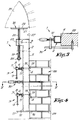
- a movable support foot 13 for example, as represented in figure 3, by means of mounting a ball-and-socket joint 14 between the threaded rod 6 and the support foot 13.
- the screw elements 3 can, at their foremost extremity, by screwing in these screw elements 3, be completely countersunk in respect to the aforementioned face 5, such that the profile 4 can be attached with the face 5 against a wall at any time.
- an opening 15 is provided in the face 5 of the profile 2, at the location of each screw element 3, which opening 15 leaves a free passageway for the screw element 3, as well as for the related support foot 13.
- the profile 2 may be provided with an anchoring element 16, which allows an anchoring in a wall, for example, in a joint between two rows of bricks.
- This anchoring element 16 preferably consists of a projecting lip which, as represented in figure 1, is situated at the aforementioned face 5.
- this anchoring element 16 preferably is situated at the lower side of profile 2 and has a tapering shape. It also has relatively small dimensions, such that it can easily be driven into a joint. Opposite to the anchoring element 16, an element 17 may be provided onto which a force can be exerted, for example, beaten with a hammer, without damaging the profile 2.
- the alignment element 1 may eventually be equipped with a support element 18 which is adjustable in height and which preferably is situated at the upper extremity of the profile 2.
- the adjustment hereof preferably is realized by means of a threaded rod 19 or a worm screw.
- the threaded rod 19 shall be provided with screw thread 20 with a relatively large thread pitch, for example in the order of magnitude of one centimeter.
- the support element 18 preferably comprises a support plate 21 with a horizontal upper plane 22.
- the support plate 21 may be formed of a round disc which is attached at the upper extremity of the aforementioned threaded rod 19.
- the support element 18 is fitted in a turnable manner in a support part 23 which protrudes laterally from the profile.
- a handle portion 24 which, in the represented example, is formed by an eye-shaped element through which a nail or similar can be put in order to be able to exert a large force during turning.
- the support element 18 preferably is placed offeset in backward direction in respect to the face 5 in which the support feet 13 are countersunk, as schematically indicated by distance D, as a result of which the support element 18 does not form an obstacle for attaching the profile 2 against a wall, or this support element 18 can not be an obstacle for further bricklaying a wall alongside the positioned profile 2.
- anchoring elements 16 and the support element 18 are optional elements. In a variant, these elements, as a matter of fact, may not be present, as a result of which the profile 2, then, ends up at the extremities 25 and 26 schematically indicated in figure 1.
- FIG. 4 The application of the alignment element 1 from figure 1 is illustrated in figures 4 and 5, whereby a positioning for bricklaying an opening 27 is represented.
- the profile 2 is attached against an already existing part 28 of the wall.
- the anchoring element 16 is attached in a joint 29, and the profile 2 is clamped against the existing part 28 by means of a clamping element 30 which can be of any nature.
- the alignment element 1 preferably shall be provided with at least two adjustment elements, more particularly screw elements, and shall the clamping during the use thereof take place at a location between these two screw elements 3.
- Figure 4 also shows how a template 31, for example, for masoning an arc, can be supported by the alignment element 1 according to the invention.
- a first positioning in height hereby can be obtained by attaching the profile 2 at a well-defined height, by means of the anchoring element 16.
- a second positioning and proper adjustment of the surface 22 of the support plate then is performed by turning the threaded rod 19.
- profile 2 may be realized in various lengths and, instead of being provided with two screw elements 3 or similar, may also be provided with only one or more than two.
- At least two adjustment elements are present in the lower part of the profile, and this in the lower third, seen in respect to the total length.
- the profile 2 shall have a length in the order of magnitude of 2,75 m and does comprise three screw elements 3, located at, respectively, 8 cm, 50 cm, and 85 cm from the lower extremity.
- the profile 2 may also be provided with adjustment means which allow adjustments in different directions, for example, X and Y, as indicated in figure 1, for example, by means of additional screw elements 3A which are turnable in a direction Y perpendicular to the movement direction X of the first-mentioned screw elements 3.
- FIG. 6 a variant is represented whereby the profile 2 is filled with a core 32.
- the seats 11 are formed by cylinders which are fixed in borings 33 in the core, such that only two openings 15 and 34 have to be realized in the metal profile 2.
- the embodiment from figures 6 to 8 also shows the characteristic that no projecting parts are present at the profile 2 at the location of the adjustment means, as a result of which such profile 2 can also be applied for other purposes.
- this characteristic is realized by replacing the aforementioned handle portion 8 by a seat 35, countersunk in the contour of the profile 2, for insertion of, for example, a socket screw key.
- the profile 2 is provided with seats 2 for the attachment of a clamping element 30.
- theses seats 36 preferably consist of a portion which is surrounded by a perpendicular edge 37 which has to render the positioning of the clamping element 30 easier and at the same time prevents that this clamping element 30 easily slides away from the profile 2.
- a variant of a screw element 3 is represented, whereby the handle portion 8 consists of an eye-shaped part, formed by a flat ring, through which, eventually, a nail or such can be put in order to render turning easier.
- the aforementioned adjustment means can also be attached in a longitudinal profiled section 38, provided to this end at the profile 2, which preferably consists of a groove 39 with inwardly directed edges 40-41, for example, in the shape of a swallowtail.
- the adjustment means are formed by a screw element 3 which is turnable in a support part 42, provided in the longitudinal profiled section 38, more particularly, in the groove 39, which part 42, when the screw element 3 is tensioned, cooperates with the inwardly directed edges 40-41.
- this support part 42 preferably consists of a rectangular block or similar which, for example, is slid into the groove 39 along an extremity of the profile 2.
- the profile 2 can be provided with a second longitudinal profiled section 43, more particularly a groove, allowing that a support foot 13 which is eventually attached at the front extremity of the screw element 3, can be countersunk in the profile 2.
- the screw element 3 is held at its place as the threaded rod 6 is put through opposite openings 44 and 45 which are provided in the profil sections 38, 39 respectively.
- Such openings can be provided at various heights, such, that the adjustment means can be mounted at the desired height.
- the openings 44-45 can also be part of a series of perforations.
- the profile 2 may also be equipped with height-adjustable means 46 for the attachment of a masonry guide line 47.
- These means 46 preferably consist, one one hand, of a longitudinal profiled section 48, preferably in the shape of a groove 49 with inwardly directed edges 50-51, for example, a swallowtail, and, on the other hand, an element 52 at which the masonry guide line 47 can be attached, whereby this element, by means of clamping means, can be clamped on at any height in the groove 49.
- these clamping means preferably are composed of, on one hand, a clamping element 53 in the form of a nut which is shiftable, but not turnable, in the groove and cooperates with the edges 50-51, and, on the other hand, a screw thread portion 54 which forms part of element 52, which is screwed through the clamping element 53 and can be tensioned with its free extremity against the bottom of the groove 49.
- the element 52 maybe provided with a groove 55 for the attachment of the masonry guide line 47 and/or of a winding plate 56 or similar for winding up the end of the masonry guide line 47, by means of which also the element 52 can be fastened and loosened manually in an easy manner.
- profile 2 can also be provided with several profiled sections for the attachment of an element 52.
- a second longitudinal profiled section 57 is provided in the opposite face.
- the profile 2 has a rectangular cross-section and the longitudinal profiled sections 38 and 48 are provided at two sides of this profile which are perpendicular to each other. It is, however, not excluded to attach the elements 52 in the same groove 39 as the adjustment means. Neither is it excluded to provide the support element 42 behind the foot 13 in the longitudinal profiled section 43, as a result of which the groove 39 becomes redundant.
- a measuring scale 58 may be provided at the profile 2, with markings 59 which are provided subsequently at equal distances to each other, whereby this distance is equal to the distance between two subsequent rows of bricks to be masoned, in such a manner that these markings 59 can be applied for adjusting the element 52, and, thereby, the masonry guide line, too, at the exact height.
- such measuring scale shall be provided fixedly at the profile 2 or shall be glued onto it in the form of a band on which one or more rows of markings are depicted.
- This measuring scale preferably consists of a lath 60, provided with markings, which is provided with attachment means 61 with which this lath can be positioned in height and be attached at the profile 2 in the desired position.
- the lath 60 may be fitted displaceable in a longitudinal profiled section 62, preferably a groove, more particularly in the shape of a swallowtail.
- the attachment means 61 may then consist of one or more elements 63 to be screwed in, by means of which the lath 60 can be clamped in the longitudinal profiled section 62, similar as the clamping element 53 in the longitudinal profiled section 48.
- the markings 59 can consist of notches which simultaneously form a seat for the masonry guide line.
- the lath 60 shall be shorter than the profile 2.
- the lath 60 for example, shall have a length of 1,60 m.
- the lath 60 When applied, the lath 60 is adjusted at the exact height, this subsequently to attaching the profile 2 at its location.
- the profile 2 from figures 10 to 13 has as an advantage that it is optimally appropriate for being realized in aluminium.
- such profile 2 can be manufactured by means of extrusion. Due to the use of longitudinal profiled sections for the attachment of the adjustment means, the element 52 and the lath 60, it is not necessary to fix any elements at the profile 2 by welding, as a result of which the difficulty of welding at aluminium is excluded.
- the element 17, however, shall be manufactured of steel, as this, then, is more resistive against the blows exerted thereupon.
- the profile be composed of two parts which are mutually adjustable, whereby a first part can be clamped against a wall, whereas the second part, which, for example, is situated above the first part, can be positioned in function of the work to be realized.
Landscapes
- Engineering & Computer Science (AREA)
- Architecture (AREA)
- Mechanical Engineering (AREA)
- Civil Engineering (AREA)
- Structural Engineering (AREA)
- Finishing Walls (AREA)
Applications Claiming Priority (2)
| Application Number | Priority Date | Filing Date | Title |
|---|---|---|---|
| BE9600373A BE1010223A3 (nl) | 1996-04-26 | 1996-04-26 | Richtelement. |
| BE9600373 | 1996-04-26 |
Publications (1)
| Publication Number | Publication Date |
|---|---|
| EP0803620A1 true EP0803620A1 (fr) | 1997-10-29 |
Family
ID=3889707
Family Applications (1)
| Application Number | Title | Priority Date | Filing Date |
|---|---|---|---|
| EP97201219A Withdrawn EP0803620A1 (fr) | 1996-04-26 | 1997-04-24 | Dispositif d'alignement |
Country Status (2)
| Country | Link |
|---|---|
| EP (1) | EP0803620A1 (fr) |
| BE (1) | BE1010223A3 (fr) |
Cited By (3)
| Publication number | Priority date | Publication date | Assignee | Title |
|---|---|---|---|---|
| CN109914826A (zh) * | 2019-04-11 | 2019-06-21 | 中冶建工集团有限公司 | 翻转式砌体墙横向灰缝控制装置 |
| CN109914828A (zh) * | 2019-04-11 | 2019-06-21 | 中冶建工集团有限公司 | 砌体墙横向灰缝及竖向灰缝控制装置 |
| CN116575639A (zh) * | 2023-05-21 | 2023-08-11 | 江苏苏亚钢结构有限公司 | 一种高度可调节的建筑用加强型钢结构承重梁 |
Citations (7)
| Publication number | Priority date | Publication date | Assignee | Title |
|---|---|---|---|---|
| US2623289A (en) * | 1949-07-18 | 1952-12-30 | Kampel Everett | Guideline supporting apparatus for bricklaying |
| GB1055072A (en) * | 1964-06-10 | 1967-01-11 | Wates Ltd | Improvements in or relating to bricklaying |
| FR2021913A1 (fr) * | 1968-10-30 | 1970-07-24 | Dalle Nogare Tullio | |
| AU426799B2 (en) * | 1969-07-24 | 1972-08-07 | Mackay And Ernest John Shields Donald | Improvements relating to bricklaying guides |
| DE2328262A1 (de) * | 1973-06-02 | 1975-01-02 | Karl Ruckh | Richtschiene fuer waende |
| DE9305647U1 (de) * | 1993-04-15 | 1993-06-17 | Steinbrink, Wolfgang, 4220 Dinslaken | Ecklehre zum Mauern |
| GB2275292A (en) * | 1992-12-22 | 1994-08-24 | John William Douglas | Alignment of building modules |
-
1996
- 1996-04-26 BE BE9600373A patent/BE1010223A3/nl not_active IP Right Cessation
-
1997
- 1997-04-24 EP EP97201219A patent/EP0803620A1/fr not_active Withdrawn
Patent Citations (7)
| Publication number | Priority date | Publication date | Assignee | Title |
|---|---|---|---|---|
| US2623289A (en) * | 1949-07-18 | 1952-12-30 | Kampel Everett | Guideline supporting apparatus for bricklaying |
| GB1055072A (en) * | 1964-06-10 | 1967-01-11 | Wates Ltd | Improvements in or relating to bricklaying |
| FR2021913A1 (fr) * | 1968-10-30 | 1970-07-24 | Dalle Nogare Tullio | |
| AU426799B2 (en) * | 1969-07-24 | 1972-08-07 | Mackay And Ernest John Shields Donald | Improvements relating to bricklaying guides |
| DE2328262A1 (de) * | 1973-06-02 | 1975-01-02 | Karl Ruckh | Richtschiene fuer waende |
| GB2275292A (en) * | 1992-12-22 | 1994-08-24 | John William Douglas | Alignment of building modules |
| DE9305647U1 (de) * | 1993-04-15 | 1993-06-17 | Steinbrink, Wolfgang, 4220 Dinslaken | Ecklehre zum Mauern |
Cited By (6)
| Publication number | Priority date | Publication date | Assignee | Title |
|---|---|---|---|---|
| CN109914826A (zh) * | 2019-04-11 | 2019-06-21 | 中冶建工集团有限公司 | 翻转式砌体墙横向灰缝控制装置 |
| CN109914828A (zh) * | 2019-04-11 | 2019-06-21 | 中冶建工集团有限公司 | 砌体墙横向灰缝及竖向灰缝控制装置 |
| CN109914828B (zh) * | 2019-04-11 | 2021-04-13 | 中冶建工集团有限公司 | 砌体墙横向灰缝及竖向灰缝控制装置 |
| CN109914826B (zh) * | 2019-04-11 | 2021-04-13 | 中冶建工集团有限公司 | 翻转式砌体墙横向灰缝控制装置 |
| CN116575639A (zh) * | 2023-05-21 | 2023-08-11 | 江苏苏亚钢结构有限公司 | 一种高度可调节的建筑用加强型钢结构承重梁 |
| CN116575639B (zh) * | 2023-05-21 | 2026-03-24 | 江苏苏亚钢结构有限公司 | 一种高度可调节的建筑用加强型钢结构承重梁 |
Also Published As
| Publication number | Publication date |
|---|---|
| BE1010223A3 (nl) | 1998-04-07 |
Similar Documents
| Publication | Publication Date | Title |
|---|---|---|
| US5468095A (en) | Adjustable concrete rod | |
| US5768793A (en) | Adjustable template for laying tiles and method | |
| US6568021B1 (en) | Trowel with levels | |
| GB2372063A (en) | A height adjustable support apparatus for screed rails | |
| CA2538272C (fr) | Systeme de nivelage du beton | |
| EP0803620A1 (fr) | Dispositif d'alignement | |
| US4934643A (en) | Holder for screed rail | |
| KR200496200Y1 (ko) | 레이저 레벨기 거치대 | |
| US5873568A (en) | Gutter holding pliers | |
| US4285139A (en) | Trig pole for masonry construction | |
| US3397458A (en) | Guide line supporting apparatus | |
| US7476053B2 (en) | Portable form and method for using same for concrete strike-off | |
| CN101631657A (zh) | 用于切割砖块的夹具 | |
| EP0662549B1 (fr) | Gabarit pour escaliers | |
| WO2020065292A1 (fr) | Appareil et procédé de support de carreau | |
| DE4438690A1 (de) | Putzabziehverfahren und Richtleiste | |
| WO1984002735A1 (fr) | Profiles permettant la pose de briques | |
| DE3716939A1 (de) | Vorrichtung zum schneiden von platten, insbesondere daemmplatten | |
| CN223423077U (zh) | 一种可便捷调整高度的沥青摊铺铝合金导梁支座 | |
| JP4129849B2 (ja) | 玄関ポーチなど建造物迫り出し構造部用柱位置の割出し具、およびそれに使用する水準器等用仮着金具 | |
| CN112878153A (zh) | 一种人行道湿铺专用工具及使用方法 | |
| CN223937578U (zh) | 一种贴瓷砖辅助设备 | |
| GB2260358A (en) | Ladder | |
| AU2864797A (en) | Brick cutting tool | |
| US5170562A (en) | Cutting/incising tool |
Legal Events
| Date | Code | Title | Description |
|---|---|---|---|
| PUAI | Public reference made under article 153(3) epc to a published international application that has entered the european phase |
Free format text: ORIGINAL CODE: 0009012 |
|
| AK | Designated contracting states |
Kind code of ref document: A1 Designated state(s): DE FR GB NL |
|
| 17P | Request for examination filed |
Effective date: 19980414 |
|
| 17Q | First examination report despatched |
Effective date: 20010724 |
|
| GRAP | Despatch of communication of intention to grant a patent |
Free format text: ORIGINAL CODE: EPIDOSNIGR1 |
|
| STAA | Information on the status of an ep patent application or granted ep patent |
Free format text: STATUS: THE APPLICATION IS DEEMED TO BE WITHDRAWN |
|
| 18D | Application deemed to be withdrawn |
Effective date: 20031121 |