EP0803790A1 - Verfahren zur Verdeckung eines Geheimcodes in einer Rechnerbeglaubigungsvorrichtung - Google Patents
Verfahren zur Verdeckung eines Geheimcodes in einer Rechnerbeglaubigungsvorrichtung Download PDFInfo
- Publication number
- EP0803790A1 EP0803790A1 EP97400793A EP97400793A EP0803790A1 EP 0803790 A1 EP0803790 A1 EP 0803790A1 EP 97400793 A EP97400793 A EP 97400793A EP 97400793 A EP97400793 A EP 97400793A EP 0803790 A1 EP0803790 A1 EP 0803790A1
- Authority
- EP
- European Patent Office
- Prior art keywords
- secret code
- image
- characters
- encryption function
- secret
- Prior art date
- Legal status (The legal status is an assumption and is not a legal conclusion. Google has not performed a legal analysis and makes no representation as to the accuracy of the status listed.)
- Granted
Links
Images

Classifications
-
- H—ELECTRICITY
- H04—ELECTRIC COMMUNICATION TECHNIQUE
- H04L—TRANSMISSION OF DIGITAL INFORMATION, e.g. TELEGRAPHIC COMMUNICATION
- H04L9/00—Cryptographic mechanisms or cryptographic arrangements for secret or secure communications; Network security protocols
- H04L9/32—Cryptographic mechanisms or cryptographic arrangements for secret or secure communications; Network security protocols including means for verifying the identity or authority of a user of the system or for message authentication, e.g. authorization, entity authentication, data integrity or data verification, non-repudiation, key authentication or verification of credentials
- H04L9/3234—Cryptographic mechanisms or cryptographic arrangements for secret or secure communications; Network security protocols including means for verifying the identity or authority of a user of the system or for message authentication, e.g. authorization, entity authentication, data integrity or data verification, non-repudiation, key authentication or verification of credentials involving additional secure or trusted devices, e.g. TPM, smartcard, USB or software token
-
- G—PHYSICS
- G06—COMPUTING OR CALCULATING; COUNTING
- G06F—ELECTRIC DIGITAL DATA PROCESSING
- G06F21/00—Security arrangements for protecting computers, components thereof, programs or data against unauthorised activity
- G06F21/30—Authentication, i.e. establishing the identity or authorisation of security principals
- G06F21/31—User authentication
-
- G—PHYSICS
- G06—COMPUTING OR CALCULATING; COUNTING
- G06F—ELECTRIC DIGITAL DATA PROCESSING
- G06F21/00—Security arrangements for protecting computers, components thereof, programs or data against unauthorised activity
- G06F21/30—Authentication, i.e. establishing the identity or authorisation of security principals
- G06F21/31—User authentication
- G06F21/34—User authentication involving the use of external additional devices, e.g. dongles or smart cards
-
- G—PHYSICS
- G06—COMPUTING OR CALCULATING; COUNTING
- G06F—ELECTRIC DIGITAL DATA PROCESSING
- G06F2221/00—Indexing scheme relating to security arrangements for protecting computers, components thereof, programs or data against unauthorised activity
- G06F2221/21—Indexing scheme relating to G06F21/00 and subgroups addressing additional information or applications relating to security arrangements for protecting computers, components thereof, programs or data against unauthorised activity
- G06F2221/2107—File encryption
Definitions
- the invention relates to a method for concealing a secret code in an authentication device such as a computer diskette, a memory card, etc., which can be read from a suitable reader.
- a simple embodiment, but not offering absolute security, consists in controlling access to the computer system by verifying the password known only to the authorized user and often changed in order to limit the possibility that users not authorized discover this password.
- passwords will be intercepted by unauthorized persons wishing to use the computer system.
- this password is stored in the memory area of the computer system (protected area or not) in order to be compared with the password entered by the user. It can therefore be easily found in memory by a fraudulent user.
- a technique consists in encrypting the password before storing it in memory. This encryption is done by means of an encryption function which is chosen, in general, so that it is impossible to find the password from the image of the password obtained after encryption of this word. password. This technique is used, for example, in UNIX® systems.
- the password image is stored in clear text in the memory so that it is possible for a fraudulent user to recover the file of all the stored password images and then to implement the function of encryption on another computer system and try lists of passwords until you find those that match the images in the file.
- Such an analysis of the system code functions, file of password images, etc. is called "dictionary attack”.
- a method for concealing a secret code by storing, on storage means such as a floppy disk, a memory card, etc., the image of the secret code by a reversible encryption function, configured by the user's password.
- This method is implemented “locally”, that is to say it is executed by the terminal, in connection with the storage means and that it requires no connection to the central system.
- this method also makes it possible to change the password of the user locally, that is to say without any connection to the central system being necessary.
- a connection to the system is compulsory to verify the validity of this change of password.
- the secret code is never transmitted, on a transmission line, to the central system.
- the only transmission of the secret code during the process is between the reader of the storage means and the terminal, which limits the risks of interception by a fraudster.
- the connection to the central system is then made, that is to say after local verification of the secret code.
- the invention aims to remedy the drawbacks of the methods described above. To this end, it proposes a method for concealing a secret code in an authentication device such as a floppy disk or a memory card. This process makes it possible to locally verify the secret code entered by the user, while limiting the risk of dictionary attacks.
- the invention relates to a method of concealing a secret code in a computer authentication device consisting of encrypt the secret code by an encryption function to form a secret code image and to store this secret code image in the authentication device.
- This process is characterized by the fact that it consists, beforehand, in choosing an encryption function which is such that, for each image of secret code, there corresponds a plurality of antecedent codes all different from the secret code, but which, a once encrypted by the encryption function, have an image identical to that of the secret code.
- the secret code having n characters the encryption function consists in associating with these n characters a secret code image of k characters, with k ⁇ n.
- the number k of the characters in the secret code image is equal to not 2 .
- the invention also relates to a method for verifying the secret code of a user wishing to access a central system from a terminal.
- This user being provided with an authentication device in which the image of the secret code is hidden by the encryption function, this method is characterized by the fact that it includes a step of local verification of the secret code entered by the user and encrypted by the encryption function, by comparison with the image of the secret code stored in the authentication device; then, if this is verified, it includes a step of authentication by the central system.
- the invention relates to a method for concealing a secret code in an authentication device such as a computer diskette or a memory card or even a calculator.
- This method consists in encrypting the secret code by an encryption function g, so as to form an image of the secret code which is then stored in the authentication device.
- the encryption function g is chosen so that the image of the secret code is sufficiently precise so that a typing error, typed by the user when he enters his secret code, can be detected with a very reasonable probability. quite satisfactory but that, however, each image of the secret code has many antecedents by the encryption function, so that a dictionary attack provides many false solutions for local verification, but not for remote authentication .
- the encryption function g is chosen so that the secret code has a secret code image which corresponds to a multitude of antecedent codes (simply called "antecedents", in the following text).
- antecedent codes are a kind of false secret codes, which, coded by the encryption function g, all give the same secret code image as the real secret code of the user, but which will be refused during the authentication procedure.
- a fraudulent user who is in possession of the authentication device for example of the floppy disk, and who has thus discovered the file of the images of secret codes and who, moreover, is in possession of the encryption function g, does not could not precisely determine what is the user's secret code.
- a dictionary attack would provide it with many solutions for local verification, but a very low chance of finding the real solution, i.e. the real secret code.
- the fraudulent user tries one of the antecedent codes provided by the dictionary attack, it is checked locally; on the other hand, it will be refused during remote authentication, that is to say authentication by the central system.
- FIG. 1 very schematically, the distribution of the images of secret codes in the memory, as well as the distribution of the antecedent codes of these images of secret codes.
- the set E1 therefore includes all the possible secret codes, including, in particular, a code x and a multitude of codes s1 to sn.
- the image of the code x by the encryption function g gives the image X which is located in the set E2 of the images of possible secret codes.
- the image by the encryption function g of each of the codes s1 to sn gives the image of secret code S contained in the set E2.
- the encryption function is chosen so that it provides sufficiently precise secret code images so that a typing error on the part of the user can be detected locally, that is to say without requiring a connection to the central system.
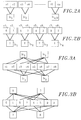
- FIG. 2A schematically represents the processing carried out by the function g1 on a secret code comprising n characters.
- FIG. 2A therefore represents the n / 2 pairs of characters (c1, c2) (c3, c4) ... (cl, cn) and each of the images Ic 1 , ..., Ic n / 2 of these bigrams.
- each image Ic n / 2 corresponds to the sum of the characters C l and C n of the corresponding bigram, knowing that if the sum of these characters gives a value greater than or equal to 10, we choose for Ic n / 2 the value of lower weight, i.e. the unit figure.
- the image of the secret code "61574392" is "7271".
- Such an image 7271 can have a multitude of antecedents, since each character of this image of the secret code can be the result of the sum (or else the unit of a digit corresponding to the sum) of a multitude of numbers included between 0 and 35.
- FIG. 3A an example of another encryption function has been represented: the function g 2 which consists in associating with the set of eight characters c1 to C8 composing the secret code, four independent linear combinations, modulo 36, of these eight characters, each linear combination can be different.
- the first character Ic1 of the image of the secret code associates the characters c1, c3, c4 and c7 of the secret code; the second character Ic2 of this image of the secret code associates the characters c2, c5, c6 and c8; the third character of the image of the secret code Ic3 associates the characters c1, c2, c5 and c7, and the fourth character Ic4 of the image of the secret code associates the characters c3, c4, c5 and c7 of the initial secret code.
- the method of concealing the secret code on the authentication device therefore has the advantage, not only of detecting a possible typing error on the part of the user when the latter enters his secret code on the terminal, but above all to avoid a dictionary attack on the part of a fraudulent user, since the image of the secret code stored on the floppy disk has such a number of possible history codes that a fraudulent user has very little chance of finding the real secret code.
- the method described above for concealing a secret code in a computer floppy disk, a memory card, or any other authentication device can be used in a method for verifying the secret code entered by a user wishing to access a central system. , from a terminal connected to a reader capable of reading its authentication device.
- the method of verifying the secret code will be described in the case where the authentication device is a computer diskette.
- This verification process consists, after the diskette has been inserted into the diskette reader associated with the terminal, for the user to enter his secret code on the terminal from which he wishes to connect to the central system.
- the terminal checks whether the image, by the encryption function g, of the secret code s that the user has just typed corresponds to the image S stored on the floppy disk. If this is not the case, then the terminal refuses any connection to the central system. On the contrary, if this is verified, then a step of determining the unencrypted secret key K is started, at the end of which the terminal will connect to the central system.
- This secret key no encrypted K is determined from the inverse f -1 of the encryption function f of the key by the password (f being a reversible function), and from the encrypted key stored on the floppy disk, such as this is explained in patent application FR-A-2 690 257, already cited above.
- FIG. 4 A functional diagram of this secret code verification method is shown in FIG. 4.
- the computer diskette, referenced 10 is introduced into the computer terminal 14 during a step el.
- the user, referenced 12, then enters his secret code (s) on the terminal 14 during a step e2.
- a step e3 is then carried out which consists in encrypting by the function g, the secret code s that the user has just entered then in verifying whether the image of the secret code by the function g corresponds well to the image of secret code s stored on the diskette 10. If this is not the case, then the verification process is abandoned (step e'4) and therefore no authentication procedure by the central system is envisaged. On the contrary, if this verification proves to be correct, a step e4 is carried out. This step e4 consists in determining the unencrypted secret key K and in sending it to the central system 16 which then begins the authentication procedure (step e5), by means of an exchange of information with the terminal 14.
- the secret code verification method ensures a limitation of the number of connections to the central system, since only the secret codes accepted during the local verification of the secret code are subject to an authentication procedure.
Landscapes
- Engineering & Computer Science (AREA)
- Computer Security & Cryptography (AREA)
- Theoretical Computer Science (AREA)
- Computer Hardware Design (AREA)
- Software Systems (AREA)
- Physics & Mathematics (AREA)
- General Engineering & Computer Science (AREA)
- General Physics & Mathematics (AREA)
- Computer Networks & Wireless Communication (AREA)
- Signal Processing (AREA)
- Storage Device Security (AREA)
- Financial Or Insurance-Related Operations Such As Payment And Settlement (AREA)
Applications Claiming Priority (2)
| Application Number | Priority Date | Filing Date | Title |
|---|---|---|---|
| FR9604404 | 1996-04-09 | ||
| FR9604404A FR2747208B1 (fr) | 1996-04-09 | 1996-04-09 | Procede de dissimulation d'un code secret dans un dispositif d'authentification informatique |
Publications (2)
| Publication Number | Publication Date |
|---|---|
| EP0803790A1 true EP0803790A1 (de) | 1997-10-29 |
| EP0803790B1 EP0803790B1 (de) | 2004-06-30 |
Family
ID=9491030
Family Applications (1)
| Application Number | Title | Priority Date | Filing Date |
|---|---|---|---|
| EP97400793A Expired - Lifetime EP0803790B1 (de) | 1996-04-09 | 1997-04-07 | Verfahren zur Verdeckung eines Geheimcodes in einer Rechnerbeglaubigungsvorrichtung |
Country Status (4)
| Country | Link |
|---|---|
| US (1) | US5894519A (de) |
| EP (1) | EP0803790B1 (de) |
| DE (1) | DE69729685T2 (de) |
| FR (1) | FR2747208B1 (de) |
Families Citing this family (15)
| Publication number | Priority date | Publication date | Assignee | Title |
|---|---|---|---|---|
| US6170058B1 (en) * | 1997-12-23 | 2001-01-02 | Arcot Systems, Inc. | Method and apparatus for cryptographically camouflaged cryptographic key storage, certification and use |
| US7454782B2 (en) | 1997-12-23 | 2008-11-18 | Arcot Systems, Inc. | Method and system for camouflaging access-controlled data |
| US7328350B2 (en) * | 2001-03-29 | 2008-02-05 | Arcot Systems, Inc. | Method and apparatus for secure cryptographic key generation, certification and use |
| US6735310B1 (en) | 1999-09-17 | 2004-05-11 | International Business Machines Corporation | Technique of password encryption and decryption for user authentication in a federated content management system |
| GB2359156B (en) * | 2000-02-14 | 2004-10-13 | Reuters Ltd | Methods of computer programs for and apparatus for providing and accessing digital content |
| US7280984B2 (en) * | 2000-05-08 | 2007-10-09 | Phelan Iii Frank | Money card system, method and apparatus |
| US7472092B2 (en) | 2000-05-08 | 2008-12-30 | Patricia Phelan | Money order device with identity verification and method |
| KR100409270B1 (ko) * | 2000-06-14 | 2003-12-11 | 주식회사 칼라짚미디어 | 물리적으로 표현된 코드이미지를 이용한 인증 서비스 방법및 그 장치 |
| FR2820916B1 (fr) * | 2001-02-15 | 2004-08-20 | Gemplus Card Int | Module d'identification pourvu d'un code d'authentification securise |
| US20030105970A1 (en) * | 2001-11-30 | 2003-06-05 | Phillip Yuan Pei Jen | Systems and methods for enforcing single computer use of software |
| DE10229765A1 (de) * | 2002-07-03 | 2004-01-29 | Johnson Controls Gmbh | Verfahren und System zum Diebstahlschutz eines elektronischen Gerätes |
| US20050076224A1 (en) * | 2003-10-07 | 2005-04-07 | Royer George R. | Coding system |
| US8281136B2 (en) * | 2005-10-21 | 2012-10-02 | Novell, Inc. | Techniques for key distribution for use in encrypted communications |
| FR2924551A1 (fr) * | 2008-02-29 | 2009-06-05 | France Telecom | Procede de controle d'acces a au moins une fonction apte a etre mise en oeuvre par une carte a puce. |
| US9325499B1 (en) * | 2013-06-24 | 2016-04-26 | Emc Corporation | Message encryption and decryption utilizing low-entropy keys |
Citations (3)
| Publication number | Priority date | Publication date | Assignee | Title |
|---|---|---|---|---|
| EP0191324A2 (de) * | 1985-02-12 | 1986-08-20 | International Business Machines Corporation | Autonome kryptographische Bewertung der persönlichen Identifizierungsnummern |
| US5233655A (en) * | 1991-02-19 | 1993-08-03 | Shapiro Sanford S | Data access verification system |
| FR2690257A1 (fr) * | 1992-04-17 | 1993-10-22 | France Telecom | Procédé d'authentification d'un ensemble informatique à partir d'une disquette informatique. |
Family Cites Families (3)
| Publication number | Priority date | Publication date | Assignee | Title |
|---|---|---|---|---|
| US5537544A (en) * | 1992-09-17 | 1996-07-16 | Kabushiki Kaisha Toshiba | Portable computer system having password control means for holding one or more passwords such that the passwords are unreadable by direct access from a main processor |
| CA2101123C (en) * | 1993-07-22 | 1997-12-30 | Kok-Wah Yeow | Absolute static lock of files and directories on magnetic disk storage media in single machine personal microcomputers |
| US5586301A (en) * | 1994-11-09 | 1996-12-17 | Ybm Technologies, Inc. | Personal computer hard disk protection system |
-
1996
- 1996-04-09 FR FR9604404A patent/FR2747208B1/fr not_active Expired - Fee Related
-
1997
- 1997-04-07 EP EP97400793A patent/EP0803790B1/de not_active Expired - Lifetime
- 1997-04-07 DE DE69729685T patent/DE69729685T2/de not_active Expired - Lifetime
- 1997-04-09 US US08/838,646 patent/US5894519A/en not_active Expired - Lifetime
Patent Citations (3)
| Publication number | Priority date | Publication date | Assignee | Title |
|---|---|---|---|---|
| EP0191324A2 (de) * | 1985-02-12 | 1986-08-20 | International Business Machines Corporation | Autonome kryptographische Bewertung der persönlichen Identifizierungsnummern |
| US5233655A (en) * | 1991-02-19 | 1993-08-03 | Shapiro Sanford S | Data access verification system |
| FR2690257A1 (fr) * | 1992-04-17 | 1993-10-22 | France Telecom | Procédé d'authentification d'un ensemble informatique à partir d'une disquette informatique. |
Non-Patent Citations (2)
| Title |
|---|
| BAUSPIESS F ET AL: "REQUIREMENTS FOR CRYPTOGRAPHIC HASH FUNCTIONS", COMPUTERS & SECURITY INTERNATIONAL JOURNAL DEVOTED TO THE STUDY OF TECHNICAL AND FINANCIAL ASPECTS OF COMPUTER SECURITY, vol. 11, no. 5, 1 September 1992 (1992-09-01), pages 427 - 437, XP000296996 * |
| FERREIRA R C: "THE SMART CARD: A HIGH SECURITY TOOL IN EDP", PHILIPS TELECOMMUNICATION REVIEW, vol. 47, no. 3, 1 September 1989 (1989-09-01), pages 1 - 19, XP000072642 * |
Also Published As
| Publication number | Publication date |
|---|---|
| FR2747208B1 (fr) | 1998-05-15 |
| DE69729685D1 (de) | 2004-08-05 |
| EP0803790B1 (de) | 2004-06-30 |
| FR2747208A1 (fr) | 1997-10-10 |
| US5894519A (en) | 1999-04-13 |
| DE69729685T2 (de) | 2005-07-07 |
Similar Documents
| Publication | Publication Date | Title |
|---|---|---|
| EP0803790B1 (de) | Verfahren zur Verdeckung eines Geheimcodes in einer Rechnerbeglaubigungsvorrichtung | |
| EP0426541B1 (de) | Verfahren zum Schutz gegen betrügerischen Gebrauch einer Mikroprozessor-Karte und Vorrichtung zur Durchführung | |
| EP0077238B1 (de) | Verfahren und Einrichtung zum Feststellen der Authentizität der Unterschrift einer unterschriebenen Nachricht | |
| EP1905189B1 (de) | System zum verwalten von authentifizierungsdaten für den zugang zu einem dienst | |
| EP0810506B1 (de) | Verfahren und Einrichtung zur gesicherten Identifikation zwischen zwei Endgeräten | |
| EP1055203B1 (de) | Zugangskontrollprotokoll zwischen einem schlüssel und einem elektronischen schloss | |
| EP1549011A1 (de) | Kommunikationsverfahren und System zwischen einem Endgerät und mindestens einer Kommunikationsvorrichtung | |
| WO1998013971A1 (fr) | Procede et systeme pour securiser les prestations de service a distance des organismes financiers | |
| EP0606792B1 (de) | Verfahren zur Beurkundung einer Informationseinheit durch eine andere | |
| US8327420B2 (en) | Authentication system and method | |
| EP1552693A1 (de) | Protokoll zur anpassung des interaktivitätsgrads zwischen computergeräteposten | |
| WO1998013990A2 (fr) | Procede et systeme pour securiser les prestations de service des operateurs de telecommunication | |
| WO1998013984A1 (fr) | Procede et systeme pour securiser les prestations de service diffusees sur un reseau informatique du type internet | |
| EP1726121A1 (de) | Anonymes authentifikationsverfahren | |
| CA2414469A1 (fr) | Procede de controle d`acces a un contenu et systeme pour le controle d`acces a un contenu | |
| EP2813962B1 (de) | Methode der Zugangskontrolle zu einem bestimmten Typ von Diensten, und Authentifizierungsvorrichtung für die Zugangskontrolle zu einem solchen Typ von Diensten | |
| WO2000041103A1 (en) | Method and system for discriminating a human action from a computerized action | |
| EP1142193A1 (de) | Verfahren zum gesicherten laden von daten zwischen sicherheitsmodulen | |
| FR3052894A1 (fr) | Procede d'authentification | |
| WO2020120849A1 (fr) | Dispositif et procédé pour sécuriser des données sécuritaires d'une carte de paiement bancaire | |
| CA1243738A (fr) | Procede et systeme pour chiffrer et dechiffrer des informations transmises entre un dispositif emetteur et un dispositif recepteur | |
| EP1364349A1 (de) | Verfahren zum gesicherten speichern und nachschlagen von persönlichen daten, chipkarte, endgerät und server zur durchführung des verfahrens | |
| WO2004084525A2 (fr) | Procede de protection d’un terminal de telecommunication de type telephone mobile | |
| FR2780797A1 (fr) | Dispositif et procede d'authentification | |
| EP0568438A1 (de) | Verfahren zum Sichern von ausführbaren Programmen gegen die Benutzung durch eine unbefugte Person und Sicherheitssystem für seine Anwendung |
Legal Events
| Date | Code | Title | Description |
|---|---|---|---|
| PUAI | Public reference made under article 153(3) epc to a published international application that has entered the european phase |
Free format text: ORIGINAL CODE: 0009012 |
|
| AK | Designated contracting states |
Kind code of ref document: A1 Designated state(s): DE GB IT |
|
| 17P | Request for examination filed |
Effective date: 19980402 |
|
| 17Q | First examination report despatched |
Effective date: 20020916 |
|
| GRAP | Despatch of communication of intention to grant a patent |
Free format text: ORIGINAL CODE: EPIDOSNIGR1 |
|
| GRAS | Grant fee paid |
Free format text: ORIGINAL CODE: EPIDOSNIGR3 |
|
| GRAA | (expected) grant |
Free format text: ORIGINAL CODE: 0009210 |
|
| AK | Designated contracting states |
Kind code of ref document: B1 Designated state(s): DE GB IT |
|
| REG | Reference to a national code |
Ref country code: GB Ref legal event code: FG4D Free format text: NOT ENGLISH |
|
| REF | Corresponds to: |
Ref document number: 69729685 Country of ref document: DE Date of ref document: 20040805 Kind code of ref document: P |
|
| GBT | Gb: translation of ep patent filed (gb section 77(6)(a)/1977) |
Effective date: 20040916 |
|
| PLBE | No opposition filed within time limit |
Free format text: ORIGINAL CODE: 0009261 |
|
| STAA | Information on the status of an ep patent application or granted ep patent |
Free format text: STATUS: NO OPPOSITION FILED WITHIN TIME LIMIT |
|
| 26N | No opposition filed |
Effective date: 20050331 |
|
| PGFP | Annual fee paid to national office [announced via postgrant information from national office to epo] |
Ref country code: IT Payment date: 20080409 Year of fee payment: 12 |
|
| PG25 | Lapsed in a contracting state [announced via postgrant information from national office to epo] |
Ref country code: IT Free format text: LAPSE BECAUSE OF NON-PAYMENT OF DUE FEES Effective date: 20090407 |
|
| PGFP | Annual fee paid to national office [announced via postgrant information from national office to epo] |
Ref country code: DE Payment date: 20110429 Year of fee payment: 15 |
|
| PGFP | Annual fee paid to national office [announced via postgrant information from national office to epo] |
Ref country code: GB Payment date: 20120327 Year of fee payment: 16 |
|
| REG | Reference to a national code |
Ref country code: DE Ref legal event code: R119 Ref document number: 69729685 Country of ref document: DE Effective date: 20121101 |
|
| GBPC | Gb: european patent ceased through non-payment of renewal fee |
Effective date: 20130407 |
|
| PG25 | Lapsed in a contracting state [announced via postgrant information from national office to epo] |
Ref country code: GB Free format text: LAPSE BECAUSE OF NON-PAYMENT OF DUE FEES Effective date: 20130407 |
|
| PG25 | Lapsed in a contracting state [announced via postgrant information from national office to epo] |
Ref country code: DE Free format text: LAPSE BECAUSE OF NON-PAYMENT OF DUE FEES Effective date: 20121101 |