EP0803829B1 - Schaltung zur Berechnung der diskreten Cosinustransformation - Google Patents
Schaltung zur Berechnung der diskreten Cosinustransformation Download PDFInfo
- Publication number
- EP0803829B1 EP0803829B1 EP97104602A EP97104602A EP0803829B1 EP 0803829 B1 EP0803829 B1 EP 0803829B1 EP 97104602 A EP97104602 A EP 97104602A EP 97104602 A EP97104602 A EP 97104602A EP 0803829 B1 EP0803829 B1 EP 0803829B1
- Authority
- EP
- European Patent Office
- Prior art keywords
- input
- discrete cosine
- output
- dimensional
- cosine transformation
- Prior art date
- Legal status (The legal status is an assumption and is not a legal conclusion. Google has not performed a legal analysis and makes no representation as to the accuracy of the status listed.)
- Expired - Lifetime
Links
Images


Classifications
-
- G—PHYSICS
- G06—COMPUTING OR CALCULATING; COUNTING
- G06G—ANALOGUE COMPUTERS
- G06G7/00—Devices in which the computing operation is performed by varying electric or magnetic quantities
- G06G7/12—Arrangements for performing computing operations, e.g. operational amplifiers specially adapted therefor
- G06G7/22—Arrangements for performing computing operations, e.g. operational amplifiers specially adapted therefor for evaluating trigonometric functions; for conversion of co-ordinates; for computations involving vector quantities
-
- G—PHYSICS
- G06—COMPUTING OR CALCULATING; COUNTING
- G06F—ELECTRIC DIGITAL DATA PROCESSING
- G06F17/00—Digital computing or data processing equipment or methods, specially adapted for specific functions
- G06F17/10—Complex mathematical operations
- G06F17/14—Fourier, Walsh or analogous domain transformations, e.g. Laplace, Hilbert, Karhunen-Loeve, transforms
- G06F17/147—Discrete orthonormal transforms, e.g. discrete cosine transform, discrete sine transform, and variations therefrom, e.g. modified discrete cosine transform, integer transforms approximating the discrete cosine transform
Definitions
- the present invention relates to a discrete cosine transformation circuit (DCT circuit).
- DCT circuit discrete cosine transformation circuit
- Discrete cosine transformation is one kind of orthogonal transformation. It is a signal processing method used more widely now that multimedia processing has developed recently. Especially in the field of image processing discrete cosine transformations based standards like JPEG and MPEG are used with increasing importance.
- DCT is usually implemented by digital circuits or software.
- Document WO-A-9016039 discloses a neural network to carry out vector-matrix multiplication by using two sets of weighting capacitors in each neuron model and differential input non linear amplifiers.
- Document US-A-4156284 discloses an apparatus to carry out vector-matrix multiplication by using a plurality of switched capacitors.
- the present invention has an object to provide a discrete cosine transformation circuit for high-speed discrete cosine transformation with less hardware requisite and with an analog input signal.
- the linear discrete cosine transformation circuit of the present invention includes: I) a number N of signal input means for receiving N points of analog input signals, and II) a number N of operation units comprising: i) a first and second inverting amplifier; ii) a first, second and third capacitor, each having a capacity corresponding to the coefficients for a discrete cosine transformation, two positive and negative input terminals and an output terminal, with the first capacitor provided between an input and output of the first inverting amplifier, the second capacitor provided between an output of the first inverting amplifier and an input of the second inverting amplifier, and the third capacitor provided between an input and an output of the second inverting amplifier; iii) two positive and negative input terminals connected to an input of the first and second inverting amplifier in the operation unit, respectively; and iv) an output terminal.
- a two dimensional discrete cosine transformation circuit of the present invention includes a number N of linear discrete cosine transformation circuits to each of which is input one of the number N of rows or columns of input signals in parallel, as mentioned above, and the N output signals of each of said number N of linear discrete cosine transformation circuits is input in parallel to one of a number N of linear discrete cosine transformation circuits in such a way to input in parallel the outputs corresponding to the identical rows or columns of the inputs of said number N of linear discrete cosine transformation circuits.
- Another two dimensional discrete cosine transformation circuit of the present invention includes the above-mentioned first discrete cosine transformation circuit for receiving a number N of rows or columns of signals in parallel, a secondary memory device for storing outputs of the above first discrete cosine transformation circuit row by row, and a second linear discrete cosine transformation circuit for receiving the signals read out column by column from the secondary memory device.
- Another two dimensional discrete cosine transformation circuit of the present invention besides the two mentioned above includes: i) a first switching circuit having first and second input terminals, each receiving a number N of input signals, and a first switching circuit having an output terminal for outputting a number N of output signals; ii) a one-dimensional discrete cosine transformation circuit as above mentioned with an input connected to an output terminal of the first switching circuit; iii) a second switching circuit having an input terminal to connect with an output of the one-dimensional discrete cosine transformation circuit as well as first and second output terminals, each able to output a number N of signals; and iv) a two-dimensional memory means for storing signals input from the first output terminal of the second switching circuit to each row, wherein a number N of rows or columns of signal sources are connected to the first input terminal of the first switching circuit, and signals read out by column from the two-dimensional memory means are connected to the second input terminal of the first switching circuit.
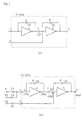
- Fig. 1 (a) and (b) show diagrams of the neural operation units used in the present invention.
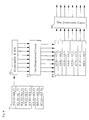
- Fig. 2 shows a diagram of the one-dimensional discrete cosine transformation circuit of the first embodiment of the present invention.
- Fig. 3 shows a diagram of the two-dimensional discrete cosine transformation circuit of the second embodiment of the present invention.
- Fig. 4 shows a diagram of a variation of the two-dimensional discrete cosine transformation circuit of the present invention.
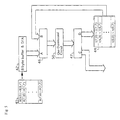
- Fig. 5 shows a diagram of another variation of the two-dimensional discrete cosine transformation circuit of the present invention.
- Fig. 1 (a) shows the structure of neural operation unit (NOU) 10 used in the discrete cosine transformation circuit of the present invention.
- NOU neural operation unit
- 1 and 2 are input terminals for inputting analog voltage signals
- 3 is an output terminal
- 4 and 5 are inverting amplifiers
- 7 and 8 are capacitors having identical capacities, with the capacity of each assumed to be C0.
- the input of inverting amplifier 4 is connected to input terminal 1
- the output of inverting amplifier 4 is connected to an input of inverting amplifier 5 through capacitor 7.
- Input terminal 2 is connected to the input of inverting amplifier 5, its output being connected to output terminal 3.
- Capacitor 6 is provided between the input and output of inverting amplifier 4, and capacitor 8 is provided between the input and output of inverting amplifier 5.
- Inverting amplifiers 4 and 5 include CMOS inverters connected in serial by an odd number of stages and other components.
- Fig. 1 (b) shows neural operation unit 10 with three input voltages applied. As shown, voltages V1 and V2 are applied to input terminal 1 through capacitors C1 and C2, respectively, and voltage V3 is applied to input terminal 2 through capacitor C3.
- Point A on the input of inverting amplifier 4 is connected to the capacitors C0, C1 and C2, and to an n-type MOSFET and a p-type MOSFET gate electrodes which are included in the first-stage CMOS inverter of inverting amplifier 4.
- Point A is floating, as is point B. If all the electric charges stored in capacitors 6, 7, 8, C1, C2 and C3 are 0, the total quantity stored in the capacitors is 0 based on the principle of conservation of charge with reference to points A and B, even when input voltages V1, V2 and V3 are applied.
- Vb is the electric potential on points A and B
- Va is the electric potential of the output of inverting amplifier 4.
- the electric potential Vb of points A and B is usually set to be 1/2 of the supply voltage applied to inverting amplifiers 4 and 5.
- the Vb is +(1/2)Vdd, and when inverting amplifiers 4 and 5 are driven by positive and negative supply voltages, respectively, it is 0 volts.
- Formula (4) means that V(1) and V(2) for inputting to input terminal 1 are added, and V(3) for inputting to input terminal 2 is subtracted.
- Input voltages V(1), V(2) and V(3) are output after being multiplied by the values corresponding to the ratios of C0 provided in neural operation unit 10 and the respective connected capacitors C1, C2 and C3.
- the operations above are performed at an extremely high speed in a time span approximately equal to the delay time from input to output of inverting amplifiers 4 and 5.
- the circuit of NOU is realized as an integrated circuit of a semiconductor. Determining the capacities of the capacitances according to conductor areas makes them remarkably accurate, enabling accurate operation results. Since its voltage alone drives the neural operation unit, electric power consumption is quite low.
- the discrete cosine transformation circuit of the present invention uses the above neural operation unit as its operation unit.
- the one-dimensional discrete cosine transformation circuit of the first embodiment performs the operations in formulas (6) to (13) in parallel.
- Fig. 2 shows the structure of the one-dimensional discrete cosine transformation circuit on eight points of N.
- 11 to 18 are the neural operation units mentioned above, d0 to d6 are capacitors, and x(0) to x(7) are one-dimensional input signals.
- matrices are formed by the wiring connected to the one-dimensional input signals x(0) to x(7), and to positive input terminals "+” and negative input terminals "-” of neural operation units 11 to 18.
- Capacitors d0 to d6 are connected to the cross points of the wiring. The "+" and "-" correspond to input terminals 1 and 2 in Fig. 1.
- the one-dimensional input signals x(0) to x(7) are input in parallel to the positive input terminals "+” and the negative input terminals "-" of eight neural operation units (NOU) 11 to 18 through capacitors d0 to d6 connected to the cross points of the matrices.
- NOU 11 to 18 input signals x(0) to x(7) are added and subtracted: x(0) to x(7) are multiplied beforehand by the coefficient determined by capacities of capacitors d0 to d6 which are connected to NOU 11 to 18. Thereafter, discrete cosine transforming coefficients y(0) to y(7) are output.
- All input signals x(0) to x(7) are input to the positive input terminal of NOU 11 through capacitor d0.
- the operation in formula (6) above is performed in NOU 11.
- the discrete cosine transformation on eight points is performed by the structure in Fig. 2. Any number of points on the first dimensional discrete cosine transformation circuit can be defined; it is not limited to eight.
- N number of points of discrete cosine transformation can be performed in parallel in N number of neural operation circuits by the one-dimensional discrete cosine transformation circuit of the present invention.
- Each neural operation circuit has an operation time approximately identical to the propagation delay time of the inverting amplifier mentioned above. This enables high-speed operation of the one-dimensional discrete cosine transformation.
- the one-dimensional discrete cosine transformation circuit can be realized with only 48 CMOS inverters and 88 capacitors. Consequently, the quantity of hardware is small.
- the two-dimensional discrete cosine transformation circuit of the second embodiment of the present invention is as follows.
- the two-dimensional discrete cosine transformation can be decomposed into two one-dimensional discrete cosine transformations independent of the variables i and j respectively.
- the one-dimensional discrete cosine transformation is performed with respect to i(j) as shown in formula (22) and then with respect to j(i) as shown in formula (23): These two operations reduce the number of operations
- Fig. 3 shows the structure of the two-dimensional discrete cosine transformation circuit of the second embodiment.
- the circuit performs two dimensional discrete cosine transformations on 8 rows x 8 columns of data.
- 20 to 35 represent the one-dimensional discrete transformation circuits shown in Fig. 2.
- High-speed two-dimensional discrete cosine transformations can be performed by eight first discrete cosine transformation circuits 20 to 27 doing one-dimensional cosine transformations in column direction, and by the other eight first discrete cosine transformation circuits 28 to 35 doing such transformations in row-direction.
- Eight inputs from x(0,0) to x(7,0), x(0,1) to x(7,1), ..., x(0,7) to x(7,7) are input to one-dimensional discrete cosine transformation circuits 20 to 27, respectively, and one-dimensional discrete cosine transformation is performed in each circuit. Then, first dimensional discrete cosine transforming coefficients t(0,0) to t(7,0), t(0,1) to t(7,1), ..., t(0,7) to t(7,7) are output from circuits 20 to 27, respectively.
- coefficients belonging to the identical row of one-dimensional discrete cosine transforming coefficients t(0,0) to t(7,7) are input to one-dimensional discrete cosine transformation circuits 28 to 35 in such manner that coefficients t(7,0) to t(7,7) are input to first discrete cosine transformation circuit 28, and coefficients t(6,0) to t(6,7) are input to circuit 29.
- Number 42 shows a buffer and D/A converting circuit for inputting one row of image data in sequence in such manner as to read data from x(0,0) to x(0,7) first, x(1,0) to x(1,7) second, and successively on to x(7,0) to x(7,7), converting the data from digital to analog and outputting it to one-dimensional cosine transformation circuit 43.
- Number 43 shows a one-dimensional discrete cosine transformation circuit for performing discrete cosine transformation on the one-row image data converted into analog data input from the buffer and D/A converting circuit 42. Its structure is similar to that in Fig. 2.
- Number 44 shows an analog memory for storing output from one-dimensional discrete cosine transformation circuit 43, including a two-dimensional analog shift register, for example.
- Number 45 shows a one-dimensional discrete cosine transformation circuit for reading in column direction the one-dimensional discrete cosine coefficients stored in analog memory 44 and performing one-dimensional discrete cosine transformation. It has the same structure as that in Fig. 2.
- Digital image data of the first row x(1,0) to x(1,7) stored in digital memory 41 is input to the buffer and D/A converting circuit 42, the one-dimensional discrete cosine conversion is performed in DCT circuit 43, and results t(1,0) to t(1,7) are stored in analog memory 44.
- digital image data in digital memory 41 are successively input to the buffer and D/A converting circuit 42 row by row, and the one-dimensional discrete cosine conversion is performed in one-dimensional DCT circuit 43.
- the results are successively stored in analog memory 44, and the results after performing the row by row one-dimensional discrete cosine conversions are stored in analog memory 44, as shown in Fig. 4.
- Data stored in analog memory 44 is read out by column by column in column direction and supplied to one-dimensional DCT circuit 45. That is, 0-order column data t(0,0) to t(0,7) among the data in analog memory 44 is read out and supplied to one-dimensional DCT circuit 45 and the first degree discrete cosine transformation performed.
- This DCT circuit 45 performs the first discrete cosine transformation in column direction, and two-dimensional discrete cosine conversion coefficients from y(0,0) to y(0,7) are output from first degree DCT circuit 45.
- First column data from t(1,0) to t(1,7) is read out from analog memory 44 and the one-dimension cosine conversion performed in one-dimension DCT circuit 45.
- the two-dimensional discrete cosine conversion coefficients from y(1,0) to y(1,7) are next output from the outputs of one-dimensional DCT circuit 45.
- data in column direction is read out and processed successively in one-dimensional DCT circuit 45. Results of the two-dimensional discrete cosine conversions are then successively output from the outputs of one-dimensional DCT circuit 45.
- Fig. 5 shows the embodiment with legs hardware than that of the embodiment in Fig. 4.
- the quantity of the hardware of the embodiment is smaller by switch-using a single one-dimensional DCT circuit from input to output and from output to input.
- the structure is formed because one-dimensional DCT circuits 43 and 45 do not work at the same time in Fig. 4.
- Fig. 5 41, 42 and 44, respectively, are the digital memory buffer and D/A converting circuit and analog memory identical to those in Fig. 4.
- Number 50 is the one-dimensional DCT circuit exactly like that in Fig. 2, and 46 and 47 are switching circuits for switching the input and the output, respectively, for this DCT circuit 50.
- switching circuit 46 is initially set so that data from side A is output and switching circuit 47 so that the supplied data is output to side D.
- image data stored in digital memory 41 is sequentially read out by one row into the buffer and D/A converting circuit 42, and the signal, now converted into analog, is applied to one-dimensional circuit 50 through switching circuit 46.
- the output signal having had the one-dimensional discrete cosine conversion performed in row direction in one-dimensional DCT circuit 50, is output from side D of switching circuit 47 and sequentially stored in analog memory 44.
- the resulting data undergoes the one-dimensional discrete cosine conversion in analog memory 44 and is stored there in row direction. Then, the signal read out from analog memory 44 is switched so as to be input to one-dimensional DCT circuit 50 by switching circuit 46 to side B, and simultaneously, the output of one-dimensional DCT circuit 50 is switched so as to be output to the outside by switching circuit 47 to side C.
- This embodiment decreases the amount of needed hardware.
- the discrete cosine transformation circuit of the present invention enables high-speed one- and two-dimensional discrete cosine conversions with minimal hardware.
Landscapes
- Physics & Mathematics (AREA)
- Engineering & Computer Science (AREA)
- Mathematical Physics (AREA)
- General Physics & Mathematics (AREA)
- Theoretical Computer Science (AREA)
- Mathematical Analysis (AREA)
- Mathematical Optimization (AREA)
- Pure & Applied Mathematics (AREA)
- Software Systems (AREA)
- Algebra (AREA)
- Data Mining & Analysis (AREA)
- Computational Mathematics (AREA)
- Databases & Information Systems (AREA)
- General Engineering & Computer Science (AREA)
- Discrete Mathematics (AREA)
- Computer Hardware Design (AREA)
- Compression Or Coding Systems Of Tv Signals (AREA)
- Complex Calculations (AREA)
- Compression, Expansion, Code Conversion, And Decoders (AREA)
Claims (4)
- Eine eindimensionale diskrete Cosinustransformationsschaltung zur Erzeugung eines Ausgangs einer diskreten Cosinustransformation (y(0) bis y(7)) von einer Anzahl N Eingangsspannungen, wobei N eine positive ganze Zahl ist und die genannte eindimensionale diskrete Transformationsschaltung umfaßt: N Signaleingabeeinrichtungen, um N analoge Eingangssignale (x(0) bis x(7)) zu erhalten; eine Anzahl N Operationseinheiten (NOU), von denen jede umfaßt:i) eine positive Eingangsklemme (1),ii) eine negative Eingangsklemme (2);iii) eine Ausgangsklemme (3);iv) einen ersten Umkehrverstärker (4) mit einem Eingang und einem Ausgang, wobei der genannte Eingang mit der genannten positiven Eingangsklemme (1) verbunden ist;v) einen ersten Rückkopplungskondensator (6), der zwischen dem genannten Eingang und dem genannten Ausgang des genannten ersten Umkehrverstärkers verbunden ist;vi) einen Zwischenkondensator (7), der einen Eingang und einen Ausgang aufweist;vii) wobei der genannte Eingang mit dem genannten Ausgang des genannten ersten Umkehrverstärkers (4) verbunden ist;viii) einen zweiten Umkehrverstärker (5), der einen Eingang und einen Ausgang aufweist, wobei der genannte Eingang mit dem genannten Ausgang des genannten Zwischenkondensators (7) verbunden ist, der genannte Ausgang mit der genannten Ausgangsklemme (3) verbunden ist; undix) einen zweiten Rückkopplungskondensator (8), der zwischen dem genannten Eingang und dem genannten Ausgang des genannten zweiten Umkehrverstärkers verbunden ist; und eine Mehrzahl Kondensatoren (d0 bis d6), die den genannten Eingangsspannungen entsprechen und von denen jeder zwischen einer der genannten Eingangsspannungen und einer der genannten positiven und negativen Klemmen verbunden ist, und wobei die genannten Kondensatoren (d0 bis d6) Kapazitäten entsprechend den Koeffizienten der genannten diskreten Cosinustransformation aufweisen.
- Eine zweidimensionale diskrete Cosinustransformationsschaltung, um eine zweidimensionale diskrete N x N-Punkt-Cosinustransformation an einem Eingangssignal von N x N Punkten durchzuführen, umfassend:i) eine Zahl N der genannten eindimensionalen diskreten Cosinustransformationsschaltungen (20 bis 27), wie in Anspruch 1 beansprucht, wobei jede N Eingangssignale parallel entsprechend einer Zeile oder einer Spalte der genannten Eingangssignale von N x N Punkten erhält und eine eindimensionale diskrete Cosinustransformation an den genanten N Eingangssignalen ausführt und N durch eine eindimensionale diskrete Cosinustransformation transformierte Signale (t(0,0) bis t(7,7)) ausgibt, undii) eine Anzahl N der genannten eindimensionalen Cosinustransformationsschaltungen (28, 35), wie in Anspruch 1 beansprucht, wobei jede den Ausgang von der genannten Anzahl N eindimensionaler diskreter Cosinustransformationsschaltungen (20, 27) erhält, wobei die genannten durch eine eindimensionale diskrete Cosinustransformation transformierten Signale (t(0,0) bis t(7,7)) der identischen Zeile oder Spalte entsprechen.
- Eine zweidimensionale diskrete Cosinustransformationsschaltung, um eine zweidimensionale diskrete N x N-Punkt-Cosinustransformation an einem Eingangssignal N x N Punkten durchzuführen, umfassend:i) eine erste eindimensionale Cosinustransformationsschaltung (43), wie in Anspruch 1 beansprucht, um N Eingangssignale parallel zu erhalten...!!;ii) eine zweidimensionale Speichereinrichtung (44), um in jeder Zeile die N Ausgänge (t(0,0) bis t(7,7)) der genannten eindimensionalen diskreten Cosinustransformationsschaltung, wie in Anspruch 1 beansprucht, zu speichern; undiii) eine zweite eindimensionale diskrete Cosinustransformationsschaltung (45), wie in Anspruch 1 beansprucht, um die spaltenweise aus der genannten zweidimensionalen Speichereinrichtung (44) ausgelesenen Signale zu erhalten und um eine zweite eindimensionale diskrete Cosinustransformation auszuführen.
- Eine zweidimensionale diskrete Cosinustransformationsschaltung, um eine zweidimensionale diskrete N x N-Punkt-Cosinustransformation an einem Eingangssignal von N x N Punkten durchzuführen, umfassend:wobei N Eingangssignale der genannten Eingangssignale an N x N Punkten zeilenweise der genannten ersten Eingangsklemme (A) der genannten ersten Schalterschaltung (46) eingegeben werden, und Signale, die spaltenweise aus der genannten zweidimensionalen Speichereinrichtung (44) ausgelesen werden, der genannten zweiten Eingangsklemme (B) der genannten ersten Schalterschaltung (46) eingegeben werden.i) eine erste Schalterschaltung (46) mit einer ersten (A) und einer zweiten (B) Eingangsklemme, von denen jede eine Anzahl N Eingangssignale erhält, sowie auch mit einer Ausgangsklemme zur Ausgabe einer Anzahl N von Ausgangssignalen;ii) eine eindimensionale diskrete Cosinustransformationsschaltung (50), wie in Anspruch 1 beansprucht, deren Eingang mit der genannten Ausgangsklemme der genannten ersten Schalterschaltung (46) verbunden ist;iii) eine zweite Schalterschaltung (47), die eine Eingangsklemme aufweist, die mit dem genannten Ausgang der genannten eindimensionalen diskreten Cosinustransformationsschaltung (50) verbunden ist, und eine erste (C) und eine zweite (D) Ausgangsklemme aufweist, von denen jede die Fähigkeit hat, eine Anzahl N Signale auszugeben; undiv) eine zweidimensionale Speichereinrichtung (44), um spaltenweise Signale zu speichern, die der genannten ersten Ausgangsklemme (D) der genannten zweiten Schalterschaltung (47) eingegeben werden,
Applications Claiming Priority (3)
| Application Number | Priority Date | Filing Date | Title |
|---|---|---|---|
| JP8893296 | 1996-03-19 | ||
| JP88932/96 | 1996-03-19 | ||
| JP8088932A JPH09259206A (ja) | 1996-03-19 | 1996-03-19 | 離散コサイン変換回路 |
Publications (2)
| Publication Number | Publication Date |
|---|---|
| EP0803829A1 EP0803829A1 (de) | 1997-10-29 |
| EP0803829B1 true EP0803829B1 (de) | 1999-09-29 |
Family
ID=13956678
Family Applications (1)
| Application Number | Title | Priority Date | Filing Date |
|---|---|---|---|
| EP97104602A Expired - Lifetime EP0803829B1 (de) | 1996-03-19 | 1997-03-18 | Schaltung zur Berechnung der diskreten Cosinustransformation |
Country Status (4)
| Country | Link |
|---|---|
| US (1) | US5862070A (de) |
| EP (1) | EP0803829B1 (de) |
| JP (1) | JPH09259206A (de) |
| DE (1) | DE69700559T2 (de) |
Families Citing this family (3)
| Publication number | Priority date | Publication date | Assignee | Title |
|---|---|---|---|---|
| JPH10117350A (ja) * | 1996-10-09 | 1998-05-06 | Matsushita Electric Ind Co Ltd | アナログ処理方式の画像符号化装置 |
| US7394939B2 (en) * | 2003-12-17 | 2008-07-01 | Microsoft Corporation | Managing file stream generation |
| WO2019165272A1 (en) * | 2018-02-23 | 2019-08-29 | Octavo Systems Llc | Analog memory cells with valid flag |
Family Cites Families (7)
| Publication number | Priority date | Publication date | Assignee | Title |
|---|---|---|---|---|
| US4156923A (en) * | 1977-10-17 | 1979-05-29 | Westinghouse Electric Corp. | Method and apparatus for performing matrix multiplication or analog signal correlation |
| US4161785A (en) * | 1977-11-17 | 1979-07-17 | General Electric Company | Matrix multiplier |
| US4156284A (en) * | 1977-11-21 | 1979-05-22 | General Electric Company | Signal processing apparatus |
| KR920701918A (ko) * | 1989-06-15 | 1992-08-12 | 제이 엘.체신 | 입력 또는 출력라인과 차등감지 또는 구동된 출력 또는 입력라인 쌍을 접속한 용량성 구조를 사용한 뉴럴네트 |
| US5187680A (en) * | 1989-06-15 | 1993-02-16 | General Electric Company | Neural net using capacitive structures connecting input lines and differentially sensed output line pairs |
| KR920008270B1 (ko) * | 1990-04-03 | 1992-09-26 | 정호선 | 신경회로망을 이용한 이산형 코사인 변환용 집적회로 |
| EP0551524A4 (en) * | 1991-08-05 | 1994-08-10 | Kawasaki Steel Co | Signal processor and learning method thereof |
-
1996
- 1996-03-19 JP JP8088932A patent/JPH09259206A/ja not_active Ceased
-
1997
- 1997-03-18 US US08/820,002 patent/US5862070A/en not_active Expired - Fee Related
- 1997-03-18 DE DE69700559T patent/DE69700559T2/de not_active Expired - Fee Related
- 1997-03-18 EP EP97104602A patent/EP0803829B1/de not_active Expired - Lifetime
Also Published As
| Publication number | Publication date |
|---|---|
| DE69700559D1 (de) | 1999-11-04 |
| JPH09259206A (ja) | 1997-10-03 |
| EP0803829A1 (de) | 1997-10-29 |
| US5862070A (en) | 1999-01-19 |
| DE69700559T2 (de) | 2000-03-02 |
Similar Documents
| Publication | Publication Date | Title |
|---|---|---|
| US4293920A (en) | Two-dimensional transform processor | |
| KR100373222B1 (ko) | 반도체집적회로 | |
| US5835045A (en) | Semiconductor device, and operating device, signal converter, and signal processing system using the semiconductor device. | |
| US5381352A (en) | Circuit for multiplying an analog value by a digital value | |
| Kub et al. | Programmable analog vector-matrix multipliers | |
| EP1676197B1 (de) | Betriebsschaltung und betriebssteuerverfahren dafür | |
| EP0914707B1 (de) | Schaltkreisarchitektur für ladungspumpen | |
| US5926057A (en) | Semiconductor device, circuit having the device, and correlation calculation apparatus, signal converter, and signal processing system utilizing the circuit | |
| US5258934A (en) | Charge domain bit serial vector-matrix multiplier and method thereof | |
| US20190294957A1 (en) | Arithmetic device and arithmetic method | |
| EP0803829B1 (de) | Schaltung zur Berechnung der diskreten Cosinustransformation | |
| CN111325334A (zh) | 一种智能处理器 | |
| Siskos et al. | Analog implementation of fast min/max filtering | |
| US4110835A (en) | Bucket brigade circuit for signal scaling | |
| EP0725356A2 (de) | Halbleiteranordnung, Halbleiterschaltung, in der die Anordnung angewandt wird und Korrelationsrechner, Signalwandler und Signalverarbeitungssystem, in dem die Schaltung angewandt wird | |
| US4860097A (en) | Transformation circuit | |
| KR100388850B1 (ko) | 정합필터회로 | |
| US5311454A (en) | Digital multiplier-accumulator | |
| JPH10117350A (ja) | アナログ処理方式の画像符号化装置 | |
| Fish et al. | CMOS current/voltage mode winner-take-all circuit with spatial filtering | |
| EP0786733A2 (de) | Multiplizierschaltung | |
| US4052606A (en) | Charge transfer device transversal filters | |
| EP0707274B1 (de) | Multiplikationsschaltung | |
| Hasler et al. | Implementation of analog neural networks | |
| JP3219915B2 (ja) | 画像圧縮回路 |
Legal Events
| Date | Code | Title | Description |
|---|---|---|---|
| PUAI | Public reference made under article 153(3) epc to a published international application that has entered the european phase |
Free format text: ORIGINAL CODE: 0009012 |
|
| AK | Designated contracting states |
Kind code of ref document: A1 Designated state(s): DE FR GB |
|
| 17P | Request for examination filed |
Effective date: 19980205 |
|
| GRAG | Despatch of communication of intention to grant |
Free format text: ORIGINAL CODE: EPIDOS AGRA |
|
| 17Q | First examination report despatched |
Effective date: 19981014 |
|
| GRAG | Despatch of communication of intention to grant |
Free format text: ORIGINAL CODE: EPIDOS AGRA |
|
| GRAH | Despatch of communication of intention to grant a patent |
Free format text: ORIGINAL CODE: EPIDOS IGRA |
|
| GRAH | Despatch of communication of intention to grant a patent |
Free format text: ORIGINAL CODE: EPIDOS IGRA |
|
| GRAA | (expected) grant |
Free format text: ORIGINAL CODE: 0009210 |
|
| AK | Designated contracting states |
Kind code of ref document: B1 Designated state(s): DE FR GB |
|
| RIN1 | Information on inventor provided before grant (corrected) |
Inventor name: TAKATORI SUNAO Inventor name: ZHOU CHANGMING Inventor name: CHEN JIE Inventor name: SHOU GUOLIANG |
|
| REF | Corresponds to: |
Ref document number: 69700559 Country of ref document: DE Date of ref document: 19991104 |
|
| ET | Fr: translation filed | ||
| PLBE | No opposition filed within time limit |
Free format text: ORIGINAL CODE: 0009261 |
|
| STAA | Information on the status of an ep patent application or granted ep patent |
Free format text: STATUS: NO OPPOSITION FILED WITHIN TIME LIMIT |
|
| 26N | No opposition filed | ||
| REG | Reference to a national code |
Ref country code: GB Ref legal event code: IF02 |
|
| PGFP | Annual fee paid to national office [announced via postgrant information from national office to epo] |
Ref country code: FR Payment date: 20040309 Year of fee payment: 8 |
|
| PGFP | Annual fee paid to national office [announced via postgrant information from national office to epo] |
Ref country code: GB Payment date: 20040317 Year of fee payment: 8 |
|
| PGFP | Annual fee paid to national office [announced via postgrant information from national office to epo] |
Ref country code: DE Payment date: 20040325 Year of fee payment: 8 |
|
| PG25 | Lapsed in a contracting state [announced via postgrant information from national office to epo] |
Ref country code: GB Free format text: LAPSE BECAUSE OF NON-PAYMENT OF DUE FEES Effective date: 20050318 |
|
| PG25 | Lapsed in a contracting state [announced via postgrant information from national office to epo] |
Ref country code: DE Free format text: LAPSE BECAUSE OF NON-PAYMENT OF DUE FEES Effective date: 20051001 |
|
| GBPC | Gb: european patent ceased through non-payment of renewal fee |
Effective date: 20050318 |
|
| PG25 | Lapsed in a contracting state [announced via postgrant information from national office to epo] |
Ref country code: FR Free format text: LAPSE BECAUSE OF NON-PAYMENT OF DUE FEES Effective date: 20051130 |
|
| REG | Reference to a national code |
Ref country code: FR Ref legal event code: ST Effective date: 20051130 |