EP0803893A2 - Evaporateur sous vide - Google Patents
Evaporateur sous vide Download PDFInfo
- Publication number
- EP0803893A2 EP0803893A2 EP97106374A EP97106374A EP0803893A2 EP 0803893 A2 EP0803893 A2 EP 0803893A2 EP 97106374 A EP97106374 A EP 97106374A EP 97106374 A EP97106374 A EP 97106374A EP 0803893 A2 EP0803893 A2 EP 0803893A2
- Authority
- EP
- European Patent Office
- Prior art keywords
- rod
- hot
- evaporation material
- evaporation
- vacuum
- Prior art date
- Legal status (The legal status is an assumption and is not a legal conclusion. Google has not performed a legal analysis and makes no representation as to the accuracy of the status listed.)
- Withdrawn
Links
Images





Classifications
-
- H—ELECTRICITY
- H01—ELECTRIC ELEMENTS
- H01J—ELECTRIC DISCHARGE TUBES OR DISCHARGE LAMPS
- H01J37/00—Discharge tubes with provision for introducing objects or material to be exposed to the discharge, e.g. for the purpose of examination or processing thereof
- H01J37/30—Electron-beam or ion-beam tubes for localised treatment of objects
- H01J37/305—Electron-beam or ion-beam tubes for localised treatment of objects for casting, melting, evaporating, or etching
- H01J37/3053—Electron-beam or ion-beam tubes for localised treatment of objects for casting, melting, evaporating, or etching for evaporating or etching
-
- H—ELECTRICITY
- H01—ELECTRIC ELEMENTS
- H01J—ELECTRIC DISCHARGE TUBES OR DISCHARGE LAMPS
- H01J2237/00—Discharge tubes exposing object to beam, e.g. for analysis treatment, etching, imaging
- H01J2237/30—Electron or ion beam tubes for processing objects
- H01J2237/31—Processing objects on a macro-scale
- H01J2237/3132—Evaporating
Definitions
- the invention relates to an evaporation source (Knudsen cell or e-gun) of a vacuum evaporator for so-called dry plating by which a solid material is melted or sublimated in a vacuum device by electron impact heating so as to be evaporated as atomic or molecular beams and adhered onto a solid deposition substrate, or to a molecular beam source of a molecular beam crystal growth device (MBE) by which evaporated molecular beams are gradually deposited on a crystal substrate to form a crystalline film.
- evaporation source Kerbul cell or e-gun
- MBE molecular beam crystal growth device
- Vacuum deposition of a solid material is a very significant technology from an industrial point of view and inevitable to form a film.
- Known evaporation methods include a resistance heating method and an electron impact heating method.
- the resistance heating method is a type which directly contacts an evaporation source material with an evaporation material (film material), and the evaporation source material has a temperature higher than the thin film material, so that there are disadvantages such as mixing of impurities into the film material, a reaction with the evaporation source material and a limitation owing to a melting point of the evaporation source material.
- the electron impact heating method was developed to avoid such disadvantages and directly hits the electrons against a portion of the evaporation material for heating.
- Such highly purified film forming technologies are increasing in importance as the electronics-related technologies undergo further development, and an electron beam heating method which does need to take an evaporation source container material into account stands without a rival at forming a film by depositing a high-melting point material. Its most prominent advantage is that since the solid evaporation material can be partly heated to be melted and evaporated by squeezing the electron beam into a thin line, a crucible for the melted material is not needed, and a material for the crucible does not melt into a melted evaporation liquid.
- known methods include one which uses an electron gun A, namely an electron gun (e-gun) which accelerates electron beams of 10 to 110 mA taken out of a hot-cathode filament with a high-voltage electric source of 10 to 10 KV to linearly hit a sample C from a distance as shown in Fig. 7, and one which deflects electron beams (electron beams E) by a magnetic field as shown in Fig. 8.
- B denotes an accelerating electrode, D a cooling water, and d a substrate.
- the latter method is mainly used today.
- the screening electrode is heated to a high temperature in a range of 600 to 800°C by radiation heat from the evaporating end and the hot-cathode filament, and the gas discharge from the electrode is increased. Besides, radiation from the high-temperature screening electrode increases the temperature of the vacuum vessel wall, and the gas discharge is also increased.
- the invention has been completed in view of the above-described disadvantages of conventional technologies and aims to provide a vacuum evaporator which does not scatter electrons or ions and has a simple electrode structure, does not need water cooling or liquid nitrogen cooling, and has an evaporation source which does not scatter molecular beams from the deposition source or radiation heat to any parts other than a deposition substrate and can be produced inexpensively without degrading vacuum. Furthermore, it is aimed to provide a vacuum evaporator by which the molecular beam intensity while depositing can be monitored at the same time, and a plurality of materials are evaporated from a single evaporation source at the same time to easily form a compound semiconductor or an alloy film.
- the invention described in Claim 1 relates to a vacuum evaporator that a solid substance provided within a vacuum vessel is melted and evaporated or sublimed by electron impact heating to form atomic or molecular beams and to adhere onto a separately provided deposition substrate, characterized in that:
- the invention described in Claim 2 relates to a vacuum evaporator according to claim 1, wherein a screening electrode is provided between the electron impact heating part and the conductive cooling member to prevent the dissipation of electrons and ions generated from the evaporation tip of the rod evaporation material and the hot-cathode filaments.
- the invention described in Claim 3 relates to a vacuum evaporator according to claim 2, wherein the screening electrode is made to be an electrical potential lower than the hot-cathode filaments' potential, and an ion current flowing to the screening electrode is detected to monitor and detect evaporation intensities of evaporated atomic beams and molecular beams.
- the invention described in Claim 4 relates to a vacuum evaporator according to claim 2, wherein an atomic and molecular beam discharge port formed on the screening electrode has a meshed structure.
- the invention described in Claim 5 relates to a vacuum evaporator according to any one of claims 1 to 4, wherein the rod evaporation material is formed by bundling a plurality of different materials into one body.
- the intensity of the molecular beams at the time of depositing the evaporated atomic beams can be monitored, a plurality of different rod evaporation materials are integrally bundled to form the rod evaporation member, so that there is provided a vacuum evaporator having quartet effects which is a single evaporation device but can easily form a compound semiconductor or alloy on a deposition substrate.
- the screening electrode has a structure divided into two in the coaxial direction with the rod evaporation material, so that the ion current is monitored by the screening electrode having a meshed opening in the neighbourhood of the tip of the rod evaporation material.
- the screening electrode is preferably configured to make degassing from the hot-cathode filament by electron impact.
- Fig. 1 shows a conduction cooling rod material electron impact heating evaporation device practising the invention.
- 1 is a thick wall cylindrical conductive cooling member made of oxygen free copper, which is configured of a good heat conductor formed of copper or copper alloy or aluminum or aluminum alloy.
- a copper donut-like disk 2 which prevents ions produced by electron impact and radiation heat which does not serve for heating a material from being diffused to a vacuum vessel wall is fixed by bolts to one end of the conductive cooling member 1 which is disposed on the vacuum side.
- an electrode holder 3 made of oxygen free copper is fixed to the interior while retaining the above functions. Insulation terminal groups 31, 31' for fixing an electrode which configures an electron impact heating unit is fixed to the oxygen free copper electrode holder 3.
- a portion 11 which is on the atmosphere side of the conductive cooling member 1 has a plurality of vacuum insulation terminals 12, 12' welded by electron beams, and also cooling fins 13 and a stainless steel vacuum flange 14 welded. And, a small stainless steel vacuum flange 15 is welded to the other end of the conductive cooling member 1, and a rod evaporation material 4 and an introduction member 5 for delivery are connected thereto.
- a hole 32 is formed to pass the rod evaporation material 4 therethrough, and the rod evaporation material 4 is slid through the hole 32 into an electron impact heating chamber 6.
- a circular hot-cathode filament 7 made of a tungsten material is mounted on the two insulation terminals 31 in a substantially horizontal position with respect to a tip 41 of the rod evaporation material 4.
- the insulation terminals 31, 31' are electrically connected to the vacuum insulation terminals 12, 12'.
- the filaments 7 and the tip 4 of the rod evaporation material 4 are surrounded by a tantalum metal cup-shaped screening electrode 8 which is mounted on another insulation terminal on the electrode holder 3 and two screening electrodes of a donut-shaped screening electrode 9. And, a hole 91 is formed at the center of the donut-shaped screening electrode 9 to inject evaporated molecular beams, and this hole has a fine screen 92 made of a very thin tungsten wire.
- the two screening electrodes 8, 9 are electrically independent each other and connected to the vacuum insulation terminal groups of the vacuum insulation terminal 12'.
- Fig. 2 shows a state that the evaporation device of the invention is mounted on a vacuum vessel.
- the conductive cooling member 1 is mounted on the upper part of a vacuum vessel a.
- the vacuum vessel a is made vacuous by a vacuum pump c (not shown).
- b is a vacuum gage
- d is a substrate
- M is a molecular beam.
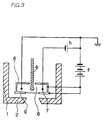
- the screening electrodes 8, 9 are wired through the vacuum terminals 12, 12' as shown in Fig. 3, and electron impact is performed to the two screening electrodes 8, 9 from the hot-cathode filaments 7 to make degassing.
- the two screening electrodes 8, 9 When the electron impact of about 1KV x 60 mA is performed, the two screening electrodes 8, 9 have a temperature exceeding 1000°C. By this step, the gas discharge from the electrodes is lowered to a negligible level even when the temperatures of the screening electrodes 8, 9 are raised to 600 to 800°C at the next electron impact heating deposition.
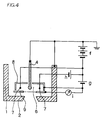
- the electrodes are wired with a positive electrode at an earth potential (the rod evaporation material 4) as shown in Fig. 4, a reverse bias voltage of -2KV is applied to the hot-cathode filaments 7, and the screening electrodes 8, 9 are set to a level 20 to 30V lower than the hot-cathode filaments' potential. In this state, the hot-cathode filaments 7 are turned on to hit the rod evaporation material 4 with electron impacts of 40 to 50 mA.
- the tip 41 of the rod evaporation member 4 melts, and a liquid ball dangles from the tip of the solid rod material 4.
- the liquid ball has a diameter of about 5 mm and a temperature exceeding 1700°C.
- the two screening electrodes 8, 9 have a high temperature of 600 to 700°C, but since they are surrounded by the oxygen free copper conductive cooling member 1 having a very small emissivity (absorption rate of radiation heat) of 2%, 98% of heat is returned to the screening electrodes 8, 9, then to the filaments 7. Therefore, the heating electric power of the filaments 7 is lowered to 1/2 to 1/3 of prior art, and absorption of heat by the cooling member 1, the donut-shaped disk 2 and the electrode holder 3 is very small. In other words, there is provided an energy-saving electron impact heating structure.
- Heat absorbed at a rate of 2% by the donut-shaped disk 2 and the electrode holder 3 is quickly discharged to the atmosphere through the oxygen free copper which has a very high heat conductivity, so that the temperature increase of the electron impact heating evaporation chamber 6 is suppressed to minimum.
- the temperature at the head (the donut-shaped disk 2) of the conductive cooling member 1 was about 80°C.
- Detrimental electron groups of backscattered electrons produced from the periphery of the electron impact heating evaporation source and secondary electrons are completely rebounded by the screening electrodes 8, 9, which are made negative with respect to the filament, to the rod material (positive electrode) to serve for heating.
- the screen 92 made of a very thin line formed on the hole 91 of the donut-shaped screening electrode 9 through which the evaporated molecules pass serves to completely prevent the backscattered electrons and secondary electrons from scattering toward the deposition substrate.
- a disk electrode (not shown) was provided at the center hole of the donut-shaped cooling disk 2 with the screen 92 removed, and backscattered electrons and secondary electrons were measured. It was found that an electron current of 2 to 5 mA with an energy width of 0 to 300 eV came flying, and when a 30-mesh screen of a fine line having a permeability of 95% was used, an ammeter indicated zero. And, even when such screens were provided, it was found that a film formed on the deposition substrate and affected by the mesh of the screen was free from any spot, and a film with good quality could be formed. This effect results from the screen mesh which is smaller than the liquid ball at the tip of the evaporation material and disposed nearest to the evaporation source.
- the ion current flowing to the screening electrodes 8, 9 is an ion current of evaporated atoms generated by the electrons discharged from the hot-cathode filaments 7, and has the same function as a kind of hot-cathode ionization vacuum gage.
- the ion current is expressed as follow: Ii - KPIe where, Ii is an ion current, Ie is an electron current, K is a proportional constant related to an ionization probability of evaporated atoms and an electrode structure.
- Fig. 5 shows a composite rod evaporation member, which is the rod evaporation material 4 formed by winding a pure iron wire 43 having a diameter of 0.7 mm into a spiral form around a silicon core rod 42 having a diameter of 2 mm.
- a tip of the evaporation material is heated by the electron impact, silicon and iron react to become ferrosilicon (FeSi 2 ) and evaporate to form a compound semiconductor film on the substrate.
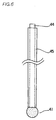
- Fig. 6 shows an example of a composite rod evaporation member which is formed by covering a cobalt rod 44 as the core with an iron pipe 45.
- the two ferromagnetic metals are melted into a liquid ball 41 before evaporating to form a magnetic alloy film on the substrate.
- Cobalt and iron have different melting point and steam pressure, but a mixing ratio of the liquid ball can be adjusted by appropriately selecting the thickness of the core wire and external pipe, so that a film having the corresponding alloy ratio can be formed.
- the vacuum evaporation device that the hot-cathode filament is provided as the electron source around the tip of the rod evaporation material removes the excessive radiation heat, conductive heat, ions, scattered electrons and secondary electrons which are parts to form the evaporation section but detrimental to the deposition by forming into a structure the conductive cooling member of the good heat conductive metal of a continuous body of copper or copper alloy or aluminum or aluminum alloy which is partly contacted with the atmosphere, so that the screening electrode and its exterior are covered in parallel to the rod evaporation material.
- the ion current only is removed as a current through the screening electrode while removing, the evaporation rate is monitored, the liquid nitrogen cooling is not required, and the composite rod evaporation material is used as a single evaporation source, so that a compound semiconductor or alloy can be formed easily on a substrate.
- a simple and inexpensive high-performance electron impact heating evaporation model is provided to solve the described disadvantages.
- the invention is not limited to the rod evaporation material, but a plurality of rod evaporation materials may be arranged side to side or may be formed into a plate to provide the evaporation source.
- the evaporation source is not limited to be disposed vertically in the vacuum device, but may be arranged to evaporate horizontally or vertically.
- a conductive cooling member of a good heat conductive metal such as a continuous body of copper or copper alloy or aluminum or aluminum alloy which is partly in contact with the atmosphere is provided on the periphery of the rod evaporation material and hot-cathode filaments in parallel to the rod evaporation material inclusively to decrease the dissipation of radiation heat into a vacuum vessel; and heat absorbed from the hot-cathode filaments and a tip of the rod evaporation material by the conductive cooling member is quickly conducted through the conductive cooling member and discharged to the atmosphere to prevent the temperature of an electron impact heating part from increasing and to prevent the increase of the gas discharge due to the heat dissipation from the electron impact heating part.
- the screening electrode is provided around the electron impact heating part to prevent the dissipation of the electrons and ions produced from the evaporation tip of the rod evaporation material and the hot-cathode filament.
- This screening electrode is made to an electrical potential lower than the hot-cathode filaments potential, and an ion current flowing to this electrode is detected so that the atomic beams and the evaporation rate of the evaporated atomic beams can be monitored.
- a single evaporation device may have a different structure as far as it can form a compound semiconductor or alloy on the melting evaporation source or the deposition substrate.
- the invention described in Claim 1 relates to a vacuum evaporator that a solid substance provided within a vacuum vessel is melted and evaporated or sublimed by electron impact heating to form atomic or molecular beams and to adhere onto a separately provided deposition substrate, characterized in that:
- the invention described in Claim 2 relates to a vacuum evaporator according to claim 1, wherein a screening electrode is provided between the electron impact heating part and the conductive cooling member to prevent the dissipation of electrons and ions generated from the evaporation tip of the rod evaporation material and the hot-cathode filaments.
- the invention described in Claim 3 relates to a vacuum evaporator according to claim 2, wherein the screening electrode is made to be an electrical potential lower than the hot-cathode filaments' potential, and an ion current flowing to the screening electrode is detected to monitor and detect evaporation intensities of evaporated atomic beams and molecular beams.
- the invention described in Claim 4 relates to a vacuum evaporator according to claim 2, wherein an atomic and molecular beam discharge port formed on the screening electrode has a meshed structure.
- the invention described in Claim 5 relates to a vacuum evaporator according to any one of claims 1 to 4, wherein the rod evaporation material is formed by bundling a plurality of different materials into one body.
- the high-temperature radiation heat and the conductive heat from the hot-cathode filament and the tip of the evaporation material do not enter an analyzer provided on the vacuum vessel wall or within the vacuum vessel but are quickly discharged outside through the conductive cooling member, and vacuum degradation due to the dissipation of various electrons and ions containing the backscattered electrons can be prevented, the deposited film can be prevented from being damaged, and water cooling or liquid nitrogen cooling is not required.
- the intensity of the molecular beams at the time of depositing the evaporated atomic beams can be monitored, and a plurality of different rod evaporation materials are integrally bundled to form the rod evaporation member, so that there is provided a vacuum evaporator having quartet effects, which is a single evaporation device but can easily form a compound semiconductor or alloy on a deposition substrate.
Landscapes
- Physics & Mathematics (AREA)
- Engineering & Computer Science (AREA)
- Plasma & Fusion (AREA)
- Chemical & Material Sciences (AREA)
- Analytical Chemistry (AREA)
- Physical Vapour Deposition (AREA)
Applications Claiming Priority (4)
| Application Number | Priority Date | Filing Date | Title |
|---|---|---|---|
| JP09999596A JP3779373B2 (ja) | 1996-04-22 | 1996-04-22 | 真空蒸着装置 |
| JP9999596 | 1996-04-22 | ||
| JP99995/96 | 1996-04-22 | ||
| US08/839,322 US5820680A (en) | 1996-04-22 | 1997-04-17 | Vacuum evaporator |
Publications (2)
| Publication Number | Publication Date |
|---|---|
| EP0803893A2 true EP0803893A2 (fr) | 1997-10-29 |
| EP0803893A3 EP0803893A3 (fr) | 2000-03-15 |
Family
ID=26441082
Family Applications (1)
| Application Number | Title | Priority Date | Filing Date |
|---|---|---|---|
| EP97106374A Withdrawn EP0803893A3 (fr) | 1996-04-22 | 1997-04-17 | Evaporateur sous vide |
Country Status (3)
| Country | Link |
|---|---|
| US (1) | US5820680A (fr) |
| EP (1) | EP0803893A3 (fr) |
| JP (1) | JP3779373B2 (fr) |
Cited By (4)
| Publication number | Priority date | Publication date | Assignee | Title |
|---|---|---|---|---|
| EP1732129A3 (fr) * | 2005-06-06 | 2007-08-01 | CreaTec Fischer & Co. GmbH | Cellule d'évaporation à haute température et procédé d'evaporation des materiaux à point de fusion élévés |
| US7700166B2 (en) | 2005-06-06 | 2010-04-20 | Createc Fischer & Co. Gmbh | Process for evaporating high-melting materials |
| GB2495638A (en) * | 2011-10-12 | 2013-04-17 | Bostech Ltd | Electron beam evaporators |
| DE102016121791A1 (de) * | 2016-11-14 | 2018-05-17 | Thomas Emde | Beschichtungsverfahren, Beschichtungseinrichtung und Bauteil |
Families Citing this family (6)
| Publication number | Priority date | Publication date | Assignee | Title |
|---|---|---|---|---|
| DE19949978A1 (de) * | 1999-10-08 | 2001-05-10 | Univ Dresden Tech | Elektronenstoßionenquelle |
| US6915592B2 (en) | 2002-07-29 | 2005-07-12 | Applied Materials, Inc. | Method and apparatus for generating gas to a processing chamber |
| US8261690B2 (en) * | 2006-07-14 | 2012-09-11 | Georgia Tech Research Corporation | In-situ flux measurement devices, methods, and systems |
| WO2010019213A2 (fr) * | 2008-08-11 | 2010-02-18 | Veeco Instruments Inc. | Sources de dépôt sous vide ayant des orifices d'effusion chauffés |
| WO2010110871A2 (fr) | 2009-03-25 | 2010-09-30 | Veeco Instruments Inc. | Dépôt de matériaux vaporisés haute pression |
| US20110104398A1 (en) * | 2009-10-29 | 2011-05-05 | General Electric Company | Method and system for depositing multiple materials on a substrate |
Family Cites Families (1)
| Publication number | Priority date | Publication date | Assignee | Title |
|---|---|---|---|---|
| US2960457A (en) * | 1956-02-28 | 1960-11-15 | Servomechanisms Inc | Apparatus for vaporizing coating materials |
-
1996
- 1996-04-22 JP JP09999596A patent/JP3779373B2/ja not_active Expired - Lifetime
-
1997
- 1997-04-17 EP EP97106374A patent/EP0803893A3/fr not_active Withdrawn
- 1997-04-17 US US08/839,322 patent/US5820680A/en not_active Expired - Lifetime
Cited By (4)
| Publication number | Priority date | Publication date | Assignee | Title |
|---|---|---|---|---|
| EP1732129A3 (fr) * | 2005-06-06 | 2007-08-01 | CreaTec Fischer & Co. GmbH | Cellule d'évaporation à haute température et procédé d'evaporation des materiaux à point de fusion élévés |
| US7700166B2 (en) | 2005-06-06 | 2010-04-20 | Createc Fischer & Co. Gmbh | Process for evaporating high-melting materials |
| GB2495638A (en) * | 2011-10-12 | 2013-04-17 | Bostech Ltd | Electron beam evaporators |
| DE102016121791A1 (de) * | 2016-11-14 | 2018-05-17 | Thomas Emde | Beschichtungsverfahren, Beschichtungseinrichtung und Bauteil |
Also Published As
| Publication number | Publication date |
|---|---|
| JPH09287070A (ja) | 1997-11-04 |
| JP3779373B2 (ja) | 2006-05-24 |
| US5820680A (en) | 1998-10-13 |
| EP0803893A3 (fr) | 2000-03-15 |
Similar Documents
| Publication | Publication Date | Title |
|---|---|---|
| Middleton | A versatile high intensity negative ion source | |
| US4919968A (en) | Method and apparatus for vacuum vapor deposition | |
| US6171461B1 (en) | Sputtering cathode | |
| CA1273716A (fr) | Spectrometre de masse a decharge luminescente | |
| US5820680A (en) | Vacuum evaporator | |
| JP3564717B2 (ja) | 集束イオンビーム発生手段を用いた処理方法及びその装置 | |
| US3930155A (en) | Ion microprobe analyser | |
| Morabito | Selected area and in-depth auger analysis of thin films | |
| US3494852A (en) | Collimated duoplasmatron-powered deposition apparatus | |
| US4876984A (en) | Apparatus for forming a thin film | |
| US2935395A (en) | High vacuum metallurgical apparatus and method | |
| US3024965A (en) | Apparatus for vacuum deposition of metals | |
| US5306406A (en) | Method and apparatus for sputtering superconducting thin films of niobium on quarter-wave resonant cavities of copper for accelerating heavy ions | |
| US4595835A (en) | Material ionizing device | |
| Veerasamy et al. | A distributed carbon cathodic vacuum arc | |
| US4367427A (en) | Glow discharge lamp for qualitative and quantitative spectrum analysis | |
| JPH01177368A (ja) | スパッタリング装置 | |
| EP1045423A2 (fr) | Canon à électrons | |
| EP0639401B1 (fr) | Procédés pour le traitement des molécules et dispositif pour la mise en oeuvre | |
| US2677060A (en) | Ion source | |
| Franceschini et al. | Investigation of metallic element separation effects in rotating cathode arcs | |
| Yasui et al. | ITO Thin Films Prepared by Magnetron Sputtering Method Using ITO Target: Effects of Plasma Conditions and Substrate Temperature on ITO Film Properties | |
| McLachlan et al. | A Soft X‐Ray Source for Photoelectron Spectroscopy | |
| JP2848590B1 (ja) | 電子ビーム励起プラズマ発生装置 | |
| Ross et al. | Liquid metal substrate for dynamic secondary ion mass spectrometry |
Legal Events
| Date | Code | Title | Description |
|---|---|---|---|
| PUAI | Public reference made under article 153(3) epc to a published international application that has entered the european phase |
Free format text: ORIGINAL CODE: 0009012 |
|
| AK | Designated contracting states |
Kind code of ref document: A2 Designated state(s): DE FR GB |
|
| PUAL | Search report despatched |
Free format text: ORIGINAL CODE: 0009013 |
|
| AK | Designated contracting states |
Kind code of ref document: A3 Designated state(s): DE FR GB |
|
| STAA | Information on the status of an ep patent application or granted ep patent |
Free format text: STATUS: THE APPLICATION HAS BEEN WITHDRAWN |
|
| 18W | Application withdrawn |
Withdrawal date: 20000404 |