EP0804521B1 - Verwendung von fluoreszierenden markierungsmitteln für petroleum- produkte - Google Patents
Verwendung von fluoreszierenden markierungsmitteln für petroleum- produkte Download PDFInfo
- Publication number
- EP0804521B1 EP0804521B1 EP95944201A EP95944201A EP0804521B1 EP 0804521 B1 EP0804521 B1 EP 0804521B1 EP 95944201 A EP95944201 A EP 95944201A EP 95944201 A EP95944201 A EP 95944201A EP 0804521 B1 EP0804521 B1 EP 0804521B1
- Authority
- EP
- European Patent Office
- Prior art keywords
- marker
- alkyl group
- petroleum product
- chlorine
- bromine atom
- Prior art date
- Legal status (The legal status is an assumption and is not a legal conclusion. Google has not performed a legal analysis and makes no representation as to the accuracy of the status listed.)
- Expired - Lifetime
Links
- 0 *C(Oc(c(*)c(c1c2)Oc3c(*)c(OC(I)=O)c(*)cc3C1(CC1)OC1=O)c2I)=O Chemical compound *C(Oc(c(*)c(c1c2)Oc3c(*)c(OC(I)=O)c(*)cc3C1(CC1)OC1=O)c2I)=O 0.000 description 3
Classifications
-
- C—CHEMISTRY; METALLURGY
- C10—PETROLEUM, GAS OR COKE INDUSTRIES; TECHNICAL GASES CONTAINING CARBON MONOXIDE; FUELS; LUBRICANTS; PEAT
- C10L—FUELS NOT OTHERWISE PROVIDED FOR; NATURAL GAS; SYNTHETIC NATURAL GAS OBTAINED BY PROCESSES NOT COVERED BY SUBCLASSES C10G OR C10K; LIQUIFIED PETROLEUM GAS; USE OF ADDITIVES TO FUELS OR FIRES; FIRE-LIGHTERS
- C10L1/00—Liquid carbonaceous fuels
- C10L1/003—Marking, e.g. coloration by addition of pigments
-
- C—CHEMISTRY; METALLURGY
- C10—PETROLEUM, GAS OR COKE INDUSTRIES; TECHNICAL GASES CONTAINING CARBON MONOXIDE; FUELS; LUBRICANTS; PEAT
- C10L—FUELS NOT OTHERWISE PROVIDED FOR; NATURAL GAS; SYNTHETIC NATURAL GAS OBTAINED BY PROCESSES NOT COVERED BY SUBCLASSES C10G OR C10K; LIQUIFIED PETROLEUM GAS; USE OF ADDITIVES TO FUELS OR FIRES; FIRE-LIGHTERS
- C10L1/00—Liquid carbonaceous fuels
- C10L1/10—Liquid carbonaceous fuels containing additives
- C10L1/14—Organic compounds
-
- C—CHEMISTRY; METALLURGY
- C10—PETROLEUM, GAS OR COKE INDUSTRIES; TECHNICAL GASES CONTAINING CARBON MONOXIDE; FUELS; LUBRICANTS; PEAT
- C10L—FUELS NOT OTHERWISE PROVIDED FOR; NATURAL GAS; SYNTHETIC NATURAL GAS OBTAINED BY PROCESSES NOT COVERED BY SUBCLASSES C10G OR C10K; LIQUIFIED PETROLEUM GAS; USE OF ADDITIVES TO FUELS OR FIRES; FIRE-LIGHTERS
- C10L1/00—Liquid carbonaceous fuels
- C10L1/10—Liquid carbonaceous fuels containing additives
- C10L1/14—Organic compounds
- C10L1/18—Organic compounds containing oxygen
- C10L1/19—Esters ester radical containing compounds; ester ethers; carbonic acid esters
- C10L1/191—Esters ester radical containing compounds; ester ethers; carbonic acid esters of di- or polyhydroxyalcohols
-
- C—CHEMISTRY; METALLURGY
- C10—PETROLEUM, GAS OR COKE INDUSTRIES; TECHNICAL GASES CONTAINING CARBON MONOXIDE; FUELS; LUBRICANTS; PEAT
- C10L—FUELS NOT OTHERWISE PROVIDED FOR; NATURAL GAS; SYNTHETIC NATURAL GAS OBTAINED BY PROCESSES NOT COVERED BY SUBCLASSES C10G OR C10K; LIQUIFIED PETROLEUM GAS; USE OF ADDITIVES TO FUELS OR FIRES; FIRE-LIGHTERS
- C10L1/00—Liquid carbonaceous fuels
- C10L1/10—Liquid carbonaceous fuels containing additives
- C10L1/14—Organic compounds
- C10L1/20—Organic compounds containing halogen
- C10L1/202—Organic compounds containing halogen aromatic bond
-
- C—CHEMISTRY; METALLURGY
- C10—PETROLEUM, GAS OR COKE INDUSTRIES; TECHNICAL GASES CONTAINING CARBON MONOXIDE; FUELS; LUBRICANTS; PEAT
- C10L—FUELS NOT OTHERWISE PROVIDED FOR; NATURAL GAS; SYNTHETIC NATURAL GAS OBTAINED BY PROCESSES NOT COVERED BY SUBCLASSES C10G OR C10K; LIQUIFIED PETROLEUM GAS; USE OF ADDITIVES TO FUELS OR FIRES; FIRE-LIGHTERS
- C10L1/00—Liquid carbonaceous fuels
- C10L1/10—Liquid carbonaceous fuels containing additives
- C10L1/14—Organic compounds
- C10L1/16—Hydrocarbons
- C10L1/1608—Well defined compounds, e.g. hexane, benzene
-
- C—CHEMISTRY; METALLURGY
- C10—PETROLEUM, GAS OR COKE INDUSTRIES; TECHNICAL GASES CONTAINING CARBON MONOXIDE; FUELS; LUBRICANTS; PEAT
- C10L—FUELS NOT OTHERWISE PROVIDED FOR; NATURAL GAS; SYNTHETIC NATURAL GAS OBTAINED BY PROCESSES NOT COVERED BY SUBCLASSES C10G OR C10K; LIQUIFIED PETROLEUM GAS; USE OF ADDITIVES TO FUELS OR FIRES; FIRE-LIGHTERS
- C10L1/00—Liquid carbonaceous fuels
- C10L1/10—Liquid carbonaceous fuels containing additives
- C10L1/14—Organic compounds
- C10L1/18—Organic compounds containing oxygen
- C10L1/182—Organic compounds containing oxygen containing hydroxy groups; Salts thereof
- C10L1/1822—Organic compounds containing oxygen containing hydroxy groups; Salts thereof hydroxy group directly attached to (cyclo)aliphatic carbon atoms
- C10L1/1824—Organic compounds containing oxygen containing hydroxy groups; Salts thereof hydroxy group directly attached to (cyclo)aliphatic carbon atoms mono-hydroxy
-
- C—CHEMISTRY; METALLURGY
- C10—PETROLEUM, GAS OR COKE INDUSTRIES; TECHNICAL GASES CONTAINING CARBON MONOXIDE; FUELS; LUBRICANTS; PEAT
- C10L—FUELS NOT OTHERWISE PROVIDED FOR; NATURAL GAS; SYNTHETIC NATURAL GAS OBTAINED BY PROCESSES NOT COVERED BY SUBCLASSES C10G OR C10K; LIQUIFIED PETROLEUM GAS; USE OF ADDITIVES TO FUELS OR FIRES; FIRE-LIGHTERS
- C10L1/00—Liquid carbonaceous fuels
- C10L1/10—Liquid carbonaceous fuels containing additives
- C10L1/14—Organic compounds
- C10L1/18—Organic compounds containing oxygen
- C10L1/182—Organic compounds containing oxygen containing hydroxy groups; Salts thereof
- C10L1/183—Organic compounds containing oxygen containing hydroxy groups; Salts thereof at least one hydroxy group bound to an aromatic carbon atom
- C10L1/1832—Organic compounds containing oxygen containing hydroxy groups; Salts thereof at least one hydroxy group bound to an aromatic carbon atom mono-hydroxy
-
- C—CHEMISTRY; METALLURGY
- C10—PETROLEUM, GAS OR COKE INDUSTRIES; TECHNICAL GASES CONTAINING CARBON MONOXIDE; FUELS; LUBRICANTS; PEAT
- C10L—FUELS NOT OTHERWISE PROVIDED FOR; NATURAL GAS; SYNTHETIC NATURAL GAS OBTAINED BY PROCESSES NOT COVERED BY SUBCLASSES C10G OR C10K; LIQUIFIED PETROLEUM GAS; USE OF ADDITIVES TO FUELS OR FIRES; FIRE-LIGHTERS
- C10L1/00—Liquid carbonaceous fuels
- C10L1/10—Liquid carbonaceous fuels containing additives
- C10L1/14—Organic compounds
- C10L1/22—Organic compounds containing nitrogen
- C10L1/222—Organic compounds containing nitrogen containing at least one carbon-to-nitrogen single bond
- C10L1/224—Amides; Imides carboxylic acid amides, imides
-
- C—CHEMISTRY; METALLURGY
- C10—PETROLEUM, GAS OR COKE INDUSTRIES; TECHNICAL GASES CONTAINING CARBON MONOXIDE; FUELS; LUBRICANTS; PEAT
- C10L—FUELS NOT OTHERWISE PROVIDED FOR; NATURAL GAS; SYNTHETIC NATURAL GAS OBTAINED BY PROCESSES NOT COVERED BY SUBCLASSES C10G OR C10K; LIQUIFIED PETROLEUM GAS; USE OF ADDITIVES TO FUELS OR FIRES; FIRE-LIGHTERS
- C10L1/00—Liquid carbonaceous fuels
- C10L1/10—Liquid carbonaceous fuels containing additives
- C10L1/14—Organic compounds
- C10L1/22—Organic compounds containing nitrogen
- C10L1/232—Organic compounds containing nitrogen containing nitrogen in a heterocyclic ring
Definitions
- the present invention relates to the use of colorless or near colorless compounds useful for marking or tagging petroleum fuels. It also pertains to a reagent useful in developing color and fluorescence of base-extractable markers.
- a marker is a substance which can be used to tag petroleum products for subsequent detection.
- the marker is dissolved in a liquid to be identified, then subsequently detected by performing a simple physical or chemical test on the tagged liquid.
- Markers are sometimes used by government to ensure that the appropriate tax has been paid on particular grades of fuel.
- Oil companies also mark their products to help identify those who have diluted or altered their products. These companies often go to great expense to make sure their branded petroleum products meet certain specifications regarding volatility and octane number, for example, as well as to provide their petroleum products with effective additive packages containing detergents and other components Consumers rely upon the product names and quality designations to assure that the product being purchased is the quality desired.
- Marker systems for fuels and other petroleum products have been suggested but various drawbacks have existed which have hindered their effectiveness. Many, for instance, lose their color over time, making them too difficult to detect after storage. In addition, reagents used to develop the color of markers often are difficult to handle or present disposal problems. Furthermore, some marking agents partition into water. This causes the markers to loose effectiveness when storage occurs in tanks that contain some water.
- the present invention provides markers which are invisible in liquid petroleum products but that provide a distinctive fluorescence and/or color when extracted from the petroleum product with an appropriate developing reagent.
- the reagents used to develop the fluorescence are themselves easy to handle and dispose of.
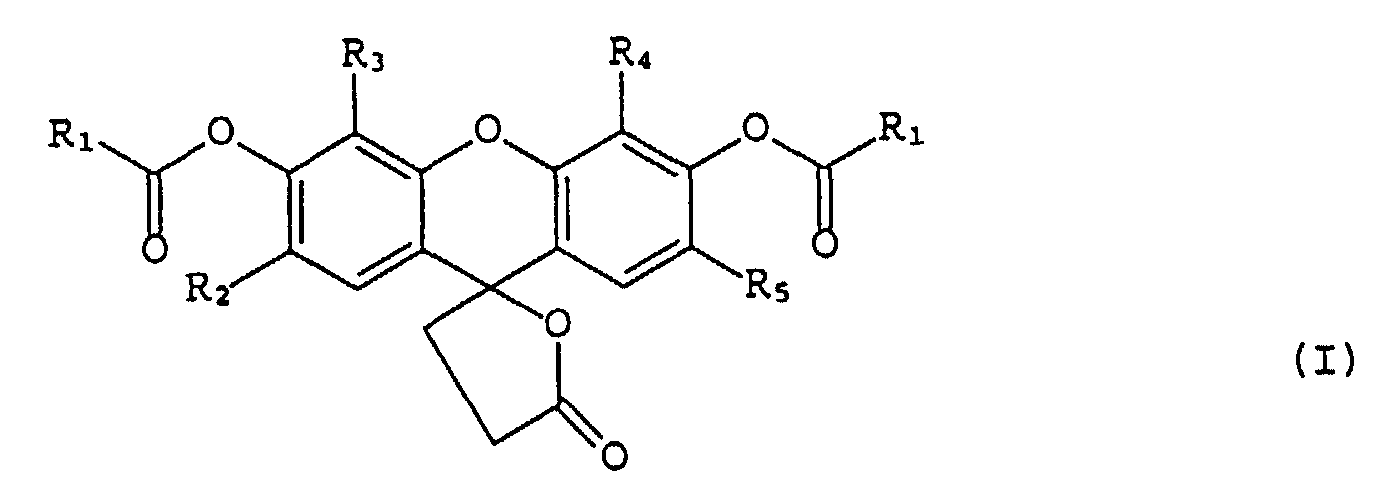
- the present invention includes the use of marker compositions and compositions comprising a liquid petroleum product and a detectable level of marker which is a derivative of 2(3H) Furanone in which the number 5 carbon atom is part of a xanthene system: wherein R 1 is an alkyl group containing from one to eighteen carbon atoms, or an aryl group.
- R 2 , R 3 , R 4 , and R 5 are hydrogen, chlorine, bromine or a C 1 -C 12 alkyl.
- R 1 may be the same or different groups and R 2 -R 5 may be the same or different groups.
- the alkyl groups may be straight or branched.
- the carbon atoms 1 and 2 of the (3H) Furanone ring may be saturated or an ethylenic bond may exist between them.
- the hydrogen atoms attached to these carbon atoms may also be replaced wholly or in part by alkyl groups.
- the number 1 and 2 carbon atoms of the 3(H) Furanone ring may form part of a carbocyclic ring system particularly a benzo ring system.
- a carbocyclic ring system particularly a benzo ring system.
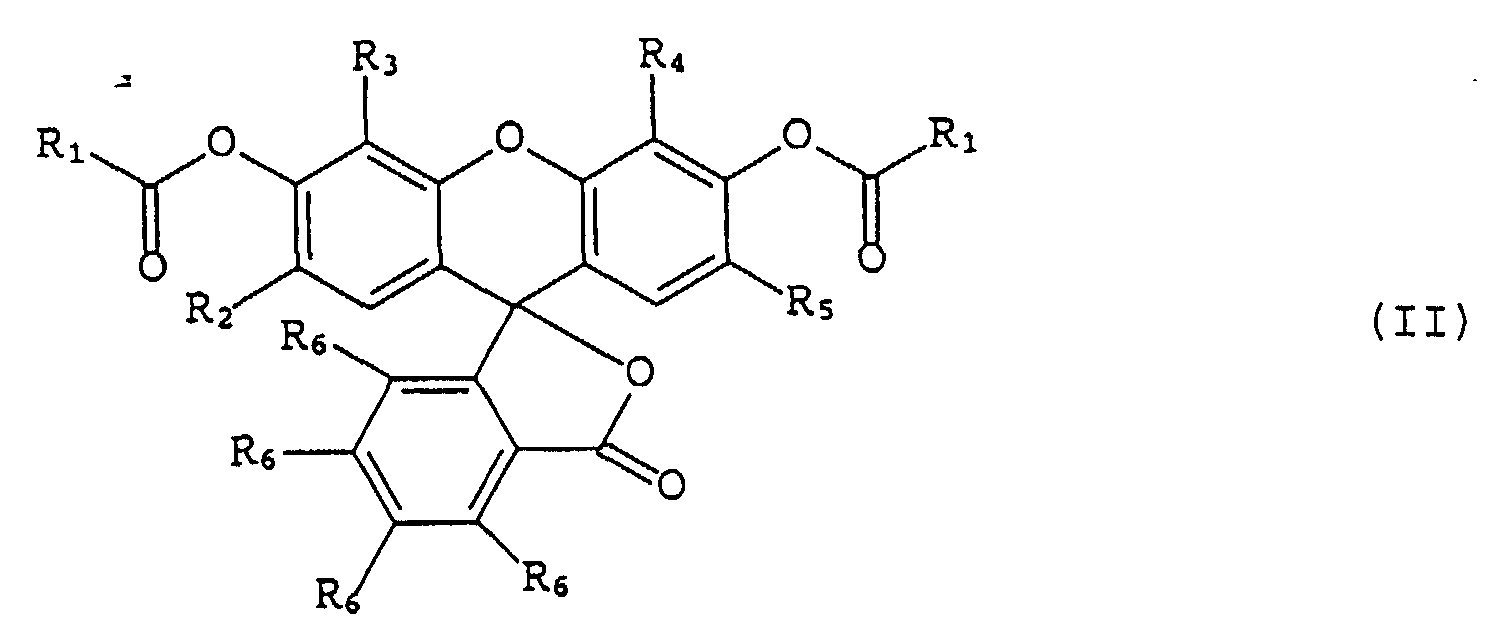
- 3,3 bis substituted derivatives of 1(3H) isobenzofuranone where the number 3 carbon atom forms part of a xanthene system.
- R1-R5 are the same as already described above and R6 is any combination of hydrogen, bromine or chlorine.
- the alkyl group may be straight or branched. When R 1 -R 5 is an alkyl group it will frequently be C 1 -C 4 .
- the present invention also includes a method of marking a liquid petroleum product comprising adding to the liquid petroleum product a detectable level of a marker selected from the group consisting of: or wherein R 1 and R 2 -R 6 are the same as described above.
- the present invention is also a method of identifying a liquid petroleum product comprising, a) obtaining a sample of liquid petroleum product containing a detectable level of a marker described above, b) and adding a developing reagent to the sample to develop fluorescence
- compositions used in the present invention contain organic esters of fluorescent dyestuffs of the hydroxyphthalein subclass of Xanthene dyes, as classified in the "Colour Index", third edition, 1975. These are more commonly referred to as organic esters of fluoroscein (C 20 H 12 O 5 ). Especially preferred are the esters of 3'6' dihydroxy Spiro [isobenzofuran-1(3H), 9'-(9H)xanthene]-3-one, commonly called Fluoroscein, which is symbolized as: where R 1 is an alkyl of 1-18 carbon atoms or an aryl group.
- esters of Fluoroscein where the aromatic ring hydrogen atoms 1',2', 4',5',7' and 8' and 4,5,6,7 are replaced by non-ionizing substituents such as alkyl groups , hydrogen, chlorine or bromine.
- the invention includes the above compounds when R 2 , R 3 , R 4 , and R 5 are hydrogen, chlorine, or bromine or C 1 -C 12 alkyl and R 6 is hydrogen, chlorine or bromine.
- R 1 -R 6 may be the same or different groups and alkyl groups may be straight or branched. For many applications R 2 -R 6 are preferably H and R 1 is preferable C 1 -C 4 alkyl group.
- Markers of the present invention also include chemicals of the following formula: wherein R 1 -R 5 are as described above.
- Fluoroscein itself has been used in the form of its water soluble salts as a marking or tagging substance for both artificial and natural water courses, for examples, so that the course of streams, rivers and sewer lines can be traced. It has also been used as a diagnostic marker in the human vascular system. It is usually considered a tinctorially weak yellow dye and is most valued for its ease of detection, even at very considerable dilution exhibiting strong fluorescence., This fluorescence is observable under natural or appropriate artificial light sources, especially a long-wave ultraviolet, or "black light” lamp. A spectro-fluorimeter can accurately quantify fluoroscein concentrations down to one part per billion (10 -9 grams per milliliter). Fluoroscein is also known for its low toxicity and ready biodegradability.
- Fluoroscein is not itself suitable as a marker for petroleum fuels, however, because it partitions readily between water and petroleum. When fuel containing Fluorscein is in contact with water, as often happens in fuel storage tanks, the compound partitions between the two phases and is rendered useless as a quantitative petroleum marker.
- any tendency to water bleed (partition) can be minimized or eliminated, by use of an esterifying agent.
- the diester may be derived from an organic acid, its anhydride or halide containing from one to eighteen carbon atoms.
- Another advantage of esterification is that the weak yellow color of Fluoroscein itself is diminished to a negligible extent in technical quality products, and can be eliminated entirely in purified material. This renders the presence of the marker substance in the marked fuel invisible to the human eye. The esterification therefore prevents the marker from obscuring coloring agents that may have been added to comply with regulatory requirements or for other reasons.
- the ester markers used in the present invention may be added to any liquid petroleum products such as fuels, lube oils and greases.
- liquid petroleum products of the present invention are gasoline, diesel fuel, fuel oil, Kerosene and lamp oil.
- the ester markers when developed, are detectable visually over a wide range of concentrations but preferably are present at a level of at least about 0.5 ppm or 5 ppm and most preferably at a level of about 0.5 to about 100 ppm.
- the developing reagent preferably contains a strong base such as an alkali metal hydroxide, or more preferably a quaternary ammonium hydroxide.
- the pH of the developing reagent is about 10 to about 14 and preferably about 11 to about 13.
- the base is believed to hydrolyse the esters and prompt formation of a highly fluorescent dianion, which also may be variously colored.
- the fluorescence readily permits visual detection. Providing that only a qualitative indication of the presence of the marker is required, the now-fluorescent "developed" fuel may be returned to its source. In this way, the developing reagent and marker are burned or used up with the product so that no potentially hazardous waste from, say, a roadside test, accumulates for disposal.
- the fluorescent dianion may be rendered visible by extraction from the developed fuel into an extraction medium. This may be accomplished by addition of water alone as an extraction medium to the sample, but use of mixtures of water and a phase separation enhancer such as aliphatic alcohols, glycols, or glycol ethers are preferred. Use of a phase separation enhancer promotes an easier separation of the aqueous and organic phases. Additionally, other substances, for example pH buffer salts, may be present in the extractant phase to stabilize the fluorescent anion.
- Preferred extraction medium mixtures also contain quaternary ammonium hydroxide compounds to provide a simple method of both developing fluorescence by forming the dianion and a suitable medium into which the developed dianion can immediately extract.
- Other strong bases may be used, particularly alkalai metal hydroxides.
- the extracted phase may be examined visually for the brilliant yellow to green fluorescence characteristic of the Fluoroscein derived dianion. At extremely low concentrations (about 1 to about 500 parts per billion) the fluorescence may be rendered more readily visible by irradiation of the extracted dye with long-wave ultraviolet light.
- the extracted marker may be detected and quantified by visible light absorption spectrophotometry or by spectrofluorimetry.
- a further advantage of the extraction technique is that it affords the opportunity to concentrate the marker from the petroleum fuel, thereby increasing the sensitivity of the test procedures.
- the marker compounds used in the present invention may be synthesized by any of a number of conventional methods for estrifying phenolic hydroxy groups. These include direct esterification with acids, reaction with acid halides, especially acid chlorides, and most significantly by reaction with acid anhydrides. In general, the preferred technique is to react the hydroxy xanthene with the acylating agent under aqueous or non aqueous conditions as appropriate to the individual reactants.
- the esters obtained from the lower aliphatic carboxylic acids are relatively high-melting solids and may be isolated as such. Esters of the higher carboxylic acids tend to be low-melting solids or viscous liquids which may be isolated as solutions in an appropriate solvent.
- R 1 is a C 1 -C 18 alkyl group or an aryl group.
- R 1 is C 1 -C 4 in either the normal, or branched chain forms.
- R 2 -R 6 are preferably all hydrogen.
- the presence of halogen atoms in the carbocyclic ring systems may provide different shades of visible color and fluorescence after hydrolysis of the ester. Bromine atoms, for instance, tend to impart a redder shade to the product compared with hydrogen atoms.
- Esters used in the present invention may be produced and used in dry form (usually power, crystals or flakes) or liquid form. Liquid forms are usually preferred for handling reasons. Esters of the present invention may be produced directly and used directly as liquids without addition of solvents. Often, however, it is preferred to combine the marker with a solvent for the marker and which is also itself readily soluble in the petroleum product to be marked. Accordingly, prior to mixing with many petroleum products, the marker may be dissolved, by conventional techniques, in a solvent that has complete compatability with the petroleum products being marked.
- Suitable solvents for use with liquid petroleum products include aromatic hydrocarbons (especially alkyl benzenes, such as xylene, and naphthalenes), aromatic alcohols, especially Benzyl alcohol, and aprotic solvents like formamide, N,N dimethylformamide or 1 methylpyrrollidinone. These solvents may be used singly or advantageously in blends.
- the aprotic solvents are particularly useful as a cosolvent combined with an aromatic or aromatic alcohol solvent.
- a composition comprised of about 0.5-10% by weight marker, about 70-80% by weight aromatic hydrocarbon solvent and about 10-30% by weight aprotic solvent may be particularly useful as a composition that dissolves readily in many liquid petroleum products and is stable in the product; that is, it remains dissolved in the petroleum product for a commercially significant period of time.
- esters of the present invention form stable liquid compositions that dissolve readily into petroleum products.
- the availability of marker compounds as stable, free-flowing liquids makes them much more attractive to the petroleum industry than dry or solid products primarily because liquids are easier to handle. Dry or solid forms of markers, however, could be used.
- Fluoroscein 33.2 grams is added to a stirred 500 ml reaction flask already containing 200 grams of glacial acetic acid and 25 grams of acetic anhydride. 0.3 grams of concentrated sulfuric acid is then added and the flask is stoppered. The contents of the flask are then heated externally until they start to boil. Boiling is continued under reflux until a sample of the flask contents examined by thin layer chromatography indicates that all of the original Fluoroscein is converted to its diacetate ester.
- the contents of the flask are then cooled below the boiling point and added slowly, with good stirring, to 600 mls of cold water.
- the mixture is stirred to hydrolyse unreacted acetic anhydride, after which the product is recovered by filtration on a Buchner funnel, it is washed free from acetic acid with distilled water, then dried to constant weight at 105°C.
- the product is obtained as creamy white crystals in almost quantitative yield.
- the compound has a melting point of 199-203°C.
- the reaction mixture is heated externally to 50-55°C until thin layer chromatography indicates the esterification is complete.
- the two phases are allowed to separate and the lower aqueous phase, containing a mere trace of unreacted fluoroscein, is removed.
- To the remaining upper xylene phase is added 50 grams of 1-methylpyrollidone.
- the contents of the flask are then placed under vacuum and all traces of water, and sufficient xylene, are azeotropically distilled out until the total weight of the reaction mass is 165 grams.
- This almost colorless solution of the dibutyl ester of fluoroscein is filtered and placed in storage. The solution has good resistance to crystallization even when stored for 3 months at 0° Fahrenheit.
- Fluoroscein dibutyrate prepared by the method of example four is dissolved in 50 grams of 1 Methylpyrollidone by gentle heating.
- the filtered solution has excellent storage stability at 0°F.
- 500 milligrams of the solution obtained in example seven is dissolved in toluene and made to 100 mls in a graduated flask. 1.0 ml of this solution is pipetted into 100 mls of premium gasoline (purchased retail), already colored red with 3 parts per million of Unisol Liquid Red B, and contained in a separatory funnel.
- the gasoline sample contains the equivalent of 10 ppm fluoroscein diacetate. as a marker.
- 5 mls of an aqueous solution containing 15% sodium chloride and sufficient potassium hydroxide to raise its pH to 12.0 is now added to the marked gasoline in the separatory funnel. The two phases are shaken together for two to three minutes, then allowed to separate.
- the upper gasoline phase retains its light red appearance but the lower aqueous phase now has a strong green fluorescence.
- This phase may be separated and the quantity of highly fluorescent dye measured by spectrophotometry or spectrofluorimetry.
- the separated solution may require a fivefold or greater dilution with more extractant to bring its absorbence/emission characteristics into the optimum sensitivity range of the measuring instruments.
- a 50 milliliter sample of gasoline marked with 10 parts per million of dibutyrate ester of fluoroscein prepared in accordance with Example 6 has added to it 5 milliliters of a developer composition, which is a 10% solution of tetrabutyl ammonium hydroxide dissolved in diethylene glycol.
- the mixture is shaken for 1 to 2 minutes, when it acquires a dark fluorescent green appearance, clearly visible above the red background color of the gasoline. If only a qualitative detection of the marker in the gasoline is required, the developed, marked gasoline may be returned to the fuel source; thus avoiding a separate potentially hazardous waste disposal problem.
- a quantitative determination of the marker is needed or desired, this can be accomplished by direct spectrophotometry or spectrofluorimetry, depending on the level of background interference from other components in the fuel. Otherwise, a 5 milliliter aliquot of a 10% solution of sodium chloride in distilled water may be added to the developed, marked fuel. When the mixture is shaken together for a short time the fluorescent marker will extract into a lower aqueous phase which may be separated and quantified as in Example 15.
- the quantity of the eosine dye generated may also be quantified by spectrophotometry or spectrofluorimetry.
- the procedure of example thirteen is repeated with the diacetyl ester of 4,5,6,7 tetrachloro 2,4,5,7 tetrabromofluoresceine.
- the hydrolized extracted marker contains the dianion of the dye historically known as Phloxine B. It has a bright cherry-red color with a dark green fluorescence.
Landscapes
- Chemical & Material Sciences (AREA)
- Oil, Petroleum & Natural Gas (AREA)
- Engineering & Computer Science (AREA)
- Chemical Kinetics & Catalysis (AREA)
- General Chemical & Material Sciences (AREA)
- Organic Chemistry (AREA)
- Health & Medical Sciences (AREA)
- Emergency Medicine (AREA)
- Investigating Or Analyzing Non-Biological Materials By The Use Of Chemical Means (AREA)
- Investigating, Analyzing Materials By Fluorescence Or Luminescence (AREA)
- Heterocyclic Carbon Compounds Containing A Hetero Ring Having Oxygen Or Sulfur (AREA)
- Vessels And Coating Films For Discharge Lamps (AREA)
- Electroluminescent Light Sources (AREA)
- Paints Or Removers (AREA)
Claims (22)
- Zusammensetzung, umfassend ein Petroleumprodukt und eine nachweisbare Konzentration eines Markers der allgemeinen Formel:oder
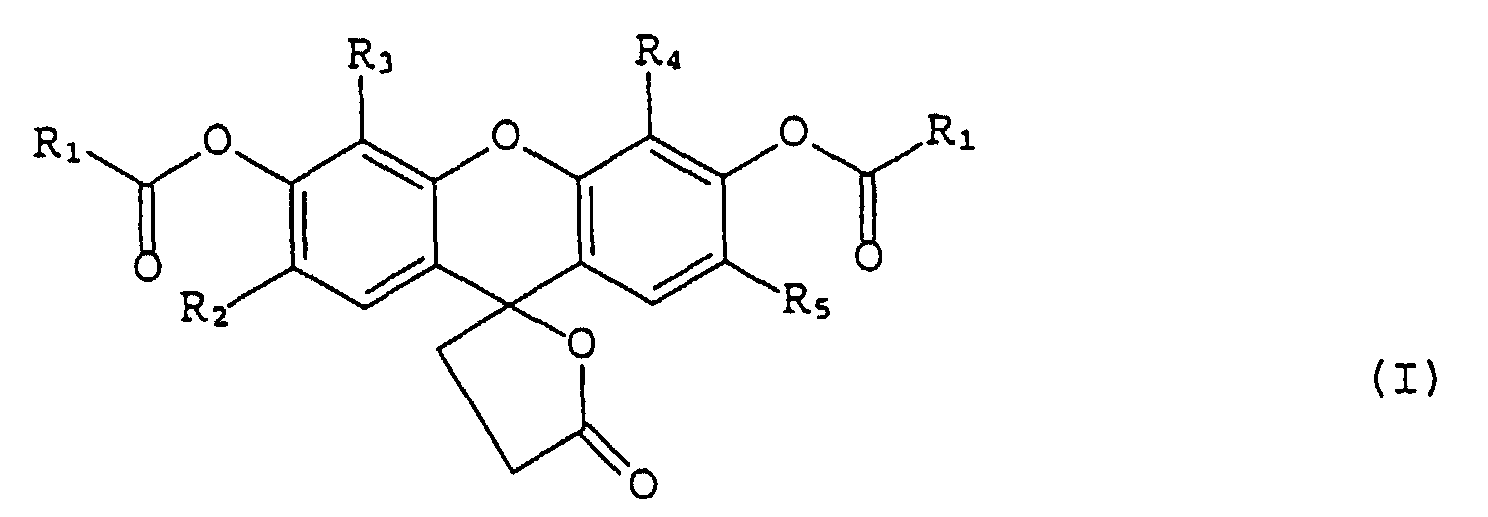 worin R1 jeweils einzeln eine C1-18-Alkylgruppe oder eine Arylgruppe bedeutet;
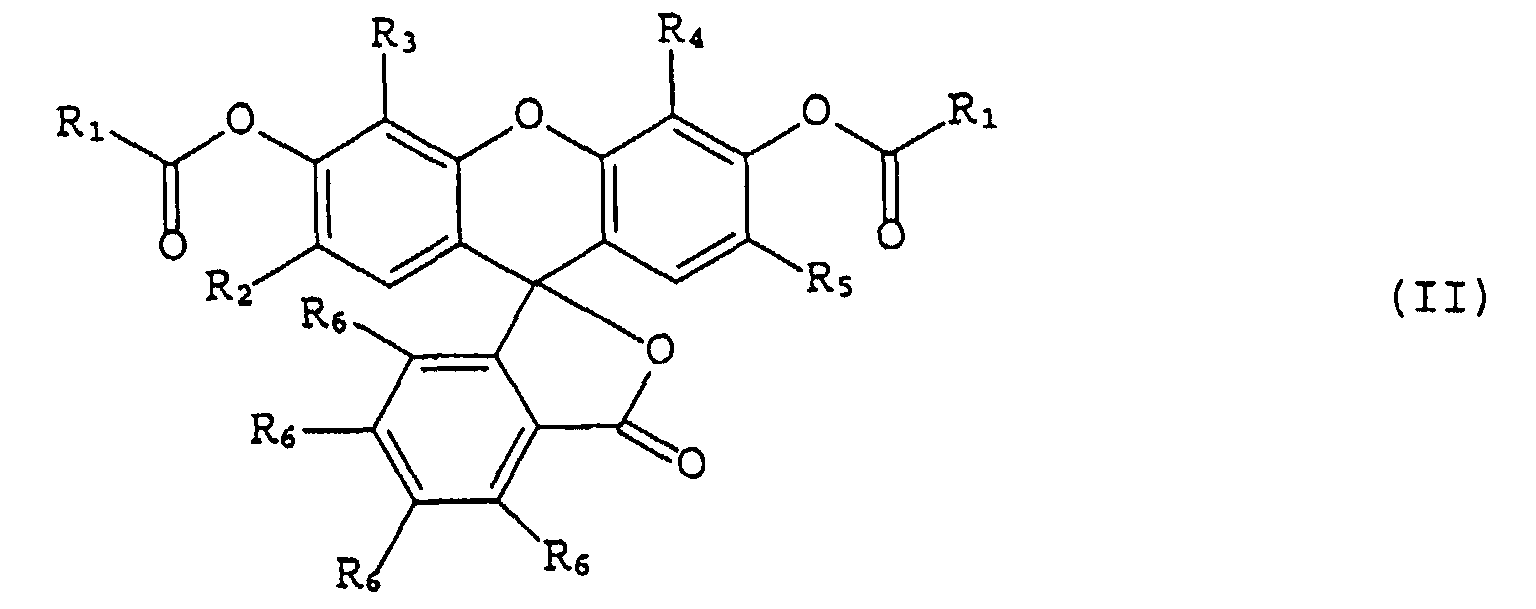 wobei der Marker Farbe oder Fluoreszenz bei Kontakt mit einem Entwicklungsreagens entwickelt, welches den Marker in ein Dianion umwandelt.R2, R3, R4 und R5 jeweils unabhängig ein Wasserstoff-, Chlor- oder Bromatom oder eine C1-12-Alkylgruppe bedeuten; undR6 ein Wasserstoff-, Chlor- oder Bromatom bedeutet;
 - Zusammensetzung gemäß Anspruch 1, wobei der Marker in dem Petroleumprodukt in einer Konzentration von mindestens 0,5 ppm vorliegt.
- Zusammensetzung gemäß Anspruch 1 oder 2, wobei der Marker in einem Anteil von 5 ppm bis 100 ppm vorliegt.
- Zusammensetzung gemäß mindestens einem der vorhergehenden Ansprüche 1 bis 3, wobei R1 eine C1-4-Alkylgruppe bedeutet und/oder alle von R2 bis R6 Wasserstoffatome sind.
- Verfahren zur Markierung eines Petroleumprodukts, wobei das Verfahren die Zugabe zu dem Petroleumprodukt einer nachweisbaren Konzentration eines Markers der allgemeinen Formeloder
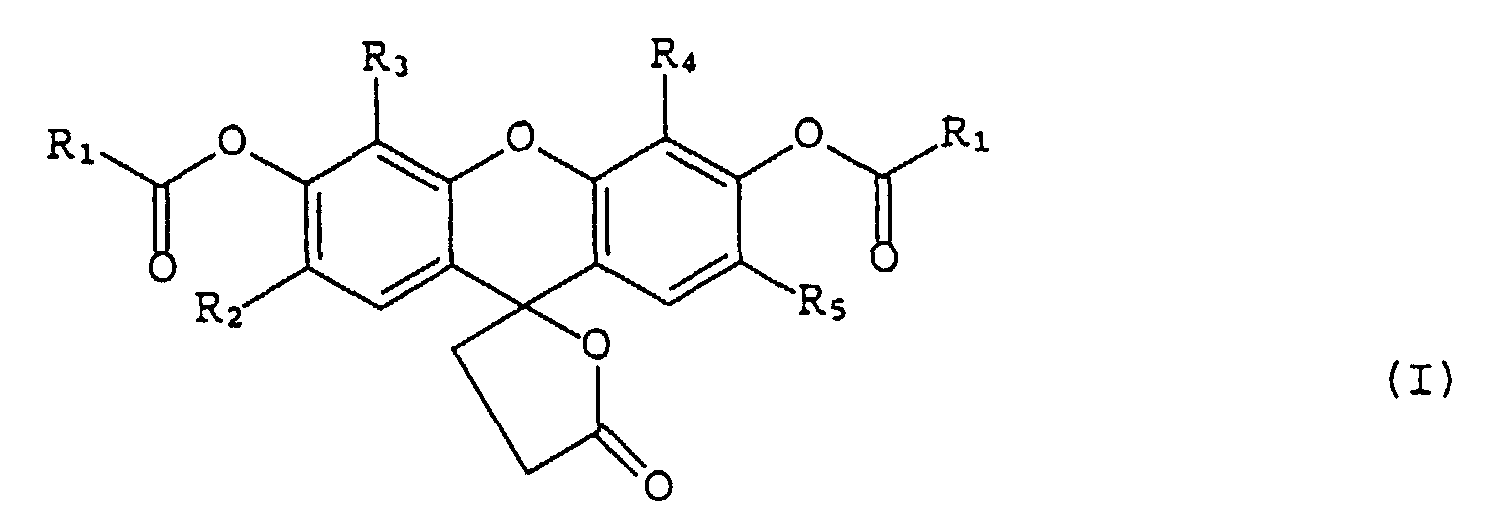 umfaßt, worin jedes R1 einzeln eine C1-18-Alkylgruppe oder eine Arylgruppe bedeutet;
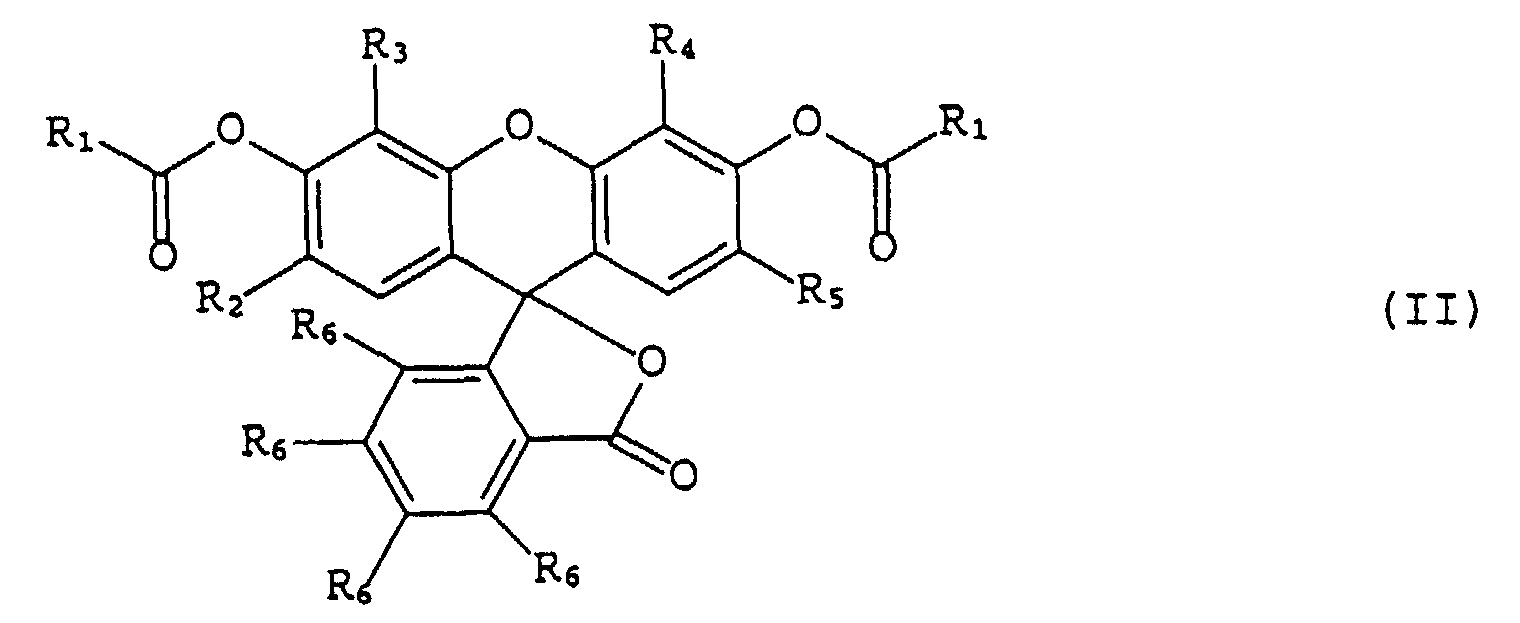 jedes von R2, R3, R4 und R5 unabhängig ein Wasserstoff-, Chlor- oder Bromatom oder eine C1-12-Alkylgruppe bedeutet; undR6 ein Wasserstoff-, Chlor- oder Bromatom bedeutet.
 - Verfahren gemäß Anspruch 5, welches zu einer Zusammensetzung gemäß Anspruch 2 bis 4 führt.
- Verfahren gemäß Anspruch 5 oder 6, wobei der Marker in flüssiger Form vorliegt, wenn er dem Petroleumprodukt zugegeben wird.
- Verfahren zur Identifizierung eines einen Marker enthaltenden Petroleumprodukts, umfassend:a. den Erhalt einer Probe eines Petroleumprodukts, enthaltend eine nachweisbare Konzentration eines Markers der allgemeinen Formel:oder
 worin R1 jeweils einzeln eine C1-18-Alkylgruppe oder eine Arylgruppe bedeutet;
 R2, R3, R4 und R5 jeweils unabhängig ein Wasserstoff-, Chlor- oder Bromatom oder eine C1-12-Alkylgruppe bedeutet;und R6 ein Wasserstoff-, Chlor- oder Bromatom bedeutet; undb. die Zugabe eines Entwicklungsreagens zu der Probe, die bei Kontakt mit dem Marker Farbe und Fluoreszenz entwickelt.
 - Verfahren gemäß Anspruch 8, wobei die Fluoreszenz durch Basenhydrolyse unter Bildung eines fluoreszierenden Dianions entsteht.
- Verfahren gemäß Anspruch 9, wobei das Entwicklungsreagens eine starke Base umfaßt.
- Verfahren gemäß mindestens einem der Ansprüche 8 bis 10, wobei das Entwicklungsreagens einen pH-Wert von 10 bis 14, gegebenenfalls von 11 bis 13 besitzt.
- Verfahren gemäß Anspruch 10 oder 11, wobei die Base einn Alkalimetallhydroxid oder ein quaternäres Ammoniumhydroxid ist.
- Verfahren gemäß mindestens einem der Ansprüche 8 bis 12, wobei ein Extraktionsmedium der Probe zugesetzt wird.
- Verfahren gemäß Anspruch 13, wobei das Extraktionsmedium und das flüssige Petroleumprodukt in einem Verhältnis von 1 bis 17 auf Volumenbasis kombiniert sind.
- Verfahren gemäß Anspruch 13 oder 14, wobei das Extraktionsmedium eine Mischung ist, umfassend Wasser, einen Phasentrennungsverstärker, welcher ein aliphatischer Alkohol, aromatischer Alkohol, Glykol oder Glykolether ist, und gegebenenfalls die starke Base.
- Verfahren zur Identifizierung eines Petroleumprodukts, umfassend:a. den Erhalt einer Probe eines Petroleumprodukts, enthaltend eine nachweisbare Konzentration eines Markers der allgemeinen Formel:oder
 worin R1 jeweils einzeln eine C1-18-Alkylgruppe oder eine Arylgruppe bedeutet;
 R2, R3, R4 und R5 jeweils unabhängig ein Wasserstoff-, Chlor- oder Bromatom oder eine C1-12-Alkylgruppe bedeutet;und R6 ein Wasserstoff-, Chlor- oder Bromatom bedeutet; undb. die Zugabe eines Entwicklungsreagens zu dem Marker; undc. das Extrahieren des Markers in ein Extraktionsmedium.
 - Verwendung als ein Marker für ein flüssiges Petroleumprodukt einer Zusammensetzung, umfassend (a) eine Markerverbindung, die eine Verbindung der allgemeinen Formeloder
 ist, worin R1 jeweils einzeln eine C1-18-Alkylgruppe oder eine Arylgruppe bedeutet;
R2, R3, R4 und R5 jeweils unabhängig ein Wasserstoff-, Chlor- oder Bromatom oder eine C1-12-Alkylgruppe bedeutet; und
(b) mindestens ein gleiches Gewicht eines Lösungsmittels für die Markerverbindung. - Verwendung gemäß Anspruch 17, wobei das Lösungsmittel ein aromatischer Kohlenwasserstoff, ein aromatischer Alkohol oder ein aprotisches Lösungsmittel ist.
- Verwendung gemäß Anspruch 18, wobei die Zusammensetzung, auf Gewichtsbasis, Folgendes umfaßt:0,5 % bis 10 % Marker;70 % bis 80 % aromatischen Kohlenwasserstoff oder aromatisches Alkohollösungsmittel; und10 % bis 30 % aprotisches Lösungsmittel.
- Verwendung gemäß Anspruch 19, wobei das aprotische Lösungsmittel 1-Methylpyrrolidon, N,N-Dimethylformamid oder Formamid ist.
- Verwendung gemäß mindestens einem der Ansprüche 17 bis 20, wobei R1 eine C1-4-Alkylgruppe bedeutet und/oder alle von R2 bis R6 Wasserstoffatome sind.
- Zusammensetzung gemäß mindestens einem der Ansprüche 1 bis 4 oder Anwendung gemäß mindestens einem der Ansprüche 17 bis 21, wobei das Petroleumprodukt Benzin, Dieselkraftstoff, Brennöl bzw. Heizöl, Kerosin oder Lampenöl ist.
Applications Claiming Priority (3)
| Application Number | Priority Date | Filing Date | Title |
|---|---|---|---|
| US08/375,310 US5498808A (en) | 1995-01-20 | 1995-01-20 | Fluorescent petroleum markers |
| US375310 | 1995-01-20 | ||
| PCT/US1995/016775 WO1996022345A1 (en) | 1995-01-20 | 1995-12-22 | Fluorescent petroleum markers |
Publications (2)
| Publication Number | Publication Date |
|---|---|
| EP0804521A1 EP0804521A1 (de) | 1997-11-05 |
| EP0804521B1 true EP0804521B1 (de) | 2000-05-10 |
Family
ID=23480371
Family Applications (1)
| Application Number | Title | Priority Date | Filing Date |
|---|---|---|---|
| EP95944201A Expired - Lifetime EP0804521B1 (de) | 1995-01-20 | 1995-12-22 | Verwendung von fluoreszierenden markierungsmitteln für petroleum- produkte |
Country Status (18)
| Country | Link |
|---|---|
| US (1) | US5498808A (de) |
| EP (1) | EP0804521B1 (de) |
| CN (1) | CN1086729C (de) |
| AR (2) | AR000643A1 (de) |
| AT (1) | ATE192776T1 (de) |
| AU (1) | AU690418B2 (de) |
| BR (1) | BR9510272A (de) |
| CA (1) | CA2210888C (de) |
| CO (1) | CO4560360A1 (de) |
| DE (1) | DE69516906T2 (de) |
| DK (1) | DK0804521T3 (de) |
| ES (1) | ES2145327T3 (de) |
| GR (1) | GR3034049T3 (de) |
| PE (1) | PE44396A1 (de) |
| PT (1) | PT804521E (de) |
| RU (1) | RU2149887C1 (de) |
| WO (1) | WO1996022345A1 (de) |
| ZA (1) | ZA96326B (de) |
Families Citing this family (30)
| Publication number | Priority date | Publication date | Assignee | Title |
|---|---|---|---|---|
| AU710997B2 (en) * | 1995-04-13 | 1999-10-07 | United Color Manufacturing, Inc. | Novel petroleum fuel markers |
| WO1996032461A1 (en) * | 1995-04-13 | 1996-10-17 | United Color Manufacturing, Inc. | Developer system for base reactable petroleum fuel markers |
| ZA962626B (en) * | 1995-04-13 | 1997-10-02 | United Color Mfg Inc | Colorless petroleum markers. |
| US5560855A (en) * | 1995-06-30 | 1996-10-01 | Morton International, Inc. | Method of tagging and subsequently indentifying refrigerant lubricants |
| US5755832A (en) * | 1996-11-07 | 1998-05-26 | Chevron Chemical Company | Fuel additive concentrate containing tagging material |
| US6482651B1 (en) * | 1999-06-30 | 2002-11-19 | United Color Manufacturing, Inc. | Aromatic esters for marking or tagging petroleum products |
| AU2001271103A1 (en) * | 2000-07-12 | 2002-01-21 | Sk Corporation | Silent mark for oil product and detection method thereto |
| KR100710561B1 (ko) * | 2000-07-12 | 2007-04-24 | 에스케이 주식회사 | 유류 제품 은닉 표지 물질 및 이를 검출하는 방법 |
| DE10063955A1 (de) * | 2000-12-20 | 2002-07-04 | Basf Ag | Verfahren zur Markierung von Mineralöl |
| US6808542B2 (en) | 2001-12-26 | 2004-10-26 | American Dye Source, Inc. | Photoluminescent markers and methods for detection of such markers |
| US8486711B2 (en) | 2004-10-22 | 2013-07-16 | Bayer Materialscience Llc | Highly fluorescent markers for fluids or articles |
| JP5363696B2 (ja) * | 2005-03-23 | 2013-12-11 | 株式会社 資生堂 | 肌化粧料用色材組成物、それを用いたファンデーション、化粧方法 |
| KR100645357B1 (ko) * | 2005-08-22 | 2006-11-14 | 심현호 | 이중결합 에스테르기를 갖는 형광표지물질, 이를 표지 및 검출하는 방법 |
| US7706700B2 (en) * | 2007-03-21 | 2010-04-27 | Xerox Corporation | System and method for authenticating an electrostatographic material in an image forming apparatus |
| US7715733B2 (en) | 2007-03-21 | 2010-05-11 | Xerox Corporation | System and method for authenticating a fuser lubricant in an image forming apparatus |
| US7495214B2 (en) | 2007-03-21 | 2009-02-24 | Xerox Corporation | Systems and methods for material authentication |
| RU2368645C2 (ru) * | 2007-09-27 | 2009-09-27 | Государственное образовательное учреждение высшего профессионального образования "Казанский государственный университет им. В.И. Ульянова-Ленина" (ГОУ ВПО КГУ) | Способ идентификации маркированных нефтепродуктов |
| US8932863B2 (en) * | 2011-12-15 | 2015-01-13 | Uop Llc | Methods for evaluating fuel compositions |
| KR101418763B1 (ko) * | 2012-09-26 | 2014-07-11 | 오리엔트화학 (주) | 유류 식별용 마커 및 이를 이용한 유류 식별 방법 |
| US20140154813A1 (en) | 2012-11-30 | 2014-06-05 | Sicpa Holding Sa | Marking of material, marked material and process of authentication or dilution determination |
| WO2015173610A1 (en) | 2014-05-16 | 2015-11-19 | Tubitak (Turkiye Bilimsel Ve Teknolojik Arastirma Kurumu) | An optical system for on-line measurement of marker(s) in liquids and gases |
| RU2574021C1 (ru) * | 2014-10-28 | 2016-01-27 | Общество с ограниченной ответственностью "ВОРМХОЛС Внедрение" | Флюоресцирующий индикатор для маркировки нефти и нефтепродуктов и способ маркировки нефти и нефтепродуктов |
| FR3046611B1 (fr) | 2016-01-12 | 2019-10-25 | Inoventeam | Utilisation de complexes de terres rares comme marqueurs de produits petroliers, de petroles bruts, de biocarburants ou de lubrifiants |
| CN109923412B (zh) | 2016-08-24 | 2021-06-29 | 联合色彩制造股份有限公司 | 标记物组合物及其制造和使用方法 |
| RU2768549C2 (ru) | 2017-08-23 | 2022-03-24 | Юнайтед Колор Мэньюфэкчеринг Инк. | Маркирующие композиции с соединениями азота и способы их получения и применения |
| CN111902520B (zh) * | 2018-04-05 | 2022-11-22 | 陶氏环球技术有限责任公司 | 作为燃料标记物的呫吨 |
| CN111454756B (zh) * | 2019-01-18 | 2021-05-28 | 天津大学 | D-a型有机掺杂晶体余辉材料在油中的应用 |
| US12169192B2 (en) | 2020-11-02 | 2024-12-17 | Afton Chemical Corporation | Methods of identifying a hydrocarbon fuel |
| WO2022161960A1 (en) | 2021-01-29 | 2022-08-04 | Basf Se | A method of marking fuels |
| US20240219366A1 (en) | 2021-04-20 | 2024-07-04 | Basf Se | A method of detecting one or more markers in a petroleum fuel using a photoacoustic detector |
Family Cites Families (19)
| Publication number | Priority date | Publication date | Assignee | Title |
|---|---|---|---|---|
| GB361310A (en) * | 1930-06-18 | 1931-11-18 | Howard Ferguson | Improvements in and relating to motor fuels or like combustible liquids |
| US2046365A (en) * | 1932-02-24 | 1936-07-07 | Wilmot And Cassidy Inc | Process of testing petroleum hydrocarbons |
| US1997670A (en) * | 1932-06-21 | 1935-04-16 | George L Armour | Method of and means for identifying brands of liquid hydrocarbons |
| US2063575A (en) * | 1934-03-31 | 1936-12-08 | Standard Oil Co | Dispersing of phenolphthalein in mineral lubricating oils |
| US3704106A (en) * | 1967-10-24 | 1972-11-28 | Morton Int Inc | Colored petroleum distillate |
| US3764273A (en) * | 1971-06-14 | 1973-10-09 | Morton Norwich Products Inc | Novel marker for water immiscible organic liquids and method of marking same |
| US3883568A (en) * | 1971-06-14 | 1975-05-13 | Morton Norwich Products Inc | 2-(2{40 ethylhexyl)-quinizarin |
| DE2238174C3 (de) * | 1972-08-03 | 1975-08-14 | Basf Ag, 6700 Ludwigshafen | Konzentrierte Lösungen eines Mittels zur Kennzeichnung von Mineralöl |
| DE2906773C3 (de) * | 1979-02-21 | 1981-09-10 | Danninger, Heinz, 8000 München | Reagens zur Bestimmung von ungelöstem Wasser in Kohlenwasserstoffgemsichen |
| US4209302A (en) * | 1979-05-10 | 1980-06-24 | Morton-Norwich Products, Inc. | Marker for petroleum fuels |
| US4514503A (en) * | 1982-09-01 | 1985-04-30 | Morton Norwich Products | Reagent and process for detecting furfural in petroleum products |
| US4764474A (en) * | 1983-12-16 | 1988-08-16 | Morton Thiokol, Inc. | Method for detecting a tagging compound |
| US4735631A (en) * | 1983-12-16 | 1988-04-05 | Morton Thiokol, Inc. | Colored petroleum markers |
| DE3627461A1 (de) * | 1986-08-13 | 1988-02-25 | Basf Ag | Farbstoffmischungen |
| US4764290A (en) * | 1987-02-02 | 1988-08-16 | National Identification Laboratories, Inc. | Identification marking of oils |
| US4918020A (en) * | 1989-03-21 | 1990-04-17 | Atlantic Richfield Company | Analyzing marker dyes in liquid hydrocarbon fuels |
| DE4001662A1 (de) * | 1990-01-22 | 1991-07-25 | Basf Ag | Markierte mineraloele sowie verfahren zum markieren von mineraloelen mittels basischer farbstoffe |
| US5156653A (en) * | 1991-04-18 | 1992-10-20 | Morton International, Inc. | Silent markers for petroleum, method of tagging, and method of detection |
| US5205840A (en) * | 1991-09-30 | 1993-04-27 | Morton International, Inc. | Markers for petroleum, method of tagging, and method of detection |
-
1995
- 1995-01-20 US US08/375,310 patent/US5498808A/en not_active Expired - Lifetime
- 1995-12-22 DK DK95944201T patent/DK0804521T3/da active
- 1995-12-22 PT PT95944201T patent/PT804521E/pt unknown
- 1995-12-22 CN CN95197781A patent/CN1086729C/zh not_active Expired - Fee Related
- 1995-12-22 ES ES95944201T patent/ES2145327T3/es not_active Expired - Lifetime
- 1995-12-22 EP EP95944201A patent/EP0804521B1/de not_active Expired - Lifetime
- 1995-12-22 AT AT95944201T patent/ATE192776T1/de active
- 1995-12-22 CA CA002210888A patent/CA2210888C/en not_active Expired - Fee Related
- 1995-12-22 AU AU46065/96A patent/AU690418B2/en not_active Ceased
- 1995-12-22 WO PCT/US1995/016775 patent/WO1996022345A1/en not_active Ceased
- 1995-12-22 BR BR9510272A patent/BR9510272A/pt not_active IP Right Cessation
- 1995-12-22 DE DE69516906T patent/DE69516906T2/de not_active Expired - Lifetime
- 1995-12-22 RU RU97114188A patent/RU2149887C1/ru not_active IP Right Cessation
-
1996
- 1996-01-09 AR AR33496096A patent/AR000643A1/es unknown
- 1996-01-16 ZA ZA96326A patent/ZA96326B/xx unknown
- 1996-01-18 CO CO96001846A patent/CO4560360A1/es unknown
- 1996-01-19 PE PE1996000041A patent/PE44396A1/es not_active Application Discontinuation
-
2000
- 2000-02-29 AR ARP000100892A patent/AR022794A2/es active IP Right Grant
- 2000-07-28 GR GR20000401741T patent/GR3034049T3/el not_active IP Right Cessation
Also Published As
| Publication number | Publication date |
|---|---|
| AU690418B2 (en) | 1998-04-23 |
| AR022794A2 (es) | 2002-09-04 |
| WO1996022345A1 (en) | 1996-07-25 |
| AU4606596A (en) | 1996-08-07 |
| HK1009148A1 (en) | 1999-09-03 |
| CA2210888C (en) | 2005-02-22 |
| PT804521E (pt) | 2000-08-31 |
| CN1177973A (zh) | 1998-04-01 |
| ZA96326B (en) | 1996-07-24 |
| MX9705483A (es) | 1998-07-31 |
| DK0804521T3 (da) | 2000-08-28 |
| EP0804521A1 (de) | 1997-11-05 |
| CO4560360A1 (es) | 1998-02-10 |
| ES2145327T3 (es) | 2000-07-01 |
| AR000643A1 (es) | 1997-07-10 |
| US5498808A (en) | 1996-03-12 |
| PE44396A1 (es) | 1996-10-15 |
| GR3034049T3 (en) | 2000-11-30 |
| BR9510272A (pt) | 1997-11-04 |
| RU2149887C1 (ru) | 2000-05-27 |
| CN1086729C (zh) | 2002-06-26 |
| CA2210888A1 (en) | 1996-07-25 |
| DE69516906T2 (de) | 2000-12-07 |
| ATE192776T1 (de) | 2000-05-15 |
| DE69516906D1 (de) | 2000-06-15 |
Similar Documents
| Publication | Publication Date | Title |
|---|---|---|
| US5498808A (en) | Fluorescent petroleum markers | |
| CA2218323C (en) | Colorless petroleum markers | |
| CA2377300C (en) | Aromatic esters for marking or tagging organic products | |
| US5672182A (en) | Developer system for base reactable petroleum fuel markers | |
| WO2008073298A2 (en) | Mixtures of aromatic esters for marking or tagging organic products, marker compositions comprising the same and manufacturing methods thereof | |
| AU2012201141B2 (en) | Aromatic esters for marking or tagging petroleum products | |
| MXPA97005483A (en) | Developers of petroleo fluorescen | |
| AU710997B2 (en) | Novel petroleum fuel markers | |
| HK1009148B (en) | Fluorescent petroleum markers |
Legal Events
| Date | Code | Title | Description |
|---|---|---|---|
| PUAI | Public reference made under article 153(3) epc to a published international application that has entered the european phase |
Free format text: ORIGINAL CODE: 0009012 |
|
| 17P | Request for examination filed |
Effective date: 19970811 |
|
| AK | Designated contracting states |
Kind code of ref document: A1 Designated state(s): AT BE CH DE DK ES FR GB GR IE IT LI LU MC NL PT SE |
|
| 17Q | First examination report despatched |
Effective date: 19980811 |
|
| GRAG | Despatch of communication of intention to grant |
Free format text: ORIGINAL CODE: EPIDOS AGRA |
|
| RIC1 | Information provided on ipc code assigned before grant |
Free format text: 6C 10L 1/00 A, 6C 10M 171/00 B, 6C 10L 1/18 B |
|
| RTI1 | Title (correction) |
Free format text: USE OF FLUORESCENT MARKERS FOR PETROLEUM PRODUCTS |
|
| GRAG | Despatch of communication of intention to grant |
Free format text: ORIGINAL CODE: EPIDOS AGRA |
|
| GRAH | Despatch of communication of intention to grant a patent |
Free format text: ORIGINAL CODE: EPIDOS IGRA |
|
| GRAH | Despatch of communication of intention to grant a patent |
Free format text: ORIGINAL CODE: EPIDOS IGRA |
|
| GRAA | (expected) grant |
Free format text: ORIGINAL CODE: 0009210 |
|
| AK | Designated contracting states |
Kind code of ref document: B1 Designated state(s): AT BE CH DE DK ES FR GB GR IE IT LI LU MC NL PT SE |
|
| REF | Corresponds to: |
Ref document number: 192776 Country of ref document: AT Date of ref document: 20000515 Kind code of ref document: T |
|
| REG | Reference to a national code |
Ref country code: CH Ref legal event code: NV Representative=s name: R. A. EGLI & CO. PATENTANWAELTE Ref country code: CH Ref legal event code: EP |
|
| ITF | It: translation for a ep patent filed | ||
| REG | Reference to a national code |
Ref country code: IE Ref legal event code: FG4D |
|
| REF | Corresponds to: |
Ref document number: 69516906 Country of ref document: DE Date of ref document: 20000615 |
|
| ET | Fr: translation filed | ||
| REG | Reference to a national code |
Ref country code: ES Ref legal event code: FG2A Ref document number: 2145327 Country of ref document: ES Kind code of ref document: T3 |
|
| RAP2 | Party data changed (patent owner data changed or rights of a patent transferred) |
Owner name: UNITED COLOR MANUFACTURING INC. |
|
| REG | Reference to a national code |
Ref country code: DK Ref legal event code: T3 |
|
| REG | Reference to a national code |
Ref country code: PT Ref legal event code: SC4A Free format text: AVAILABILITY OF NATIONAL TRANSLATION Effective date: 20000525 |
|
| NLT2 | Nl: modifications (of names), taken from the european patent patent bulletin |
Owner name: UNITED COLOR MANUFACTURING INC. |
|
| REG | Reference to a national code |
Ref country code: PT Ref legal event code: TE4A Free format text: UNITED COLOR MANUFACTURING INC. US Effective date: 20000818 |
|
| PGFP | Annual fee paid to national office [announced via postgrant information from national office to epo] |
Ref country code: SE Payment date: 20001220 Year of fee payment: 6 |
|
| PGFP | Annual fee paid to national office [announced via postgrant information from national office to epo] |
Ref country code: AT Payment date: 20001221 Year of fee payment: 6 |
|
| PGFP | Annual fee paid to national office [announced via postgrant information from national office to epo] |
Ref country code: CH Payment date: 20001222 Year of fee payment: 6 |
|
| PGFP | Annual fee paid to national office [announced via postgrant information from national office to epo] |
Ref country code: MC Payment date: 20001227 Year of fee payment: 6 |
|
| PGFP | Annual fee paid to national office [announced via postgrant information from national office to epo] |
Ref country code: PT Payment date: 20001229 Year of fee payment: 6 Ref country code: GR Payment date: 20001229 Year of fee payment: 6 |
|
| BECA | Be: change of holder's address |
Free format text: 20000510 *UNITED COLOR MFG INC.:660 NEWTOWN-YARDLEY ROAD SUITE 205, NEWTOWN PENNSYLVANIA 18940 |
|
| PGFP | Annual fee paid to national office [announced via postgrant information from national office to epo] |
Ref country code: LU Payment date: 20010102 Year of fee payment: 6 Ref country code: DK Payment date: 20010102 Year of fee payment: 6 |
|
| PGFP | Annual fee paid to national office [announced via postgrant information from national office to epo] |
Ref country code: BE Payment date: 20010123 Year of fee payment: 6 |
|
| PLBE | No opposition filed within time limit |
Free format text: ORIGINAL CODE: 0009261 |
|
| STAA | Information on the status of an ep patent application or granted ep patent |
Free format text: STATUS: NO OPPOSITION FILED WITHIN TIME LIMIT |
|
| 26N | No opposition filed | ||
| PG25 | Lapsed in a contracting state [announced via postgrant information from national office to epo] |
Ref country code: MC Free format text: LAPSE BECAUSE OF NON-PAYMENT OF DUE FEES Effective date: 20011222 Ref country code: LU Free format text: LAPSE BECAUSE OF NON-PAYMENT OF DUE FEES Effective date: 20011222 Ref country code: DK Free format text: LAPSE BECAUSE OF NON-PAYMENT OF DUE FEES Effective date: 20011222 Ref country code: AT Free format text: LAPSE BECAUSE OF NON-PAYMENT OF DUE FEES Effective date: 20011222 |
|
| PG25 | Lapsed in a contracting state [announced via postgrant information from national office to epo] |
Ref country code: SE Free format text: LAPSE BECAUSE OF NON-PAYMENT OF DUE FEES Effective date: 20011223 |
|
| PG25 | Lapsed in a contracting state [announced via postgrant information from national office to epo] |
Ref country code: LI Free format text: LAPSE BECAUSE OF NON-PAYMENT OF DUE FEES Effective date: 20011231 Ref country code: CH Free format text: LAPSE BECAUSE OF NON-PAYMENT OF DUE FEES Effective date: 20011231 Ref country code: BE Free format text: LAPSE BECAUSE OF NON-PAYMENT OF DUE FEES Effective date: 20011231 |
|
| REG | Reference to a national code |
Ref country code: GB Ref legal event code: IF02 |
|
| BERE | Be: lapsed |
Owner name: UNITED COLOR MFG INC. Effective date: 20011231 |
|
| PG25 | Lapsed in a contracting state [announced via postgrant information from national office to epo] |
Ref country code: PT Free format text: LAPSE BECAUSE OF NON-PAYMENT OF DUE FEES Effective date: 20020630 |
|
| PG25 | Lapsed in a contracting state [announced via postgrant information from national office to epo] |
Ref country code: GR Free format text: LAPSE BECAUSE OF NON-PAYMENT OF DUE FEES Effective date: 20020708 |
|
| EUG | Se: european patent has lapsed |
Ref document number: 95944201.3 |
|
| REG | Reference to a national code |
Ref country code: CH Ref legal event code: PL |
|
| REG | Reference to a national code |
Ref country code: DK Ref legal event code: EBP |
|
| REG | Reference to a national code |
Ref country code: PT Ref legal event code: MM4A Free format text: LAPSE DUE TO NON-PAYMENT OF FEES Effective date: 20020630 |
|
| PGFP | Annual fee paid to national office [announced via postgrant information from national office to epo] |
Ref country code: FR Payment date: 20061220 Year of fee payment: 12 |
|
| PGFP | Annual fee paid to national office [announced via postgrant information from national office to epo] |
Ref country code: NL Payment date: 20061221 Year of fee payment: 12 |
|
| PGFP | Annual fee paid to national office [announced via postgrant information from national office to epo] |
Ref country code: ES Payment date: 20061226 Year of fee payment: 12 |
|
| PGFP | Annual fee paid to national office [announced via postgrant information from national office to epo] |
Ref country code: IE Payment date: 20061229 Year of fee payment: 12 |
|
| PGFP | Annual fee paid to national office [announced via postgrant information from national office to epo] |
Ref country code: IT Payment date: 20061231 Year of fee payment: 12 |
|
| NLV4 | Nl: lapsed or anulled due to non-payment of the annual fee |
Effective date: 20080701 |
|
| REG | Reference to a national code |
Ref country code: IE Ref legal event code: MM4A |
|
| PG25 | Lapsed in a contracting state [announced via postgrant information from national office to epo] |
Ref country code: IE Free format text: LAPSE BECAUSE OF NON-PAYMENT OF DUE FEES Effective date: 20071224 |
|
| REG | Reference to a national code |
Ref country code: FR Ref legal event code: ST Effective date: 20081020 |
|
| PG25 | Lapsed in a contracting state [announced via postgrant information from national office to epo] |
Ref country code: NL Free format text: LAPSE BECAUSE OF NON-PAYMENT OF DUE FEES Effective date: 20080701 |
|
| REG | Reference to a national code |
Ref country code: ES Ref legal event code: FD2A Effective date: 20071224 |
|
| PG25 | Lapsed in a contracting state [announced via postgrant information from national office to epo] |
Ref country code: FR Free format text: LAPSE BECAUSE OF NON-PAYMENT OF DUE FEES Effective date: 20071231 Ref country code: ES Free format text: LAPSE BECAUSE OF NON-PAYMENT OF DUE FEES Effective date: 20071224 |
|
| PG25 | Lapsed in a contracting state [announced via postgrant information from national office to epo] |
Ref country code: IT Free format text: LAPSE BECAUSE OF NON-PAYMENT OF DUE FEES Effective date: 20071222 |
|
| PGFP | Annual fee paid to national office [announced via postgrant information from national office to epo] |
Ref country code: GB Payment date: 20131227 Year of fee payment: 19 Ref country code: DE Payment date: 20131230 Year of fee payment: 19 |
|
| REG | Reference to a national code |
Ref country code: DE Ref legal event code: R119 Ref document number: 69516906 Country of ref document: DE |
|
| GBPC | Gb: european patent ceased through non-payment of renewal fee |
Effective date: 20141222 |
|
| PG25 | Lapsed in a contracting state [announced via postgrant information from national office to epo] |
Ref country code: DE Free format text: LAPSE BECAUSE OF NON-PAYMENT OF DUE FEES Effective date: 20150701 Ref country code: GB Free format text: LAPSE BECAUSE OF NON-PAYMENT OF DUE FEES Effective date: 20141222 |