EP0805123B1 - Procédé et dispositif pour la fusion du verre - Google Patents
Procédé et dispositif pour la fusion du verre Download PDFInfo
- Publication number
- EP0805123B1 EP0805123B1 EP96400933A EP96400933A EP0805123B1 EP 0805123 B1 EP0805123 B1 EP 0805123B1 EP 96400933 A EP96400933 A EP 96400933A EP 96400933 A EP96400933 A EP 96400933A EP 0805123 B1 EP0805123 B1 EP 0805123B1
- Authority
- EP
- European Patent Office
- Prior art keywords
- oxygen
- melting
- compartment
- burner
- furnace
- Prior art date
- Legal status (The legal status is an assumption and is not a legal conclusion. Google has not performed a legal analysis and makes no representation as to the accuracy of the status listed.)
- Expired - Lifetime
Links
Images

Classifications
-
- C—CHEMISTRY; METALLURGY
- C03—GLASS; MINERAL OR SLAG WOOL
- C03B—MANUFACTURE, SHAPING, OR SUPPLEMENTARY PROCESSES
- C03B5/00—Melting in furnaces; Furnaces so far as specially adapted for glass manufacture
- C03B5/16—Special features of the melting process; Auxiliary means specially adapted for glass-melting furnaces
- C03B5/235—Heating the glass
-
- C—CHEMISTRY; METALLURGY
- C03—GLASS; MINERAL OR SLAG WOOL
- C03B—MANUFACTURE, SHAPING, OR SUPPLEMENTARY PROCESSES
- C03B5/00—Melting in furnaces; Furnaces so far as specially adapted for glass manufacture
- C03B5/16—Special features of the melting process; Auxiliary means specially adapted for glass-melting furnaces
- C03B5/235—Heating the glass
- C03B5/2353—Heating the glass by combustion with pure oxygen or oxygen-enriched air, e.g. using oxy-fuel burners or oxygen lances
-
- Y—GENERAL TAGGING OF NEW TECHNOLOGICAL DEVELOPMENTS; GENERAL TAGGING OF CROSS-SECTIONAL TECHNOLOGIES SPANNING OVER SEVERAL SECTIONS OF THE IPC; TECHNICAL SUBJECTS COVERED BY FORMER USPC CROSS-REFERENCE ART COLLECTIONS [XRACs] AND DIGESTS
- Y02—TECHNOLOGIES OR APPLICATIONS FOR MITIGATION OR ADAPTATION AGAINST CLIMATE CHANGE
- Y02P—CLIMATE CHANGE MITIGATION TECHNOLOGIES IN THE PRODUCTION OR PROCESSING OF GOODS
- Y02P40/00—Technologies relating to the processing of minerals
- Y02P40/50—Glass production, e.g. reusing waste heat during processing or shaping
-
- Y—GENERAL TAGGING OF NEW TECHNOLOGICAL DEVELOPMENTS; GENERAL TAGGING OF CROSS-SECTIONAL TECHNOLOGIES SPANNING OVER SEVERAL SECTIONS OF THE IPC; TECHNICAL SUBJECTS COVERED BY FORMER USPC CROSS-REFERENCE ART COLLECTIONS [XRACs] AND DIGESTS
- Y02—TECHNOLOGIES OR APPLICATIONS FOR MITIGATION OR ADAPTATION AGAINST CLIMATE CHANGE
- Y02P—CLIMATE CHANGE MITIGATION TECHNOLOGIES IN THE PRODUCTION OR PROCESSING OF GOODS
- Y02P40/00—Technologies relating to the processing of minerals
- Y02P40/50—Glass production, e.g. reusing waste heat during processing or shaping
- Y02P40/57—Improving the yield, e-g- reduction of reject rates
Definitions
- the invention relates to a method and a device for the fusion of glass from vitrifiable materials, a device more commonly called melting furnace, with a view to continuously supplying molten glass to the forming facilities, either flat glass as rolling or float, either hollow glass or goblet making as a plurality of forming machines, either glass for insulation (wool glass, rock wool), either glass for reinforcing fibers or still special glass for television screens or the like.
- the invention relates to all types of melting furnaces, involving production capacities in molten glass which can be quantified by example by pulling from 10 tonnes / day up to 1000 tonnes / day and more.
- This type of oven is usually composed, in a known manner, a succession of compartments opening into each other and each having specific functions and dimensions.
- the oven must indeed be able to melt vitrifiable materials and guarantee homogeneity chemical and thermal of the glass once melted.
- the ovens can be classified into two main categories according to the heating means adopted to melt the batch materials in the melting compartment:
- regenerators also known from US-A-4,599,100.
- heating power is provided by two rows of burners generally operating with a fuel / air mixture, and alternately; the combustion gases then alternately heat either of the two regenerators placed opposite each side of the compartment and in communication with it.
- Combustion gases thermally depleted through stacks of refractories which constitute these regenerators, refractory then returning the heat thus stored in the melting compartment.
- This heating mode is effective and widely used, although it is not without some inherent disadvantages. So the energy cost of the burners fuel / air is relatively high.
- the operating system burners which are "activated" alternately with cycles of the order of 15 to 60 minutes is not the easiest to rigorously control and can cause discontinuity in continuous manufacturing and the temperature balance is affected. Their use leads to in addition to introducing a significant amount into the melting compartment air, therefore nitrogen, hence an increased risk of forming a quantity certain polluting gases type NOx which must then be treated.
- regenerators In addition, the large quantity of special and expensive refractories necessary for the manufacture of regenerators increases the cost of material significant construction cost of the furnace.
- the object of the invention is therefore to overcome the drawbacks associated with the use of flame ovens, by proposing a new type of heater by flames which greatly reduces the energy cost and the cost in furnace building materials, which simplifies its mode of while ensuring that a molten glass is obtained from a quality at least as high.
- Another object of the invention is to reduce the wear of refractories constituting the walls of the oven and thus increase the duration of the oven.
- WO-A-9406723 describes a method and a glass melting furnace that fuel and oxidizer are injected into it separately. This document does not teach anything about the distribution of proportions of the fluids injected and the relative height of the injections of fuel and oxidizer relative to the surface of the glass. The objective in this document is to obtain a flame "by cloud ”in the center of the oven.
- EP-A-0498937 describes a furnace for melting flame glass with separate oxygen supplies to the flame.
- EP-A-0601274 teaches a combustion process using two different oxidants; the first oxidant is air which is mixed with fuel to form a flame. The second oxidant has a higher oxygen concentration than the first and it is introduced near the flame.
- WO-A-9004571 teaches a set of heaters for fusion glass including an air burner and an oxygen lance located below the burner level.
- upstream and downstream are in reference to the overall direction of flow of the molten glass or through the oven.
- melting compartment is meant both the the melting / refining compartment.
- a heating mode combining oxygen burners and lances providing at least 50% of oxygen in a separate way indeed presents a whole series advantages over more conventional burners, operating in particular with an air type oxidizer, or even with respect to oxygen burners supplied with oxygen in stoichiometric quantity.
- this type of burner is significantly higher than that of conventional burners operating with an air type oxidizer, due to the absence of nitrogen which decreases considerably the volume of smoke generated. We thus obtain overall significant energy cost reductions, and this type of burners also allows for significant increases of the specific oven draw.
- the oxygen burners allow to introduce into the melting compartment a much smaller volume of gas, and likewise the volume of gas resulting from combustion is also greatly decreased as already mentioned. This means that we can consider reducing the volume said "laboratory" previously mentioned, in particular for example in lowering the arch of the melting compartment a little, which again tends to reduce both the energy cost and the cost of building the oven itself.
- the flame temperature obtained at the burner output is higher than the flame temperature using air as an oxidizer. Then there can be a rapid deterioration of the refractories constituting the walls of the furnace, especially around the burners' noses.
- the melting of batch materials in a melting compartment with a view to continuously supply molten glass to the forming facilities of the glass, in which the melting of vitrifiable materials is ensured for essentially by the combustion of a mixture of fuel and / or gas with essentially pure oxygen, the supply of fuel and / or gas in the melting compartment taking place at at least one point with a default oxygen relative to the stoichiometric amounts. at least 50% of the oxygen corresponding to the total combustion being supplied so separated into at least one different end point.
- This supply of at least 50% of the oxygen necessary for total combustion by at least one different end point and preferably by several different arrival points also provides greater flexibility in setting temperatures in the compartment zone (s) of the compartment where oxygen is supplied generally corresponding to points whose level we want to control thermal.
- the supply of burners lacking oxygen in accordance with the invention, and the supply of oxygen, in combination, by judiciously distributed oxygen lances makes it possible in particular to have a controlled flame temperature called "flame”. low temperature, low No x ”.
- the fact of inserting oxygen between the flame and the walls of the furnace ensures an oxidizing atmosphere at the walls.
- the flame is also distant from the walls and the phenomenon of exudation and attack of the refractories in its vitreous phase is thus reduced.
- the oxygen supply by the burners on the one hand and by oxygen lances on the other hand is therefore done at 0 to 50% due only to burners and 100% supplement to oxygen required for combustion by oxygen lances.
- the oxygen supply is at a rate of at least 80% separately by oxygen lances.
- all oxygen or essentially all oxygen, can advantageously be brought separately. This avoids everything incident on the nozzle nose (burner) in the event of fouling or drips especially in the case of special glasses. Everywhere that essentially all oxygen means about 100 to 95% of oxygen.
- the flame is fed of a burner by successive contributions of oxygen to the flame and in determined locations in the oven to have the temperature of desired flame.
- downstream compartments are intended to condition the glass, that is to say essentially intended to cool it gradually so that it reaches its forming temperature, to perfect its chemical and thermal homogeneity and to remove foreign bodies from it. unfounded type or particles of refractory material.
- this thermal conditioning can be carried out in one or other of these so-called downstream compartments by, in known manner, the alternative or combined use of heating means, for example conventional fuel-air burners, and of means cooling introducing air in large quantities at room temperature into these compartments. It is therefore necessary to prevent these types of gases from "rising” towards the melting / refining compartment so that they do not disturb its very controlled atmosphere.
- downstream compartment (s) are designed to way, for example, to use cooling means without introduction of air, and to present an atmosphere not composed of air, these means for sealing are no longer essential.
- the burners or injectors are distributed in lines alternating with lances to oxygen in the upstream pinion and / or the downstream pinion, and / or the walls lateral parallel to the glass bath with a number and an inclination of +5 to -15 degrees, depending on the structure and dimensions of the oven, and position relative to the glass bath.
- Oxygen burners and lances open into the melting / refining compartment through the walls of superstructure whose sections can be very small and do not alter thermal insulation of the assembly.
- the burners can be independent or associated in groups of burners whose power heating is regulated independently from one group to another.
- the groups are arranged essentially perpendicular to the axis of the oven on the side walls and essentially parallel to the oven on the walls upstream or downstream frontal, with possibility of orientation from 0 to 20 degrees from these axes and the horizontal plane.
- Heating can be optimally modulated and regulated throughout the compartment melting / refining and reaching all the desired temperature profiles, depending on the types of molten glass and manufacturing.
- Other provisions of oxygen burners and lances are of course possible.
- recuperator or regenerators reduces the number of openings, frees access and places it around the oven, which allows better insulation and facilitates its maintenance.
- the discharge openings behind the openings supply of vitrifiable materials preferably the discharge openings behind the openings supply of vitrifiable materials, the fumes following a path of the center of the oven towards the walls (making a screen between the flame and the walls) to return from downstream to upstream to penetrate above the charging zone where vitrifiable materials which can thus be advantageously preheated.
- An advantageous solution can be two symmetrical openings in look at each other in the side walls.
- This passage 30 flared towards the face 41 intended to be oriented towards the interior of the oven extends the opening 33 provided in a plate composite 34 for mounting the burner 35 (not shown in FIG. 5) using a cylindrical sleeve 36.
- Two other passages 37 arranged symmetrically, under the axis of the burner, and out of the truncated cone 31, are provided for mounting using cylindrical sleeves 38 of two oxygen lances (not shown).
- the axes of these two passages 37 are located at a distance greater than 10 cm from the axis 39 of the burner nose 35.
- Means of fixing 40 are provided for fixing the composite plate 34 on the block refractory 29.
- This heating set allows in particular a very good adjustment flame temperature, neither too hot nor too cold. He avoids by especially fouling of the burner nose, and also deterioration rapid refractory near the burner nose.
Landscapes
- Chemical & Material Sciences (AREA)
- Engineering & Computer Science (AREA)
- Materials Engineering (AREA)
- Organic Chemistry (AREA)
- Combustion & Propulsion (AREA)
- Glass Melting And Manufacturing (AREA)
- Vertical, Hearth, Or Arc Furnaces (AREA)
Description
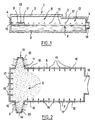
- la zone 8 de fusion où sont enfournées les matières vitrifiables 9 surnageant sur le verre en fusion,
- la zone 10 de fusion/affinage, cette zone est délimitée par une voûte 3 plus basse, ce qui permet notamment un gain de réfractaire.
Claims (15)
- Procédé pour la fusion de matière vitrifiable dans un compartiment (1) de fusion, en vue d'alimenter en continu en verre fondu des installations de formage, dans lequel la fusion des matières vitrifiables est assurée pour l'essentiel par la combustion d'un mélange de fuel et/ou de gaz avec de l'oxygène essentiellement pur, caractérisé en ce que l'apport en fuel et/ou en gaz dans le compartiment de fusion s'effectue en au moins un point d'arrivée avec un défaut d'oxygène par rapport aux quantités désirées correspondant sensiblement aux quantités stoechiométriques et à la combustion totale, au moins 50 % de l'oxygène correspondant à la combustion totale étant apporté de manière séparée en au moins un point d'arrivée différent distant d'au moins 5 cm, et de préférence d'au moins 10 cm du point d'arrivée du fuel et/ou du gaz et situé à un niveau entre la surface supérieure du verre en fusion et le point d'arrivée du fuel et/ou du gaz, afin de réaliser une plus grande souplesse de réglage des températures dans ledit compartiment de fusion.
- Procédé selon la revendication 1, caractérisé en ce qu'au moins 80 % de l'oxygène est apporté de manière séparée.
- Procédé selon l'une des revendications précédentes, caractérisé en ce que tout ou essentiellement tout l'oxygène est apporté de manière séparée, de préférence en plusieurs points d'arrivée.
- Procédé selon l'une des revendications précédentes, caractérisé en ce qu'on règle les températures et la position des zones dont on veut contrôler le niveau thermique dans le compartiment de fusion par un apport de manière séparée d'une part de l'essentiel de l'oxygène nécessaire à la combustion et d'autre part du fuel et/ou du gaz.
- Procédé selon une des revendications précédentes, caractérisé en ce qu'on alimente la flamme du brûleur par apports successifs et en différents points de l'oxygène nécessaire à la combustion.
- Procédé selon l'une des revendications précédentes, caractérisé en ce que l'oxygène est apporté en deux points disposés autour du point d'arrivée du fuel et/ou gaz, les deux points d'arrivée de l'oxygène étant à un niveau inférieur au niveau de l'apport du fuel et/ou gaz.
- Procédé selon l'une des revendications précédentes caractérisé en ce que les installations de formage sont pour le verre plat.
- Ensemble de chauffe équipé ou non d'un brûleur et de lances à oxygène, apte à être utilisé pour la mise en oeuvre du procédé selon l'une des revendications précédentes, caractérisé en ce qu'il comprend un bloc réfractaire (28) muni d'un passage (30)correspondant au logement d'un brûleur, ce passage étant évasé vers la face (41) destinée à être orientée vers l'intérieur du four, et de deux passages (37) disposés à plus de 5 cm, et de préférence à plus de 10 cm de l'axe de passage du brûleur, pour le logement de lances à oxygène disposés hors du passage 30 évasé pour le brûleur et à un niveau inférieur à l'axe de ce passage quand l'ensemble est utilisé.
- Four pour la fusion de matières vitrifiables destinées à la fabrication de verre, comportant un compartiment (1) de fusion de verre, ledit compartiment étant muni, en partie amont, d'au moins une ouverture (11, 12) destinée à être alimentée en matières vitrifiables (9) à l'aide d'un dispositif d'enfournement placé en regard, et en partie aval, d'une ouverture (18) de sortie du verre fondu débouchant dans un compartiment aval destiné à conduire le verre fondu vers la zone de formage, caractérisé en ce que la fusion des matières vitrifiables est assurée dans le compartiment (1) de fusion, pour l'essentiel, par au moins un brûleur (15) à fuel et/ou à gaz fonctionnant en défaut d'oxygène, le comburant étant formé majoritairement d'oxygène essentiellement pur, au moins 50 % de l'oxygène nécessaire à la combustion désirée et produisant une flamme avec une température contrôlée étant apporté de manière séparée par au moins deux lances à oxygène (17), lesdites lances débouchant en des points distants d'au moins 5 cm et de préférence d'au moins 10 cm du au moins un brûleur, à un niveau au-dessous du brûleur et étant disposés autour dudit brûleur.
- Four selon la revendication précédente, caractérisé en ce que tout ou essentiellement tout l'oxygène est apporté de manière séparée par les lances à oxygène disposées sur le trajet de la flamme.
- Four selon l'une des revendications de four précédentes, caractérisé en ce qu'il est équipé d'au moins un moyen pour étanchéifier vis-à-vis des gaz entre le compartiment (1) de fusion et le compartiment aval.
- Four selon l'une des revendications de four précédentes, caractérisé en ce qu'au moins une partie des brûleurs est répartie en vis-à-vis en deux rangées, en débouchant dans le compartiment (1) de fusion au travers des parois latérales (4, 5) de celui-ci, en étant alternés avec les lances à oxygène.
- Four selon l'une des revendications de four précédentes, caractérisé en ce que les brûleurs (16) sont répartis en une pluralité de groupes dont la puissance de chauffe est régulée de manière autonome d'un groupe à l'autre.
- Four selon l'une des revendications de four précédentes, caractérisé en ce que des moyens auxiliaires de chauffe sont prévus dans le compartiment de fusion (1), notamment sous forme d'électrodes immergées dans la profondeur de verre fondu.
- Four selon l'une des revendications de four précédentes, caractérisé en ce qu'il est destiné à la fabrication de verre plat.
Priority Applications (7)
| Application Number | Priority Date | Filing Date | Title |
|---|---|---|---|
| FR9413380A FR2728254B1 (fr) | 1994-11-08 | 1994-11-08 | Procede et dispositif pour la fusion du verre |
| US08/641,589 US5906119A (en) | 1994-11-08 | 1996-05-01 | Process and device for melting glass |
| PT96400933T PT805123E (pt) | 1994-11-08 | 1996-05-02 | Processo e dispositivo para a fusao do vidro |
| DE69629103T DE69629103T2 (de) | 1994-11-08 | 1996-05-02 | Verfahren und Vorrichtung zum Schmelzen von Glas |
| EP96400933A EP0805123B1 (fr) | 1994-11-08 | 1996-05-02 | Procédé et dispositif pour la fusion du verre |
| ES96400933T ES2203672T3 (es) | 1994-11-08 | 1996-05-02 | Procedimiento y dispositivo para la fusion del vidrio. |
| BR9602176A BR9602176A (pt) | 1994-11-08 | 1996-05-07 | Forno e processo para a fusão de matérias vitrificáveis e conjunto de aquecimento equipado ou não de um queimador e de lanças de oxigênio apto a ser utilizado para a execução do processo |
Applications Claiming Priority (4)
| Application Number | Priority Date | Filing Date | Title |
|---|---|---|---|
| FR9413380A FR2728254B1 (fr) | 1994-11-08 | 1994-11-08 | Procede et dispositif pour la fusion du verre |
| US08/641,589 US5906119A (en) | 1994-11-08 | 1996-05-01 | Process and device for melting glass |
| EP96400933A EP0805123B1 (fr) | 1994-11-08 | 1996-05-02 | Procédé et dispositif pour la fusion du verre |
| BR9602176A BR9602176A (pt) | 1994-11-08 | 1996-05-07 | Forno e processo para a fusão de matérias vitrificáveis e conjunto de aquecimento equipado ou não de um queimador e de lanças de oxigênio apto a ser utilizado para a execução do processo |
Publications (2)
| Publication Number | Publication Date |
|---|---|
| EP0805123A1 EP0805123A1 (fr) | 1997-11-05 |
| EP0805123B1 true EP0805123B1 (fr) | 2003-07-16 |
Family
ID=27425257
Family Applications (1)
| Application Number | Title | Priority Date | Filing Date |
|---|---|---|---|
| EP96400933A Expired - Lifetime EP0805123B1 (fr) | 1994-11-08 | 1996-05-02 | Procédé et dispositif pour la fusion du verre |
Country Status (7)
| Country | Link |
|---|---|
| US (1) | US5906119A (fr) |
| EP (1) | EP0805123B1 (fr) |
| BR (1) | BR9602176A (fr) |
| DE (1) | DE69629103T2 (fr) |
| ES (1) | ES2203672T3 (fr) |
| FR (1) | FR2728254B1 (fr) |
| PT (1) | PT805123E (fr) |
Families Citing this family (20)
| Publication number | Priority date | Publication date | Assignee | Title |
|---|---|---|---|---|
| FR2743360B1 (fr) * | 1996-01-05 | 1998-02-27 | Air Liquide | Procede de chauffage de la charge d'un four de verre |
| ES2169843T3 (es) * | 1996-05-14 | 2002-07-16 | L Air Liquide S A Direct Et Co | Procedimiento para la reparacion de un horno de vidrio con ayuda de un quemador auxiliar con combustion de oxigeno. |
| DE19634182A1 (de) * | 1996-08-23 | 1998-02-26 | Nachtmann F X Bleikristall | Verringerung des NO¶x¶-Gehaltes |
| FR2892497B1 (fr) * | 2005-10-24 | 2008-07-04 | Air Liquide | Procede de combustion mixte dans un four a regenerateurs |
| FR2909995B1 (fr) | 2006-12-18 | 2010-04-23 | Saint Gobain Rech | Four a boucle pour verre a fibrer |
| FR2918657B1 (fr) * | 2007-07-10 | 2010-11-12 | Air Liquide | Four et procede oxy-combustible pour la fusion de matieres vitrifiables. |
| WO2009118337A1 (fr) * | 2008-03-25 | 2009-10-01 | Agc Flat Glass Europe Sa | Four de fusion du verre |
| JP5454808B2 (ja) * | 2008-03-25 | 2014-03-26 | エージーシー グラス ユーロップ | ガラス溶融炉 |
| EP2254844A1 (fr) | 2008-03-25 | 2010-12-01 | AGC Glass Europe | Four de fusion du verre |
| US20100242545A1 (en) * | 2009-03-30 | 2010-09-30 | Richardson Andrew P | Cyclical stoichiometric variation of oxy-fuel burners in glass furnaces |
| DE102010020176A1 (de) | 2010-05-11 | 2011-11-17 | Beteiligungen Sorg Gmbh & Co. Kg | Glas-Schmelzwanne mit U-Flammenbeheizung und Verfahren zum Betrieb |
| US20120224601A1 (en) * | 2011-03-01 | 2012-09-06 | Air Liquide Advanced Technologies U.S. Llc | Burner and/or injector panel apparatus, methods of installation and use of the same in a metal-melting furnace, and metal-melting furnace including the same |
| US20130180289A1 (en) * | 2011-04-07 | 2013-07-18 | Rainer Mieth | Method and device for melting meltable stock |
| SI2508827T2 (sl) * | 2011-04-07 | 2019-05-31 | Linde Aktiengesellschaft | Postopek in naprava za taljenje materiala za taljenje |
| FR2982658A1 (fr) | 2011-11-10 | 2013-05-17 | Valeo Vision | Dispositif optique comportant une pluralite de faces reflechissantes |
| US20140162204A1 (en) * | 2012-12-11 | 2014-06-12 | Neil G. SIMPSON | Oxy-fuel boosting of zero port area in glass melter using a reversing system |
| US9016094B2 (en) | 2013-01-16 | 2015-04-28 | Guardian Industries Corp. | Water cooled oxygen lance for use in a float glass furnace and/or float glass furnace using the same |
| GB2511115A (en) * | 2013-02-25 | 2014-08-27 | Linde Ag | An end port regenerative furnace |
| PT3431446T (pt) * | 2017-07-21 | 2020-06-16 | Engie | Processo de combustão aplicado para fundir materiais como o vidro num forno de extremidade quente |
| DE102018116418A1 (de) | 2018-07-06 | 2020-01-09 | Saint-Gobain Isover G+H Ag | Brennerstein für einen Schmelzofen, hiermit versehener Schmelzofen sowie Verfahren zum Abführen von Kondensat aus einem Brennstein |
Family Cites Families (8)
| Publication number | Priority date | Publication date | Assignee | Title |
|---|---|---|---|---|
| US3592623A (en) * | 1969-04-04 | 1971-07-13 | Air Reduction | Glass melting furnace and method of operating it |
| US4911744A (en) * | 1987-07-09 | 1990-03-27 | Aga A.B. | Methods and apparatus for enhancing combustion and operational efficiency in a glass melting furnace |
| DE3730036C2 (de) * | 1987-09-08 | 1994-04-28 | Koerting Ag | Glasschmelzofen |
| AU613725B2 (en) * | 1988-04-01 | 1991-08-08 | Boc Group, Inc., The | Method and apparatus for gas lancing |
| DE4103051A1 (de) * | 1991-02-01 | 1992-08-06 | Koerting Ag | Glasschmelzofen |
| US5203859A (en) * | 1992-04-22 | 1993-04-20 | Institute Of Gas Technology | Oxygen-enriched combustion method |
| US5346524A (en) * | 1992-09-14 | 1994-09-13 | Schuller International, Inc. | Oxygen/fuel firing of furnaces with massive, low velocity, turbulent flames |
| US5242296A (en) * | 1992-12-08 | 1993-09-07 | Praxair Technology, Inc. | Hybrid oxidant combustion method |
-
1994
- 1994-11-08 FR FR9413380A patent/FR2728254B1/fr not_active Expired - Lifetime
-
1996
- 1996-05-01 US US08/641,589 patent/US5906119A/en not_active Expired - Lifetime
- 1996-05-02 ES ES96400933T patent/ES2203672T3/es not_active Expired - Lifetime
- 1996-05-02 DE DE69629103T patent/DE69629103T2/de not_active Expired - Lifetime
- 1996-05-02 EP EP96400933A patent/EP0805123B1/fr not_active Expired - Lifetime
- 1996-05-02 PT PT96400933T patent/PT805123E/pt unknown
- 1996-05-07 BR BR9602176A patent/BR9602176A/pt not_active IP Right Cessation
Also Published As
| Publication number | Publication date |
|---|---|
| PT805123E (pt) | 2003-12-31 |
| ES2203672T3 (es) | 2004-04-16 |
| FR2728254A1 (fr) | 1996-06-21 |
| DE69629103D1 (de) | 2003-08-21 |
| FR2728254B1 (fr) | 1997-01-31 |
| US5906119A (en) | 1999-05-25 |
| EP0805123A1 (fr) | 1997-11-05 |
| BR9602176A (pt) | 1998-06-30 |
| DE69629103T2 (de) | 2004-04-22 |
Similar Documents
| Publication | Publication Date | Title |
|---|---|---|
| EP0805123B1 (fr) | Procédé et dispositif pour la fusion du verre | |
| EP0650934B2 (fr) | Dispositif pour la fusion du verre | |
| EP2254846B1 (fr) | Four de fusion du verre | |
| EP2254845B1 (fr) | Four de fusion du verre | |
| EP2091872B1 (fr) | Procédé de combustion pour la fusion de verre | |
| EP2858955B1 (fr) | Installation et procede de fusion de verre | |
| EP0782973B1 (fr) | Procédé de chauffage de la charge d'un four de verre | |
| EP0850884B1 (fr) | Procédé pour améliorer le profil thermique des fours de verre et four de fusion de verre pour sa mise en oeuvre | |
| EP2257500A1 (fr) | Four de fusion du verre | |
| WO2009010697A2 (fr) | Four et procede oxy-combustible pour la fusion de matieres vitrifiables | |
| WO2009118340A1 (fr) | Four de fusion du verre | |
| EP4433431A1 (fr) | Four hydride de fabrication de verre à fusion électrique pour alimenter une unité de flottage | |
| EP2297053B1 (fr) | Four de fusion du verre | |
| EP4590646A1 (fr) | Four hydride de fabrication de verre presentant une flexibilite energetique et procede de fabrication de verre | |
| EP0807608B1 (fr) | Procédé pour la réparation d'un four de verre à l'aide d'un brûleur auxiliaire à combustion d'oxygène | |
| WO2009092941A2 (fr) | Procede et four de fusion | |
| EP4183753A1 (fr) | Four hydride de fabrication de verre à fusion électrique pour alimenter une unité de flottage | |
| EP4186872A1 (fr) | Four hydride de fabrication de verre à trois courroies de convection pour alimenter une unité de flottage | |
| WO2023099245A1 (fr) | Four hydride de fabrication de verre à trois courroies de convection pour alimenter une unité de flottage |
Legal Events
| Date | Code | Title | Description |
|---|---|---|---|
| PUAI | Public reference made under article 153(3) epc to a published international application that has entered the european phase |
Free format text: ORIGINAL CODE: 0009012 |
|
| AK | Designated contracting states |
Kind code of ref document: A1 Designated state(s): BE DE ES FR GB LU PT |
|
| 17P | Request for examination filed |
Effective date: 19980505 |
|
| 17Q | First examination report despatched |
Effective date: 19990820 |
|
| RAP1 | Party data changed (applicant data changed or rights of an application transferred) |
Owner name: SAINT-GOBAIN GLASS FRANCE |
|
| GRAH | Despatch of communication of intention to grant a patent |
Free format text: ORIGINAL CODE: EPIDOS IGRA |
|
| GRAH | Despatch of communication of intention to grant a patent |
Free format text: ORIGINAL CODE: EPIDOS IGRA |
|
| GRAA | (expected) grant |
Free format text: ORIGINAL CODE: 0009210 |
|
| AK | Designated contracting states |
Designated state(s): BE DE ES FR GB LU PT |
|
| REG | Reference to a national code |
Ref country code: GB Ref legal event code: FG4D Free format text: NOT ENGLISH |
|
| REF | Corresponds to: |
Ref document number: 69629103 Country of ref document: DE Date of ref document: 20030821 Kind code of ref document: P |
|
| GBT | Gb: translation of ep patent filed (gb section 77(6)(a)/1977) |
Effective date: 20031119 |
|
| REG | Reference to a national code |
Ref country code: ES Ref legal event code: FG2A Ref document number: 2203672 Country of ref document: ES Kind code of ref document: T3 |
|
| PLBE | No opposition filed within time limit |
Free format text: ORIGINAL CODE: 0009261 |
|
| STAA | Information on the status of an ep patent application or granted ep patent |
Free format text: STATUS: NO OPPOSITION FILED WITHIN TIME LIMIT |
|
| 26N | No opposition filed |
Effective date: 20040419 |
|
| PGFP | Annual fee paid to national office [announced via postgrant information from national office to epo] |
Ref country code: ES Payment date: 20120607 Year of fee payment: 17 |
|
| PGFP | Annual fee paid to national office [announced via postgrant information from national office to epo] |
Ref country code: DE Payment date: 20130515 Year of fee payment: 18 Ref country code: GB Payment date: 20130501 Year of fee payment: 18 Ref country code: LU Payment date: 20130510 Year of fee payment: 18 |
|
| PGFP | Annual fee paid to national office [announced via postgrant information from national office to epo] |
Ref country code: PT Payment date: 20130502 Year of fee payment: 18 Ref country code: FR Payment date: 20130604 Year of fee payment: 18 Ref country code: BE Payment date: 20130530 Year of fee payment: 18 |
|
| REG | Reference to a national code |
Ref country code: PT Ref legal event code: MM4A Free format text: LAPSE DUE TO NON-PAYMENT OF FEES Effective date: 20141103 |
|
| REG | Reference to a national code |
Ref country code: DE Ref legal event code: R119 Ref document number: 69629103 Country of ref document: DE |
|
| PG25 | Lapsed in a contracting state [announced via postgrant information from national office to epo] |
Ref country code: LU Free format text: LAPSE BECAUSE OF NON-PAYMENT OF DUE FEES Effective date: 20140502 |
|
| GBPC | Gb: european patent ceased through non-payment of renewal fee |
Effective date: 20140502 |
|
| PG25 | Lapsed in a contracting state [announced via postgrant information from national office to epo] |
Ref country code: PT Free format text: LAPSE BECAUSE OF NON-PAYMENT OF DUE FEES Effective date: 20141103 |
|
| REG | Reference to a national code |
Ref country code: DE Ref legal event code: R119 Ref document number: 69629103 Country of ref document: DE Effective date: 20141202 |
|
| REG | Reference to a national code |
Ref country code: FR Ref legal event code: ST Effective date: 20150130 |
|
| PG25 | Lapsed in a contracting state [announced via postgrant information from national office to epo] |
Ref country code: DE Free format text: LAPSE BECAUSE OF NON-PAYMENT OF DUE FEES Effective date: 20141202 |
|
| PG25 | Lapsed in a contracting state [announced via postgrant information from national office to epo] |
Ref country code: FR Free format text: LAPSE BECAUSE OF NON-PAYMENT OF DUE FEES Effective date: 20140602 Ref country code: GB Free format text: LAPSE BECAUSE OF NON-PAYMENT OF DUE FEES Effective date: 20140502 |
|
| REG | Reference to a national code |
Ref country code: ES Ref legal event code: FD2A Effective date: 20150630 |
|
| PG25 | Lapsed in a contracting state [announced via postgrant information from national office to epo] |
Ref country code: ES Free format text: LAPSE BECAUSE OF NON-PAYMENT OF DUE FEES Effective date: 20140503 |
|
| PG25 | Lapsed in a contracting state [announced via postgrant information from national office to epo] |
Ref country code: BE Free format text: LAPSE BECAUSE OF NON-PAYMENT OF DUE FEES Effective date: 20140531 |