EP0805943B1 - Entkupferungs-zusatzmischung für treibstoff - Google Patents
Entkupferungs-zusatzmischung für treibstoff Download PDFInfo
- Publication number
- EP0805943B1 EP0805943B1 EP95943611A EP95943611A EP0805943B1 EP 0805943 B1 EP0805943 B1 EP 0805943B1 EP 95943611 A EP95943611 A EP 95943611A EP 95943611 A EP95943611 A EP 95943611A EP 0805943 B1 EP0805943 B1 EP 0805943B1
- Authority
- EP
- European Patent Office
- Prior art keywords
- decoppering agent
- decoppering
- additive
- bismuth
- propellant
- Prior art date
- Legal status (The legal status is an assumption and is not a legal conclusion. Google has not performed a legal analysis and makes no representation as to the accuracy of the status listed.)
- Expired - Lifetime
Links
- 239000003380 propellant Substances 0.000 title claims abstract description 41
- 239000000654 additive Substances 0.000 title claims abstract description 33
- 230000000996 additive effect Effects 0.000 title claims abstract description 32
- 239000002131 composite material Substances 0.000 title description 8
- 239000003795 chemical substances by application Substances 0.000 claims abstract description 38
- 229910052802 copper Inorganic materials 0.000 claims abstract description 23
- 239000010949 copper Substances 0.000 claims abstract description 23
- RYGMFSIKBFXOCR-UHFFFAOYSA-N Copper Chemical compound [Cu] RYGMFSIKBFXOCR-UHFFFAOYSA-N 0.000 claims abstract description 21
- 239000011230 binding agent Substances 0.000 claims abstract description 16
- JCXGWMGPZLAOME-UHFFFAOYSA-N bismuth atom Chemical compound [Bi] JCXGWMGPZLAOME-UHFFFAOYSA-N 0.000 claims abstract description 16
- 239000000020 Nitrocellulose Substances 0.000 claims abstract description 10
- 229920001220 nitrocellulos Polymers 0.000 claims abstract description 10
- 229910052797 bismuth Inorganic materials 0.000 claims description 11
- 238000006396 nitration reaction Methods 0.000 claims description 8
- 150000001622 bismuth compounds Chemical class 0.000 claims description 7
- 239000011159 matrix material Substances 0.000 claims description 7
- 229910001152 Bi alloy Inorganic materials 0.000 claims description 5
- GWEVSGVZZGPLCZ-UHFFFAOYSA-N Titan oxide Chemical compound O=[Ti]=O GWEVSGVZZGPLCZ-UHFFFAOYSA-N 0.000 claims description 5
- 239000004014 plasticizer Substances 0.000 claims description 5
- OTYBMLCTZGSZBG-UHFFFAOYSA-L potassium sulfate Chemical compound [K+].[K+].[O-]S([O-])(=O)=O OTYBMLCTZGSZBG-UHFFFAOYSA-L 0.000 claims description 4
- 229910052939 potassium sulfate Inorganic materials 0.000 claims description 4
- 229920006217 cellulose acetate butyrate Polymers 0.000 claims description 2
- 235000011151 potassium sulphates Nutrition 0.000 claims description 2
- 239000004408 titanium dioxide Substances 0.000 claims description 2
- 229910002651 NO3 Inorganic materials 0.000 claims 1
- -1 nitrate ester Chemical class 0.000 claims 1
- 239000008188 pellet Substances 0.000 description 28
- 239000000463 material Substances 0.000 description 15
- 230000005484 gravity Effects 0.000 description 7
- 230000008901 benefit Effects 0.000 description 6
- 239000011888 foil Substances 0.000 description 5
- 229910000881 Cu alloy Inorganic materials 0.000 description 4
- 238000010304 firing Methods 0.000 description 4
- 239000007789 gas Substances 0.000 description 4
- 229910000014 Bismuth subcarbonate Inorganic materials 0.000 description 3
- VYZAMTAEIAYCRO-UHFFFAOYSA-N Chromium Chemical compound [Cr] VYZAMTAEIAYCRO-UHFFFAOYSA-N 0.000 description 3
- 229910045601 alloy Inorganic materials 0.000 description 3
- 239000000956 alloy Substances 0.000 description 3
- MGLUJXPJRXTKJM-UHFFFAOYSA-L bismuth subcarbonate Chemical compound O=[Bi]OC(=O)O[Bi]=O MGLUJXPJRXTKJM-UHFFFAOYSA-L 0.000 description 3
- 229910052804 chromium Inorganic materials 0.000 description 3
- 239000011651 chromium Substances 0.000 description 3
- 238000002485 combustion reaction Methods 0.000 description 3
- 239000007788 liquid Substances 0.000 description 3
- 230000000087 stabilizing effect Effects 0.000 description 3
- 229910000831 Steel Inorganic materials 0.000 description 2
- 229940036358 bismuth subcarbonate Drugs 0.000 description 2
- WMWLMWRWZQELOS-UHFFFAOYSA-N bismuth(III) oxide Inorganic materials O=[Bi]O[Bi]=O WMWLMWRWZQELOS-UHFFFAOYSA-N 0.000 description 2
- 150000001879 copper Chemical class 0.000 description 2
- 230000008021 deposition Effects 0.000 description 2
- 230000003628 erosive effect Effects 0.000 description 2
- 238000005552 hardfacing Methods 0.000 description 2
- 239000006193 liquid solution Substances 0.000 description 2
- 238000004519 manufacturing process Methods 0.000 description 2
- 239000010959 steel Substances 0.000 description 2
- 231100000331 toxic Toxicity 0.000 description 2
- 230000002588 toxic effect Effects 0.000 description 2
- 239000004429 Calibre Substances 0.000 description 1
- SNIOPGDIGTZGOP-UHFFFAOYSA-N Nitroglycerin Chemical compound [O-][N+](=O)OCC(O[N+]([O-])=O)CO[N+]([O-])=O SNIOPGDIGTZGOP-UHFFFAOYSA-N 0.000 description 1
- 229910000978 Pb alloy Inorganic materials 0.000 description 1
- 229910001128 Sn alloy Inorganic materials 0.000 description 1
- ATJFFYVFTNAWJD-UHFFFAOYSA-N Tin Chemical compound [Sn] ATJFFYVFTNAWJD-UHFFFAOYSA-N 0.000 description 1
- 239000000853 adhesive Substances 0.000 description 1
- 230000001070 adhesive effect Effects 0.000 description 1
- PEEDYJQEMCKDDX-UHFFFAOYSA-N antimony bismuth Chemical compound [Sb].[Bi] PEEDYJQEMCKDDX-UHFFFAOYSA-N 0.000 description 1
- QVGXLLKOCUKJST-UHFFFAOYSA-N atomic oxygen Chemical compound [O] QVGXLLKOCUKJST-UHFFFAOYSA-N 0.000 description 1
- 229910000416 bismuth oxide Inorganic materials 0.000 description 1
- 229920002678 cellulose Polymers 0.000 description 1
- 239000001913 cellulose Substances 0.000 description 1
- TVZPLCNGKSPOJA-UHFFFAOYSA-N copper zinc Chemical compound [Cu].[Zn] TVZPLCNGKSPOJA-UHFFFAOYSA-N 0.000 description 1
- 238000005260 corrosion Methods 0.000 description 1
- 230000007797 corrosion Effects 0.000 description 1
- 230000001419 dependent effect Effects 0.000 description 1
- TYIXMATWDRGMPF-UHFFFAOYSA-N dibismuth;oxygen(2-) Chemical compound [O-2].[O-2].[O-2].[Bi+3].[Bi+3] TYIXMATWDRGMPF-UHFFFAOYSA-N 0.000 description 1
- LYAGTVMJGHTIDH-UHFFFAOYSA-N diethylene glycol dinitrate Chemical compound [O-][N+](=O)OCCOCCO[N+]([O-])=O LYAGTVMJGHTIDH-UHFFFAOYSA-N 0.000 description 1
- 239000006185 dispersion Substances 0.000 description 1
- 238000004090 dissolution Methods 0.000 description 1
- 230000000694 effects Effects 0.000 description 1
- 230000008020 evaporation Effects 0.000 description 1
- 238000001704 evaporation Methods 0.000 description 1
- 239000000835 fiber Substances 0.000 description 1
- 239000000446 fuel Substances 0.000 description 1
- 229960003711 glyceryl trinitrate Drugs 0.000 description 1
- 238000000227 grinding Methods 0.000 description 1
- RXPAJWPEYBDXOG-UHFFFAOYSA-N hydron;methyl 4-methoxypyridine-2-carboxylate;chloride Chemical compound Cl.COC(=O)C1=CC(OC)=CC=N1 RXPAJWPEYBDXOG-UHFFFAOYSA-N 0.000 description 1
- 238000010348 incorporation Methods 0.000 description 1
- 230000002401 inhibitory effect Effects 0.000 description 1
- 230000001788 irregular Effects 0.000 description 1
- 150000002611 lead compounds Chemical class 0.000 description 1
- WABPQHHGFIMREM-UHFFFAOYSA-N lead(0) Chemical compound [Pb] WABPQHHGFIMREM-UHFFFAOYSA-N 0.000 description 1
- 239000000155 melt Substances 0.000 description 1
- 230000008018 melting Effects 0.000 description 1
- 238000002844 melting Methods 0.000 description 1
- 229910052751 metal Inorganic materials 0.000 description 1
- 239000002184 metal Substances 0.000 description 1
- 150000002739 metals Chemical class 0.000 description 1
- 238000000034 method Methods 0.000 description 1
- 239000000203 mixture Substances 0.000 description 1
- 150000002823 nitrates Chemical class 0.000 description 1
- 230000000802 nitrating effect Effects 0.000 description 1
- 150000002895 organic esters Chemical class 0.000 description 1
- 239000001301 oxygen Substances 0.000 description 1
- 229910052760 oxygen Inorganic materials 0.000 description 1
- 239000000843 powder Substances 0.000 description 1
- 239000007779 soft material Substances 0.000 description 1
- 239000007787 solid Substances 0.000 description 1
- XLYOFNOQVPJJNP-UHFFFAOYSA-N water Substances O XLYOFNOQVPJJNP-UHFFFAOYSA-N 0.000 description 1
Images
Classifications
-
- C—CHEMISTRY; METALLURGY
- C06—EXPLOSIVES; MATCHES
- C06B—EXPLOSIVES OR THERMIC COMPOSITIONS; MANUFACTURE THEREOF; USE OF SINGLE SUBSTANCES AS EXPLOSIVES
- C06B23/00—Compositions characterised by non-explosive or non-thermic constituents
- C06B23/04—Compositions characterised by non-explosive or non-thermic constituents for cooling the explosion gases including antifouling and flash suppressing agents
-
- F—MECHANICAL ENGINEERING; LIGHTING; HEATING; WEAPONS; BLASTING
- F42—AMMUNITION; BLASTING
- F42B—EXPLOSIVE CHARGES, e.g. FOR BLASTING, FIREWORKS, AMMUNITION
- F42B5/00—Cartridge ammunition, e.g. separately-loaded propellant charges
- F42B5/02—Cartridges, i.e. cases with charge and missile
- F42B5/24—Cartridges, i.e. cases with charge and missile for cleaning; for cooling; for lubricating ; for wear reducing
Definitions
- This invention relates to an addition to a propellant charge effective for removing copper deposits from the inside surfaces of a gun barrel. More particularly, a composite addition has a pulverized decoppering agent dispersed in a combustible matrix.
- Most large caliber guns have a barrel with a rifled internal bore that imparts a stabilizing spin on an expelled projectile.
- the internal bore may be coated with a hard facing material, such as chromium, to minimize erosive wear increasing the number of projectiles that may be fired from the gun.
- the typical large caliber projectile has a diameter slightly less than the diameter of the internal bore.
- One or more obturator, or rotating, bands gird the circumference of the projectile. At the bands, the diameter of the projectile is slightly larger than the internal diameter of the gun barrel.
- the rotating band is engraved by the rifling, contacting the rifling throughout the length of the tube imparting the projectile with a stabilizing spin.
- the gun barrel is manufactured from a material such as steel and sometimes coated with a hard material such as a chromium facing.
- the gun barrel is harder than the rotating band which is typically copper or a copper alloy.
- This copper deposition referred to as "copper fouling" can affect the ballistics of the projectile and major fouling can prevent the projectile from being inserted and seated, positioned in the barrel prior to firing, properly.
- Copper fouling is currently a major problem for large artillery weapons, such as 155 millimeter howitzers, and is also noted in small and medium caliber cannons, such as 20 millimeter canons.
- the current solution to copper fouling is including a decoppering agent in the propellant charge. The decoppering agent removes the copper without damaging the gun barrel or the rifling.
- a common decoppering agent is a sheet of lead foil deposited between the propellant and the projectile. On ignition of the propellant charge, the lead is vaporized and diffuses into the copper. The resultant alloy is brittle and easily shattered. The combination of the heat generated by the burning propellant and the mechanical movement of the propellant gases separates the brittle lead/copper alloy from the surface of the barrel. The fractured debris is swept from the muzzle of the gun with the propellant gases.
- lead foil is effective as a decoppering agent is that the heat generated by the burning propellant melts the lead foil. Liquid lead contacts the copper deposition and dissolves the copper, the copper bearing lead solution is expelled as a liquid from the muzzle with the propellant gases.
- bismuth bismuth subcarbonate (BiCO 3 ), tin and tin alloys.
- Bismuth compounds are very brittle and even metallic bismuth cannot be rolled into a thin foil like lead. Alloys of bismuth metal with other metals can be rolled into a foil, but the alloys are very expensive and less effective as a decoppering agent.
- US-A-5 463 956 discloses an additive for a liner proximate to a propellant for medium and large calibre guns.
- the liner comprises a decoppering agent which may include an additive such as bismuth or bismuth oxide.
- US-A- 5 463 956 was published on November 7, 1995, which is after the priority date of the present invention.
- the decoppering agent is a composite material containing a combustible matrix and a decoppering additive dispersed throughout the matrix. It is another feature of the invention that the decoppering additive is pulverized prior to dispersion into the matrix. Yet another feature is that the composite is readily positioned at any desired location within the propellant charge.
- the pulverized additive is essentially lead free and is selected from the group consisting of metallic bismuth, bismuth alloys and bismuth compounds.
- the combustible matrix is substantially consumed when the propellant is ignited.
- the pulverized decoppering additive is transported through the gun barrel with the propellant gases.
- the composite material may be formed into a sheet and located between the propellant charge and a projectile.
- the composite may be formed into pellets of a desired shape and then either dispersed throughout the propellant charge or stored in small combustible containers added to the propellant charge.
- a decoppering agent for a propellant charge consists essentially of an essentially lead free pulverized additive that is effective to remove copper deposits from a gun barrel.
- This additive is dispersed in a combustible binder, and is selected from the group consisting of metallic bismuth, bismuth alloys and bismuth compounds.
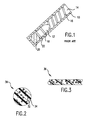
- Figure 1 illustrates in cross-sectional representation a gun barrel for firing a large caliber projectile as known from the prior art.
- Figure 2 illustrates in cross-sectional representation a composite decoppering agent in accordance with an embodiment of the invention.
- Figure 3 illustrates in cross-sectional representation another composite decoppering agent in accordance with a different embodiment of the invention.
- FIG. 1 shows in cross-sectional representation a gun barrel 10 for projecting a large caliber projectile 12.
- the gun barrel 10 has an internal bore 14 with raised rifling 16 that cooperates with a rotating band 18 to impart spin on the projectile 12.
- the gun barrel 10 is typically made from steel and the surfaces of the internal bore 14 may be coated with a hard facing material such as chromium.
- the rotating band 18 is typically formed from a relatively soft material such as copper or a copper alloy such as a copper-zinc gilding alloy.
- a propellant charge 20 ignited by any conventional means expels the projectile 12 from the gun barrel 10.
- the rotating band 18 is engraved by the rifling 16, thereby imparting stabilizing spin on the projectile 12.
- a decoppering agent 22 typically lead, is disposed between the propellant charge 20 and the projectile 12.
- the heat of ignition of the propellant charge 20 either vaporizes or liquifies the low melting temperature lead decoppering agent 22 which then either dissolves or embrittles copper deposits on the rifling 16, effectively removing those deposits from the surfaces of the internal bore 14 of the gun barrel 10.
- Figure 2 illustrates a pellet 30 that may have any desired shape.
- the pellet 30 is an essentially lead free pulverized additive 32 dispersed in a combustible binder 34.
- the pulverized additive 32 is a material effective to remove copper deposits from the a gun barrel, namely a material selected from the group consisting of bismuth metal, bismuth alloys and bismuth compounds. By effective, it is meant that the copper deposit is substantially removed without significant corrosion, erosion or other attack of the gun barrel or the rifling.
- Preferred bismuth compounds include bismuth subcarbonate and bismuth trioxide (BiO 3 ).
- Other suitable materials include bismuth nitrate and bismuth antimonide.
- the pulverized additive is preferably provided as a powder, either spherical, irregular or other shape, having a maximum average cross-sectional diameter of from about 0.00025 mm (0.00001 inch) to about 1.27 mm (0.05 inch) and more preferably, having a maximum average cross-sectional diameter of from about 0.025 mm (0.001 inch) to about 0.13 mm (0.005 inch).
- the cross-sectional profile of the additive is not necessarily round. Therefore, diameter is broadly construed to mean the length of a straight line passing from one side of the additive to the other while passing through the center of the additive.
- the combustible binder 34 is any material that energetically burns on ignition of the propellant.
- the combustible binder 34 should burn with a minimum ash generation and other residues.
- the combustible binder is preferably a polymeric material that holds the pulverized additive 32 together as a pellet or other desired shape.
- the binder preferably also provides both fuel and oxygen to the propellant charge during combustion.
- One preferred binder is nitrocellulose having either a low degree of nitration (approximately 12.6% by weight nitrated) or a high degree of nitration (around 13.5% by weight nitrated). Nitrocellulose with an intermediate degree nitration, typically 13.15% nitration, is commonly used in gun propellants and is readily available.
- Preferred is a nitrocellulose having from about 12.6% to about 14% nitration and, most preferably, with from about 13.1% to about 13.5% nitration.
- the degree of nitration is selected to provide
- Nonenergetic binders can also be used, as can nonenergetic binders.
- Suitable nonenergetic binders such as cellulose acetate butyrate, are less preferred because they do not contribute to the combustion reaction to the same degree as nitrocellulose.
- the pellet 30 can have from about 5% to about 95% by weight of the pulverized additive 32. If the pellet 30 has a low percentage of pulverized additive 32, then achieving an effective amount of decoppering material may require a large number of decoppering pellets 30. This may result in a significant amount of actual propellant being displaced and overall interior ballistics may be detrimentally impacted. If the decoppering pellets are made with a high percentage of pulverized additive, they may not burn properly and leave unwanted residue in the gun chamber.
- the pellet 30 contains from about 5% to about 95% by weight of the pulverized additive. Preferably, the pellet 30 contains from about 25% to about 75% by weight of the pulverized additive and more preferably, the pulverized additive is present in an amount of from about 30% to about 45%.
- the specific gravity (density) of the pellets 30 is controlled by the manufacturing process.
- the ignitability and burn rate of the pellets is directly proportional to the initial surface area and the amount of surface area during the propellant burn.
- a porous pellet lower specific gravity
- a more dense pellet higher specific gravity
- the specific gravity is from about 1.0 to about 4.0 grams per cubic centimeter, and most preferably from about 1.5 to about 2.5 g/cm 3 .
- the specific gravity is greater than about 4.0 g/cm 3 , the burn rate is generally too slow for use in propellant charges.
- the pellet leaves unburnt residue in the gun chamber or the barrel.
- a specific gravity of less than 1 g/cm 3 lacks the necessary mechanical strength to survive incorporation into a charge and handling the charge may undergo before firing. If the grains break apart during loading or handling, they will not burn properly during combustion.
- K 2 SO 4 potassium sulfate
- a preferred amount of K 2 SO 4 is from about 20% to about 75% by weight, with a most preferred amount being from about 20% to about 40% by weight.
- Titanium dioxide in an amount of from about 1% to about 95% by weight, and preferably from about 25% to about 75% by weight, may be added to inhibit barrel wear.
- a most preferred amount of TiO 2 is from about 20% to about 40% by weight.
- An energetic plasticizer may be added to increase the burn rate of the pellets 30 thereby minimizing or eliminating residue after firing.
- the energetic plasticizer is also useful to modify the mechanical properties of the pellets 30, to increase the energy rate of the pellets and to,increase the flame temperature of the pellets.
- Suitable energetic plasticizers include nitrate esters such as nitroglycerine and diethylene glycol dinitrate present in an amount, by weight, of from about 1% to about 40%.
- the amount of the energetic plasticizer is from about 1% to about 20% by weight.
- the additional additives may be added singly or in multiple combinations.
- the pellet 30 as illustrated in Figure 2 has a substantially round cross-sectional profile, as for example a flat disk.
- any suitable shape may be used, recognizing that the ignitability and burning velocity (burn rate) of the pellet is dependent on the overall surface area as the grain burns.
- the geometric shape can be adjusted and changed to improve both the ignitability and burn rate. Grains with more surface area, such as cruciform, multiply perforated and lobed pellets will burn faster. Other shapes, such as flat disks, right circular disks (both solid and single perforated) and spheres have less surface area and will ignite slower. This property of controlling the shape of the pellet 30 gives propellant charge designers the additional benefit of flexibility in tailoring the ignitability and burn rate of the additive grain to a specific propellant charge.
- the pellets 30 are introduced to the propellant charge according to the needs of the propellant charge designer.
- the pellets may be sewed into a fiber bag or other special container, attached to the wall of the propellant charge or to the propellant base with an adhesive or other means of attachment, added directly to the propellant bed, added to other materials such as an igniter or primer material or attached to or contained within the primer.
- the decoppering agent can be in the form of a sheet 36 as illustrated in cross-sectional representation in Figure 3 to line the propellant charge or be disposed between the propellant charge and the projectile.
- decoppering agent of the invention has been described most particularly in relation to large caliber guns, it is equally suitable to both medium caliber and low caliber gun barrels. It is equally usable for high zone artillery charges, those operating at higher pressures and temperatures, as well as low zone artillery charges, those operating at lower pressures and temperatures. Of course, the specific gravity and shape of the pellets will be tailored for an ignitability and burn rate suitable for each type of artillery charge.
- a preferred method of manufacturing either the pellet 30 of Figure 2 or the sheet 36 of Figure 3, is to provide the essentially lead free additive pulverized by any suitable means.
- bismuth metal may be pulverized by mechanical grinding or any other suitable means.
- the pulverized additive is then dispersed in a viscous liquid solution containing nitrocellulose dissolved in a mixture of water and an organic ester. Prior to dissolution, cellulose was nitrated to the desired degree according to conventional nitrating practice.
- the viscous liquid solution containing the dissolved nitrocellulose and suspended pulverized additive is then extruded through a die having orifices of a desired cross sectional profile.
- the extruded strands are cut at a desired thickness and the liquid component then removed by evaporation, preferably assisted by the addition of heat.
Landscapes
- Engineering & Computer Science (AREA)
- General Engineering & Computer Science (AREA)
- Chemical & Material Sciences (AREA)
- Organic Chemistry (AREA)
- Powder Metallurgy (AREA)
- Solid Fuels And Fuel-Associated Substances (AREA)
- Cosmetics (AREA)
- Medicinal Preparation (AREA)
- Agricultural Chemicals And Associated Chemicals (AREA)
- Manufacture And Refinement Of Metals (AREA)
Claims (9)
- Entkupferungsmittel (30, 36) für eine Treibmittel-Ladung, gekennzeichnet durch einen pulverförmigen Zusatzstoff (32), der zur Entfernung von Kupfer-Ablagerungen von einem Gewehrlauf wirksam ist und in einer brennbaren Bindemittelmatrix (34) verteilt ist, wobei der pulverförmige Zusatzstoff (32) im Wesentlichen bleifrei ist und aus der aus metallischem Bismut, Bismutlegierungen und Bismuthverbindungen bestehenden Gruppe ausgewählt ist.
- Entkupferungsmittel (30, 36) nach Anspruch 1, dadurch gekennzeichnet, dass das brennbare Bindemittel (34) Nitrocellulose ist.
- Entkupferungsmittel (30, 36) nach Anspruch 1, dadurch gekennzeichnet, dass das Bindemittel (34) Cellulose-acetat-butyrat ist.
- Entkupferungsmittel (30, 36) nach entweder Anspruch 2 oder 3, dadurch gekennzeichnet, dass die Nitrocellulose (34) einen Nitrierungsgrad von etwa 12,6 Gewichtsprozent bis etwa 14 Gewichtsprozent hat.
- Entkupferungsmittel (30, 36) nach einem der Ansprüche 1 bis 4, dadurch gekennzeichnet, dass der pulverförmige Zusatzstoff (32) metallisches Bismut ist.
- Entkupferungsmittel (30, 36) nach einem der Ansprüche 1 bis 5, dadurch gekennzeichnet, dass der pulverförmige Zusatzstoff (32) einen mittleren Maximaldurchmesser von etwa 0,00025 mm (0,00001 inch) bis etwa 0,127 mm (0,050 inch) hat.
- Entkupferungsmittel (30, 36) nach einem der Ansprüche 1 bis 6, das außerdem etwa 1 Gewichtsprozent bis etwa 95 Gewichtsprozent Kaliumsulfat enthält.
- Entkupferungsmittel (30, 36) nach einem der Ansprüche 1 bis 6, das außerdem etwa 1 Gewichtsprozent bis etwa 95 Gewichtsprozent Titandioxid enthält.
- Entkupferungsmittel (30, 36) nach einem der Ansprüche 1 bis 6, das außerdem etwa 1 Gewichtsprozent bis etwa 40 Gewichtsprozent eines energiereichen Nitratester-Weichmachers enthält.
Applications Claiming Priority (3)
| Application Number | Priority Date | Filing Date | Title |
|---|---|---|---|
| US357906 | 1994-12-16 | ||
| US08/357,906 US5565643A (en) | 1994-12-16 | 1994-12-16 | Composite decoppering additive for a propellant |
| PCT/US1995/015440 WO1996018862A1 (en) | 1994-12-16 | 1995-11-30 | Composite decoppering additive for a propellant |
Publications (3)
| Publication Number | Publication Date |
|---|---|
| EP0805943A1 EP0805943A1 (de) | 1997-11-12 |
| EP0805943A4 EP0805943A4 (de) | 1998-04-29 |
| EP0805943B1 true EP0805943B1 (de) | 2003-10-15 |
Family
ID=23407513
Family Applications (1)
| Application Number | Title | Priority Date | Filing Date |
|---|---|---|---|
| EP95943611A Expired - Lifetime EP0805943B1 (de) | 1994-12-16 | 1995-11-30 | Entkupferungs-zusatzmischung für treibstoff |
Country Status (7)
| Country | Link |
|---|---|
| US (1) | US5565643A (de) |
| EP (1) | EP0805943B1 (de) |
| AT (1) | ATE252220T1 (de) |
| AU (1) | AU4503996A (de) |
| DE (1) | DE69531960T2 (de) |
| ES (1) | ES2204970T3 (de) |
| WO (1) | WO1996018862A1 (de) |
Families Citing this family (15)
| Publication number | Priority date | Publication date | Assignee | Title |
|---|---|---|---|---|
| US5747723A (en) * | 1996-11-26 | 1998-05-05 | The United States Of America As Represented By The Secretary Of The Army | Modular artillery charge system |
| FR2802918B1 (fr) * | 1999-12-23 | 2002-05-03 | Giat Ind Sa | Additif pour chargement propulsif, notamment additif antiusure, objet combustible et chargement propulsif incorporant un tel additif |
| US6230626B1 (en) | 2000-02-23 | 2001-05-15 | The United States Of America As Represented By The Secretary Of The Navy | Flashless MK 66 rocket motor |
| US7067532B2 (en) * | 2000-11-02 | 2006-06-27 | Astrazeneca | Substituted quinolines as antitumor agents |
| SE523997C2 (sv) * | 2002-02-08 | 2004-06-15 | Nexplo Bofors Ab | Avkoppringsmedel |
| DE10350024A1 (de) * | 2003-10-27 | 2005-05-25 | Metallwerk Elisenhütte GmbH | Patrone mit nachweisrelevanter Dotierung |
| DK1616845T3 (da) * | 2004-07-16 | 2014-02-03 | Nitrochemie Wimmis Ag | Hældbart drivladningspulver |
| WO2011123398A1 (en) * | 2010-03-30 | 2011-10-06 | Lockheed Martin Corporation | Methods for rework of a solder |
| US9625242B1 (en) * | 2015-02-12 | 2017-04-18 | The United States Of America As Represented By The Secretary Of The Army | Igniter for modular artillery charge system |
| DE102016112510A1 (de) * | 2016-07-07 | 2018-01-11 | Krauss-Maffei Wegmann Gmbh & Co. Kg | Verfahren und Vorrichtung zur Temperaturermittlung sowie Verfahren und Vorrichtung zum Fügen von Treibladungsmodulen |
| CA3172854A1 (en) * | 2020-02-27 | 2021-09-02 | Bae Systems Plc | Improvements relating to ammunition |
| EP3872440A1 (de) * | 2020-02-27 | 2021-09-01 | BAE SYSTEMS plc | Verbesserungen im zusammenhang mit munition |
| US20220411347A1 (en) * | 2021-03-23 | 2022-12-29 | Evoq Nano, Inc. | Propellant compositions with metal nanoparticles |
| CN113154938A (zh) * | 2021-04-07 | 2021-07-23 | 中北大学 | 一种高效环保合金除铜剂及其制备方法与应用 |
| FR3139818B1 (fr) * | 2022-09-21 | 2025-06-20 | Eurenco France | Chargements combustibles adhérant à la paroi interne d'une structure combustible contenant un chargement propulsif |
Family Cites Families (21)
| Publication number | Priority date | Publication date | Assignee | Title |
|---|---|---|---|---|
| US1329610A (en) * | 1916-10-28 | 1920-02-03 | Arlington Company | Solidified fuel |
| US1357865A (en) * | 1920-03-03 | 1920-11-02 | Du Pont | Propellent powder and process of making same |
| US2001070A (en) * | 1932-04-29 | 1935-05-14 | Hercules Powder Co Ltd | Nitrocellulose gel and method of producing |
| GB548793A (en) * | 1938-03-11 | 1939-07-26 | Thomas Thomson | Improvements in or relating to propellent explosive charges |
| US3257948A (en) * | 1963-08-23 | 1966-06-28 | Axelrod Sydney | Consumable artillery components |
| US3429261A (en) * | 1965-10-06 | 1969-02-25 | Herbert M Goldstein | Round of fixed ammunition having improved gun bore erosion characteristics |
| US3392669A (en) * | 1966-01-24 | 1968-07-16 | Army Usa | Erosion reducer |
| US3392670A (en) * | 1966-01-24 | 1968-07-16 | Army Usa | Erosion reducer |
| US3397636A (en) * | 1967-03-22 | 1968-08-20 | Wegematic Corp | Wear reduction additives |
| US3672851A (en) * | 1971-04-26 | 1972-06-27 | Joseph M Ihm | Gelled alcohol fuel containing nitrocellulose and boric acid |
| GB2061148B (en) * | 1979-09-19 | 1983-02-02 | Secr Defence | Cleaning metal surfaces |
| SE451716B (sv) * | 1983-07-13 | 1987-10-26 | Nobel Kemi Ab | Sett att tillfora inhiberingssubstans till krut i en fluidiserad bedd samt ett for behandlingen av krutet avpassat medel |
| DE3544907A1 (de) * | 1985-12-19 | 1987-06-25 | Diehl Gmbh & Co | Additiv-manschette fuer grosskalibrige geschuetzmunition zur schonung des waffenrohres |
| DE3544927A1 (de) * | 1985-12-19 | 1987-06-25 | Diehl Gmbh & Co | Additivmanschette fuer eine treibladung fuer grosskalibrige rohrwaffenmunition |
| US4858534A (en) * | 1986-04-23 | 1989-08-22 | Amoco Corporation | Ballistic lubricating and process |
| US4949644A (en) * | 1989-06-23 | 1990-08-21 | Brown John E | Non-toxic shot and shot shell containing same |
| DE3924986A1 (de) * | 1989-07-28 | 1991-01-31 | Rheinmetall Gmbh | Treibladungsbehaelter |
| US5288458A (en) * | 1991-03-01 | 1994-02-22 | Olin Corporation | Machinable copper alloys having reduced lead content |
| US5151557A (en) * | 1991-07-01 | 1992-09-29 | The United States Of America As Represented By The Secretary Of The Army | Additive for propelling charge |
| US5399187A (en) * | 1993-09-23 | 1995-03-21 | Olin Corporation | Lead-free bullett |
| US5463956A (en) * | 1994-02-08 | 1995-11-07 | Ici Americas Inc. | Wear decoppering liner |
-
1994
- 1994-12-16 US US08/357,906 patent/US5565643A/en not_active Expired - Lifetime
-
1995
- 1995-11-30 AT AT95943611T patent/ATE252220T1/de not_active IP Right Cessation
- 1995-11-30 AU AU45039/96A patent/AU4503996A/en not_active Abandoned
- 1995-11-30 WO PCT/US1995/015440 patent/WO1996018862A1/en not_active Ceased
- 1995-11-30 ES ES95943611T patent/ES2204970T3/es not_active Expired - Lifetime
- 1995-11-30 DE DE69531960T patent/DE69531960T2/de not_active Expired - Lifetime
- 1995-11-30 EP EP95943611A patent/EP0805943B1/de not_active Expired - Lifetime
Also Published As
| Publication number | Publication date |
|---|---|
| US5565643A (en) | 1996-10-15 |
| EP0805943A1 (de) | 1997-11-12 |
| DE69531960D1 (de) | 2003-11-20 |
| WO1996018862A1 (en) | 1996-06-20 |
| ATE252220T1 (de) | 2003-11-15 |
| EP0805943A4 (de) | 1998-04-29 |
| DE69531960T2 (de) | 2004-08-12 |
| AU4503996A (en) | 1996-07-03 |
| ES2204970T3 (es) | 2004-05-01 |
Similar Documents
| Publication | Publication Date | Title |
|---|---|---|
| EP0805943B1 (de) | Entkupferungs-zusatzmischung für treibstoff | |
| US5773748A (en) | Limited-life cartridge primers | |
| CA3017804C (en) | Frangible firearm projectiles, methods for forming the same, and firearm cartridges containing the same | |
| JP5405006B2 (ja) | 発射体を加速させるための推進系 | |
| US11473887B2 (en) | Castable frangible projectile | |
| EP1272808A1 (de) | Projektil zur zerstorung grosser, explosiver ziele | |
| US11473889B2 (en) | Enhanced castable frangible breaching round | |
| EP1472199B1 (de) | Entkupferungsmittel | |
| AU2014321143A1 (en) | Burn rate modifier | |
| US8778104B1 (en) | Insensitive gun propellant, ammunition round assembly, armament system, and related methods | |
| US5834673A (en) | Method of providing fixed ammunition with an additive which limits barrel wear, and ammunition produced in accordance therewith | |
| US2201640A (en) | Progressive burning smokeless powder | |
| GB2630165A (en) | Lead-Free Shot Composition for Firearms | |
| CA2283839A1 (en) | Plated projectile for use in subsonic ammunition | |
| AU2001229156A1 (en) | Projectile for the destruction of large explosive targets |
Legal Events
| Date | Code | Title | Description |
|---|---|---|---|
| PUAI | Public reference made under article 153(3) epc to a published international application that has entered the european phase |
Free format text: ORIGINAL CODE: 0009012 |
|
| 17P | Request for examination filed |
Effective date: 19970715 |
|
| AK | Designated contracting states |
Kind code of ref document: A1 Designated state(s): AT BE CH DE ES FR GB GR LI NL SE |
|
| A4 | Supplementary search report drawn up and despatched |
Effective date: 19980317 |
|
| AK | Designated contracting states |
Kind code of ref document: A4 Designated state(s): AT BE CH DE ES FR GB GR LI NL SE |
|
| 17Q | First examination report despatched |
Effective date: 20000413 |
|
| GRAH | Despatch of communication of intention to grant a patent |
Free format text: ORIGINAL CODE: EPIDOS IGRA |
|
| GRAH | Despatch of communication of intention to grant a patent |
Free format text: ORIGINAL CODE: EPIDOS IGRA |
|
| RAP1 | Party data changed (applicant data changed or rights of an application transferred) |
Owner name: GENERAL DYNAMICS ORDNANCE AND TACTICAL SYSTEMS, IN |
|
| GRAS | Grant fee paid |
Free format text: ORIGINAL CODE: EPIDOSNIGR3 |
|
| GRAA | (expected) grant |
Free format text: ORIGINAL CODE: 0009210 |
|
| AK | Designated contracting states |
Kind code of ref document: B1 Designated state(s): AT BE CH DE ES FR GB GR LI NL SE |
|
| REG | Reference to a national code |
Ref country code: GB Ref legal event code: FG4D Ref country code: CH Ref legal event code: EP |
|
| REF | Corresponds to: |
Ref document number: 69531960 Country of ref document: DE Date of ref document: 20031120 Kind code of ref document: P |
|
| REG | Reference to a national code |
Ref country code: SE Ref legal event code: TRGR |
|
| REG | Reference to a national code |
Ref country code: CH Ref legal event code: NV Representative=s name: A. BRAUN, BRAUN, HERITIER, ESCHMANN AG PATENTANWAE |
|
| RAP2 | Party data changed (patent owner data changed or rights of a patent transferred) |
Owner name: GENERAL DYNAMICS ORDNANCE AND TACTICAL SYSTEMS, IN |
|
| REG | Reference to a national code |
Ref country code: GR Ref legal event code: EP Ref document number: 20040400032 Country of ref document: GR |
|
| REG | Reference to a national code |
Ref country code: ES Ref legal event code: FG2A Ref document number: 2204970 Country of ref document: ES Kind code of ref document: T3 |
|
| NLT2 | Nl: modifications (of names), taken from the european patent patent bulletin |
Owner name: GENERAL DYNAMICS ORDNANCE AND TACTICAL SYSTEMS, IN |
|
| ET | Fr: translation filed | ||
| PLBE | No opposition filed within time limit |
Free format text: ORIGINAL CODE: 0009261 |
|
| STAA | Information on the status of an ep patent application or granted ep patent |
Free format text: STATUS: NO OPPOSITION FILED WITHIN TIME LIMIT |
|
| 26N | No opposition filed |
Effective date: 20040716 |
|
| PGFP | Annual fee paid to national office [announced via postgrant information from national office to epo] |
Ref country code: NL Payment date: 20041029 Year of fee payment: 10 |
|
| PGFP | Annual fee paid to national office [announced via postgrant information from national office to epo] |
Ref country code: AT Payment date: 20041103 Year of fee payment: 10 |
|
| PGFP | Annual fee paid to national office [announced via postgrant information from national office to epo] |
Ref country code: GR Payment date: 20041126 Year of fee payment: 10 |
|
| PG25 | Lapsed in a contracting state [announced via postgrant information from national office to epo] |
Ref country code: AT Free format text: LAPSE BECAUSE OF NON-PAYMENT OF DUE FEES Effective date: 20051130 |
|
| PG25 | Lapsed in a contracting state [announced via postgrant information from national office to epo] |
Ref country code: NL Free format text: LAPSE BECAUSE OF NON-PAYMENT OF DUE FEES Effective date: 20060601 |
|
| NLV4 | Nl: lapsed or anulled due to non-payment of the annual fee |
Effective date: 20060601 |
|
| PG25 | Lapsed in a contracting state [announced via postgrant information from national office to epo] |
Ref country code: GR Free format text: LAPSE BECAUSE OF NON-PAYMENT OF DUE FEES Effective date: 20031015 |
|
| REG | Reference to a national code |
Ref country code: CH Ref legal event code: PFA Owner name: GENERAL DYNAMICS ORDNANCE AND TACTICAL SYSTEMS, I Free format text: GENERAL DYNAMICS ORDNANCE AND TACTICAL SYSTEMS, INC.#11441 WILLOWS ROAD, NE#REDMOND, WASHINGTON 98073-9709 (US) -TRANSFER TO- GENERAL DYNAMICS ORDNANCE AND TACTICAL SYSTEMS, INC.#11441 WILLOWS ROAD, NE#REDMOND, WASHINGTON 98073-9709 (US) |
|
| REG | Reference to a national code |
Ref country code: CH Ref legal event code: PCAR Free format text: NEW ADDRESS: HOLBEINSTRASSE 36-38, 4051 BASEL (CH) |
|
| PGFP | Annual fee paid to national office [announced via postgrant information from national office to epo] |
Ref country code: FR Payment date: 20141118 Year of fee payment: 20 Ref country code: SE Payment date: 20141128 Year of fee payment: 20 Ref country code: GB Payment date: 20141127 Year of fee payment: 20 Ref country code: ES Payment date: 20141126 Year of fee payment: 20 Ref country code: DE Payment date: 20141128 Year of fee payment: 20 Ref country code: CH Payment date: 20141127 Year of fee payment: 20 |
|
| PGFP | Annual fee paid to national office [announced via postgrant information from national office to epo] |
Ref country code: BE Payment date: 20141128 Year of fee payment: 20 |
|
| REG | Reference to a national code |
Ref country code: DE Ref legal event code: R071 Ref document number: 69531960 Country of ref document: DE |
|
| REG | Reference to a national code |
Ref country code: CH Ref legal event code: PL |
|
| REG | Reference to a national code |
Ref country code: GB Ref legal event code: PE20 Expiry date: 20151129 |
|
| PG25 | Lapsed in a contracting state [announced via postgrant information from national office to epo] |
Ref country code: GB Free format text: LAPSE BECAUSE OF EXPIRATION OF PROTECTION Effective date: 20151129 |
|
| REG | Reference to a national code |
Ref country code: SE Ref legal event code: EUG |
|
| REG | Reference to a national code |
Ref country code: ES Ref legal event code: FD2A Effective date: 20160329 |
|
| PG25 | Lapsed in a contracting state [announced via postgrant information from national office to epo] |
Ref country code: ES Free format text: LAPSE BECAUSE OF EXPIRATION OF PROTECTION Effective date: 20151201 |