EP0806074B1 - Alimentation a decoupage avec moyens pour recuperer l'energie de fuite du transformateur - Google Patents
Alimentation a decoupage avec moyens pour recuperer l'energie de fuite du transformateur Download PDFInfo
- Publication number
- EP0806074B1 EP0806074B1 EP96905395A EP96905395A EP0806074B1 EP 0806074 B1 EP0806074 B1 EP 0806074B1 EP 96905395 A EP96905395 A EP 96905395A EP 96905395 A EP96905395 A EP 96905395A EP 0806074 B1 EP0806074 B1 EP 0806074B1
- Authority
- EP
- European Patent Office
- Prior art keywords
- switch
- power supply
- storage means
- energy storage
- diode
- Prior art date
- Legal status (The legal status is an assumption and is not a legal conclusion. Google has not performed a legal analysis and makes no representation as to the accuracy of the status listed.)
- Expired - Lifetime
Links
Images


Classifications
-
- H—ELECTRICITY
- H02—GENERATION; CONVERSION OR DISTRIBUTION OF ELECTRIC POWER
- H02M—APPARATUS FOR CONVERSION BETWEEN AC AND AC, BETWEEN AC AND DC, OR BETWEEN DC AND DC, AND FOR USE WITH MAINS OR SIMILAR POWER SUPPLY SYSTEMS; CONVERSION OF DC OR AC INPUT POWER INTO SURGE OUTPUT POWER; CONTROL OR REGULATION THEREOF
- H02M3/00—Conversion of DC power input into DC power output
- H02M3/22—Conversion of DC power input into DC power output with intermediate conversion into AC
- H02M3/24—Conversion of DC power input into DC power output with intermediate conversion into AC by static converters
- H02M3/28—Conversion of DC power input into DC power output with intermediate conversion into AC by static converters using discharge tubes with control electrode or semiconductor devices with control electrode to produce the intermediate AC
- H02M3/325—Conversion of DC power input into DC power output with intermediate conversion into AC by static converters using discharge tubes with control electrode or semiconductor devices with control electrode to produce the intermediate AC using devices of a triode or a transistor type requiring continuous application of a control signal
- H02M3/335—Conversion of DC power input into DC power output with intermediate conversion into AC by static converters using discharge tubes with control electrode or semiconductor devices with control electrode to produce the intermediate AC using devices of a triode or a transistor type requiring continuous application of a control signal using semiconductor devices only
- H02M3/33569—Conversion of DC power input into DC power output with intermediate conversion into AC by static converters using discharge tubes with control electrode or semiconductor devices with control electrode to produce the intermediate AC using devices of a triode or a transistor type requiring continuous application of a control signal using semiconductor devices only having several active switching elements
Definitions
- the present invention relates generally to power supplies, and, in particular, to switching power supplies having a power steering clamp.
- Certain high-density electronic devices such as currency or bill validators, use switching power supplies to provide the needed voltage levels, for example, to drive the various components of the validator.
- Such power supplies may require high power switches which may be damaged by high voltage transients.
- certain known switcher designs dissipate commonly found energy transients as heat, for example, through the use of an RC circuit. Such designs not only waste the unused energy, but typically require heat sinks or other means to prevent the validator from overheating and damaging electrical or other components.
- US-A-4 378 586 relates to a circuit according to the preamble of claim 1 for protecting a semiconductor switch which connects an inductive load to a voltage supply.
- the electrical energy which is provided at output terminals of the protective circuit may be advantageously returned to the voltage supply so as to reduce to a minimum the electrical energy dissipated in the protective circuit, or, alternatively, such energy may be available for any desired use, illustratively, as an auxiliary power supply.
- FR-A-2 688 369 relates to converter including a transformer, a switch and a capacitor.
- the switch When the switch is open, the current in the primary winding of the transformer charges a storage capacitor.
- the switch When the switch is closed, the energy stored in the capacitor is restored to the primary winding.
- US-A-5 377 091 relates to a power converter including a complementary regeneration circuit for eliminating oscillations and conserving leakage energy to increase the efficiency of a fly-back power converter.
- DE-A-1 956 145 provides a protective circuit which connects an inductive load to a voltage supply and which is shunted by a diode in series with a capacitor. The charge accumulated in the capacitor is discharged back via a discharging circuit into the voltage supply.
- the present invention provides a switching power supply as set out in claim 1.
- the switching power supply includes at least one lead for connection to a power source such as an 115 ac voltage power supply.
- the switching power supply includes energy storage means and a pulse width modulator controller. It also includes a first and a second switch controlled by the pulse width modulator controller for controlling the energy into and out of a transformer.
- the transformer reflects leakage energy back to the energy storage means.
- the power steering clamp which includes the second switch, routes the leakage energy from the transformer to the energy storage means.
- the power steering clamp suitably includes, in addition to the second switch, clamp diodes and circuitry for driving the gate of the second switch.
- the circuitry for driving the gate of the second switch is controlled by the pulse width modulator controller.
- use of the power steering clamp permits leakage energy to be stored for subsequent use. This feature may improve the efficiency of the circuit. It may also avoid the need for heat sinks to prevent overheating of circuit components.
- the power supply of the present invention is suitable for use in high density electronic devices, such as a bill validators.
- the power supply may be configured for use in a banknote or bill validator.
- secondary coils of the transformer may suitably be connected electrically, for example, to motors, signal processing circuitry, and light emitting diodes which comprise other portions of a bill validator.
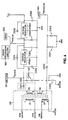
- FIG. 1 is a symbolic block diagram of a switching power supply 100.
- the switching power supply 100 requires a power source, and thus preferably includes means for connection to a power source.
- the switching power supply may suitably have one or more leads 101, 102 for connection to an outlet providing, for example, a 115 AC voltage supply.
- a thermal device 105 is preferably connected in series with one of the leads 101, 102 to prevent the power supply 100 from drawing too much power.
- the power supply 100 also preferably has electromagnetic interference (EMI) reduction and surge protection circuitry 110.
- the power supply 100 may suitably include a rectifier 112 which converts the AC voltage supply to a DC voltage supply. The rectifier 112 may then be connected to energy storage means 114.
- EMI electromagnetic interference
- the power supply 100 further comprises a power steering clamp 116 which is described in greater detail below.
- the power steering clamp 116 may be controlled by a pulse width modulator (PWM) controller 118 and associated circuitry.
- PWM controller 118 also controls a first high power switch Q201.
- An example of a suitable switch Q201 is a high power switch part number IRFR 224 available from the International Rectifier Company.
- Leakage energy may also be released by the transformer 120, and is preferably rerouted back to the energy storage means 114 by the voltage steering clamp 116.
- a desired output voltage V OUT may be obtained from the energy storage means 124.
- the transformer 120 may also be connected to the PWM controller 118 to provide a feedback signal to control the duty cycle of the PWM controller 118.
- FIGS. 2A through 2C form a schematic diagram showing a preferred embodiment of the power supply 100 according to the present invention.
- the thermal device 105 may suitably comprise a fuse connected in series with the lead 101.
- the EMI reduction and surge protection circuitry 110 may suitably comprise a plurality of capacitors C202, C203, C204, C205, and a common mode choke L201, connected in a manner well known in the art as shown in FIG. 2A, to reduce electromagnetic interference.
- a capacitor C201 preferably is connected in parallel with the lead 102 and the thermal device 105.
- the EMI reduction and surge protection circuitry 110 may further comprise a surge or transient suppressor D201.
- a rectifier circuit 112 is connected electrically to the EMI reduction and surge protection circuitry 110 and may suitably comprise a plurality of diodes D202, D203, D204, D205, to form a bridge rectifier as is known in the art and as shown in FIG. 2A.
- the outputs of the rectifier 112 may then be electrically connected to an energy storage means 114, which may suitably comprise a capacitor C210 with one junction connected to the cathode of the diode D204 and the other junction connected to the anode of the diode D203 and connected to high-voltage ground (HVGND).
- HVGND high-voltage ground
- the PWM controller 118 and associated circuitry may comprise a pulse width modulator (PWM) controller U201.
- PWM controller U201 is an SG2844 device, commercially available from the Silicon General Company.
- the PWM controller U201 has two input pins labelled V FB and I SENSE , respectively, and an output pin labelled OUT. Additional pins of the PWM U201 are labelled COMP, RTCT, V REF , V CC , V C , GND, and PGND, as shown.
- the V CC and V C pins supply power to the PWM controller U201 and may be connected electrically to a lead 201, with a capacitor C206 connected between the lead 201 and HVGND.
- the GND and PGND pins of the PWM controller U201 may be tied to HVGND.
- the RTCT and V REF pins may be connected electrically via a resistor R204.
- the RTCT and Vref pins may also be connected to HVGND via capacitors C208 and C209, respectively.
- the V FB pin controls the duty cycle of the PWM controller U201 may be connected to HVGND via a resistor R203.
- the resistor R203 is connected electrically to the junction of another resistor R201 which, in turn, may be connected to the lead 201.
- One junction of a resistor R202 and one junction of a capacitor C207 may be connected electrically to a respective junction of each of the resistors R201, R203, as shown in FIG. 2B.
- the resistor R202 and the capacitor C207 may be connected in parallel and may be connected to the COMP pin of the PWM controller U201, as shown in FIG. 2B.
- the I SENSE pin of the PWM controller U201 is used to sense the amount of current flowing through the first high power switch Q201, which may operate in an on state or an off state, corresponding to the situations where the switch Q201 is closed or open, respectively. Thus, for example, if the current is too high, the PWM controller U201 may be shut off and the switch Q201 opened.
- the switch Q201 may suitably have a gate 20, a drain 21 and a source 22.
- the I SENSE pin may be connected to HVGND via a capacitor C227.
- the I SENSE pin may also be connected to one junction of a resistor R207.
- the resistor R207 may be connected, in turn, to the source 22 of the switch Q201, and to HVGND via another resistor R208.
- the OUT pin of the PWM controller U201 may be connected, via a resistor R206, to the gate 20 of the switch Q201.
- the gate 20 of the switch Q201 is also preferably connected to HVGND via a resistor R209.
- the gate 20 and the source 22 of the switch Q201 are preferably tied together via a capacitor C211.
- the OUT pin of the PWM controller U201 may also be connected to a resistor R222 for connection to driving circuitry associated with the power steering clamp 116, as further explained below.
- the resistors R206, R209, R222 and the capacitor C211 help further reduce electromagnetic interference.
- the power supply of the present invention also includes a power steering clamp 116.
- the power steering clamp 116 preferably comprises a second high power switch Q202, a plurality of clamp diodes D206 and D209, and driving circuitry 117.
- An example of a suitable switch Q202 is an IRFR 9220 device available from the International Rectifier Company.
- Suitable diodes D206, D209 are EGL 41G devices available from General Instrument Company.
- the switch Q202 of the power steering clamp 116 may suitably comprise a gate 23, a drain 24 and a source 25.
- the source 25 of the switch Q202 preferably is tied to the positive junction of the capacitor C210 of FIG. 2A.
- the cathode of the diode D206 preferably is connected electrically to the source 25 of the switch Q202, and the anode of the diode D206 preferably is tied to the drain 21 of the switch Q201.
- the drain 24 of the switch Q202 preferably is tied to the cathode of the diode D209, the anode of which preferably is tied to HVGND, as shown in FIG. 2C.
- the PWM controller U201 controls the second switch Q202 directly via circuitry to drive the gate of the switch Q202.
- the driving circuitry 117 comprises a high power fast inverter U204 and voltage translation circuitry.
- the components of the driving circuitry should be suitable for operating at speeds of approximately 82 KHz.
- a suitable high power fast inverter U204 is an SI 9942 complementary MOSFET high speed inverter available from the Siliconix Company.
- the inverter U204 and the voltage translation circuitry may be ac coupled.
- the voltage translation circuitry may comprise a fast Zener or transient suppressor diode D208 and a capacitor C213, as shown in FIG. 2C.
- Inputs of the inverter U204 may be connected to the OUT pin of the PWH controller U201 via the resistor R222 in FIG. 2B.
- appropriate pins of the inverter U204 may be connected to the lead 201, via a resistor R221, and to HVGND, respectively.
- the output of the inverter U204 may be connected to the anode of a protection diode D216, the cathode of which is also connected to the lead 201.
- the output of the inverter U204 is connected to one junction of the capacitor C213.
- the second junction of the capacitor C213 is connected to the anode of the diode D208, the cathode of which is tied to the source 25 of the switch Q202.
- a resistor R211 may be connected between the second junction of the capacitor C213 and the gate 23 of the switch Q202. Additionally, a capacitor C224 may be connected between the source 25 and the gate 23 of the switch Q202. The resistor R211 and the capacitor C224 help to reduce electromagnetic interference. Finally, a resistor R220 may be connected between the drain 24 and the gate 23 of the switch Q202 as shown in FIG. 2C.
- a suitable diode D208 is a T6L41-15A device available from the General Instrument Company.
- a suitable diode D216 is an SMBD 914 device available from the Motorola Company.
- the resistors R211, R220 and R221 may suitably have the values 47 Ohms, 820 k-Ohms and 56 Ohms, respectively.
- the capacitors C213 and C224 may have the values 47 nF and 2.2 nF, respectively.
- the transformer 120 comprises a primary coil 31, a control coil 32, and at least one secondary coil 33. In certain applications, however, it may be desirable to have more than one secondary coil.
- a pin 1 of the primary coil 31 preferably is connected to the drain 24 of the switch Q202 via a lead 203.
- a pin 2 of the primary coil 31 preferably is tied to the drain 21 of the switch Q201 in FIG. 2B and to the anode of the diode D206 as shown in FIG. 2C.
- a resistor R214 and a capacitor C214, connected in series with one another, preferably are connected across the primary coil 31. The resistor R214 and the capacitor C214 serve further to reduce electromagnetic interference.
- a pin 4 of the control coil 32 of the transformer 120 is preferably connected to HVGND.
- a pin 3 of the control coil 32 is connected to the anode of a diode D210 whose cathode is connected to the lead 201.
- Another capacitor C212 is preferably connected between the cathode of the diode D210 and HVGND.
- a resistor R210 is connected between the cathode of the diode D210 and the pin 1 of the primary coil 31.
- a pin 6 of the secondary coil 33 of the transformer 120 may suitably be connected to GND.
- GND may also be connected, via a capacitor C216, to HVGND to provide further electromagnetic interference reduction.
- a pin 5 of the secondary coil 33 may be connected to the rectifier 122, which may suitably comprise a diode D211 with its anode connected to the pin 5.
- the energy storage means 124 which may suitably comprise a capacitor C215, is connected between the cathode of the diode D211 and pin 6 of the secondary coil 33.
- the desired output voltage V OUT may then be taken from the energy storage means 124 as shown in FIG. 2C.
- FIGS. 2A through 2C The operation of the switching power supply of FIGS. 2A through 2C may be described generally as follows.
- the leads 101, 102 are plugged into an outlet so as to provide, for example, a 115-volt AC voltage supply
- a DC voltage appears across the capacitor C210 in FIG. 2A.
- the voltage at the source 25 of the switch Q202 may be, for example, approximately 160 volts.
- the switch Q202 closes from the effect of the voltage across the resistor R220, and power is applied to the resistor R210.
- the capacitor C206 in FIG. 2B will then charge as well.
- the PWM controller U201 is turned on.
- the PWM controller U201 closes the switch Q201. At the same time, the PWM controller U201 also closes the switch Q202 via the driving circuitry 117. The voltage on the drain 21 of the switch Q201 will become approximately zero volts, while the voltage on the drain 24 of the switch Q202 becomes approximately 160 volts. When the switches Q201, Q202 close, the transformer 120 begins to charge.
- the PWM controller U201 After a short duration of time which depends upon the duty cycle set by the PWM controller U201, the PWM controller U201 opens the switch Q201. At the same time, the PWM controller U201 opens the switch Q202 via the driving circuitry 117. When the switch Q201 opens, the secondary currents in the transformer 120 reverse direction. Thus, the capacitor C215 begins to charge; and its voltage rises to the desired V OUT , which may be, for example, twelve volts. Similarly, the capacitors C206 and C212 charge, thereby supplying power and feedback to the PWM controller U201.
- the voltage on the drain 24 of the switch Q202 falls slightly below ground, thereby forward-biasing the diode D209.
- the voltage on the drain 21 of the switch Q201 will rise slightly above the voltage on the capacitor C210, thereby forward-biasing the diode D206.
- This situation allows transient leakage energy from the transformer 120 to be routed to and stored in the capacitor C210. Rather than being wasted as heat, for example, in an RC system, the energy may be reused during the next cycle of the PWM controller U201.
- Another advantage of rerouting the leakage energy is that the maximum voltages appearing across the switches Q201 and Q202 are maintained at a level less than the maximum voltage appearing across the capacitor C210.
- the pulse width modulator U201 checks the voltage on the capacitor C206. If the voltage on the capacitor C206 is not sufficiently high, then the pulse width modulator U201 again closes the switches Q201 and Q202, and the cycle described above begins again. In particular, the pulse width modulator U201 adjusts the duty cycle so that the voltages across the capacitors C206, C215 remain at approximately the desired levels, for example, sixteen and twelve volts, respectively.
- the present invention is that the switch Q201 is protected from excessively high voltages, as explained above.
- the power supply of the present invention thus permits the use of high power switches which do not have the high voltage tolerances that are often required when using known switching power supplies.
- use of the power steering clamp 116 permits leakage energy to be rerouted subsequently to the capacitor 120. This feature may improve the efficiency of the power supply by as much as ten percent, and also avoids the need for heat sinks to prevent overheating of circuit components.
- the present invention may thus suitably be used as a cool operating power supply in high density devices.
- FIG. 3 shows an alternative embodiment of the power steering clamp 116 of FIG. 1 according to the present invention.
- the power steering clamp 116 comprises the switch Q202, the clamp diodes D206 and D209, and driving circuitry to drive the gate 23 of the switch Q202.
- the switch is controlled indirectly by the PWM controller U201.
- the driving circuitry for the switch Q202 is coupled to the drain 21 of the switch Q201 so that the two switches Q201 and Q202 are effectively coupled together.
- the driving circuitry for the switch Q202 comprises a transient suppressor diode D308, a diode D307, a capacitor C313, and a plurality of resistors R311, R312, R313, arranged as shown.
- the cathode of the diode D308 preferably is tied to the source 25 of the switch Q202, and its anode preferably is tied to the gate 23 of the switch Q202.
- At least one resistor may be connected between the gate 23 of the switch Q202 and the drain 221 of the switch Q201.
- the two resistors R312 and R313 are connected in series between the gate 23 of the switch Q202 and the drain 21 of the switch Q201.
- one junction of the capacitor C313 preferably is tied to the gate 23 of the switch Q202 and the anode of the diode D308.
- the diode D307 and the resistor R311 preferably are connected in parallel and are connected between the second junction of the capacitor C313 and the drain 21 of the switch Q201 such that the anode of the diode D307 is tied to the drain 21 of the switch Q201.
- a suitable diode D307 is an EGL 41G device available from the General Instrument Company.
- a suitable diode D308 is a T6L41-15A device also available from the General Instrument Company.
- the resistors R311, R312 and R313 may suitably have values of 2.2 k-Ohm, 120 k-Ohm, and 120 k-Ohm, respectively.
- the capacitor C213 may suitably have the value of 1 nF.
- FIG. 4 shows additional circuitry which may be used where the switching power supply of the present invention is to be used as part of a bill validator.
- the additional circuitry shown in FIG. 4 provide the secondary voltages needed to operate certain bill validators by providing the required power supply signals to other components of the bill validator.
- Typical secondary voltages may include, for example, V MOTOR which provides power for one or more motors 301, V ANALOG which provides power for signal processing circuitry 302, such as operational amplifiers, and one or more light emitting diodes (LEDs) or other light emitting devices 303, V RECOGNITION which drives one or more high powered or other LEDs 304, and V CC .
- V MOTOR which provides power for one or more motors 301
- V ANALOG which provides power for signal processing circuitry 302, such as operational amplifiers, and one or more light emitting diodes (LEDs) or other light emitting devices 303, V RECOGNITION which drives one or more high powered or other LEDs 304, and V CC .
- LEDs light emitting diodes
- V RECOGNITION which drives one or more high powered or other LEDs 304
- V CC high powered or other LEDs
- the transformer 120 may suitably comprise the primary coil 31, the control coil 32, the secondary coil 33, and an additional secondary coil 34.
- the primary coil 31 and the control coil 32 of the transformer 120 in FIG. 4 may be suitably connected to the same circuitry as the primary and control coils of the transformer 120 of FIG. 2C.
- the pin 6 of the secondary coil 33 may suitably be connected to GND.
- GND may also be connected, via a capacitor C316, to HVGND to provide further electromagnetic interference reduction.
- the pin 5 of the secondary coil 33 may be connected to the rectifier 122, which may suitably comprise the diode D311 with its anode connected to the pin 5.
- the energy storage means 124 which may suitably comprise a capacitor C315, may be connected between the cathode of the diode D311 and pin 6 of the secondary coil 33.
- V MOTOR may be taken from the energy storage means 124 so as to provide, for example, a 12-volt voltage supply.
- the motors 301 then may be connected, for example, to this 12-volt power supply signal.
- Voltage regulators VR301, VR302 with corresponding feedback diodes D314, D315 and capacitors C319, C320, C322 and C325, may be configured in a known manner to provide V ANALOG and V CC , as shown in FIG. 4.
- Suitable voltage regulators VR301, VR302 are 78M08 and 78L05 devices, respectively, which are available from National Semiconductor Corporation.
- the operational amplifiers 302 and the light emitting devices 303 may be connected to receive the V ANALOG .
- pin 6 of the secondary coil 33 and a pin 7 of the secondary coil 34 may be connected to the GND.
- a pin 8 of the secondary coil 34 may then be connected to the anode of a diode D313 and associated capacitors C321, C323 as shown in FIG. 3 to provide V RECOGNITION .
- High powered and other light emitting devices 304 then may be connected to V RECOGNITION .
- the motors 301, the signal processing circuitry 302, and the LEDs 303, 304 are electrically connected to the secondary coils of the transformer 120 so as to receive the required power supplies for proper operation of the bill validator.
Landscapes
- Engineering & Computer Science (AREA)
- Power Engineering (AREA)
- Dc-Dc Converters (AREA)
Claims (10)
- Alimentation à découpage comprenant :dans lequel ladite diode de pince (D206) est connectée entre le drain (21) et le premier commutateur (Q201) et la source du second commutateur (Q202) ; etun moyen de stockage d'énergie (114, C210) ayant une jonction positive et une jonction négative, ledit moyen de stockage d'énergie étant directement connecté à une alimentation en tension continue ;un contrôleur de modulateur de largeur d'impulsion (118) ;un premier commutateur (Q201) et un second commutateur (Q202), les deux commutateurs pouvant être entraínés de manière simultanée pour être dans une position ouverte ou dans une position fermée, par le contrôleur de modulateur de largeur d'impulsion (118) ;un transformateur (120), comprenant un enroulement primaire (31) connecté au moyen de stockage d'énergie (114, C210) et au dispositif d'alimentation en tension continue via le second commutateur (Q202), dans lequel de l'énergie s'écoule depuis le moyen de stockage d'énergie (114, C210) jusqu'au transformateur (120) lorsque le premier commutateur (Q201) et le second commutateur (Q202) sont fermés ; etune pince de servodirection (116) comprenant une première diode de pince (D206), dans laquelle la première diode de pince (D206) oriente l'énergie de fuite depuis l'enroulement primaire du transformateur (120) jusqu'au moyen de stockage d'énergie (114) lorsque le premier commutateur (Q201) et le second commutateur (Q202) sont ouverts, caractérisé en ce quechacun du premier commutateur (Q201) et du second commutateur (Q202) est un transistor à effet de champ ayant une source, un drain et une porte ;
dans lequel la pince de servodirection (116) comprend en outre une seconde diode de pince (D209) connectée entre le drain du second commutateur (Q202) et le fond (HVGND) du moyen de stockage d'énergie ; disposé de manière à ce que :la source (25) du second commutateur (Q202) soit connectée à la jonction positive du moyen de stockage d'énergie (114, C210) ;le drain (24) du second commutateur (Q202) soit connecté à un premier axe (1) de l'enroulement primaire (31) du transformateur (120) ;le premier axe (1) de l'enroulement primaire (31) du transformateur (120) soit connecté à une cathode de seconde diode de pince (D209) ;une anode de la seconde diode de pince (D209) soit connectée au fond (HVGND) du moyen de stockage d'énergie (114, C210) ;un second axe (2) de l'enroulement primaire (31) du transformateur (120) soit connecté au drain (21) du premier commutateur (Q201) et à une anode de la diode de la première pince (D206) ;la source (22) du premier commutateur (Q201) soit connectée au fond (EVGND) du moyen de stockage d'énergie (114, C210) ; etla cathode de la première diode de pince (D206) soit connectée à la source (25) du second commutateur (Q202) et ainsi à la jonction positive du moyen de stockage d'énergie (114, C210). - Alimentation à découpage selon la revendication 1, dans laquelle le moyen de stockage d'énergie est un condensateur (C210).
- Alimentation à découpage selon la revendication 1 ou la revendication 2, destinée à être utilisée dans un validateur de factures dans lequel le transformateur (120) a au moins une bobine primaire (31) et une bobine secondaire (33),
et la au moins une bobine secondaire (33) est appropriée pour être connectée de manière électrique à au moins un moteur (301), un circuit de traitement de signal (302), et au moins un dispositif émetteur de lumière (303, 304). - Alimentation à découpage selon la revendication 3, dans laquelle le circuit pour entraíner la porte du second commutateur (Q202) est contrôlé par le contrôleur de modulateur de largeur d'impulsion (118) et comprend :un inverseur de puissance (U204) ; etun circuit de translation de tension.
- Alimentation à découpage selon la revendication 4, dans laquelle le circuit de translation de tension est couplé par courant alternatif à l'inverseur de puissance (U204).
- Alimentation à découpage selon la revendication 4, dans laquelle le circuit de translation de tension comprend :une diode de grille d'arrêt transitoire (D208) ayant une anode et une cathode, dans laquelle la cathode est attachée à la source du second commutateur (Q202) ; etun condensateur (C213) connecté entre l'anode et l'inverseur de puissance (U204).
- Alimentation à découpage selon la revendication 4, dans laquelle l'inverseur de puissance (U204) est un inverseur rapide MOSFET complémentaire.
- Alimentation à découpage selon la revendication 4, dans laquelle l'inverseur de puissance (U204) est approprié pour fonctionner à environ 82 KHz.
- Alimentation à découpage selon l'une quelconque des revendications précédentes, dans laquelle le moyen de stockage d'énergie comprend un condensateur (C210).
- Alimentation à découpage selon la revendication 9, dans laquelle le circuit entraínant la porte du second commutateur comprend :(a) une diode grille d'arrêt transitoire (D208) ayant une anode et une cathode, dans laquelle la cathode (D208) est attachée à la source du second commutateur (Q202) et l'anode est attachée à la porte du second commutateur (Q202) ;(b) au moins une résistance (R220, R221) connectée entre la porte du second commutateur (Q202) et le drain du premier commutateur (Q201) ;(c) un condensateur (C224) avant deux jonctions, dans lequel une jonction est attachée à la porte du second commutateur (Q202) ; et(d) une diode (D208) ayant une anode et une cathode, dans laquelle la diode est connectée entre la seconde jonction du condensateur (C224) et le drain du premier commutateur (Q201), de sorte que la cathode de la diode (D208) est connectée à la seconde jonction du condensateur (C224).
Applications Claiming Priority (3)
| Application Number | Priority Date | Filing Date | Title |
|---|---|---|---|
| US376932 | 1995-01-23 | ||
| US08/376,932 US5600545A (en) | 1995-01-23 | 1995-01-23 | Apparatus and method for a switching power supply with a power steering clamp |
| PCT/US1996/001637 WO1996023345A1 (fr) | 1995-01-23 | 1996-01-22 | Procede et appareil d'alimentation d'energie de commutation |
Publications (3)
| Publication Number | Publication Date |
|---|---|
| EP0806074A2 EP0806074A2 (fr) | 1997-11-12 |
| EP0806074A4 EP0806074A4 (fr) | 1999-08-11 |
| EP0806074B1 true EP0806074B1 (fr) | 2004-10-13 |
Family
ID=23487088
Family Applications (1)
| Application Number | Title | Priority Date | Filing Date |
|---|---|---|---|
| EP96905395A Expired - Lifetime EP0806074B1 (fr) | 1995-01-23 | 1996-01-22 | Alimentation a decoupage avec moyens pour recuperer l'energie de fuite du transformateur |
Country Status (7)
| Country | Link |
|---|---|
| US (1) | US5600545A (fr) |
| EP (1) | EP0806074B1 (fr) |
| AU (1) | AU4916896A (fr) |
| CA (1) | CA2209186C (fr) |
| DE (1) | DE69633608T2 (fr) |
| ES (1) | ES2229262T3 (fr) |
| WO (1) | WO1996023345A1 (fr) |
Families Citing this family (3)
| Publication number | Priority date | Publication date | Assignee | Title |
|---|---|---|---|---|
| US7916505B2 (en) * | 2008-03-06 | 2011-03-29 | Enphase Energy, Inc. | Method and apparatus for a leakage energy recovery circuit |
| US7770039B2 (en) * | 2008-05-29 | 2010-08-03 | iGo, Inc | Primary side control circuit and method for ultra-low idle power operation |
| US20140159608A1 (en) * | 2009-11-11 | 2014-06-12 | Osram Sylvania Inc. | Driver circuit for dimmable solid state light sources with filtering and protective isolation |
Citations (1)
| Publication number | Priority date | Publication date | Assignee | Title |
|---|---|---|---|---|
| DE1956145A1 (de) * | 1969-11-07 | 1971-05-19 | Siemens Ag | Schaltung zur Unterdrueckung von Spannungsspitzen an Transistoren |
Family Cites Families (7)
| Publication number | Priority date | Publication date | Assignee | Title |
|---|---|---|---|---|
| DE3007597C2 (de) * | 1980-02-28 | 1982-04-15 | Siemens Ag, 1000 Berlin Und 8000 Muenchen | Schutzbeschaltungsanordnung für Halbleiterschalter |
| US4639849A (en) * | 1985-05-08 | 1987-01-27 | International Exide Electronics/Corporation | Snubber circuit for H.F. bridge converter |
| US5019957A (en) * | 1989-07-24 | 1991-05-28 | Wilkinson Bruce L | Forward converter type of switched power supply |
| FR2654878B1 (fr) * | 1989-11-23 | 1993-11-12 | Commissariat A Energie Atomique | Systeme d'alimentation electrique impulsionnelle d'une charge, muni de moyens pour derouter l'energie electrique susceptible d'etre reflechie par la charge. |
| JPH04354266A (ja) * | 1991-05-30 | 1992-12-08 | Sony Corp | 高圧安定化回路 |
| FR2688360B1 (fr) * | 1992-03-09 | 1997-06-27 | Merlin Gerin | Convertisseur a decoupage avec recuperation d'energie. |
| US5377091A (en) * | 1994-01-28 | 1994-12-27 | Compaq Computer Corporation | Power converter having regeneration circuit for reducing oscillations |
-
1995
- 1995-01-23 US US08/376,932 patent/US5600545A/en not_active Expired - Fee Related
-
1996
- 1996-01-22 AU AU49168/96A patent/AU4916896A/en not_active Abandoned
- 1996-01-22 WO PCT/US1996/001637 patent/WO1996023345A1/fr not_active Ceased
- 1996-01-22 EP EP96905395A patent/EP0806074B1/fr not_active Expired - Lifetime
- 1996-01-22 CA CA002209186A patent/CA2209186C/fr not_active Expired - Fee Related
- 1996-01-22 ES ES96905395T patent/ES2229262T3/es not_active Expired - Lifetime
- 1996-01-22 DE DE69633608T patent/DE69633608T2/de not_active Expired - Fee Related
Patent Citations (1)
| Publication number | Priority date | Publication date | Assignee | Title |
|---|---|---|---|---|
| DE1956145A1 (de) * | 1969-11-07 | 1971-05-19 | Siemens Ag | Schaltung zur Unterdrueckung von Spannungsspitzen an Transistoren |
Also Published As
| Publication number | Publication date |
|---|---|
| DE69633608T2 (de) | 2006-02-16 |
| WO1996023345A1 (fr) | 1996-08-01 |
| EP0806074A2 (fr) | 1997-11-12 |
| CA2209186A1 (fr) | 1996-08-01 |
| ES2229262T3 (es) | 2005-04-16 |
| US5600545A (en) | 1997-02-04 |
| CA2209186C (fr) | 2005-08-16 |
| EP0806074A4 (fr) | 1999-08-11 |
| AU4916896A (en) | 1996-08-14 |
| DE69633608D1 (de) | 2004-11-18 |
Similar Documents
| Publication | Publication Date | Title |
|---|---|---|
| US7592790B2 (en) | Start-up circuit with feedforward compensation for power converters | |
| US7042178B2 (en) | Motor driving apparatus | |
| US5909360A (en) | Uninterruptible power supplies | |
| US20030169606A1 (en) | Start-up circuit for switched mode power supply | |
| US4438486A (en) | Low loss snubber for power converters | |
| EP0973246A1 (fr) | Contrôleur pour redresseur synchrone et convertisseur de puissance employant ce contrôleur | |
| US6493245B1 (en) | Inrush current control for AC to DC converters | |
| KR19980046508A (ko) | 배터리 충전회로 | |
| US10903751B2 (en) | Method and system of driving an electrically controlled switch with a snubber capacitor | |
| EP0914706A1 (fr) | Alimentation a decoupage dotee d'un circuit de mise en marche perfectionne | |
| US6115268A (en) | Method and apparatus for supplying uninterrupted power | |
| EP0806074B1 (fr) | Alimentation a decoupage avec moyens pour recuperer l'energie de fuite du transformateur | |
| EP0854563B1 (fr) | Convertisseur continu-continu à découpage à faible puissance et domaine étendu de tension d'entrée | |
| US6018473A (en) | Power supply and printing machine containing same | |
| CN1441991B (zh) | 具有检测反馈环断路功能的开关式电源 | |
| US6661209B2 (en) | Leading edge modulator for post regulation of multiple output voltage power supplies | |
| ITMI941072A1 (it) | Dispositivo per l'alimentazione di carichi elettrici e del circuito di accensione di motori a scoppio di veicoli a motore | |
| US4837670A (en) | Bias source for a switchmode converter | |
| US6046916A (en) | High and low d.c. voltage power supply | |
| US5712775A (en) | Startup protecting for a switch mode power supply | |
| EP1376838A1 (fr) | Convertisseur alimenté en courant avec circuit de verrouillage à récupération d'énergie | |
| US12283891B1 (en) | Switched-mode power supply startup circuit | |
| EA038303B1 (ru) | Способ и устройство рекуперации энергии рассеяния трансформатора обратноходового преобразователя | |
| JP2974114B2 (ja) | コンバータ | |
| JP3351221B2 (ja) | スイッチング電源装置 |
Legal Events
| Date | Code | Title | Description |
|---|---|---|---|
| PUAI | Public reference made under article 153(3) epc to a published international application that has entered the european phase |
Free format text: ORIGINAL CODE: 0009012 |
|
| 17P | Request for examination filed |
Effective date: 19970822 |
|
| AK | Designated contracting states |
Kind code of ref document: A2 Designated state(s): CH DE ES FR GB LI SE |
|
| RAP1 | Party data changed (applicant data changed or rights of an application transferred) |
Owner name: MARS, INCORPORATED |
|
| RAP1 | Party data changed (applicant data changed or rights of an application transferred) |
Owner name: MARS, INCORPORATED |
|
| A4 | Supplementary search report drawn up and despatched |
Effective date: 19990630 |
|
| AK | Designated contracting states |
Kind code of ref document: A4 Designated state(s): CH DE ES FR GB LI SE |
|
| 17Q | First examination report despatched |
Effective date: 20001218 |
|
| GRAP | Despatch of communication of intention to grant a patent |
Free format text: ORIGINAL CODE: EPIDOSNIGR1 |
|
| RTI1 | Title (correction) |
Free format text: SWITCHING POWER SUPPLY WITH MEANS FOR RECOVERING LEAKAGE ENERGY FROM THE TRANSFORMER |
|
| RTI1 | Title (correction) |
Free format text: SWITCHING POWER SUPPLY WITH MEANS FOR RECOVERING LEAKAGE ENERGY FROM THE TRANSFORMER |
|
| GRAS | Grant fee paid |
Free format text: ORIGINAL CODE: EPIDOSNIGR3 |
|
| GRAA | (expected) grant |
Free format text: ORIGINAL CODE: 0009210 |
|
| AK | Designated contracting states |
Kind code of ref document: B1 Designated state(s): CH DE ES FR GB LI SE |
|
| PG25 | Lapsed in a contracting state [announced via postgrant information from national office to epo] |
Ref country code: LI Free format text: LAPSE BECAUSE OF FAILURE TO SUBMIT A TRANSLATION OF THE DESCRIPTION OR TO PAY THE FEE WITHIN THE PRESCRIBED TIME-LIMIT Effective date: 20041013 Ref country code: FR Free format text: LAPSE BECAUSE OF FAILURE TO SUBMIT A TRANSLATION OF THE DESCRIPTION OR TO PAY THE FEE WITHIN THE PRESCRIBED TIME-LIMIT Effective date: 20041013 Ref country code: CH Free format text: LAPSE BECAUSE OF FAILURE TO SUBMIT A TRANSLATION OF THE DESCRIPTION OR TO PAY THE FEE WITHIN THE PRESCRIBED TIME-LIMIT Effective date: 20041013 |
|
| REG | Reference to a national code |
Ref country code: GB Ref legal event code: FG4D |
|
| REG | Reference to a national code |
Ref country code: CH Ref legal event code: EP |
|
| REF | Corresponds to: |
Ref document number: 69633608 Country of ref document: DE Date of ref document: 20041118 Kind code of ref document: P |
|
| PG25 | Lapsed in a contracting state [announced via postgrant information from national office to epo] |
Ref country code: SE Free format text: LAPSE BECAUSE OF FAILURE TO SUBMIT A TRANSLATION OF THE DESCRIPTION OR TO PAY THE FEE WITHIN THE PRESCRIBED TIME-LIMIT Effective date: 20050113 |
|
| PGFP | Annual fee paid to national office [announced via postgrant information from national office to epo] |
Ref country code: GB Payment date: 20050119 Year of fee payment: 10 |
|
| PGFP | Annual fee paid to national office [announced via postgrant information from national office to epo] |
Ref country code: DE Payment date: 20050120 Year of fee payment: 10 |
|
| PGFP | Annual fee paid to national office [announced via postgrant information from national office to epo] |
Ref country code: ES Payment date: 20050211 Year of fee payment: 10 |
|
| REG | Reference to a national code |
Ref country code: ES Ref legal event code: FG2A Ref document number: 2229262 Country of ref document: ES Kind code of ref document: T3 |
|
| REG | Reference to a national code |
Ref country code: CH Ref legal event code: PL |
|
| PLBE | No opposition filed within time limit |
Free format text: ORIGINAL CODE: 0009261 |
|
| STAA | Information on the status of an ep patent application or granted ep patent |
Free format text: STATUS: NO OPPOSITION FILED WITHIN TIME LIMIT |
|
| 26N | No opposition filed |
Effective date: 20050714 |
|
| EN | Fr: translation not filed | ||
| PG25 | Lapsed in a contracting state [announced via postgrant information from national office to epo] |
Ref country code: GB Free format text: LAPSE BECAUSE OF NON-PAYMENT OF DUE FEES Effective date: 20060122 |
|
| PG25 | Lapsed in a contracting state [announced via postgrant information from national office to epo] |
Ref country code: ES Free format text: LAPSE BECAUSE OF NON-PAYMENT OF DUE FEES Effective date: 20060123 |
|
| PG25 | Lapsed in a contracting state [announced via postgrant information from national office to epo] |
Ref country code: DE Free format text: LAPSE BECAUSE OF NON-PAYMENT OF DUE FEES Effective date: 20060801 |
|
| GBPC | Gb: european patent ceased through non-payment of renewal fee |
Effective date: 20060122 |
|
| REG | Reference to a national code |
Ref country code: ES Ref legal event code: FD2A Effective date: 20060123 |