EP0806353A1 - Vorrichtung zum automatischen Herstellen von Aufguss - Google Patents
Vorrichtung zum automatischen Herstellen von Aufguss Download PDFInfo
- Publication number
- EP0806353A1 EP0806353A1 EP97830192A EP97830192A EP0806353A1 EP 0806353 A1 EP0806353 A1 EP 0806353A1 EP 97830192 A EP97830192 A EP 97830192A EP 97830192 A EP97830192 A EP 97830192A EP 0806353 A1 EP0806353 A1 EP 0806353A1
- Authority
- EP
- European Patent Office
- Prior art keywords
- station
- machine
- bags
- strip
- axes
- Prior art date
- Legal status (The legal status is an assumption and is not a legal conclusion. Google has not performed a legal analysis and makes no representation as to the accuracy of the status listed.)
- Granted
Links
Images



Classifications
-
- B—PERFORMING OPERATIONS; TRANSPORTING
- B65—CONVEYING; PACKING; STORING; HANDLING THIN OR FILAMENTARY MATERIAL
- B65B—MACHINES, APPARATUS OR DEVICES FOR, OR METHODS OF, PACKAGING ARTICLES OR MATERIALS; UNPACKING
- B65B57/00—Automatic control, checking, warning, or safety devices
- B65B57/10—Automatic control, checking, warning, or safety devices responsive to absence, presence, abnormal feed, or misplacement of articles or materials to be packaged
- B65B57/16—Automatic control, checking, warning, or safety devices responsive to absence, presence, abnormal feed, or misplacement of articles or materials to be packaged and operating to stop, or to control the speed of, the machine as a whole
-
- B—PERFORMING OPERATIONS; TRANSPORTING
- B65—CONVEYING; PACKING; STORING; HANDLING THIN OR FILAMENTARY MATERIAL
- B65B—MACHINES, APPARATUS OR DEVICES FOR, OR METHODS OF, PACKAGING ARTICLES OR MATERIALS; UNPACKING
- B65B29/00—Packaging of materials presenting special problems
- B65B29/02—Packaging of substances, e.g. tea, which are intended to be infused in the package
- B65B29/028—Packaging of substances, e.g. tea, which are intended to be infused in the package packaging infusion material into filter bags
Definitions
- the present invention relates to a machine intended for the automated manufacture of filter bags filled with infusionable substances, for example tea, herbal powders and similar products.
- automatic machines of the type in question comprise a series of stations arranged along a substantially horizontal pass line, by which single bags of the infusionable substance are fashioned and made ready for packaging into boxes.
- a continuous strip of filter paper is drawn from a roll and divided longitudinally into two halves; the first half is directed beneath a station from which measures of the infusionable substance are dispensed singly, or alternatively in pairs arranged two abreast, whilst the second half is made to by-pass the dispensing station and then assume a position over the first half, covering the single or paired measures of the substance already deposited on the paper.
- the station next in sequence, or rather positioned following the dispenser along the pass line, comprises means by which to heat seal the external border of the two joined halves and, where the bags are fashioned in pairs, also the mid-line dividing the measures of the infusionable substance lying two abreast on the first half; such heat seal means will consist, typically, in a pair of rollers counter-rotating about respective horizontal axes and positioned one directly above the other.
- the continuous strip of bags fashioned in this way is advanced along a table toward a station at which it is severed longitudinally by means of a special cutter, and thereafter through a further station at which it is divided transversely by a second rotary cutter into a plurality of single bags.
- the discrete bags are then stacked in pairs at a station immediately beyond the transverse cutting station. More exactly, the bags are stacked in a given predeterminable number internally of a vertical duct, then, after descending vertically, released onto a moving horizontal surface and conveyed toward subsequent stations either incorporated into or separate from the machine, by which the end product is packed into boxes.
- Each machine unit operating at the various stations mentioned above (dispenser, heat seal rollers, cutters and stackers) is set in motion by a drive system which normally will be centralized, and connected with the single units by way of mechanical transmission links comprising gears, chains or belts; the drive ratios and proportions of these are selected according to the output required from each unit, so as to maintain the production of bags steady and correct, or according to the dimensions of the end product.
- the machine operates to certain key parameters, namely the size of the filter bag, which if changed will require adaptation or replacement of the heat seal rollers and the dispenser, and the final packaging format, i.e. the number of bags or pairs of bags destined to make up one box.
- Machines structured after this fashion by now have a long pedigree and are able to combine high output per unit of time with an appreciable guarantee of quality in respect of the finished product, but tend at the same time to betray a certain lack of "flexibility" as regards the material requirements of the manufacturer, typically the need to change quickly to a different packaging format (number of bags per box) for a given market, and possibly to make minor alterations to the size and/or shape of the bag.
- To change the setup of such a machine it becomes necessary on each occasion to alter the drive ratio for each one of the stations affected by the change, making manual adjustments to the transmission link between the drive system and the machine unit and thus changing the positions occupied by the units at the start of the cycle. This is done for example with the aid of a circular graduated scale fitted to each gear, which can be used to set a new "zero" or starting point for the unit, or perhaps by changing the transmission link wholly or in part.
- the object of the invention is to provide a machine for the automated manufacture of filter bags containing infusionable substances, designed in such a way that the output per unit of time and the ultimate packaging format can be changed automatically without the machine itself having to stand still for prolonged periods and with no need for mechanical adjustments to made directly to any of its component parts, beyond the obvious replacement of machine units or assemblies directly influenced by the shape and size of the bag, namely the dispenser, heat seal rollers etc.; instead, the angular position of the shafts driving the various machine units is controlled directly in such a manner that the motors can be retimed in a few moments and the operating cycle of the machine restarted without delay.
- the present invention relates to an automatic machine for the continuous production of filter bags 1 containing an infusionable substance (typically tea leaves, camomile flowers, etc.).
- an infusionable substance typically tea leaves, camomile flowers, etc.
- the bag 1 (see fig 2) is of the type fashioned from two breasted strips 2 and 3 of filter paper enveloping a measure 4 of the substance and heat sealed together at the edges.
- Fig 2 shows a continuous strip of such bags 1 which in the particular example illustrated are generated in pairs two abreast by the various units of the machine for reasons concerned purely with output, albeit the principle clearly would stay the same were the bags to be generated in a single file utilizing two narrower strips: in short, the inventive concept underlying the machine remains unaffected.
- the machine in question incorporates a succession of stations (see fig 1) arranged along a horizontal pass line indicated by the arrow denoted A.
- a station 5 Located first in sequence along the pass line A is a station 5 at which a continuous film F of filter paper is decoiled from a bulk roll 6 secured to a freely revolving pivot 37; the film can be fed initially in one piece and then divided as in the example of the drawings, or alternatively, two separate rolls might be utilized.
- the decoiling film F is directed by way of transfer rollers 38 toward longitudinal cutting means 7, shown in the drawings as a circular cutter 7c anchored to a fixed structure 36 of the machine, and divided into two films F2 and F3 of identical width that will be heat sealed together ultimately to fashion the bag 1 (as discernible from fig 2).
- the first strip 2 or first film F2 is directed into a second station 8 from which measures 4 of the infusionable substance are dispensed through the agency of metering means 9 embodied as a revolving drum 39 and set in motion by a relative motor 8m; the measures 4 are deposited pair by pair in succession on the advancing strip 2, two abreast (see fig 2).
- the drum 39 receives the substance from a hopper unit 40 (conventional in embodiment and therefore illustrated only in part) mounted above and connected to the drum.
- the second strip 3 or second film F3 advances toward the second station 8, which it joins at a given point beyond the revolving drum 39: in practice the second strip 3 is caused to by-pass the second station 8, being diverted instead through transfer means 10 afforded by a set of idle rollers 10r positioned above the drum 39, thereafter descending and covering the first strip 2 with the measures 4 already in place.
- This third station comprises a pair of contrarotating rollers 11a and 11b set in motion by a drive comprising a single motor 11m and a timing belt 41; the two rollers 11a and 11b present a contoured and heated contact surface (conventional in embodiment and therefore indicated only in part) such as will seal a peripheral area of the strips 2 and 3 circumscribing each measure 4 (the outline will be selected on the basis of packaging and marketing requirements) and thus generate a plurality of single bags 1, still united in a continuous strip and advancing in pairs two abreast (as indicated to advantage in fig 2).
- the two contrarotating rollers 11a and 11b are mounted overhung, each rotatable about a pivot coinciding with the relative horizontal axis of rotation, denoted 11ay and 11by.
- the pivots 11ay and 11by are associated permanently, to the front of the machine, with relative moving arms 42 associated in their turn at the rear of the machine with respective ends of a pair of rods 25 and 26; the two rods combine to create a toggle mechanism 27, connected pivotably to the end of a pneumatic actuator 28 (a cylinder in practice) disposed horizontally and anchored to the aforementioned fixed structure 36, by which the two rollers 11a and 11b can be drawn together and spread apart respectively at the start of a cycle and when the cycle is interrupted, in response to control media that will be described more fully in due course.
- a pneumatic actuator 28 a cylinder in practice
- the advancing strip of bags 1 is cut longitudinally at a sixth station 12 through the agency of a second circular cutter 13 and divided into two halves, with the result that two parallel files of bags 1 are generated (the numbering of the stations is derived from the chronology of the appended claims, hence the slight discrepancy in terms of descriptive sequence when reading the specification).
- the second longitudinal cutter 13 (see figs 1 and 4) is positioned beneath the pass line A followed by the continuous strip of bags 1, whilst the station 12 also comprises a reaction wheel 29 located above the cutter 13 and the strip, mounted rotatably to a block 30 secured to the fixed structure 36 of the machine. 29a denotes a pair of pinch wheels positioned immediately preceding the cutter 13.
- the strip of bags 1 (not separated longitudinally as yet) can be restrained by means of a clamp element 31 located between the two wheels 29 and 29a and anchored to the selfsame block 30, of which the operative end portion is capable of movement vertically between an inactive raised position, distanced from the strip in such a manner as to allow its advance, and an active lowered position of stable contact in which the strip is prevented both from advancing any further and from returning toward the third station 11 in the event of the operating cycle being interrupted.
- a clamp element 31 located between the two wheels 29 and 29a and anchored to the selfsame block 30, of which the operative end portion is capable of movement vertically between an inactive raised position, distanced from the strip in such a manner as to allow its advance, and an active lowered position of stable contact in which the strip is prevented both from advancing any further and from returning toward the third station 11 in the event of the operating cycle being interrupted.
- a fourth station 14 comprising a first cutter 15, consisting in a roller 15r fitted with a double edged blade, in such a way as to generate the discrete bags (see fig 2); the cutter 15 is driven by a relative motor 14m, which also transmits rotation to the second cutter 13 by way of a further timing belt 14c.
- the cut bags 1 are collected and stacked at a fifth station 16 through the agency of means 17 by which the stacks are formed according to subsequent packaging requirements and in predetermined number.
- the means 17 in question are embodied as a vertical duct 32 with open top and bottom ends by which the single bags 1 are accommodated two abreast, one on top of another (creating a pair of stacks P1 and P2 each composed of single bags), and supported initially on two bearers 48 before dropping down onto a movable platform denoted 33.
- the bearers 48 are essentially C-shaped, and positioned facing one another with the active top finger ends insertable through respective slots afforded by the walls of the duct 32; the bottom ends are pivotably associated with a support 49 which is secured in its turn to a belt 50 driven by a further motor 48m, in such a way that the bearers 48 can be set in motion along the duct 32.
- the bearers 48 are designed to spread apart and draw together respectively into open and closed positions, utilizing the pivotable association mentioned above (see fig 4): anchored by their bottom ends to the piston rod 48a of a vertically disposed actuator 48p associated rigidly with the support 49, the bearers 48 can be distanced from one another by the actuator 48p (as illustrated in fig 4) when the stack of bags 1 is due to drop onto the platform 33, then drawn together to create a temporary second platform above and thus separate the stacked bags 1, already deposited on the movable platform 33 and descending toward the bottom of the duct 32, from the cut bags continuing to enter above and destined to make up the next package.
- the platform 33 is capable of ascending and descending movement within the duct 32, its operation timed in relation to the opening and closing movement of the bearers 48 in such a way that bags 1 can be assembled in the numbers required for subsequent packaging steps at other stations.
- the platform 33 is rigidly associated with a support element 43 capable of sliding along a rod 44 anchored to the fixed structure 36 of the machine; the support element 43 is set in motion by way of a lever arm 45 pivotably associated at one end with the element and at the opposite end with the fixed structure 36, and coupled also to a crank mechanism comprising a rod 46 of which one is anchored to a slot 45a afforded by the arm 45 and the remaining end to a wheel 47 driven by a motor denoted 16m.
- the arm 45 is invested with alternating motion and the platform 33 supporting the bags 1 will rise and fall with each revolution of the power driven wheel 47.
- a diverter 51 located at the bottom of the duct 32 directs the two stacks P1 and P2 of bags 1 in a horizontal direction toward the aforementioned packaging stations (not illustrated in the drawings, being conventional in embodiment and no more than incidental to the present invention).
- the diverter 51 is set in motion by a rod 52 connected via a transmission link, denoted 53 in its entirety, to a cam 47c which is also connected to the motor 16m driving the platform in such a way that the diverter and platform 51 and 33 are permanently synchronized.
- an arm 34 by which the bags 1 are directed forcibly into the duct 32; disposed transversely to the duct and anchored by way of a fulcrum pivot 35 to the fixed structure 36 of the machine, the arm 34 is caused to alternate in time with the movements of the remaining stations, being connected likewise to the motor 14m driving the first cutter 15, and to move in a vertical direction V in such a way that its free end 34a will impinge firmly on the bags 1 advancing from the first cutter 15, thus favouring and ensuring their correct entry into the duct 32.
- the main machine units at the majority of the stations described thus far, and in particular the dispensing station 8, the heat seal station 11, the transverse cutting station 14 and the stacking station 16, are driven by dedicated motors, i.e. 8m, 11m, 14m and 16m respectively, also 48m in the case of the bearers 48; each motor operates both independently of and in timed coordination with the remainder, providing e.m.f. for a respective machine axis 8x, 11x, 14x, 16x and 48x of which the angular position is controlled electrically.
- each single axis 8x, 11x, 14x, 16x and 48x performing a given work cycle in the machine is controlled independently in respect of predetermined operating parameters (described in due course) by way of elements connected directly and indirectly to the movement of the selfsame axis.
- one of these electrically controlled axes, and in particular the axis 14x driving the first or transverse cutter 15, provides the master axis to which all remaining axes are referred: in this way, it becomes possible to establish operating parameters for the start of the cycle or for changing these selfsame parameters during the cycle.
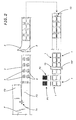
- axis signifying the electric motor together with the unit 8g, 11g, 14g, 16g and 48g by which its operation is controlled (as indicated in the diagram of fig 3) are interlocked to a monitoring and control unit 21 (e.g. utilizing printed circuit modules) such as will keep track of their angular positions one relative to another on the basis of variable operating parameters, i.e. the type of cycle adopted in manufacture of the filter bags 1, the number of bags per package, also the pattern and size of the single bag.
- variable operating parameters i.e. the type of cycle adopted in manufacture of the filter bags 1, the number of bags per package, also the pattern and size of the single bag.
- each axis 8x, 11x, 14x, 16x and 48x is equipped with respective first means 18 (typically conventional encoders keyed directly to the relative motor shaft) by which to monitor the position of the axis both as an angular value and in relation to the corresponding station 8, 11, 14, 16 and 48, also second means 19 (typically conventional proximity sensors connected indirectly to the relative motor shaft) by which to determine the absolute position in space of the machine components associated with the single axes 8x, 11x, 14x, 16x and 48x, i.e. the drum 39, heat seal rollers 11a and 11b, first cutter 15, platform 33 and bearers 48.
- first means 18 typically conventional encoders keyed directly to the relative motor shaft
- second means 19 typically conventional proximity sensors connected indirectly to the relative motor shaft
- each machine component is monitored in terms both of its expected position at a given moment in the context of the operating cycle, and of its prescribed absolute position in the light of the aforementioned operating parameters, which are pre-programmable by way of the monitoring and control unit 21.
- the monitoring and control unit 21 might comprise one circuit module 22 for each one of the axes 8x, 11x, 14x, 16x and 48x, which will monitor and control the respective angular position on the basis of values Va and Va' received by the module from the first and second position sensing means 18 and 19, and of values Vb and Vb' derived from the master axis 14x.
- the monitoring and control unit 21 might comprise one circuit module 22 for each one of the axes 8x, 11x, 14x, 16x and 48x, which will monitor and control the respective angular position on the basis of values Va and Va' received by the module from the first and second position sensing means 18 and 19, and of values Vb and Vb' derived from the master axis 14x.
- use could be made of multiple modules controlling a plurality of axes (i.e. depending on the design of the modules) as indicated in fig 3, where a single module 22 controls two axes.
- the monitoring and control unit 21 will comprise means 23 by which to vary the speed of the master axis 14x and as a result obtain a simultaneous adjustment in speed of the subordinate axes driving the remaining stations of the machine, by virtue of their connection through the respective modules 22.
- the monitoring and control unit 21 is connected in turn to a unit 24 such as will display and allow manual or programmable changes to the variable operating parameters utilizing suitable software.
- the relative combination is selected by way of the unit denoted 24; this then generates an instruction by way of the interlocked modules 22 to run the relative motors (16m and 48m in this instance) at new angular velocities such as will produce the new format. Accordingly, with the various motors and the corresponding axes controlled electrically, changes of speed and format can be effected swiftly, with machine down times having very little influence on output.
- first sensing means 18 keyed directly to the motor shafts is instrumental in enabling the monitoring and control unit to recognize the angular position of the relative machine axis at any given moment, whilst with second absolute position sensing means 19 applied preferably to the low speed axes or located along the trajectory of the components driven by them, the monitoring and control unit is able to establish the position in space of a given component without reference to the number of revolutions that must be completed by the shaft of the relative motor per operating cycle, i.e. information dependent upon the cycle.
- the opening and closing movement of the heat seal rollers 11a and 11b could be automated so as to prevent any damage to the strips 2 and 3 occupying the station 11 at the moment when a stoppage occurs.
- the monitoring and control unit 21 will detect the movement and cause the clamp element 31 to descend, restraining the strips of bags 1 currently advancing through the longitudinal cut; these would otherwise be pulled back toward the heat seal rollers 11a and 11b and the already formed bags 1 consequently lost.
- a further advantage afforded by the machine disclosed is that the components of one or more stations could be embodied as interchangeable modular assemblies and selected on the basis of the aforementioned variable operating parameters.
- the heat seal rollers 11a and 11b might easily be released from the arms 42 and replaced with others; the arms thus provide means by which the assembly is associated removably with the respective electric motor 11m, this being a non-interchangeable part.
Landscapes
- Engineering & Computer Science (AREA)
- Mechanical Engineering (AREA)
- Auxiliary Devices For And Details Of Packaging Control (AREA)
- Making Paper Articles (AREA)
- Infusion, Injection, And Reservoir Apparatuses (AREA)
Applications Claiming Priority (2)
| Application Number | Priority Date | Filing Date | Title |
|---|---|---|---|
| IT96BO000259A IT1285927B1 (it) | 1996-05-09 | 1996-05-09 | Macchina per la produzione automatica di sacchetti - filtro per prodotti da infusione |
| ITBO960259 | 1996-05-09 |
Publications (2)
| Publication Number | Publication Date |
|---|---|
| EP0806353A1 true EP0806353A1 (de) | 1997-11-12 |
| EP0806353B1 EP0806353B1 (de) | 2002-09-04 |
Family
ID=11341395
Family Applications (1)
| Application Number | Title | Priority Date | Filing Date |
|---|---|---|---|
| EP97830192A Expired - Lifetime EP0806353B1 (de) | 1996-05-09 | 1997-04-24 | Vorrichtung zum automatischen Herstellen von Aufgussbeuteln |
Country Status (3)
| Country | Link |
|---|---|
| EP (1) | EP0806353B1 (de) |
| DE (1) | DE69715079T2 (de) |
| IT (1) | IT1285927B1 (de) |
Cited By (5)
| Publication number | Priority date | Publication date | Assignee | Title |
|---|---|---|---|---|
| WO1999037542A1 (en) * | 1998-01-22 | 1999-07-29 | Tetley Gb Ltd. | A method for manufacturing and packing infusion packages and an apparatus therefor |
| EP1038777A1 (de) * | 1999-03-26 | 2000-09-27 | TECNOMECCANICA S.r.l. | Vorrichtung zum Kompaktieren und Festhalten von regelmässig beabstandeten, auf einem luftdurchlässigen Riemen geförderten aus festem Schüttgutmaterial bestehenden Dosen |
| WO2001062599A1 (en) * | 2000-02-22 | 2001-08-30 | I.M.A. Industria Macchine Automatiche S.P.A. | Method and device for rejecting infusion bags in manufacturing machine |
| WO2006067616A1 (en) | 2004-12-20 | 2006-06-29 | I.M.A. Industria Macchine Automatiche S.P.A. | A packaging machine for making and packaging articles containing a product for infusion |
| CN100577522C (zh) * | 2004-12-20 | 2010-01-06 | I.M.A.工业机械自动装置股份公司 | 用于包装含有浸泡产品的制品的装置 |
Citations (4)
| Publication number | Priority date | Publication date | Assignee | Title |
|---|---|---|---|---|
| EP0095542A1 (de) * | 1982-05-28 | 1983-12-07 | Nicolas Goedert | Verfahren und Vorrichtung zur Herstellung von Filterbeutel für aufbrühbare Produkte |
| US4722168A (en) * | 1987-06-25 | 1988-02-02 | Doboy Packaging Machinery, Inc. | Product-out-of-registration control for high speed wrapping machine |
| WO1993007061A1 (en) * | 1991-10-09 | 1993-04-15 | A.G. (Patents) Limited | Manufacturing infusion packages |
| EP0548057A1 (de) * | 1989-04-28 | 1993-06-23 | A.G. (Patents) Limited | Herstellung von Aufgussbeuteln |
-
1996
- 1996-05-09 IT IT96BO000259A patent/IT1285927B1/it active IP Right Grant
-
1997
- 1997-04-24 DE DE69715079T patent/DE69715079T2/de not_active Expired - Fee Related
- 1997-04-24 EP EP97830192A patent/EP0806353B1/de not_active Expired - Lifetime
Patent Citations (4)
| Publication number | Priority date | Publication date | Assignee | Title |
|---|---|---|---|---|
| EP0095542A1 (de) * | 1982-05-28 | 1983-12-07 | Nicolas Goedert | Verfahren und Vorrichtung zur Herstellung von Filterbeutel für aufbrühbare Produkte |
| US4722168A (en) * | 1987-06-25 | 1988-02-02 | Doboy Packaging Machinery, Inc. | Product-out-of-registration control for high speed wrapping machine |
| EP0548057A1 (de) * | 1989-04-28 | 1993-06-23 | A.G. (Patents) Limited | Herstellung von Aufgussbeuteln |
| WO1993007061A1 (en) * | 1991-10-09 | 1993-04-15 | A.G. (Patents) Limited | Manufacturing infusion packages |
Cited By (13)
| Publication number | Priority date | Publication date | Assignee | Title |
|---|---|---|---|---|
| GB2348863A (en) * | 1998-01-22 | 2000-10-18 | Tetley Gb Ltd | A method for manufacturing and packing infusion packages and an apparatus therefor |
| WO1999037542A1 (en) * | 1998-01-22 | 1999-07-29 | Tetley Gb Ltd. | A method for manufacturing and packing infusion packages and an apparatus therefor |
| GB2348863B (en) * | 1998-01-22 | 2002-01-23 | Tetley Gb Ltd | A method for manufacturing and packing infusion packages and an apparatus therefor |
| US6588183B1 (en) | 1999-03-26 | 2003-07-08 | Technomeccanica S.R.L. | Device for compacting and holding a loose solid substance, dosed at regular intervals, on a mobile conveyor belt which is permeable to air |
| EP1038777A1 (de) * | 1999-03-26 | 2000-09-27 | TECNOMECCANICA S.r.l. | Vorrichtung zum Kompaktieren und Festhalten von regelmässig beabstandeten, auf einem luftdurchlässigen Riemen geförderten aus festem Schüttgutmaterial bestehenden Dosen |
| WO2001062599A1 (en) * | 2000-02-22 | 2001-08-30 | I.M.A. Industria Macchine Automatiche S.P.A. | Method and device for rejecting infusion bags in manufacturing machine |
| US6571537B2 (en) | 2000-02-22 | 2003-06-03 | I.M.A. Industria Macchine Automatiche S.P.A. | Method and device for rejecting infusion bags in manufacturing machine |
| JP2003523896A (ja) * | 2000-02-22 | 2003-08-12 | イ.エンメ.ア.インドゥストリア マッキーネ アウトマティケ ソチエタ ペル アツィオニ | 製造機械中の煎出バックを排除する方法及びその装置 |
| WO2006067616A1 (en) | 2004-12-20 | 2006-06-29 | I.M.A. Industria Macchine Automatiche S.P.A. | A packaging machine for making and packaging articles containing a product for infusion |
| US7367172B2 (en) | 2004-12-20 | 2008-05-06 | I.M.A. Industria Macchine Automatiche S.P.A. | Packaging machine for making and packaging articles containing a product for infusion |
| JP2008524078A (ja) * | 2004-12-20 | 2008-07-10 | イ.エンメ.ア.インドゥストリア マッキーネ アウトマティケ ソチエタ ペル アツィオニ | 注入用製品を含む物品を作製し包装するための包装機 |
| CN100577522C (zh) * | 2004-12-20 | 2010-01-06 | I.M.A.工业机械自动装置股份公司 | 用于包装含有浸泡产品的制品的装置 |
| CN101061036B (zh) * | 2004-12-20 | 2010-09-01 | I.M.A.工业机械自动装置股份公司 | 用于制造和包装含有浸泡产品的物品的包装机 |
Also Published As
| Publication number | Publication date |
|---|---|
| DE69715079T2 (de) | 2003-04-30 |
| IT1285927B1 (it) | 1998-06-26 |
| EP0806353B1 (de) | 2002-09-04 |
| DE69715079D1 (de) | 2002-10-10 |
| ITBO960259A1 (it) | 1997-11-09 |
| ITBO960259A0 (it) | 1996-05-09 |
Similar Documents
| Publication | Publication Date | Title |
|---|---|---|
| US4807420A (en) | Horizontal form-fill-seal packaging machines | |
| CN112810909B (zh) | 口罩全自动包装设备 | |
| US10730649B2 (en) | Servo driven ice cream sandwich assembly and wrapping machine | |
| GB2359300A (en) | Longitudinal registration of printed webs | |
| US4596112A (en) | Cigarette packing machines | |
| US4875329A (en) | Wrapping machine, particularly for blister packs and the like, with synchronized plural driving means | |
| US5535573A (en) | Apparatus (blank unit) for feeding blanks to an article which is to be wrapped | |
| ES2965364T3 (es) | Aparato para el suministro individual de material en lámina para capa base | |
| EP0806353B1 (de) | Vorrichtung zum automatischen Herstellen von Aufgussbeuteln | |
| CN100478256C (zh) | 馈送包装材料纸带并切割成多段用的装置 | |
| US8991460B2 (en) | Assembly for producing paper packaging for fast food, particularly comprising deep coated pleats | |
| JP2006318915A (ja) | 被包器および電池プレート群を形成する装置 | |
| CN217049298U (zh) | 一种送膜机构 | |
| CN110371392A (zh) | 一种一次性吸收用品单片产品的包装系统及其控制方法 | |
| CN218490042U (zh) | 口罩全自动包装设备 | |
| JPH07149320A (ja) | 包装材料の部分を梱包ラインへ供給するための方法及び装置 | |
| EP3261936B1 (de) | Verpackungsgruppe und verfahren zum verpacken von produkten, insbesondere von druckprodukten, in sicherheitsbändern | |
| GB2382341A (en) | Producing a packaging carton | |
| US11351748B2 (en) | Flexible package-forming machine for horizontal packaging and method of manufacturing flexible packages | |
| HK1248661A1 (en) | Wrapping group and wrapping method for wrapping products, in particular editorial products, in containment bands | |
| US565479A (en) | Package-wrapping machine | |
| US20240025590A1 (en) | Horizontal packaging machine with adjustable cut-sew group | |
| CN119389515B (zh) | 一种双通道模块化卷烟盒包装机构及包装方法 | |
| CN223494850U (zh) | 一种双通道模块化卷烟盒包装机构 | |
| US2274745A (en) | Equipment to produce packaged rolls |
Legal Events
| Date | Code | Title | Description |
|---|---|---|---|
| PUAI | Public reference made under article 153(3) epc to a published international application that has entered the european phase |
Free format text: ORIGINAL CODE: 0009012 |
|
| AK | Designated contracting states |
Kind code of ref document: A1 Designated state(s): DE FR GB IT |
|
| 17P | Request for examination filed |
Effective date: 19980311 |
|
| 17Q | First examination report despatched |
Effective date: 20001011 |
|
| GRAG | Despatch of communication of intention to grant |
Free format text: ORIGINAL CODE: EPIDOS AGRA |
|
| GRAG | Despatch of communication of intention to grant |
Free format text: ORIGINAL CODE: EPIDOS AGRA |
|
| GRAH | Despatch of communication of intention to grant a patent |
Free format text: ORIGINAL CODE: EPIDOS IGRA |
|
| GRAH | Despatch of communication of intention to grant a patent |
Free format text: ORIGINAL CODE: EPIDOS IGRA |
|
| GRAA | (expected) grant |
Free format text: ORIGINAL CODE: 0009210 |
|
| AK | Designated contracting states |
Kind code of ref document: B1 Designated state(s): DE FR GB IT |
|
| REG | Reference to a national code |
Ref country code: GB Ref legal event code: FG4D |
|
| REF | Corresponds to: |
Ref document number: 69715079 Country of ref document: DE Date of ref document: 20021010 |
|
| ET | Fr: translation filed | ||
| PLBE | No opposition filed within time limit |
Free format text: ORIGINAL CODE: 0009261 |
|
| STAA | Information on the status of an ep patent application or granted ep patent |
Free format text: STATUS: NO OPPOSITION FILED WITHIN TIME LIMIT |
|
| 26N | No opposition filed |
Effective date: 20030605 |
|
| PGFP | Annual fee paid to national office [announced via postgrant information from national office to epo] |
Ref country code: GB Payment date: 20090327 Year of fee payment: 13 |
|
| PGFP | Annual fee paid to national office [announced via postgrant information from national office to epo] |
Ref country code: FR Payment date: 20090428 Year of fee payment: 13 Ref country code: DE Payment date: 20090504 Year of fee payment: 13 |
|
| PGFP | Annual fee paid to national office [announced via postgrant information from national office to epo] |
Ref country code: IT Payment date: 20100409 Year of fee payment: 14 |
|
| GBPC | Gb: european patent ceased through non-payment of renewal fee |
Effective date: 20100424 |
|
| REG | Reference to a national code |
Ref country code: FR Ref legal event code: ST Effective date: 20101230 |
|
| PG25 | Lapsed in a contracting state [announced via postgrant information from national office to epo] |
Ref country code: DE Free format text: LAPSE BECAUSE OF NON-PAYMENT OF DUE FEES Effective date: 20101103 |
|
| PG25 | Lapsed in a contracting state [announced via postgrant information from national office to epo] |
Ref country code: GB Free format text: LAPSE BECAUSE OF NON-PAYMENT OF DUE FEES Effective date: 20100424 |
|
| PG25 | Lapsed in a contracting state [announced via postgrant information from national office to epo] |
Ref country code: IT Free format text: LAPSE BECAUSE OF NON-PAYMENT OF DUE FEES Effective date: 20110424 |
|
| PG25 | Lapsed in a contracting state [announced via postgrant information from national office to epo] |
Ref country code: FR Free format text: LAPSE BECAUSE OF NON-PAYMENT OF DUE FEES Effective date: 20100430 |