EP0806431A2 - Carbodiimide group-containing digoxigenin derivatives - Google Patents
Carbodiimide group-containing digoxigenin derivatives Download PDFInfo
- Publication number
- EP0806431A2 EP0806431A2 EP97302924A EP97302924A EP0806431A2 EP 0806431 A2 EP0806431 A2 EP 0806431A2 EP 97302924 A EP97302924 A EP 97302924A EP 97302924 A EP97302924 A EP 97302924A EP 0806431 A2 EP0806431 A2 EP 0806431A2
- Authority
- EP
- European Patent Office
- Prior art keywords
- group
- formula
- digoxigenin
- carbodiimide
- derivative
- Prior art date
- Legal status (The legal status is an assumption and is not a legal conclusion. Google has not performed a legal analysis and makes no representation as to the accuracy of the status listed.)
- Granted
Links
- SHIBSTMRCDJXLN-KCZCNTNESA-N digoxigenin Chemical class C1([C@@H]2[C@@]3([C@@](CC2)(O)[C@H]2[C@@H]([C@@]4(C)CC[C@H](O)C[C@H]4CC2)C[C@H]3O)C)=CC(=O)OC1 SHIBSTMRCDJXLN-KCZCNTNESA-N 0.000 title claims abstract description 97
- VPKDCDLSJZCGKE-UHFFFAOYSA-N carbodiimide group Chemical group N=C=N VPKDCDLSJZCGKE-UHFFFAOYSA-N 0.000 title claims abstract description 51
- 108020004707 nucleic acids Proteins 0.000 claims abstract description 40
- 102000039446 nucleic acids Human genes 0.000 claims abstract description 40
- 150000007523 nucleic acids Chemical class 0.000 claims abstract description 40
- 238000000034 method Methods 0.000 claims abstract description 36
- 238000003018 immunoassay Methods 0.000 claims abstract description 12
- -1 carbodiimide compound Chemical class 0.000 claims description 38
- SHIBSTMRCDJXLN-UHFFFAOYSA-N Digoxigenin Natural products C1CC(C2C(C3(C)CCC(O)CC3CC2)CC2O)(O)C2(C)C1C1=CC(=O)OC1 SHIBSTMRCDJXLN-UHFFFAOYSA-N 0.000 claims description 28
- QONQRTHLHBTMGP-UHFFFAOYSA-N digitoxigenin Natural products CC12CCC(C3(CCC(O)CC3CC3)C)C3C11OC1CC2C1=CC(=O)OC1 QONQRTHLHBTMGP-UHFFFAOYSA-N 0.000 claims description 28
- 125000000217 alkyl group Chemical group 0.000 claims description 14
- 239000000427 antigen Substances 0.000 claims description 14
- 102000036639 antigens Human genes 0.000 claims description 14
- 108091007433 antigens Proteins 0.000 claims description 14
- 125000004432 carbon atom Chemical group C* 0.000 claims description 14
- 125000001453 quaternary ammonium group Chemical group 0.000 claims description 13
- 125000002947 alkylene group Chemical group 0.000 claims description 10
- 125000003277 amino group Chemical group 0.000 claims description 10
- 125000003118 aryl group Chemical group 0.000 claims description 9
- 125000000623 heterocyclic group Chemical group 0.000 claims description 9
- 238000009396 hybridization Methods 0.000 claims description 9
- 125000003710 aryl alkyl group Chemical group 0.000 claims description 8
- 150000001875 compounds Chemical class 0.000 claims description 8
- 125000005843 halogen group Chemical group 0.000 claims description 8
- 125000004435 hydrogen atom Chemical group [H]* 0.000 claims description 8
- 125000001931 aliphatic group Chemical group 0.000 claims description 7
- 125000000753 cycloalkyl group Chemical group 0.000 claims description 7
- QJGQUHMNIGDVPM-UHFFFAOYSA-N nitrogen group Chemical group [N] QJGQUHMNIGDVPM-UHFFFAOYSA-N 0.000 claims description 7
- 125000000962 organic group Chemical group 0.000 claims description 7
- 229920006395 saturated elastomer Polymers 0.000 claims description 7
- 125000001302 tertiary amino group Chemical group 0.000 claims description 5
- 238000002372 labelling Methods 0.000 abstract description 18
- 238000001514 detection method Methods 0.000 abstract description 12
- 238000003556 assay Methods 0.000 abstract description 6
- ZMXDDKWLCZADIW-UHFFFAOYSA-N N,N-Dimethylformamide Chemical compound CN(C)C=O ZMXDDKWLCZADIW-UHFFFAOYSA-N 0.000 description 36
- 239000000243 solution Substances 0.000 description 30
- 239000012528 membrane Substances 0.000 description 29
- 238000006243 chemical reaction Methods 0.000 description 25
- 239000000872 buffer Substances 0.000 description 22
- 239000000203 mixture Substances 0.000 description 17
- 102000004169 proteins and genes Human genes 0.000 description 13
- 108090000623 proteins and genes Proteins 0.000 description 13
- YMWUJEATGCHHMB-UHFFFAOYSA-N Dichloromethane Chemical compound ClCCl YMWUJEATGCHHMB-UHFFFAOYSA-N 0.000 description 12
- 239000011541 reaction mixture Substances 0.000 description 10
- FAPWRFPIFSIZLT-UHFFFAOYSA-M Sodium chloride Chemical class [Na+].[Cl-] FAPWRFPIFSIZLT-UHFFFAOYSA-M 0.000 description 9
- 239000000523 sample Substances 0.000 description 7
- 125000000008 (C1-C10) alkyl group Chemical group 0.000 description 6
- 239000002904 solvent Substances 0.000 description 6
- 150000003431 steroids Chemical group 0.000 description 6
- 230000015572 biosynthetic process Effects 0.000 description 5
- 229910052736 halogen Inorganic materials 0.000 description 5
- 150000002367 halogens Chemical class 0.000 description 5
- 125000002496 methyl group Chemical group [H]C([H])([H])* 0.000 description 5
- 229910052757 nitrogen Inorganic materials 0.000 description 5
- 125000004433 nitrogen atom Chemical group N* 0.000 description 5
- 125000001997 phenyl group Chemical group [H]C1=C([H])C([H])=C(*)C([H])=C1[H] 0.000 description 5
- 238000003786 synthesis reaction Methods 0.000 description 5
- YBJHBAHKTGYVGT-ZKWXMUAHSA-N (+)-Biotin Chemical compound N1C(=O)N[C@@H]2[C@H](CCCCC(=O)O)SC[C@@H]21 YBJHBAHKTGYVGT-ZKWXMUAHSA-N 0.000 description 4
- CSCPPACGZOOCGX-UHFFFAOYSA-N Acetone Chemical compound CC(C)=O CSCPPACGZOOCGX-UHFFFAOYSA-N 0.000 description 4
- CPELXLSAUQHCOX-UHFFFAOYSA-M Bromide Chemical compound [Br-] CPELXLSAUQHCOX-UHFFFAOYSA-M 0.000 description 4
- LCGLNKUTAGEVQW-UHFFFAOYSA-N Dimethyl ether Chemical compound COC LCGLNKUTAGEVQW-UHFFFAOYSA-N 0.000 description 4
- IAZDPXIOMUYVGZ-UHFFFAOYSA-N Dimethylsulphoxide Chemical compound CS(C)=O IAZDPXIOMUYVGZ-UHFFFAOYSA-N 0.000 description 4
- LFQSCWFLJHTTHZ-UHFFFAOYSA-N Ethanol Chemical compound CCO LFQSCWFLJHTTHZ-UHFFFAOYSA-N 0.000 description 4
- VUQUOGPMUUJORT-UHFFFAOYSA-N methyl 4-methylbenzenesulfonate Chemical compound COS(=O)(=O)C1=CC=C(C)C=C1 VUQUOGPMUUJORT-UHFFFAOYSA-N 0.000 description 4
- 239000011780 sodium chloride Substances 0.000 description 4
- XLYOFNOQVPJJNP-UHFFFAOYSA-N water Substances O XLYOFNOQVPJJNP-UHFFFAOYSA-N 0.000 description 4
- UHOVQNZJYSORNB-UHFFFAOYSA-N Benzene Chemical compound C1=CC=CC=C1 UHOVQNZJYSORNB-UHFFFAOYSA-N 0.000 description 3
- 102000004190 Enzymes Human genes 0.000 description 3
- 108090000790 Enzymes Proteins 0.000 description 3
- NQRYJNQNLNOLGT-UHFFFAOYSA-N Piperidine Chemical group C1CCNCC1 NQRYJNQNLNOLGT-UHFFFAOYSA-N 0.000 description 3
- JUJWROOIHBZHMG-UHFFFAOYSA-N Pyridine Chemical group C1=CC=NC=C1 JUJWROOIHBZHMG-UHFFFAOYSA-N 0.000 description 3
- RWRDLPDLKQPQOW-UHFFFAOYSA-N Pyrrolidine Chemical group C1CCNC1 RWRDLPDLKQPQOW-UHFFFAOYSA-N 0.000 description 3
- XSQUKJJJFZCRTK-UHFFFAOYSA-N Urea Natural products NC(N)=O XSQUKJJJFZCRTK-UHFFFAOYSA-N 0.000 description 3
- UMGDCJDMYOKAJW-UHFFFAOYSA-N aminothiocarboxamide Natural products NC(N)=S UMGDCJDMYOKAJW-UHFFFAOYSA-N 0.000 description 3
- 239000003153 chemical reaction reagent Substances 0.000 description 3
- 229940125898 compound 5 Drugs 0.000 description 3
- 230000000694 effects Effects 0.000 description 3
- RTZKZFJDLAIYFH-UHFFFAOYSA-N ether Substances CCOCC RTZKZFJDLAIYFH-UHFFFAOYSA-N 0.000 description 3
- ADAMEOZKZQRNKP-UHFFFAOYSA-N n'-propylmethanediimine Chemical compound CCCN=C=N ADAMEOZKZQRNKP-UHFFFAOYSA-N 0.000 description 3
- FSVCQIDHPKZJSO-UHFFFAOYSA-L nitro blue tetrazolium dichloride Chemical compound [Cl-].[Cl-].COC1=CC(C=2C=C(OC)C(=CC=2)[N+]=2N(N=C(N=2)C=2C=CC=CC=2)C=2C=CC(=CC=2)[N+]([O-])=O)=CC=C1[N+]1=NC(C=2C=CC=CC=2)=NN1C1=CC=C([N+]([O-])=O)C=C1 FSVCQIDHPKZJSO-UHFFFAOYSA-L 0.000 description 3
- KZNICNPSHKQLFF-UHFFFAOYSA-N succinimide Chemical compound O=C1CCC(=O)N1 KZNICNPSHKQLFF-UHFFFAOYSA-N 0.000 description 3
- QRXMUCSWCMTJGU-UHFFFAOYSA-L (5-bromo-4-chloro-1h-indol-3-yl) phosphate Chemical compound C1=C(Br)C(Cl)=C2C(OP([O-])(=O)[O-])=CNC2=C1 QRXMUCSWCMTJGU-UHFFFAOYSA-L 0.000 description 2
- QKNYBSVHEMOAJP-UHFFFAOYSA-N 2-amino-2-(hydroxymethyl)propane-1,3-diol;hydron;chloride Chemical compound Cl.OCC(N)(CO)CO QKNYBSVHEMOAJP-UHFFFAOYSA-N 0.000 description 2
- IZQAUUVBKYXMET-UHFFFAOYSA-N 2-bromoethanamine Chemical compound NCCBr IZQAUUVBKYXMET-UHFFFAOYSA-N 0.000 description 2
- UIKUBYKUYUSRSM-UHFFFAOYSA-N 3-morpholinopropylamine Chemical compound NCCCN1CCOCC1 UIKUBYKUYUSRSM-UHFFFAOYSA-N 0.000 description 2
- 102000002260 Alkaline Phosphatase Human genes 0.000 description 2
- 108020004774 Alkaline Phosphatase Proteins 0.000 description 2
- 108090001008 Avidin Proteins 0.000 description 2
- BTBUEUYNUDRHOZ-UHFFFAOYSA-N Borate Chemical compound [O-]B([O-])[O-] BTBUEUYNUDRHOZ-UHFFFAOYSA-N 0.000 description 2
- HEDRZPFGACZZDS-UHFFFAOYSA-N Chloroform Chemical compound ClC(Cl)Cl HEDRZPFGACZZDS-UHFFFAOYSA-N 0.000 description 2
- TWRXJAOTZQYOKJ-UHFFFAOYSA-L Magnesium chloride Chemical compound [Mg+2].[Cl-].[Cl-] TWRXJAOTZQYOKJ-UHFFFAOYSA-L 0.000 description 2
- CSNNHWWHGAXBCP-UHFFFAOYSA-L Magnesium sulfate Chemical compound [Mg+2].[O-][S+2]([O-])([O-])[O-] CSNNHWWHGAXBCP-UHFFFAOYSA-L 0.000 description 2
- 241001465754 Metazoa Species 0.000 description 2
- 239000004677 Nylon Substances 0.000 description 2
- 108091034117 Oligonucleotide Proteins 0.000 description 2
- 229910019142 PO4 Inorganic materials 0.000 description 2
- 125000003342 alkenyl group Chemical group 0.000 description 2
- 125000000304 alkynyl group Chemical group 0.000 description 2
- 229960002685 biotin Drugs 0.000 description 2
- 235000020958 biotin Nutrition 0.000 description 2
- 239000011616 biotin Substances 0.000 description 2
- 229910021538 borax Inorganic materials 0.000 description 2
- 150000001718 carbodiimides Chemical group 0.000 description 2
- 230000000747 cardiac effect Effects 0.000 description 2
- 238000005119 centrifugation Methods 0.000 description 2
- 239000007810 chemical reaction solvent Substances 0.000 description 2
- 229940125904 compound 1 Drugs 0.000 description 2
- 229940125782 compound 2 Drugs 0.000 description 2
- 229940126214 compound 3 Drugs 0.000 description 2
- 239000013078 crystal Substances 0.000 description 2
- 238000010790 dilution Methods 0.000 description 2
- 239000012895 dilution Substances 0.000 description 2
- 238000001914 filtration Methods 0.000 description 2
- 150000002337 glycosamines Chemical class 0.000 description 2
- UYTPUPDQBNUYGX-UHFFFAOYSA-N guanine Chemical compound O=C1NC(N)=NC2=C1N=CN2 UYTPUPDQBNUYGX-UHFFFAOYSA-N 0.000 description 2
- 150000002430 hydrocarbons Chemical group 0.000 description 2
- 229910000474 mercury oxide Inorganic materials 0.000 description 2
- UKWHYYKOEPRTIC-UHFFFAOYSA-N mercury(ii) oxide Chemical compound [Hg]=O UKWHYYKOEPRTIC-UHFFFAOYSA-N 0.000 description 2
- 125000001570 methylene group Chemical group [H]C([H])([*:1])[*:2] 0.000 description 2
- 229920001778 nylon Polymers 0.000 description 2
- 125000004430 oxygen atom Chemical group O* 0.000 description 2
- 239000010452 phosphate Substances 0.000 description 2
- 108091033319 polynucleotide Proteins 0.000 description 2
- 102000040430 polynucleotide Human genes 0.000 description 2
- 239000002157 polynucleotide Substances 0.000 description 2
- BWHMMNNQKKPAPP-UHFFFAOYSA-L potassium carbonate Chemical compound [K+].[K+].[O-]C([O-])=O BWHMMNNQKKPAPP-UHFFFAOYSA-L 0.000 description 2
- 238000004321 preservation Methods 0.000 description 2
- 239000000047 product Substances 0.000 description 2
- 230000002285 radioactive effect Effects 0.000 description 2
- 230000009257 reactivity Effects 0.000 description 2
- 229930195734 saturated hydrocarbon Natural products 0.000 description 2
- 230000035945 sensitivity Effects 0.000 description 2
- 238000013207 serial dilution Methods 0.000 description 2
- 239000012064 sodium phosphate buffer Substances 0.000 description 2
- 235000010339 sodium tetraborate Nutrition 0.000 description 2
- 238000003756 stirring Methods 0.000 description 2
- 229960002317 succinimide Drugs 0.000 description 2
- RWQNBRDOKXIBIV-UHFFFAOYSA-N thymine Chemical compound CC1=CNC(=O)NC1=O RWQNBRDOKXIBIV-UHFFFAOYSA-N 0.000 description 2
- BSVBQGMMJUBVOD-UHFFFAOYSA-N trisodium borate Chemical compound [Na+].[Na+].[Na+].[O-]B([O-])[O-] BSVBQGMMJUBVOD-UHFFFAOYSA-N 0.000 description 2
- 229930195735 unsaturated hydrocarbon Natural products 0.000 description 2
- 238000005406 washing Methods 0.000 description 2
- OOFAEFCMEHZNGP-UHFFFAOYSA-N 1-n',1-n'-dimethylpropane-1,1-diamine Chemical compound CCC(N)N(C)C OOFAEFCMEHZNGP-UHFFFAOYSA-N 0.000 description 1
- VKPPFDPXZWFDFA-UHFFFAOYSA-N 2-chloroethanamine Chemical compound NCCCl VKPPFDPXZWFDFA-UHFFFAOYSA-N 0.000 description 1
- DIOZLZOUTWUWIQ-UHFFFAOYSA-N 2-iodoethanamine Chemical compound NCCI DIOZLZOUTWUWIQ-UHFFFAOYSA-N 0.000 description 1
- 125000000094 2-phenylethyl group Chemical group [H]C1=C([H])C([H])=C(C([H])=C1[H])C([H])([H])C([H])([H])* 0.000 description 1
- 125000003903 2-propenyl group Chemical group [H]C([*])([H])C([H])=C([H])[H] 0.000 description 1
- 125000001494 2-propynyl group Chemical group [H]C#CC([H])([H])* 0.000 description 1
- 125000004105 2-pyridyl group Chemical group N1=C([*])C([H])=C([H])C([H])=C1[H] 0.000 description 1
- DSYBJJPCWALMGQ-UHFFFAOYSA-N 3-(iminomethylideneamino)-1-n,1-n'-dimethylpentane-1,1-diamine Chemical compound N=C=NC(CC)CC(NC)NC DSYBJJPCWALMGQ-UHFFFAOYSA-N 0.000 description 1
- DUMWHKMWMMNVFU-UHFFFAOYSA-N 3-[3,3-bis(methylamino)propyliminomethylideneamino]-1-n,1-n'-dimethylpropane-1,1-diamine Chemical compound CNC(NC)CCN=C=NCCC(NC)NC DUMWHKMWMMNVFU-UHFFFAOYSA-N 0.000 description 1
- BPEJYSQEPFQTAV-UHFFFAOYSA-N 3-isothiocyanato-1-n,1-n'-dimethylpropane-1,1-diamine Chemical compound CNC(NC)CCN=C=S BPEJYSQEPFQTAV-UHFFFAOYSA-N 0.000 description 1
- LDXHWJITNCSIJC-UHFFFAOYSA-N 3-isothiocyanato-n,n-dimethylpropan-1-amine Chemical compound CN(C)CCCN=C=S LDXHWJITNCSIJC-UHFFFAOYSA-N 0.000 description 1
- 125000003349 3-pyridyl group Chemical group N1=C([H])C([*])=C([H])C([H])=C1[H] 0.000 description 1
- BCEFDMYFAAAFPE-UHFFFAOYSA-N 4-(3-isothiocyanatopropyl)morpholine Chemical compound S=C=NCCCN1CCOCC1 BCEFDMYFAAAFPE-UHFFFAOYSA-N 0.000 description 1
- BTJIUGUIPKRLHP-UHFFFAOYSA-N 4-nitrophenol Chemical compound OC1=CC=C([N+]([O-])=O)C=C1 BTJIUGUIPKRLHP-UHFFFAOYSA-N 0.000 description 1
- 125000000339 4-pyridyl group Chemical group N1=C([H])C([H])=C([*])C([H])=C1[H] 0.000 description 1
- QQZQDLXFLXKJSD-CZABBWDISA-N CC([C@H](CC1)C(CN2)=CC2=O)([C@@H](CC(C2CC3)[C@@](C)(CC4)[C@H]3C[C@H]4OCC(NCCCCCC(NCCBr)=O)=O)O)[C@]12O Chemical compound CC([C@H](CC1)C(CN2)=CC2=O)([C@@H](CC(C2CC3)[C@@](C)(CC4)[C@H]3C[C@H]4OCC(NCCCCCC(NCCBr)=O)=O)O)[C@]12O QQZQDLXFLXKJSD-CZABBWDISA-N 0.000 description 1
- RWFWYFXXXLZCJE-UHFFFAOYSA-N CN(C)CCCNC(NCCCN(CC1)CC[O]1[N](C)(C)CCCN=C=NCCCN1CCOCC1)=S Chemical compound CN(C)CCCNC(NCCCN(CC1)CC[O]1[N](C)(C)CCCN=C=NCCCN1CCOCC1)=S RWFWYFXXXLZCJE-UHFFFAOYSA-N 0.000 description 1
- 241000283707 Capra Species 0.000 description 1
- VEXZGXHMUGYJMC-UHFFFAOYSA-M Chloride anion Chemical compound [Cl-] VEXZGXHMUGYJMC-UHFFFAOYSA-M 0.000 description 1
- LTMHDMANZUZIPE-AMTYYWEZSA-N Digoxin Natural products O([C@H]1[C@H](C)O[C@H](O[C@@H]2C[C@@H]3[C@@](C)([C@@H]4[C@H]([C@]5(O)[C@](C)([C@H](O)C4)[C@H](C4=CC(=O)OC4)CC5)CC3)CC2)C[C@@H]1O)[C@H]1O[C@H](C)[C@@H](O[C@H]2O[C@@H](C)[C@H](O)[C@@H](O)C2)[C@@H](O)C1 LTMHDMANZUZIPE-AMTYYWEZSA-N 0.000 description 1
- CPELXLSAUQHCOX-UHFFFAOYSA-N Hydrogen bromide Chemical class Br CPELXLSAUQHCOX-UHFFFAOYSA-N 0.000 description 1
- 108060003951 Immunoglobulin Proteins 0.000 description 1
- 239000000020 Nitrocellulose Substances 0.000 description 1
- 108020004711 Nucleic Acid Probes Proteins 0.000 description 1
- 241000283973 Oryctolagus cuniculus Species 0.000 description 1
- 239000002033 PVDF binder Substances 0.000 description 1
- 102000004160 Phosphoric Monoester Hydrolases Human genes 0.000 description 1
- 108090000608 Phosphoric Monoester Hydrolases Proteins 0.000 description 1
- GLUUGHFHXGJENI-UHFFFAOYSA-N Piperazine Chemical group C1CNCCN1 GLUUGHFHXGJENI-UHFFFAOYSA-N 0.000 description 1
- VYPSYNLAJGMNEJ-UHFFFAOYSA-N Silicium dioxide Chemical compound O=[Si]=O VYPSYNLAJGMNEJ-UHFFFAOYSA-N 0.000 description 1
- VMHLLURERBWHNL-UHFFFAOYSA-M Sodium acetate Chemical compound [Na+].CC([O-])=O VMHLLURERBWHNL-UHFFFAOYSA-M 0.000 description 1
- 238000002105 Southern blotting Methods 0.000 description 1
- QAOWNCQODCNURD-UHFFFAOYSA-L Sulfate Chemical compound [O-]S([O-])(=O)=O QAOWNCQODCNURD-UHFFFAOYSA-L 0.000 description 1
- 238000004458 analytical method Methods 0.000 description 1
- 150000001450 anions Chemical class 0.000 description 1
- 125000001797 benzyl group Chemical group [H]C1=C([H])C([H])=C(C([H])=C1[H])C([H])([H])* 0.000 description 1
- 230000000903 blocking effect Effects 0.000 description 1
- 238000009835 boiling Methods 0.000 description 1
- 229910052794 bromium Inorganic materials 0.000 description 1
- 125000000484 butyl group Chemical group [H]C([*])([H])C([H])([H])C([H])([H])C([H])([H])[H] 0.000 description 1
- 239000003054 catalyst Substances 0.000 description 1
- 229910052801 chlorine Inorganic materials 0.000 description 1
- 230000002860 competitive effect Effects 0.000 description 1
- 230000000295 complement effect Effects 0.000 description 1
- 238000007796 conventional method Methods 0.000 description 1
- 239000012043 crude product Substances 0.000 description 1
- 125000000113 cyclohexyl group Chemical group [H]C1([H])C([H])([H])C([H])([H])C([H])(*)C([H])([H])C1([H])[H] 0.000 description 1
- 125000000640 cyclooctyl group Chemical group [H]C1([H])C([H])([H])C([H])([H])C([H])([H])C([H])(*)C([H])([H])C([H])([H])C1([H])[H] 0.000 description 1
- 125000001511 cyclopentyl group Chemical group [H]C1([H])C([H])([H])C([H])([H])C([H])(*)C1([H])[H] 0.000 description 1
- 125000001559 cyclopropyl group Chemical group [H]C1([H])C([H])([H])C1([H])* 0.000 description 1
- 238000006477 desulfuration reaction Methods 0.000 description 1
- 230000023556 desulfurization Effects 0.000 description 1
- 125000001664 diethylamino group Chemical group [H]C([H])([H])C([H])([H])N(*)C([H])([H])C([H])([H])[H] 0.000 description 1
- LTMHDMANZUZIPE-PUGKRICDSA-N digoxin Chemical compound C1[C@H](O)[C@H](O)[C@@H](C)O[C@H]1O[C@@H]1[C@@H](C)O[C@@H](O[C@@H]2[C@H](O[C@@H](O[C@@H]3C[C@@H]4[C@]([C@@H]5[C@H]([C@]6(CC[C@@H]([C@@]6(C)[C@H](O)C5)C=5COC(=O)C=5)O)CC4)(C)CC3)C[C@@H]2O)C)C[C@@H]1O LTMHDMANZUZIPE-PUGKRICDSA-N 0.000 description 1
- 229960005156 digoxin Drugs 0.000 description 1
- LTMHDMANZUZIPE-UHFFFAOYSA-N digoxine Natural products C1C(O)C(O)C(C)OC1OC1C(C)OC(OC2C(OC(OC3CC4C(C5C(C6(CCC(C6(C)C(O)C5)C=5COC(=O)C=5)O)CC4)(C)CC3)CC2O)C)CC1O LTMHDMANZUZIPE-UHFFFAOYSA-N 0.000 description 1
- 125000002147 dimethylamino group Chemical group [H]C([H])([H])N(*)C([H])([H])[H] 0.000 description 1
- 238000001035 drying Methods 0.000 description 1
- 125000001495 ethyl group Chemical group [H]C([H])([H])C([H])([H])* 0.000 description 1
- 125000000816 ethylene group Chemical group [H]C([H])([*:1])C([H])([H])[*:2] 0.000 description 1
- 125000002534 ethynyl group Chemical group [H]C#C* 0.000 description 1
- 238000000605 extraction Methods 0.000 description 1
- 230000002140 halogenating effect Effects 0.000 description 1
- 125000004051 hexyl group Chemical group [H]C([H])([H])C([H])([H])C([H])([H])C([H])([H])C([H])([H])C([H])([H])* 0.000 description 1
- 229910052739 hydrogen Inorganic materials 0.000 description 1
- 239000001257 hydrogen Substances 0.000 description 1
- XMBWDFGMSWQBCA-UHFFFAOYSA-N hydrogen iodide Chemical compound I XMBWDFGMSWQBCA-UHFFFAOYSA-N 0.000 description 1
- 230000007062 hydrolysis Effects 0.000 description 1
- 238000006460 hydrolysis reaction Methods 0.000 description 1
- 125000002887 hydroxy group Chemical group [H]O* 0.000 description 1
- 102000018358 immunoglobulin Human genes 0.000 description 1
- 230000003993 interaction Effects 0.000 description 1
- 238000011835 investigation Methods 0.000 description 1
- 229910052740 iodine Inorganic materials 0.000 description 1
- HVTICUPFWKNHNG-UHFFFAOYSA-N iodoethane Chemical compound CCI HVTICUPFWKNHNG-UHFFFAOYSA-N 0.000 description 1
- INQOMBQAUSQDDS-UHFFFAOYSA-N iodomethane Chemical compound IC INQOMBQAUSQDDS-UHFFFAOYSA-N 0.000 description 1
- 150000002500 ions Chemical class 0.000 description 1
- 125000000959 isobutyl group Chemical group [H]C([H])([H])C([H])(C([H])([H])[H])C([H])([H])* 0.000 description 1
- 125000001972 isopentyl group Chemical group [H]C([H])([H])C([H])(C([H])([H])[H])C([H])([H])C([H])([H])* 0.000 description 1
- 125000001449 isopropyl group Chemical group [H]C([H])([H])C([H])(*)C([H])([H])[H] 0.000 description 1
- 150000002540 isothiocyanates Chemical class 0.000 description 1
- 229910000464 lead oxide Inorganic materials 0.000 description 1
- 125000005647 linker group Chemical group 0.000 description 1
- 229910001629 magnesium chloride Inorganic materials 0.000 description 1
- 229910052943 magnesium sulfate Inorganic materials 0.000 description 1
- 235000019341 magnesium sulphate Nutrition 0.000 description 1
- 238000004519 manufacturing process Methods 0.000 description 1
- 239000011259 mixed solution Substances 0.000 description 1
- 239000012046 mixed solvent Substances 0.000 description 1
- 238000002156 mixing Methods 0.000 description 1
- 125000002950 monocyclic group Chemical group 0.000 description 1
- 125000004573 morpholin-4-yl group Chemical group N1(CCOCC1)* 0.000 description 1
- 125000001624 naphthyl group Chemical group 0.000 description 1
- 229920001220 nitrocellulos Polymers 0.000 description 1
- 238000007899 nucleic acid hybridization Methods 0.000 description 1
- 239000002853 nucleic acid probe Substances 0.000 description 1
- 239000002773 nucleotide Substances 0.000 description 1
- 125000003729 nucleotide group Chemical group 0.000 description 1
- 229920002113 octoxynol Polymers 0.000 description 1
- YEXPOXQUZXUXJW-UHFFFAOYSA-N oxolead Chemical compound [Pb]=O YEXPOXQUZXUXJW-UHFFFAOYSA-N 0.000 description 1
- 125000001147 pentyl group Chemical group C(CCCC)* 0.000 description 1
- 239000004033 plastic Substances 0.000 description 1
- 229920003023 plastic Polymers 0.000 description 1
- 125000003367 polycyclic group Chemical group 0.000 description 1
- 229920002981 polyvinylidene fluoride Polymers 0.000 description 1
- 229910000027 potassium carbonate Inorganic materials 0.000 description 1
- 239000002244 precipitate Substances 0.000 description 1
- 125000001844 prenyl group Chemical group [H]C([*])([H])C([H])=C(C([H])([H])[H])C([H])([H])[H] 0.000 description 1
- 125000001436 propyl group Chemical group [H]C([*])([H])C([H])([H])C([H])([H])[H] 0.000 description 1
- 238000000746 purification Methods 0.000 description 1
- 125000004076 pyridyl group Chemical group 0.000 description 1
- 239000000941 radioactive substance Substances 0.000 description 1
- 238000010992 reflux Methods 0.000 description 1
- 230000003362 replicative effect Effects 0.000 description 1
- 238000011160 research Methods 0.000 description 1
- 125000002914 sec-butyl group Chemical group [H]C([H])([H])C([H])([H])C([H])(*)C([H])([H])[H] 0.000 description 1
- 238000011896 sensitive detection Methods 0.000 description 1
- 238000000926 separation method Methods 0.000 description 1
- 239000000741 silica gel Substances 0.000 description 1
- 229910002027 silica gel Inorganic materials 0.000 description 1
- 239000001632 sodium acetate Substances 0.000 description 1
- 235000017281 sodium acetate Nutrition 0.000 description 1
- 239000007787 solid Substances 0.000 description 1
- 239000000126 substance Substances 0.000 description 1
- 125000001424 substituent group Chemical group 0.000 description 1
- 229910052717 sulfur Inorganic materials 0.000 description 1
- 125000004434 sulfur atom Chemical group 0.000 description 1
- 125000000999 tert-butyl group Chemical group [H]C([H])([H])C(*)(C([H])([H])[H])C([H])([H])[H] 0.000 description 1
- 229940113082 thymine Drugs 0.000 description 1
- 238000013519 translation Methods 0.000 description 1
- 125000003258 trimethylene group Chemical group [H]C([H])([*:2])C([H])([H])C([H])([H])[*:1] 0.000 description 1
- 125000000391 vinyl group Chemical group [H]C([*])=C([H])[H] 0.000 description 1
Classifications
-
- G—PHYSICS
- G01—MEASURING; TESTING
- G01N—INVESTIGATING OR ANALYSING MATERIALS BY DETERMINING THEIR CHEMICAL OR PHYSICAL PROPERTIES
- G01N33/00—Investigating or analysing materials by specific methods not covered by groups G01N1/00 - G01N31/00
- G01N33/48—Biological material, e.g. blood, urine; Haemocytometers
- G01N33/50—Chemical analysis of biological material, e.g. blood, urine; Testing involving biospecific ligand binding methods; Immunological testing
- G01N33/53—Immunoassay; Biospecific binding assay; Materials therefor
- G01N33/531—Production of immunochemical test materials
- G01N33/532—Production of labelled immunochemicals
- G01N33/533—Production of labelled immunochemicals with fluorescent label
-
- C—CHEMISTRY; METALLURGY
- C07—ORGANIC CHEMISTRY
- C07J—STEROIDS
- C07J41/00—Normal steroids containing one or more nitrogen atoms not belonging to a hetero ring
- C07J41/0033—Normal steroids containing one or more nitrogen atoms not belonging to a hetero ring not covered by C07J41/0005
- C07J41/0055—Normal steroids containing one or more nitrogen atoms not belonging to a hetero ring not covered by C07J41/0005 the 17-beta position being substituted by an uninterrupted chain of at least three carbon atoms which may or may not be branched, e.g. cholane or cholestane derivatives, optionally cyclised, e.g. 17-beta-phenyl or 17-beta-furyl derivatives
-
- C—CHEMISTRY; METALLURGY
- C07—ORGANIC CHEMISTRY
- C07J—STEROIDS
- C07J43/00—Normal steroids having a nitrogen-containing hetero ring spiro-condensed or not condensed with the cyclopenta(a)hydrophenanthrene skeleton
- C07J43/003—Normal steroids having a nitrogen-containing hetero ring spiro-condensed or not condensed with the cyclopenta(a)hydrophenanthrene skeleton not condensed
-
- G—PHYSICS
- G01—MEASURING; TESTING
- G01N—INVESTIGATING OR ANALYSING MATERIALS BY DETERMINING THEIR CHEMICAL OR PHYSICAL PROPERTIES
- G01N33/00—Investigating or analysing materials by specific methods not covered by groups G01N1/00 - G01N31/00
- G01N33/48—Biological material, e.g. blood, urine; Haemocytometers
- G01N33/50—Chemical analysis of biological material, e.g. blood, urine; Testing involving biospecific ligand binding methods; Immunological testing
- G01N33/58—Chemical analysis of biological material, e.g. blood, urine; Testing involving biospecific ligand binding methods; Immunological testing involving labelled substances
- G01N33/582—Chemical analysis of biological material, e.g. blood, urine; Testing involving biospecific ligand binding methods; Immunological testing involving labelled substances with fluorescent label
Definitions
- the present invention relates to a novel digoxigenin derivative. More specifically, the present invention relates to a novel digoxigenin derivative having high sensitivity and capable of labeling a nucleic acid or a protein easily, a process for producing it, and a detection method using it.
- radioactive isotopes e.g., 32 P, 14 C, 3 H, etc.
- the detection method using such a radioactive isotope-labelled nucleic acid is generally characterized by high sensitivity and high specificity, while it is disadvantageous in safety, expense, and stability. Namely, radioisotopes must be preserved and used taking their half-life period into consideration. In other words, they cannot be preserved for a long time and cannot be used repeatedly. Further, since they are generally harmful to humans, the strict care must be taken in handling them, for example, by using specific facilities.
- digoxigenin derivatives having a basic skeleton of digoxigenin to which another molecule or carrier is bound are used as assay reagents in various biological analyses.
- a digoxigenin derivative is used for measuring a cardiac aminosugar, particularly digoxin, in immunoassay as an antibody specific to the cardiac aminosugar.
- a digoxigenin derivative is used as the hapten in a nucleic acid-detection method using a nucleic acid having a complementary base sequence to which hapten is bound as the label.
- hapten are carried out based on the principle of interaction between hapten and antihapten antibody.
- the digoxigenin derivative in which digoxigenin is bound to another molecule via the 3-position of the steroid skeleton, is generally used.
- the digoxigenin derivatives which have been conventionally used have the following disadvantages. Namely, a digoxigenin derivative in which the steroid skeleton of digoxigenin is bound to another molecule via an ester bond or a urethane bond has a problem that it is decomposed during its use since the ester bond or the urethane bond is extremely unstable under basic conditions to easily undergo hydrolysis.
- the digoxigenin derivative has a reactive hydroxyl group at the 12-position of the steroid skeleton as well as at the 3-position.
- a mixture of the 3-derivative and the 12-derivative is often produced. If such a mixture is used without carrying out purification, accuracy of the assay is reduced because of errors.
- the digoxigenin derivative may possibly be contaminated with a variant, for example, in which an oxygen atom at the 3-position of the steroid skeleton is replaced with a nitrogen atom of an amino group. Such a variant sometimes prevents an antibody to non-variant steroid skeleton from recognizing a hapten.
- An object of the invention is to provide a novel digoxigenin derivative to be used as a label in a nucleic acid detection method or immunoassay, which makes the labeling procedure simple, can be used to label a naturally-occurring nucleic acid, and enables highly sensitive assay.
- the present invention also provides a carbodiimide-containing digoxigenin derivative represented by the above formula (I) in which W is a quaternary ammonium group represented by the following formula (W): wherein
- the present invention also provides a carbodiimide group-containing digoxigenin derivative represented by the above formula (I) in which B represents a tertiary amino group or a quaternary ammonium group.
- the present invention also provides a carbodiimide group-containing digoxigenin derivative represented by the above formula (I) in which B is a monovalent organic group represented by -W-Z, wherein W and Z each has the same definition as in the formula (I).
- the present invention also provides a carbodiimide group-containing digoxigenin derivative represented by the above formula (I) which is a compound represented by the following formula (II): wherein
- the present invention relates to a method of detecting a nucleic acid by hybridization using the labelled nucleic acid, wherein the above-described carbodiimide group-containing digoxigenin derivative is used as the label.
- the present invention relates to a method of immunoassay using a labelled antigen or a labelled antibody, wherein the above-described carbodiimide group-containing digoxigenin derivative is used as the label.
- the digoxigenin derivative represented by the formula (I) according to the present invention is a compound having a carbodiimide group which is highly reactive with a nucleic acid base, and digoxigenin which is known to have highly sensitive reactivity in the assay. It enables labeling of a naturally-occurring DNA by a simple method without using a nucleic acid artificially modified with an amino linker and the like. It can be handled simply as compared with photoreactive labeling compounds. Therefore, it is useful as the label for introducing a digoxigenin moiety to a nucleic acid or a protein.
- the carbodiimide group-containing digoxigenin derivative according to the present invention has the structure represented by the above formula (I).
- Z represents a digoxigenin-containing moiety represented by the formula (Z)
- W represents a quaternary ammonium group.
- Y 1 and Y 2 each represents a direct bond or a straight-chain or branched alkylene group having from 1 to 20 carbon atoms in the straight-chain or the main chain which may have in the main chain a moiety selected from the group consisting of -NHCO-, -CONH-, -O-, -S-, -NR-, wherein R is an alkyl group, -COO-, and -OCO-.
- B is a hydrogen atom or a monovalent organic group which may be the same as or different from -W-Z in the formula (I).
- A represents -O-, -COO-, or -NHCOO-, preferably -O-.
- L represents a straight-chain or branched alkylene group which may have in the main chain a moiety selected from the group consisting of -NHCO-, -CONH-, -O-, -S-, -NR-, wherein R is an alkyl group, -COO-, and -OCO-.
- the main chain of L has preferably from 1 to 20 carbon atoms.
- L is exemplified by an alkylene group represented by the following formula (L): -(CH 2 ) q -L 1 -(CH 2 ) r -L 2 -(CH 2 ) s - (L)
- L 1 and L 2 each represents a moiety selected from the group consisting of -NHCO-, -CONH-, -O-, -S-, -NR-, wherein R is an alkyl group, -COO-, and -OCO-. It is particularly preferred that both of L 1 and L 2 are -NHCO-.
- W represents a quaternary ammonium group, preferably represented by formula (W).
- R 1 and R 2 each represents a straight-chain or branched, saturated or unsaturated, aliphatic hydrocarbon group having from 1 to 6 carbon atoms, a substituted or unsubstituted cycloalkyl group, a substituted or unsubstituted aryl group, or a substituted or unsubstituted aralkyl group.
- R 1 and R 2 may be the same or different.
- Examples of the aliphatic hydrocarbon group include an alkyl group, an alkenyl group, an alkynyl group, and a cycloalkyl group.
- alkyl group examples include a methyl group, an ethyl group, a propyl group, an isopropyl group, a butyl group, an isobutyl group, a sec-butyl group, a tert-butyl group, a pentyl group, an isopentyl group, a hexyl group and the like.
- a methyl group is preferred.
- alkenyl group include a vinyl group, an allyl group, an crotyl group, an tiglyl group, a prenyl group, and the like. Particularly, those having from 2 to 5 carbon atoms are preferred.
- alkynyl group examples include an ethynyl group, a propargyl group, and the like, with being those having from 2 to 5 carbon atoms preferred.
- the cycloalkyl group may have on its ring a substituent such as an alkyl group. Examples thereof include a cyclopropyl group, a cyclopentyl group, a cyclohexyl group, a 4-methylcyclohexyl group, 4-tert-butylcyclohexyl group, a cyclooctyl group, and the like. Particularly, those having 6 to 10 carbon atoms are preferred.
- the aryl group may be either monocyclic or polycyclic, for example, a phenyl group, a naphthyl group, and the like.
- the aralkyl group is exemplified by a benzyl group, a phenethyl group, and the like.
- R 1 and R 2 may be bound to each other to form a nitrogen-containing heterocyclic group.
- the nitrogen-containing heterocyclic group include a pyridinium group, a pyrrolidinium group, a piperidinium group, a piperazinium group, and a morpholino group.
- X is a halogen atom such as Br, Cl, and I.
- Y 1 and Y 2 is a linker for binding the carbodiimide group to B or -W-Z, and represents a direct bond or a straight-chain or branched alkylene group having from 1 to 20 carbon atoms in its main chain. Preferably, it is an alkylene group having from 1 to 4 carbon atoms in its main chain and optionally having a methyl group as a side chain. Examples thereof include a methylene group, an ethylene group, a trimethylene group, a 1-methyltrimethylene group, a 1-methyltetramethylene group, a 2,2-dimethyltrimethylene group, and the like.
- Y 1 and Y 2 may have in the main chain a moiety selected from the group consisting of -NHCO-, -CONH-, -O-, -S-, -NR-, wherein R is an alkyl group, -COO-, and -OCO-.
- R is an alkyl group, -COO-, and -OCO-.
- Examples thereof include a moiety having plural alkylene groups which are bonded to each other via a bond arbitrarily selected from the group consisting of -NHCO-, -CONH-, -O-, -S-, -NR-, wherein R is an alkyl group, -COO-, and -OCO-.
- B represents a hydrogen atom, or a monovalent organic group, preferably, a tertiary amino group or a quaternary ammonium group. Suitable examples thereof include the following.
- R 6 and R 7 each represents a hydrogen atom, a C 1 -C 10 alkyl group, or a phenyl group, or a phenyl group substituted with a C 1 -C 10 alkyl group.
- B may be the same as or different from a monovalent organic group represented by -W-Z in the formula (I) (W and Z have the same meaning as defined in the formula (I)). When it is the same, it can be a compound having a structure symmetrical about the carbodiimide group in the formula (I).
- a particularly preferable compound of the carbodiimide group-containing digoxigenin derivative of the present invention is represented by the following formula (II): wherein k and p each represents an integer of from 1 to 12; L 1 , L 2 q, r, and s each has the same meaning as defined in the formula (L); A and B have the same meaning as defined in the formula (I) and the formula (Z), respectively; and R 1 and R 2 each has the same meaning as defined in the formula (W).
- the digoxigenin derivative represented by the above formula (I) according to the present invention can be produced by a method comprising a step of reacting the carbodiimide compound represented by the above formula (III) with the halogen-containing digoxigenin derivative represented by the above formula (IV).
- the carbodiimide compound represented by the formula (III) has at its terminal end a substituted or unsubstituted amino group (W'), which is reacted with a halogen atom (X) at the terminal end of the digoxigenin derivative represented by the formula (IV) to thereby bind to each other.
- carbodiimide compound represented by the formula (III) include N-3,3-dimethylaminopropyl-N'-3-(4-morpholino)propylcarbo diimide, 1-ethyl-3,3-dimethylaminopropylcarbodiimide, bis-(3,3-dimethylaminopropyl)carbodiimide, and the like.
- carbodiimide compounds can be obtained by reacting an amino group-containing isothiocyanate compound ("a” in the reaction formula) with an amine compound ("b") to synthesize a thiourea compound ("c"), and subjecting the resulting thiourea compound to the conventional desulfurization reaction using as a catalyst mercury oxide, lead oxide, and the like.
- the amino group-containing isothiocyanate and the amine compound used in this reaction can be arbitrarily selected depending on the structure of a desired carbodiimide compound.
- the amino group-containing isothiocyanate compound include 3,3-dimethylaminopropyl-isothiocyanate, 3-(4-morpholino)propylisothiocyanate, and the like.
- the amine compound 4-(3-aminopropyl)morpholine, N,N-dimethylpropane diamine, and the like are exemplified.
- halogen-containing digoxigenin derivative represented by the formula (IV)
- examples of the halogen-containing digoxigenin derivative represented by the formula (IV) include digoxigenin bromide, digoxigenin iodide, digoxigenin chloride, and the like, represented by the following formula:
- halogen-containing digoxigenin derivative can be obtained by reacting an ester derivative of digoxigenin, such as digoxigenin succinimide, digoxigenin p-nitrophenol, and the like, with a halogenating reagent, such as 2-bromoethylamine, 2-iodoethylamine, 2-chloroethylamine, and the like, using the conventional method.
- a halogenating reagent such as 2-bromoethylamine, 2-iodoethylamine, 2-chloroethylamine, and the like, using the conventional method.
- the ester derivative of digoxigenin is dissolved in a mixed solvent containing a buffer such as sodium borate buffer and the like, prior to the reaction.
- Each step of these reactions can be carried out by the known methods using a solvent usually used such as dimethylformamide (DMF), acetone, benzene, ether, dichloromethane, and the like.
- a solvent usually used such as dimethylformamide (DMF), acetone, benzene, ether, dichloromethane, and the like.
- the thus-obtained carbodiimide compound represented by the formula (III) is reacted with the halogen-containing digoxigenin derivative represented by the formula (IV) using a solvent usually used such as dimethylformamide, dichloromethane, dimethylsulfoxide (DMSO) and the like, for example, through the reaction steps represented by the following formulae, to obtain the carbodiimide group-containing digoxigenin derivative.
- a solvent usually used such as dimethylformamide, dichloromethane, dimethylsulfoxide (DMSO) and the like
- the B portion of B in the resulting carbodiimide group-containing digoxigenin derivative represented by the formula (I) is a tertiary amino group
- the B portion can be converted to a quaternary ammonium group by further reacting the derivative with methyl p-toluenesulfonate (TsOMe), methyl iodide, ethyl iodide, and the like, in a solvent such as dimethylformamide to improve its water-solubility.
- TsOMe methyl p-toluenesulfonate
- methyl iodide methyl iodide
- ethyl iodide ethyl iodide
- the thus-obtained carbodiimide group-containing digoxigenin derivative of the present invention can be suitably used as the label in the nucleic acid detection method and immunoassay.
- the carbodiimide group-containing digoxigenin derivative of the present invention can be brought into contact with a nucleic acid such as DNA or a protein such as antigen or antibody to be labelled by mixing these compounds in a solvent to bind to each other.
- digoxigenin which is a highly sensitive detection reagent
- a substance to be labelled including a nucleic acid or a protein by binding the carbodiimide group which is highly reactive with a nucleic acid base, of the carbodiimide group-containing digoxigenin derivative of the present invention to the nucleic acid or the protein.
- the carbodiimide group is preferably contacted under its reactive condition, for example, under alkaline conditions such as about pH 7.5 to 8.5.
- the carbodiimide group-containing digoxigenin derivative of the present invention can be used as the label in the nucleic acid detection method by hybridization using a labelled nucleic acid.
- the nucleic acid labelled with the carbodiimide group-containing digoxigenin derivative can be used as a probe for hybridization.
- the nucleic acid to be assayed can be detected by allowing the nucleic acid to be assayed to hybridize with the probe to form a nucleic acid-nucleic acid hybrid, removing free probe from the system, and detecting the label contained in the hybrid.
- the carbodiimide group-containing digoxigenin derivative used as the label can be detected using an enzyme-bound anti-digoxigenin antibody.
- the nucleic acid to be assayed is usually immobilized on a membrane such as nylon membrane or nitrocellulose, prior to use.
- any common nucleic acid hybridization method can be applied, including colony hybridization, plaque hybridization, dot blot hybridization, southern hybridization, northern hybridization, and the like, except for using the carbodiimide group-containing digoxigenin derivative as the label for a nucleic acid probe.
- the nucleic acid to be assayed may be either DNA or RNA.
- the nucleic acid used as a probe may also be DNA or RNA.
- Labeling of a nucleic acid used as a probe can be preferably carried out by labeling polynucleotide or oligonucleotide using the above method.
- labelled nucleotide can be incorporated into polynucleotide or oligonucleotide by the polymerase reaction.
- the above-described carbodiimide group-containing digoxigenin derivative of the present invention can be used as the label in immunoassay using a labelled antigen or a labelled antibody.
- an antigen When an antigen is to be assayed, it can be detected by labeling an antibody which is specifically bound to the antigen, forming an antigen-antibody complex, then removing free antibody from the system, and detecting the label contained in the complex.
- the carbodiimide group-containing digoxigenin derivative to be used as the label can be detected by using an enzyme-bound anti-digoxigenin antibody.
- a first antibody which is specifically bound to the antigen is immobilized, and allowed to bind to the antigen, then a labelled second antibody which is specifically bound to the antigen is further allowed to bind thereto.
- the first antibody and the second antibody may be the same polyclonal antibody, or different monoclonal antibodies.
- one of them may be polyclonal antibody, and the other may be monoclonal antibody.
- an unlabelled antibody may be used in place of a labelled antibody, an antigen is allowed to bind thereto, and a labelled second antibody which is specifically bound to the antibody is further allowed to bind thereto.
- Immunoglobulin derived from an animal used in preparing an antibody can be used to immunize a different animal to obtain the second antibody.
- an antibody When an antibody is to be assayed, it can be detected by labeling an antigen which is specifically bound to the antibody, forming an antigen-antibody complex, then removing free antigen from the system, and detecting the label contained in the complex.
- an antibody which is specifically bound to the antibody to be assayed can be obtained, it may be labelled and used to form an antibody-antibody complex.
- Any commonly used procedure of immunoassay can be applied to the immunoassay of the present invention, except for using the carbodiimide group-containing digoxigenin derivative as the label for an antigen or an antibody. Immobilization of an antigen or an antibody, antigen-antibody reaction, washing procedure, and the like can be carried out in the same manner as in the commonly used methods. Any method of immunoassay including the direct method, the indirect method, the competitive method, and the like can be applied.
- the reaction mixture (phage DNA (replicative form of M13mp18: Takara Shuzo) 1 ⁇ g : 0.1 M borate buffer (pH 8.5) : 0.25% SDS : 0.1M carbodiimide group-containing digoxigenin derivative (Compound-5)) was incubated at 85°C for 1 minute to label DNA with digoxigenin. Then, in order to remove unreacted carbodiimide group-containing digoxigenin derivative, the reaction mixture was mixed with 3 M sodium acetate in a 1/9 amount of the sample and cold ethanol in a double amount of the sample, and the resulting mixture was allowed to stand at -80°C for 45 minutes.
- the mixture was centrifuged at 4°C at 12,000 rpm for 15 minutes using a centrifuge (H-1500FR Model, Kokusansha) to remove the upper layer. Then, 500 ⁇ l of 70% ethanol was added to the residue, and centrifugation was further carried out at 4°C at 12,000 rpm for 1 minute and 30 seconds. After removing the upper layer, the precipitate was dissolved in 100 ⁇ l of sterilized water, and the mixture was kept at -20°C. The thus-obtained digoxigenin-labelled DNA was used for the dot blotting detection as described below.
- a DNA concentration of the digoxigenin-labelled DNA solution was determined using a UV detector (UV-VISIBLE RECORDING SPECTROPHOTOMETER UV-2100, Shimadzu Seisakusho). Then, serial dilutions of the digoxigenin-labelled DNA (10 pg/ ⁇ l, 1 pg/ ⁇ l, 100 fg/ ⁇ l, 10 fg/ ⁇ l, 1 fg/ ⁇ l) were prepared and 1- ⁇ l aliquots of each dilution was dot blotted on nylon membrane (Hybond N+, Amersham). After drying the membrane, Auto Cross Link (DNA immobilization program) was carried out using UV stratalinkerTM (STRATAGENE) to immobilize DNA on the membrane.
- UV detector UV-VISIBLE RECORDING SPECTROPHOTOMETER UV-2100, Shimadzu Seisakusho.
- the membrane was immersed in buffer A solution (0.2 M NaCl : 0.1 M Tris-HCl (pH 7.5) : 0.05% Triton-X 100) for 1 minute. Then, the above membrane was put into a plastic bag (Hybribag, tradename: BRL (Bethesda Research Laboratories)), buffer B solution (3% BSA + buffer A solution) was added thereto at a ratio of 5 ml per 100 cm 2 of the membrane, and the bag was allowed to stand at room temperature for 30 minutes.
- buffer A solution 0.2 M NaCl : 0.1 M Tris-HCl (pH 7.5) : 0.05% Triton-X 100
- the membrane was taken out from the Hybribag, washed with 100 ml of buffer A solution for 10 minutes three times, and immersed in 50 ml of buffer C solution (0.1 M NaCl : 0.1 M Tris-HCl (pH 9.5) : 50 mM MgCl 2 ) for 5 minutes. Then, the membrane was put into the Hybribag again.
- buffer C solution 0.1 M NaCl : 0.1 M Tris-HCl (pH 9.5) : 50 mM MgCl 2
- a solution was prepared so as to contain 32 ⁇ l of NBT (Nitroblue tetrazolium chloride) and 16 ⁇ l of X-phosphate (5-bromo-4-chloro-3-indolyl phosphate) per 5 ml of buffer C solution and added at a ratio of 5 ml per 100 cm 2 of the membrane to allow it to color in the dark.
- NBT Nonroblue tetrazolium chloride
- X-phosphate 5-bromo-4-chloro-3-indolyl phosphate
- DNA labelled with the digoxigenin derivative of the present invention can be detected at the level of 1 fg.
- a DNA labelled using DIG DNA Labeling and detection Kit by the random primer method which was allowed to color in the same manner as described above could be detected to the level of only 10 fg.
- a protein was detected by the antigen-antibody reaction using a membrane in the following manner.
- the reaction mixture [anti-rabbit IgG antibody (goat) (VECTER LABORATORIES) 100 ⁇ g : 0.1 M borate buffer (pH 9.0) : 0.1 M carbodiimide group-containing digoxigenin derivative (Compound-5)] was allowed to stand on ice for 10 minutes to label a protein with digoxigenin. Them, 10% SDS was added thereto so as to give a concentration of 0.3 % based on the total amount and the mixture was centrifuged at 5,000 rpm for 15 minutes using microtube for centrifugation (Ultrafree C3LGC, tradename: Millipore) to remove unreacted carbodiimide group-containing digoxigenin derivative.
- Ultrafree C3LGC tradename: Millipore
- Ten-fold serial dilutions of rabbit IgG were prepared using buffer A solution in the range from 100 pg/ ⁇ l to 1 fg/ ⁇ l. 1- ⁇ l aliquots of each IgG dilutions were dot blotted on PBDF (polyvinylidene fluoride) membrane (Millipore) and dried at 37°C for 10 minutes to immobilize IgG on the membrane. Then, the resulting IgG-immobilized membrane was immersed in buffer B solution and allowed to stand for 30 minutes to effect blocking.
- PBDF polyvinylidene fluoride
- the membrane was taken out from the buffer B solution and immersed in the reaction solution with shaking with a shaker at room temperature for 30 minutes.
- the reaction solution used have the following composition: buffer B solution, 10 ml; 4 ⁇ g/ ⁇ l digoxigenin-labelled anti-rabbit IgG, 10 ⁇ l.
- the digoxigenin-labelled anti-rabbit antibody used was obtained by the method described in the (1) above.
- the unreacted digoxigenin-labelled anti-rabbit antibody which did not react with the immobilized antibody was removed by carrying out the washing procedure three times wherein the reacted membrane was immersed in buffer A solution with shaking at room temperature for 5 minutes.
- the membrane was put into Hybribag (BRL) and buffer B solution was added to the bag at a ratio of 5 ml per 100 cm 2 of the membrane. The bag was allowed to stand at room temperature for 30 minutes. Then, the membrane was transferred to a new Hybribag. Separately, a solution was prepared so as to contain 2.5 ⁇ l of Anti DIG alkaline phosphatase conjugate (Boehringer Mannheim Biochemica) per 1 ml of buffer B solution. This solution was added into the bag at a ratio of 1 ml per 100 cm 2 of the membrane, and the bag was allowed to stand at room temperature for 25 minutes.
- the membrane was taken out from the Hybribag, washed with 100 ml of buffer A solution for 10 minutes three times, and immersed in 50 ml of buffer C for 5 minutes. Then, the membrane was put into the Hybribag again.
- a solution was prepared so as to contain 32 ⁇ l of NBT and 16 ⁇ l of X-phosphate (5-bromo-4-chloro-3-indolyl phosphate) per 5 ml of buffer C solution and added at a ratio of 5 ml per 100 cm 2 of the membrane to effect coloration for 1 hour in the dark.
- the membrane was washed with sterilized water and dried for preservation.
- the protein labelled with the digoxigenin derivative of the present invention can be detected at the level of 1 pg.
- a protein labelled with N-hydroxysuccuinimide digoxigenin-3-o-methylcarbonyl-E-aminocaproate (Boehringer Mannheim Biochemica) which was allowed to color in the same manner as described above could be detected to the level of only 10 pg.
- the carbodiimide group-containing digoxigenin derivative of the present invention enables highly sensitive nucleic acid detection and immunoassay with simple labeling procedure.
Landscapes
- Health & Medical Sciences (AREA)
- Chemical & Material Sciences (AREA)
- Life Sciences & Earth Sciences (AREA)
- Immunology (AREA)
- Engineering & Computer Science (AREA)
- Molecular Biology (AREA)
- General Health & Medical Sciences (AREA)
- Biomedical Technology (AREA)
- Urology & Nephrology (AREA)
- Hematology (AREA)
- Organic Chemistry (AREA)
- Physics & Mathematics (AREA)
- Biochemistry (AREA)
- Cell Biology (AREA)
- Food Science & Technology (AREA)
- Medicinal Chemistry (AREA)
- Biotechnology (AREA)
- Analytical Chemistry (AREA)
- Microbiology (AREA)
- General Physics & Mathematics (AREA)
- Pathology (AREA)
- Saccharide Compounds (AREA)
- Steroid Compounds (AREA)
- Measuring Or Testing Involving Enzymes Or Micro-Organisms (AREA)
- Heterocyclic Carbon Compounds Containing A Hetero Ring Having Oxygen Or Sulfur (AREA)
- Peptides Or Proteins (AREA)
Abstract
Description
- The present invention relates to a novel digoxigenin derivative. More specifically, the present invention relates to a novel digoxigenin derivative having high sensitivity and capable of labeling a nucleic acid or a protein easily, a process for producing it, and a detection method using it.
- Conventionally, radioactive isotopes (e.g., 32P, 14C, 3H, etc.) have been used for labeling a nucleic acid incorporating them into the nucleic acid by means of the nick translation method, the random primer method, the tailing method, and the like. The detection method using such a radioactive isotope-labelled nucleic acid is generally characterized by high sensitivity and high specificity, while it is disadvantageous in safety, expense, and stability. Namely, radioisotopes must be preserved and used taking their half-life period into consideration. In other words, they cannot be preserved for a long time and cannot be used repeatedly. Further, since they are generally harmful to humans, the strict care must be taken in handling them, for example, by using specific facilities.
- For these reasons, labeling of a nucleic acid and a protein with a non-radioactive substance has been increasingly used. Particularly, the method using biotin having high affinity for avidin or streptoavidin has been widely used. The method can be carried out by binding an enzyme-labelled avidin to biotin which is incorporated into a nucleic acid and, then measuring activity of the bound enzyme. However, such a biotin-labeling method has problems that it requires complicated operation, specific reaction devices or conditions, and a lot of time for labeling procedure.
- On the other hand, digoxigenin derivatives having a basic skeleton of digoxigenin to which another molecule or carrier is bound are used as assay reagents in various biological analyses. For example, a digoxigenin derivative is used for measuring a cardiac aminosugar, particularly digoxin, in immunoassay as an antibody specific to the cardiac aminosugar. Also, in a nucleic acid-detection method using a nucleic acid having a complementary base sequence to which hapten is bound as the label, a digoxigenin derivative is used as the hapten. These assays are carried out based on the principle of interaction between hapten and antihapten antibody. As such haptens, the digoxigenin derivative, in which digoxigenin is bound to another molecule via the 3-position of the steroid skeleton, is generally used.
- However, the digoxigenin derivatives which have been conventionally used have the following disadvantages. Namely, a digoxigenin derivative in which the steroid skeleton of digoxigenin is bound to another molecule via an ester bond or a urethane bond has a problem that it is decomposed during its use since the ester bond or the urethane bond is extremely unstable under basic conditions to easily undergo hydrolysis.
- Further, the digoxigenin derivative has a reactive hydroxyl group at the 12-position of the steroid skeleton as well as at the 3-position. Thus, upon synthesis of the derivative, a mixture of the 3-derivative and the 12-derivative is often produced. If such a mixture is used without carrying out purification, accuracy of the assay is reduced because of errors. On the other hand, there is a problem that separation of the mixture into the respective isomers requires a great expense. Further, the digoxigenin derivative may possibly be contaminated with a variant, for example, in which an oxygen atom at the 3-position of the steroid skeleton is replaced with a nitrogen atom of an amino group. Such a variant sometimes prevents an antibody to non-variant steroid skeleton from recognizing a hapten.
- In order to solve the above problems, a digoxigenin derivative in which the steroid skeleton is bound to another molecule at the 3-position via an ether bond has been proposed as a substitute (see JP-B-6-37513). However, since this derivative is designed to have a group reactive with an amino group at the side chain extended from digoxigenin, it must be reacted to label a nucleic acid which has been artificially modified with an amino linker and the like. Thus, there are problems that the labeling procedure is complicated and it cannot be used to label a naturally-occurring DNA.
- An object of the invention is to provide a novel digoxigenin derivative to be used as a label in a nucleic acid detection method or immunoassay, which makes the labeling procedure simple, can be used to label a naturally-occurring nucleic acid, and enables highly sensitive assay.
- It is known that a carbodiimide compound reacts with an nucleic acid. For example, it is reported that a carbodiimide compound reacts with guanine and thymine which do not form a hydrogen bond in a nucleic acid, to form an addition product [P. T. Gilham, J. Amer. Chem. Soc., 84, 688 (1962)].
- As a result of intensive investigation of a method of simply and efficiently introducing digoxigenin into a nucleic acid, a protein and the like, the present inventors found that the above problems can be solved by introducing a digoxigenin moiety to a carbodiimide compound utilizing high reactivity of a carbodiimide moiety with a nucleic acid or a protein, to thereby achieve the present invention.
- The present invention provides a carbodiimide group-containing digoxigenin derivative represented by the following formula (I):
B-Y2-N=C=N-Y1-W-Z (I)
wherein Z represents a digoxigenin-containing moiety represented by the following formula (Z):
- A represents -O-, -COO-, or -NHCOO-;
- L represents a straight-chain or branched alkylene group which may have a moiety in the main chain selected from the group consisting of -NHCO-, -CONH-, -O-, -S-, -NR-, wherein R is an alkyl group, -COO-, and -OCO-;
- W represents a quaternary ammonium group;
- Y1 and Y2 each represents a direct bond or a straight-chain or branched alkylene group having from 1 to 20 carbon atoms in its main chain and optionally having in the main chain a moiety selected from the group consisting of -NHCO-, -CONH-, -O-, -S-, -NR-, wherein R is an alkyl group, -COO-, and -OCO-; and
- B represents a hydrogen atom or a monovalent organic group which may be the same as or different from that represented by -W-Z.
- The present invention also provides a carbodiimide-containing digoxigenin derivative represented by the above formula (I) in which W is a quaternary ammonium group represented by the following formula (W):

- R1 and R2 each represents a straight-chain or branched, saturated or unsaturated aliphatic hydrocarbon group having from 1 to 6 carbon atoms, a substituted or unsubstituted cycloalkyl group, a substituted or unsubstituted aryl group, a substituted or unsubstituted aralkyl group, or a nitrogen-containing heterocyclic group formed by R1 and R2 which are bound to each other; and
- X represents a halogen atom.
- The present invention also provides a carbodiimide group-containing digoxigenin derivative represented by the above formula (I) in which B represents a tertiary amino group or a quaternary ammonium group.
- The present invention also provides a carbodiimide group-containing digoxigenin derivative represented by the above formula (I) in which B is a monovalent organic group represented by -W-Z, wherein W and Z each has the same definition as in the formula (I).
- The present invention also provides a carbodiimide group-containing digoxigenin derivative represented by the above formula (I) which is a compound represented by the following formula (II):

- k, p, q, r and s each represents an integer of from 1 to 12;
- L1 and L2 each represents a moiety selected from the group consisting of -NHCO-, -CONH-, -O-, -S-, -NR-, wherein R is an alkyl group, -COO-, and -OCO-;
- A and B each has the same meaning as those defined in the formulae (I) and (Z);
- R1 and R2 each represents a straight-chain or branched, saturated or unsaturated aliphatic hydrocarbon group having from 1 to 6 carbon atoms, a substituted or unsubstituted cycloalkyl group, a substituted or unsubstituted aryl group, a substituted or unsubstituted aralkyl group, or a nitrogen-containing heterocyclic group formed by R1 and R2 which are bound to each other;
and - X represents a halogen atom.
- Further, the present invention provides a process for producing the above-described carbodiimide group-containing digoxigenin derivative which comprises a step of reacting a carbodiimide compound represented by the following formula (III):
B-Y2-N=C=N-Y1-W' (III)
wherein B, Y1 and Y2 each has the same meaning as those defined in the formula (I) and W' represents a substituted or unsubstituted amino group,
with a digoxigenin halide represented by the following formula (IV):
Z-X (IV)
wherein Z has the same meaning as that defined in the formula (I); and X represents a halogen atom. - Furthermore, the present invention relates to a method of detecting a nucleic acid by hybridization using the labelled nucleic acid, wherein the above-described carbodiimide group-containing digoxigenin derivative is used as the label.
- Moreover, the present invention relates to a method of immunoassay using a labelled antigen or a labelled antibody, wherein the above-described carbodiimide group-containing digoxigenin derivative is used as the label.
- The digoxigenin derivative represented by the formula (I) according to the present invention is a compound having a carbodiimide group which is highly reactive with a nucleic acid base, and digoxigenin which is known to have highly sensitive reactivity in the assay. It enables labeling of a naturally-occurring DNA by a simple method without using a nucleic acid artificially modified with an amino linker and the like. It can be handled simply as compared with photoreactive labeling compounds. Therefore, it is useful as the label for introducing a digoxigenin moiety to a nucleic acid or a protein.
- The embodiments of the present invention will be illustrated in detail below.
- The carbodiimide group-containing digoxigenin derivative according to the present invention has the structure represented by the above formula (I). In the formula (I), Z represents a digoxigenin-containing moiety represented by the formula (Z), and W represents a quaternary ammonium group. Y1 and Y2 each represents a direct bond or a straight-chain or branched alkylene group having from 1 to 20 carbon atoms in the straight-chain or the main chain which may have in the main chain a moiety selected from the group consisting of -NHCO-, -CONH-, -O-, -S-, -NR-, wherein R is an alkyl group, -COO-, and -OCO-. B is a hydrogen atom or a monovalent organic group which may be the same as or different from -W-Z in the formula (I).
- In the formula (Z), A represents -O-, -COO-, or -NHCOO-, preferably -O-. L represents a straight-chain or branched alkylene group which may have in the main chain a moiety selected from the group consisting of -NHCO-, -CONH-, -O-, -S-, -NR-, wherein R is an alkyl group, -COO-, and -OCO-. The main chain of L has preferably from 1 to 20 carbon atoms. Specifically, L is exemplified by an alkylene group represented by the following formula (L):
-(CH2)q-L1-(CH2)r-L2-(CH2)s- (L)
- In the formula (L), q, r ,and s each represents an integer of from 1 to 12. L1 and L2 each represents a moiety selected from the group consisting of -NHCO-, -CONH-, -O-, -S-, -NR-, wherein R is an alkyl group, -COO-, and -OCO-. It is particularly preferred that both of L1 and L2 are -NHCO-.
- In the formula (I), W represents a quaternary ammonium group, preferably represented by formula (W). In the formula (W), R1 and R2 each represents a straight-chain or branched, saturated or unsaturated, aliphatic hydrocarbon group having from 1 to 6 carbon atoms, a substituted or unsubstituted cycloalkyl group, a substituted or unsubstituted aryl group, or a substituted or unsubstituted aralkyl group. R1 and R2 may be the same or different. Examples of the aliphatic hydrocarbon group include an alkyl group, an alkenyl group, an alkynyl group, and a cycloalkyl group. Examples of the alkyl group include a methyl group, an ethyl group, a propyl group, an isopropyl group, a butyl group, an isobutyl group, a sec-butyl group, a tert-butyl group, a pentyl group, an isopentyl group, a hexyl group and the like. Among these, a methyl group is preferred. Examples of the alkenyl group include a vinyl group, an allyl group, an crotyl group, an tiglyl group, a prenyl group, and the like. Particularly, those having from 2 to 5 carbon atoms are preferred. Examples of the alkynyl group include an ethynyl group, a propargyl group, and the like, with being those having from 2 to 5 carbon atoms preferred. The cycloalkyl group may have on its ring a substituent such as an alkyl group. Examples thereof include a cyclopropyl group, a cyclopentyl group, a cyclohexyl group, a 4-methylcyclohexyl group, 4-tert-butylcyclohexyl group, a cyclooctyl group, and the like. Particularly, those having 6 to 10 carbon atoms are preferred. The aryl group may be either monocyclic or polycyclic, for example, a phenyl group, a naphthyl group, and the like. The aralkyl group is exemplified by a benzyl group, a phenethyl group, and the like.
- R1 and R2 may be bound to each other to form a nitrogen-containing heterocyclic group. Examples of the nitrogen-containing heterocyclic group include a pyridinium group, a pyrrolidinium group, a piperidinium group, a piperazinium group, and a morpholino group.
- In the formula (W), X is a halogen atom such as Br, Cl, and I. Each of Y1 and Y2 is a linker for binding the carbodiimide group to B or -W-Z, and represents a direct bond or a straight-chain or branched alkylene group having from 1 to 20 carbon atoms in its main chain. Preferably, it is an alkylene group having from 1 to 4 carbon atoms in its main chain and optionally having a methyl group as a side chain. Examples thereof include a methylene group, an ethylene group, a trimethylene group, a 1-methyltrimethylene group, a 1-methyltetramethylene group, a 2,2-dimethyltrimethylene group, and the like. Y1 and Y2 may have in the main chain a moiety selected from the group consisting of -NHCO-, -CONH-, -O-, -S-, -NR-, wherein R is an alkyl group, -COO-, and -OCO-. Examples thereof include a moiety having plural alkylene groups which are bonded to each other via a bond arbitrarily selected from the group consisting of -NHCO-, -CONH-, -O-, -S-, -NR-, wherein R is an alkyl group, -COO-, and -OCO-.
- In the formula (I), B represents a hydrogen atom, or a monovalent organic group, preferably, a tertiary amino group or a quaternary ammonium group. Suitable examples thereof include the following.
- (i) A nitrogen-containing heterocyclic group in which a nitrogen atom may be quaternarized with a hydrogen atom, a saturated or unsaturated hydrocarbon group, an aryl group, an aralkyl group, or a digoxigenin-containing moiety represented by the above formula (Z), such as a pyridyl group, a pyridinium group, a pyrrolidyl group, a pyrrolidinium group, a piperidilyl group or a piperidinium group, particularly, a nitrogen atom may be quarternarized with a C1-C10 alkyl group, such as a methyl group, exemplified by 2-, 3-, or 4-pyridyl group, or pyridinium group, 2- or 3-pyrrolidyl group or pyrrolidinium group, and 2-, 3-, or 4-piperidilyl group or piperidinium group.
- (ii) An amino group in which a nitrogen atom may be quaternarized with a hydrogen atom, a saturated or unsaturated hydrocarbon group, an aryl group, an aralkyl group, or a digoxigenin-containing moiety represented by the above formula (Z), particularly, an amino group in which a nitrogen atom may be quaternarized with a C1-C10 alkyl group such as a methyl group, or a digoxigenin-containing moiety represented by the above formula (Z), specifically exemplified by a dimethylamino group, a diethylamino group, and a diisopropylamino group.
- (iii) A heterocyclic tertiary amino group, a heterocyclic tertiary or quaternary ammonium group, represented by the following formula:

- Specifically, a group represented by the following formula:


- B may be the same as or different from a monovalent organic group represented by -W-Z in the formula (I) (W and Z have the same meaning as defined in the formula (I)). When it is the same, it can be a compound having a structure symmetrical about the carbodiimide group in the formula (I).
- A particularly preferable compound of the carbodiimide group-containing digoxigenin derivative of the present invention is represented by the following formula (II):

- Specifically, it is exemplified by the compound represented by the following formula:

- The digoxigenin derivative represented by the above formula (I) according to the present invention can be produced by a method comprising a step of reacting the carbodiimide compound represented by the above formula (III) with the halogen-containing digoxigenin derivative represented by the above formula (IV). Namely, the carbodiimide compound represented by the formula (III) has at its terminal end a substituted or unsubstituted amino group (W'), which is reacted with a halogen atom (X) at the terminal end of the digoxigenin derivative represented by the formula (IV) to thereby bind to each other.
- B, Y1 ,and Y2 in the formula (III), and Z in the formula (IV) have the same meaning as defined in the above formula (I). The carbodiimide compound represented by the formula (III) and the halogen-containing digoxigenin derivative represented by the formula (IV) are arbitrarily selected depending on the structure of a desired carbodiimide group-containing digoxigenin derivative.
- Specific examples of the carbodiimide compound represented by the formula (III) include N-3,3-dimethylaminopropyl-N'-3-(4-morpholino)propylcarbo diimide, 1-ethyl-3,3-dimethylaminopropylcarbodiimide, bis-(3,3-dimethylaminopropyl)carbodiimide, and the like. These carbodiimide compounds can be obtained by reacting an amino group-containing isothiocyanate compound ("a" in the reaction formula) with an amine compound ("b") to synthesize a thiourea compound ("c"), and subjecting the resulting thiourea compound to the conventional desulfurization reaction using as a catalyst mercury oxide, lead oxide, and the like.

- The amino group-containing isothiocyanate and the amine compound used in this reaction can be arbitrarily selected depending on the structure of a desired carbodiimide compound. Examples of the amino group-containing isothiocyanate compound include 3,3-dimethylaminopropyl-isothiocyanate, 3-(4-morpholino)propylisothiocyanate, and the like. As the amine compound, 4-(3-aminopropyl)morpholine, N,N-dimethylpropane diamine, and the like are exemplified.
- Examples of the halogen-containing digoxigenin derivative represented by the formula (IV) include digoxigenin bromide, digoxigenin iodide, digoxigenin chloride, and the like, represented by the following formula:

- These halogen-containing digoxigenin derivative can be obtained by reacting an ester derivative of digoxigenin, such as digoxigenin succinimide, digoxigenin p-nitrophenol, and the like, with a halogenating reagent, such as 2-bromoethylamine, 2-iodoethylamine, 2-chloroethylamine, and the like, using the conventional method. In this case, it is preferable that the ester derivative of digoxigenin is dissolved in a mixed solvent containing a buffer such as sodium borate buffer and the like, prior to the reaction.

- Each step of these reactions can be carried out by the known methods using a solvent usually used such as dimethylformamide (DMF), acetone, benzene, ether, dichloromethane, and the like.
- In the present invention, the thus-obtained carbodiimide compound represented by the formula (III) is reacted with the halogen-containing digoxigenin derivative represented by the formula (IV) using a solvent usually used such as dimethylformamide, dichloromethane, dimethylsulfoxide (DMSO) and the like, for example, through the reaction steps represented by the following formulae, to obtain the carbodiimide group-containing digoxigenin derivative.

- When the portion of B in the resulting carbodiimide group-containing digoxigenin derivative represented by the formula (I) is a tertiary amino group, the B portion can be converted to a quaternary ammonium group by further reacting the derivative with methyl p-toluenesulfonate (TsOMe), methyl iodide, ethyl iodide, and the like, in a solvent such as dimethylformamide to improve its water-solubility.
- The thus-obtained carbodiimide group-containing digoxigenin derivative of the present invention can be suitably used as the label in the nucleic acid detection method and immunoassay. In this case, the carbodiimide group-containing digoxigenin derivative of the present invention can be brought into contact with a nucleic acid such as DNA or a protein such as antigen or antibody to be labelled by mixing these compounds in a solvent to bind to each other. Namely, digoxigenin, which is a highly sensitive detection reagent, can be attached as the label to a substance to be labelled including a nucleic acid or a protein by binding the carbodiimide group which is highly reactive with a nucleic acid base, of the carbodiimide group-containing digoxigenin derivative of the present invention to the nucleic acid or the protein. The carbodiimide group is preferably contacted under its reactive condition, for example, under alkaline conditions such as about pH 7.5 to 8.5.
- The carbodiimide group-containing digoxigenin derivative of the present invention can be used as the label in the nucleic acid detection method by hybridization using a labelled nucleic acid. Namely, the nucleic acid labelled with the carbodiimide group-containing digoxigenin derivative can be used as a probe for hybridization. The nucleic acid to be assayed can be detected by allowing the nucleic acid to be assayed to hybridize with the probe to form a nucleic acid-nucleic acid hybrid, removing free probe from the system, and detecting the label contained in the hybrid. In the present invention, the carbodiimide group-containing digoxigenin derivative used as the label can be detected using an enzyme-bound anti-digoxigenin antibody. The nucleic acid to be assayed is usually immobilized on a membrane such as nylon membrane or nitrocellulose, prior to use.
- For hybridization in the nucleic acid detection method according to the present invention, any common nucleic acid hybridization method can be applied, including colony hybridization, plaque hybridization, dot blot hybridization, southern hybridization, northern hybridization, and the like, except for using the carbodiimide group-containing digoxigenin derivative as the label for a nucleic acid probe. The nucleic acid to be assayed may be either DNA or RNA. The nucleic acid used as a probe may also be DNA or RNA.
- Labeling of a nucleic acid used as a probe can be preferably carried out by labeling polynucleotide or oligonucleotide using the above method. Alternatively, labelled nucleotide can be incorporated into polynucleotide or oligonucleotide by the polymerase reaction.
- The above-described carbodiimide group-containing digoxigenin derivative of the present invention can be used as the label in immunoassay using a labelled antigen or a labelled antibody.
- When an antigen is to be assayed, it can be detected by labeling an antibody which is specifically bound to the antigen, forming an antigen-antibody complex, then removing free antibody from the system, and detecting the label contained in the complex. In the present invention, the carbodiimide group-containing digoxigenin derivative to be used as the label can be detected by using an enzyme-bound anti-digoxigenin antibody. Alternatively, a first antibody which is specifically bound to the antigen is immobilized, and allowed to bind to the antigen, then a labelled second antibody which is specifically bound to the antigen is further allowed to bind thereto. In this case, the first antibody and the second antibody may be the same polyclonal antibody, or different monoclonal antibodies. Further, one of them may be polyclonal antibody, and the other may be monoclonal antibody. In each case, alternatively, an unlabelled antibody may be used in place of a labelled antibody, an antigen is allowed to bind thereto, and a labelled second antibody which is specifically bound to the antibody is further allowed to bind thereto. Immunoglobulin derived from an animal used in preparing an antibody can be used to immunize a different animal to obtain the second antibody.
- When an antibody is to be assayed, it can be detected by labeling an antigen which is specifically bound to the antibody, forming an antigen-antibody complex, then removing free antigen from the system, and detecting the label contained in the complex. When an antibody which is specifically bound to the antibody to be assayed can be obtained, it may be labelled and used to form an antibody-antibody complex.
- Any commonly used procedure of immunoassay can be applied to the immunoassay of the present invention, except for using the carbodiimide group-containing digoxigenin derivative as the label for an antigen or an antibody. Immobilization of an antigen or an antibody, antigen-antibody reaction, washing procedure, and the like can be carried out in the same manner as in the commonly used methods. Any method of immunoassay including the direct method, the indirect method, the competitive method, and the like can be applied.
- In the following, Examples of the present invention is provided.
- An example of the process for producing the carbodiimide group-containing digoxigenin derivative of the present invention is illustrated with reference to the reaction formulae.
- In 15 ml of dry methylene chloride was dissolved 1.4 g (10 mmol) of 3-dimethylaminopropylisothiocyanate and the mixture was cooled in ice. After adding in the mixture 1.4 g (10 mmol) of 4-(3-aminopropyl)morpholine, the mixture was stirred overnight at room temperature. Water was added to the reaction mixture, which was subjected to extraction with methylene chloride (5 ml x 3 times). After dried over anhydrous potassium carbonate, the resulting mixture was concentrated to obtain 2.7 g (yield: 98%) of
N-3-dimethylaminopropyl-N'-3-(4-morpholino)propylthioure a (Compound-1 in the following reaction formula (1)). -
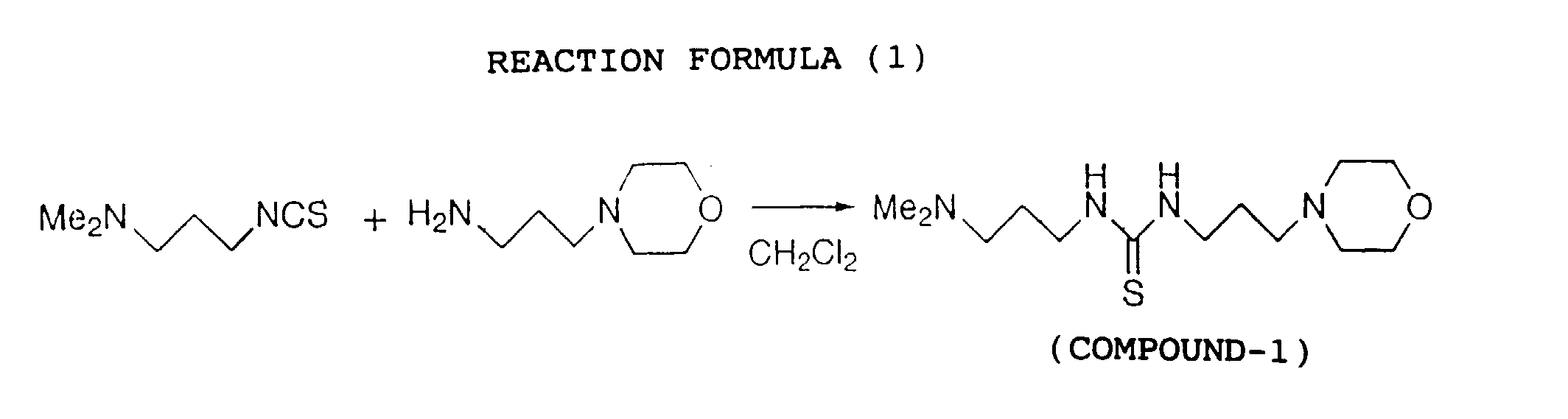
- In 35 ml of acetone was dissolved 2.7 g (10 mmol) of N-3-dimethylaminopropyl-N'-3-(4-morpholino)propylthioure a (Compound-1). Further, 4.2 g (20 mmol) of mercury oxide was added thereto, and the resulting mixture was stirred for 2 hours under reflux. Then, the reaction mixture was allowed to cool and filtered. The solvent was distilled off to obtain a crude product. This product was distilled under reduced pressure to obtain 1.5 g (yield: 60%) of N-3-dimethylaminopropyl-N'-3-(4-morpholino)propylcarbodi imide (Compound-2). Its boiling point (b.p.) was from 125 to 128°C/0.2 mmHg.
-

- 20 mg (0.03 mmol) of a digoxigenin succinimide ester derivative was dissolved in a mixed solution of 0.5 ml of dimethylformamide (DMF) and 0.5 ml of 1N sodium borate buffer (pH 8.5). To this mixture was added 6 mg (0.03 mmol) of a hydrobromide salt of 2-bromoethylamine and the resulting mixture was allowed to react at room temperature for 18 hours with gently shaking. Then, the resulting reaction mixture was extracted with chloroform (1 ml) three times and washed with a saturated sodium chloride solution once. After dried over magnesium sulfate, the solvent was distilled off to obtain 21 mg of a solid reaction mixture. This reaction mixture was purified using a silica gel column to give 10 mg of digoxigenin bromide (Compound-3).
-

- 10 mg (0.015 mmol) of digoxigenin bromide (Compound-3) was dissolved in 3 ml of dimethylformamide. Then, 2 ml of dimethylformamide solution containing 10 mg (0.04 mmol) of N-3-dimethylaminopropyl-N'-3-(4-morpholino)propylcarbodi imide (Compound-2) was added thereto, followed by stirring at room temperature for 18 hours. After the reaction solvent was distilled off, the remaining reaction mixture was dissolved in a small amount of dimethylformamide and the resulting mixture was added dropwise to dimethyl ether. The precipitated white crystal was separated by filtration and dried to obtain 10 mg of a carbodiimide group-containing digoxigenin derivative (Compound-4).
-

- 10 mg (0.01 mmol) of the carbodiimide group-containing digoxigenin derivative (Compound-4) was dissolved in 3 ml of dimethylformamide. Then, 2 ml of dimethylformamide solution containing 10 mg (0.05 mmol) of methyl p-toluenesulfonate (TsOMe), followed by stirring at room temperature for 18 hours. After the reaction solvent was distilled off, the remaining reaction mixture was dissolved in a small amount of dimethylformamide and the resulting mixture was added dropwise into dimethyl ether. The precipitated white crystal was separated by filtration and dried to obtain 5 mg of a carbodiimide group-containing digoxigenin derivative having a quaternary ammonium group (Compound-5).
-

- The reaction mixture (phage DNA (replicative form of M13mp18: Takara Shuzo) 1 µg : 0.1 M borate buffer (pH 8.5) : 0.25% SDS : 0.1M carbodiimide group-containing digoxigenin derivative (Compound-5)) was incubated at 85°C for 1 minute to label DNA with digoxigenin. Then, in order to remove unreacted carbodiimide group-containing digoxigenin derivative, the reaction mixture was mixed with 3 M sodium acetate in a 1/9 amount of the sample and cold ethanol in a double amount of the sample, and the resulting mixture was allowed to stand at -80°C for 45 minutes. The mixture was centrifuged at 4°C at 12,000 rpm for 15 minutes using a centrifuge (H-1500FR Model, Kokusansha) to remove the upper layer. Then, 500 µl of 70% ethanol was added to the residue, and centrifugation was further carried out at 4°C at 12,000 rpm for 1 minute and 30 seconds. After removing the upper layer, the precipitate was dissolved in 100 µl of sterilized water, and the mixture was kept at -20°C. The thus-obtained digoxigenin-labelled DNA was used for the dot blotting detection as described below.
- A DNA concentration of the digoxigenin-labelled DNA solution was determined using a UV detector (UV-VISIBLE RECORDING SPECTROPHOTOMETER UV-2100, Shimadzu Seisakusho). Then, serial dilutions of the digoxigenin-labelled DNA (10 pg/µl, 1 pg/µl, 100 fg/µl, 10 fg/µl, 1 fg/µl) were prepared and 1-µl aliquots of each dilution was dot blotted on nylon membrane (Hybond N+, Amersham). After drying the membrane, Auto Cross Link (DNA immobilization program) was carried out using UV stratalinkerTM (STRATAGENE) to immobilize DNA on the membrane.
- The membrane was immersed in buffer A solution (0.2 M NaCl : 0.1 M Tris-HCl (pH 7.5) : 0.05% Triton-X 100) for 1 minute. Then, the above membrane was put into a plastic bag (Hybribag, tradename: BRL (Bethesda Research Laboratories)), buffer B solution (3% BSA + buffer A solution) was added thereto at a ratio of 5 ml per 100 cm2 of the membrane, and the bag was allowed to stand at room temperature for 30 minutes.
- Then, the above membrane was transferred to a new Hybribag. Separately, a solution was prepared so as to contain 2.5 µl of anti-digoxigenin antibody-alkaline phosphatase conjugate (Anti DIG alkaline phosphatase conjugate: Boehringer Mannheim Biochemica) per ml of buffer A solution. This solution was added into the bag at a ratio of 1 ml per 100 cm2 of the membrane, and the bag was allowed to stand at room temperature for 25 minutes. The membrane was taken out from the Hybribag, washed with 100 ml of buffer A solution for 10 minutes three times, and immersed in 50 ml of buffer C solution (0.1 M NaCl : 0.1 M Tris-HCl (pH 9.5) : 50 mM MgCl2) for 5 minutes. Then, the membrane was put into the Hybribag again.
- A solution was prepared so as to contain 32 µl of NBT (Nitroblue tetrazolium chloride) and 16 µl of X-phosphate (5-bromo-4-chloro-3-indolyl phosphate) per 5 ml of buffer C solution and added at a ratio of 5 ml per 100 cm2 of the membrane to allow it to color in the dark. The membrane was washed with sterilized water and dried for preservation.
- As a result, DNA labelled with the digoxigenin derivative of the present invention can be detected at the level of 1 fg. On the other hand, a DNA labelled using DIG DNA Labeling and detection Kit by the random primer method which was allowed to color in the same manner as described above could be detected to the level of only 10 fg.
- Using the carbodiimide group-containing digoxigenin derivative of the present invention as the label, a protein was detected by the antigen-antibody reaction using a membrane in the following manner.
- The reaction mixture [anti-rabbit IgG antibody (goat) (VECTER LABORATORIES) 100 µg : 0.1 M borate buffer (pH 9.0) : 0.1 M carbodiimide group-containing digoxigenin derivative (Compound-5)] was allowed to stand on ice for 10 minutes to label a protein with digoxigenin. Them, 10% SDS was added thereto so as to give a concentration of 0.3 % based on the total amount and the mixture was centrifuged at 5,000 rpm for 15 minutes using microtube for centrifugation (Ultrafree C3LGC, tradename: Millipore) to remove unreacted carbodiimide group-containing digoxigenin derivative. Then, 50 µl each of 100 mM sodium phosphate buffer (pH 7.6) and 50 mM NaCl were added to a filter cup to centrifuge at 5,000 rpm for 10 minutes. After repeating the same procedure, the residue was transferred to an Eppendorf tube and 100 mM sodium phosphate buffer (pH 7.6) and 50 mM NaCl were added thereto to give a 0.1 M solution. The resulting solution was kept at 4°C.
- Ten-fold serial dilutions of rabbit IgG were prepared using buffer A solution in the range from 100 pg/µl to 1 fg/µl. 1-µl aliquots of each IgG dilutions were dot blotted on PBDF (polyvinylidene fluoride) membrane (Millipore) and dried at 37°C for 10 minutes to immobilize IgG on the membrane. Then, the resulting IgG-immobilized membrane was immersed in buffer B solution and allowed to stand for 30 minutes to effect blocking.
- The membrane was taken out from the buffer B solution and immersed in the reaction solution with shaking with a shaker at room temperature for 30 minutes. The reaction solution used have the following composition: buffer B solution, 10 ml; 4 µg/µl digoxigenin-labelled anti-rabbit IgG, 10 µl. The digoxigenin-labelled anti-rabbit antibody used was obtained by the method described in the (1) above.
- The unreacted digoxigenin-labelled anti-rabbit antibody which did not react with the immobilized antibody was removed by carrying out the washing procedure three times wherein the reacted membrane was immersed in buffer A solution with shaking at room temperature for 5 minutes.
- The membrane was put into Hybribag (BRL) and buffer B solution was added to the bag at a ratio of 5 ml per 100 cm2 of the membrane. The bag was allowed to stand at room temperature for 30 minutes. Then, the membrane was transferred to a new Hybribag. Separately, a solution was prepared so as to contain 2.5 µl of Anti DIG alkaline phosphatase conjugate (Boehringer Mannheim Biochemica) per 1 ml of buffer B solution. This solution was added into the bag at a ratio of 1 ml per 100 cm2 of the membrane, and the bag was allowed to stand at room temperature for 25 minutes. The membrane was taken out from the Hybribag, washed with 100 ml of buffer A solution for 10 minutes three times, and immersed in 50 ml of buffer C for 5 minutes. Then, the membrane was put into the Hybribag again. A solution was prepared so as to contain 32 µl of NBT and 16 µl of X-phosphate (5-bromo-4-chloro-3-indolyl phosphate) per 5 ml of buffer C solution and added at a ratio of 5 ml per 100 cm2 of the membrane to effect coloration for 1 hour in the dark. The membrane was washed with sterilized water and dried for preservation.
- As a result, the protein labelled with the digoxigenin derivative of the present invention can be detected at the level of 1 pg. On the other hand, a protein labelled with N-hydroxysuccuinimide digoxigenin-3-o-methylcarbonyl-E-aminocaproate (Boehringer Mannheim Biochemica) which was allowed to color in the same manner as described above could be detected to the level of only 10 pg.
- Thus, the carbodiimide group-containing digoxigenin derivative of the present invention enables highly sensitive nucleic acid detection and immunoassay with simple labeling procedure.
Claims (8)
- A carbodiimide group-containing digoxigenin derivative represented by the formula (I):
B-Y2-N=C=N-Y1-W-Z (I)
wherein Z represents a digoxigenin-containing moiety represented by the formula (Z): A represents -O-, -COO-, or -NHCOO-;L represents a straight-chain or branched alkylene group which may have a moiety in the main chain selected from the group consisting of -NHCO-, -CONH-, -O-, -S-, -NR-, wherein R is an alkyl group, -COO-, and -OCO-;W represents a quaternary ammonium group;Y1 and Y2 each represents a direct bond or a straight-chain or branched alkylene group having from 1 to 20 carbon atoms in its main chain and optionally having in the main chain a moiety selected from the group consisting of -NHCO-, -CONH-, -O-, -S-, -NR-, wherein R is an alkyl group, -COO-, and -OCO-; and B represents a hydrogen atom or a monovalent organic group which may be the same as or different from that represented by -W-Z in the formula (I).
 - The carbodiimide group-containing digoxigenin derivative as claimed in Claim 1, wherein W in the formula (I) is a quaternary ammonium group represented by the formula (W):
 R1 and R2 each represents a straight-chain or branched, saturated or unsaturated aliphatic hydrocarbon group having from 1 to 6 carbon atoms, a substituted or unsubstituted cycloalkyl group, a substituted or unsubstituted aryl group, a substituted or unsubstituted aralkyl group, or a nitrogen-containing heterocyclic group formed by R1 and R2 which are bound to each other; andX represents a halogen atom.
 - The carbodiimide group-containing digoxigenin derivative as claimed in Claim 1, wherein B in the formula (I) represents a tertiary amino group or a quaternary ammonium group.
- The carbodiimide group-containing digoxigenin derivative as claimed in Claim 1, wherein B in the formula (I) is a monovalent organic group represented by -W-Z, wherein W and Z each has the same definition as in the formula (I).
- The carbodiimide group-containing digoxigenin derivative as claimed in Claim 1, wherein the derivative represented by the formula (I) is a compound represented by the formula (II):
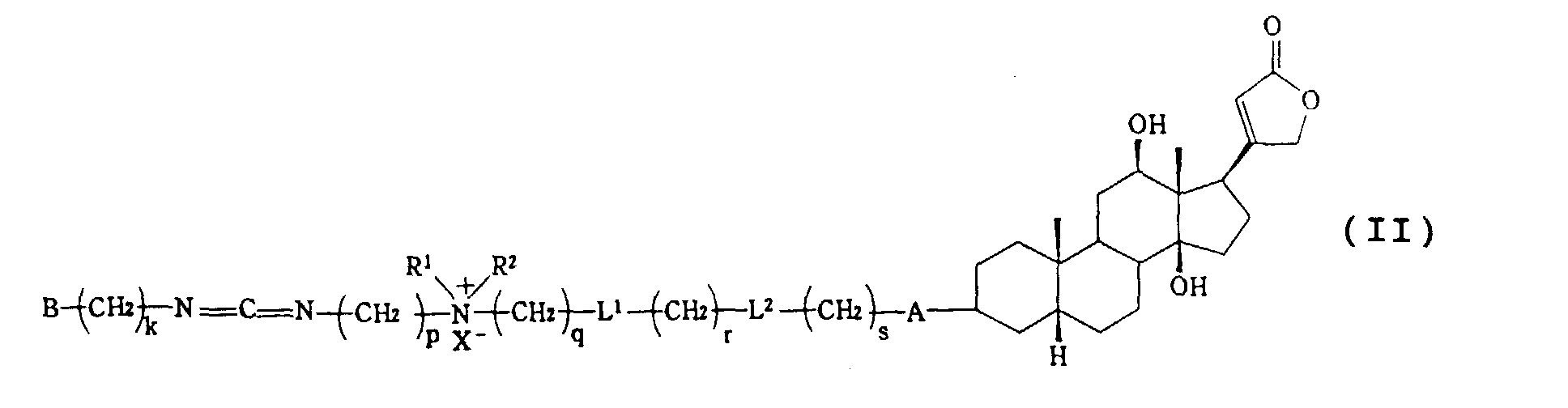 k, p, q, r and s each represents an integer of from 1 to 12;L1 and L2 each represents a moiety selected from the group consisting of -NHCO-, -CONH-, -O-, -S-, -NR-, wherein R is an alkyl group, -COO-, and -OCO-;A and B each has the same meaning as those defined in the formulae (I) and (Z);R1 and R2 each represents a straight-chain or branched, saturated or unsaturated aliphatic hydrocarbon group having from 1 to 6 carbon atoms, a substituted or unsubstituted cycloalkyl group, a substituted or unsubstituted aryl group, a substituted or unsubstituted aralkyl, or a nitrogen-containing heterocyclic group formed by R1 and R2 which are bound to each other; and X represents a halogen atom.
 - A process for producing the carbodiimide group-containing digoxigenin derivative as claimed in Claim 1 which comprises a step of reacting a carbodiimide compound represented by the formula (III):
B-Y2-N=C=N-Y1-W' (III)
wherein B, Y1 and Y2 each has the same meaning as those defined in the formula (I); and W' represents a substituted or unsubstituted amino group, with a digoxigenin halide represented by the formula (IV):
Z-X (IV)
wherein Z has the same meaning as that defined in the formula (I); and X represents a halogen atom. - A method of detecting a nucleic acid by hybridization using the labelled nucleic acid, wherein the carbodiimide group-containing digoxigenin derivative as claimed in Claim 1 is used as the label.
- A method of immunoassay using a labelled antigen or a labelled antibody, wherein the carbodiimide group-containing digoxigenin derivative as claimed in Claim 1 is used as the label.
Applications Claiming Priority (3)
| Application Number | Priority Date | Filing Date | Title |
|---|---|---|---|
| JP11392296 | 1996-05-08 | ||
| JP11392296A JP3798064B2 (en) | 1996-05-08 | 1996-05-08 | Digoxigenin derivatives containing carbodiimide groups |
| JP113922/96 | 1996-05-08 |
Publications (3)
| Publication Number | Publication Date |
|---|---|
| EP0806431A2 true EP0806431A2 (en) | 1997-11-12 |
| EP0806431A3 EP0806431A3 (en) | 1999-04-07 |
| EP0806431B1 EP0806431B1 (en) | 2002-07-03 |
Family
ID=14624558
Family Applications (1)
| Application Number | Title | Priority Date | Filing Date |
|---|---|---|---|
| EP97302924A Expired - Lifetime EP0806431B1 (en) | 1996-05-08 | 1997-04-29 | Carbodiimide group-containing digoxigenin derivatives |
Country Status (4)
| Country | Link |
|---|---|
| US (1) | US5843670A (en) |
| EP (1) | EP0806431B1 (en) |
| JP (1) | JP3798064B2 (en) |
| DE (1) | DE69713679T2 (en) |
Cited By (1)
| Publication number | Priority date | Publication date | Assignee | Title |
|---|---|---|---|---|
| WO1999057307A1 (en) * | 1998-05-06 | 1999-11-11 | Genprofile Ag | Method for non-radioactive detection of membrane-bonded nucleic acids and test kit |
Families Citing this family (2)
| Publication number | Priority date | Publication date | Assignee | Title |
|---|---|---|---|---|
| US6503736B1 (en) * | 1999-11-12 | 2003-01-07 | BIOMéRIEUX, INC. | Antibodies to crosslinkers and methods for using the same |
| US10058502B2 (en) | 2015-12-31 | 2018-08-28 | L'oreal | Nail polish compositions |
Family Cites Families (4)
| Publication number | Priority date | Publication date | Assignee | Title |
|---|---|---|---|---|
| US4895955A (en) * | 1988-05-27 | 1990-01-23 | Lifecodes Corporation | Non-radioactive carbodiimide precursor to nucleic acid probes |
| JPH06271581A (en) * | 1993-03-15 | 1994-09-27 | Isamu Yamamoto | Biotin derivative and its use |
| JPH07157497A (en) * | 1993-12-01 | 1995-06-20 | Isamu Yamamoto | Radiotionless labeling of gene with biotin derivative |
| JP3583489B2 (en) * | 1994-12-22 | 2004-11-04 | 日清紡績株式会社 | Carbodiimide derivative |
-
1996
- 1996-05-08 JP JP11392296A patent/JP3798064B2/en not_active Expired - Fee Related
-
1997
- 1997-04-22 US US08/837,853 patent/US5843670A/en not_active Expired - Fee Related
- 1997-04-29 EP EP97302924A patent/EP0806431B1/en not_active Expired - Lifetime
- 1997-04-29 DE DE69713679T patent/DE69713679T2/en not_active Expired - Fee Related
Cited By (1)
| Publication number | Priority date | Publication date | Assignee | Title |
|---|---|---|---|---|
| WO1999057307A1 (en) * | 1998-05-06 | 1999-11-11 | Genprofile Ag | Method for non-radioactive detection of membrane-bonded nucleic acids and test kit |
Also Published As
| Publication number | Publication date |
|---|---|
| DE69713679D1 (en) | 2002-08-08 |
| EP0806431B1 (en) | 2002-07-03 |
| DE69713679T2 (en) | 2003-02-20 |
| JPH09301994A (en) | 1997-11-25 |
| JP3798064B2 (en) | 2006-07-19 |
| US5843670A (en) | 1998-12-01 |
| EP0806431A3 (en) | 1999-04-07 |
Similar Documents
| Publication | Publication Date | Title |
|---|---|---|
| US5198537A (en) | Digoxigenin derivatives and use thereof | |
| KR960016340B1 (en) | Electrochemiluminescence assay | |
| DE3750503T2 (en) | Chemiluminescent acridinium and phenantridinium salts. | |
| DE69214942T2 (en) | METHOD FOR SPECIFIC BINDING ASSAYS USING A RELEASABLE LIGAND | |
| EP0718300B1 (en) | Carbodiimide derivative | |
| JPH0741482A (en) | Aminomethylfluorescein derivative | |
| EP0635020A1 (en) | 5(6)-methyl substituted fluorescein derivatives | |
| US6262252B1 (en) | Single-step method for labeling nucleic acids with mustard or aziridine labeling reagents | |
| JPS6160697A (en) | Novel derived nucleic acid arrangement, manufacture and method of detecting nucleic acid or nucleic acid arrangement | |
| US4895955A (en) | Non-radioactive carbodiimide precursor to nucleic acid probes | |
| EP0806431B1 (en) | Carbodiimide group-containing digoxigenin derivatives | |
| JPS6257220B2 (en) | ||
| GB1586185A (en) | Synthetic antigens radio labelled derivatives thereof and methods of analysis using such derivatives | |
| US5491071A (en) | Reagents and methods for the detection and quantification of testosterone in fluid samples | |
| EP0808829B1 (en) | Fluorescent group-containing carbodiimide compound | |
| EP0656422B1 (en) | Chloramphenicol acetyl transferase (CAT) assay | |
| JPH0454904B2 (en) | ||
| EP0812823B1 (en) | Chemiluminescent group-containing carbodiimide compound | |
| CA2062240A1 (en) | Labeled hydantoin derivatives for immunoassays | |
| DE69424132T2 (en) | Chloramphenicol Acetyl Transferase (CAT) detection | |
| US20040210044A1 (en) | Method for single-step attachment of a label to target molecules | |
| BARKAN et al. | Column Chromatographic Analysis of Barbiturates in Their Dosage | |
| Eisenhardt Jr et al. | Synthetic antigens, radiolabelled derivatives thereof, and methods of analysis using such derivatives | |
| JPH10313891A (en) | Labeling substances such as nucleic acids and proteins |
Legal Events
| Date | Code | Title | Description |
|---|---|---|---|
| PUAI | Public reference made under article 153(3) epc to a published international application that has entered the european phase |
Free format text: ORIGINAL CODE: 0009012 |
|
| AK | Designated contracting states |
Kind code of ref document: A2 Designated state(s): DE FR GB |
|
| PUAL | Search report despatched |
Free format text: ORIGINAL CODE: 0009013 |
|
| AK | Designated contracting states |
Kind code of ref document: A3 Designated state(s): DE FR GB |
|
| 17P | Request for examination filed |
Effective date: 19990521 |
|
| 17Q | First examination report despatched |
Effective date: 19990714 |
|
| GRAG | Despatch of communication of intention to grant |
Free format text: ORIGINAL CODE: EPIDOS AGRA |
|
| GRAG | Despatch of communication of intention to grant |
Free format text: ORIGINAL CODE: EPIDOS AGRA |
|
| GRAH | Despatch of communication of intention to grant a patent |
Free format text: ORIGINAL CODE: EPIDOS IGRA |
|
| GRAG | Despatch of communication of intention to grant |
Free format text: ORIGINAL CODE: EPIDOS AGRA |
|
| GRAH | Despatch of communication of intention to grant a patent |
Free format text: ORIGINAL CODE: EPIDOS IGRA |
|
| GRAA | (expected) grant |
Free format text: ORIGINAL CODE: 0009210 |
|
| AK | Designated contracting states |
Kind code of ref document: B1 Designated state(s): DE FR GB |
|
| RIN1 | Information on inventor provided before grant (corrected) |
Inventor name: SHIOHATA, NAMIKO, TOKYO RESEARCH CENTER Inventor name: MATSUMOTO, KAZUKO, TOKYO RESEARCH CENTER Inventor name: MASUDA, GEN, TOKYO RESEARCH CENTER Inventor name: SUZUKI, OSAMU, TOKYO RESEARCH CENTER |
|
| REF | Corresponds to: |
Ref document number: 69713679 Country of ref document: DE Date of ref document: 20020808 |
|
| ET | Fr: translation filed | ||
| PLBE | No opposition filed within time limit |
Free format text: ORIGINAL CODE: 0009261 |
|
| STAA | Information on the status of an ep patent application or granted ep patent |
Free format text: STATUS: NO OPPOSITION FILED WITHIN TIME LIMIT |
|
| 26N | No opposition filed |
Effective date: 20030404 |
|
| PGFP | Annual fee paid to national office [announced via postgrant information from national office to epo] |
Ref country code: FR Payment date: 20060410 Year of fee payment: 10 |
|
| PGFP | Annual fee paid to national office [announced via postgrant information from national office to epo] |
Ref country code: GB Payment date: 20060426 Year of fee payment: 10 |
|
| PGFP | Annual fee paid to national office [announced via postgrant information from national office to epo] |
Ref country code: DE Payment date: 20060427 Year of fee payment: 10 |
|
| GBPC | Gb: european patent ceased through non-payment of renewal fee |
Effective date: 20070429 |
|
| PG25 | Lapsed in a contracting state [announced via postgrant information from national office to epo] |
Ref country code: DE Free format text: LAPSE BECAUSE OF NON-PAYMENT OF DUE FEES Effective date: 20071101 |
|
| PG25 | Lapsed in a contracting state [announced via postgrant information from national office to epo] |
Ref country code: GB Free format text: LAPSE BECAUSE OF NON-PAYMENT OF DUE FEES Effective date: 20070429 |
|
| PG25 | Lapsed in a contracting state [announced via postgrant information from national office to epo] |
Ref country code: FR Free format text: LAPSE BECAUSE OF NON-PAYMENT OF DUE FEES Effective date: 20070430 |