EP0806500A1 - Procédé pour la fabrication de fibrilles - Google Patents
Procédé pour la fabrication de fibrilles Download PDFInfo
- Publication number
- EP0806500A1 EP0806500A1 EP97107360A EP97107360A EP0806500A1 EP 0806500 A1 EP0806500 A1 EP 0806500A1 EP 97107360 A EP97107360 A EP 97107360A EP 97107360 A EP97107360 A EP 97107360A EP 0806500 A1 EP0806500 A1 EP 0806500A1
- Authority
- EP
- European Patent Office
- Prior art keywords
- fibrils
- solution
- precipitation medium
- polyarylene ether
- mixture
- Prior art date
- Legal status (The legal status is an assumption and is not a legal conclusion. Google has not performed a legal analysis and makes no representation as to the accuracy of the status listed.)
- Ceased
Links
- 238000000034 method Methods 0.000 title claims abstract description 42
- RTZKZFJDLAIYFH-UHFFFAOYSA-N Diethyl ether Chemical compound CCOCC RTZKZFJDLAIYFH-UHFFFAOYSA-N 0.000 claims abstract description 59
- 229920000412 polyarylene Polymers 0.000 claims abstract description 45
- 239000007788 liquid Substances 0.000 claims abstract description 21
- 238000004519 manufacturing process Methods 0.000 claims abstract description 16
- 239000003960 organic solvent Substances 0.000 claims abstract description 16
- 238000001556 precipitation Methods 0.000 claims description 53
- 230000015572 biosynthetic process Effects 0.000 claims description 17
- 239000002904 solvent Substances 0.000 claims description 17
- XLYOFNOQVPJJNP-UHFFFAOYSA-N water Substances O XLYOFNOQVPJJNP-UHFFFAOYSA-N 0.000 claims description 17
- SECXISVLQFMRJM-UHFFFAOYSA-N N-Methylpyrrolidone Chemical compound CN1CCCC1=O SECXISVLQFMRJM-UHFFFAOYSA-N 0.000 claims description 15
- ZMXDDKWLCZADIW-UHFFFAOYSA-N N,N-Dimethylformamide Chemical compound CN(C)C=O ZMXDDKWLCZADIW-UHFFFAOYSA-N 0.000 claims description 13
- 239000000203 mixture Substances 0.000 claims description 12
- YLQBMQCUIZJEEH-UHFFFAOYSA-N Furan Chemical compound C=1C=COC=1 YLQBMQCUIZJEEH-UHFFFAOYSA-N 0.000 claims description 7
- YMWUJEATGCHHMB-UHFFFAOYSA-N Dichloromethane Chemical compound ClCCl YMWUJEATGCHHMB-UHFFFAOYSA-N 0.000 claims description 6
- LFQSCWFLJHTTHZ-UHFFFAOYSA-N Ethanol Chemical compound CCO LFQSCWFLJHTTHZ-UHFFFAOYSA-N 0.000 claims description 6
- 150000002576 ketones Chemical class 0.000 claims description 5
- GUVUOGQBMYCBQP-UHFFFAOYSA-N dmpu Chemical compound CN1CCCN(C)C1=O GUVUOGQBMYCBQP-UHFFFAOYSA-N 0.000 claims description 4
- 238000000227 grinding Methods 0.000 claims description 4
- 239000004745 nonwoven fabric Substances 0.000 claims description 4
- 229920006393 polyether sulfone Polymers 0.000 claims description 4
- 239000004695 Polyether sulfone Substances 0.000 claims description 3
- HXJUTPCZVOIRIF-UHFFFAOYSA-N sulfolane Chemical compound O=S1(=O)CCCC1 HXJUTPCZVOIRIF-UHFFFAOYSA-N 0.000 claims description 2
- 229920002492 poly(sulfone) Polymers 0.000 claims 1
- 230000001376 precipitating effect Effects 0.000 abstract description 3
- 238000010008 shearing Methods 0.000 abstract 1
- 239000000243 solution Substances 0.000 description 44
- 229920000642 polymer Polymers 0.000 description 26
- 150000002170 ethers Chemical class 0.000 description 14
- 229920001577 copolymer Polymers 0.000 description 13
- WYURNTSHIVDZCO-UHFFFAOYSA-N Tetrahydrofuran Chemical compound C1CCOC1 WYURNTSHIVDZCO-UHFFFAOYSA-N 0.000 description 12
- 239000000835 fiber Substances 0.000 description 9
- -1 polyethylene Polymers 0.000 description 8
- 125000002496 methyl group Chemical group [H]C([H])([H])* 0.000 description 7
- ZWEHNKRNPOVVGH-UHFFFAOYSA-N 2-Butanone Chemical compound CCC(C)=O ZWEHNKRNPOVVGH-UHFFFAOYSA-N 0.000 description 6
- OKKJLVBELUTLKV-UHFFFAOYSA-N Methanol Chemical compound OC OKKJLVBELUTLKV-UHFFFAOYSA-N 0.000 description 6
- 239000007900 aqueous suspension Substances 0.000 description 4
- 125000003118 aryl group Chemical group 0.000 description 4
- 229920001400 block copolymer Polymers 0.000 description 4
- 125000004432 carbon atom Chemical group C* 0.000 description 4
- 125000001495 ethyl group Chemical group [H]C([H])([H])C([H])([H])* 0.000 description 4
- 238000002156 mixing Methods 0.000 description 4
- 239000002245 particle Substances 0.000 description 4
- 125000001997 phenyl group Chemical group [H]C1=C([H])C([H])=C(*)C([H])=C1[H] 0.000 description 4
- 239000000126 substance Substances 0.000 description 4
- 125000001424 substituent group Chemical group 0.000 description 4
- 239000000725 suspension Substances 0.000 description 4
- LYCAIKOWRPUZTN-UHFFFAOYSA-N Ethylene glycol Chemical compound OCCO LYCAIKOWRPUZTN-UHFFFAOYSA-N 0.000 description 3
- 150000001298 alcohols Chemical class 0.000 description 3
- 150000002240 furans Chemical class 0.000 description 3
- 229910052739 hydrogen Inorganic materials 0.000 description 3
- 239000001257 hydrogen Substances 0.000 description 3
- 125000001449 isopropyl group Chemical group [H]C([H])([H])C([H])(*)C([H])([H])[H] 0.000 description 3
- 230000002093 peripheral effect Effects 0.000 description 3
- 229920005989 resin Polymers 0.000 description 3
- 239000011347 resin Substances 0.000 description 3
- 230000003068 static effect Effects 0.000 description 3
- 125000000008 (C1-C10) alkyl group Chemical group 0.000 description 2
- CSCPPACGZOOCGX-UHFFFAOYSA-N Acetone Chemical compound CC(C)=O CSCPPACGZOOCGX-UHFFFAOYSA-N 0.000 description 2
- IJGRMHOSHXDMSA-UHFFFAOYSA-N Atomic nitrogen Chemical compound N#N IJGRMHOSHXDMSA-UHFFFAOYSA-N 0.000 description 2
- 229920003043 Cellulose fiber Polymers 0.000 description 2
- UFHFLCQGNIYNRP-UHFFFAOYSA-N Hydrogen Chemical compound [H][H] UFHFLCQGNIYNRP-UHFFFAOYSA-N 0.000 description 2
- KFZMGEQAYNKOFK-UHFFFAOYSA-N Isopropanol Chemical compound CC(C)O KFZMGEQAYNKOFK-UHFFFAOYSA-N 0.000 description 2
- LRHPLDYGYMQRHN-UHFFFAOYSA-N N-Butanol Chemical compound CCCCO LRHPLDYGYMQRHN-UHFFFAOYSA-N 0.000 description 2
- PPBRXRYQALVLMV-UHFFFAOYSA-N Styrene Chemical compound C=CC1=CC=CC=C1 PPBRXRYQALVLMV-UHFFFAOYSA-N 0.000 description 2
- QAOWNCQODCNURD-UHFFFAOYSA-N Sulfuric acid Chemical compound OS(O)(=O)=O QAOWNCQODCNURD-UHFFFAOYSA-N 0.000 description 2
- DKGAVHZHDRPRBM-UHFFFAOYSA-N Tert-Butanol Chemical compound CC(C)(C)O DKGAVHZHDRPRBM-UHFFFAOYSA-N 0.000 description 2
- TZCXTZWJZNENPQ-UHFFFAOYSA-L barium sulfate Chemical compound [Ba+2].[O-]S([O-])(=O)=O TZCXTZWJZNENPQ-UHFFFAOYSA-L 0.000 description 2
- 206010061592 cardiac fibrillation Diseases 0.000 description 2
- 230000001427 coherent effect Effects 0.000 description 2
- 125000000753 cycloalkyl group Chemical group 0.000 description 2
- ZUOUZKKEUPVFJK-UHFFFAOYSA-N diphenyl Chemical compound C1=CC=CC=C1C1=CC=CC=C1 ZUOUZKKEUPVFJK-UHFFFAOYSA-N 0.000 description 2
- 239000002270 dispersing agent Substances 0.000 description 2
- 230000002600 fibrillogenic effect Effects 0.000 description 2
- ZXEKIIBDNHEJCQ-UHFFFAOYSA-N isobutanol Chemical compound CC(C)CO ZXEKIIBDNHEJCQ-UHFFFAOYSA-N 0.000 description 2
- 239000000463 material Substances 0.000 description 2
- 125000001280 n-hexyl group Chemical group C(CCCCC)* 0.000 description 2
- 125000004123 n-propyl group Chemical group [H]C([H])([H])C([H])([H])C([H])([H])* 0.000 description 2
- 125000001624 naphthyl group Chemical group 0.000 description 2
- 229920000728 polyester Polymers 0.000 description 2
- 229920000098 polyolefin Polymers 0.000 description 2
- 239000002244 precipitate Substances 0.000 description 2
- BDERNNFJNOPAEC-UHFFFAOYSA-N propan-1-ol Chemical compound CCCO BDERNNFJNOPAEC-UHFFFAOYSA-N 0.000 description 2
- 229920001059 synthetic polymer Polymers 0.000 description 2
- 125000000999 tert-butyl group Chemical group [H]C([H])([H])C(*)(C([H])([H])[H])C([H])([H])[H] 0.000 description 2
- BQCIDUSAKPWEOX-UHFFFAOYSA-N 1,1-Difluoroethene Chemical compound FC(F)=C BQCIDUSAKPWEOX-UHFFFAOYSA-N 0.000 description 1
- RYHBNJHYFVUHQT-UHFFFAOYSA-N 1,4-Dioxane Chemical compound C1COCCO1 RYHBNJHYFVUHQT-UHFFFAOYSA-N 0.000 description 1
- OCJBOOLMMGQPQU-UHFFFAOYSA-N 1,4-dichlorobenzene Chemical compound ClC1=CC=C(Cl)C=C1 OCJBOOLMMGQPQU-UHFFFAOYSA-N 0.000 description 1
- OEPOKWHJYJXUGD-UHFFFAOYSA-N 2-(3-phenylmethoxyphenyl)-1,3-thiazole-4-carbaldehyde Chemical compound O=CC1=CSC(C=2C=C(OCC=3C=CC=CC=3)C=CC=2)=N1 OEPOKWHJYJXUGD-UHFFFAOYSA-N 0.000 description 1
- 238000004438 BET method Methods 0.000 description 1
- ZAMOUSCENKQFHK-UHFFFAOYSA-N Chlorine atom Chemical compound [Cl] ZAMOUSCENKQFHK-UHFFFAOYSA-N 0.000 description 1
- VGGSQFUCUMXWEO-UHFFFAOYSA-N Ethene Chemical compound C=C VGGSQFUCUMXWEO-UHFFFAOYSA-N 0.000 description 1
- 239000005977 Ethylene Substances 0.000 description 1
- ISWSIDIOOBJBQZ-UHFFFAOYSA-N Phenol Chemical compound OC1=CC=CC=C1 ISWSIDIOOBJBQZ-UHFFFAOYSA-N 0.000 description 1
- 239000004952 Polyamide Substances 0.000 description 1
- 239000004698 Polyethylene Substances 0.000 description 1
- 239000004642 Polyimide Substances 0.000 description 1
- 239000004793 Polystyrene Substances 0.000 description 1
- 229920001328 Polyvinylidene chloride Polymers 0.000 description 1
- 229920002472 Starch Polymers 0.000 description 1
- LSNNMFCWUKXFEE-UHFFFAOYSA-N Sulfurous acid Chemical compound OS(O)=O LSNNMFCWUKXFEE-UHFFFAOYSA-N 0.000 description 1
- BZHJMEDXRYGGRV-UHFFFAOYSA-N Vinyl chloride Chemical compound ClC=C BZHJMEDXRYGGRV-UHFFFAOYSA-N 0.000 description 1
- 238000010521 absorption reaction Methods 0.000 description 1
- 230000001133 acceleration Effects 0.000 description 1
- 239000013543 active substance Substances 0.000 description 1
- 125000003545 alkoxy group Chemical group 0.000 description 1
- 235000010290 biphenyl Nutrition 0.000 description 1
- 239000004305 biphenyl Substances 0.000 description 1
- 238000009835 boiling Methods 0.000 description 1
- 229910052799 carbon Inorganic materials 0.000 description 1
- 150000004649 carbonic acid derivatives Chemical class 0.000 description 1
- 238000005119 centrifugation Methods 0.000 description 1
- 229910052801 chlorine Inorganic materials 0.000 description 1
- 239000000460 chlorine Substances 0.000 description 1
- UUAGAQFQZIEFAH-UHFFFAOYSA-N chlorotrifluoroethylene Chemical group FC(F)=C(F)Cl UUAGAQFQZIEFAH-UHFFFAOYSA-N 0.000 description 1
- 238000007796 conventional method Methods 0.000 description 1
- 238000005520 cutting process Methods 0.000 description 1
- 150000004292 cyclic ethers Chemical class 0.000 description 1
- 229940117389 dichlorobenzene Drugs 0.000 description 1
- 238000010790 dilution Methods 0.000 description 1
- 239000012895 dilution Substances 0.000 description 1
- 239000006185 dispersion Substances 0.000 description 1
- 238000004821 distillation Methods 0.000 description 1
- 239000000975 dye Substances 0.000 description 1
- 230000000694 effects Effects 0.000 description 1
- 238000005265 energy consumption Methods 0.000 description 1
- 238000005516 engineering process Methods 0.000 description 1
- 238000001704 evaporation Methods 0.000 description 1
- 230000008020 evaporation Effects 0.000 description 1
- 239000004744 fabric Substances 0.000 description 1
- 239000000945 filler Substances 0.000 description 1
- 238000001914 filtration Methods 0.000 description 1
- 229920005570 flexible polymer Polymers 0.000 description 1
- 125000005843 halogen group Chemical group 0.000 description 1
- 229920006158 high molecular weight polymer Polymers 0.000 description 1
- 150000002431 hydrogen Chemical class 0.000 description 1
- 230000002209 hydrophobic effect Effects 0.000 description 1
- 229960004592 isopropanol Drugs 0.000 description 1
- 239000000155 melt Substances 0.000 description 1
- 125000000956 methoxy group Chemical group [H]C([H])([H])O* 0.000 description 1
- 239000010445 mica Substances 0.000 description 1
- 229910052618 mica group Inorganic materials 0.000 description 1
- 239000012452 mother liquor Substances 0.000 description 1
- 238000000465 moulding Methods 0.000 description 1
- 229910052757 nitrogen Inorganic materials 0.000 description 1
- 229920002647 polyamide Polymers 0.000 description 1
- 239000004417 polycarbonate Substances 0.000 description 1
- 229920000515 polycarbonate Polymers 0.000 description 1
- 229920001601 polyetherimide Polymers 0.000 description 1
- 229920000573 polyethylene Polymers 0.000 description 1
- 229920001721 polyimide Polymers 0.000 description 1
- 229920001296 polysiloxane Polymers 0.000 description 1
- 229920002223 polystyrene Polymers 0.000 description 1
- 229920002451 polyvinyl alcohol Polymers 0.000 description 1
- 235000019422 polyvinyl alcohol Nutrition 0.000 description 1
- 239000004800 polyvinyl chloride Substances 0.000 description 1
- 229920000915 polyvinyl chloride Polymers 0.000 description 1
- 239000005033 polyvinylidene chloride Substances 0.000 description 1
- 238000003825 pressing Methods 0.000 description 1
- 239000000047 product Substances 0.000 description 1
- 125000001436 propyl group Chemical group [H]C([*])([H])C([H])([H])C([H])([H])[H] 0.000 description 1
- 238000011084 recovery Methods 0.000 description 1
- 230000003014 reinforcing effect Effects 0.000 description 1
- 230000000717 retained effect Effects 0.000 description 1
- LIVNPJMFVYWSIS-UHFFFAOYSA-N silicon monoxide Inorganic materials [Si-]#[O+] LIVNPJMFVYWSIS-UHFFFAOYSA-N 0.000 description 1
- 239000007787 solid Substances 0.000 description 1
- 238000009987 spinning Methods 0.000 description 1
- 239000008107 starch Substances 0.000 description 1
- 235000019698 starch Nutrition 0.000 description 1
- 239000007858 starting material Substances 0.000 description 1
- 238000003756 stirring Methods 0.000 description 1
- 150000003457 sulfones Chemical class 0.000 description 1
- 239000000454 talc Substances 0.000 description 1
- 229910052623 talc Inorganic materials 0.000 description 1
- BFKJFAAPBSQJPD-UHFFFAOYSA-N tetrafluoroethene Chemical group FC(F)=C(F)F BFKJFAAPBSQJPD-UHFFFAOYSA-N 0.000 description 1
- 239000012815 thermoplastic material Substances 0.000 description 1
- GBXQPDCOMJJCMJ-UHFFFAOYSA-M trimethyl-[6-(trimethylazaniumyl)hexyl]azanium;bromide Chemical compound [Br-].C[N+](C)(C)CCCCCC[N+](C)(C)C GBXQPDCOMJJCMJ-UHFFFAOYSA-M 0.000 description 1
- 238000011144 upstream manufacturing Methods 0.000 description 1
- 238000005406 washing Methods 0.000 description 1
- 238000003466 welding Methods 0.000 description 1
- 238000010626 work up procedure Methods 0.000 description 1
Images


Classifications
-
- D—TEXTILES; PAPER
- D01—NATURAL OR MAN-MADE THREADS OR FIBRES; SPINNING
- D01F—CHEMICAL FEATURES IN THE MANUFACTURE OF ARTIFICIAL FILAMENTS, THREADS, FIBRES, BRISTLES OR RIBBONS; APPARATUS SPECIALLY ADAPTED FOR THE MANUFACTURE OF CARBON FILAMENTS
- D01F6/00—Monocomponent artificial filaments or the like of synthetic polymers; Manufacture thereof
- D01F6/58—Monocomponent artificial filaments or the like of synthetic polymers; Manufacture thereof from homopolycondensation products
- D01F6/66—Monocomponent artificial filaments or the like of synthetic polymers; Manufacture thereof from homopolycondensation products from polyethers
-
- D—TEXTILES; PAPER
- D01—NATURAL OR MAN-MADE THREADS OR FIBRES; SPINNING
- D01D—MECHANICAL METHODS OR APPARATUS IN THE MANUFACTURE OF ARTIFICIAL FILAMENTS, THREADS, FIBRES, BRISTLES OR RIBBONS
- D01D5/00—Formation of filaments, threads, or the like
- D01D5/40—Formation of filaments, threads, or the like by applying a shearing force to a dispersion or solution of filament formable polymers, e.g. by stirring
Definitions
- the present invention relates to a method for producing fibrils by introducing a solution of a polyarylene ether in a suitable organic solvent into a liquid precipitation medium under the simultaneous action of shear forces, a shear field with an average energy density of at least 5 when the solution is introduced into the precipitation medium in the fibril formation space W ⁇ s / cm 3 , as well as fibrils per se, which can be produced by the process according to the invention, and their use as binding fibers in the production of papers, seals, friction linings and nonwovens.
- Fibrils of this type are used on a large scale in many areas of technology to increase the mechanical strength, in particular the rigidity, of synthetic and natural materials or moldings produced therefrom, or as binding fiber or process fiber in the production of special papers.
- DE-A 14 69 120 describes a process for producing suspensions from fibrils when polymers are dissolved from a solution by dispersing the solution in a precipitation medium under the action of shear forces be canceled.
- the shear effect is generated either by a stirrer (Waring-Misher) or by means of a turbulent flowing liquid.
- These fibrils can be in the form of a tape, film or fiber, or they can be a mixture of these structures, ie they are not uniform. Fibrils made from polyarylene ethers are not described there.
- DE-A 22 08 553 relates to a method for producing fibrils from linear polyolefins, such as e.g. Ziegler polyethylene, in which the polyolefin dissolved in a solvent above its melt dissolving temperature is subjected to flash evaporation.
- This method requires a very large amount of energy since the melt release temperatures of polymers such as polyvinyl chloride, polyvinylidene chloride and polystyrene are very high, i.e. above 100 ° C.
- DE-A 25 16 561 describes an improved process for the production of fibrils from polymers or copolymers of styrene, vinyl chloride or vinylidene chloride Solutions of these polymers or copolymers in methyl ethyl ketone, tetrahydrofuran or 1,4-dioxane are introduced into a liquid precipitation medium under the simultaneous action of shear forces, wherein when these solutions are introduced into the precipitation medium in the fibril formation space of the shear field, an average energy density of at least 5 W ⁇ s / cm 3 prevails. This procedure is carried out at room temperature.
- DE-A 25 43 824 describes a complex process for the production of fibrils from poly (amide-imide) resins, in which the polymers are also dissolved in an organic solvent (a) and, before being introduced into the precipitation medium (b), with a organic, cyclic ether (c), which does not dissolve the above resin, but can be mixed homogeneously with the organic solvent (a) and the precipitation medium (b) to an unlimited extent, are mixed in a certain volume ratio.
- This document shows that when using the process according to DE-A 26 46 332 or DE-A 25 16 561 described above on poly (amide-imide) resins, no discrete fibrils are obtained, but only finely divided powder-like particles. that show no tendency to form fleece.
- the particles produced using the conventional method usually contain a large amount of solvent, so that the subsequent workup is difficult and time-consuming.
- Fibrils in the sense of the invention are fibrous particles made of synthetic polymers which are morphologically similar in size and shape and in their properties to cellulose fibers.
- the term "fibrids" is common in Anglo-Saxon usage.
- polyarylene ether used in the context of the present invention denotes polymers and copolymers which contain the repeating units I.
- the radicals R c and R d can also form, together with the carbon atom to which they are attached, a cycloaliphatic ring, preferably a C 5 to C 7 cycloalkyl ring.
- This cycloalkyl ring can in turn carry one or more substituents.
- the preferred substituents include C 1 -C 10 -alkyl radicals, such as methyl, ethyl, propyl or i-propyl, in particular methyl.
- Preference is given to polyarylene ethers A in which T, Q and Z are -O-, -SO 2 -, C O, a chemical bond or a group of the formula -CR c R d .
- Ar and Ar 1 are C 6 to C 18 aryl groups, such as 1,5-naphthyl, 1,6-naphthyl, 2,7-naphthyl, 1,5-anthryl, 9,10-anthryl, 2,6- Anthryl, 2,7-anthryl or biphenyl, especially phenyl. These aryl groups are preferably not substituted.
- substituents selected from C 1 to C 10 alkyl such as methyl, ethyl, n-propyl, i-propyl, t-butyl, n-hexyl, C 6 to C 18 aryl such as phenyl or naphthyl, C 1 - to C 10 alkoxy such as methoxy, ethoxy, n-propoxy, i-propoxy, n-butoxy or halogen atoms.
- Preferred substituents include methyl, phenyl, methoxy and chlorine.
- Fibrils are preferably produced from a polyarylene sulfone or a polyarylene ether sulfone using the method according to the invention, polymers with the repeating units (I 1 ) and (I 2 ) being particularly preferred.
- the polyarylene ethers can also be copolymers or block copolymers in which there are polyarylene ether segments and segments of other thermoplastic materials, such as polyamides, polyesters, aromatic polycarbonates, polyester carbonates, polysiloxanes, polyimides or polyetherimides.
- the number average molecular weights M n of the block or graft arms in the copolymers are generally in the range from 1,000 to 30,000 g / mol.
- the blocks of different structures can be arranged alternately or statistically.
- the proportion by weight of the polyarylene ethers in the copolymers or block copolymers is generally at least 10% by weight.
- the proportion by weight of the polyarylene ethers can be up to 97% by weight. Co or block copolymers with a weight fraction of polyarylene ether of up to 90% by weight are preferred. Copolymers and block copolymers with 20 to 80% by weight of polyarylene ether are particularly preferably used.
- the polyarylene ethers have a number average molecular weight M n in the range from 10,000 to 60,000 g / mol, preferably 10,000 to 40,000 g / mol, and relative viscosities from 1.25 to 1.95.
- M n number average molecular weight
- the relative viscosities are either in 1% by weight N-methylpyrrolidone solution, in mixtures of phenol and dichlorobenzene, the mixing ratio generally being about 1: 1 v / v, or as 0.5% by weight .-% solution measured in 96% sulfuric acid at 20 ° C and 25 ° C respectively.
- a solution of a polyarylene ether is introduced into a liquid precipitation medium under the simultaneous action of shear forces, fibrils of these polyarylene ethers being formed.
- the process according to the invention is generally carried out at low temperature, i.e. at about 10 to about. 90 ° C, preferably at a temperature which is from about 20 to about 60 ° C.
- Entering the solution of a polyarylene ether in a liquid precipitation medium means mixing this solution with a large excess of the precipitation medium.
- the polyarylene ethers dissolved in a solvent at low temperature should preferably be insoluble in the precipitation medium, but the solvent used should be miscible with the precipitation medium as much as possible.
- the volume ratio of polymer solution to precipitation medium is preferably between approximately 1: 5 to approximately 1: 100, more preferably approximately 1:10 to approximately 1:35, in particular approximately 1:10 to approximately 1:20.
- solvents which fulfill the two properties listed above are suitable as solvents in the context of the present invention.
- organic solvents for polyarylene ethers have been N-methylpyrrolidone (NMP), dimethylformamide (DMF), 1,3-dimethyltetrahydro-2- [1H] -pyrimidinone (DMPU), sulfolane, methylene chloride or a mixture of two or more of which has been proven, with NMP being particularly preferred.
- the above solvents are distinguished by a particularly high solvency for the polymers in question at low temperature, by their good miscibility with the precipitation medium, in particular with water, and by their low boiling point. Some of them, such as DMF form an azeotrope with water, which has a high proportion of organic solvent, which is important for the economic recovery of the solvent.
- the concentration of the polyarylene ethers in the solution can be 0.5 to 40, preferably 5 to 25,% by weight.
- furans, ketones or alcohols, N-methylpyrrolidone or a mixture of two or more thereof are added to the above solution before being introduced into the precipitation medium, preferably alcohols having 1 to 4 carbon atoms, such as For example, methanol, ethanol, iso-propanol, n-propanol, iso-butanol, n-butanol and tert-butanol, ketones such as acetone and methyl ethyl ketone, and furans such as THF, the carbon atoms within the furans or THF can be substituted by methyl or ethyl groups can be used.
- Methanol, THF and NMP are particularly preferably used.
- the addition can take place, for example, with the aid of static or dynamic mixers.
- These additional organic ones Solvents can be added to the polymer solution in an amount until the polymer begins to precipitate, ie they are precipitants for the polyarylene ethers in question.
- the proportion of additional organic solvents is up to 50%, based on the total volume of the solution.
- solvents are preferably added to the polyarylene ether solution in such a proportion that it does not precipitate out before contacting the precipitation medium.
- the result of this addition is that the formation of fibrils from such a solution begins immediately when the solution comes into contact with the precipitation medium, whereby individual fibrils with a very large surface area are obtained.
- the additional organic solvent is added or mixed into the solution of the polyarylene ether before it is introduced into the precipitation medium, preferably using a static or dynamic mixer.
- Water has proven particularly useful as a liquid precipitation medium.
- the process can also be carried out using other precipitation media, such as, for example, ethylene glycol or alcohols having 1 to 4 carbon atoms or mixtures thereof.
- a mixture of water and at least one furan, alcohol, ketone, N-methylpyrrolidone or a mixture of two or more thereof can also be used. It is crucial that the dissolved polyarylene ether is insoluble in the precipitation medium, but the solvent used with the precipitation medium within the volume ratios used is completely miscible.
- Fibril formation space is understood to mean the zone of a shear field generator in which the polymer solution and the liquid precipitation medium meet and in which an average energy density of at least approximately 5 W ⁇ s / cm 3 , preferably approximately 10 to approximately 100 W ⁇ s / cm 3 , is further preferred about 20 to about 50 Ws / cm 3 .
- the volume of the fibril formation space depends on the flow rate of the precipitation medium combined with the polymer solution. Since the formation of the fibrils takes place within 1 ⁇ 10 -2 to 1 ⁇ 10 -4 s, the length of the fibril formation space at flow velocities of 5 to 50 m / s is 0.05 to 50 cm, preferably 0.1 to 5 cm.
- Devices are preferably used as shear field generators which mechanically generate a shear field by rotating tools.
- Commercially available machines are suitable for this, which are used for dispersing and homogenizing, for example, polymer dispersions.
- High-speed dispersing machines or shear field generators of the Ultra-Turrax type can be used for discontinuous operation.
- the shear field can also be generated hydraulically. If, for example, the solution of the polymer is pressed out through one or more nozzles, the liquid precipitating medium optionally being mixed intensively with the solution of the polymer in a shear field at a flow rate of at least 5 m / s, fibrils are likewise obtained.
- the average energy density in the fibril formation space is preferably approximately 5 to approximately 50 W ⁇ s / cm 3 .
- the apparatus shown in FIG. 1 allows continuous operation, for example.
- a rotor (4) which is driven by a shaft (5), is located in a housing (1) with an inlet nozzle (2) and an outlet nozzle (3).
- This rotor (4) sets the liquid precipitating medium in the housing, which is continuously fed through the inlet connection (2), in a rotating movement.
- the kinetic energy of the rotor is transferred to the liquid precipitation medium.
- the accelerated liquid precipitation medium is braked in an annular braking zone (6). Part of the kinetic energy is converted into heat.
- the braking zone is formed by an annular stator that has sharp-edged openings and baffles.
- the polymer solution is passed through a tube (7) with an inside diameter of preferably about 4 mm by means of a Dosing pump entered into the liquid precipitation medium, the outlet opening of the tube (7) being located at the location at which the liquid precipitation medium experiences its highest acceleration.
- a fibril suspension is continuously discharged from the discharge nozzle (3), the fibrils being present as solid particles.
- the method according to the invention can be carried out according to the so-called injector principle.
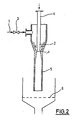
- a device suitable for this is shown in FIG. This device and the implementation of the method are explained using the example according to the invention described below.
- the nozzle by means of which the solution of the polyarylene ether is introduced into the precipitation medium is completely surrounded by the precipitation medium, in other words, the nozzle is located within the precipitation medium.
- the nozzle can also be located outside the precipitation medium, but this leads to fibrils with a slightly smaller surface.
- the pressure at the nozzle outlet is generally approximately 3 to 10 bar, or approximately 5 bar when using a rotating nozzle, although higher pressures can also be achieved and lead to good results.
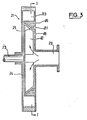
- FIG. 3 shows a longitudinal section of this device.
- the rotor preferably a radial pump wheel (22)
- the housing (21) consists of the front end plate (28), which has a central feed (29) for the precipitation medium, and from the periphery (25) of the peripheral part (26) surrounding the radial pump wheel (22), one over its Has circumferentially evenly distributed passage openings (27), which is shown in Fig. 4, for the formation of the fibrils.
- These passage openings (27) in the peripheral part (26) represent the fibril formation space.
- the housing (21) also has an open, rear end which can be covered by a removable end plate (24) which can be fastened to the housing by means of a suitable screw connection, the end plate (24) having a bushing for the shaft (23) of the radial pump wheel ( 22) is provided.
- the radial pump wheel (22) is preferably a commercially available centrifugal pump wheel, the periphery of which may be adapted to the shape of the inner circumference of the part (26).
- pump wheels with radial pump action can also be used, such as paddle wheels or discs or arms provided with beaters.
- the peripheral part (26) of the housing (21) surrounding the periphery of the radial pump wheel (22) consists of elements (210), preferably rectangular in cross section, which are arranged in a circle at the same distance and which are connected to the front end plate (28) by known means. for example screwing or welding.
- reference numeral (211) denotes inlets for the solution of the polyarylene ether
- (212) denotes the sides of the elements (210), which can have many steps
- reference numeral (213) denotes a collecting container for the fibril suspension
- reference numeral (214 ) designates a discharge nozzle arranged tangentially to it, which is connected to the discharge line.
- the intensive mixing of the flowing media takes place in a pulse exchange space upstream of the two-substance nozzle, concentrically in the flow direction.
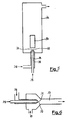
- FIGS. 5 and 6 Such a device has been described in DE-A 22 08 921.
- the technical implementation of this device is shown in FIGS. 5 and 6.
- the nozzle is installed in a larger container.
- the nozzle and the tube (33) are shown enlarged compared to the container (34).
- the reference number (31) denotes a central nozzle opening from which the precipitation medium emerges, (32) an outlet opening for the solution of the polyarylene ether, (33) the tube (pulse exchange space), (34) a container, (35) a feed for the precipitation medium and (36) a feed for the solution of the polyarylene ether.
- Figure 6 shows a device in which one can do without a large container.
- Reference number (37) represents the supply for the slower flowing liquid.
- the fibrils are formed in the tube (33), which acts as a momentum exchange space.
- three-component and four-component nozzles can also be used to carry out the method according to the invention.
- Stable, discrete fibrils are obtained immediately after all process variants. They can be separated from the liquid precipitation medium and the majority of the organic solvent by filtration or centrifugation. The remaining solvent is removed by washing with water on the filter or in the centrifuge. The organic solvents used and the corresponding precipitation media can be recovered by distillation from the mother liquor and from the wash water and returned to the process.
- the fibrils produced according to the invention can have water contents of from 60 to 99% by weight, preferably from 90 to 98% by weight, and are highly capable of forming sheets or fleece when the fibrils are deposited from an aqueous suspension on a sieve.
- the present invention also relates to the use of the fibrils produced here as binding fibers in the production of papers, seals, friction linings and nonwovens.
- Aqueous suspensions from the fibrils produced according to the invention are obtained by introducing the fibrils into water while stirring.
- the consistency here is approximately 0.2 to approximately 2% and preferably approximately 0.5 to approximately 1%.
- a dispersant may also be present in this suspension, which is generally dissolved in an amount of 0.1 to 1.0% by weight, based on the dry weight of the fibrils.
- Suitable dispersants are, for example, surface-active substances which are composed of hydrophilic and hydrophobic segments, polyvinyl alcohols or starch.
- the fiber pulp obtained is then worked for a further 5 to 15 minutes using a high-speed propeller stirrer.
- the consistency is generally 0.5 to 10% and preferably 1 to 5%.
- paper-like sheetlike structures can be obtained from the aqueous suspensions of the fibrils.
- the fibrils according to the invention can likewise be mixed with one another in any ratio with cellulose fibers or with staple fibers of synthetic polymers and can be processed on the paper machine to form self-supporting, coherent webs.
- a standard sheet (2.4 g) made from fibrils must have an initial wet strength of at least 80 g with a water content of 83% by weight.
- the initial wet strengths are determined with the test equipment developed by W. Brecht and H. Fiebinger (Karl Frank, paperback paper test . 3rd extended edition, Eduard Roether Verlag, Darmstadt, 1958, p. 59).
- the fibrils to be tested are turned on a sheet forming device by inserting a frame test strips with the dimensions 30 ⁇ 95 mm.
- the thickness of the test strips (basis weight) is determined by the weight of the fabric. The tester then measures the load at which the test strip breaks in g.
- the particular advantage of the method according to the invention is that discrete fibrils are obtained which are highly fibrillated and practically free of organic solvents.
- the residual organic solvent content in the fibrils is less than 0.1% by weight.
- highly fibrillated in the present context means that aggregates consisting of fibrils with a very high surface area according to BET up to 180 m 2 / g are obtained.
- the present invention also relates to fibrils which can be produced by introducing a solution of a polyarylene ether in a suitable organic solvent into a liquid precipitation medium under the simultaneous action of shear forces, a shear field having an average energy density of at least 5 W when the solution is introduced into the precipitation medium in the fibril formation space.
- s / cm 3 which preferably has a length of approximately 0.1 to approximately 10 mm, a thickness of approximately 1 to 300 ⁇ m, a Schopper-Riegler degree of grinding of approximately 15 to approximately 50 and a specific surface area of approximately 1 to approximately Have 180 m 2 / g.
- the fibrils produced according to the invention have the structure of finely branched aggregates, as is shown by an observation through an electron microscope.
- the extent of the fibrillation of the fibrils obtained is determined by determining the freeness according to the Schopper-Riegler method (Korn-Burgstaller, Handbuch der Werkstoff Albany , 2nd ed. 1953, 4th vol., Textil- und Zellstoff Albany, p. 388 ff, Springer Publishing house). To carry out this determination, the fibrils must be placed in an aqueous suspension with a constant consistency (2 g / l and 20 ° C). The amount of water that is retained by the suspended fibrils under certain conditions is determined. The higher the fibrillation of the fibrils, the greater the amount of water absorbed (° Schopper-Riegler, ° SR).
- the Schopper-Riegler values of an unground sulfite pulp are between 12 and 25 ° SR.
- the Schopper-Riegler values of the fibrils according to the present invention are, for example, approximately 15 to approximately 90 ° SR.
- the specific surface of the fibrils according to the invention is determined by the BET method by nitrogen absorption (S. Brunnauer, TH Emmett, E. Teller, Journal of American Chemical Society , 60 (1938), p. 309).
- the parts given in the example are parts by weight and the percentages are percentages by weight.
- a solution of 11% polyether sulfone of the repeating unit I 1 and a molecular weight of 25,000 and 89% NMP was used as the starting material. Kurt prior to entry into the fibril formation room, based on the solution, 27% THF was homogeneously mixed in with a static mixer. The solution of the polyether sulfones obtained, consisting of 8.66% polyether sulfone, 70% NMP and 21.34% THF, was then fed to the device described in FIG. 2 by means of a metering pump. 69 kg of solution were fed via the pipeline (1) to an injector nozzle (2). At the same time, water was added via a feed (4) under a pressure of 6 bar. The water jet had an exit speed of 30 m / s. The gap at point A was 0.25 mm. The polymer solution was metered in such that 30 liters of water are used as the precipitation medium for 1 liter of solution. The resulting fibrils were collected with a sieve (6).
- the resulting fibrils had a length of 0.5 to 1.5 mm, a thickness of 1 to 10 ⁇ m and a degree of grinding of 32 ° SR.
- the BET specific surface area was 150 m 2 / g.
Landscapes
- Engineering & Computer Science (AREA)
- Chemical & Material Sciences (AREA)
- Textile Engineering (AREA)
- Chemical Kinetics & Catalysis (AREA)
- General Chemical & Material Sciences (AREA)
- Dispersion Chemistry (AREA)
- Mechanical Engineering (AREA)
- Artificial Filaments (AREA)
- Spinning Methods And Devices For Manufacturing Artificial Fibers (AREA)
- Paper (AREA)
Applications Claiming Priority (2)
| Application Number | Priority Date | Filing Date | Title |
|---|---|---|---|
| DE19618330 | 1996-05-07 | ||
| DE1996118330 DE19618330A1 (de) | 1996-05-07 | 1996-05-07 | Verfahren zur Herstellung von Fibrillen |
Publications (1)
| Publication Number | Publication Date |
|---|---|
| EP0806500A1 true EP0806500A1 (fr) | 1997-11-12 |
Family
ID=7793607
Family Applications (1)
| Application Number | Title | Priority Date | Filing Date |
|---|---|---|---|
| EP97107360A Ceased EP0806500A1 (fr) | 1996-05-07 | 1997-05-05 | Procédé pour la fabrication de fibrilles |
Country Status (3)
| Country | Link |
|---|---|
| EP (1) | EP0806500A1 (fr) |
| JP (1) | JPH1060730A (fr) |
| DE (1) | DE19618330A1 (fr) |
Cited By (2)
| Publication number | Priority date | Publication date | Assignee | Title |
|---|---|---|---|---|
| WO2015023943A1 (fr) * | 2013-08-15 | 2015-02-19 | Sabic Innovative Plastics Ip B.V. | Fibres sous-micrométriques filées par cisaillement |
| US10119214B2 (en) | 2013-07-17 | 2018-11-06 | Sabic Global Technologies B.V. | Force spun sub-micron fiber and applications |
Families Citing this family (1)
| Publication number | Priority date | Publication date | Assignee | Title |
|---|---|---|---|---|
| JP4710344B2 (ja) * | 2005-02-18 | 2011-06-29 | 東レ株式会社 | 電気絶縁材料 |
Citations (6)
| Publication number | Priority date | Publication date | Assignee | Title |
|---|---|---|---|---|
| DE2208921A1 (de) * | 1972-02-25 | 1973-09-06 | Basf Ag | Verfahren und vorrichtung zur herstellung von kurzfasern aus thermoplastischen kunststoffen |
| DE2543824A1 (de) * | 1975-10-01 | 1977-04-14 | Basf Ag | Verfahren zur herstellung von fibrillen aus poly(amid-imid)-harzen |
| JPS52121524A (en) * | 1976-04-06 | 1977-10-13 | Teijin Ltd | Production of pulp like substance |
| JPS52124904A (en) * | 1976-04-12 | 1977-10-20 | Teijin Ltd | Process for making sheets |
| DE2646332A1 (de) * | 1976-10-14 | 1978-04-20 | Basf Ag | Verfahren zur herstellung von fibrillen aus polymerisaten |
| WO1996014130A1 (fr) * | 1994-11-08 | 1996-05-17 | Hoechst Aktiengesellschaft | Materiau de filtration et procede d'elimination de composants de melanges gazeux et de liquides |
-
1996
- 1996-05-07 DE DE1996118330 patent/DE19618330A1/de not_active Withdrawn
-
1997
- 1997-05-05 EP EP97107360A patent/EP0806500A1/fr not_active Ceased
- 1997-05-06 JP JP11541097A patent/JPH1060730A/ja not_active Withdrawn
Patent Citations (6)
| Publication number | Priority date | Publication date | Assignee | Title |
|---|---|---|---|---|
| DE2208921A1 (de) * | 1972-02-25 | 1973-09-06 | Basf Ag | Verfahren und vorrichtung zur herstellung von kurzfasern aus thermoplastischen kunststoffen |
| DE2543824A1 (de) * | 1975-10-01 | 1977-04-14 | Basf Ag | Verfahren zur herstellung von fibrillen aus poly(amid-imid)-harzen |
| JPS52121524A (en) * | 1976-04-06 | 1977-10-13 | Teijin Ltd | Production of pulp like substance |
| JPS52124904A (en) * | 1976-04-12 | 1977-10-20 | Teijin Ltd | Process for making sheets |
| DE2646332A1 (de) * | 1976-10-14 | 1978-04-20 | Basf Ag | Verfahren zur herstellung von fibrillen aus polymerisaten |
| WO1996014130A1 (fr) * | 1994-11-08 | 1996-05-17 | Hoechst Aktiengesellschaft | Materiau de filtration et procede d'elimination de composants de melanges gazeux et de liquides |
Non-Patent Citations (2)
| Title |
|---|
| DATABASE WPI Section Ch Week 7747, Derwent World Patents Index; Class A26, AN 77-83683Y, XP002039001 * |
| DATABASE WPI Section Ch Week 7748, Derwent World Patents Index; Class A26, AN 77-85488Y, XP002039002 * |
Cited By (3)
| Publication number | Priority date | Publication date | Assignee | Title |
|---|---|---|---|---|
| US10119214B2 (en) | 2013-07-17 | 2018-11-06 | Sabic Global Technologies B.V. | Force spun sub-micron fiber and applications |
| WO2015023943A1 (fr) * | 2013-08-15 | 2015-02-19 | Sabic Innovative Plastics Ip B.V. | Fibres sous-micrométriques filées par cisaillement |
| US10400355B2 (en) | 2013-08-15 | 2019-09-03 | Sabic Global Technologies B.V. | Shear spun sub-micrometer fibers |
Also Published As
| Publication number | Publication date |
|---|---|
| JPH1060730A (ja) | 1998-03-03 |
| DE19618330A1 (de) | 1997-11-13 |
Similar Documents
| Publication | Publication Date | Title |
|---|---|---|
| DE69733415T2 (de) | Auf fibrillen basierende fasern, methode zu deren herstellung, dabei verwendete spinndüse und damit hergestellte formkörper | |
| DE2543824C3 (de) | Verfahren zur Herstellung von Fibrillen aus Poly(amid-imid)-harzen und die Fibrillen aus diesen Harzen | |
| DE2052224A1 (de) | Faserprodukt aus regenerierter Cellulose und Verfahren zu dessen Her stellung | |
| EP0905144A1 (fr) | Procédé pour la fabrication de particules de cellulose | |
| DE2308996A1 (de) | Fasern aus polyolefinischen materialien und verfahren zu ihrer herstellung und verwendung | |
| EP0807698B1 (fr) | Procédé et dispositif pour la préparation d'une structure fibrillaire à base de dérivés de cellulose | |
| DE2646332C3 (fr) | ||
| DE2516561C3 (de) | Verfahren zur Herstellung von Fibrillen aus Polymerisaten | |
| DE2402896C2 (de) | Verfahren zur Herstellung von Polymerfasern | |
| DE69311264T2 (de) | Verfahren zum Flash-Spinnen von starken diskontinuierlichen Fasern | |
| EP0806500A1 (fr) | Procédé pour la fabrication de fibrilles | |
| DE602004003232T2 (de) | Eine mikropulpe enthaltende polymervorläuferdispersion und herstellungsverfahren dafür | |
| DE2543816C3 (de) | Verwendung von Fibrillen aus aromatischen Poly(amid-imid)harzen zur Herstellung von papier- und textilähnlichen Flächengebilden | |
| EP1299459B1 (fr) | Procede et dispositif pour la production de particules de cellulose | |
| DE4225425C2 (de) | Stärkemasse, Verfahren zu ihrer Herstellung und ihre Verwendung in der Herstellung von Papier und Pappe | |
| EP1268556A1 (fr) | Procede et dispositif pour produire en continu une suspension cellulosique dans un aminoxyde aqueux | |
| DE2320188A1 (de) | Verfahren und vorrichtung zur herstellung von polymerfasern | |
| DE69316585T2 (de) | Vorrichtung und verfahren zur herstellung von faserigem material aus staerke | |
| DE2343543C2 (de) | Verfahren zur Herstellung von polymeren Fasern | |
| EP0824105A2 (fr) | Particules de cellulose | |
| EP0071084B1 (fr) | Appareil pour la fabrication de fibres liantes à partir de dispersions de polymères | |
| DE2253752B2 (de) | Verfahren zur Herstellung von Fasergebilden | |
| DE2651267C2 (fr) | ||
| DE2545727C2 (de) | Verfahren zur Herstellung von nicht schäumenden wäßrigen Suspensionen von Fibrillen | |
| DE2659821C3 (de) | Verfahren zur Herstellung von Fibrillen |
Legal Events
| Date | Code | Title | Description |
|---|---|---|---|
| PUAI | Public reference made under article 153(3) epc to a published international application that has entered the european phase |
Free format text: ORIGINAL CODE: 0009012 |
|
| AK | Designated contracting states |
Kind code of ref document: A1 Designated state(s): BE DE FR GB IT NL |
|
| 17P | Request for examination filed |
Effective date: 19980504 |
|
| 17Q | First examination report despatched |
Effective date: 19981022 |
|
| GRAG | Despatch of communication of intention to grant |
Free format text: ORIGINAL CODE: EPIDOS AGRA |
|
| STAA | Information on the status of an ep patent application or granted ep patent |
Free format text: STATUS: THE APPLICATION HAS BEEN REFUSED |
|
| 18R | Application refused |
Effective date: 20000203 |