EP0806649B1 - Verfahren zur Bestimmung der Eigenschaften von einer Fasersuspension zur Papiererzeugung - Google Patents
Verfahren zur Bestimmung der Eigenschaften von einer Fasersuspension zur Papiererzeugung Download PDFInfo
- Publication number
- EP0806649B1 EP0806649B1 EP97660049A EP97660049A EP0806649B1 EP 0806649 B1 EP0806649 B1 EP 0806649B1 EP 97660049 A EP97660049 A EP 97660049A EP 97660049 A EP97660049 A EP 97660049A EP 0806649 B1 EP0806649 B1 EP 0806649B1
- Authority
- EP
- European Patent Office
- Prior art keywords
- fibre
- fibres
- diffusion
- suspension
- tracer
- Prior art date
- Legal status (The legal status is an assumption and is not a legal conclusion. Google has not performed a legal analysis and makes no representation as to the accuracy of the status listed.)
- Expired - Lifetime
Links
- 239000000725 suspension Substances 0.000 title claims abstract description 49
- 238000000034 method Methods 0.000 title claims abstract description 40
- 239000000835 fiber Substances 0.000 claims abstract description 204
- 238000009792 diffusion process Methods 0.000 claims abstract description 102
- 238000005259 measurement Methods 0.000 claims abstract description 58
- 239000000700 radioactive tracer Substances 0.000 claims abstract description 42
- 230000001419 dependent effect Effects 0.000 claims abstract description 15
- 239000008346 aqueous phase Substances 0.000 claims abstract description 13
- 239000003792 electrolyte Substances 0.000 claims description 10
- 238000004364 calculation method Methods 0.000 claims description 3
- WCUXLLCKKVVCTQ-UHFFFAOYSA-M Potassium chloride Chemical compound [Cl-].[K+] WCUXLLCKKVVCTQ-UHFFFAOYSA-M 0.000 description 21
- 238000012360 testing method Methods 0.000 description 19
- 239000000243 solution Substances 0.000 description 13
- 239000000203 mixture Substances 0.000 description 12
- 239000001103 potassium chloride Substances 0.000 description 11
- 235000011164 potassium chloride Nutrition 0.000 description 10
- 238000004519 manufacturing process Methods 0.000 description 8
- XLYOFNOQVPJJNP-UHFFFAOYSA-N water Substances O XLYOFNOQVPJJNP-UHFFFAOYSA-N 0.000 description 8
- 230000000694 effects Effects 0.000 description 6
- 238000004064 recycling Methods 0.000 description 6
- 239000000126 substance Substances 0.000 description 6
- 238000012546 transfer Methods 0.000 description 6
- 230000003780 keratinization Effects 0.000 description 5
- 238000004458 analytical method Methods 0.000 description 4
- 239000000047 product Substances 0.000 description 4
- 239000002761 deinking Substances 0.000 description 3
- 230000006866 deterioration Effects 0.000 description 3
- 238000011161 development Methods 0.000 description 3
- 230000018109 developmental process Effects 0.000 description 3
- 238000002156 mixing Methods 0.000 description 3
- 239000010893 paper waste Substances 0.000 description 3
- 238000010586 diagram Methods 0.000 description 2
- 238000001035 drying Methods 0.000 description 2
- 238000005516 engineering process Methods 0.000 description 2
- 230000005284 excitation Effects 0.000 description 2
- 238000011835 investigation Methods 0.000 description 2
- 229920005610 lignin Polymers 0.000 description 2
- 238000005316 response function Methods 0.000 description 2
- 239000012266 salt solution Substances 0.000 description 2
- 229920006395 saturated elastomer Polymers 0.000 description 2
- 239000007787 solid Substances 0.000 description 2
- 239000002344 surface layer Substances 0.000 description 2
- 241001251054 Formica truncorum Species 0.000 description 1
- 229920001131 Pulp (paper) Polymers 0.000 description 1
- 241000529895 Stercorarius Species 0.000 description 1
- 230000006978 adaptation Effects 0.000 description 1
- 239000003513 alkali Substances 0.000 description 1
- 239000007864 aqueous solution Substances 0.000 description 1
- 238000004061 bleaching Methods 0.000 description 1
- 230000000903 blocking effect Effects 0.000 description 1
- 239000001913 cellulose Substances 0.000 description 1
- 229920002678 cellulose Polymers 0.000 description 1
- 238000012512 characterization method Methods 0.000 description 1
- 239000007795 chemical reaction product Substances 0.000 description 1
- 239000003086 colorant Substances 0.000 description 1
- 238000009826 distribution Methods 0.000 description 1
- 150000004820 halides Chemical class 0.000 description 1
- 150000002500 ions Chemical class 0.000 description 1
- 230000002427 irreversible effect Effects 0.000 description 1
- 239000007788 liquid Substances 0.000 description 1
- 238000013178 mathematical model Methods 0.000 description 1
- 238000010297 mechanical methods and process Methods 0.000 description 1
- 229910052751 metal Inorganic materials 0.000 description 1
- 239000002184 metal Substances 0.000 description 1
- 238000000386 microscopy Methods 0.000 description 1
- 150000007522 mineralic acids Chemical class 0.000 description 1
- 238000012544 monitoring process Methods 0.000 description 1
- 230000007935 neutral effect Effects 0.000 description 1
- -1 neutral tracers Substances 0.000 description 1
- 150000007524 organic acids Chemical class 0.000 description 1
- 238000003825 pressing Methods 0.000 description 1
- 238000004537 pulping Methods 0.000 description 1
- 238000007670 refining Methods 0.000 description 1
- 230000001105 regulatory effect Effects 0.000 description 1
- 238000011160 research Methods 0.000 description 1
- 238000002798 spectrophotometry method Methods 0.000 description 1
- 238000004148 unit process Methods 0.000 description 1
- 239000002023 wood Substances 0.000 description 1
Images


Classifications
-
- G—PHYSICS
- G01—MEASURING; TESTING
- G01N—INVESTIGATING OR ANALYSING MATERIALS BY DETERMINING THEIR CHEMICAL OR PHYSICAL PROPERTIES
- G01N13/00—Investigating surface or boundary effects, e.g. wetting power; Investigating diffusion effects; Analysing materials by determining surface, boundary, or diffusion effects
-
- G—PHYSICS
- G01—MEASURING; TESTING
- G01N—INVESTIGATING OR ANALYSING MATERIALS BY DETERMINING THEIR CHEMICAL OR PHYSICAL PROPERTIES
- G01N33/00—Investigating or analysing materials by specific methods not covered by groups G01N1/00 - G01N31/00
- G01N33/34—Paper
- G01N33/343—Paper pulp
-
- G—PHYSICS
- G01—MEASURING; TESTING
- G01N—INVESTIGATING OR ANALYSING MATERIALS BY DETERMINING THEIR CHEMICAL OR PHYSICAL PROPERTIES
- G01N13/00—Investigating surface or boundary effects, e.g. wetting power; Investigating diffusion effects; Analysing materials by determining surface, boundary, or diffusion effects
- G01N2013/003—Diffusion; diffusivity between liquids
Definitions
- the present invention relates to a procedure for characterizing the papermaking properties of a fibre suspension including determining a quantity dependent on the rate of diffusion in the fibre wall for diffusion occurring through it.
- Prior art document EP-A-0 703 451 discloses a method of monitoring a papermaking system and is related to the application.
- secondary fibre refers to fibre that has gone through the paper manufacturing process at least once.
- secondary fibre comprises actual recycled fibre obtained from waste paper and fibre obtained from culled paper produced in a paper mill.
- Primary fibre or virgin fibre refers to fibre that has not gone through the paper manufacturing process.
- Fibre refers to fibres used in paper and pulp industry, produced by chemical or mechanical methods from plants or plant parts containing lignocellulose, such as wood or plants with a herbaceous stalk, from which the lignin has been removed or in which the lignin is partly or completely preserved, such as cellulose, groundwood and/or refiner mechanical pulp or mixtures of these.
- Fibre recycling is controlled by various regulations and green values, but in the long run the technology will largely orient itself according to cycled paper has also been growing vigorously.
- Fibre recycling is controlled by various regulations and green values, but in the long run the technology will largely orient itself according to supply and demand.
- a good market value of recycled paper serves as an incitement for the development of waste paper collection and sorting systems.
- the situation varies from one country to another. For instance, in Japan the amount of fibre recycled is very high as the country lacks natural fibre resources of its own.
- the Scandinavian countries have a sufficient supply of primary fibre and the amount of waste paper produced in them is relatively low as the centre of paper consumption is in Central Europe; therefore, for economic reasons alone, the use of secondary fibre has less significant proportions in Scandinavia.
- Secondary fibre is treated before reuse in a so-called deinking process so as to raise its potential in paper manufacture to a level sufficient for a new paper product.
- the unit processes in deinking comprise both physical and chemical operations that have an effect on the fibre quality and therefore on the quality of the paper product manufactured from the secondary fibre.
- the earlier history of the fibre in paper manufacture has an effect on the end product.
- the properties of paper manufactured from secondary fibre e.g. the tensile and burst strength of the paper are worse than for paper manufactured using only primary fibre. Paper manufactured from secondary fibre generally also has a lower lightness, but this depends on the bleaching method.
- the object of the present invention is to eliminate the drawbacks described above.
- a specific object of the invention is to produce a new method for characterizing the papermaking properties of a fibre suspension containing secondary fibre, the method includes determining a quantity dependent on the rate of diffusion and especially determining the coefficient of diffusion from the fibre wall in diffusion occurring through the wall, which will make it possible to estimate the papermaking properties, adaptability and/or keratinization of secondary fibre in fibre mixtures.
- the invention is based on extensive investigations in which it was established that the rate of diffusion of a tracer in the keratinized wall of secondary fibre is lower than in the wall of undried primary fibre. This is because the fibre keratinization occurring in paper manufacture in conjunction with drying blocks the micropores in the fibre wall and increases the density of the wall, reducing the diffusion, the rate of diffusion and a quantity dependent on diffusion or the rate of diffusion, especially the coefficient of diffusion, in diffusion taking place through the wall.
- a method for measuring the rate of diffusion and/or any quantity dependent on it and especially the diffusion coefficient when a tracer is being diffused through the fibre wall.
- the measured rate of diffusion and/or diffusion coefficient or quantities dependent on these characterize the papermaking properties or adaptability of the fibre mixture.
- the quantities obtained can be used to determine the proportion of keratinized fibre (secondary fibre) in the fibre mixture.
- the quantities obtained can be used to characterize the papermaking properties of fibre suspensions containing secondary fibre.
- a diffusible tracer is introduced into the fibres in a fibre sample to be investigated.
- the fibres are then placed in water and the diffusion through the fibre wall of the diffusible tracer contained in the fibres is measured by measuring the concentration of the diffusible tracer in bulk mixture outside the fibres at a certain time or as a function of time.
- the total diffusion or the rate of diffusion taking place through the fibre wall can be calculated on the basis of the concentration of the bulk mixture at a given instant and/or on the basis of the change in concentration per unit of time.
- the measurement data is fitted in a mathematical model describing the diffusion occurring inside the fibres, whereupon the diffusion coefficient, which describes the rate of diffusion in a known manner, and/or a quantity dependent on it can be calculated.
- the tracer may be in general any watersoluble substance whose concentration can be accurately measured in a fibre suspension outside the fibres.
- Typical tracers are organic or inorganic acid, alkali or salt solutions ionizable or non-ionizable in the fibre suspension, neutral tracers, colorants or radiotracers. The measurement can be performed using any sufficiently fast, cheap and reliable analysing method whose dynamic behaviour is known or can be measured.
- the tracer can be introduced into the fibres preferably by impregnating a fibre sample in a saturated or nearly saturated tracer solution, e.g. a salt solution, such as a halide solution of an alkaline metal.
- a saturated or nearly saturated tracer solution e.g. a salt solution, such as a halide solution of an alkaline metal.
- the extra tracer solution outside the fibres can be removed e.g. by pressing the fibres so that no significant amounts of tracer will remain on the outside of the fibres, or in some other way.
- the fibres thus cleaned externally are placed in a vessel provided with a vigorous mixing capability, preferably in ion-exchanged water, and the concentration of the tracer diffused in the water is determined outside the fibres as a function of time e.g. via potentiometric measurement of conductivity when the tracer is in an ionized state, or by spectrophotometry or in some other way, as is generally known in analytic chemistry.
- the initial condition (1a) means that the tracer must be homogeneously distributed inside the fibre before the test is started.
- Edge condition (1b) will be true if the suspension is effectively mixed and/or the diffusion coefficient for the tracer is much higher in water than inside the fibre wall.
- edge condition (1c) the fibres are symmetric and undamaged.
- a solution which is a Bessel function of the first kind of order zero, can be represented as a series development and the constants in the solution can be determined from the initial condition (1a) (Carslaw and Jaeger, Conduction of Heat in Solids).
- the molar flow of the tracer through the fibre wall can be represented according to Fick's first law by means of the concentration gradient prevailing in the surface layer of the fibre, likewise in cylindrical coordinates.
- the concentration gradient can be solved by differentiating the series development solution of the Bessel function in the surface layer of the fibre and inserted in Fick's first law.
- Equation (2) gives the theoretic tracer concentration C s * in the aqueous phase outside the fibres at different times during the diffusion test.
- f in (t) is a step function which has the value 1 when t>0.
- the transfer function G(s) is obtained by solving the Laplace transforms for the functions f in (t) and f out (t) and inserting them in equation (3).
- function f out (t) is as given by equation (4)
- the average diffusion coefficient prevailing in the fibres in the fibre suspension is determined. What is obtained is therefore in the first place a virtual diffusion coefficient because the suspension consists of different kinds of fibres having different diffusion coefficients. In the procedure, it is not the different diffusion coefficients prevailing in individual fibres that are determined, but instead the procedure yields a single virtual diffusion coefficient characterizing the entire fibre suspension.
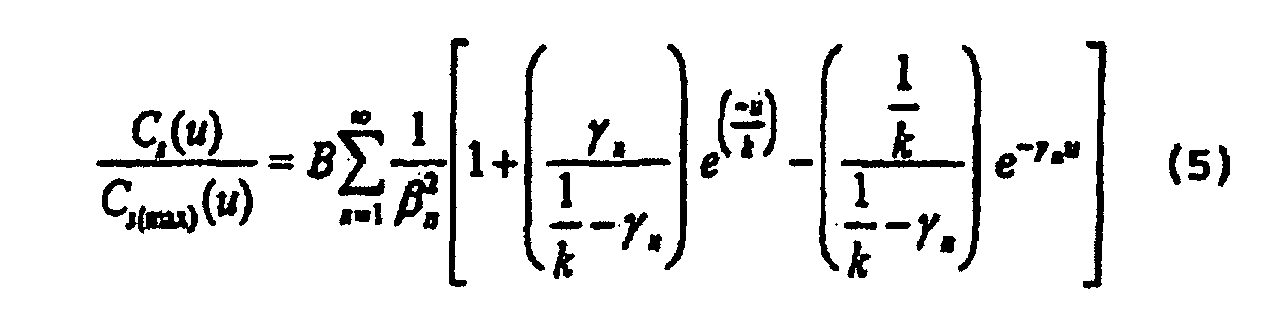
- equation (5) describes the diffusion when ions are being diffused from inside the fibre into the surrounding water.
- equation (5) describes the diffusion when ions are being diffused from inside the fibre into the surrounding water.
- the tests were carried out using chemical birchwood pulp. Determined using laser microscope pictures and laser microscopy, the average fibre diameters were about 30 ⁇ m and 35 ⁇ m for dried fibres and for fibres suspended in water, respectively.
- the electrolyte used was potassium chloride (Merck, p.a.).
- the equipment used in the test is shown in Fig. 2 and comprises a measurement vessel 1 provided with a mixer 2 and a temperature regulation system 3. Moreover, the equipment comprises a device 4 for measuring the temperature in the measurement vessel and a device 5 for measuring the tracer concentration in the measurement solution in the vessel, based on conductance measurement. The data were transferred to a data acquisition device 6 and further to a computer 7.
- the parameter T, the time delay and the time constant k are parameters specific to the equipment and analysing method used and they are different for different sets of equipment. The parameters can be determined separately for each case.
- the total amount of KCl added was the same as in tests in which fibres are used.
- the fibres were first impregnated with 3M KCl solution, whereupon they were pressed until there was no solution left on the outside of the fibres.
- the fibre sample was placed in the measurement vessel and suspended by mixing at a fast rate.
- the increse of KCl concentration outside the fibres was monitored by measuring the conductivity of the solution as a function of time. It is generally known that concentration and conductivity are directly proportional in weak solutions.
- the diffusion coefficients for KCl in the fibre wall were calculated from the curve representing the dependence of the measured concentration on time, as described above.
- the measurements were carried out in the same way as in Example 1 by recycling the fibre used in Example 1 and performing the measurements for each cycle.
- measurement 1 fibre as described in Example 1 was used in the wet state; in measurement 2, the same fibre as in measurement 1, made into a sheet of paper and dried, was used; in measurement 3, the fibre used in measurement 2, made again into a sheet of paper and dried, was used; in measurement 4, the fibre used in measurement 3, made once more into a sheet of paper and dried, was used.
- the fibre of the previous stage was washed very carefully before the next stage to remove the KCl.
- the share of secondary fibre in the fibre suspension under measurement can be approximately determined e.g. as illustrated by Fig. 5 by placing the measured diffusion coefficient value on the graph and reading the corresponding value defining the proportion of secondary fibre from the scale. It is to be noted that this method can only be used to define the proportion of secondary fibre as an approximate value. To obtain a more accurate result, a graph as shown in Fig. 5 can be defined more precisely by performing more measurements on known fibre suspensions, e.g. in the conditions prevailing in a given paper mill; from a more accurate graph, the proportion of secondary fibre can be interpolated more exactly.
- the proportion of secondary fibre in the fibre suspension under analysis can be estimated by assuming that the diffusion coefficient depends mainly linearly on the proportions of primary and secondary fibre in the fibre suspension.
- the diffusion coefficient correlates with the papermaking properties of the fibre suspension, and the papermaking properties can therefore be characterized by the virtual diffusion coefficient of the fibre suspension and/or by a quantity dependent on it.
- the proportion of secondary fibre in a fibre suspension under analysis can be estimated by assuming that the diffusion coefficient depends mainly linearly on the proportions of primary and secondary fibre in the fibre suspension.
- a linear scale is created using a diffusion coefficient describing non-recycled fibre, obtained from Fig. 5, and a suitably selected diffusion coefficient describing recycled fibre.
- a diffusion coefficient that is the most representative of recycled fibre is selected by using the diffusion coefficients representing different reclaiming cycles, e.g. as their mean value, if the suspension is likely to contain fibres differing in respect of the number of times they have been recycled. As the difference in the diffusion coefficient is small even after the first reclaiming cycle when the fibre is further recycled, this procedure does not involve any large error.
- the diffusion coefficient bears a correlation to the quality of the fibre suspension, and the papermaking properties can therefore be characterized by a virtual diffusion coefficient and/or a quantity dependent on it.
- the procedure shows a more pronounced reaction to the amount of recycled fibre than to the number of times the fibre has been recycled, both have an effect of the same nature.
- the lower the diffusion coefficient is the worse is the fibre mixture in respect of papermaking properties.
- the higher the diffusion coefficient the better is the fibre mixture in respect of papermaking properties.
- the model developed explains the test results very well.
- the share of secondary fibre in the fibre suspension under measurement is approximately determined as illustrated by fig. 5 by placing and reading corresponding value defining the proportion of secondary fibre from the scale.
- the share of the secondary fibre in the suspension under analysis is estimated by assuming that the diffusion coefficient depends mainly linearly on the proportions of primary and secondary fibre in the fibre suspension.
- a linear scale is created using a diffusion coefficient describing non-recycled fibre, obtained from fig. 5, and a suitably selected diffusion coefficient describing recycled fibre.
- a diffusion coefficient that is the most representative of recycled fibre is selected by using the diffusion coefficients representing different reclaiming cycles, e.g. as their mean value, if the suspension is likely to contain fibres differing in respect of the number of times they have been recycled. As the difference in the diffusion coefficient is small even after the first reclaiming cycle when the fibre is further recycled, this procedure does not involve any large error.
- fibre contains the primary fibre used in example 2 and recycled fibre, recycled 2, 3 and 4 times.
- the share of primary fibre was ab. 20 % and secondary fibre 80 % of the total amount of fibre.
- the share of primary fibre was ab. 53 % and secondary fibre (recycled 2, 3 and 4 times) ab. 67 %.
Landscapes
- Health & Medical Sciences (AREA)
- Life Sciences & Earth Sciences (AREA)
- Chemical & Material Sciences (AREA)
- Pathology (AREA)
- Physics & Mathematics (AREA)
- Analytical Chemistry (AREA)
- Biochemistry (AREA)
- General Health & Medical Sciences (AREA)
- General Physics & Mathematics (AREA)
- Immunology (AREA)
- Food Science & Technology (AREA)
- Medicinal Chemistry (AREA)
- Engineering & Computer Science (AREA)
- Paper (AREA)
- Treatment Of Fiber Materials (AREA)
- Artificial Filaments (AREA)
Claims (8)
- Verfahren zum Charakterisieren der Papierherstellungseigenschaften einer Suspension von Fasern, wobei das Verfahren umfasst:I) Ausführen von Schritten a) bis e) für Fasern, die die Suspension von Fasern sind, für Fasern, die Primärfasern sind, sowie für Fasern, die Sekundärfasem sind;a) Einleitung eines diffusionsfähigen Indikators in die Fasern;b) Suspension der Fasern in einer wässrigen Phase;c) Bestimmung der Indikatorkonzentration in der wässrigen Phase als Funktion der Zeit, die seit dem Zeitpunkt der Suspension der Fasern verstrichen ist;d) Bestimmung des Diffusionskoeffizienten in den Fasern;e) Berechnung einer Größe, die von der Diffusionsrate abhängt, auf Basis der bestimmten Konzentration und der verstrichenen Zeit;II) Vergleichen der Größe, die von der Diffusionsrate der Suspension von Fasern abhängt, mit der Größe, die von der Diffusionsrate der Primärfasern abhängt, und der Größe, die von der Diffusionsrate der Sekundärfasem abhängt.
- Verfahren nach Anspruch 1, dadurch gekennzeichnet, dass ein diffusionsfähiger Indikator in die zu messenden Fasern eingeleitet wird, die Fasen in einer wässrigen Phase suspendiert werden, die Indikator-Konzentration in der wässrigen Phase bestimmt wird, und der Diffusionskoeffizient entsprechend Gleichung (2) bestimmt wird,wobei C * / s die Elektrolyt-Konzentration außerhalb der Fasern in der wässrigen Phase ist, A die Gesamtfläche der Fasern ist, Cmax die Anfangs-Elektrolyt-Konzentration innerhalb der Fasern ist, R der Faserradius ist, VH20 das Suspensions-Volumen ist, βn die n-te Wurzel (die eine Bessel-Funktion erster Art der Ordnung 0 ist) von Gleichung Jo (βn) = 0 ist, D der Indikator-Diffusionskoeffizient innerhalb der Faserwand ist und t die Zeit ist.

- Verfahren nach Anspruch 1, dadurch gekennzeichnet, dass der Diffusionskoeffizient entsprechend Gleichung (5) bestimmt wird.wobei Cs(u) die Indikator-Konzentration gemessen anhand der wässrigen Phase ist, Cs(max)(u) die End-Indikatorkonzentration in der wässrigen Phase ist, B 2ACmaxR/VH2O entspricht, γn Dβ2 n/R2 entspricht, u t - T entspricht (wobei T die Länge einer Verzögerung ist) und k eine Zeitkonstante ist.
- Verfahren nach einem der Ansprüche 1 - 3, dadurch gekennzeichnet, dass der Anteil von Sekundärfasern in einer Fasersuspension, die Primärfasern und Sekundärfasern enthält, so bestimmt wird, dass die Diffusionskoeffizienten in der Faserwand bei durch sie hindurch stattfindender Diffusion in wenigstens zwei Fasersuspensionen, für die die Anteile von Primär- und Sekundärfasern bekannt sind, und in einer zu messenden Fasersuspension bestimmt werden, und dass der Anteil von Sekundärfasern in der zu messenden Suspension geschätzt wird, indem angenommen wird, dass der Diffusionskoeffizient hauptsächlich linear von dem Anteil der Primär- und der Sekundärfasem in der Fasersuspension abhängt.
- Verfahren nach Anspruch 2 oder 3, dadurch gekennzeichnet, dass der Indikator in die Faser eingeleitet wird, indem die Fasern in einer Indikatorlösung suspendiert werden und der Indikator außen von der Oberfläche der Fasern entfernt wird.
- Verfahren nach einem der Ansprüche 2 - 5, dadurch gekennzeichnet, dass die Fasern so gepresst werden, dass jegliche Indikatorlösung von der Oberfläche der Fasern entfernt wird.
- Verfahren nach einem der Ansprüche 2-6, dadurch gekennzeichnet, dass der Indikator ein Elektrolyt ist.
- Verfahren nach einem der Ansprüche 2 - 7, dadurch gekennzeichnet, dass die Indikatorkonzentration in der wässrigen Phase über eine Leitfähigkeitsmessung gemessen wird.
Priority Applications (1)
| Application Number | Priority Date | Filing Date | Title |
|---|---|---|---|
| EP03012776A EP1353163B1 (de) | 1996-05-03 | 1997-04-22 | Verfahren zur Bestimmung des in einer Faserwand vorliegenden Diffusionskoeffizienten in einer primäre und sekundäre Fasern beinhaltenden Suspension |
Applications Claiming Priority (2)
| Application Number | Priority Date | Filing Date | Title |
|---|---|---|---|
| FI961907A FI104195B1 (fi) | 1996-05-03 | 1996-05-03 | Menetelmä ensiö- ja uusiokuitua sisältävässä suspensiossa kuidun seinämässä vallitsevan diffuusiokertoimen, uusiokuidun osuuden ja paperinvalmistusominaisuuksien määräämiseksi |
| FI961907 | 1996-05-03 |
Related Child Applications (1)
| Application Number | Title | Priority Date | Filing Date |
|---|---|---|---|
| EP03012776A Division EP1353163B1 (de) | 1996-05-03 | 1997-04-22 | Verfahren zur Bestimmung des in einer Faserwand vorliegenden Diffusionskoeffizienten in einer primäre und sekundäre Fasern beinhaltenden Suspension |
Publications (3)
| Publication Number | Publication Date |
|---|---|
| EP0806649A2 EP0806649A2 (de) | 1997-11-12 |
| EP0806649A3 EP0806649A3 (de) | 1998-07-01 |
| EP0806649B1 true EP0806649B1 (de) | 2005-01-19 |
Family
ID=8545957
Family Applications (2)
| Application Number | Title | Priority Date | Filing Date |
|---|---|---|---|
| EP03012776A Expired - Lifetime EP1353163B1 (de) | 1996-05-03 | 1997-04-22 | Verfahren zur Bestimmung des in einer Faserwand vorliegenden Diffusionskoeffizienten in einer primäre und sekundäre Fasern beinhaltenden Suspension |
| EP97660049A Expired - Lifetime EP0806649B1 (de) | 1996-05-03 | 1997-04-22 | Verfahren zur Bestimmung der Eigenschaften von einer Fasersuspension zur Papiererzeugung |
Family Applications Before (1)
| Application Number | Title | Priority Date | Filing Date |
|---|---|---|---|
| EP03012776A Expired - Lifetime EP1353163B1 (de) | 1996-05-03 | 1997-04-22 | Verfahren zur Bestimmung des in einer Faserwand vorliegenden Diffusionskoeffizienten in einer primäre und sekundäre Fasern beinhaltenden Suspension |
Country Status (11)
| Country | Link |
|---|---|
| US (1) | US5913235A (de) |
| EP (2) | EP1353163B1 (de) |
| JP (1) | JP3046260B2 (de) |
| AT (2) | ATE287530T1 (de) |
| AU (1) | AU716454B2 (de) |
| CA (1) | CA2204215C (de) |
| DE (2) | DE69734327T2 (de) |
| FI (1) | FI104195B1 (de) |
| NO (1) | NO317205B1 (de) |
| NZ (1) | NZ314719A (de) |
| PT (1) | PT806649E (de) |
Families Citing this family (10)
| Publication number | Priority date | Publication date | Assignee | Title |
|---|---|---|---|---|
| JP4163383B2 (ja) * | 1998-04-14 | 2008-10-08 | カリフォルニア・インスティテュート・オブ・テクノロジー | 検体活性を判定するための方法とシステム |
| AU1725200A (en) | 1998-11-16 | 2000-06-05 | California Institute Of Technology | Simultaneous determination of equilibrium and kinetic properties |
| US6631333B1 (en) * | 1999-05-10 | 2003-10-07 | California Institute Of Technology | Methods for remote characterization of an odor |
| US7122152B2 (en) * | 1999-05-10 | 2006-10-17 | University Of Florida | Spatiotemporal and geometric optimization of sensor arrays for detecting analytes fluids |
| US6455319B1 (en) | 1999-05-10 | 2002-09-24 | California Institute Of Technology | Use of spatiotemporal response behavior in sensor arrays to detect analytes in fluids |
| US6890715B1 (en) * | 1999-08-18 | 2005-05-10 | The California Institute Of Technology | Sensors of conducting and insulating composites |
| US20050150778A1 (en) * | 2002-11-18 | 2005-07-14 | Lewis Nathan S. | Use of basic polymers in carbon black composite vapor detectors to obtain enhanced sensitivity and classification performance for volatile fatty acids |
| KR100515853B1 (ko) * | 2002-11-19 | 2005-09-21 | 한국과학기술연구원 | 중공사 미세 기공을 통한 나노입자 유체의 확산계수 측정방법 및 장치 |
| US7099778B2 (en) * | 2003-12-30 | 2006-08-29 | Caliper Life Sciences, Inc. | Method for determining diffusivity and molecular weight in a microfluidic device |
| CN117091997B (zh) * | 2023-10-13 | 2023-12-22 | 四川省生态环境科学研究院 | 一种河道胶体纵向动力学分散系数直接测定方法及装置 |
Citations (1)
| Publication number | Priority date | Publication date | Assignee | Title |
|---|---|---|---|---|
| EP0703451A2 (de) * | 1994-09-26 | 1996-03-27 | Nalco Chemical Company | Überwachung von Prozessflüssigkeiten in Papierherstellungssystemen |
Family Cites Families (7)
| Publication number | Priority date | Publication date | Assignee | Title |
|---|---|---|---|---|
| DE2556217C3 (de) * | 1975-12-13 | 1978-09-21 | Kernforschungsanlage Juelich Gmbh, 5170 Juelich | Verfahren und Vorrichtung zur Messung der Diffusion von Teilchen eines oder mehrerer Materialien durch ein anderes, in fester Form vorliegendes Material |
| FI77535C (fi) * | 1987-03-09 | 1989-03-10 | Kajaani Electronics | Foerfarande foer maetning av massakomponenternas relativa maengder i pappermassa. |
| SE461156B (sv) * | 1988-05-25 | 1990-01-15 | Eka Nobel Ab | Saett foer framstaellning av papper varvid formning och avvattning aeger rum i naervaro av en aluminiumfoerening, ett katjoniskt retentionsmedel och en polymer kiselsyra |
| SE500871C2 (sv) * | 1989-09-27 | 1994-09-19 | Sca Research Ab | Aluminiumsaltimpregnerade fibrer, sätt att framställa dessa, absorptionsmaterial för användning i hygienartiklar och användning av fibrerna som absorptionsmaterial |
| DE3933382C2 (de) * | 1989-10-06 | 1994-03-10 | Audi Ag | Verfahren zum Bestimmen des Permeationsverhaltens |
| DE4011731A1 (de) * | 1990-04-11 | 1991-10-17 | Interatom | Vorrichtung zur messung der gaspermeation durch gummielastische membranen |
| DE19525779A1 (de) * | 1995-07-13 | 1997-01-16 | Siemens Ag | Verfahren zur Bestimmung der mechanischen Eigenschaften von Papier und Anordnung zur Durchführung des Verfahrens |
-
1996
- 1996-05-03 FI FI961907A patent/FI104195B1/fi active
-
1997
- 1997-04-22 PT PT97660049T patent/PT806649E/pt unknown
- 1997-04-22 DE DE69734327T patent/DE69734327T2/de not_active Expired - Fee Related
- 1997-04-22 AT AT97660049T patent/ATE287530T1/de not_active IP Right Cessation
- 1997-04-22 DE DE69732265T patent/DE69732265T2/de not_active Expired - Fee Related
- 1997-04-22 EP EP03012776A patent/EP1353163B1/de not_active Expired - Lifetime
- 1997-04-22 AT AT03012776T patent/ATE306076T1/de not_active IP Right Cessation
- 1997-04-22 EP EP97660049A patent/EP0806649B1/de not_active Expired - Lifetime
- 1997-04-28 US US08/848,582 patent/US5913235A/en not_active Expired - Fee Related
- 1997-04-28 NO NO19971957A patent/NO317205B1/no unknown
- 1997-05-01 NZ NZ314719A patent/NZ314719A/xx unknown
- 1997-05-01 CA CA002204215A patent/CA2204215C/en not_active Expired - Fee Related
- 1997-05-01 AU AU19962/97A patent/AU716454B2/en not_active Ceased
- 1997-05-02 JP JP9114847A patent/JP3046260B2/ja not_active Expired - Fee Related
Patent Citations (1)
| Publication number | Priority date | Publication date | Assignee | Title |
|---|---|---|---|---|
| EP0703451A2 (de) * | 1994-09-26 | 1996-03-27 | Nalco Chemical Company | Überwachung von Prozessflüssigkeiten in Papierherstellungssystemen |
Also Published As
| Publication number | Publication date |
|---|---|
| JPH1053984A (ja) | 1998-02-24 |
| JP3046260B2 (ja) | 2000-05-29 |
| FI961907A0 (fi) | 1996-05-03 |
| NO971957D0 (no) | 1997-04-28 |
| US5913235A (en) | 1999-06-15 |
| AU716454B2 (en) | 2000-02-24 |
| DE69734327D1 (de) | 2005-11-10 |
| ATE306076T1 (de) | 2005-10-15 |
| DE69732265D1 (de) | 2005-02-24 |
| AU1996297A (en) | 1997-11-06 |
| DE69732265T2 (de) | 2006-04-06 |
| EP1353163B1 (de) | 2005-10-05 |
| FI104195B (fi) | 1999-11-30 |
| EP0806649A2 (de) | 1997-11-12 |
| NZ314719A (en) | 1998-12-23 |
| CA2204215C (en) | 2006-07-18 |
| ATE287530T1 (de) | 2005-02-15 |
| EP1353163A1 (de) | 2003-10-15 |
| CA2204215A1 (en) | 1997-11-03 |
| NO317205B1 (no) | 2004-09-20 |
| FI104195B1 (fi) | 1999-11-30 |
| DE69734327T2 (de) | 2006-06-14 |
| PT806649E (pt) | 2005-03-31 |
| NO971957L (no) | 1997-11-04 |
| FI961907A7 (fi) | 1997-11-04 |
| EP0806649A3 (de) | 1998-07-01 |
Similar Documents
| Publication | Publication Date | Title |
|---|---|---|
| EP0806649B1 (de) | Verfahren zur Bestimmung der Eigenschaften von einer Fasersuspension zur Papiererzeugung | |
| EP2417497B1 (de) | Modellierung einer eigenschaft von papier, pappe oder karton | |
| CN110914496A (zh) | 纸浆质量监测 | |
| Sandas et al. | Measuring the water retention of coating colors | |
| US6125688A (en) | Method of determining pulp properties | |
| WO2023203834A1 (ja) | 推測装置、推測システム、推測プログラム及び推測方法 | |
| US6098450A (en) | Determination of the immobilization of colloidal coating dispersions | |
| US5954922A (en) | Method and apparatus for determining pulp permeability and compressibility for controlling papermaking process | |
| EP3903090B1 (de) | Überwachung und steuerung hydrophober komponenten in einem zellstoffprozess | |
| CN103335921B (zh) | 一种检测助留剂在纸浆中留着效果的方法 | |
| CN203960666U (zh) | 用于制备浆内施胶手抄片的系统 | |
| Norman et al. | A method for measurement of chalk distribution in paper sheets | |
| Zhang et al. | Using cupriethylenediamine (CED) solution to decrease cellulose fibre network strength for removal of pulp fibre plugs | |
| US5251475A (en) | Method and apparatus for determining contents of salt and water in water-in-oil type emulsified product | |
| DE102004040426A1 (de) | Vorrichtung zur Entwässerung einer Faserstoffbahn | |
| CN101988883A (zh) | 一种快速测定造纸原料浸渍程度的方法 | |
| Kovasin | Modeling ultrafiltration and filtration phenomena applied in chemical pulping processes | |
| JPS6398563A (ja) | 繊維状分散液の動特性測定方法 | |
| KR20040054684A (ko) | 웨브 구조들에 있어서의 스트리크 결함들을 특징짓는 방법및 시스템 | |
| Greenwood et al. | Ultrasonic sensor to characterize wood pulp during refining | |
| Howarth et al. | The Areal Distribution of Liquid Penetration of Paper | |
| CN101587054A (zh) | 一种快速测定造纸湿部一次留着率的方法 | |
| Kalliokoski | Models of filtration curve as a part of pulp drainage analyzers | |
| SU1684378A1 (ru) | Способ управлени процессом проклейки волокнистой массы при производстве бумаги и картона | |
| Przybysz et al. | A new method for determination of pulp suspension drainability |
Legal Events
| Date | Code | Title | Description |
|---|---|---|---|
| PUAI | Public reference made under article 153(3) epc to a published international application that has entered the european phase |
Free format text: ORIGINAL CODE: 0009012 |
|
| AK | Designated contracting states |
Kind code of ref document: A2 Designated state(s): AT BE CH DE ES FR GB GR IE IT LI PT SE |
|
| PUAL | Search report despatched |
Free format text: ORIGINAL CODE: 0009013 |
|
| RHK1 | Main classification (correction) |
Ipc: G01N 13/00 |
|
| AK | Designated contracting states |
Kind code of ref document: A3 Designated state(s): AT BE CH DE ES FR GB GR IE IT LI PT SE |
|
| 17P | Request for examination filed |
Effective date: 19980609 |
|
| 17Q | First examination report despatched |
Effective date: 20020731 |
|
| GRAP | Despatch of communication of intention to grant a patent |
Free format text: ORIGINAL CODE: EPIDOSNIGR1 |
|
| RTI1 | Title (correction) |
Free format text: PROCEDURE FOR CHARACTERIZING THE PAPER MAKING PROPERTIES OF A SUSPENSION OF FIBRES |
|
| GRAS | Grant fee paid |
Free format text: ORIGINAL CODE: EPIDOSNIGR3 |
|
| RAP1 | Party data changed (applicant data changed or rights of an application transferred) |
Owner name: M-REAL CORPORATION |
|
| GRAA | (expected) grant |
Free format text: ORIGINAL CODE: 0009210 |
|
| AK | Designated contracting states |
Kind code of ref document: B1 Designated state(s): AT BE CH DE ES FR GB GR IE IT LI PT SE |
|
| PG25 | Lapsed in a contracting state [announced via postgrant information from national office to epo] |
Ref country code: IT Free format text: LAPSE BECAUSE OF FAILURE TO SUBMIT A TRANSLATION OF THE DESCRIPTION OR TO PAY THE FEE WITHIN THE PRESCRIBED TIME-LIMIT;WARNING: LAPSES OF ITALIAN PATENTS WITH EFFECTIVE DATE BEFORE 2007 MAY HAVE OCCURRED AT ANY TIME BEFORE 2007. THE CORRECT EFFECTIVE DATE MAY BE DIFFERENT FROM THE ONE RECORDED. Effective date: 20050119 Ref country code: BE Free format text: LAPSE BECAUSE OF FAILURE TO SUBMIT A TRANSLATION OF THE DESCRIPTION OR TO PAY THE FEE WITHIN THE PRESCRIBED TIME-LIMIT Effective date: 20050119 |
|
| REG | Reference to a national code |
Ref country code: GB Ref legal event code: FG4D |
|
| REG | Reference to a national code |
Ref country code: CH Ref legal event code: EP |
|
| REG | Reference to a national code |
Ref country code: IE Ref legal event code: FG4D |
|
| REF | Corresponds to: |
Ref document number: 69732265 Country of ref document: DE Date of ref document: 20050224 Kind code of ref document: P |
|
| REG | Reference to a national code |
Ref country code: CH Ref legal event code: NV Representative=s name: LEMAN CONSULTING S.A. |
|
| REG | Reference to a national code |
Ref country code: PT Ref legal event code: SC4A Free format text: AVAILABILITY OF NATIONAL TRANSLATION Effective date: 20050128 |
|
| PG25 | Lapsed in a contracting state [announced via postgrant information from national office to epo] |
Ref country code: GR Free format text: LAPSE BECAUSE OF FAILURE TO SUBMIT A TRANSLATION OF THE DESCRIPTION OR TO PAY THE FEE WITHIN THE PRESCRIBED TIME-LIMIT Effective date: 20050419 |
|
| PG25 | Lapsed in a contracting state [announced via postgrant information from national office to epo] |
Ref country code: IE Free format text: LAPSE BECAUSE OF NON-PAYMENT OF DUE FEES Effective date: 20050422 |
|
| REG | Reference to a national code |
Ref country code: SE Ref legal event code: TRGR |
|
| PG25 | Lapsed in a contracting state [announced via postgrant information from national office to epo] |
Ref country code: ES Free format text: LAPSE BECAUSE OF FAILURE TO SUBMIT A TRANSLATION OF THE DESCRIPTION OR TO PAY THE FEE WITHIN THE PRESCRIBED TIME-LIMIT Effective date: 20050430 |
|
| PLBE | No opposition filed within time limit |
Free format text: ORIGINAL CODE: 0009261 |
|
| STAA | Information on the status of an ep patent application or granted ep patent |
Free format text: STATUS: NO OPPOSITION FILED WITHIN TIME LIMIT |
|
| 26N | No opposition filed |
Effective date: 20051020 |
|
| PG25 | Lapsed in a contracting state [announced via postgrant information from national office to epo] |
Ref country code: PT Free format text: LAPSE BECAUSE OF NON-PAYMENT OF DUE FEES Effective date: 20060123 |
|
| ET | Fr: translation filed | ||
| PGFP | Annual fee paid to national office [announced via postgrant information from national office to epo] |
Ref country code: SE Payment date: 20070412 Year of fee payment: 11 |
|
| PGFP | Annual fee paid to national office [announced via postgrant information from national office to epo] |
Ref country code: CH Payment date: 20070413 Year of fee payment: 11 Ref country code: AT Payment date: 20070413 Year of fee payment: 11 |
|
| REG | Reference to a national code |
Ref country code: CH Ref legal event code: PCAR Free format text: LEMAN CONSULTING S.A.;CHEMIN DE PRECOSSY 31;1260 NYON (CH) |
|
| PGFP | Annual fee paid to national office [announced via postgrant information from national office to epo] |
Ref country code: DE Payment date: 20070423 Year of fee payment: 11 |
|
| PGFP | Annual fee paid to national office [announced via postgrant information from national office to epo] |
Ref country code: GB Payment date: 20070426 Year of fee payment: 11 |
|
| PGFP | Annual fee paid to national office [announced via postgrant information from national office to epo] |
Ref country code: FR Payment date: 20070416 Year of fee payment: 11 |
|
| PG25 | Lapsed in a contracting state [announced via postgrant information from national office to epo] |
Ref country code: PT Free format text: LAPSE BECAUSE OF NON-PAYMENT OF DUE FEES Effective date: 20050422 |
|
| REG | Reference to a national code |
Ref country code: CH Ref legal event code: PL |
|
| EUG | Se: european patent has lapsed | ||
| GBPC | Gb: european patent ceased through non-payment of renewal fee |
Effective date: 20080422 |
|
| PG25 | Lapsed in a contracting state [announced via postgrant information from national office to epo] |
Ref country code: LI Free format text: LAPSE BECAUSE OF NON-PAYMENT OF DUE FEES Effective date: 20080430 Ref country code: DE Free format text: LAPSE BECAUSE OF NON-PAYMENT OF DUE FEES Effective date: 20081101 Ref country code: CH Free format text: LAPSE BECAUSE OF NON-PAYMENT OF DUE FEES Effective date: 20080430 |
|
| REG | Reference to a national code |
Ref country code: FR Ref legal event code: ST Effective date: 20081231 |
|
| PG25 | Lapsed in a contracting state [announced via postgrant information from national office to epo] |
Ref country code: AT Free format text: LAPSE BECAUSE OF NON-PAYMENT OF DUE FEES Effective date: 20080422 |
|
| PG25 | Lapsed in a contracting state [announced via postgrant information from national office to epo] |
Ref country code: FR Free format text: LAPSE BECAUSE OF NON-PAYMENT OF DUE FEES Effective date: 20080430 |
|
| PG25 | Lapsed in a contracting state [announced via postgrant information from national office to epo] |
Ref country code: GB Free format text: LAPSE BECAUSE OF NON-PAYMENT OF DUE FEES Effective date: 20080422 |
|
| PG25 | Lapsed in a contracting state [announced via postgrant information from national office to epo] |
Ref country code: SE Free format text: LAPSE BECAUSE OF NON-PAYMENT OF DUE FEES Effective date: 20080423 |