EP0806737A2 - Programmation à l'intérieur d'un système avec une interface à deux fils - Google Patents
Programmation à l'intérieur d'un système avec une interface à deux fils Download PDFInfo
- Publication number
- EP0806737A2 EP0806737A2 EP97303091A EP97303091A EP0806737A2 EP 0806737 A2 EP0806737 A2 EP 0806737A2 EP 97303091 A EP97303091 A EP 97303091A EP 97303091 A EP97303091 A EP 97303091A EP 0806737 A2 EP0806737 A2 EP 0806737A2
- Authority
- EP
- European Patent Office
- Prior art keywords
- serial
- interface
- programming
- data
- parallel
- Prior art date
- Legal status (The legal status is an assumption and is not a legal conclusion. Google has not performed a legal analysis and makes no representation as to the accuracy of the status listed.)
- Withdrawn
Links
Images

Classifications
-
- G—PHYSICS
- G06—COMPUTING OR CALCULATING; COUNTING
- G06F—ELECTRIC DIGITAL DATA PROCESSING
- G06F30/00—Computer-aided design [CAD]
- G06F30/30—Circuit design
- G06F30/34—Circuit design for reconfigurable circuits, e.g. field programmable gate arrays [FPGA] or programmable logic devices [PLD]
Definitions
- the present invention relates to the design of programmable logic devices and, in particular, relates to the programming of programmable logic devices.
- an in-system programmable logic device may be reprogrammed in its application without removal from the circuit board.
- ISPLD devices such as those available from Lattice Semiconductor Corporation, Hillsboro, Oregon, can be reprogrammed using an operating power supply rather than a high programming voltage.
- the method of reprogramming an ISPLD in place is known in the art as in-system programming (ISP).
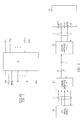
- Figure 1 shows an idealized pin-out of a typical ISPLD 5.
- ISPLD 5 comprises a number of input-only pins (I 1 , I 2 ..., I n ), a number of programmable input/output pins (I/O 1 , I/O 2 ,...,I/O m ), power (VCC) and ground (GND) pins, and a set of four ISP pins (SDI, SDO, SCLK, and MODE).
- a host system including a microprocessor or microcontroller and a signal source (which is well known and thus not shown for simplicity) converts the desired programming parameters into a JEDEC file using a design tool such as Synario/pDS available from Lattice Semiconductor Corporation.
- This JEDEC file is then converted to a binary file such as for instance an ispSTREAM file using software such as JED2ISP Conversion Utility available from Lattice Semiconductor Corporation.
- an isp signal source provides programming data and programming control signals to ISPLD 5 at pins SDI, SCLK, and MODE, respectively, and receives signals from ISPLD 5 indicative of for instance programming verification or self-test at pin SDO.
- an 8-bit parallel port serves as the interface between the host system and ISPLD 5.
- ISPLD 5 is said to employ a four-wire interface.
- ISP mode a state machine within ISPLD 5 having numerous states takes over control of the programming activities.
- Programming data generated by the host system is input serially into the program memory of ISPLD 5 over the serial input pin SDI via the parallel interface.
- the rate of serial input is 1-bit per clock period.
- a clock signal is provided on pin SCLK when the ISP mode is entered.
- Each ISPLD 5 can in a mode operation referred to as Flowthrough mode provide on its output pin SDO data received from its serial input pin SDI. In this manner, a number of ISPLDs 5 may be "daisy-chained" together by tying the serial input pin SDI of one ISPLD 5 to the serial output pin SDO of another ISPLD 5.
- Any ISPLD 5 in the daisy chain can be re-programmed by providing the new program to the serial input pin SDI of the first ISPLD 5, where the data is then provided to the ISPLD 5 desired to be programmed by shifting the data through intervening ISPLDs 5 (which are placed in Flowthrough mode) in the daisy chain.
- ISPLD 5 In-system programming techniques for ISPLDs employing a four-wire ISP parallel interface such as ISPLD 5 are discussed further in U.S. Patents 4,855,954 (entitled “In-system Programmable Logic Device with Four Dedicated Terminals” to Turner et al, issued August 8, 1989), 4,761,768 (entitled “Programmable Logic Device”, to Turner et al, issued August 2, 1988), and 4,896,296 (entitled “Programmable Logic Device Configurable I/O Cell”, to Turner et al, issued Jan 23, 1990).
- ISPLDs reduce total pin overhead by employing only one dedicated programming pin, e.g. the in-system programming or ispEN pin.
- the ISPLD When an enabling signal associated with the ispEN pin is asserted, this ISPLD enters a programming mode.
- the additional in-system programming pins (SDI, SDO, SCLK, and MODE) referred to above are made available by multiplexing pins which are normally, i.e., when not in programming mode, input/output pins. In-system programming may thus be implemented at the cost of only a single dedicated pin.
- programming techniques using only one dedicated programming pin ispEN see U.S.
- Patent 5,237,218 (entitled “Structure and Method for Multiplexing Pins for In-System Programming", to Josephson et al, issued August 17, 1993), hereby incorporated by reference. Note that when ISPLDs having a dedicated programming pin ispEN are in a programming state, the use of five pins (ispEN, SDI, SDO, SCLK, and MODE) are required. Accordingly, such ISPLDs require a five-wire interface.
- a structure and a method to implement programming of an in-system programmable logic device using only a two-wire interface is disclosed.
- program data generated by the host system to be used in programming one or more associated ISPLDs is converted using a first interface from a parallel data format to a serial data string and then transmitted serially to a second interface receiving unit.
- the first and second interfaces employ Universal Asynchronous Receiver/Transmitter (UARTs).
- UARTs Universal Asynchronous Receiver/Transmitter
- the receiving unit converts the serial program data string to a parallel data byte which is then provided to the programming pins of the ISPLD desired to be programmed.
- inventions in accordance with the present invention may utilize a two-wire transmission scheme, and thus two-wire interfaces, to facilitate programming of the associated ISPLDs.
- Having the capability to utilize a two-wire transmission scheme allows ISPLDs in accordance with the present invention to be programmed using wired transmission schemes such as for instance coaxial, twisted pair, and coaxial as wells as wireless transmission schemes such as for instance radio frequency (RF) and infrared radiation (Ir).
- RF radio frequency
- Ir infrared radiation
- Embodiments in accordance with the present invention are discussed below in the context of ISPLD configured in a manner consistent to use five ISP signals during programming (i.e. ISP enable, serial data in, serial data out, mode, and shift clock) at associated respective pins ispEN, SDI, SDO, MODE, and SCLK. It is to be noted, however, that those skilled in the art will, after reading the disclosure below, be readily able to apply the teachings herein to ISPLDs utilizing a different number of ISP programming signals and/or pins during programming, such as for instance the four-wire ISPLD 5 of Figure 1.
- ISPLD 40 shown in Figure 2 and discussed below is representative of any suitable PLD, including those employing EPROM, EEPROM, and Flash memory cells.
- EPROM erasable programmable read-only memory
- EEPROM electrically erasable read-only memory
- Flash memory cells For convenience, those elements common to various illustrative embodiments discussed below are similarly labelled.
- an ISP signal source 10 contained in a suitable host system such as for instance a PC or UNIX machine generates the programming signals associated with pins ispEN, SDI, SCLK, and MODE of an ISPLD 40 in a well known manner.
- These signals are provided in parallel format e.g. a parallel byte to an interface 20 via a five-wire interface bus 11 which may in other embodiments include a greater number of wires.
- Interface 20 converts this parallel byte to a half duplex or full duplex serial data string, and then transmits this serial data string to a half duplex or full duplex interface 30 via one line 21 of a two-wire serial transmission interface 21, 22.
- Interface 30 receives the serial string and converts the serial data string into parallel form and, in this manner, provides the ISP programming signals to respective pins ispEN, SDI, SCLK, and MODE of ISPLD 40 via five-wire interface bus 31, which in other embodiments may include a greater number of wires.
- Signals indicative of information relating to the operation of ISPLD 40 may be provided from ISPLD 40 to interface 30 as serial data on pin SDO.
- Interface 30 converts the serial data string associated with pin SDO of ISPLD 40 into a serial format consistent with that employed in transmitting data from interface 20 to interface 30 via wire 21. This conversion ensures that data may be transmitted from both interface 20 to interface 30 and from interface 30 to interface 20 according to the same transmission protocol.
- this serial data string indicative of the signals at pin SDO is transmitted to interface 20 via another line 22 of the aforementioned serial transmission interface 21, 22. Once received by interface 20, the serial data stream is converted to parallel format and provided to signal source 10 via bus 11.
- the above described embodiment allows ISPLD 40 to be programmed and/or reprogrammed using only a two-wire transmission scheme.
- Present embodiments by allowing ISPLDs 40 to be programmed and/or reprogrammed using a two-wire transmission scheme, are thus able to take advantage of not only various superior two-wire serial transmission schemes such as coaxial, ethernet, conventional phone lines, and fiber optics but also wireless transmission schemes such as infrared and RF.
- two-wire transmission schemes in accordance with the present invention reduce the programming interface pin overhead on the PLD while allowing for increased programming flexibility (i.e., programming via network, remote programming via telephone etc, and wireless programming of system where physical connections between the host system and ISPLD 40 is not feasible).
- interfaces 20 and 30 each employ a Universal Asynchronous Receiver/Transmitter (UART). Signals to be provided to ISPLD 40 may be transmitted between interfaces 20 and 30 according to the RS-232C standard transmission protocol which requires a start bit, 8 data bits, and one stop bit, although other serial transmission protocols may be used. Interfaces 20 and 30 also include a well-known logic circuit which detects when data is received, pauses a predetermined amount of time before transmitting data, and commences the transmission of data. This logic circuit may be in the form of a discrete logic circuit attached to the UART, or in some embodiments may be an ISPLD from Lattice Semiconductor which has been programmed or integrated into a circuit to implement such transmission protocol control functions.
- UART Universal Asynchronous Receiver/Transmitter
- interfaces 20 and 30 may include an Intel 8051 microprocessor having built-in UART capabilities. Employing an 8051 processor in such a manner allows interfaces 20 and 30 to implement additional functions such as variable transmission rates for multiple interfaces. Note that in yet other embodiments other well known techniques may be employed in interfaces 20 and 30 to convert parallel data into a serial data string and to convert a serial data string into parallel data.
- programming ISPLD 40 When programming ISPLD 40, programming data generated by signal source 10 is grouped into data strings for serial transmission by interface 20. For each possible transition on one of the programming pins ispEN, SDI, SDO, SCLK, and MODE, a corresponding data string is loaded into a serial shift register within interface 20 and then serially transmitted to interface 30. In response thereto, interface 30 captures the data string and latches the data string in its parallel register. The time delay typically associated with latching the programming data in the parallel register allows ISPLD 40, or in some embodiments an attached daisy chain of ISPLDs 40, to respond to the signals associated with the next program data string.
- ISPLD 40 Data indicative of ISPLD 40's current status such as for instance self-test results or programming verification is provided to interface 30 by ISPLD 40 via pin SDO.
- Interface 30 converts this data to a serial data stream and transmits this data stream to the host system e.g. signal source 10 in a manner consistent with that discussed above.
- signal source 10 causes the next segment of data to be transmitted to ISPLD 40.
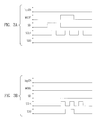
- the timing diagrams shown in Figures 3A and 3B illustrate the relationship between the signals associated with pins ispEN, MODE, SDI, SCLK, and SDO when transmitting and receiving, respectively, serial data.
- Figure 3A illustrates segmenting parallel data for serial transmission to ISPLD 40, where the signals on pins MODE and SDI are clocked by the signal on pin SCLK.
- Figure 3B illustrates segmenting parallel data from ISPLD 40 for serial transmission back to signal source 10 for verification. The data on pins SDO is clocked by the signal on pin SCLK.
- interface 30 may be implemented within ISPLD 40, thereby eliminating the need for a serial controller on the board associated with ISPLD40.
- ISPLD 40 would require a serial port, a serial to parallel register, a parallel to serial register, and a well-known logic circuit to control the transmission of data signals to and from interface 20.
- ISPLDs 40 contained on a single board may be independently programmed by individually selecting and enabling each of ISPLDs 40.
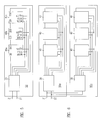
- Figure 4 shows such a board 45 containing interface 30 and three ISPLDs 40.
- Interface 30 may employ a standard 8-bit port to connect with the programming pins of the three ISPLDs 40 contained on board 45, where only seven of the eight pins of the parallel port are used: four of the eight bits of the parallel port are connected to each of respective pins SDI, SDO, MODE, and SCLK of the three ISPLDs 40, and three of the eight bits of the parallel port are individually connected to the ispEN pin of an associated one of ISPLDs 40, as shown in Figure 4, so that each of ISPLDs 40 may be individually enabled for programming via its ispEN pin.
- the remaining pin of the parallel port may be used to enable a fourth ISPLD 40 (not shown) on board 45 or, in other embodiments, may be reserved for other suitable purposes.
- ISPLD 40 (not shown) on board 45 or, in other embodiments, may be reserved for other suitable purposes.
- up to four different ISPLDs 40 may be addressed by the host system.
- the parallel port definition may be as follows: Table 1 pin number pin assignment description send receive 0 SDI/TDI serial data in/text data in 1 MODE/TMS SDO/TDO control mode/test mode select for sending data to ISPLD 40; serial data out/test data out for receiving data from ISPLD 40 2 SCLK/TCK serial clock/test clock 3 ispEN0 enable first ISPLD 40 for ISP 4 ispEN1 enable second ISPLD 40 for ISP 5 ispEN2 enable third ISPLD 40 for ISP 6 ispEN3 enable fourth ISPLD 40 for ISP 7 ispEN4 enable fifth ISPLD 40 for ISP
- TDI, TMS, TDO, and TCK are common to JTAG and Boundary Scan Test Access Port (TAP) used for in-system programming, and is therefore provided in Table 1 for clarity and convenience. Note that any of the pins listed above in Table 1 may be used for both sending and receiving data, as illustrated above by pin 1.
- a daisy chain of ISPLDs 40 may be programmed using the above described serial interfaces in conjunction with software such as ispCODE.C or ispCODE.EXE available from Lattice Semiconductor Corporation.
- Figure 5 shows a board 50 including a daisy chain of three ISPLDs 40a-40c and interface 30, although in actual embodiments a greater or fewer number of ISPLDs 40 may be included on board 45.
- ISPLDs 40a-40c are identical to ISPLD 40 discussed above.
- Three of the pins of interface 30 are connected to respective pins SCLK, MODE, and ispEN of ISPLDs 40a-40c.
- a fourth pin of interface 30 is connected to the SDI pin of the first ISPLD 40a.
- the SDO pin of ISPLD 40a is connected to the SDI pin of ISPLD 40b
- the SDO pin of ISPLD 40b is connected to the SDI pin of ISPLD 40c
- the SDO pins of ISPLD 40c is connected to a fifth pin of interface 30.
- interface 30 includes an eight-bit parallel port
- the remaining three bits may be used for controlling multiple daisy chains of ISPLDs 40. Accordingly, when programming a daisy chain such as that shown in Figure 5 in accordance with the present invention, the parallel port definition of interface 30 must be changed from that shown in Table 1 to a well known standard parallel format.
- the signal associated with the ispEN pins of ISPLDs 40 is asserted so as to enable all ISPLDs 40 in the daisy chain.
- the first ISPLD 40a is then addressed and programmed as described above while remaining ISPLDs 40b and 40c are held in a Flowthrough or Bypass mode.
- the SDI/TDI pin of ISPLD 40 is connected directly to its SDO/TDO pin.
- the SDI/TDI pin of ISPLD 40 When in Bypass mode, the SDI/TDI pin of ISPLD 40 is connected to the input terminal of an edge triggered D-type register (not shown for simplicity) and the SDO/TDO pin of the ISPLD 40 is connected to the output terminal of the D-type register.
- Flowthrough and Bypass modes may be enabled either by a specific instruction provided to ISPLD 40 or by a combination of signals provided on the programming pins of ISPLD 40.
- the first ISPLD 40a in the daisy chain After having been programmed, the first ISPLD 40a in the daisy chain is placed in Flowthrough or Bypass mode while the second ISPLD 40b in the daisy chain is programmed, and so on until all ISPLDs 40a-40c in the daisy chain have been programmed.
- multiple ISPLDs 40 may be programmed in parallel to reduce programming time.
- the programming software operating within the host system must support parallel programming.
- software such as DDOWNLD.EXE, WDOWNLD.EXE, ispATE.EXE and ispCODE.EXE (collectively known in the industry as Turbo programming) available from Lattice Semiconductor Corporation supports parallel programming and may thus be used.
- Turbo programming available from Lattice Semiconductor Corporation supports parallel programming and may thus be used.
- the daisy chain of ISPLDs 40 is treated as a single device.
- each of the ISPLDs 40 in the daisy chain is clocked to a shift state.
- a Data Shift command is then provided to ISPLDs 40, after which programming data for ISPLDs 40 is sequentially clocked into the data registers of ISPLDs 40 via their respective SDI pins.
- the ISPLDs 40 then enter the Data Shift State.
- the Program Data command is then clocked into the ISPLDs 40 of the daisy chain, after which the ISPLDs 40 enter the Execute state.
- a clock pulse asserted on pin SCLK causes data stored in the shift registers of ISPLDs 40 to program the EEPROM cells within ISPLDs 40, thereby reprogramming ISPLDs 40.
- the required programming pulse width time delay is applied to transfer sufficient electrons to the floating gate of the EEPROM cell. Once the required programming pulse width time delay (TPWP) has been applied a clock pulse to halt programming and clock back to the Shift State is asserted. This process continues until the entire daisy chain of ISPLDs 40 is programmed.
- Each interface 30 shown in Figure 6 includes a well-known decoder logic circuit which, upon detecting that its assigned address code has been asserted by the host system, enables its internal serial controller (not shown for simplicity) for programming. The enabled interface 30 then facilitates programming of ISPLDs 40 associated therewith. Those interfaces 30 not addressed by the host system are disabled and therefore inactive.
- the host system disables that interface 30 and then addresses interface 30 associated with another board e.g. board 50b, thereby allowing programming of another corresponding daisy chain of ISPLDs 40.
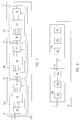
- FIG. 7 shows three such device 70a-70c formed on a board 72, where two-wire serial transmission interface 21, 22 is connected to and provides programming signals to a first one of devices 70a via its interface 30.
- This interface 30 is connected to an associated ISPLD 40 in the manner described above with respect to Figure 2.
- a configuration having a greater number of wires such as for instance a standard 8-bit parallel port may be employed.
- the host system When programming ISPLDs 40 shown in the embodiment of Figure 7, the host system provides programming data to interface 30 of board 70a as discussed above with respect to Figure 2.
- the serial program data string is received by this interface 30, converted to parallel format, and provided to its associated ISPLD 40.
- the associated ISPLD 40 transmits the program data in parallel to its associated interface 20 which, as discussed above, converts the program data to a serial data string.
- the program data is transmitted via single wire 21 to a second one of devices 70b, where the serial string is received and converted to parallel format by its interface 30.
- Data indicative of each of ISPLDs 40 current status such as for instance self-test results or programming verification is provided to the host device via wire 22.
- board 72 is shown in Figure 7 to include only three of devices 70a-70c, board 72 may in actual embodiments include a greater or fewer number of devices 70. Further, any number of boards 72 may be connected together, as shown for instance in Figure 8, and programmed as discussed above.
- a direct physical connection is made between the host computer and PC board containing one or more ISPLDs 40.
- This physical connection may be for instance a twisted pair which allows for two-wire testing and programming of ISPLD(s) provided on the board, thereby saving valuable pin resources of ISPLD(s) 40 provided on the board.
- Transmitting serial data in a manner consistent with a two-wire transmission scheme advantageously allows phone lines to be used in such transmissions.
- modems may be coupled in a well known manner to interfaces 20 and 30, thereby allowing programming data to be used in programming ISPLD 40 to be transmitted over long distances using phone lines rather than transmission wires 21, 22. This feature is especially useful in remote environments such as when field upgrading a board or system of ISPLDs 40.
- Wireless transmission schemes may also be used instead of two-wire serial transmission interface 21, 22 shown for instance in Figure 2.
- RF Radio Frequency
- Infrared (IR) technology may also be used in accordance with the present invention to transmit program data from the host system to a board containing ISPLDs 40 desired to be programmed.
- IR transmission of program data may be implemented by simply coupling an Infrared Data Association (IrDA) standards compliant transmitter to the host system and coupling an IrDA standards compliant receiver to the board in a well-known manner.
- the IrDA transmitter may be initialized by the host system and the IrDA receiver may be initialized by a well known logic circuit coupled thereto. As long as both the receiver and transmitter are initialized to utilize the same data transmitter rate, other wireless transmission protocols may be employed.
Landscapes
- Engineering & Computer Science (AREA)
- Computer Hardware Design (AREA)
- Physics & Mathematics (AREA)
- Theoretical Computer Science (AREA)
- Evolutionary Computation (AREA)
- Geometry (AREA)
- General Engineering & Computer Science (AREA)
- General Physics & Mathematics (AREA)
- Logic Circuits (AREA)
- Selective Calling Equipment (AREA)
- Information Transfer Systems (AREA)
- Stored Programmes (AREA)
Applications Claiming Priority (2)
| Application Number | Priority Date | Filing Date | Title |
|---|---|---|---|
| US08/643,291 US5864486A (en) | 1996-05-08 | 1996-05-08 | Method and apparatus for in-system programming of a programmable logic device using a two-wire interface |
| US643291 | 1996-05-08 |
Publications (2)
| Publication Number | Publication Date |
|---|---|
| EP0806737A2 true EP0806737A2 (fr) | 1997-11-12 |
| EP0806737A3 EP0806737A3 (fr) | 1999-05-12 |
Family
ID=24580165
Family Applications (1)
| Application Number | Title | Priority Date | Filing Date |
|---|---|---|---|
| EP97303091A Withdrawn EP0806737A3 (fr) | 1996-05-08 | 1997-05-06 | Programmation à l'intérieur d'un système avec une interface à deux fils |
Country Status (3)
| Country | Link |
|---|---|
| US (1) | US5864486A (fr) |
| EP (1) | EP0806737A3 (fr) |
| JP (1) | JPH1083296A (fr) |
Cited By (10)
| Publication number | Priority date | Publication date | Assignee | Title |
|---|---|---|---|---|
| WO1999023588A1 (fr) * | 1997-11-04 | 1999-05-14 | Lattice Semiconductor Corporation | Programmation interne simultanee a distance avec et sans fil de systemes multiples a distance |
| WO1999027473A1 (fr) * | 1997-11-24 | 1999-06-03 | Xilinx Inc | Configuration reseau de circuits programmables |
| US6023570A (en) * | 1998-02-13 | 2000-02-08 | Lattice Semiconductor Corp. | Sequential and simultaneous manufacturing programming of multiple in-system programmable systems through a data network |
| US6212650B1 (en) | 1997-11-24 | 2001-04-03 | Xilinx, Inc. | Interactive dubug tool for programmable circuits |
| WO2002006979A3 (fr) * | 2000-07-13 | 2002-12-12 | Nds Ltd | Systeme de materiel informatique configurable |
| WO2002015473A3 (fr) * | 2000-08-16 | 2004-02-26 | Microchip Tech Inc | Programmation serie connectee de configuration par defaut |
| WO2007005706A3 (fr) * | 2005-06-30 | 2007-05-03 | Honeywell Int Inc | Interface jtag cryptee |
| US7509250B2 (en) | 2005-04-20 | 2009-03-24 | Honeywell International Inc. | Hardware key control of debug interface |
| US7900064B2 (en) | 2005-04-20 | 2011-03-01 | Honeywell International Inc. | Encrypted debug interface |
| US8011005B2 (en) | 2005-04-20 | 2011-08-30 | Honeywell International Inc. | Hardware encryption key for use in anti-tamper system |
Families Citing this family (29)
| Publication number | Priority date | Publication date | Assignee | Title |
|---|---|---|---|---|
| US6023565A (en) | 1996-03-29 | 2000-02-08 | Xilinx, Inc. | Method for configuring circuits over a data communications link |
| US6691267B1 (en) | 1997-06-10 | 2004-02-10 | Altera Corporation | Technique to test an integrated circuit using fewer pins |
| US6021447A (en) * | 1997-12-12 | 2000-02-01 | Scenix Semiconductor, Inc. | Non-intrusive in-system programming using in-system programming circuitry coupled to oscillation circuitry for entering, exiting, and performing in-system programming responsive to oscillation circuitry signals |
| US6304099B1 (en) * | 1998-05-21 | 2001-10-16 | Lattice Semiconductor Corporation | Method and structure for dynamic in-system programming |
| US6191713B1 (en) * | 1998-08-04 | 2001-02-20 | Intel Corporation | Conversion between serial bus cycles and parallel port commands using a state machine |
| US6519644B1 (en) | 1998-12-01 | 2003-02-11 | Telefonaktiebolaget Lm Ericsson (Publ) | System and method for dial-up networking over infrared data link |
| US6430736B1 (en) | 1999-02-26 | 2002-08-06 | Xilinx, Inc. | Method and apparatus for evolving configuration bitstreams |
| US6539532B1 (en) | 1999-02-26 | 2003-03-25 | Xilinx, Inc. | Method and apparatus for relocating elements in an evolvable configuration bitstream |
| US6363517B1 (en) * | 1999-02-26 | 2002-03-26 | Xilinx, Inc. | Method and apparatus for remotely evolving configuration bitstreams |
| US6378122B1 (en) | 1999-02-26 | 2002-04-23 | Xilinx, Inc. | Method and apparatus for evolving a plurality of versions of a configuration bitstream in parallel |
| US6363519B1 (en) * | 1999-02-26 | 2002-03-26 | Xilinx, Inc. | Method and apparatus for testing evolvable configuration bitstreams |
| US7155711B2 (en) * | 1999-12-10 | 2006-12-26 | Sedna Patent Services, Llc | Method and apparatus providing remote reprogramming of programmable logic devices using embedded JTAG physical layer and protocol |
| US6912601B1 (en) * | 2000-06-28 | 2005-06-28 | Cypress Semiconductor Corp. | Method of programming PLDs using a wireless link |
| US6954929B2 (en) * | 2001-07-30 | 2005-10-11 | Hewlett-Packard Development Company, L.P. | Method for just-in-time updating of programming parts |
| US6883109B2 (en) * | 2001-07-30 | 2005-04-19 | Hewlett-Packard Development Company, L.P. | Method for accessing scan chains and updating EEPROM-resident FPGA code through a system management processor and JTAG bus |
| US20040225783A1 (en) * | 2001-07-30 | 2004-11-11 | Erickson Michael John | Bus to multiple jtag bus bridge |
| US20030023793A1 (en) * | 2001-07-30 | 2003-01-30 | Mantey Paul J. | Method and apparatus for in-system programming through a common connection point of programmable logic devices on multiple circuit boards of a system |
| US6918027B2 (en) | 2001-07-30 | 2005-07-12 | Hewlett-Packard Development Company, L.P. | System and method for in-system programming through an on-system JTAG bridge of programmable logic devices on multiple circuit boards of a system |
| US7353418B2 (en) * | 2002-03-18 | 2008-04-01 | Sun Microsystems, Inc. | Method and apparatus for updating serial devices |
| AU2003248951A1 (en) * | 2002-08-13 | 2004-02-25 | Xyratex Technology Limited | Network monitor and method |
| TW594566B (en) * | 2002-09-26 | 2004-06-21 | Ene Technology Inc | Method and apparatus of in-system programming |
| CN100349152C (zh) * | 2004-07-08 | 2007-11-14 | 华为技术有限公司 | 接口装置 |
| US7383478B1 (en) * | 2005-07-20 | 2008-06-03 | Xilinx, Inc. | Wireless dynamic boundary-scan topologies for field |
| US7487331B2 (en) * | 2005-09-15 | 2009-02-03 | Microchip Technology Incorprated | Programming a digital processor with a single connection |
| US8276519B2 (en) * | 2005-11-17 | 2012-10-02 | Polywad, Inc. | Wad-less cartridges and method of manufacturing the same |
| US7884672B1 (en) | 2006-11-01 | 2011-02-08 | Cypress Semiconductor Corporation | Operational amplifier and method for amplifying a signal with shared compensation components |
| US7483630B1 (en) | 2008-03-08 | 2009-01-27 | International Business Machines Corporation | Exchanging asynchronous system information using optical transmission |
| JP2013050860A (ja) * | 2011-08-31 | 2013-03-14 | Renesas Electronics Corp | マイクロコンピュータ及びマルチマイクロコンピュータシステム |
| WO2015161903A1 (fr) * | 2014-04-25 | 2015-10-29 | Telefonaktiebolaget L M Ericsson (Publ) | Appareil et procédé pour gérer des dispositifs client |
Family Cites Families (10)
| Publication number | Priority date | Publication date | Assignee | Title |
|---|---|---|---|---|
| US4849928A (en) * | 1987-01-28 | 1989-07-18 | Hauck Lane T | Logic array programmer |
| US5594786A (en) * | 1990-07-27 | 1997-01-14 | Executone Information Systems, Inc. | Patient care and communication system |
| US5412260A (en) * | 1991-05-03 | 1995-05-02 | Lattice Semiconductor Corporation | Multiplexed control pins for in-system programming and boundary scan state machines in a high density programmable logic device |
| US5237218A (en) * | 1991-05-03 | 1993-08-17 | Lattice Semiconductor Corporation | Structure and method for multiplexing pins for in-system programming |
| US5473758A (en) * | 1992-08-31 | 1995-12-05 | Microchip Technology Incorporated | System having input output pins shifting between programming mode and normal mode to program memory without dedicating input output pins for programming mode |
| US5329179A (en) * | 1992-10-05 | 1994-07-12 | Lattice Semiconductor Corporation | Arrangement for parallel programming of in-system programmable IC logical devices |
| US5493582A (en) * | 1994-02-04 | 1996-02-20 | Ericsson Ge Mobile Communications | Method and apparatus for encoding and decoding automatic radio identification data |
| US5619544A (en) * | 1994-06-03 | 1997-04-08 | Texas Instruments Incorporated | Universal asynchronous receive/transmit circuit with flow control |
| US5457408A (en) * | 1994-11-23 | 1995-10-10 | At&T Corp. | Method and apparatus for verifying whether a bitstream received by a field programmable gate array (FPGA) is intended for that FPGA |
| US5493239A (en) * | 1995-01-31 | 1996-02-20 | Motorola, Inc. | Circuit and method of configuring a field programmable gate array |
-
1996
- 1996-05-08 US US08/643,291 patent/US5864486A/en not_active Expired - Lifetime
-
1997
- 1997-05-06 EP EP97303091A patent/EP0806737A3/fr not_active Withdrawn
- 1997-05-07 JP JP9116720A patent/JPH1083296A/ja active Pending
Cited By (18)
| Publication number | Priority date | Publication date | Assignee | Title |
|---|---|---|---|---|
| GB2346997B (en) * | 1997-11-04 | 2002-12-04 | Lattice Semiconductor Corp | Simultaneous wired and wireless remote in-system programming of multiple remote systems |
| WO1999023588A1 (fr) * | 1997-11-04 | 1999-05-14 | Lattice Semiconductor Corporation | Programmation interne simultanee a distance avec et sans fil de systemes multiples a distance |
| GB2346997A (en) * | 1997-11-04 | 2000-08-23 | Lattice Semiconductor Corp | Simultaneous wired and wireless remote in-system programming of multiple remote systems |
| US6389321B2 (en) | 1997-11-04 | 2002-05-14 | Lattice Semiconductor Corporation | Simultaneous wired and wireless remote in-system programming of multiple remote systems |
| US5995744A (en) * | 1997-11-24 | 1999-11-30 | Xilinx, Inc. | Network configuration of programmable circuits |
| US6144933A (en) * | 1997-11-24 | 2000-11-07 | Xilink, Inc. | Method and apparatus for remotely probing and stimulating a programmable logic device |
| US6212650B1 (en) | 1997-11-24 | 2001-04-03 | Xilinx, Inc. | Interactive dubug tool for programmable circuits |
| WO1999027473A1 (fr) * | 1997-11-24 | 1999-06-03 | Xilinx Inc | Configuration reseau de circuits programmables |
| US6023570A (en) * | 1998-02-13 | 2000-02-08 | Lattice Semiconductor Corp. | Sequential and simultaneous manufacturing programming of multiple in-system programmable systems through a data network |
| GB2382445A (en) * | 2000-07-13 | 2003-05-28 | Nds Ltd | Configurable hardware system |
| WO2002006979A3 (fr) * | 2000-07-13 | 2002-12-12 | Nds Ltd | Systeme de materiel informatique configurable |
| GB2382445B (en) * | 2000-07-13 | 2004-10-27 | Nds Ltd | Configurable hardware system |
| WO2002015473A3 (fr) * | 2000-08-16 | 2004-02-26 | Microchip Tech Inc | Programmation serie connectee de configuration par defaut |
| US7509250B2 (en) | 2005-04-20 | 2009-03-24 | Honeywell International Inc. | Hardware key control of debug interface |
| US7900064B2 (en) | 2005-04-20 | 2011-03-01 | Honeywell International Inc. | Encrypted debug interface |
| US7961885B2 (en) | 2005-04-20 | 2011-06-14 | Honeywell International Inc. | Encrypted JTAG interface |
| US8011005B2 (en) | 2005-04-20 | 2011-08-30 | Honeywell International Inc. | Hardware encryption key for use in anti-tamper system |
| WO2007005706A3 (fr) * | 2005-06-30 | 2007-05-03 | Honeywell Int Inc | Interface jtag cryptee |
Also Published As
| Publication number | Publication date |
|---|---|
| JPH1083296A (ja) | 1998-03-31 |
| EP0806737A3 (fr) | 1999-05-12 |
| US5864486A (en) | 1999-01-26 |
Similar Documents
| Publication | Publication Date | Title |
|---|---|---|
| US5864486A (en) | Method and apparatus for in-system programming of a programmable logic device using a two-wire interface | |
| US6023570A (en) | Sequential and simultaneous manufacturing programming of multiple in-system programmable systems through a data network | |
| EP0964338B1 (fr) | Méthode et appareil pour exécuter à travers un port JTAG des opérations sur une unité de mémoire | |
| US6389321B2 (en) | Simultaneous wired and wireless remote in-system programming of multiple remote systems | |
| US5329179A (en) | Arrangement for parallel programming of in-system programmable IC logical devices | |
| US5734868A (en) | Efficient in-system programming structure and method for non-volatile programmable logic devices | |
| US8055947B2 (en) | Comparing supplied and sampled link ID bits on TMS lead | |
| EP1987431B1 (fr) | Système et procédé de partage d'une liaison de communication entre de multiples protocoles de communication | |
| US20080320175A1 (en) | Methods and apparatus for identifying operating modes for peripheral devices | |
| US20020040412A1 (en) | Flash memory card with enhanced operating mode detection and user-friendly interfacing system | |
| US6192436B1 (en) | System and method for configuration of electronic devices using a smart card which having configuration data stored therein | |
| US6178525B1 (en) | Trigger sequencing controller | |
| US6718284B2 (en) | Smart module and adapter apparatus | |
| US4996655A (en) | Real time monitoring of remote signals in an industrial environment | |
| US20060279439A1 (en) | System and method for improved performance and optimization of data exchanges over a communications link | |
| CN116450552B (zh) | 基于i2c总线异步批量读写寄存器的方法及系统 | |
| US5563524A (en) | Apparatus for testing electric circuits | |
| US6298006B1 (en) | Method and apparatus to automatically determine the size of an external EEPROM | |
| EP0506060B1 (fr) | Circuit d'attaque d'entrée/sortie, bidirectionnel et programmable | |
| CN100364010C (zh) | 一种eeprom在板编程方法 | |
| EP1695186A2 (fr) | Bornes d'entree/sortie configurables | |
| CN210324176U (zh) | 存储器芯片及集成电路 | |
| KR0178588B1 (ko) | I2c 프로토콜 통신 장치 | |
| JPH01501103A (ja) | 機器から応答信号を誘導する装置及びその方法 | |
| US12277085B2 (en) | Instrumentation system configured with a common base module |
Legal Events
| Date | Code | Title | Description |
|---|---|---|---|
| PUAI | Public reference made under article 153(3) epc to a published international application that has entered the european phase |
Free format text: ORIGINAL CODE: 0009012 |
|
| AK | Designated contracting states |
Kind code of ref document: A2 Designated state(s): DE GB |
|
| 17P | Request for examination filed |
Effective date: 19980511 |
|
| PUAL | Search report despatched |
Free format text: ORIGINAL CODE: 0009013 |
|
| AK | Designated contracting states |
Kind code of ref document: A3 Designated state(s): DE GB |
|
| 17Q | First examination report despatched |
Effective date: 20020614 |
|
| STAA | Information on the status of an ep patent application or granted ep patent |
Free format text: STATUS: THE APPLICATION IS DEEMED TO BE WITHDRAWN |
|
| 18D | Application deemed to be withdrawn |
Effective date: 20021025 |