EP0806840B1 - Modules pour un émetteur-récepteur en radiofréquence, ainsi qu'un émetteur-récepteur - Google Patents
Modules pour un émetteur-récepteur en radiofréquence, ainsi qu'un émetteur-récepteur Download PDFInfo
- Publication number
- EP0806840B1 EP0806840B1 EP19970104279 EP97104279A EP0806840B1 EP 0806840 B1 EP0806840 B1 EP 0806840B1 EP 19970104279 EP19970104279 EP 19970104279 EP 97104279 A EP97104279 A EP 97104279A EP 0806840 B1 EP0806840 B1 EP 0806840B1
- Authority
- EP
- European Patent Office
- Prior art keywords
- frequency
- signals
- system recited
- channels
- signal
- Prior art date
- Legal status (The legal status is an assumption and is not a legal conclusion. Google has not performed a legal analysis and makes no representation as to the accuracy of the status listed.)
- Expired - Lifetime
Links
- 238000005070 sampling Methods 0.000 claims description 43
- 238000000926 separation method Methods 0.000 claims description 14
- 230000010355 oscillation Effects 0.000 description 19
- 238000001228 spectrum Methods 0.000 description 14
- 238000000034 method Methods 0.000 description 10
- 238000006243 chemical reaction Methods 0.000 description 8
- 239000008186 active pharmaceutical agent Substances 0.000 description 6
- 238000010586 diagram Methods 0.000 description 6
- 230000000295 complement effect Effects 0.000 description 4
- 230000001934 delay Effects 0.000 description 4
- 229910052710 silicon Inorganic materials 0.000 description 4
- 239000010703 silicon Substances 0.000 description 4
- JBRZTFJDHDCESZ-UHFFFAOYSA-N AsGa Chemical compound [As]#[Ga] JBRZTFJDHDCESZ-UHFFFAOYSA-N 0.000 description 3
- 229910001218 Gallium arsenide Inorganic materials 0.000 description 3
- 230000000694 effects Effects 0.000 description 3
- 239000004065 semiconductor Substances 0.000 description 3
- 230000007423 decrease Effects 0.000 description 2
- 230000005669 field effect Effects 0.000 description 2
- 238000004519 manufacturing process Methods 0.000 description 2
- 238000013139 quantization Methods 0.000 description 2
- 239000007787 solid Substances 0.000 description 2
- 230000003595 spectral effect Effects 0.000 description 2
- 238000007792 addition Methods 0.000 description 1
- 238000004458 analytical method Methods 0.000 description 1
- 230000005540 biological transmission Effects 0.000 description 1
- 239000003990 capacitor Substances 0.000 description 1
- 239000013078 crystal Substances 0.000 description 1
- 230000003247 decreasing effect Effects 0.000 description 1
- 230000003111 delayed effect Effects 0.000 description 1
- 230000001419 dependent effect Effects 0.000 description 1
- 238000005516 engineering process Methods 0.000 description 1
- 230000010363 phase shift Effects 0.000 description 1
- 230000001360 synchronised effect Effects 0.000 description 1
Images


Classifications
-
- H—ELECTRICITY
- H03—ELECTRONIC CIRCUITRY
- H03K—PULSE TECHNIQUE
- H03K3/00—Circuits for generating electric pulses; Monostable, bistable or multistable circuits
- H03K3/02—Generators characterised by the type of circuit or by the means used for producing pulses
- H03K3/027—Generators characterised by the type of circuit or by the means used for producing pulses by the use of logic circuits, with internal or external positive feedback
- H03K3/03—Astable circuits
-
- H—ELECTRICITY
- H03—ELECTRONIC CIRCUITRY
- H03G—CONTROL OF AMPLIFICATION
- H03G3/00—Gain control in amplifiers or frequency changers
- H03G3/20—Automatic control
- H03G3/30—Automatic control in amplifiers having semiconductor devices
- H03G3/3089—Control of digital or coded signals
-
- H—ELECTRICITY
- H03—ELECTRONIC CIRCUITRY
- H03K—PULSE TECHNIQUE
- H03K3/00—Circuits for generating electric pulses; Monostable, bistable or multistable circuits
- H03K3/02—Generators characterised by the type of circuit or by the means used for producing pulses
- H03K3/027—Generators characterised by the type of circuit or by the means used for producing pulses by the use of logic circuits, with internal or external positive feedback
- H03K3/03—Astable circuits
- H03K3/0315—Ring oscillators
- H03K3/0322—Ring oscillators with differential cells
-
- H—ELECTRICITY
- H04—ELECTRIC COMMUNICATION TECHNIQUE
- H04B—TRANSMISSION
- H04B1/00—Details of transmission systems, not covered by a single one of groups H04B3/00 - H04B13/00; Details of transmission systems not characterised by the medium used for transmission
- H04B1/38—Transceivers, i.e. devices in which transmitter and receiver form a structural unit and in which at least one part is used for functions of transmitting and receiving
- H04B1/40—Circuits
- H04B1/44—Transmit/receive switching
Definitions
- This invention relates generally to radio frequency transceivers and more particularly to transceivers having the receiver section and a portion of the transmitter section thereof adapted for fabrication on a single chip of silicon.
- the invention also relates to an oscillator.
- transceivers include a transmitter section and a receiver section.
- the transmitter section includes a modulator to superimpose information, i.e., data, onto a suitable radio frequency (RF) carrier signal, such as a microwave frequency carrier signal.
- RF radio frequency
- the receiver section receives data carried by the carrier frequency signal and, in a heterodyning system, downconverts the received signal to a suitable intermediate frequency signal. Signals having frequencies above the intermediate frequency are then removed by a low pass filter. The data is then extracted from the intermediate frequency signals passed by the low pass filter using a demodulator.
- transceivers As is also known in the art, it would be desirable to fabricate such transceivers using integrated circuit fabrication techniques.
- One technique used today is to form the portions of the transceiver which operate at microwave frequencies, (i.e., the modulator and downconverter) on a gallium arsenide, GaAs, chip and the portions of the transceiver which operate at the intermediate frequency, or lower (i.e., the demodulator) on a silicon, Si, chip. While such transceivers are useful in some applications, they are too large in other applications, and because they use GaAs, are relatively expensive.
- one type of transceiver is adapted to transmit data on a selected one of a plurality of frequency channels and is likewise adapted to receive signals on a selected one of the plurality of signal channels. Further, in such transceiver, the received signals in a selected one of the channels are downconverted to the intermediate frequency and demodulated using two locally generated oscillator signals in quadrature phase relationship as when digital signal processing techniques are used to demodulate, or extract, the data from a selected carrier frequency signal. Accurately generating two quadrature phase local oscillator signals is expensive and difficult.
- the receiver when digital signal processing is used, samples of the intermediate frequency signal are taken and then converted into corresponding digital signals. Further, the frequency spectrum of the sampled signals repeats at the sampling frequency and its harmonics. Therefore, if the receiver is adapted to receive signal over a predetermined band of frequencies, or predetermined bandwidth, over which the plurality of frequency channels extend, the signals are sampled at a frequency, or rate, greater than twice the predetermined bandwidth in order to prevent aliasing, i.e., prevent frequency components of signals in an unselected channel from folding into the pass band of the low pass filter. This minimum sampling frequency is referred to as the Nyquist sampling frequency. It follows then that as the bandwidth over which the receiver channels extend increases, the Nyquist sampling frequency correspondingly increases thereby placing severe sampling frequency requirements on the sampler, or else requiring a limitation in the predetermined overall bandwidth of the transceiver.
- the receiver section of such transceivers usually includes an analog automatic gain control (AGC) circuit to maintain the strength of the signal being processed at some predetermined level independent of variations in the strength of the received signal.
- AGC analog automatic gain control
- the intermediate frequency signal is fed to an amplifier.
- the gain of the amplifier is adjusted in accordance with the power of the demodulated signal.
- the analog AGC circuit is used to adjust the strength of an analog signal, i.e., the intermediate frequency signal.
- digital signal processing techniques are used in the demodulation process.
- the AGC'd analog signal is digitized then fed to a digital signal processor for demodulation. While such AGC'ing technique may be satisfactory in many such digital processing applications, in other such applications, the analog AGC circuit may not provide sufficient gain to prevent undesired computational round-off errors in the digital processing.
- oscillators are used to generate a signal having a frequency selected in accordance with an applied control signal (i.e., a voltage controlled oscillator, VCO).
- VCO voltage controlled oscillator
- One technique used to fabricate such VCO is with a ring of serially connected inverters as described in FIG 3 of an article entitled " A 300-MHZ CMOS Voltage-Controlled Ring Oscillator" by S.K. Enam and Asad A. Abidi, IEEE Journal of Solid State Circuits Vol. 25, No. 1, February 1990 .
- Each inverter in the ring VCO includes an n channel transistor (nMOS transistor) connected in a totem pole arrangement to a p channel transistor (pMOS transistor).
- the gates of the nMOS and pMOS transistors are connected together to provide a common input for the inverter and the drain and source of the pMOS and nMOS transistors are connected together to provide an output for the inverter.
- the ring VCO has an inner ring with an odd number of inverters and an outer ring, fed by an output of the inner ring, having an even number of inverters.
- the outer and inner rings feed a pair of transistors having gates connected to a control voltage.
- the pair of transistors are arranged to provide a potentiometer which vectorially adds the signals produced by the inner and outer rings in a proportion selected by the control signal.
- the inner ring provides a signal which oscillates at the highest frequency of the VCO and the outer ring produces a signal which oscillates at the lowest VCO frequency.
- the pair of potentiometer-arranged transistors produce an output signal having a frequency intermediate between these two extremes.
- the frequency of oscillation is determined by the total propagation delay through each ring and the control voltage. More particularly, the transistors in each inverter circuit are driven periodically at the frequency of oscillation into complementary conducting/nonconducting states. Because pMOS transistors switch between conducting/non-conducting states slower than nMOS transistors, the oscillation frequency of the inner ring, i.e., the maximum frequency, is constrained by the gain-bandwidth capability of the pMOS transistors.
- US-A-5 444 415 discloses that in the modulation and demodulation of a plurality of frequency separated channels on a radio frequency carrier by digitally coded speech or data, the speech or data is modulated on a digitally generated sub-carrier by quadrature phase shift keying and after conversion to analogue form the modulated sub-carrier is mixed with an RF carrier of fixed frequency to produce the signal for transmission. Reception and demodulation of the transmitted signal are effected by the reverse processes. Frequency multiplication is effected after the digital to analogue conversion by producing analogue samples of very short duration and applying them to a suitable filter. Frequency division during the analogue to digital conversion is effected by subsampling.
- the channels have a predetermined frequency separation, ⁇ , a predetermined channel bandwidth f b , no more than ⁇ /2, and the sampling frequency, f s , is selected to produce an intermediate frequency, f if , less than ⁇ .
- f if is equal: ⁇ 4 ⁇ 2 ⁇ L + 1 where L in an integer equal to, or greater than, 0.
- f s 4 ⁇ f c - d 4 ⁇ K ⁇ Nd
- N is the number of channels
- f c is the carrier frequency of the selected one of the frequency channels and K is a constant.
- a low pass filter is provided for selectively passing only those frequencies less than ⁇ /2, or preferably, less than, ⁇ /4+(f b /2), to a demodulator.
- the passed signals are converted into corresponding digital signals.
- the demodulator includes a Hilbert-Transform-pair filter section.
- the filter section includes: a pair of Hilbert-Transform-pair filters fed by the digitized, intermediate frequency signal passed by the low pass filter; a pair of multipliers fed by the outputs of the Hilbert-Transform-pair filters for producing signals representative of the square of the digitized signals fed to such multipliers; and, an adder for adding the signals produced by the each multiplier to produce the demodulated signal.
- a receiver having a digitizer section for converting the intermediate frequency signals passed by the low pass filter into corresponding digital signals; and, a digital signal processor for processing the digital signals.
- the receiver includes: a first automatic gain control circuit (AGC), fed by the low-pass filtered intermediate frequency signals and responsive to an output of the digital signal processor, for adjusting the gain of the AGC circuit in accordance with the output of the digital signal processor; and, a second AGC circuit fed by the digital signals and the output of the digital signal processor, for adjusting the magnitude of the digital signals in accordance with the output of the digital signal processor.
- AGC automatic gain control circuit
- the output of the demodulator is used to provide the control signal for the first and second AGC circuits.
- an oscillator having a plurality of cascade coupled inverters.
- Each one of the inverters is a differential amplifier having a p-input and an n-input.
- the output of each one of the amplifiers is connected to: the n-input of the next succeeding amplifier to provide a closed loop, or ring oscillator; and, the p-input of an amplifier positioned an even number of amplifier stages forward of such amplifier.
- each amplifier in the ring includes an n channel transistor (nMOS transistor) connected in a totem pole arrangement, to a p channel transistor (pMOS transistor).
- the gate of the nMOS transistor provides the n-input and gate of the pMOS transistor provides the p-input.
- the source and the drain of the pMOS and nMOS transistors are connected together to provide an output for the amplifier.
- the ring oscillator provides the inner, higher oscillation frequency, ring of a two ring VCO.
- the outputs of the two rings are combined in a transistor circuit arranged to provide for vectorially adding the signals produced by the two rings in proportion dictated by a control signal.
- the second outer ring includes at least two inverters and in another embodiment the outer ring includes a transistor have a gate geometry selected to provide the signal produced in the outer ring with the minimum frequency for the VCO.
- oscillators are used to generate a signal having a frequency selected in accordance with an applied control signal (i.e., a voltage controlled oscillator, VCO).
- VCO voltage controlled oscillator
- One technique used to fabricate such VCO is with a ring of serially connected inverters as described in FIG 3 of an article entitled " A 300-MHZ CMOS Voltage-Controlled Ring Oscillator" by S.K. Enam and Asad A. Abidi, IEEE Journal of Solid State Circuits Vol. 25, No. 1, February 1990 .
- Each inverter in the ring VCO includes an n channel transistor (nMOS transistor) connected in a totem pole arrangement to a p channel transistor (pMOS transistor).
- the gates of the nMOS and pMOS transistors are connected together to provide a common input for the inverter and the drain and source paths of the pMOS and nMOS transistors are connected together to provide an output for the inverter.
- the ring VCO has an inner ring with an odd number of inverters and an outer ring, fed by an output of the inner ring, having an even number of inverters.
- the outer and inner rings feed a pair of transistors having gates connected to a control voltage.
- the pair of transistors are arranged to provide a potentiometer which vectorially adds the signals produced by the inner and outer rings in a proportion selected by the control signal.
- the inner ring provides a signal which oscillates at the highest frequency of the VCO and the outer ring produces a signal which oscillates at the lowest VCO frequency.
- the pair of potentiometer-arranged transistors produce an output signal having a frequency intermediate between these two extremes.
- the frequency of oscillation is determined by the total propagation delay through each ring and the control voltage. More particularly, the transistors in each inverter circuit are driven periodically at the frequency of oscillation into complementary conducting/nonconducting states. Because pMOS transistors switch between conducting/non-conducting states slower than nMOS transistors, the oscillation frequency of the inner ring, i.e., the maximum frequency, is constrained by the gain-bandwidth capability of the pMOS transistors.
- An oscillator having a plurality of cascade coupled inverters.
- Each one of the inverters is a differential amplifier having a p-input and an n-input.
- the output of each one of the amplifiers is connected to: the n-input of the next succeeding amplifier to provide a closed loop, or ring oscillator; and, the p-input of an amplifier positioned an even number of amplifier stages forward of such next succeeding amplifier.
- each amplifier in the ring includes an n channel transistor (nMOS transistor) connected in a totem pole arrangement, to a p channel transistor (pMOS transistor).
- the gate of the nMOS transistor provides the n-input and gate of the pMOS transistor provides the p-input.
- the source and the drain pathsof the pMOS and nMOS transistors are connected together to provide an output for the amplifier.
- the ring oscillator provides the inner, higher oscillation frequency, ring of a two ring VCO.
- the outputs of the two rings are combined in a transistor circuit arranged to provide for vectorially adding the signals produced by the two rings in proportion dictated by a control signal.
- the second outer ring includes at least two inverters and in another embodiment the outer ring includes a transistor have a gate geometry selected to provide the signal produced in the outer ring with the minimum frequency for the VCO.
- a transceiver 10 having a transmitter section 12 and a receiver section 14 coupled to an antenna section 16.
- the antenna section 16 includes: an antenna 15; a conventional transmit/receive (T/R) switch 17 controlled by a T/R control signal from microprocessor 18 to place the transceiver 10 in either the transmit (T) mode or the receive (R) mode; and, an image rejection bandpass filter 20, as shown.
- T/R transmit/receive
- the transmitter section 12 includes: a modulator 22; a transmit channel frequency selector 24; a frequency multiplier 26 and a power amplifier 28 arranged as shown.
- Modulator 22 is here an on-off keyed amplitude modulation (AM) modulator to superimpose information, (i.e., binary data), from the microprocessor 18 onto the amplitude of a suitable radio frequency (RF) carrier signal, such as a microwave frequency carrier signal.
- RF radio frequency
- the transmitter section 12 is adapted to transmit the data on a selected one of a plurality of carrier frequency channels.
- the carrier frequency is selected by a transmit channel selector 24 in response to data read from a parameter random access memory (RAM) 25.
- the RAM 25 is read in response to signals fed thereto from microprocessor 18 via microprocessor interface 27.
- the transmit channel selector 24 produces a signal having a frequency one third the frequency of the transmitted carrier signal. Therefore, the modulated signal is fed to the frequency multiplier 26, here a times three frequency multiplier, to produce the transmitted carrier frequency, f c , after passing through the power amplifier 28 to the T/R switch 17, the band pass filter 20 and antenna 15.
- the signal produced by the transmit channel selector 24 has a frequency in one of 100 equally spaced frequency channels extending from 800.33 MHz to 833.33 MHz.
- the times three frequency multiplier 28 upconverts the signal produced by the transmit channel selector 24 to 2.401 GHz to 2.500 GHz, respectively, resulting in 100 equally spaced frequency channels 200 1 -200 N , the frequency spectra, R(f) being shown in FIG. 2A . It is noted that because the signals transmitted are "real" signals, the transmit frequency spectrum has both positive and negative frequency components, as shown.
- transmit channel selector 24 is fed by a local oscillator 30, here a crystal oscillator which produces a local oscillator frequency, f r , here 20 MHz +/- 20 ppm).
- the transmit channel selector 24 has two frequency dividers, a divide by 60 frequency divider 32 fed by the local oscillator signal f r to produce a signal having a frequency f r /60, here .33 MHz, and a divide by No frequency divider 34, where No is an integer provided by the microprocessor 18 to select the carrier frequency f C1 -f CN to be transmitted.
- the output signals produced by the frequency dividers 32, 34 are fed to a phase comparator 36.
- a signal representative of the phase difference in the two signals are used to control a voltage controlled oscillator 38, the details of which will be described in connection with FIGS. 3 , 4 and 5 . Suffice it to say here, however, that the signal produced by the VCO 38 is fed back to the divide by No frequency divider 34 to provide a phase locked loop. That is, in the steady state, the frequency, produced by the divide by No frequency divider 34 will be forced equal to f r /60. Thus, the frequency, f o , of the signal produced by the VCO 38 will be forced equal to (N o/ 60)(f r ), here N o /3 MHz.
- the signal produced by the VCO 38 is fed to the modulator 22 and, as noted above, has a frequency one third of the selected carrier frequency, f c , used to transmit the data.
- f c the selected carrier frequency
- the receiver section 14 includes: a low noise amplifier 40; a downconverter 42, here including a sample-hold circuit 43 and low pass filter 45; a receiver channel selector 46; a coarse AGC circuit 48; and a digital signal processor (DSP) 50.
- the receiver channel selector 46 will be described in detail hereinafter. Suffice it to say here however that the receiver channel selector 46 provides sampling signals at a sampling frequency, f s , for the sample-hold circuit 43 to downconvert the carrier frequency of a received signal within a selected one of the plurality of frequency channels, 200 1 -200 N , to a predetermined intermediate frequency, f if , here ⁇ /4, where ⁇ is the adjacent channel carrier frequency separation between channels 200 1 -200 N .
- ⁇ 1 MHZ and therefore f if is here 250 KHz.
- the digital signal processor 50 includes: an analog to digital converter (ADC) 52 sampled by signals from a frequency divider 53, here a divide by 20 frequency divider fed by the local oscillator 30; a fine AGC circuit 54; a demodulator 56, here having a pair of Hilbert-Transform-pair filters in filter section 55, to be described in detail hereinafter, for recovering the baseband data from the downconverted, intermediate frequency signal passed by low pass filter 45; an AGC control 58, responsive to the power in the demodulated signal, for adjusting the gains in the coarse AGC circuit 48, fine AGC circuit 54, and low noise amplifier 40, in a manner to be described in detail hereinafter and, a threshold circuit 59.
- ADC analog to digital converter
- the modulator 22, downconverter 42, receiver channel selector 46, transmit channel selector 24 digital signal processor 56, microprocessor interface 25, parameter RAM 25, and twenty to one frequency divider 53 are formed on a single semiconductor body, or chip 51.
- the semiconductor body is silicon and such circuits are formed using CMOS technology with the transistors thereof having gate channel lengths in the order of one micrometer.
- the downconverter 42 includes: a sample-hold circuit 43, sampled by signals generated by the receiver channel selector 46; and, a bandpass filter 45.
- the sampling frequency,f S fed to the sample-hold circuit 43 has a selected one of 100 sampling frequencies.
- Each one of the 100 selectable sampling frequencies results in the received microwave signal fed thereto being down converted to a common intermediate frequency, here 250 KHz.
- the receiver has a plurality of, here 100, selectable frequency channels, each one thereof being selected by the correspondingly distinct frequency of the sampling signal.
- Each one of the channels has a predetermined bandwidth, here f b .
- the sampling frequency, f s which is less than twice the predetermined overall bandwidth, is selected to convert the frequency of a signal within a selected one of the frequency channels to the intermediate frequency, f if , here 250 KHz, and to convert the frequencies of signals in the unselected channels to frequencies greater than the intermediate frequency, f if . It is noted that, regardless of which one of the frequency channels 200 1 -200 N is selected, the effect of the sampling frequency, f s , is to convert the frequency of the signal in the selected one of the frequency channels to the same intermediate frequency, f if .
- the sampling frequency, f s is selected by the receiver channel selector 46 responding to signals N S , D S provided by the microprocessor 18 through interface 27 and RAM 25.
- Sample and hold circuit 43 of downconverter 42 ( Fig. 1 ) samples r(t) to produce duplicates of R(f) at multiples of the sampling frequency f s in the sample hold circuit 43; i.e, having a sampled frequency spectrum, R s (f), as shown in FIG. 2B .
- a channel of interest 200 n (i.e., the selected one of the N channels) with symmetric components at the carrier frequencies f c and -f c is shifted to intermediate frequencies f if , -f if and frequencies spaced from f if by multiples of the sampling frequency f s .
- R s (f) the sampled signal frequency spectrum
- each channel 200 1 -200 N has a bandwidth, f b , less than ⁇ /2, here less than 500 KHz.
- the optimal intermediate frequency, f if is 250 kHz. This low intermediate frequency allows the processor to employ low-frequency, low-cost components.
- N is the number of channels in the received signal r(t)
- ⁇ is the separation between channels
- f c is the carrier frequency of the selected one of the channels
- K is the largest integer k satisfying: k ⁇ ( 4 ⁇ f c / ⁇ ) - 1 4 ⁇ N
- K may be chosen that satisfy the inequality given in Equation (7). However, choosing K as the largest integer k minimizes the sampling frequency, and thus reduces the cost of downconverter 42. In addition, requiring the sampling frequency to be larger than N ⁇ ensures adequate separation between channels in the sampled signal R s (f).
- each interleaved channel is centered between adjacent channels in the sampled spectrum R s (f).
- the separation between channels in R s (f) is equal to ⁇ /2, and is constant.
- interleaved channel 202 will be placed closer to one adjacent channel (200 n , 200 n+1 ) than another. This will increase the likelihood of spectral distortion, especially when the bandwidth of each channel is relatively large.
- the sampling aperture of the sample hold circuit 43 is chosen to be small in order to minimize mixer conversion loss and spectral distortion.
- the receiver channel selector 46 includes a divide by D S frequency divider 70 fed by the local oscillator 30 signal having the frequency, f r , and a divide by N S frequency divider 72, arranged in a similar manner as the transmit channel selector 24.
- the output signals of the pair of frequency dividers 72, 70 are fed to a phase comparator 74, the output signal thereof providing the control signal for a voltage controlled oscillator (VCO) 76.
- VCO voltage controlled oscillator
- the output of the VCO 76 is fed back to the divide by N S frequency divider 72 and serves as the receiver frequency channels selector (more specifically as the sampling signal for the sample hold circuit 43 in the down converter 42).
- K 24 and D S is 1920 and N S is 9603, 9607, 9611, ... 9999, for tuning the receiver to channels 1 through 100, respectively.
- the low pass filter 45 of the downconverter 42 has a 480 KHz cutoff frequency and therefore selectively passing only those frequencies less than ⁇ /2, to demodulator 56 for demodulation after conversion to corresponding digital signals.
- low pass filter 45 passes only signals from the selected one of the frequency channels because the sample hold circuit 43 translates the frequencies of the signals in all unselected frequency channels to frequencies greater than ⁇ /2.
- the number of odd (n) inverters 300 1 -300 n is greater than the number of even (m) inverters 304 1 -304 n .
- An exemplary one of the inverters is shown in FIG. 4 .
- each one of the inverters is a differential amplifier having a p-input and an n-input.
- each one of the amplifiers is connected to: the n-input of the next succeeding amplifier to provide a closed loop, or ring oscillator; and, the p-input of an amplifier positioned an even number of amplifier stages forward of such next succeeding amplifier.
- Each amplifier in the ring includes an n channel transistor (nMOS transistor) connected in a totem pole arrangement, to a p channel transistor (pMOS transistor).
- nMOS transistor n channel transistor
- pMOS transistor p channel transistor
- the gate of the nMOS transistor provides the non-inverting input and the gate of the pMOS transistor provides the inverting input.
- the source and drain paths of the pMOS and nMOS transistors are connected together to provide an output for the amplifier.
- the outputs of the nth inverter 300 n , here 300 5 , and the (n+m)th inverter 304 m , here 304 4 , are connected to an interpolating circuit 306.
- the interpolating circuit 306 includes a pair of depletion mode field effect transistors 305, 307 arranged as a potentiometer to combine the signals produced in an inner, fast loop 308 and a slower outer loop 310. That is, the cascade of n inverters thus forms an inner ring 308, and the cascade of (n+m) inverters forms an outer ring 310.
- the total propagation delay through inner ring 308 determines a highest frequency of oscillation of VCOs 36, 38, i.e., a longer delay in each inverter 300 or a larger number of inverters 300 decreases the maximum frequency of oscillation of VCOs 36, 38.
- the total propagation delay through outer ring 310 determines a lowest frequency of oscillation of VCOs 36, 38.
- Circuit 306 produces a weighted vector sum of the signals at the output of the nth inverter 300 n and the (n+m)th inverter 304 m to control the total propagation delay through VCOs 38, 76, and thus the frequency of oscillation, in response to a control voltage.
- VCOs 38, 76 are preferably designed to oscillate between 700 MHz and 1 GHz.
- each inverter 300, 304 includes a relatively slow, pMOS transistor and a relatively fast NMOS transistor.
- VCOs 38, 76 include a look-ahead mechanism.
- the output of each inverter is fed forward by two, or more generally, an even number of stages.
- the output of each inverter is fed into the n-input, or gate of the nMOS transistor, of the successive inverter, and the gate of the pMOS transistor in such inverter in the inner ring is fed by a signal an even number of stages before it.
- five stage inner ring 308 in VCOs 38, 76 has a two stage look-ahead. This drives the relatively slow pMOS gate 350 of each inverter in anticipation of the faster response in nMOS gate 352, and decreases the total propagation delay of inner ring 308.
- the output of inverter 300 1 is fed to the n-input of inverter 300 2 and to the p-input of inverter 300 4 .
- the output of inverter 300 2 is fed to the n-input of inverter 300 3 and to the p-input of inverter 300 5 .
- the output of inverter 300 3 is fed to the n-input of inverter 300 4 and to the p-input of inverter 300 1 .
- the output of inverter 300 4 is fed to the n-input of inverter 300 5 and to the p-input of inverter 300 2 .
- the output of inverter 300 5 is fed, via the circuit 306, to the n-input of inverter 300 1 and to the p-input of inverter 300 3 .
- each one of the inverters is a differential amplifier having a p-input and an n-input.
- the output of each one of the amplifiers is connected to: the n-input of the next succeeding amplifier to provide a closed loop, or ring oscillator; and, the p-input of an amplifier positioned an even number of amplifier stages forward of such next succeeding amplifier.
- Each amplifier in the ring includes an n channel transistor (nMOS transistor) connected in a totem pole arrangement, to a p channel transistor (pMOS transistor). The gate of the nMOS transistor provides the n-input and gate of the pMOS transistor provides the p-input.
- the source and drain paths of the pMOS and nMOS transistors are connected together to provide an output for the amplifier.
- the oscillator is adapted to operate at a higher frequency of oscillation. That is, one input of the differential amplifier is driven prematurely.
- the outer loop 310' instead of having an even number of cascaded inverters 304 1 -304 4 , as in VCOs 38, 76 ( FIG. 4 ), has a pMOS transistor 304', as shown.
- the pMOS transistor 304' is not connected as an inverter but rather shares the nMOS transistor of inverter 300 5 .
- the drain of the pMOS transistor in inverter 300 5 and the drain of pMOS transistor 304' are coupled to the interpolation circuit 306', as shown.
- Circuit 306' includes a pair of field effect transistors 305', 307', having their sources connected, respectively, to the drain of the pMOS transistor of inverter 300 5 and the drain of PMOS transistor 304'.
- the delay in the two rings is modified by slow transistor 304' and the fast nMOS transistor in inverter 300 5 .
- Interpolator 306 mixes the outputs in response to a control voltage fed to the gates of transistors 305', 307 to vary the frequency of oscillation of VCOs 38', 76'.
- VCOs 38', 76' thus provide a higher maximum frequency than VCO 38, 76 by removing the two inverters in the outer ring of VCOs 38, 76 that capacitively load the five inverters in the inner ring.
- the look-ahead mechanism can be used to increase the maximum frequency of oscillation in any ring oscillator with components having differential delays.
- the low pass filter is an elliptic filter with 1 dB in-band ripple, a 480 kHz 3 dB bandwidth, and a stopband (with greater than or equal to 25 dB rejection) of 520 kHz.
- the output r i (t) of the filter is approximately equal to the bandpass signal r s (t) shifted to f if and scaled by the gain of the low pass filter.
- low noise amplifier 40 and coarse AGC circuit 48 together adjust the gain of the signal, a n , produced at the output of coarse AGC circuit 54 in 3 dB steps, to maintain the received energy within the transceiver's dynamic range of 60 dB.
- AGC control 58 and low pass filter 57 shown in detail in FIG. 7 , produce a signal on line 61 to cause coarse AGC 48 and amplifier 40 to adjust the gain of the received signal by one step in the appropriate direction when power of the signal, v(n), produced by the Hilbert-Transform-pair demodulator 56 is outside the dynamic range of fine AGC circuit 54.
- Coarse AGC circuit 48 and amplifier 40 minimize the effect of quantization noise and prevent arithmetic overflow (due to too large signals) in digital signal processor 50.
- Coarse AGC circuit 48 and ADC 52 are synchronized to different phases of the reference frequency (f r ) to ensure adequate settling time for coarse AGC circuit 48 and amplifier 40.
- the ADC conversion rate exceeds 2f b + ⁇ /2, where ⁇ is the adjacent channel separation in R(f) (e.g, 1 MHz), and 2f b is the bandwidth of each channel 200 ( FIG. 2A ).
- the ADC 52 preferably has a conversion rate of 1 MHz. This ensures that the conversion rate is larger than twice the highest frequency component in its input r i (t), or the Nyquist frequency.
- the sampling frequency is provided to ADC 52 by divider 53 dividing the reference frequency (20 MHz) from oscillator 30 by 20.
- the ADC 52 also preferably encodes signal samples in a 2's complement format in 10 bits or more.
- a 10 bit ADC has a quantization signal to noise ratio (SNR) of better than 55 dB, which is adequate. All subsequent operations in DSP 50 maintain a 10 bit accuracy in 2's complement format to match ADC 52. All numbers are represented in fixed point fractional format in the range [-1,1).
- fine AGC circuit 54 causes the power in the signal, v(n), produced by the Hilbert-Transform-pair Demodulator 56 to track a constant reference value P, and thus minimizes the effect of arithmetic truncation errors in the Hilbert-Transform-pair demodulator 56.
- Fine AGC circuit 54 multiplies digitized output a n of the ADC 52 by a factor ⁇ n-1 .
- a low pass filter 57 calculates the resulting average energy p n from the output v(n) of the Hilbert-Transform-pair demodulator 56.
- the fine AGC control 58 then iteratively adapts ⁇ to cause the average energy p n to track a constant reference P.
- DSP 50 ( FIG. 1 ) functions in fixed point arithmetic in the range [-1,1)
- the gain ⁇ is thus limited to 3 dB.
- low pass filter 57 has a multiplier 406 multiplying v(n) by a factor ⁇ .
- the output of multiplier 406 is coupled to an adder 408.
- the output of the adder 408 is fed back through a one-cycle delay 409 and a multiplier 410 multiplying its input by ⁇ .
- the factors ⁇ and ⁇ are stored in RAM 25 by microprocessor 18 ( FIG. 1 ).
- the average power p n is fed to an adder 412 that subtracts p n from the constant reference power P to generate an error signal.
- the output of adder 412, the error signal, is then multiplied by the step size of the iteration, ⁇ , in multiplier 414.
- the step size and the reference power P are stored in RAM 25 by microprocessor 18 ( FIG. 1 ).
- ⁇ n-1 is computed from ⁇ n-1 with a polynomial approximation using the least-square technique.
- Multiplier 422 multiplies the output of delay 418 ( ⁇ n-1 ) by d 2 , and adder 424 sums the output of multiplier 422 with d 1 .
- the output of adder 424 is then multiplied by the output of delay 418 in multiplier 426, and summed with do in adder 428.
- Equation (15) The constants in Equation (15) are all stored in RAM 25 by microprocessor 18.
- the fine AGC circuit 54 calculates ⁇ n-1 from ⁇ n-1 by multiplying a n by ⁇ n-1 in multiplier 430, and adding a n to the output of multiplier 430 in adder 432.
- the AGC component 404 i.e., the output of delay 418, (i.e., ⁇ n-1 ) is compared with a predetermined threshold level, TH, in threshold device 434.
- threshold device 434 determines that ⁇ n-1 exceeds the predetermined threshold level, TH, indicating that P differs from p n-1 by more than 3 dB
- an AGC component signal is produced on line 61 by the threshold device 434 to inform coarse AGC 78 and amplifier 69 to adjust the gain of the received signal by 3 dB in the appropriate direction.
- AGC component 404 then resets parameter ⁇ n-1 to zero, and the gain ⁇ is iteratively readjusted to the new received power p n .
- the approximation error in calculating ⁇ n-1 with Equation (17) is no more than 2% over the entire interval of interest.
- ⁇ n-1 is guaranteed to converge as long as the power p n varies slowly relative to the time of convergence of fine AGC circuit 54, i.e., the received data a n is approximately wide-sense stationary.
- Hilbert-transform-pair filters 92, 94 in filter section 55 thus account for an 80 kHz error range in the downconversion of the bandpass spectrum to f if . In other words, the Hilbert-transform-pair preserves information that is shifted from the intermediate frequency by 80 kHz plus half the channel bandwidth.
- the Hamming window smooths the magnitude response of the Hilbert-transform-pair filters 92, 94 to eliminate passband ripples due to the well-known Gibb's phenomenon.
- K is the largest integer less than or equal to N f /2
- filters 92, 94 have matched in-band magnitudes and are +90 degrees out of phase for positive frequencies and -90 degrees out of phase for negative frequencies. Any imbalance in the magnitude of the filters is less than -40 dB. Filters 92, 94 achieve a worst-case stopband rejection (at a 256 kilobits per second data rate) of at least 10 dB. Together with low pass filter 76, the total worst-case adjacent channel rejection exceeds 35 dB.
- an analog representation of the Fourier transforms X'(f), Y'(f) of the square of the filter outputs, x 2 (n) and y 2 (n) indicates schematically that the outputs are normal vector components of the magnitude of s(n). Squaring and adding the outputs thus produces the baseband power in s(n) (equal to v(n)).
- a transceiver having a transmitter section and a receiver section.
- the transmitter section includes a modulator to superimpose information, i.e., data, onto the amplitude of a suitable carrier signal, such as a microwave frequency carrier signal.
- the receiver section receives data carried by the carrier frequency signal and, in a heterodyning system, downconverts the received signal to a suitable intermediate frequency signal.
- the modulator and the downconverter are formed on a single semiconductor body, or chip of silicon.
- the receiver section is adapted to receive over a predetermined bandwidth signals having carrier frequencies within a plurality of frequency channels, each one of the channels having a predetermined channel bandwidth; and, a sampler for sampling such received signals at a sampling frequency less twice the predetermined overall bandwidth.
- the sampling frequency is selected to convert the carrier frequency of a signal within a selected one of the frequency channels to a frequency within a predetermined intermediate frequency and to convert the carrier frequencies of signals of the un-selected one of the frequency channels to frequencies other than the predetermined intermediate frequency.
- the downconverted signals are converted into corresponding digital signals.
- a demodulator includes a Hilbert-Transform-pair filter section.
- the receiver includes: a first automatic gain control circuit (AGC) and is responsive to an output of the digital signal processor, for adjusting the gain of the AGC circuit in accordance with the output of the digital signal processor; and, a second AGC circuit fed by the digital signals and the output of the digital signal processor, for adjusting the gain of the magnitude of the digital signals in accordance with the output of the digital signal processor.
- AGC automatic gain control circuit
- an oscillator having a plurality of cascade coupled inverters.
- Each one of the inverters is a differential amplifier having a p-input and an n-input.
- the output of each one of the amplifiers is connected to: the n-input of the next succeeding amplifier to provide a closed loop, or ring oscillator; and, the p-input of an amplifier positioned an even number of amplifier stages forward of such amplifier.
- each amplifier in the ring includes an n channel transistor (nMOS transistor) connected in a totem pole arrangement, to a p channel transistor (pMOS transistor).
- the gate of the nMOS transistor provides the n-input and gate of the pMOS transistor provides the p-input.
- the source and the drain of the pMOS and nMOS transistors are connected together to provide an output for the amplifier. With such arrangement, because the gate of the more slowly responding pMOS transistor is driven before the gate of the nMOS transistor the oscillator is adapted to operate at a higher frequency of oscillation.
Landscapes
- Superheterodyne Receivers (AREA)
- Transceivers (AREA)
- Amplifiers (AREA)
Claims (19)
- Système incluant une section de réception (14) adaptée à recevoir des signaux ayant des fréquences situées à l'intérieur d'une pluralité de canaux de fréquence, chacun des canaux ayant sa propre largeur de bande de canal prédéterminé fb et la pluralité de canaux de fréquence s'étendant sur une largeur de bande totale prédéterminée, et un dispositif d'échantillonnage (42) pour échantillonner les signaux reçus à une fréquence d'échantillonnage fs,
le système étant caractérisé en ce que :les canaux ont une séparation en fréquence δ prédéterminée, égale ou supérieure à deux fois fb ; etla fréquence d'échantillonnage est moins de deux fois la largeur de bande totale prédéterminée, la fréquence d'échantillonnage étant choisie pour convertir la fréquence d'un signal dans l'un sélectionné des canaux de fréquence en une fréquence intermédiaire prédéterminée fif et à convertir les fréquences des signaux des canaux de fréquence non sélectionnés en fréquences autres que la fréquence intermédiaire prédéterminée, sans recouvrement. - Système selon la revendication 1, dans lequel la fréquence d'échantillonnage est sélectionnée pour convertir les fréquences des signaux des canaux de fréquence non sélectionnés en fréquences supérieures à fif+fb/2.
- Système selon la revendication 2, dans lequel la fréquence d'échantillonnage est sélectionnée pour produire la fréquence intermédiaire fif = δ/4, fif étant inférieur aux fréquences converties des canaux non sélectionnés.
- Système selon la revendication 1, dans lequel la fréquence intermédiaire fif est déterminée selon la formule suivante :

où L est un entier non négatif. - Système selon la revendication 1, dans lequel :

où fc est la fréquence porteuse du canal sélectionné, N est le nombre de canaux, et K est le plus entier k satisfaisant à la relation :
- Système selon la revendication 1, dans lequel la section de réception (14) inclut un démodulateur (56) et dans lequel le démodulateur (56) fournit un signal de commande pour un premier circuit de commande automatique de gain, AGC, (48) et un second circuit AGC (54).
- Système selon la revendication 1, dans lequel la fréquence d'échantillonnage est sélectionnée pour abaisser la fréquence du signal à l'intérieur de l'un sélectionné des canaux de fréquence vers la fréquence intermédiaire prédéterminée.
- Système selon la revendication 7, dans lequel la fréquence d'échantillonnage fs est sélectionnée pour produire la fréquence intermédiaire fif inférieure à δ.
- Système selon la revendication 8, dans lequel fif est sensiblement égal à (δ/4) (2L+1), où L est un entier égal ou supérieur à zéro.
- Système selon la revendication 8, dans lequel la fréquence intermédiaire fif = δ/4.
- Système selon la revendication 8, incluant un filtre passe-bas (45) pour laisser passer sélectivement seulement des fréquences inférieures à δ vers un démodulateur (56).
- Système selon la revendication 11, incluant un convertisseur analogique/numérique (52) pour convertir les signaux transmis par le filtre passe-bas ; et une section de filtre à paire de transformées de Hilbert (55) pour démoduler le signal transmis.
- Système selon la revendication 12, dans lequel la section de filtre à paire de transformées de Hilbert (55) comprend : deux filtres (92, 94) en relation de paire de transformées de Hilbert recevant un signal à fréquence intermédiaire numérisé transmis par le filtre passe-bas (45) ; deux multiplieurs (452, 458) alimentés par les sorties des filtres à paire de transformées de Hilbert (92, 94) pour produire des signaux représentatifs du carré des signaux numérisés fournis aux multiplieurs (452, 458) ; et un additionneur (454, 460) pour ajouter les signaux produits par chaque multiplieur (452, 458) pour produire le signal démodulé (x(n), y(n)).
- Système selon la revendication 11, dans lequel le filtre passe-bas (45) laisse passer des fréquences inférieures à (δ/4) + (fb/2).
- Système selon la revendication 7, dans lequel la fréquence d'échantillonnage fs est donnée par :

où N est le nombre de canaux, fc est la fréquence porteuse de celui sélectionné des canaux de fréquence, et K est une constante. - Système selon la revendication 15, dans lequel K est le plus grand entier inférieur ou égal à :
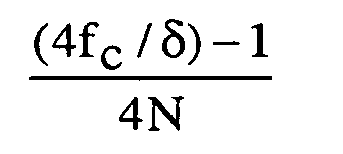
- Système selon la revendication 7, dans lequel la section de réception (14) comprend : une section de numérisation (52) pour convertir les signaux à fréquence intermédiaire en des signaux numériques correspondants ; et un processeur de signaux numériques (50) pour traiter les signaux numériques.
- Système selon la revendication 17, dans lequel la section de réception (14) comprend : un premier circuit de commande automatique de gain, AGC, (48) recevant des signaux à fréquence intermédiaire transmis par un filtre passe-bas (45) et agissant en réponse à la sortie du processeur de signaux numériques (50) pour régler le gain du premier circuit AGC (48) en fonction de la sortie du processeur de signaux numériques (50) ; et un second circuit AGC (54) recevant les signaux numériques et la sortie du processeur de signaux numériques (50) pour régler le gain des signaux numériques dans le second circuit AGC (54) en accord avec la sortie du processeur de signaux numériques (50).
- Système selon la revendication 18, dans lequel la section de réception (14) comprend un démodulateur (56) et dans lequel le démodulateur (56) fournit un signal de commande pour les premier et second circuits AGC (48, 54).
Applications Claiming Priority (6)
| Application Number | Priority Date | Filing Date | Title |
|---|---|---|---|
| US61487596A | 1996-03-13 | 1996-03-13 | |
| US614592 | 1996-03-13 | ||
| US615347 | 1996-03-13 | ||
| US08/614,592 US5668505A (en) | 1996-03-13 | 1996-03-13 | Ring oscillator having two rings whose outputs are combined |
| US08/615,347 US5758274A (en) | 1996-03-13 | 1996-03-13 | Radio frequency receiver with automatic gain control |
| US614875 | 2000-07-12 |
Publications (3)
| Publication Number | Publication Date |
|---|---|
| EP0806840A2 EP0806840A2 (fr) | 1997-11-12 |
| EP0806840A3 EP0806840A3 (fr) | 2000-04-12 |
| EP0806840B1 true EP0806840B1 (fr) | 2008-08-13 |
Family
ID=27417129
Family Applications (1)
| Application Number | Title | Priority Date | Filing Date |
|---|---|---|---|
| EP19970104279 Expired - Lifetime EP0806840B1 (fr) | 1996-03-13 | 1997-03-13 | Modules pour un émetteur-récepteur en radiofréquence, ainsi qu'un émetteur-récepteur |
Country Status (2)
| Country | Link |
|---|---|
| EP (1) | EP0806840B1 (fr) |
| DE (1) | DE69738894D1 (fr) |
Families Citing this family (2)
| Publication number | Priority date | Publication date | Assignee | Title |
|---|---|---|---|---|
| GB2322042B (en) * | 1997-02-05 | 2002-02-06 | Ericsson Telefon Ab L M | Radio architecture |
| GB9805148D0 (en) * | 1998-03-11 | 1998-05-06 | Philips Electronics Nv | Radio receiver |
Family Cites Families (3)
| Publication number | Priority date | Publication date | Assignee | Title |
|---|---|---|---|---|
| WO1994005087A1 (fr) * | 1992-08-25 | 1994-03-03 | Wireless Access, Inc. | Recepteur a conversion directe pour protocoles multiples |
| GB2308514B (en) * | 1993-03-01 | 1997-09-17 | Texas Instruments Ltd | A digital oscillator |
| US5640698A (en) * | 1995-06-06 | 1997-06-17 | Stanford University | Radio frequency signal reception using frequency shifting by discrete-time sub-sampling down-conversion |
-
1997
- 1997-03-13 DE DE69738894T patent/DE69738894D1/de not_active Expired - Fee Related
- 1997-03-13 EP EP19970104279 patent/EP0806840B1/fr not_active Expired - Lifetime
Also Published As
| Publication number | Publication date |
|---|---|
| DE69738894D1 (de) | 2008-09-25 |
| EP0806840A3 (fr) | 2000-04-12 |
| EP0806840A2 (fr) | 1997-11-12 |
Similar Documents
| Publication | Publication Date | Title |
|---|---|---|
| US5758274A (en) | Radio frequency receiver with automatic gain control | |
| US7925238B2 (en) | Simplified high frequency tuner and tuning method | |
| US5668505A (en) | Ring oscillator having two rings whose outputs are combined | |
| KR100780117B1 (ko) | 각도 변조 rf 신호 수신기 | |
| EP0540195B1 (fr) | Radioréception numérique en quadrature avec traitement en deux étapes | |
| US6151367A (en) | Digital demodulator | |
| EP0935851A1 (fr) | Dispositif de communication numerique et melangeur | |
| US7477706B2 (en) | Switched capacitor network for tuning and downconversion | |
| US6347123B1 (en) | Low-current sample rate converter | |
| EP0806840A2 (fr) | Modules pour un émetteur-récepteur en radiofréquence, ainsi qu'un émetteur-récepteur | |
| JP3275179B2 (ja) | 量子化を用いる直角信号の復調 | |
| JP2002135154A (ja) | ラジオ周波数トランシーバ | |
| JP3032268B2 (ja) | 復調回路 | |
| EP1527514A1 (fr) | Recepteur comprenant plusieurs elements de reception paralleles | |
| JPH03165146A (ja) | 4位相復調回路 |
Legal Events
| Date | Code | Title | Description |
|---|---|---|---|
| PUAI | Public reference made under article 153(3) epc to a published international application that has entered the european phase |
Free format text: ORIGINAL CODE: 0009012 |
|
| AK | Designated contracting states |
Kind code of ref document: A2 Designated state(s): DE FR GB IT |
|
| RIC1 | Information provided on ipc code assigned before grant |
Free format text: 7H 04B 1/00 A, 7H 04B 1/30 B, 7H 04B 1/40 B |
|
| PUAL | Search report despatched |
Free format text: ORIGINAL CODE: 0009013 |
|
| AK | Designated contracting states |
Kind code of ref document: A3 Designated state(s): DE FR GB IT |
|
| 17P | Request for examination filed |
Effective date: 20001004 |
|
| 17Q | First examination report despatched |
Effective date: 20070904 |
|
| GRAP | Despatch of communication of intention to grant a patent |
Free format text: ORIGINAL CODE: EPIDOSNIGR1 |
|
| GRAS | Grant fee paid |
Free format text: ORIGINAL CODE: EPIDOSNIGR3 |
|
| GRAA | (expected) grant |
Free format text: ORIGINAL CODE: 0009210 |
|
| AK | Designated contracting states |
Kind code of ref document: B1 Designated state(s): DE FR GB IT |
|
| REG | Reference to a national code |
Ref country code: GB Ref legal event code: FG4D |
|
| REF | Corresponds to: |
Ref document number: 69738894 Country of ref document: DE Date of ref document: 20080925 Kind code of ref document: P |
|
| PLBE | No opposition filed within time limit |
Free format text: ORIGINAL CODE: 0009261 |
|
| STAA | Information on the status of an ep patent application or granted ep patent |
Free format text: STATUS: NO OPPOSITION FILED WITHIN TIME LIMIT |
|
| PGFP | Annual fee paid to national office [announced via postgrant information from national office to epo] |
Ref country code: GB Payment date: 20090206 Year of fee payment: 13 |
|
| 26N | No opposition filed |
Effective date: 20090514 |
|
| PG25 | Lapsed in a contracting state [announced via postgrant information from national office to epo] |
Ref country code: IT Free format text: LAPSE BECAUSE OF FAILURE TO SUBMIT A TRANSLATION OF THE DESCRIPTION OR TO PAY THE FEE WITHIN THE PRESCRIBED TIME-LIMIT Effective date: 20080813 |
|
| PGFP | Annual fee paid to national office [announced via postgrant information from national office to epo] |
Ref country code: DE Payment date: 20090331 Year of fee payment: 13 |
|
| PGFP | Annual fee paid to national office [announced via postgrant information from national office to epo] |
Ref country code: FR Payment date: 20090306 Year of fee payment: 13 |
|
| GBPC | Gb: european patent ceased through non-payment of renewal fee |
Effective date: 20100313 |
|
| REG | Reference to a national code |
Ref country code: FR Ref legal event code: ST Effective date: 20101130 |
|
| PG25 | Lapsed in a contracting state [announced via postgrant information from national office to epo] |
Ref country code: FR Free format text: LAPSE BECAUSE OF NON-PAYMENT OF DUE FEES Effective date: 20100331 |
|
| PG25 | Lapsed in a contracting state [announced via postgrant information from national office to epo] |
Ref country code: DE Free format text: LAPSE BECAUSE OF NON-PAYMENT OF DUE FEES Effective date: 20101001 |
|
| PG25 | Lapsed in a contracting state [announced via postgrant information from national office to epo] |
Ref country code: GB Free format text: LAPSE BECAUSE OF NON-PAYMENT OF DUE FEES Effective date: 20100313 |