EP0807449B1 - Pansement protecteur pour cathéters profonds et son nécessaire hygiénique - Google Patents
Pansement protecteur pour cathéters profonds et son nécessaire hygiénique Download PDFInfo
- Publication number
- EP0807449B1 EP0807449B1 EP96203123A EP96203123A EP0807449B1 EP 0807449 B1 EP0807449 B1 EP 0807449B1 EP 96203123 A EP96203123 A EP 96203123A EP 96203123 A EP96203123 A EP 96203123A EP 0807449 B1 EP0807449 B1 EP 0807449B1
- Authority
- EP
- European Patent Office
- Prior art keywords
- skin
- pouch
- window
- patient
- catheters
- Prior art date
- Legal status (The legal status is an assumption and is not a legal conclusion. Google has not performed a legal analysis and makes no representation as to the accuracy of the status listed.)
- Expired - Lifetime
Links
- 239000011505 plaster Substances 0.000 title 1
- 239000000853 adhesive Substances 0.000 claims abstract description 10
- 230000001070 adhesive effect Effects 0.000 claims abstract description 10
- 239000000463 material Substances 0.000 claims abstract description 8
- 230000001681 protective effect Effects 0.000 claims description 20
- 229920001296 polysiloxane Polymers 0.000 claims description 3
- 210000002105 tongue Anatomy 0.000 claims 1
- 239000004698 Polyethylene Substances 0.000 abstract description 4
- -1 polyethylene Polymers 0.000 abstract description 4
- 229920000573 polyethylene Polymers 0.000 abstract description 4
- 239000012815 thermoplastic material Substances 0.000 abstract description 2
- 238000000502 dialysis Methods 0.000 description 10
- 239000002390 adhesive tape Substances 0.000 description 5
- 238000011109 contamination Methods 0.000 description 5
- 230000000474 nursing effect Effects 0.000 description 5
- 208000015181 infectious disease Diseases 0.000 description 4
- 239000007788 liquid Substances 0.000 description 3
- 238000004806 packaging method and process Methods 0.000 description 3
- 230000000717 retained effect Effects 0.000 description 3
- 230000001012 protector Effects 0.000 description 2
- 238000011012 sanitization Methods 0.000 description 2
- 230000001464 adherent effect Effects 0.000 description 1
- 210000001367 artery Anatomy 0.000 description 1
- 230000003416 augmentation Effects 0.000 description 1
- YFXPPSKYMBTNAV-UHFFFAOYSA-N bensultap Chemical compound C=1C=CC=CC=1S(=O)(=O)SCC(N(C)C)CSS(=O)(=O)C1=CC=CC=C1 YFXPPSKYMBTNAV-UHFFFAOYSA-N 0.000 description 1
- 230000000740 bleeding effect Effects 0.000 description 1
- 239000011248 coating agent Substances 0.000 description 1
- 238000000576 coating method Methods 0.000 description 1
- 238000004040 coloring Methods 0.000 description 1
- 230000000694 effects Effects 0.000 description 1
- 238000009434 installation Methods 0.000 description 1
- 238000004519 manufacturing process Methods 0.000 description 1
- 238000000034 method Methods 0.000 description 1
- 230000002093 peripheral effect Effects 0.000 description 1
- 239000004033 plastic Substances 0.000 description 1
- 229920003023 plastic Polymers 0.000 description 1
- 231100000614 poison Toxicity 0.000 description 1
- 238000002360 preparation method Methods 0.000 description 1
- 230000001737 promoting effect Effects 0.000 description 1
- 239000000523 sample Substances 0.000 description 1
- 238000000638 solvent extraction Methods 0.000 description 1
- 238000004659 sterilization and disinfection Methods 0.000 description 1
- 229920001169 thermoplastic Polymers 0.000 description 1
- 239000004416 thermosoftening plastic Substances 0.000 description 1
- 239000003440 toxic substance Substances 0.000 description 1
- 210000003462 vein Anatomy 0.000 description 1
Images


Classifications
-
- A—HUMAN NECESSITIES
- A61—MEDICAL OR VETERINARY SCIENCE; HYGIENE
- A61M—DEVICES FOR INTRODUCING MEDIA INTO, OR ONTO, THE BODY; DEVICES FOR TRANSDUCING BODY MEDIA OR FOR TAKING MEDIA FROM THE BODY; DEVICES FOR PRODUCING OR ENDING SLEEP OR STUPOR
- A61M25/00—Catheters; Hollow probes
- A61M25/01—Introducing, guiding, advancing, emplacing or holding catheters
- A61M25/02—Holding devices, e.g. on the body
-
- A—HUMAN NECESSITIES
- A61—MEDICAL OR VETERINARY SCIENCE; HYGIENE
- A61M—DEVICES FOR INTRODUCING MEDIA INTO, OR ONTO, THE BODY; DEVICES FOR TRANSDUCING BODY MEDIA OR FOR TAKING MEDIA FROM THE BODY; DEVICES FOR PRODUCING OR ENDING SLEEP OR STUPOR
- A61M25/00—Catheters; Hollow probes
- A61M25/01—Introducing, guiding, advancing, emplacing or holding catheters
- A61M25/02—Holding devices, e.g. on the body
- A61M2025/0246—Holding devices, e.g. on the body fixed on the skin having a cover for covering the holding means
-
- A—HUMAN NECESSITIES
- A61—MEDICAL OR VETERINARY SCIENCE; HYGIENE
- A61M—DEVICES FOR INTRODUCING MEDIA INTO, OR ONTO, THE BODY; DEVICES FOR TRANSDUCING BODY MEDIA OR FOR TAKING MEDIA FROM THE BODY; DEVICES FOR PRODUCING OR ENDING SLEEP OR STUPOR
- A61M25/00—Catheters; Hollow probes
- A61M25/01—Introducing, guiding, advancing, emplacing or holding catheters
- A61M25/02—Holding devices, e.g. on the body
- A61M2025/0266—Holding devices, e.g. on the body using pads, patches, tapes or the like
Definitions
- the present invention relates to the medical field and / or sanitary and more specifically relates to a protective dressing for deep catheters, suitable for ambulatory treatment.
- the catheter or probe designates a thin tube, preferably plastic, flexible and capable of being introduced into the body (for example: a vein or an artery) to explore or intervene.
- the introduction of the catheter into a conduit called "catheterization" is a delicate intervention which also requires medical staff caregiver, respect for draconian sanitary and hygienic rules in order to prevent any risk of patient infection.
- Catheters covered by the protective dressing of the invention are those of the type worn permanently by dialysis patients which open to the outside of the skin and which are generally among two of which, one for the suction and the other for the return of the liquid in a circuit outside the body periodically set up to separate said liquid from toxic substances before reinjecting it into the body.
- protective devices catheter described in particular that in document EP 0671182 (GAMBRO AB) consisting of a pocket provided with a circular window with adhesion means arranged around the window to make the pocket airtight, this pocket further comprising a reclosable opening allowing connection and disconnection of catheters.
- the Applicant has conducted research having for the study of a dressing of a new type which overcomes the disadvantages mentioned above and which provides hermetic protection for catheter tips deep, in satisfactory hygienic and comfort conditions as well for the patient as for the nursing staff, while promoting a wide dissemination of such a dressing while ensuring its lower cost price by a industrial mass production.
- a window (110a) is essentially characterized in that this window (110a), is closed by a strip made of a non-woven compress (210) provided with two slots (211a-212b) for the passage of catheters, said strip being bordered by a ribbon (220) surrounding at least said window (110a) of the pocket (100), the face (210a) of said strip capable of being applied to the skin being sanitized and the face (220a) of said tape (220) capable of being applied to the skin being covered with an adhesive material allowing hold the pocket (100) on the patient's skin.
- the said faces of said strip and of said ribbon intended to be applied to the skin are covered by a removable silicone protective film (200a) formed two tabs (201a-202a) terminated at their ends opposite two flaps (201a-202b) overlapping to be easily graspable.
- this pocket shaped in a waterproof transparent flexible thermoplastic material such as polyethylene approved medically, has for its object, in the so-called open position of its window, allow passage of the catheter tips inside, and in position so-called closing, when its window is closed by the adhesion means secured on the skin around said end pieces, ensuring watertight partitioning of the pocket containing the tips, thus preserving the basic principles of hygiene.
- the advantage of such a dressing is that it can be combined into a single product industrial, watertight protection of catheter tips and retaining means of the pocket on the patient's body.
- this dressing has implications appreciable for the comfort of the patient both in terms of ease (the pocket flexible deformable is retained on the skin only on a reduced surface of the means adhesion surrounding the window), only aesthetically (discretion of the dressing under clothing) or only on the reassuring level (little risk of contamination guaranteed by the tightness of the polyethylene material of the poached).
- This little bulky dressing kit and ready to use is essential and sufficient for nursing staff to perform a hygienic dressing change protector according to the invention.
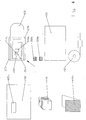
- the pocket 100 shaped in a material waterproof transparent flexible thermoplastic, such as approved polyethylene medically, is open from a window 110a (preferably practiced in the upper part 110 of its face 100a) to allow the passage of two end pieces of catheter 300a and 300b opening to the outside of the patient's skin and intended, one (300a) at the suction and the other (300b) at the return of the liquid in the organism, via an external treatment circuit connected periodically to said tips.
- the ends of these tips 300a and 300b are either connected to the lines a dialysis circuit, either closed by two removable caps 310a and 310b (cf. figure 4) each coated in the same color (blue or red) as that of the corresponding tip 300a and 300b.
- the above means of membership 200 is arranged at least around the window 110a, in order to seal the pocket 100 applied to the skin with its catheter tips 300a and 300b trapped inside.
- the flexibility of the material of the pocket 100 allows it follow the movements of the tips around its attachment to the skin, which is reduced to the adhesive surface of said means 200. Opening the window 110a in the upper part 110 of the pocket 100 intended to be in contact with the skin allows to leave free the lower part 120 of the pocket with its tips catheter 300a and 300b which is naturally retained suspended from the skin by its adhesion means 200.
- the nursing staff may direct access to bits 300a and 300b and immediately without removal dressing to ensure, after disinfection, the connection of the dialysis circuit inside the pocket 100 still forming a protective envelope for intervention.
- the face 100a of the pocket 100 may be covered with a veil 100a 'of non-adherent material pleasant to the touch, disposed around said adhesion means 200.
- the other face 100b of the pocket 100 remain transparent to quickly visualize bleeding, oozing, coloring of the skin, etc ...
- the above means of membership 200 is composed, meanwhile, a central strip 210 formed of a nonwoven compress and pierced with an opening formed in the present case of two slots 211a and 211b parallel to the longitudinal axis of the pocket 100 to allow the passage of the two catheter tips 300a and 300b.
- This compress 210 forming the band central is bordered by a peripheral tape 220 surrounding at least the window 110 of the pocket 100.
- the face 210a of the compress of the central strip can be applied to the skin is sanitized and the face 220a of the tape 220 can be applied to the skin is covered with an adhesive material allowing the pocket 100 to be retained on the skin around said tips 300a and 300b.
- the face 210a of the compress of the central strip 210 and that 220a of the adhesive tape 220, intended to be in contact with the skin are covered with a removable protective film 200a, shaped conventionally in silicone paper.
- This 200a film consists of two tabs 201a and 202a, arranged perpendicular to the longitudinal axis of the pocket 100, and terminated at their ends opposite two small flaps 201a 'and 202a' overlapping to be easily graspable and able to remove easily the two tabs 201a and 202a, one after the other after having engaged the two end pieces 300a and 300b in the pocket 100, via the two slots 211a and 211b and window 110a.
- the face 210b of the compress of the central strip 210 and that 220b of the adhesive tape 220 opposite the pocket 100 are covered with a waterproof non-stick protective veil 200b.
Landscapes
- Health & Medical Sciences (AREA)
- Life Sciences & Earth Sciences (AREA)
- Biophysics (AREA)
- Pulmonology (AREA)
- Engineering & Computer Science (AREA)
- Anesthesiology (AREA)
- Biomedical Technology (AREA)
- Heart & Thoracic Surgery (AREA)
- Hematology (AREA)
- Animal Behavior & Ethology (AREA)
- General Health & Medical Sciences (AREA)
- Public Health (AREA)
- Veterinary Medicine (AREA)
- Materials For Medical Uses (AREA)
- Medical Preparation Storing Or Oral Administration Devices (AREA)
- Media Introduction/Drainage Providing Device (AREA)
- External Artificial Organs (AREA)
Description
- Une mise en place longue (de l'ordre de vingt minutes) et très lourde (enrobage des bouchons des embouts par des compresses bétadinées, pose de compresses stériles sur les embouts et application de rubans adhésifs occlusifs),
- Un manque de confort pour le patient ambulatoire équipé d'un tel pansement volumineux et inesthétique.
- Un risque de contamination de ce pansement non étanche à l'eau ou autre souillure du milieu ambiant environnant,
- Un temps important de préparation préalable pour la mise en place du circuit de dialyse puisque, pour dégager les embouts de cathéter pour la connexion, il est indispensable de supprimer le pansement avec toutes les incommodités que cela engendre pour le patient,
- Une augmentation du risque d'infection au moment de la connexion du circuit de dialyse sur les deux embouts des cathéters,
- L'impossibilité pour le patient de prendre des douches ou des bains sans risquer d'endommager son pansement,
- Etc.
- Un pansement protecteur selon l'invention,
- Un lot de compresses non tissées stériles,
- Un premier champ opératoire stérile avec fenêtre,
- Un deuxième champ opératoire stérile de table,
- Un emballage des compresses stériles,
- Et deux bouchons revêtus chacun de la couleur de l'embout du cathéter correspondant.
- D'une poche 100 comportant une face 100a côté peau et d'une face 100b côté opposé,
- D'un moyen d'adhésion 200 de la poche 100 à la peau du patient.
- Une poche 100 avec son moyen d'adhésion 200 comportant une bande centrale 210 percée de deux fentes parallèles 211a et 211b parallèles à l'axe longitudinal de la poche 100 et un ruban adhésif 220 entourant au moins la fenêtre 110a de la poche 100,
- Un lot de compresses non tissées stériles 410,
- Un premier champ opératoire stérile 420 avec fenêtre 420a,
- Un deuxième champ opératoire stérile de table 430,
- Un emballage 410a des compresses 410,
- Deux bouchons 310a et 310b revêtus chacun de la couleur de l'embout de cathéter correspondant 300a et 300b.
Claims (4)
- Pansement protecteur de cathéters profonds débouchant à l'extérieur de la peau d'un patient formé d'une poche (100) pouvant recevoir dans sa partie inférieure (120) les embouts (300a-300b) desdits cathéters, cette poche (100) comportant dans sa partie supérieure (110) sur la face (100a) destinée à venir au contact de la peau du patient, une fenêtre (110a) caractérisé en ce que cette fenêtre (110a), est obturée par une bande constituée d'une compresse non tissée (210) munie de deux fentes (211a-211b) pour le passage des cathéters, ladite bande étant bordée d'un ruban (220) entourant au moins ladite fenêtre (110a) de la poche (100), la face (210a) de la dite bande susceptible d'être appliquée sur la peau étant aseptisée et la face (220a) dudit ruban (220) susceptible d'être appliquée sur la peau étant recouverte d'un matériau adhésif permettant de retenir la poche (100) sur la peau du patient.
- Pansement protecteur selon la revendication 1 caractérisé en ce que les deux fentes (211a-211b) prévues dans la compresse (210) obturant la fenêtre (110a) sont orientées parallèlement à l'axe longitudinal de la poche (100).
- Pansement protecteur selon la revendication 1 caractérisé en ce que lesdites faces de ladite bande et dudit ruban destinées à être appliquées sur la peau sont recouvertes par une pellicule protectrice siliconée, détachable (200a) formée de deux languettes (201a-202a) terminées à leurs extrémités en vis-à-vis de deux rabats (201a-202b) se recouvrant pour être facilement saisissables.
- Nécessaire hygiénique de pansement renfermant :Un pansement protecteur selon les revendications 1 à 3 (100).Un lot de compresses non tissées stériles (410).Un premier champ opératoire stérile (420) avec fenêtre (420a).Un deuxième champ opératoire stérile de table (430).Un emballage (410a) des compresses stériles (410).Deux bouchons (310a et 310b) revêtus chacun de la couleur de l'embout de cathéter correspondant (300a et 300b).
Applications Claiming Priority (2)
| Application Number | Priority Date | Filing Date | Title |
|---|---|---|---|
| FR9606329A FR2748661B1 (fr) | 1996-05-15 | 1996-05-15 | Pansement protecteur pour catheters profonds et son necessaire hygienique |
| FR9606329 | 1996-05-15 |
Publications (2)
| Publication Number | Publication Date |
|---|---|
| EP0807449A1 EP0807449A1 (fr) | 1997-11-19 |
| EP0807449B1 true EP0807449B1 (fr) | 2003-10-08 |
Family
ID=9492339
Family Applications (1)
| Application Number | Title | Priority Date | Filing Date |
|---|---|---|---|
| EP96203123A Expired - Lifetime EP0807449B1 (fr) | 1996-05-15 | 1996-11-07 | Pansement protecteur pour cathéters profonds et son nécessaire hygiénique |
Country Status (4)
| Country | Link |
|---|---|
| EP (1) | EP0807449B1 (fr) |
| AT (1) | ATE251483T1 (fr) |
| DE (1) | DE69630280D1 (fr) |
| FR (1) | FR2748661B1 (fr) |
Cited By (1)
| Publication number | Priority date | Publication date | Assignee | Title |
|---|---|---|---|---|
| US8663171B2 (en) | 2006-05-12 | 2014-03-04 | Fresenius Medical Care Deutshland Gmbh | Medical-use bandage |
Families Citing this family (8)
| Publication number | Priority date | Publication date | Assignee | Title |
|---|---|---|---|---|
| DE29808821U1 (de) * | 1998-05-17 | 1999-09-23 | GIP Medizin Technik GmbH, 83224 Grassau | Verband mit einem flachen Verbandsteil für die Aufnahme eines Kanülen-, Sonden- oder Katheterhalters |
| ES1043707Y (es) * | 1999-07-16 | 2000-06-16 | Perez Teresa Martinez | Protector para cateteres de uso clinico. |
| US6267115B1 (en) * | 2000-09-25 | 2001-07-31 | Florine Marshel | Intravenous protecting device |
| US6682507B2 (en) * | 2002-02-20 | 2004-01-27 | Doug's Kangaroo Pouch, Llc | User wearable device having sterile environment for connecting peritoneal dialysis tubes |
| GB201101402D0 (en) | 2011-01-27 | 2011-03-16 | Prosys Internat Ltd | Shield apparatus |
| FR3020574B1 (fr) | 2014-04-30 | 2016-06-24 | Nephrokit | Dispositif de protection d'un catheter |
| ES3063354T3 (en) * | 2019-09-20 | 2026-04-16 | Iberhospitex Sa | A sanitary dressing |
| FR3148724A1 (fr) | 2023-05-17 | 2024-11-22 | Gergonne Sas | Dispositif de protection de la partie proximale d’un cathéter |
Family Cites Families (4)
| Publication number | Priority date | Publication date | Assignee | Title |
|---|---|---|---|---|
| US4778456A (en) * | 1987-04-03 | 1988-10-18 | Oddvin Lokken | Method of sterilizing an operating field and sterilized cassette therefor |
| DE4117282A1 (de) * | 1991-05-27 | 1992-12-03 | Beiersdorf Ag | Haftverband fuer intravenoese katheter |
| US5372589A (en) * | 1993-11-24 | 1994-12-13 | Davis; W. Gordon | Fenestrated transparent catheter securing device and method |
| SE9400832D0 (sv) * | 1994-03-10 | 1994-03-10 | Gambro Ab | Kateterskydd |
-
1996
- 1996-05-15 FR FR9606329A patent/FR2748661B1/fr not_active Expired - Lifetime
- 1996-11-07 EP EP96203123A patent/EP0807449B1/fr not_active Expired - Lifetime
- 1996-11-07 DE DE69630280T patent/DE69630280D1/de not_active Expired - Lifetime
- 1996-11-07 AT AT96203123T patent/ATE251483T1/de not_active IP Right Cessation
Cited By (1)
| Publication number | Priority date | Publication date | Assignee | Title |
|---|---|---|---|---|
| US8663171B2 (en) | 2006-05-12 | 2014-03-04 | Fresenius Medical Care Deutshland Gmbh | Medical-use bandage |
Also Published As
| Publication number | Publication date |
|---|---|
| DE69630280D1 (de) | 2003-11-13 |
| EP0807449A1 (fr) | 1997-11-19 |
| FR2748661B1 (fr) | 1998-11-20 |
| ATE251483T1 (de) | 2003-10-15 |
| FR2748661A1 (fr) | 1997-11-21 |
Similar Documents
| Publication | Publication Date | Title |
|---|---|---|
| US12076507B2 (en) | Integrated sealing and securing device for vascular catheters and methods for use of same | |
| EP1603627B1 (fr) | Dispositif de fixation au corps d'un patient d'un catheter | |
| US6809230B2 (en) | Waterproof venipuncture site cover | |
| CA2510868C (fr) | Ruban adhesif pour catheter intravasculaire | |
| US6222090B1 (en) | Waterproof injection port cover | |
| US20090240207A1 (en) | adhesive tape for an intravascular catheter | |
| IE60248B1 (en) | "Fixing system for fastening catheters, cannulas or the like to the skin surface and process for the sterile fastening thereof" | |
| CN101170975A (zh) | 伤口保护和治疗系统 | |
| US5630804A (en) | Metallic silver-plated silicon ring element for exit site disinfection and a method for preventing contamination at an exit site | |
| US6019103A (en) | Disposable sanitary eye protector | |
| WO2015166157A1 (fr) | Dispositif de protection d'un catheter | |
| WO2000076440A1 (fr) | Pansement adhesif | |
| EP0807449A1 (fr) | Pansement protecteur pour cathéters profonds et son nécessaire hygiénique | |
| US8753355B2 (en) | Umbilical cord tab | |
| EP0311721B1 (fr) | Composition plastique pour la protection de surfaces corporelles et dispositif pour son application | |
| EP0772473B1 (fr) | Nouveau dispositif de badigeonnage | |
| US20150182738A1 (en) | Alcohol prep applicator | |
| CN201676078U (zh) | 一种避光眼睛保护贴 | |
| FR2953416A3 (fr) | Canule et dispositif a canule pour la mise en place d'un implant | |
| FR2511600A1 (fr) | Dispositif de guidage pour faciliter l'introduction d'un catheter | |
| FR3086529A1 (fr) | Procede de fabrication d'un dispositif adhesif destine a proteger un catheter implante chez un patient et dispositif adhesif obtenu | |
| FR3070850B1 (fr) | Dispositif de compression hemostatique arteriel | |
| EP4713068A1 (fr) | Dispositif de protection de la partie proximale d'un catheter | |
| FR3080272A1 (fr) | Set de pansement protecteur de catheter | |
| KR102542048B1 (ko) | 영아용 구강관리기 |
Legal Events
| Date | Code | Title | Description |
|---|---|---|---|
| PUAI | Public reference made under article 153(3) epc to a published international application that has entered the european phase |
Free format text: ORIGINAL CODE: 0009012 |
|
| AK | Designated contracting states |
Kind code of ref document: A1 Designated state(s): AT BE CH DE DK ES FI GB GR IE IT LI LU MC NL PT SE |
|
| REG | Reference to a national code |
Ref country code: CH Ref legal event code: PLI Owner name: VOGEL, DENISE TRANSFER- HEMOTECH, SOCITETE ANONYME |
|
| 111L | Licence recorded |
Free format text: 971206 0100 HEMOTECH, SOCITETE ANONYME |
|
| REG | Reference to a national code |
Ref country code: CH Ref legal event code: PLI Owner name: VOGEL, DENISE TRANSFER- HEMOTECH, SOCITETE ANONYME |
|
| 17P | Request for examination filed |
Effective date: 19980406 |
|
| 17Q | First examination report despatched |
Effective date: 19991220 |
|
| GRAH | Despatch of communication of intention to grant a patent |
Free format text: ORIGINAL CODE: EPIDOS IGRA |
|
| GRAS | Grant fee paid |
Free format text: ORIGINAL CODE: EPIDOSNIGR3 |
|
| GRAA | (expected) grant |
Free format text: ORIGINAL CODE: 0009210 |
|
| AK | Designated contracting states |
Kind code of ref document: B1 Designated state(s): AT BE CH DE DK ES FI GB GR IE IT LI LU MC NL PT SE |
|
| PG25 | Lapsed in a contracting state [announced via postgrant information from national office to epo] |
Ref country code: NL Free format text: LAPSE BECAUSE OF FAILURE TO SUBMIT A TRANSLATION OF THE DESCRIPTION OR TO PAY THE FEE WITHIN THE PRESCRIBED TIME-LIMIT Effective date: 20031008 Ref country code: IT Free format text: LAPSE BECAUSE OF FAILURE TO SUBMIT A TRANSLATION OF THE DESCRIPTION OR TO PAY THE FEE WITHIN THE PRE;WARNING: LAPSES OF ITALIAN PATENTS WITH EFFECTIVE DATE BEFORE 2007 MAY HAVE OCCURRED AT ANY TIME BEFORE 2007. THE CORRECT EFFECTIVE DATE MAY BE DIFFERENT FROM THE ONE RECORDED.SCRIBED TIME-LIMIT Effective date: 20031008 Ref country code: IE Free format text: LAPSE BECAUSE OF FAILURE TO SUBMIT A TRANSLATION OF THE DESCRIPTION OR TO PAY THE FEE WITHIN THE PRESCRIBED TIME-LIMIT Effective date: 20031008 Ref country code: GB Free format text: LAPSE BECAUSE OF FAILURE TO SUBMIT A TRANSLATION OF THE DESCRIPTION OR TO PAY THE FEE WITHIN THE PRESCRIBED TIME-LIMIT Effective date: 20031008 Ref country code: FI Free format text: LAPSE BECAUSE OF FAILURE TO SUBMIT A TRANSLATION OF THE DESCRIPTION OR TO PAY THE FEE WITHIN THE PRESCRIBED TIME-LIMIT Effective date: 20031008 Ref country code: AT Free format text: LAPSE BECAUSE OF FAILURE TO SUBMIT A TRANSLATION OF THE DESCRIPTION OR TO PAY THE FEE WITHIN THE PRESCRIBED TIME-LIMIT Effective date: 20031008 |
|
| REG | Reference to a national code |
Ref country code: GB Ref legal event code: FG4D Free format text: NOT ENGLISH |
|
| REG | Reference to a national code |
Ref country code: CH Ref legal event code: EP |
|
| PG25 | Lapsed in a contracting state [announced via postgrant information from national office to epo] |
Ref country code: LU Free format text: LAPSE BECAUSE OF NON-PAYMENT OF DUE FEES Effective date: 20031107 |
|
| REG | Reference to a national code |
Ref country code: IE Ref legal event code: FG4D Free format text: FRENCH |
|
| REF | Corresponds to: |
Ref document number: 69630280 Country of ref document: DE Date of ref document: 20031113 Kind code of ref document: P |
|
| PG25 | Lapsed in a contracting state [announced via postgrant information from national office to epo] |
Ref country code: MC Free format text: LAPSE BECAUSE OF NON-PAYMENT OF DUE FEES Effective date: 20031130 Ref country code: LI Free format text: LAPSE BECAUSE OF NON-PAYMENT OF DUE FEES Effective date: 20031130 Ref country code: CH Free format text: LAPSE BECAUSE OF NON-PAYMENT OF DUE FEES Effective date: 20031130 Ref country code: BE Free format text: LAPSE BECAUSE OF NON-PAYMENT OF DUE FEES Effective date: 20031130 |
|
| R11L | Licence recorded (corrected) |
Free format text: 0100 SOCIETE HEMODIA Effective date: 20030813 |
|
| PG25 | Lapsed in a contracting state [announced via postgrant information from national office to epo] |
Ref country code: SE Free format text: LAPSE BECAUSE OF FAILURE TO SUBMIT A TRANSLATION OF THE DESCRIPTION OR TO PAY THE FEE WITHIN THE PRESCRIBED TIME-LIMIT Effective date: 20040108 Ref country code: GR Free format text: LAPSE BECAUSE OF FAILURE TO SUBMIT A TRANSLATION OF THE DESCRIPTION OR TO PAY THE FEE WITHIN THE PRESCRIBED TIME-LIMIT Effective date: 20040108 Ref country code: DK Free format text: LAPSE BECAUSE OF FAILURE TO SUBMIT A TRANSLATION OF THE DESCRIPTION OR TO PAY THE FEE WITHIN THE PRESCRIBED TIME-LIMIT Effective date: 20040108 |
|
| PG25 | Lapsed in a contracting state [announced via postgrant information from national office to epo] |
Ref country code: DE Free format text: LAPSE BECAUSE OF FAILURE TO SUBMIT A TRANSLATION OF THE DESCRIPTION OR TO PAY THE FEE WITHIN THE PRESCRIBED TIME-LIMIT Effective date: 20040109 |
|
| PG25 | Lapsed in a contracting state [announced via postgrant information from national office to epo] |
Ref country code: ES Free format text: LAPSE BECAUSE OF FAILURE TO SUBMIT A TRANSLATION OF THE DESCRIPTION OR TO PAY THE FEE WITHIN THE PRESCRIBED TIME-LIMIT Effective date: 20040119 |
|
| NLV1 | Nl: lapsed or annulled due to failure to fulfill the requirements of art. 29p and 29m of the patents act | ||
| GBV | Gb: ep patent (uk) treated as always having been void in accordance with gb section 77(7)/1977 [no translation filed] |
Effective date: 20031008 |
|
| BERE | Be: lapsed |
Owner name: *VOGEL DENISE Effective date: 20031130 |
|
| REG | Reference to a national code |
Ref country code: CH Ref legal event code: PL |
|
| PLBE | No opposition filed within time limit |
Free format text: ORIGINAL CODE: 0009261 |
|
| STAA | Information on the status of an ep patent application or granted ep patent |
Free format text: STATUS: NO OPPOSITION FILED WITHIN TIME LIMIT |
|
| 26N | No opposition filed |
Effective date: 20040709 |
|
| PG25 | Lapsed in a contracting state [announced via postgrant information from national office to epo] |
Ref country code: PT Free format text: LAPSE BECAUSE OF NON-PAYMENT OF DUE FEES Effective date: 20040308 |