EP0807458B1 - Méthode d'incinération de polluants dans du dioxyde de carbone supercritique - Google Patents
Méthode d'incinération de polluants dans du dioxyde de carbone supercritique Download PDFInfo
- Publication number
- EP0807458B1 EP0807458B1 EP97104767A EP97104767A EP0807458B1 EP 0807458 B1 EP0807458 B1 EP 0807458B1 EP 97104767 A EP97104767 A EP 97104767A EP 97104767 A EP97104767 A EP 97104767A EP 0807458 B1 EP0807458 B1 EP 0807458B1
- Authority
- EP
- European Patent Office
- Prior art keywords
- carbon dioxide
- oxidation
- pollutants
- temperature
- supercritical
- Prior art date
- Legal status (The legal status is an assumption and is not a legal conclusion. Google has not performed a legal analysis and makes no representation as to the accuracy of the status listed.)
- Expired - Lifetime
Links
Images



Classifications
-
- B—PERFORMING OPERATIONS; TRANSPORTING
- B01—PHYSICAL OR CHEMICAL PROCESSES OR APPARATUS IN GENERAL
- B01D—SEPARATION
- B01D53/00—Separation of gases or vapours; Recovering vapours of volatile solvents from gases; Chemical or biological purification of waste gases, e.g. engine exhaust gases, smoke, fumes, flue gases, aerosols
- B01D53/34—Chemical or biological purification of waste gases
- B01D53/46—Removing components of defined structure
- B01D53/72—Organic compounds not provided for in groups B01D53/48 - B01D53/70, e.g. hydrocarbons
Definitions
- the invention relates to a method for burning organic Pollutants in supercritical carbon dioxide according to the first claim.
- Oxidation in supercritical carbon dioxide is also in the publication "Oxidation Catalysis in a Supercritical Fluid Medium "by Kerry M. Dooley and F. Carl Knopf in Ind. Eng. Chem. Res. 1987, 26, 1910-1916. toluene is in the presence of redox or acid catalysts with air contacted and mainly oxidized to benzaldehyde. The temperature during the oxidation was in the range between 400 and 500 K (127 ° C to 227 ° C) maintained; the reaction pressure is 80 atm. Even with this procedure, no complete Oxidation of the organic compounds achieved.
- the Measurement of catalyst effectiveness was made before the kinetic Experiments at the lowest process temperature for each Reaction carried out. Above the specified temperatures no deactivation of the catalyst is observed.
- EP-A-0 506 069 discloses a method in which an organic Fuel dissolved in supercritical carbon dioxide and is then burned with the help of an oxidizing agent. The combustion takes place essentially in a combustion chamber at atmospheric pressure instead. The solution of fuel in supercritical carbon sprayed into the combustion chamber, the is kept at atmospheric pressure, the carbon dioxide evaporates almost instantaneously and the fuel forms finely divided Droplets that are easily flammable. The combustion can with maintain an auxiliary burner in the combustion chamber become.
- WO 93 02969 A describes a process for the oxidation of organic substances in supercritical water as a solvent. This oxidation produces water and carbon dioxide. The carbon dioxide is removed so that the supercritical water is recyclable again. It is assumed that the Oxidation of the organic matter is hindered when the solvent the oxidation product contains carbon dioxide.
- the object of the invention is to provide a method with whose help is organic pollutants, especially aromatic ones Compounds fully oxidized in supercritical carbon dioxide can be without the need for a catalyst is.
- the invention is based on the observation that for complete Oxidation of organic pollutants no catalyst required is when the components are pollutant, oxygen and supercritical carbon dioxide in contact with a hot body to be brought.
- the hot body is preferably on one Temperature kept at 200 ° C or more.
- the temperature of the hot body becomes according to the oxidation resistance of the pollutant selected. While some aliphatic compounds even at temperatures from 200 ° C, around 250 ° C can be completely oxidized, it is appropriate for difficult to oxidize aromatic compounds, e.g. B. benzene, to choose a temperature of 300 ° C or more. Temperatures However, temperatures above 500 ° C are generally not necessary.
- any body can be considered as a hot body.
- a hot body an electrically heated and adjustable heating rod from a under the reaction conditions non-oxidizable material can be used.
- the carbon content of the pollutant largely or completely to carbon dioxide oxidized.
- Carbon dioxide can cause supercritical carbon dioxide losses, which can occur in a circular operation, compensated become.
- the oxidation of the pollutants takes place more uniformly, in particular without pronounced temperature and pressure peaks, if the supercritical solution of the pollutant 1 to 10 vol .-% water or hydrogen peroxide can be added. Will the supercritical It is therefore carbon dioxide circulated not necessary, which results from the oxidation of the hydrogen content water forming organic pollutants completely remove.
- the pressure of the supercritical solvent carbon dioxide barely needs during the oxidation on the hot body to be above the critical pressure. Are therefore expedient Pressures between 70 and 300 bar. Higher pressures are used for cost reasons avoided.
- An important area of application of the method according to the invention is the oxidation of organic pollutants that occur in the Filter regeneration may occur.
- filters that are used to clean contaminated soil were used, regenerated with supercritical carbon dioxide whereupon the now with the filtered out Carbon dioxide-laden pollutants according to the invention Procedure is treated. After oxidation, parts of the formed water and possibly the oxidation products are separated from hetero atoms of the pollutant, after which the supercritical carbon dioxide again for filter regeneration is used.
- Fig. 1 the experimental plant is shown schematically.
- Out a container 1 is an organic compound and / or Pollutant introduced into a preheater 4 via a membrane pump 5.
- the preheater 4 will also have another Diaphragm pump 5 from a container 2 supercritical carbon dioxide and air 3 supplied via a compressor 9.
- the carbon dioxide is cooled before compression to make it pumpable becomes.
- the solution of organic compound and / or the pollutant in supercritical Carbon dioxide is in a further mixing head 7 with the Air.
- the further mixing head 7 is in one Fluidized bed sand bath 8 surrounding a reactor 10. With the Fluidized bed sand bath 8, the reactor 10 is heated up and its surface temperature kept constant.
- the trial temperature can be in the range between 250 ° C and 450 ° C to adjust.
- the reactor 10 consists of a high pressure pipe made of Inconel with an inner diameter of 2 mm; it is 6 m long. After the oxidation of the organic compound and / or the pollutant, the reaction mixture is cooled in a cooler to initially 17 ° C. and then expanded to normal pressure via a valve 12. After separation into liquid and gas phases, the CO, CO 2 and O 2 content of the gas phase is measured on-line. In addition, 13 gas and liquid samples are taken in a sampling section and subjected to an analysis.
- the device is used before carrying out the tests Air purged; then the reactor is placed in the hot fluidized bed sand bath 8 submerged and brought to the operating pressure. After that the carbon dioxide and finally the organic Connection and / or the pollutant supplied.
- the organic compound ethanol is often used in extractions with carbon dioxide added to the extractability of certain Improve pollutants. Will follow the extraction of the pollutant carried out the oxidation under certain circumstances larger amounts of ethanol in addition to smaller amounts Pollutant are burned. For this reason, ethanol is one suitable model substance for the oxidation of organic compounds, especially of pollutants, in carbon dioxide.
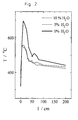
- Fig. 2 the reactor temperature is versus the reactor length for Ethanol with 10 vol .-% and 5 vol .-% water as well as for pure Ethanol applied. How from the temperature rise between 0 and 25 cm reactor length results, the oxidation proceeds of ethanol at the beginning of the reactor. It turned out that a Add about 5 to 10% by volume of water to the ethanol lower temperature exothermic and for provide a quieter, easily controlled response. By adding water, the temperature peak at the beginning of the Reactor that forms with pure ethanol, largely avoided. Based on the remaining TOC content (TOC: Total Organic Carbon) results in a turnover of> 99.9%. In the Fig. 2 results were shown with a sand bath temperature of 450 ° C, an air flow of 450 l / h, one Carbon dioxide flow of 350 g / h and an ethanol flow of 36 g / h receive.
- TOC Total Organic Carbon
- Toluene is more difficult to oxidize than ethanol and is a model compound for aromatic pollutants. Toluene burns with sales similar to those of ethanol, but tends to be higher Reactor temperatures stronger for soot formation. Toluene burns also under strong heat, which leads to a local Temperature increase in the reaction zone leads.
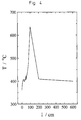
- Fig. 4 shows an example of the heat development.
- the reactor temperature is plotted against the length of the reactor. The highest temperature is in the range between 0 and 200 cm a.
- the sand bath temperature was 400 ° C, the air flow 720 l / h, the flow of carbon dioxide 500 g / h and the Toluene flow 35 g / h.
- the oxygen content in the reactor is changing Sand bath temperatures plotted against time. Like that abruptly shows decreasing oxygen content in the reactor ignites the Oxidation from a sand bath temperature of 370 ° C. The oxidation disappears when the sand bath temperature drops below 308 ° C becomes. The oxygen content in the reactor increases again on. The oxidation was the same as in the experiments with ethanol of the toluene either completely or did not take place.
Landscapes
- Chemical & Material Sciences (AREA)
- Engineering & Computer Science (AREA)
- Chemical Kinetics & Catalysis (AREA)
- Environmental & Geological Engineering (AREA)
- Biomedical Technology (AREA)
- Analytical Chemistry (AREA)
- General Chemical & Material Sciences (AREA)
- Oil, Petroleum & Natural Gas (AREA)
- Health & Medical Sciences (AREA)
- Organic Low-Molecular-Weight Compounds And Preparation Thereof (AREA)
- Carbon And Carbon Compounds (AREA)
- Treating Waste Gases (AREA)
- Physical Or Chemical Processes And Apparatus (AREA)
- Treatment Of Water By Oxidation Or Reduction (AREA)
- Catalysts (AREA)
- Exhaust Gas Treatment By Means Of Catalyst (AREA)
Claims (6)
- Procédé d'incinération de substances organiques nocives dans du dioxyde de carbone supercritique, dans lequela) sans utiliser un catalyseur,b) on prépare une solution des substances nocives dans du dioxyde de carbone supercritique,c) dans la solution présente à l'état supercritique, on dissout une quantité suffisante d'oxygène pour l'oxydation totale des substances nocives,d) on met en contact la solution avec un corps chaud qui présente une température telle que la fraction carbonée des substances nocives est oxydée en dioxyde de carbone par l'oxygène.
- Procédé selon la revendication 1,
dans lequel
on dissout en outre de l'eau ou du peroxyde d'hydrogène dans la solution se trouvant à l'état supercritique. - Procédé selon la revendication 1,
dans lequel
le corps chaud présente une température d'au moins 200°C. - Procédé selon la revendication 1, 2 ou 3,
dans lequel
la pression pendant la réaction d'oxydation est maintenue dans la plage comprise entre 70 bars et 300 bars. - Procédé selon la revendication 1,
avec du benzène ou des dérivés de benzène en tant que substance nocive. - Procédé selon la revendication 1,
dans lequel
on prépare la solution des substances nocives en régénérant avec du dioxyde de carbone supercritique un filtre ayant été utilisé pour l'épuration de sol contaminé par la substance nocive.
Applications Claiming Priority (2)
| Application Number | Priority Date | Filing Date | Title |
|---|---|---|---|
| DE19619559 | 1996-05-14 | ||
| DE19619559A DE19619559A1 (de) | 1996-05-14 | 1996-05-14 | Verfahren zum Verbrennen von Schadstoffen in überkritischem Kohlendioxid |
Publications (3)
| Publication Number | Publication Date |
|---|---|
| EP0807458A2 EP0807458A2 (fr) | 1997-11-19 |
| EP0807458A3 EP0807458A3 (fr) | 1998-02-11 |
| EP0807458B1 true EP0807458B1 (fr) | 2001-12-12 |
Family
ID=7794371
Family Applications (1)
| Application Number | Title | Priority Date | Filing Date |
|---|---|---|---|
| EP97104767A Expired - Lifetime EP0807458B1 (fr) | 1996-05-14 | 1997-03-20 | Méthode d'incinération de polluants dans du dioxyde de carbone supercritique |
Country Status (3)
| Country | Link |
|---|---|
| EP (1) | EP0807458B1 (fr) |
| AT (1) | ATE210489T1 (fr) |
| DE (2) | DE19619559A1 (fr) |
Families Citing this family (1)
| Publication number | Priority date | Publication date | Assignee | Title |
|---|---|---|---|---|
| EP2916075B1 (fr) * | 2014-03-05 | 2023-10-11 | General Electric Technology GmbH | Procédé et système pour fournir un carburant dans une chambre de combustion |
Family Cites Families (3)
| Publication number | Priority date | Publication date | Assignee | Title |
|---|---|---|---|---|
| US5170727A (en) * | 1991-03-29 | 1992-12-15 | Union Carbide Chemicals & Plastics Technology Corporation | Supercritical fluids as diluents in combustion of liquid fuels and waste materials |
| AU2436192A (en) * | 1991-08-09 | 1993-03-02 | Board Of Regents, The University Of Texas System | High temperature wet oxidation using sintered separators |
| DE4406899A1 (de) * | 1994-03-03 | 1995-09-07 | Fraunhofer Ges Forschung | Verfahren zur Dekontamination von Böden |
-
1996
- 1996-05-14 DE DE19619559A patent/DE19619559A1/de not_active Ceased
-
1997
- 1997-03-20 EP EP97104767A patent/EP0807458B1/fr not_active Expired - Lifetime
- 1997-03-20 AT AT97104767T patent/ATE210489T1/de not_active IP Right Cessation
- 1997-03-20 DE DE59705727T patent/DE59705727D1/de not_active Expired - Fee Related
Also Published As
| Publication number | Publication date |
|---|---|
| DE59705727D1 (de) | 2002-01-24 |
| ATE210489T1 (de) | 2001-12-15 |
| EP0807458A2 (fr) | 1997-11-19 |
| EP0807458A3 (fr) | 1998-02-11 |
| DE19619559A1 (de) | 1997-11-27 |
Similar Documents
| Publication | Publication Date | Title |
|---|---|---|
| DE69101040T2 (de) | Verfahren zur Beseitigung von chemischen Stoffen durch Oxidation in einer Plasmaflamme. | |
| DE60116861T2 (de) | Wiedergewinnung der platinmetalle aus platinmetalle enthaltenden organischen zusammensetzungen durch reaktion mit superkritischem wasser | |
| DE3804722A1 (de) | Verfahren, vorrichtung und katalysator zur beseitigung einer organischen verbindung aus einem abgas | |
| DD237181A5 (de) | Verfahren zur verminderung der konzentration von mercaptanverbindungen | |
| DE4132915C1 (fr) | ||
| DE69505271T2 (de) | Verfahren zur umwandlung von komplexen chemischen strukturen unter reduzierenden bedingungen in einem superkritischen fluid | |
| DE60215164T2 (de) | Verfahren zur wiedergewinnung von brennbaren bestandteilen aus einem gasstrom | |
| DE2335403C3 (de) | Verfahren zur Überwachung des Gehaltes an Stickoxiden in Abgasen, insbesondere in Kfz.-Abgasen, sowie Sensor zur Durchführung des Verfahrens | |
| DE2714947B2 (de) | Verfahren zur Entfernung von Mercaptane·! aus einer Kohlenwasserstoffbeschickung | |
| DE1252597B (de) | Verfahren zum Behandeln von dispergierte, oxydierbare, organische und gegebenenfalls anorganische Stoffe enthaltenden Abwassern und Vorrichtung zur Durchfuhrung des Verfahrens | |
| DE60206890T2 (de) | Nassoxidation mit hilfe eines porösen katalytischen kontaktelements | |
| EP0807458A2 (fr) | Méthode d'incinération de polluants dans du dioxyde de carbone supercritique | |
| DE3714016A1 (de) | Verfahren zum behandeln von waschwasser aus einer gaswaesche | |
| DE69103743T2 (de) | Verfahren zur Flüssigphasenreaktion. | |
| EP2340120B1 (fr) | Procédé pour éliminer des dépôts contenant du carbone sur des surfaces de catalyseur et de parties d'installation | |
| DE2745100C2 (de) | Verfahren zur katalytischen Verbrennung von Gasen, die verbrennbare Substanzen enthalten | |
| EP0898688A1 (fr) | PROCEDE POUR REDUIRE AU MINIMUM LA TENEUR EN NOx DES GAZ DE FUMEE | |
| DE2623686B2 (de) | Verfahren zur Entfernung von Stickstoffoxiden aus Abgasen | |
| EP0033084B1 (fr) | Procédé et apparatus pour l'alimentation assurée d'oxygène moléculaire ou gaz contenant celle-ci lors de l'oxydation d'hydrocarbures | |
| DE2350165C2 (de) | Verfahren zur Oxidation eines oxidierbaren Materials | |
| DE2545552C2 (de) | Verfahren zur schnellen Senkung des Drucks und/oder der Temperatur im Reaktionssystem der Oxidation von Kohlenwasserstoffen in flüssiger Phase unter Druck mit Sauerstoff enthaltenden Gasen | |
| DE2649697A1 (de) | Verfahren zur entfernung von aethylen und/oder chlor aus einem stoffgemisch | |
| EP0442088B1 (fr) | Procédé de l'oxidation de composés organiques/insolubles dans l'eau | |
| DE19630417A1 (de) | Verfahren und Vorrichtung zur NO¶x¶-armen Verbrennung ammoniakhaltiger Gase | |
| DE2703521C3 (de) | Verfahren zum Regenerieren von mit Koks verunreinigten Katalysatoren mit gleichzeitiger sorgfältig gesteuerter Verbrennung von Kohlenmonoxyd |
Legal Events
| Date | Code | Title | Description |
|---|---|---|---|
| PUAI | Public reference made under article 153(3) epc to a published international application that has entered the european phase |
Free format text: ORIGINAL CODE: 0009012 |
|
| AK | Designated contracting states |
Kind code of ref document: A2 Designated state(s): AT BE CH DE FR GB LI |
|
| PUAL | Search report despatched |
Free format text: ORIGINAL CODE: 0009013 |
|
| AK | Designated contracting states |
Kind code of ref document: A3 Designated state(s): AT BE CH DE FR GB LI |
|
| 17P | Request for examination filed |
Effective date: 19980209 |
|
| 17Q | First examination report despatched |
Effective date: 19991119 |
|
| GRAG | Despatch of communication of intention to grant |
Free format text: ORIGINAL CODE: EPIDOS AGRA |
|
| GRAG | Despatch of communication of intention to grant |
Free format text: ORIGINAL CODE: EPIDOS AGRA |
|
| GRAH | Despatch of communication of intention to grant a patent |
Free format text: ORIGINAL CODE: EPIDOS IGRA |
|
| GRAH | Despatch of communication of intention to grant a patent |
Free format text: ORIGINAL CODE: EPIDOS IGRA |
|
| GRAA | (expected) grant |
Free format text: ORIGINAL CODE: 0009210 |
|
| AK | Designated contracting states |
Kind code of ref document: B1 Designated state(s): AT BE CH DE FR GB LI |
|
| REF | Corresponds to: |
Ref document number: 210489 Country of ref document: AT Date of ref document: 20011215 Kind code of ref document: T |
|
| REG | Reference to a national code |
Ref country code: CH Ref legal event code: NV Representative=s name: ROTTMANN, ZIMMERMANN + PARTNER AG Ref country code: CH Ref legal event code: EP |
|
| REG | Reference to a national code |
Ref country code: GB Ref legal event code: IF02 |
|
| REF | Corresponds to: |
Ref document number: 59705727 Country of ref document: DE Date of ref document: 20020124 |
|
| GBT | Gb: translation of ep patent filed (gb section 77(6)(a)/1977) |
Effective date: 20020308 |
|
| ET | Fr: translation filed | ||
| PLBE | No opposition filed within time limit |
Free format text: ORIGINAL CODE: 0009261 |
|
| STAA | Information on the status of an ep patent application or granted ep patent |
Free format text: STATUS: NO OPPOSITION FILED WITHIN TIME LIMIT |
|
| 26N | No opposition filed | ||
| PGFP | Annual fee paid to national office [announced via postgrant information from national office to epo] |
Ref country code: GB Payment date: 20070323 Year of fee payment: 11 Ref country code: BE Payment date: 20070323 Year of fee payment: 11 Ref country code: AT Payment date: 20070323 Year of fee payment: 11 |
|
| PGFP | Annual fee paid to national office [announced via postgrant information from national office to epo] |
Ref country code: CH Payment date: 20070329 Year of fee payment: 11 |
|
| PGFP | Annual fee paid to national office [announced via postgrant information from national office to epo] |
Ref country code: DE Payment date: 20070523 Year of fee payment: 11 |
|
| PGFP | Annual fee paid to national office [announced via postgrant information from national office to epo] |
Ref country code: FR Payment date: 20070321 Year of fee payment: 11 |
|
| BERE | Be: lapsed |
Owner name: FORSCHUNGSZENTRUM *KARLSRUHE G.M.B.H. Effective date: 20080331 |
|
| REG | Reference to a national code |
Ref country code: CH Ref legal event code: PL |
|
| GBPC | Gb: european patent ceased through non-payment of renewal fee |
Effective date: 20080320 |
|
| PG25 | Lapsed in a contracting state [announced via postgrant information from national office to epo] |
Ref country code: AT Free format text: LAPSE BECAUSE OF NON-PAYMENT OF DUE FEES Effective date: 20080320 |
|
| REG | Reference to a national code |
Ref country code: FR Ref legal event code: ST Effective date: 20081125 |
|
| PG25 | Lapsed in a contracting state [announced via postgrant information from national office to epo] |
Ref country code: LI Free format text: LAPSE BECAUSE OF NON-PAYMENT OF DUE FEES Effective date: 20080331 Ref country code: DE Free format text: LAPSE BECAUSE OF NON-PAYMENT OF DUE FEES Effective date: 20081001 Ref country code: CH Free format text: LAPSE BECAUSE OF NON-PAYMENT OF DUE FEES Effective date: 20080331 |
|
| PG25 | Lapsed in a contracting state [announced via postgrant information from national office to epo] |
Ref country code: BE Free format text: LAPSE BECAUSE OF NON-PAYMENT OF DUE FEES Effective date: 20080331 |
|
| PG25 | Lapsed in a contracting state [announced via postgrant information from national office to epo] |
Ref country code: FR Free format text: LAPSE BECAUSE OF NON-PAYMENT OF DUE FEES Effective date: 20080331 |
|
| PG25 | Lapsed in a contracting state [announced via postgrant information from national office to epo] |
Ref country code: GB Free format text: LAPSE BECAUSE OF NON-PAYMENT OF DUE FEES Effective date: 20080320 |