EP0807681A2 - Kompakte Vorrichtung zur Detektion von Mikroorganismen in grösseren Mengen - Google Patents
Kompakte Vorrichtung zur Detektion von Mikroorganismen in grösseren Mengen Download PDFInfo
- Publication number
- EP0807681A2 EP0807681A2 EP97303130A EP97303130A EP0807681A2 EP 0807681 A2 EP0807681 A2 EP 0807681A2 EP 97303130 A EP97303130 A EP 97303130A EP 97303130 A EP97303130 A EP 97303130A EP 0807681 A2 EP0807681 A2 EP 0807681A2
- Authority
- EP
- European Patent Office
- Prior art keywords
- spool
- vessels
- detection apparatus
- microorganism detection
- vessel
- Prior art date
- Legal status (The legal status is an assumption and is not a legal conclusion. Google has not performed a legal analysis and makes no representation as to the accuracy of the status listed.)
- Withdrawn
Links
- 244000005700 microbiome Species 0.000 title claims abstract description 27
- 238000001514 detection method Methods 0.000 title claims abstract description 23
- 239000011159 matrix material Substances 0.000 claims 1
- 238000013019 agitation Methods 0.000 abstract description 15
- 238000009640 blood culture Methods 0.000 description 26
- 238000000034 method Methods 0.000 description 13
- CURLTUGMZLYLDI-UHFFFAOYSA-N Carbon dioxide Chemical compound O=C=O CURLTUGMZLYLDI-UHFFFAOYSA-N 0.000 description 8
- 230000001580 bacterial effect Effects 0.000 description 7
- 239000013307 optical fiber Substances 0.000 description 5
- 238000012360 testing method Methods 0.000 description 5
- 229910002092 carbon dioxide Inorganic materials 0.000 description 4
- 239000001569 carbon dioxide Substances 0.000 description 4
- 230000012010 growth Effects 0.000 description 4
- 239000000126 substance Substances 0.000 description 4
- 241000894006 Bacteria Species 0.000 description 3
- 239000008280 blood Substances 0.000 description 3
- 210000004369 blood Anatomy 0.000 description 3
- 238000004519 manufacturing process Methods 0.000 description 3
- 238000012544 monitoring process Methods 0.000 description 3
- 238000009635 antibiotic susceptibility testing Methods 0.000 description 2
- 238000013459 approach Methods 0.000 description 2
- 239000000835 fiber Substances 0.000 description 2
- 239000001963 growth medium Substances 0.000 description 2
- 230000009670 mycobacterial growth Effects 0.000 description 2
- 230000035945 sensitivity Effects 0.000 description 2
- 230000003595 spectral effect Effects 0.000 description 2
- 201000008827 tuberculosis Diseases 0.000 description 2
- 238000011179 visual inspection Methods 0.000 description 2
- 238000010521 absorption reaction Methods 0.000 description 1
- 239000013543 active substance Substances 0.000 description 1
- 230000003377 anti-microbal effect Effects 0.000 description 1
- 210000001124 body fluid Anatomy 0.000 description 1
- 239000010839 body fluid Substances 0.000 description 1
- 239000006227 byproduct Substances 0.000 description 1
- 238000010276 construction Methods 0.000 description 1
- 238000012864 cross contamination Methods 0.000 description 1
- 238000005516 engineering process Methods 0.000 description 1
- 230000005284 excitation Effects 0.000 description 1
- 238000001917 fluorescence detection Methods 0.000 description 1
- 239000007788 liquid Substances 0.000 description 1
- 239000006194 liquid suspension Substances 0.000 description 1
- 238000012423 maintenance Methods 0.000 description 1
- 230000002503 metabolic effect Effects 0.000 description 1
- 238000012986 modification Methods 0.000 description 1
- 230000004048 modification Effects 0.000 description 1
- 230000003287 optical effect Effects 0.000 description 1
- 238000004806 packaging method and process Methods 0.000 description 1
- 230000002265 prevention Effects 0.000 description 1
Images




Classifications
-
- C—CHEMISTRY; METALLURGY
- C12—BIOCHEMISTRY; BEER; SPIRITS; WINE; VINEGAR; MICROBIOLOGY; ENZYMOLOGY; MUTATION OR GENETIC ENGINEERING
- C12M—APPARATUS FOR ENZYMOLOGY OR MICROBIOLOGY; APPARATUS FOR CULTURING MICROORGANISMS FOR PRODUCING BIOMASS, FOR GROWING CELLS OR FOR OBTAINING FERMENTATION OR METABOLIC PRODUCTS, i.e. BIOREACTORS OR FERMENTERS
- C12M23/00—Constructional details, e.g. recesses, hinges
- C12M23/02—Form or structure of the vessel
- C12M23/08—Flask, bottle or test tube
-
- C—CHEMISTRY; METALLURGY
- C12—BIOCHEMISTRY; BEER; SPIRITS; WINE; VINEGAR; MICROBIOLOGY; ENZYMOLOGY; MUTATION OR GENETIC ENGINEERING
- C12M—APPARATUS FOR ENZYMOLOGY OR MICROBIOLOGY; APPARATUS FOR CULTURING MICROORGANISMS FOR PRODUCING BIOMASS, FOR GROWING CELLS OR FOR OBTAINING FERMENTATION OR METABOLIC PRODUCTS, i.e. BIOREACTORS OR FERMENTERS
- C12M27/00—Means for mixing, agitating or circulating fluids in the vessel
- C12M27/10—Rotating vessel
Definitions
- the present invention relates to an automated compact high-volume microorganism detection apparatus.
- the presence of biologically active agents such as bacteria in a patient's body fluid, especially blood, is generally determined using blood culture vials.
- a small quantity of blood is injected through an enclosing rubber septum into a sterile vial containing a culture medium and the vial is then incubated at 37°C and monitored for microorganism growth.
- visual inspection involves monitoring the turbidity or eventual color changes of the liquid suspension of blood and culture medium.
- Known instrumental methods detect changes in the carbon dioxide content of the culture bottles, which is a metabolic by-product of the bacterial growth.
- Monitoring the carbon dioxide content can be accomplished by methods well established in the art, such as radiochemical or infrared absorption at a carbon dioxide spectral line. Until now, these methods have required invasive procedures which result in the well-known problem of cross-contamination between different vials. It has also been proposed to detect microorganism growth in sealable containers by monitoring positive and/or negative pressure changes.
- non-invasive methods have been developed involving chemical sensors disposed inside the vial. These sensors respond to changes in the carbon dioxide concentration by changing their color or by changing their fluorescence intensity.
- individual light sources, spectral excitation/emission filters, and photodetectors are arranged adjacent to each vial. This results in station sensitivity variations from one vial to the next. Therefore, extensive and time-consuming calibration procedures are required to operate such systems.
- flexible electrical cables are required to connect the individual sources and detectors with the rest of the instrument. With the large number of light sources, typically 240 or more per instrument, maintenance can become very cumbersome and expensive when individual sources start to fail.
- LEDs light emitting diodes
- These sources have only a relatively low optical output power. Therefore, high photometric detection sensitivity is required to monitor the vial sensor emissions. This results in additional and more complicated front-end electronics for each photodetector, increasing production cost.
- optical fibers at each vial to feed the output light of an instrument's sensors to a central photodetector.
- a disadvantage to this approach is the need for arranging a large number of relatively long fibers of different length within the instrument.
- the present invention overcomes the above problems and comprises an automated compact high-volume microorganism detection apparatus.
- the present invention is, in particular, advantageous in connection with small-size sample containers as used in the field of tuberculosis testing.
- a typical small-size sample container is the Mycobacterial Growth Indicator Tube (MGIT) which is produced by Becton Dickinson Microbiology Systems, Cockeysville, Maryland.
- MGIT Mycobacterial Growth Indicator Tube
- the above objective is achieved by arranging the sample tubes vertically side by side in a number of long vessels that hang vertically on horizontal rods mounted to the circumference of a cylindrical spool that is rotated around a horizontal shaft. During rotation of the spool, the vessels remain vertically oriented. In this way, any sample agitation can be avoided, if required for biological reasons.
- an apparatus provides means to optimize the frequency and the degree of sample agitation according to the biological requirements.
- the vessels accommodate two rows of sample tubes each in its own chamber.
- the long vessel walls there are windows that allow access to barcode labels attached to each sample tube.
- Two barcode readers are arranged on a carriage that can be moved parallel to the spool shaft on rails mounted to the apparatus mainframe below the spool.
- spool rotation is interrupted and the carriage is moved across the whole length of the spool. In this way, two rows of sample containers are scanned.
- the spool is rotated by an appropriate angle, and the carriage is moved again across the whole spool length. This procedure is repeated until all sample tubes are scanned.
- a bacterial sensor reading head is mounted to the same carriage that holds the two barcode readers.
- the bacterial sensor reading head is constructed so that it can access two adjacent sample tubes, i.e., one in each row, simultaneously.
- the spool is rotated into the appropriate angular position and the carriage is moved across the whole spool length. This procedure is repeated until the sample tubes in all vessels within the apparatus are read.
- Each vessel can be as long as the spool and can be mounted permanently to the horizontal rods. It is also possible to segment the vessels into appropriate lengths so that the number of sample tubes within one vessel matches with particular requirements for antimicrobic susceptibility testing (AST). In this case, it may be more convenient if the vessels can be removed from the rods, and re-inserted after loading a new group of test samples.
- AST antimicrobic susceptibility testing
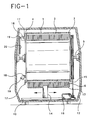
- a multitude of sample tubes 1 is vertically oriented side by side in a number of long vessels 2 that are hanging vertically on horizontal rods 3 mounted to the circumference of a cylindrical spool 4 that is rotating around a horizontal shaft 5. During rotation of spool 4, the vessels 2 remain vertically oriented. In this way, any sample agitation can be avoided, if required for biological reasons.
- An apparatus can accommodate up to 800 Mycobacterial Growth Indicator Tubes (MGIT) which are produced by Becton Dickinson Microbiology Systems.
- the apparatus has a small size of only 35"x33"x37" (WxDxH).
- the machine structure is simple and the number of parts is relatively low, so that the system can be produced at low cost, has a long meantime between failures (MTBF) and a short time to repair.
- the construction allows for simultaneous access to approximately 150 tubes for the purpose of loading and unloading.
- the system provides for barcode reading on each tube 1 after loading them into the apparatus.
- the frequency and the intensity of sample container agitation can be controlled via software according to the biological requirements.
- an apparatus offers a good chance to shorten the time to detection, and is suitable to perform not only detection, but also antimicrobial susceptibility testing (AST).
- AST antimicrobial susceptibility testing
- Variable agitation is provided by the apparatus locking vessels 2 to spool 4 for a certain percentage of a spool rotation period. This feature allows sample tubes 1 to be tilted by an arbitrary angle, before they fall back into their originally vertical orientation. Depending on the percentage selected, the sample agitation will be absent, soft, or more vigorous. In other words, an apparatus according to the present invention provides means to optimize the frequency and the degree of sample agitation according to the biological requirements.
- Controlling the degree of agitation is achieved by using electro-magnets 18, half-moon-shaped metallic disks 17, brushes 19 and a segmented electrode array 20, all shown in Figs. 1, 6, and 7.
- Each of the horizontal rods 3 carries on one end a half-moon-shaped metallic disk 17.
- One electro-magnet 18 is mounted onto each end of spool 4 around the spool's radius between shaft 5 and each horizontal rod 3, as illustrated in Fig. 6.
- Segmented electrode array 20 is mounted on an internal wall of a thermo-isolated housing 12 such that brushes 19 make contact with segments of the electrode array 20 during spool rotation, as discussed below.
- a system controller computer powers a selected number of electrode segments of array 20 with a voltage. If, during spool rotation, a particular vessel 2 approaches a first electrode segment area and the segment is powered by the system controller, then the corresponding electro-magnet 18 will receive electrical power via brush 19 from that segment, and will lock the corresponding half-moon-shaped disk 17 to spool 4. This means that the corresponding vessel 2 will be tilted during further spool rotation. The degree of tilting depends on how many electrode segments are powered by the system controller. This is illustrated in Fig. 7, which shows different tilting orientations of a sample tube 1. If the vessel reaches a position where the corresponding electrode segment is not receiving electrical power, electro-magnet 18 becomes deactivated, and vessel 2 falls back into its original vertical orientation.
- spool 4 is driven by a motor 16 via belt 15.
- motor 16 is a stepper motor so that spool 4 can either rotate continuously or can be stopped in any required position.
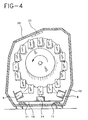
- Spool 4 is arranged and rotatably mounted in thermo-isolated housing 12 as shown in Figs. 1, 4, 5, 6, 7, and 10.
- Housing 12 is equipped with a door 20, as shown in Fig. 4, to allow for sample loading and un-loading.
- Door 20 can carry an indicator array 21 depicting the position number of positive sample tubes and other information.
- the interior of housing 12 is temperature-stabilized at approximately 35°C to allow for optimum growth conditions.
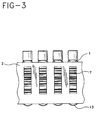
- Vessels 2 accommodate two rows of sample tubes 1 as illustrated in Figs. 2 and 3.
- windows 6 that allow access to barcode labels 7 attached to each sample tube 1.
- two barcode readers 8 and 9 are arranged on a carriage 10 that can be moved parallel to spool shaft 5 on rails 11 mounted to the apparatus housing 12 below spool 4.
- the spool rotation is interrupted and carriage 10 is moved across the length of spool 4. In this way, two rows of sample tubes 1 are barcode-scanned.
- spool 4 is rotated by an appropriate angle so that the next two vessels can be scanned.
- Carriage 10 is moved again across the whole spool length of spool 4. This procedure is repeated until all sample tubes 1 are scanned.
- a sensor reading head 14 is mounted to the same carriage 10 that holds the two barcode readers 8 and 9 (see Figs. 1 and 4).
- the sensor reading head 14 is constructed so that it can access two adjacent sample tubes 1, i.e., one in each row, simultaneously.
- spool 4 is rotated into the appropriate angular position and carriage 10 is moved across the length of spool 4. This procedure is repeated until the sample tubes in all vessels within the apparatus are read.
- Vessels 2 can be as long as spool 4 and can be mounted permanently to the horizontal rods 3. However, it is also possible to segment vessels 2 into appropriate lengths so that the number of sample tubes 1 within one vessel 2 matches with particular requirements for antimicrobial susceptibility testing (AST). In this case, it may be more convenient if the vessels can be removed from rods 3, and re-inserted after loading a new group of test samples.
- AST antimicrobial susceptibility testing
- This feature of the invention is illustrated in Figs. 8 and 9.
- the short vessel 21 has windows 22 to allow for the reading of barcodes 7 that are attached to sample tubes 1. At both ends of each vessel 21 there are hooks 23 allowing vessels 21 to hang from horizontal rod 3, which has a rectangular cross-section in this case. Also at both ends of each vessel 21 there are legs 24 that provide a stable positioning of vessels 21 on a bench during loading and unloading of sample tubes 1.
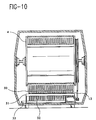
- FIG. 10 A modification of an apparatus according to the invention is illustrated in Fig. 10.
- This apparatus version does not contain rails and does not contain a carriage with a sensor reading head and/or barcode reader. Instead, a series of light-emitting diodes (LED's) 30 is mounted onto a platform 31 with the number of LED's being equal to the number of sample tubes 1 per row. Adjacent to each of the LED's 30, one end of an optical fiber 32 is mounted to the platform. The other ends of all fibers 32 are arranged closely together, forming an end of a fiber-optic bundle 33, which is arranged in front of a large-size photodetector such as a conventional photomultiplier (not shown in Fig. 10).
- a large-size photodetector such as a conventional photomultiplier
- a first LED 30 is turned on, and the light re-emitted by the chemical sensor 13 in the corresponding sample tube is collected by the adjacent optical fiber 32. This light is then fed to the photodetector and the electrical signal is measured. Next, the first LED is turned off and a second LED is switched on, with the corresponding sensor light being monitored using the same photodetector. Due to the fact that the system "knows" which LED has been activated, it also knows which sample tube is emitting sensor light. After all sample tubes within a row have been interrogated, spool 4 is rotated until another row of sample tubes can be interrogated.
- the present invention is not limited to the field of tuberculosis detection.
- the invention can also be applied, for instance, to detecting the presence of bacteria in blood culture bottles.
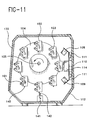
- An embodiment of this kind is depicted schematically in Fig. 11.
- a cylindrical spool 104 rotating around a horizontal shaft 105 is mounted inside a thermo-isolated housing 112.
- a multitude of blood culture bottles 101 are oriented side by side in a number of long vessels 102 that are hanging vertically on horizontal rods 103 mounted to the circumference of spool 104.
- blood culture bottles 101 are oriented in a horizontal orientation. After opening a door 120 in the front wall of housing 112, blood culture bottles can be loaded or unloaded.
- vessels 102 remain vertically oriented. In this way, any sample agitation can be avoided, if required for biological reasons.
- a member 142 that can be positioned close to vessels 102 by a positioning device 141. If positioning device 141 is activated then member 142 will touch a protrusion 140 on vessels 102. In this way, each vessel 102 and therefore each blood culture bottle 101 will be agitated when it passes by member 142. The degree of agitation can be controlled via positioning device 141.
- the presence of bacteria in blood culture bottles is detected by means of conventional chemical fluorescent or colorimetric sensors that are disposed to the inner bottom of each blood culture bottle 101.
- these sensors and the barcode labels attached to each blood culture bottle are read out in the same way as described in connection with the embodiment of Fig. 1.
- the vessels 102 accommodate two rows of blood culture bottles 101. In the long vessel walls, there are windows that allow access to barcode labels on each bottle 101. Within the vessel bottoms, there are also two rows of openings to allow for interrogating the bacterial sensors that are attached to the inner bottom of each bottle 101. As shown in Fig.
- two barcode readers 108 and 109 are arranged on a carriage 110 that can be moved parallel to spool shaft 105 on rails 111 mounted to the apparatus housing 112 behind spool 104.
- spool rotation is interrupted and carriage 110 is moved across the whole length of spool 104. In this way, two rows of blood culture bottles 101 are barcode scanned.
- spool 104 is rotated by an appropriate angle so that the next two vessels can be scanned by moving carriage 110 across the whole spool length. This procedure is repeated until all blood culture bottles 101 are scanned.
- a sensor reading head 114 is mounted to the same carriage 110 that holds the two barcode readers 108 and 109 (see Fig. 11). Sensor reading head 114 is constructed so that it can access two adjacent blood culture bottles 101, i.e., one in each row, simultaneously. As mentioned above, in order to interrogate vessels 102 spool 104 is rotated into the appropriate angular position and carriage 110 is moved across the whole spool length. This procedure is repeated until the blood culture bottles 101 in all vessels within the apparatus are read.
- the vessels are designed so that the sample tubes or the blood culture bottles are hanging in an intermediate orientation, i.e., in between the two limiting cases of vertical orientation or horizontal orientation.
- a typical case would be represented by a 45-degree orientation.
- This option offers both, optimum access to the sample containers during loading and unloading, and prevention of potential spills in case of a leakage in the rubber septum.
- the chemical sensor is in direct contact with the liquid most of the time. This may not be the case for a strictly horizontal bottle orientation.
- FIG. 12 An embodiment of this kind is depicted schematically in Fig. 12.
- a cylindrical spool 204 rotating around a horizontal shaft 205 is mounted inside a thermo-isolated housing 212.
- a multitude of blood culture bottles 201 is oriented side by side in a number of long vessels 202 that are handing in a 45-degree orientation on horizontal rods 203 mounted to the circumference of a spool 204.
- blood culture bottles 201 are oriented in a 45-degree orientation.
- blood culture bottles 201 After opening a door 220 in the front wall of housing 212, blood culture bottles 201 can be loaded or unloaded.
- vessels 202 remain in their 45-degree orientation. In this way, any sample agitation can be avoided, if required for biological reasons.
- a member 242 Inside of housing 212 there is arranged a member 242 that can be positioned close to vessels 202 by a positioning device 241. If positioning device 241 is activated then member 242 will touch vessels 202. In this way, each vessel 202 and, therefore, each blood culture bottle 201 will be agitated when it passes by member 242. The degree of agitation can be controlled via positioning device 241.
- the blood culture apparatus shown in Fig. 12 has a similar fluorescence reading system as the apparatus depicted in Fig. 10, which comprises an array of LED's 230 and optical fibers 232 that are mounted to a platform 231.
- the advantage of this apparatus version would be the fact that no mechanically moving carriage and no flexible electric cables are required to interrogate the many blood culture bottles. Therefore, extreme high reliability and low production cost can be accomplished for the whole instrument.
Landscapes
- Health & Medical Sciences (AREA)
- Wood Science & Technology (AREA)
- Life Sciences & Earth Sciences (AREA)
- Engineering & Computer Science (AREA)
- Bioinformatics & Cheminformatics (AREA)
- Organic Chemistry (AREA)
- Chemical & Material Sciences (AREA)
- Zoology (AREA)
- Biomedical Technology (AREA)
- Sustainable Development (AREA)
- Microbiology (AREA)
- Biochemistry (AREA)
- General Engineering & Computer Science (AREA)
- General Health & Medical Sciences (AREA)
- Genetics & Genomics (AREA)
- Biotechnology (AREA)
- Clinical Laboratory Science (AREA)
- Apparatus Associated With Microorganisms And Enzymes (AREA)
- Measuring Or Testing Involving Enzymes Or Micro-Organisms (AREA)
Applications Claiming Priority (2)
| Application Number | Priority Date | Filing Date | Title |
|---|---|---|---|
| US08/648,798 US5705384A (en) | 1996-05-16 | 1996-05-16 | Compact high-volume microorganism detection apparatus |
| US648798 | 1996-05-16 |
Publications (1)
| Publication Number | Publication Date |
|---|---|
| EP0807681A2 true EP0807681A2 (de) | 1997-11-19 |
Family
ID=24602290
Family Applications (1)
| Application Number | Title | Priority Date | Filing Date |
|---|---|---|---|
| EP97303130A Withdrawn EP0807681A2 (de) | 1996-05-16 | 1997-05-08 | Kompakte Vorrichtung zur Detektion von Mikroorganismen in grösseren Mengen |
Country Status (6)
| Country | Link |
|---|---|
| US (1) | US5705384A (de) |
| EP (1) | EP0807681A2 (de) |
| JP (1) | JP3127133B2 (de) |
| AU (1) | AU714969B2 (de) |
| CA (1) | CA2204706C (de) |
| MX (1) | MX9703531A (de) |
Cited By (1)
| Publication number | Priority date | Publication date | Assignee | Title |
|---|---|---|---|---|
| EP2595737A4 (de) * | 2010-07-22 | 2017-04-05 | Biomerieux, Inc | Riemenschüttelsystem für kulturbehälter |
Families Citing this family (14)
| Publication number | Priority date | Publication date | Assignee | Title |
|---|---|---|---|---|
| AU2001223397A1 (en) * | 2000-02-01 | 2001-08-14 | Disetronic Licensing Ag | Configurable device and method for releasing a substance |
| DE10051575B4 (de) * | 2000-02-01 | 2008-09-18 | Tecpharma Licensing Ag | System mit Behälter und Vorrichtung zur Verabreichung einer Substanz |
| AU2001223396A1 (en) * | 2000-02-01 | 2001-08-14 | Disetronic Licensing Ag | Container and device for administering a substance |
| GB2387130A (en) * | 2002-04-04 | 2003-10-08 | Fluid Technologies Plc | Hollow fibre filter membrane unit with microorganism detector, and associated usage |
| CN102803959B (zh) * | 2009-05-15 | 2015-07-08 | 生物梅里埃有限公司 | 用于样品中的微生物剂的快速的识别和/或表征的系统和方法 |
| WO2010132749A2 (en) * | 2009-05-15 | 2010-11-18 | Biomerieux, Inc. | Automated transfer mechanism for microbial. detection apparatus |
| US9739788B2 (en) * | 2010-07-20 | 2017-08-22 | Biomerieux, Inc. | Detector arrangement for blood culture bottles with colorimetric sensors |
| EP2795306B1 (de) | 2011-12-22 | 2022-06-15 | Becton, Dickinson and Company | Verfahren und vorrichtung zur schnellen erkennung infektiöser mikroorganismen |
| WO2014039082A1 (en) | 2012-09-04 | 2014-03-13 | Becton, Dickinson And Company | Bacterial pre-concentration and detection technique |
| US9468895B2 (en) * | 2013-04-02 | 2016-10-18 | Forward Biotech, Inc. | Advanced laboratory platform rocker |
| FR3006692B1 (fr) * | 2013-06-11 | 2016-05-06 | Biomerieux Sa | Dispositif, systeme et procede de detection permettant de detecter la presence d'un micro-organisme dans un echantillon a l'interieur d'un contenant |
| US11170189B1 (en) | 2020-09-29 | 2021-11-09 | Express Scripts Strategic Development, Inc. | Imaging system for identifying medication containers |
| US20230381782A1 (en) * | 2020-11-02 | 2023-11-30 | Mgi Tech Co., Ltd. | Sequencing systems and methods utilizing non-planar substrates |
| CN113416633A (zh) * | 2021-07-24 | 2021-09-21 | 陈米佳 | 一种基于光纤激光灯的微生物检测仪 |
Family Cites Families (5)
| Publication number | Priority date | Publication date | Assignee | Title |
|---|---|---|---|---|
| US4576916A (en) * | 1982-04-26 | 1986-03-18 | Akzo N.V. | Electro-optical apparatus for microbial identification and enumeration |
| CA2100020C (en) * | 1992-07-17 | 2001-09-11 | Walter Blumenfeld | Methods and apparatus for detecting bacterial growth by spectrophotometric sampling of a fiber-optic array |
| US5371016A (en) * | 1993-04-26 | 1994-12-06 | Becton, Dickinson And Company | Detecting biological activities in culture vials |
| US5397709A (en) * | 1993-08-27 | 1995-03-14 | Becton Dickinson And Company | System for detecting bacterial growth in a plurality of culture vials |
| US5498543A (en) * | 1994-06-07 | 1996-03-12 | Becton Dickinson And Company | Sub-compact blood culture apparatus |
-
1996
- 1996-05-16 US US08/648,798 patent/US5705384A/en not_active Expired - Fee Related
-
1997
- 1997-05-07 CA CA002204706A patent/CA2204706C/en not_active Expired - Fee Related
- 1997-05-07 AU AU20103/97A patent/AU714969B2/en not_active Ceased
- 1997-05-08 EP EP97303130A patent/EP0807681A2/de not_active Withdrawn
- 1997-05-14 JP JP09123872A patent/JP3127133B2/ja not_active Expired - Fee Related
- 1997-05-14 MX MX9703531A patent/MX9703531A/es not_active Application Discontinuation
Cited By (1)
| Publication number | Priority date | Publication date | Assignee | Title |
|---|---|---|---|---|
| EP2595737A4 (de) * | 2010-07-22 | 2017-04-05 | Biomerieux, Inc | Riemenschüttelsystem für kulturbehälter |
Also Published As
| Publication number | Publication date |
|---|---|
| CA2204706C (en) | 1999-06-08 |
| AU2010397A (en) | 1997-11-20 |
| AU714969B2 (en) | 2000-01-13 |
| US5705384A (en) | 1998-01-06 |
| JPH1042856A (ja) | 1998-02-17 |
| CA2204706A1 (en) | 1997-11-16 |
| JP3127133B2 (ja) | 2001-01-22 |
| MX9703531A (es) | 1998-11-29 |
Similar Documents
| Publication | Publication Date | Title |
|---|---|---|
| EP0773988B1 (de) | Kompaktes gerät zur kultivierung von blut | |
| US5498543A (en) | Sub-compact blood culture apparatus | |
| US5705384A (en) | Compact high-volume microorganism detection apparatus | |
| CA2113879C (en) | Compact blood culture apparatus | |
| EP0834553B1 (de) | Blutkultur-Apparat mit Selbstentlade- und Sortiervorrichtung | |
| US6709857B2 (en) | System and method for optically monitoring the concentration of a gas in a sample vial using photothermal spectroscopy to detect sample growth | |
| US7041493B2 (en) | Bioreactor and bioprocessing technique | |
| US5817507A (en) | Blood culture apparatus having a bell-shaped drum | |
| US5869329A (en) | Blood culture vial or bottle having an agitation paddle | |
| CA2138254A1 (en) | Improved optical detection system for apparatus to culture and detect bacteria in human tissue | |
| MXPA97007237A (en) | Appliance with cylinder in the form of a hood for sangui cultivation | |
| MXPA97007236A (en) | Apparatus for blood cultivation with a device for self-dumping and classification | |
| AU3927797A (en) | Blood culture apparatus having a bell-shaped drum |
Legal Events
| Date | Code | Title | Description |
|---|---|---|---|
| PUAI | Public reference made under article 153(3) epc to a published international application that has entered the european phase |
Free format text: ORIGINAL CODE: 0009012 |
|
| AK | Designated contracting states |
Kind code of ref document: A2 Designated state(s): DE ES FR GB IT SE |
|
| STAA | Information on the status of an ep patent application or granted ep patent |
Free format text: STATUS: THE APPLICATION IS DEEMED TO BE WITHDRAWN |
|
| 18D | Application deemed to be withdrawn |
Effective date: 20011204 |