EP0808812A1 - Brique poreuse pour maçonnerie - Google Patents
Brique poreuse pour maçonnerie Download PDFInfo
- Publication number
- EP0808812A1 EP0808812A1 EP97102716A EP97102716A EP0808812A1 EP 0808812 A1 EP0808812 A1 EP 0808812A1 EP 97102716 A EP97102716 A EP 97102716A EP 97102716 A EP97102716 A EP 97102716A EP 0808812 A1 EP0808812 A1 EP 0808812A1
- Authority
- EP
- European Patent Office
- Prior art keywords
- brick
- foam
- added
- blank
- masonry
- Prior art date
- Legal status (The legal status is an assumption and is not a legal conclusion. Google has not performed a legal analysis and makes no representation as to the accuracy of the status listed.)
- Granted
Links
- 239000011449 brick Substances 0.000 title claims abstract description 98
- 239000006260 foam Substances 0.000 claims abstract description 55
- 239000004927 clay Substances 0.000 claims abstract description 32
- 239000003381 stabilizer Substances 0.000 claims abstract description 22
- 238000004519 manufacturing process Methods 0.000 claims abstract description 21
- 235000019353 potassium silicate Nutrition 0.000 claims abstract description 12
- NTHWMYGWWRZVTN-UHFFFAOYSA-N sodium silicate Chemical compound [Na+].[Na+].[O-][Si]([O-])=O NTHWMYGWWRZVTN-UHFFFAOYSA-N 0.000 claims abstract description 12
- 238000000034 method Methods 0.000 claims abstract description 10
- 239000000126 substance Substances 0.000 claims abstract description 9
- 239000000835 fiber Substances 0.000 claims abstract description 7
- 239000006063 cullet Substances 0.000 claims abstract description 5
- RMAQACBXLXPBSY-UHFFFAOYSA-N silicic acid Chemical compound O[Si](O)(O)O RMAQACBXLXPBSY-UHFFFAOYSA-N 0.000 claims abstract description 5
- 229920003043 Cellulose fiber Polymers 0.000 claims abstract description 4
- VYPSYNLAJGMNEJ-UHFFFAOYSA-N Silicium dioxide Chemical compound O=[Si]=O VYPSYNLAJGMNEJ-UHFFFAOYSA-N 0.000 claims description 16
- 239000004088 foaming agent Substances 0.000 claims description 11
- XLYOFNOQVPJJNP-UHFFFAOYSA-N water Substances O XLYOFNOQVPJJNP-UHFFFAOYSA-N 0.000 claims description 10
- 239000000203 mixture Substances 0.000 claims description 9
- 239000004575 stone Substances 0.000 claims description 9
- 239000000377 silicon dioxide Substances 0.000 claims description 8
- 239000004094 surface-active agent Substances 0.000 claims description 8
- 238000001035 drying Methods 0.000 claims description 7
- 238000010304 firing Methods 0.000 claims description 7
- 239000007787 solid Substances 0.000 claims description 7
- 238000002156 mixing Methods 0.000 claims description 6
- 238000012545 processing Methods 0.000 claims description 6
- 102000004169 proteins and genes Human genes 0.000 claims description 6
- 108090000623 proteins and genes Proteins 0.000 claims description 6
- 239000003795 chemical substances by application Substances 0.000 claims description 4
- 239000003365 glass fiber Substances 0.000 claims description 3
- 239000002557 mineral fiber Substances 0.000 claims description 3
- 230000006641 stabilisation Effects 0.000 claims description 3
- 238000011105 stabilization Methods 0.000 claims description 3
- 239000008240 homogeneous mixture Substances 0.000 claims description 2
- 239000011469 building brick Substances 0.000 claims 7
- 229920001131 Pulp (paper) Polymers 0.000 claims 2
- 238000005187 foaming Methods 0.000 claims 1
- 239000000463 material Substances 0.000 abstract description 4
- 235000012239 silicon dioxide Nutrition 0.000 abstract 3
- 239000011521 glass Substances 0.000 abstract 1
- 229910052500 inorganic mineral Inorganic materials 0.000 abstract 1
- 239000011707 mineral Substances 0.000 abstract 1
- 239000010802 sludge Substances 0.000 abstract 1
- 229920002994 synthetic fiber Polymers 0.000 abstract 1
- 239000011148 porous material Substances 0.000 description 25
- 238000009413 insulation Methods 0.000 description 13
- 239000011470 perforated brick Substances 0.000 description 12
- 239000002734 clay mineral Substances 0.000 description 9
- 230000015572 biosynthetic process Effects 0.000 description 7
- 238000010276 construction Methods 0.000 description 6
- 239000004570 mortar (masonry) Substances 0.000 description 6
- 239000004566 building material Substances 0.000 description 5
- 239000004567 concrete Substances 0.000 description 5
- 239000000919 ceramic Substances 0.000 description 4
- 238000002474 experimental method Methods 0.000 description 4
- 210000001503 joint Anatomy 0.000 description 4
- 238000012360 testing method Methods 0.000 description 4
- 230000033228 biological regulation Effects 0.000 description 3
- 239000000839 emulsion Substances 0.000 description 3
- 230000008646 thermal stress Effects 0.000 description 3
- 239000000470 constituent Substances 0.000 description 2
- 238000013461 design Methods 0.000 description 2
- 238000010586 diagram Methods 0.000 description 2
- 230000000694 effects Effects 0.000 description 2
- 238000000227 grinding Methods 0.000 description 2
- 239000007788 liquid Substances 0.000 description 2
- 229910052751 metal Inorganic materials 0.000 description 2
- 239000002184 metal Substances 0.000 description 2
- 238000000465 moulding Methods 0.000 description 2
- 230000003068 static effect Effects 0.000 description 2
- 238000012546 transfer Methods 0.000 description 2
- 239000011800 void material Substances 0.000 description 2
- 239000004604 Blowing Agent Substances 0.000 description 1
- 239000004793 Polystyrene Substances 0.000 description 1
- 230000002745 absorbent Effects 0.000 description 1
- 239000002250 absorbent Substances 0.000 description 1
- 230000006978 adaptation Effects 0.000 description 1
- 239000000654 additive Substances 0.000 description 1
- XAGFODPZIPBFFR-UHFFFAOYSA-N aluminium Chemical compound [Al] XAGFODPZIPBFFR-UHFFFAOYSA-N 0.000 description 1
- 238000013459 approach Methods 0.000 description 1
- 239000011230 binding agent Substances 0.000 description 1
- 239000001913 cellulose Substances 0.000 description 1
- 229920002678 cellulose Polymers 0.000 description 1
- 238000005253 cladding Methods 0.000 description 1
- 239000003245 coal Substances 0.000 description 1
- 239000004035 construction material Substances 0.000 description 1
- 238000005520 cutting process Methods 0.000 description 1
- 238000011161 development Methods 0.000 description 1
- 230000018109 developmental process Effects 0.000 description 1
- 238000009826 distribution Methods 0.000 description 1
- -1 e.g. Sawdust Substances 0.000 description 1
- 238000001704 evaporation Methods 0.000 description 1
- 230000008020 evaporation Effects 0.000 description 1
- 238000001125 extrusion Methods 0.000 description 1
- 239000011468 face brick Substances 0.000 description 1
- 230000002349 favourable effect Effects 0.000 description 1
- 239000002657 fibrous material Substances 0.000 description 1
- 238000011049 filling Methods 0.000 description 1
- 239000011381 foam concrete Substances 0.000 description 1
- 238000007496 glass forming Methods 0.000 description 1
- 239000003292 glue Substances 0.000 description 1
- 239000011796 hollow space material Substances 0.000 description 1
- 238000005304 joining Methods 0.000 description 1
- 238000003754 machining Methods 0.000 description 1
- 239000002245 particle Substances 0.000 description 1
- 235000019362 perlite Nutrition 0.000 description 1
- 230000000704 physical effect Effects 0.000 description 1
- 239000004033 plastic Substances 0.000 description 1
- 229920002223 polystyrene Polymers 0.000 description 1
- 230000008092 positive effect Effects 0.000 description 1
- 238000002360 preparation method Methods 0.000 description 1
- 230000005855 radiation Effects 0.000 description 1
- 238000000926 separation method Methods 0.000 description 1
- 239000002002 slurry Substances 0.000 description 1
- 230000000087 stabilizing effect Effects 0.000 description 1
- 238000003756 stirring Methods 0.000 description 1
- 239000010902 straw Substances 0.000 description 1
- 230000035882 stress Effects 0.000 description 1
Images

Classifications
-
- C—CHEMISTRY; METALLURGY
- C04—CEMENTS; CONCRETE; ARTIFICIAL STONE; CERAMICS; REFRACTORIES
- C04B—LIME, MAGNESIA; SLAG; CEMENTS; COMPOSITIONS THEREOF, e.g. MORTARS, CONCRETE OR LIKE BUILDING MATERIALS; ARTIFICIAL STONE; CERAMICS; REFRACTORIES; TREATMENT OF NATURAL STONE
- C04B38/00—Porous mortars, concrete, artificial stone or ceramic ware; Preparation thereof
- C04B38/10—Porous mortars, concrete, artificial stone or ceramic ware; Preparation thereof by using foaming agents or by using mechanical means, e.g. adding preformed foam
-
- E—FIXED CONSTRUCTIONS
- E04—BUILDING
- E04B—GENERAL BUILDING CONSTRUCTIONS; WALLS, e.g. PARTITIONS; ROOFS; FLOORS; CEILINGS; INSULATION OR OTHER PROTECTION OF BUILDINGS
- E04B2/00—Walls, e.g. partitions, for buildings; Wall construction with regard to insulation; Connections specially adapted to walls
- E04B2/02—Walls, e.g. partitions, for buildings; Wall construction with regard to insulation; Connections specially adapted to walls built-up from layers of building elements
-
- E—FIXED CONSTRUCTIONS
- E04—BUILDING
- E04B—GENERAL BUILDING CONSTRUCTIONS; WALLS, e.g. PARTITIONS; ROOFS; FLOORS; CEILINGS; INSULATION OR OTHER PROTECTION OF BUILDINGS
- E04B2/00—Walls, e.g. partitions, for buildings; Wall construction with regard to insulation; Connections specially adapted to walls
- E04B2/02—Walls, e.g. partitions, for buildings; Wall construction with regard to insulation; Connections specially adapted to walls built-up from layers of building elements
- E04B2002/0202—Details of connections
- E04B2002/0204—Non-undercut connections, e.g. tongue and groove connections
- E04B2002/0208—Non-undercut connections, e.g. tongue and groove connections of trapezoidal shape
Definitions
- the invention relates to a porous brick for statically resilient masonry according to the preambles of claims 1 and 2, and a method for its production according to the preambles of claims 10 and 11.
- a brick fired from clay has the known advantageous properties which distinguish it as a suitable construction material. Due to its low equilibrium moisture content, it guarantees short drying times and thus also construction times and at the same time ensures a comfortable room climate. Furthermore, due to its favorable weight / volume ratio compared to other building materials, it is an easy to process building material. Other significant advantages compared to other solid building materials are the slight changes in shape due to the influence of moisture, creep and temperature.
- an open-pored solid brick can be created which can have a porosity of over 75% but does not contain large contiguous cavities.
- a relatively pressure-stable brick element is nevertheless created with a low body density and correspondingly good thermal insulation properties.
- the minimum stone pressure strengths of 2.5 to 5 N / mm 2 which are generally required for structural reasons are therefore achieved with the brick according to the invention.
- the invention thus presents a new generation of masonry brick which, in addition to good strength properties, enables a significant improvement in thermal conductivity in comparison to conventional perforated brick.
- Another advantage of the masonry brick according to the invention is that no convection occurs due to the homogeneous distribution of the pores and thus through the formation of a large number of small cavities which are generally not connected to one another.
- the heat transfer in the masonry brick according to the invention is essentially limited to the heat conduction, whereby very good thermal insulation properties are achieved due to the many pores and the associated low solids content.
- the incorporated foam is a surfactant foam. With that lies a well mixable, homogeneous foam that can be evenly distributed when incorporated into the clay emulsion and enables the formation of pores.
- the surfactant foam has proven to be advantageous here since it retains its foam structure even when suitable stabilizers are used when it is mixed with the clay emulsion. Experiments in this regard have shown that the foam structure of many other foams is destroyed when mixed with the clay, as a result of which the formation of pores would not be possible.
- a protein foam according to claim 2 is equally suitable to achieve these advantageous effects.
- a stabilizer is added to the incorporated foam. This ensures that it does not collapse before drying.
- the stabilizer therefore improves the resistance of the foam and thus ensures that the pores can form.
- stabilizers have surprisingly proven to be advantageous for the compressive strength of the finished product. As tests have shown, the choice of a suitable stabilizer has a considerable influence on the strength of the brick, since it has a positive effect on the formation of the ceramic bond on the clay minerals.
- the manufacturing steps can thus be kept simple and easy to control, which advantageously leads to a constant quality of the brick even in mass production.
- Aerated concrete there are already porous building materials, e.g. Aerated concrete, known, but these are not suitable for the use according to the invention.
- the known aerated concrete blocks can equally have extremely low bulk densities and be machined on all sides, but consist entirely of a different material.
- AAC is a hydraulically bound binder that is subjected to a cold manufacturing process and creates a closed-cell pore structure. This results in an unfavorable drying behavior that takes place very slowly.
- the expansion behavior in aerated concrete is brought about by the addition of an aluminum powder, which acts as a blowing agent and causes multiple inflation.
- an aluminum powder which acts as a blowing agent and causes multiple inflation.
- very large blocks of up to 5 m 3 are formed , which then have to be separated in complex process steps.
- the aerated concrete is therefore based on a completely different problem than the porous brick according to the invention and the product has different properties.
- the thermal insulation properties of the masonry brick improve further. Therefore, possible stricter thermal insulation regulations can be met in the future. In addition, the weight of the brick is reduced, which makes it easier to work with.
- a stabilizer e.g. Stabilizers based on water glass or aqueous silica sol can be considered.
- water glass as a stabilizer have shown that the contact points of the clay minerals are well wetted. Furthermore, the water glass ensures that the contact points take on small dimensions. So while the foam increases the distance between the clay minerals, the water glass reacts with the brick clay components and stiffens the connection points between the pores. As a result, the strength and in particular the compressive strength of the brick can be increased significantly.
- the pore brick according to the invention can therefore be used in an excellent manner as a brick for load-bearing masonry.
- a fine-grained brick clay or a fine-grained brick clay mixture as the basic substance for the masonry brick, which preferably has a grain size of less than 1.5 mm and preferably less than 1.0 mm.
- a grain band is then present in the brick clay, which essentially consists of clay minerals with dimensions of less than 50 nm. This includes the physical properties of thermal conductivity, Porosity and compressive strength of the porous brick are advantageously influenced.
- the fineness of the clay minerals enables a very good formation of the pores.
- the grain size of the clay minerals is not so fine that significant disadvantages with regard to drying behavior have to be accepted.
- the fact that the brick has porosity means that the formation of the pores is additionally supported.
- Known additives such as e.g. Sawdust, polystyrene and possibly also fibrous materials such as sawdust or straw.
- the porosity agent is mixed with the clay clay mixed with water and forms a viscous but pourable liquid with it, the emulsion or the slip. This is then mixed with the pre-made foam. This can further improve the structure of the pore brick.
- fibrous substances such as cellulose fibers, paper fibers, glass or mineral fibers or fibers from animal hair are added to the blank mass for stabilization during the production process, an increase in the internal cohesion of the mass is achieved. This prevents cracks due to internal stresses in the blanks during drying.
- the brick according to the invention has a thermal conductivity of less than 0.18 W / mK, preferably 0.14 W / mK or less and in particular 0.09 W / mK or less, since a building material is thus present which the thermal insulation properties are significantly improved compared to conventional perforated brick.
- This brick is therefore suitable for universal use in the construction industry.
- a block of masonry bricks which consists of at least two masonry bricks exists, which are factory-assembled into a unit. This takes into account the fact that only elements with a thickness dimension of less than approximately 15 cm can be produced due to the thermal stresses occurring during the firing inside the brick. This means that bricks with a standard height of 124 mm can be produced. By joining two such pore bricks at the factory, the high-format bricks (face bricks) most commonly used in the construction industry with a height of 249 mm can be created. This considerably simplifies the processing of the brick according to the invention on the construction site.
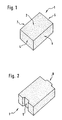
- FIG. 1 shows a brick 1 according to the invention. This can be produced with stone lengths between 247 and 498 mm, preferably 300 mm, stone widths between 100 and 490 mm, preferably 365 mm, and stone heights between 71 and 150 mm, preferably 124 mm.
- the brick 1 has homogeneously distributed pores that form an open-pore system.
- the porosity is approx. 75% and a thermal conductivity of 0.08 W / mK is achieved.
- the body density is less than 500 kg / m 3 .
- the brick 1 is machined on all surfaces and possibly ground.
- an upper bed joint surface 2 and a lower bed joint surface 3 are ground plane-parallel.
- butt joint surfaces 4 and 5 as well as outer surfaces 6 and 7 are reworked by grinding. In special cases, however, it is also possible to dispense with machining the outer surfaces 6 and 7 by grinding.
- the brick 1 Since all outer edges of the brick 1 have been reworked, it has a very exact shape, which allows the use of thin-bed mortar (joint thicknesses 1 to 3 mm, preferably 1 mm). Through these thin joints, the strength-reducing influence of normal joints (joint thicknesses 10 to 12 mm) is avoided, so that the wall pressure resistance can be significantly improved compared to wall materials with the same stone pressure resistance with normal joints.
- the brick 1 is layered into masonry during processing using thin-bed mortar or the like.
- FIG. 2 shows a modified embodiment of the porous brick 1 according to the invention, which, as is customary in practice, is provided with a spring 8 and a pocket 9 at the longitudinal ends of the brick 1 in order to produce a better connection or toothing to the adjacent brick.
- the design and the number of springs and pockets can be any, where the types of gearing currently used in practice are preferred.
- FIG. 3 shows a flow diagram of an exemplary production method for the porous brick 1.
- the manufacturing process usually begins with the preparation of the brick clays, which are in pieces as delivered. These are dried at approx. 50 ° C and then e.g. crushed by means of a pan mill. The now fine-grained clay is then mixed with a defined amount of water until the slip is in a homogeneous form.
- a surfactant foam is made in a conventional foam gun.
- the mixture of foaming agent and water is pressed by compressed air through a cylinder that contains internals with a large surface area. Turbulent turbulence that creates the foam takes place on these elements.
- a water glass-based stabilizer is also added to this foam.
- the foam is fed directly to the clay slurries in a countercurrent positive mixer during the mixing process.
- the foaming agents mentioned are in liquid form and are water-soluble.
- the ADDIMENT® foaming agent 2 has a density of 1.04 kg / dm 3 and is used with a ratio of 130-200 g / 100 liters of foam.
- the foam weight is 6-9 kg / 100 liters of foam.
- the ADDIMENT® foaming agent 3 has a density of 1.08 kg / dm 3 and is used in a ratio of 150-230 g / 100 liters of foam. The foam weight is then 7-9 kg / 100 liters of foam.
- the clay slip is mixed with the foam until a plastic and pourable, homogeneous mixture is obtained.
- the mixture is shaped by pouring it into a mold and making it uniform. This avoids voids and inhomogeneities.
- the mold boxes are made of perforated sheet metal so that the moldings can be dried on all sides. To prevent the clay paste from sticking to the sheet metal molds, they are lined with absorbent recycled paper before filling.
- the molding is then dried, the clay paste being stiffened rapidly before the foam disintegrates due to the evaporation of the water in it.
- a climate-controlled dryer is therefore used for this.
- the molded blank is compressed and solidified.
- the pore bricks are fired in a gas-fired chamber furnace in an oxidized atmosphere.
- porous bricks coming out of the furnace are then sawn to the desired formats.
- the water glass ensures that the foam does not collapse before the clay paste is stiffened. Furthermore, the water glass wets the contact points of the clay minerals between the pores and causes them to assume small dimensions. Therefore, many points of contact are formed and a stable framework is created, whereby a relatively high compressive strength is achieved. The water glass also influences the properties of the finished product.
- the most suitable mixing ratio between foam and slip depends on the brick clay used, the foaming agent and the desired properties of the finished product. In particular, the composition of the sound varies considerably depending on the geographical origin. An adaptation to the respective circumstances is therefore necessary.
- the volume ratio of the foam to the clay is therefore generally less than 3: 1 and a value below the ratio 2: 1 is preferred in order to ensure sufficient compressive strength.
- the porosified masonry brick 1 according to the invention can currently only be produced in panels with a maximum thickness of 15 cm, since during firing thermal stresses are created inside the brick, which would cause the brick to burst with a greater thickness.
- a thin-bed mortar is provided for this. This bonding can be carried out at the factory, so that the brick 1 can be delivered to the construction site as a block in the currently usual height format of approx. 249 mm.
- the brick 1 is bricked up using thin-bed mortar, and since all six surfaces are finished with a very dimensionally stable stone, despite the reduced pressure resistance of the individual brick compared to the conventional brick, it is possible to obtain a wall pressure resistance of the same order of magnitude as that of conventional bricks. Therefore there is no loss of stability of the entire wall.
- clays or clay mixtures can be used.
- an aqueous silica-based sol or any other silica-based substance can be used instead of the water glass-based stabilizer used.
- other substances are also conceivable which are suitable for stabilizing the foam until the brick has dried sufficiently. This keeps the pores in shape. It is also advantageous if the stabilizer is also able to wet the connection points between the pores, that is to say the contact points, and thus to stiffen them.
- the stabilizer is compatible with the surfactant foam or that another foaming agent is used.
- the foam can also be formed in the blank mass, a foaming agent and water being mixed with the blank mass and then the aqueous mixture thus produced by a stirring device and the like. is foamed.
- the porous brick 1 can also be designed as a flat plate element, and thus e.g. serve as a thermal insulation board. With this as wall cladding, e.g. an improvement in the thermal insulation in the building stock.
- the invention thus creates a porous brick 1 for structurally resilient masonry, which is designed as a homogeneous solid brick and has an open-cell structure. This enables a very low cullet density to be achieved, which leads to a low thermal conductivity. At the same time, however, the type of foam added and the stabilizer used can cause a stable framework to form at the pore boundaries, which enables relatively high compressive strengths.
- the porous brick 1 can therefore be subjected to static loads and is suitable for use in load-bearing and external walls. Since the brick 1 has no large cavities, it also shows improved sound insulation properties in relation to the weight curve according to DIN 4109.
Landscapes
- Engineering & Computer Science (AREA)
- Chemical & Material Sciences (AREA)
- Structural Engineering (AREA)
- Architecture (AREA)
- Ceramic Engineering (AREA)
- Electromagnetism (AREA)
- Civil Engineering (AREA)
- Physics & Mathematics (AREA)
- Materials Engineering (AREA)
- Organic Chemistry (AREA)
- Building Environments (AREA)
- Glass Compositions (AREA)
- Manufacture Of Porous Articles, And Recovery And Treatment Of Waste Products (AREA)
- Percussion Or Vibration Massage (AREA)
- Porous Artificial Stone Or Porous Ceramic Products (AREA)
Applications Claiming Priority (2)
| Application Number | Priority Date | Filing Date | Title |
|---|---|---|---|
| DE19606111 | 1996-02-19 | ||
| DE19606111 | 1996-02-19 |
Publications (2)
| Publication Number | Publication Date |
|---|---|
| EP0808812A1 true EP0808812A1 (fr) | 1997-11-26 |
| EP0808812B1 EP0808812B1 (fr) | 2001-05-23 |
Family
ID=7785801
Family Applications (1)
| Application Number | Title | Priority Date | Filing Date |
|---|---|---|---|
| EP97102716A Expired - Lifetime EP0808812B1 (fr) | 1996-02-19 | 1997-02-19 | Brique poreuse pour maçonnerie |
Country Status (3)
| Country | Link |
|---|---|
| EP (1) | EP0808812B1 (fr) |
| AT (1) | ATE201391T1 (fr) |
| DE (2) | DE59703581D1 (fr) |
Cited By (3)
| Publication number | Priority date | Publication date | Assignee | Title |
|---|---|---|---|---|
| DE10111487A1 (de) * | 2001-03-09 | 2002-09-19 | Arbeitsgemeinschaft Mauerziege | Verfahren und Vorrichtung zur Herstellung eines schaumporosierten Mauerziegels, sowie schaumporosierter Mauerziegel |
| CN103362245A (zh) * | 2012-04-01 | 2013-10-23 | 贵州中建建筑科研设计院有限公司 | 一种复合废渣保温砌块及其制作方法 |
| EP2952643A1 (fr) * | 2014-06-04 | 2015-12-09 | FÜHRER Exklusivfenster - Türen Sonnenschutz GmbH | Pierre de formage et pierre d'isolation totale |
Families Citing this family (11)
| Publication number | Priority date | Publication date | Assignee | Title |
|---|---|---|---|---|
| DE29722863U1 (de) * | 1997-08-12 | 1998-12-10 | Ziegelwerk Klosterbeuren Ludwig Leinsing GmbH & Co., 87727 Babenhausen | Gefüllter Ziegelstein |
| DE10300043B4 (de) * | 2002-02-15 | 2011-12-22 | Fraunhofer-Gesellschaft zur Förderung der angewandten Forschung e.V. | Verfahren zur Herstellung geformter und gebrannter Bauelemente aus Schaumton |
| DE20307429U1 (de) | 2003-05-12 | 2003-08-07 | Ullermann, Klaus, Dipl.-Ing. (FH), 91126 Schwabach | Mauerstein |
| DE10347356A1 (de) * | 2003-10-11 | 2005-05-19 | Wienerberger Ziegelindustrie Gmbh | Verfahren u. Mischung zur Herstellung von Produkten der keramischen Industrie, insbesondere zur Herstellung von Mauerziegeln |
| DE202008014415U1 (de) * | 2008-10-30 | 2009-01-22 | Schlagmann Baustoffwerke Gmbh & Co. Kg | Wärmedämmziegel |
| EP2958875A1 (fr) | 2013-02-22 | 2015-12-30 | Seal-Tec GmbH | Matières ou corps façonnés poreux en polymères inorganiques et leur préparation |
| DE102013101840A1 (de) * | 2013-02-25 | 2014-08-28 | Knauf Aquapanel Gmbh | Körper mit einem Dämmmaterial, Bindmittelmischung zur Erstellung des Dämmmaterials, Verwendung einer Bindemittelmischung zur Erstellung des Dämmmaterials sowie Verfahren zur Herstellung des Körpers |
| DE102013106560B4 (de) * | 2013-06-24 | 2018-07-26 | Andreas Hilke | Verfahren zur Herstellung eines mit Gasblasen durchsetzten Glaskörpers |
| DE102014207015B4 (de) * | 2014-04-11 | 2017-09-14 | Schlagmann Poroton Gmbh & Co. Kg | Verfahren zur Herstellung von Ziegelmodulen und Verwendung einer Formulierung zum Herstellen eines Ziegelmoduls |
| EP4041525A4 (fr) * | 2019-10-07 | 2023-11-01 | MuCell Extrusion LLC | Film de mousse multicouche léger présentant une blancheur de surface perçue améliorée |
| CN111943576A (zh) * | 2020-08-18 | 2020-11-17 | 悉地(苏州)勘察设计顾问有限公司 | 一种海绵城市生态透水路面砖及其制备方法 |
Citations (8)
| Publication number | Priority date | Publication date | Assignee | Title |
|---|---|---|---|---|
| DE396691C (de) * | 1923-03-06 | 1924-06-12 | Heinrich Koppers Dr Ing | Verfahren zur Herstellung von Leichtsteinen |
| US1944007A (en) * | 1933-04-01 | 1934-01-16 | Battelle Memorial Institute | Light weight ceramic material and method of making the same |
| US1948878A (en) * | 1932-03-22 | 1934-02-27 | United States Gypsum Co | Ceramic acoustical material |
| GB419484A (en) * | 1933-11-20 | 1934-11-13 | Babcock & Wilcox Co | Improvements in a porous heat insulating body |
| FR1381834A (fr) * | 1964-02-04 | 1964-12-14 | Morgan Refractories Ltd | Perfectionnements aux produits réfractaires de cuisson, tels que briques et autres articles résistant aux températures élevées |
| GB1042591A (en) * | 1962-05-04 | 1966-09-14 | Morgan Refractories Ltd | Improvements in and relating to refractory products and the production thereof |
| EP0341150A1 (fr) * | 1988-05-04 | 1989-11-08 | Aris S.A. | Matériau composite réfractaire et son procédé de fabrication |
| JPH06263560A (ja) * | 1993-03-15 | 1994-09-20 | Aroma Kagaku Kikai Kogyo:Kk | 多孔質セラミック製品の製造方法 |
-
1997
- 1997-02-19 AT AT97102716T patent/ATE201391T1/de not_active IP Right Cessation
- 1997-02-19 DE DE59703581T patent/DE59703581D1/de not_active Expired - Fee Related
- 1997-02-19 EP EP97102716A patent/EP0808812B1/fr not_active Expired - Lifetime
- 1997-02-19 DE DE19706492A patent/DE19706492A1/de not_active Withdrawn
Patent Citations (8)
| Publication number | Priority date | Publication date | Assignee | Title |
|---|---|---|---|---|
| DE396691C (de) * | 1923-03-06 | 1924-06-12 | Heinrich Koppers Dr Ing | Verfahren zur Herstellung von Leichtsteinen |
| US1948878A (en) * | 1932-03-22 | 1934-02-27 | United States Gypsum Co | Ceramic acoustical material |
| US1944007A (en) * | 1933-04-01 | 1934-01-16 | Battelle Memorial Institute | Light weight ceramic material and method of making the same |
| GB419484A (en) * | 1933-11-20 | 1934-11-13 | Babcock & Wilcox Co | Improvements in a porous heat insulating body |
| GB1042591A (en) * | 1962-05-04 | 1966-09-14 | Morgan Refractories Ltd | Improvements in and relating to refractory products and the production thereof |
| FR1381834A (fr) * | 1964-02-04 | 1964-12-14 | Morgan Refractories Ltd | Perfectionnements aux produits réfractaires de cuisson, tels que briques et autres articles résistant aux températures élevées |
| EP0341150A1 (fr) * | 1988-05-04 | 1989-11-08 | Aris S.A. | Matériau composite réfractaire et son procédé de fabrication |
| JPH06263560A (ja) * | 1993-03-15 | 1994-09-20 | Aroma Kagaku Kikai Kogyo:Kk | 多孔質セラミック製品の製造方法 |
Non-Patent Citations (1)
| Title |
|---|
| DATABASE WPI Week 9442, Derwent World Patents Index; AN 94-338135, XP002031759 * |
Cited By (3)
| Publication number | Priority date | Publication date | Assignee | Title |
|---|---|---|---|---|
| DE10111487A1 (de) * | 2001-03-09 | 2002-09-19 | Arbeitsgemeinschaft Mauerziege | Verfahren und Vorrichtung zur Herstellung eines schaumporosierten Mauerziegels, sowie schaumporosierter Mauerziegel |
| CN103362245A (zh) * | 2012-04-01 | 2013-10-23 | 贵州中建建筑科研设计院有限公司 | 一种复合废渣保温砌块及其制作方法 |
| EP2952643A1 (fr) * | 2014-06-04 | 2015-12-09 | FÜHRER Exklusivfenster - Türen Sonnenschutz GmbH | Pierre de formage et pierre d'isolation totale |
Also Published As
| Publication number | Publication date |
|---|---|
| ATE201391T1 (de) | 2001-06-15 |
| DE19706492A1 (de) | 1997-08-21 |
| DE59703581D1 (de) | 2001-06-28 |
| EP0808812B1 (fr) | 2001-05-23 |
Similar Documents
| Publication | Publication Date | Title |
|---|---|---|
| EP0179775B1 (fr) | Materiau en ceramique leger pour construction, procede pour sa fabrication ainsi que son utilisation | |
| DE69627897T2 (de) | Wärmedammende bauteile | |
| EP0971862B1 (fr) | Corps moule en materiau leger, procede permettant de le produire et son utilisation | |
| EP0808812B1 (fr) | Brique poreuse pour maçonnerie | |
| EP0990628B1 (fr) | Mortier léger pour maçonnerie | |
| EP2163534B1 (fr) | Matériau en béton poreux et son procédé de fabrication | |
| WO2018103794A1 (fr) | Procédé pour réaliser un élément de construction à partir de béton mousse et analogue | |
| EP0985646B1 (fr) | Mortier de collage mince | |
| EP0049733A1 (fr) | Mélange coulant à base d'eau, de matière de remplissage et de liants ainsi que son application pour moulage et fonte de ces éléments de construction isolants et un élément de construction en forme de plaque, de bloc ou de panneau | |
| DE3722242C1 (de) | Verfahren zur Herstellung von keramischen Erzeugnissen | |
| DE19708779A1 (de) | Bindemittelgebundener Ziegelleichtschaum | |
| EP4081452B1 (fr) | Flotteur respectueux de l'environnement ayant des propriétés de flottabilité améliorées et une stabilité au chavirement accrue | |
| DE102019113570A1 (de) | Verfahren zur Herstellung eines Schaumbetons und eines Bauelements | |
| EP0568752A1 (fr) | Plâtre léger | |
| DE102008001176B4 (de) | Formkörper und Verfahren zur Herstellung eines Formkörpers | |
| DE3810683A1 (de) | Leichtbetonbaukoerper mit einem leichtzuschlag aus schaumzement und verfahren zu seiner herstellung | |
| AT9511U1 (de) | Leichtbetone bzw. mineralstoffe sowie verfahren zu ihrer herstellung | |
| DE19548952C2 (de) | Leichtmauermörtel | |
| DE2604793B2 (de) | Schaumkeramikelement sowie Verfahren zu seiner Herstellung | |
| CH692992A5 (de) | Wärmedämmendes, tragendes Bauelement. | |
| DE3228278A1 (de) | Dachziegel sowie verfahren zu seiner herstellung | |
| DE2641631B2 (de) | Verfahren zur Herstellung eines porösen keramischen Leichtgewichterzeugnisses | |
| DE29722863U1 (de) | Gefüllter Ziegelstein | |
| DE2638707A1 (de) | Leichtes, teilchenfoermiges aggregat und verfahren zu seiner herstellung | |
| DE102004017199B4 (de) | Calciumsilikathydratgebundener Baustein nach Art eines Kalksandsteins und Verfahren zu seiner Herstellung |
Legal Events
| Date | Code | Title | Description |
|---|---|---|---|
| PUAI | Public reference made under article 153(3) epc to a published international application that has entered the european phase |
Free format text: ORIGINAL CODE: 0009012 |
|
| AK | Designated contracting states |
Kind code of ref document: A1 Designated state(s): AT BE CH DE DK ES FR GB GR IE IT LI LU NL PT SE |
|
| 17P | Request for examination filed |
Effective date: 19980513 |
|
| 17Q | First examination report despatched |
Effective date: 19990701 |
|
| GRAG | Despatch of communication of intention to grant |
Free format text: ORIGINAL CODE: EPIDOS AGRA |
|
| GRAG | Despatch of communication of intention to grant |
Free format text: ORIGINAL CODE: EPIDOS AGRA |
|
| GRAH | Despatch of communication of intention to grant a patent |
Free format text: ORIGINAL CODE: EPIDOS IGRA |
|
| GRAH | Despatch of communication of intention to grant a patent |
Free format text: ORIGINAL CODE: EPIDOS IGRA |
|
| GRAA | (expected) grant |
Free format text: ORIGINAL CODE: 0009210 |
|
| AK | Designated contracting states |
Kind code of ref document: B1 Designated state(s): AT BE CH DE DK ES FR GB GR IE IT LI LU NL PT SE |
|
| PG25 | Lapsed in a contracting state [announced via postgrant information from national office to epo] |
Ref country code: NL Free format text: LAPSE BECAUSE OF FAILURE TO SUBMIT A TRANSLATION OF THE DESCRIPTION OR TO PAY THE FEE WITHIN THE PRESCRIBED TIME-LIMIT Effective date: 20010523 Ref country code: IT Free format text: LAPSE BECAUSE OF FAILURE TO SUBMIT A TRANSLATION OF THE DESCRIPTION OR TO PAY THE FEE WITHIN THE PRESCRIBED TIME-LIMIT;WARNING: LAPSES OF ITALIAN PATENTS WITH EFFECTIVE DATE BEFORE 2007 MAY HAVE OCCURRED AT ANY TIME BEFORE 2007. THE CORRECT EFFECTIVE DATE MAY BE DIFFERENT FROM THE ONE RECORDED. Effective date: 20010523 Ref country code: IE Free format text: LAPSE BECAUSE OF FAILURE TO SUBMIT A TRANSLATION OF THE DESCRIPTION OR TO PAY THE FEE WITHIN THE PRESCRIBED TIME-LIMIT Effective date: 20010523 Ref country code: GB Free format text: LAPSE BECAUSE OF FAILURE TO SUBMIT A TRANSLATION OF THE DESCRIPTION OR TO PAY THE FEE WITHIN THE PRESCRIBED TIME-LIMIT Effective date: 20010523 Ref country code: FR Free format text: LAPSE BECAUSE OF FAILURE TO SUBMIT A TRANSLATION OF THE DESCRIPTION OR TO PAY THE FEE WITHIN THE PRESCRIBED TIME-LIMIT Effective date: 20010523 |
|
| REF | Corresponds to: |
Ref document number: 201391 Country of ref document: AT Date of ref document: 20010615 Kind code of ref document: T |
|
| REG | Reference to a national code |
Ref country code: CH Ref legal event code: EP |
|
| REF | Corresponds to: |
Ref document number: 59703581 Country of ref document: DE Date of ref document: 20010628 |
|
| REG | Reference to a national code |
Ref country code: IE Ref legal event code: FG4D Free format text: GERMAN |
|
| PG25 | Lapsed in a contracting state [announced via postgrant information from national office to epo] |
Ref country code: SE Free format text: LAPSE BECAUSE OF FAILURE TO SUBMIT A TRANSLATION OF THE DESCRIPTION OR TO PAY THE FEE WITHIN THE PRESCRIBED TIME-LIMIT Effective date: 20010823 Ref country code: PT Free format text: LAPSE BECAUSE OF FAILURE TO SUBMIT A TRANSLATION OF THE DESCRIPTION OR TO PAY THE FEE WITHIN THE PRESCRIBED TIME-LIMIT Effective date: 20010823 Ref country code: DK Free format text: LAPSE BECAUSE OF FAILURE TO SUBMIT A TRANSLATION OF THE DESCRIPTION OR TO PAY THE FEE WITHIN THE PRESCRIBED TIME-LIMIT Effective date: 20010823 |
|
| PG25 | Lapsed in a contracting state [announced via postgrant information from national office to epo] |
Ref country code: GR Free format text: LAPSE BECAUSE OF FAILURE TO SUBMIT A TRANSLATION OF THE DESCRIPTION OR TO PAY THE FEE WITHIN THE PRESCRIBED TIME-LIMIT Effective date: 20010824 |
|
| NLV1 | Nl: lapsed or annulled due to failure to fulfill the requirements of art. 29p and 29m of the patents act | ||
| GBV | Gb: ep patent (uk) treated as always having been void in accordance with gb section 77(7)/1977 [no translation filed] |
Effective date: 20010523 |
|
| PG25 | Lapsed in a contracting state [announced via postgrant information from national office to epo] |
Ref country code: ES Free format text: LAPSE BECAUSE OF FAILURE TO SUBMIT A TRANSLATION OF THE DESCRIPTION OR TO PAY THE FEE WITHIN THE PRESCRIBED TIME-LIMIT Effective date: 20011130 |
|
| EN | Fr: translation not filed | ||
| PG25 | Lapsed in a contracting state [announced via postgrant information from national office to epo] |
Ref country code: LU Free format text: LAPSE BECAUSE OF NON-PAYMENT OF DUE FEES Effective date: 20020219 Ref country code: AT Free format text: LAPSE BECAUSE OF NON-PAYMENT OF DUE FEES Effective date: 20020219 |
|
| REG | Reference to a national code |
Ref country code: IE Ref legal event code: FD4D |
|
| PG25 | Lapsed in a contracting state [announced via postgrant information from national office to epo] |
Ref country code: LI Free format text: LAPSE BECAUSE OF NON-PAYMENT OF DUE FEES Effective date: 20020228 Ref country code: CH Free format text: LAPSE BECAUSE OF NON-PAYMENT OF DUE FEES Effective date: 20020228 Ref country code: BE Free format text: LAPSE BECAUSE OF NON-PAYMENT OF DUE FEES Effective date: 20020228 |
|
| PLBE | No opposition filed within time limit |
Free format text: ORIGINAL CODE: 0009261 |
|
| STAA | Information on the status of an ep patent application or granted ep patent |
Free format text: STATUS: NO OPPOSITION FILED WITHIN TIME LIMIT |
|
| 26N | No opposition filed | ||
| BERE | Be: lapsed |
Owner name: ARBEITSGEMEINSCHAFT MAUERZIEGEL E.V. Effective date: 20020228 |
|
| PG25 | Lapsed in a contracting state [announced via postgrant information from national office to epo] |
Ref country code: DE Free format text: LAPSE BECAUSE OF NON-PAYMENT OF DUE FEES Effective date: 20020903 |
|
| REG | Reference to a national code |
Ref country code: CH Ref legal event code: PL |