EP0808941A1 - Procédé de fabrication d'un appareil de tamisage à ouvertures en forme de fentes et appareil de tamisage produit par ce procédé - Google Patents
Procédé de fabrication d'un appareil de tamisage à ouvertures en forme de fentes et appareil de tamisage produit par ce procédé Download PDFInfo
- Publication number
- EP0808941A1 EP0808941A1 EP97104439A EP97104439A EP0808941A1 EP 0808941 A1 EP0808941 A1 EP 0808941A1 EP 97104439 A EP97104439 A EP 97104439A EP 97104439 A EP97104439 A EP 97104439A EP 0808941 A1 EP0808941 A1 EP 0808941A1
- Authority
- EP
- European Patent Office
- Prior art keywords
- rods
- reinforcing elements
- sorting
- recesses
- depressions
- Prior art date
- Legal status (The legal status is an assumption and is not a legal conclusion. Google has not performed a legal analysis and makes no representation as to the accuracy of the status listed.)
- Granted
Links
- 238000000034 method Methods 0.000 title claims description 36
- 238000012216 screening Methods 0.000 title claims description 19
- 238000004519 manufacturing process Methods 0.000 claims abstract description 19
- 239000000835 fiber Substances 0.000 claims abstract description 10
- 230000002787 reinforcement Effects 0.000 claims abstract description 7
- 239000000725 suspension Substances 0.000 claims abstract description 6
- 229910000679 solder Inorganic materials 0.000 claims abstract description 5
- 239000000853 adhesive Substances 0.000 claims abstract description 4
- 230000001070 adhesive effect Effects 0.000 claims abstract description 4
- 230000003014 reinforcing effect Effects 0.000 claims description 31
- 239000011230 binding agent Substances 0.000 claims description 11
- 238000005476 soldering Methods 0.000 claims description 11
- 238000003780 insertion Methods 0.000 claims description 6
- 230000037431 insertion Effects 0.000 claims description 6
- 238000003466 welding Methods 0.000 abstract description 5
- 230000008719 thickening Effects 0.000 abstract description 2
- 239000007767 bonding agent Substances 0.000 abstract 3
- 230000000694 effects Effects 0.000 description 4
- 238000004026 adhesive bonding Methods 0.000 description 3
- 238000007873 sieving Methods 0.000 description 3
- 238000005452 bending Methods 0.000 description 2
- 230000005489 elastic deformation Effects 0.000 description 2
- 238000005516 engineering process Methods 0.000 description 2
- 239000002245 particle Substances 0.000 description 2
- 230000000717 retained effect Effects 0.000 description 2
- 238000000926 separation method Methods 0.000 description 2
- 229910000851 Alloy steel Inorganic materials 0.000 description 1
- 206010010774 Constipation Diseases 0.000 description 1
- 229910000831 Steel Inorganic materials 0.000 description 1
- 239000007900 aqueous suspension Substances 0.000 description 1
- 230000015572 biosynthetic process Effects 0.000 description 1
- 238000005219 brazing Methods 0.000 description 1
- 239000000470 constituent Substances 0.000 description 1
- 238000009792 diffusion process Methods 0.000 description 1
- 230000003628 erosive effect Effects 0.000 description 1
- 239000004744 fabric Substances 0.000 description 1
- 230000002452 interceptive effect Effects 0.000 description 1
- 238000005304 joining Methods 0.000 description 1
- 239000007788 liquid Substances 0.000 description 1
- 239000000463 material Substances 0.000 description 1
- 239000000155 melt Substances 0.000 description 1
- 238000002360 preparation method Methods 0.000 description 1
- 238000005096 rolling process Methods 0.000 description 1
- 239000011265 semifinished product Substances 0.000 description 1
- 239000007787 solid Substances 0.000 description 1
- 239000010959 steel Substances 0.000 description 1
- 239000000126 substance Substances 0.000 description 1
- 238000005406 washing Methods 0.000 description 1
Images
Classifications
-
- B—PERFORMING OPERATIONS; TRANSPORTING
- B07—SEPARATING SOLIDS FROM SOLIDS; SORTING
- B07B—SEPARATING SOLIDS FROM SOLIDS BY SIEVING, SCREENING, SIFTING OR BY USING GAS CURRENTS; SEPARATING BY OTHER DRY METHODS APPLICABLE TO BULK MATERIAL, e.g. LOOSE ARTICLES FIT TO BE HANDLED LIKE BULK MATERIAL
- B07B1/00—Sieving, screening, sifting, or sorting solid materials using networks, gratings, grids, or the like
- B07B1/46—Constructional details of screens in general; Cleaning or heating of screens
- B07B1/4609—Constructional details of screens in general; Cleaning or heating of screens constructional details of screening surfaces or meshes
- B07B1/4618—Manufacturing of screening surfaces
-
- B—PERFORMING OPERATIONS; TRANSPORTING
- B07—SEPARATING SOLIDS FROM SOLIDS; SORTING
- B07B—SEPARATING SOLIDS FROM SOLIDS BY SIEVING, SCREENING, SIFTING OR BY USING GAS CURRENTS; SEPARATING BY OTHER DRY METHODS APPLICABLE TO BULK MATERIAL, e.g. LOOSE ARTICLES FIT TO BE HANDLED LIKE BULK MATERIAL
- B07B1/00—Sieving, screening, sifting, or sorting solid materials using networks, gratings, grids, or the like
- B07B1/12—Apparatus having only parallel elements
-
- B—PERFORMING OPERATIONS; TRANSPORTING
- B07—SEPARATING SOLIDS FROM SOLIDS; SORTING
- B07B—SEPARATING SOLIDS FROM SOLIDS BY SIEVING, SCREENING, SIFTING OR BY USING GAS CURRENTS; SEPARATING BY OTHER DRY METHODS APPLICABLE TO BULK MATERIAL, e.g. LOOSE ARTICLES FIT TO BE HANDLED LIKE BULK MATERIAL
- B07B1/00—Sieving, screening, sifting, or sorting solid materials using networks, gratings, grids, or the like
- B07B1/18—Drum screens
-
- B—PERFORMING OPERATIONS; TRANSPORTING
- B07—SEPARATING SOLIDS FROM SOLIDS; SORTING
- B07B—SEPARATING SOLIDS FROM SOLIDS BY SIEVING, SCREENING, SIFTING OR BY USING GAS CURRENTS; SEPARATING BY OTHER DRY METHODS APPLICABLE TO BULK MATERIAL, e.g. LOOSE ARTICLES FIT TO BE HANDLED LIKE BULK MATERIAL
- B07B1/00—Sieving, screening, sifting, or sorting solid materials using networks, gratings, grids, or the like
- B07B1/46—Constructional details of screens in general; Cleaning or heating of screens
- B07B1/4609—Constructional details of screens in general; Cleaning or heating of screens constructional details of screening surfaces or meshes
- B07B1/4681—Meshes of intersecting, non-woven, elements
-
- D—TEXTILES; PAPER
- D21—PAPER-MAKING; PRODUCTION OF CELLULOSE
- D21D—TREATMENT OF THE MATERIALS BEFORE PASSING TO THE PAPER-MAKING MACHINE
- D21D5/00—Purification of the pulp suspension by mechanical means; Apparatus therefor
- D21D5/02—Straining or screening the pulp
- D21D5/16—Cylinders and plates for screens
-
- Y—GENERAL TAGGING OF NEW TECHNOLOGICAL DEVELOPMENTS; GENERAL TAGGING OF CROSS-SECTIONAL TECHNOLOGIES SPANNING OVER SEVERAL SECTIONS OF THE IPC; TECHNICAL SUBJECTS COVERED BY FORMER USPC CROSS-REFERENCE ART COLLECTIONS [XRACs] AND DIGESTS
- Y10—TECHNICAL SUBJECTS COVERED BY FORMER USPC
- Y10S—TECHNICAL SUBJECTS COVERED BY FORMER USPC CROSS-REFERENCE ART COLLECTIONS [XRACs] AND DIGESTS
- Y10S29/00—Metal working
- Y10S29/902—Filter making
-
- Y—GENERAL TAGGING OF NEW TECHNOLOGICAL DEVELOPMENTS; GENERAL TAGGING OF CROSS-SECTIONAL TECHNOLOGIES SPANNING OVER SEVERAL SECTIONS OF THE IPC; TECHNICAL SUBJECTS COVERED BY FORMER USPC CROSS-REFERENCE ART COLLECTIONS [XRACs] AND DIGESTS
- Y10—TECHNICAL SUBJECTS COVERED BY FORMER USPC
- Y10T—TECHNICAL SUBJECTS COVERED BY FORMER US CLASSIFICATION
- Y10T29/00—Metal working
- Y10T29/49—Method of mechanical manufacture
- Y10T29/496—Multiperforated metal article making
- Y10T29/49604—Filter
-
- Y—GENERAL TAGGING OF NEW TECHNOLOGICAL DEVELOPMENTS; GENERAL TAGGING OF CROSS-SECTIONAL TECHNOLOGIES SPANNING OVER SEVERAL SECTIONS OF THE IPC; TECHNICAL SUBJECTS COVERED BY FORMER USPC CROSS-REFERENCE ART COLLECTIONS [XRACs] AND DIGESTS
- Y10—TECHNICAL SUBJECTS COVERED BY FORMER USPC
- Y10T—TECHNICAL SUBJECTS COVERED BY FORMER US CLASSIFICATION
- Y10T29/00—Metal working
- Y10T29/49—Method of mechanical manufacture
- Y10T29/49826—Assembling or joining
- Y10T29/49908—Joining by deforming
- Y10T29/49925—Inward deformation of aperture or hollow body wall
Definitions
- the invention relates to a method according to the preamble of claim 1.
- a well-known example of the use of screening devices which can be produced by the method of this type is the sorting of fiber suspensions.
- the fibers contained in the suspension should pass through the sieve while the undesired solid constituents at the gap are rejected and led out of the sieve device.
- An application for the separation of different fiber components is also conceivable.
- the fact that the openings have an essentially elongated shape, that is to say slits or slits allows fibrous particles to pass through more easily than cubic particles, even if both types should be of a similar size.
- a very good separation effect of seam-fibrous interfering substances from fiber suspensions is possible.
- a prerequisite is a high precision of the slot shape on the entire screen surface.
- DE 39 27 748 A1 shows a method for producing such screen baskets, in which the profiled bars are clamped in by plastic deformation of the retaining rings provided with depressions for the bars.
- profile bars are used for such manufacturing processes.
- Sieves or sieve baskets with good strength and high surface quality can be produced by a process which is described in DE 42 14 061 A1. Here a high-temperature soldering process is used to attach the rod-like profiles. The results are excellent, but the process is complex and expensive.
- the invention has for its object to provide an economically advantageous method with which sieve devices can be produced that have optimal strength and surface properties.
- the advantages of the invention have an effect particularly in the case of rod screen devices whose sorting slots have a width in a size range of less than 2 mm. Slit widths of 0.1 - 0.2 mm are quite common for fiber sorting or washing. Such screens have to be provided with a very large number of rods in order to obtain a sufficient screen area in the narrow slots. Therefore, with her Manufacturing the preparation for assembly is very complex. In series production it is possible to use special devices, but these are also complex and expensive. In the method according to the invention, however, the profile bars are z. B. brought into position by simple insertion, fixed and remain in it until the binder has provided the final firm hold.
- a holding force of the rods in the recesses is therefore provided which is large enough to be able to carry out the handling operations following the insertion without inadvertently changing the position.
- This handling includes, for example, the transport and turning of these semi-finished products.
- the binder creates an inseparable connection on the contact surfaces, such as when soldering, gluing or welding. In pure contact welding, the binder comes as a melt from the components themselves.
- Such a screening apparatus with advantage in the manufacture applicable soldering process the brazing at a temperature up to about 900 o C. It is but may also be a process at high temperatures of about 1000 to 1200 select o C, which is carried out in a high vacuum.
- the materials of rods and reinforcing elements are connected by diffusion of the solder into the areas to be connected, which results in very high strength with a flawless surface.
- the latter soldering process initially requires high investments.
- Gluing can also be regarded as an inexpensive connection, since it can be carried out at relatively low temperatures. E.g. If a technical two-component adhesive is used, the clamping forces are retained. This can e.g. the possibly lower strength of the adhesive connection can be compensated. If drawn profiles are used for the rods, for example made of steel or a steel alloy, special cross-sectional shapes are also economically and precisely available.
- a special case is the widening of the depressions by elastic deformation of the reinforcing elements before the rods are inserted or inserted. After the relief, i.e. the reshaping, this leads to a secure fit and, at the same time, good properties of the screening device produced in this way.
- the tolerances do not have to be as narrow as with the method that works without deformation.
- the elastic deformation can also be kept low. Relatively low holding forces are sufficient since only the position of the bars is to be secured during handling.
- a particularly important application is the use of straight strip-shaped reinforcing elements with the depressions already described.
- the final shape of the screening device can be produced by subsequent bending, for example round rolling of the reinforcing elements.
- the rods are clamped in the same operation and thus their fixation required for the further manufacturing process.
- a further reduction in the cost of the method is possible if the depressions in the reinforcing elements are designed in such a way that the rods can be inserted vertically, possibly with compressive forces, so that they do not have to be pushed from the side.
- the fixation of the rods in the reinforcing elements until the end of the Manufacturing process can, but need not, then take place by deforming the reinforcing elements.
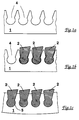
- FIGS. 1 a - 1 c The most important manufacturing steps of the method according to the invention are schematically recorded in FIGS. 1 a - 1 c.
- 1 a shows the part of a reinforcing element 1 with the recesses 4 which have already been introduced.
- a common method for producing such recesses is, for example, laser welding. To achieve higher precision, electrical erosion can also be useful.
- the reinforcing element contains a large number of such depressions in the production of the usual screening devices.
- Fig. 1 b three rods 2 are already inserted into the recesses, it being evident that the shape of the recess on the sides of the rod 2 leaves some air in each case. This makes it easy to insert the rod.
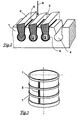
- the section in Fig. 2 shows a perspective view of part of the Reinforcing element 1, in which the rods 2 are inserted and already fastened therein. It can be seen that a slot sieve with the gaps 3 has formed through this arrangement, through which the liquid to be sorted can pass in the direction of flow (arrow S). In operation, parts the size of which exceed the free gap width are retained and removed in a manner known per se. A recess 4 for receiving a rod is shown here without the rod.
- the binder 5 indicated as a fat line can be introduced by soldering, welding or gluing. It forms a firm, non-detachable bond between the contact surfaces and thus decisively increases the strength of the screening device. In cases where the optimal cross-section of the bars was not chosen, e.g. because the sorting task required special shapes, the strength can still be high enough.
- the sieve device produced according to the invention can be designed as a cylindrical sieve basket which is held together by a plurality of annular reinforcing elements 1.
- the illustration shows only a part of the existing rods 2, which are inserted radially inside the rings here. Of course, these could also have been inserted outside.
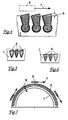
- the bars 2 will be inserted deeper or less deep into the reinforcing element 1. So, as shown in Fig. 4, almost completely recessed rods are also conceivable. This enables a particularly secure connection of rods 2 and reinforcing elements 1.
- the depressions 4 in the reinforcing elements 1 are designed as openings.
- the bars 2 have to be inserted laterally, whereby they have a hold even without deformation of the reinforcing element, e.g. if it is a press fit or a shrink fit. This is e.g. with tight fitting tolerances or with different temperatures of the joining partners when assembling.
- the profiles of the bars used can be freely selected according to the usage criteria (sorting technology) of the screening device. Another shape suitable for lateral insertion is shown in FIG. 6.
- FIG. 7 shows a section through a screening device designed as a half-shell.
- an arrangement is selected as an example in which the rods 2 are inserted on the radially outer part.
- the fixation could be carried out here by elastically bending the semi-ring-shaped reinforcing element 1 and releasing it after inserting the rods 2.
Landscapes
- Engineering & Computer Science (AREA)
- Mechanical Engineering (AREA)
- Manufacturing & Machinery (AREA)
- Paper (AREA)
- Combined Means For Separation Of Solids (AREA)
Applications Claiming Priority (4)
| Application Number | Priority Date | Filing Date | Title |
|---|---|---|---|
| DE29609298U DE29609298U1 (de) | 1996-05-24 | 1996-05-24 | Siebvorrichtung mit spaltförmigen Öffnungen |
| DE29609298U | 1996-05-24 | ||
| DE19709582 | 1997-03-08 | ||
| DE19709582A DE19709582C2 (de) | 1996-05-24 | 1997-03-08 | Verfahren zur Herstellung einer Siebvorrichtung mit spaltförmigen Öffnungen |
Publications (2)
| Publication Number | Publication Date |
|---|---|
| EP0808941A1 true EP0808941A1 (fr) | 1997-11-26 |
| EP0808941B1 EP0808941B1 (fr) | 2001-12-12 |
Family
ID=26034649
Family Applications (1)
| Application Number | Title | Priority Date | Filing Date |
|---|---|---|---|
| EP97104439A Revoked EP0808941B1 (fr) | 1996-05-24 | 1997-03-15 | Procédé de fabrication d'un appareil de tamisage à ouvertures en forme de fentes et appareil de tamisage produit par ce procédé |
Country Status (4)
| Country | Link |
|---|---|
| US (1) | US6047834A (fr) |
| EP (1) | EP0808941B1 (fr) |
| AT (1) | ATE210756T1 (fr) |
| CA (1) | CA2203325C (fr) |
Cited By (5)
| Publication number | Priority date | Publication date | Assignee | Title |
|---|---|---|---|---|
| WO2001061104A1 (fr) * | 2000-02-19 | 2001-08-23 | Hermann Finckh Maschinenfabrik Gmbh & Co. | Tamis pour suspensions de fibres et son procede de production |
| WO2008119548A3 (fr) * | 2007-04-02 | 2009-01-15 | Andritz Fiedler Gmbh | Dispositif de filtration |
| EP1825933A3 (fr) * | 2006-02-22 | 2011-03-09 | Voith Patent GmbH | Procédé de fabrication d'un dispositifl de criblage à rotation symmétrique, en particulier cylindrique |
| EP1825932A3 (fr) * | 2006-02-22 | 2011-03-09 | Voith Paper Patent GmbH | Procédé de fabrication d'un dispositif de criblage à rotation symétrique, en particulier cylindrique |
| EP2663688A4 (fr) * | 2011-01-13 | 2014-06-25 | Georgia Pacific Consumer Prod | Tamis optimisé pour retirer des matières collantes d'une fibre recyclable contaminée par des adhésifs |
Families Citing this family (12)
| Publication number | Priority date | Publication date | Assignee | Title |
|---|---|---|---|---|
| FR2809029B1 (fr) * | 2000-05-16 | 2002-06-21 | Johnson Filtration Systems | Procede de fabrication d'un panier mecanique de filtration |
| IT1315545B1 (it) * | 2000-11-13 | 2003-02-18 | Comer Spa | Metodo per la fabbricazione di cestelli filtranti per macchine difiltrazione di fibre in sospensione acquosa e cestello filtrante |
| FI119440B (fi) * | 2004-07-16 | 2008-11-14 | Advanced Fiber Tech Aft Trust | Menetelmä seulasylinterin valmistamiseksi ja seulasylinteri |
| JP4376151B2 (ja) * | 2004-08-09 | 2009-12-02 | 相川鉄工株式会社 | スクリーン装置 |
| US20090020461A1 (en) * | 2005-05-09 | 2009-01-22 | Filtration Fibrewall Inc. | Screen Basket with Replaceable Profiled Bars |
| JP5465181B2 (ja) * | 2007-11-14 | 2014-04-09 | フィルトレーション・ファイバーウォール・インコーポレーテッド | スクリーンバスケット |
| US20090211965A1 (en) * | 2008-02-21 | 2009-08-27 | Weatherford/Lamb, Inc. | Arrangement for splicing panels together to form a cylindrical screen |
| US8028691B2 (en) * | 2008-10-27 | 2011-10-04 | Johnson Screens, Inc. | Passive solar wire screens for buildings |
| US9023456B2 (en) | 2011-03-18 | 2015-05-05 | Bilfinger Water Technologies, Inc. | Profiled wire screen for process flow and other applications |
| DE102014011679A1 (de) | 2013-08-20 | 2015-02-26 | Andritz Fiedler Gmbh | Profilierter Siebstab und Siebvorrichtung aus profilierten Siebstäben |
| JP6460741B2 (ja) * | 2014-08-06 | 2019-01-30 | 相川鉄工株式会社 | 製紙用ストレーナ及び製紙用異物分離装置 |
| US10513825B2 (en) | 2017-09-18 | 2019-12-24 | Ahmed Ibrahim | Paper manufacturing system |
Citations (7)
| Publication number | Priority date | Publication date | Assignee | Title |
|---|---|---|---|---|
| US1937274A (en) * | 1931-03-12 | 1933-11-28 | Brown Co | Screen plate |
| DE3327422A1 (de) * | 1983-07-29 | 1985-02-07 | J.M. Voith Gmbh, 7920 Heidenheim | Sieb, insbesondere fuer die sortierung von auf der grundlage von altpapier hergestellten fasersuspensionen |
| US4846971A (en) * | 1984-11-12 | 1989-07-11 | E&M Lamort | Sieves for scrubbers and their method of manufacture |
| US5011065A (en) * | 1987-11-14 | 1991-04-30 | J.M. Voith Gmbh | Screen basket and method of manufacture |
| US5094360A (en) * | 1989-08-23 | 1992-03-10 | J. M. Voith Gmbh | Screen basket |
| DE4214061A1 (de) * | 1992-04-29 | 1993-11-04 | Escher Wyss Gmbh | Siebvorrichtung |
| US5394600A (en) * | 1994-02-14 | 1995-03-07 | Chen; Chao-Ho | Method for making a screen |
Family Cites Families (3)
| Publication number | Priority date | Publication date | Assignee | Title |
|---|---|---|---|---|
| DE59004134D1 (de) * | 1989-12-09 | 1994-02-17 | Escher Wyss Gmbh | Verfahren zur Herstellung eines Spaltsiebes. |
| JP3396246B2 (ja) * | 1993-01-18 | 2003-04-14 | 株式会社ナガオカ | 多層コンポジットスクリーン |
| US5387340A (en) * | 1993-07-15 | 1995-02-07 | Ackerman; Carl D. | Wire filter element and method of manufacture |
-
1997
- 1997-03-15 EP EP97104439A patent/EP0808941B1/fr not_active Revoked
- 1997-03-15 AT AT97104439T patent/ATE210756T1/de not_active IP Right Cessation
- 1997-04-22 CA CA002203325A patent/CA2203325C/fr not_active Expired - Fee Related
- 1997-04-23 US US08/839,181 patent/US6047834A/en not_active Expired - Lifetime
Patent Citations (7)
| Publication number | Priority date | Publication date | Assignee | Title |
|---|---|---|---|---|
| US1937274A (en) * | 1931-03-12 | 1933-11-28 | Brown Co | Screen plate |
| DE3327422A1 (de) * | 1983-07-29 | 1985-02-07 | J.M. Voith Gmbh, 7920 Heidenheim | Sieb, insbesondere fuer die sortierung von auf der grundlage von altpapier hergestellten fasersuspensionen |
| US4846971A (en) * | 1984-11-12 | 1989-07-11 | E&M Lamort | Sieves for scrubbers and their method of manufacture |
| US5011065A (en) * | 1987-11-14 | 1991-04-30 | J.M. Voith Gmbh | Screen basket and method of manufacture |
| US5094360A (en) * | 1989-08-23 | 1992-03-10 | J. M. Voith Gmbh | Screen basket |
| DE4214061A1 (de) * | 1992-04-29 | 1993-11-04 | Escher Wyss Gmbh | Siebvorrichtung |
| US5394600A (en) * | 1994-02-14 | 1995-03-07 | Chen; Chao-Ho | Method for making a screen |
Cited By (9)
| Publication number | Priority date | Publication date | Assignee | Title |
|---|---|---|---|---|
| WO2001061104A1 (fr) * | 2000-02-19 | 2001-08-23 | Hermann Finckh Maschinenfabrik Gmbh & Co. | Tamis pour suspensions de fibres et son procede de production |
| US6789681B2 (en) | 2000-02-19 | 2004-09-14 | Voith Paper Patent Gmbh | Screen for fiber suspensions and method for the manufacture thereof |
| EP1825933A3 (fr) * | 2006-02-22 | 2011-03-09 | Voith Patent GmbH | Procédé de fabrication d'un dispositifl de criblage à rotation symmétrique, en particulier cylindrique |
| EP1825932A3 (fr) * | 2006-02-22 | 2011-03-09 | Voith Paper Patent GmbH | Procédé de fabrication d'un dispositif de criblage à rotation symétrique, en particulier cylindrique |
| WO2008119548A3 (fr) * | 2007-04-02 | 2009-01-15 | Andritz Fiedler Gmbh | Dispositif de filtration |
| US8292086B2 (en) | 2007-04-02 | 2012-10-23 | Andritz Fiedler Gmbh | Strainer apparatus |
| CN101657269B (zh) * | 2007-04-02 | 2014-04-23 | 安德里兹·菲德勒有限责任公司 | 过滤装置 |
| EP2129477B1 (fr) | 2007-04-02 | 2015-07-08 | Andritz Fiedler Gmbh | Dispositif de filtration |
| EP2663688A4 (fr) * | 2011-01-13 | 2014-06-25 | Georgia Pacific Consumer Prod | Tamis optimisé pour retirer des matières collantes d'une fibre recyclable contaminée par des adhésifs |
Also Published As
| Publication number | Publication date |
|---|---|
| CA2203325A1 (fr) | 1997-11-24 |
| CA2203325C (fr) | 2003-06-10 |
| ATE210756T1 (de) | 2001-12-15 |
| EP0808941B1 (fr) | 2001-12-12 |
| US6047834A (en) | 2000-04-11 |
Similar Documents
| Publication | Publication Date | Title |
|---|---|---|
| EP0808941B1 (fr) | Procédé de fabrication d'un appareil de tamisage à ouvertures en forme de fentes et appareil de tamisage produit par ce procédé | |
| DE69615414T2 (de) | Siebvorrichtung wie ein siebzylinder, und verfahren zur herstellung der siebvorrichtung | |
| EP0499154B1 (fr) | Epurateur | |
| EP0705649B1 (fr) | Procédé de fabrication d'un tamis plat ou centripète | |
| EP0837178B1 (fr) | Procédé pour la fabrication de tamis et tamis ainsi obtenu | |
| EP0316570A2 (fr) | Tambour de tamisage et son procédé de fabrication | |
| EP1825932B1 (fr) | Procédé de fabrication d'un dispositif de criblage à rotation symétrique, en particulier cylindrique | |
| EP1297218A1 (fr) | Tamis pour suspensions de fibres et son procede de production | |
| DE69823558T2 (de) | Verfahren zur herstellung eines siebzylinders und siebzylinder | |
| DE19651643A1 (de) | Siebvorrichtung mit spaltförmigen Öffnungen | |
| DE4214061C2 (de) | Siebvorrichtung | |
| EP1122359B1 (fr) | Tamis et son procédé de fabrication | |
| EP1825933A2 (fr) | Procédé de fabrication d'un dispositifl de criblage à rotation symmétrique, en particulier cylindrique | |
| DE69501491T2 (de) | Verfahren zur Herstellung eines Siebzylinders and damit hergestellter Siebzylinder | |
| EP4048450B1 (fr) | Cylindre de criblage | |
| DE19709582C2 (de) | Verfahren zur Herstellung einer Siebvorrichtung mit spaltförmigen Öffnungen | |
| DE19547585A1 (de) | Verfahren zur Herstellung eines Siebelementes sowie nach diesem Verfahren hergestelltes Siebelement | |
| DE602004006611T2 (de) | Stabsiebkorb zur Filtrierung von Fasersuspensionen und Verfahren zu dessen Herstellung | |
| DE3015370C2 (de) | Siebkorb für Sortierer der Papierindustrie | |
| DE3790016C2 (fr) | ||
| EP0989897B1 (fr) | Tamis a barres pour suspensions de fibres et son procede de production | |
| DE10247166A1 (de) | Verfahren zur Herstellung einer Siebvorrichtung mit schlitzförmigen Öffnungen | |
| DE19836316C2 (de) | Verfahren zur Herstellung von gewölbten Sieben | |
| EP1875970A1 (fr) | Procédé de fabrication de cribles tout comme crible ainsi fabriqué | |
| DE19635156C2 (de) | Verfahren zur Herstellung von Sieben |
Legal Events
| Date | Code | Title | Description |
|---|---|---|---|
| PUAI | Public reference made under article 153(3) epc to a published international application that has entered the european phase |
Free format text: ORIGINAL CODE: 0009012 |
|
| AK | Designated contracting states |
Kind code of ref document: A1 Designated state(s): AT DE FI FR GB NL SE |
|
| 17P | Request for examination filed |
Effective date: 19980526 |
|
| 17Q | First examination report despatched |
Effective date: 20000531 |
|
| GRAG | Despatch of communication of intention to grant |
Free format text: ORIGINAL CODE: EPIDOS AGRA |
|
| GRAG | Despatch of communication of intention to grant |
Free format text: ORIGINAL CODE: EPIDOS AGRA |
|
| GRAH | Despatch of communication of intention to grant a patent |
Free format text: ORIGINAL CODE: EPIDOS IGRA |
|
| GRAH | Despatch of communication of intention to grant a patent |
Free format text: ORIGINAL CODE: EPIDOS IGRA |
|
| GRAA | (expected) grant |
Free format text: ORIGINAL CODE: 0009210 |
|
| AK | Designated contracting states |
Kind code of ref document: B1 Designated state(s): AT DE FI FR GB NL SE |
|
| REF | Corresponds to: |
Ref document number: 210756 Country of ref document: AT Date of ref document: 20011215 Kind code of ref document: T |
|
| REG | Reference to a national code |
Ref country code: GB Ref legal event code: IF02 |
|
| GBT | Gb: translation of ep patent filed (gb section 77(6)(a)/1977) |
Effective date: 20011212 |
|
| REF | Corresponds to: |
Ref document number: 59705733 Country of ref document: DE Date of ref document: 20020124 |
|
| ET | Fr: translation filed | ||
| PLBQ | Unpublished change to opponent data |
Free format text: ORIGINAL CODE: EPIDOS OPPO |
|
| PLBI | Opposition filed |
Free format text: ORIGINAL CODE: 0009260 |
|
| PLBF | Reply of patent proprietor to notice(s) of opposition |
Free format text: ORIGINAL CODE: EPIDOS OBSO |
|
| 26 | Opposition filed |
Opponent name: ADVANCED FIBER TECHNOLOGIES OY Effective date: 20020830 |
|
| NLR1 | Nl: opposition has been filed with the epo |
Opponent name: ADVANCED FIBER TECHNOLOGIES OY |
|
| PLBF | Reply of patent proprietor to notice(s) of opposition |
Free format text: ORIGINAL CODE: EPIDOS OBSO |
|
| PGFP | Annual fee paid to national office [announced via postgrant information from national office to epo] |
Ref country code: DE Payment date: 20030403 Year of fee payment: 7 |
|
| PGFP | Annual fee paid to national office [announced via postgrant information from national office to epo] |
Ref country code: GB Payment date: 20040227 Year of fee payment: 8 |
|
| RDAF | Communication despatched that patent is revoked |
Free format text: ORIGINAL CODE: EPIDOSNREV1 |
|
| PGFP | Annual fee paid to national office [announced via postgrant information from national office to epo] |
Ref country code: FR Payment date: 20040322 Year of fee payment: 8 |
|
| PGFP | Annual fee paid to national office [announced via postgrant information from national office to epo] |
Ref country code: NL Payment date: 20040323 Year of fee payment: 8 Ref country code: AT Payment date: 20040323 Year of fee payment: 8 |
|
| PGFP | Annual fee paid to national office [announced via postgrant information from national office to epo] |
Ref country code: FI Payment date: 20040324 Year of fee payment: 8 |
|
| PGFP | Annual fee paid to national office [announced via postgrant information from national office to epo] |
Ref country code: SE Payment date: 20040325 Year of fee payment: 8 |
|
| RDAG | Patent revoked |
Free format text: ORIGINAL CODE: 0009271 |
|
| STAA | Information on the status of an ep patent application or granted ep patent |
Free format text: STATUS: PATENT REVOKED |
|
| 27W | Patent revoked |
Effective date: 20040329 |
|
| GBPR | Gb: patent revoked under art. 102 of the ep convention designating the uk as contracting state |
Free format text: 20040329 |
|
| REG | Reference to a national code |
Ref country code: SE Ref legal event code: ECNC |
|
| NLR2 | Nl: decision of opposition |
Effective date: 20040329 |