EP0809105A1 - Messfühler - Google Patents
Messfühler Download PDFInfo
- Publication number
- EP0809105A1 EP0809105A1 EP97303419A EP97303419A EP0809105A1 EP 0809105 A1 EP0809105 A1 EP 0809105A1 EP 97303419 A EP97303419 A EP 97303419A EP 97303419 A EP97303419 A EP 97303419A EP 0809105 A1 EP0809105 A1 EP 0809105A1
- Authority
- EP
- European Patent Office
- Prior art keywords
- sensor device
- space
- recess
- vibrating portion
- introduction holes
- Prior art date
- Legal status (The legal status is an assumption and is not a legal conclusion. Google has not performed a legal analysis and makes no representation as to the accuracy of the status listed.)
- Granted
Links
- 239000012530 fluid Substances 0.000 claims abstract description 43
- 239000010408 film Substances 0.000 description 47
- 239000003792 electrolyte Substances 0.000 description 39
- 238000000034 method Methods 0.000 description 23
- 238000010586 diagram Methods 0.000 description 15
- 239000002253 acid Substances 0.000 description 11
- 239000000919 ceramic Substances 0.000 description 10
- 239000000463 material Substances 0.000 description 9
- 238000003754 machining Methods 0.000 description 8
- PXHVJJICTQNCMI-UHFFFAOYSA-N Nickel Chemical compound [Ni] PXHVJJICTQNCMI-UHFFFAOYSA-N 0.000 description 6
- QAOWNCQODCNURD-UHFFFAOYSA-N Sulfuric acid Chemical compound OS(O)(=O)=O QAOWNCQODCNURD-UHFFFAOYSA-N 0.000 description 6
- 238000000465 moulding Methods 0.000 description 6
- 238000003860 storage Methods 0.000 description 6
- 239000000758 substrate Substances 0.000 description 6
- 229910052751 metal Inorganic materials 0.000 description 5
- 239000002184 metal Substances 0.000 description 5
- 230000001681 protective effect Effects 0.000 description 5
- 230000015572 biosynthetic process Effects 0.000 description 4
- BASFCYQUMIYNBI-UHFFFAOYSA-N platinum Chemical compound [Pt] BASFCYQUMIYNBI-UHFFFAOYSA-N 0.000 description 4
- 238000005245 sintering Methods 0.000 description 4
- WFKWXMTUELFFGS-UHFFFAOYSA-N tungsten Chemical compound [W] WFKWXMTUELFFGS-UHFFFAOYSA-N 0.000 description 4
- 229910052721 tungsten Inorganic materials 0.000 description 4
- 239000010937 tungsten Substances 0.000 description 4
- ZOKXTWBITQBERF-UHFFFAOYSA-N Molybdenum Chemical compound [Mo] ZOKXTWBITQBERF-UHFFFAOYSA-N 0.000 description 3
- HEMHJVSKTPXQMS-UHFFFAOYSA-M Sodium hydroxide Chemical compound [OH-].[Na+] HEMHJVSKTPXQMS-UHFFFAOYSA-M 0.000 description 3
- 230000008859 change Effects 0.000 description 3
- 229910017052 cobalt Inorganic materials 0.000 description 3
- 239000010941 cobalt Substances 0.000 description 3
- GUTLYIVDDKVIGB-UHFFFAOYSA-N cobalt atom Chemical compound [Co] GUTLYIVDDKVIGB-UHFFFAOYSA-N 0.000 description 3
- 239000011521 glass Substances 0.000 description 3
- 229910052750 molybdenum Inorganic materials 0.000 description 3
- 239000011733 molybdenum Substances 0.000 description 3
- 229910052759 nickel Inorganic materials 0.000 description 3
- 230000010287 polarization Effects 0.000 description 3
- 230000008569 process Effects 0.000 description 3
- 238000007650 screen-printing Methods 0.000 description 3
- VYZAMTAEIAYCRO-UHFFFAOYSA-N Chromium Chemical compound [Cr] VYZAMTAEIAYCRO-UHFFFAOYSA-N 0.000 description 2
- XEEYBQQBJWHFJM-UHFFFAOYSA-N Iron Chemical compound [Fe] XEEYBQQBJWHFJM-UHFFFAOYSA-N 0.000 description 2
- 229910052765 Lutetium Inorganic materials 0.000 description 2
- FYYHWMGAXLPEAU-UHFFFAOYSA-N Magnesium Chemical compound [Mg] FYYHWMGAXLPEAU-UHFFFAOYSA-N 0.000 description 2
- CPLXHLVBOLITMK-UHFFFAOYSA-N Magnesium oxide Chemical compound [Mg]=O CPLXHLVBOLITMK-UHFFFAOYSA-N 0.000 description 2
- 229910000896 Manganin Inorganic materials 0.000 description 2
- VYPSYNLAJGMNEJ-UHFFFAOYSA-N Silicium dioxide Chemical compound O=[Si]=O VYPSYNLAJGMNEJ-UHFFFAOYSA-N 0.000 description 2
- RTAQQCXQSZGOHL-UHFFFAOYSA-N Titanium Chemical compound [Ti] RTAQQCXQSZGOHL-UHFFFAOYSA-N 0.000 description 2
- HCHKCACWOHOZIP-UHFFFAOYSA-N Zinc Chemical compound [Zn] HCHKCACWOHOZIP-UHFFFAOYSA-N 0.000 description 2
- 239000000853 adhesive Substances 0.000 description 2
- 230000001070 adhesive effect Effects 0.000 description 2
- 230000002411 adverse Effects 0.000 description 2
- PNEYBMLMFCGWSK-UHFFFAOYSA-N aluminium oxide Inorganic materials [O-2].[O-2].[O-2].[Al+3].[Al+3] PNEYBMLMFCGWSK-UHFFFAOYSA-N 0.000 description 2
- 239000007864 aqueous solution Substances 0.000 description 2
- 230000008901 benefit Effects 0.000 description 2
- 238000005229 chemical vapour deposition Methods 0.000 description 2
- 229910052804 chromium Inorganic materials 0.000 description 2
- 239000011651 chromium Substances 0.000 description 2
- 238000004891 communication Methods 0.000 description 2
- 229910052741 iridium Inorganic materials 0.000 description 2
- GKOZUEZYRPOHIO-UHFFFAOYSA-N iridium atom Chemical compound [Ir] GKOZUEZYRPOHIO-UHFFFAOYSA-N 0.000 description 2
- 238000010030 laminating Methods 0.000 description 2
- 229910052746 lanthanum Inorganic materials 0.000 description 2
- FZLIPJUXYLNCLC-UHFFFAOYSA-N lanthanum atom Chemical compound [La] FZLIPJUXYLNCLC-UHFFFAOYSA-N 0.000 description 2
- VJPLIHZPOJDHLB-UHFFFAOYSA-N lead titanium Chemical compound [Ti].[Pb] VJPLIHZPOJDHLB-UHFFFAOYSA-N 0.000 description 2
- OHSVLFRHMCKCQY-UHFFFAOYSA-N lutetium atom Chemical compound [Lu] OHSVLFRHMCKCQY-UHFFFAOYSA-N 0.000 description 2
- 229910052749 magnesium Inorganic materials 0.000 description 2
- 239000011777 magnesium Substances 0.000 description 2
- 238000004519 manufacturing process Methods 0.000 description 2
- 238000002844 melting Methods 0.000 description 2
- 230000004048 modification Effects 0.000 description 2
- 238000012986 modification Methods 0.000 description 2
- 229910052758 niobium Inorganic materials 0.000 description 2
- 239000010955 niobium Substances 0.000 description 2
- GUCVJGMIXFAOAE-UHFFFAOYSA-N niobium atom Chemical compound [Nb] GUCVJGMIXFAOAE-UHFFFAOYSA-N 0.000 description 2
- 239000003960 organic solvent Substances 0.000 description 2
- 229910052697 platinum Inorganic materials 0.000 description 2
- 229910052703 rhodium Inorganic materials 0.000 description 2
- 239000010948 rhodium Substances 0.000 description 2
- MHOVAHRLVXNVSD-UHFFFAOYSA-N rhodium atom Chemical compound [Rh] MHOVAHRLVXNVSD-UHFFFAOYSA-N 0.000 description 2
- 230000035945 sensitivity Effects 0.000 description 2
- 229910052814 silicon oxide Inorganic materials 0.000 description 2
- 239000002904 solvent Substances 0.000 description 2
- 229910002076 stabilized zirconia Inorganic materials 0.000 description 2
- 229910052712 strontium Inorganic materials 0.000 description 2
- CIOAGBVUUVVLOB-UHFFFAOYSA-N strontium atom Chemical compound [Sr] CIOAGBVUUVVLOB-UHFFFAOYSA-N 0.000 description 2
- 239000000126 substance Substances 0.000 description 2
- 229910052715 tantalum Inorganic materials 0.000 description 2
- GUVRBAGPIYLISA-UHFFFAOYSA-N tantalum atom Chemical compound [Ta] GUVRBAGPIYLISA-UHFFFAOYSA-N 0.000 description 2
- 239000010409 thin film Substances 0.000 description 2
- 229910052719 titanium Inorganic materials 0.000 description 2
- 239000010936 titanium Substances 0.000 description 2
- 229910052725 zinc Inorganic materials 0.000 description 2
- 239000011701 zinc Substances 0.000 description 2
- OYPRJOBELJOOCE-UHFFFAOYSA-N Calcium Chemical compound [Ca] OYPRJOBELJOOCE-UHFFFAOYSA-N 0.000 description 1
- RYGMFSIKBFXOCR-UHFFFAOYSA-N Copper Chemical compound [Cu] RYGMFSIKBFXOCR-UHFFFAOYSA-N 0.000 description 1
- BQCADISMDOOEFD-UHFFFAOYSA-N Silver Chemical compound [Ag] BQCADISMDOOEFD-UHFFFAOYSA-N 0.000 description 1
- ATJFFYVFTNAWJD-UHFFFAOYSA-N Tin Chemical compound [Sn] ATJFFYVFTNAWJD-UHFFFAOYSA-N 0.000 description 1
- QCWXUUIWCKQGHC-UHFFFAOYSA-N Zirconium Chemical compound [Zr] QCWXUUIWCKQGHC-UHFFFAOYSA-N 0.000 description 1
- 229910045601 alloy Inorganic materials 0.000 description 1
- 239000000956 alloy Substances 0.000 description 1
- 229910052782 aluminium Inorganic materials 0.000 description 1
- XAGFODPZIPBFFR-UHFFFAOYSA-N aluminium Chemical compound [Al] XAGFODPZIPBFFR-UHFFFAOYSA-N 0.000 description 1
- 229910052788 barium Inorganic materials 0.000 description 1
- DSAJWYNOEDNPEQ-UHFFFAOYSA-N barium atom Chemical compound [Ba] DSAJWYNOEDNPEQ-UHFFFAOYSA-N 0.000 description 1
- JRPBQTZRNDNNOP-UHFFFAOYSA-N barium titanate Chemical compound [Ba+2].[Ba+2].[O-][Ti]([O-])([O-])[O-] JRPBQTZRNDNNOP-UHFFFAOYSA-N 0.000 description 1
- 229910002113 barium titanate Inorganic materials 0.000 description 1
- 229910052791 calcium Inorganic materials 0.000 description 1
- 239000011575 calcium Substances 0.000 description 1
- 239000011195 cermet Substances 0.000 description 1
- 238000006243 chemical reaction Methods 0.000 description 1
- 238000000576 coating method Methods 0.000 description 1
- 150000001875 compounds Chemical class 0.000 description 1
- 230000008602 contraction Effects 0.000 description 1
- 229910052802 copper Inorganic materials 0.000 description 1
- 239000010949 copper Substances 0.000 description 1
- PMHQVHHXPFUNSP-UHFFFAOYSA-M copper(1+);methylsulfanylmethane;bromide Chemical compound Br[Cu].CSC PMHQVHHXPFUNSP-UHFFFAOYSA-M 0.000 description 1
- 238000005520 cutting process Methods 0.000 description 1
- KZHJGOXRZJKJNY-UHFFFAOYSA-N dioxosilane;oxo(oxoalumanyloxy)alumane Chemical compound O=[Si]=O.O=[Si]=O.O=[Al]O[Al]=O.O=[Al]O[Al]=O.O=[Al]O[Al]=O KZHJGOXRZJKJNY-UHFFFAOYSA-N 0.000 description 1
- 238000007598 dipping method Methods 0.000 description 1
- 230000008020 evaporation Effects 0.000 description 1
- 238000001704 evaporation Methods 0.000 description 1
- PCHJSUWPFVWCPO-UHFFFAOYSA-N gold Chemical compound [Au] PCHJSUWPFVWCPO-UHFFFAOYSA-N 0.000 description 1
- 229910052737 gold Inorganic materials 0.000 description 1
- 239000010931 gold Substances 0.000 description 1
- 238000000227 grinding Methods 0.000 description 1
- 238000010438 heat treatment Methods 0.000 description 1
- 238000001746 injection moulding Methods 0.000 description 1
- 230000010354 integration Effects 0.000 description 1
- 238000007733 ion plating Methods 0.000 description 1
- 238000010884 ion-beam technique Methods 0.000 description 1
- 229910052742 iron Inorganic materials 0.000 description 1
- 230000001788 irregular Effects 0.000 description 1
- 239000011133 lead Substances 0.000 description 1
- HEPLMSKRHVKCAQ-UHFFFAOYSA-N lead nickel Chemical compound [Ni].[Pb] HEPLMSKRHVKCAQ-UHFFFAOYSA-N 0.000 description 1
- JQJCSZOEVBFDKO-UHFFFAOYSA-N lead zinc Chemical compound [Zn].[Pb] JQJCSZOEVBFDKO-UHFFFAOYSA-N 0.000 description 1
- 239000000395 magnesium oxide Substances 0.000 description 1
- 238000010297 mechanical methods and process Methods 0.000 description 1
- 230000005226 mechanical processes and functions Effects 0.000 description 1
- 230000008018 melting Effects 0.000 description 1
- 229910001092 metal group alloy Inorganic materials 0.000 description 1
- 239000000203 mixture Substances 0.000 description 1
- 229910052863 mullite Inorganic materials 0.000 description 1
- 230000003647 oxidation Effects 0.000 description 1
- 238000007254 oxidation reaction Methods 0.000 description 1
- -1 paradium Chemical compound 0.000 description 1
- 238000000206 photolithography Methods 0.000 description 1
- 238000007747 plating Methods 0.000 description 1
- 238000004080 punching Methods 0.000 description 1
- 239000002994 raw material Substances 0.000 description 1
- 230000009467 reduction Effects 0.000 description 1
- 230000004044 response Effects 0.000 description 1
- 229910052709 silver Inorganic materials 0.000 description 1
- 239000004332 silver Substances 0.000 description 1
- 239000002002 slurry Substances 0.000 description 1
- 239000007787 solid Substances 0.000 description 1
- 238000004544 sputter deposition Methods 0.000 description 1
- 229910052718 tin Inorganic materials 0.000 description 1
- 239000011135 tin Substances 0.000 description 1
- 238000007740 vapor deposition Methods 0.000 description 1
- 229910052726 zirconium Inorganic materials 0.000 description 1
Images









Classifications
-
- G—PHYSICS
- G01—MEASURING; TESTING
- G01L—MEASURING FORCE, STRESS, TORQUE, WORK, MECHANICAL POWER, MECHANICAL EFFICIENCY, OR FLUID PRESSURE
- G01L9/00—Measuring steady of quasi-steady pressure of fluid or fluent solid material by electric or magnetic pressure-sensitive elements; Transmitting or indicating the displacement of mechanical pressure-sensitive elements, used to measure the steady or quasi-steady pressure of a fluid or fluent solid material, by electric or magnetic means
- G01L9/0041—Transmitting or indicating the displacement of flexible diaphragms
- G01L9/008—Transmitting or indicating the displacement of flexible diaphragms using piezoelectric devices
-
- G—PHYSICS
- G01—MEASURING; TESTING
- G01N—INVESTIGATING OR ANALYSING MATERIALS BY DETERMINING THEIR CHEMICAL OR PHYSICAL PROPERTIES
- G01N29/00—Investigating or analysing materials by the use of ultrasonic, sonic or infrasonic waves; Visualisation of the interior of objects by transmitting ultrasonic or sonic waves through the object
- G01N29/02—Analysing fluids
- G01N29/036—Analysing fluids by measuring frequency or resonance of acoustic waves
-
- G—PHYSICS
- G01—MEASURING; TESTING
- G01N—INVESTIGATING OR ANALYSING MATERIALS BY DETERMINING THEIR CHEMICAL OR PHYSICAL PROPERTIES
- G01N29/00—Investigating or analysing materials by the use of ultrasonic, sonic or infrasonic waves; Visualisation of the interior of objects by transmitting ultrasonic or sonic waves through the object
- G01N29/22—Details, e.g. general constructional or apparatus details
- G01N29/222—Constructional or flow details for analysing fluids
-
- G—PHYSICS
- G01—MEASURING; TESTING
- G01N—INVESTIGATING OR ANALYSING MATERIALS BY DETERMINING THEIR CHEMICAL OR PHYSICAL PROPERTIES
- G01N2291/00—Indexing codes associated with group G01N29/00
- G01N2291/01—Indexing codes associated with the measuring variable
- G01N2291/014—Resonance or resonant frequency
-
- G—PHYSICS
- G01—MEASURING; TESTING
- G01N—INVESTIGATING OR ANALYSING MATERIALS BY DETERMINING THEIR CHEMICAL OR PHYSICAL PROPERTIES
- G01N2291/00—Indexing codes associated with group G01N29/00
- G01N2291/01—Indexing codes associated with the measuring variable
- G01N2291/015—Attenuation, scattering
Definitions
- the present invention relates to a sensor device having a piezoelectric element for measuring the viscosity, the density, the concentration, etc., of a fluid.
- a sensor device using a vibrator such as a piezoelectric element has been used.
- Figs. 20A and 20B show an example of the sensor device of this type, in which Fig. 20A is a perspective view of the sensor device, and Fig. 20B is a partially enlarged cross-sectional view of the sensor device taken along a line VI-VI.
- the sensor device 40 includes a base body 12 having a thin vibrating portion 14.
- a piezoelectric element 20 having a piezoelectric film 22 and a pair of electrodes 24a and 24b which are disposed to be in contact with the piezoelectric film 22, and the other surface of the vibrating portion 14 faces a space (surrounded space) 16 defined in the interior of the base body.
- introduction holes 18 that communicate with the space 16 are defined in the vicinity of a tip of the sensor device 40 in such a manner that a fluid flowing into the space 16 from the introduction holes 18 is led to the vibrating portion 14.
- the piezoelectric element 20 is covered with a protective cover 17 so as not to be in direct contact with the fluid.
- a fluid to be measured is allowed to flow into the space 16 from the introduction holes 18 so as to be in contact with the vibrating portion 14.
- a voltage is applied to the piezoelectric film 22 to vibrate the vibrating portion 14, as a result of which in the case where the viscosity of the fluid is large, the amplitude of the vibrating portion 14 becomes small whereas in the case where the viscosity of the fluid is small, the amplitude of the vibrating portion 14 becomes large, thereby being capable of measuring the viscosity of the fluid by detecting a current corresponding to that amplitude.
- the viscosity of the fluid correlates with the concentration of the fluid or the density of components in the fluid, the concentration and the density of the fluid can be measured.
- the sensor device is built in a lead storage battery to measure a change in the density of an electrolyte.
- a sulfuric acid aqueous solution is used as the electrolyte in the lead storage battery, and the viscosity of the sulfuric acid aqueous solution correlates with the density thereof, the density can be detected by the above sensor device.
- the density of the electrolyte changes depending on the charge and discharge of the battery, the charge and discharge state of the battery can be notified by measuring a change in the density.
- Fig. 21 shows a state in which the above sensor device 40 is built in the lead storage battery.
- a porous sheet (separator) 34 is interposed between a pair of electrodes 32a and 32b of the battery, and the sensor device 40 is embedded in the porous sheet 34.
- the sensor device 40 in this state is accommodated within a battery case, and the electrolyte is injected thereinto in such a manner that the electrolyte is infiltrated into the porous sheet 34 so as to be fully supplied between the electrodes 32a and 32b, and the electrolyte that percolates from the porous sheet 34 enters the introduction holes 18, flows into the space 16 and is then led to the vibrating portion 14.
- the present invention has been made in view of the above problems with the prior art, and therefore an object of the present invention is to provide a sensor device which is capable of readily replacing an air by a fluid to be measured within a space.
- a sensor device which comprises: a base body having a vibrating portion; a piezoelectric element fixed onto one surface of said vibrating portion and having a piezoelectric film and a pair of electrodes which are in contact with said piezoelectric film; a space that allows a fluid to lead to the other surface of said vibrating portion; and introduction holes that communicate with said space; wherein said sensor device is in a longitudinal shape, and a recess which contains at least an opening end of the introduction hole on the surface side of the sensor device (a fluid flow-in side) in its region and extends up to the rear end portion of the sensor device is formed on the surface of the sensor device by a protrusion disposed on the surface of said sensor device so as to extend substantially continuously from the periphery of said introduction holes to a rear end portion of said sensor device (an end portion on a side far from said introduction holes).
- a sensor device which comprises: a base body having a vibrating portion; a piezoelectric element fixed onto one surface of said vibrating portion and having a piezoelectric film and a pair of electrodes which are in contact with said piezoelectric film; a space that allows a fluid to lead to the other surface of said vibrating portion; and introduction holes that communicate with said space; wherein said sensor device is in a longitudinal shape, and a plurality of introduction holes are provided, and a first recess which contains at least opening ends of a part of introduction holes on the surface side of the sensor device in its region and extends continuously up to the rear end portion of the sensor device and a second recess which contains at least opening ends of other introduction holes on the surface side of the sensor device in its region are formed by a protrusion disposed on the surface of the sensor device, the protrusion is covered with a cap member in such a manner that a cylindrical space that opens only on a side of the rear end portion of the sensor device (an
- a sensor device which comprises: a base body having a vibrating portion; a piezoelectric element fixed onto one surface of said vibrating portion and having a piezoelectric film and a pair of electrodes which are in contact with said piezoelectric film; a space which is defined within said base body and allows a fluid to lead to the other surface of said vibrating portion; and introduction holes that communicate with said space; wherein said sensor device is in a longitudinal shape, and said space forms a cylindrical space and has a gas exhaust hole that opens on one end portion of said cylindrical space.
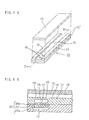
- Figs. 1A and 1B show an example of the sensor device of this type, in which Fig. 1A is a perspective view of the sensor device, and Fig. 1B is a partially enlarged cross-sectional view of the sensor device taken along a line I-I.
- a sensor device 10 includes, as its basic structure, a base body 12 having a vibrating portion 14, a piezoelectric element 20 fixed onto one surface of the vibrating portion 14 and having a piezoelectric film 22 and a pair of electrodes 24a and 24b which are in contact with the vibrating film 22, a space 16 that allows a fluid to lead to the other surface of the vibrating portion 14, and introduction holes 18 that communicate with the space 16, as in the above-mentioned conventional sensor device.
- the sensor device according to the present invention includes a projection 13 defined on the surface of the sensor device 10 as its characteristic structure.
- the protrusion 13 extends substantially continuously from the periphery of the introduction holes 18 to a rear end portion 10' of the sensor device (an end portion on a side far from the introduction holes 18), and is arranged to form a recess 15.
- the recess 15 contains at least opening ends of the introduction holes 18 on the surface side of the sensor device (a fluid flow-in side) within its recess formation region and is formed continuously up to the rear end portion 10' of the sensor device.
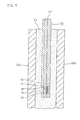
- Fig. 9 shows a state in which the above sensor device 10 is built in a lead storage battery.
- the sensor device 10 is designed in such a manner that a tip portion where at least the introduction holes 18 are formed is embedded in the porous sheet 34 which is interposed between the electrodes 32a and 32b of the battery.
- the porous sheet 34 into which an electrolyte which is a fluid to be measured is infiltrated is in contact with the protrusion 13, but not in contact with the opening end of the introduction holes 18 on the surface side of the sensor device which is in the formation region of the recess 15.
- the protrusion 13 allows a cylindrical space to be defined between the recess 15 and the porous sheet 34 so as to extend from the opening end of the introduction holes 18 toward the rear end 10' of the sensor device.
- the cylindrical space allows the electrolyte that percolates from the porous sheet 34 to reside therein to regulate the entrance of the electrolyte into the introduction holes 18, and functions as a gas exhaust duct.
- the gas within the space 16 is exhausted from the introduction holes 18 to the above cylindrical space while the electrolyte flows in the space 16, thus readily replacing the gas by the electrolyte in the space 16.
- the height h of the protrusion 13 defined on the surface of the sensor device is preferably 0.1 mm or more, and more preferably 0. 3 mm or more.
- the width w of the recess 15 formed by the protrusion 13 is preferably 0.1 mm or more, and more preferably 0. 5 mm or more. It should be noted that the height h and the width w of the protrusion 13 may not be constant with respect to the longitudinal direction of the sensor device 10, respectively.
- the height of the protrusion of the tip portion (the periphery of the introduction holes 18) of the sensor device is preferably higher for the response of the sensor. On the other hand, it is preferably lower for the introduction of the electrolyte into the introduction holes 18.
- Fig. 2 shows a sensor device with the width of the recess 15 being changed in accordance with an embodiment of the present invention.
- Fig. 3 shows a sensor device with the recess 15 being branched by the protrusion 13 in accordance with another embodiment of the present invention.
- a sectional area of the cylindrical space is increased.
- the width of the recess is excessively wide, the porous sheet is inserted into the recess 15 so that the sectional area of the cylindrical space is adversely reduced.
- the recess 15 is branched, the respective widths of the branched portions are narrowed to prevent the porous sheet from being inserted into the recess 15.
- the total sectional area of the cylindrical space in the respective branched portions can be increased.
- the sensor device 10 is not completely embedded in the porous sheet 34 in such a manner that its rear end portion (an end portion on a side far from the introduction holes 18) 10' is positioned in a space portion where no electrolyte exists. Since the recess 15 is formed continuously up to the rear end portion 10' of the sensor device, the rear end portion 10' of the sensor device 10 is positioned in the space where no electrolyte exists, thereby being capable of forming a passage that extends continuously from the space 16 to the space where no electrolyte exists. As a result, the gas within the space 16 is readily exhausted.
- the sensor device 10 may be built in the battery in a state where one surface of the sensor device is in contact with the electrode of the battery.
- a surface of the sensor device 10 on a side where the protrusion 13 is provided is made in contact with the electrode 32a, and in this case, the cylindrical space is formed by an inner surface of the electrode 32a, the protrusion 13 and the recess 15.
- the sensor device 10 may be built in the battery in a state where the surface of the sensor device on a side where no protrusion 13 is formed is brought in contact with the electrode, but in the case where the height of the protrusion 13 is kept constant, it is preferable that the sensor device is arranged in such a manner that the protrusion 13 is in contact with the electrode as described above. This is because the space portion is sufficiently ensured.
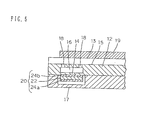
- the protrusion 13 is covered with a cap member 19 so that the cylindrical space is formed by the protrusion 13, the cap member 19 and the recess 15.
- the tip portion of the sensor device 10 is identical in position with the tip portion of the cap member 19, and as shown in Fig. 5, the tip portions of both the sensor device 10 and the cap member 19 may be shifted in position.
- the opening of the tip portion formed by the cap member 19 and the base body 12 is not always limited to the tip portion shown in the figure, and may be provided on the lateral side of the tip portion, and more preferably the opening is defined in a direction along which a plurality of introduction holes are aligned.
- the thickness of the opening portion is preferably made smaller than that of the introduction holes for the introduction of a fluid to be measured.
- the cap member 19 is uniform in thickness.
- the thickness of the cap member 19 on the tip portion side of the sensor device may be thinned. In this case, machining is facilitated when changing the length of the cylindrical space formed in the tip portion of the sensor device.
- a sensor device which can surely and readily replace the gas by the electrolyte in the space
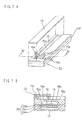
- a sensor device with the structure shown in the perspective view of Fig. 7A and the cross-sectional view of Fig. 7B which is taken along a line IV-IV of Fig. 7A.
- this sensor device has a protrusion 13 on the surface of the sensor device to form a recess.
- this sensor device has two discontinuous recesses consisting of a first recess 15a and a second recess 15b.
- the sensor device 10 includes a plurality of introduction holes
- the first recess 15a contains the opening ends of introduction holes 18a which are parts of the plural introduction holes 18 on the surface side of the sensor device in its region, and extends continuously up to the rear end portion of the sensor device (an end portion on a side far from the introduction holes) 10'.
- the second recess 15b is formed so as to contain the opening ends of at least introduction holes 18b which are parts of other introduction holes on the surface side of the sensor device in its region.
- the protrusion 13 is covered with a cap member 19, and a cylindrical space is formed by the protrusion 13, the cap member 19 and the first recess 15a.
- the cylindrical space is opened on only a side of the rear end portion 10' of the sensor device.
- the first recess 15a and the second recess 15b are discontinuously formed and isolated from each other by the protrusion 13 and the cap member 19.
- the sensor device 10 thus structured is built in the battery in such a manner that its rear end portion 10' is positioned in a space where no electrolyte exists, and then an electrolyte is injected thereinto.
- the electrolyte percolated from the porous sheet resides in the second recess 15b and enters the introduction holes 18b so that it flows into the space 16.
- the electrolyte does not enter the cylindrical space formed by the protrusion 13, the cap member 19 and the first recess 15.
- the introduction holes 18a being not blocked by the electrolyte, a gas within the space 16 is surely exhausted to the cylindrical space through the introduction holes 18a while the electrolyte flows into the space 16 from the introduction holes 18b.
- the plural introduction holes are divided into introduction holes 18b for leading the electrolyte to the space 16 and introduction holes 18a for exhausting the gas within the space 16 so that their roles are shared.
- introduction holes 18b for leading the electrolyte to the space 16
- introduction holes 18a for exhausting the gas within the space 16 so that their roles are shared.
- Figs. 8A and 8B are a perspective view showing a sensor device in accordance with another embodiment of the present invention, and a partially enlarged sectional view showing the sensor device taken along a line V-V of Fig. 8A.
- a first recess 15a and a second recess 15b are arranged in a longitudinal direction of the sensor device 10, and the respective recess formation regions are structured in such a manner that the open ends of introduction holes 18a and 18b on the surface side of the sensor device are contained in their recess formation regions one by one, respectively.
- a sensor device of the structure in which a space forms a cylindrical space, and which has a gas exhaust port opening on its one end portion.
- a space 16 formed within the base body 12 forms a cylindrical space, and there is provided a gas exhaust hole 26 which opens on one end portion of the space 16 (cylindrical space).
- reference numeral 28 denotes a gas exhaust hole 26 for introducing a fluid into the space 16.
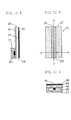
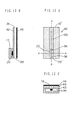
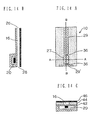
- Figs. 11A, 12A, 13A, 14A and 15A are a plan view showing a different sensor device, respectively;
- Figs. 11B, 12B, 13B, 14B and 15B are a cross-sectional view showing the sensor device taken along a line B-B, respectively; and Figs.
- 11C, 12C, 13C, 14C and 15C are a cross-sectional view showing the sensor device taken along a line A-A.
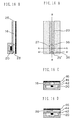
- Fig. 16A is a plan view showing another sensor device
- Fig. 16B is a cross-sectional view showing the sensor device taken along a line B-B
- Fig. 16C is a cross-sectional view showing the sensor device taken along a ling A-A
- Fig. 16D is a cross-sectional view showing the sensor device taken along a line A'-A'.
- Those sensor device 10 are built in a lead storage battery in such a manner that its rear end portion 10' is positioned in a space where no electrolyte exists, and then an electrolyte is injected therein. As a result, the electrolyte flows from the introduction holes 28, and a gas within the space 16 elevates in the cylindrical space of the space 16 and is then exhausted to the exterior from the gas exhaust hole 26 that opens on an upper end portion of the cylindrical space while the electrolyte flows into the space 16.
- Figs. 11A to 11C show a basic structure of a sensor device in which a space forms a cylindrical space, which is an example in which a space 16 forms a simple cylindrical space.
- a sensor device shown in Figs. 12A to 12C is an example in which drawing portions are formed as a space 16 on the boundaries of a part 27 corresponding to the piezoelectric element 20 and other parts 29, and 29'.
- the sensor devices shown in Figs. 13A to 13C and 14A to 14C show modified examples of Figs. 12A to 12C, respectively.
- FIGS. 13A to 13C show an example in which lateral sectional areas of parts 29 and 29' of the space 16 expect for a part corresponding to the piezoelectric element 20 are enlarged in comparison with that of a part 27 corresponding to the piezoelectric element 20, and Figs. 14A to 14C show an example in which a lateral sectional area of a part 29' of the space 16 which communicates with the communication holes 28 is enlarged whereas a lateral sectional area of a part 29 of the space 16 which communicates with the gas exhaust hole 26 is reduced.
- a sensor device shown in Figs. 15A to 15C show an example in which an introduction hole 28 that communicates with the space 16 is defined not in a lower end portion of the cylindrical space but in a lateral side of the lower end portion thereof.
- a sensor device shown in Figs. 16A to 16D show an example in which the lateral sectional areas of the drawing portion 36 are more reduced in Fig. 12.
- the sensor devices shown in Figs. 11A to 16D since they are of the structure in which the space forms the cylindrical space, they have such an advantage that a manufacture process is simplified in comparison with the structure in which the protrusion is provided, or the structure in which the protrusion and the cap member are provided, as shown in Figs. 1A to 8B.
- the shape of a flow passage of a fluid which extends from the introduction holes 28 up to the gas exhaust hole 26 through the space 16 is straight, the gas within the space 16 is more readily exhausted.
- the sensor devices shown in Figs. 11A to 16D facilitate the control of the resistance of the fluid to the flow passage in comparison with the sensor devices shown in Figs. 1A to 8B.
- the resistance to the flow passage is controlled by a diameter of the introduction holes 18 and a thickness of a member that forms the introduction holes 18, in order to measure a fluid of a low viscosity, it is required that the diameter of the introduction holes 18 is reduced and the thickness of the member is increased.
- the reduction of the diameter of the introduction holes 18 is limited from the viewpoint of the machining accuracy, and also that the sensor device can not be thinned.
- the space 16 that regulates the resistance to the flow passage is a cylindrical space formed in the base body 12
- the resistance to the flow passage can be readily controlled by adjusting the sectional area and the length of the space 16 depending to the characteristics of the fluid to be measured such as viscosity, and in particular, even in the case where the space 16 is lengthened to increase the resistance to the flow passage, the sensor device can be thinned.
- Figs. 17A to 19C show examples of a four-layer structure which is thickened by one layer more than the sensor devices shown in Figs. 11A to 16D as a layer structure that constitutes a base body 12 having a space 16 formed inside thereof.
- Figs. 17A, 18A and 19A show plan views of the sensor devices
- Figs. 17B, 18B and 19B show cross-sectional views taken along a line B-B of Figs. 17A, 18A and 19A
- Figs. 17C, 18C and 19C show cross-sectional views taken along a line A-A thereof, respectively.
- the sensor devices shown in Figs. 11A to 16D usually have, as a layer structure that constitutes the base body 12, a three-layer structure consisting of a first layer 42 of a thin plate layer which forms the vibrating portion 14 a part of which is arranged to fix the piezoelectric element 20, a second layer 44 having a window that forms the space 16 after sintering the laminated layers, and a third layer 46 that shields the window.
- the second layer 44 having the window is formed on the first layer 42 of the thin plate layer, and the second layer 44 and the third layer 46 are held by the first layer 42 weak in strength. Therefore, in the sensor devices shown in Figs.
- a second layer 50 having a window (which forms the space 16 after the laminated layers are sintered) at only a part 27 corresponding to the piezoelectric element 20 is located on the first layer 42 that forms the thin plate layer, then a third layer 52 having a window (which forms a cylindrical space after the laminated layers are sintered) which communicates with the space 16 is laminated on the second layer 50, and further a fourth layer 54 that shields the window that forms the cylindrical space is laminated on the third layer 52.
- the second layer 50 that functions as a backup layer is provided on the first layer 42 of the thin plate layer except for the part 27 corresponding to the piezoelectric element 20, as a result of which the sensor device is obtained which improves in strength and durability as a whole.
- the sensor device shown in Figs. 17A to 17C shows an example in which only the window and a part that communicates with the space 16 are spatial in the third layer 52 having the window that communicates with the space 16.
- the sensor device shown in Figs. 18A to 18C show an example in which the window and a part corresponding to the piezoelectric element 20 are spatial, and a slender communication space is provided between the window and a part corresponding to the piezoelectric element 20 in the third layer 52 having the window that communicates with the space 16. Further, the sensor device shown in Figs.
- 19A to 19C show an example in which only a part that communicates with the space 16 is spatial in the third layer 52 having the window that communicates with the space 16, and a part corresponding to the piezoelectric element 20 is not shielded, and an introduction hole 28 that extends to the space 16 is formed in the fourth layer 54 that shields the window.
- the part corresponding to the piezoelectric element 20 is preferably arranged at a relatively lower position.
- the piezoelectric element part is disposed at the relatively lower position in the sensor device with the advantages stated below.
- the piezoelectric element part can be filled with such electrolyte. Even though the electrolyte is sucked out, the piezoelectric element part becomes empty lastly, thus making it hard that the electrolyte escape.
- the adhesion of the electrolyte to a wall surface forming the cylindrical space acts as a resistance to a suck-out force, thereby making it hard that the electrolyte escape.
- the sensor device of the present invention is built in the lead storage battery.
- the sensor device of the present invention is not limited to such application, but may be applicable to a case in which the sensor device is built in another sort of battery, or a case except that it is built in the battery.
- the fluid to be measured is not limited to the electrolyte. That is, the sensor device of the present invention can be used to measure various kinds of fluid characteristics of a variety of fluids such as acid-base solvent, a variety of aqueous, solvent using an organic solvent or an organic solvent per se.
- the space 16 is defined in the base body 12 so that the vibrating portion 14 is thinned, and the introduction hole 18 that communicates with the space 16 is also defined in the base body 12.
- the shape of the space 16 is not particularly limited.
- the vibrating portion 14 is preferably in the form of a plate because it is proper for vibrations.
- the thickness of the plate is preferably set to 1 to 100 ⁇ m, more preferably to 3 to 50 ⁇ m, and most preferably to 5 to 20 ⁇ m. When the thickness of the plate exceeds 100 ⁇ m, the sensitivity is deteriorated, and when it is less than 1 ⁇ m, the mechanical strength is deteriorated.
- the piezoelectric element 20 is fixed onto one surface of the vibrating portion 14 (a surface opposite to a side facing the space 16).
- the piezoelectric element 20 includes the piezoelectric film 22 and a pair of electrodes 24a, 24b which are in contact with the piezoelectric film 22.
- dielectric polarization is developed so that the piezoelectric element 20 flexibly vibrates in the width direction of the piezoelectric film 22 and the vibrating portion 14 together with the vibrating portion 14.
- the thickness of the piezoelectric film 22 is preferably set to 1 to 100 ⁇ m, more preferably to 5 to 50 ⁇ m, and most preferably to 5 to 30 ⁇ m. When the thickness of the piezoelectric film 22 exceeds 100 ⁇ m, the sensitivity is deteriorated, and when it is less than 1 ⁇ m, it is difficult to ensure the reliability.
- the piezoelectric film 22 may be dense or porous, and when it is porous, the porosity is preferably set to 40% or less. Also, the piezoelectric film 22 may be formed of one layer or of a laminate structure consisting of two or more layers. When it is of the laminate structure consisting of two or more layers, the respective layers may be laterally located, or vertically located.
- the thickness of electrodes 24a and 24b is set appropriately depending on its application, but preferably set to 0.1 to 50 ⁇ m.
- the piezoelectric element 20 is normally covered with the protective cover 17.
- the protective cover 17 enables the piezoelectric element 20 to be isolated from those fluids.
- a voltage is applied to the piezoelectric element to vibrate the piezoelectric element and the vibrating portion, thereby vibrating a fluid which is in contact with the vibrating portion. Then, the piezoelectric film of the piezoelectric element converts the vibrations into electric signals, and then outputs the electric signals through the electrode which is disposed in contact with the piezoelectric film. For example, a voltage is applied to the piezoelectric element 20 to vibrate the piezoelectric element 20 and the vibrating portion 14 while being in contact with the fluid.
- a current is detected through the electrodes 24a and 24b of the piezoelectric element 20, to thereby obtain information relating to values of the impedance, phase, resistance, reactance, admittance, conductance, susceptance, inductance, capacitance, loss coefficient, etc., of the piezoelectric element 20, as well as the value of a frequency (resonance frequency) corresponding to those values. Since those information correlates with the characteristics such as the viscosity of the fluid, such characteristics of the fluid can be detected.
- the base body 12 having the vibrating portion 14 is preferably made of ceramics.
- ceramics for example, stabilized zirconia, alumina, magnesia oxide, mullite, aluminum nitride, silicon oxide, glass, or the like can be used for the material of the base body 12.
- the stabilized zirconia is preferable because even though the vibrating portion is thin, the mechanical strength is high, the toughness is high, the chemical reaction with the piezoelectric film and the electrode is small, etc.
- the respective materials of the protrusion 13, the protective cover 17 and the cap member 19 are not particularly limited, and for example, may be the same as that of the base material 12.
- the base body 12, the protrusion 13, the protective cover 17 and the cap member 19 may be integrated in such a manner that the respective components are assembled with each other and then sintered after they are molded.
- the respective structural components or parts of the structural components may adhere to each other by glass, an organic adhesive or the like.
- the piezoelectric film 22 can be suitably made of piezoelectric ceramics, but may be made of electrostrictive ceramics or ferro-electric ceramics.
- the piezoelectric film 22 may be made of a material required to be subjected to a polarization process or a material not required to be subjected to the polarization process.
- the ceramics used for the piezoelectric film may be, for example, ceramics containing lead zirconate, lead magnesium niobic acid, lead nickel niobic acid, lead zinc niobic acid, lead manganin niobic acid, lead antimonic stannic acid, lead titanium acid, lead manganic tungsten acid, lead cobalt niobic acid, barium titanate or the like, or containing the components of any combination of the above material.
- the piezoelectric film may be the above ceramics to which oxide of lanthanum, calcium, strontium, molybdenum, tungsten, barium, niobium, zinc, nickel manganin or the like, any combination of the above material, or other compounds are appropriately added.
- ceramics which mainly contain components consisting of lead magnesium niobic acid, lead zirconate, lead titanium acid in addition to ceramics containing lanthanum or strontium.
- the electrode 24a is solid at room temperature and made of conductive metal.
- conductive metal for example, there is used metal simple substance or the metal alloy containing aluminum, titanium, chromium, iron, cobalt, nickel, copper, zinc, niobium, molybdenum, lutetium, rhodium, silver, tin, tantalum, tungsten, iridium, platinum, gold, lead or the like.
- the electrode 24b is made of a simple substance or an alloy containing metal having a high melting point such as platinum, lutetium, rhodium, paradium, iridium, titanium, chromium, molybdenum, tantalum, tungsten, nickel, cobalt or the like. This is because the electrode 24b is exposed at a high temperature while the piezoelectric film is thermally treated, and therefore it is preferably made of metal that withstands a high-temperature oxidation atmosphere. Also, it may be made of cermet containing those high-melting point metal and ceramics such as alumina, zirconium, silicon oxide or glass.
- a base body can be integrated by laminating molded layers of green sheets or green tapes by thermocompression bonding or the like and then sintering the laminated layers.
- a base body 12 shown in Figs. 1A and 1B three layers of green sheets or green tapes are laminated, and a through-hole of a predetermined shape which will form the space 16 is defined in the second layer in advance before those layers are laminated.
- the molded layer is formed by pressure molding using a molding die, cast molding, injection molding or the like, and then a space or the like may be formed in the molded layer by a mechanical process such as cutting, grinding machining, laser machining, punching due press machining or the like.
- the molded layers may not be identical in thickness with each other, but it is preferable that the thickness of the respective layers is set so that contraction due to sintering is the same degree.
- a method of forming the piezoelectric element 20 on the vibrating portion 14 there is a method of molding a piezoelectric body through a press molding method using a mold or a press molding method using a slurry raw material, laminating the piezoelectric body which has not yet been sintered on the vibrating portion of the substrate which has not yet been sintered by thermocompression bonding, and simultaneously sintering it to form the substrate and the piezoelectric body.
- the temperature at which the piezoelectric film is sintered is appropriately determined according to a material that forms the piezoelectric film, but in general, it is 800 to 1400 °C, and preferably 1000 to 1400 °C. In this case, in order to control the composition of the piezoelectric film, it is preferable that the piezoelectric film is sintered under the condition where an evaporation source of the piezoelectric material exists.
- the electrode 24b, the piezoelectric film 22 and the electrode 24a are laminated on the vibrating portion 14 in the stated order to form the piezoelectric element 20.
- a known film forming method for example, a thick-film method such as screen printing, a coating method such as dipping, ion beam, sputtering, vapor deposition, ion plating, chemical vapor deposition method (CVD), a thin-film method such as plating, or the like.
- the film forming method of the present invention is not limited to those methods. Among them, the screen printing method is preferable because it allows the film to be stably manufactured.
- the piezoelectric film is formed through the film forming method as described above, the piezoelectric element and the vibrating portion can be integrally bonded to each other without using adhesive, whereby it is excellent in reliability and reproducibility, and further integration is facilitated.
- the above method is particularly preferable.
- the shape of such a film is formed by appropriate pattern.
- the pattern may be formed by the screen printing method, the photolithography method or the like. Also, unnecessary parts are removed by using the mechanical machining method such as the laser machining method, slicing or supersonic wave machining to pattern the piezoelectric film.
- the respective films (22, 24a, and 24b) formed on the substrate as described above are heat-treated every time each film is formed such that the respective films are integral with the substrate.
- those films are heat-treated simultaneously after they are formed, so that the respective films are integrally bonded to the substrate. It should be noted that in the case of forming the electrodes through the thin-film method, the heat treatment is not always required in order to integrate those electrodes.
- the gas within the space is liable to be replaced by the fluid to be measured, thereby being capable of readily introducing the fluid to be measured within the space.
Landscapes
- Physics & Mathematics (AREA)
- General Physics & Mathematics (AREA)
- Acoustics & Sound (AREA)
- Health & Medical Sciences (AREA)
- Life Sciences & Earth Sciences (AREA)
- Chemical & Material Sciences (AREA)
- Analytical Chemistry (AREA)
- Biochemistry (AREA)
- General Health & Medical Sciences (AREA)
- Immunology (AREA)
- Pathology (AREA)
- Measuring Oxygen Concentration In Cells (AREA)
Applications Claiming Priority (6)
| Application Number | Priority Date | Filing Date | Title |
|---|---|---|---|
| JP12727896 | 1996-05-22 | ||
| JP12727896 | 1996-05-22 | ||
| JP127278/96 | 1996-05-22 | ||
| JP16218796A JP3343030B2 (ja) | 1996-05-22 | 1996-06-21 | センサ素子 |
| JP162187/96 | 1996-06-21 | ||
| JP16218796 | 1996-06-21 |
Publications (2)
| Publication Number | Publication Date |
|---|---|
| EP0809105A1 true EP0809105A1 (de) | 1997-11-26 |
| EP0809105B1 EP0809105B1 (de) | 2001-12-05 |
Family
ID=26463267
Family Applications (1)
| Application Number | Title | Priority Date | Filing Date |
|---|---|---|---|
| EP97303419A Expired - Lifetime EP0809105B1 (de) | 1996-05-22 | 1997-05-20 | Messfühler |
Country Status (6)
| Country | Link |
|---|---|
| US (3) | US5892143A (de) |
| EP (1) | EP0809105B1 (de) |
| JP (1) | JP3343030B2 (de) |
| CN (1) | CN1173642A (de) |
| DE (1) | DE69708751D1 (de) |
| ID (1) | ID16941A (de) |
Cited By (3)
| Publication number | Priority date | Publication date | Assignee | Title |
|---|---|---|---|---|
| EP0950889A1 (de) * | 1998-03-27 | 1999-10-20 | Ngk Insulators, Ltd. | Piezoelektrischer Sensor und Verfahren zur Feststellung der Änderung elektrischer Konstanten unter Verwendung des Sensors |
| US6602714B1 (en) * | 1999-11-09 | 2003-08-05 | Sri International | Viscosity and mass sensor for the high-throughput synthesis, screening and characterization of combinatorial libraries |
| CN103796579A (zh) * | 2011-09-01 | 2014-05-14 | 微创医学科技有限公司 | 检测门静脉和/或肝静脉压力的方法和门静脉高压监控系统 |
Families Citing this family (27)
| Publication number | Priority date | Publication date | Assignee | Title |
|---|---|---|---|---|
| JP3236536B2 (ja) * | 1997-07-18 | 2001-12-10 | 日本碍子株式会社 | セラミック基体及びこれを用いたセンサ素子 |
| US6575020B1 (en) * | 1999-05-03 | 2003-06-10 | Cantion A/S | Transducer for microfluid handling system |
| US6308553B1 (en) * | 1999-06-04 | 2001-10-30 | Honeywell International Inc | Self-normalizing flow sensor and method for the same |
| US6269685B1 (en) * | 1999-09-23 | 2001-08-07 | Ut Battelle, Llc | Viscosity measuring using microcantilevers |
| JP3830843B2 (ja) * | 2002-03-28 | 2006-10-11 | 株式会社東芝 | 薄膜圧電共振子 |
| US6668621B1 (en) * | 2002-06-13 | 2003-12-30 | Hubert Arthur Wright | Viscosity measurement by means of damped resonant vibration normal to an approximate rigid plate |
| JP2004245613A (ja) * | 2003-02-12 | 2004-09-02 | Japan Science & Technology Agency | フロ−セル型qcm装置および試料測定方法 |
| US7721590B2 (en) * | 2003-03-21 | 2010-05-25 | MEAS France | Resonator sensor assembly |
| KR100576849B1 (ko) * | 2003-09-19 | 2006-05-10 | 삼성전기주식회사 | 발광소자 및 그 제조방법 |
| US7581434B1 (en) * | 2003-09-25 | 2009-09-01 | Rockwell Automation Technologies, Inc. | Intelligent fluid sensor for machinery diagnostics, prognostics, and control |
| EP1830169B1 (de) | 2004-12-15 | 2014-02-12 | Nihon Dempa Kogyo Co., Ltd. | Quarzsensor und wahrnehmungsvorrichtung |
| EP1830170A4 (de) * | 2004-12-15 | 2012-04-11 | Nihon Dempa Kogyo Co | Komponentenmessvorrichtung |
| CN101084427B (zh) * | 2004-12-15 | 2011-07-20 | 日本电波工业株式会社 | 石英传感器和感知装置 |
| JP4134025B2 (ja) * | 2004-12-28 | 2008-08-13 | 日本電波工業株式会社 | 感知装置 |
| US7228735B2 (en) * | 2005-02-03 | 2007-06-12 | Integrated Sensing Systems, Inc. | Fluid sensing device with integrated bypass and process therefor |
| US7845230B2 (en) | 2005-08-03 | 2010-12-07 | Nihon Dempa Kogyo Co., Ltd. | Concentration sensor and concentration detector |
| WO2007037386A1 (ja) * | 2005-09-30 | 2007-04-05 | Ulvac, Inc. | センサ及びこれを使用した装置 |
| JP2007093550A (ja) * | 2005-09-30 | 2007-04-12 | Ulvac Japan Ltd | センサ及びこれを使用した装置 |
| JP4669767B2 (ja) * | 2005-09-30 | 2011-04-13 | 株式会社アルバック | センサ及びこれを使用した装置 |
| CN101368988B (zh) * | 2007-08-15 | 2011-02-02 | 中国科学院电子学研究所 | 免封装压电驱动式微小型电场传感器 |
| JP2011203246A (ja) * | 2010-03-03 | 2011-10-13 | Noboru Wakatsuki | 粘弾性評価装置 |
| US9086338B2 (en) | 2010-06-25 | 2015-07-21 | Nihon Dempa Kogyo Co., Ltd. | Sensing device |
| JP5102334B2 (ja) * | 2010-06-25 | 2012-12-19 | 日本電波工業株式会社 | 感知装置 |
| GB201120887D0 (en) * | 2011-12-06 | 2012-01-18 | The Technology Partnership Plc | Acoustic sensor |
| CN111947724B (zh) * | 2019-05-16 | 2025-11-18 | 纳智源科技(唐山)有限责任公司 | 气流传感器及电子烟 |
| JP7487600B2 (ja) * | 2020-07-29 | 2024-05-21 | セイコーエプソン株式会社 | 流体デバイス |
| JP7484534B2 (ja) * | 2020-07-30 | 2024-05-16 | セイコーエプソン株式会社 | 流体デバイス |
Citations (5)
| Publication number | Priority date | Publication date | Assignee | Title |
|---|---|---|---|---|
| JPS56133644A (en) * | 1980-03-24 | 1981-10-19 | Toshiba Corp | Ultrasonic hydrometer |
| EP0226570A2 (de) * | 1985-12-09 | 1987-06-24 | OttoSensors Corporation | Messeinrichtung und Rohranschluss sowie Herstellungsverfahren für diese |
| US4961345A (en) * | 1986-12-08 | 1990-10-09 | Fuji Electric Co., Ltd. | Vibration type transducer |
| US5485744A (en) * | 1991-09-18 | 1996-01-23 | Tadamasa Akutagawa | Sulfuric acid concentration sensor for lead storage battery |
| EP0714022A2 (de) * | 1994-11-25 | 1996-05-29 | Ngk Insulators, Ltd. | Vorrichtung zur Viskositätsmessung und Vorrichtung zur Messung der Eigenschaften eines Fluides |
Family Cites Families (11)
| Publication number | Priority date | Publication date | Assignee | Title |
|---|---|---|---|---|
| US4741200A (en) * | 1986-07-11 | 1988-05-03 | Ford Motor Company | Method and apparatus for measuring viscosity in a liquid utilizing a piezoelectric sensor |
| US4721874A (en) * | 1986-10-06 | 1988-01-26 | Emmert Sans W | Apparatus and method for determining the viscosity of a fluid sample |
| JPH01311250A (ja) * | 1988-06-08 | 1989-12-15 | Seiko Instr Inc | 流体粘度計測方法及び計測装置 |
| JPH02213743A (ja) * | 1989-02-15 | 1990-08-24 | Seiko Instr Inc | 液体の物理的性質の測定装置 |
| JPH03148040A (ja) * | 1989-11-06 | 1991-06-24 | Izumi Denki Toyama Seisakusho:Kk | 粘度測定装置 |
| DE69221758T2 (de) * | 1991-03-22 | 1998-01-02 | Seiko Instr Inc | Elektrochemische Messeinrichtung |
| US5374521A (en) * | 1991-09-17 | 1994-12-20 | Kipling; Arlin L. | Acoustic reflection process for molecular sensing using a bulk acoustic wave quartz sensor |
| JP3148040B2 (ja) | 1993-03-23 | 2001-03-19 | 株式会社東芝 | 教師信号作成装置および画像認識装置 |
| JP3162584B2 (ja) * | 1994-02-14 | 2001-05-08 | 日本碍子株式会社 | 圧電/電歪膜型素子及びその製造方法 |
| US5545461A (en) * | 1994-02-14 | 1996-08-13 | Ngk Insulators, Ltd. | Ceramic diaphragm structure having convex diaphragm portion and method of producing the same |
| JP3323343B2 (ja) * | 1994-04-01 | 2002-09-09 | 日本碍子株式会社 | センサ素子及び粒子センサ |
-
1996
- 1996-06-21 JP JP16218796A patent/JP3343030B2/ja not_active Expired - Fee Related
-
1997
- 1997-05-16 US US08/857,338 patent/US5892143A/en not_active Expired - Fee Related
- 1997-05-20 EP EP97303419A patent/EP0809105B1/de not_active Expired - Lifetime
- 1997-05-20 DE DE69708751T patent/DE69708751D1/de not_active Expired - Fee Related
- 1997-05-20 ID IDP971673A patent/ID16941A/id unknown
- 1997-05-22 CN CN97114923A patent/CN1173642A/zh active Pending
-
1998
- 1998-12-04 US US09/205,274 patent/US6047590A/en not_active Expired - Fee Related
-
2000
- 2000-02-22 US US09/510,246 patent/US6490911B1/en not_active Expired - Fee Related
Patent Citations (5)
| Publication number | Priority date | Publication date | Assignee | Title |
|---|---|---|---|---|
| JPS56133644A (en) * | 1980-03-24 | 1981-10-19 | Toshiba Corp | Ultrasonic hydrometer |
| EP0226570A2 (de) * | 1985-12-09 | 1987-06-24 | OttoSensors Corporation | Messeinrichtung und Rohranschluss sowie Herstellungsverfahren für diese |
| US4961345A (en) * | 1986-12-08 | 1990-10-09 | Fuji Electric Co., Ltd. | Vibration type transducer |
| US5485744A (en) * | 1991-09-18 | 1996-01-23 | Tadamasa Akutagawa | Sulfuric acid concentration sensor for lead storage battery |
| EP0714022A2 (de) * | 1994-11-25 | 1996-05-29 | Ngk Insulators, Ltd. | Vorrichtung zur Viskositätsmessung und Vorrichtung zur Messung der Eigenschaften eines Fluides |
Non-Patent Citations (2)
| Title |
|---|
| JOHN M. CHARLESWORTH: "Determination of the state-of-charge of a lead acid battery using impedance of the quartz crystal oscillator", ELECTROCHIMICA ACTA, vol. 41, no. 10, June 1996 (1996-06-01), UK, pages 1721 - 1726, XP004019401 * |
| PATENT ABSTRACTS OF JAPAN vol. 006, no. 008 (P - 098) 19 January 1982 (1982-01-19) * |
Cited By (6)
| Publication number | Priority date | Publication date | Assignee | Title |
|---|---|---|---|---|
| EP0950889A1 (de) * | 1998-03-27 | 1999-10-20 | Ngk Insulators, Ltd. | Piezoelektrischer Sensor und Verfahren zur Feststellung der Änderung elektrischer Konstanten unter Verwendung des Sensors |
| US6360606B2 (en) | 1998-03-27 | 2002-03-26 | Ngk Insulators, Ltd. | Piezoelectric sensor device and a method for detecting change in electric constants using the device |
| US6602714B1 (en) * | 1999-11-09 | 2003-08-05 | Sri International | Viscosity and mass sensor for the high-throughput synthesis, screening and characterization of combinatorial libraries |
| CN103796579A (zh) * | 2011-09-01 | 2014-05-14 | 微创医学科技有限公司 | 检测门静脉和/或肝静脉压力的方法和门静脉高压监控系统 |
| US10105067B2 (en) | 2011-09-01 | 2018-10-23 | Microtech Medical Technologies Ltd. | Method of detecting portal and/or hepatic pressure and a portal hypertension monitoring system |
| US11490823B2 (en) | 2011-09-01 | 2022-11-08 | Microtech Medical Technologies Ltd. | Method of detecting portal and/or hepatic pressure and a portal hypertension monitoring system |
Also Published As
| Publication number | Publication date |
|---|---|
| ID16941A (id) | 1997-11-27 |
| DE69708751D1 (de) | 2002-01-17 |
| US6047590A (en) | 2000-04-11 |
| EP0809105B1 (de) | 2001-12-05 |
| US6490911B1 (en) | 2002-12-10 |
| JPH1038788A (ja) | 1998-02-13 |
| CN1173642A (zh) | 1998-02-18 |
| JP3343030B2 (ja) | 2002-11-11 |
| US5892143A (en) | 1999-04-06 |
Similar Documents
| Publication | Publication Date | Title |
|---|---|---|
| US6490911B1 (en) | Sensor device with fluid introduction holes | |
| EP0675355B1 (de) | Sensorelement und Teilchendetektor | |
| US6389877B1 (en) | Double-headed mass sensor and mass detection method | |
| EP0615295B1 (de) | Piezoelektrisches/elektrostriktives Element mit Elektrodenfilmen mit einer bestimmten Oberflächenrauhigkeit | |
| EP1154497B1 (de) | Piezoelektrisches/elektrostriktives schichtartiges Bauelement | |
| EP0671772A1 (de) | Membranstruktur aus Keramik mit einem konvexen Teil und Verfahren zu ihrer Herstellung | |
| US6495945B2 (en) | Piezoelectric/electrostrictive element | |
| EP0950889A1 (de) | Piezoelektrischer Sensor und Verfahren zur Feststellung der Änderung elektrischer Konstanten unter Verwendung des Sensors | |
| EP2214221B1 (de) | Piezoelektrisches oder elektrostriktives Element und Herstellungsverfahren dafür | |
| US5747671A (en) | Axial flow particle sensor | |
| EP0816839B1 (de) | Aufschlagsensor für Teilchen in einem Fluid mit Massnahmen zur Unterdrückung desBlasenplatzens | |
| US6723217B1 (en) | Method and device for pumping oxygen into a gas sensor | |
| EP2020692B1 (de) | Piezoelektrische filmanordnung | |
| EP1603173B1 (de) | Piezoelektrisches/elektrostriktives filmartiges Bauelement | |
| EP0862995B1 (de) | Verfahren zur Herstellung eines Bauteils mit funktioneller Schicht | |
| US20020158550A1 (en) | Piezoelectric/electrostrictive film element | |
| WO2001029546A2 (en) | Method and device for pumping oxygen into a gas sensor | |
| EP0766086A2 (de) | Teilchensensor aus mehrfachen Elementen und Elektronik für die Signalverarbeitung | |
| EP2037252A1 (de) | Piezoelektrischer filmsensor | |
| EP0945413B1 (de) | Keramischer Körper aus Zirkonoxid | |
| JP3471506B2 (ja) | 振動制御したセンサ素子 | |
| EP2042851A1 (de) | Piezoelektrischer filmsensor | |
| JPH05133930A (ja) | 酸素濃度センサ |
Legal Events
| Date | Code | Title | Description |
|---|---|---|---|
| PUAI | Public reference made under article 153(3) epc to a published international application that has entered the european phase |
Free format text: ORIGINAL CODE: 0009012 |
|
| AK | Designated contracting states |
Kind code of ref document: A1 Designated state(s): DE FR GB |
|
| 17P | Request for examination filed |
Effective date: 19980109 |
|
| 17Q | First examination report despatched |
Effective date: 19990812 |
|
| GRAG | Despatch of communication of intention to grant |
Free format text: ORIGINAL CODE: EPIDOS AGRA |
|
| GRAG | Despatch of communication of intention to grant |
Free format text: ORIGINAL CODE: EPIDOS AGRA |
|
| GRAH | Despatch of communication of intention to grant a patent |
Free format text: ORIGINAL CODE: EPIDOS IGRA |
|
| GRAH | Despatch of communication of intention to grant a patent |
Free format text: ORIGINAL CODE: EPIDOS IGRA |
|
| GRAA | (expected) grant |
Free format text: ORIGINAL CODE: 0009210 |
|
| AK | Designated contracting states |
Kind code of ref document: B1 Designated state(s): DE FR GB |
|
| REG | Reference to a national code |
Ref country code: GB Ref legal event code: IF02 |
|
| REF | Corresponds to: |
Ref document number: 69708751 Country of ref document: DE Date of ref document: 20020117 |
|
| PGFP | Annual fee paid to national office [announced via postgrant information from national office to epo] |
Ref country code: GB Payment date: 20020510 Year of fee payment: 6 |
|
| ET | Fr: translation filed | ||
| PGFP | Annual fee paid to national office [announced via postgrant information from national office to epo] |
Ref country code: FR Payment date: 20020521 Year of fee payment: 6 |
|
| PGFP | Annual fee paid to national office [announced via postgrant information from national office to epo] |
Ref country code: DE Payment date: 20020527 Year of fee payment: 6 |
|
| PLBE | No opposition filed within time limit |
Free format text: ORIGINAL CODE: 0009261 |
|
| STAA | Information on the status of an ep patent application or granted ep patent |
Free format text: STATUS: NO OPPOSITION FILED WITHIN TIME LIMIT |
|
| 26N | No opposition filed | ||
| PG25 | Lapsed in a contracting state [announced via postgrant information from national office to epo] |
Ref country code: GB Free format text: LAPSE BECAUSE OF NON-PAYMENT OF DUE FEES Effective date: 20030520 |
|
| PG25 | Lapsed in a contracting state [announced via postgrant information from national office to epo] |
Ref country code: DE Free format text: LAPSE BECAUSE OF NON-PAYMENT OF DUE FEES Effective date: 20031202 |
|
| GBPC | Gb: european patent ceased through non-payment of renewal fee |
Effective date: 20030520 |
|
| PG25 | Lapsed in a contracting state [announced via postgrant information from national office to epo] |
Ref country code: FR Free format text: LAPSE BECAUSE OF NON-PAYMENT OF DUE FEES Effective date: 20040130 |
|
| REG | Reference to a national code |
Ref country code: FR Ref legal event code: ST |