EP0809657B1 - Process for producing chitosan-glucan complexes, compounds producible therefrom and their use - Google Patents
Process for producing chitosan-glucan complexes, compounds producible therefrom and their use Download PDFInfo
- Publication number
- EP0809657B1 EP0809657B1 EP96904067A EP96904067A EP0809657B1 EP 0809657 B1 EP0809657 B1 EP 0809657B1 EP 96904067 A EP96904067 A EP 96904067A EP 96904067 A EP96904067 A EP 96904067A EP 0809657 B1 EP0809657 B1 EP 0809657B1
- Authority
- EP
- European Patent Office
- Prior art keywords
- chitin
- mass
- chitosan
- process according
- glucan
- Prior art date
- Legal status (The legal status is an assumption and is not a legal conclusion. Google has not performed a legal analysis and makes no representation as to the accuracy of the status listed.)
- Expired - Lifetime
Links
- 238000000034 method Methods 0.000 title claims abstract description 32
- 229920001503 Glucan Polymers 0.000 title claims abstract description 29
- 230000008569 process Effects 0.000 title claims abstract description 20
- 150000001875 compounds Chemical class 0.000 title description 2
- 239000000243 solution Substances 0.000 claims abstract description 25
- 229920002101 Chitin Polymers 0.000 claims abstract description 23
- 230000006196 deacetylation Effects 0.000 claims abstract description 19
- 238000003381 deacetylation reaction Methods 0.000 claims abstract description 19
- 244000005700 microbiome Species 0.000 claims abstract description 15
- 239000000047 product Substances 0.000 claims abstract description 15
- XLYOFNOQVPJJNP-UHFFFAOYSA-N water Substances O XLYOFNOQVPJJNP-UHFFFAOYSA-N 0.000 claims abstract description 15
- 239000012670 alkaline solution Substances 0.000 claims abstract description 9
- 229910052500 inorganic mineral Inorganic materials 0.000 claims abstract description 8
- 239000011707 mineral Substances 0.000 claims abstract description 8
- 239000002253 acid Substances 0.000 claims abstract description 6
- 238000002360 preparation method Methods 0.000 claims abstract description 3
- 239000007787 solid Substances 0.000 claims abstract description 3
- 239000006228 supernatant Substances 0.000 claims abstract description 3
- 238000005406 washing Methods 0.000 claims abstract description 3
- HEMHJVSKTPXQMS-UHFFFAOYSA-M sodium hydroxide Inorganic materials [OH-].[Na+] HEMHJVSKTPXQMS-UHFFFAOYSA-M 0.000 claims description 43
- 210000002421 cell wall Anatomy 0.000 claims description 18
- 239000000126 substance Substances 0.000 claims description 17
- VEXZGXHMUGYJMC-UHFFFAOYSA-N Hydrochloric acid Chemical compound Cl VEXZGXHMUGYJMC-UHFFFAOYSA-N 0.000 claims description 16
- 238000001179 sorption measurement Methods 0.000 claims description 13
- 229910001385 heavy metal Inorganic materials 0.000 claims description 9
- 102000004169 proteins and genes Human genes 0.000 claims description 9
- 108090000623 proteins and genes Proteins 0.000 claims description 9
- KWYUFKZDYYNOTN-UHFFFAOYSA-M Potassium hydroxide Chemical compound [OH-].[K+] KWYUFKZDYYNOTN-UHFFFAOYSA-M 0.000 claims description 7
- NBIIXXVUZAFLBC-UHFFFAOYSA-N Phosphoric acid Chemical compound OP(O)(O)=O NBIIXXVUZAFLBC-UHFFFAOYSA-N 0.000 claims description 6
- 240000004808 Saccharomyces cerevisiae Species 0.000 claims description 5
- 239000000463 material Substances 0.000 claims description 5
- 241000233866 Fungi Species 0.000 claims description 4
- DGAQECJNVWCQMB-PUAWFVPOSA-M Ilexoside XXIX Chemical compound C[C@@H]1CC[C@@]2(CC[C@@]3(C(=CC[C@H]4[C@]3(CC[C@@H]5[C@@]4(CC[C@@H](C5(C)C)OS(=O)(=O)[O-])C)C)[C@@H]2[C@]1(C)O)C)C(=O)O[C@H]6[C@@H]([C@H]([C@@H]([C@H](O6)CO)O)O)O.[Na+] DGAQECJNVWCQMB-PUAWFVPOSA-M 0.000 claims description 4
- 239000000975 dye Substances 0.000 claims description 4
- 239000003925 fat Substances 0.000 claims description 4
- GRYLNZFGIOXLOG-UHFFFAOYSA-N Nitric acid Chemical compound O[N+]([O-])=O GRYLNZFGIOXLOG-UHFFFAOYSA-N 0.000 claims description 3
- 239000013543 active substance Substances 0.000 claims description 3
- 150000002500 ions Chemical class 0.000 claims description 3
- 229910017604 nitric acid Inorganic materials 0.000 claims description 3
- 231100000252 nontoxic Toxicity 0.000 claims description 3
- 230000003000 nontoxic effect Effects 0.000 claims description 3
- 235000011007 phosphoric acid Nutrition 0.000 claims description 3
- 239000003357 wound healing promoting agent Substances 0.000 claims description 3
- 241000186361 Actinobacteria <class> Species 0.000 claims description 2
- 239000003795 chemical substances by application Substances 0.000 claims description 2
- 238000006386 neutralization reaction Methods 0.000 claims description 2
- 238000011084 recovery Methods 0.000 claims description 2
- 241000228212 Aspergillus Species 0.000 claims 1
- 241000235548 Blakeslea Species 0.000 claims 1
- 241000228143 Penicillium Species 0.000 claims 1
- 238000001727 in vivo Methods 0.000 claims 1
- 238000013268 sustained release Methods 0.000 claims 1
- 239000012730 sustained-release form Substances 0.000 claims 1
- 230000003472 neutralizing effect Effects 0.000 abstract 1
- 238000004519 manufacturing process Methods 0.000 description 14
- HVYWMOMLDIMFJA-DPAQBDIFSA-N cholesterol Chemical compound C1C=C2C[C@@H](O)CC[C@]2(C)[C@@H]2[C@@H]1[C@@H]1CC[C@H]([C@H](C)CCCC(C)C)[C@@]1(C)CC2 HVYWMOMLDIMFJA-DPAQBDIFSA-N 0.000 description 10
- 241000228245 Aspergillus niger Species 0.000 description 7
- 229920001661 Chitosan Polymers 0.000 description 7
- 206010052428 Wound Diseases 0.000 description 7
- 208000027418 Wounds and injury Diseases 0.000 description 7
- HEDRZPFGACZZDS-UHFFFAOYSA-N Chloroform Chemical group ClC(Cl)Cl HEDRZPFGACZZDS-UHFFFAOYSA-N 0.000 description 6
- KRKNYBCHXYNGOX-UHFFFAOYSA-N citric acid Chemical compound OC(=O)CC(O)(C(O)=O)CC(O)=O KRKNYBCHXYNGOX-UHFFFAOYSA-N 0.000 description 6
- 239000006185 dispersion Substances 0.000 description 6
- 230000000694 effects Effects 0.000 description 6
- 235000010755 mineral Nutrition 0.000 description 6
- 239000002594 sorbent Substances 0.000 description 6
- 235000012000 cholesterol Nutrition 0.000 description 5
- 230000007613 environmental effect Effects 0.000 description 5
- 235000013305 food Nutrition 0.000 description 5
- 239000000203 mixture Substances 0.000 description 5
- 241000894006 Bacteria Species 0.000 description 4
- BVKZGUZCCUSVTD-UHFFFAOYSA-L Carbonate Chemical compound [O-]C([O-])=O BVKZGUZCCUSVTD-UHFFFAOYSA-L 0.000 description 4
- 108090000790 Enzymes Proteins 0.000 description 4
- 102000004190 Enzymes Human genes 0.000 description 4
- 235000014680 Saccharomyces cerevisiae Nutrition 0.000 description 4
- QAOWNCQODCNURD-UHFFFAOYSA-N Sulfuric acid Chemical compound OS(O)(=O)=O QAOWNCQODCNURD-UHFFFAOYSA-N 0.000 description 4
- 239000003814 drug Substances 0.000 description 4
- 229940088598 enzyme Drugs 0.000 description 4
- QTBSBXVTEAMEQO-UHFFFAOYSA-N Acetic acid Chemical compound CC(O)=O QTBSBXVTEAMEQO-UHFFFAOYSA-N 0.000 description 3
- 102000016943 Muramidase Human genes 0.000 description 3
- 108010014251 Muramidase Proteins 0.000 description 3
- 108010062010 N-Acetylmuramoyl-L-alanine Amidase Proteins 0.000 description 3
- 239000003513 alkali Substances 0.000 description 3
- 210000004369 blood Anatomy 0.000 description 3
- 239000008280 blood Substances 0.000 description 3
- 238000005115 demineralization Methods 0.000 description 3
- 230000002328 demineralizing effect Effects 0.000 description 3
- 239000012153 distilled water Substances 0.000 description 3
- 238000005516 engineering process Methods 0.000 description 3
- 239000010408 film Substances 0.000 description 3
- 230000002538 fungal effect Effects 0.000 description 3
- 230000035876 healing Effects 0.000 description 3
- 229960000274 lysozyme Drugs 0.000 description 3
- 239000004325 lysozyme Substances 0.000 description 3
- 235000010335 lysozyme Nutrition 0.000 description 3
- 239000012528 membrane Substances 0.000 description 3
- 229920001542 oligosaccharide Polymers 0.000 description 3
- 150000002482 oligosaccharides Chemical class 0.000 description 3
- -1 plasters Substances 0.000 description 3
- 230000029663 wound healing Effects 0.000 description 3
- 235000001674 Agaricus brunnescens Nutrition 0.000 description 2
- 241000228257 Aspergillus sp. Species 0.000 description 2
- 108091003079 Bovine Serum Albumin Proteins 0.000 description 2
- XUMBMVFBXHLACL-UHFFFAOYSA-N Melanin Chemical compound O=C1C(=O)C(C2=CNC3=C(C(C(=O)C4=C32)=O)C)=C2C4=CNC2=C1C XUMBMVFBXHLACL-UHFFFAOYSA-N 0.000 description 2
- 241001465754 Metazoa Species 0.000 description 2
- 241000228150 Penicillium chrysogenum Species 0.000 description 2
- 241000228168 Penicillium sp. Species 0.000 description 2
- 241000235527 Rhizopus Species 0.000 description 2
- 229910052770 Uranium Inorganic materials 0.000 description 2
- XSQUKJJJFZCRTK-UHFFFAOYSA-N Urea Chemical compound NC(N)=O XSQUKJJJFZCRTK-UHFFFAOYSA-N 0.000 description 2
- 239000000654 additive Substances 0.000 description 2
- 125000003277 amino group Chemical group 0.000 description 2
- 230000000844 anti-bacterial effect Effects 0.000 description 2
- 230000008901 benefit Effects 0.000 description 2
- 230000015572 biosynthetic process Effects 0.000 description 2
- 210000001124 body fluid Anatomy 0.000 description 2
- 239000010839 body fluid Substances 0.000 description 2
- 239000004202 carbamide Substances 0.000 description 2
- 150000004649 carbonic acid derivatives Chemical class 0.000 description 2
- 150000001768 cations Chemical class 0.000 description 2
- 210000004027 cell Anatomy 0.000 description 2
- 229920002678 cellulose Polymers 0.000 description 2
- 239000001913 cellulose Substances 0.000 description 2
- 230000006378 damage Effects 0.000 description 2
- 239000000839 emulsion Substances 0.000 description 2
- 238000002474 experimental method Methods 0.000 description 2
- 238000000605 extraction Methods 0.000 description 2
- 239000004744 fabric Substances 0.000 description 2
- 239000012065 filter cake Substances 0.000 description 2
- 239000008394 flocculating agent Substances 0.000 description 2
- 239000011888 foil Substances 0.000 description 2
- 238000004108 freeze drying Methods 0.000 description 2
- 238000011534 incubation Methods 0.000 description 2
- 229910021645 metal ion Inorganic materials 0.000 description 2
- 239000000575 pesticide Substances 0.000 description 2
- 230000035484 reaction time Effects 0.000 description 2
- 150000003839 salts Chemical class 0.000 description 2
- 238000000926 separation method Methods 0.000 description 2
- 210000002966 serum Anatomy 0.000 description 2
- 239000003381 stabilizer Substances 0.000 description 2
- 239000004753 textile Substances 0.000 description 2
- 239000003053 toxin Substances 0.000 description 2
- 231100000765 toxin Toxicity 0.000 description 2
- 108700012359 toxins Proteins 0.000 description 2
- 238000000870 ultraviolet spectroscopy Methods 0.000 description 2
- JFALSRSLKYAFGM-UHFFFAOYSA-N uranium(0) Chemical compound [U] JFALSRSLKYAFGM-UHFFFAOYSA-N 0.000 description 2
- 239000002699 waste material Substances 0.000 description 2
- HGUFODBRKLSHSI-UHFFFAOYSA-N 2,3,7,8-tetrachloro-dibenzo-p-dioxin Chemical compound O1C2=CC(Cl)=C(Cl)C=C2OC2=C1C=C(Cl)C(Cl)=C2 HGUFODBRKLSHSI-UHFFFAOYSA-N 0.000 description 1
- 241000186046 Actinomyces Species 0.000 description 1
- 241001149952 Amylomyces rouxii Species 0.000 description 1
- 241000235349 Ascomycota Species 0.000 description 1
- 241000907567 Choanephora Species 0.000 description 1
- 208000032544 Cicatrix Diseases 0.000 description 1
- 102000008186 Collagen Human genes 0.000 description 1
- 108010035532 Collagen Proteins 0.000 description 1
- 241000221785 Erysiphales Species 0.000 description 1
- 241000221775 Hypocreales Species 0.000 description 1
- 241000530268 Lycaena heteronea Species 0.000 description 1
- 229920001410 Microfiber Polymers 0.000 description 1
- 241001149951 Mucor mucedo Species 0.000 description 1
- 241001558145 Mucor sp. Species 0.000 description 1
- OVRNDRQMDRJTHS-FMDGEEDCSA-N N-acetyl-beta-D-glucosamine Chemical group CC(=O)N[C@H]1[C@H](O)O[C@H](CO)[C@@H](O)[C@@H]1O OVRNDRQMDRJTHS-FMDGEEDCSA-N 0.000 description 1
- 241000221961 Neurospora crassa Species 0.000 description 1
- 241001507673 Penicillium digitatum Species 0.000 description 1
- 108091005804 Peptidases Proteins 0.000 description 1
- 102000035195 Peptidases Human genes 0.000 description 1
- 241000235400 Phycomyces Species 0.000 description 1
- 241000235088 Saccharomyces sp. Species 0.000 description 1
- 239000004115 Sodium Silicate Substances 0.000 description 1
- DBMJMQXJHONAFJ-UHFFFAOYSA-M Sodium laurylsulphate Chemical compound [Na+].CCCCCCCCCCCCOS([O-])(=O)=O DBMJMQXJHONAFJ-UHFFFAOYSA-M 0.000 description 1
- 241000187180 Streptomyces sp. Species 0.000 description 1
- 241001655322 Streptomycetales Species 0.000 description 1
- QAOWNCQODCNURD-UHFFFAOYSA-L Sulfate Chemical compound [O-]S([O-])(=O)=O QAOWNCQODCNURD-UHFFFAOYSA-L 0.000 description 1
- 238000010521 absorption reaction Methods 0.000 description 1
- 125000002777 acetyl group Chemical group [H]C([H])([H])C(*)=O 0.000 description 1
- 230000021736 acetylation Effects 0.000 description 1
- 238000006640 acetylation reaction Methods 0.000 description 1
- 150000007513 acids Chemical class 0.000 description 1
- 230000009471 action Effects 0.000 description 1
- 239000000853 adhesive Substances 0.000 description 1
- 230000001070 adhesive effect Effects 0.000 description 1
- 239000003463 adsorbent Substances 0.000 description 1
- 230000002776 aggregation Effects 0.000 description 1
- 238000004220 aggregation Methods 0.000 description 1
- 150000001299 aldehydes Chemical class 0.000 description 1
- 239000007864 aqueous solution Substances 0.000 description 1
- 230000004888 barrier function Effects 0.000 description 1
- 230000033228 biological regulation Effects 0.000 description 1
- 229920001222 biopolymer Polymers 0.000 description 1
- 239000001045 blue dye Substances 0.000 description 1
- 229940098773 bovine serum albumin Drugs 0.000 description 1
- 239000002775 capsule Substances 0.000 description 1
- 239000003054 catalyst Substances 0.000 description 1
- 238000005341 cation exchange Methods 0.000 description 1
- 230000004663 cell proliferation Effects 0.000 description 1
- 210000003850 cellular structure Anatomy 0.000 description 1
- 239000003922 charged colloid Substances 0.000 description 1
- 238000006243 chemical reaction Methods 0.000 description 1
- 239000003153 chemical reaction reagent Substances 0.000 description 1
- 238000004587 chromatography analysis Methods 0.000 description 1
- 238000004140 cleaning Methods 0.000 description 1
- 238000005345 coagulation Methods 0.000 description 1
- 230000015271 coagulation Effects 0.000 description 1
- 229920001436 collagen Polymers 0.000 description 1
- 239000000084 colloidal system Substances 0.000 description 1
- 238000010668 complexation reaction Methods 0.000 description 1
- 239000002131 composite material Substances 0.000 description 1
- 239000003599 detergent Substances 0.000 description 1
- 238000011161 development Methods 0.000 description 1
- 230000018109 developmental process Effects 0.000 description 1
- 238000000502 dialysis Methods 0.000 description 1
- 238000001035 drying Methods 0.000 description 1
- 238000000635 electron micrograph Methods 0.000 description 1
- 230000008030 elimination Effects 0.000 description 1
- 238000003379 elimination reaction Methods 0.000 description 1
- 239000003344 environmental pollutant Substances 0.000 description 1
- 239000010200 folin Substances 0.000 description 1
- 210000001035 gastrointestinal tract Anatomy 0.000 description 1
- 239000011521 glass Substances 0.000 description 1
- 239000011491 glass wool Substances 0.000 description 1
- 229960002442 glucosamine Drugs 0.000 description 1
- 239000003292 glue Substances 0.000 description 1
- 150000004676 glycans Chemical class 0.000 description 1
- 239000008187 granular material Substances 0.000 description 1
- 239000001963 growth medium Substances 0.000 description 1
- 239000004009 herbicide Substances 0.000 description 1
- 230000007062 hydrolysis Effects 0.000 description 1
- 238000006460 hydrolysis reaction Methods 0.000 description 1
- 230000003301 hydrolyzing effect Effects 0.000 description 1
- 230000002757 inflammatory effect Effects 0.000 description 1
- 238000011835 investigation Methods 0.000 description 1
- 239000007788 liquid Substances 0.000 description 1
- 239000011159 matrix material Substances 0.000 description 1
- 230000007246 mechanism Effects 0.000 description 1
- 230000036564 melanin content Effects 0.000 description 1
- 239000002207 metabolite Substances 0.000 description 1
- 229910052751 metal Inorganic materials 0.000 description 1
- 239000002184 metal Substances 0.000 description 1
- 230000002906 microbiologic effect Effects 0.000 description 1
- 239000003658 microfiber Substances 0.000 description 1
- 230000007935 neutral effect Effects 0.000 description 1
- 231100000956 nontoxicity Toxicity 0.000 description 1
- 239000004745 nonwoven fabric Substances 0.000 description 1
- 230000001575 pathological effect Effects 0.000 description 1
- 239000000049 pigment Substances 0.000 description 1
- 238000011020 pilot scale process Methods 0.000 description 1
- 239000004033 plastic Substances 0.000 description 1
- 229920003023 plastic Polymers 0.000 description 1
- 231100000719 pollutant Toxicity 0.000 description 1
- 229920000867 polyelectrolyte Polymers 0.000 description 1
- 229920000642 polymer Polymers 0.000 description 1
- 229920001282 polysaccharide Polymers 0.000 description 1
- 239000005017 polysaccharide Substances 0.000 description 1
- 239000011148 porous material Substances 0.000 description 1
- 230000008092 positive effect Effects 0.000 description 1
- 235000011118 potassium hydroxide Nutrition 0.000 description 1
- 239000000843 powder Substances 0.000 description 1
- 238000001556 precipitation Methods 0.000 description 1
- 125000002924 primary amino group Chemical group [H]N([H])* 0.000 description 1
- 230000009993 protective function Effects 0.000 description 1
- 229940024999 proteolytic enzymes for treatment of wounds and ulcers Drugs 0.000 description 1
- 238000000425 proton nuclear magnetic resonance spectrum Methods 0.000 description 1
- 238000000746 purification Methods 0.000 description 1
- 238000004064 recycling Methods 0.000 description 1
- 238000011160 research Methods 0.000 description 1
- 230000000717 retained effect Effects 0.000 description 1
- 231100000241 scar Toxicity 0.000 description 1
- 230000037387 scars Effects 0.000 description 1
- 239000011734 sodium Substances 0.000 description 1
- 229910052708 sodium Inorganic materials 0.000 description 1
- NTHWMYGWWRZVTN-UHFFFAOYSA-N sodium silicate Chemical compound [Na+].[Na+].[O-][Si]([O-])=O NTHWMYGWWRZVTN-UHFFFAOYSA-N 0.000 description 1
- 229910052911 sodium silicate Inorganic materials 0.000 description 1
- 238000003756 stirring Methods 0.000 description 1
- 210000002784 stomach Anatomy 0.000 description 1
- 238000003860 storage Methods 0.000 description 1
- 239000000758 substrate Substances 0.000 description 1
- 239000000725 suspension Substances 0.000 description 1
- 230000017423 tissue regeneration Effects 0.000 description 1
- 238000004448 titration Methods 0.000 description 1
- 229910001428 transition metal ion Inorganic materials 0.000 description 1
- 210000002700 urine Anatomy 0.000 description 1
- 239000002351 wastewater Substances 0.000 description 1
Classifications
-
- C—CHEMISTRY; METALLURGY
- C12—BIOCHEMISTRY; BEER; SPIRITS; WINE; VINEGAR; MICROBIOLOGY; ENZYMOLOGY; MUTATION OR GENETIC ENGINEERING
- C12P—FERMENTATION OR ENZYME-USING PROCESSES TO SYNTHESISE A DESIRED CHEMICAL COMPOUND OR COMPOSITION OR TO SEPARATE OPTICAL ISOMERS FROM A RACEMIC MIXTURE
- C12P19/00—Preparation of compounds containing saccharide radicals
- C12P19/26—Preparation of nitrogen-containing carbohydrates
-
- A—HUMAN NECESSITIES
- A61—MEDICAL OR VETERINARY SCIENCE; HYGIENE
- A61P—SPECIFIC THERAPEUTIC ACTIVITY OF CHEMICAL COMPOUNDS OR MEDICINAL PREPARATIONS
- A61P17/00—Drugs for dermatological disorders
-
- C—CHEMISTRY; METALLURGY
- C08—ORGANIC MACROMOLECULAR COMPOUNDS; THEIR PREPARATION OR CHEMICAL WORKING-UP; COMPOSITIONS BASED THEREON
- C08B—POLYSACCHARIDES; DERIVATIVES THEREOF
- C08B37/00—Preparation of polysaccharides not provided for in groups C08B1/00 - C08B35/00; Derivatives thereof
- C08B37/0006—Homoglycans, i.e. polysaccharides having a main chain consisting of one single sugar, e.g. colominic acid
- C08B37/0024—Homoglycans, i.e. polysaccharides having a main chain consisting of one single sugar, e.g. colominic acid beta-D-Glucans; (beta-1,3)-D-Glucans, e.g. paramylon, coriolan, sclerotan, pachyman, callose, scleroglucan, schizophyllan, laminaran, lentinan or curdlan; (beta-1,6)-D-Glucans, e.g. pustulan; (beta-1,4)-D-Glucans; (beta-1,3)(beta-1,4)-D-Glucans, e.g. lichenan; Derivatives thereof
- C08B37/0027—2-Acetamido-2-deoxy-beta-glucans; Derivatives thereof
- C08B37/003—Chitin, i.e. 2-acetamido-2-deoxy-(beta-1,4)-D-glucan or N-acetyl-beta-1,4-D-glucosamine; Chitosan, i.e. deacetylated product of chitin or (beta-1,4)-D-glucosamine; Derivatives thereof
Definitions
- the present invention relates to a method for Production of chitosan-glucan complexes according to the generic term of claim 1, a mass consisting essentially of a chitosan-glucan complex obtainable by the invention Process, masses formed therefrom, a wound healing agent and uses of the invention Dimensions.
- cell walls of microscopic fungi, actinomycetes and yeast exhibit different complexes of polysaccharides on. For example, in Neurospora crassa, Penicillium sp., Aspergillus sp. the inner layer of the Cell wall made of chitin microfibers in a 1,3-polyglucan matrix are sunk. The cell walls form a barrier against many harmful environmental influences and have one Protective function for the corresponding microorganisms.
- the chitin content in fungi can up to 45% of the cell components (e.g. with the Penicillium digitatum).
- Out Chitin can be an important aminopolysaccharide, chitosan, receive.
- the primary amino groups of chitosan or its Complexes can selectively bind certain metal ions come in.
- Chitosan is a sorbent in heavy metal elimination and as a flocculant for negatively charged Colloids have been used. Furthermore, it is for polymers on a chitin basis known that this is a lowering of the Can cause cholesterol.
- Chitosan could be of great importance for use in many areas of technology. To date, however, no satisfactory process has been provided for obtaining chitosan derivatives that can be used, for example, in medicine, the food industry or environmental and waste disposal technology. So far, starting from mycelia, for example from Rhizopus arhisus, the corresponding mycelium has been treated with 4% sodium dodecyl sulfate solution, an aggressive detergent, mechanically destroyed, centrifuged and washed with water. However, total destruction of the native cell wall structure is inevitable. This has a negative effect on the sorption capacity.
- GB-2,102,506 relates to the production of chitin-containing substances from the molds Mucor mucedo and Risomucor miecheli. Incubation with an 8% H 2 O 2 solution is carried out at 100 ° C for one hour and then treated with sodium silicate solution. A mass is obtained which has a high protein and ash content. This can have a negative impact on the flexibility of the corresponding masses.
- the production of chitin-containing substances for use in wound healing is described in US 3,632,575.
- chloroform extraction treatment with 1.0 N sodium hydroxide solution, 18 hours at room temperature, followed by the addition of low-concentration hydrochloric acid and dialysis with distilled water.
- chloroform extraction is a technically problematic step, since the use of large amounts of chloroform is not recommended for ecological and workplace hygiene reasons.
- DE 29 23 802 A1 and GB 2,026,516 relate to a method Mycelia of the Mucor rouxii mold with 40% sodium hydroxide solution Treat at 128 ° C for four hours.
- Man receives a chitosan-glucan complex of 32 to 52% of the Total weight of the fungal mycelia, the chitin-glucan complex obtained Heavy metal ions, e.g. B. copper can bind.
- a disadvantage of this method is that it is impossible is the required level of purity regarding proteins, fats and to ensure carbonates in this complex.
- a high one Carbonate content also has a negative effect on flexibility and applicability of the masses obtained.
- the native structure of the mold cell walls is completely destroyed and regulation the degree of deacetylation of chitin is also not possible is.
- RU-A-2,043,995 describes a process for the production of a chitosan-glucan complex, the chitin-containing Microorganisms such as Aspergillus niger, Blakeslia trispora, Actinomyceten roseum or P. chrysogenum 2 to 4 times at 60 up to 90 ° C with a sodium hydroxide solution.
- the Chitosan-glucan complex can be used in medicine, agriculture and food industry as sorbent for metal ions be used in water purification.
- the technical problem underlying the invention exists in specifying a procedure that is initially generalized Form avoids the disadvantages of the prior art, that is is particularly able to process the fungal mycelia in such a way that the greatest possible use in different Areas of technology becomes possible as well as in particular to control the degree of deacetylation. Furthermore the process should be environmentally safe and economical his.
- chitin-containing microorganisms In the process according to the invention for the production of chitosan-glucan complexes one starts from chitin-containing microorganisms out. These are treated with solutions, whereby the The method according to the invention is characterized in that the chitin-containing microorganisms at least twice a lye solution of low concentration. Then the product obtained from this step is included low concentration hydrochloric acid, nitric acid, orthophosphoric acid treated. One follows this step Further treatment with sodium or potassium hydroxide solution, whose Alkalinity greater than that of the first alkaline solution is. The alkalinity of the second alkaline solution is like this set that a deacetylation of the from the previous Step obtained product is not completed. The separation of the solid components then closes from this stage of treatment followed by discarding the Supernatant, neutralization of the residue and washing of the Residue with water.
- the method according to the invention has the advantage that it gently modified the fungal mycelia so that the the native structure of the cell walls essentially is retained and the degree of deacetylation is controllable. This is particularly advantageous for setting the properties that obtainable with the method according to the invention masses according to the invention to these various fields of application feed. For example, is a higher one Acetylation content desirable when the inventive Masses, for example used for wound healing. However, should that be obtainable from the method according to the invention Product can be used as a sorbent, it may be advantageous to increase the degree of deacetylation, for additional complexation sites or free amino groups To obtain sorption sites.
- chitin-containing ones are preferred Microorganisms, such as zygomycetes, ascomycetes, Plectomycetes, streptomycetes, pyrenomycetes, discomycetes and / or yeasts used. These include in particular Aspergillus sp., Penicillium sp., Mucor sp., Phycomyces sp., Choanephora sp., Zygorrhynchus sp., Blakesila sp., Actinomyces and Saccharomyces sp.
- Microorganisms in the stage of their highest chitin content and / or in the final state of their application for industrial Purposes. Basically, however, it does does not depend on the state of development. These mushrooms or yeasts are characterized by a chitin content in their cell wall.
- the treatment with a 2 to 4% or 8% sodium hydroxide solution.
- the temperatures are preferably in the range from 50 to 110 ° C and especially at 60 to 90 ° C.
- the normality is preferably the one to be used Mineral acid in step b) of claim 1 0.5 to 5.
- Mineral acid come hydrochloric acid, nitric acid, orthophosphoric acid or combinations thereof. Less preferred is sulfuric acid, because when treated with sulfuric acid it is a Tendency to prevent sulfate precipitation is.
- the treatment temperature is between 110 and 125 ° C and the treatment preferably lasts between 30 and 180 min., in particular between 60 and 120 min., and especially preferably between 60 and 90 min.
- the chitin-containing mycelia of the molds before their deacetylation treated with less concentrated lye solution to eliminate, for example, pigments, fats and proteins.
- Demineralization occurs with a low concentration Mineral acid, preferably at room temperature.
- the mushroom mycelia processed in this way then become the second alkaline solution deacetylated. From electron microscopic Investigations show that according to the invention Process the native structure of the cell walls as much as possible preserved. Demineralization required according to the invention removed according to step b) of claim 1 Salts from the cell walls, preferably after a treatment period of 2 hours at room temperature.
- the advantages of the method according to the invention are that the chitosan-glucan complexes obtainable with it are only one were exposed to relatively low lye concentrations that Short incubation times can be observed that improvements the degree of purity of the complex can be achieved, the native structures of the cell wall are preserved. Thereby highly effective new sorbents can be made available, that are biodegradable and non-toxic. In order to new areas of application of these materials open up to Example in medicine, food industry and environmental protection.
- the present invention therefore relates to Processes obtainable according to the invention, which are essentially consist of a chitosan-glucan complex. Essentially here means that even small amounts of others Substances, especially chitin or with acetyl groups or Residual minerals that may contain material. The However, the degree of purity is very high.
- Masses are particularly characterized by this from that the structure of the cell wall of the microorganisms, from of the masses are still largely intact.
- the Ash content of these materials is less than 10%. This is also an indication that the term "essentially” for adequately explained to the expert.
- compositions of the invention can be in their degree of deacetylation influence by means of the method according to the invention.
- the exposure time of the Mycelium with increasing the second alkaline solution one increased deacetylation can be achieved, whereas treatment with a lower alkali concentration or at lower temperature within a shorter time a lower one Degree of deacetylation is adjustable.
- Shaped masses can be made from the masses according to the invention produce by, for example, a suspension of the invention Mass is freeze-dried.
- the shaped masses can in particular be in the form of porous Films such as membranes, mats, plasters, nonwovens, in particular in the form of so-called non-woven textiles, or threads available.
- the molded masses can also be made from a first Mass, which consists of the mass according to the invention, and one second cellulose-containing mass. In particular can such shaped masses in the form of a film or a sheet-like structure. From the molded or the unshaped masses according to the invention in particular manufacture wound healing agents, preferably in Foil or strip shape. These can then be used as plasters applied to a wound, accelerate the healing of this wound. If the composition according to the invention is formed into threads, can use these as surgical sutures be used.
- the fields of the invention are further fields of application Masses as enterosorbents in question.
- sorbents understand that from body fluids like blood serum, or bind substances in the stomach. To include, for example, cholesterol or other substances that e.g. B. occur in pathological cases in increased concentration.
- On the sorptive potency of the masses according to the invention is also based the area of application as a wound covering, for example tissue drainage takes place. Has an advantageous effect in particular the action of hydrolyzing enzymes, like lysozyme, on the masses of the invention.
- oligosaccharides which have a healing effect can, such as oligomers from or with N-acetyl-glucanamine. In such cases it can make sense to keep the degree of deacetylation as low as possible in order to to ensure high release of the desired oligosaccharides.
- Mass bateriostatic or even bactericidal work by adsorbing bacteria. This is particularly so advantageous when using the invention Masses as wound cover or enterosorbent. The the latter property qualifies the inventive But also as a stabilizer for food, especially emulsions.
- compositions according to the invention are in shaped form, for example as membranes or compacts, as in Fillings for the removal and / or recovery of substances, particularly suitable from solutions.
- be sorbed Substances come both organic and inorganic Substances in question.
- Heavy metals are removed from aqueous solutions so that the compositions of the invention used in environmental protection can be.
- Organic substances can also be especially pesticides, herbicides and other organic Remove pollutants from solutions. Also in this area of application can the compositions of the invention in environmental protection come for retribution.
- Another interesting application is its use as a chromatography aid for separation or immobilization of biopolymers, such as enzymes, antibodies and catalysts.
- Adsorption data of transition metal ions show that this also with the complex of alkali and alkaline earth elements can be separated. For example, is lysozyme on the Chitosan-glucan complex chromatographically in a column separated, it retains 70% of its activity.
- Masses in question for example for production of products and preparations, such as glues, adhesives, Flocculants, coagulation aids, substrates for enzymes, Adsorbents for chromatographic purposes, production resources, Additives to paper, auxiliaries and additives for Textiles, for glass wool, for plastics, for dyes for natural and artificial skins, for pharmaceutical Capsules, for cell aggregation, for microbiological media, for culture media and food for humans and animals in question.
- products and preparations such as glues, adhesives, Flocculants, coagulation aids, substrates for enzymes, Adsorbents for chromatographic purposes, production resources, Additives to paper, auxiliaries and additives for Textiles, for glass wool, for plastics, for dyes for natural and artificial skins, for pharmaceutical Capsules, for cell aggregation, for microbiological media, for culture media and food for humans and animals in question.
- the low protein content and melanin and the low mineral content, especially Carbonates (ash content) and the high and / or adjustable Degree of deacetylation and by largely maintaining the Cell wall structure can be defined products with defined ones Get properties.
- the outstanding property is especially the high sorption capacity (see table 4), which is positively influenced by all three treatment steps for many substances from solutions such as biological Liquids (blood, serum), waste water etc. for removal, Storage and / or recycling.
- the product non-toxic and biodegradable.
- Sorption capacity especially for heavy metals, inclusive Uranium and other radionuclides, as well as those for bacteria and their toxins and metabolites, proteins and fats and others organic and biological compounds such as cholesterol, Urea, pesticides, dioxin, dyes, aldehydes, acids etc.
- the chitin-chitosan-glucan complex can be used for various purposes with preserved cell wall structure not only as Powder or granules, but also light in other forms such as film, foil, membrane (self-supporting), paper, "blotting paper” (especially in the composite with cellulose), sponge-like or fabric-like structure (by freeze drying, e.g. B. plasters).
- Other uses are as flocculants for polyelectrolytes and colloids as well as stabilizers for emulsions.
- the fabric-like structure allows the production of elastic highly porous, d. H. well-permeable plasters for wound coverage. Visible pores can be created. The porosity can be reduced by gassing during freeze drying to adjust. By adding desired substances the patch can serve as a depot for them.
- the dismantling of Chitin-chitosan structures by hydrolysis sets directly on the patch containing oligosaccharides N-glucosamine and N-acetylglucosamine units are free participate in tissue regeneration and accelerate wound healing.
- Cell proliferation is activated, epithelial formation stimulates and the formation of collagen phases reduced (healing of large wounds without scars). Through the Sorption of bacteria affects the patch "bactericidal".
- the sorption of inflammatory mediators also has a positive effect and proteolytic enzymes.
- the high water absorption capacity (loses when drying the product in relation to the dry weight 500% of water) can be the material for tissue drainage and wound drainage be used.
- Example 10 was produced according to DE-A-29 23 802 ("prototype).
- Example 11 shows a production on a pilot scale corresponding to No. 1: 6 kg of mycelia with 60 l of 8% sodium hydroxide solution in the first step and 60 l of 2 N hydrochloric acid in the second step give 4.9 kg of chitin-glucan complex, which are then used for 50 l 29% sodium hydroxide solution 4.5 kg (wet weight) chitin-glucan complex corresponding to 0.8 kg dry weight.
- Chitin-chitosan-glucan complexes were also used in accordance with Examples 1-9 from P. chrysogenum mycelia (No. 12-20), Blakeslia trispora (No. 21-29) and Streptomyces sp. (No. 30 - 38).
- Table 2 shows the effect of protein removal and Demineralization (carbonate removal).
- the protein content in the chitin-glucan complex was with the Folin reagent at 750 nm (low concentration range) and 500 nm (high Concentration range).
- the protein content was out a calibration line with bovine serum albumin standards R.M.C. Dawson et al., Data for Biochemical Research, Clarendon Press, Oxford 1986, page 550, determined the Melanin content spectrophotometrically according to A. Malama, "Biological active substances from microorganisms ", in Nauka i Kunststoffa, Minsk, 1975, pages 120-126.
- Table 3 shows the effect of deacetylation.
- the degree of deacetylation was carried out with UV spectroscopy according to R.A.A. Muzzarelli, G. Rochette, "Determination of the Degree of Deacetylation of Chitin by First Derivative UV Spectrometry ", in carbohydr. Res. 1985, 5, pages 461-472.
- the stated cation exchange capacity refers to the Balance.
- No. 10 is the "prototype" according to DE 29 23 802.
- Table 4 shows the equilibrium sorption capacities for heavy metal cations, the active red and active blue dyes and the protein bovine serum albumin.
- the sorption experiments were carried out with 0.1 g chitosan-glucan complex in 50 ml, using heavy metal cations in concentrations of 52 mg / ml (the salts used were: Pb (NO 3 ) 2 Hg (Ac) 2 , K 2 Cr 2 O 7 and CuSO 4 ), the amount of dye was about 70 mg / ml and the amount of protein was about 10 mg / ml.
- the values are significantly higher than those mentioned in DE 29 23 802 for the chitosan-glucan complex produced there (10 *, Table 4), which correspond to those found for the prototype No. 10 produced according to the information there were.
Landscapes
- Chemical & Material Sciences (AREA)
- Life Sciences & Earth Sciences (AREA)
- Health & Medical Sciences (AREA)
- Organic Chemistry (AREA)
- Engineering & Computer Science (AREA)
- Chemical Kinetics & Catalysis (AREA)
- General Health & Medical Sciences (AREA)
- Molecular Biology (AREA)
- Wood Science & Technology (AREA)
- Zoology (AREA)
- Biochemistry (AREA)
- Medicinal Chemistry (AREA)
- General Chemical & Material Sciences (AREA)
- Bioinformatics & Cheminformatics (AREA)
- General Engineering & Computer Science (AREA)
- Materials Engineering (AREA)
- Genetics & Genomics (AREA)
- Polymers & Plastics (AREA)
- Biotechnology (AREA)
- Microbiology (AREA)
- Pharmacology & Pharmacy (AREA)
- Animal Behavior & Ethology (AREA)
- Public Health (AREA)
- Veterinary Medicine (AREA)
- Nuclear Medicine, Radiotherapy & Molecular Imaging (AREA)
- Dermatology (AREA)
- Polysaccharides And Polysaccharide Derivatives (AREA)
- Pharmaceuticals Containing Other Organic And Inorganic Compounds (AREA)
- Agricultural Chemicals And Associated Chemicals (AREA)
- Preparation Of Compounds By Using Micro-Organisms (AREA)
Abstract
Description
Gegenstand der vorliegenden Erfindung ist ein Verfahren zur Herstellung von Chitosan-Glukan-Komplexen gemäß Oberbegriff des Anspruchs 1, eine Masse bestehend im wesentlichen aus einem Chitosan-Glukan-Komplex erhältlich durch das erfindungsgemäße Verfahren, daraus geformte Massen, ein Wundheilungsmittel sowie Verwendungen der erfindungsgemäßen Masse.The present invention relates to a method for Production of chitosan-glucan complexes according to the generic term of claim 1, a mass consisting essentially of a chitosan-glucan complex obtainable by the invention Process, masses formed therefrom, a wound healing agent and uses of the invention Dimensions.
Zellwände von Mikroorganismen, die Chitin enthalten, werden bereits für viele Anwendungen im Stand der Technik eingesetzt. So ist es möglich mit Mikroorganismen Metallionen aus Wasser zu binden und zu akkumulieren. Die sorptive Potenz der Mikroorganismen wird auf die Zellwände zurückgeführt. Insbesondere Zellwände von mikroskopischen Pilzen, Aktinomyzeten und Hefen weisen verschiedene Komplexe von Polysacchariden auf. So besteht beispielsweise bei Neurospora crassa, Penicillium sp., Aspergillus sp. die innere Schicht der Zellwand aus Chitinmikrofasern, die in einer 1,3-Polyglukanmatrix eingesenkt sind. Die Zellwände bilden eine Schranke gegen viele schädliche Umwelteinflüsse und besitzen eine Schutzfunktion für die entsprechenden Mikroorganismen. So kann der Chitingehalt in Pilzen bis zu 45% der Zellbestandteile (z. B. beim Penicillium digitatum) erreichen. Aus Chitin läßt sich ein wichtiges Aminopolysaccharid, Chitosan, erhalten. Die primären Aminogruppen des Chitosans oder seiner Komplexe können bestimmte Bindungen mit Metallionen selektiv eingehen. Chitosan ist als Sorbens in der Schwermetalleliminierung und als Flockulationsmittel für negativ geladene Kolloide eingesetzt worden. Desweiteren ist es für Polymeren auf Chitinbasis bekannt, daß diese eine Erniedrigung des Cholesteringehaltes bewirken können.Cell walls of microorganisms that contain chitin already used for many applications in the prior art. So it is possible with metal microorganisms To bind and accumulate water. The sorptive potency the microorganisms are returned to the cell walls. In particular cell walls of microscopic fungi, actinomycetes and yeast exhibit different complexes of polysaccharides on. For example, in Neurospora crassa, Penicillium sp., Aspergillus sp. the inner layer of the Cell wall made of chitin microfibers in a 1,3-polyglucan matrix are sunk. The cell walls form a barrier against many harmful environmental influences and have one Protective function for the corresponding microorganisms. So The chitin content in fungi can up to 45% of the cell components (e.g. with the Penicillium digitatum). Out Chitin can be an important aminopolysaccharide, chitosan, receive. The primary amino groups of chitosan or its Complexes can selectively bind certain metal ions come in. Chitosan is a sorbent in heavy metal elimination and as a flocculant for negatively charged Colloids have been used. Furthermore, it is for polymers on a chitin basis known that this is a lowering of the Can cause cholesterol.
Chitosan könnte eine große Bedeutung für die Anwendung auf vielen Gebieten der Technik erreichen. Bislang ist jedoch kein zufriedenstellendes Verfahren bereitgestellt worden, Chitosanderivate zu erhalten, die beispielsweise in der Medizin, Nahrungsmittelindustrie oder Umwelt- und Entsorgungstechnik eingesetzt werden können. So wird bislang, ausgehend von Myzelien, beispielsweise aus Rhizopus arhisus, das entsprechende Myzel mit 4%-iger Natriumdodecylsulfatlösung, einem aggressiven Detergenz, behandelt, mechanisch zerstört, zentrifugiert und mit Wasser gewaschen. Dadurch ist jedoch eine totale Zerstörung der nativen Zellwandstruktur unvermeidlich. Dies wirkt sich negativ auf das Sorptionsvermögen aus. Es ist desweiteren bekannt, beispielsweise Zellen von Saccharomyces cerevisiae mit denaturierenden Agenzien wie 8 M Harnstofflösung, 1 M Kalilauge und 33 mM Essigsäure-Lösung zu bearbeiten. Hier werden Substanzen erhalten, die nur eine niedrige Sorptionskapazität für Schwermetallionen aufweisen. Diese Methoden sind in Biotechnol. & Bioeng., Vol. 24, N2, Seite 385 - 401, 1982, The Mechanism of Uranium Biosorption by Rhizopus arhisus, The Fungi Eds. Ainsworth G. C., Sussman A. V., Academic Press 1965, p. 46 - 76 sowie in der GB-2,188,135 A1 beschrieben. GB-2,102,506 betrifft die Gewinnung chitinhaltiger Stof-fe aus den Schimmelpilzen Mucor mucedo und Risomucor miecheli. Dabei wird mit 8%-iger H2O2-Lösung eine Stunde bei 100°C inkubiert und anschließend mit Natriumsilikatlösung behandelt. Es wird eine Masse erhalten, die einen hohen Protein- und Aschegehalt aufweist. Dies kann sich negativ auf die Flexibilität der entsprechenden Massen auswirken. Die Gewinnung chitinhaltiger Stoffe für den Einsatz in der Wundheilung wird in der US 3,632,575 beschrieben. Dabei erfolgt zunächst eine Chloroformextraktion, eine Behandlung mit 1,0 N Natronlauge, 18 Stunden bei Raumtemperatur, gefolgt von einer Zugabe niedrig konzentrierter Salzsäure und einer Dialyse mit destilliertem Wasser. Hierbei ist die Chloroformextraktion ein großtechnisch problematischer Schritt, da die Verwendung großer Chloroformmengen aus ökologischen und arbeitsplatzhygenischen Gründen nicht zu empfehlen sind.Chitosan could be of great importance for use in many areas of technology. To date, however, no satisfactory process has been provided for obtaining chitosan derivatives that can be used, for example, in medicine, the food industry or environmental and waste disposal technology. So far, starting from mycelia, for example from Rhizopus arhisus, the corresponding mycelium has been treated with 4% sodium dodecyl sulfate solution, an aggressive detergent, mechanically destroyed, centrifuged and washed with water. However, total destruction of the native cell wall structure is inevitable. This has a negative effect on the sorption capacity. It is also known to process, for example, cells from Saccharomyces cerevisiae with denaturing agents such as 8 M urea solution, 1 M potassium hydroxide solution and 33 mM acetic acid solution. Here substances are obtained which have only a low sorption capacity for heavy metal ions. These methods are in biotechnol. & Bioeng., Vol. 24, N2, pages 385-401, 1982, The Mechanism of Uranium Biosorption by Rhizopus arhisus, The Fungi Eds. Ainsworth GC, Sussman AV, Academic Press 1965, p. 46-76 and in GB-2,188,135 A1. GB-2,102,506 relates to the production of chitin-containing substances from the molds Mucor mucedo and Risomucor miecheli. Incubation with an 8% H 2 O 2 solution is carried out at 100 ° C for one hour and then treated with sodium silicate solution. A mass is obtained which has a high protein and ash content. This can have a negative impact on the flexibility of the corresponding masses. The production of chitin-containing substances for use in wound healing is described in US 3,632,575. First of all, there is chloroform extraction, treatment with 1.0 N sodium hydroxide solution, 18 hours at room temperature, followed by the addition of low-concentration hydrochloric acid and dialysis with distilled water. Here, chloroform extraction is a technically problematic step, since the use of large amounts of chloroform is not recommended for ecological and workplace hygiene reasons.
Die DE 29 23 802 A1 und GB 2,026,516 betreffen ein Verfahren, Myzelien des Schimmelpilzes Mucor rouxii mit 40%-iger Natronlaugelösung bei 128°C vier Stunden lang zu behandeln. In ähnlicher Weise werden beispielsweise Myzelien von Apergillus niger mit 40%-iger Natronlauge 6 Stunden lang behandelt. Man erhält einen Chitosan-Glukan-Komplex von 32 bis 52% des Gesamtgewichts der Pilzmyzelien, wobei der erhaltene Chitin-Glukankomplex Schwermetallionen, z. B. Kupfer, binden kann. Nachteilig an diesem Verfahren ist jedoch, daß es unmöglich ist, den geforderten Reinheitsgrad betreffend Proteine, Fette und Carbonate in diesem Komplex zu gewährleisten. Ein hoher Carbonatgehalt wirkt sich ebenfalls negativ auf die Flexibilität und Anwendbarkeit der erhaltenen Massen aus. Des weiteren ist nachteilig, daß die native Struktur der Schimmelpilzzellwände vollständig zerstört wird und eine Regulierung des Deacetylierungsgrades von Chitin ebenfalls nicht möglich ist.DE 29 23 802 A1 and GB 2,026,516 relate to a method Mycelia of the Mucor rouxii mold with 40% sodium hydroxide solution Treat at 128 ° C for four hours. In Similarly, mycelia from Apergillus, for example niger treated with 40% sodium hydroxide solution for 6 hours. Man receives a chitosan-glucan complex of 32 to 52% of the Total weight of the fungal mycelia, the chitin-glucan complex obtained Heavy metal ions, e.g. B. copper can bind. A disadvantage of this method, however, is that it is impossible is the required level of purity regarding proteins, fats and to ensure carbonates in this complex. A high one Carbonate content also has a negative effect on flexibility and applicability of the masses obtained. Furthermore is disadvantageous that the native structure of the mold cell walls is completely destroyed and regulation the degree of deacetylation of chitin is also not possible is.
Die RU-A-2,043,995 beschreibt ein Verfahren zur Herstellung eines Chitosan-Glukan-Komplexes, wobei die chitinhaltigen Mikroorganismen wie Aspergillus niger, Blakeslia trispora, Aktinomyceten roseum oder P. chrysogenum 2 bis 4 mal bei 60 bis 90°C mit einer Natronlaugen-Lösung behandelt werden. Der Chitosan-Glukan-Komplex kann in der Medizin, Landwirtschaft und Nahrungsmittelindustrie als Sorptionsmittel für Metall-Ionen in der Wasserreinigung verwendet werden.RU-A-2,043,995 describes a process for the production of a chitosan-glucan complex, the chitin-containing Microorganisms such as Aspergillus niger, Blakeslia trispora, Actinomyceten roseum or P. chrysogenum 2 to 4 times at 60 up to 90 ° C with a sodium hydroxide solution. The Chitosan-glucan complex can be used in medicine, agriculture and food industry as sorbent for metal ions be used in water purification.
Das der Erfindung zugrundeliegende technische Problem besteht darin, ein Verfahren anzugeben, das zunächst in allgemeiner Form die Nachteile des Standes der Technik vermeidet, also insbesondere in der Lage ist, die Pilzmyzelien so aufzuarbeiten, daß eine möglichst weitgehende Verwendung in unterschiedlichen Bereichen der Technik möglich wird sowie insbesondere den Deacetylierungsgrad zu steuern. Desweiteren soll das Verfahren umweltmäßig unbedenklich und dabei wirtschaftlich sein.The technical problem underlying the invention exists in specifying a procedure that is initially generalized Form avoids the disadvantages of the prior art, that is is particularly able to process the fungal mycelia in such a way that the greatest possible use in different Areas of technology becomes possible as well as in particular to control the degree of deacetylation. Furthermore the process should be environmentally safe and economical his.
Überraschenderweise wird das der Erfindung zugrundeliegende Problem gelöst durch ein Verfahren gemäß den Merkmalen des Anspruchs 1. Die Unteransprüche 2 bis 6 betreffen bevorzugte Ausführungsformen des erfindungsgemäßen Verfahrens.Surprisingly, that is the basis of the invention Problem solved by a method according to the characteristics of the Claim 1. The sub-claims 2 to 6 relate to preferred Embodiments of the method according to the invention.
Beim erfindungsgemäßen Verfahren zur Herstellung von Chitosan-Glukan-Komplexen geht man von chitinhaltigen Mikroorganismen aus. Diese werden mit Lösungen behandelt, wobei das erfindungsgemäße Verfahren dadurch gekennzeichnet ist, daß die chitinhaltigen Mikroorganismen mindestens zweimal mit einer Laugen-Lösung geringer Konzentration behandelt werden. Danach wird das aus diesem Schritt erhaltene Produkt mit niedrigkonzentrierter Salzsäure, Salpetersäure, Ortho-Phosphorsäure behandelt. An diesen Schritt schließt sich eine Weiterbehandlung mit Natron- oder Kalilaugen-Lösung an, deren Alkalität größer als diejenige der ersten alkalischen Lösung ist. Die Alkalität der zweiten alkalischen Lösung ist so eingestellt, daß eine Deacetylierung des aus dem vorhergehenden Schrittes erhaltenen Produktes nicht vollständig erfolgt. Danach schließt sich das Abtrennen der festen Bestandteile aus dieser Behandlungsstufe an gefolgt vom Verwerfen des Überstandes, Neutralisation des Rückstandes und Waschen des Rückstandes mit Wasser.In the process according to the invention for the production of chitosan-glucan complexes one starts from chitin-containing microorganisms out. These are treated with solutions, whereby the The method according to the invention is characterized in that the chitin-containing microorganisms at least twice a lye solution of low concentration. Then the product obtained from this step is included low concentration hydrochloric acid, nitric acid, orthophosphoric acid treated. One follows this step Further treatment with sodium or potassium hydroxide solution, whose Alkalinity greater than that of the first alkaline solution is. The alkalinity of the second alkaline solution is like this set that a deacetylation of the from the previous Step obtained product is not completed. The separation of the solid components then closes from this stage of treatment followed by discarding the Supernatant, neutralization of the residue and washing of the Residue with water.
Das erfindungsgemäße Verfahren besitzt den Vorteil, das es in schonender Weise die Pilzmyzelien modifiziert, so daß zum einen die native Struktur der Zellwände im wesentlichen erhalten bleibt und der Deacetylierungsgrad steuerbar ist. Dies ist insbesondere von Vorteil zur Einstellung der Eigenschaften der mit dem erfindungsgemäßen Verfahren erhältlichen erfindungsgemäßen Massen, um diese verschiedensten Anwendungsbereichen zuzuführen. So ist zum Beispiel ein höherer Acetylierungsgehalt wünschenswert, wenn die erfindungsgemäßen Massen, beispielsweise zur Wundheilung eingesetzt werden. Soll jedoch das aus dem erfindungsgemäßen Verfahren erhältliche Produkt beispielsweise als Sorbens eingesetzt werden, kann es vorteilhaft sein, den Deacetylierungsgrad zu erhöhen, um über freie Aminogruppen weitere Komplexierungsstellen bzw. Sorptionsstellen zu erhalten.The method according to the invention has the advantage that it gently modified the fungal mycelia so that the the native structure of the cell walls essentially is retained and the degree of deacetylation is controllable. This is particularly advantageous for setting the properties that obtainable with the method according to the invention masses according to the invention to these various fields of application feed. For example, is a higher one Acetylation content desirable when the inventive Masses, for example used for wound healing. However, should that be obtainable from the method according to the invention Product can be used as a sorbent, it may be advantageous to increase the degree of deacetylation, for additional complexation sites or free amino groups To obtain sorption sites.
Im erfindungsgemäßen Verfahren werden vorzugsweise chitinhaltige Mikroorganismen, wie Zygomyzeten, Ascomyzeten, Plectomyzeten, Streptomyzeten, Pyrenomyzeten, Discomyzeten und/oder Hefen eingesetzt. Dazu gehören insbesondere Aspergillus sp., Penicillium sp., Mucor sp., Phycomyces sp., Choanephora sp., Zygorrhynchus sp., Blakesila sp., Actinomyces sowie Saccharomyces sp. Vorzugsweise werden die genannten Mikroorganismen im Stadium ihres höchsten Chitingehaltes und/oder im Endzustand ihrer Anwendung für industrielle Zwecke eingesetzt. Grundsätzlich kommt es jedoch auf den Entwicklungszustand nicht an. Diese Pilze bzw. Hefen zeichnen sich durch einen Chitingehalt in ihrer Zellwand aus.In the process according to the invention, chitin-containing ones are preferred Microorganisms, such as zygomycetes, ascomycetes, Plectomycetes, streptomycetes, pyrenomycetes, discomycetes and / or yeasts used. These include in particular Aspergillus sp., Penicillium sp., Mucor sp., Phycomyces sp., Choanephora sp., Zygorrhynchus sp., Blakesila sp., Actinomyces and Saccharomyces sp. Preferably the above Microorganisms in the stage of their highest chitin content and / or in the final state of their application for industrial Purposes. Basically, however, it does does not depend on the state of development. These mushrooms or yeasts are characterized by a chitin content in their cell wall.
Erfindungsgemäß wird bevorzugt, daß die Behandlung mit einer 2 bis 4% oder 8%-igen Natronlaugen-Lösung erfolgt.According to the invention it is preferred that the treatment with a 2 to 4% or 8% sodium hydroxide solution.
Die Temperaturen liegen vorzugsweise im Bereich von 50 bis 110°C und insbesondere bei 60 bis 90°C.The temperatures are preferably in the range from 50 to 110 ° C and especially at 60 to 90 ° C.
Vorzugsweise beträgt die Normalität der zu verwendenden Mineralsäure im Schritt b) des Anspruchs 1 0,5 bis 5. Als Mineralsäure kommen Salzsäure, Salpetersäure, ortho-Phosphorsäure oder Kombinationen davon in Frage. Weniger bevorzugt ist Schwefelsäure, da bei Behandlung mit Schwefelsäure eine Tendenz zur Ausfällung von Sulfaten nicht immer zu verhindern ist.The normality is preferably the one to be used Mineral acid in step b) of claim 1 0.5 to 5. As Mineral acid come hydrochloric acid, nitric acid, orthophosphoric acid or combinations thereof. Less preferred is sulfuric acid, because when treated with sulfuric acid it is a Tendency to prevent sulfate precipitation is.
Vorzugsweise beträgt die Konzentration der Natron- oder Kalilaugen-Lösung gemäß Schritt c) des Anspruchs 1 20 bis 30%. Die Behandlungstemperatur liegt zwischen 110 und 125°C und die Behandlung dauert vorzugsweise zwischen 30 und 180 min., insbesondere zwischen 60 und 120 min., und besonders bevorzugt zwischen 60 und 90 min. Erfindungsgemäß werden die chitinhaltigen Myzelien der Schimmelpilze also vor ihrer Deacetylierung mit weniger konzentrierter Laugenlösung behandelt, um beispielsweise Pigmente, Fette und Proteine zu eliminieren. Die Demineralisierung erfolgt mit niedrig konzentrierter Mineralsäure, vorzugsweise bei Raumtemperatur. Die so bearbeiteten Pilzmyzelien werden dann mit der zweiten alkalischen Lösung deacetyliert. Aus elektronenmikroskopischen Untersuchungen ergibt sich, daß nach dem erfindungsgemäßen Verfahren die native Struktur der Zellwände weitestgehend erhalten bleibt. Die erfindungsgemäß geforderte Demineralisation gemäß Schritt b) des Anspruchs 1 entfernt Salze von den Zellwänden, vorzugsweise nach einer Behandlungszeit von 2 Stunden bei Raumtemperatur.The concentration of sodium or Potash lye solution according to step c) of claim 1 20 to 30%. The treatment temperature is between 110 and 125 ° C and the treatment preferably lasts between 30 and 180 min., in particular between 60 and 120 min., and especially preferably between 60 and 90 min. According to the chitin-containing mycelia of the molds before their deacetylation treated with less concentrated lye solution, to eliminate, for example, pigments, fats and proteins. Demineralization occurs with a low concentration Mineral acid, preferably at room temperature. The mushroom mycelia processed in this way then become the second alkaline solution deacetylated. From electron microscopic Investigations show that according to the invention Process the native structure of the cell walls as much as possible preserved. Demineralization required according to the invention removed according to step b) of claim 1 Salts from the cell walls, preferably after a treatment period of 2 hours at room temperature.
Die Vorteile des erfindungsgemäßen Verfahrens liegen darin, daß die damit gewinnbaren Chitosan-Glukan-Komplexe nur einer relativ geringen Laugenkonzentration ausgesetzt waren, daß kurze Inkubationszeiten eingehalten werden können, daß Verbesserungen des Reinheitsgrades des Komplexes erzielbar sind, die nativen Strukturen der Zellwand erhalten bleiben. Dadurch lassen sich hocheffektive neue Sorbentien zur Verfügung stellen, die biologisch abbaubar und nicht toxisch sind. Damit eröffnen sich neue Einsatzgebiete dieser Materialien, zum Beispiel in der Medizin, Nahrungsmittelindustrie und dem Umweltschutz.The advantages of the method according to the invention are that the chitosan-glucan complexes obtainable with it are only one were exposed to relatively low lye concentrations that Short incubation times can be observed that improvements the degree of purity of the complex can be achieved, the native structures of the cell wall are preserved. Thereby highly effective new sorbents can be made available, that are biodegradable and non-toxic. In order to new areas of application of these materials open up to Example in medicine, food industry and environmental protection.
Gegenstand der vorliegenden Erfindung sind mithin durch das erfindungsgemäße Verfahren erhältliche Massen, die im wesentlichen aus einem Chitosan-Glukan-Komplex bestehen. Im wesentlichen bedeutet hier, daß auch noch geringe Mengen anderer Substanzen, insbesondere Chitin oder mit Acetylgruppen oder Restmineralien, in dem Material enthalten sein können. Der Reinheitsgrad ist jedoch sehr hoch. The present invention therefore relates to Processes obtainable according to the invention, which are essentially consist of a chitosan-glucan complex. Essentially here means that even small amounts of others Substances, especially chitin or with acetyl groups or Residual minerals that may contain material. The However, the degree of purity is very high.
Die nach dem erfindungsgemäßen Verfahren erhältlichen erfindungsgemäßen Massen zeichnen sich insbesondere dadurch aus, daß die Struktur der Zellwand der Mikroorganismen, aus der die Massen stammen, noch weitestgehend intakt sind. Der Ascheanteil dieser Materialien liegt unter 10%. Dies ist ebenfalls eine Angabe, die den Begriff "im wesentlichen" für den Fachmann hinreichend erläutert.The inventive according to the invention obtainable by the process Masses are particularly characterized by this from that the structure of the cell wall of the microorganisms, from of the masses are still largely intact. The Ash content of these materials is less than 10%. This is also an indication that the term "essentially" for adequately explained to the expert.
Die erfindungsgemäßen Massen lassen sich in ihrem Deacetylierungsgrad mittels des erfindungsgemäßen Verfahrens beeinflussen. So kann durch eine Erhöhung der Expositionszeit des Myzels mit Erhöhung der zweiten alkalischen Lösung eine erhöhte Deacetylierung erzielt werden, wohingegen die Behandlung mit geringerer Laugenkonzentration oder bei niedrigerer Temperatur innerhalb kürzerer Zeit ein geringerer Deacetylierungsgrad einstellbar wird.The compositions of the invention can be in their degree of deacetylation influence by means of the method according to the invention. Thus, by increasing the exposure time of the Mycelium with increasing the second alkaline solution one increased deacetylation can be achieved, whereas treatment with a lower alkali concentration or at lower temperature within a shorter time a lower one Degree of deacetylation is adjustable.
Aus den erfindungsgemäßen Massen lassen sich geformte Massen herstellen, indem beispielsweise eine Suspension der erfindungsgemäßen Masse einer Gefriertrocknung unterzogen wird. Die geformten Massen können insbesondere in Form von porösen Filmen, wie Membranen, Matten, Pflastern, Vliesen, insbesondere in Form sogenannter Non-Woven-Textilien, oder Fäden vorliegen. Die geformten Massen können auch aus einer ersten Masse, die aus der erfindungsgemäßen Masse besteht, und einer zweiten Zellulose enthaltenden Masse geformt sein. Insbesondere können solche geformten Massen in Form einer Folie oder einer blattartigen Struktur vorliegen. Aus den geformten oder den ungeformten Massen gemäß der Erfindung lassen sich insbesondere Wundheilungsmittel herstellen, vorzugsweise in Folien- oder Streifenform. Diese können dann als Pflaster auf eine Wunde aufgelegt, die Heilung dieser Wunde beschleunigen. Wird die erfindungsgemäße Masse in Fäden geformt, können diese als chirurgische Wundnahtmaterialien eingesetzt werden. Shaped masses can be made from the masses according to the invention produce by, for example, a suspension of the invention Mass is freeze-dried. The shaped masses can in particular be in the form of porous Films such as membranes, mats, plasters, nonwovens, in particular in the form of so-called non-woven textiles, or threads available. The molded masses can also be made from a first Mass, which consists of the mass according to the invention, and one second cellulose-containing mass. In particular can such shaped masses in the form of a film or a sheet-like structure. From the molded or the unshaped masses according to the invention in particular manufacture wound healing agents, preferably in Foil or strip shape. These can then be used as plasters applied to a wound, accelerate the healing of this wound. If the composition according to the invention is formed into threads, can use these as surgical sutures be used.
Als weitere Anwendungsgebiete kommen die erfindungsgemäßen Massen als Enterosorbentien in Frage. Darunter sind Sorbentien zu verstehen, die aus Körperflüssigkeiten, wie Blutserum, oder im Magen Substanzen zu binden vermögen. Dazu gehören beispielsweise Cholesterin oder andere Stoffe, die z. B. in pathologischen Fällen in erhöhter Konzentration auftreten. Ebenso lassen sich andere Körperflüssigkeiten, wie beispielsweise Urin mit diesen Sorbentien reinigen. Es können aufgrund der sorptiven Potenz insbesondere Bakterien und Toxine, unerwünschte Enzyme etc. gebunden werden. Auf der sorptiven Potenz der erfindungsgemäßen Massen beruht auch der Anwendungsbereich als Wundabdeckung, wodurch beispielsweise eine Gewebeentwässerung erfolgt. Vorteilhaft wirkt sich hierbei insbesondere die Einwirkung hydrolysierender Enzyme, wie Lysozym, auf die erfindungsgemäßen Massen aus. Dabei entstehen Oligosaccharide, die eine Heilwirkung aufweisen können, wie beispielsweise Oligomere aus oder mit N-Acetyl-Glukanamin. In solchen Fällen kann es also sinnvoll sein, den Deacetylierungsgrad möglichst gering zu halten, um eine hohe Freisetzung der gewünschten Oligosaccharide zu gewährleisten. Aufgrund des sorptiven Charakters kann die erfindungsgemäße Masse bateriostatisch oder gar bakterizid wirken, indem Bakterien adsorbiert werden. Dies ist insbesondere vorteilhaft bei der Verwendung der erfindungsgemäßen Massen als Wundabdeckung oder Enterosorbens. Die letztgenannte Eigenschaft qualifiziert die erfindungsgemäßen Massen jedoch auch als Stabilisator für Nahrungsmittel, insbesondere Emulsionen.The fields of the invention are further fields of application Masses as enterosorbents in question. Among them are sorbents understand that from body fluids like blood serum, or bind substances in the stomach. To include, for example, cholesterol or other substances that e.g. B. occur in pathological cases in increased concentration. You can also use other body fluids, such as For example, clean urine with these sorbents. It can due to the sorptive potency especially bacteria and Toxins, unwanted enzymes etc. are bound. On the sorptive potency of the masses according to the invention is also based the area of application as a wound covering, for example tissue drainage takes place. Has an advantageous effect in particular the action of hydrolyzing enzymes, like lysozyme, on the masses of the invention. there oligosaccharides are formed which have a healing effect can, such as oligomers from or with N-acetyl-glucanamine. In such cases it can make sense to keep the degree of deacetylation as low as possible in order to to ensure high release of the desired oligosaccharides. Due to the sorptive nature of the invention Mass bateriostatic or even bactericidal work by adsorbing bacteria. This is particularly so advantageous when using the invention Masses as wound cover or enterosorbent. The the latter property qualifies the inventive But also as a stabilizer for food, especially emulsions.
Die erfindungsgemäßen Massen sind in geformter Form, beispielsweise als Membranen oder Presskörper, wie auch in Schüttungen zur Entfernung und/oder Rückgewinnung von Substanzen, insbesondere aus Lösungen geeignet. Als zu sorbierende Substanzen kommen sowohl organische wie auch anorganische Substanzen in Frage. So können beispielsweise Schwermetalle aus wäßrigen Lösungen entfernt werden, so daß die erfindungsgemäßen Massen im Umweltschutz eingesetzt werden können. Es lassen sich ebenfalls organische Substanzen, insbesondere Pestizide, Herbizide und andere organische Schadstoffe aus Lösungen entfernen. Auch in diesem Anwendungsbereich können die erfindungsgemäßen Massen im Umweltschutz zur Geltung kommen.The compositions according to the invention are in shaped form, for example as membranes or compacts, as in Fillings for the removal and / or recovery of substances, particularly suitable from solutions. As to be sorbed Substances come both organic and inorganic Substances in question. For example Heavy metals are removed from aqueous solutions so that the compositions of the invention used in environmental protection can be. Organic substances can also be especially pesticides, herbicides and other organic Remove pollutants from solutions. Also in this area of application can the compositions of the invention in environmental protection come for retribution.
Eine weitere interessante Anwendung besteht in der Verwendung als Chromatographiehilfe zur Trennung oder Immobilisierung von Biopolymeren, wie Enzymen, Antikörpern und Katalysatoren. So zeigen Adsorptionsdaten von Übergangsmetallionen, daß diese auch mit dem Komplex von Alkali- und Erdalkalielementen getrennt werden können. Wird Lysozym beispielsweise an dem Chitosan-Glukan-Komplex chromatographisch in einer Säule getrennt, so behält es 70% seiner Aktivität.Another interesting application is its use as a chromatography aid for separation or immobilization of biopolymers, such as enzymes, antibodies and catalysts. Adsorption data of transition metal ions show that this also with the complex of alkali and alkaline earth elements can be separated. For example, is lysozyme on the Chitosan-glucan complex chromatographically in a column separated, it retains 70% of its activity.
Desweiteren kommen noch andere Anwendungen der erfindungsgemäßen Massen in Frage, so beispielsweise zur Herstellung von Produkten und Zubereitungen, wie Leimen, Klebemitteln, Flockungsmitteln, Koagulationshilfen, Substraten für Enzyme, Adsorptionsmittel für chromatographische Zwecke, Fertigungsmittel, Zusätze zu Papier, Hilfsstoffe und Zusätze für Textilien, für Glaswolle, für Kunststoffe, für Farbstoffe für natürliche und künstliche Häute, für pharmazeutische Kapseln, zur Zellaggregation, für mikrobiologische Medien, für Kulturmedien sowie Nahrungsmittel für Menschen und Tiere in Frage.Furthermore, there are other applications of the invention Masses in question, for example for production of products and preparations, such as glues, adhesives, Flocculants, coagulation aids, substrates for enzymes, Adsorbents for chromatographic purposes, production resources, Additives to paper, auxiliaries and additives for Textiles, for glass wool, for plastics, for dyes for natural and artificial skins, for pharmaceutical Capsules, for cell aggregation, for microbiological media, for culture media and food for humans and animals in question.
Durch den guten Reinheitsgrad der hergestellten Chitin-Chitosan-Glukan-Komplexe, d. h. den niedrigen Gehalt an Protein und Melanin und den niedrigen Gehalt an Mineralien, vor allem Carbonaten (Ascheanteil) und den hohen und/oder einstellbaren Deacetylierungsgrad und durch die weitgehende Erhaltung der Zellwandstruktur lassen sich definierte Produkte mit definierten Eigenschaften erhalten. Die herausragende Eigenschaft ist insbesondere die hohe Sorptionskapazität (siehe Tabelle 4), die durch alle drei Behandlungsschritte positiv beeinflußt wird, für viele Stoffe aus Lösungen, wie biologischen Flüssigkeiten (Blut, Serum), Abwässern usw. zur Entfernung, Lagerung und/oder Wiederverwertung. Außerdem ist das Produkt nicht toxisch und biologisch abbaubar.Due to the good purity of the chitin-chitosan-glucan complexes, d. H. the low protein content and melanin and the low mineral content, especially Carbonates (ash content) and the high and / or adjustable Degree of deacetylation and by largely maintaining the Cell wall structure can be defined products with defined ones Get properties. The outstanding property is especially the high sorption capacity (see table 4), which is positively influenced by all three treatment steps for many substances from solutions such as biological Liquids (blood, serum), waste water etc. for removal, Storage and / or recycling. In addition, the product non-toxic and biodegradable.
Zu den in der Praxis relevanten Verwendungen gehört die Sorptionsfähigkeit insbesondere für Schwermetalle, inklusive Uran und anderen Radionukliden, sowie die für Bakterien und deren Toxine und Metaboliten, Proteine und Fette und andere organische und biologische Verbindungen, wie Cholesterol, Harnstoff, Pestizide, Dioxin, Farbstoffe, Aldehyde, Säuren usw.The uses relevant in practice include Sorption capacity especially for heavy metals, inclusive Uranium and other radionuclides, as well as those for bacteria and their toxins and metabolites, proteins and fats and others organic and biological compounds such as cholesterol, Urea, pesticides, dioxin, dyes, aldehydes, acids etc.
Für verschiedene Verwendungen kann der Chitin-Chitosan-Glukan-Komplex mit erhaltener Zellwandstruktur nicht nur als Pulver oder Granulat, sondern auch leicht in anderen Formen wie Film, Folie, Membran (selbsttragend), Papier, "Löschpapier" (insbesondere im Komposit mit Cellulose), schwammartige oder gewebeartige Struktur (durch Gefriertrocknung, z. B. Pflaster) hergestellt werden. Weitere Anwendungen sind als Flockungsmittel für Polyelektrolyte und Kolloide sowie als Stabilisatoren für Emulsionen.The chitin-chitosan-glucan complex can be used for various purposes with preserved cell wall structure not only as Powder or granules, but also light in other forms such as film, foil, membrane (self-supporting), paper, "blotting paper" (especially in the composite with cellulose), sponge-like or fabric-like structure (by freeze drying, e.g. B. plasters). Other uses are as flocculants for polyelectrolytes and colloids as well as stabilizers for emulsions.
In der Medizin ergeben sich mehrere Anwendungsmöglichkeiten des Produktes aufgrund seiner Eigenschaften. Aus der hohen Sorptionskapazität für unerwünschte Stoffe und der Ungiftigkeit, die sich im Tierversuch erwiesen hat, ergibt sich die Anwendung als Enterosorbens für die Reinigung des Magen-Darm-Traktes oder des Bluts sowie die Senkung der Konzentration bestimmter Stoffe im Blut, wie Cholesterol.There are several possible uses in medicine of the product due to its properties. From the high Sorption capacity for undesirable substances and non-toxicity, which has been shown in animal experiments results in Use as an enterosorbent for cleaning the gastrointestinal tract or blood, as well as lowering the concentration certain substances in the blood, such as cholesterol.
Die gewebeartige Struktur erlaubt die Herstellung von elastischen hochporösen, d. h. gut luftdurchlässigen Pflastern für die Wundabdeckung. Es lassen sich sichtbare Poren erzeugen. Die Porosität läßt sich durch Begasung während der Gefriertrocknung einstellen. Durch Zusatz gewünschter Stoffe kann das Pflaster als Depot für diese dienen. Der Abbau von Chitin-Chitosan-Strukturen durch Hydrolyse (z. B. mit Lysozym) setzt direkt auf dem Pflaster Oligosaccharide enthaltend N-Glukosamin- und N-Acetylglucosamineinheiten frei, die an der Geweberegeneration teilnehmen und die Wundheilung beschleunigen. Die Zellproliferation wird aktiviert, die Epithelbildung stimuliert und die Bildung von Kollagenphasen verringert (Heilung großer Wunden ohne Narben). Durch die Sorption von Bakterien wirkt das Pflaster "bakterizid". Positiv wirkt auch die Sorption von Entzündungsmediatoren und proteolytischen Enzymen.The fabric-like structure allows the production of elastic highly porous, d. H. well-permeable plasters for wound coverage. Visible pores can be created. The porosity can be reduced by gassing during freeze drying to adjust. By adding desired substances the patch can serve as a depot for them. The dismantling of Chitin-chitosan structures by hydrolysis (e.g. with lysozyme) sets directly on the patch containing oligosaccharides N-glucosamine and N-acetylglucosamine units are free participate in tissue regeneration and accelerate wound healing. Cell proliferation is activated, epithelial formation stimulates and the formation of collagen phases reduced (healing of large wounds without scars). Through the Sorption of bacteria affects the patch "bactericidal". The sorption of inflammatory mediators also has a positive effect and proteolytic enzymes.
Die hohe Wasseraufnahmekapazität (bei der Trocknung verliert das Produkt im Verhältnis zum Trockengewicht 500% an Wasser) kann das Material zur Gewebeentwässerung und Wunddrainage eingesetzt werden.The high water absorption capacity (loses when drying the product in relation to the dry weight 500% of water) can be the material for tissue drainage and wound drainage be used.
Die Erfindung wird anhand der folgenden Beispiele näher erläutert.The following examples illustrate the invention explained.
Herstellung eines Chitosan-Glukan-Komplexes aus A.niger aus
Abfall der Zitronensäureproduktion.
Herstellung von Chitosan-Glukan-Komplexen aus A. niger aus Abfall der Zitronensäureproduktion.Production of chitosan-glucan complexes from A. niger Decrease in citric acid production.
Grundsätzlich wie Beispiel 1. Tabelle 1 gibt die unterschiedlichen Bedingungen an.Basically like example 1. Table 1 gives the different ones Conditions.
Beispiel 10 wurde nach DE-A-29 23 802 hergestellt ("Prototyp). Example 10 was produced according to DE-A-29 23 802 ("prototype).
Beispiel 11 zeigt eine Herstellung in pilottechnischem Maßstab entsprechend Nr. 1: 6 kg Myzelien mit 60 l 8%-ige Natronlauge im ersten Schritt und 60 l 2 N Salzsäure im zweiten Schritt ergeben 4,9 kg Chitin-Glukan-Komplex, daraus werden mit 50 l 29%-iger Natronlauge 4,5 kg (Feuchtgewicht) Chitin-Glukan-Komplex entsprechend 0,8 kg Trockengewicht. Example 11 shows a production on a pilot scale corresponding to No. 1: 6 kg of mycelia with 60 l of 8% sodium hydroxide solution in the first step and 60 l of 2 N hydrochloric acid in the second step give 4.9 kg of chitin-glucan complex, which are then used for 50 l 29% sodium hydroxide solution 4.5 kg (wet weight) chitin-glucan complex corresponding to 0.8 kg dry weight.
Entsprechend den Beispielen 1 - 9 wurden auch Chitin-Chitosan-Glukan-Komplexe aus Myzelien von P. chrysogenum (Nr. 12 - 20), Blakeslia trispora (Nr. 21 - 29) und Streptomyces sp. (Nr. 30 - 38) hergestellt.Chitin-chitosan-glucan complexes were also used in accordance with Examples 1-9 from P. chrysogenum mycelia (No. 12-20), Blakeslia trispora (No. 21-29) and Streptomyces sp. (No. 30 - 38).
Tabelle 2 zeigt die Wirkung der Proteinentfernung und der Demineralisierung (Carbonatentfernung). Der Proteingehalt im Chitin-Glukan-Komplex wurde mit dem Folin-Reagenz bei 750 nm (niedriger Konzentrationsbereich) und 500 nm (hoher Konzentrationsbereich) bestimmt. Der Proteingehalt wurde aus einer Eichgeraden mit Rinderserumalbumin-Standards nach R.M.C. Dawson et al., "Data for Biochemical Research", Clarendon Press, Oxford 1986, Seite 550, bestimmt, der Melaningehalt spektrophotometrisch nach A. Malama, "Biologisch aktive Stoffe aus Mikroorganismen", in Nauka i Technika, Minsk, 1975, Seiten 120- 126.Table 2 shows the effect of protein removal and Demineralization (carbonate removal). The protein content in the chitin-glucan complex was with the Folin reagent at 750 nm (low concentration range) and 500 nm (high Concentration range). The protein content was out a calibration line with bovine serum albumin standards R.M.C. Dawson et al., Data for Biochemical Research, Clarendon Press, Oxford 1986, page 550, determined the Melanin content spectrophotometrically according to A. Malama, "Biological active substances from microorganisms ", in Nauka i Technika, Minsk, 1975, pages 120-126.
Tabelle 3 zeigt die Wirkung der Deacetylierung. Der Deacetylierungsgrad wurde mit UV-Spektroskopie nach R.A.A. Muzzarelli, G. Rochette, "Determination of the Degree of Deacetylation of Chitin by First Derivative UV-Spectrometry", in Carbohydr. Res. 1985, 5, Seiten 461 - 472 bestimmt. Die angegebene Kationaustauschkapazität bezieht sich auf das Gleichgewicht. Die Nr. 10 ist der "Prototyp" nach DE 29 23 802.Table 3 shows the effect of deacetylation. The degree of deacetylation was carried out with UV spectroscopy according to R.A.A. Muzzarelli, G. Rochette, "Determination of the Degree of Deacetylation of Chitin by First Derivative UV Spectrometry ", in carbohydr. Res. 1985, 5, pages 461-472. The stated cation exchange capacity refers to the Balance. No. 10 is the "prototype" according to DE 29 23 802.
Aus den Daten ist zu erkennen, daß der Deacetylierungsgrad mit der Reaktionsdauer zunimmt, daß aber auch bei zu hohen Reaktionszeiten (in Abhängigkeit von der Laugenkonzentration und Temperatur) die Zerstörung der Zellwände zunimmt. Mit der Reaktionsdauer nimmt auch der Anteil der wasserlöslichen Fraktion des Chitin-Chitosan-Glukan-Komplexes zu. Die chemischen Verschiebungen im 1H-NMR-Spektrum der löslichen Fraktion und die Titration der Aminogruppen zeigen, daß es sich um Chitosan handelt.It can be seen from the data that the degree of deacetylation increases with the duration of the reaction, but that the destruction of the cell walls also increases if the reaction times are too long (depending on the alkali concentration and temperature). The proportion of the water-soluble fraction of the chitin-chitosan-glucan complex increases with the reaction time. The chemical shifts in the 1 H-NMR spectrum of the soluble fraction and the titration of the amino groups show that it is chitosan.
Tabelle 4 zeigt die Gleichgewichts-Sorptionskapazitäten für Schwermetallkationen, die Farbstoffe Aktiv Rot und Aktiv Blau sowie das Protein Rinderserumalbumin. Die Sorptionsexperimente wurden mit 0,1 g Chitosan-Glukan-Komplex in 50 ml durchgeführt, wobei Schwermetallkationen in Konzentrationen von 52 mg/ml eingesetzt wurden (als Salze wurden verwendet: Pb(NO3)2 Hg(Ac)2, K2Cr2O7 und CuSO4), die Farbstoffmenge betrug etwa 70 mg/ml und die Proteinmenge etwa 10 mg/ml. Die Werte liegen deutlich über denen, die in der DE 29 23 802 für den dort hergestellten Chitosan-Glukan-Komplex (10*, Tabelle 4) genannt wurden, die denen entsprechen, die für den nach den dortigen Angaben hergestellten Prototyp Nr. 10 gefunden wurden.Table 4 shows the equilibrium sorption capacities for heavy metal cations, the active red and active blue dyes and the protein bovine serum albumin. The sorption experiments were carried out with 0.1 g chitosan-glucan complex in 50 ml, using heavy metal cations in concentrations of 52 mg / ml (the salts used were: Pb (NO 3 ) 2 Hg (Ac) 2 , K 2 Cr 2 O 7 and CuSO 4 ), the amount of dye was about 70 mg / ml and the amount of protein was about 10 mg / ml. The values are significantly higher than those mentioned in DE 29 23 802 for the chitosan-glucan complex produced there (10 *, Table 4), which correspond to those found for the prototype No. 10 produced according to the information there were.
Außerdem ist für zwei Komplexe die prozentuale Abnahme der
Cholesterinkonzentration aus 50 ml Lösungen mit 100 mg/l und
0,1 g Chitosan-Glukan-Komplex angegeben.
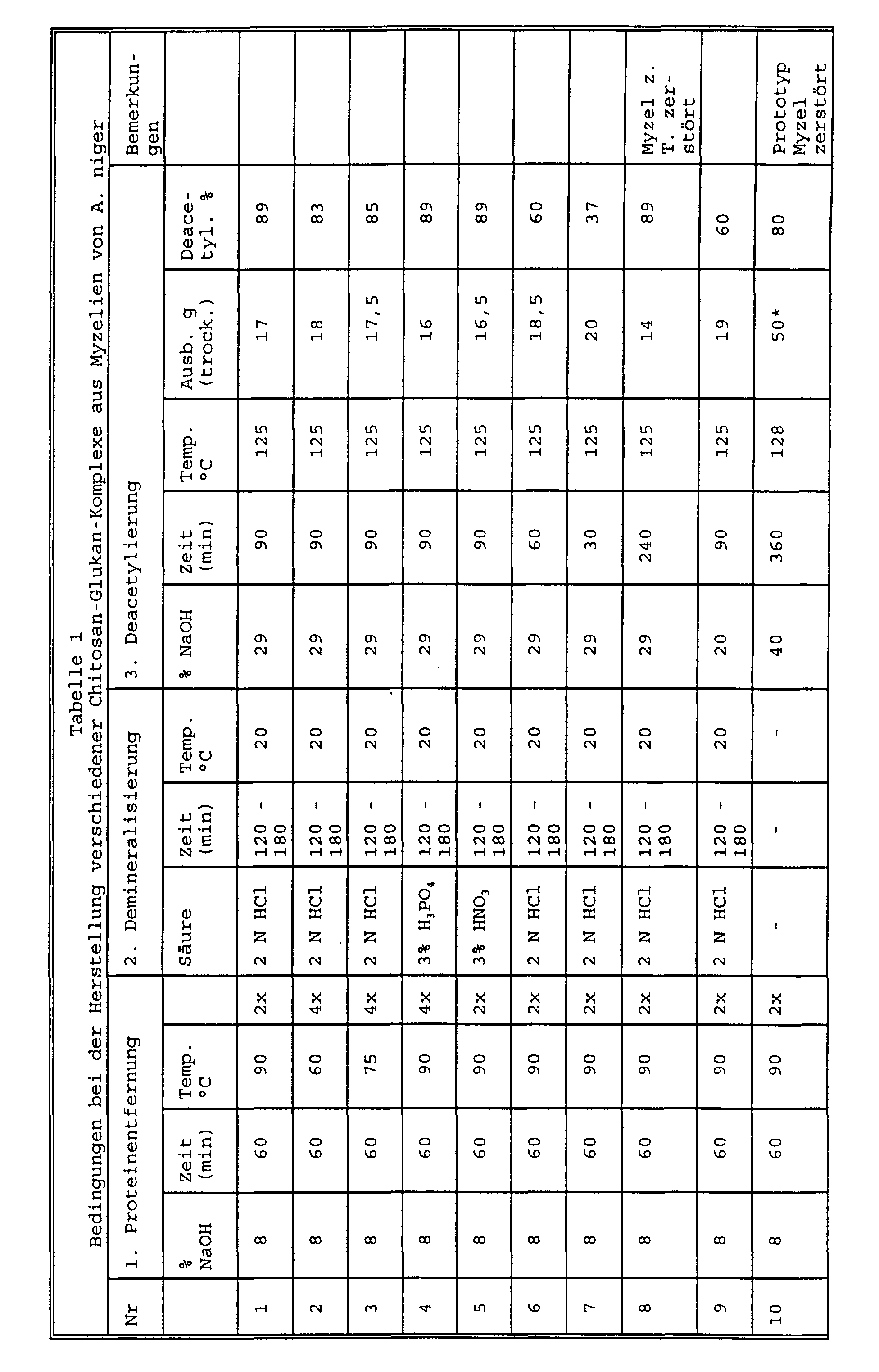



Claims (14)
- A process for the preparation of chitosan-glucan complexes from chitin-containing mycelia of microscopic fungi by treating the mycelia with solutions, characterized in thata) chitin-containing microorganisms are treated at least twice with a low concentration alkaline solution;b) followed by treating the product obtained from step a) with low concentration hydrochloric acid, nitric acid, ortho-phosphoric acid;c) followed by a further treatment for 60 to 120 min with an aqueous sodium or potassium hydroxide solution whose alkalinity is higher than that of said alkaline solution of step a) for incomplete deacetylation of the fraction obtained from step b);d) separating the solid components, discarding the supernatant, neutralization and washing the residue with water.
- The process according to claim 1, characterized in that said chitin-containing microorganisms are actinomycetes, Aspergillus, Penicillium, Blakeslea and/or yeasts.
- The process according to claim 1 and/or 2, characterized in that the treatment is performed with an 8% aqueous sodium hydroxide solution.
- The process according to at least one of claims 1 to 3, characterized in that the normality of the mineral acid is 2 N.
- The process according to at least one of claims 1 to 4, characterized in that the concentration of said aqueous sodium or potassium hydroxide solution is 29%.
- The process according to at least one of claims 1 to 5, characterized in that the treatment in step c) lasts between 30 or 60 min.
- A mass essentially consisting of a chitosan-glucan complex obtainable by a process according to at least one of claims 1 to 6.
- The mass according to claim 7, characterized by having the structure of the cell wall of the microorganisms from which the mass is derived.
- The mass according to claim 7 and/or 8, characterized by having an ash content of 3% or 8%.
- Use of a mass according to at least one of claims 7 to 9 as a sorption material for the removal and/or recovery of substances, especially heavy metals, from solutions.
- Use of a mass according to at least one of claims 7 to 9 as a biodegradable non-toxic sorption agent for heavy metal ions, dyes, proteins and fats.
- The use according to claim 11 as an enterosorbent in vivo.
- Use of a mass according to at least one of claims 7 to 9 as a wound-healing agent.
- Use of a mass according to at least one of claims 7 to 9 as a support for active substances for a sustained release of the active substances.
Applications Claiming Priority (3)
| Application Number | Priority Date | Filing Date | Title |
|---|---|---|---|
| DE19504640 | 1995-02-13 | ||
| DE19504640 | 1995-02-13 | ||
| PCT/EP1996/000590 WO1996025437A1 (en) | 1995-02-13 | 1996-02-12 | Process for producing chitosan-glucan complexes, compounds producible therefrom and their use |
Publications (2)
| Publication Number | Publication Date |
|---|---|
| EP0809657A1 EP0809657A1 (en) | 1997-12-03 |
| EP0809657B1 true EP0809657B1 (en) | 2001-10-24 |
Family
ID=7753770
Family Applications (1)
| Application Number | Title | Priority Date | Filing Date |
|---|---|---|---|
| EP96904067A Expired - Lifetime EP0809657B1 (en) | 1995-02-13 | 1996-02-12 | Process for producing chitosan-glucan complexes, compounds producible therefrom and their use |
Country Status (7)
| Country | Link |
|---|---|
| US (1) | US6333399B1 (en) |
| EP (1) | EP0809657B1 (en) |
| JP (1) | JPH11500159A (en) |
| AT (1) | ATE207501T1 (en) |
| AU (1) | AU4830896A (en) |
| DE (2) | DE19680077D2 (en) |
| WO (1) | WO1996025437A1 (en) |
Families Citing this family (26)
| Publication number | Priority date | Publication date | Assignee | Title |
|---|---|---|---|---|
| IT1286276B1 (en) * | 1996-10-24 | 1998-07-08 | Univ Bologna | METHOD FOR THE TOTAL OR PARTIAL REMOVAL OF PESTICIDES AND/OR PESTICIDES FROM FOOD LIQUIDS AND NOT THROUGH THE USE OF DERIVATIVES |
| SE515085C2 (en) * | 1998-04-20 | 2001-06-05 | Lizyx Ab | Porous structure comprising fungal cell walls |
| DE19911056B9 (en) * | 1999-03-12 | 2005-09-08 | Biotec Asa | Cosmetic preparations and their use |
| CA2313836C (en) * | 2000-03-15 | 2009-06-09 | Cargill, Incorporated | Chitosan and method of preparing chitosan |
| EP1206931A1 (en) * | 2000-11-15 | 2002-05-22 | ERPHAR Société d'Etudes et de Recherches Pharmaceutiques et Cosmétiques | Chitosan formulations |
| JP2004517066A (en) * | 2000-11-20 | 2004-06-10 | ダウ グローバル テクノロジーズ インコーポレイティド | In vivo use of water-absorbable polymers |
| US6693188B2 (en) | 2001-08-08 | 2004-02-17 | Cargill Incorporated | N-acetyl-D-glucosamine and process for producing N-acetyl-D-glucosamine |
| US20020115639A1 (en) * | 2001-02-16 | 2002-08-22 | Weiyu Fan | Glucosamine and method of making glucosamine from microbial blomass |
| US7816514B2 (en) | 2001-02-16 | 2010-10-19 | Cargill, Incorporated | Glucosamine and method of making glucosamine from microbial biomass |
| US8222232B2 (en) * | 2001-02-16 | 2012-07-17 | Cargill, Incorporated | Glucosamine and N-acetylglucosamine compositions and methods of making the same fungal biomass |
| US7923437B2 (en) * | 2001-02-16 | 2011-04-12 | Cargill, Incorporated | Water soluble β-glucan, glucosamine, and N-acetylglucosamine compositions and methods for making the same |
| US8715540B2 (en) * | 2002-01-16 | 2014-05-06 | MG3 Technologies Inc. | Aqueous and dry duel-action flame and smoke retardant and microbe inhibiting compositions, and related methods |
| US7767010B2 (en) * | 2002-01-16 | 2010-08-03 | Smt, Inc. | Flame retardant and microbe inhibiting methods and compositions |
| BE1014638A6 (en) * | 2002-02-12 | 2004-02-03 | Univ Liege | Method of preparation of derivatives of cell wall from biomass. |
| EP1497335A4 (en) * | 2002-04-02 | 2009-08-12 | Cargill Inc | Chitosan production |
| US20060058263A1 (en) * | 2002-11-01 | 2006-03-16 | Rogers Brent D | Heat pasturized liquids containing glucosamine |
| US20060003965A1 (en) * | 2002-11-01 | 2006-01-05 | Fosdick Lawrence D | N-acetyl-d-glucosamine (nag) supplemented food products and beverages |
| ATE426037T1 (en) | 2004-02-13 | 2009-04-15 | Alpron Co Ltd | METHOD FOR PRODUCING YEAST-derived GLUCAN |
| EP1756362A4 (en) * | 2004-06-01 | 2009-07-01 | Fpinnovations | ADDITIVE FOR MANUFACTURING PAPER |
| CZ299903B6 (en) * | 2006-01-17 | 2008-12-29 | Výzkumný ústav potravinárský Praha, v.v.i. | Isolation method of polysaccharide complex from cell walls of fungal mycelia by employing chemical hydrolysis |
| CZ303471B6 (en) * | 2007-10-03 | 2012-10-03 | Contipro Biotech S.R.O. | Composition containing chitosan-glucan intended for healing wounds and preventing adhesion of bandage to wound |
| RU2548178C2 (en) * | 2008-03-19 | 2015-04-20 | Агратек Интернэшнл, Инк. | Method of obtaining chitosan |
| PT104149B (en) * | 2008-07-30 | 2020-05-08 | 73100 - Setenta E Três Mil E Cem, Lda. | CO-PRODUCTION PROCESS OF CHITIN, ITS DERIVATIVES AND POLYMERS CONTAINING GLUCOSE, MANNOSIS AND / OR GALACTOSE, BY CULTIVATING THE PICHIA PASTORIS YEAST |
| JP5805522B2 (en) * | 2011-12-26 | 2015-11-04 | 株式会社Adeka | Powder composite and wound dressing |
| WO2014001589A1 (en) * | 2012-06-25 | 2014-01-03 | S.A. Damm | Fat binder obtained from biomass resulting from beer production |
| FR3016882A1 (en) | 2014-01-30 | 2015-07-31 | Sofradim Production | PROCESS FOR THE PREPARATION OF HIGH-DEGREE ACETYLATION CHITOSAN |
Family Cites Families (7)
| Publication number | Priority date | Publication date | Assignee | Title |
|---|---|---|---|---|
| IT1104351B (en) * | 1978-06-14 | 1985-10-21 | Muzzarelli Riccardo | THE GLUCAN COMPLEX CHITOSANO THE METHOD OF ITS PRODUCTION FROM MUSHROOMS AND YEASTS AND ITS USES |
| US4806474A (en) * | 1985-06-10 | 1989-02-21 | Miles Inc. | Preparation of mycelial chitosan and glucan fractions from microbial biomass |
| WO1990014071A2 (en) * | 1989-05-17 | 1990-11-29 | Rhone-Poulenc Chemicals Limited | Cosmetic preparations |
| US5488040A (en) * | 1989-09-08 | 1996-01-30 | Alpha-Beta Technology, Inc. | Use of neutral soluble glucan preparations to stimulate platelet production |
| GB2259709A (en) * | 1991-09-19 | 1993-03-24 | British Textile Tech | Production of chitin/chitosan |
| RU2043995C1 (en) * | 1992-12-29 | 1995-09-20 | Всероссийский научно-исследовательский институт пищевых ароматизаторов, кислот и красителей | Method of preparing glucane-chitosan complex |
| CA2215978A1 (en) * | 1995-04-04 | 1996-10-10 | Wound Healing Of Oklahoma | Cancer treatment by photodynamic therapy, in combination with an immunoadjuvant |
-
1996
- 1996-02-12 JP JP8524650A patent/JPH11500159A/en not_active Ceased
- 1996-02-12 WO PCT/EP1996/000590 patent/WO1996025437A1/en not_active Ceased
- 1996-02-12 AU AU48308/96A patent/AU4830896A/en not_active Abandoned
- 1996-02-12 EP EP96904067A patent/EP0809657B1/en not_active Expired - Lifetime
- 1996-02-12 US US08/894,142 patent/US6333399B1/en not_active Expired - Fee Related
- 1996-02-12 DE DE19680077T patent/DE19680077D2/en not_active Expired - Lifetime
- 1996-02-12 DE DE59608011T patent/DE59608011D1/en not_active Expired - Fee Related
- 1996-02-12 AT AT96904067T patent/ATE207501T1/en not_active IP Right Cessation
Also Published As
| Publication number | Publication date |
|---|---|
| WO1996025437A1 (en) | 1996-08-22 |
| ATE207501T1 (en) | 2001-11-15 |
| US6333399B1 (en) | 2001-12-25 |
| DE59608011D1 (en) | 2001-11-29 |
| EP0809657A1 (en) | 1997-12-03 |
| AU4830896A (en) | 1996-09-04 |
| DE19680077D2 (en) | 1998-02-12 |
| JPH11500159A (en) | 1999-01-06 |
Similar Documents
| Publication | Publication Date | Title |
|---|---|---|
| EP0809657A1 (en) | Process for producing chitosan-glucan complexes, compounds producible therefrom and their use | |
| DE2840503C2 (en) | Process for the preparation of a solid porous material for chromatographic purposes | |
| DE69828245T2 (en) | CHITINPERLENE, CHITOSANPERLENE, METHOD FOR THE PRODUCTION THEREOF, CARRIER MATERIALS MANUFACTURED THEREFROM AND METHOD OF MICROSPORENE | |
| DE2923802A1 (en) | CHITOSAN-GLUCAN COMPLEX AND PROCESS FOR PRODUCING IT | |
| DE4134854C2 (en) | ||
| DE2527884A1 (en) | PROCESS FOR THE IMMOBILIZATION OF BIOLOGICALLY ACTIVE SUBSTANCES ON CARRIER MATERIALS | |
| CH660026A5 (en) | POLYSACCHARIDES WITH ANTI-CARCINOGENIC EFFECT AND METHOD FOR THE PRODUCTION THEREOF. | |
| DE3139249C2 (en) | ||
| DE3407814A1 (en) | PHASE CARRIERS FOR DISTRIBUTION CHROMATOGRAPHY OF MACROMOLECULES, METHOD FOR THEIR PRODUCTION AND THEIR USE | |
| DE2224131A1 (en) | PROCESS FOR THE RECOVERY OF CHOLESTEROL OXYDASE | |
| DE69705023T2 (en) | ENZYMATIC GELLING OF POLYMER MATERIALS | |
| DE4429018C2 (en) | A process for producing an enzyme immobilizing carrier, regenerated porous chitosan carrier in particulate form and use of the carrier | |
| DE2815908A1 (en) | AGGLOMERATED FIBROUS CELLULOSE | |
| EP4257556A2 (en) | Particles with biozidal coating | |
| DE69224517T2 (en) | Carrier material and biocompatible anion exchanger | |
| DE3218697C2 (en) | ||
| DE60206764T2 (en) | USE OF MATERIAL BASED ON ORGANIC AND / OR INORGANIC FIBERS AND CHITOSAN FOR FIXING METALIONS | |
| DE2414521A1 (en) | ADSORPTION AGENTS | |
| DE2410693A1 (en) | PROCEDURE FOR IMMOBILIZING ENZYMES | |
| WO2002046294A1 (en) | Method for producing dimensionally stable, spherical carbohydrate particles and the use thereof | |
| DE3786927T2 (en) | ANTITHROMBOTIC DRUGS AND THEIR PRODUCTION. | |
| EP0054778B1 (en) | Process for preparing an anion exchanger, and its use | |
| EP3445865A1 (en) | Method for obtaining at least one or more beta-glucan compounds or a solids suspension containg beta glucan from yeast cells | |
| DE3634761C1 (en) | High-protoplasmic, large-scale fungal hyphae with high enzyme activity and process for their production | |
| DE19842785A1 (en) | Preparation of porous material with a hydrophilic and porous surface with functional ligands |
Legal Events
| Date | Code | Title | Description |
|---|---|---|---|
| PUAI | Public reference made under article 153(3) epc to a published international application that has entered the european phase |
Free format text: ORIGINAL CODE: 0009012 |
|
| 17P | Request for examination filed |
Effective date: 19970809 |
|
| AK | Designated contracting states |
Kind code of ref document: A1 Designated state(s): AT BE CH DE DK ES FR GB GR IE IT LI LU MC NL PT SE |
|
| 17Q | First examination report despatched |
Effective date: 19990602 |
|
| GRAG | Despatch of communication of intention to grant |
Free format text: ORIGINAL CODE: EPIDOS AGRA |
|
| RAP1 | Party data changed (applicant data changed or rights of an application transferred) |
Owner name: TESLENKO, ALEXANDER, DR. |
|
| GRAG | Despatch of communication of intention to grant |
Free format text: ORIGINAL CODE: EPIDOS AGRA |
|
| GRAH | Despatch of communication of intention to grant a patent |
Free format text: ORIGINAL CODE: EPIDOS IGRA |
|
| GRAH | Despatch of communication of intention to grant a patent |
Free format text: ORIGINAL CODE: EPIDOS IGRA |
|
| GRAA | (expected) grant |
Free format text: ORIGINAL CODE: 0009210 |
|
| RIN1 | Information on inventor provided before grant (corrected) |
Inventor name: NIKOLAEWNA, WOEWODINA, IRINA, ABION BETEILUNGS-UN Inventor name: TESLENKO, ALEXANDER |
|
| AK | Designated contracting states |
Kind code of ref document: B1 Designated state(s): AT BE CH DE DK ES FR GB GR IE IT LI LU MC NL PT SE |
|
| PG25 | Lapsed in a contracting state [announced via postgrant information from national office to epo] |
Ref country code: NL Free format text: LAPSE BECAUSE OF FAILURE TO SUBMIT A TRANSLATION OF THE DESCRIPTION OR TO PAY THE FEE WITHIN THE PRESCRIBED TIME-LIMIT Effective date: 20011024 Ref country code: IE Free format text: LAPSE BECAUSE OF FAILURE TO SUBMIT A TRANSLATION OF THE DESCRIPTION OR TO PAY THE FEE WITHIN THE PRESCRIBED TIME-LIMIT Effective date: 20011024 |
|
| REF | Corresponds to: |
Ref document number: 207501 Country of ref document: AT Date of ref document: 20011115 Kind code of ref document: T |
|
| REG | Reference to a national code |
Ref country code: CH Ref legal event code: EP |
|
| REG | Reference to a national code |
Ref country code: IE Ref legal event code: FG4D Free format text: GERMAN |
|
| REF | Corresponds to: |
Ref document number: 59608011 Country of ref document: DE Date of ref document: 20011129 |
|
| REG | Reference to a national code |
Ref country code: GB Ref legal event code: IF02 |
|
| PG25 | Lapsed in a contracting state [announced via postgrant information from national office to epo] |
Ref country code: SE Free format text: LAPSE BECAUSE OF FAILURE TO SUBMIT A TRANSLATION OF THE DESCRIPTION OR TO PAY THE FEE WITHIN THE PRESCRIBED TIME-LIMIT Effective date: 20020124 Ref country code: PT Free format text: LAPSE BECAUSE OF FAILURE TO SUBMIT A TRANSLATION OF THE DESCRIPTION OR TO PAY THE FEE WITHIN THE PRESCRIBED TIME-LIMIT Effective date: 20020124 Ref country code: DK Free format text: LAPSE BECAUSE OF FAILURE TO SUBMIT A TRANSLATION OF THE DESCRIPTION OR TO PAY THE FEE WITHIN THE PRESCRIBED TIME-LIMIT Effective date: 20020124 |
|
| PG25 | Lapsed in a contracting state [announced via postgrant information from national office to epo] |
Ref country code: GR Free format text: LAPSE BECAUSE OF FAILURE TO SUBMIT A TRANSLATION OF THE DESCRIPTION OR TO PAY THE FEE WITHIN THE PRESCRIBED TIME-LIMIT Effective date: 20020125 |
|
| GBT | Gb: translation of ep patent filed (gb section 77(6)(a)/1977) |
Effective date: 20020111 |
|
| PG25 | Lapsed in a contracting state [announced via postgrant information from national office to epo] |
Ref country code: LU Free format text: LAPSE BECAUSE OF NON-PAYMENT OF DUE FEES Effective date: 20020212 Ref country code: AT Free format text: LAPSE BECAUSE OF NON-PAYMENT OF DUE FEES Effective date: 20020212 |
|
| PG25 | Lapsed in a contracting state [announced via postgrant information from national office to epo] |
Ref country code: LI Free format text: LAPSE BECAUSE OF NON-PAYMENT OF DUE FEES Effective date: 20020228 Ref country code: CH Free format text: LAPSE BECAUSE OF NON-PAYMENT OF DUE FEES Effective date: 20020228 Ref country code: BE Free format text: LAPSE BECAUSE OF NON-PAYMENT OF DUE FEES Effective date: 20020228 |
|
| ET | Fr: translation filed | ||
| NLV1 | Nl: lapsed or annulled due to failure to fulfill the requirements of art. 29p and 29m of the patents act | ||
| PG25 | Lapsed in a contracting state [announced via postgrant information from national office to epo] |
Ref country code: ES Free format text: LAPSE BECAUSE OF FAILURE TO SUBMIT A TRANSLATION OF THE DESCRIPTION OR TO PAY THE FEE WITHIN THE PRESCRIBED TIME-LIMIT Effective date: 20020430 |
|
| REG | Reference to a national code |
Ref country code: IE Ref legal event code: FD4D |
|
| PLBE | No opposition filed within time limit |
Free format text: ORIGINAL CODE: 0009261 |
|
| STAA | Information on the status of an ep patent application or granted ep patent |
Free format text: STATUS: NO OPPOSITION FILED WITHIN TIME LIMIT |
|
| BERE | Be: lapsed |
Owner name: TESLENKO ALEXANDER Effective date: 20020228 |
|
| PG25 | Lapsed in a contracting state [announced via postgrant information from national office to epo] |
Ref country code: MC Free format text: LAPSE BECAUSE OF NON-PAYMENT OF DUE FEES Effective date: 20020901 |
|
| REG | Reference to a national code |
Ref country code: CH Ref legal event code: PL |
|
| 26N | No opposition filed | ||
| PGFP | Annual fee paid to national office [announced via postgrant information from national office to epo] |
Ref country code: GB Payment date: 20040309 Year of fee payment: 9 |
|
| PGFP | Annual fee paid to national office [announced via postgrant information from national office to epo] |
Ref country code: FR Payment date: 20040318 Year of fee payment: 9 |
|
| PGFP | Annual fee paid to national office [announced via postgrant information from national office to epo] |
Ref country code: DE Payment date: 20040407 Year of fee payment: 9 |
|
| PG25 | Lapsed in a contracting state [announced via postgrant information from national office to epo] |
Ref country code: IT Free format text: LAPSE BECAUSE OF NON-PAYMENT OF DUE FEES;WARNING: LAPSES OF ITALIAN PATENTS WITH EFFECTIVE DATE BEFORE 2007 MAY HAVE OCCURRED AT ANY TIME BEFORE 2007. THE CORRECT EFFECTIVE DATE MAY BE DIFFERENT FROM THE ONE RECORDED. Effective date: 20050212 Ref country code: GB Free format text: LAPSE BECAUSE OF NON-PAYMENT OF DUE FEES Effective date: 20050212 |
|
| PG25 | Lapsed in a contracting state [announced via postgrant information from national office to epo] |
Ref country code: DE Free format text: LAPSE BECAUSE OF NON-PAYMENT OF DUE FEES Effective date: 20050901 |
|
| GBPC | Gb: european patent ceased through non-payment of renewal fee |
Effective date: 20050212 |
|
| PG25 | Lapsed in a contracting state [announced via postgrant information from national office to epo] |
Ref country code: FR Free format text: LAPSE BECAUSE OF NON-PAYMENT OF DUE FEES Effective date: 20051031 |
|
| REG | Reference to a national code |
Ref country code: FR Ref legal event code: ST Effective date: 20051031 |