EP0809723B1 - Procédé de filature à chaud de polyuréthane et/ou polyuréthane-urée, et dispositif pour ce procédé - Google Patents
Procédé de filature à chaud de polyuréthane et/ou polyuréthane-urée, et dispositif pour ce procédé Download PDFInfo
- Publication number
- EP0809723B1 EP0809723B1 EP96902861A EP96902861A EP0809723B1 EP 0809723 B1 EP0809723 B1 EP 0809723B1 EP 96902861 A EP96902861 A EP 96902861A EP 96902861 A EP96902861 A EP 96902861A EP 0809723 B1 EP0809723 B1 EP 0809723B1
- Authority
- EP
- European Patent Office
- Prior art keywords
- prepolymer
- extruder
- spinning
- melt
- polyurethane
- Prior art date
- Legal status (The legal status is an assumption and is not a legal conclusion. Google has not performed a legal analysis and makes no representation as to the accuracy of the status listed.)
- Expired - Lifetime
Links
- 238000000034 method Methods 0.000 title claims abstract description 68
- 229920003226 polyurethane urea Polymers 0.000 title claims abstract description 19
- 239000004814 polyurethane Substances 0.000 title claims abstract description 16
- 229920002635 polyurethane Polymers 0.000 title claims abstract description 13
- 230000008569 process Effects 0.000 title abstract description 10
- 238000002074 melt spinning Methods 0.000 title abstract description 7
- 238000009987 spinning Methods 0.000 claims abstract description 46
- 125000005442 diisocyanate group Chemical group 0.000 claims abstract description 21
- 229920000642 polymer Polymers 0.000 claims abstract description 20
- 238000006243 chemical reaction Methods 0.000 claims abstract description 19
- 150000002009 diols Chemical class 0.000 claims abstract description 17
- 239000000654 additive Substances 0.000 claims abstract description 10
- 238000003756 stirring Methods 0.000 claims abstract description 8
- 238000002156 mixing Methods 0.000 claims abstract description 7
- 230000000996 additive effect Effects 0.000 claims abstract description 3
- 238000001816 cooling Methods 0.000 claims description 30
- 239000000155 melt Substances 0.000 claims description 30
- 238000010438 heat treatment Methods 0.000 claims description 22
- 238000002844 melting Methods 0.000 claims description 22
- 230000008018 melting Effects 0.000 claims description 22
- 239000007788 liquid Substances 0.000 claims description 17
- 238000002360 preparation method Methods 0.000 claims description 15
- 239000011261 inert gas Substances 0.000 claims description 8
- 239000000203 mixture Substances 0.000 claims description 7
- JBKVHLHDHHXQEQ-UHFFFAOYSA-N epsilon-caprolactam Chemical compound O=C1CCCCCN1 JBKVHLHDHHXQEQ-UHFFFAOYSA-N 0.000 claims description 6
- 125000001931 aliphatic group Chemical group 0.000 claims description 5
- 150000001875 compounds Chemical class 0.000 claims description 5
- 239000005057 Hexamethylene diisocyanate Substances 0.000 claims description 4
- -1 aromatic diamine compounds Chemical class 0.000 claims description 4
- 239000003381 stabilizer Substances 0.000 claims description 4
- AVXURJPOCDRRFD-UHFFFAOYSA-N Hydroxylamine Chemical class ON AVXURJPOCDRRFD-UHFFFAOYSA-N 0.000 claims description 2
- 239000000975 dye Substances 0.000 claims description 2
- 239000003995 emulsifying agent Substances 0.000 claims description 2
- 239000000049 pigment Substances 0.000 claims description 2
- 239000004014 plasticizer Substances 0.000 claims description 2
- 238000009423 ventilation Methods 0.000 claims description 2
- 239000003795 chemical substances by application Substances 0.000 claims 7
- 239000007787 solid Substances 0.000 claims 3
- 150000001732 carboxylic acid derivatives Chemical class 0.000 claims 2
- 230000004927 fusion Effects 0.000 claims 1
- 239000012748 slip agent Substances 0.000 claims 1
- 239000004970 Chain extender Substances 0.000 abstract description 16
- 238000006116 polymerization reaction Methods 0.000 abstract description 3
- 239000012530 fluid Substances 0.000 abstract 1
- 238000004519 manufacturing process Methods 0.000 description 12
- 239000007789 gas Substances 0.000 description 8
- 229910052751 metal Inorganic materials 0.000 description 8
- 239000002184 metal Substances 0.000 description 8
- 239000000047 product Substances 0.000 description 8
- 238000004804 winding Methods 0.000 description 6
- 230000000694 effects Effects 0.000 description 5
- 239000000126 substance Substances 0.000 description 5
- NBIIXXVUZAFLBC-UHFFFAOYSA-N Phosphoric acid Chemical compound OP(O)(O)=O NBIIXXVUZAFLBC-UHFFFAOYSA-N 0.000 description 4
- 238000004140 cleaning Methods 0.000 description 4
- 230000000875 corresponding effect Effects 0.000 description 4
- 229920000909 polytetrahydrofuran Polymers 0.000 description 4
- 238000012545 processing Methods 0.000 description 4
- 230000002123 temporal effect Effects 0.000 description 4
- 238000012549 training Methods 0.000 description 4
- 241000237858 Gastropoda Species 0.000 description 3
- ISWSIDIOOBJBQZ-UHFFFAOYSA-N Phenol Chemical compound OC1=CC=CC=C1 ISWSIDIOOBJBQZ-UHFFFAOYSA-N 0.000 description 3
- QVGXLLKOCUKJST-UHFFFAOYSA-N atomic oxygen Chemical compound [O] QVGXLLKOCUKJST-UHFFFAOYSA-N 0.000 description 3
- 230000015572 biosynthetic process Effects 0.000 description 3
- 230000007717 exclusion Effects 0.000 description 3
- 239000000835 fiber Substances 0.000 description 3
- RRAMGCGOFNQTLD-UHFFFAOYSA-N hexamethylene diisocyanate Chemical compound O=C=NCCCCCCN=C=O RRAMGCGOFNQTLD-UHFFFAOYSA-N 0.000 description 3
- 239000001301 oxygen Substances 0.000 description 3
- 229910052760 oxygen Inorganic materials 0.000 description 3
- 230000000704 physical effect Effects 0.000 description 3
- 238000003860 storage Methods 0.000 description 3
- 238000005496 tempering Methods 0.000 description 3
- 238000012546 transfer Methods 0.000 description 3
- IJGRMHOSHXDMSA-UHFFFAOYSA-N Atomic nitrogen Chemical compound N#N IJGRMHOSHXDMSA-UHFFFAOYSA-N 0.000 description 2
- CURLTUGMZLYLDI-UHFFFAOYSA-N Carbon dioxide Chemical compound O=C=O CURLTUGMZLYLDI-UHFFFAOYSA-N 0.000 description 2
- ABLZXFCXXLZCGV-UHFFFAOYSA-N Phosphorous acid Chemical compound OP(O)=O ABLZXFCXXLZCGV-UHFFFAOYSA-N 0.000 description 2
- 239000002253 acid Substances 0.000 description 2
- 229910000147 aluminium phosphate Inorganic materials 0.000 description 2
- 150000003857 carboxamides Chemical class 0.000 description 2
- 239000002274 desiccant Substances 0.000 description 2
- 238000009826 distribution Methods 0.000 description 2
- 229920001971 elastomer Polymers 0.000 description 2
- 239000000806 elastomer Substances 0.000 description 2
- 239000010408 film Substances 0.000 description 2
- 230000036541 health Effects 0.000 description 2
- 239000000463 material Substances 0.000 description 2
- 230000001105 regulatory effect Effects 0.000 description 2
- 238000003303 reheating Methods 0.000 description 2
- 239000004576 sand Substances 0.000 description 2
- 238000007789 sealing Methods 0.000 description 2
- 238000010008 shearing Methods 0.000 description 2
- 238000001228 spectrum Methods 0.000 description 2
- HVLLSGMXQDNUAL-UHFFFAOYSA-N triphenyl phosphite Chemical compound C=1C=CC=CC=1OP(OC=1C=CC=CC=1)OC1=CC=CC=C1 HVLLSGMXQDNUAL-UHFFFAOYSA-N 0.000 description 2
- 238000010792 warming Methods 0.000 description 2
- PNODHUVFEYBMIV-UHFFFAOYSA-L P([O-])([O-])=O.[Na+].C1=CC=CC=C1.[Na+] Chemical compound P([O-])([O-])=O.[Na+].C1=CC=CC=C1.[Na+] PNODHUVFEYBMIV-UHFFFAOYSA-L 0.000 description 1
- 239000012963 UV stabilizer Substances 0.000 description 1
- 238000013459 approach Methods 0.000 description 1
- 150000001565 benzotriazoles Chemical class 0.000 description 1
- 239000003990 capacitor Substances 0.000 description 1
- 239000001569 carbon dioxide Substances 0.000 description 1
- 229910002092 carbon dioxide Inorganic materials 0.000 description 1
- 230000015556 catabolic process Effects 0.000 description 1
- 239000007795 chemical reaction product Substances 0.000 description 1
- 239000002826 coolant Substances 0.000 description 1
- 125000004122 cyclic group Chemical group 0.000 description 1
- 230000003247 decreasing effect Effects 0.000 description 1
- 238000007872 degassing Methods 0.000 description 1
- 238000006731 degradation reaction Methods 0.000 description 1
- 238000013461 design Methods 0.000 description 1
- ZBCBWPMODOFKDW-UHFFFAOYSA-N diethanolamine Chemical compound OCCNCCO ZBCBWPMODOFKDW-UHFFFAOYSA-N 0.000 description 1
- 238000011143 downstream manufacturing Methods 0.000 description 1
- 238000001035 drying Methods 0.000 description 1
- 230000009977 dual effect Effects 0.000 description 1
- 238000005485 electric heating Methods 0.000 description 1
- 150000002148 esters Chemical class 0.000 description 1
- 238000002474 experimental method Methods 0.000 description 1
- 238000000605 extraction Methods 0.000 description 1
- 238000001125 extrusion Methods 0.000 description 1
- 239000004744 fabric Substances 0.000 description 1
- 230000002349 favourable effect Effects 0.000 description 1
- 238000011049 filling Methods 0.000 description 1
- 239000003063 flame retardant Substances 0.000 description 1
- 238000011010 flushing procedure Methods 0.000 description 1
- 230000006870 function Effects 0.000 description 1
- 239000003292 glue Substances 0.000 description 1
- 239000012760 heat stabilizer Substances 0.000 description 1
- 238000009434 installation Methods 0.000 description 1
- 239000004611 light stabiliser Substances 0.000 description 1
- 239000000314 lubricant Substances 0.000 description 1
- 238000012423 maintenance Methods 0.000 description 1
- 238000005259 measurement Methods 0.000 description 1
- 238000012986 modification Methods 0.000 description 1
- 230000004048 modification Effects 0.000 description 1
- 229910052757 nitrogen Inorganic materials 0.000 description 1
- 238000010525 oxidative degradation reaction Methods 0.000 description 1
- 150000003018 phosphorus compounds Chemical class 0.000 description 1
- 229920003023 plastic Polymers 0.000 description 1
- 239000004033 plastic Substances 0.000 description 1
- 238000012667 polymer degradation Methods 0.000 description 1
- 238000004886 process control Methods 0.000 description 1
- 238000005086 pumping Methods 0.000 description 1
- 239000002994 raw material Substances 0.000 description 1
- 239000000376 reactant Substances 0.000 description 1
- 150000003839 salts Chemical class 0.000 description 1
- 238000004904 shortening Methods 0.000 description 1
- 235000019830 sodium polyphosphate Nutrition 0.000 description 1
- 239000002904 solvent Substances 0.000 description 1
- 239000007858 starting material Substances 0.000 description 1
- ISIJQEHRDSCQIU-UHFFFAOYSA-N tert-butyl 2,7-diazaspiro[4.5]decane-7-carboxylate Chemical compound C1N(C(=O)OC(C)(C)C)CCCC11CNCC1 ISIJQEHRDSCQIU-UHFFFAOYSA-N 0.000 description 1
- 239000010409 thin film Substances 0.000 description 1
- GGUBFICZYGKNTD-UHFFFAOYSA-N triethyl phosphonoacetate Chemical compound CCOC(=O)CP(=O)(OCC)OCC GGUBFICZYGKNTD-UHFFFAOYSA-N 0.000 description 1
- XZZNDPSIHUTMOC-UHFFFAOYSA-N triphenyl phosphate Chemical compound C=1C=CC=CC=1OP(OC=1C=CC=CC=1)(=O)OC1=CC=CC=C1 XZZNDPSIHUTMOC-UHFFFAOYSA-N 0.000 description 1
- XLYOFNOQVPJJNP-UHFFFAOYSA-N water Substances O XLYOFNOQVPJJNP-UHFFFAOYSA-N 0.000 description 1
- 238000003466 welding Methods 0.000 description 1
Images


Classifications
-
- D—TEXTILES; PAPER
- D01—NATURAL OR MAN-MADE THREADS OR FIBRES; SPINNING
- D01F—CHEMICAL FEATURES IN THE MANUFACTURE OF ARTIFICIAL FILAMENTS, THREADS, FIBRES, BRISTLES OR RIBBONS; APPARATUS SPECIALLY ADAPTED FOR THE MANUFACTURE OF CARBON FILAMENTS
- D01F6/00—Monocomponent artificial filaments or the like of synthetic polymers; Manufacture thereof
- D01F6/58—Monocomponent artificial filaments or the like of synthetic polymers; Manufacture thereof from homopolycondensation products
- D01F6/70—Monocomponent artificial filaments or the like of synthetic polymers; Manufacture thereof from homopolycondensation products from polyurethanes
-
- C—CHEMISTRY; METALLURGY
- C08—ORGANIC MACROMOLECULAR COMPOUNDS; THEIR PREPARATION OR CHEMICAL WORKING-UP; COMPOSITIONS BASED THEREON
- C08G—MACROMOLECULAR COMPOUNDS OBTAINED OTHERWISE THAN BY REACTIONS ONLY INVOLVING UNSATURATED CARBON-TO-CARBON BONDS
- C08G18/00—Polymeric products of isocyanates or isothiocyanates
- C08G18/06—Polymeric products of isocyanates or isothiocyanates with compounds having active hydrogen
- C08G18/08—Processes
- C08G18/0895—Manufacture of polymers by continuous processes
-
- C—CHEMISTRY; METALLURGY
- C08—ORGANIC MACROMOLECULAR COMPOUNDS; THEIR PREPARATION OR CHEMICAL WORKING-UP; COMPOSITIONS BASED THEREON
- C08G—MACROMOLECULAR COMPOUNDS OBTAINED OTHERWISE THAN BY REACTIONS ONLY INVOLVING UNSATURATED CARBON-TO-CARBON BONDS
- C08G18/00—Polymeric products of isocyanates or isothiocyanates
- C08G18/06—Polymeric products of isocyanates or isothiocyanates with compounds having active hydrogen
- C08G18/08—Processes
- C08G18/10—Prepolymer processes involving reaction of isocyanates or isothiocyanates with compounds having active hydrogen in a first reaction step
-
- C—CHEMISTRY; METALLURGY
- C08—ORGANIC MACROMOLECULAR COMPOUNDS; THEIR PREPARATION OR CHEMICAL WORKING-UP; COMPOSITIONS BASED THEREON
- C08G—MACROMOLECULAR COMPOUNDS OBTAINED OTHERWISE THAN BY REACTIONS ONLY INVOLVING UNSATURATED CARBON-TO-CARBON BONDS
- C08G18/00—Polymeric products of isocyanates or isothiocyanates
- C08G18/06—Polymeric products of isocyanates or isothiocyanates with compounds having active hydrogen
- C08G18/28—Polymeric products of isocyanates or isothiocyanates with compounds having active hydrogen characterised by the compounds used containing active hydrogen
- C08G18/40—High-molecular-weight compounds
- C08G18/48—Polyethers
- C08G18/4854—Polyethers containing oxyalkylene groups having four carbon atoms in the alkylene group
-
- D—TEXTILES; PAPER
- D01—NATURAL OR MAN-MADE THREADS OR FIBRES; SPINNING
- D01D—MECHANICAL METHODS OR APPARATUS IN THE MANUFACTURE OF ARTIFICIAL FILAMENTS, THREADS, FIBRES, BRISTLES OR RIBBONS
- D01D5/00—Formation of filaments, threads, or the like
- D01D5/08—Melt spinning methods
Definitions
- the invention relates to a method for melt spinning of polyurethane and / or polyurethane urea, in which a prepolymer is produced, the one Contains melting aid, a device for Carrying out the procedure and using this procedure manufactured threads.
- EP 0 553 944 describes a thermally stable processable Melt of polyurethane and / or polyurethane urea elastomers known.
- This melt will produced by a polyaddition or building reaction of longer-chain diols with diisocyanate, chain extenders and a polar gel and / or Melting aids.
- a gel and / or melting aid carboxamide is proposed here.
- this Melt can be processed into shaped articles can.
- One of the methods used here is Melting spinning mentioned. However, there are no others Details revealed how this melt spinning this melt is to take place.
- the invention is according to the method by the characterizing Features of claim 1 solved in relation to the device by the features of claim 23.
- the sub-claims show advantageous Further training.
- a first process stage first to produce a prepolymer that is a reaction product from an organic diisocyanate and a polymer Diol contains and then only in a second downstream Process stage (process step b) after Cooling this prepolymer by 10 to 50 K the gel and / or Add melting aids.
- Process step b second downstream Process stage
- Process step c added with a chain extender while stirring.
- this prepolymer as above described manufactured in the molten State is fed to an extruder and then subsequently the resulting polymer melt over Spinnerets for polyurethane and / or polyurethane urea threads is spun.
- the exact sequence of process steps a to e It has been shown that only with compliance the procedure described above Polyurethane and / or polyurethane urea threads with obtain usable physical properties become.
- the procedure is such that the starting components, ie the diol and the organic diisocyanate, are preferably introduced separately in the liquid state and then reacted in a suitable reaction vessel, for example a stirred reactor.
- the reaction temperature depends on the selected starting components and is in the range from 50 to 150 ° C.
- the reaction is carried out until a complete or almost complete reaction of the diol with the diisocyanate is achieved. It is preferred if a ratio of diol to diisocyanate (in moles to moles) of 1: 1.1 to 1: 10.0 is maintained.
- the molar ratio is particularly preferably 1: 1.4 to 1: 4.
- the starting compounds can be used in pure form or as a mixture.
- the invention includes all of the diisocyanates or polymeric diols known to date for the production of polyurethane and / or polyurethane urea.
- the invention includes in particular the compounds mentioned in EP 0 553 944. It is preferred if uncapped and / or capped diisocyanate is used as the organic diisocyanate.
- uncapped and / or capped diisocyanate is used as the organic diisocyanate.
- hexamethylene diisocyanate is particularly preferred.
- the hydroxypolyethers and / or the hydroxypolyesters are preferred.
- the use of polytetrahydrofuran is very particularly suitable for the process according to the invention.
- the polymeric diols preferably have a molar mass of 1000 to 3000 g / mol and a molar mass ratio of M w / M n ⁇ 2.0. Compliance with these conditions has proven to be particularly favorable for the properties of the threads. It is possible to influence the product properties through the different installation of the hard segments in statistical or non-statistical distribution.
- chain extender After adding the gel and / or melting aid becomes a chain extender, also under intense Stir added.
- the intense stirring has in this stage of the process, the task of an almost complete and homogeneous distribution of the chain extender im manufactured as described above To achieve prepolymer.
- the chain extender is not after the addition of the gel and / or melting aid is used, but simultaneously with the gel and / or Melting aids.
- the chain extender can alternatively be fed into the extruder.
- chain extenders everyone comes from State of the art previously known chain extenders in the production of polyurethane and / or polyurethane urea melts in question.
- aliphatic dihydroxy compounds examples include aliphatic and / or arylaliphatic hydroxyamine compounds, aliphatic and / or aromatic diamine compounds or their mixtures.
- trifunctional chain extenders be used for modification. This serves e.g. to improve the dyeability.
- the amount of chain extender is determined by the one specified Molar ratio of diol to diisocyanate (1: 1.1 up to 1:10).
- Add a, b and / or c additives are also possible to use in the process step Add a, b and / or c additives.
- the additive like the chain extender, it can also be directly attached to the Extruders are fed.
- Additives are stabilizers (e.g. heat stabilizers) Plasticizers, lubricants, spinning aids, Flame retardants, pigments, dyes, color additives or emulsifiers.
- stabilizers against thermal degradation and oxidative degradation are suitable sterically hindered phenol and phosphorus compounds, such as.
- Esters of phosphoric acid e.g. triphenyl phosphate
- phosphorous acid e.g.
- triphenyl phosphite examples include triphenyl phosphite), phosphonic acid (e.g. diethylethoxycarbonylmethylphosphonate), phosphonic acid (e.g. Benzene phosphonic acid sodium salt) and salts of Phosphoric acid (e.g. sodium polyphosphate).
- phosphonic acid e.g. diethylethoxycarbonylmethylphosphonate
- phosphonic acid e.g. Benzene phosphonic acid sodium salt
- salts of Phosphoric acid e.g. sodium polyphosphate
- Examples for a sterically hindered phenol is phenol with the CAS number 6683
- examples of UV and light stabilizers are compounds of benzotriazoles.
- the viscosity of the prepolymer as described above ranges from 1 to 200 Pa ⁇ s at 80 ° C, and the molecular weight of the prepolymer increases Values from 1,000 to 5,000 g / mol.
- this prepolymer is already a homogeneous Reaction system represents, so that a polymerization now only be done specifically by increasing the temperature can.
- the continuation of the polyaddition reaction made in an extruder thereby there is a possibility that by dimensioning and the operation of the extruder the polyaddition conditions targeted and thus also can be influenced.
- a twin screw extruder is preferred used in which the snails are closely intermeshing and have a high self-cleaning effect have and at the same time mixing well and are shearing.
- the screws are preferably configured that the narrowest possible residence time spectrum to achieve a uniform product quality is achieved.
- the snails have a high L / D ratio to (20 to 60, preferably 25 to 60).
- the extruder comes with a high temperature profile time constant temperature operated.
- the polymer melt obtained after process step d becomes polyurethane and / or via spinnerets Spun polyurethane urea threads.
- the prepolymer after Method step c it is also possible to do this in in a liquid state. It has been shown that in particular the prepolymer melt, the has been obtained after step c, even without stabilizers that increase storage stability Can be stored for at least one week in the absence of air is. It is the same with the cooled polymer melt, obtained after process step d has been. This is also at least in the absence of air one week shelf life.
- melt spun to the corresponding threads via spinnerets As already described above, the melt spun to the corresponding threads via spinnerets. Depending on the reaction-typical and temporal Course of the polyaddition of the chemical used Systems thus passes through a particular one Melt viscosity value distinguished polymer melt in the spinning head.
- This viscosity value can be between 150 and 10,000 Pa ⁇ s, measured at the Temperature of the melt line.
- the melt viscosity can be influenced in certain areas by higher temperatures lower the viscosity. It is important that the viscosity immediately before the Spinneret does not exceed 3,000 Pa ⁇ s.
- the temperatures of the spinning head are preferred in kept in a range of 210 to 240 ° C. Too high Temperatures harbor the risk of polymer degradation beginning in itself.
- the spin pack preferably consists of one or several filter elements made of filter cloth, metal fiber fleece inlays, Sintered metal plates or Sand fillings can consist of sealing elements and support elements as well as the spinneret plate.
- Cooling is preferred here in made a cooling shaft, this transverse or can be ventilated parallel to the running direction. The the resulting exhaust air is extracted and carried away.
- Another preferred embodiment proposes that the filaments after exiting the spinnerets, however in front of the cooling shaft, still led through a post-heating zone become.
- a zone can also be used instead in which warm air is coated, e.g. with air or inert gas.
- warm air e.g. with air or inert gas.
- For the post-heating section are depending on the polymer composition and process control Lengths from 100 to 300 mm and heating temperatures from 50 to 200 ° C. This measure has been due to better structural training of filaments proven. However, it is also possible, good spinning and thread properties with complete No need to find reheating.
- the other cooling conditions implemented in the cooling shaft of the filaments are from the speed the cross-flow to the longitudinal axis of the cooling shaft moving air and its temperature.
- Limit values can apply 0.2 to 1.0 m / s and 10 to 80 ° C.
- the parallel flow has values of 0.3 up to 3 m / s, at temperatures between 10 and 80 ° C.
- Threads of certain fineness, firmness, Stretch and elasticity With a subsequent one Heat treatment of the thread, for example on the coil, with a temperature of 60 to 130 ° C and a heat treatment time of 1 to 48 hours, the property values for strength, Increase the stretch and elastic part of the stretch again.
- the heat treatment is preferred under air and Exclusion of moisture made.
- the present method can also for the production of wires and profiles and other semi-finished plastic products based on Polyurethane or polyurethane urea can be used.
- an extrusion tool is attached to the extruder with known take-off and winding or Cut-off devices arranged.
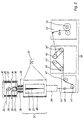
- Figure 1 shows an exemplary embodiment for Preparation of the prepolymer, i.e. the device, which includes the process steps a to d.
- the tempering of the liquid or melted Starting components follows the example 1 in double jacket containers 1 to 4, also with a stirrer and / or pumping devices (not shown) can be equipped.
- the tempering can also be over external heat exchangers take place.
- the transport, the storage and processing of the reactants is preferably carried out under inert gas and under Exclusion of oxygen and acid gases, e.g. Carbon dioxide and moisture.
- oxygen and acid gases e.g. Carbon dioxide and moisture.
- the dosing units 5 to 8 are added in batches of the starting components via temperature-controlled pipes 11 in a stirred reactor 16. for metering a feed 10 is additionally provided for additives, which are controlled by means of the metering pump 9 can.
- the determination of the necessary quantities can e.g. both volumetric and gravimetric.
- the stirred reactor 16 is equipped with a temperature control system. The tempering is preferably carried out via vaporous or liquid heat transfer media. The heating or cooling capacity is according to the in the product room a sensor 15 temperature controlled and kept at set temperature. Prepolymer production takes place in the stirred reactor 16 preferably under Ambient pressure. Depending on the steam pressure used Output components can also be operated under elevated conditions Pressure may be required.
- the stirred reactor 16 is with an agitator drive that can be changed in speed 14 equipped. In one with cooling medium charged capacitor 13 can with the Inert gas flushing condensed products discharged and be returned.
- the continuation of the polyaddition reaction takes place in a twin screw extruder 49 instead.
- 1 is a double-screw extruder running in the same direction.
- the screws 19 are closely meshing with one high self-cleaning effect, good mixing and shearing.
- the screws 19 are configured so that a as narrow a residence time spectrum as possible to achieve uniform product quality is achieved.
- the screws 19 have a high L / D ratio (20 to 60, preferably 25 to 60).
- the extruder 49 is with a temperature profile with high temporal Operated consistently. Heating the extruder 49 takes place here via individual electrical heating jackets 21.
- the prepolymer from the stirred reactor 16 is via a heated line 17 and conveyor 18, preferably a gear pump, the extruder feed shaft 20 dosed so that a complete filling all worm threads guaranteed with the machine running becomes. It is also possible that with several extruders 49 is operated. In this case can then the heated line 17 according to the Number of extruders can be split 49 or it separate lines can be used.
- the temperature in the feed shaft 20 is below the reaction temperature the chain building reaction. About the Temperature regime of extruder 49 becomes the rate of polymerization the polymer build-up reaction controlled melt processable melt.
- the pressure difference building up in the extruder 49 should assume values ⁇ 100 bar, because backflow effects and too high shear, to avoid reducing the product quality are.
- a minimum pressure must be available for stable support on Suction flange 22 of the heated pressure pump 23 are present.
- the extruder 49 is preferably in the feed shaft 20 operated without pressure. Alternatively, an infeed of the prepolymer or individual components also under Pressure. For example, the chain extender and additives also only in the extruder 49 in corresponding Mixing zones are fed.
- the melting line 24 is to be tempered exactly. The pressure drop in the melt line delivers during operation with otherwise constant temperature conditions and throughput statements for control the polymer build-up reaction.
- FIG. 2 now shows the schematic structure of the spinning Part of the device.
- the melt line 24 reaches the polymer melt Spinning head 25.
- the spinning head 25 has the task of To transform polymer melt into individual melt jets, the filaments in the downstream cooling shaft 57 27 freeze.
- the cooling shaft 57 is in the Embodiment according to FIG. 2 essentially from one cylindrical device 26.
- Spinning pump called motor-driven gear pump 28
- the spin pack 29 consists of filter elements for Cleaning the conveyed melt, from sealing and Support elements and the spinneret plate 30th
- the spinning head 25 as a whole is coated with a liquid or steam-heated double jacket or with surrounded by an electric heating jacket 31 and thermally insulated 32. Detected inside a sensor 33 the current temperature and causes their regulation according to the setpoint. Farther exists in the melt stream after the spinning pump 28 Pressure sensor 34, the so-called spinning pressure monitors and procedural irregularities as well as the Filter occupancy rate can be seen.
- melt jets emerge from the spinneret 30 in the free space they have to cool to to solidify. It can be used in the individual filaments beginning structural training desired or may be necessary to cool down at first Spinneret 30 to slow down the next section.
- the length and temperature can be varied heated tube 35, the cross section of which is sufficient is large so that it is not too comes into contact with the wall through the filaments.
- the Wall temperature or near-wall temperature of the so-called Post-heater is replaced by another sensor 36 determined and also regulated.
- the filaments pass through for further cooling the cooling shaft 57, which in the example is transverse to the thread running direction is ventilated.
- the cooling air is then 37 aspirated, causing cooling air to the filaments 27 is introduced and at the same time vapors that the Filaments 27 and the harmful to health can be deliberately dissipated.
- the filaments are all subordinate to the cooling shaft 57 Devices referred to as spinning machine 56.
- the filaments come 27 in contact with a preparation device 40, which is the filament bundle that is now a closed Thread 42 forms with one the further processing securing oily film wrapped before the thread of of the first godet 41 detected and continuously as one Solidified thread 42 spun from a melt is subtracted.
- the filaments can also be passed through before or after the false twist device arranged in the preparation device 40 (not shown) received rotation, which already bundle the filaments in Spinning shaft or downpipe leads.
- the preparation device can 40 more or less distant from the Spinneret 30 may be arranged.
- the filament bundle is not transverse, but with a cooling shaft 57 parallel to the running direction flowed with air or an inert gas.
- the Structure of the spinning head 25 and the spinning machine 56 corresponds to that according to FIG. 2.
- the cooling shaft 57 is structured as follows:
- the thread runs behind the reheating zone 35 through a porous tube 50, e.g. made of sintered metal.
- a porous tube 50 e.g. made of sintered metal.
- This gas flow has the task in the following downpipe 51 a defined axial temperature profile in Thread 42 to adjust the formation of orderly Structures in the polymer as well as a further increase of sales of chemical chain growth reactions favored. Both processes improve the thread properties.
- the downpipe 51 can be heated from the outside (electric, with steam or a liquid Heat transfer). Its length depends heavily on the chemical Composition of the polymer and of the thread speed from. Systems with slow post-reaction and structure training require great lengths.
- a second one porous tube 52 with double jacket attached by that the gas flow is sucked out At the lower end of the downpipe 51 is a second one porous tube 52 with double jacket attached by that the gas flow is sucked out. among them can be arranged another such device 53 through which a gas flow is introduced, the cools the thread 42 and the escape of (health) harmful Prevents gases. This gas flow rises to the top and is suctioned off in 52.
- this Place mechanically through an appropriate device 54 brought a false twist on the thread 42, the one for welding the individual filaments in the downpipe leads.
- the Thread 42 is passed through a swirl nozzle.
- the further one The procedure corresponds to that of FIG. 2.
- the invention is illustrated below by three examples described in more detail. The procedure was carried out using a device according to FIG. 1 in connection with FIG. 2 carried out.
- the P-THF was melted in a heating chamber 1 and at a temperature of 50 ° C and with a vacuum of approximately 1 mbar and in the presence of Desiccant dried for about 48 hours.
- the required Quantity was the Stirred reactor 16 fed. At the same time it was followed made sure that the remaining components in sufficient pure and dry form.
- the stirring reactor was then briefly evacuated with subsequent nitrogen exposure. After the stirred reactor contents are heated to 80 ° C the diisocyanate was added, with strong mixing using an anchor stirrer was realized. Then the stirred reactor brought to a temperature of 120 ° C and leave at this level for 2.5 hours.
- the twin screw extruder used here had the following features: Screw diameter 28 mm screw length 780 mm Number of heating / cooling zones 7 snails rotating in the same direction, thread profiles, continuously decreasing pitch
- the prepolymer was metered in such a way that the Screws in the feed shaft 20 were filled, whereby 20 normal pressure prevailed in the feed shaft.
- the temperature profile was steadily increasing.
- the heating zone temperature ranged between 150 and 180 ° C.
- the Extruder ran at a speed of 30 rpm.
- the Pressure at the extruder head was 21 bar with a throughput of 500 g / h.
- the pressure pump 23 promoted the Melt in a heated with heat transfer medium of 185 ° C Line 24 of approximately 2300 mm in length and a diameter of 7 mm to the spinning pump 28 and the spinning head 25th
- the spinning head 25 had a temperature of 217 ° C. His gear spinning pump 28 was on a delivery rate set at 500 g / h.
- the melt flowed through a sieve of 40 ⁇ m Mesh size and a 5 mm thick sintered metal plate of 150 ⁇ m grain size before going out of five holes a spinneret 30 emerged as a melt jet.
- the Bores were 0.5 mm in diameter and 1.0 mm in capillary length on.
- the five solidifying filaments 27 passed a post-heating zone 35 of 100 mm in length and 100 ° C temperature.
- melt flow was before Spinning head discharged through a bypass valve.
Landscapes
- Chemical & Material Sciences (AREA)
- Engineering & Computer Science (AREA)
- Chemical Kinetics & Catalysis (AREA)
- Health & Medical Sciences (AREA)
- Textile Engineering (AREA)
- Medicinal Chemistry (AREA)
- Polymers & Plastics (AREA)
- Organic Chemistry (AREA)
- General Chemical & Material Sciences (AREA)
- Mechanical Engineering (AREA)
- Manufacturing & Machinery (AREA)
- Artificial Filaments (AREA)
- Spinning Methods And Devices For Manufacturing Artificial Fibers (AREA)
Abstract
Claims (26)
- Procédé en vue de la filature à chaud de polyuréthanne et/ou de polyuréthanne-urée, dans lequel on prépare un prépolymère à partir d'un diol polymère et d'un diisocyanate organique, et on ajoute à ce prépolymère un agent gélifiant et/ou un agent activateur de la fusion et un agent de prolongation de chaínes,a) le prépolymère étant préparé par mélange à une température de 50 à 150°C,b) le niveau de température étant abaissé ensuite de 5 à 50°C et, après abaissement du niveau de température, un agent de gélifiant et/ou un agent activateur de la fusion étant ajouté(s) à l'état liquide,c) ce prépolymère étant mélangé, avec maintien de son état de masse en fusion, sous agitation, à un agent de prolongation de chaínes,d) ce prépolymère à l'état de masse en fusion étant acheminé à une extrudeuse, la polymérisation se faisant à température élevée dans l'extrudeuse,e) cette masse de polymère étant filé par l'intermédiaire de filières pour former des fils de polyuréthanne et/ou de polyuréthanne-urée.
- Procédé selon la revendication 1, caractérisé en ce que, lors de la préparation du prépolymère (étape de procédé a), l'on introduit initialement le diol polymère à l'état liquide et en ce que l'on ajoute par mélange le composant de diisocyanate organique à l'état liquide ou à l'état de masse en fusion, en agitant et en ce que la réaction est poursuivie jusqu'à l'achèvement complet ou presque complet de la réaction.
- Procédé selon la revendication 1 ou 2, caractérisé en ce que l'on maintient un rapport molaire de diol à diisocyanate de 1 : 1,1 à 1 : 10,0.
- Procédé selon au moins l'une des revendications 1 à 3, caractérisé en ce que l'agent de prolongation de chaíne (étape de procédé c) est mélangé en maintenant constante la température de fusion.
- Procédé selon au moins l'une des revendications 1 à 4, caractérisé en ce que l'agent de prolongation de chaínes et/ou les additifs est/sont ajouté(s) simultanément à l'agent de gélification et/ou à l'agent activateur de la fusion ou directement à l'extrudeuse.
- Procédé selon au moins l'une des revendications de 1 à 5, caractérisé en ce que l'on ajoute au prépolymère, lors de l'étape de procédé a, b, et/ou c, des additifs tels que des agents de stabilisation, des plastifiants, des lubrifiants, des agents d'aide à la filature, des agents ignifuges, des pigments, des colorants, des adjuvants tinctoriaux ou des émulsifiants.
- Procédé selon au moins l'une des revendications 1 à 6, caractérisé en ce que l'on travaille avec une boudineuse à deux vis.
- Procédé selon au moins l'une des revendications 1 à 7, caractérisé en ce que le prépolymère, qui est obtenu après l'étape de procédé c, subit un entreposage intermédiaire à l'état liquide ou solide, à nouveau fusible, et est acheminé, en cas de besoin, à l'extrudeuse.
- Procédé selon au moins l'une des revendications 1 à 8, caractérisé en ce que la masse en fusion de polymère, qui est obtenue après traitement à l'extrudeuse à l'étape de procédé d, est convertie dans l'état solide granulé, de telle sorte qu'elle puisse être stockée et en ce que ce produit de polymère solide est à nouveau fondu, en cas de besoin, et est alors filé.
- Procédé selon au moins l'une des revendications 1 à 9, caractérisé en ce que le filament/les filaments est/sont conduit(s) après sortie de la ou des filières, à travers un puits de refroidissement.
- Procédé selon au moins l'une des revendications 1 à 10, caractérisé en ce que le filament/les filaments est/sont conduit(s), après la sortie de la ou des filières, avant le puits de refroidissement à travers une zone de chauffage secondaire.
- Procédé selon au moins l'une des revendications 1 à 11, caractérisé en ce que l'on effectue, avant le puits de refroidissement, à la place d'une zone de chauffage secondaire, un balayage à l'aide d'air/de gaz inerte chaud.
- Procédé selon au moins l'une des revendications 1 à 12, caractérisé en ce que la viscosité de la masse en fusion se situe, avant l'alimentation dans la tête de filature, dans le domaine de 150 à 10 000 Pas, la mesure étant effectuée à la température du conduit de la masse en fusion.
- Procédé selon au moins l'une des revendications 1 à 13, caractérisé en ce que l'on utilise, en tant qu'agent de gélification et/ou d'agent activateur de la fusion, un amide d'acide carboxylique.
- Procédé selon la revendication 14, caractérisé en ce que l'on utilise, en tant qu'amide d'acide carboxylique, la ε-caprolactame.
- Procédé selon au moins l'une des revendications 1 à 15, caractérisé en ce que l'on utilise une proportion de l'agent de gélification et/ou d'agent activateur de la fusion de 1 à 25% en masse de prépolymère.
- Procédé selon au moins l'une des revendications 1 à 16, caractérisé en ce que l'on utilise, en tant que diisocyanate organique, un diisocyanate non bloqué.
- Procédé selon au moins l'une des revendications 1 à 16, caractérisé en ce que l'on utilise, en tant que diisocyanate organique, un diisocyanate bloqué.
- Procédé selon la revendication 18, caractérisé en ce que l'on utilise, en tant que diisocyanate organique, le diisocyanate de 1,6-hexaméthylène.
- Procédé selon au moins l'une des revendications 1 à 19, caractérisé en ce que l'on utilise, en tant que diols polymère, un dihydroxypolyéther et/ou un dihydroxypolyester, ayant une masse molaire de 1 000 à 3 000 g/mole et un rapport de masse molaire de Mw/Mn < 2,0.
- Procédé selon la revendication 20, caractérisé en ce que l'on utilise le polytétrahydrofurane.
- Procédé selon au moins l'une des revendications 1 à 21, caractérisé en ce que l'on utilise, en tant qu'agent de prolongation de chaínes, un composé, sélectionné parmi le groupe des composés dihydroxy aliphatiques, des composés hydroxyamino aliphatiques et/ou arylaliphatiques, des composés de diamine aliphatiques et/ou arylaliphatiques et/ou aromatiques ou de leurs mélanges.
- Dispositif pour l'exécution du procédé selon au moins l'une des revendications 1 à 22, dans lequel au moins un réacteur (16) thermorégulé pour la préparation du prépolymère est raccordé au puits d'entrée (20) d'une extrudeuse (49), par l'intermédiaire d'au moins une alimentation (17), thermorégulée qui fonctionne à l'aide d'au moins une pompe d'alimentation (18), la sortie de l'extrudeus (49) conduisant, par l'intermédiaire d'un conduit de fusion (24) pourvue d'une pompe (23), à la tête de filature (25), qui, à son tour, débouche dans un puits de refroidissement (57), et le puits de refroidissement (57) étant raccordé à une machine à filer (56).
- Dispositif selon la revendication 23, caractérisé en ce que l'extrudeuse (49) est une boudineuse à deux vis, ayant des vis tournant dans le même sens.
- Dispositif selon la revendication 24, caractérisé en ce que les vis présentent un rapport L/D de 20 à 60.
- Dispositif selon au moins l'une des revendications 21 à 25, caractérisé en ce que le puits de refroidissement (57) est réalisé de telle sorte que la ventilation du filament ou des filaments est possible perpendiculairement à la direction de déplacement.
Applications Claiming Priority (3)
| Application Number | Priority Date | Filing Date | Title |
|---|---|---|---|
| DE19504671 | 1995-02-13 | ||
| DE19504671A DE19504671C1 (de) | 1995-02-13 | 1995-02-13 | Verfahren und Vorrichtung zum Schmelzspinnen von Polyurethan und/oder Polyurethanharnstoff und danach erhaltene Fäden |
| PCT/DE1996/000235 WO1996025539A1 (fr) | 1995-02-13 | 1996-02-13 | Procede de filature a chaud de polyurethane et/ou polyurethane-uree |
Publications (2)
| Publication Number | Publication Date |
|---|---|
| EP0809723A1 EP0809723A1 (fr) | 1997-12-03 |
| EP0809723B1 true EP0809723B1 (fr) | 2002-08-28 |
Family
ID=7753785
Family Applications (1)
| Application Number | Title | Priority Date | Filing Date |
|---|---|---|---|
| EP96902861A Expired - Lifetime EP0809723B1 (fr) | 1995-02-13 | 1996-02-13 | Procédé de filature à chaud de polyuréthane et/ou polyuréthane-urée, et dispositif pour ce procédé |
Country Status (5)
| Country | Link |
|---|---|
| EP (1) | EP0809723B1 (fr) |
| KR (1) | KR100235215B1 (fr) |
| CN (1) | CN1071383C (fr) |
| DE (2) | DE19504671C1 (fr) |
| WO (1) | WO1996025539A1 (fr) |
Families Citing this family (28)
| Publication number | Priority date | Publication date | Assignee | Title |
|---|---|---|---|---|
| US6171537B1 (en) | 1995-10-16 | 2001-01-09 | E.I. Du Pont De Nemours And Company | Preparation of poly (urethaneurea) fibers |
| DE19754600A1 (de) * | 1997-12-10 | 1999-06-24 | Basf Ag | Reaktionsmischung und Verfahren zur Herstellung von Polyisocyanat-Polyadditionsprodukten |
| US6368533B1 (en) * | 1997-12-22 | 2002-04-09 | Kimberly-Clark Worldwide, Inc. | Process for forming films, fibers and base webs from thermoset polymers |
| DE69827242T2 (de) * | 1998-01-30 | 2006-02-02 | Nisshinbo Industries, Inc. | Verfahren zur herstellung eines polyurethanelastomers und eines elastischen filaments |
| JP4132244B2 (ja) * | 1998-07-06 | 2008-08-13 | 株式会社クラレ | 熱可塑性ポリウレタンからなるポリウレタン弾性繊維およびその製造方法 |
| DE10109301A1 (de) * | 2001-02-26 | 2002-09-05 | Basf Ag | Thermoplastische Polyurethane auf der Basis aliphatischer Isocyanate |
| KR100526948B1 (ko) * | 2002-01-29 | 2005-11-08 | 주식회사 효성 | 저내열성 폴리우레탄 탄성섬유의 제조방법 |
| CN100537859C (zh) * | 2003-07-16 | 2009-09-09 | 李绍光 | 一种制造聚氨酯弹性纤维的熔融纺丝法 |
| DE102005054653B4 (de) * | 2005-11-11 | 2009-09-10 | Uhde Inventa-Fischer Gmbh & Co. Kg | Vorrichtung und Verfahren zur Herstellung schmelzgesponnener Filamente |
| CN101070370B (zh) * | 2007-05-25 | 2010-04-14 | 张勇 | 熔纺氨纶用聚氨酯交联剂的生产方法 |
| CN102021672B (zh) * | 2010-12-10 | 2012-07-25 | 太仓市金祥氨纶纤维有限公司 | 单个静态反应釜进行反应的熔融直纺超细旦氨纶纤维设备 |
| CN102115919B (zh) * | 2010-12-10 | 2013-02-13 | 太仓市金祥氨纶纤维有限公司 | 熔融直纺超细旦4.6-5.5旦高弹模氨纶纤维设备 |
| CN102051698B (zh) * | 2010-12-10 | 2012-07-25 | 太仓市金祥氨纶纤维有限公司 | 直接熔体过滤的熔融直纺超细旦氨纶纤维生产设备 |
| CN102908965B (zh) * | 2011-08-04 | 2015-07-01 | 左彦毅 | 复合稳定剂生产线 |
| CN103590138B (zh) * | 2013-11-06 | 2015-09-30 | 浙江华峰氨纶股份有限公司 | 一种阻燃聚氨酯弹性纤维的制备方法 |
| CN103755941B (zh) * | 2014-01-08 | 2015-10-21 | 中国纺织科学研究院 | 扩链改性聚酯连续聚合的方法 |
| CN105040147A (zh) * | 2015-07-06 | 2015-11-11 | 陈援朝 | 可替代低温氨纶的弹性纤维的制备方法以及制备系统 |
| CN106757408A (zh) * | 2015-11-19 | 2017-05-31 | 张家港市宏盛贸易有限公司 | 纺丝箱 |
| CN106167926A (zh) * | 2016-06-27 | 2016-11-30 | 广州赛奥碳纤维技术有限公司 | 一种新型的碳纤维生产用碳化炉中丝束冷却及节能技术 |
| CN108823654B (zh) * | 2018-08-13 | 2021-01-08 | 绍兴九洲化纤有限公司 | 一种可生物降解聚丁二酸丁二醇酯长丝的生产设备 |
| CN111575817A (zh) * | 2019-02-19 | 2020-08-25 | 海宁新高纤维有限公司 | 一种热塑性聚氨酯纤维的制造方法 |
| CN112481708B (zh) * | 2019-09-11 | 2022-08-12 | 宁波国际材料基因工程研究院有限公司 | 一种高通量聚合物纤维制备设备及其制备方法 |
| TWI705164B (zh) * | 2020-02-05 | 2020-09-21 | 三芳化學工業股份有限公司 | 熱塑性聚氨酯纖維及其製作方法 |
| WO2022136093A1 (fr) | 2020-12-21 | 2022-06-30 | Hte Gmbh The High Throughput Experimentation Company | Système d'analyse de systèmes de matériaux |
| CN114672897A (zh) * | 2022-03-28 | 2022-06-28 | 浙江理工大学 | 一种抗静电阻燃氨纶纤维及制备方法 |
| CN116770510A (zh) * | 2023-06-12 | 2023-09-19 | 美瑞新材料创新中心(山东)有限公司 | 反应法制备高强度tpu熔喷无纺布的方法及其产品 |
| EP4477789A1 (fr) | 2023-06-13 | 2024-12-18 | Fare' S.p.A. a Socio Unico | Procédé et appareil pour la production d'un tissu non tissé spunbond |
| CN119372798A (zh) * | 2023-07-25 | 2025-01-28 | 广东金发科技有限公司 | 一种分散闪蒸纺丝的设备及方法 |
Family Cites Families (4)
| Publication number | Priority date | Publication date | Assignee | Title |
|---|---|---|---|---|
| EP0592668B1 (fr) * | 1991-07-03 | 1999-03-10 | Kanebo, Ltd. | Procede et dispositiv de production d' un elastomere de polyurethane thermoplastique |
| DE4203297A1 (de) * | 1992-01-31 | 1993-08-05 | Fischer Karl Ind Gmbh | Verfahren zur herstellung von polyurethan- und/oder polyurethanharnstoff-elastomer |
| CN1059478C (zh) * | 1994-03-12 | 2000-12-13 | 陶宇 | 一种生产聚氨酯弹性纤维的方法 |
| DE4414327A1 (de) * | 1994-04-25 | 1995-10-26 | Bayer Ag | Verfahren zur Herstellung von Elastanfäden |
-
1995
- 1995-02-13 DE DE19504671A patent/DE19504671C1/de not_active Expired - Fee Related
-
1996
- 1996-02-13 CN CN96193085A patent/CN1071383C/zh not_active Expired - Fee Related
- 1996-02-13 WO PCT/DE1996/000235 patent/WO1996025539A1/fr not_active Ceased
- 1996-02-13 DE DE59609591T patent/DE59609591D1/de not_active Expired - Lifetime
- 1996-02-13 EP EP96902861A patent/EP0809723B1/fr not_active Expired - Lifetime
- 1996-02-13 KR KR1019970705577A patent/KR100235215B1/ko not_active Expired - Fee Related
Also Published As
| Publication number | Publication date |
|---|---|
| EP0809723A1 (fr) | 1997-12-03 |
| CN1180386A (zh) | 1998-04-29 |
| KR19980702182A (ko) | 1998-07-15 |
| KR100235215B1 (ko) | 2000-03-02 |
| DE59609591D1 (de) | 2002-10-02 |
| WO1996025539A1 (fr) | 1996-08-22 |
| DE19504671C1 (de) | 1996-06-05 |
| CN1071383C (zh) | 2001-09-19 |
Similar Documents
| Publication | Publication Date | Title |
|---|---|---|
| EP0809723B1 (fr) | Procédé de filature à chaud de polyuréthane et/ou polyuréthane-urée, et dispositif pour ce procédé | |
| DE10022889B4 (de) | Verfahren zum Herstellen von synthetischen Fäden aus einer Polymermischung auf Polyesterbasis | |
| DE2445477A1 (de) | Verfahren zur schnelleren herstellung und strukturellen modifikation von polymeren faeden und folien | |
| DE69917067T3 (de) | Filamente mit hoher rv und vorrichtung und verfahren zur herstellung von granulaten mit hoher rv und diese filamente | |
| EP2147136B1 (fr) | Procédé et dispositif de fabrication d'une solution de filage pour la fabrication d'une fibre polymère | |
| DE19517350C1 (de) | Verfahren zur Herstellung von Polyester-Bikomponenten-Fasern und -Filamenten und dadurch herstellbare Fasern und Filamente | |
| EP0817802B1 (fr) | Procede de fabrication de solutions de cellulose dans des n-oxydes d'amines tertiaires hydrates | |
| DE4412398C2 (de) | Polyamid-Hohlfilamente | |
| DE3610159C2 (fr) | ||
| DE69611036T2 (de) | Verfahren zur herstellung von polyparaphenylenterephtalamidfasern | |
| EP2171138B1 (fr) | Procédé de filage | |
| DE1760938C3 (de) | Verfahren zum Herstellen orientierter Fäden aus synthetischen Polymeren | |
| DE602005005212T2 (de) | Verfahren zur auflösung von ppta in schwefelsäure unter verwendung eines doppelschneckenextruders | |
| DE102005054653B4 (de) | Vorrichtung und Verfahren zur Herstellung schmelzgesponnener Filamente | |
| EP1440783B1 (fr) | Procédé de fabrication d'une bande d'emballage | |
| EP1287189B1 (fr) | Procede pour l'extrusion d'un corps moule sans fin | |
| EP1285107B1 (fr) | Procede pour extruder un corps moule continu | |
| EP1430005B1 (fr) | Procede et dispositif de production de fibres ceramiques droites | |
| DE3323202C2 (fr) | ||
| DE2514874B2 (de) | Verfahren zum Schnellspinnen von Polyamiden | |
| WO2003083190A1 (fr) | Procede pour le filage et le bobinage de fils multifilament polyester avec utilisation d'additifs de filage, ainsi que fils multifilament polyester obtenus par ce procede de filage | |
| DE10201834B4 (de) | Herstellung dimensionsstabiler Polyesterfäden | |
| DE3605202C2 (fr) | ||
| DE2445798A1 (de) | Verfahren zur herstellung von polyurethanfasern | |
| DE1803432A1 (de) | Verfahren und Vorrichtung zur Herstellung von hochfesten Polyamid- oder Polyestergarnen |
Legal Events
| Date | Code | Title | Description |
|---|---|---|---|
| PUAI | Public reference made under article 153(3) epc to a published international application that has entered the european phase |
Free format text: ORIGINAL CODE: 0009012 |
|
| 17P | Request for examination filed |
Effective date: 19970804 |
|
| AK | Designated contracting states |
Kind code of ref document: A1 Designated state(s): DE |
|
| 17Q | First examination report despatched |
Effective date: 19990817 |
|
| RAP1 | Party data changed (applicant data changed or rights of an application transferred) |
Owner name: INVENTA-FISCHER GMBH |
|
| GRAG | Despatch of communication of intention to grant |
Free format text: ORIGINAL CODE: EPIDOS AGRA |
|
| RTI1 | Title (correction) |
Free format text: PROCESS AND APPARATUS FOR THE MELT SPINNING OF POLYURETHANE AND/OR POLYURETHANE UREA |
|
| GRAG | Despatch of communication of intention to grant |
Free format text: ORIGINAL CODE: EPIDOS AGRA |
|
| GRAG | Despatch of communication of intention to grant |
Free format text: ORIGINAL CODE: EPIDOS AGRA |
|
| GRAH | Despatch of communication of intention to grant a patent |
Free format text: ORIGINAL CODE: EPIDOS IGRA |
|
| GRAG | Despatch of communication of intention to grant |
Free format text: ORIGINAL CODE: EPIDOS AGRA |
|
| GRAH | Despatch of communication of intention to grant a patent |
Free format text: ORIGINAL CODE: EPIDOS IGRA |
|
| GRAH | Despatch of communication of intention to grant a patent |
Free format text: ORIGINAL CODE: EPIDOS IGRA |
|
| GRAA | (expected) grant |
Free format text: ORIGINAL CODE: 0009210 |
|
| AK | Designated contracting states |
Kind code of ref document: B1 Designated state(s): DE |
|
| RIN1 | Information on inventor provided before grant (corrected) |
Inventor name: WEGER, FRIEDRICH Inventor name: HAGEN, RAINER Inventor name: TAENDLER, BERNHARD Inventor name: LEHMANN, DIETER Inventor name: BELLMANN, CORNELIA Inventor name: BRAEUER, MATTHIAS Inventor name: SCHAUER, GOTTFRIED |
|
| REF | Corresponds to: |
Ref document number: 59609591 Country of ref document: DE Date of ref document: 20021002 |
|
| PLBE | No opposition filed within time limit |
Free format text: ORIGINAL CODE: 0009261 |
|
| STAA | Information on the status of an ep patent application or granted ep patent |
Free format text: STATUS: NO OPPOSITION FILED WITHIN TIME LIMIT |
|
| 26N | No opposition filed |
Effective date: 20030530 |
|
| PGFP | Annual fee paid to national office [announced via postgrant information from national office to epo] |
Ref country code: DE Payment date: 20100219 Year of fee payment: 15 |
|
| REG | Reference to a national code |
Ref country code: DE Ref legal event code: R119 Ref document number: 59609591 Country of ref document: DE Effective date: 20110901 |
|
| PG25 | Lapsed in a contracting state [announced via postgrant information from national office to epo] |
Ref country code: DE Free format text: LAPSE BECAUSE OF NON-PAYMENT OF DUE FEES Effective date: 20110901 |