EP0810276A1 - Verfahren zur Wiederverwertung von Asphalt - Google Patents
Verfahren zur Wiederverwertung von Asphalt Download PDFInfo
- Publication number
- EP0810276A1 EP0810276A1 EP97201460A EP97201460A EP0810276A1 EP 0810276 A1 EP0810276 A1 EP 0810276A1 EP 97201460 A EP97201460 A EP 97201460A EP 97201460 A EP97201460 A EP 97201460A EP 0810276 A1 EP0810276 A1 EP 0810276A1
- Authority
- EP
- European Patent Office
- Prior art keywords
- asphalt
- fractions
- mixing apparatus
- fraction
- steam
- Prior art date
- Legal status (The legal status is an assumption and is not a legal conclusion. Google has not performed a legal analysis and makes no representation as to the accuracy of the status listed.)
- Withdrawn
Links
- 239000010426 asphalt Substances 0.000 title claims abstract description 77
- 238000000034 method Methods 0.000 title claims abstract description 35
- 238000004064 recycling Methods 0.000 title claims abstract description 10
- 238000002156 mixing Methods 0.000 claims abstract description 29
- 239000002245 particle Substances 0.000 claims abstract description 14
- 239000011230 binding agent Substances 0.000 claims abstract description 11
- 239000000463 material Substances 0.000 claims description 11
- 238000010438 heat treatment Methods 0.000 claims description 10
- 239000000203 mixture Substances 0.000 claims description 6
- 239000004568 cement Substances 0.000 claims description 4
- 235000008733 Citrus aurantifolia Nutrition 0.000 claims description 2
- 235000011941 Tilia x europaea Nutrition 0.000 claims description 2
- 238000000265 homogenisation Methods 0.000 claims description 2
- 239000004571 lime Substances 0.000 claims description 2
- 238000000926 separation method Methods 0.000 claims 1
- -1 polycyclic aromatic compounds Chemical class 0.000 abstract description 6
- 238000012216 screening Methods 0.000 description 10
- 239000000839 emulsion Substances 0.000 description 9
- 238000009833 condensation Methods 0.000 description 3
- 230000005494 condensation Effects 0.000 description 3
- 239000002994 raw material Substances 0.000 description 3
- UFWIBTONFRDIAS-UHFFFAOYSA-N Naphthalene Chemical compound C1=CC=CC2=CC=CC=C21 UFWIBTONFRDIAS-UHFFFAOYSA-N 0.000 description 2
- 238000010793 Steam injection (oil industry) Methods 0.000 description 2
- 238000011049 filling Methods 0.000 description 2
- 239000012634 fragment Substances 0.000 description 2
- 230000001473 noxious effect Effects 0.000 description 2
- 239000004576 sand Substances 0.000 description 2
- 239000000126 substance Substances 0.000 description 2
- 230000009286 beneficial effect Effects 0.000 description 1
- 239000000567 combustion gas Substances 0.000 description 1
- 150000001875 compounds Chemical class 0.000 description 1
- 239000000945 filler Substances 0.000 description 1
- 239000000446 fuel Substances 0.000 description 1
- 239000007789 gas Substances 0.000 description 1
- 238000000227 grinding Methods 0.000 description 1
- 229910052500 inorganic mineral Inorganic materials 0.000 description 1
- 238000009434 installation Methods 0.000 description 1
- 230000001050 lubricating effect Effects 0.000 description 1
- 239000011707 mineral Substances 0.000 description 1
- 230000000704 physical effect Effects 0.000 description 1
- 230000002265 prevention Effects 0.000 description 1
- 238000012545 processing Methods 0.000 description 1
- 238000012958 reprocessing Methods 0.000 description 1
- 239000004575 stone Substances 0.000 description 1
- XLYOFNOQVPJJNP-UHFFFAOYSA-N water Substances O XLYOFNOQVPJJNP-UHFFFAOYSA-N 0.000 description 1
- 238000005303 weighing Methods 0.000 description 1
Images
Classifications
-
- C—CHEMISTRY; METALLURGY
- C10—PETROLEUM, GAS OR COKE INDUSTRIES; TECHNICAL GASES CONTAINING CARBON MONOXIDE; FUELS; LUBRICANTS; PEAT
- C10C—WORKING-UP PITCH, ASPHALT, BITUMEN, TAR; PYROLIGNEOUS ACID
- C10C3/00—Working-up pitch, asphalt, bitumen
- C10C3/007—Working-up pitch, asphalt, bitumen winning and separation of asphalt from mixtures with aggregates, fillers and other products, e.g. winning from natural asphalt and regeneration of waste asphalt
-
- E—FIXED CONSTRUCTIONS
- E01—CONSTRUCTION OF ROADS, RAILWAYS, OR BRIDGES
- E01C—CONSTRUCTION OF, OR SURFACES FOR, ROADS, SPORTS GROUNDS, OR THE LIKE; MACHINES OR AUXILIARY TOOLS FOR CONSTRUCTION OR REPAIR
- E01C19/00—Machines, tools or auxiliary devices for preparing or distributing paving materials, for working the placed materials, or for forming, consolidating, or finishing the paving
- E01C19/02—Machines, tools or auxiliary devices for preparing or distributing paving materials, for working the placed materials, or for forming, consolidating, or finishing the paving for preparing the materials
- E01C19/10—Apparatus or plants for premixing or precoating aggregate or fillers with non-hydraulic binders, e.g. with bitumen, with resins, i.e. producing mixtures or coating aggregates otherwise than by penetrating or surface dressing; Apparatus for premixing non-hydraulic mixtures prior to placing or for reconditioning salvaged non-hydraulic compositions
- E01C19/1004—Reconditioning or reprocessing bituminous mixtures, e.g. salvaged paving, fresh patching mixtures grown unserviceable; Recycling salvaged bituminous mixtures; Apparatus for the in-plant recycling thereof
-
- E—FIXED CONSTRUCTIONS
- E01—CONSTRUCTION OF ROADS, RAILWAYS, OR BRIDGES
- E01C—CONSTRUCTION OF, OR SURFACES FOR, ROADS, SPORTS GROUNDS, OR THE LIKE; MACHINES OR AUXILIARY TOOLS FOR CONSTRUCTION OR REPAIR
- E01C19/00—Machines, tools or auxiliary devices for preparing or distributing paving materials, for working the placed materials, or for forming, consolidating, or finishing the paving
- E01C19/02—Machines, tools or auxiliary devices for preparing or distributing paving materials, for working the placed materials, or for forming, consolidating, or finishing the paving for preparing the materials
- E01C19/10—Apparatus or plants for premixing or precoating aggregate or fillers with non-hydraulic binders, e.g. with bitumen, with resins, i.e. producing mixtures or coating aggregates otherwise than by penetrating or surface dressing; Apparatus for premixing non-hydraulic mixtures prior to placing or for reconditioning salvaged non-hydraulic compositions
- E01C19/1059—Controlling the operations; Devices solely for supplying or proportioning the ingredients
- E01C19/1068—Supplying or proportioning the ingredients
-
- E—FIXED CONSTRUCTIONS
- E01—CONSTRUCTION OF ROADS, RAILWAYS, OR BRIDGES
- E01C—CONSTRUCTION OF, OR SURFACES FOR, ROADS, SPORTS GROUNDS, OR THE LIKE; MACHINES OR AUXILIARY TOOLS FOR CONSTRUCTION OR REPAIR
- E01C7/00—Coherent pavings made in situ
- E01C7/08—Coherent pavings made in situ made of road-metal and binders
- E01C7/18—Coherent pavings made in situ made of road-metal and binders of road-metal and bituminous binders
- E01C7/26—Coherent pavings made in situ made of road-metal and binders of road-metal and bituminous binders mixed with other materials, e.g. cement, rubber, leather, fibre
Definitions
- the invention relates to a method for recycling asphalt, used asphalt being broken into pieces which in the main are smaller than 5 cm, the said pieces being separated into at least two fractions, if necessary.
- the object of the present invention is to provide a method which avoids these problems.
- the method according to the invention is characterized in that the fractions of old asphalt are separately heated in respective proportioning units, whereupon the fractions, in a weight ratio changed with respect to the original asphalt, are combined in a mixing apparatus.
- the fractions are mixed, in the mixing apparatus, with a binder.
- the remixing of the various fractions of the asphalt to be recycled, which has been broken into pieces, allows for a considerable improvement in the properties in terms of stability, processibility and durability of the recycled product.
- the lumps of asphalt are formed into a first fraction containing particles having a size of between about 4 and 50 millimetres, and a second fraction containing particles which are smaller than about 4 millimetres.
- the different fractions contain different gradations of minerals.
- the fine fraction contains virtually exclusively sand, filler and bitumen.
- the coarser fractions contain relatively large amounts of gravel or stone.
- the fine fraction contains more binder, such as bitumen, than the coarse fraction. Remixing the fractions together in a weight ratio to be chosen between 20/80 and 80/20 produces a very advantageous product in terms of stability, density and degree of filling.
- bitumen no more than 3% of bitumen are added to the fractions formed. It was found that as a result of the different fractions being separated and being back-mixed at the changed weight ratios, relatively little bitumen (in the form of an emulsion or foamed bitumen), from a process point of view, need be added to obtain a sufficiently processible mixture which can be readily conveyed and mixed within the system.
- heating takes place by the virtually exclusive supply of steam to the proportioning units, in which the filling level and temperature are such that all of the steam condenses.
- the proportioning units are constructed in such a way and the steam injection takes place in such a way that no steam leaves the proportioning unit.
- Tar-containing asphalt which, during recycling, has been heated in the abovementioned manner can be applied, for example, to a road surface without significant emission of noxious substances such as naphthalene. It is assumed that as a result of the condensation of steam the polycyclic aromatic compounds in particular are dissolved in the condensate and are therefore unable, while the asphalt is being processed, to escape into the atmosphere as vapour.
- the temperature in the proportioning units is between 80° and 100°C, preferably between 90 and 95°C, which is relatively high compared with heating to about 65°C via, for example, a known system such as the "turbo-steam unit", in which fuel such as oil is burnt under water in a high-pressure vessel.
- a known system such as the "turbo-steam unit"
- fuel such as oil is burnt under water in a high-pressure vessel.
- the gas mixture of steam and combustion gases is injected in its entirety into the proportioning hoppers.
- the energy efficiency of this known process is relatively low, since large amounts of steam disappear into the air, entraining polycyclic aromatic compounds. If steam is employed virtually exclusively for heating, using the method according to the invention, the temperature rises to 90 to 95°C.
- asphalt is recycled with the addition of minimal amounts of other and fresh raw materials.
- this material is first heated in the proportioning unit, before the heated fractions of old asphalt are fed into the mixing apparatus, and is then, together with a binder, fed to the mixing apparatus.
- This mixture which for example comprises hardcore and/or sand and bitumen, is then homogenized.
- the homogenized mixture is then admixed with the first and the second fraction of the old asphalt in the correct weight ratios. The previous homogenization of the unused material ensures that the added emulsion comes into effective contact with the fresh materials, very homogeneous and beneficial mixing being obtained as a result.
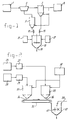
- Figure 1 schematically shows how used asphalt is crushed, in a crushing apparatus 1, into fragments having a size of at most 5 centimetres. Via a conveyor these fragments are fed to a screening apparatus 3, two fractions being formed in the process.
- the fraction of particles having a size smaller than 4 millimetres is then fed to the proportioning units 5, 7 by means of, for example, a shovel.
- the fraction of larger particles having a size of between 4 and 50 millimetres, which remains behind on the screening apparatus 3, is fed to a proportioning unit 7, the weight fraction of the small particles fed to the proportioning unit 5 being between 10 and 90% of the total weight of the broken-up asphalt fed to the screening apparatus 3.
- steam is introduced into the centre of the proportioning units 5, 7, at a temperature of about 110° or higher.
- the steam is introduced at a point at the bottom of the proportioning units 5 and 7.
- the molten asphalt forms a plug through which the steam introduced at the bottom is passed upwards, heating the cold asphalt.
- heated material is drawn off from the proportioning units 5, 7 via closing devices 11, 13, for example from 2 to 4 metric tonnes of asphalt being discharged, and the proportioning units are replenished with fresh, cold material.
- shut-off valves 11, 13 are dimensioned correctly, the shut-off valves, for example, being designed to have different respective through-flow diameters or having a different open-close cycle, different weight ratios of materials are fed to a mixing apparatus 15 from the proportioning units 5 and 7.
- the purpose of determining the weight fractions and feeding to the mixing apparatus is preferably served by a belt weigher, as shown in Figure 2.
- the mixing apparatus 15 is supplied, from a container 17, with a binder such as bitumen emulsion which is preferably sprayed over the introduced asphalt via a nozzle situated within the mixing apparatus 15. Up to 2 wt% of cement can be supplied to the mixing apparatus 15 from a container 21. Via a discharge valve 19, the asphalt mixed with the binder from the container 17 is discharged from the mixing apparatus 15.
- the fractions from the proportioning units 5 and 7 are preferably each supplied separately to the mixing apparatus 15. If a first fraction consists of fresh material and has been placed into the mixing apparatus 15, the required amount of bitumen emulsion is supplied from the container 17. Instead of bitumen emulsion it is also possible to use foamed bitumen. A method and apparatus for producing and applying foamed bitumen has been described in the Canadian Patent No. 1261183. The one weight fraction is then blended with the binder into a homogeneous mass. Then the mixed weight fraction is fed in from the proportioning units 5 or 7 and is blended with the bitumen present in the mixing apparatus 15 and with the first weight fraction. If necessary, a further amount of emulsion can be fed in at this time from the container 17.
- FIG. 2 shows an alternative embodiment of an apparatus according to the present invention.
- the two fractions of asphalt to be recycled are formed by used asphalt being broken up, in separate breaking and screening installations 23, 25, into a fraction of lumps having a size of between 4 mm and 5 cm, and a fraction of particles having a size smaller than about 4 mm.
- the asphalt particles formed and separated in the breaking and screening apparatuses 23, 25 are stored in an intermediate store 27, 29, for example on a heap.
- the breaking and screening apparatuses may be at different locations, at a relatively large distance from the proportioning units. With the aid of a shovel the particles are then dumped into the proportioning units 31, 33 from the intermediate store 27, 29.
- a steam source 30 steam having a temperature of at least about 110°C is injected into the proportioning units 31, 33.
- the heated fractions are fed, one by one, via an automatically operated valve 34, 36, to a conveyor belt 35.
- the conveyor belt 35 comprises a weighing device (not shown) for determining the weight of heated material dumped on the conveyor belt.
- the conveyor belt 35 feeds a weighed amount to a mixing apparatus 37.
- the mixing apparatus 37 the fractions coming from the proportioning units 31, 33 are mixed together by means of mixing paddles 41, and a bitumen emulsion is fed in via a line 39 and a nozzle.
- the mixed fractions can be dumped, for example, into a lorry and the recycled asphalt can be transported to a site in order to be applied once more as a road surface.
Landscapes
- Engineering & Computer Science (AREA)
- Chemical & Material Sciences (AREA)
- Civil Engineering (AREA)
- Structural Engineering (AREA)
- Architecture (AREA)
- Chemical Kinetics & Catalysis (AREA)
- Analytical Chemistry (AREA)
- General Chemical & Material Sciences (AREA)
- Materials Engineering (AREA)
- Oil, Petroleum & Natural Gas (AREA)
- Organic Chemistry (AREA)
- Processing Of Solid Wastes (AREA)
- Working-Up Tar And Pitch (AREA)
Applications Claiming Priority (2)
| Application Number | Priority Date | Filing Date | Title |
|---|---|---|---|
| NL1003236 | 1996-05-30 | ||
| NL1003236A NL1003236C2 (nl) | 1996-05-30 | 1996-05-30 | Werkwijze voor het recycleren van asfalt. |
Publications (1)
| Publication Number | Publication Date |
|---|---|
| EP0810276A1 true EP0810276A1 (de) | 1997-12-03 |
Family
ID=19762943
Family Applications (1)
| Application Number | Title | Priority Date | Filing Date |
|---|---|---|---|
| EP97201460A Withdrawn EP0810276A1 (de) | 1996-05-30 | 1997-05-15 | Verfahren zur Wiederverwertung von Asphalt |
Country Status (2)
| Country | Link |
|---|---|
| EP (1) | EP0810276A1 (de) |
| NL (1) | NL1003236C2 (de) |
Cited By (9)
| Publication number | Priority date | Publication date | Assignee | Title |
|---|---|---|---|---|
| GB2332010A (en) * | 1997-12-06 | 1999-06-09 | Peter Botterill | Recycling road materials |
| EP1138721A3 (de) * | 2000-04-01 | 2003-04-02 | Asphalt & Mineral Development Company Limited | Hertsellung von Asphalt auf Basis von Bitumen |
| WO2010077141A1 (en) | 2009-01-05 | 2010-07-08 | Rasenberg Wegenbouw B.V. | Asphalt composition |
| US9022686B2 (en) | 2009-12-31 | 2015-05-05 | Heatwurx, Inc. | System and method for controlling an asphalt repair apparatus |
| FR3020074A1 (fr) * | 2014-04-17 | 2015-10-23 | Rene Studli | Procede de recyclage d'anciens enrobes ou similaires et revetement routier obtenu par ledit procede |
| US9416499B2 (en) | 2009-12-31 | 2016-08-16 | Heatwurx, Inc. | System and method for sensing and managing pothole location and pothole characteristics |
| WO2018091769A1 (en) * | 2016-11-21 | 2018-05-24 | Amomatic Oy | Method and system for processing asphalt pavement road for recycling purposes, and use of briquettes obtainable by such method |
| US10018986B2 (en) | 2014-06-05 | 2018-07-10 | Clarence Richard | Mass flow control for a conveyor system |
| DE102020123078A1 (de) | 2020-09-03 | 2022-03-03 | Pakexa AG | Verfahren zum Aufbereiten von bitumen- und/oder teerhaltigen Feststoffen |
Citations (8)
| Publication number | Priority date | Publication date | Assignee | Title |
|---|---|---|---|---|
| US2413908A (en) * | 1942-08-04 | 1947-01-07 | Pavements Reclaiming Corp | Apparatus for conditioning pavement material |
| US3999743A (en) * | 1975-08-11 | 1976-12-28 | Mendenhall Robert Lamar | Asphalt-aggregate recycle process and apparatus |
| US4096588A (en) * | 1975-08-11 | 1978-06-20 | Mendenhall Robert Lamar | Recycled asphalt-aggregate process and apparatus |
| NL7708800A (en) * | 1977-08-10 | 1979-02-13 | Moel Wegenbouwmaatschappij B V | Used asphalted concrete reworking system - heats in vessel and mixes with new asphalt |
| US4272212A (en) * | 1979-06-15 | 1981-06-09 | Andrew J. Bauer, Jr. | Method and apparatus for rejuvenating and recycling asphalt |
| US4619550A (en) * | 1984-10-05 | 1986-10-28 | Cd High Technology, Inc. | Microwave method and apparatus for heating loose paving materials |
| DE4140964A1 (de) * | 1991-12-12 | 1993-06-17 | Wibau Gmbh | Verfahren zur herstellung von asphaltmischgut |
| FR2689051A1 (fr) * | 1992-03-26 | 1993-10-01 | Screg Routes & Travaux | Procédé de préparation d'un enrobé bitumineux, et son application à divers travaux routiers. |
-
1996
- 1996-05-30 NL NL1003236A patent/NL1003236C2/nl not_active IP Right Cessation
-
1997
- 1997-05-15 EP EP97201460A patent/EP0810276A1/de not_active Withdrawn
Patent Citations (8)
| Publication number | Priority date | Publication date | Assignee | Title |
|---|---|---|---|---|
| US2413908A (en) * | 1942-08-04 | 1947-01-07 | Pavements Reclaiming Corp | Apparatus for conditioning pavement material |
| US3999743A (en) * | 1975-08-11 | 1976-12-28 | Mendenhall Robert Lamar | Asphalt-aggregate recycle process and apparatus |
| US4096588A (en) * | 1975-08-11 | 1978-06-20 | Mendenhall Robert Lamar | Recycled asphalt-aggregate process and apparatus |
| NL7708800A (en) * | 1977-08-10 | 1979-02-13 | Moel Wegenbouwmaatschappij B V | Used asphalted concrete reworking system - heats in vessel and mixes with new asphalt |
| US4272212A (en) * | 1979-06-15 | 1981-06-09 | Andrew J. Bauer, Jr. | Method and apparatus for rejuvenating and recycling asphalt |
| US4619550A (en) * | 1984-10-05 | 1986-10-28 | Cd High Technology, Inc. | Microwave method and apparatus for heating loose paving materials |
| DE4140964A1 (de) * | 1991-12-12 | 1993-06-17 | Wibau Gmbh | Verfahren zur herstellung von asphaltmischgut |
| FR2689051A1 (fr) * | 1992-03-26 | 1993-10-01 | Screg Routes & Travaux | Procédé de préparation d'un enrobé bitumineux, et son application à divers travaux routiers. |
Cited By (12)
| Publication number | Priority date | Publication date | Assignee | Title |
|---|---|---|---|---|
| GB2332010A (en) * | 1997-12-06 | 1999-06-09 | Peter Botterill | Recycling road materials |
| GB2332010B (en) * | 1997-12-06 | 2002-06-05 | Peter Botterill | Method for recycling or making road materials |
| EP1138721A3 (de) * | 2000-04-01 | 2003-04-02 | Asphalt & Mineral Development Company Limited | Hertsellung von Asphalt auf Basis von Bitumen |
| WO2010077141A1 (en) | 2009-01-05 | 2010-07-08 | Rasenberg Wegenbouw B.V. | Asphalt composition |
| US9022686B2 (en) | 2009-12-31 | 2015-05-05 | Heatwurx, Inc. | System and method for controlling an asphalt repair apparatus |
| US9416499B2 (en) | 2009-12-31 | 2016-08-16 | Heatwurx, Inc. | System and method for sensing and managing pothole location and pothole characteristics |
| FR3020074A1 (fr) * | 2014-04-17 | 2015-10-23 | Rene Studli | Procede de recyclage d'anciens enrobes ou similaires et revetement routier obtenu par ledit procede |
| US10018986B2 (en) | 2014-06-05 | 2018-07-10 | Clarence Richard | Mass flow control for a conveyor system |
| WO2018091769A1 (en) * | 2016-11-21 | 2018-05-24 | Amomatic Oy | Method and system for processing asphalt pavement road for recycling purposes, and use of briquettes obtainable by such method |
| DE102020123078A1 (de) | 2020-09-03 | 2022-03-03 | Pakexa AG | Verfahren zum Aufbereiten von bitumen- und/oder teerhaltigen Feststoffen |
| EP3964646A1 (de) | 2020-09-03 | 2022-03-09 | Pakexa AG | Verfahren zum aufbereiten von bitumen- und/oder teerhaltigen feststoffen |
| DE102020123078B4 (de) | 2020-09-03 | 2025-02-13 | Pakexa AG | Verfahren zum Aufbereiten von bitumen- und/oder teerhaltigen Feststoffen |
Also Published As
| Publication number | Publication date |
|---|---|
| NL1003236C2 (nl) | 1997-12-10 |
| NL1003236A1 (nl) | 1997-12-10 |
Similar Documents
| Publication | Publication Date | Title |
|---|---|---|
| DE60224053T2 (de) | Schwefeladditive für fahrbahnbindemittel und herstellungsverfahren | |
| PL174227B1 (pl) | Sposób i urządzenie do regeneracji asfaltowej nawierzchni drogowej | |
| US5405440A (en) | Process for the preparation of a cold mix asphalt paving composition | |
| EP0810276A1 (de) | Verfahren zur Wiederverwertung von Asphalt | |
| Takal | Advances in technology of asphalt paving materials containing used tire rubber | |
| US2701213A (en) | Process for reclaiming asphaltic pavement and a composition so formed | |
| EP3541996B1 (de) | Verfahren und system zur verarbeitung einer asphaltfahrbahn für recyclingzwecke und verwendung von durch solch ein verfahren erhaltenen briketts | |
| US6497930B1 (en) | Process for recycling asphalt shingles and product produced thereby | |
| US2413908A (en) | Apparatus for conditioning pavement material | |
| JP5713583B2 (ja) | アスファルト廃材から再生アスファルト簡易舗装材を製造する方法 | |
| KR100881217B1 (ko) | 건설폐기물을 혼합하여 순환골재를 제조하는 장치 | |
| GB2115711A (en) | A highway asphalt and coated a recycling machine | |
| Czarnecki | Making use of contaminated soil | |
| EP1256656B1 (de) | Verfahren und Vorrichtung zur Herstellung eines bituminösen Mischgutes und Verfahren zur Herstellung einer Strassendecke damit | |
| EP1138721B1 (de) | Herstellung von Asphalt auf Basis von Bitumen | |
| EP0760882B1 (de) | Verfahren und vorrichtung zum kaltmischen von fahrbahnbelag | |
| EP2671924A1 (de) | Bitumenkonglomerate mit hohem Gehalt an Fräsungen und entsprechendes Verfahren zur Herstellung | |
| KR100430894B1 (ko) | 혼합골재 및 그 제조방법 | |
| EP0448335A2 (de) | Asphaltbetonprodukt und Verfahren zum Fixieren kontaminierter Böden in diesem Asphaltbeton | |
| McQuillen Jr et al. | Construction of rubber-modified asphalt pavements | |
| FI125995B (fi) | Menetelmä ja laitteisto jätteeksi luokiteltavan aineen käsittelemiseksi sekä menetelmällä ja laitteistolla valmistetun tuotteen käyttö | |
| DE102004055474A1 (de) | Verfahren zur Herstellung von bituminösem Mischgut für den Straßenbau | |
| JP2003165900A (ja) | 舗装用結合材、舗装用合材及び舗装 | |
| EP0550834A1 (de) | Verfahren zur Herstellung von Asphaltmischgut | |
| EP2671923A1 (de) | Bitumenkonglomerate, die im Wesentlichen monogranulare natürliche, bituminöse Sande enthalten |
Legal Events
| Date | Code | Title | Description |
|---|---|---|---|
| PUAI | Public reference made under article 153(3) epc to a published international application that has entered the european phase |
Free format text: ORIGINAL CODE: 0009012 |
|
| AK | Designated contracting states |
Kind code of ref document: A1 Designated state(s): BE DE DK FI FR GB LU NL SE |
|
| STAA | Information on the status of an ep patent application or granted ep patent |
Free format text: STATUS: THE APPLICATION IS DEEMED TO BE WITHDRAWN |
|
| 18D | Application deemed to be withdrawn |
Effective date: 19980604 |