EP0810459A2 - Ecran contouré de rétroprojection pour affichage désaxé à grand champs - Google Patents
Ecran contouré de rétroprojection pour affichage désaxé à grand champs Download PDFInfo
- Publication number
- EP0810459A2 EP0810459A2 EP97303619A EP97303619A EP0810459A2 EP 0810459 A2 EP0810459 A2 EP 0810459A2 EP 97303619 A EP97303619 A EP 97303619A EP 97303619 A EP97303619 A EP 97303619A EP 0810459 A2 EP0810459 A2 EP 0810459A2
- Authority
- EP
- European Patent Office
- Prior art keywords
- backscreen
- view
- observer
- lower edge
- eyepoint
- Prior art date
- Legal status (The legal status is an assumption and is not a legal conclusion. Google has not performed a legal analysis and makes no representation as to the accuracy of the status listed.)
- Granted
Links
- 230000000007 visual effect Effects 0.000 claims abstract description 9
- 230000008901 benefit Effects 0.000 description 3
- 230000007423 decrease Effects 0.000 description 3
- 238000010586 diagram Methods 0.000 description 3
- 208000003464 asthenopia Diseases 0.000 description 2
- 230000003247 decreasing effect Effects 0.000 description 2
- 230000009977 dual effect Effects 0.000 description 2
- 239000000463 material Substances 0.000 description 2
- 230000002411 adverse Effects 0.000 description 1
- 239000002131 composite material Substances 0.000 description 1
- 230000000694 effects Effects 0.000 description 1
- 230000008030 elimination Effects 0.000 description 1
- 238000003379 elimination reaction Methods 0.000 description 1
- 230000004438 eyesight Effects 0.000 description 1
- 230000004313 glare Effects 0.000 description 1
Images

Classifications
-
- G—PHYSICS
- G09—EDUCATION; CRYPTOGRAPHY; DISPLAY; ADVERTISING; SEALS
- G09B—EDUCATIONAL OR DEMONSTRATION APPLIANCES; APPLIANCES FOR TEACHING, OR COMMUNICATING WITH, THE BLIND, DEAF OR MUTE; MODELS; PLANETARIA; GLOBES; MAPS; DIAGRAMS
- G09B9/00—Simulators for teaching or training purposes
- G09B9/02—Simulators for teaching or training purposes for teaching control of vehicles or other craft
- G09B9/08—Simulators for teaching or training purposes for teaching control of vehicles or other craft for teaching control of aircraft, e.g. Link trainer
- G09B9/30—Simulation of view from aircraft
- G09B9/32—Simulation of view from aircraft by projected image
-
- G—PHYSICS
- G02—OPTICS
- G02B—OPTICAL ELEMENTS, SYSTEMS OR APPARATUS
- G02B27/00—Optical systems or apparatus not provided for by any of the groups G02B1/00 - G02B26/00, G02B30/00
- G02B27/30—Collimators
-
- G—PHYSICS
- G09—EDUCATION; CRYPTOGRAPHY; DISPLAY; ADVERTISING; SEALS
- G09B—EDUCATIONAL OR DEMONSTRATION APPLIANCES; APPLIANCES FOR TEACHING, OR COMMUNICATING WITH, THE BLIND, DEAF OR MUTE; MODELS; PLANETARIA; GLOBES; MAPS; DIAGRAMS
- G09B9/00—Simulators for teaching or training purposes
- G09B9/02—Simulators for teaching or training purposes for teaching control of vehicles or other craft
- G09B9/08—Simulators for teaching or training purposes for teaching control of vehicles or other craft for teaching control of aircraft, e.g. Link trainer
- G09B9/30—Simulation of view from aircraft
- G09B9/32—Simulation of view from aircraft by projected image
- G09B9/326—Simulation of view from aircraft by projected image the image being transformed by optical means
Definitions
- the present invention relates to display systems employed in aircraft simulator training systems.
- Various display systems are known for aircraft simulator applications used to train pilots and other aircraft crew members.
- the simulators allow training in a ground-based facility and attempt to provide simulated experiences and situations which are as close to actual events as possible.
- One of the drawbacks of present simulator systems is the limited field of view (FOV).
- the FOV is often insufficient to provide vision in the areas necessary for multiple training tasks, such as landing training and refueling training. These tasks in particular require the largest possible FOV display.
- OABD off-axis backscreen/mirror visual display system
- the vertical FOV of OABD systems is normally limited since the portion of the backscreen that displays the lower portion of the FOV also blocks or occults the observers' upper FOV. Attempts to increase the FOV coverage in the downward direction have adversely affected (that is, decreased) the FOV coverage in the upward direction. Similarly, increases in the upward FOV coverage have decreased the FOV coverage in the downward direction.
- the present invention overcomes the problems noted above with respect to known off-axis back-screen/mirror visual display systems (OABD) and provides a system which meets the above-stated objects.
- OABD off-axis back-screen/mirror visual display systems
- the present invention provides an OABD system having an increased vertical field of view (FOV) while preserving the collimation and distortion characteristics of the display.
- FOV vertical field of view
- the system includes a projector for projecting an image beam, a collimating mirror, and a backscreen interposed between the projector and the mirror for redirecting the image beam onto a surface of the collimating mirror.
- the collimated mirror in turn redirects the image beam to the observer's eyepoint.
- the lower edge of the backscreen is contoured to approximate the field of view limits of an aircraft sill line. This contouring increases the usable vertical FOV without changing the geometrical relationship of the eyepoint, backscreen and mirror.
- a demarcation line is determined and used as a guide for contouring the bottom edge of the backscreen.
- Other additional occultation areas such as those caused from other aircraft parts, both inside and outside of the cockpit, may also be taken advantage of and used to add or delete additional material to the backscreen during contouring.
- the contouring takes into consideration the field of view of both the pilot/observer and the co-pilot/crew member.
- the areas of the backscreen which are removed by the contouring of the bottom edge increase the vertical field of view in those areas.
- FIG 1 is a schematic diagram illustrating an off-axis backscreen/mirror visual display system (OABD).
- the OABD system is generally referred to by the reference numeral 10.
- the system 10 includes a projector system 12, a backscreen member 14, and a collimating mirror 16.
- the projector 12 is mounted on a projector platform 18 and includes red, green and blue image projectors 20, 22 and 24, respectively.
- the OABD system is housed in a simulator apparatus 26.
- the OABD system 10 projects an image beam 30 onto the backscreen member 14.
- the backscreen member 14 in turn redirects the image beam as beam 30a onto the collimating mirror 16.
- the mirror 16 in turn redirects the image beam as beam 30b to the observer's eyepoint 32.
- the vertical field of view (FOV) of OABD systems are normally limited due to the fact that the portion of the backscreen member 14 that displays the lower portion of the field of view also occults the upper FOV of the observer. This means that if an attempt is made to increase the FOV coverage in the downward or upward directions, the corresponding FOV coverage in the upper or lower directions, respectively, decreases.
- the lower edge 40 of the backscreen 14 is shaped or contoured to eliminate certain material. Portions of the lower edge of the backscreen are removed so that the upward vertical field of view of the observer and/or crew member can be increased in the simulator without moving either the eyepoint, the backscreen or the mirror.
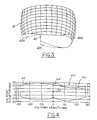
- a contoured backscreen 14 is shown in Figure 3.
- the backscreen has a curved or rounded shape (when viewed from above) with an elongated curved upper edge 38 and a corresponding elongated curved lower edge 40.
- the lower edge 40 of the backscreen is contoured with sections 42a, 42b and 42c having been removed in order to increase the observer's field of view in those areas.
- the lower edge of the backscreen is contoured differently depending on whether the observer is viewing the display alone, or whether an observer and crew member are jointly viewing the display.
- the bottom edge is contoured as a result of a composite analysis which takes into account the viewing of the display on the collimated mirror by two persons.
- FIG. 2 A typical field of view of the windows of an aircraft is shown in Figure 2 and designated by the reference numeral 50.
- the point on the graph marked "x" and designated by the reference numeral 32 is the straight ahead line of sight of the observer when the observer is located in the left-hand seat of a side-by-side aircraft seating arrangement.
- Each of the generally rectangular polygons 52 represent the windows of the aircraft as viewed by the pilot or observer with his eyes leveled at eyepoint 32.
- a co-pilot or crew member sitting along side the pilot would see a field of view which is a mirror image of the field of view 50 as shown in Figure 2.
- line 54 is the demarcation line for the depicted aircraft. This is the practical limit of the pilot's field of view in the vertical downward direction when only the windows are taken into account. In an actual cockpit of an aircraft, the pilot's view out of the windows also may be partially occulted by the glareshield and instrumentation and there is no reason to provide a FOV for that subject matter.
- the FOV 50 is generated by conventional computer software used in visual systems design, al- though it also can be generated by use of a transit system.
- the FOV boundaries 60 as viewed from the pilot/observer's eyepoint is shown in Figure 4.
- the FOV boundaries viewed by a co-pilot or crew member would be a mirror image of the FOV 60 shown in Figure 4.
- the FOV 60 is the image that the pilot/observer can see on the collimating mirror 16 which is projected from the backscreen 14.
- the contouring of the lower edge 40 of the backscreen 14 allows the field of view 60 to have additional viewing areas 62, 64 and 66.
- This contouring could be the elimination of areas 42a, 42b and 42c, as shown in Figure 3.
- a view of areas 62, 64 and 66 would not be possible without contouring and thus eliminating the areas 42a, 42b and 42c on the backscreen 14.
- the backscreen edge contouring in accordance with the present invention provides a means to increase the upward field of view without having to change the eyepoint/display relationship. This preserves the collimation and distortion characteristics of the display.
- the demarcation line 54 shown in Figure 2 is used as a guide to contour the bottom edge of the backscreen 14. Since nothing outside the airplane is visible to the pilot or co-pilot below the demarcation line 54, there is no reason to display information below that elevation.
- the contouring takes into account both the pilot/observer and the co-pilot/crew members' fields of view.
- the present invention economically solves the problem of providing a large vertical field of view while at the same time maintaining vergence and distortion performance.
Landscapes
- Engineering & Computer Science (AREA)
- Theoretical Computer Science (AREA)
- Physics & Mathematics (AREA)
- General Physics & Mathematics (AREA)
- Business, Economics & Management (AREA)
- Aviation & Aerospace Engineering (AREA)
- Educational Administration (AREA)
- Educational Technology (AREA)
- Optics & Photonics (AREA)
- Stereoscopic And Panoramic Photography (AREA)
- Overhead Projectors And Projection Screens (AREA)
- Lenses (AREA)
- Eye Examination Apparatus (AREA)
Priority Applications (1)
| Application Number | Priority Date | Filing Date | Title |
|---|---|---|---|
| EP02078351A EP1265207A1 (fr) | 1996-05-31 | 1997-05-28 | Ecran contouré de rétroprojection pour affichage désaxé à grand champs |
Applications Claiming Priority (2)
| Application Number | Priority Date | Filing Date | Title |
|---|---|---|---|
| US08/656,674 US6224218B1 (en) | 1996-05-31 | 1996-05-31 | Backscreen edge contouring for off-axis large field of view displays |
| US656674 | 1996-05-31 |
Related Child Applications (1)
| Application Number | Title | Priority Date | Filing Date |
|---|---|---|---|
| EP02078351A Division EP1265207A1 (fr) | 1996-05-31 | 1997-05-28 | Ecran contouré de rétroprojection pour affichage désaxé à grand champs |
Publications (3)
| Publication Number | Publication Date |
|---|---|
| EP0810459A2 true EP0810459A2 (fr) | 1997-12-03 |
| EP0810459A3 EP0810459A3 (fr) | 1998-07-08 |
| EP0810459B1 EP0810459B1 (fr) | 2003-02-12 |
Family
ID=24634080
Family Applications (2)
| Application Number | Title | Priority Date | Filing Date |
|---|---|---|---|
| EP02078351A Ceased EP1265207A1 (fr) | 1996-05-31 | 1997-05-28 | Ecran contouré de rétroprojection pour affichage désaxé à grand champs |
| EP97303619A Expired - Lifetime EP0810459B1 (fr) | 1996-05-31 | 1997-05-28 | Ecran contouré de rétroprojection pour affichage désaxé à grand champs |
Family Applications Before (1)
| Application Number | Title | Priority Date | Filing Date |
|---|---|---|---|
| EP02078351A Ceased EP1265207A1 (fr) | 1996-05-31 | 1997-05-28 | Ecran contouré de rétroprojection pour affichage désaxé à grand champs |
Country Status (4)
| Country | Link |
|---|---|
| US (1) | US6224218B1 (fr) |
| EP (2) | EP1265207A1 (fr) |
| CA (1) | CA2205724C (fr) |
| DE (1) | DE69718967T2 (fr) |
Cited By (2)
| Publication number | Priority date | Publication date | Assignee | Title |
|---|---|---|---|---|
| EP0965968A3 (fr) * | 1998-06-17 | 2001-07-18 | THOMSON TRAINING & SIMULATION LIMITED | Système de simulation |
| WO2004002168A1 (fr) * | 2002-06-19 | 2003-12-31 | Collender Robert B | Procede et appareil d'affichage d'images stereoscopiques |
Families Citing this family (3)
| Publication number | Priority date | Publication date | Assignee | Title |
|---|---|---|---|---|
| US6343863B1 (en) * | 2000-03-20 | 2002-02-05 | Rockwell Collins, Inc. | Aircraft display mounting system |
| GB0310702D0 (en) * | 2003-05-09 | 2003-06-11 | Seos Ltd | Image display apparatus |
| EP4238080A4 (fr) * | 2020-10-28 | 2024-09-25 | FlightSafety International Inc. | Système et procédé de réduction active de l'apparence d'une ligne de jonction dans un ensemble de miroirs |
Family Cites Families (10)
| Publication number | Priority date | Publication date | Assignee | Title |
|---|---|---|---|---|
| GB1297139A (fr) * | 1969-07-03 | 1972-11-22 | ||
| US3807849A (en) * | 1970-05-15 | 1974-04-30 | Redifon Ltd | Visual display arrangements |
| GB1385908A (en) * | 1971-05-12 | 1975-03-05 | Redifon Ltd | Visual display apparatus |
| US3880509A (en) * | 1974-03-15 | 1975-04-29 | Us Navy | Wide-angle on-axis projection system |
| US3973840A (en) * | 1974-09-03 | 1976-08-10 | Corporation Of The President Of The Church Of Jesus Christ Of Latter-Day Saints | Mannequin |
| US3895861A (en) * | 1974-09-13 | 1975-07-22 | Us Navy | Rear-screen wide-angle on-axis projection system |
| US4234891A (en) * | 1979-07-30 | 1980-11-18 | The Singer Company | Optical illumination and distortion compensator |
| US4473355A (en) * | 1983-06-30 | 1984-09-25 | Messerschmitt-Boelkow-Blohm Gesellschaft Mit Beschraenkter Haftung | Visual simulator and display screen for said simulator |
| FR2636459B1 (fr) * | 1988-09-09 | 1990-10-19 | Thomson Csf | Systeme de restitution de l'environnement visuel d'un pilote en simulateur |
| US5566370A (en) * | 1994-11-03 | 1996-10-15 | Lockheed Martin Corporation | Simulation display system |
-
1996
- 1996-05-31 US US08/656,674 patent/US6224218B1/en not_active Expired - Lifetime
-
1997
- 1997-05-20 CA CA002205724A patent/CA2205724C/fr not_active Expired - Fee Related
- 1997-05-28 DE DE69718967T patent/DE69718967T2/de not_active Expired - Fee Related
- 1997-05-28 EP EP02078351A patent/EP1265207A1/fr not_active Ceased
- 1997-05-28 EP EP97303619A patent/EP0810459B1/fr not_active Expired - Lifetime
Cited By (2)
| Publication number | Priority date | Publication date | Assignee | Title |
|---|---|---|---|---|
| EP0965968A3 (fr) * | 1998-06-17 | 2001-07-18 | THOMSON TRAINING & SIMULATION LIMITED | Système de simulation |
| WO2004002168A1 (fr) * | 2002-06-19 | 2003-12-31 | Collender Robert B | Procede et appareil d'affichage d'images stereoscopiques |
Also Published As
| Publication number | Publication date |
|---|---|
| DE69718967T2 (de) | 2004-01-22 |
| CA2205724A1 (fr) | 1997-11-30 |
| DE69718967D1 (de) | 2003-03-20 |
| CA2205724C (fr) | 2002-05-07 |
| US6224218B1 (en) | 2001-05-01 |
| EP0810459A3 (fr) | 1998-07-08 |
| EP1265207A1 (fr) | 2002-12-11 |
| EP0810459B1 (fr) | 2003-02-12 |
Similar Documents
| Publication | Publication Date | Title |
|---|---|---|
| EP0170523B1 (fr) | Affichage d'information pour pilotes d'avion | |
| Weintraub | Human factors issues in head-up display design: The book of HUD | |
| US4634384A (en) | Head and/or eye tracked optically blended display system | |
| US4723160A (en) | Windscreen deviation correcting pilot display | |
| US5137348A (en) | Collimated projection system with wide horizontal field, with device to increase the vertical field | |
| US4350489A (en) | Dome field of view scene extenders | |
| EP0810459B1 (fr) | Ecran contouré de rétroprojection pour affichage désaxé à grand champs | |
| Bray | Visual and motion cueing in helicopter simulation | |
| US7871270B2 (en) | Deployable training device visual system | |
| Theunissen | A primary flight display for four-dimensional guidance and navigation influence of tunnel size and level of additional information on pilot performance and control behaviour | |
| Huff et al. | Psychological aspects of aeronautical flight simulation. | |
| Roscoe et al. | Cockpit visibility and contrail detection | |
| Liggett et al. | Development and evaluation of a background attitude indicator | |
| French et al. | Terrain awareness & pathway guidance for head-up displays (tapguide); a simulator study of pilot performance | |
| Frey et al. | Virtual HUD using an HMD | |
| Rezek | Preliminary experience with a stereoscopic video system in a remotely piloted aircraft application | |
| JPH07323900A (ja) | 透明表面が不十分な航空機の視野の範囲を改善する装置 | |
| Design | Human Factors Engineering and Flight Deck Design | |
| Kraft et al. | Psychophysical Criteria for Visual Simulation Systems. | |
| Naish | Flight Tests of the Head-Up Display (HUD) in DC-9-20 Ship 382, November 1968-January 1969. IRAD Line Item Description Number D36-69-033f | |
| Rostad et al. | Analysis of azimuth head motion in rotary-wing flight using various helmet-mounted display configurations | |
| Jennings et al. | In-flight evaluation of stereoscopic imagery in helicopter cockpits | |
| Moore et al. | Flight Testing of Helmet Mounted Displays | |
| Rezek | Stereoscopic Video System in a Remotely Piloted Aircraft Application | |
| Newman et al. | Improvement of Head-Up Display Standards. Volume 4. Head-Up Display Dynamics Flight Tests. |
Legal Events
| Date | Code | Title | Description |
|---|---|---|---|
| PUAI | Public reference made under article 153(3) epc to a published international application that has entered the european phase |
Free format text: ORIGINAL CODE: 0009012 |
|
| AK | Designated contracting states |
Kind code of ref document: A2 Designated state(s): DE FR GB |
|
| PUAL | Search report despatched |
Free format text: ORIGINAL CODE: 0009013 |
|
| AK | Designated contracting states |
Kind code of ref document: A3 Designated state(s): DE FR GB |
|
| RAP1 | Party data changed (applicant data changed or rights of an application transferred) |
Owner name: RAYTHEON COMPANY |
|
| 17P | Request for examination filed |
Effective date: 19981126 |
|
| 17Q | First examination report despatched |
Effective date: 20010301 |
|
| GRAG | Despatch of communication of intention to grant |
Free format text: ORIGINAL CODE: EPIDOS AGRA |
|
| GRAG | Despatch of communication of intention to grant |
Free format text: ORIGINAL CODE: EPIDOS AGRA |
|
| GRAH | Despatch of communication of intention to grant a patent |
Free format text: ORIGINAL CODE: EPIDOS IGRA |
|
| GRAH | Despatch of communication of intention to grant a patent |
Free format text: ORIGINAL CODE: EPIDOS IGRA |
|
| GRAA | (expected) grant |
Free format text: ORIGINAL CODE: 0009210 |
|
| RAP1 | Party data changed (applicant data changed or rights of an application transferred) |
Owner name: L-3 COMMUNICATIONS CORPORATION |
|
| AK | Designated contracting states |
Designated state(s): DE FR GB |
|
| REG | Reference to a national code |
Ref country code: GB Ref legal event code: FG4D |
|
| REF | Corresponds to: |
Ref document number: 69718967 Country of ref document: DE Date of ref document: 20030320 Kind code of ref document: P |
|
| ET | Fr: translation filed | ||
| PLBE | No opposition filed within time limit |
Free format text: ORIGINAL CODE: 0009261 |
|
| STAA | Information on the status of an ep patent application or granted ep patent |
Free format text: STATUS: NO OPPOSITION FILED WITHIN TIME LIMIT |
|
| 26N | No opposition filed |
Effective date: 20031113 |
|
| PGFP | Annual fee paid to national office [announced via postgrant information from national office to epo] |
Ref country code: FR Payment date: 20090518 Year of fee payment: 13 Ref country code: DE Payment date: 20090528 Year of fee payment: 13 |
|
| PGFP | Annual fee paid to national office [announced via postgrant information from national office to epo] |
Ref country code: GB Payment date: 20090528 Year of fee payment: 13 |
|
| GBPC | Gb: european patent ceased through non-payment of renewal fee |
Effective date: 20100528 |
|
| REG | Reference to a national code |
Ref country code: FR Ref legal event code: ST Effective date: 20110131 |
|
| PG25 | Lapsed in a contracting state [announced via postgrant information from national office to epo] |
Ref country code: DE Free format text: LAPSE BECAUSE OF NON-PAYMENT OF DUE FEES Effective date: 20101201 |
|
| PG25 | Lapsed in a contracting state [announced via postgrant information from national office to epo] |
Ref country code: FR Free format text: LAPSE BECAUSE OF NON-PAYMENT OF DUE FEES Effective date: 20100531 |
|
| PG25 | Lapsed in a contracting state [announced via postgrant information from national office to epo] |
Ref country code: GB Free format text: LAPSE BECAUSE OF NON-PAYMENT OF DUE FEES Effective date: 20100528 |