EP0810513A1 - Système de traitement d'entrée de données avec un clavier virtuel ayant une disposition ergonomique basée sur la position préférentielle de certains caractères - Google Patents
Système de traitement d'entrée de données avec un clavier virtuel ayant une disposition ergonomique basée sur la position préférentielle de certains caractères Download PDFInfo
- Publication number
- EP0810513A1 EP0810513A1 EP97201344A EP97201344A EP0810513A1 EP 0810513 A1 EP0810513 A1 EP 0810513A1 EP 97201344 A EP97201344 A EP 97201344A EP 97201344 A EP97201344 A EP 97201344A EP 0810513 A1 EP0810513 A1 EP 0810513A1
- Authority
- EP
- European Patent Office
- Prior art keywords
- keys
- edge
- key
- keyboard
- data processing
- Prior art date
- Legal status (The legal status is an assumption and is not a legal conclusion. Google has not performed a legal analysis and makes no representation as to the accuracy of the status listed.)
- Withdrawn
Links
Images
Classifications
-
- G—PHYSICS
- G06—COMPUTING OR CALCULATING; COUNTING
- G06F—ELECTRIC DIGITAL DATA PROCESSING
- G06F3/00—Input arrangements for transferring data to be processed into a form capable of being handled by the computer; Output arrangements for transferring data from processing unit to output unit, e.g. interface arrangements
- G06F3/01—Input arrangements or combined input and output arrangements for interaction between user and computer
- G06F3/048—Interaction techniques based on graphical user interfaces [GUI]
- G06F3/0487—Interaction techniques based on graphical user interfaces [GUI] using specific features provided by the input device, e.g. functions controlled by the rotation of a mouse with dual sensing arrangements, or of the nature of the input device, e.g. tap gestures based on pressure sensed by a digitiser
- G06F3/0488—Interaction techniques based on graphical user interfaces [GUI] using specific features provided by the input device, e.g. functions controlled by the rotation of a mouse with dual sensing arrangements, or of the nature of the input device, e.g. tap gestures based on pressure sensed by a digitiser using a touch-screen or digitiser, e.g. input of commands through traced gestures
- G06F3/04886—Interaction techniques based on graphical user interfaces [GUI] using specific features provided by the input device, e.g. functions controlled by the rotation of a mouse with dual sensing arrangements, or of the nature of the input device, e.g. tap gestures based on pressure sensed by a digitiser using a touch-screen or digitiser, e.g. input of commands through traced gestures by partitioning the display area of the touch-screen or the surface of the digitising tablet into independently controllable areas, e.g. virtual keyboards or menus
Definitions
- the invention relates to a data processing system based on a keyboard structure for a multi-character keyboard, representation means for on-screen representing said keyboard structure, and user pointing means for through pointing activating a particular keyboard key for thereby presenting associated key data to said system.
- Most data processing systems such as personal computers, are keyboard-oriented, in that they are provided with a hardware keyboard of the QWERTY or similar type, if the Latin, Greek, Cyrillic, or similar alphabet is used.
- the keyboard is augmented with other keys such as control keys, numerical keys, space bar, and special function keys.
- many other data processing systems are more screen-oriented and have an on-screen representation of a so-called 'soft keyboard'.
- Actuating a key is then done by some pointing device, such as mouse, joystick, tracker ball, or even with non-computer devices, such as a pencil or a finger. It has been found that selecting among the keys often implies user requirements that need a high degree of motor skill.
- the term data processing system is understood to include systems wherein the data are not changed , such as data entry systems, data storage systems, or data terminals.
- the multi-character keyboard comprises a relatively large number of letter and/or digit keys, sometimes enhanced with control keys that expand the character or word processing functionality, such as punctuation marks, enter or delete keys, or additional non-character keys. Pointing at a key can be effected in various ways, such as through a pencil touching the screen, or through moving a cursor by means of a mouse and subsequently clicking a mouse button.
- the invention is characterized in that said representation means are operative for representing all letter keys according to a compact ergonomic layout based on rows and columns that has edge positions reserved for vowels, and further letter keys arranged on respective key lines terminating at said edge positions according to standard alphabet sequence whilst suppressing or avoiding any further vowel key.
- Vowels have been found to represent a particular subclass of all letters, that are experienced by users in a different manner from consonants, in that people tend to memorize a word in the first place through its configuration of vocals.
- the number of vowels in the alphabet is usually relatively small, so that each of the respective vowels is used relatively more often in written language. This renders the number of available edge positions in the keyboard representation quite sufficient for accommodating all vowels, and users will know to find the vowels in a very easy manner.
- said layout is a rectangular array that is substantially dedicated to letter keys only.
- the letter block has thus allowed to position a pointing device in a straightforward manner, which is intuitively user-friendly.
- the vowel keys are edge stopped, in that the cursor is constrained from crossing such edge. This allows to faster attain the location of the vowel in question, inasmuch as no cursor overshoot is liable to occur.
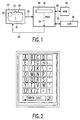
- FIG. 1 shows a data processing system according to the invention.
- the central element is processor 30 that via line 38 is connected to external memory 40, which may be RAM, floppy drive, optical disc drive or other.
- the processor via line 28 feeds video display 20 with video signals for effecting a display on screen 22.
- Further I/O devices such as for example, a speech channel, hardware keys, or a cursor controller are symbolized by block 36 interconnected via line 34.
- the screen 22 has an on-screen field 24 for representing the keyboard structure. Layout and operation embodiments will be discussed with reference to Figure 2.
- Further screen field 26 can be used for representing a line of text, such as may have been developed by successive key actuations through field 24.
- a cursor representation has been indicated by item 42.
- Block 44 internal to the processor 30 symbolizes a keyboard structure, such as the relative locations of the various keys with respect to each other, that may be stored in appropriate internal memory locations of the processor.
- a keyboard structure such as the relative locations of the various keys with respect to each other, that may be stored in appropriate internal memory locations of the processor.
- the character shapes of the various keys are sent via line 50 for being included in the overall screen image.
- the representation of particular keys in appropriate areas of a display screen is standard technology and will not be discussed in detail. The remainder of the display is application-specific and irrelevant for the disclosure of the present invention.
- the pointing on a particular character in field 24 may be effected in various ways. A first one is by controlling cursor 42 to go to the wanted character, and subsequently actuating that character by a single actuation button, such as on I/O device 36. A second one is by pointing with a finger or other appropriate object, such as a stylus, to the intended character. This pointing may be detected by a special overlay device to the screen (not shown) which sends an associated position detection signal to the processor.
- a special overlay device to the screen (not shown) which sends an associated position detection signal to the processor.
- Figure 2 shows a keyboard structure according to the invention as use for the Dutch language.
- the Dutch language has five standard vocals A, E, I, O, U. Moreover, it also uses the Y, and in addition, a letter IJ, which has here been represented as a pair of letters ( I+J ), but which in Dutch is generally looked upon as a vocal. All letters have been positioned in a block of 4X6 letter fields, leaving one position unused. The seven "vowels" occupy the left edge column. The other letters have been assigned to the other columns of the seven key lines terminating at the respective edge positions of the seven vowels.
- the sequence is according to the natural sequence, be it with the vowels suppressed.
- this also corresponds exactly to the natural sequence in the first three lines, until in the fourth line the vowel O precedes its natural rank by two positions.
- vowel U precedes its natural position by four positions
- vowel Y precedes its natural position by five positions
- "vowel" IJ precedes its natural position by one position.
- the 28th position has been reserved for an enter control or space control key .
- the righthand edge is occupied by seven interpunction marks.
- the lower line of keys has been reserved for other purposes, in particular for a delete key. In a simple embodiment, various of the control keys could be left out.
- the keyboard has been specifically designed for use on the left hand edge of the screen, preferably in the upper left hand corner. A slightly less advantageous position is in the lower left hand corner, or on the middle of the left hand screen edge.
- Various advantages of the layout are the following:
Landscapes
- Engineering & Computer Science (AREA)
- General Engineering & Computer Science (AREA)
- Theoretical Computer Science (AREA)
- Human Computer Interaction (AREA)
- Physics & Mathematics (AREA)
- General Physics & Mathematics (AREA)
- Input From Keyboards Or The Like (AREA)
Priority Applications (1)
| Application Number | Priority Date | Filing Date | Title |
|---|---|---|---|
| EP97201344A EP0810513A1 (fr) | 1996-05-31 | 1997-05-06 | Système de traitement d'entrée de données avec un clavier virtuel ayant une disposition ergonomique basée sur la position préférentielle de certains caractères |
Applications Claiming Priority (3)
| Application Number | Priority Date | Filing Date | Title |
|---|---|---|---|
| EP96201517 | 1996-05-31 | ||
| EP96201517 | 1996-05-31 | ||
| EP97201344A EP0810513A1 (fr) | 1996-05-31 | 1997-05-06 | Système de traitement d'entrée de données avec un clavier virtuel ayant une disposition ergonomique basée sur la position préférentielle de certains caractères |
Publications (1)
| Publication Number | Publication Date |
|---|---|
| EP0810513A1 true EP0810513A1 (fr) | 1997-12-03 |
Family
ID=26142845
Family Applications (1)
| Application Number | Title | Priority Date | Filing Date |
|---|---|---|---|
| EP97201344A Withdrawn EP0810513A1 (fr) | 1996-05-31 | 1997-05-06 | Système de traitement d'entrée de données avec un clavier virtuel ayant une disposition ergonomique basée sur la position préférentielle de certains caractères |
Country Status (1)
| Country | Link |
|---|---|
| EP (1) | EP0810513A1 (fr) |
Cited By (5)
| Publication number | Priority date | Publication date | Assignee | Title |
|---|---|---|---|---|
| US6712534B2 (en) | 2001-07-23 | 2004-03-30 | Sanjay M. Patel | Ergonomic and efficient keyboard |
| CN1306368C (zh) * | 2000-06-09 | 2007-03-21 | S·K·B·张 | 一种字母字符输入装置 |
| US9678580B2 (en) | 2004-03-23 | 2017-06-13 | Keypoint Technologies (UK) Limted | Human-to-computer interfaces |
| US9798717B2 (en) | 2005-03-23 | 2017-10-24 | Keypoint Technologies (Uk) Limited | Human-to-mobile interfaces |
| US10365727B2 (en) | 2005-03-23 | 2019-07-30 | Keypoint Technologies (Uk) Limited | Human-to-mobile interfaces |
Citations (3)
| Publication number | Priority date | Publication date | Assignee | Title |
|---|---|---|---|---|
| EP0372592A2 (fr) * | 1988-10-07 | 1990-06-13 | Tokuzo Hirose | Dispositif de petite taille pour introduire des caractères et méthode utilisée à cet effet |
| WO1990008655A1 (fr) * | 1989-02-03 | 1990-08-09 | Tuilier Jean Jacques | Clavier alphabetique international simplifie |
| WO1990016032A1 (fr) * | 1989-06-12 | 1990-12-27 | Grid Systems Corporation | Emulateur de clavier a ecran divise |
-
1997
- 1997-05-06 EP EP97201344A patent/EP0810513A1/fr not_active Withdrawn
Patent Citations (3)
| Publication number | Priority date | Publication date | Assignee | Title |
|---|---|---|---|---|
| EP0372592A2 (fr) * | 1988-10-07 | 1990-06-13 | Tokuzo Hirose | Dispositif de petite taille pour introduire des caractères et méthode utilisée à cet effet |
| WO1990008655A1 (fr) * | 1989-02-03 | 1990-08-09 | Tuilier Jean Jacques | Clavier alphabetique international simplifie |
| WO1990016032A1 (fr) * | 1989-06-12 | 1990-12-27 | Grid Systems Corporation | Emulateur de clavier a ecran divise |
Non-Patent Citations (1)
| Title |
|---|
| "SOFT ADAPTIVE FOLLOW-FINGER KEYBOARD FOR TOUCH-SCREEN PADS", IBM TECHNICAL DISCLOSURE BULLETIN, vol. 36, no. 11, 1 November 1993 (1993-11-01), pages 5 - 7, XP000424761 * |
Cited By (5)
| Publication number | Priority date | Publication date | Assignee | Title |
|---|---|---|---|---|
| CN1306368C (zh) * | 2000-06-09 | 2007-03-21 | S·K·B·张 | 一种字母字符输入装置 |
| US6712534B2 (en) | 2001-07-23 | 2004-03-30 | Sanjay M. Patel | Ergonomic and efficient keyboard |
| US9678580B2 (en) | 2004-03-23 | 2017-06-13 | Keypoint Technologies (UK) Limted | Human-to-computer interfaces |
| US9798717B2 (en) | 2005-03-23 | 2017-10-24 | Keypoint Technologies (Uk) Limited | Human-to-mobile interfaces |
| US10365727B2 (en) | 2005-03-23 | 2019-07-30 | Keypoint Technologies (Uk) Limited | Human-to-mobile interfaces |
Similar Documents
| Publication | Publication Date | Title |
|---|---|---|
| US5128672A (en) | Dynamic predictive keyboard | |
| US6104317A (en) | Data entry device and method | |
| US6160555A (en) | Method for providing a cue in a computer system | |
| RU2277719C2 (ru) | Способ работы системы скоростного письма и устройство скоростного письма | |
| US7096432B2 (en) | Write anywhere tool | |
| EP0882259B1 (fr) | Unite d'entree a touches a presentation sur ecran | |
| US6741235B1 (en) | Rapid entry of data and information on a reduced size input area | |
| US8583440B2 (en) | Apparatus and method for providing visual indication of character ambiguity during text entry | |
| US5818437A (en) | Reduced keyboard disambiguating computer | |
| US6692170B2 (en) | Method and apparatus for text input | |
| US6567549B1 (en) | Method and apparatus for immediate response handwriting recognition system that handles multiple character sets | |
| JP4463795B2 (ja) | 減少型キーボード曖昧さ除去システム | |
| KR20000035960A (ko) | 고속 타자 장치와 방법 | |
| EP1996995A2 (fr) | Procédé de saisie de caractères | |
| KR20050119112A (ko) | 터치 스크린용 명료 텍스트 입력 방법 및 감소된 키보드시스템 | |
| KR19990035985A (ko) | 감축된 키보드 명료화 시스템 | |
| US20040243389A1 (en) | Method and apparatus for selecting symbols in ideographic languages | |
| JPH06202784A (ja) | 文字入力装置 | |
| KR20240130673A (ko) | 전자장치에서 문자입력시 직전에 입력된 문자가 무엇인지 알려주기 위한 방법 | |
| US20060279433A1 (en) | Method of mapping characters for a mobile telephone keypad | |
| US5600314A (en) | Data input device and correlative encoding technique | |
| GB2259386A (en) | Text processing | |
| KR200221583Y1 (ko) | 리모콘입력방식 한글자판 및 키배열방법 | |
| KR100846042B1 (ko) | 전기전자기기의 버튼효율 증대방법 | |
| AU2002322159B2 (en) | Method of and apparatus for selecting symbols in ideographic languages |
Legal Events
| Date | Code | Title | Description |
|---|---|---|---|
| PUAI | Public reference made under article 153(3) epc to a published international application that has entered the european phase |
Free format text: ORIGINAL CODE: 0009012 |
|
| AK | Designated contracting states |
Kind code of ref document: A1 Designated state(s): DE FR GB |
|
| 17P | Request for examination filed |
Effective date: 19980603 |
|
| RAP3 | Party data changed (applicant data changed or rights of an application transferred) |
Owner name: KONINKLIJKE PHILIPS ELECTRONICS N.V. |
|
| STAA | Information on the status of an ep patent application or granted ep patent |
Free format text: STATUS: THE APPLICATION HAS BEEN WITHDRAWN |
|
| 18W | Application withdrawn |
Withdrawal date: 19981022 |