EP0810583A2 - Système de reconnaissance de la parole - Google Patents
Système de reconnaissance de la parole Download PDFInfo
- Publication number
- EP0810583A2 EP0810583A2 EP97108686A EP97108686A EP0810583A2 EP 0810583 A2 EP0810583 A2 EP 0810583A2 EP 97108686 A EP97108686 A EP 97108686A EP 97108686 A EP97108686 A EP 97108686A EP 0810583 A2 EP0810583 A2 EP 0810583A2
- Authority
- EP
- European Patent Office
- Prior art keywords
- memory
- distance
- unit
- data
- distances
- Prior art date
- Legal status (The legal status is an assumption and is not a legal conclusion. Google has not performed a legal analysis and makes no representation as to the accuracy of the status listed.)
- Withdrawn
Links
- 230000015654 memory Effects 0.000 claims abstract description 163
- 238000009825 accumulation Methods 0.000 claims description 23
- 238000004364 calculation method Methods 0.000 claims description 17
- 238000005070 sampling Methods 0.000 claims 1
- 238000000034 method Methods 0.000 description 20
- 238000011112 process operation Methods 0.000 description 8
- 239000000284 extract Substances 0.000 description 4
- 238000010586 diagram Methods 0.000 description 3
- 230000006870 function Effects 0.000 description 2
- 238000013500 data storage Methods 0.000 description 1
- 230000003247 decreasing effect Effects 0.000 description 1
- 230000002542 deteriorative effect Effects 0.000 description 1
- JEIPFZHSYJVQDO-UHFFFAOYSA-N iron(III) oxide Inorganic materials O=[Fe]O[Fe]=O JEIPFZHSYJVQDO-UHFFFAOYSA-N 0.000 description 1
- 230000004048 modification Effects 0.000 description 1
- 238000012986 modification Methods 0.000 description 1
Images



Classifications
-
- G—PHYSICS
- G10—MUSICAL INSTRUMENTS; ACOUSTICS
- G10L—SPEECH ANALYSIS TECHNIQUES OR SPEECH SYNTHESIS; SPEECH RECOGNITION; SPEECH OR VOICE PROCESSING TECHNIQUES; SPEECH OR AUDIO CODING OR DECODING
- G10L15/00—Speech recognition
- G10L15/08—Speech classification or search
- G10L15/10—Speech classification or search using distance or distortion measures between unknown speech and reference templates
Definitions
- the present invention generally relates to a speech recognition system, and more particularly to a speech recognition system having a distance calculating unit.
- HMM hidden Markov model
- a sound of conversation or speech
- the input pattern "A” is compared with a standard pattern "bj" (1 ⁇ j ⁇ J, wherein j and J are each an integer).
- the standard pattern "bj” is a subword such as a syllable and/or a phoneme which is smaller than a word, as described in the "BASICS OF SPEECH RECOGNITION” (pages 247 to 260 in section 8 thereof, incorporated herein by reference).
- the standard pattern "bj” is called as "subword standard pattern”.
- the feature "ai” (1 ⁇ i ⁇ I, wherein i is an integer) of the input pattern "A" is entered, the feature “ai” is compared with all of the subword standard patterns (e.g., b1, b2, ..., bJ) stored in a standard pattern memory, for calculating a difference between the feature "ai” and the subword standard pattern "bj".
- the difference is called a "distance”.
- the input pattern "A” is compared with many standard words having some of the subword standard patterns.
- the standard words are predetermined for recognizing words, and are stored in a dictionary memory.
- a distance D(A, B) between the input pattern "A” and the standard word "B” is calculated with an asymptotic-processing formula as shown in the following:
- the asymptotic-processing formula (6) is sequentially calculated for each grid point(s) based on an initial value of (1, 1) on the (i, j) plane shown in Figure 1.
- the calculation result is stored into the accumulation value memory as an accumulation value g(i, j), every time the asymptotic-processing formula is calculated. Then, this stored calculation result is employed in the asymptotic-processing formula calculation at the next grid point.
- Another calculation result is stored: into the accumulation value memory as a new accumulation value. Therefore, the operations for loading and memory as a new accumulation value. Therefore, the operations for loading and storing data g(i, j) in the accumulation value memory are performed J times per one frame.
- the above-described process must be performed typically within a predetermined time (e.g., a relatively short time), since the speech recognition result must be obtained immediately after the sound is inputted.
- a predetermined time e.g., a relatively short time
- J the above-described value of J increases, and further high-speed processing operations are required.
- the loading/storing; operations for the standard pattern memory and for the accumulation value memory should be performed at high speed.
- a speech recognition system includes an analyzing unit for receiving a sound, sequentially dividing the sound into a plurality of frames, converting each of the frames sequentially to first data, and sequentially storing the first data to an input pattern memory, a distance calculating unit for reading a predetermined number of the first data from the input pattern memory, reading one of second data stored in a standard pattern memory, calculating first distances between each of the predetermined number of the first data and the one of the second data, and a judging unit for judging a word representing the sound based on the first distances.
- the distance calculating unit reads a predetermined number of the first data from the input pattern memory, and calculates first distances between each of the predetermined number of the first data and the one of the second data, and a word associated with the closest first distance is selected. Therefore, a less expensive speech recognition system can be formed because of a decreased number of times the distance calculating unit must access the standard pattern memory.
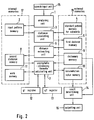
- Figure 2 is a block diagram illustrating a speech recognizing system which includes an analyzing unit 1, a distance calculating unit 3, a distance extracting unit 6, an asymptotic-processing formula calculating unit 7, a g1 register 12, a g2 register 13, a result determining unit 14, a speech input-unit 15, internal memories 17 and external memories 18.
- Figure 3 - 4 are flow-charts for describing a sequential process of the system shown in Figure 2.
- an initial value is set (step S1). For example, infinity (“ ⁇ ”) is set as a value of g(0, j), and "0” is set as a value of g(0, 0) in an accumulation value memory 10 of the external memories 18. Also, “1” is set as an initial value of a starting frame “is” (where "is” is an integer). Then, the speech input unit 15 (e.g., a microphone, voice box, or other sound producing device) samples a sound of conversation (or speech).
- infinity is set as a value of g(0, j)
- 0 is set as a value of g(0, 0) in an accumulation value memory 10 of the external memories 18.
- "1” is set as an initial value of a starting frame “is” (where "is” is an integer).
- the speech input unit 15 e.g., a microphone, voice box, or other sound producing device samples a sound of conversation (or speech).
- the analyzing unit 1 extracts the sound, sequentially divides the sound into a plurality of frames (e.g., the number of the frames is "I" which is an integer), analyzes each frame sequentially with some analyzing method (e.g., MEL cepstrum analysis described in "DIGITAL SPEECH PROCESSING", T.KOGA published by TOKAI UNIVERSITY), and sequentially stores the analyzed data as a feature "ai" (1 ⁇ i ⁇ I, wherein i and I are an integer) to the input pattern memory 2 (step S2). Finally, an input pattern "A”, as shown in the formula (1), is stored in the input pattern memory 2.
- some analyzing method e.g., MEL cepstrum analysis described in "DIGITAL SPEECH PROCESSING", T.KOGA published by TOKAI UNIVERSITY
- the distance calculating unit 3 extracts the features of the analyzed data when the input pattern memory 2 stores a predetermined number "IL” (e.g., a so-called “length of time block") of the features. For example, the distance calculating unit 3 extracts the features "a1", “a2", “a3” and “a4" simultaneously when the input pattern memory 2 stores the features "a1” - “a4" if the predetermined number "IL” is four. The distance calculating unit 3 does not access the input pattern memory 2 before the input pattern memory 2 stores the feature "a4" in this case (step S3).
- IL e.g., a so-called "length of time block
- the distance calculating unit 3 extracts the features "ais”, ---, “ a(is + IL - 1) " ("ais” represents a particular feature, e.g., if “is” is “1”, then “ais” is “a1” in the description above).
- the distance calculating unit 3 loads a subword standard pattern "bk” (1 ⁇ k ⁇ K, wherein k and K are each an integer) sequentially from the standard pattern memory 4 (step S4), because the standard pattern memory 4 stores all the subword standard patterns b1 - bK.
- the subword standard pattern "bk” has the same character analyzed by the same analyzing method (e.g., MEL cepstrum analysis) as that of the feature "ai".
- the distance calculating unit 3 calculates a distance d(i, k)(step S5) in synchronization with the loading of each subword pattern "bk".
- the distance calculating unit 3 accesses the standard pattern memory 4 for loading the subword pattern "bk". Therefore, a number of accesses required by the distance calculating unit 3 to access the standard pattern memory 4 becomes ("I” ⁇ "K”)/("IL") .
- the number of accesses required is 1/("IL") that of the conventional system and method.
- the standard pattern memory need not be a high performance memory (e.g., high speed access) because the accessing number (number of accesses required) is much smaller than that of the conventional system.
- the distances of a single time block e.g., d(1, k), d(2, k), d(3, k) and d(4, k)
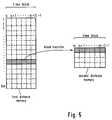
- the first distance memory 5 stores the distances of the single time block to the portion ksn (1 ⁇ ksn ⁇ Ksn wherein ksn and Ksn are an integer), as shown in Figure 5.
- one word in the dictionary memory is outputted as the recognized word (e.g., W1) by the result determining unit 14.
- This word W1 has the smallest value among the accumulation values of the end frame of the word stored in the accumulation value memory 10 (step S18).
- the words contained in the speech can be recognized in accordance with the above-described sequential operation.
- the input pattern memory 2, the second distance memory 8, and the work memory 11 can have relatively small memory capacities and are operated at high speed, these memories are built-in to the microprocessor (e.g., internal memories).
- the input pattern memory 2, second distance memory 8, and work memory 11 may be arranged preferably as the internal memory of the microprocessor without deteriorating the high-speed operations thereof, a high-speed memory may be employed instead of these memories and may be provided outside the microprocessor. Also, the distance value data are transferred from the first distance memory 5 to the second distance memory 8 in the block transfer manner in the distance extracting unit 6.
- a single time block transfer manner is employed as this block transfer operation.
- this block transfer operation as indicated in Fig. 5, since the distance value data defined from the frame “is” to the frame " is + IL - 1 " within a single time block are transferred from the first distance memory 5 to the second distance memory 8 in the batch form simultaneously, the processing operation can be executed at high speed.
- the path ⁇ g(i -1, j -1), g(i - 1) ⁇ is utilized in the matching method executed in the asymptotic-processing formula calculation.
- other paths may be employed.
- the path ⁇ g(i - 1, j - 2), g(i - 1, j - 1), g(i - 1, j) ⁇ may be employed in the matching method.
- the method using HMM also may be employed.
- the equations indicated in "BASICS OF SPEECH RECOGNITION" (pages 126 to 128 in section 6) are used instead of the above-described equations (3) to (7), and the present invention could be suitably and easily modified as would be known by one of ordinary skill in the art within the purview of the present specification.
- the time required for the speech recognition process operation can be reduced by utilizing a high-speed memory with a low memory capacity even when a memory operated at relatively low speed is employed.
- the speech recognition process operation is performed in units of the time block.
- the distance calculation is performed in units of the subword standard pattern, and the resultant distance values are transferred in units of the time block to the memory with a high-speed read/write operation.
- the distance value is read out from this memory with the high-speed read/write operation. Consequently, the process operation executed by using a low-speed memory can be accomplished quickly.
- the cost of the high-speed memory is relatively high. Since the expensive high-speed memories are required less than in the conventional system, the speech recognizing apparatus can be made inexpensive. Furthermore, since a small number of high-speed memories are employed, the memory can be easily assembled into the microprocessor. Therefore, the overall size of the speech recognition apparatus can be reduced.
Landscapes
- Engineering & Computer Science (AREA)
- Computational Linguistics (AREA)
- Health & Medical Sciences (AREA)
- Audiology, Speech & Language Pathology (AREA)
- Human Computer Interaction (AREA)
- Physics & Mathematics (AREA)
- Acoustics & Sound (AREA)
- Multimedia (AREA)
- Image Analysis (AREA)
- Compression, Expansion, Code Conversion, And Decoders (AREA)
- Telephonic Communication Services (AREA)
Applications Claiming Priority (2)
| Application Number | Priority Date | Filing Date | Title |
|---|---|---|---|
| JP8136689A JP2980026B2 (ja) | 1996-05-30 | 1996-05-30 | 音声認識装置 |
| JP136689/96 | 1996-05-30 |
Publications (2)
| Publication Number | Publication Date |
|---|---|
| EP0810583A2 true EP0810583A2 (fr) | 1997-12-03 |
| EP0810583A3 EP0810583A3 (fr) | 1998-10-07 |
Family
ID=15181179
Family Applications (1)
| Application Number | Title | Priority Date | Filing Date |
|---|---|---|---|
| EP97108686A Withdrawn EP0810583A3 (fr) | 1996-05-30 | 1997-05-30 | Système de reconnaissance de la parole |
Country Status (4)
| Country | Link |
|---|---|
| US (1) | US5909665A (fr) |
| EP (1) | EP0810583A3 (fr) |
| JP (1) | JP2980026B2 (fr) |
| CA (1) | CA2206505A1 (fr) |
Cited By (3)
| Publication number | Priority date | Publication date | Assignee | Title |
|---|---|---|---|---|
| EP0903728A3 (fr) * | 1997-09-19 | 2000-01-05 | Nortel Networks Corporation | Algorithme à blocs pour la reconnaissance de formes |
| US6195639B1 (en) | 1999-05-14 | 2001-02-27 | Telefonaktiebolaget Lm Ericsson (Publ) | Matching algorithm for isolated speech recognition |
| EP1497824A4 (fr) * | 2002-04-22 | 2006-06-14 | Matsushita Electric Industrial Co Ltd | Appariement pour reconnaissance vocale a vocabulaire etendu, a repartition par paquets et acces en treillis localise |
Families Citing this family (11)
| Publication number | Priority date | Publication date | Assignee | Title |
|---|---|---|---|---|
| US6463415B2 (en) | 1999-08-31 | 2002-10-08 | Accenture Llp | 69voice authentication system and method for regulating border crossing |
| US7590538B2 (en) * | 1999-08-31 | 2009-09-15 | Accenture Llp | Voice recognition system for navigating on the internet |
| US6275806B1 (en) * | 1999-08-31 | 2001-08-14 | Andersen Consulting, Llp | System method and article of manufacture for detecting emotion in voice signals by utilizing statistics for voice signal parameters |
| US6151571A (en) * | 1999-08-31 | 2000-11-21 | Andersen Consulting | System, method and article of manufacture for detecting emotion in voice signals through analysis of a plurality of voice signal parameters |
| US6697457B2 (en) | 1999-08-31 | 2004-02-24 | Accenture Llp | Voice messaging system that organizes voice messages based on detected emotion |
| US6427137B2 (en) | 1999-08-31 | 2002-07-30 | Accenture Llp | System, method and article of manufacture for a voice analysis system that detects nervousness for preventing fraud |
| US7222075B2 (en) * | 1999-08-31 | 2007-05-22 | Accenture Llp | Detecting emotions using voice signal analysis |
| US6353810B1 (en) | 1999-08-31 | 2002-03-05 | Accenture Llp | System, method and article of manufacture for an emotion detection system improving emotion recognition |
| EP1317749B1 (fr) * | 2000-07-31 | 2007-05-09 | Eliza Corporation | Procede et systeme d'amelioration de la precision dans un systeme de reconnaissance de la parole |
| EP1271346A1 (fr) * | 2001-06-28 | 2003-01-02 | Nokia Corporation | Procédé pour rechercher des données dans au moins deux bases de données |
| US8255216B2 (en) * | 2006-10-30 | 2012-08-28 | Nuance Communications, Inc. | Speech recognition of character sequences |
Citations (1)
| Publication number | Priority date | Publication date | Assignee | Title |
|---|---|---|---|---|
| US4882756A (en) * | 1983-10-27 | 1989-11-21 | Nec Corporation | Pattern matching system using dynamic programming |
Family Cites Families (10)
| Publication number | Priority date | Publication date | Assignee | Title |
|---|---|---|---|---|
| JPS5569880A (en) * | 1978-11-22 | 1980-05-26 | Nec Corp | Pattern recognition unit |
| US4592086A (en) * | 1981-12-09 | 1986-05-27 | Nippon Electric Co., Ltd. | Continuous speech recognition system |
| JP2595495B2 (ja) * | 1982-09-03 | 1997-04-02 | 日本電気株式会社 | パタンマッチング装置 |
| JPS5998387A (ja) * | 1982-11-26 | 1984-06-06 | Nec Corp | メモリ回路 |
| US4712243A (en) * | 1983-05-09 | 1987-12-08 | Casio Computer Co., Ltd. | Speech recognition apparatus |
| JPS62220998A (ja) * | 1986-03-22 | 1987-09-29 | 工業技術院長 | 音声認識装置 |
| EP0283902B1 (fr) * | 1987-03-16 | 1993-06-30 | Nec Corporation | Système pour la comparaison de formes |
| JP2841404B2 (ja) * | 1989-01-12 | 1998-12-24 | 日本電気株式会社 | 連続音声認識装置 |
| JPH04362698A (ja) * | 1991-06-11 | 1992-12-15 | Canon Inc | 音声認識方法及び装置 |
| JP2662120B2 (ja) | 1991-10-01 | 1997-10-08 | インターナショナル・ビジネス・マシーンズ・コーポレイション | 音声認識装置および音声認識用処理ユニット |
-
1996
- 1996-05-30 JP JP8136689A patent/JP2980026B2/ja not_active Expired - Fee Related
-
1997
- 1997-05-29 CA CA002206505A patent/CA2206505A1/fr not_active Abandoned
- 1997-05-29 US US08/864,914 patent/US5909665A/en not_active Expired - Lifetime
- 1997-05-30 EP EP97108686A patent/EP0810583A3/fr not_active Withdrawn
Patent Citations (1)
| Publication number | Priority date | Publication date | Assignee | Title |
|---|---|---|---|---|
| US4882756A (en) * | 1983-10-27 | 1989-11-21 | Nec Corporation | Pattern matching system using dynamic programming |
Cited By (4)
| Publication number | Priority date | Publication date | Assignee | Title |
|---|---|---|---|---|
| EP0903728A3 (fr) * | 1997-09-19 | 2000-01-05 | Nortel Networks Corporation | Algorithme à blocs pour la reconnaissance de formes |
| US6092045A (en) * | 1997-09-19 | 2000-07-18 | Nortel Networks Corporation | Method and apparatus for speech recognition |
| US6195639B1 (en) | 1999-05-14 | 2001-02-27 | Telefonaktiebolaget Lm Ericsson (Publ) | Matching algorithm for isolated speech recognition |
| EP1497824A4 (fr) * | 2002-04-22 | 2006-06-14 | Matsushita Electric Industrial Co Ltd | Appariement pour reconnaissance vocale a vocabulaire etendu, a repartition par paquets et acces en treillis localise |
Also Published As
| Publication number | Publication date |
|---|---|
| CA2206505A1 (fr) | 1997-11-30 |
| JPH09319392A (ja) | 1997-12-12 |
| US5909665A (en) | 1999-06-01 |
| JP2980026B2 (ja) | 1999-11-22 |
| EP0810583A3 (fr) | 1998-10-07 |
Similar Documents
| Publication | Publication Date | Title |
|---|---|---|
| US6092045A (en) | Method and apparatus for speech recognition | |
| EP0769184B1 (fr) | Procedes et appareils de reconnaissance de la parole a base de la modelisation de nouveaux mots | |
| US5909665A (en) | Speech recognition system | |
| US5848389A (en) | Speech recognizing method and apparatus, and speech translating system | |
| EP0715298B1 (fr) | Réduction de l'espace de recherche dans la reconnaissance de la parole sous utilisation des limites et classement des sons | |
| US5005203A (en) | Method of recognizing continuously spoken words | |
| EP0847041A2 (fr) | Procédé et dispositif de reconnaissance de la parole effectuant une adaptation au bruit | |
| EP0978823A2 (fr) | Reconnaissance de la parole | |
| EP0282272B1 (fr) | Système de reconnaissance de la parole | |
| US6662159B2 (en) | Recognizing speech data using a state transition model | |
| JPH0422276B2 (fr) | ||
| EP0162255B1 (fr) | Procédé et dispositif pour la comparaison de formes | |
| EP0042590B1 (fr) | Dispositif d'extraction de phonèmes | |
| US5732190A (en) | Number-of recognition candidates determining system in speech recognizing device | |
| US6374222B1 (en) | Method of memory management in speech recognition | |
| EP0977173B1 (fr) | Minimisation d'un réseau de recherche pour la reconnaissance de la parole | |
| JP2964881B2 (ja) | 音声認識装置 | |
| US6631349B1 (en) | Speech recognition method and system | |
| JP3315565B2 (ja) | 音声認識装置 | |
| JPWO1999028898A1 (ja) | 音声認識方法およびシステム | |
| US7818172B2 (en) | Voice recognition method and system based on the contexual modeling of voice units | |
| JP3293191B2 (ja) | 音声認識装置 | |
| JP2002006883A (ja) | 音声認識装置および音声認識方法、並びに、プログラム記録媒体 | |
| JPS62111295A (ja) | 音声認識装置 | |
| JPH0689099A (ja) | 連続音声認識方法 |
Legal Events
| Date | Code | Title | Description |
|---|---|---|---|
| PUAI | Public reference made under article 153(3) epc to a published international application that has entered the european phase |
Free format text: ORIGINAL CODE: 0009012 |
|
| AK | Designated contracting states |
Kind code of ref document: A2 Designated state(s): DE FR GB |
|
| PUAL | Search report despatched |
Free format text: ORIGINAL CODE: 0009013 |
|
| AK | Designated contracting states |
Kind code of ref document: A3 Designated state(s): DE FR GB |
|
| 17P | Request for examination filed |
Effective date: 19990407 |
|
| 17Q | First examination report despatched |
Effective date: 20011228 |
|
| GRAG | Despatch of communication of intention to grant |
Free format text: ORIGINAL CODE: EPIDOS AGRA |
|
| RIC1 | Information provided on ipc code assigned before grant |
Free format text: 7G 10L 15/10 A |
|
| GRAG | Despatch of communication of intention to grant |
Free format text: ORIGINAL CODE: EPIDOS AGRA |
|
| RAP1 | Party data changed (applicant data changed or rights of an application transferred) |
Owner name: NEC ELECTRONICS CORPORATION |
|
| STAA | Information on the status of an ep patent application or granted ep patent |
Free format text: STATUS: THE APPLICATION HAS BEEN WITHDRAWN |
|
| 18W | Application withdrawn |
Effective date: 20030621 |