EP0811041B1 - Verfahren zum färben von polyester und polyesterhaltigen textilmaterialien - Google Patents
Verfahren zum färben von polyester und polyesterhaltigen textilmaterialien Download PDFInfo
- Publication number
- EP0811041B1 EP0811041B1 EP95910526A EP95910526A EP0811041B1 EP 0811041 B1 EP0811041 B1 EP 0811041B1 EP 95910526 A EP95910526 A EP 95910526A EP 95910526 A EP95910526 A EP 95910526A EP 0811041 B1 EP0811041 B1 EP 0811041B1
- Authority
- EP
- European Patent Office
- Prior art keywords
- alkyl
- polyester
- dyeing
- dye
- dyes
- Prior art date
- Legal status (The legal status is an assumption and is not a legal conclusion. Google has not performed a legal analysis and makes no representation as to the accuracy of the status listed.)
- Expired - Lifetime
Links
- 0 CCN(C)C(CCC1N=C=C*C2C(C#N)=CC(C)CC2C#N)C=C1NS(C)(=O)=O Chemical compound CCN(C)C(CCC1N=C=C*C2C(C#N)=CC(C)CC2C#N)C=C1NS(C)(=O)=O 0.000 description 7
Classifications
-
- C—CHEMISTRY; METALLURGY
- C09—DYES; PAINTS; POLISHES; NATURAL RESINS; ADHESIVES; COMPOSITIONS NOT OTHERWISE PROVIDED FOR; APPLICATIONS OF MATERIALS NOT OTHERWISE PROVIDED FOR
- C09B—ORGANIC DYES OR CLOSELY-RELATED COMPOUNDS FOR PRODUCING DYES, e.g. PIGMENTS; MORDANTS; LAKES
- C09B67/00—Influencing the physical, e.g. the dyeing or printing properties of dyestuffs without chemical reactions, e.g. by treating with solvents grinding or grinding assistants, coating of pigments or dyes; Process features in the making of dyestuff preparations; Dyestuff preparations of a special physical nature, e.g. tablets, films
- C09B67/0033—Blends of pigments; Mixtured crystals; Solid solutions
- C09B67/0046—Mixtures of two or more azo dyes
- C09B67/0051—Mixtures of two or more azo dyes mixture of two or more monoazo dyes
-
- C—CHEMISTRY; METALLURGY
- C09—DYES; PAINTS; POLISHES; NATURAL RESINS; ADHESIVES; COMPOSITIONS NOT OTHERWISE PROVIDED FOR; APPLICATIONS OF MATERIALS NOT OTHERWISE PROVIDED FOR
- C09B—ORGANIC DYES OR CLOSELY-RELATED COMPOUNDS FOR PRODUCING DYES, e.g. PIGMENTS; MORDANTS; LAKES
- C09B29/00—Monoazo dyes prepared by diazotising and coupling
- C09B29/06—Monoazo dyes prepared by diazotising and coupling from coupling components containing amino as the only directing group
- C09B29/08—Amino benzenes
- C09B29/0805—Amino benzenes free of acid groups
- C09B29/0807—Amino benzenes free of acid groups characterised by the amino group
- C09B29/0809—Amino benzenes free of acid groups characterised by the amino group substituted amino group
- C09B29/081—Amino benzenes free of acid groups characterised by the amino group substituted amino group unsubstituted alkylamino, alkenylamino, alkynylamino, cycloalkylamino, aralkylamino or arylamino
-
- C—CHEMISTRY; METALLURGY
- C09—DYES; PAINTS; POLISHES; NATURAL RESINS; ADHESIVES; COMPOSITIONS NOT OTHERWISE PROVIDED FOR; APPLICATIONS OF MATERIALS NOT OTHERWISE PROVIDED FOR
- C09B—ORGANIC DYES OR CLOSELY-RELATED COMPOUNDS FOR PRODUCING DYES, e.g. PIGMENTS; MORDANTS; LAKES
- C09B43/00—Preparation of azo dyes from other azo compounds
- C09B43/40—Preparation of azo dyes from other azo compounds by substituting hetero atoms by radicals containing other hetero atoms
- C09B43/42—Preparation of azo dyes from other azo compounds by substituting hetero atoms by radicals containing other hetero atoms by substituting radicals containing hetero atoms for —CN radicals
-
- D—TEXTILES; PAPER
- D06—TREATMENT OF TEXTILES OR THE LIKE; LAUNDERING; FLEXIBLE MATERIALS NOT OTHERWISE PROVIDED FOR
- D06P—DYEING OR PRINTING TEXTILES; DYEING LEATHER, FURS OR SOLID MACROMOLECULAR SUBSTANCES IN ANY FORM
- D06P3/00—Special processes of dyeing or printing textiles, or dyeing leather, furs, or solid macromolecular substances in any form, classified according to the material treated
- D06P3/34—Material containing ester groups
- D06P3/52—Polyesters
- D06P3/54—Polyesters using dispersed dyestuffs
-
- D—TEXTILES; PAPER
- D06—TREATMENT OF TEXTILES OR THE LIKE; LAUNDERING; FLEXIBLE MATERIALS NOT OTHERWISE PROVIDED FOR
- D06P—DYEING OR PRINTING TEXTILES; DYEING LEATHER, FURS OR SOLID MACROMOLECULAR SUBSTANCES IN ANY FORM
- D06P1/00—General processes of dyeing or printing textiles, or general processes of dyeing leather, furs, or solid macromolecular substances in any form, classified according to the dyes, pigments, or auxiliary substances employed
- D06P1/16—General processes of dyeing or printing textiles, or general processes of dyeing leather, furs, or solid macromolecular substances in any form, classified according to the dyes, pigments, or auxiliary substances employed using dispersed, e.g. acetate, dyestuffs
- D06P1/18—Azo dyes
-
- Y—GENERAL TAGGING OF NEW TECHNOLOGICAL DEVELOPMENTS; GENERAL TAGGING OF CROSS-SECTIONAL TECHNOLOGIES SPANNING OVER SEVERAL SECTIONS OF THE IPC; TECHNICAL SUBJECTS COVERED BY FORMER USPC CROSS-REFERENCE ART COLLECTIONS [XRACs] AND DIGESTS
- Y10—TECHNICAL SUBJECTS COVERED BY FORMER USPC
- Y10S—TECHNICAL SUBJECTS COVERED BY FORMER USPC CROSS-REFERENCE ART COLLECTIONS [XRACs] AND DIGESTS
- Y10S8/00—Bleaching and dyeing; fluid treatment and chemical modification of textiles and fibers
- Y10S8/92—Synthetic fiber dyeing
- Y10S8/922—Polyester fiber
-
- Y—GENERAL TAGGING OF NEW TECHNOLOGICAL DEVELOPMENTS; GENERAL TAGGING OF CROSS-SECTIONAL TECHNOLOGIES SPANNING OVER SEVERAL SECTIONS OF THE IPC; TECHNICAL SUBJECTS COVERED BY FORMER USPC CROSS-REFERENCE ART COLLECTIONS [XRACs] AND DIGESTS
- Y10—TECHNICAL SUBJECTS COVERED BY FORMER USPC
- Y10S—TECHNICAL SUBJECTS COVERED BY FORMER USPC CROSS-REFERENCE ART COLLECTIONS [XRACs] AND DIGESTS
- Y10S8/00—Bleaching and dyeing; fluid treatment and chemical modification of textiles and fibers
- Y10S8/933—Thermosol dyeing, thermofixation or dry heat fixation or development
Definitions
- the present invention relates to a method for dyeing of textile polyester or textile materials containing polyester with red dicyanazo dyes.
- polyester is polyester or polyester-containing Textile materials with disperse dyes aqueous dye bath under HT conditions in a temperature range colored from 120 to 140 ° C at pH values from 4 to 6, because at higher pH values the disperse dyes partially or completely destroyed. At higher pH values This leads to loss of color strength and color deviations when dyeing and the dyeings are not reproducible.
- the polyester fiber in a separate step before staining an alkaline Subject to rinsing treatment to aids that have been used in weaving or spinning the fiber, to remove.
- These tools are e.g. Oiling or Sizing agents that, when available, are level Dyeing the polyester fiber difficult or impossible would do.
- the alkaline treatment is also carried out to oligomers of polyester fiber that are used in the dyeing process have emerged from the inside of the fiber and the Color uneven, destroy and appear in the to keep aqueous dye liquor.
- the oligomers mentioned are particularly undesirable in yarn dyeing because they itself when spinning the dyed yarn in the spinning apparatus where the yarn is deflected by abrasion settle powdery. This will contaminate the equipment and cause the yarn to tear.
- This alkaline rinsing treatment is convenient performed at elevated temperature. For time and energy to save and the number of alkaline for both processes Pretreatment and dyeing, equipment needed reduce, it has always been the goal of both processes to form a one-bath rinsing and dyeing process. However, procedures must be implemented to achieve this goal be developed in an aqueous dyebath at pH 8 reproducible colorations up to pH 11.
- Polyester-cellulose or polyester-polyamide blend are with disperse or reactive dyes from aqueous Dye bath usually dyed in two dyeing steps.
- the goal here in the past was a one-bath Develop application methods for both dye classes. They searched for reactive dyes which are already colored at pH values between 8 and 11 and procedures were also required who ensure that under these conditions the Polyester content reproducible with disperse dyes can be colored.
- DE-A 39 38 631 describes a method in which disperse dyes in the pH range between pH 8 and 10 in Presence of at least one, optionally on nitrogen substituted amino acid and / or an alkali metal salt one optionally substituted on nitrogen Amino acid can be colored.
- Red dicyanazo dyes are already known from EP-A 501 238 known with which polyester or polyester Fiber materials according to the HT process in the pH range between 8 and 11 can be colored. These dyes have high pH stability, but not the desired one Brilliance. In addition, they do not come in the shade close enough to C.I. Disperse Red 60 and have Defects with regard to their application and their fastness to use.
- alkali-stable Dyes provide brilliant reds deliver with sufficient fastness to use.
- Dicyanazo dyes solve this task.
- This Dicyanazo dyes are partly already from DE-A 27 11 130 known, but without their special Suitability for alkali dyeing known or obvious would have been.
- X (C 1 -C 3 ) -alkyl is, for example, methyl, ethyl, i-propyl or n-propyl, ethyl being preferred and methyl being particularly preferred.
- R standing for (C 1 -C 6 ) alkyl means, for example, methyl, ethyl, n-propyl, i-propyl, n-butyl, i-butyl, sec-butyl, n-pentyl, i-pentyl and n-hexyl.
- R is preferably (C 3 -C 5 ) alkyl.
- Linear (C 2 -C 4 ) alkyl representing R 1 and R 2 means, for example, ethyl, n-propyl and n-butyl.
- R 1 and R 2 are preferably the same and are ethyl or n-propyl.
- Preferred dyes of the general formula I to be used according to the invention are those in which the sum of the carbon atoms in the radicals X, R, R 1 and R 2 is 8 to 14, particularly preferably 9 to 12.
- Particularly preferred dyes of the general formula I have several of the preferred features mentioned above on.
- Preferred general dyes according to the invention Formula I are those that described as preferred above Features.
- the cyan exchange process is, for example, in DE-A 27 11 130. Also the making of the connections the general formula II can be analogous to those there Information is given.
- the process according to the invention can be carried out using a dye of the general formula I are carried out. But it can also with two, three or four dyes of the general Formula I run, but two and three Dyes are preferred.
- the proportion of a dye in in these cases it is preferably 5 to 95% by weight, particularly preferably 20 to 70% by weight, based in each case on the Total amount of dye.
- dyes of the general formula I are used, these preferably differ only in the meaning of the radicals R or only in the meaning of the radicals R 1 and R 2 , which are the same within one dye.
- the process according to the invention is preferred under HT conditions executed, i.e. in aqueous dye liquor Temperatures between 120 ° C and 140 ° C in a dyeing autoclave.
- the pH value is preferably pH 9 to pH 10.
- the dyes of the general formula I according to the invention can not, but according to the inventive method also in other common dyeing and dyeing processes Printing of hydrophobic synthetic textile materials, e.g. under HT conditions in the pH range between 4 and 11, in the so-called thermosol process or after be applied to the fiber in a printing process.
- Polyesters are in particular those based on polyethylene glycol terephthalates. Textile materials containing polyester are e.g. Mixtures of polyester and polyamides.
- the dyes or dye mixtures used in fine distribution takes place in a manner known per se Wise in that the one arising in the manufacturing Dye together with dispersants in in a liquid medium, preferably in water and the mix of shear forces exposes the original dye particles mechanically crushed to the extent that a optimal specific surface is achieved and the Sedimentation of the dye is as low as possible.
- the Particle sizes of the dyes are generally between 0.5 and 5 ⁇ m, preferably around 1 ⁇ m.
- the dispersants used in the grinding process can be nonionic or anionic.
- Non-ionogenic Dispersants are e.g. Reaction products of alkylene oxides, such as. Ethylene or propylene oxide with alkylatable Connections such as Fatty alcohols, fatty amines, Fatty acids, phenols, alkylphenols and carboxamides.
- Anionic dispersants are, for example Lignin sulfonates, alkyl or alkyl aryl sulfonates or alkyl aryl polyglycol ether sulfonates.
- the dye preparations thus obtained are intended for most applications are pourable.
- the dye and The dispersant content is therefore limited in these cases.
- the dispersions are in one Dye content up to 25% by weight and a dispersant content set up to about 25%. From economic Dye contents of 15% by weight are usually not the reason undershot.
- the dispersions can also contain other auxiliaries, e.g. those that act as oxidizing agents, such as e.g. Sodium m-nitrobenzenesulfonate or fungicidal agents, such as. Sodium o-phenyl phenolate.
- auxiliaries e.g. those that act as oxidizing agents, such as e.g. Sodium m-nitrobenzenesulfonate or fungicidal agents, such as. Sodium o-phenyl phenolate.
- These powders contain the dye or that Dye mixture, dispersant and other auxiliaries, such as. Wetting, oxidation, preservation and Dedusting agent.
- a preferred manufacturing method for powdery Dye preparations are that described above liquid dye dispersions the liquid is withdrawn, e.g. by vacuum drying, freeze drying, by drying on drum dryers, preferably but by spray drying.
- the necessary Amounts of dye settings made according to the were made with the coloring medium, preferably diluted with water to the extent that the dyeing a liquor ratio of 1: 5 to 1:50 results.
- the fleets are generally more Dyeing aids, such as dispersing, wetting and Fixing aid added.
- the required pH value of the dye liquor is checked before or also during dyeing by adding bases such as alkali hydroxides, e.g. aqueous sodium hydroxide solution, alkali hydrogen carbonates, e.g. Sodium bicarbonate or alkali carbonates e.g. Soda, discontinued.
- bases such as alkali hydroxides, e.g. aqueous sodium hydroxide solution, alkali hydrogen carbonates, e.g. Sodium bicarbonate or alkali carbonates e.g. Soda, discontinued.
- buffer substances are preferably added, as are described, for example, in JSDC 77 (1979), p. 47 or JSDC 79 (1981), p. 115.
- Particularly suitable buffer substances are those which have the greatest buffering action in the pH range between 9 and 11.
- Suitable buffer systems are, for example, acetic acid / sodium pyrophosphate, boric acid / borax, sodium dihydrogen phosphate / disodium hydrogen phosphate, phosphoric acid / succinic acid / boric acid or combinations of organic phosphorus compounds with polycarboxylic acids.
- the amounts of buffer system used are preferably between 0.5 and 10 g / l.
- 0.5 g of a 20% powder preparation of the dye of the formula Ib are made in a dyeing autoclave from a dyeing liquor consisting of 2 l of water, 2 g of a dyeing aid based on formaldehyde condensation product and 5 g of a buffer substance, which is a mixture of an organic phosphorus compound and a polycarboxylic acid, at 130 ° C. on 100 g of a fabric Polyethylene terephthalate dyed after the pH of the dye liquor had previously been adjusted to 10 with aqueous sodium hydroxide solution. The dyeing is then rinsed, reductively cleaned, and rinsed and dried. This gives a red color with a brilliant hue.
- the coloring is repeated, using as a buffer substance now added 4 g of sodium acetate and the pH of the Dyeing liquor is adjusted to 4.5 with acetic acid.
- the resulting coloring is almost the same color strength and shade, the dye has come in handy at pH 10 not decomposed.
- 57.4 g of the intermediate of formula IV are suspended in 250 ml of dimethylformamide and mixed with 11.8 g of zinc cyanide and 1 g of copper-I-cyanide. After heating to 100 ° C. for 30 minutes, the dye is precipitated with 250 ml of water, suction filtered, washed with 50% aqueous dimethylformamide and then with water and dried at 50 ° C. It dissolves in acetone with a bluish red color and has its absorption maximum at 524 nm in phthalic acid ester and dyes polyester in a clear bluish red shade even at pH values> 9. The shade therefore comes very close to that of CI Disperse Red 60.
- Dyes according to the invention are listed in the table below.
Landscapes
- Chemical & Material Sciences (AREA)
- Organic Chemistry (AREA)
- Chemical Kinetics & Catalysis (AREA)
- Dispersion Chemistry (AREA)
- Engineering & Computer Science (AREA)
- Textile Engineering (AREA)
- Coloring (AREA)
- Floor Finish (AREA)
- Duct Arrangements (AREA)
Description


| X | R | R1 | R2 |
| CH3 | n-C3H7 | C2H5 | C2H5 |
| CH3 | i-C3H7 | C2H5 | C2H5 |
| CH3 | i-C4H9 | C2H5 | C2H5 |
| CH3 | sek-C4H9 | C2H5 | C2H5 |
| CH3 | n-C5H11 | C2H5 | C2H5 |
| CH3 | i-C5H11 | C2H5 | C2H5 |
| CH3 | n-C6H13 | C2H5 | C2H5 |
| CH3 | C2H5 | n-C3H7 | n-C3H7 |
| CH3 | C2H5 | n-C4H9 | n-C4H9 |
| CH3 | C2H5 | n-C3H7 | n-C4H9 |
| CH3 | n-C3H7 | C2H5 | n-C4H9 |
| CH3 | n-C3H7 | n-C3H7 | n-C3H7 |
| CH3 | n-C3H7 | n-C3H7 | n-C4H9 |
| CH3 | i-C3H7 | n-C3H7 | n-C3H7 |
| CH3 | i-C3H7 | n-C4H9 | n-C4H9 |
| CH3 | n-C4H9 | C2H5 | n-C3H7 |
| CH3 | n-C4H9 | n-C3H7 | n-C3H7 |
| CH3 | n-C4H9 | n-C4H9 | n-C4H9 |
| CH3 | n-C4H9 | C2H5 | n-C3H7 |
| CH3 | i-C4H9 | n-C3H7 | n-C3H7 |
| CH3 | i-C4H9 | n-C4H9 | n-C4H9 |
| CH3 | sek-C4H9 | n-C3H7 | n-C3H7 |
| CH3 | n-C5H11 | n-C3H7 | n-C3H7 |
| CH3 | n-C5H11 | n-C3H7 | n-C4H9 |
| CH3 | n-C6H13 | n-C3H7 | n-C3H7 |
| CH3 | (CH2)2CH(CH3)2 | C2H5 | C2H5 |
| CH3 | (CH2)2CH(CH3)2 | C2H5 | n-C3H7 |
| CH3 | (CH2)2CH(CH3)2 | n-C4H9 | n-C4H9 |
| C2H5 | C2H5 | C2H5 | C2H5 |
| C2H5 | C2H5 | i-C3H7 | n-C3H7 |
| C2H5 | C2H5 | n-C4H9 | n-C4H9 |
| C2H5 | n-C3H7 | C2H5 | C2H5 |
| C2H5 | n-C3H7 | n-C3H7 | n-C3H7 |
| C2H5 | i-C3H7 | C2H5 | C2H5 |
| C2H5 | i-C3H7 | C2H5 | n-C4H9. |
| C2H5 | i-C3H7 | n-C4H9 | n-C4H9 |
| n-C3H7 | n-C3H7 | n-C3H7 | n-C3H7 |
| n-C3H7 | n-C4H9 | C2H5 | n-C4H9 |
| i-C3H7 | C2H5 | C2H5 | C2H5 |
| i-C3H7 | C2H5 | n-C3H7 | n-C3H7 |
| i-C3H7 | C2H5 | n-C4H9 | n-C4H9 |
| i-C3H7 | n-C3H7 | C2H5 | C2H5 |
| i-C3H7 | n-C4H9 | C2H5 | C2H5 |
| i-C3H7 | n-C4H9 | n-C3H7 | n-C3H7 |
| CH3 | CH3 | n-C3H7 | n-C3H7 |
| CH3 | CH3 | n-C4H9 | n-C4H9 |
| C2H5 | CH3 | n-C3H7 | n-C3H7 |
| X | R | R1 | R2 | Mischungsverhältnis |
| CH3 | C2H5 | C2H5 | C2H5 | 50 |
| CH3 | n-C4H9 | C2H5 | C2H5 | 50 |
| CH3 | C2H5 | C2H5 | C2H5 | 35 |
| CH3 | n-C4H9 | n-C3H7 | n-C3H7 | 65 |
| CH3 | C2H5 | n-C3H7 | n-C3H7 | 45 |
| CH3 | n-C4H9 | C2H5 | C2H5 | 55 |
| CH3 | C2H5 | n-C4H9 | n-C4H9 | 30 |
| CH3 | n-C4H9 | n-C4H9 | n-C4H9 | 70 |
| CH3 | C2H5 | n-C3H7 | C2H5 | 85 |
| CH3 | n-C6H13 | n-C3H7 | n-C3H7 | 15 |
| CH3 | i-C3H7 | n-C4H9 | n-C3H7 | 65 |
| CH3 | n-C4H9 | C2H5 | C2H5 | 35 |
| CH3 | i-C3H7 | C2H5 | C2H5 | 40 |
| CH3 | n-C4H9 | n-C3H7 | n-C3H7 | 60 |
| CH3 | i-C3H7 | n-C4H9 | n-C4H9 | 50 |
| CH3 | C2H5 | n-C4H9 | n-C4H9 | 50 |
| CH3 | i-C3H7 | C2H5 | C2H5 | 55 |
| CH3 | i-C4H9 | C2H5 | C2H5 | 45 |
| CH3 | i-C3H7 | n-C4H9 | n-C4H9 | 60 |
| CH3 | n-C5H11 | C2H5 | C2H5 | 40 |
| CH3 | C2H5 | n-C3H7 | n-C3H7 | 35 |
| CH3 | C2H5 | n-C4H9 | n-C4H9 | 65 |
| CH3 | i-C3H7 | n-C3H7 | n-C3H7 | 50 |
| CH3 | i-C3H7 | C2H5 | n-C4H9 | 50 |
| CH3 | i-C3H7 | C2H5 | C2H5 | 65 |
| CH3 | i-C3H7 | n-C4H9 | n-C4H9 | 35 |
| CH3 | n-C4H9 | C2H5 | C2H5 | 45 |
| CH3 | n-C4H9 | n-C3H7 | n-C3H7 | 55 |
| CH3 | n-C6H13 | C2H5 | C2H5 | 70 |
| CH3 | n-C6H13 | n-C3H7 | n-C3H7 | 30 |
| C2H5 | C2H5 | n-C3H7 | n-C3H7 | 50 |
| C2H5 | n-C4H9 | C2H5 | C2H5 | 50 |
| C2H5 | i-C3H7 | n-C3H7 | n-C3H7 | 35 |
| C2H5 | n-C4H9 | n-C3H7 | n-C3H7 | 65 |
| C2H5 | n-C4H9 | C2H5 | n-C3H7 | 50 |
| C2H5 | n-C6H13 | C2H5 | n-C3H7 | 50 |
| C2H5 | n-C4H9 | C2H5 | n-C4H9 | 95 |
| C2H5 | sek-C4H9 | C2H5 | C2H5 | 5 |
| n-C3H7 | n-C3H7 | C2H5 | C2H5 | 55 |
| n-C3H7 | i-C3H7 | C2H5 | C2H5 | 45 |
| i-C3H7 | C2H5 | n-C3H7 | n-C3H7 | 30 |
| i-C3H7 | n-C4H9 | n-C3H7 | n-C3H7 | 70 |
| i-C3H7 | n-C4H9 | n-C3H7 | n-C3H7 | 40 |
| i-C3H7 | n-C4H9 | n-C4H9 | n-C4H9 | 60 |
| CH3 | n-C4H9 | n-C3H7 | n-C3H7 | 60 |
| C2H5 | n-C4H9 | n-C3H7 | n-C3H7 | 40 |
| CH3 | n-C4H9 | C2H5 | C2H5 | 85 |
| C2H5 | i-C3H7 | C2H5 | C2H5 | 15 |
| CH3 | n-C4H9 | n-C4H9 | n-C4H9 | 50 |
| C2H5 | C2H5 | n-C3H7 | n-C3H7 | 50 |
| CH3 | n-C4H9 | n-C3H7 | n-C3H7 | 70 |
| i-C3H7 | n-C4H9 | n-C4H9 | n-C4H9 | 30 |
| CH3 | C2H5 | n-C3H7 | n-C3H7 | 20 |
| CH3 | n-C4H9 | n-C3H7 | n-C3H7 | 40 |
| CH3 | n-C4H9 | n-C4H9 | n-C4H9 | 40 |
| CH3 | n-C3H7 | n-C3H7 | n-C3H7 | 25 |
| CH3 | i-C3H7 | n-C3H7 | n-C3H7 | 25 |
| CH3 | n-C4H9 | C2H5 | C2H5 | 50 |
| CH3 | n-C4H9 | n-C3H7 | n-C3H7 | 70 |
| CH3 | C2H5 | n-C3H7 | n-C3H7 | 15 |
| C2H5 | C2H5 | n-C3H7 | n-C3H7 | 15 |
| CH3 | i-C3H7 | n-C3H7 | n-C3H7 | 33 |
| CH3 | i-C3H7 | C2H5 | C2H5 | 33 |
| C2H5 | n-C4H9 | n-C4H9 | n-C4H9 | 33 |
| CH3 | CH3 | n-C3H7 | n-C3H7 | 60 |
| CH3 | CH3 | n-C4H9 | n-C4H9 | 40 |
| CH3 | CH3 | n-C3H7 | n-C3H7 | 10 |
| CH3 | n-C3H7 | C2H5 | C2H5 | 90 |
| CH3 | CH3 | n-C3H7 | n-C3H7 | 80 |
| C2H5 | CH3 | n-C3H7 | n-C3H7 | 20 |
| X | R | R1 | R2 |
| CH3 | n-C5H11 | C2H5 | n-C3H7 |
| CH3 | n-C5H11 | n-C3H7 | n-C3H7 |
| CH3 | n-C5H11 | n-C4H9 | n-C4H9 |
| CH3 | (CH2)2CH(CH3)2 | C2H5 | C2H5 |
| CH3 | (CH2)2CH(CH3)2 | n-C3H7 | n-C3H7 |
| CH3 | n-C6H13 | C2H5 | C2H5 |
| CH3 | n-C6H13 | n-C3H7 | n-C3H7 |
| CH3 | n-C6H13 | C2H5 | n-C3H7 |
| CH3 | n-C6H13 | n-C4H9 | n-C4H9 |
| C2H5 | n-C5H11 | C2H5 | C2H5 |
| C2H5 | n-C5H11 | n-C3H7 | n-C3H7 |
| C2H5 | (CH2)2CH(CH3)2 | C2H5 | C2H5 |
| C2H5 | (CH2)2CH(CH3)2 | n-C3H7 | n-C3H7 |
| C2H5 | n-C6H13 | C2H5 | C2H5 |
| C2H5 | n-C6H13 | n-C3H7 | n-C3H7 |
| i-C3H7 | n-C5H11 | n-C3H7 | n-C4H9 |
| i-C3H7 | n-C5H11 | C2H5 | C2H5 |
| i-C3H7 | n-C6H13 | C2H5 | C2H5 |
| n-C3H7 | n-C5H11 | n-C3H7 | n-C3H7 |
Claims (9)
- Verfahren zum Färben von Polyester oder polyesterhaltigen Textilmaterialien bei pH 8 bis pH 11, dadurch gekennzeichnet, daß man einen oder mehrere Monoazofarbstoffe der allgemeinen Formel Ieinsetzt, worin
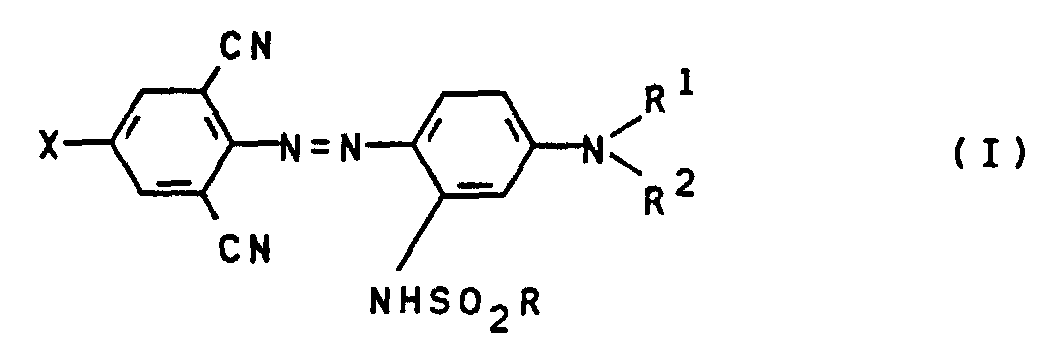 x (C1-C3)-AlkylR (C1-C6)-Alkyl undR1 und R2 unabhängig voneinander lineares (C2-C4)-Alkyl bedeuten, wobei R1 und R2 unabhängig voneinander (C3-C4)-Alkyl bedeuten, falls R für Methyl steht.
 - Verfahren gemäß Anspruch 1, dadurch gekennzeichnet, daß X Methyl bedeutet.
- Verfahren gemäß Anspruch 1 und/oder 2, dadurch gekennzeichnet, daß R (C3-C5)-Alkyl bedeutet.
- Verfahren gemäß einem oder mehreren der Ansprüche 1 bis 3, dadurch gekennzeichnet, daß R1 und R2 gleich sind und Ethyl oder n-Propyl bedeuten.
- Verfahren gemäß einem oder mehreren der Ansprüche 1 bis 4, dadurch gekennzeichnet, daß es unter HT-Bedingungen in wäßriger Färbeflotte bei Temperaturen zwischen 120°C und 140°C in einem Färbeautoklaven ausgeführt wird.
- Verfahren gemäß einem oder mehreren der Ansprüche 1 bis 5, dadurch gekennzeichnet, daß es bei pH 9 bis pH 10 ausgeführt wird.
- Monoazofarbstoffe der allgemeinen Formel Iworin
 X (C1-C3)-AlkylR (C5-C6)-Alkyl undR1 und R2 unabhängig voneinander lineares (C2-C4)-Alkyl bedeuten.
 - Verfahren zur Herstellung von Monoazofarbstoffen der allgemeinen Formel I gemäß Anspruch 7, durch Cyanaustausch aus Verbindungen der allgemeinen Formel IIworin
 Y Cyan oder HalHal ein Halogenatom, wie Chlor oder insbesondere Brom, bedeuten undX, R, R1 und R2 wie in Anspruch 7 angegeben definiert sind.
 - Verwendung von Monoazofarbstoffen der allgemeinen Formel I gemäß Anspruch 7 zum Färben und Bedrucken von hydrophoben Textilmaterialien.
Applications Claiming Priority (1)
| Application Number | Priority Date | Filing Date | Title |
|---|---|---|---|
| PCT/EP1995/000702 WO1996026982A1 (de) | 1995-02-27 | 1995-02-27 | Verfahren zum färben von polyester und polyesterhaltigen textilmaterialien |
Publications (2)
| Publication Number | Publication Date |
|---|---|
| EP0811041A1 EP0811041A1 (de) | 1997-12-10 |
| EP0811041B1 true EP0811041B1 (de) | 1999-07-21 |
Family
ID=8165962
Family Applications (1)
| Application Number | Title | Priority Date | Filing Date |
|---|---|---|---|
| EP95910526A Expired - Lifetime EP0811041B1 (de) | 1995-02-27 | 1995-02-27 | Verfahren zum färben von polyester und polyesterhaltigen textilmaterialien |
Country Status (6)
| Country | Link |
|---|---|
| US (1) | US5922089A (de) |
| EP (1) | EP0811041B1 (de) |
| JP (1) | JPH11501059A (de) |
| AT (1) | ATE181409T1 (de) |
| ES (2) | ES2135701T3 (de) |
| WO (1) | WO1996026982A1 (de) |
Families Citing this family (3)
| Publication number | Priority date | Publication date | Assignee | Title |
|---|---|---|---|---|
| US7416599B2 (en) * | 2003-12-10 | 2008-08-26 | Dow Global Technologies Inc. | System for bonding glass into a structure |
| KR20160002843A (ko) * | 2013-04-27 | 2016-01-08 | 다우 글로벌 테크놀로지스 엘엘씨 | Lcd의 컬러 필터에 사용되는 아조 염료 |
| CN105111775A (zh) * | 2015-09-30 | 2015-12-02 | 上海安诺其集团股份有限公司 | 一种偶氮化合物的应用 |
Family Cites Families (11)
| Publication number | Priority date | Publication date | Assignee | Title |
|---|---|---|---|---|
| GB1559562A (en) * | 1977-03-15 | 1980-01-23 | Bayer Ag | Azo compounds |
| DE2711130C2 (de) * | 1977-03-15 | 1983-08-25 | Bayer Ag, 5090 Leverkusen | Azofarbstoffe |
| DE2846438C2 (de) * | 1978-10-25 | 1987-05-07 | Bayer Ag, 5090 Leverkusen | Verfahren zur Herstellung von Cyanazofarbstoffen |
| DE3533527A1 (de) * | 1985-09-20 | 1987-04-02 | Bayer Ag | Mischungen roter dispersionsazofarbstoffe |
| US5013133A (en) * | 1988-10-31 | 1991-05-07 | The University Of Rochester | Diffractive optical imaging lens systems |
| US5019133A (en) * | 1988-11-25 | 1991-05-28 | Mitsubishi Kasei Corporation | Method for dyeing polyester-containing fibers in an alkaline dyeing bath and dyeing assistant, an amino-acid compound |
| DE3844067A1 (de) * | 1988-12-28 | 1990-07-05 | Bayer Ag | Mischungen von dispersionsazofarbstoffen |
| EP0489972A1 (de) * | 1990-12-10 | 1992-06-17 | Agfa-Gevaert N.V. | Wärmeempfindliches Registriermaterial |
| DE4106323A1 (de) * | 1991-02-28 | 1992-09-03 | Cassella Ag | Verfahren zum faerben von polyester und polyesterhaltigen textilmaterialien |
| EP0526170B1 (de) * | 1991-07-31 | 1997-10-08 | MITSUI TOATSU CHEMICALS, Inc. | Farbstoff für wärmeempfindliche Übertragungsaufzeichnung und Übertragungsblatt die ihn enthält |
| DE4329761A1 (de) * | 1993-09-03 | 1995-03-09 | Cassella Ag | Verfahren zum Färben von Polyester und polyesterhaltigen Textilmaterialien |
-
1995
- 1995-02-10 ES ES95909192T patent/ES2135701T3/es not_active Expired - Lifetime
- 1995-02-10 AT AT95909192T patent/ATE181409T1/de active
- 1995-02-27 JP JP8525971A patent/JPH11501059A/ja active Pending
- 1995-02-27 ES ES95910526T patent/ES2135706T3/es not_active Expired - Lifetime
- 1995-02-27 EP EP95910526A patent/EP0811041B1/de not_active Expired - Lifetime
- 1995-02-27 US US08/894,647 patent/US5922089A/en not_active Expired - Fee Related
- 1995-02-27 WO PCT/EP1995/000702 patent/WO1996026982A1/de not_active Ceased
Also Published As
| Publication number | Publication date |
|---|---|
| EP0811041A1 (de) | 1997-12-10 |
| US5922089A (en) | 1999-07-13 |
| WO1996026982A1 (de) | 1996-09-06 |
| JPH11501059A (ja) | 1999-01-26 |
| ES2135701T3 (es) | 1999-11-01 |
| ATE181409T1 (de) | 1999-07-15 |
| ES2135706T3 (es) | 1999-11-01 |
Similar Documents
| Publication | Publication Date | Title |
|---|---|---|
| EP0945493B1 (de) | Dispersionsazofarbstoffmischungen | |
| EP0499090B1 (de) | Verfahren zum Färben von Polyester und polyesterhaltigen Textilmaterialien | |
| EP0106104B1 (de) | Mischungen von Monoazofarbstoffen | |
| EP0501238B1 (de) | Verfahren zum Färben von Polyester und polyesterhaltigen Textilmaterialien | |
| EP0152005B1 (de) | Mischungen von Monoazofarbstoffen | |
| EP0336163B1 (de) | Mischungen von Monoazofarbstoffen | |
| EP0811041A1 (de) | Verfahren zum färben von polyester und polyesterhaltigen textilmaterialien | |
| EP0540936B1 (de) | Verfahren zum Färben von Polyester und polyesterhaltigen Textilmaterialien | |
| EP0643107B1 (de) | Verfahren zum Färben von Polyester und polyesterhaltigen Textilmaterialien | |
| EP0391121A1 (de) | Monoazofarbstoffe, ihre Herstellung und Verwendung | |
| DE2653284B2 (de) | Verfahren zum gleichmäßigen Farben von synthetischen Fasermaterialien | |
| EP0640666B1 (de) | Verfahren zum Färben von Polyester und polyesterhaltigen Textilmaterialien | |
| EP0185207B1 (de) | Farbstoffmischungen, Verfahren zu ihrer Herstellung und Verfahren zum Färben und Bedrucken von hydrophoben Fasermaterialien | |
| EP0546366B1 (de) | Monoazofarbstoffe und diese enthaltende Mischungen | |
| DE3704809A1 (de) | Mischungen von monoazofarbstoffen | |
| EP0708152B1 (de) | Mischungen blauer Dispersionsazofarbstoffe | |
| EP0719888A2 (de) | Verfahren zum Färben von Polyester und polyesterhaltigen Textilmaterialien | |
| EP0439057B1 (de) | Monoazofarbstoffe, ihre Herstellung und Verwendung | |
| DE4329761A1 (de) | Verfahren zum Färben von Polyester und polyesterhaltigen Textilmaterialien | |
| EP0641837A1 (de) | Verfahren zum Färben von Polyester und polyesterhaltigen Textilmaterialien | |
| DE4202870A1 (de) | Monoazofarbstoffe und diese enthaltende mischungen | |
| DE3800708A1 (de) | Wasserunloesliche monoazofarbstoffe, ihre herstellung und verwendung | |
| EP0439054A1 (de) | Monoazofarbstoffe, ihre Herstellung und Verwendung | |
| DE4020117A1 (de) | Monoazofarbstoff, seine herstellung und verwendung | |
| DE3841505A1 (de) | Wasserunloesliche monoazofarbstoffe, mischungen dieser monoazofarbstoffe, ihre herstellung und verwendung |
Legal Events
| Date | Code | Title | Description |
|---|---|---|---|
| PUAI | Public reference made under article 153(3) epc to a published international application that has entered the european phase |
Free format text: ORIGINAL CODE: 0009012 |
|
| 17P | Request for examination filed |
Effective date: 19970929 |
|
| AK | Designated contracting states |
Kind code of ref document: A1 Designated state(s): ES FR GB IT |
|
| RAP1 | Party data changed (applicant data changed or rights of an application transferred) |
Owner name: DYSTAR TEXTILFARBEN GMBH & CO. DEUTSCHLAND KG |
|
| GRAG | Despatch of communication of intention to grant |
Free format text: ORIGINAL CODE: EPIDOS AGRA |
|
| 17Q | First examination report despatched |
Effective date: 19981111 |
|
| GRAG | Despatch of communication of intention to grant |
Free format text: ORIGINAL CODE: EPIDOS AGRA |
|
| GRAH | Despatch of communication of intention to grant a patent |
Free format text: ORIGINAL CODE: EPIDOS IGRA |
|
| RBV | Designated contracting states (corrected) |
Designated state(s): ES FR GB IT |
|
| GRAH | Despatch of communication of intention to grant a patent |
Free format text: ORIGINAL CODE: EPIDOS IGRA |
|
| GRAA | (expected) grant |
Free format text: ORIGINAL CODE: 0009210 |
|
| AK | Designated contracting states |
Kind code of ref document: B1 Designated state(s): ES FR GB IT |
|
| RAP2 | Party data changed (patent owner data changed or rights of a patent transferred) |
Owner name: DYSTAR TEXTILFARBEN GMBH & CO. DEUTSCHLAND KG |
|
| ET | Fr: translation filed | ||
| GBT | Gb: translation of ep patent filed (gb section 77(6)(a)/1977) |
Effective date: 19990825 |
|
| ITF | It: translation for a ep patent filed | ||
| REG | Reference to a national code |
Ref country code: ES Ref legal event code: FG2A Ref document number: 2135706 Country of ref document: ES Kind code of ref document: T3 |
|
| PLBE | No opposition filed within time limit |
Free format text: ORIGINAL CODE: 0009261 |
|
| STAA | Information on the status of an ep patent application or granted ep patent |
Free format text: STATUS: NO OPPOSITION FILED WITHIN TIME LIMIT |
|
| 26N | No opposition filed | ||
| PGFP | Annual fee paid to national office [announced via postgrant information from national office to epo] |
Ref country code: FR Payment date: 20010116 Year of fee payment: 7 |
|
| PGFP | Annual fee paid to national office [announced via postgrant information from national office to epo] |
Ref country code: ES Payment date: 20010228 Year of fee payment: 7 |
|
| PGFP | Annual fee paid to national office [announced via postgrant information from national office to epo] |
Ref country code: GB Payment date: 20011224 Year of fee payment: 8 |
|
| REG | Reference to a national code |
Ref country code: GB Ref legal event code: IF02 |
|
| PG25 | Lapsed in a contracting state [announced via postgrant information from national office to epo] |
Ref country code: ES Free format text: LAPSE BECAUSE OF NON-PAYMENT OF DUE FEES Effective date: 20020228 |
|
| PG25 | Lapsed in a contracting state [announced via postgrant information from national office to epo] |
Ref country code: FR Free format text: LAPSE BECAUSE OF NON-PAYMENT OF DUE FEES Effective date: 20021031 |
|
| REG | Reference to a national code |
Ref country code: FR Ref legal event code: ST |
|
| PG25 | Lapsed in a contracting state [announced via postgrant information from national office to epo] |
Ref country code: GB Free format text: LAPSE BECAUSE OF NON-PAYMENT OF DUE FEES Effective date: 20030227 |
|
| GBPC | Gb: european patent ceased through non-payment of renewal fee | ||
| PG25 | Lapsed in a contracting state [announced via postgrant information from national office to epo] |
Ref country code: IT Free format text: LAPSE BECAUSE OF NON-PAYMENT OF DUE FEES Effective date: 20050227 |