EP0813145A2 - Befehlszuteilungseinheit mit Pipelinung in einem superskalaren Prozessor - Google Patents
Befehlszuteilungseinheit mit Pipelinung in einem superskalaren Prozessor Download PDFInfo
- Publication number
- EP0813145A2 EP0813145A2 EP97303831A EP97303831A EP0813145A2 EP 0813145 A2 EP0813145 A2 EP 0813145A2 EP 97303831 A EP97303831 A EP 97303831A EP 97303831 A EP97303831 A EP 97303831A EP 0813145 A2 EP0813145 A2 EP 0813145A2
- Authority
- EP
- European Patent Office
- Prior art keywords
- instruction
- instructions
- group
- central processing
- processing unit
- Prior art date
- Legal status (The legal status is an assumption and is not a legal conclusion. Google has not performed a legal analysis and makes no representation as to the accuracy of the status listed.)
- Granted
Links
Images

Classifications
-
- G—PHYSICS
- G06—COMPUTING OR CALCULATING; COUNTING
- G06F—ELECTRIC DIGITAL DATA PROCESSING
- G06F9/00—Arrangements for program control, e.g. control units
- G06F9/06—Arrangements for program control, e.g. control units using stored programs, i.e. using an internal store of processing equipment to receive or retain programs
- G06F9/30—Arrangements for executing machine instructions, e.g. instruction decode
- G06F9/38—Concurrent instruction execution, e.g. pipeline or look ahead
- G06F9/3885—Concurrent instruction execution, e.g. pipeline or look ahead using a plurality of independent parallel functional units
-
- G—PHYSICS
- G06—COMPUTING OR CALCULATING; COUNTING
- G06F—ELECTRIC DIGITAL DATA PROCESSING
- G06F9/00—Arrangements for program control, e.g. control units
- G06F9/06—Arrangements for program control, e.g. control units using stored programs, i.e. using an internal store of processing equipment to receive or retain programs
- G06F9/30—Arrangements for executing machine instructions, e.g. instruction decode
- G06F9/38—Concurrent instruction execution, e.g. pipeline or look ahead
- G06F9/3836—Instruction issuing, e.g. dynamic instruction scheduling or out of order instruction execution
- G06F9/3853—Instruction issuing, e.g. dynamic instruction scheduling or out of order instruction execution of compound instructions
-
- G—PHYSICS
- G06—COMPUTING OR CALCULATING; COUNTING
- G06F—ELECTRIC DIGITAL DATA PROCESSING
- G06F9/00—Arrangements for program control, e.g. control units
- G06F9/06—Arrangements for program control, e.g. control units using stored programs, i.e. using an internal store of processing equipment to receive or retain programs
- G06F9/30—Arrangements for executing machine instructions, e.g. instruction decode
- G06F9/38—Concurrent instruction execution, e.g. pipeline or look ahead
- G06F9/3885—Concurrent instruction execution, e.g. pipeline or look ahead using a plurality of independent parallel functional units
- G06F9/3889—Concurrent instruction execution, e.g. pipeline or look ahead using a plurality of independent parallel functional units controlled by multiple instructions, e.g. MIMD, decoupled access or execute
Definitions
- This invention relates to computer architecture.
- this invention relates to the design of an instruction unit in a superscalar processor.
- VLIW very long instruction word
- superscalar processor is a computer which can dispatch one, two or more instructions simultaneously.
- Such a processor typically includes multiple functional units which can independently execute the dispatched instructions.
- a control logic circuit which has come to be known as the "grouping logic” circuit, determines the instructions to dispatch (the "instruction group"), according to certain resource allocation and data dependency constraints.
- the task of the computer designer is to provide a grouping logic circuit which can dynamically evaluate such constraints to dispatch instruction groups which optimally use the available resources.
- a resource allocation constraint can be, for instance, in a computer with a single floating point multiplier unit, the constraint that no more than one floating point multiply instruction is to be dispatched for any given processor cycle.
- a processor cycle is the basic timing unit for a pipelined unit of the processor, typically the clock period of the CPU clock.
- An example of a data dependency constraint is the avoidance of a "read-after-write" hazard. This constraint prevents dispatching an instruction which requires an operand from a register which is the destination of an write instruction dispatched earlier, but yet to be unretired.
- a VLIW processor unlike a superscalar processor, does not dynamically allocate system resources at run time. Rather, resource allocation and data dependency analysis are performed during program compilation.
- a VLIW processor decodes the long instruction word to provide the control information for operating the various independent functional units.
- the task of the compiler is to optimize performance of a program by generating a sequence of such instructions which, when decoded, efficiently exploit the program's inherent parallelism in the computer's parallel hardware. The hardware is given little control of instruction sequencing and dispatch.
- a VLIW computer has a significant drawback in that its programs must be recompiled for each machine they run on. Such recompilation is required because the control information required by each machine is encoded in the instruction words.
- a superscalar computer by contrast, is often designed to be able to run existing executable programs (i.e., "binaries"). In a superscalar computer, the instructions of an existing executable program are dispatched by the computer at run time according to the computer's particular resource availability and data integrity requirements. From a computer user's point of view, because existing binaries represent significant investments, the ability to acquire enhanced performance without the expense of purchasing new copies of binaries is a significant advantage.
- a superscalar computer performs the resource allocation and data dependency checking tasks in the immediately preceding processor cycle.
- the computer designer must ensure that such resource allocation and data dependency checking tasks complete within their processor cycle.
- the time required for performing such resource allocation and data dependency checking tasks grows more rapidly than linearly. Consequently, in a superscalar computer design, the ability to perform resource and data integrity analysis within a single processor cycle can become a factor that limits the performance gain of additional parallelism.
- the present invention provides a central processing unit which includes a grouping logic circuit for determining simultaneously dispatchable instructions in an processor cycle.
- the central processing unit of the present invention includes such a grouping logic circuit and a number of functional units, each adapted to execute one or more specified instructions dispatched by the grouping logic circuit.
- the grouping logic circuit includes a number of pipeline stages, such that resource allocation and data dependency checks can be performed over a number of processor cycles. The present invention therefore allows dispatching a large number of instruction simultaneously, while avoiding the complexity of the grouping logic circuit from becoming limiting the duration of the central processing unit's processor cycle.
- the grouping logic circuit checks intra-group data dependency immediately upon receiving the instruction group. In that embodiment, all instruction in a group of instructions received in a first processor cycle are dispatched prior to dispatching any instruction of a second group of instructions received at an processor cycle subsequent to said first processor cycle.
- FIG. 1 is a block diagram of a CPU 100, in an exemplary 4-way superscalar processor of the present invention.
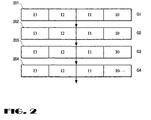
- Figure 2 shows schematically a 4-stage pipelined grouping logic circuit 109 in the 4-way superscalar processor of Figure 1.
- FIG. 1 An embodiment of the present invention is illustrated by the block diagram of Figure 1, which shows a central processing unit (CPU) 100 in an exemplary 4-way superscalar processor of the present invention.
- CPU central processing unit
- a 4-way superscalar processor fetches, dispatches, executes and retires up to four instructions per processor cycle.
- central processing unit 100 includes two arithmetic logic units 101 and 102, a load/store unit 103, which includes a 9-deep load buffer 104 and an 8-deep store buffer 105, a floating point adder 106, a floating point multiplier 107, and a floating point divider 108.
- a grouping logic circuit 109 dispatches up to four instructions per processor cycle.
- Completion unit 110 retires instructions upon completion.
- a register file (not shown), including numerous integer and float point registers, is provided with sufficient number of ports to prevent contention among functional units for access to this register file during operand fetch or result write-back.
- loads are non-blocking, i.e., CPU 100 continues to execute even though one or more dispatched load instructions have not complete.
- floating point adder 106 and floating point multiplier 107 each have a 4-stage pipeline.
- load/store unit 103 has a 2-stage pipeline.
- Floating point divider 108 which is not pipelined, requires more than one processor cycle per instruction.
- state of CPU 100 relevant to grouping logic 109 is summarized by a state variable S(t), which is defined below.
- S(t) the state of CPU 100 includes also other variables, such as those conventionally included in the processor status word.
- ALU 1 (t) and ALU 2 (t) are the states, at time t, of arithmetic logic units 101 and 102 respectively
- LS(t) and LB(t) are the states, at time t, of store buffer 105 and load buffer 104 respectively
- FA(t) , FM(t), and FDS(t) are the states, at time t, of floating point adder 106, floating point multiplier 107 and floating point divider 108 respectively.
- each functional unit can be represented by the source and destination registers specified in the instructions dispatched to the functional unit but not yet retired.
- ALU 1 ⁇ ALU 1 .rs1 ( t ), ALU 1 . rs2 ( t ), ALU 1 .rd ( t ) ⁇ where rs1(t), rs2(t) and rd(t) are respectively the first and second source registers, and the destination of registers of the instruction executing at time t in arithmetic logic unit 101.
- ALU 2 ⁇ ALU 2 . rs1 ( t ), ALU 2 . rs2 ( t ), ALU 2 . rd ( t ) ⁇
- State variable S(t) can be represented by a memory element, such as a register or a content addressable memory unit, at either a centralized location or in a distributed fashion.
- a memory element such as a register or a content addressable memory unit
- the portion of state S(t) associated with a given functional unit can be implemented with the control logic of the functional unit.
- a grouping logic circuit would determine from the current state, S(t) at time t, the next state S(t+1), which includes information necessary to dispatch the instructions of the next processor cycle at time t+1. For example, to avoid a read-after-write hazard, such a grouping circuit would exclude from the next state S(t+1) an instruction having an operand to be fetched from a register designated for storing a result of a yet incomplete instruction. As another example, such a grouping circuit would include in state S(t+1) no more than one floating point "add" instruction in each processor cycle, since only one floating point adder (i.e. floating point adder 106) is available.
- grouping logic circuit 109 is pipelined to derive, over ⁇ processor cycles, a future state S(t+ ⁇ ) based on the present state S(t).
- the future state S(t+ ⁇ ) determines the instruction group to dispatch at time t+ ⁇ .
- Pipelining grouping logic 109 is possible because, as demonstrated below, (i) the values of most state variables in the state S(t+ ⁇ ) can be estimated from corresponding values of state S(t) with sufficient accuracy, and (ii) for those state variables for which values can not be accurately predicted, it is relatively straightforward to provide for all possible outcomes of state S(t+ ⁇ ), or to use a conservative approach (i.e. not dispatching an instruction when such an instruction could have been dispatched) with a slight penalty on performance.
- the states FA, FM and LS at time t+1 can be derived from the corresponding state S(t) at time t, the immediately preceding processor cycle.
- state LB(t+1) at time t+1 cannot be determined from the immediately previous state LB(t) at time t with certainty.
- state LB(t+1) can only either remain the same, or reflect the movement of the pipeline by one stage, two possible approaches to determine state LB(t+1) can be used.
- a conservative approach would predict LB(t+1) to be the same as LB(t). Under this approach, when load buffer 104 is full, an instruction is not dispatched until the pipeline in load buffer 106 advances. An incorrect prediction, i.e.
- state S(t+1) of CPU 100 can be predicted from state S(t). Consequently, both the number of instructions and the types of instructions that can be dispatched at time t+1 (i.e. the instruction group at time t+1) based on predicted state S(t+1) can be derived, at time t, from state S(t), subject to additional handling based on the actual state S A (t+1) at time t+1.
- the above analysis can be can be extended to allow state S(t+ ⁇ ) at time t+ ⁇ to be derived from state S(t) at time t.
- the instruction group at time t+ ⁇ can be derived from time t, provided that, for each instruction group between time t and t+ ⁇ , all instruction from that instruction group must be dispatched before any instruction from a subsequent instruction group is allowed to be dispatched (i.e. no instruction group merging).
- the instructions are either fetched from an instruction cache or an instruction buffer.
- An instruction buffer is preferable in a system in which not all accesses (e.g. branch instructions) to the instruction cache are aligned, and multiple entry points in the basic blocks of a program are allowed.
- intra-group data dependency checking can begin. Because of the constraint against instruction group merging described above, i.e., all instructions in an instruction group must be dispatched before an instruction from a subsequent instruction group can be dispatched, intra-group dependency checking can be accomplished in a pipelined fashion. That is, intra-group dependency checking can span more than one processor cycle and all inter-group dependency checking can occur independently of inter-group dependency checking.
- An example of a four-stage pipeline 200 is shown in Figure 2. In Figure 2, at first stage 201, as soon as the instruction group is constituted, intra-group dependency checking is performed immediately. Thereafter, at stage 202, resource allocation within the instruction group can be determined. At stage 203, intergroup decisions, e.g.
- resource allocation decisions taking into consideration resource allocation in previous instruction groups are merged with the decisions at stages 201 and 202. For example, if the present instruction group includes an instruction designated for floating point divider 108, stage 203 would have determined at by this time if a previous instruction using floating point divider 108 would have completed by the time the present instruction group is due to be dispatched. Finally, at stage 204, non-deterministic conditions, e.g. the condition at store buffer 105, is considered. Dispatchable instructions are issued into CPU 100 at the end of stage 204.
Landscapes
- Engineering & Computer Science (AREA)
- Software Systems (AREA)
- Theoretical Computer Science (AREA)
- Physics & Mathematics (AREA)
- General Engineering & Computer Science (AREA)
- General Physics & Mathematics (AREA)
- Advance Control (AREA)
- Complex Calculations (AREA)
Applications Claiming Priority (2)
| Application Number | Priority Date | Filing Date | Title |
|---|---|---|---|
| US662582 | 1984-10-19 | ||
| US08/662,582 US5958042A (en) | 1996-06-11 | 1996-06-11 | Grouping logic circuit in a pipelined superscalar processor |
Publications (3)
| Publication Number | Publication Date |
|---|---|
| EP0813145A2 true EP0813145A2 (de) | 1997-12-17 |
| EP0813145A3 EP0813145A3 (de) | 1999-07-28 |
| EP0813145B1 EP0813145B1 (de) | 2005-10-05 |
Family
ID=24658307
Family Applications (1)
| Application Number | Title | Priority Date | Filing Date |
|---|---|---|---|
| EP97303831A Expired - Lifetime EP0813145B1 (de) | 1996-06-11 | 1997-06-04 | Pipeline-Befehlszuteilungseinheit in einem superskalaren Prozessor |
Country Status (5)
| Country | Link |
|---|---|
| US (3) | US5958042A (de) |
| EP (1) | EP0813145B1 (de) |
| JP (1) | JP3851707B2 (de) |
| KR (1) | KR100616722B1 (de) |
| DE (1) | DE69734303D1 (de) |
Cited By (4)
| Publication number | Priority date | Publication date | Assignee | Title |
|---|---|---|---|---|
| US10740126B2 (en) | 2013-03-15 | 2020-08-11 | Intel Corporation | Methods, systems and apparatus for supporting wide and efficient front-end operation with guest-architecture emulation |
| US11163720B2 (en) | 2006-04-12 | 2021-11-02 | Intel Corporation | Apparatus and method for processing an instruction matrix specifying parallel and dependent operations |
| US11204769B2 (en) | 2011-03-25 | 2021-12-21 | Intel Corporation | Memory fragments for supporting code block execution by using virtual cores instantiated by partitionable engines |
| US11656875B2 (en) | 2013-03-15 | 2023-05-23 | Intel Corporation | Method and system for instruction block to execution unit grouping |
Families Citing this family (24)
| Publication number | Priority date | Publication date | Assignee | Title |
|---|---|---|---|---|
| US5958042A (en) | 1996-06-11 | 1999-09-28 | Sun Microsystems, Inc. | Grouping logic circuit in a pipelined superscalar processor |
| USRE38599E1 (en) * | 1996-06-11 | 2004-09-21 | Sun Microsystems, Inc. | Pipelined instruction dispatch unit in a superscalar processor |
| EP1050809A1 (de) * | 1999-05-03 | 2000-11-08 | STMicroelectronics SA | Befehlsabhängigkeit in einem Rechner |
| US6618802B1 (en) * | 1999-09-07 | 2003-09-09 | Hewlett-Packard Company, L.P. | Superscalar processing system and method for selectively stalling instructions within an issue group |
| US6651164B1 (en) * | 1999-10-14 | 2003-11-18 | Hewlett-Packard Development Company, L.P. | System and method for detecting an erroneous data hazard between instructions of an instruction group and resulting from a compiler grouping error |
| US6895497B2 (en) * | 2002-03-06 | 2005-05-17 | Hewlett-Packard Development Company, L.P. | Multidispatch CPU integrated circuit having virtualized and modular resources and adjustable dispatch priority |
| US7020765B2 (en) * | 2002-09-27 | 2006-03-28 | Lsi Logic Corporation | Marking queue for simultaneous execution of instructions in code block specified by conditional execution instruction |
| US20040128485A1 (en) * | 2002-12-27 | 2004-07-01 | Nelson Scott R. | Method for fusing instructions in a vector processor |
| US7191320B2 (en) * | 2003-02-11 | 2007-03-13 | Via Technologies, Inc. | Apparatus and method for performing a detached load operation in a pipeline microprocessor |
| US7237094B2 (en) * | 2004-10-14 | 2007-06-26 | International Business Machines Corporation | Instruction group formation and mechanism for SMT dispatch |
| WO2008090665A1 (ja) * | 2007-01-25 | 2008-07-31 | Nec Corporation | プログラム並列化方法及び装置 |
| KR101335001B1 (ko) * | 2007-11-07 | 2013-12-02 | 삼성전자주식회사 | 프로세서 및 인스트럭션 스케줄링 방법 |
| JP5436033B2 (ja) * | 2009-05-08 | 2014-03-05 | パナソニック株式会社 | プロセッサ |
| EP2862069A4 (de) | 2012-06-15 | 2016-12-28 | Soft Machines Inc | Anweisungsdefinition zur implementierung von lastspeicherumordnung und -optimierung |
| CN104823168B (zh) | 2012-06-15 | 2018-11-09 | 英特尔公司 | 用于实现从由加载存储重新排序和优化导致的推测性转发遗漏预测/错误中恢复的方法和系统 |
| CN107748673B (zh) | 2012-06-15 | 2022-03-25 | 英特尔公司 | 包括虚拟加载存储队列的处理器和系统 |
| TWI646422B (zh) | 2012-06-15 | 2019-01-01 | 英特爾股份有限公司 | 在處理器中之免消歧義失序載入/儲存佇列方法、微處理器、和非暫態性電腦可讀取儲存媒體 |
| CN104583957B (zh) | 2012-06-15 | 2018-08-10 | 英特尔公司 | 具有无消歧乱序加载存储队列的重新排序的推测性指令序列 |
| EP2862062B1 (de) | 2012-06-15 | 2024-03-06 | Intel Corporation | Speicherwarteschlange für virtuelle last mit dynamischem versandfenster mit verteilter struktur |
| US9710278B2 (en) | 2014-09-30 | 2017-07-18 | International Business Machines Corporation | Optimizing grouping of instructions |
| US9971601B2 (en) | 2015-02-13 | 2018-05-15 | International Business Machines Corporation | Dynamic assignment across dispatch pipes of source ports to be used to obtain indication of physical registers |
| US9710281B2 (en) * | 2015-07-30 | 2017-07-18 | International Business Machines Corporation | Register comparison for operand store compare (OSC) prediction |
| US10089114B2 (en) | 2016-03-30 | 2018-10-02 | Qualcomm Incorporated | Multiple instruction issuance with parallel inter-group and intra-group picking |
| CN114327644B (zh) * | 2022-03-16 | 2022-06-03 | 广东省新一代通信与网络创新研究院 | 一种处理器预测访存相关性的实现方法 |
Family Cites Families (19)
| Publication number | Priority date | Publication date | Assignee | Title |
|---|---|---|---|---|
| US5127093A (en) * | 1989-01-17 | 1992-06-30 | Cray Research Inc. | Computer look-ahead instruction issue control |
| US5295249A (en) * | 1990-05-04 | 1994-03-15 | International Business Machines Corporation | Compounding preprocessor for cache for identifying multiple instructions which may be executed in parallel |
| ATE146611T1 (de) * | 1990-05-04 | 1997-01-15 | Ibm | Maschinenarchitektur für skalaren verbundbefehlssatz |
| US5202975A (en) * | 1990-06-11 | 1993-04-13 | Supercomputer Systems Limited Partnership | Method for optimizing instruction scheduling for a processor having multiple functional resources |
| CA2038264C (en) * | 1990-06-26 | 1995-06-27 | Richard James Eickemeyer | In-memory preprocessor for a scalable compound instruction set machine processor |
| US5193167A (en) * | 1990-06-29 | 1993-03-09 | Digital Equipment Corporation | Ensuring data integrity by locked-load and conditional-store operations in a multiprocessor system |
| JP2535252B2 (ja) * | 1990-10-17 | 1996-09-18 | 三菱電機株式会社 | 並列処理装置 |
| GB9027853D0 (en) * | 1990-12-21 | 1991-02-13 | Inmos Ltd | Multiple instruction issue |
| US5488729A (en) * | 1991-05-15 | 1996-01-30 | Ross Technology, Inc. | Central processing unit architecture with symmetric instruction scheduling to achieve multiple instruction launch and execution |
| GB9123271D0 (en) * | 1991-11-02 | 1991-12-18 | Int Computers Ltd | Data processing system |
| DE69311330T2 (de) * | 1992-03-31 | 1997-09-25 | Seiko Epson Corp., Tokio/Tokyo | Befehlsablauffolgeplanung von einem risc-superskalarprozessor |
| JP3544214B2 (ja) * | 1992-04-29 | 2004-07-21 | サン・マイクロシステムズ・インコーポレイテッド | プロセッサの状態を監視する方法及び監視システム |
| KR100309566B1 (ko) * | 1992-04-29 | 2001-12-15 | 리패치 | 파이프라인프로세서에서다중명령어를무리짓고,그룹화된명령어를동시에발행하고,그룹화된명령어를실행시키는방법및장치 |
| US5546593A (en) * | 1992-05-18 | 1996-08-13 | Matsushita Electric Industrial Co., Ltd. | Multistream instruction processor able to reduce interlocks by having a wait state for an instruction stream |
| US5627984A (en) * | 1993-03-31 | 1997-05-06 | Intel Corporation | Apparatus and method for entry allocation for a buffer resource utilizing an internal two cycle pipeline |
| US5878245A (en) * | 1993-10-29 | 1999-03-02 | Advanced Micro Devices, Inc. | High performance load/store functional unit and data cache |
| EP0652510B1 (de) * | 1993-11-05 | 2000-01-26 | Intergraph Corporation | Superskalare Rechnerarchitektur mit Softwarescheduling |
| US5555432A (en) * | 1994-08-19 | 1996-09-10 | Intel Corporation | Circuit and method for scheduling instructions by predicting future availability of resources required for execution |
| US5958042A (en) | 1996-06-11 | 1999-09-28 | Sun Microsystems, Inc. | Grouping logic circuit in a pipelined superscalar processor |
-
1996
- 1996-06-11 US US08/662,582 patent/US5958042A/en not_active Expired - Lifetime
-
1997
- 1997-06-04 EP EP97303831A patent/EP0813145B1/de not_active Expired - Lifetime
- 1997-06-04 DE DE69734303T patent/DE69734303D1/de not_active Expired - Lifetime
- 1997-06-10 JP JP15173897A patent/JP3851707B2/ja not_active Expired - Lifetime
- 1997-06-11 KR KR1019970023946A patent/KR100616722B1/ko not_active Expired - Lifetime
-
1999
- 1999-08-02 US US09/583,097 patent/US7430653B1/en not_active Expired - Fee Related
-
2000
- 2000-07-25 US US09/625,268 patent/US6349381B1/en not_active Ceased
Cited By (4)
| Publication number | Priority date | Publication date | Assignee | Title |
|---|---|---|---|---|
| US11163720B2 (en) | 2006-04-12 | 2021-11-02 | Intel Corporation | Apparatus and method for processing an instruction matrix specifying parallel and dependent operations |
| US11204769B2 (en) | 2011-03-25 | 2021-12-21 | Intel Corporation | Memory fragments for supporting code block execution by using virtual cores instantiated by partitionable engines |
| US10740126B2 (en) | 2013-03-15 | 2020-08-11 | Intel Corporation | Methods, systems and apparatus for supporting wide and efficient front-end operation with guest-architecture emulation |
| US11656875B2 (en) | 2013-03-15 | 2023-05-23 | Intel Corporation | Method and system for instruction block to execution unit grouping |
Also Published As
| Publication number | Publication date |
|---|---|
| US5958042A (en) | 1999-09-28 |
| US7430653B1 (en) | 2008-09-30 |
| JP3851707B2 (ja) | 2006-11-29 |
| EP0813145A3 (de) | 1999-07-28 |
| KR980004028A (ko) | 1998-03-30 |
| KR100616722B1 (ko) | 2006-12-07 |
| DE69734303D1 (de) | 2005-11-10 |
| JPH1097424A (ja) | 1998-04-14 |
| US6349381B1 (en) | 2002-02-19 |
| EP0813145B1 (de) | 2005-10-05 |
Similar Documents
| Publication | Publication Date | Title |
|---|---|---|
| US5958042A (en) | Grouping logic circuit in a pipelined superscalar processor | |
| EP0411747B1 (de) | Mehrfachbefehlsdecoder | |
| US6247115B1 (en) | Non-stalling circular counterflow pipeline processor with reorder buffer | |
| US5913925A (en) | Method and system for constructing a program including out-of-order threads and processor and method for executing threads out-of-order | |
| US5694565A (en) | Method and device for early deallocation of resources during load/store multiple operations to allow simultaneous dispatch/execution of subsequent instructions | |
| US6212542B1 (en) | Method and system for executing a program within a multiscalar processor by processing linked thread descriptors | |
| WO1985000453A1 (en) | Data processing system | |
| GB2321543A (en) | Constructing a program including a navigation instruction | |
| USRE38599E1 (en) | Pipelined instruction dispatch unit in a superscalar processor | |
| US11481223B2 (en) | Reducing operations of sum-of-multiply-accumulate (SOMAC) instructions | |
| US5875326A (en) | Data processing system and method for completing out-of-order instructions | |
| EP0778519B1 (de) | System zur Zuteilung mehrerer Befehle ohne Verzweigungsunterbrechung in einem Pipelineprozessor | |
| GB2321544A (en) | Concurrently executing multiple threads containing data dependent instructions | |
| US5850563A (en) | Processor and method for out-of-order completion of floating-point operations during load/store multiple operations | |
| US5713012A (en) | Microprocessor | |
| JPH10187464A (ja) | マルチスカラ・プログラムを作成する方法およびシステム | |
| US6490653B1 (en) | Method and system for optimally issuing dependent instructions based on speculative L2 cache hit in a data processing system | |
| Brehob et al. | Beyond RISC–The Post-RISC Architecture | |
| Burns et al. | Modelling of superscala processor architectures with design/CPN | |
| Fernandes et al. | A study of associative dispatch in superscalar processors | |
| Page | Advanced Processor Design | |
| KR19980037092A (ko) | 이중 기능 확인 흐름을 갖는 파이프라인 구조 | |
| KR19980035724A (ko) | 기능 확인 흐름을 갖는 파이프라인 구조와 그 파이프라이닝 방법 |
Legal Events
| Date | Code | Title | Description |
|---|---|---|---|
| PUAI | Public reference made under article 153(3) epc to a published international application that has entered the european phase |
Free format text: ORIGINAL CODE: 0009012 |
|
| AK | Designated contracting states |
Kind code of ref document: A2 Designated state(s): DE GB NL SE |
|
| AX | Request for extension of the european patent |
Free format text: AL;LT;LV;SI |
|
| PUAL | Search report despatched |
Free format text: ORIGINAL CODE: 0009013 |
|
| AK | Designated contracting states |
Kind code of ref document: A3 Designated state(s): AT BE CH DE DK ES FI FR GB GR IE IT LI LU MC NL PT SE |
|
| AX | Request for extension of the european patent |
Free format text: AL;LT;LV;SI |
|
| 17P | Request for examination filed |
Effective date: 20000106 |
|
| AKX | Designation fees paid |
Free format text: DE GB NL SE |
|
| 17Q | First examination report despatched |
Effective date: 20030603 |
|
| GRAP | Despatch of communication of intention to grant a patent |
Free format text: ORIGINAL CODE: EPIDOSNIGR1 |
|
| GRAS | Grant fee paid |
Free format text: ORIGINAL CODE: EPIDOSNIGR3 |
|
| GRAA | (expected) grant |
Free format text: ORIGINAL CODE: 0009210 |
|
| AK | Designated contracting states |
Kind code of ref document: B1 Designated state(s): DE GB NL SE |
|
| PG25 | Lapsed in a contracting state [announced via postgrant information from national office to epo] |
Ref country code: NL Free format text: LAPSE BECAUSE OF FAILURE TO SUBMIT A TRANSLATION OF THE DESCRIPTION OR TO PAY THE FEE WITHIN THE PRESCRIBED TIME-LIMIT Effective date: 20051005 |
|
| REG | Reference to a national code |
Ref country code: GB Ref legal event code: FG4D |
|
| REF | Corresponds to: |
Ref document number: 69734303 Country of ref document: DE Date of ref document: 20051110 Kind code of ref document: P |
|
| PG25 | Lapsed in a contracting state [announced via postgrant information from national office to epo] |
Ref country code: SE Free format text: LAPSE BECAUSE OF FAILURE TO SUBMIT A TRANSLATION OF THE DESCRIPTION OR TO PAY THE FEE WITHIN THE PRESCRIBED TIME-LIMIT Effective date: 20060105 |
|
| PG25 | Lapsed in a contracting state [announced via postgrant information from national office to epo] |
Ref country code: DE Free format text: LAPSE BECAUSE OF FAILURE TO SUBMIT A TRANSLATION OF THE DESCRIPTION OR TO PAY THE FEE WITHIN THE PRESCRIBED TIME-LIMIT Effective date: 20060106 |
|
| NLV1 | Nl: lapsed or annulled due to failure to fulfill the requirements of art. 29p and 29m of the patents act | ||
| PLBE | No opposition filed within time limit |
Free format text: ORIGINAL CODE: 0009261 |
|
| STAA | Information on the status of an ep patent application or granted ep patent |
Free format text: STATUS: NO OPPOSITION FILED WITHIN TIME LIMIT |
|
| 26N | No opposition filed |
Effective date: 20060706 |
|
| PGFP | Annual fee paid to national office [announced via postgrant information from national office to epo] |
Ref country code: GB Payment date: 20160601 Year of fee payment: 20 |
|
| REG | Reference to a national code |
Ref country code: GB Ref legal event code: PE20 Expiry date: 20170603 |
|
| PG25 | Lapsed in a contracting state [announced via postgrant information from national office to epo] |
Ref country code: GB Free format text: LAPSE BECAUSE OF EXPIRATION OF PROTECTION Effective date: 20170603 |