EP0813147A2 - Objektorientierte Multimedia-Architektur - Google Patents
Objektorientierte Multimedia-Architektur Download PDFInfo
- Publication number
- EP0813147A2 EP0813147A2 EP97303923A EP97303923A EP0813147A2 EP 0813147 A2 EP0813147 A2 EP 0813147A2 EP 97303923 A EP97303923 A EP 97303923A EP 97303923 A EP97303923 A EP 97303923A EP 0813147 A2 EP0813147 A2 EP 0813147A2
- Authority
- EP
- European Patent Office
- Prior art keywords
- hardware
- processors
- virtual machine
- processor
- execution
- Prior art date
- Legal status (The legal status is an assumption and is not a legal conclusion. Google has not performed a legal analysis and makes no representation as to the accuracy of the status listed.)
- Withdrawn
Links
Images


Classifications
-
- G—PHYSICS
- G06—COMPUTING OR CALCULATING; COUNTING
- G06F—ELECTRIC DIGITAL DATA PROCESSING
- G06F15/00—Digital computers in general; Data processing equipment in general
- G06F15/16—Combinations of two or more digital computers each having at least an arithmetic unit, a program unit and a register, e.g. for a simultaneous processing of several programs
-
- G—PHYSICS
- G06—COMPUTING OR CALCULATING; COUNTING
- G06F—ELECTRIC DIGITAL DATA PROCESSING
- G06F9/00—Arrangements for program control, e.g. control units
- G06F9/06—Arrangements for program control, e.g. control units using stored programs, i.e. using an internal store of processing equipment to receive or retain programs
- G06F9/46—Multiprogramming arrangements
- G06F9/48—Program initiating; Program switching, e.g. by interrupt
- G06F9/4806—Task transfer initiation or dispatching
- G06F9/4843—Task transfer initiation or dispatching by program, e.g. task dispatcher, supervisor, operating system
-
- G—PHYSICS
- G06—COMPUTING OR CALCULATING; COUNTING
- G06F—ELECTRIC DIGITAL DATA PROCESSING
- G06F9/00—Arrangements for program control, e.g. control units
- G06F9/06—Arrangements for program control, e.g. control units using stored programs, i.e. using an internal store of processing equipment to receive or retain programs
- G06F9/46—Multiprogramming arrangements
- G06F9/54—Interprogram communication
-
- H—ELECTRICITY
- H04—ELECTRIC COMMUNICATION TECHNIQUE
- H04N—PICTORIAL COMMUNICATION, e.g. TELEVISION
- H04N21/00—Selective content distribution, e.g. interactive television or video on demand [VOD]
- H04N21/40—Client devices specifically adapted for the reception of or interaction with content, e.g. set-top-box [STB]; Operations thereof
- H04N21/43—Processing of content or additional data, e.g. demultiplexing additional data from a digital video stream; Elementary client operations, e.g. monitoring of home network or synchronising decoder's clock; Client middleware
- H04N21/443—OS processes, e.g. booting an STB, implementing a Java virtual machine in an STB or power management in an STB
- H04N21/4437—Implementing a Virtual Machine [VM]
Definitions
- the present invention pertains to the field of digital computer hardware and software architectures and, more specifically, relates to an object-oriented, multi-media architecture for processing multi-media data in real time.
- Multi-media systems combine a variety of information sources such as voice, graphics, animation, images, audio and full-motion video into a wide range of applications.
- multi-media represents a new combination of three historically distinct industries: computing, communication and broadcasting.
- the defining characteristic of multi-media systems is the incorporation of continuous media such as voice, video and animation.
- Distributed multi-media systems require continuous data transfer over relatively long periods of time, for example play-out of a video stream from a remote camera, media synchronization, very large storage and other technical challenges.
- Multi-media libraries databases
- portable computers game machines
- advanced portable digital instruments mobile terminals
- world wide web pages The large amounts of data involved in multi-media applications, and the need for real-time or near real-time processing presents challenges to both hardware and software system designers. These challenges are being addressed on a number of different fronts, such as improvements in compression algorithms and special purpose hardware processors.
- the complexity of multi-media applications stresses all the components of a computer system. Multi-media data requires very substantial processing power for implementing graphics, transformations, data decompression, etc.
- the architecture obviously must provide very high bus bandwidth and efficient I/O.
- a multi-media operating system should support new data types, real-time scheduling, and fast interrupt processing.
- DSP digital signal processing
- VRAM Video random access memory
- VRAM frequently is implemented on a "video board” which is a circuit board for use in a personal computer to improve screen refresh by providing improved display bandwidth.
- an improved multi-media software and hardware architecture takes full advantage of an object-oriented paradigm, and carries that paradigm all the way through from data communication to the performance of multi-media content in real-time.
- software objects are carried down to the execution level as light-weight processes (LWP) or threads executing in parallel on multiple processors.
- LWP light-weight processes
- object-oriented techniques are used for programming and authoring multi-media applications. To reduce data communication bandwidth requirements and provide portability across various hardware platforms, those object-oriented applications are compiled into a low-level pseudo-language (e.g. Java® bytecodes), and the bytecodes are interpreted at run time, essentially by translating the pseudo-language operations into equivalent operations (op codes) on the target processor.
- the original "objects" and threads defined in the source program are recovered from an incoming stream of bytecodes in a new type of virtual machine.
- the new virtual machine includes class libraries for instantiating objects and methods used in the source program, and recovers the "threads" of the original application program.
- a plurality of processors is provided under control of a micro-kernel operating system.
- One or more of the hardware processors are designed or optimized to carry out a specific MM function or method, such as audio decompression or visual object rotation calculations.
- the virtual machine correlates the objects and threads recovered from the bytecode stream -- consulting the class libraries - to a list of the currently available hardware resources.
- This architecture delivers the performance of a parallel processing machine while maintaining portability of the pseudo-code program across a variety of platforms. Additionally, the virtual machine can automatically exploit hardware resources available to it - including cores not yet available - again without compromising portability of the application program.
- Objects or threads requiring those functions directly supported by hardware are routed to the corresponding processors for execution.
- Other processors or “cores” can be provided that execute the virtual language (e.g. Java bytecodes) directly.
- "Flat” threads or code segments can be routed to these "native" processors (e.g. the SUN Pico-Java Engine) for execution without translating op codes.
- the new architecture instead of simply interpreting a serial stream of pseudo-language instructions for execution on a target processor, as in the prior art, the new architecture combines principles of parallel processing and the object-oriented paradigm to speed execution. In other words, the advantages of an object-oriented environment are preserved, and indeed extended, all the way to the hardware.
- one aspect of the present invention is to better "align" software processes to hardware for execution.
- the system is object-oriented throughout, including the virtual machine, the micro-kernel, and even the hardware in the sense that the hardware comprises discrete elements (processors or cores in present-day technology) deployed for execution of tasks related to specific object class methods.
- the new virtual machine can be programmed for any target hardware platform, thus preserving the portability advantage of object-oriented environments. And, it adapts itself to the currently available platform hardware resources, thus allowing flexibility in cost vs. performance.
- the invention includes a virtual machine program stored in a memory.
- the virtual machine has access to stored libraries of object class definitions, and has access to hardware that receives and buffers an incoming stream of pseudo-language instructions such as bytecodes.
- the VM includes a class loader that checks ensures that all classes referenced in the bytecodes are present in the stored libraries, and downloads any that are missing, from network resources which may be the source transmitting the bytecode stream.
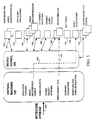
- FIG. 1 is a simplified data flow diagram illustrating a prior art, object-oriented virtual machine environment useful in multi-media applications.
- FIG. 2 illustrates a new, object-oriented, multi-processor architecture for processing multi-media applications according to the present invention.
- FIG. 3 illustrates the architecture of FIG. 2 in greater detail.
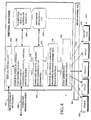
- FIG. 4 is a hybrid data flow and hardware block diagram illustrating the virtual machine of FIGS. 2 and 3 in greater detail.
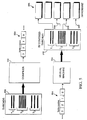
- FIG. 5 is a functional block diagram illustrating handling of program threads in the new architecture of FIGS. 2 and 3.
- FIG 1 is a data flow diagram of a virtual-machine implementation of an object-oriented programming language.
- Sun Microsystems' Java® environment is an example.
- the Java environment comprises several different parts.
- block 10 represents a program written in the Java language source code.
- a Java language program could be compiled for execution on various machine architectures.
- VM virtual machine
- the Java virtual machine implements an abstract processor architecture. This virtual machine can then be implemented in software on a variety of operating systems and hardware.
- the Java source code program 10 is compiled into pseudo-code, a series of "byte codes" according to the Java virtual machine instruction set. The virtual machine thus must be ported for each target platform.
- a run-time interpreter performs a task much like emulation: it translates the Java instruction set byte codes into op codes that are executable on the target platform hardware.
- the interpreter also imports code by calls to another component of the Java environment, the Foundation Class Library -- Java class definitions.
- This step is fundamental to the object-oriented paradigm in which program objects are merely instances of predefined classes.
- Other libraries available to the interpreter provide various functions that are not necessarily implemented in Java.
- the VM will generally include a library of C-code TCP/IP functions.
- the resulting "interpreted" code can then be executed using calls to the target platform operating system 44 which, in turn, interfaces with the processor hardware 46.
- This prior art environment thus converts the original, object-oriented program into serial, flat code for execution in the target platform. It provides portability because the same source code program 10 can be executed on any platform for which the virtual machine 40 has been implemented.
- Java virtual machine More detail about implementation of the Java virtual machine can be found, for example, in "Implementing the Java Virtual Machine - Java's Complex Instruction Set Can Be Built in Software or Hardware," by Brian Case, Microprocessor Report, March 25, 1996, p. 12. While portability is achieved by Java, execution of the program on a client machine falls back on conventional, serial execution of flat code on a general purpose processor.
- FIG. 2 is a conceptual diagram illustrating a new multi-media architecture according to the present invention.
- data here meaning program code and data
- data flows from the left to the right of the Figure as follows.
- Incoming data in the form of an object-oriented pseudo-code such as Java byte codes
- the bytecode stream can originate locally (in the same machine) or travel over a local or wide area network from a server to a client machine.
- the input stream can just as well travel over a world-wide network such as the Internet 100.
- This stream of byte codes complies with a predefined virtual machine API.
- the virtual machine 102 contains a run-time interpreter, garbage collection mechanism and other features further described later.
- the input streams are not limited to Java byte codes, although an object-oriented pseudo-code is required.
- the system of the present invention will be especially useful in connection with evolving new multi-media programming languages, such as the MPEG-4 "syntactic description language".
- MPEG-4 is an emerging coding standard that will support new ways (notably content-based) for communication, access, and manipulation of digital audio-visual data.
- the standard is far from promulgation - it is expected to take several years to define completely. Nonetheless, the concept is clear - to provide for coding of audio-visual objects per se.
- video and audio frames do not distinguish objects. All parts of the frame have equal priority so when coding, for example detailed background data can "steal" bits from more important foreground objects.
- the MPEG-4 community believe that some form of object-based coding is needed to reach new levels of performance and interactivity.
- the MPEG-4 Syntactic Description Language (MSDL) will provided a template to support interaction with both natural and artificial objects. Instead of processing large quantities of pixel data to display the car, the wheel object described in MSDL will simply call a "spin" method. See ISO/IEC JTC1/SC29/WG11/N0998 / Coding of Moving Pictures and Associated Audio Information (MPEG-4 Proposal Package, July, 1995). The system described herein will be readily adaptable to processing of multi-media applications coded in MSDL.
- the virtual machine 102 also includes at least a foundation class library (sets of software object definitions) of the source code language, and preferably further includes an extension class library.
- the Java foundation classes include some 15 different packages, all included in the Java Development Kit.
- the JDK packages include java.applet, java.awt, java.io, java.net and java.image.
- one of the applet interfaces is used for playing back an audio clip.
- An "interface” is a special type of Java class.
- the package java.awt includes the classes and interfaces necessary for constructing user interfaces and on-screen graphics. Examples are button, label, panel, color, etc.
- the image package classes handle manipulation of pixel images.
- Extension classes are more specialized classes, many under construction today, to implement such things as commercial transactions over the internet, cryptography, banking, database API, and various graphics operations.
- the MM architecture of the present invention can take full advantage of extension classes as they appear and, importantly, it can deploy specialized hardware processors for execution of extension class object calls.
- processors can include, for example, dedicated, special purpose processors, RISC cores, native engines or other types of processors not yet well known.
- the advent of new extension classes may motivate hardware designers to provide specialized processors for execution of those class methods.
- the virtual machine 102 reconstructs the software objects indicated in the source code by mapping all incoming byte codes into (a) fields; (b) objects; and (c) threads. Fields are variables that are not fully disclosed at compile time. The VM resolves them before they can be accessed. Objects of course are instances of classes defined in the class libraries.
- Threads also called light-weight processes, are separate streams of control that can execute their instructions independently, allowing a multi-threaded process to perform numerous tasks concurrently. Multiple threads can run as a single process. (Some use the terms “thread” and “lightweight process” interchangeably. In some implementations, however, there is not necessarily a one-to-one correspondence between each thread and a single LWP.) However, the present invention seeks to maximize parallelism in execution, and therefore attempts to schedule every thread for separate execution, as more fully described later.
- the Java language implements thread classes.
- the Foundation and Extension Classes which are part of the virtual machine, allow this reconstruction to succeed, because they contain the same information as the libraries that were used by the compiler to generate to pseudo-code or bytecodes.
- the VM includes a class loader component that will download any classes used in the pseudo-code that do not appear in the library.
- a firm dividing line between the user's space and the kernel space In a typical multi-tasking operating system, such as VMS or UNIX, there is a firm dividing line between the user's space and the kernel space. This division is enforced by hardware.
- User programs are executed in user space.
- the user space includes user code, global data, program counter and a stack pointer.
- the data that a program or process can access and change directly is limited to data in the users space.
- the user program When the user program needs something from the kernel (for example to read a file, or find out the current time), the user program must make a system call.
- the kernel determines what action is necessary, and whether has permission to do it. Finally, the kernel performs the desired task, returning any information to the user process.
- a process can do the same thing by running more than a single thread.
- Each thread is a different stream of control that can execute its instructions independently, allowing a multi-threaded process to perform numerous tasks concurrently. For example, one thread can run the GUI, while a second thread performs I/O and a third performs calculations.
- a thread is similar to a process, it comprises data, code, kernel state, and a set of CPU registers.
- a process is a kernel-level entity and includes such things as virtual memory map, file descriptors, user ID, etc. and each process has its own collection of these.
- the only way for a program to access data in the process structure, or to query or change its state is via a system call.
- the thread is primarily a user-level entity.
- the thread structure is in user space and can be accessed directly with the thread library call, which are just user-level functions.
- the registers (stack pointer, program counter, etc.) are all part of a thread, and each thread has its own stack, but the code it is executing is not part of the thread.
- the actual code (function, routines, signal handlers, etc.) is global and can be executed on any thread.
- all threads in a process share the state of that process. They reside in the exact same memory space, see the same functions and see the same data. When one thread alters a process variable, all the others will see the change when they next access it. When one thread opens a file to read it, all the other threads can also read from it. While this arrangement implies certain synchronization and scheduling requirements, it has the advantages of executing multiple tasks without the kernel overhead of actual process switching.
- the operating system 106 includes a real-time micro-kernel operating system which routes the objects and the threads and the Java byte codes to multiple cores or parallel processors 112 as further explained later.
- An important aspect of the present invention is to better "align" program threads with hardware resources "on the fly”. Because threads provide for concurrent execution, and they have access to the same user memory space, care must be taken by the programmer to coordinate or "synchronize" their operation. One thread cannot read data at the same time that another thread is modifying the same data. Thus, a thread must be able to acquire exclusive access to an object, at least temporarily.
- Several techniques are known for thread synchronization. In the simplest case, a Mutual Exclusion Lock or mutex allows only one thread at a time to execute a given piece of code, for example code that modifies global data. Condition variables are known for inhibiting execution of a thread until a given condition tests true.
- threads are supported as an integral part of the language. It provides for synchronous methods to be defined in a class protocol. When a class with synchronized methods is "instantiated," the new object is given a "monitor". To call a synchronized message in an object, a thread acquires the monitor of that object. If it is able to acquire the monitor, the thread enters the synchronized method, and while it owns the monitor, no other thread can call a synchronized method in that object. If a thread calls a synchronized method in an object and that object's monitor is owned by another thread, the calling thread is blocked until the other thread relinquished the monitor.
- the VM 102 identifies the application layer threads, and separates them for separate, parallel execution as further described below.
- the VM next generates code for execution on the host platform. Importantly, it first inspects a list of hardware resources available on the platform, comparing the identified threads and objects with the hardware list. In other words, the VM is aware of the hardware resources in the machine (even though the application programmer likely was not). Depending on the hardware resources available, appropriate addresses and variables are arranged on a stack in memory for each execution thread or LWP. Executable code is arranged and stored in memory for each thread. Generating the executable includes op code translation for those threads that will not be routed to a native processor engine. The VM then calls the micro-kernel operating system 104 to schedule execution of the threads.
- the identification of threads for execution by the VM is not limited to those threads expressly delineated as such by the application programmer.
- the VM may find a particular processor in the hardware resources list -- say a processor for adding "base boost" to an audio file. If the VM finds the "bass boost” object called, it will arrange that call as a thread for execution on the "bass boost” hardware, because the hardware function matches the software method.
- a "thread" in the new VM can be a thread expressly delineated by the application programmer, or it can be any object or code fragment designated by the VM as a thread for execution.
- VM or the kernel can "split" a thread in two if it has appropriate hardware resources available to process both smaller threads, thereby increasing parallelism.
- Fig. 5 illustrates a reconstructed thread T2 which is split (see routes 324,326) for execution on two different processors.
- the Micro-kernel operating system 104 can be adapted from commercially available operating systems of this type, also known as RTOS - real-time micro kernel operating system.
- ISI Integrated Systems Solutions of Mountain View, CA. has such a product called pSOS.
- MicroWare of DesMoines, IA has a such a product called OS-9.
- WindRiver of Oakland, CA offers VxWorks OS.
- the micro-kernel interfaces with the hardware resources 106; it sorts and directs the objects and threads to the corresponding hardware processors 108.
- the micro-kernel handles scheduling of hardware resources, to the extent necessary.
- the micro-kernel schedules the tasks, using techniques that are known in the art.
- the micro-kernel also attends to handling the network file system (NFS), networking operations, peripheral device drivers, virtual memory management, user interface, and other tasks for which the operating system conventionally is responsible.
- NFS network file system
- the first is "garbage collection," i.e. freeing memory assigned to an object or thread to which there is no longer any reference in the code. Details of garbage collection are known for example in the Java environment.
- the garbage collection task itself is a process, and may be assigned to a suitable processor.
- the operating system is written in the Java language, and the garbage collection task can be run in native code on a Java native processor.
- the other special memory management task is managing distributed memory across the native processors, e.g. PicoJava® processors.
- FIG. 3 further illustrates an embodiment of a multi-media architecture according to the present invention, here showing additional detail of the hardware resources 108.
- Each of the hardware resources generally a processor core, communicates with micro-kernel 104 as indicated for example by line 124.
- the following types of processors are illustrative of a presently preferred embodiment of the invention. However, many different combinations of hardware resources can be applied in this architecture to optimize performance for particular multi-media applications.
- One of the advantages of the invention is that various processors can be added or removed at will, without changing the virtual machine. This provides great flexibility and portability for improved performance.
- the hardware resources 108 include: video background processors 120; DSP audio processors 122; video decompression processors 124; two-dimensional object rotation processor 126; stereo audio synchronization processors 128; three-dimensional rendering processors 130; graphical user interface tools processor 132; additional video background processor 134 and one or more native byte code processors 136.
- processors may be, for example, commercially available processor cores, such as the ARM-8 RISC processor available from RISC Machines Ltd. of Cambridge, England. Processors of that type offer high performance, on the order of 100 MIPS, in a small, lower power configuration.
- processors can be a native byte code cores. These are processors that are designed to execute the virtual machine pseudo-language instructions directly. Code segments or threads which are not appropriate for one of the available dedicated processors will be routed by the virtual machine to a native byte code core for execution as further explained later.
- some or all of the processors mentioned above can be native byte code cores. In that case, code generation in the virtual machine will not require translation of op codes.
- Figure 3 further illustrates by way of two examples how software objects are reconstructed in the virtual machine 102 and passed through to corresponding hardware processors.
- the examples shown are a video background object indicated by dashed line 152 and a three-dimensional video object indicated by dashed line 150.
- FIG. 4 illustrates the virtual machine program 102 in greater detail.
- the virtual machine which preferably is implemented in software, communicates with the hardware buffer, pipeline or the like 200 that receives an incoming stream of byte codes 100 as described previously.
- the first operations of the virtual machine are indicated by reconstruction box 200.
- the reconstruction steps 200 include a class loader that determines what classes are referenced in the incoming byte code, and looks up those classes in the class libraries 204.
- the class libraries stored in the virtual machine include the application programming language libraries.
- the Foundation libraries include the AWT classes (abstract windows tool kit), network classes, utilities, graphics, sound, video classes, etc. Examples of extension classes were mentioned previously.
- the reconstruction step 202 includes identifying any missing classes, i.e., classes referenced in the byte codes but not available in the stored libraries, and downloading the missing classes as indicated by arrow 206, from the source of the input stream 100.
- the reconstruction steps 202 include reconstructing the original software objects, threads and code fragments that are used in the source program (10 in Figure 1). Lists of these objects, threads and byte code segments are provided to correlation process 210 as indicated arrow 208.
- the correlation step 210 examines a hardware resources list 212.
- a hardware resources list is formed via communication with the micro-kernel 104 which, in turn, interfaces with the hardware resources 108.
- Process 210 then correlates the objects, threads and byte codes that need to be executed with the currently available hardware resources. It binds each object and thread to the most appropriate available hardware resource. Examples were described earlier with reference to Figure 3.
- the virtual machine resolves necessary variables (fields) and other references, using the class libraries as necessary. It arranges all of the necessary parameters and variables for execution of the tasks presented. There are essentially four types of tasks or processes to be executed: threads, objects, applets and flat code segments.
- a co-generation process 220 is similar to conventional code generation. It includes translating op codes from the virtual machine pseudo-language to executable machine code.
- the co-generation process 220 arranges the operands, variables, pointers, etc. in proper sequence on a stack for each process to be executed, and then "passes" the process to the micro-kernel 104. In this process, the co-generation step 220 ensures that each executable process is directed to the appropriate processor as determined in the correlation step 210 described above.
- the executable processes indicated for example by line 230, are executed on the corresponding processors, 120, 122, 136.
- Various types of processors were summarized above in the description of Figure 3.
- Execution threads are not necessarily bound 1:1 to hardware resources. In some applications, even greater improvements in performance will be achieved by providing a "smart" kernel that can restructure threads "on the fly” based on the available resources. Preferably, a substantial number of processors are implemented, say 20, 30 or even 100. Many threads are executed in parallel. Moreover, the whole process is continuous and dynamic. Thus, hardware allocations change constantly as threads complete execution and new ones are allocated. Implementation of the entire system on a single silicon "chip” will provide high performance at low cost.
- a smart controller effectively stands between the micro-kernel and the hardware resources and controls access to the bus. It passes addresses to processors and reduces bus traffic, thereby reducing contention and delay.
- Figure 5 further illustrates the broad concept of the invention.
- a source program 300 includes several program threads, indicated by T1, T2 and T3.
- the source program 300 is compiled in a suitable compiler 302 so as to form a series of pseudo-language byte codes 304.
- Compiler 302 includes class libraries for the particular object-oriented programming language used in 300.
- the byte codes 304 may be stored, transmitted or distributed through any of various means such as included in machine-readable distribution media such as magnetic or optical disks, over networks, internet, etc.
- the byte codes received on a client machine are processed in a virtual machine 306 as described above.
- the virtual machine reconstructs the program threads and objects 310, and then are routed to corresponding special purpose processors indicated generally by 320.
- the object-oriented nature of the original program 300 is reconstructed and carried through the hardware processors 320, providing benefits of parallel execution while preserving portability, compactness and the other advantages of the object-oriented paradigm.
- the present architecture can provide real-time processing of multi-media data far more effectively than prior art solutions.
Landscapes
- Engineering & Computer Science (AREA)
- Software Systems (AREA)
- Theoretical Computer Science (AREA)
- Physics & Mathematics (AREA)
- General Engineering & Computer Science (AREA)
- General Physics & Mathematics (AREA)
- Multimedia (AREA)
- Signal Processing (AREA)
- Computer Hardware Design (AREA)
- Devices For Executing Special Programs (AREA)
- Stored Programmes (AREA)
Applications Claiming Priority (2)
| Application Number | Priority Date | Filing Date | Title |
|---|---|---|---|
| US08/661,183 US5946487A (en) | 1996-06-10 | 1996-06-10 | Object-oriented multi-media architecture |
| US661183 | 1996-06-10 |
Publications (1)
| Publication Number | Publication Date |
|---|---|
| EP0813147A2 true EP0813147A2 (de) | 1997-12-17 |
Family
ID=24652550
Family Applications (1)
| Application Number | Title | Priority Date | Filing Date |
|---|---|---|---|
| EP97303923A Withdrawn EP0813147A2 (de) | 1996-06-10 | 1997-06-06 | Objektorientierte Multimedia-Architektur |
Country Status (4)
| Country | Link |
|---|---|
| US (1) | US5946487A (de) |
| EP (1) | EP0813147A2 (de) |
| JP (1) | JPH1069394A (de) |
| KR (1) | KR980004099A (de) |
Cited By (14)
| Publication number | Priority date | Publication date | Assignee | Title |
|---|---|---|---|---|
| WO1998050852A1 (en) * | 1997-05-08 | 1998-11-12 | Iready Corporation | Hardware accelerator for an object-oriented programming language |
| EP0984631A1 (de) * | 1998-09-04 | 2000-03-08 | THOMSON multimedia | Vorrichtung und Verfahren zur Ausführung von interaktiven Fernsehanwendungen auf Set Top Boxen |
| WO2000024192A1 (en) * | 1998-10-19 | 2000-04-27 | General Instrument Corporation | Television set-top box with configurable functionality |
| WO2000030346A1 (en) * | 1998-11-12 | 2000-05-25 | General Instrument Corporation | Application programming interface (api) for accessing and managing resources in a digital television receiver |
| WO2000072583A1 (en) * | 1999-05-21 | 2000-11-30 | General Instrument Corporation | Software architecture for a television set-top terminal providing compatibility with multiple operating environments |
| WO2000072586A3 (en) * | 1999-05-21 | 2001-05-17 | Gen Instrument Corp | Programming interface for television settop core system software |
| WO2001075599A3 (en) * | 2000-03-27 | 2002-08-01 | Gen Instrument Corp | Operating system abstraction interface for broadband terminal platform firmware |
| WO2001086415A3 (en) * | 2000-05-08 | 2003-01-16 | Transilica Inc | Priority in a portable thread environment |
| EP1291761A3 (de) * | 2001-08-13 | 2004-01-02 | Texas Instruments Incorporated | Universeller Dekodierer zur Verwendung in einem Netzwerk-Media-Spieler |
| US6721949B1 (en) | 2000-03-27 | 2004-04-13 | General Instrument Corporation | Kernel abstraction layer for digital television set-top box firmware |
| EP1259075A3 (de) * | 2001-05-15 | 2004-05-12 | Digita OY | Verfahren zur Verteilung von Anwendungen in einem DVB-Netzwerk |
| AU777773B2 (en) * | 1999-09-01 | 2004-10-28 | Tao Group Ltd. | Translating and executing object-oriented computer programs |
| WO2005074252A1 (en) * | 2004-01-28 | 2005-08-11 | Koninklijke Philips Electronics N.V. | Digital broadcasting terminal |
| US6961934B2 (en) | 2000-05-08 | 2005-11-01 | Microtune (San Diego), Inc. | Portable thread environment |
Families Citing this family (212)
| Publication number | Priority date | Publication date | Assignee | Title |
|---|---|---|---|---|
| US7487507B1 (en) * | 2001-07-18 | 2009-02-03 | City U Research Limited | Secure control transfer in information system |
| US6405255B1 (en) * | 1996-07-01 | 2002-06-11 | Sun Microsystems, Inc. | Mixing and splitting multiple independent audio data streams in kernel space |
| EP0825506B1 (de) | 1996-08-20 | 2013-03-06 | Invensys Systems, Inc. | Verfahren und Gerät zur Fernprozesssteuerung |
| BR9713267A (pt) | 1996-10-25 | 2004-06-15 | Schlumberger Systems & Service | Cartão de circuito integrado para uso com um terminal, processo para uso com o mesmo, microcontrolador e processo para sua programação |
| US6079566A (en) * | 1997-04-07 | 2000-06-27 | At&T Corp | System and method for processing object-based audiovisual information |
| US9098297B2 (en) * | 1997-05-08 | 2015-08-04 | Nvidia Corporation | Hardware accelerator for an object-oriented programming language |
| US6330659B1 (en) * | 1997-11-06 | 2001-12-11 | Iready Corporation | Hardware accelerator for an object-oriented programming language |
| US6960133B1 (en) | 2000-08-28 | 2005-11-01 | Igt | Slot machine game having a plurality of ways for a user to obtain payouts based on selection of one or more symbols (power pays) |
| US6654931B1 (en) | 1998-01-27 | 2003-11-25 | At&T Corp. | Systems and methods for playing, browsing and interacting with MPEG-4 coded audio-visual objects |
| US6110226A (en) * | 1998-02-19 | 2000-08-29 | Cygnus Solutions | Java development environment using optimizing ahead-of-time compiler |
| US6256637B1 (en) * | 1998-05-05 | 2001-07-03 | Gemstone Systems, Inc. | Transactional virtual machine architecture |
| US6349322B1 (en) * | 1998-05-06 | 2002-02-19 | Sun Microsystems, Inc. | Fast synchronization for programs written in the JAVA programming language |
| US6233611B1 (en) * | 1998-05-08 | 2001-05-15 | Sony Corporation | Media manager for controlling autonomous media devices within a network environment and managing the flow and format of data between the devices |
| US6704764B1 (en) * | 1998-06-18 | 2004-03-09 | Hewlett-Packard Development Company, L.P. | Method and apparatus for a servlet server class |
| US6324688B1 (en) * | 1998-07-30 | 2001-11-27 | International Business Machines Corporation | Method and apparatus for optimizing execution of Java programs |
| US6260190B1 (en) * | 1998-08-11 | 2001-07-10 | Hewlett-Packard Company | Unified compiler framework for control and data speculation with recovery code |
| KR20010072477A (ko) * | 1998-08-13 | 2001-07-31 | 썬 마이크로시스템즈, 인코포레이티드 | 가상 머신 환경에서 네이티브 코드를 변환하고 실행하는방법 및 장치 |
| US6253215B1 (en) * | 1998-08-17 | 2001-06-26 | Sun Microsystems | Method, apparatus, and article of manufacture for facilitating resource management for applications having two types of program code |
| CA2245976A1 (en) * | 1998-08-26 | 2000-02-26 | Qnx Software Systems Ltd. | Symmetric multi-processor system and method |
| ES2235296T3 (es) * | 1998-09-11 | 2005-07-01 | Two Way Media Limited | Distribucion de aplicaciones interactivas. |
| US6651080B1 (en) * | 1998-10-16 | 2003-11-18 | Sun Microsystems, Inc. | Techniques for implementing pluggable virtual machines |
| GB9825102D0 (en) * | 1998-11-16 | 1999-01-13 | Insignia Solutions Plc | Computer system |
| JP4109772B2 (ja) * | 1998-12-03 | 2008-07-02 | キヤノン株式会社 | データ処理方法及びその装置 |
| US20050149694A1 (en) * | 1998-12-08 | 2005-07-07 | Mukesh Patel | Java hardware accelerator using microcode engine |
| US7225436B1 (en) * | 1998-12-08 | 2007-05-29 | Nazomi Communications Inc. | Java hardware accelerator using microcode engine |
| US6286138B1 (en) * | 1998-12-31 | 2001-09-04 | International Business Machines Corporation | Technique for creating remotely updatable programs for use in a client/server environment |
| US6801943B1 (en) * | 1999-04-30 | 2004-10-05 | Honeywell International Inc. | Network scheduler for real time applications |
| EP1059781B1 (de) * | 1999-05-06 | 2007-09-05 | Siemens Aktiengesellschaft | Kommunikationseinrichtung mit Mitteln zur Echtzeitverarbeitung von zu übertragenden Nutzdaten |
| US6427228B1 (en) * | 1999-05-12 | 2002-07-30 | International Business Machines Corporation | Combining a meta data file and java source code to dynamically create java classes and javabeans |
| US7089530B1 (en) | 1999-05-17 | 2006-08-08 | Invensys Systems, Inc. | Process control configuration system with connection validation and configuration |
| AU5025600A (en) | 1999-05-17 | 2000-12-05 | Foxboro Company, The | Process control configuration system with parameterized objects |
| JP3722194B2 (ja) * | 1999-05-20 | 2005-11-30 | セイコーエプソン株式会社 | 画像表示システム |
| US6788980B1 (en) * | 1999-06-11 | 2004-09-07 | Invensys Systems, Inc. | Methods and apparatus for control using control devices that provide a virtual machine environment and that communicate via an IP network |
| JP3756352B2 (ja) * | 1999-06-29 | 2006-03-15 | 富士通株式会社 | コンパイラ装置およびコンパイラを記録したコンピュータ読み取り可能な記録媒体 |
| US7062769B1 (en) * | 1999-07-07 | 2006-06-13 | National Semiconductor Corporation | Object-oriented processor design and design methodologies |
| US7882501B1 (en) * | 1999-08-13 | 2011-02-01 | Oracle America, Inc. | System and method for enabling dynamic modifed class reloading in an application server environment |
| WO2001013583A2 (en) | 1999-08-16 | 2001-02-22 | Iready Corporation | Internet jack |
| US7996843B2 (en) * | 1999-08-25 | 2011-08-09 | Qnx Software Systems Gmbh & Co. Kg | Symmetric multi-processor system |
| US6668317B1 (en) | 1999-08-31 | 2003-12-23 | Intel Corporation | Microengine for parallel processor architecture |
| US6427196B1 (en) | 1999-08-31 | 2002-07-30 | Intel Corporation | SRAM controller for parallel processor architecture including address and command queue and arbiter |
| US6983350B1 (en) | 1999-08-31 | 2006-01-03 | Intel Corporation | SDRAM controller for parallel processor architecture |
| WO2001016702A1 (en) | 1999-09-01 | 2001-03-08 | Intel Corporation | Register set used in multithreaded parallel processor architecture |
| AU5144500A (en) * | 1999-09-01 | 2001-03-26 | Audiobase, Inc. | A system and method for streaming data in java |
| HK1046049A1 (zh) | 1999-09-01 | 2002-12-20 | Intel Corporation | 用於多线程处理器的分支指令 |
| US7191309B1 (en) | 1999-09-01 | 2007-03-13 | Intel Corporation | Double shift instruction for micro engine used in multithreaded parallel processor architecture |
| GB9921721D0 (en) * | 1999-09-14 | 1999-11-17 | Tao Group Ltd | Loading object-oriented computer programs |
| US6970893B2 (en) * | 2000-10-27 | 2005-11-29 | Bea Systems, Inc. | System and method for regeneration of methods and garbage collection of unused methods |
| EP1107550B1 (de) * | 1999-12-06 | 2005-11-09 | Alcatel | Endgerät zur Ausführung von einer Endgerätsanwendung |
| US7062779B1 (en) * | 1999-12-10 | 2006-06-13 | Sun Microsystems, Inc. | Methods and apparatus for accessing synchronized broadcast data |
| US6842899B2 (en) | 1999-12-21 | 2005-01-11 | Lockheed Martin Corporation | Apparatus and method for resource negotiations among autonomous agents |
| US6532509B1 (en) | 1999-12-22 | 2003-03-11 | Intel Corporation | Arbitrating command requests in a parallel multi-threaded processing system |
| US6694380B1 (en) | 1999-12-27 | 2004-02-17 | Intel Corporation | Mapping requests from a processing unit that uses memory-mapped input-output space |
| US7620702B1 (en) | 1999-12-28 | 2009-11-17 | Intel Corporation | Providing real-time control data for a network processor |
| US6307789B1 (en) | 1999-12-28 | 2001-10-23 | Intel Corporation | Scratchpad memory |
| US6631430B1 (en) | 1999-12-28 | 2003-10-07 | Intel Corporation | Optimizations to receive packet status from fifo bus |
| US6625654B1 (en) | 1999-12-28 | 2003-09-23 | Intel Corporation | Thread signaling in multi-threaded network processor |
| US6661794B1 (en) | 1999-12-29 | 2003-12-09 | Intel Corporation | Method and apparatus for gigabit packet assignment for multithreaded packet processing |
| US6976095B1 (en) | 1999-12-30 | 2005-12-13 | Intel Corporation | Port blocking technique for maintaining receive packet ordering for a multiple ethernet port switch |
| US6952824B1 (en) | 1999-12-30 | 2005-10-04 | Intel Corporation | Multi-threaded sequenced receive for fast network port stream of packets |
| US7480706B1 (en) | 1999-12-30 | 2009-01-20 | Intel Corporation | Multi-threaded round-robin receive for fast network port |
| US6584522B1 (en) | 1999-12-30 | 2003-06-24 | Intel Corporation | Communication between processors |
| US6631462B1 (en) * | 2000-01-05 | 2003-10-07 | Intel Corporation | Memory shared between processing threads |
| WO2001055917A1 (en) * | 2000-01-27 | 2001-08-02 | Morphics Technology Inc. | Improved apparatus and method for multi-threaded signal processing |
| US6823517B1 (en) * | 2000-01-27 | 2004-11-23 | Andrew E. Kalman | Multi-tasking-real-time operating system for microprocessors with limited memory that constrains context switching to occur only at task level |
| US6557168B1 (en) * | 2000-02-25 | 2003-04-29 | Sun Microsystems, Inc. | System and method for minimizing inter-application interference among static synchronized methods |
| US6567974B1 (en) * | 2000-02-25 | 2003-05-20 | Sun Microsystems, Inc. | Small memory footprint system and method for separating applications within a single virtual machine |
| US6745386B1 (en) * | 2000-03-09 | 2004-06-01 | Sun Microsystems, Inc. | System and method for preloading classes in a data processing device that does not have a virtual memory manager |
| US6684390B1 (en) * | 2000-04-17 | 2004-01-27 | Koninklijke Philips Electronics N.V. | Multi-processor JAVA subsystem |
| US20030149967A1 (en) * | 2000-05-04 | 2003-08-07 | Tomihisa Kamada | Information processing method and system |
| US6792601B1 (en) * | 2000-05-18 | 2004-09-14 | International Business Machines Corporation | Multiple mode object locking method and system |
| US6769985B1 (en) | 2000-05-31 | 2004-08-03 | Igt | Gaming device and method for enhancing the issuance or transfer of an award |
| US7695363B2 (en) | 2000-06-23 | 2010-04-13 | Igt | Gaming device having multiple display interfaces |
| US6731313B1 (en) | 2000-06-23 | 2004-05-04 | Igt | Gaming device having touch activated alternating or changing symbol |
| US7699699B2 (en) | 2000-06-23 | 2010-04-20 | Igt | Gaming device having multiple selectable display interfaces based on player's wagers |
| US7274368B1 (en) | 2000-07-31 | 2007-09-25 | Silicon Graphics, Inc. | System method and computer program product for remote graphics processing |
| US6865585B1 (en) * | 2000-07-31 | 2005-03-08 | Microsoft Corporation | Method and system for multiprocessor garbage collection |
| WO2002017638A1 (en) * | 2000-08-21 | 2002-02-28 | Istream Tv | Open architecture set-top box |
| US7681018B2 (en) | 2000-08-31 | 2010-03-16 | Intel Corporation | Method and apparatus for providing large register address space while maximizing cycletime performance for a multi-threaded register file set |
| US6935955B1 (en) | 2000-09-07 | 2005-08-30 | Igt | Gaming device with award and deduction proximity-based sound effect feature |
| EP1197847A3 (de) * | 2000-10-10 | 2003-05-21 | Nazomi Communications Inc. | Java-Hardwarebeschleuniger mit Mikrokodemaschine |
| US6739973B1 (en) | 2000-10-11 | 2004-05-25 | Igt | Gaming device having changed or generated player stimuli |
| US6968356B1 (en) | 2000-10-19 | 2005-11-22 | International Business Machines Corporation | Method and apparatus for transferring data between a client and a host across a firewall |
| US6901586B1 (en) * | 2000-11-06 | 2005-05-31 | Sun Microsystems, Inc. | Safe language static variables initialization in a multitasking system |
| US7039717B2 (en) | 2000-11-10 | 2006-05-02 | Nvidia Corporation | Internet modem streaming socket method |
| US8312429B2 (en) * | 2000-11-10 | 2012-11-13 | Oracle International Corporation | Cell based data processing |
| US6826550B2 (en) | 2000-12-15 | 2004-11-30 | International Business Machines Corporation | Method, system, and program for converting application program code to executable code using neural networks based on characteristics of the inputs |
| US7020871B2 (en) | 2000-12-21 | 2006-03-28 | Intel Corporation | Breakpoint method for parallel hardware threads in multithreaded processor |
| GB0031206D0 (en) * | 2000-12-21 | 2001-01-31 | Ibm | Multi-platform command line interpretation |
| US7379475B2 (en) | 2002-01-25 | 2008-05-27 | Nvidia Corporation | Communications processor |
| US20020116166A1 (en) * | 2001-02-13 | 2002-08-22 | El-Ghoroury Hussein S. | Matched instruction set processor systems and method, system, and apparatus to efficiently design and implement matched instruction set process systems using interconnected design components |
| US7040983B2 (en) | 2001-03-21 | 2006-05-09 | Igt | Gaming device having a multi-round, multi-characteristic matching game |
| US6749502B2 (en) | 2001-03-21 | 2004-06-15 | Igt | Gaming device having a multi-characteristic matching game |
| US9110692B2 (en) * | 2001-03-22 | 2015-08-18 | Frederick Master | Method and apparatus for a compiler and related components for stream-based computations for a general-purpose, multiple-core system |
| US7571388B2 (en) | 2001-05-31 | 2009-08-04 | International Business Machines Corporation | Computer-readable memory medium for fast drawing of text fields and labels using a Java swing application program interface |
| US6918093B2 (en) * | 2001-05-31 | 2005-07-12 | International Business Machines Corp. | Inheritance of background color in a containment hierarchy of objects in a graphical user interface |
| US20020180790A1 (en) * | 2001-05-31 | 2002-12-05 | International Business Machines Corporation | System and method for encapsulating software components in an application program interface using a proxy object |
| US6957391B2 (en) * | 2001-05-31 | 2005-10-18 | International Business Machines Corporation | Application program interface that can maintain similar look and feel of a displayed image regardless of whether the interface is platform dependent or platform independent |
| US20020191018A1 (en) * | 2001-05-31 | 2002-12-19 | International Business Machines Corporation | System and method for implementing a graphical user interface across dissimilar platforms yet retaining similar look and feel |
| US20020180793A1 (en) * | 2001-05-31 | 2002-12-05 | International Business Machines Corporation | Dynamic buffering of graphic images by a platform independent application program interface |
| US7571389B2 (en) * | 2001-05-31 | 2009-08-04 | International Business Machines Corporation | System, computer-readable storage device, and method for combining the functionality of multiple text controls in a graphical user interface |
| US7562306B2 (en) * | 2001-05-31 | 2009-07-14 | International Business Machines Corporation | System and method for reducing memory use associated with the graphical representation of a list control |
| US6993773B2 (en) | 2001-05-31 | 2006-01-31 | International Business Machines Corporation | System and method for introducing enhanced features into a java swing application program interface |
| US7620955B1 (en) | 2001-06-08 | 2009-11-17 | Vmware, Inc. | High-performance virtual machine networking |
| US7216204B2 (en) | 2001-08-27 | 2007-05-08 | Intel Corporation | Mechanism for providing early coherency detection to enable high performance memory updates in a latency sensitive multithreaded environment |
| US6868476B2 (en) * | 2001-08-27 | 2005-03-15 | Intel Corporation | Software controlled content addressable memory in a general purpose execution datapath |
| US7487505B2 (en) | 2001-08-27 | 2009-02-03 | Intel Corporation | Multithreaded microprocessor with register allocation based on number of active threads |
| US7225281B2 (en) | 2001-08-27 | 2007-05-29 | Intel Corporation | Multiprocessor infrastructure for providing flexible bandwidth allocation via multiple instantiations of separate data buses, control buses and support mechanisms |
| JP3852568B2 (ja) * | 2001-09-11 | 2006-11-29 | ソニー株式会社 | マルチメディアプレゼンテーション作成装置および方法 |
| US7126952B2 (en) | 2001-09-28 | 2006-10-24 | Intel Corporation | Multiprotocol decapsulation/encapsulation control structure and packet protocol conversion method |
| US7901291B2 (en) * | 2001-09-28 | 2011-03-08 | Igt | Gaming device operable with platform independent code and method |
| US7666098B2 (en) | 2001-10-15 | 2010-02-23 | Igt | Gaming device having modified reel spin sounds to highlight and enhance positive player outcomes |
| US7708642B2 (en) | 2001-10-15 | 2010-05-04 | Igt | Gaming device having pitch-shifted sound and music |
| US6848996B2 (en) * | 2001-10-15 | 2005-02-01 | Igt | Gaming device with sound recording changes associated with player inputs |
| US8156471B2 (en) * | 2001-11-09 | 2012-04-10 | Oracle International Corporation | Multi-language execution method |
| WO2003048961A1 (en) * | 2001-12-04 | 2003-06-12 | Powerllel Corporation | Parallel computing system, method and architecture |
| US7158964B2 (en) * | 2001-12-12 | 2007-01-02 | Intel Corporation | Queue management |
| US7107413B2 (en) | 2001-12-17 | 2006-09-12 | Intel Corporation | Write queue descriptor count instruction for high speed queuing |
| US7269179B2 (en) | 2001-12-18 | 2007-09-11 | Intel Corporation | Control mechanisms for enqueue and dequeue operations in a pipelined network processor |
| US7895239B2 (en) | 2002-01-04 | 2011-02-22 | Intel Corporation | Queue arrays in network devices |
| US7181573B2 (en) | 2002-01-07 | 2007-02-20 | Intel Corporation | Queue array caching in network devices |
| US7114152B2 (en) * | 2002-01-08 | 2006-09-26 | International Business Machines Corporation | Method, apparatus, and program to determine the mutability of an object at loading time |
| US6934951B2 (en) | 2002-01-17 | 2005-08-23 | Intel Corporation | Parallel processor with functional pipeline providing programming engines by supporting multiple contexts and critical section |
| US7181594B2 (en) * | 2002-01-25 | 2007-02-20 | Intel Corporation | Context pipelines |
| US7610451B2 (en) | 2002-01-25 | 2009-10-27 | Intel Corporation | Data transfer mechanism using unidirectional pull bus and push bus |
| US7149226B2 (en) | 2002-02-01 | 2006-12-12 | Intel Corporation | Processing data packets |
| US20030200336A1 (en) * | 2002-02-15 | 2003-10-23 | Suparna Pal | Apparatus and method for the delivery of multiple sources of media content |
| US7437724B2 (en) | 2002-04-03 | 2008-10-14 | Intel Corporation | Registers for data transfers |
| US7039911B2 (en) * | 2002-05-17 | 2006-05-02 | Naturalbridge, Inc. | Hybrid threads for multiplexing virtual machine |
| US7853557B2 (en) * | 2002-06-14 | 2010-12-14 | Siebel Systems, Inc. | Method and computer for responding to a query according to the language used |
| US7471688B2 (en) | 2002-06-18 | 2008-12-30 | Intel Corporation | Scheduling system for transmission of cells to ATM virtual circuits and DSL ports |
| US8788650B1 (en) | 2002-07-19 | 2014-07-22 | Fortinet, Inc. | Hardware based detection devices for detecting network traffic content and methods of using the same |
| US7337275B2 (en) | 2002-08-13 | 2008-02-26 | Intel Corporation | Free list and ring data structure management |
| TWI324309B (en) * | 2002-08-26 | 2010-05-01 | Interdigital Tech Corp | Communication circuit |
| US7352769B2 (en) | 2002-09-12 | 2008-04-01 | Intel Corporation | Multiple calendar schedule reservation structure and method |
| US7346902B2 (en) * | 2002-10-22 | 2008-03-18 | Sun Microsystems, Inc. | System and method for block-based concurrentization of software code |
| US7603664B2 (en) * | 2002-10-22 | 2009-10-13 | Sun Microsystems, Inc. | System and method for marking software code |
| US7765532B2 (en) * | 2002-10-22 | 2010-07-27 | Oracle America, Inc. | Inducing concurrency in software code |
| US7433307B2 (en) | 2002-11-05 | 2008-10-07 | Intel Corporation | Flow control in a network environment |
| US20040123289A1 (en) * | 2002-12-20 | 2004-06-24 | Drews Paul C | Multi-processing inside a virtual machine |
| US6941438B2 (en) | 2003-01-10 | 2005-09-06 | Intel Corporation | Memory interleaving |
| US7443836B2 (en) | 2003-06-16 | 2008-10-28 | Intel Corporation | Processing a data packet |
| US7015913B1 (en) * | 2003-06-27 | 2006-03-21 | Nvidia Corporation | Method and apparatus for multithreaded processing of data in a programmable graphics processor |
| US8776050B2 (en) * | 2003-08-20 | 2014-07-08 | Oracle International Corporation | Distributed virtual machine monitor for managing multiple virtual resources across multiple physical nodes |
| US7789748B2 (en) * | 2003-09-04 | 2010-09-07 | Igt | Gaming device having player-selectable music |
| US7105736B2 (en) | 2003-09-09 | 2006-09-12 | Igt | Gaming device having a system for dynamically aligning background music with play session events |
| US8176545B1 (en) | 2003-12-19 | 2012-05-08 | Nvidia Corporation | Integrated policy checking system and method |
| US8065439B1 (en) | 2003-12-19 | 2011-11-22 | Nvidia Corporation | System and method for using metadata in the context of a transport offload engine |
| US7899913B2 (en) | 2003-12-19 | 2011-03-01 | Nvidia Corporation | Connection management system and method for a transport offload engine |
| US7260631B1 (en) | 2003-12-19 | 2007-08-21 | Nvidia Corporation | System and method for receiving iSCSI protocol data units |
| US8549170B2 (en) | 2003-12-19 | 2013-10-01 | Nvidia Corporation | Retransmission system and method for a transport offload engine |
| US7624198B1 (en) | 2003-12-19 | 2009-11-24 | Nvidia Corporation | Sequence tagging system and method for transport offload engine data lists |
| US7213099B2 (en) | 2003-12-30 | 2007-05-01 | Intel Corporation | Method and apparatus utilizing non-uniformly distributed DRAM configurations and to detect in-range memory address matches |
| US9323571B2 (en) * | 2004-02-06 | 2016-04-26 | Intel Corporation | Methods for reducing energy consumption of buffered applications using simultaneous multi-threading processor |
| US7206872B2 (en) | 2004-02-20 | 2007-04-17 | Nvidia Corporation | System and method for insertion of markers into a data stream |
| US7249306B2 (en) | 2004-02-20 | 2007-07-24 | Nvidia Corporation | System and method for generating 128-bit cyclic redundancy check values with 32-bit granularity |
| US7761923B2 (en) | 2004-03-01 | 2010-07-20 | Invensys Systems, Inc. | Process control methods and apparatus for intrusion detection, protection and network hardening |
| US7698413B1 (en) | 2004-04-12 | 2010-04-13 | Nvidia Corporation | Method and apparatus for accessing and maintaining socket control information for high speed network connections |
| US7877484B2 (en) * | 2004-04-23 | 2011-01-25 | International Business Machines Corporation | System and method for bulk processing of semi-structured result streams from multiple resources |
| JP2006031261A (ja) * | 2004-07-14 | 2006-02-02 | Matsushita Electric Ind Co Ltd | マルチメディア処理システム |
| US7585219B2 (en) | 2004-09-30 | 2009-09-08 | Igt | Gaming device having a matching symbol game |
| US8043155B2 (en) | 2004-10-18 | 2011-10-25 | Igt | Gaming device having a plurality of wildcard symbol patterns |
| US7957379B2 (en) | 2004-10-19 | 2011-06-07 | Nvidia Corporation | System and method for processing RX packets in high speed network applications using an RX FIFO buffer |
| US7921425B2 (en) * | 2005-03-14 | 2011-04-05 | Cisco Technology, Inc. | Techniques for allocating computing resources to applications in an embedded system |
| US8713524B2 (en) * | 2005-04-06 | 2014-04-29 | Microsoft Corporation | Memory management configuration |
| US8701095B2 (en) * | 2005-07-25 | 2014-04-15 | Microsoft Corporation | Add/remove memory pressure per object |
| US8327353B2 (en) * | 2005-08-30 | 2012-12-04 | Microsoft Corporation | Hierarchical virtualization with a multi-level virtualization mechanism |
| US20070201270A1 (en) * | 2005-12-30 | 2007-08-30 | Stmicroelectronics Pvt. Ltd. | Read only memory device with bitline leakage reduction |
| JP4654918B2 (ja) * | 2006-01-12 | 2011-03-23 | 株式会社日立製作所 | 情報処理装置及び情報処理システム |
| TW200731134A (en) * | 2006-02-14 | 2007-08-16 | Mitac Int Corp | Software system structure and application program processing method |
| US7784041B2 (en) * | 2006-03-30 | 2010-08-24 | Oracle America, Inc. | Mechanism for reducing detectable pauses in dynamic output caused by dynamic compilation |
| WO2007123753A2 (en) | 2006-03-30 | 2007-11-01 | Invensys Systems, Inc. | Digital data processing apparatus and methods for improving plant performance |
| US8245199B2 (en) * | 2006-05-05 | 2012-08-14 | International Business Machines Corporation | Selectively marking and executing instrumentation code |
| US8176491B1 (en) * | 2006-08-04 | 2012-05-08 | Oracle America, Inc. | Fast synchronization of simple synchronized methods |
| US8028290B2 (en) * | 2006-08-30 | 2011-09-27 | International Business Machines Corporation | Multiple-core processor supporting multiple instruction set architectures |
| US8533710B1 (en) * | 2006-08-31 | 2013-09-10 | Oracle America, Inc. | Using observed thread activity to dynamically tune a virtual machine for responsiveness |
| US8533697B2 (en) * | 2007-02-14 | 2013-09-10 | The Mathworks, Inc. | Graphical processing unit (GPU) arrays providing high computational capabilities in a computing environment |
| US8549500B2 (en) | 2007-02-14 | 2013-10-01 | The Mathworks, Inc. | Saving and loading graphical processing unit (GPU) arrays providing high computational capabilities in a computing environment |
| JP5018140B2 (ja) * | 2007-03-07 | 2012-09-05 | 日本電気株式会社 | マルチプロセッサシステム、タスクスケジューリング方法およびタスクスケジューリングプログラム |
| WO2008127622A2 (en) * | 2007-04-11 | 2008-10-23 | Apple Inc. | Data parallel computing on multiple processors |
| US8286196B2 (en) | 2007-05-03 | 2012-10-09 | Apple Inc. | Parallel runtime execution on multiple processors |
| US8341611B2 (en) | 2007-04-11 | 2012-12-25 | Apple Inc. | Application interface on multiple processors |
| US11836506B2 (en) | 2007-04-11 | 2023-12-05 | Apple Inc. | Parallel runtime execution on multiple processors |
| US8276164B2 (en) | 2007-05-03 | 2012-09-25 | Apple Inc. | Data parallel computing on multiple processors |
| US20080313647A1 (en) * | 2007-06-18 | 2008-12-18 | Microsoft Corporation | Thread virtualization techniques |
| JP5128972B2 (ja) * | 2008-01-25 | 2013-01-23 | 学校法人日本大学 | 保安処理装置 |
| US8225325B2 (en) | 2008-06-06 | 2012-07-17 | Apple Inc. | Multi-dimensional thread grouping for multiple processors |
| US8286198B2 (en) * | 2008-06-06 | 2012-10-09 | Apple Inc. | Application programming interfaces for data parallel computing on multiple processors |
| CN104407518B (zh) | 2008-06-20 | 2017-05-31 | 因文西斯系统公司 | 对用于过程控制的实际和仿真设施进行交互的系统和方法 |
| US8591308B2 (en) | 2008-09-10 | 2013-11-26 | Igt | Gaming system and method providing indication of notable symbols including audible indication |
| US9450783B2 (en) * | 2009-05-28 | 2016-09-20 | Red Hat, Inc. | Abstracting cloud management |
| US8463964B2 (en) | 2009-05-29 | 2013-06-11 | Invensys Systems, Inc. | Methods and apparatus for control configuration with enhanced change-tracking |
| US8127060B2 (en) | 2009-05-29 | 2012-02-28 | Invensys Systems, Inc | Methods and apparatus for control configuration with control objects that are fieldbus protocol-aware |
| US8930277B2 (en) * | 2010-04-30 | 2015-01-06 | Now Technologies (Ip) Limited | Content management apparatus |
| RU2573777C2 (ru) | 2010-04-30 | 2016-01-27 | НАУ ТЕКНОЛОДЖИЗ (Ай Пи) ЛИМИТЕД | Устройство управления содержимым |
| CN102014302B (zh) * | 2010-12-01 | 2012-10-03 | 福建新大陆通信科技股份有限公司 | 一种机顶盒高性能模块调度的方法 |
| JP2013061810A (ja) * | 2011-09-13 | 2013-04-04 | Fujitsu Ltd | 情報処理装置、情報処理装置制御方法及び中間コード命令実行プログラム |
| US8460090B1 (en) | 2012-01-20 | 2013-06-11 | Igt | Gaming system, gaming device, and method providing an estimated emotional state of a player based on the occurrence of one or more designated events |
| US20130191838A1 (en) * | 2012-01-23 | 2013-07-25 | Phillip M. Hoffman | System and method for separating multiple workloads processing in a single computer operating environment |
| JP5900061B2 (ja) * | 2012-03-19 | 2016-04-06 | 富士通株式会社 | 試験方法、試験装置及びプログラム |
| US9183059B1 (en) * | 2012-06-01 | 2015-11-10 | Wyse Technology L.L.C. | VM client administrative interface for virtual machine instantiation allows a user to select from a subset of predetermined available resources assigned to the user |
| US9245407B2 (en) | 2012-07-06 | 2016-01-26 | Igt | Gaming system and method that determines awards based on quantities of symbols included in one or more strings of related symbols displayed along one or more paylines |
| US8740689B2 (en) | 2012-07-06 | 2014-06-03 | Igt | Gaming system and method configured to operate a game associated with a reflector symbol |
| US10489416B2 (en) | 2013-02-28 | 2019-11-26 | Micro Focus Llc | Optimizing and managing execution of hybrid flows |
| US9192857B2 (en) | 2013-07-23 | 2015-11-24 | Igt | Beat synchronization in a game |
| CN103365665A (zh) * | 2013-07-25 | 2013-10-23 | 成都品果科技有限公司 | 一种基于虚拟指令的应用程序移植方法 |
| US9369744B2 (en) | 2014-10-15 | 2016-06-14 | Fortinet, Inc. | Optimizing multimedia streaming in WLANs (wireless local access networks) |
| US10606651B2 (en) * | 2015-04-17 | 2020-03-31 | Microsoft Technology Licensing, Llc | Free form expression accelerator with thread length-based thread assignment to clustered soft processor cores that share a functional circuit |
| CN104808907B (zh) * | 2015-05-20 | 2018-01-09 | 腾讯科技(深圳)有限公司 | 一种内容同屏显示方法、装置及终端设备 |
| US10540588B2 (en) | 2015-06-29 | 2020-01-21 | Microsoft Technology Licensing, Llc | Deep neural network processing on hardware accelerators with stacked memory |
| US9947170B2 (en) | 2015-09-28 | 2018-04-17 | Igt | Time synchronization of gaming machines |
| US20180082464A1 (en) * | 2016-09-16 | 2018-03-22 | Tomas G. Akenine-Moller | Apparatus and method for an efficient 3d graphics pipeline |
| CN112579249B (zh) * | 2019-09-30 | 2024-09-10 | 奇安信安全技术(珠海)有限公司 | 多cpu虚拟机的运行方法及装置、存储介质、计算机设备 |
Family Cites Families (6)
| Publication number | Priority date | Publication date | Assignee | Title |
|---|---|---|---|---|
| CA2002201C (en) * | 1988-12-06 | 1999-04-27 | John Charles Goettelmann | Translation technique |
| US5088036A (en) * | 1989-01-17 | 1992-02-11 | Digital Equipment Corporation | Real time, concurrent garbage collection system and method |
| US5457780A (en) * | 1991-04-17 | 1995-10-10 | Shaw; Venson M. | System for producing a video-instruction set utilizing a real-time frame differential bit map and microblock subimages |
| FR2683344B1 (fr) * | 1991-10-30 | 1996-09-20 | Bull Sa | Systeme multiprocesseur avec moyens microprogrammes pour la repartition des processus aux processeurs. |
| US5692193A (en) * | 1994-03-31 | 1997-11-25 | Nec Research Institute, Inc. | Software architecture for control of highly parallel computer systems |
| US5706515A (en) * | 1996-03-25 | 1998-01-06 | Sun Microsystems, Inc. | System and method for implementing an atomic wait for notification operation |
-
1996
- 1996-06-10 US US08/661,183 patent/US5946487A/en not_active Expired - Lifetime
-
1997
- 1997-06-05 JP JP9147592A patent/JPH1069394A/ja active Pending
- 1997-06-06 EP EP97303923A patent/EP0813147A2/de not_active Withdrawn
- 1997-06-10 KR KR1019970023891A patent/KR980004099A/ko not_active Ceased
Cited By (20)
| Publication number | Priority date | Publication date | Assignee | Title |
|---|---|---|---|---|
| AU734115B2 (en) * | 1997-05-08 | 2001-06-07 | Nvidia Corporation | Hardware accelerator for an object-oriented programming language |
| WO1998050852A1 (en) * | 1997-05-08 | 1998-11-12 | Iready Corporation | Hardware accelerator for an object-oriented programming language |
| EP0984631A1 (de) * | 1998-09-04 | 2000-03-08 | THOMSON multimedia | Vorrichtung und Verfahren zur Ausführung von interaktiven Fernsehanwendungen auf Set Top Boxen |
| WO2000014965A1 (en) * | 1998-09-04 | 2000-03-16 | Thomson Multimedia | Apparatus and method for executing interactive tv applications on set top units |
| CN100338955C (zh) * | 1998-09-04 | 2007-09-19 | 汤姆森多媒体公司 | 在电视机顶盒中执行交互式电视的设备和方法 |
| WO2000024192A1 (en) * | 1998-10-19 | 2000-04-27 | General Instrument Corporation | Television set-top box with configurable functionality |
| US7487534B1 (en) | 1998-11-12 | 2009-02-03 | General Instrument Corporation | Application programming interface (API) for accessing and managing resources in digital television receiver |
| WO2000030346A1 (en) * | 1998-11-12 | 2000-05-25 | General Instrument Corporation | Application programming interface (api) for accessing and managing resources in a digital television receiver |
| WO2000072586A3 (en) * | 1999-05-21 | 2001-05-17 | Gen Instrument Corp | Programming interface for television settop core system software |
| WO2000072583A1 (en) * | 1999-05-21 | 2000-11-30 | General Instrument Corporation | Software architecture for a television set-top terminal providing compatibility with multiple operating environments |
| AU777773B2 (en) * | 1999-09-01 | 2004-10-28 | Tao Group Ltd. | Translating and executing object-oriented computer programs |
| WO2001075599A3 (en) * | 2000-03-27 | 2002-08-01 | Gen Instrument Corp | Operating system abstraction interface for broadband terminal platform firmware |
| US6721949B1 (en) | 2000-03-27 | 2004-04-13 | General Instrument Corporation | Kernel abstraction layer for digital television set-top box firmware |
| US6961934B2 (en) | 2000-05-08 | 2005-11-01 | Microtune (San Diego), Inc. | Portable thread environment |
| WO2001086418A3 (en) * | 2000-05-08 | 2008-06-05 | Transilica Inc | Portable thread environment |
| WO2001086415A3 (en) * | 2000-05-08 | 2003-01-16 | Transilica Inc | Priority in a portable thread environment |
| EP1259075A3 (de) * | 2001-05-15 | 2004-05-12 | Digita OY | Verfahren zur Verteilung von Anwendungen in einem DVB-Netzwerk |
| US7240120B2 (en) | 2001-08-13 | 2007-07-03 | Texas Instruments Incorporated | Universal decoder for use in a network media player |
| EP1291761A3 (de) * | 2001-08-13 | 2004-01-02 | Texas Instruments Incorporated | Universeller Dekodierer zur Verwendung in einem Netzwerk-Media-Spieler |
| WO2005074252A1 (en) * | 2004-01-28 | 2005-08-11 | Koninklijke Philips Electronics N.V. | Digital broadcasting terminal |
Also Published As
| Publication number | Publication date |
|---|---|
| US5946487A (en) | 1999-08-31 |
| JPH1069394A (ja) | 1998-03-10 |
| KR980004099A (ko) | 1998-03-30 |
Similar Documents
| Publication | Publication Date | Title |
|---|---|---|
| US5946487A (en) | Object-oriented multi-media architecture | |
| Watsen et al. | Bamboo-a portable system for dynamically extensible, real-time, networked, virtual environments | |
| Aridor et al. | cJVM: A Single System Image of a JVM on a Cluster. | |
| US7206819B2 (en) | Method and apparatus for providing virtual namespaces for active computing environments | |
| US8689232B2 (en) | Object synchronization in shared object space | |
| EP2141651B1 (de) | Rahmenwerk zum Integrieren und Abstrahieren der Verarbeitung von mehreren Hardware-Domänen, Datentypen und Format | |
| US6980979B2 (en) | Method and apparatus for customizing Java API implementations | |
| AU2008203192B2 (en) | Data processing system and method | |
| KR20010020250A (ko) | 객체 지향의 프로그래밍 언어를 위한 하드웨어 가속기 | |
| US20020133529A1 (en) | Method and apparatus for representing and encapsulating active computing environments | |
| WO1997020267A1 (en) | Method and system for modeling and presenting integrated media | |
| US20120188263A1 (en) | Method and system to dynamically bind and unbind applications on a general purpose graphics processing unit | |
| US20050086237A1 (en) | Shared queues in shared object space | |
| Lucco et al. | Omniware: A universal substrate for web programming | |
| JP2002505462A (ja) | ネットワーク上における動的分散型計算のための方法及び装置 | |
| AU2002337307A1 (en) | Data processing system and method | |
| CN113986466A (zh) | 一种面向云计算的gpu虚拟化系统和方法 | |
| CN1190211A (zh) | 面向对象的多媒体结构 | |
| CN117742863B (zh) | 一种基于Qt和GStreamer结合的多媒体处理方法、系统 | |
| Furmanski et al. | MOVIE model for open‐systems‐based high‐performance distributed computing | |
| Longobardi et al. | Efficient augmented reality on low-power embedded systems | |
| Berekovic et al. | Hardware realization of a Java virtual machine for high performance multimedia applications | |
| Lesage et al. | High performance interactive computing with FlowVR | |
| Cavilla | Flexible Computing with Virtual Machines | |
| Stoops et al. | Migration Strategies for Application streaming |
Legal Events
| Date | Code | Title | Description |
|---|---|---|---|
| PUAI | Public reference made under article 153(3) epc to a published international application that has entered the european phase |
Free format text: ORIGINAL CODE: 0009012 |
|
| AK | Designated contracting states |
Kind code of ref document: A2 Designated state(s): AT BE CH DE DK ES FI FR GB GR IE IT LI LU MC NL PT SE |
|
| STAA | Information on the status of an ep patent application or granted ep patent |
Free format text: STATUS: THE APPLICATION HAS BEEN WITHDRAWN |
|
| 18W | Application withdrawn |
Withdrawal date: 19990316 |