EP0813156A2 - Verfahren und Apparat zur Sprachübersetzung - Google Patents
Verfahren und Apparat zur Sprachübersetzung Download PDFInfo
- Publication number
- EP0813156A2 EP0813156A2 EP97109411A EP97109411A EP0813156A2 EP 0813156 A2 EP0813156 A2 EP 0813156A2 EP 97109411 A EP97109411 A EP 97109411A EP 97109411 A EP97109411 A EP 97109411A EP 0813156 A2 EP0813156 A2 EP 0813156A2
- Authority
- EP
- European Patent Office
- Prior art keywords
- transduction
- language
- target
- source
- head
- Prior art date
- Legal status (The legal status is an assumption and is not a legal conclusion. Google has not performed a legal analysis and makes no representation as to the accuracy of the status listed.)
- Granted
Links
Images




Classifications
-
- G—PHYSICS
- G06—COMPUTING OR CALCULATING; COUNTING
- G06F—ELECTRIC DIGITAL DATA PROCESSING
- G06F40/00—Handling natural language data
- G06F40/40—Processing or translation of natural language
- G06F40/42—Data-driven translation
- G06F40/44—Statistical methods, e.g. probability models
-
- G—PHYSICS
- G06—COMPUTING OR CALCULATING; COUNTING
- G06F—ELECTRIC DIGITAL DATA PROCESSING
- G06F40/00—Handling natural language data
- G06F40/40—Processing or translation of natural language
- G06F40/55—Rule-based translation
Definitions
- the present invention relates to automatic language translation. More particularly, the present invention relates to methods and apparatus for direct translation utilizing a probabilistic lexical transduction model.
- Language translation involves the conversion of sentences from one natural language, usually referred to as the "source” language, into another language, typically called the "target” language.
- source natural language
- target typically called the “target” language.
- machine translation When performed by a machine, e.g., a computer, such translation is referred to as automatic language translation or machine translation.
- mapping via intermediate representation For example, in the so called “interlingua” translation systems, the intermediate representation is a language-independent representation resulting from an initial analysis of the source language sentence. The intermediate representation is then converted into the target language by a generation phase. See, for example, Nirenburg et al., Machine Translation: A Knowledge-Based Approach , (Morgan Kaufmann, San Mateo, Ca. 1992).
- mapping via intermediate representation are the "transfer" translation systems.
- Such systems include three phases; analysis of the source language sentence into a source representation, conversion of the source representation into a target representation, and generation of a target sentence from the target representation. See, van Noord et al., "An Overview of Mimo2,” v.6 Machine Translation, pp. 201-04, 1991.
- a second type of translation system can be classified as a "direct" translation system.
- Such direct methods do not use intermediate representations.
- a third direct translation system has been proposed that uses standard left-to-right finite state transducers for translation.
- Using such standard finite state transducers limits the ability of the method to allow for words in the target sentence being arbitrarily far away from their original position in the source sentence. This is because, for non-trivial vocabularies, the required number of transducer states becomes too large for practical use. See Vilar et al., "Spoken-Language Machine Translation in Limited Domains: Can it be Achieved by Finite-State Models?," 1995 Proc. Sixth Int'l. Conf. Theoretical and Methodological Issues in Machine Translation, Leuven, Belgium.
- the translator consists of a plurality of finite state transducers referred to as head transducers, a bilingual lexicon associating pairings of words from the two languages with particular head transducers, a parameter table specifying "cost" values for the actions taken by the transducers and a transduction search engine for finding the lowest cost translation of an input phrase or sentence.
- the action costs code lexical associations in the source and target language; a lower cost corresponding to a stronger lexical association.
- the head transducers utilized in the present invention are distinct from the standard finite state transducers known in the art. Standard transducers are typically limited to converting a single input sequence into a single output sequence, usually reading the input sequence from left to right. The present head transducers have the ability to read a pair of sequences, one scanned leftwards, the other scanned rightwards, and write a pair of sequences, one leftwards, the other rightwards.
- Each head transducer is associated with a pair of "head" words with corresponding meanings in the source and target languages.
- a head word is typically the word carrying the basic or most important meaning of a phrase.
- Head words are associated with dependents, which are the head words of subphrases of the phrase.
- the purpose of a transducer for a particular head word pairing is to (i) recognize dependent words to the left and right of the source language head word and (ii) propose corresponding dependents to the left and right of the target language head word in the target sentence being constructed.
- a bilingual lexicon with associated head transducers will allow for many possible translations of a sentence. This results from the many different possible choices for entries from the lexicon, including choices of target words, choices of the heads of phrases in the source sentence and choices of the dependent words in the source and target phrases.
- the parameter table provides different "costs" for such choices reflecting association strengths, i.e., indicative of the likelihood of co-occurence, for source-target word translations and for head-dependent word pairs in each of the two languages.
- a total translation cost may be defined as the sum of the costs of all the choices leading to that translation. The translation with the lowest total cost is selected as the output of the translator, that is, the translation.
- the search for the lowest cost translation is carried out by the transduction search engine.
- the transduction search engine utilizes the head transducers to recursively translate first the head word, then the heads of each of the dependent phrases, and then their dependents, and so on. This process is referred to herein as recursive head transduction.
- the present system and methods do not requiring modeling of word positions directly, avoiding the drawback of the method proposed by Brown. Furthermore, the present system and methods are purely lexical. As such, unlike the method proposed by Wu, the present invention does not require syntactic rules. Rather, the best translation is chosen on the basis of word-to-word association strengths in the source language and the target language. Moreover, the head transducers utilized in the present invention allows the words in the target sentence to be arbitrarily far away from their corresponding positions in the source sentence without a corresponding increase in the number of model states.
- the present invention relates to improved systems and methods for automatic language translation. It should be understood that the present invention is applicable to both written and spoken language. As such, the present invention can be utilized as the translation component of a printed text translation system, a handwriting translation system or a speech translation system. Moreover, the present invention relates to natural language translation, as well as the translation of other types of languages, such as programming languages and the like.
- Illustrative embodiments of the present invention are presented as individual functional blocks. The functions these blocks represent may be provided using either shared or dedicated hardware, including, without limitation, hardware capable of executing software. Illustrative embodiments may comprise digital signal processor (DSP) hardware, read-only memory (ROM) for storing software performing the operations discussed below, random-access memory (RAM) for storing DSP results and for storing data utilized by the translator for a particular translation and non-volatile memory for storing the complete data set, i.e., full lexicon, cost parameters, and the like used by the translator.
- DSP digital signal processor
- ROM read-only memory
- RAM random-access memory
- head word is used herein to refer, typically, to the word carrying the basic or most important meaning of a phrase for translation.
- the main verb of a sentence may be selected as the head word.
- the dependents of a bead word are the head words of subphrases of the phrase.
- the dependents of a verb heading a sentence might include the main noun of the subject noun phrase of the sentence and also the main noun of the object noun phrase of the sentence.
- word, symbol and character are interchangeable except as noted.
- FIG. 1 is an illustration of a preferred embodiment of a translator 1 according to the present invention
- FIG. 2 is a flow chart of an embodiment of a method 1a for translation utilizing the translator 1 shown in FIG. 1.
- the translator 1a includes an optional source language preprocessor 5, a transduction search engine 10, a plurality of head transducers 13, a bilingual lexicon 15, a parameter table 17 and a target string selector 20.
- a source language input is provided for translation.
- the source language may be written or spoken language.
- the source language input is converted to a plurality of word position records, as indicated in step 105.
- Each of such word position records consists of a source word, w , two position indicators i and j , and a cost, c o , e.g., ( w , i , j , c o ).
- the word position record indicates that there is a word, w , from position i to position j in the input with certainty indicated by the cost c o , a lower cost indicating a higher certainty.
- the word-postion record format is used because it is a compact way of representing possible input strings from a number of source language preprocessing components 5.
- Such input strings can be in the form of plain text, or the output of a speech recognizer or the output of a text segmenter for languages, such as Chinese, which do not include spaces between the words.
- plain text there is one record for each input word, and the cost c o is zero for all records.
- the record for an input word string " w 1 , w 2 ... w n " is ( w 1 , 0, 1, 0), ( w 2 , 1, 2, 0), ... ( w n, n -1, n , 0).
- the input records are preferably organized as a word lattice data structure, which is a well-known construct for storing a collection of possible strings, allowing substrings to be shared.
- the indices i and j may correspond to time points in the input speech signal, and the cost c o indicates the degree to which the input speech signal between i and j matches a reference acoustic pattern for w .
- One such language recognition system is described in Serial No. 08/331,874 filed April 10, 1996, which is assigned to the present assignee and incorporated by reference herein.
- the input to the transduction search engine 10 can be either the plurality of word string hypotheses generated by the speech recognizer's acoustic model, or, alternatively, the "best" word string selected from the plurality of word string hypotheses by the speech recognizer's language model.
- the input is a plurality of word string hypotheses, it is preferably organized as a word lattice, and if the input is a single "best" string, it is organized as word-position records, as described above.
- a set of indices I for the start of the input and J for the end of the input must be identified, as well.
- Any "path" through the word lattice from a member of I to a member of J corresponds to a possible input source string spanning the entire input.
- the output of the translator will be a target string " v 1 , v 2 " being the lowest cost translation of any such string spanning the entire input.
- the source-language preprocessor 5 converts the written or spoken language for translation into a format convenient for use by the transduction search engine 10.
- the head transducers 13 are finite state machines. Each head transducer 13 is associated with a pair of head words with corresponding meanings in the source and target languages. For example, one of the head words may be an English verb, w , and the other a Chinese verb, v .
- the purpose of a head transducer 13 for w and v is to recognize or read the dependent words of w to its left and right in the source sentence ("the left source sequence" and "the right source sequence") and propose corresponding dependents to the left and right of v in the target sentence ("the left target sequence" and "the right target sequence") being generated.
- the head transducer 13 takes into account the required word order for the target language.
- the heads of each of the dependent phrases are similarly translated, and then their dependents, and so on, by the transduction search engine. This process is referred to herein as recursive head transduction.
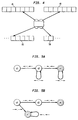
- FIG. 3 Recursive head transduction is illustrated in FIG. 3, wherein a source sentence " w 1 , w 2 w 3 w 4 w 5 w 6 w 7 w 8 " is converted to a target sentence " v 5 v 6 v 2 v 3 v 4 v 10 v 8 v 9 v 7 ⁇ .
- the top-level corresponding heads are w 4 and v 4, and the pairs of corresponding dependent words are ( w 3, v 3 ), ( w 6 , v 6 ) and ( w 7, v 7 ).
- w 6 and v 6 have a single corresponding pair of dependents ( w 5 , v 5 ), and so on. Note that in the example shown in FIG. 3, the word order of the target sentence is different than that of the source sentence. This may occur since word order may vary with language.
- the head transducer 13 is characterized by a finite set of states, Q , and a tranducer action table specifying possible actions that the head transducer 13 can take.
- One possible action includes a start action; the head transducer can start in state q ⁇ Q with empty target sequences.
- a second possible action is a stop action; the head transducer can stop in state q ⁇ Q , in which case both target sequences are considered complete.
- Another possible action is a transition. A transition will occur if in state q the head transducer 13 can enter state q ' after reading a symbol w ' from one of the input sequences and writing a symbol v ' to one of the target sequences.
- the positions from which symbols are read and written are also specified in the transitions.
- the input and output symbols w ' and v ' are permitted to be the empty string, denoted ⁇ .
- the head transducers 13 utilized in the present invention are different than "standard" finite state transducers known in the art. The latter are typically limited to converting a single input sequence into a single output sequence, usually reading the input sequence and writing the output sequence from left to right.
- a head transducer according to the present invention with the same number of states as a standard transducer is capable of producing a greater degree of divergence between the ordering of words in the input and output sequences. This additional ordering flexibility results from the ability to write each output symbol, i.e., character, identifier, word or the like, to the left or right output sequence as necessary.
- An additional benefit of the present head transducers are that they work outwards from the head of a phrase typically resulting in more accurate translations since processing can start with a less common word, limiting the possibilities for translation.
- the reading and writing positions for transitions are restricted to certain "directions."
- a transition may specify writing to the right end of the right target sequence 50, denoted ⁇ , or writing to the left end of the left target sequence 55, denoted ⁇ .
- a transition may specify reading the next symbol of the right source sequence 40 going rightwards from the left end of this sequence, denoted ⁇ , or reading the next symbol of the left source sequence 45, going leftwards from the right end of this sequence, denoted ⁇ .
- Entries in the bilingual lexicon, 15, are records of the from ( w , v , M ). Such a record "asserts" that the source word w can be translated into the target word v , and the dependents of w may be converted into the dependents of v according to the head transducer M . When such an entry is applied by the translator 1, the entry has "activated” the head transducer M .
- one of the words w or v may be the empty string ⁇ instead of a normal word in the vocabulary of the language.
- Entries with an empty string are used for translations involving a word in one language without a corresponding word in the other language. Examples include the introduction of an article or the translation of a source word into two target words.
- the terms word, string and phrase can mean empty string, unless otherwise noted.
- the head transducer M of a lexical entry with an empty string is restricted to having a single state q o and no transitions.
- a translator generates possible translations by applying head transducers 13 to convert the dependents of the head of the source sentence into the dependents of the head of the target sentence, and recursively transducing the dependents of these dependents using the transduction search engine 10.
- a total translation cost may be defined as the sum of the cost of all actions taken by all head tranducers involved in the translation. The translation with the lowest total cost is selected as the output of the translator, i.e., the translation.
- the cost of the various actions taken by the various head transducers 13 are provided in the parameter table 17.
- the costs specified in the parameter table 17 for a head transducer M take into account the identity of the source word w and the target word v in the bilingual lexicon entry that led to the activation of M .
- the cost of a start action, f is a function of M , w , v and the start state q , i.e., f ( M , w , v , q ).
- the cost of a transition, g is a function of M , w , v , the states q and q ' before and after transition, the source and target dependents w ' and v ', and the reading and writing directions d 1 and d 2 , i.e., g ( M , w , v , q , q ', w , w ', v ', d 1 , d 2 ).
- the cost of a stop action, h is a function of M , w , v and the stop state q , i.e., h ( M , w , v , q ).
- the costs in the parameter table 17 include not only costs for the appropriateness of translating one source language word into a corresponding target language word, but also the cost of associations between head-dependent words in each of the two languages.
- the strengths of these associations i.e., the likelihood of co-occurrence of such words, can influence the selection of the target sentence, a stronger association being indicated by a lower cost.
- FIGS. 5A & 5B show exemplary possible transitions for head transducers M 1 and M 2 , respectively, for generating part of the string transduction shown in FIG. 3. States are shown as circles and transitions as arrows labeled with source and target directions. States at which stop actions may take place are shown as double circles. The relevant parameter table entries required for this transduction are also shown below in Table 1. The actions of M 1 convert the dependent sequences for w 4 into those for v 4 and the actions for M 2 convert the dependent source sequences for w 7 into those for v 7 .
- head transducer M 1 with states q 1 , q 2 , q 3 , is activated by a lexical entry ( w 4 , v 4 , M 1 ), starting in state q 1 with cost c 1 .
- a transition from q 1 to q 2 with directions ( ⁇ , ⁇ ) and cost c 3 reads source word w 3 leftwards and writes target word v 3 , also leftwards.
- a transition from q 2 to q 3 with directions ( ⁇ , ⁇ ) reads source word w 6 rightwards and writes target word v 6 leftwards.
- a third transition from state q 3 back to q 3 with directions ( ⁇ , ⁇ ) reads source word w 7 rightwards and writes target word v 7 also rightwards.
- Transducer M 1 then undergoes a stop action in state q 3 with cost c 8 .
- head transducer M 2 is activated by an entry ( w 7 , v 7, M 2 ), starting in state q 4 with cost c 2 .
- M 2 makes a transition to state q 5 , reading the empty string ⁇ and writing the target word v 9 leftwards. It then makes a transition to state q 6 , reading the word w 8 rightwards and writing the word v 8 leftwards.
- Transducer M 2 then undergoes a stop action in state q 6 with cost c 9 .
- a transduction lattice is generated based on the input source language in step 110.
- the transduction lattice is generated by the transduction search engine 10.
- the target string selector 20 selects "the translation" from the output of the search engine 10.
- FIG. 6 depicts an embodiment of a method by which the transduction search engine 10 constructs the transduction lattice.
- step 200 the word position records or word lattice generated by the source language preprocessor 5 is received.
- the method begins with an initialization step, which is accomplished in steps 205 through 220, collectively identified by the reference numberal 230.
- Initialization takes place by adding to a queue a set of transduction records ( M , w , v , i , j , q o , v , c 2 ) developed from the word position records.
- the set of transduction records corresponds to activations of all bilingual lexical entries ( w , v , M ) for the source word w for each input word position record ( w , i , j , c o ).
- Activating a bilingual lexical entry i.e., activating a head transducer M , consists of retrieveing the entry from the bilingual lexicon 15 that is stored in a memory device.
- the present invention only the head transducers related to the source words in the input word position records or word lattice are activated. In other words, according to the present invention, it is not necessary to load the entire lexicon into RAM. In contrast, typical prior art translators require that their entire collections of grammatical rules, translation rules and the like be loaded into RAM. The present translation system and methods may thus be implemented on computers having limited RAM memory.
- the remaining steps 240 - 295 form a loop that consumes items from the queue and creates new transduction records.
- Decision block 240 queries whether the queue is empty. If it is, then all low cost records that can be developed from the source words have been "extended” as fully as possible, i.e., all applicable transitions by the head transducers have been made.
- the transduction lattice i.e, the collection of transduction records developed by the transduction search engine 10, is then post-processed in the target string selector 20 to select the best translation, as indicated in step 300.
- step 245 processing continues with step 245, wherein a transduction record is removed from the queue.
- the cost c of the transduction record is compared with the current lowest cost record in step 250.
- the lowest cost record is identified in a hash table.
- the entries in the hash table include a hash key, ( w , v , i , j , q , M ), and a hash value that is a pointer to the transduction record.
- the hash table maintains the pointer to the lowest cost transduction record found between i and j headed by w in state q of machine M .
- the information making up the hash key is referred to as a "full state” and c is referred to as the "full state cost”. If the cost c of the transduction record under consideration ("the current record”) is not less than the full state cost, the current record is discarded or "pruned”. Processing then returns to step 240 to determine if another transduction record is available. If the current record has a lower cost than the lowest cost record identified in the hash table, it is added to the transduction lattice in step 255. While step 250 is not required as a step in the present method, it improves efficiency because it avoids creating transduction records that will be discarded later.
- decision block 260 queries whether or not there are more phrases to combine with. If not, processing loops back to decision block 240. If there are more phrases, a combination operation performed by the steps collectively identified by the reference numeral 280 results in a new record for an extended partial translation. The old records still remain in the lattice. Combination operations are described in more detail later in this specification.
- the cost of the record is compared, in step 285, with the full state cost in the hash table. If the cost of the new record is higher than the full state cost, then processing returns to step 260 without adding the new record to the queue so that it is effectively discarded. If the cost of the new record is less than the full state value, then the hash table entry is updated with the new record pointer in step 290 and the old full state record is removed form the transduction lattice. The new low cost record is then added to the queue in step 295 and processing continues with step 260.
- step 300 wherein the target string selector 20 selects the word string having the lowest cost.
- a method for such low cost string selection is shown in FIG. 7.
- a list of all lattice records ( M , w , v , i , j , q , t , c ) from an initial input position i ⁇ I to a final input position j ⁇ J is compiled.
- the stopping action cost h ( M , w , v , q ) specified in the parameter table 17 is added to each record in the list.
- step 330 the string t from the record having the lowest total cost is selected as the translation. If there are several such spanning records with the same low cost, then select one of such records at random.
- each combination corresponds to a transition action of the head transducer for one of the two transduction records.
- the combination is a transition action for the transducer acting as the head in the combination, the other record acting as the dependent in the combination If successful, the combination operation results in a new record for an extended partial translation, with the old records remaining in the lattice.
- the four combinations of transition directions previously described correspond to four types of transduction or combination steps arising from the choice of left or right source direction and left or right target direction.
- An exemplary transduction step will be described for a left source direction ( ⁇ ) and a right target direction ( ⁇ ).
- the other three types of transduction steps are analogous, with the source phrase records and the target string concatenation reversed as appropriate.
- the action table for M 2 includes a transition from q 2 to q ' 2 with source direction ⁇ , target direction ⁇
- the parameter table 17 includes a cost
- c 3 g ( M 2 , w 2, v 2 , w 1 , v 1 , q 2 , q ' 2 , ⁇ , ⁇ ,) for this transition with source dependent word w 1 and target dependent word v 1
- the head transducer M 2 activated by a bilingual entry ( w 2 , v 2 , M 2 ) has undergone a transition "consuming" a dependent source string to the left (headed by w 1 ) and extending the target string t 2 to its right by a string t 1 (headed by v 1 ), t 1 being the translation of the "consumed" string.
- the dependent source word for the transition e.g., w 1 in the above example
- ⁇ the empty string.
- the old record for the head word i.e., ( M 2 , w 2 , v 2 , ⁇ , k , j , q 2 , t 2 , 2 ) is required for the transition to take place.
- the present invention does not require any specific interpretation of the various cost parameters for transducer actions other than the general requirement that lower costs correspond to more desirable translations.
- the cost function is negated log likelihood.
- Log-likelihood costs can be determined as follows for the present invention. Transducer actions are taken to be events in a so-called generative model, specifically a probabilistic model for simultaneously generating a source language string and a target language string. A data set of source sentences for a particular translation application are collected. A parameter table is created in which all costs are the same constant value. The translator is run with each of the source sentences from the data set, keeping a count of all transducer actions taken.
- the resulting source and target sentence pairs are presented to an individual competent in both languages so they may classify the translations as acceptable or unacceptable. Counts leading to unacceptable translations are discarded and probabilities are estimated from the remaining counts using standard statistical methods. For each estimated probability P ( e ) for an action e , set the cost for e equal to -log( P ( e )), and construct a new parameter table from such costs.
- the likelihood ratio is the number of times in training that a particular transducer action leads to the incorrect string and the number of times that it leads to selecting a correct string.
- means other than "costs" can be used for selecting the best transduction.
- Such means include, without limitation, constraints.
- constraints for use in the present translator include unification constraints and selectional restrictions.
- the parameter table 17 is not required.
- a constraint table 17a will replace the parameter table 17. Note that in such constraint-based translators, the transduction search engine 10a will admit the results of combinations on a basis other than cost..
- the "best" translation is selected at random from candidate translations so that a target string selector 20a is not required.
- a plurality of head transducers 13 are required. In some simple applications, however, such as translating certain collections of computer instructions, a single head transducer 13 can be used for translation.
Landscapes
- Engineering & Computer Science (AREA)
- Theoretical Computer Science (AREA)
- Physics & Mathematics (AREA)
- Health & Medical Sciences (AREA)
- Artificial Intelligence (AREA)
- Audiology, Speech & Language Pathology (AREA)
- Computational Linguistics (AREA)
- General Health & Medical Sciences (AREA)
- General Engineering & Computer Science (AREA)
- General Physics & Mathematics (AREA)
- Probability & Statistics with Applications (AREA)
- Machine Translation (AREA)
Applications Claiming Priority (2)
| Application Number | Priority Date | Filing Date | Title |
|---|---|---|---|
| US08/665,182 US6233544B1 (en) | 1996-06-14 | 1996-06-14 | Method and apparatus for language translation |
| US665182 | 1996-06-14 |
Publications (3)
| Publication Number | Publication Date |
|---|---|
| EP0813156A2 true EP0813156A2 (de) | 1997-12-17 |
| EP0813156A3 EP0813156A3 (de) | 1998-12-23 |
| EP0813156B1 EP0813156B1 (de) | 2003-11-26 |
Family
ID=24669064
Family Applications (1)
| Application Number | Title | Priority Date | Filing Date |
|---|---|---|---|
| EP97109411A Expired - Lifetime EP0813156B1 (de) | 1996-06-14 | 1997-06-10 | Verfahren und Apparat zur Sprachübersetzung |
Country Status (4)
| Country | Link |
|---|---|
| US (1) | US6233544B1 (de) |
| EP (1) | EP0813156B1 (de) |
| CA (1) | CA2202696C (de) |
| DE (1) | DE69726339T2 (de) |
Cited By (1)
| Publication number | Priority date | Publication date | Assignee | Title |
|---|---|---|---|---|
| WO2010150067A1 (en) * | 2009-06-26 | 2010-12-29 | Nokia Corporation | Method and apparatus for converting text input |
Families Citing this family (100)
| Publication number | Priority date | Publication date | Assignee | Title |
|---|---|---|---|---|
| US8489980B2 (en) | 1998-02-23 | 2013-07-16 | Transperfect Global, Inc. | Translation management system |
| US20130124987A1 (en) | 1998-02-23 | 2013-05-16 | Transperfect Global, Inc. | Translation management system |
| US6952827B1 (en) * | 1998-11-13 | 2005-10-04 | Cray Inc. | User program and operating system interface in a multithreaded environment |
| US6385586B1 (en) * | 1999-01-28 | 2002-05-07 | International Business Machines Corporation | Speech recognition text-based language conversion and text-to-speech in a client-server configuration to enable language translation devices |
| US7369994B1 (en) | 1999-04-30 | 2008-05-06 | At&T Corp. | Methods and apparatus for rapid acoustic unit selection from a large speech corpus |
| US6697780B1 (en) * | 1999-04-30 | 2004-02-24 | At&T Corp. | Method and apparatus for rapid acoustic unit selection from a large speech corpus |
| US7082396B1 (en) | 1999-04-30 | 2006-07-25 | At&T Corp | Methods and apparatus for rapid acoustic unit selection from a large speech corpus |
| CN1176432C (zh) * | 1999-07-28 | 2004-11-17 | 国际商业机器公司 | 提供本国语言查询服务的方法和系统 |
| US6556972B1 (en) * | 2000-03-16 | 2003-04-29 | International Business Machines Corporation | Method and apparatus for time-synchronized translation and synthesis of natural-language speech |
| US20010029442A1 (en) * | 2000-04-07 | 2001-10-11 | Makoto Shiotsu | Translation system, translation processing method and computer readable recording medium |
| DE10018143C5 (de) * | 2000-04-12 | 2012-09-06 | Oerlikon Trading Ag, Trübbach | DLC-Schichtsystem sowie Verfahren und Vorrichtung zur Herstellung eines derartigen Schichtsystems |
| US7451085B2 (en) * | 2000-10-13 | 2008-11-11 | At&T Intellectual Property Ii, L.P. | System and method for providing a compensated speech recognition model for speech recognition |
| US6963839B1 (en) * | 2000-11-03 | 2005-11-08 | At&T Corp. | System and method of controlling sound in a multi-media communication application |
| US7203648B1 (en) | 2000-11-03 | 2007-04-10 | At&T Corp. | Method for sending multi-media messages with customized audio |
| US20080040227A1 (en) * | 2000-11-03 | 2008-02-14 | At&T Corp. | System and method of marketing using a multi-media communication system |
| US6990452B1 (en) | 2000-11-03 | 2006-01-24 | At&T Corp. | Method for sending multi-media messages using emoticons |
| US7035803B1 (en) | 2000-11-03 | 2006-04-25 | At&T Corp. | Method for sending multi-media messages using customizable background images |
| US7091976B1 (en) | 2000-11-03 | 2006-08-15 | At&T Corp. | System and method of customizing animated entities for use in a multi-media communication application |
| US6976082B1 (en) | 2000-11-03 | 2005-12-13 | At&T Corp. | System and method for receiving multi-media messages |
| US7209880B1 (en) * | 2001-03-20 | 2007-04-24 | At&T Corp. | Systems and methods for dynamic re-configurable speech recognition |
| US6934675B2 (en) * | 2001-06-14 | 2005-08-23 | Stephen C. Glinski | Methods and systems for enabling speech-based internet searches |
| AU2002316581A1 (en) | 2001-07-03 | 2003-01-21 | University Of Southern California | A syntax-based statistical translation model |
| US20030065505A1 (en) * | 2001-08-17 | 2003-04-03 | At&T Corp. | Systems and methods for abstracting portions of information that is represented with finite-state devices |
| CN1578954B (zh) * | 2001-10-29 | 2010-04-14 | 英国电讯有限公司 | 计算机语言翻译扩展系统 |
| US7671861B1 (en) | 2001-11-02 | 2010-03-02 | At&T Intellectual Property Ii, L.P. | Apparatus and method of customizing animated entities for use in a multi-media communication application |
| US7221654B2 (en) * | 2001-11-13 | 2007-05-22 | Nokia Corporation | Apparatus, and associated method, for selecting radio communication system parameters utilizing learning controllers |
| FR2833375B1 (fr) * | 2001-12-07 | 2004-06-04 | Amadeus | Procede, dispositif d'adaptation de fichiers numeriques |
| US7272377B2 (en) * | 2002-02-07 | 2007-09-18 | At&T Corp. | System and method of ubiquitous language translation for wireless devices |
| US7620538B2 (en) * | 2002-03-26 | 2009-11-17 | University Of Southern California | Constructing a translation lexicon from comparable, non-parallel corpora |
| US8234115B2 (en) * | 2002-03-29 | 2012-07-31 | At&T Intellectual Property Ii, L.P. | Systems and methods for determining the N-best strings |
| EP1353280B1 (de) * | 2002-04-12 | 2006-06-14 | Targit A/S | Verfahren zur Verarbeitung von mehrsprachigen Abfragen |
| USH2189H1 (en) * | 2002-10-21 | 2007-05-01 | Oracle International Corporation | SQL enhancements to support text queries on speech recognition results of audio data |
| US7257575B1 (en) | 2002-10-24 | 2007-08-14 | At&T Corp. | Systems and methods for generating markup-language based expressions from multi-modal and unimodal inputs |
| US8548794B2 (en) | 2003-07-02 | 2013-10-01 | University Of Southern California | Statistical noun phrase translation |
| US7711545B2 (en) * | 2003-07-02 | 2010-05-04 | Language Weaver, Inc. | Empirical methods for splitting compound words with application to machine translation |
| US7660400B2 (en) | 2003-12-19 | 2010-02-09 | At&T Intellectual Property Ii, L.P. | Method and apparatus for automatically building conversational systems |
| US8296127B2 (en) | 2004-03-23 | 2012-10-23 | University Of Southern California | Discovery of parallel text portions in comparable collections of corpora and training using comparable texts |
| US8666725B2 (en) | 2004-04-16 | 2014-03-04 | University Of Southern California | Selection and use of nonstatistical translation components in a statistical machine translation framework |
| JP5452868B2 (ja) | 2004-10-12 | 2014-03-26 | ユニヴァーシティー オブ サザン カリフォルニア | トレーニングおよび復号のためにストリングからツリーへの変換を使うテキスト‐テキスト・アプリケーションのためのトレーニング |
| US8886517B2 (en) | 2005-06-17 | 2014-11-11 | Language Weaver, Inc. | Trust scoring for language translation systems |
| US8676563B2 (en) | 2009-10-01 | 2014-03-18 | Language Weaver, Inc. | Providing human-generated and machine-generated trusted translations |
| US8265924B1 (en) | 2005-10-06 | 2012-09-11 | Teradata Us, Inc. | Multiple language data structure translation and management of a plurality of languages |
| US10319252B2 (en) | 2005-11-09 | 2019-06-11 | Sdl Inc. | Language capability assessment and training apparatus and techniques |
| US7827028B2 (en) * | 2006-04-07 | 2010-11-02 | Basis Technology Corporation | Method and system of machine translation |
| US8943080B2 (en) | 2006-04-07 | 2015-01-27 | University Of Southern California | Systems and methods for identifying parallel documents and sentence fragments in multilingual document collections |
| US8886518B1 (en) | 2006-08-07 | 2014-11-11 | Language Weaver, Inc. | System and method for capitalizing machine translated text |
| US9235573B2 (en) | 2006-10-10 | 2016-01-12 | Abbyy Infopoisk Llc | Universal difference measure |
| US9645993B2 (en) | 2006-10-10 | 2017-05-09 | Abbyy Infopoisk Llc | Method and system for semantic searching |
| US9189482B2 (en) | 2012-10-10 | 2015-11-17 | Abbyy Infopoisk Llc | Similar document search |
| US9047275B2 (en) | 2006-10-10 | 2015-06-02 | Abbyy Infopoisk Llc | Methods and systems for alignment of parallel text corpora |
| US9984071B2 (en) | 2006-10-10 | 2018-05-29 | Abbyy Production Llc | Language ambiguity detection of text |
| US9053090B2 (en) | 2006-10-10 | 2015-06-09 | Abbyy Infopoisk Llc | Translating texts between languages |
| US9495358B2 (en) | 2006-10-10 | 2016-11-15 | Abbyy Infopoisk Llc | Cross-language text clustering |
| US20080086298A1 (en) * | 2006-10-10 | 2008-04-10 | Anisimovich Konstantin | Method and system for translating sentences between langauges |
| US9471562B2 (en) | 2006-10-10 | 2016-10-18 | Abbyy Infopoisk Llc | Method and system for analyzing and translating various languages with use of semantic hierarchy |
| US9633005B2 (en) | 2006-10-10 | 2017-04-25 | Abbyy Infopoisk Llc | Exhaustive automatic processing of textual information |
| US8892423B1 (en) | 2006-10-10 | 2014-11-18 | Abbyy Infopoisk Llc | Method and system to automatically create content for dictionaries |
| US8195447B2 (en) * | 2006-10-10 | 2012-06-05 | Abbyy Software Ltd. | Translating sentences between languages using language-independent semantic structures and ratings of syntactic constructions |
| US8214199B2 (en) * | 2006-10-10 | 2012-07-03 | Abbyy Software, Ltd. | Systems for translating sentences between languages using language-independent semantic structures and ratings of syntactic constructions |
| US9892111B2 (en) | 2006-10-10 | 2018-02-13 | Abbyy Production Llc | Method and device to estimate similarity between documents having multiple segments |
| US8548795B2 (en) * | 2006-10-10 | 2013-10-01 | Abbyy Software Ltd. | Method for translating documents from one language into another using a database of translations, a terminology dictionary, a translation dictionary, and a machine translation system |
| US8145473B2 (en) | 2006-10-10 | 2012-03-27 | Abbyy Software Ltd. | Deep model statistics method for machine translation |
| US8078450B2 (en) * | 2006-10-10 | 2011-12-13 | Abbyy Software Ltd. | Method and system for analyzing various languages and constructing language-independent semantic structures |
| US9588958B2 (en) | 2006-10-10 | 2017-03-07 | Abbyy Infopoisk Llc | Cross-language text classification |
| US8433556B2 (en) | 2006-11-02 | 2013-04-30 | University Of Southern California | Semi-supervised training for statistical word alignment |
| US9122674B1 (en) | 2006-12-15 | 2015-09-01 | Language Weaver, Inc. | Use of annotations in statistical machine translation |
| US8468149B1 (en) | 2007-01-26 | 2013-06-18 | Language Weaver, Inc. | Multi-lingual online community |
| US8615389B1 (en) * | 2007-03-16 | 2013-12-24 | Language Weaver, Inc. | Generation and exploitation of an approximate language model |
| US8959011B2 (en) | 2007-03-22 | 2015-02-17 | Abbyy Infopoisk Llc | Indicating and correcting errors in machine translation systems |
| US8831928B2 (en) | 2007-04-04 | 2014-09-09 | Language Weaver, Inc. | Customizable machine translation service |
| US8825466B1 (en) | 2007-06-08 | 2014-09-02 | Language Weaver, Inc. | Modification of annotated bilingual segment pairs in syntax-based machine translation |
| US8812296B2 (en) | 2007-06-27 | 2014-08-19 | Abbyy Infopoisk Llc | Method and system for natural language dictionary generation |
| JP5238205B2 (ja) * | 2007-09-07 | 2013-07-17 | ニュアンス コミュニケーションズ,インコーポレイテッド | 音声合成システム、プログラム及び方法 |
| US8209164B2 (en) * | 2007-11-21 | 2012-06-26 | University Of Washington | Use of lexical translations for facilitating searches |
| US7949679B2 (en) * | 2008-03-05 | 2011-05-24 | International Business Machines Corporation | Efficient storage for finite state machines |
| US9262409B2 (en) | 2008-08-06 | 2016-02-16 | Abbyy Infopoisk Llc | Translation of a selected text fragment of a screen |
| US8990064B2 (en) | 2009-07-28 | 2015-03-24 | Language Weaver, Inc. | Translating documents based on content |
| US8380486B2 (en) | 2009-10-01 | 2013-02-19 | Language Weaver, Inc. | Providing machine-generated translations and corresponding trust levels |
| US10417646B2 (en) | 2010-03-09 | 2019-09-17 | Sdl Inc. | Predicting the cost associated with translating textual content |
| IT1400269B1 (it) * | 2010-05-31 | 2013-05-24 | Google Inc | Distanza di editazione generalizzata per interrogazioni |
| US11003838B2 (en) | 2011-04-18 | 2021-05-11 | Sdl Inc. | Systems and methods for monitoring post translation editing |
| US8694303B2 (en) | 2011-06-15 | 2014-04-08 | Language Weaver, Inc. | Systems and methods for tuning parameters in statistical machine translation |
| US8914277B1 (en) * | 2011-09-20 | 2014-12-16 | Nuance Communications, Inc. | Speech and language translation of an utterance |
| US8886515B2 (en) | 2011-10-19 | 2014-11-11 | Language Weaver, Inc. | Systems and methods for enhancing machine translation post edit review processes |
| US8942973B2 (en) | 2012-03-09 | 2015-01-27 | Language Weaver, Inc. | Content page URL translation |
| US8971630B2 (en) | 2012-04-27 | 2015-03-03 | Abbyy Development Llc | Fast CJK character recognition |
| US8989485B2 (en) | 2012-04-27 | 2015-03-24 | Abbyy Development Llc | Detecting a junction in a text line of CJK characters |
| US10261994B2 (en) | 2012-05-25 | 2019-04-16 | Sdl Inc. | Method and system for automatic management of reputation of translators |
| US9152622B2 (en) | 2012-11-26 | 2015-10-06 | Language Weaver, Inc. | Personalized machine translation via online adaptation |
| US9213694B2 (en) | 2013-10-10 | 2015-12-15 | Language Weaver, Inc. | Efficient online domain adaptation |
| RU2592395C2 (ru) | 2013-12-19 | 2016-07-20 | Общество с ограниченной ответственностью "Аби ИнфоПоиск" | Разрешение семантической неоднозначности при помощи статистического анализа |
| RU2586577C2 (ru) | 2014-01-15 | 2016-06-10 | Общество с ограниченной ответственностью "Аби ИнфоПоиск" | Фильтрация дуг в синтаксическом графе |
| RU2596600C2 (ru) | 2014-09-02 | 2016-09-10 | Общество с ограниченной ответственностью "Аби Девелопмент" | Способы и системы обработки изображений математических выражений |
| US9626358B2 (en) | 2014-11-26 | 2017-04-18 | Abbyy Infopoisk Llc | Creating ontologies by analyzing natural language texts |
| CN104572028B (zh) * | 2014-12-26 | 2017-06-20 | 中国科学院自动化研究所 | 一种状态机等价变换的方法和装置 |
| KR102407630B1 (ko) * | 2015-09-08 | 2022-06-10 | 삼성전자주식회사 | 서버, 사용자 단말 및 이들의 제어 방법. |
| US9916305B1 (en) * | 2016-12-28 | 2018-03-13 | Facebook, Inc. | Translating terms within a digital communication |
| DE102017008079A1 (de) | 2017-08-25 | 2018-04-19 | Daimler Ag | Verfahren zum Übersetzen einer ersten Wortfolge in eine zweite Wortfolge |
| US10552547B2 (en) * | 2017-10-10 | 2020-02-04 | International Business Machines Corporation | Real-time translation evaluation services for integrated development environments |
| JP6784718B2 (ja) * | 2018-04-13 | 2020-11-11 | グリー株式会社 | ゲームプログラム及びゲーム装置 |
Family Cites Families (8)
| Publication number | Priority date | Publication date | Assignee | Title |
|---|---|---|---|---|
| US4868750A (en) | 1987-10-07 | 1989-09-19 | Houghton Mifflin Company | Collocational grammar system |
| JPH02165378A (ja) * | 1988-12-20 | 1990-06-26 | Csk Corp | 機械翻訳システム |
| US5477451A (en) * | 1991-07-25 | 1995-12-19 | International Business Machines Corp. | Method and system for natural language translation |
| GB9209346D0 (en) | 1992-04-30 | 1992-06-17 | Sharp Kk | Machine translation system |
| US5434777A (en) * | 1992-05-27 | 1995-07-18 | Apple Computer, Inc. | Method and apparatus for processing natural language |
| JP3599775B2 (ja) * | 1993-04-21 | 2004-12-08 | ゼロックス コーポレイション | ハイフネーション規則に関する有限状態符号化システム |
| US5510981A (en) | 1993-10-28 | 1996-04-23 | International Business Machines Corporation | Language translation apparatus and method using context-based translation models |
| US5621859A (en) * | 1994-01-19 | 1997-04-15 | Bbn Corporation | Single tree method for grammar directed, very large vocabulary speech recognizer |
-
1996
- 1996-06-14 US US08/665,182 patent/US6233544B1/en not_active Expired - Lifetime
-
1997
- 1997-04-15 CA CA002202696A patent/CA2202696C/en not_active Expired - Lifetime
- 1997-06-10 DE DE69726339T patent/DE69726339T2/de not_active Expired - Fee Related
- 1997-06-10 EP EP97109411A patent/EP0813156B1/de not_active Expired - Lifetime
Cited By (1)
| Publication number | Priority date | Publication date | Assignee | Title |
|---|---|---|---|---|
| WO2010150067A1 (en) * | 2009-06-26 | 2010-12-29 | Nokia Corporation | Method and apparatus for converting text input |
Also Published As
| Publication number | Publication date |
|---|---|
| CA2202696A1 (en) | 1997-12-14 |
| EP0813156B1 (de) | 2003-11-26 |
| CA2202696C (en) | 2001-02-06 |
| EP0813156A3 (de) | 1998-12-23 |
| US6233544B1 (en) | 2001-05-15 |
| MX9704287A (es) | 1998-06-30 |
| DE69726339T2 (de) | 2004-09-09 |
| DE69726339D1 (de) | 2004-01-08 |
Similar Documents
| Publication | Publication Date | Title |
|---|---|---|
| US6233544B1 (en) | Method and apparatus for language translation | |
| US5895446A (en) | Pattern-based translation method and system | |
| US5610812A (en) | Contextual tagger utilizing deterministic finite state transducer | |
| JP4911028B2 (ja) | 単語翻訳装置、翻訳方法および翻訳プログラム | |
| US5418717A (en) | Multiple score language processing system | |
| US6401061B1 (en) | Combinatorial computational technique for transformation phrase text-phrase meaning | |
| US5930746A (en) | Parsing and translating natural language sentences automatically | |
| KR101120798B1 (ko) | 텍스트로부터 세만틱 구조들을 식별하기 위한 방법 및장치 | |
| CN1029170C (zh) | 语言翻译系统 | |
| US7552051B2 (en) | Method and apparatus for mapping multiword expressions to identifiers using finite-state networks | |
| JPH03224055A (ja) | 同時通訳向き音声認識システムおよびその音声認識方法 | |
| JP2005507524A (ja) | 機械翻訳 | |
| JP2005507525A (ja) | 機械翻訳 | |
| US7346511B2 (en) | Method and apparatus for recognizing multiword expressions | |
| JP3071570B2 (ja) | 複合のターゲット語に関する辞書データを決定するための装置及び方法 | |
| US8041556B2 (en) | Chinese to english translation tool | |
| KR100327114B1 (ko) | 문장골격을 기반으로 한 자동번역 시스템 및 그 방법 | |
| US12333245B2 (en) | Methods and apparatus to improve disambiguation and interpretation in automated text analysis using structured language space and transducers applied on automatons | |
| Alshawi et al. | Learning dependency transduction models from unannotated examples | |
| KR20040018008A (ko) | 품사 태깅 장치 및 태깅 방법 | |
| Gebremeskel | Geez POS Tagger Using Hybrid Approach | |
| JP4113204B2 (ja) | 機械翻訳装置、その方法およびプログラム | |
| JP3873305B2 (ja) | 仮名漢字変換装置および仮名漢字変換方法 | |
| Papakitsos et al. | Modelling a Morpheme‐based Lexicon for Modern Greek | |
| JPS646499B2 (de) |
Legal Events
| Date | Code | Title | Description |
|---|---|---|---|
| PUAI | Public reference made under article 153(3) epc to a published international application that has entered the european phase |
Free format text: ORIGINAL CODE: 0009012 |
|
| AK | Designated contracting states |
Kind code of ref document: A2 Designated state(s): DE FR GB |
|
| PUAL | Search report despatched |
Free format text: ORIGINAL CODE: 0009013 |
|
| AK | Designated contracting states |
Kind code of ref document: A3 Designated state(s): AT BE CH DE DK ES FI FR GB GR IE IT LI LU MC NL PT SE |
|
| 17P | Request for examination filed |
Effective date: 19990607 |
|
| AKX | Designation fees paid |
Free format text: DE FR GB |
|
| 17Q | First examination report despatched |
Effective date: 20000630 |
|
| GRAH | Despatch of communication of intention to grant a patent |
Free format text: ORIGINAL CODE: EPIDOS IGRA |
|
| GRAS | Grant fee paid |
Free format text: ORIGINAL CODE: EPIDOSNIGR3 |
|
| GRAA | (expected) grant |
Free format text: ORIGINAL CODE: 0009210 |
|
| AK | Designated contracting states |
Kind code of ref document: B1 Designated state(s): DE FR GB |
|
| REG | Reference to a national code |
Ref country code: GB Ref legal event code: FG4D |
|
| REF | Corresponds to: |
Ref document number: 69726339 Country of ref document: DE Date of ref document: 20040108 Kind code of ref document: P |
|
| ET | Fr: translation filed | ||
| PLBE | No opposition filed within time limit |
Free format text: ORIGINAL CODE: 0009261 |
|
| STAA | Information on the status of an ep patent application or granted ep patent |
Free format text: STATUS: NO OPPOSITION FILED WITHIN TIME LIMIT |
|
| 26N | No opposition filed |
Effective date: 20040827 |
|
| PGFP | Annual fee paid to national office [announced via postgrant information from national office to epo] |
Ref country code: FR Payment date: 20090605 Year of fee payment: 13 |
|
| PGFP | Annual fee paid to national office [announced via postgrant information from national office to epo] |
Ref country code: DE Payment date: 20090630 Year of fee payment: 13 |
|
| REG | Reference to a national code |
Ref country code: FR Ref legal event code: ST Effective date: 20110228 |
|
| PG25 | Lapsed in a contracting state [announced via postgrant information from national office to epo] |
Ref country code: DE Free format text: LAPSE BECAUSE OF NON-PAYMENT OF DUE FEES Effective date: 20110101 |
|
| PG25 | Lapsed in a contracting state [announced via postgrant information from national office to epo] |
Ref country code: FR Free format text: LAPSE BECAUSE OF NON-PAYMENT OF DUE FEES Effective date: 20100630 |
|
| PGFP | Annual fee paid to national office [announced via postgrant information from national office to epo] |
Ref country code: GB Payment date: 20160525 Year of fee payment: 20 |
|
| REG | Reference to a national code |
Ref country code: GB Ref legal event code: PE20 Expiry date: 20170609 |
|
| PG25 | Lapsed in a contracting state [announced via postgrant information from national office to epo] |
Ref country code: GB Free format text: LAPSE BECAUSE OF EXPIRATION OF PROTECTION Effective date: 20170609 |
|
| REG | Reference to a national code |
Ref country code: GB Ref legal event code: 732E Free format text: REGISTERED BETWEEN 20170914 AND 20170920 |