EP0813158A2 - Procédé et dispositif pour l'évaluation accélérée d'une requête sur de très grandes bases de données de texte - Google Patents
Procédé et dispositif pour l'évaluation accélérée d'une requête sur de très grandes bases de données de texte Download PDFInfo
- Publication number
- EP0813158A2 EP0813158A2 EP97109680A EP97109680A EP0813158A2 EP 0813158 A2 EP0813158 A2 EP 0813158A2 EP 97109680 A EP97109680 A EP 97109680A EP 97109680 A EP97109680 A EP 97109680A EP 0813158 A2 EP0813158 A2 EP 0813158A2
- Authority
- EP
- European Patent Office
- Prior art keywords
- term
- document
- documents
- contribution
- query
- Prior art date
- Legal status (The legal status is an assumption and is not a legal conclusion. Google has not performed a legal analysis and makes no representation as to the accuracy of the status listed.)
- Withdrawn
Links
Images


Classifications
-
- G—PHYSICS
- G06—COMPUTING OR CALCULATING; COUNTING
- G06F—ELECTRIC DIGITAL DATA PROCESSING
- G06F16/00—Information retrieval; Database structures therefor; File system structures therefor
- G06F16/30—Information retrieval; Database structures therefor; File system structures therefor of unstructured textual data
- G06F16/31—Indexing; Data structures therefor; Storage structures
- G06F16/313—Selection or weighting of terms for indexing
-
- Y—GENERAL TAGGING OF NEW TECHNOLOGICAL DEVELOPMENTS; GENERAL TAGGING OF CROSS-SECTIONAL TECHNOLOGIES SPANNING OVER SEVERAL SECTIONS OF THE IPC; TECHNICAL SUBJECTS COVERED BY FORMER USPC CROSS-REFERENCE ART COLLECTIONS [XRACs] AND DIGESTS
- Y10—TECHNICAL SUBJECTS COVERED BY FORMER USPC
- Y10S—TECHNICAL SUBJECTS COVERED BY FORMER USPC CROSS-REFERENCE ART COLLECTIONS [XRACs] AND DIGESTS
- Y10S707/00—Data processing: database and file management or data structures
- Y10S707/99931—Database or file accessing
- Y10S707/99933—Query processing, i.e. searching
- Y10S707/99935—Query augmenting and refining, e.g. inexact access
-
- Y—GENERAL TAGGING OF NEW TECHNOLOGICAL DEVELOPMENTS; GENERAL TAGGING OF CROSS-SECTIONAL TECHNOLOGIES SPANNING OVER SEVERAL SECTIONS OF THE IPC; TECHNICAL SUBJECTS COVERED BY FORMER USPC CROSS-REFERENCE ART COLLECTIONS [XRACs] AND DIGESTS
- Y10—TECHNICAL SUBJECTS COVERED BY FORMER USPC
- Y10S—TECHNICAL SUBJECTS COVERED BY FORMER USPC CROSS-REFERENCE ART COLLECTIONS [XRACs] AND DIGESTS
- Y10S707/00—Data processing: database and file management or data structures
- Y10S707/99931—Database or file accessing
- Y10S707/99939—Privileged access
Definitions
- the present invention relates to systems and methods for computer based text retrieval, and more particularly, to systems and method for text or information retrieval from very large text databases.
- Typical information retrieval systems use an "inverted index" database format.
- the inverted index stores or identifies the documents which contain the term and a measure of the frequency of the term within each document.
- Term frequency may be measured in various manners, such as raw term counts, and various logrithmic functions thereof.
- Each document in the database has a unique document number, and the terms in the inverted index are typically sorted by document number so that multiple rows (terms) can be efficiently compared by iterating over the rows in parallel.
- Conventional search systems process a query by scoring documents in the database according to term frequency information contained in the inverted index.
- the terms in the query are used to identify the relevant rows in the inverted index. These rows are then traversed, and document scores computed for each of the listed documents.
- Most such scoring functions are based on a between-document term frequency known called the inverse document frequency (IDF) of each term that reflects the frequency of occurrence of the term within a document database, a within-document term frequency that reflects the frequency of a term in each document, and a normalization factor k, typically the length of the document vector.
- IDF inverse document frequency
- Such a scoring function may be: where S D is the document score for document D, q iterates over each term of the query, W q is a weight for term q, IDF q is the IDF of term q in a given document database, f D,q is the within-document frequency of term q in document D, and l D is the normalization factor for document D, typically the length of the vector represented by the document.
- Some conventional information retrieval systems use a different sort order in the inverted index to arrange the documents corresponding to each term.
- Differential compression techniques are typically quite efficient on dense rows when those rows are sorted by increasing document number; using a different sort order eliminates this benefit. Therefore the total bytes required to store the document/frequency tuples for the given term increases dramatically.
- the increased size of the inverted index in turn has a significant impact on the resources required to store and manage the database.
- a database in accordance with the invention includes in addition to the inverted index, a small persistent data structure that stores a static cache of "important" documents for some (or all) of the terms in the inverted index.
- the static cache stores sufficient information about each document to enable the retrieval system to quickly calculate a document score for the important documents without having to traverse the inverted index in a conventional manner. This cache is consulted for each term in a query, and if possible the query is completed and documents scored from the cache using the information contained therein.
- a significant feature provided by the system is the ability to prune the search so that the only a relatively few documents must be scored in order to obtain bounds on the scores of all the other documents in the collection. As a result, a relatively small number of documents are scored and returned, while still guaranteeing that no unscored document is more relevant to the query than those that were scored.
- present invention comprises a contribution cache and an efficient mechanism for accessing arbitrary documents in inverted index.
- the latter mechanism is fulfilled by the lookup-table, but other methods could be used as well.
- a database of documents stored persistently in one or more computer readable memories, such as hard disk, optical disk, or the like.
- a typical database used with the invention may have 500,000 or more documents, and may be distributed across various computer systems. Each document is associated with a unique document identifer.
- documents are scored by the system according to the following formula: where S D is the score of document D, W t is the (normalized) weight of term t in the query and c t is the contribution from term t to the overall score for the document D.
- Equation (2) is a re-expression of (1) above, where c t is: where f t is a frequency of the term t in document D, and IDF t is an inverse document frequency of the term t in the database.
- the database is structured to include an inverted index, which may be conventional.
- an inverted index which may be conventional.
- the static cache contains an entry for each term of the inverted index that has more than k (document, term frequency) tuples. K may be set at any useful value, depending on the total number of documents in the database, and the distribution of document across terms. In most preferred embodiments, k is typically between 500 and 2000. In general, these are the terms for which a query would typically require very extensive and time consuming processing in a conventional system due to the number of documents that contain the term in the inverted index, which for common terms, may be in the tens of thousands, or more. This is because, as noted above, the documents in the inverted index are typically ordered by some document identifier, and not by any measure of the significance of the term to the document or the database as a whole. The present invention eliminates this defect with the static cache.
- each entry in the static cache includes a contribution cache and a lookup table.
- the contribution cache contains a list of (document, contribution) tuples where "contribution" is a measure of the contribution the term makes to the document score of the document.
- the list may contain k tuples, using the same threshold number as before. Or alternatively, some other number of tuples may be stored, for example, based on a percentage of the number of documents containing the term, or based on a threshold contribution value.
- the contribution may be computed as described above in (3). However, other contribution formulas may also be used.
- the contribution need only be a function of both the within-document frequency of the term (f D,t ) and a between-document frequency of the term, such as IDF.
- the contribution cache tuples are sorted by the contribution value.
- Documents are represented by any useful identifier mechanism, such as their document number, pointer, or the like. As used herein, a document may be identified by both indexing and referencing mechanisms, or combinations thereof. The term "document identifier" is used to mean any such referencing value.
- the lookup table contains some number of pointers into the (document, term frequency) tuples in the inverted index for the term. This allows random access to the frequency information for a specific term in any document in the row without having to traverse the entire row of the inverted index to obtain the frequency information.
- the lookup table is a primary index to the inverted index.
- the (document, term frequency) tuples in the inverted index are considered as arranged in blocks, each block having some number of tuples, such 100 tuples.
- the lookup table then contains the document identifier of, and pointer (or index) to, the first tuple in each block.
- any (document, term frequency) tuple in the block may be easily accessed by first a binary search, linear interpolation, or other search technique, into the lookup table given a document identifier, then a reference into the block of the inverted index, and then a scan of the block.
- the static cache Since the static cache is arranged by terms, it may stored in the inverted index itself, or provided as a separate file or table. Storage in a separate file provides benefits of decrease search time due to improved locality.
- the cache index is a list of indices (0 to the number of tuples) into the contribution cache. Whereas the contribution cache is ordered by the contribution value, the cache index for a term is ordered by the document identifiers. The cache index allows for the rapid determination of whether a given document is found in the contribution cache of a term.
- the present invention provides improved methods for processing queries.
- the lookup table for "orange” is searched to find the pointer into the inverted index row of "orange” for the block containing document number 1000.
- the inverted index rows are sorted by document number. The pointer can thus be efficiently calculated from known starting points, and fixed size fields, or can be seached in various manners).
- Once referenced into the correct block in the inverted index only a limited number of entries therein need be expanded until the desired document number 1000 is reached.
- the document score for this document is then updated from the term frequency information in the inverted index at this point, using the equation (1) set forth above.
- This process of referencing the lookup table and traversing a limited portion of the term rows in the inverted index is repeated for each term of the document when the document is not found in the contribution cache portion of for the term.
- the lookup table is properly constructed to allow relative efficient random access to (document, term frequency) information, the information retrieval system will have to unpack far fewer (document, term frequency) tuples in the inverted index than it would unpacked if it had iterated over the entire row of the inverted index as in a conventional information retrieval system.
- this problem may be handled even more efficiently by using the document identifier to search the cache index of a query term.
- Retrieved cache indices are mapped to the underlying document identifier in the contribution cache.
- the contribution cache is searched using the cache index, and matching the document identifiers against the given document identifier. If there a match, then the contribution for the term can be immediately accessed from the contribution cache, without incurring the I/O expense associated with using the lookup tables and the inverted index. This approach substantially increases performance.
- the contribution-caches of the present invention entirely solve this problem by identifying a maximum bound on the scores of otherwise unscored documents.
- an upper bound document score value is maintained as the combined contributions of the documents (regardless of their document identifer) at a furthest advanced index for the contribution cache rows.
- all unscored documents that remain in the contribution caches will have, at any time, a document score less than the defined upper bound document score.
- no document that is not in contribution can have a higher document score than this upper bound, because it is already known that the contribution of the terms of the query to the document was so low as to not include the document in the contribution cache of one or more the terms.
- n document scores of is maintained, such as the top 20 or 100 document scores, or any number as desired, as the current search results.
- a minimum document score from this set is maintained, and updated as new documents are scored.
- the minimum document score in the result set is less than or equal to the upper bound, then the document scoring is halted.
- the search results are guaranteed to include the n highest scoring documents for the query, even though many, perhaps tens of thousands, of documents containing some terms of the query have not even been scored. No other known information retrieval system can guarantee this type of result.
- the use of the minimum document score also provides another optional technique for handling documents appearing only the contribution cache of some terms, and not others.
- the document can be stored for deferred processing, along with a maximum possible score for the document. Since the document does not appear in the contribution cache of a query term, the maximum document score can be determined by the lowest contribution value in the contribution cache of the term.
- the minimum document score of the search results can be compared with the maximum document scores of the stored documents. Only those documents having a maximum document score greater than the minimum document score of the search results need to be further processed and completely scored. In many cases, none of the stored documents need to be scored at all. In either case, significant time and computational efficiency may be acheived.
- the present invention provides considerable performance advantages over conventional information retrieval systems. In experiments on a large document database, improvements in retrieval speed and throughput by a factor of 20 or 30 have been experienced, and improvements by a factor of 100 are not uncommon.
- auxiliary structures are typically smaller than the original document/frequency tuples, they can be stored in less main memory. This means that smaller machines can still perform efficient queries on large databases.
- Various aspects of the present invention are capable of different embodiments. These include, for example, the particular structural arrangements for a database of documents to include the contribution cache, the random access mechanism and its variants; methods for preprocessing documents in the database to create the contribution caches; methods for processing queries using the contribution caches; database management systems providing the structural arrangements of the static caches, and useful querying processing methods.
- the present invention is applicable to a variety of compression schemes within both the primary document/frequency data structure and the cache and lookup tables themselves.
- the invention can be extended to handle boolean constraints or other filters. While designed for very large databases, the invention also provides noticeable performance improvements even on relatively small collections.
- scoring function (2), (3) is particularly useful, many other different scoring functions and variations thereof may be used with the present invention, which is independent of any particular scoring function.
- the invention can easily be extended to handle inverse cosine scaling.
- the present invention may be usefully extended to information retrieval systems that treat multiple word phrases as single terms, providing an inverted index entry, and static cache for such terms, and allowing searching on the phrases. In such systems, contribution caches are created for the phrase terms, with the appropriate document identifier and term/phrase frequency information.
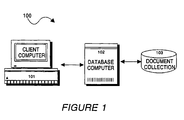
- FIG 1 is an illustration of an information retrieval system in accordance with the present invention.
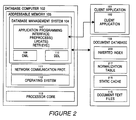
- FIG. 2 is an illustration of the software architecture of the database computer and document database in accordance with the present invention.
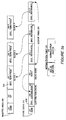
- Figure 3a is an illustration of the static cache including the contribution cache, lookup tables, and cache index.
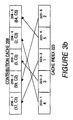
- Figure 3b illustrates an example of the cache index.
- FIGS 4a through 4e illustrate an example of the use of the static cache during query processing in accordance with the present invention.
- FIGS 5a, 5b, and 5c are flowcharts of various methods of query processing in accordance with the present invention.
- system 100 there is at least one client computer 101 (or “client”), and a database computer 102, communicatively coupled over a network, preferably the Internet, or other similar wide area networks, or even local area networks, as the actual network architecture is not material to the present invention.
- client computer 101 or "client”
- database computer 102 is coupled to and controls a document database 103.
- a client computer 101 is of conventional design, and includes a processor, an addressable memory, a display, a local hard disk (though diskless computers may also be suitably used), input/output ports, and a network interface.
- the display is of conventional design, preferably color bitmapped, and provides output for a graphical user interface for software applications thereon.
- the input/output ports support input devices, such as a keyboard, mouse, and the like, for inputting commands and data.
- the client computer 101 executes a conventional operating system.
- a conventional network interface to a network provides access to remotely situated mass storage devices, along with access to the Internet, with a TCP-IP type connection, or to other network embodiments, such as a WAN, LAN, MAN or the like.
- the client computer 101 may be implemented on a Intel-based computer operating under Microsoft Windows® operating system, or equivalent devices.
- a client computer 101 executes some form of client application that interfaces with the database computer 102 to request and receive documents therefrom, and display such documents to the user.
- a client computer 101 executes some form of client application that interfaces with the database computer 102 to provide user queries thereto and receive documents satisfying such queries therefrom, and display such documents to the user.
- the client application is adapted for communication via the Hypertext Transfer Protocol, and further adapted for decoding and displaying HTML documents.
- the client application may be a database frontend, a World Wide Web browser, or other similar applications, executing conventionally in the local memory of the client computer 101. It is anticipated that in a preferred embodiment, the client computer 101 may be personal computer as used by an end user, whether in their home or place of employment, in order to access documents and information stored in the document databases 103 distributed on the Internet or other network.
- the database computers 102 are conventional server type computers, preferably supporting a relatively large number of multiple clients simultaneously for handling search and document requests, and other processing operations.
- the database computers 102 may be implemented with Intel-based personal computers, or other more powerful processors, such as various models of Sun Microsystems' SparcStations, operating under their UNIX implementation.
- the database computers 102 provide one or more conventional processors, and a suitable amount of RAM, preferably on the order of 18-64 Mb.
- each database computer 102 comprises a database management system 104, having a DDL 110 and DML 109 for defining and manipulating the document database 103.
- the database management system 104 is adapted in accordance with the present invention to provide an application programming interface 107 with preprocessing, update, and retrieve methods.
- the preprocess method creates the static cache for an existing database 103 of documents.
- the update method updates the static cache as new documents are added to the database 103.
- the retrieve method provides for query processing adapted to the static cache of the present invention.
- Client applications 122 of whatever type, hold the necessary interfaces to the database management system 104, typically for invoking the retrieve method.
- the database computer 102 further includes a network communication protocol 111 for handing communication with multiple client computers 101.
- a conventional operating system 112 is also present. These software elements operate conventionally in the addressable memory 105 of the database computer 102.
- the database management system 104 with an application programming interface 107 supporting the present invention may be provided to the database computer 102 as a software product on a computer readable media, such as CD-ROM, 8mm magnetic tape, or the like, for installation and execution thereon.
- the document database 103 coupled to a database computer 102 may have any useful internal architecture or schema.
- the document database 103 preferably accommodates anywhere from several thousand to in excess of 1 million documents, providing persistent storage thereof in a set of document text files 115.
- the document database 103 is preferably relational, though object oriented, or network database architectures may also be used. Support for conventional structured query languages is also preferred.
- the database 103 may employ any of a variety of document representation techniques.
- document representation in accordance with the present invention includes the use of document vectors.
- a document vector may be constructed as a set of (term, term frequency) tuples.
- a document is associated with its full text in the text files 115.
- the actual document vector may be created and stored for the document.
- the document vector may be created as needed during the execution of a query.
- the document database 103 persistently maintains an inverted index 200, a static cache 215, and a normalization table 217. These elements are preferably persistently stored in the storage media of the database 103, such as hard disk, optical disk, or the like. During operation, all or selected portions of these elements may be usefully copied into the addressable memory 105 of the database computer 102 for improved performance.
- the static cache 215 is copied to memory for high speed query processing.
- Figure 3a illustrates elements of one embodiment of an inverted index 200 and static cache 215 for use with the present invention.
- Inverted index 200 includes an ordered (typically alphabetically) table of terms 201, each term being one of the unique terms in the database 103. Multiple word phrases, such as "intellectual property", may also be included as individual terms in the inverted index 200, to allow for phrase searching.
- Each term 201 is associated with at least one, typically many (document, term frequency) tuples 204.
- the document is uniquely identified by some identifier, using an identification scheme, and not the full text of the document itself, which is stored in the text files 115.
- the term frequency describes the number of occurrences of the term in that document.
- the (document, term frequency) tuples 204 are ordered by the identifiers of the documents.
- each tuple requires typically 6 bytes, 3 bytes for a document identifier (sufficient to identify 2 24 documents) and 2 bytes for the frequency, sufficient for upto 65,536 occurences of a term in a document. Differential compression may be used to reduce these memory requirements.
- Differential compression may be used to reduce these memory requirements.
- the (document, term frequency) tuples 204 are grouped into blocks 205. There are p such blocks 205 (block 1 through block p). Each block 205 contains some number z of the tuples 204. The number is preferably predetermined and fixed. In one embodiment, each block has about 1000 tuples 204. Alternatively, variable sized blocks may be used.
- each term 201 in the inverted index 200 has an associated inverse document frequency (IDF) 203 that describes the relative significance of the term in the database 103.
- the IDF 203 of a term 201 may be computed in any of a variety of manners, the particular implementation of which is not limited by the present invention.
- One simple and useful definition of the IDF of a term T is: where N is the number of documents in the database 103, and n T is the number of documents in the database 103 that contain at least one occurrence of term T.
- Other more complex definitions of IDF may be used with the present invention.
- database 203 further includes a static cache 215.
- the static cache 215 is ordered by a set of terms 207. These terms are selected from the inverted index 200 as those for which the total number of (document, term frequency) tuples 205 exceeds a predetermined threshold.
- the threshold may be established with respect to the total number of documents in the database, or other criteria. In the preferred embodiment, thresholds between 500 to 2000 are found to be useful.
- the threshold value is called k .
- the set of terms 207 in the static cache 215 is a subset of the set of terms 201 in the inverted index 200.
- n tuples are stored. N may be determined in a variety of manners, not limited by the invention. In one embodiment, n is equal to k. Alternatively, n may be a percentage of k, based on the number of documents in the database. Also, n may vary between contribution caches 209. For example, the number of tuples may dynamically result from the use of a contribution threshold value, such that tuples 208 are created only for those documents for which the contribution of the term 207 exceeds a predetermined threshold. This limits the tuples to including only a certain range of documents with a known degree of relevance to the term.
- n k tuples are stored, but it is understood that n can be determined in any of the foregoing, or other way manners.
- "document” here is understood by those of skill in the art to mean that some identification scheme is used to identify a document, and that the text of the document itself is not stored in the tuple.
- the tuples 208 are ordered by the descending value of the contribution.
- the contribution is the contribution of the term to a document score for the identified document.
- the contribution is preferrably computed as shown above in (3) and reproduced here:
- the static cache 215 further includes a lookup table 214 for each term 207.
- the lookup table 214 includes a number of (document, pointer) tuples. Where there are p blocks 205 in the inverted index, there are p (document, pointer) tuples 213.
- the document is the document identifier of the first (document, term frequency) tuple 204 in correponding block 205 for the term in the inverted index, and the pointer references the memory location of the block, or alternatively indexes the offset of the block in the row.
- the lookup table 214 enables the database management system 104 to easily access the tuples 204 in the block 205 for a given document in order to score the document during query processing.
- this is done by a binary search, or other technique, through the lookup table 214 for the corresponding block containing the document identifier. Access is then made to the block in the term row of inverted index 200. The block is traversed until the given document identifer is located. A document score based on the term is then computed from the term frequency information in the (document, term frequency) tuple 204.
- the preprocess method of the database management system 104 is used to create the static cache 215.
- the preprocess method creates each contribution cache 209 by selecting those term rows of the inverted index 200 that have more than k (document, term frequency) tuples 204. For each selected term, the preprocess method creates a contribution cache 209 entry and stores the term. The preprocess method then traverses the documents in the term row to determine the contribution of the term to the document according to its frequency in the document. For computational efficiency the documents are ranked by contribution as the contributions are being determined, for example in any of a variety of tree data structures, such as AVL trees, splay trees, or the like, for storing the n highest ranking documents by contribution.
- the n tuples 208 are stored from this data. Alternatively, all of the contribution values for a term may be determined first, ranked, and then the n documents with the highest contribution values selected.
- the preprocess method then creates the lookup table 214 for the term by traversing the blocks of the term row in inverted index 200 and storing the (document, pointer) pair 213 information for the appropriate blocks. Again, this process may be done in line while scanning the term row for computing term contributions.
- the contribution cache 209 for each term 207 is preferrably updated in conjunction with the inverted index 200 when a document is initially processed and entered into the document database 103. This may be achieved with the update method, or similar operations. Generally, the document text is iterated over, the unique terms in the document identified, along with their frequencies. The IDFs of terms, and the (document, term frequency) tuples 204 are then updated in the inverted index 200, as are the contributions of each the terms to the document using (3). The (document, contribution) tuples 208 are then updated, by re-ordering the tuples 208 on the basis of the new contributions for terms in the document, disgarding tuples 208 if necessary so that n tuples always remain. Any changes in the term row for the inverted index 200 that effect the block orderings are updated to the lookup table 214 of the term in the static cache 215.
- a cache index 223 may be associated with each contribution cache 209.
- the cache index 223 contains n index entries, each entry storing an index to one of the tuples 208 in the contribution cache 209. These entries are ordered not by the value of the index, or the contribution, but rather, by the values of the document identifier in the respective tuples 208.
- Figure 3b illustrates a simple example, with a contribution cache 209 having 5 tuples 208, and the accompanying cache index 223.
- the entries 223-1 to 223-5 include the index values to tuples 208-1 through 208-5, and are ordered by the document identifiers in the tuples.
- This cache index 223 is optionally consulted during query processing, by looking up the document identifier for a particular index entry, and matching it with a previously determined document identifier. This enables very rapid determination of whether a document is present in the contribution cache of a given term, without having to incur the input/output overhead and time delay associated with using the lookup tables 214 and inverted index.
- FIGS. 4a through 4d there are shown illustrations of the contribution caches 209 and lookup tables 214 of the static cache 215 for explaining the processing of queries using the database structures in accordance with the present invention.
- the contribution cache 209 there are three rows, each representing a term in a user's query, the query being "apple orange banana".
- a portion of the contribution cache 209 having the (document, contribution) tuples 208.
- the first tuple 208 in the contribution cache 209 of "apple” is document 63. Being the first document, its contribution c is the highest at .98, meaning that the term "apple" contributes to the document score of this document more than it contributes to the document score of any other document.
- the scaling of the contributions here are arbitrary. Also, as described above, there would be anywhere from about 500 to 2,000 or more entries in each of the contribution caches 209.
- the cache indices 223 are not shown in these figures.
- lookup table 214 For each term there is shown a portion of the lookup table 214 for the term, here indexed to blocks of 50 entries in the inverted index 200.
- Each lookup table 214 has (document, pointer) tuples 213. Note that the pointer values are merely indicated by the letter "P", and again, would point to, or index to, different portions or offsets in the respective term rows of the inverted index 200. As described above, there would be p entries in the look up table 214, where p is the number of blocks in each row of the inverted index 200.
- the result set 301 that stores a limited number of documents sorted by document score.
- the size of the result set 301 may be determined on demand when the user submits the query.
- the result set 301 includes the top 20 to 100 documents located in response to a query.
- the result set 301 is empty, and new documents and document scores are added until the limit is reached.
- the document score of the last entry in the result set 301 is usefully stored in the minimum document score 302; alternatively, it may be directly accessed as needed from the document score of the last entry in the set 301.
- the score is disgarded, and the document is not added to the result set 301.
- a query processing method increments a cache counter 305 over each column of the (document, contribution) tuples 208 listed in contribution caches 209, in order to score the documents identified in the contribution caches 209 of each of the query terms in a parallel manner.
- the score of a document is based on the contribution of a query term to the document as found in the contribution cache 209 for the term, and on the term frequencies of the other query terms in document. These term frequencies may be found by looking up the block that "contains" the document in the lookup table another query term, and obtaining the frequency information from the term row of that other term in the inverted index.
- a document score may be determined by using the cache index 223 of a query term to search the contribution cache 209 of term, for the document, and using the term contribution therein to compute the document score. As documents are scored the results are placed in the result set 301 if the document score is greater than the minimum document score 302, and the minimum document score 302 is updated from this as well.
- the process is terminated whenever the minimum document score 302 is greater than the upper bound document score 303.
- the upper bound document score 303 is the sum of the contributions of the documents at the current cache counter 305 across the contribution caches 209 of all the query terms. More precisely, for a cache counter i, and contribution caches j for T query terms, the upper bound document score U i is:
- the process can terminate on this basis because no unscored document that is in any contribution cache at a location greater than the current cache counter 305 (or not even present in the contribution caches at all) can have a document score that is greater than the upper bound document score 303.
- the upper bound document score 303 becomes less than the minimum document score 302 in the result set 301, there is no further need to score documents.
- the result set can therefore be returned to the user.
- FIGS 5a, 5b, and 5c illustrates flowcharts for various methods of query processing in accordance with the present invention. This methods are managed by the database management system 104, typically by an implementation of a retrieve() method provided in the application programming interface of the database management system 104. Figures 4b through 4d will be used to explain these operations by way of an example.
- the minimum document result 302 is initialized to 0, and the result set 301 is also initialized 501.
- the retrieve() method then begins traversing the contribution caches 209 by incrementing 503 a cache counter 305 over the number n of (document, contribution) tuples 208 in a contribution cache 209.
- the initial position of the cache counter 305 is shown in Figure 4b with the cache counter 305 covering the first entries in the contribution caches 209.
- the upper bound document score 303 is set 505 to the combined value of the contributions of the i th (document, contribution) tuples 208 in the contribution caches 209 all the query terms, as per (4).
- the upper bound document score 302 is 2.42, equal the summed contributions of all of the first contribution cache tuples for the query terms. As cache counter i is incremented, this value will change, typically dropping slightly with every increment.
- the upper bound document score 303 is compared 507 with the minimum document score 302. Since it is greater (2.42 > 0) the process continues.
- query terms are iterated over 509, for each query term j, from 1 to T, the total number of query terms.
- the identifier of the current document is retrieved 511 from the i th entry in the contribution cache 209 of query term j (j[i].doc_id); this becomes the current_doc_id.
- This is the identifier of the document that is to be scored. In Figure 4b, this would be document 63, from the first (document, contribution) tuple 208 for the first query term "apple", thus setting the current_doc_id to 63.
- the document score for document 63 is initialized 513 using the contribution (here .98) in a scoring function, for example as set forth in (2):
- the retrieve method scores each of the query terms on the current document by searching 518 the lookup tables 214 of the query terms, and accessing the term frequency information from the inverted index entry for document and the term. This technique is illustrated in Figure 5b as operations 519-523, and in Figures 4b-4e.
- the cache index 223 and contribution cache 209 of the query term is searched 517 to identify the current document in the contribution cache 209. The document is then scored from the term contribution. This technique is illustrated in Figure 5c. Depending on the results of the cache index search 517, various other operations may be undertaken, as further described below.
- the lookup table search 518 is discussed first.
- the retrieve() method loops 515 over these other terms using loop variable k.
- the current_doc_id here 63 for the first document, is found 519 in the lookup table 214, as being in the block beginning with document 50.
- This finding operation may be done by linear search, binary search, linear interpolation, or other efficient means, the particular implementation not being limited by the present invention.
- the current_pointer is taken from this entry, here P.
- this pointer references the memory location in the inverted index 200, for the 50 th block 205 for the term "banana.” Beginning from this block and traversing 521 forward, there will be found (since these entries are ordered by document identifier) the (document identifer, term frequency) tuple for document 63. The frequency of the term "banana" is obtained 523 and the document score for document 63 is updated 525 with the scoring function using this term frequency information.
- the document score for document 63 is updated for the term "orange.”
- the lookup table 214 for "orange” is searched 519 to get the pointer to the block 205 in the term row for "orange” in the inverted index 200 that contains the (document, term frequency) tuple 208 for document 63, and the term "orange".
- This frequency information is then used to update 523 the document score for document 63.
- the document score of document 63 is assumed to be 1.5.
- the document score for document 63 is placed 525 in the result set 301, and the minimum document score 303 is updated to 1.50, here since there is only one entry, with the document score of document 63.
- the process then returns to the next contribution cache 209 at the current cache counter 305 of 1, this being document 25 in first entry for the term "banana”, and repeats, scoring document 25 on each of the query terms.
- the lookup tables 214 of "apple” and “orange” will be respectively searched 519, and the inverted index rows for these terms traversed 521 for the (document, term frequency) tuple 208 for document 25.
- Next document 61 the first document in the contribution cache 209 of "orange” will be scored in the same manner.
- the result set 301 and minimum document score 302 is updated.
- the result set 301 of Figure 4b shows assumed document scores following the scoring of these three documents, 63, 25, and 61.
- the result set 301 is updated 525 with the documents, and their scores, placing them in ranked order.
- the result set 301 is constrained to the top five entries, though in practice the top 20 or 100, or some other larger limit is used.
- the minimum document result 302 is likewise updated 525, here with document score 1.65 from document 12, thereby eliminating document 63 with a score of 1.50 from the result set 301. This state is shown in Figure 4d.
- FIG. 4e there is illustrated the mechanism by which the minimum document score 302 and the upper bound document score 303 are used to prune the query process, while ensuring that the result set 301 has all possible documents that could have signficantly meaningful document scores.
- the cache counter 305 is 503 incremented to the next entry (the third column), as shown, and the upper bound document score 303 is here computed 505 to be 0.98.
- FIG. 4e Also shown in Figure 4e are the contribution cache tuples in heavy outline that are at cache counter values greater than the current cache counter, but that include documents that have been previously scored. For example, in the contribution cache 209 for "orange,” there appears a (document, contribution) tuple 208 for document 63. This document was the first document scored as it appeared earlier in the contribution cache 209 of "apple.” The entries without outlines indicate documents that have not been scored.
- the process terminates and returns 527 the result set 301 to the user, performing any necessary post-query processing, such as obtaining document titles, locations, and the like.
- the result set 301 is guaranteed at this point such that no unscored document anywhere in the database, whether it has all, some, or none of the terms of the query, can have a document score greater than the upper bound document score 303.
- the document score is based on the contribution of the query terms. However, the contributions of the query terms have already been determined and stored in the contribution caches 209.
- the upper bound document score 303 is the greatest possible value of the contributions of such terms in the remaining documents, since they must all have lower contribution values individually then the contributions at the current cache counter. If they had higher contribution values, then they would have been ranked higher in the contribution caches, and hence already processed and scored. If a document containing any of the terms of the query is not even present in the contribution caches, then clearly the contribution of the query terms to the document score was minor (i.e. the document did not rank in the top k entries based on any of the terms' contributions).
- the cache counter 305 may be incremented through all entries in the contribution cache 209. If this occurs without the upper bound document score 303 falling below the minimum document score 302, then there are documents remaining in the database that may have higher document scores than the minimum document result 302. Accordingly, one alternative is to restart 528 the query processing using conventional search techniques.
- the accumulated result set 301 may be passed to the conventional search technique or disgarded, if query processing techniques are often highly optimized for the handling of search results.
- an alternative method for overcoming the problem of documents that do not appear in the contribution caches, and that are unscored is the cache index search 517.
- This approach is based on the the optional use of the cache index 223.
- the cache index 223 is searched 517, by selecting an index entry, the r th index, in the cache index 223, and comparing the document identifier of the r th tuple 208 in the contribution cache of the k th query term to the current document identifier.
- the document score of the current document is updated directly for this query term using the contribution value from the tuple 208, as per (2), and the result set 301 is also updated 525, as shown in Figure 5a. If there is no match, then the cache index 223 is searched, using a search technique such as binary search, linear interpolation or the like to determine the next index entry to evaluate. Such search techniques are possible because, as noted above, the indices are ordered by the document identifiers of their respective tuples.
- the current document is not further scored on the terms of the query, but rather processing of the document is deferred 520. Since the document did not appear in the contribution cache 209 of the query term, it may be a relatively low scoring document, compared with other documents that have all of the terms of the query. Referring again to Figure 5c, for deferred processing 520, a maximum document score is determined 524 for the document using the contribution from the last tuple 208 of the contribution cache of the k th query term. The document is then stored 526 with this maximum document score. The stored documents are ordered by their maximum document scores. Processing continues with the next document. The stored documents will be later evaluated, once all of the terms of the query and documents in the contribution caches 209 have been evaluated.
- This minimum document score 302 is compared with the maximum document scores of the queued documents, and only stored documents having a maximum document score greater than the minimum document score 302 of the result set 301 need be further evaluated 526 with respect to all of the query terms. The reason for this is that if a maximum document score of a document is less than the minimum document score 302, then obviously this is not a document that would have been included in the result set 301 to begin with, and so need not be scored on the remaining query terms. Deferring processing of these documents further reduces the time needed to identify a complete set of highly relevant documents in response to the query.
- the contribution cache 209 can be updated 528 on demand with the term contribution for the document for the remaining terms of the query. This allows subsequent queries to be processed, having the contribution information available in the contribution caches 209.
- the present invention provides an improved organization and arrangement for a document database along with various complementary query processing techniques that dramatically improve retrieval times, and guarantee the completeness of the search results.
Landscapes
- Engineering & Computer Science (AREA)
- Theoretical Computer Science (AREA)
- Software Systems (AREA)
- Data Mining & Analysis (AREA)
- Databases & Information Systems (AREA)
- Physics & Mathematics (AREA)
- General Engineering & Computer Science (AREA)
- General Physics & Mathematics (AREA)
- Information Retrieval, Db Structures And Fs Structures Therefor (AREA)
Applications Claiming Priority (2)
| Application Number | Priority Date | Filing Date | Title |
|---|---|---|---|
| US08/661,335 US5915249A (en) | 1996-06-14 | 1996-06-14 | System and method for accelerated query evaluation of very large full-text databases |
| US661335 | 1996-06-14 |
Publications (2)
| Publication Number | Publication Date |
|---|---|
| EP0813158A2 true EP0813158A2 (fr) | 1997-12-17 |
| EP0813158A3 EP0813158A3 (fr) | 1999-04-21 |
Family
ID=24653166
Family Applications (1)
| Application Number | Title | Priority Date | Filing Date |
|---|---|---|---|
| EP97109680A Withdrawn EP0813158A3 (fr) | 1996-06-14 | 1997-06-13 | Procédé et dispositif pour l'évaluation accélérée d'une requête sur de très grandes bases de données de texte |
Country Status (2)
| Country | Link |
|---|---|
| US (1) | US5915249A (fr) |
| EP (1) | EP0813158A3 (fr) |
Cited By (15)
| Publication number | Priority date | Publication date | Assignee | Title |
|---|---|---|---|---|
| US5913208A (en) * | 1996-07-09 | 1999-06-15 | International Business Machines Corporation | Identifying duplicate documents from search results without comparing document content |
| US6496818B1 (en) * | 1999-03-31 | 2002-12-17 | Verizon Laboratories Inc. | Semi-automatic index term augmentation in document retrieval |
| US6789083B2 (en) * | 1997-12-22 | 2004-09-07 | Hewlett-Packard Development Company, L.P. | Methods and system for browsing large text files |
| GB2388678B (en) * | 2000-05-22 | 2004-12-01 | Overture Services Inc | Method and apparatus for identifying related searches in a database search system |
| US7003516B2 (en) | 2002-07-03 | 2006-02-21 | Word Data Corp. | Text representation and method |
| US7016895B2 (en) | 2002-07-05 | 2006-03-21 | Word Data Corp. | Text-classification system and method |
| US7024408B2 (en) | 2002-07-03 | 2006-04-04 | Word Data Corp. | Text-classification code, system and method |
| US7181451B2 (en) * | 2002-07-03 | 2007-02-20 | Word Data Corp. | Processing input text to generate the selectivity value of a word or word group in a library of texts in a field is related to the frequency of occurrence of that word or word group in library |
| EP1582999A4 (fr) * | 2002-12-27 | 2008-05-28 | Intellectual Property Bank | Dispositif, programme et procede d'evaluation de technique |
| US7386442B2 (en) | 2002-07-03 | 2008-06-10 | Word Data Corp. | Code, system and method for representing a natural-language text in a form suitable for text manipulation |
| US8015173B2 (en) | 2000-05-08 | 2011-09-06 | Google Inc. | Techniques for web site integration |
| US8244795B2 (en) | 1999-07-30 | 2012-08-14 | Verizon Laboratories Inc. | Page aggregation for web sites |
| US8275661B1 (en) | 1999-03-31 | 2012-09-25 | Verizon Corporate Services Group Inc. | Targeted banner advertisements |
| US8572069B2 (en) | 1999-03-31 | 2013-10-29 | Apple Inc. | Semi-automatic index term augmentation in document retrieval |
| CN107426301A (zh) * | 2017-06-21 | 2017-12-01 | 郑州云海信息技术有限公司 | 分布式集群节点信息管理方法、系统及分布式集群系统 |
Families Citing this family (277)
| Publication number | Priority date | Publication date | Assignee | Title |
|---|---|---|---|---|
| JP2833580B2 (ja) * | 1996-04-19 | 1998-12-09 | 日本電気株式会社 | 全文インデックス作成装置および全文データベース検索装置 |
| US5987460A (en) * | 1996-07-05 | 1999-11-16 | Hitachi, Ltd. | Document retrieval-assisting method and system for the same and document retrieval service using the same with document frequency and term frequency |
| US7269587B1 (en) | 1997-01-10 | 2007-09-11 | The Board Of Trustees Of The Leland Stanford Junior University | Scoring documents in a linked database |
| US6285999B1 (en) | 1997-01-10 | 2001-09-04 | The Board Of Trustees Of The Leland Stanford Junior University | Method for node ranking in a linked database |
| JP3499105B2 (ja) * | 1997-03-03 | 2004-02-23 | 株式会社東芝 | 情報検索方法および情報検索装置 |
| US5893094A (en) | 1997-07-25 | 1999-04-06 | Claritech Corporation | Method and apparatus using run length encoding to evaluate a database |
| US6163782A (en) * | 1997-11-19 | 2000-12-19 | At&T Corp. | Efficient and effective distributed information management |
| US6073129A (en) * | 1997-12-29 | 2000-06-06 | Bull Hn Information Systems Inc. | Method and apparatus for improving the performance of a database management system through a central cache mechanism |
| KR100285265B1 (ko) * | 1998-02-25 | 2001-04-02 | 윤덕용 | 데이터 베이스 관리 시스템과 정보 검색의 밀결합을 위하여 서브 인덱스와 대용량 객체를 이용한 역 인덱스 저장 구조 |
| US6119126A (en) * | 1998-05-29 | 2000-09-12 | Oracle Corporation | Object-relational query builder which determines existence of structures from information loaded from the server and cached locally on the client computing system |
| US6208988B1 (en) * | 1998-06-01 | 2001-03-27 | Bigchalk.Com, Inc. | Method for identifying themes associated with a search query using metadata and for organizing documents responsive to the search query in accordance with the themes |
| JP2000235583A (ja) * | 1999-02-16 | 2000-08-29 | Fujitsu Ltd | 分散型検索システムのデータアクセス装置及びその方法 |
| US7024416B1 (en) | 1999-03-31 | 2006-04-04 | Verizon Laboratories Inc. | Semi-automatic index term augmentation in document retrieval |
| US6665665B1 (en) * | 1999-07-30 | 2003-12-16 | Verizon Laboratories Inc. | Compressed document surrogates |
| AU6630800A (en) | 1999-08-13 | 2001-03-13 | Pixo, Inc. | Methods and apparatuses for display and traversing of links in page character array |
| JP4048006B2 (ja) * | 1999-09-03 | 2008-02-13 | 富士フイルム株式会社 | データベース検索システムおよび方法 |
| US6546387B1 (en) | 1999-11-15 | 2003-04-08 | Transcom Software Inc. | Computer network information management system and method using intelligent software agents |
| US6564233B1 (en) | 1999-12-17 | 2003-05-13 | Openwave Systems Inc. | Server chaining system for usenet |
| US6507847B1 (en) | 1999-12-17 | 2003-01-14 | Openwave Systems Inc. | History database structure for Usenet |
| US6397211B1 (en) * | 2000-01-03 | 2002-05-28 | International Business Machines Corporation | System and method for identifying useless documents |
| US8645137B2 (en) | 2000-03-16 | 2014-02-04 | Apple Inc. | Fast, language-independent method for user authentication by voice |
| US7428500B1 (en) * | 2000-03-30 | 2008-09-23 | Amazon. Com, Inc. | Automatically identifying similar purchasing opportunities |
| US6915308B1 (en) * | 2000-04-06 | 2005-07-05 | Claritech Corporation | Method and apparatus for information mining and filtering |
| US6675159B1 (en) | 2000-07-27 | 2004-01-06 | Science Applic Int Corp | Concept-based search and retrieval system |
| US7395222B1 (en) * | 2000-09-07 | 2008-07-01 | Sotos John G | Method and system for identifying expertise |
| US7027974B1 (en) | 2000-10-27 | 2006-04-11 | Science Applications International Corporation | Ontology-based parser for natural language processing |
| US7272589B1 (en) * | 2000-11-01 | 2007-09-18 | Oracle International Corporation | Database index validation mechanism |
| CN1191540C (zh) * | 2000-12-29 | 2005-03-02 | 国际商业机器公司 | 为文本文档语料库建立索引的方法和装置 |
| US6766316B2 (en) | 2001-01-18 | 2004-07-20 | Science Applications International Corporation | Method and system of ranking and clustering for document indexing and retrieval |
| US20020107835A1 (en) * | 2001-02-08 | 2002-08-08 | Coram Michael T. | System and method for adaptive result set caching |
| CA2340531C (fr) * | 2001-03-12 | 2006-10-10 | Ibm Canada Limited-Ibm Canada Limitee | Systeme de recherche documentaire, et methode de recherche faisant appel a un ensemble de termes et a des tables de recherche de caracteres |
| US20020184317A1 (en) * | 2001-05-29 | 2002-12-05 | Sun Microsystems, Inc. | System and method for searching, retrieving and displaying data from an email storage location |
| US20020184340A1 (en) * | 2001-05-31 | 2002-12-05 | Alok Srivastava | XML aware logical caching system |
| US6859808B1 (en) * | 2001-05-31 | 2005-02-22 | Oracle International Corporation | Mapping logical row identifiers for primary B+tree-like structures to physical row identifiers |
| US6714934B1 (en) | 2001-07-31 | 2004-03-30 | Logika Corporation | Method and system for creating vertical search engines |
| US6978274B1 (en) * | 2001-08-31 | 2005-12-20 | Attenex Corporation | System and method for dynamically evaluating latent concepts in unstructured documents |
| ITFI20010199A1 (it) | 2001-10-22 | 2003-04-22 | Riccardo Vieri | Sistema e metodo per trasformare in voce comunicazioni testuali ed inviarle con una connessione internet a qualsiasi apparato telefonico |
| US7028045B2 (en) * | 2002-01-25 | 2006-04-11 | International Business Machines Corporation | Compressing index files in information retrieval |
| US7065526B2 (en) * | 2002-02-21 | 2006-06-20 | Intuit, Inc. | Scalable database management system |
| US20040006459A1 (en) * | 2002-07-05 | 2004-01-08 | Dehlinger Peter J. | Text-searching system and method |
| US20040006547A1 (en) * | 2002-07-03 | 2004-01-08 | Dehlinger Peter J. | Text-processing database |
| US20040054520A1 (en) * | 2002-07-05 | 2004-03-18 | Dehlinger Peter J. | Text-searching code, system and method |
| US20040100509A1 (en) * | 2002-11-27 | 2004-05-27 | Microsoft Corporation | Web page partitioning, reformatting and navigation |
| US7721192B2 (en) * | 2002-11-27 | 2010-05-18 | Microsoft Corporation | User interface for a resource search tool |
| JP2004280361A (ja) * | 2003-03-14 | 2004-10-07 | Fujitsu Ltd | テキスト情報作成装置、事例寄せ装置、faq作成用質問事例抽出装置、検索装置 |
| US7669134B1 (en) | 2003-05-02 | 2010-02-23 | Apple Inc. | Method and apparatus for displaying information during an instant messaging session |
| US7149748B1 (en) * | 2003-05-06 | 2006-12-12 | Sap Ag | Expanded inverted index |
| US7647299B2 (en) * | 2003-06-30 | 2010-01-12 | Google, Inc. | Serving advertisements using a search of advertiser web information |
| US7630963B2 (en) * | 2003-06-30 | 2009-12-08 | Microsoft Corporation | Fast ranked full-text searching |
| US7849063B2 (en) * | 2003-10-17 | 2010-12-07 | Yahoo! Inc. | Systems and methods for indexing content for fast and scalable retrieval |
| US7222117B1 (en) | 2003-11-14 | 2007-05-22 | Advent Software, Inc. | Segmented global area database |
| US7801898B1 (en) * | 2003-12-30 | 2010-09-21 | Google Inc. | Methods and systems for compressing indices |
| US6960395B2 (en) * | 2003-12-30 | 2005-11-01 | General Electric Company | Ceramic compositions useful for thermal barrier coatings having reduced thermal conductivity |
| US7191175B2 (en) | 2004-02-13 | 2007-03-13 | Attenex Corporation | System and method for arranging concept clusters in thematic neighborhood relationships in a two-dimensional visual display space |
| US7580929B2 (en) * | 2004-07-26 | 2009-08-25 | Google Inc. | Phrase-based personalization of searches in an information retrieval system |
| US7584175B2 (en) | 2004-07-26 | 2009-09-01 | Google Inc. | Phrase-based generation of document descriptions |
| US7599914B2 (en) | 2004-07-26 | 2009-10-06 | Google Inc. | Phrase-based searching in an information retrieval system |
| US7711679B2 (en) | 2004-07-26 | 2010-05-04 | Google Inc. | Phrase-based detection of duplicate documents in an information retrieval system |
| US7567959B2 (en) | 2004-07-26 | 2009-07-28 | Google Inc. | Multiple index based information retrieval system |
| US7580921B2 (en) * | 2004-07-26 | 2009-08-25 | Google Inc. | Phrase identification in an information retrieval system |
| US7536408B2 (en) | 2004-07-26 | 2009-05-19 | Google Inc. | Phrase-based indexing in an information retrieval system |
| US7702618B1 (en) | 2004-07-26 | 2010-04-20 | Google Inc. | Information retrieval system for archiving multiple document versions |
| US20060047656A1 (en) * | 2004-09-01 | 2006-03-02 | Dehlinger Peter J | Code, system, and method for retrieving text material from a library of documents |
| US7529753B1 (en) | 2004-09-03 | 2009-05-05 | Crossroads Systems, Inc. | Providing application-layer functionality between one or more database clients and one or more database servers |
| US7509330B2 (en) * | 2004-09-03 | 2009-03-24 | Crossroads Systems, Inc. | Application-layer monitoring of communication between one or more database clients and one or more database servers |
| US7548917B2 (en) * | 2005-05-06 | 2009-06-16 | Nelson Information Systems, Inc. | Database and index organization for enhanced document retrieval |
| US20060271520A1 (en) * | 2005-05-27 | 2006-11-30 | Ragan Gene Z | Content-based implicit search query |
| US8538969B2 (en) * | 2005-06-03 | 2013-09-17 | Adobe Systems Incorporated | Data format for website traffic statistics |
| WO2007002820A2 (fr) * | 2005-06-28 | 2007-01-04 | Yahoo! Inc. | Moteur de recherche a classement de pertinence ameliore par la participation d'une communaute |
| US8677377B2 (en) | 2005-09-08 | 2014-03-18 | Apple Inc. | Method and apparatus for building an intelligent automated assistant |
| US7633076B2 (en) | 2005-09-30 | 2009-12-15 | Apple Inc. | Automated response to and sensing of user activity in portable devices |
| US20070162481A1 (en) * | 2006-01-10 | 2007-07-12 | Millett Ronald P | Pattern index |
| US7783589B2 (en) * | 2006-08-04 | 2010-08-24 | Apple Inc. | Inverted index processing |
| US9318108B2 (en) | 2010-01-18 | 2016-04-19 | Apple Inc. | Intelligent automated assistant |
| US20080072134A1 (en) * | 2006-09-19 | 2008-03-20 | Sreeram Viswanath Balakrishnan | Annotating token sequences within documents |
| US7895185B2 (en) * | 2006-09-28 | 2011-02-22 | International Business Machines Corporation | Row-identifier list processing management |
| US7720837B2 (en) * | 2007-03-15 | 2010-05-18 | International Business Machines Corporation | System and method for multi-dimensional aggregation over large text corpora |
| US8086594B1 (en) | 2007-03-30 | 2011-12-27 | Google Inc. | Bifurcated document relevance scoring |
| US8166021B1 (en) | 2007-03-30 | 2012-04-24 | Google Inc. | Query phrasification |
| US7693813B1 (en) | 2007-03-30 | 2010-04-06 | Google Inc. | Index server architecture using tiered and sharded phrase posting lists |
| US7702614B1 (en) | 2007-03-30 | 2010-04-20 | Google Inc. | Index updating using segment swapping |
| US8166045B1 (en) | 2007-03-30 | 2012-04-24 | Google Inc. | Phrase extraction using subphrase scoring |
| US7925655B1 (en) | 2007-03-30 | 2011-04-12 | Google Inc. | Query scheduling using hierarchical tiers of index servers |
| US8977255B2 (en) | 2007-04-03 | 2015-03-10 | Apple Inc. | Method and system for operating a multi-function portable electronic device using voice-activation |
| US7668823B2 (en) | 2007-04-03 | 2010-02-23 | Google Inc. | Identifying inadequate search content |
| US7822752B2 (en) * | 2007-05-18 | 2010-10-26 | Microsoft Corporation | Efficient retrieval algorithm by query term discrimination |
| US20080306949A1 (en) * | 2007-06-08 | 2008-12-11 | John Martin Hoernkvist | Inverted index processing |
| US7917516B2 (en) | 2007-06-08 | 2011-03-29 | Apple Inc. | Updating an inverted index |
| ITFI20070177A1 (it) | 2007-07-26 | 2009-01-27 | Riccardo Vieri | Sistema per la creazione e impostazione di una campagna pubblicitaria derivante dall'inserimento di messaggi pubblicitari all'interno di uno scambio di messaggi e metodo per il suo funzionamento. |
| US20090049035A1 (en) * | 2007-08-14 | 2009-02-19 | International Business Machines Corporation | System and method for indexing type-annotated web documents |
| US8117223B2 (en) | 2007-09-07 | 2012-02-14 | Google Inc. | Integrating external related phrase information into a phrase-based indexing information retrieval system |
| US20090083214A1 (en) * | 2007-09-21 | 2009-03-26 | Microsoft Corporation | Keyword search over heavy-tailed data and multi-keyword queries |
| US9053089B2 (en) | 2007-10-02 | 2015-06-09 | Apple Inc. | Part-of-speech tagging using latent analogy |
| US8165886B1 (en) | 2007-10-04 | 2012-04-24 | Great Northern Research LLC | Speech interface system and method for control and interaction with applications on a computing system |
| US8595642B1 (en) | 2007-10-04 | 2013-11-26 | Great Northern Research, LLC | Multiple shell multi faceted graphical user interface |
| US8364694B2 (en) | 2007-10-26 | 2013-01-29 | Apple Inc. | Search assistant for digital media assets |
| US8335782B2 (en) * | 2007-10-29 | 2012-12-18 | Hitachi, Ltd. | Ranking query processing method for stream data and stream data processing system having ranking query processing mechanism |
| US8620662B2 (en) * | 2007-11-20 | 2013-12-31 | Apple Inc. | Context-aware unit selection |
| US10002189B2 (en) | 2007-12-20 | 2018-06-19 | Apple Inc. | Method and apparatus for searching using an active ontology |
| US9330720B2 (en) | 2008-01-03 | 2016-05-03 | Apple Inc. | Methods and apparatus for altering audio output signals |
| US8327272B2 (en) | 2008-01-06 | 2012-12-04 | Apple Inc. | Portable multifunction device, method, and graphical user interface for viewing and managing electronic calendars |
| US8065143B2 (en) | 2008-02-22 | 2011-11-22 | Apple Inc. | Providing text input using speech data and non-speech data |
| US8289283B2 (en) | 2008-03-04 | 2012-10-16 | Apple Inc. | Language input interface on a device |
| US8996376B2 (en) | 2008-04-05 | 2015-03-31 | Apple Inc. | Intelligent text-to-speech conversion |
| US8140538B2 (en) * | 2008-04-17 | 2012-03-20 | International Business Machines Corporation | System and method of data caching for compliance storage systems with keyword query based access |
| US10496753B2 (en) | 2010-01-18 | 2019-12-03 | Apple Inc. | Automatically adapting user interfaces for hands-free interaction |
| US8464150B2 (en) | 2008-06-07 | 2013-06-11 | Apple Inc. | Automatic language identification for dynamic text processing |
| US8171031B2 (en) * | 2008-06-27 | 2012-05-01 | Microsoft Corporation | Index optimization for ranking using a linear model |
| US8161036B2 (en) * | 2008-06-27 | 2012-04-17 | Microsoft Corporation | Index optimization for ranking using a linear model |
| US20100030549A1 (en) | 2008-07-31 | 2010-02-04 | Lee Michael M | Mobile device having human language translation capability with positional feedback |
| US8468142B2 (en) * | 2008-08-06 | 2013-06-18 | Fujitsu Limited | Caching query results with binary decision diagrams (BDDs) |
| US8768702B2 (en) | 2008-09-05 | 2014-07-01 | Apple Inc. | Multi-tiered voice feedback in an electronic device |
| US8898568B2 (en) | 2008-09-09 | 2014-11-25 | Apple Inc. | Audio user interface |
| US8355919B2 (en) | 2008-09-29 | 2013-01-15 | Apple Inc. | Systems and methods for text normalization for text to speech synthesis |
| US8352272B2 (en) | 2008-09-29 | 2013-01-08 | Apple Inc. | Systems and methods for text to speech synthesis |
| US8352268B2 (en) | 2008-09-29 | 2013-01-08 | Apple Inc. | Systems and methods for selective rate of speech and speech preferences for text to speech synthesis |
| US8583418B2 (en) * | 2008-09-29 | 2013-11-12 | Apple Inc. | Systems and methods of detecting language and natural language strings for text to speech synthesis |
| US8712776B2 (en) | 2008-09-29 | 2014-04-29 | Apple Inc. | Systems and methods for selective text to speech synthesis |
| US8396714B2 (en) | 2008-09-29 | 2013-03-12 | Apple Inc. | Systems and methods for concatenation of words in text to speech synthesis |
| US8676904B2 (en) | 2008-10-02 | 2014-03-18 | Apple Inc. | Electronic devices with voice command and contextual data processing capabilities |
| US9959870B2 (en) | 2008-12-11 | 2018-05-01 | Apple Inc. | Speech recognition involving a mobile device |
| US8862252B2 (en) | 2009-01-30 | 2014-10-14 | Apple Inc. | Audio user interface for displayless electronic device |
| US8380507B2 (en) | 2009-03-09 | 2013-02-19 | Apple Inc. | Systems and methods for determining the language to use for speech generated by a text to speech engine |
| US10241644B2 (en) | 2011-06-03 | 2019-03-26 | Apple Inc. | Actionable reminder entries |
| US10241752B2 (en) | 2011-09-30 | 2019-03-26 | Apple Inc. | Interface for a virtual digital assistant |
| US9858925B2 (en) | 2009-06-05 | 2018-01-02 | Apple Inc. | Using context information to facilitate processing of commands in a virtual assistant |
| US10540976B2 (en) | 2009-06-05 | 2020-01-21 | Apple Inc. | Contextual voice commands |
| US10255566B2 (en) | 2011-06-03 | 2019-04-09 | Apple Inc. | Generating and processing task items that represent tasks to perform |
| US9431006B2 (en) | 2009-07-02 | 2016-08-30 | Apple Inc. | Methods and apparatuses for automatic speech recognition |
| US8635223B2 (en) | 2009-07-28 | 2014-01-21 | Fti Consulting, Inc. | System and method for providing a classification suggestion for electronically stored information |
| US20110040761A1 (en) * | 2009-08-12 | 2011-02-17 | Globalspec, Inc. | Estimation of postings list length in a search system using an approximation table |
| US8458217B1 (en) | 2009-08-24 | 2013-06-04 | Advent Software, Inc. | Instantly built information space (IBIS) |
| EP2471009A1 (fr) | 2009-08-24 | 2012-07-04 | FTI Technology LLC | Génération d'un ensemble de référence pour utilisation lors de la révision d'un document |
| CN102023989B (zh) * | 2009-09-23 | 2012-10-10 | 阿里巴巴集团控股有限公司 | 一种信息检索方法及其系统 |
| US20110110534A1 (en) * | 2009-11-12 | 2011-05-12 | Apple Inc. | Adjustable voice output based on device status |
| US8682649B2 (en) | 2009-11-12 | 2014-03-25 | Apple Inc. | Sentiment prediction from textual data |
| CN101751473A (zh) * | 2009-12-31 | 2010-06-23 | 中兴通讯股份有限公司 | 一种修改记录项的查找、更新和同步方法及数据同步设备 |
| US8600743B2 (en) | 2010-01-06 | 2013-12-03 | Apple Inc. | Noise profile determination for voice-related feature |
| US8381107B2 (en) | 2010-01-13 | 2013-02-19 | Apple Inc. | Adaptive audio feedback system and method |
| US8311838B2 (en) | 2010-01-13 | 2012-11-13 | Apple Inc. | Devices and methods for identifying a prompt corresponding to a voice input in a sequence of prompts |
| US10679605B2 (en) | 2010-01-18 | 2020-06-09 | Apple Inc. | Hands-free list-reading by intelligent automated assistant |
| US10553209B2 (en) | 2010-01-18 | 2020-02-04 | Apple Inc. | Systems and methods for hands-free notification summaries |
| US10705794B2 (en) | 2010-01-18 | 2020-07-07 | Apple Inc. | Automatically adapting user interfaces for hands-free interaction |
| US10276170B2 (en) | 2010-01-18 | 2019-04-30 | Apple Inc. | Intelligent automated assistant |
| DE202011111062U1 (de) | 2010-01-25 | 2019-02-19 | Newvaluexchange Ltd. | Vorrichtung und System für eine Digitalkonversationsmanagementplattform |
| US8682667B2 (en) | 2010-02-25 | 2014-03-25 | Apple Inc. | User profiling for selecting user specific voice input processing information |
| US8639516B2 (en) | 2010-06-04 | 2014-01-28 | Apple Inc. | User-specific noise suppression for voice quality improvements |
| US8713021B2 (en) | 2010-07-07 | 2014-04-29 | Apple Inc. | Unsupervised document clustering using latent semantic density analysis |
| US9104670B2 (en) | 2010-07-21 | 2015-08-11 | Apple Inc. | Customized search or acquisition of digital media assets |
| US8719006B2 (en) | 2010-08-27 | 2014-05-06 | Apple Inc. | Combined statistical and rule-based part-of-speech tagging for text-to-speech synthesis |
| US8719014B2 (en) | 2010-09-27 | 2014-05-06 | Apple Inc. | Electronic device with text error correction based on voice recognition data |
| US10762293B2 (en) | 2010-12-22 | 2020-09-01 | Apple Inc. | Using parts-of-speech tagging and named entity recognition for spelling correction |
| US10515147B2 (en) | 2010-12-22 | 2019-12-24 | Apple Inc. | Using statistical language models for contextual lookup |
| US8892680B2 (en) * | 2011-01-25 | 2014-11-18 | Openwave Mobility, Inc. | System and method for caching content elements with dynamic URLs |
| US8781836B2 (en) | 2011-02-22 | 2014-07-15 | Apple Inc. | Hearing assistance system for providing consistent human speech |
| US9262612B2 (en) | 2011-03-21 | 2016-02-16 | Apple Inc. | Device access using voice authentication |
| US8463765B2 (en) | 2011-04-29 | 2013-06-11 | Zachary C. LESAVICH | Method and system for creating vertical search engines with cloud computing networks |
| US10672399B2 (en) | 2011-06-03 | 2020-06-02 | Apple Inc. | Switching between text data and audio data based on a mapping |
| US10057736B2 (en) | 2011-06-03 | 2018-08-21 | Apple Inc. | Active transport based notifications |
| US8812294B2 (en) | 2011-06-21 | 2014-08-19 | Apple Inc. | Translating phrases from one language into another using an order-based set of declarative rules |
| US8706472B2 (en) | 2011-08-11 | 2014-04-22 | Apple Inc. | Method for disambiguating multiple readings in language conversion |
| US8994660B2 (en) | 2011-08-29 | 2015-03-31 | Apple Inc. | Text correction processing |
| US8769350B1 (en) | 2011-09-20 | 2014-07-01 | Advent Software, Inc. | Multi-writer in-memory non-copying database (MIND) system and method |
| US8762156B2 (en) | 2011-09-28 | 2014-06-24 | Apple Inc. | Speech recognition repair using contextual information |
| US8332349B1 (en) | 2012-01-06 | 2012-12-11 | Advent Software, Inc. | Asynchronous acid event-driven data processing using audit trail tools for transaction systems |
| US10134385B2 (en) | 2012-03-02 | 2018-11-20 | Apple Inc. | Systems and methods for name pronunciation |
| US9483461B2 (en) | 2012-03-06 | 2016-11-01 | Apple Inc. | Handling speech synthesis of content for multiple languages |
| US9122748B2 (en) * | 2012-03-23 | 2015-09-01 | Jive Software, Inc. | Matching documents against monitors |
| US9280610B2 (en) | 2012-05-14 | 2016-03-08 | Apple Inc. | Crowd sourcing information to fulfill user requests |
| US8775442B2 (en) | 2012-05-15 | 2014-07-08 | Apple Inc. | Semantic search using a single-source semantic model |
| US10417037B2 (en) | 2012-05-15 | 2019-09-17 | Apple Inc. | Systems and methods for integrating third party services with a digital assistant |
| US10019994B2 (en) | 2012-06-08 | 2018-07-10 | Apple Inc. | Systems and methods for recognizing textual identifiers within a plurality of words |
| US9721563B2 (en) | 2012-06-08 | 2017-08-01 | Apple Inc. | Name recognition system |
| US9495129B2 (en) | 2012-06-29 | 2016-11-15 | Apple Inc. | Device, method, and user interface for voice-activated navigation and browsing of a document |
| US9576574B2 (en) | 2012-09-10 | 2017-02-21 | Apple Inc. | Context-sensitive handling of interruptions by intelligent digital assistant |
| US9547647B2 (en) | 2012-09-19 | 2017-01-17 | Apple Inc. | Voice-based media searching |
| US8935167B2 (en) | 2012-09-25 | 2015-01-13 | Apple Inc. | Exemplar-based latent perceptual modeling for automatic speech recognition |
| DE112014000709B4 (de) | 2013-02-07 | 2021-12-30 | Apple Inc. | Verfahren und vorrichtung zum betrieb eines sprachtriggers für einen digitalen assistenten |
| US9977779B2 (en) | 2013-03-14 | 2018-05-22 | Apple Inc. | Automatic supplementation of word correction dictionaries |
| US10652394B2 (en) | 2013-03-14 | 2020-05-12 | Apple Inc. | System and method for processing voicemail |
| US10642574B2 (en) | 2013-03-14 | 2020-05-05 | Apple Inc. | Device, method, and graphical user interface for outputting captions |
| US9368114B2 (en) | 2013-03-14 | 2016-06-14 | Apple Inc. | Context-sensitive handling of interruptions |
| US9733821B2 (en) | 2013-03-14 | 2017-08-15 | Apple Inc. | Voice control to diagnose inadvertent activation of accessibility features |
| US10572476B2 (en) | 2013-03-14 | 2020-02-25 | Apple Inc. | Refining a search based on schedule items |
| CN105190607B (zh) | 2013-03-15 | 2018-11-30 | 苹果公司 | 通过智能数字助理的用户培训 |
| KR102057795B1 (ko) | 2013-03-15 | 2019-12-19 | 애플 인크. | 콘텍스트-민감성 방해 처리 |
| WO2014144579A1 (fr) | 2013-03-15 | 2014-09-18 | Apple Inc. | Système et procédé pour mettre à jour un modèle de reconnaissance de parole adaptatif |
| WO2014144949A2 (fr) | 2013-03-15 | 2014-09-18 | Apple Inc. | Entraînement d'un système à commande au moins partiellement vocale |
| US10748529B1 (en) | 2013-03-15 | 2020-08-18 | Apple Inc. | Voice activated device for use with a voice-based digital assistant |
| US9501506B1 (en) | 2013-03-15 | 2016-11-22 | Google Inc. | Indexing system |
| US8965915B2 (en) | 2013-03-17 | 2015-02-24 | Alation, Inc. | Assisted query formation, validation, and result previewing in a database having a complex schema |
| US9483568B1 (en) | 2013-06-05 | 2016-11-01 | Google Inc. | Indexing system |
| WO2014197334A2 (fr) | 2013-06-07 | 2014-12-11 | Apple Inc. | Système et procédé destinés à une prononciation de mots spécifiée par l'utilisateur dans la synthèse et la reconnaissance de la parole |
| WO2014197336A1 (fr) | 2013-06-07 | 2014-12-11 | Apple Inc. | Système et procédé pour détecter des erreurs dans des interactions avec un assistant numérique utilisant la voix |
| US9582608B2 (en) | 2013-06-07 | 2017-02-28 | Apple Inc. | Unified ranking with entropy-weighted information for phrase-based semantic auto-completion |
| WO2014197335A1 (fr) | 2013-06-08 | 2014-12-11 | Apple Inc. | Interprétation et action sur des commandes qui impliquent un partage d'informations avec des dispositifs distants |
| US10176167B2 (en) | 2013-06-09 | 2019-01-08 | Apple Inc. | System and method for inferring user intent from speech inputs |
| KR101959188B1 (ko) | 2013-06-09 | 2019-07-02 | 애플 인크. | 디지털 어시스턴트의 둘 이상의 인스턴스들에 걸친 대화 지속성을 가능하게 하기 위한 디바이스, 방법 및 그래픽 사용자 인터페이스 |
| KR101809808B1 (ko) | 2013-06-13 | 2017-12-15 | 애플 인크. | 음성 명령에 의해 개시되는 긴급 전화를 걸기 위한 시스템 및 방법 |
| KR101749009B1 (ko) | 2013-08-06 | 2017-06-19 | 애플 인크. | 원격 디바이스로부터의 활동에 기초한 스마트 응답의 자동 활성화 |
| US8886671B1 (en) | 2013-08-14 | 2014-11-11 | Advent Software, Inc. | Multi-tenant in-memory database (MUTED) system and method |
| US10296160B2 (en) | 2013-12-06 | 2019-05-21 | Apple Inc. | Method for extracting salient dialog usage from live data |
| US9620105B2 (en) | 2014-05-15 | 2017-04-11 | Apple Inc. | Analyzing audio input for efficient speech and music recognition |
| US10592095B2 (en) | 2014-05-23 | 2020-03-17 | Apple Inc. | Instantaneous speaking of content on touch devices |
| US9502031B2 (en) | 2014-05-27 | 2016-11-22 | Apple Inc. | Method for supporting dynamic grammars in WFST-based ASR |
| US9715875B2 (en) | 2014-05-30 | 2017-07-25 | Apple Inc. | Reducing the need for manual start/end-pointing and trigger phrases |
| US10289433B2 (en) | 2014-05-30 | 2019-05-14 | Apple Inc. | Domain specific language for encoding assistant dialog |
| US9842101B2 (en) | 2014-05-30 | 2017-12-12 | Apple Inc. | Predictive conversion of language input |
| US9760559B2 (en) | 2014-05-30 | 2017-09-12 | Apple Inc. | Predictive text input |
| US9633004B2 (en) | 2014-05-30 | 2017-04-25 | Apple Inc. | Better resolution when referencing to concepts |
| US9430463B2 (en) | 2014-05-30 | 2016-08-30 | Apple Inc. | Exemplar-based natural language processing |
| US10170123B2 (en) | 2014-05-30 | 2019-01-01 | Apple Inc. | Intelligent assistant for home automation |
| WO2015184186A1 (fr) | 2014-05-30 | 2015-12-03 | Apple Inc. | Procédé d'entrée à simple énoncé multi-commande |
| US9734193B2 (en) | 2014-05-30 | 2017-08-15 | Apple Inc. | Determining domain salience ranking from ambiguous words in natural speech |
| US9785630B2 (en) | 2014-05-30 | 2017-10-10 | Apple Inc. | Text prediction using combined word N-gram and unigram language models |
| US10078631B2 (en) | 2014-05-30 | 2018-09-18 | Apple Inc. | Entropy-guided text prediction using combined word and character n-gram language models |
| US10061808B2 (en) * | 2014-06-03 | 2018-08-28 | Sap Se | Cached views |
| US10659851B2 (en) | 2014-06-30 | 2020-05-19 | Apple Inc. | Real-time digital assistant knowledge updates |
| US9338493B2 (en) | 2014-06-30 | 2016-05-10 | Apple Inc. | Intelligent automated assistant for TV user interactions |
| US10446141B2 (en) | 2014-08-28 | 2019-10-15 | Apple Inc. | Automatic speech recognition based on user feedback |
| US9818400B2 (en) | 2014-09-11 | 2017-11-14 | Apple Inc. | Method and apparatus for discovering trending terms in speech requests |
| US10789041B2 (en) | 2014-09-12 | 2020-09-29 | Apple Inc. | Dynamic thresholds for always listening speech trigger |
| US9668121B2 (en) | 2014-09-30 | 2017-05-30 | Apple Inc. | Social reminders |
| US9886432B2 (en) | 2014-09-30 | 2018-02-06 | Apple Inc. | Parsimonious handling of word inflection via categorical stem + suffix N-gram language models |
| US10074360B2 (en) | 2014-09-30 | 2018-09-11 | Apple Inc. | Providing an indication of the suitability of speech recognition |
| US9646609B2 (en) | 2014-09-30 | 2017-05-09 | Apple Inc. | Caching apparatus for serving phonetic pronunciations |
| US10127911B2 (en) | 2014-09-30 | 2018-11-13 | Apple Inc. | Speaker identification and unsupervised speaker adaptation techniques |
| US10552013B2 (en) | 2014-12-02 | 2020-02-04 | Apple Inc. | Data detection |
| US9711141B2 (en) | 2014-12-09 | 2017-07-18 | Apple Inc. | Disambiguating heteronyms in speech synthesis |
| US9865280B2 (en) | 2015-03-06 | 2018-01-09 | Apple Inc. | Structured dictation using intelligent automated assistants |
| US10567477B2 (en) | 2015-03-08 | 2020-02-18 | Apple Inc. | Virtual assistant continuity |
| US9886953B2 (en) | 2015-03-08 | 2018-02-06 | Apple Inc. | Virtual assistant activation |
| US9721566B2 (en) | 2015-03-08 | 2017-08-01 | Apple Inc. | Competing devices responding to voice triggers |
| US9899019B2 (en) | 2015-03-18 | 2018-02-20 | Apple Inc. | Systems and methods for structured stem and suffix language models |
| US9842105B2 (en) | 2015-04-16 | 2017-12-12 | Apple Inc. | Parsimonious continuous-space phrase representations for natural language processing |
| US10083688B2 (en) | 2015-05-27 | 2018-09-25 | Apple Inc. | Device voice control for selecting a displayed affordance |
| US10127220B2 (en) | 2015-06-04 | 2018-11-13 | Apple Inc. | Language identification from short strings |
| US10101822B2 (en) | 2015-06-05 | 2018-10-16 | Apple Inc. | Language input correction |
| US11025565B2 (en) | 2015-06-07 | 2021-06-01 | Apple Inc. | Personalized prediction of responses for instant messaging |
| US10186254B2 (en) | 2015-06-07 | 2019-01-22 | Apple Inc. | Context-based endpoint detection |
| US10255907B2 (en) | 2015-06-07 | 2019-04-09 | Apple Inc. | Automatic accent detection using acoustic models |
| US10671428B2 (en) | 2015-09-08 | 2020-06-02 | Apple Inc. | Distributed personal assistant |
| US10747498B2 (en) | 2015-09-08 | 2020-08-18 | Apple Inc. | Zero latency digital assistant |
| US9697820B2 (en) | 2015-09-24 | 2017-07-04 | Apple Inc. | Unit-selection text-to-speech synthesis using concatenation-sensitive neural networks |
| US11010550B2 (en) | 2015-09-29 | 2021-05-18 | Apple Inc. | Unified language modeling framework for word prediction, auto-completion and auto-correction |
| US10366158B2 (en) | 2015-09-29 | 2019-07-30 | Apple Inc. | Efficient word encoding for recurrent neural network language models |
| US11587559B2 (en) | 2015-09-30 | 2023-02-21 | Apple Inc. | Intelligent device identification |
| US10783142B2 (en) | 2015-10-23 | 2020-09-22 | Oracle International Corporation | Efficient data retrieval in staged use of in-memory cursor duration temporary tables |
| US10642831B2 (en) * | 2015-10-23 | 2020-05-05 | Oracle International Corporation | Static data caching for queries with a clause that requires multiple iterations to execute |
| US10678792B2 (en) | 2015-10-23 | 2020-06-09 | Oracle International Corporation | Parallel execution of queries with a recursive clause |
| US10691473B2 (en) | 2015-11-06 | 2020-06-23 | Apple Inc. | Intelligent automated assistant in a messaging environment |
| US10049668B2 (en) | 2015-12-02 | 2018-08-14 | Apple Inc. | Applying neural network language models to weighted finite state transducers for automatic speech recognition |
| US10223066B2 (en) | 2015-12-23 | 2019-03-05 | Apple Inc. | Proactive assistance based on dialog communication between devices |
| US10446143B2 (en) | 2016-03-14 | 2019-10-15 | Apple Inc. | Identification of voice inputs providing credentials |
| US9934775B2 (en) | 2016-05-26 | 2018-04-03 | Apple Inc. | Unit-selection text-to-speech synthesis based on predicted concatenation parameters |
| US11068546B2 (en) | 2016-06-02 | 2021-07-20 | Nuix North America Inc. | Computer-implemented system and method for analyzing clusters of coded documents |
| US9972304B2 (en) | 2016-06-03 | 2018-05-15 | Apple Inc. | Privacy preserving distributed evaluation framework for embedded personalized systems |
| US10249300B2 (en) | 2016-06-06 | 2019-04-02 | Apple Inc. | Intelligent list reading |
| US10049663B2 (en) | 2016-06-08 | 2018-08-14 | Apple, Inc. | Intelligent automated assistant for media exploration |
| DK179588B1 (en) | 2016-06-09 | 2019-02-22 | Apple Inc. | INTELLIGENT AUTOMATED ASSISTANT IN A HOME ENVIRONMENT |
| US10192552B2 (en) | 2016-06-10 | 2019-01-29 | Apple Inc. | Digital assistant providing whispered speech |
| US10586535B2 (en) | 2016-06-10 | 2020-03-10 | Apple Inc. | Intelligent digital assistant in a multi-tasking environment |
| US10067938B2 (en) | 2016-06-10 | 2018-09-04 | Apple Inc. | Multilingual word prediction |
| US10490187B2 (en) | 2016-06-10 | 2019-11-26 | Apple Inc. | Digital assistant providing automated status report |
| US10509862B2 (en) | 2016-06-10 | 2019-12-17 | Apple Inc. | Dynamic phrase expansion of language input |
| DK179049B1 (en) | 2016-06-11 | 2017-09-18 | Apple Inc | Data driven natural language event detection and classification |
| DK201670540A1 (en) | 2016-06-11 | 2018-01-08 | Apple Inc | Application integration with a digital assistant |
| DK179415B1 (en) | 2016-06-11 | 2018-06-14 | Apple Inc | Intelligent device arbitration and control |
| DK179343B1 (en) | 2016-06-11 | 2018-05-14 | Apple Inc | Intelligent task discovery |
| US10593346B2 (en) | 2016-12-22 | 2020-03-17 | Apple Inc. | Rank-reduced token representation for automatic speech recognition |
| CN106682202B (zh) * | 2016-12-29 | 2020-01-10 | 北京奇艺世纪科技有限公司 | 一种搜索缓存更新方法及装置 |
| DK179745B1 (en) | 2017-05-12 | 2019-05-01 | Apple Inc. | SYNCHRONIZATION AND TASK DELEGATION OF A DIGITAL ASSISTANT |
| DK201770431A1 (en) | 2017-05-15 | 2018-12-20 | Apple Inc. | Optimizing dialogue policy decisions for digital assistants using implicit feedback |
| EP3874383A1 (fr) | 2018-11-01 | 2021-09-08 | rewardStyle, Inc. | Système et procédé de recherche améliorée dans plusieurs bases de données |
| US11403557B2 (en) * | 2019-05-15 | 2022-08-02 | Capital One Services, Llc | System and method for scalable, interactive, collaborative topic identification and tracking |
| US12306857B2 (en) * | 2020-12-31 | 2025-05-20 | Proofpoint, Inc. | Systems and methods for query term analytics |
| CN114791941B (zh) * | 2022-06-21 | 2022-08-26 | 北京有生博大软件股份有限公司 | 一种静默化数据处理方法及处理系统 |
Family Cites Families (1)
| Publication number | Priority date | Publication date | Assignee | Title |
|---|---|---|---|---|
| JPH0675265B2 (ja) * | 1989-09-20 | 1994-09-21 | インターナシヨナル・ビジネス・マシーンズ・コーポレーシヨン | 情報検索方法及びシステム |
-
1996
- 1996-06-14 US US08/661,335 patent/US5915249A/en not_active Expired - Lifetime
-
1997
- 1997-06-13 EP EP97109680A patent/EP0813158A3/fr not_active Withdrawn
Cited By (22)
| Publication number | Priority date | Publication date | Assignee | Title |
|---|---|---|---|---|
| US5913208A (en) * | 1996-07-09 | 1999-06-15 | International Business Machines Corporation | Identifying duplicate documents from search results without comparing document content |
| US6789083B2 (en) * | 1997-12-22 | 2004-09-07 | Hewlett-Packard Development Company, L.P. | Methods and system for browsing large text files |
| US8572069B2 (en) | 1999-03-31 | 2013-10-29 | Apple Inc. | Semi-automatic index term augmentation in document retrieval |
| US6496818B1 (en) * | 1999-03-31 | 2002-12-17 | Verizon Laboratories Inc. | Semi-automatic index term augmentation in document retrieval |
| US9275130B2 (en) | 1999-03-31 | 2016-03-01 | Apple Inc. | Semi-automatic index term augmentation in document retrieval |
| US8275661B1 (en) | 1999-03-31 | 2012-09-25 | Verizon Corporate Services Group Inc. | Targeted banner advertisements |
| US7725424B1 (en) | 1999-03-31 | 2010-05-25 | Verizon Laboratories Inc. | Use of generalized term frequency scores in information retrieval systems |
| US8095533B1 (en) | 1999-03-31 | 2012-01-10 | Apple Inc. | Automatic index term augmentation in document retrieval |
| US8244795B2 (en) | 1999-07-30 | 2012-08-14 | Verizon Laboratories Inc. | Page aggregation for web sites |
| US8862565B1 (en) | 2000-05-08 | 2014-10-14 | Google Inc. | Techniques for web site integration |
| US8756212B2 (en) | 2000-05-08 | 2014-06-17 | Google Inc. | Techniques for web site integration |
| US8015173B2 (en) | 2000-05-08 | 2011-09-06 | Google Inc. | Techniques for web site integration |
| GB2388678B (en) * | 2000-05-22 | 2004-12-01 | Overture Services Inc | Method and apparatus for identifying related searches in a database search system |
| US6876997B1 (en) | 2000-05-22 | 2005-04-05 | Overture Services, Inc. | Method and apparatus for indentifying related searches in a database search system |
| US7657555B2 (en) | 2000-05-22 | 2010-02-02 | Yahoo! Inc | Method and apparatus for identifying related searches in a database search system |
| US7003516B2 (en) | 2002-07-03 | 2006-02-21 | Word Data Corp. | Text representation and method |
| US7386442B2 (en) | 2002-07-03 | 2008-06-10 | Word Data Corp. | Code, system and method for representing a natural-language text in a form suitable for text manipulation |
| US7181451B2 (en) * | 2002-07-03 | 2007-02-20 | Word Data Corp. | Processing input text to generate the selectivity value of a word or word group in a library of texts in a field is related to the frequency of occurrence of that word or word group in library |
| US7024408B2 (en) | 2002-07-03 | 2006-04-04 | Word Data Corp. | Text-classification code, system and method |
| US7016895B2 (en) | 2002-07-05 | 2006-03-21 | Word Data Corp. | Text-classification system and method |
| EP1582999A4 (fr) * | 2002-12-27 | 2008-05-28 | Intellectual Property Bank | Dispositif, programme et procede d'evaluation de technique |
| CN107426301A (zh) * | 2017-06-21 | 2017-12-01 | 郑州云海信息技术有限公司 | 分布式集群节点信息管理方法、系统及分布式集群系统 |
Also Published As
| Publication number | Publication date |
|---|---|
| US5915249A (en) | 1999-06-22 |
| EP0813158A3 (fr) | 1999-04-21 |
Similar Documents
| Publication | Publication Date | Title |
|---|---|---|
| US5915249A (en) | System and method for accelerated query evaluation of very large full-text databases | |
| US6374232B1 (en) | Method and mechanism for retrieving values from a database | |
| US5987453A (en) | Method and apparatus for performing a join query in a database system | |
| US5560007A (en) | B-tree key-range bit map index optimization of database queries | |
| DK1629406T3 (en) | LIMITATION OF scans SOLVED SUBSIDIARY AND / OR GROUP READY RELATIONS BY APPROXIMATE SUBSIDIARY PICTURES | |
| Raman et al. | Online dynamic reordering for interactive data processing | |
| US5781906A (en) | System and method for construction of a data structure for indexing multidimensional objects | |
| US6795817B2 (en) | Method and system for improving response time of a query for a partitioned database object | |
| US7107260B2 (en) | Data access system | |
| AU2010200478B2 (en) | Multiple index based information retrieval system | |
| US7743060B2 (en) | Architecture for an indexer | |
| US8429133B2 (en) | Partial key indexes | |
| US20050027692A1 (en) | Method, system, and program for accessing data in a database table | |
| Lin et al. | Frame-sliced signature files | |
| JPH0675265B2 (ja) | 情報検索方法及びシステム | |
| US6366902B1 (en) | Using an epoch number to optimize access with rowid columns and direct row access | |
| AU2002312104A1 (en) | Method and system for improving response time of a query for a partitioned database object | |
| US6513028B1 (en) | Method, system, and program for searching a list of entries when search criteria is provided for less than all of the fields in an entry | |
| CN113486156A (zh) | 一种基于es的关联文档检索方法 | |
| US20040006568A1 (en) | Apparatus and method for performing transformation-based indexing of high-dimensional data | |
| US6785669B1 (en) | Methods and apparatus for flexible indexing of text for use in similarity searches | |
| Terrovitis et al. | Efficient answering of set containment queries for skewed item distributions | |
| US7054872B1 (en) | Online tracking and fixing of invalid guess-DBAs in secondary indexes and mapping tables on primary B+tree structures | |
| Bovey et al. | An algorithm for weighted searching on a Boolean system | |
| Olken | Scientific and statistical data management research at LBL |
Legal Events
| Date | Code | Title | Description |
|---|---|---|---|
| PUAI | Public reference made under article 153(3) epc to a published international application that has entered the european phase |
Free format text: ORIGINAL CODE: 0009012 |
|
| AK | Designated contracting states |
Kind code of ref document: A2 Designated state(s): AT BE DE ES FR GB IT NL |
|
| PUAL | Search report despatched |
Free format text: ORIGINAL CODE: 0009013 |
|
| AK | Designated contracting states |
Kind code of ref document: A3 Designated state(s): AT BE CH DE DK ES FI FR GB GR IE IT LI LU MC NL PT SE |
|
| 17P | Request for examination filed |
Effective date: 19990719 |
|
| AKX | Designation fees paid |
Free format text: AT BE DE ES FR GB IT NL |
|
| 17Q | First examination report despatched |
Effective date: 20011122 |
|
| STAA | Information on the status of an ep patent application or granted ep patent |
Free format text: STATUS: THE APPLICATION IS DEEMED TO BE WITHDRAWN |
|
| 18D | Application deemed to be withdrawn |
Effective date: 20020803 |