EP0814143A2 - Verfahren und Apparat zur Konvertierung von Kunststoffabfällen in Öl - Google Patents
Verfahren und Apparat zur Konvertierung von Kunststoffabfällen in Öl Download PDFInfo
- Publication number
- EP0814143A2 EP0814143A2 EP97401152A EP97401152A EP0814143A2 EP 0814143 A2 EP0814143 A2 EP 0814143A2 EP 97401152 A EP97401152 A EP 97401152A EP 97401152 A EP97401152 A EP 97401152A EP 0814143 A2 EP0814143 A2 EP 0814143A2
- Authority
- EP
- European Patent Office
- Prior art keywords
- plastic waste
- reaction
- water
- converting
- oil
- Prior art date
- Legal status (The legal status is an assumption and is not a legal conclusion. Google has not performed a legal analysis and makes no representation as to the accuracy of the status listed.)
- Granted
Links
Images


Classifications
-
- C—CHEMISTRY; METALLURGY
- C10—PETROLEUM, GAS OR COKE INDUSTRIES; TECHNICAL GASES CONTAINING CARBON MONOXIDE; FUELS; LUBRICANTS; PEAT
- C10G—CRACKING HYDROCARBON OILS; PRODUCTION OF LIQUID HYDROCARBON MIXTURES, e.g. BY DESTRUCTIVE HYDROGENATION, OLIGOMERISATION, POLYMERISATION; RECOVERY OF HYDROCARBON OILS FROM OIL-SHALE, OIL-SAND, OR GASES; REFINING MIXTURES MAINLY CONSISTING OF HYDROCARBONS; REFORMING OF NAPHTHA; MINERAL WAXES
- C10G1/00—Production of liquid hydrocarbon mixtures from oil-shale, oil-sand, or non-melting solid carbonaceous or similar materials, e.g. wood, coal
- C10G1/10—Production of liquid hydrocarbon mixtures from oil-shale, oil-sand, or non-melting solid carbonaceous or similar materials, e.g. wood, coal from rubber or rubber waste
Definitions
- the present invention relates to a method of decomposing a plastic waste by a chemical reactions, in which water in a supercritical or near supercritical region is used as a reaction medium, and thereby converting the plastic waste into oil, and further relates to an apparatus therefor.
- Supercritical water is defined as water that is in conditions in which the temperature is critical temperature (namely, 374°C) of water or higher and the pressure is the critical pressure (namely, 22.1 MPa) or higher.
- the quantity of generated gas is low and the amount of a residue is small, in comparison with the case of utilizing thermolysis at ordinary pressure.
- a high oil conversion ratio at which a plastic waste is converted into oil, can be realized.
- the pressure of water is not higher than the critical pressure
- the water acting as a reaction medium behaves almost similarly as supercritical water does when the pressure thereof is close to the critical pressure (namely, the ratio of the pressure thereof to the critical pressure is 0.8 or more).
- the plastic waste contains chlorine-base (or chlorine-containing) plastic such as vinyl chloride resin
- chlorine-base plastic such as vinyl chloride resin
- problems that the corrosion of the reactor and piping is effected by hydrogen chloride produced by the decomposition of the chlorine-base plastic contained in the plastic waste during the decomposition of the plastic waste and the conversion thereof into oil Namely, a supercritical water reaction is effected in high-temperature water. Further, hydrogen chloride is ionized and chlorine ions are dissociated therefrom. Thus, conditions for accelerating the corrosion are produced. Consequently, the conventional treatment of a plastic waste by the supercritical water method has encountered another problem that metallic materials are seriously corroded.
- a first object of the present invention is to provide a method and apparatus of treating a plastic waste, which is suitable for industrialization and can decompose a plastic waste and convert the plastic waste into oil at a high speed in a supercritical water process for treating a plastic waste and further can treat large amounts of plastic waste.
- a second object of the present invention is to provide a method and apparatus of treating a plastic waste, which can effectively suppress the corrosion of the apparatus due to hydrogen chloride generated during the decomposition of the plastic waste and the conversion thereof into oil.
- a method of decomposing a plastic waste by a reaction using water in a supercritical or near supercritical region as a reaction medium and converting the plastic waste into oil which comprises the step of carrying out the reaction in a tubular type continuous reactor.
- the residence time of the plastic waste in the reactor is 5 minutes or less when conducting the reaction according to this method of converting the plastic waste into oil.
- a method of decomposing a plastic waste by a reaction using water in a supercritical or near supercritical region as a reaction medium and converting the plastic waste into oil comprises the steps of: heating a plastic waste to decompose part or all of chlorine-base plastic included in the plastic waste and separate and remove generated hydrogen chloride therefrom; and conducting the reaction by mixing the plastic waste, from which the hydrogen chloride is separated, with water.
- a tubular type continuous reactor is used as the reactor for conducting the reaction.
- the residence time of the plastic waste in the reactor is 5 minutes or less when conducting the reaction according to this method of converting the plastic waste into oil.
- an apparatus for decomposing a plastic waste by a reaction using water in a supercritical or near supercritical region as a reaction medium and for converting the plastic waste into oil which comprises a tubular type continuous reactor as a reactor for conducting the reaction.
- an apparatus for decomposing a plastic waste by a reaction using water in a supercritical or near supercritical region as a reaction medium and for converting the plastic waste into oil which comprises: a hydrogen-chloride decomposing/removing mechanism for heating a plastic waste to decompose part or all of chlorine-base plastic contained in the plastic waste and separate and remove generated hydrogen chloride therefrom; and a reactor for decomposing the plastic waste, from which the hydrogen chloride is separated, by conducting the reaction.
- a tubular type continuous reactor is used as the reactor for conducting the reaction.
- the decomposition of a plastic waste and the conversion thereof into oil are performed by a supercritical water reaction.
- supercritical water is defined as water whose temperature is at the critical temperature of water or higher and whose pressure is at the critical pressure of water or higher.
- the behavior of the water acting as a reaction medium results in its showing activity which is almost similarly as of supercritical water when the pressure thereof is close to the critical pressure (namely, the ratio of the pressure thereof to the critical pressure is 0.8 or more). Therefore, supercritical water reactions according to the present invention include those caused in the case that the pressure of supercritical water is operated in the vicinity of the critical pressure of water.
- tubular type continuous reactors as the reactors for conducting supercritical water reactions.
- a tubular type continuous reactor is one adapted to perform the decomposition of a plastic waste therein and the conversion of the plastic waste into oil by permitting a mixture of water, whose condition is maintained in a supercritical or near supercritical region, and the plastic waste to continuously flow therethrough.
- a multitubular type reactor constituted by tying a plurality of thick-walled reaction tubes in a bundle can be mentioned.
- the reaction tubes can be made from suitable metals such as stainless steel.
- the present invention which relates to the aforesaid methods and apparatuses, aims at suppressing the corrosion of the apparatuses used in supercritical water reactions by heating a plastic waste to decompose part or all of chlorine-base plastic contained in the plastic waste and separate and remove generated hydrogen chloride, which is in a gaseous state, therefrom, before the step of mixing a plastic waste with water, hot water or supercritical water, for conducting supercritical water reactions.
- the decomposition of a plastic waste and the conversion of the plastic waste into oil can be achieved in a short time which is 5 minutes or less, by using the tubular type continuous reactor as the reactor and by treating the plastic waste at temperatures which are a specific temperature or higher. Thereby, a large amount of a plastic waste can be continuously treated or processed.
- the range of preferable reaction temperatures varies with the kind of plastic that is a main part of the plastic waste.
- the reaction temperature it is preferable to set the reaction temperature at a value that is 410°C or higher.
- the temperatures ranging from 410 to 600°C are preferable.
- the temperatures ranging from 420 to 480°C are particularly preferable.
- the temperatures ranging from 480 to 600°C are preferable. Further, the temperatures ranging from 490 to 550°C are particularly preferable.
- the reaction pressure is set in such a manner as to be equal to or higher than the critical pressure of water, or to be close to the critical pressure thereof.
- further preferable pressures range from 18 to 50 MPa.
- Particularly preferable pressures range from 22.1 to 35 MPa.
- a plastic waste is mixed with water, hot water or supercritical water to thereby cause a supercritical water reaction.
- the plastic waste may be mixed with such supercritical water or the like while the plastic waste is heated and melted.
- the plastic waste, which is crushed into fragments may be mixed with such supercritical water or the like.
- a chlorine-containing plastic such as polyvinyl chloride and polyvinylidene chloride
- the corrosion of the apparatus occurs when conducting a supercritical water reaction, as above described. Therefore, if a plastic waste including such chloride-containing plastic is treated, it is preferable that the hydrogen-chloride decomposing/removing mechanism is provided in the apparatus, before performing the step of mixing the plastic waste with water, hot water or supercritical water, and that thus the plastic waste is heated and melted to thereby decompose part or all of chlorine-base plastic contained in the plastic waste and separate and remove generated gaseous hydrogen chloride therefrom.
- Heating temperature at which the plastic waste is heated for removing hydrogen chloride therefrom, is suitably set according to the composition and properties of the waste. Because the generation of decomposition gases other than hydrogen chloride should be suppressed, the preferable heating temperatures range from 200 to 400°C. Further, particularly preferable heating temperatures range from 250 to 350°C.
- a plastic waste can be efficiently decomposed and converted into oil in a short time by using a tubular type continuous reactor as a reactor.
- a large quantity of a plastic waste can be continuously treated.
- the methods and apparatuses of the present invention are made to be more effective by setting the reaction temperature at a value within a specific range according to the kind of a plastic waste which is a major constituent of the plastic waste. Namely, the present invention enables the speed-up of the reaction and the continuous treatment of large amounts of plastic waste. Moreover, a reduction in size of the reactor can be achieved.
- the industrialization of the treatment of a plastic waste by the supercritical water method can be attained.
- oil-like materials which contain almost no chlorine ingredient and can be effectively utilized as fuel oil, can be collected in good yield from a plastic waste containing chlorine-base plastic.
- FIG. 1 there is shown a system flowchart illustrating a method and apparatus embodying the present invention, namely, an embodiment of the present invention. Namely, this embodiment does not have the step of removing hydrogen chloride. Further, the decomposition of a plastic waste and the conversion of the plastic waste into oil are performed in the following steps (1) to (3).
- step (1) pretreatments such as crushing, separating and fractionating are performed on a plastic waste, if necessary. Thereafter, the plastic waste is heated and melted. At that time, generated decomposition gas may be separated therefrom, and may be further cleaned and collected or may be neutralized.
- step (2) the plastic waste and the water are pressurized, upon completion of the treatment of the aforementioned step (1). Thereafter, the plastic waste is mixed with the water. Moreover, a supercritical water reaction is conducted by using a tubular type continuous reactor under the aforementioned temperature and pressure conditions. In this case, after mixing the plastic waste with water or hot water, the mixture may be heated in such a manner as to be in a supercritical or near supercritical region. Alternatively, the plastic waste may be mixed with supercritical water.
- FIG. 2 is a system flowchart illustrating another embodiment of the present invention, which is another method and apparatus embodying the present invention. Namely, this embodiment has the step of removing hydrogen chloride before conducting the supercritical water reaction. Further, the decomposition of a plastic waste and the conversion of a plastic waste into oil are carried out in the following step (1) to (3).
- step (1) the plastic waste, which has undergone pretreatments such as crushing, separating and fractionating as needed, is heated and melted to thereby decompose a part or all of chlorine-base plastic contained in the plastic waste and separate and remove produced gaseous hydrogen chloride (a dehydrochlorination treatment).
- the separated and removed gaseous hydrogen chloride is cleaned and collected or is neutralized.
- step (2) the plastic waste and the water are pressurized upon completion of the treatment of step (1). Then, the plastic waste is mixed with the water. Thereafter, a supercritical water reaction is conducted. In this case, after mixing the plastic waste with water or hot water, the mixture may be heated in such a manner as to be in a supercritical or near supercritical region. Alternatively, the plastic waste may be mixed with supercritical water.
- step (3) the reactant is cooled. Subsequently, the separation of oil from water is performed. Thereafter, produced oil-like materials are collected. Incidentally, the decomposition gas generated in the superdritical water reaction can be cleaned and collected or can be neutralized.
- FIG. 3 is a schematic diagram illustrating the configuration of an apparatus for converting a plastic waste into oil according to the present invention, which is still another embodiment of the present invention.
- the plastic waste is supplied to a melting tank 2 of the vertical type or of the horizontal type (incidentally, the meting tank shown in this figure is of the vertical type) provided with agitating means through a feeder 1.
- the plastic waste is heated to a temperature, which is in the range of 200 to 400°C, preferably, in the range of 250 to 350°C, and are thus melted.
- Decomposition gases, such as gaseous hydrogen chloride, generated at that time are emitted from an upper portion of the melting tank 2 and are further sent to an apparatus for performing an exhaust-gas treating step.
- a molten plastic waste is pressurized in a press fitting unit 3 provided with a single-shaft or two-shaft screw and is continuously press-fit into a mixer (or a mixing tube) 7.
- water contained in a water regulating tank 4 is sent out by a pump 5 to a pre-heater 6 whereupon the sent water is heated to a temperature which is in the range of 200 to 600°C, preferably, in the range of 350 to 500°C. Then, the water is continuously press-fit into the mixer (or the mixing tube) 7 whereupon the water is mixed with the molten plastic waste. It is preferable that an amount of water added thereto, which is represented in terms of the ratio of the weight of the plastic waste to the weight of the added water, becomes within a range of 0.05 to 0.5.
- a plastic waste can be decomposed into oil, which is in any state from that of heavy oil to that of light oil, by suitably selecting the reaction temperature, the reaction pressure, the plastic-waste-to-water mixing ratio and the reaction time in the reactor 8.
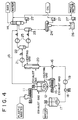
- FIG. 4 is a schematic diagram illustrating the configuration of another apparatus for converting a plastic waste into oil according to the present invention, which is yet another embodiment of the present invention.
- the plastic waste is supplied to a melting tank 12 of the vertical type or of the horizontal type (incidentally, the meting tank shown in this figure is of the vertical type) provided with agitating means through a feeder 11.
- the plastic waste is heated to a temperature, which is in the range of 200 to 400°C, preferably, in the range of 250 to 350°C, and is thus melted.
- a temperature which is in the range of 200 to 400°C, preferably, in the range of 250 to 350°C, and is thus melted.
- This gaseous hydrogen chloride is emitted from an upper portion of the melting tank 2 and is further sent to gaseous-hydrogen-chloride removing piping 13.
- this gaseous hydrogen chloride is removed during passing through the piping 13, and is then sent to a gas washer tower 14 whereupon the gaseous hydrogen chloride is treated.
- the plastic waste, from which the gaseous hydrogen chloride has been removed, is pressurized in a press fitting unit 15 provided with a single-shaft or two-shaft screw and are continuously press-fit into a mixer (or a mixing tube) 16.
- water contained in a water regulating tank 17 is sent out by a pump 18 to a pre-heater 19 whereupon the sent water is heated to a temperature which is in the range of 200 to 600°C, preferably, in the range of 350 to 500°C. Then, the water is continuously press-fit into the mixer (or the mixing tube) 16 whereupon the water is mixed with the molten plastic waste. It is preferable that an amount of water added thereto, which is represented in terms of the ratio of the weight of the plastic waste to the weight of the added water, becomes within a range of 0.05 to 0.5.
- Mixture of the molten plastic waste and the water is sent to a reactor 20.
- This mixture which is in a supercritical or near supercritical state, is heated in the reactor 20 to a temperature, which is in the range of 400 to 600°C, preferably, in the range of 450 to 550°C, and is decomposed in a short time at a pressure, which is in the range of 18 to 50 MPa, preferably, 22.1 to 35 MPa, into low-molecular-weight hydrocarbon.
- a plastic waste can be decomposed into oil, which is in any state from that of heavy oil to that of light oil, by suitably selecting the reaction temperature, the reaction pressure, the plastic-waste-to-water mixing ratio and the reaction time in the reactor 20.
- Tests on the decomposition of plastic waste samples of compositions Nos. 6 to 8, which are described in TABLE 2 and on the conversion of the samples into oil were performed by using the apparatus having the configuration of FIG. 4.
- Test process was as follows. Namely, each of the plastic waste samples was heated and melted in the melting tank 12 under the pretreatment conditions described in TABLE 2. Gaseous hydrogen chloride generated by the decomposition of chlorine-base plastic (polyvinyl chloride) was separated and removed from the plastic waste sample by being made to flow through the gaseous-hydrogen-chloride removing piping 13. Thereafter, the molten plastic waste was mixed with water heated to 420°C in the mixer 16. Then, a resultant mixture was loaded into the reactor 20.
Landscapes
- Chemical & Material Sciences (AREA)
- Engineering & Computer Science (AREA)
- Oil, Petroleum & Natural Gas (AREA)
- Life Sciences & Earth Sciences (AREA)
- Wood Science & Technology (AREA)
- Chemical Kinetics & Catalysis (AREA)
- General Chemical & Material Sciences (AREA)
- Organic Chemistry (AREA)
- Separation, Recovery Or Treatment Of Waste Materials Containing Plastics (AREA)
- Production Of Liquid Hydrocarbon Mixture For Refining Petroleum (AREA)
- Processing Of Solid Wastes (AREA)
- Manufacture Of Porous Articles, And Recovery And Treatment Of Waste Products (AREA)
Applications Claiming Priority (4)
| Application Number | Priority Date | Filing Date | Title |
|---|---|---|---|
| JP144213/96 | 1996-06-06 | ||
| JP14421396A JP3367822B2 (ja) | 1996-06-06 | 1996-06-06 | プラスチック廃棄物の油化方法及び装置 |
| JP14421396 | 1996-06-06 | ||
| US09/359,383 US6352674B2 (en) | 1996-06-06 | 1999-07-23 | Apparatus for converting a plastic waste into oil |
Publications (3)
| Publication Number | Publication Date |
|---|---|
| EP0814143A2 true EP0814143A2 (de) | 1997-12-29 |
| EP0814143A3 EP0814143A3 (de) | 1998-04-01 |
| EP0814143B1 EP0814143B1 (de) | 2001-10-17 |
Family
ID=26475701
Family Applications (1)
| Application Number | Title | Priority Date | Filing Date |
|---|---|---|---|
| EP97401152A Expired - Lifetime EP0814143B1 (de) | 1996-06-06 | 1997-05-26 | Verfahren und Apparat zur Konvertierung von Kunststoffabfällen in Öl |
Country Status (5)
| Country | Link |
|---|---|
| US (1) | US6352674B2 (de) |
| EP (1) | EP0814143B1 (de) |
| JP (1) | JP3367822B2 (de) |
| CN (1) | CN1097608C (de) |
| SG (1) | SG52977A1 (de) |
Cited By (3)
| Publication number | Priority date | Publication date | Assignee | Title |
|---|---|---|---|---|
| EP0872536A3 (de) * | 1997-04-16 | 1999-05-06 | Tohoku Electric Power Co., Inc. | Verfahren und System zur Umwandlung von Kunststoffen zu Oel |
| WO2002074881A1 (en) * | 2001-03-19 | 2002-09-26 | Deinking/Solvent Extraction Technologies Ltd. | A process for the catalytic reduction of heavy oils, kerogens, plastics, bio - masses, sludges, and organic waste to light hydrocarbon liquids, carbon dioxide-and amines |
| EP2705117B1 (de) * | 2011-05-05 | 2015-10-21 | Omv Refining & Marketing Gmbh | Verfahren zur energieeffizienten aufbereitung sekundärer lagerstätten |
Families Citing this family (18)
| Publication number | Priority date | Publication date | Assignee | Title |
|---|---|---|---|---|
| JP4141764B2 (ja) * | 2002-08-20 | 2008-08-27 | 東京エレクトロン株式会社 | プラズマ処理装置 |
| CA2426253A1 (en) * | 2003-04-22 | 2004-10-22 | Hurdon A. Hooper | Rubber reduction |
| JP4334298B2 (ja) * | 2003-08-19 | 2009-09-30 | 株式会社東芝 | 有機廃棄物の処理装置および処理方法 |
| TW200536879A (en) * | 2004-02-12 | 2005-11-16 | Teijin Ltd | Method for decomposing polycarbonate |
| JP4861652B2 (ja) * | 2005-04-28 | 2012-01-25 | タピオカ コマーシオ エ サービコス ソシエダーデ ウニペッソアル エルディーエー | 加熱油化装置及び加熱油化方法 |
| WO2006117002A2 (en) * | 2005-04-29 | 2006-11-09 | Scf Technologies A/S | Method and apparatus for converting organic material |
| US7678163B2 (en) * | 2005-04-29 | 2010-03-16 | Scf Technologies A/S | Method and apparatus for converting organic material |
| JP5368790B2 (ja) * | 2006-05-25 | 2013-12-18 | 株式会社ブレスト | 油化装置 |
| JP4673874B2 (ja) * | 2007-08-20 | 2011-04-20 | 株式会社東芝 | 廃棄物処理方法 |
| US10967349B2 (en) * | 2008-03-11 | 2021-04-06 | Xtrudx Technologies, Inc. | Machine and methods for transforming biomass and/or waste plastics via supercritical water reaction |
| CN104530473B (zh) * | 2014-12-30 | 2017-02-22 | 同济大学 | 一种基于蒸汽流分散吹脱废塑料脱氯的方法与系统 |
| CN110225958B (zh) * | 2016-12-14 | 2021-12-14 | 穆拉科技有限公司 | 用于生产生物燃料的方法和设备 |
| CN107434979A (zh) * | 2017-08-09 | 2017-12-05 | 蓝德环保科技集团股份有限公司 | 一种废塑料炼油方法 |
| FI4037817T3 (fi) * | 2019-10-04 | 2026-03-02 | Mura Tech Limited | Menetelmä ja laitteisto polymeerien muuntamiseksi tuotteiksi |
| EP4430140A1 (de) * | 2021-11-12 | 2024-09-18 | Borealis AG | Umwandlung von kunststoffabfällen in kohlenwasserstoffe unter verwendung eines übergangsmetalloxids |
| US12240757B2 (en) | 2022-01-12 | 2025-03-04 | Saudi Arabian Oil Company | Syngas production via supercritical water |
| US11542438B1 (en) | 2022-01-14 | 2023-01-03 | Saudi Arabian Oil Company | Hydrothermal conversion of plastic to oil |
| US11802245B1 (en) | 2022-11-16 | 2023-10-31 | Saudi Arabian Oil Company | Processes for viscosity breaking of plastics |
Family Cites Families (12)
| Publication number | Priority date | Publication date | Assignee | Title |
|---|---|---|---|---|
| US4113446A (en) | 1975-07-22 | 1978-09-12 | Massachusetts Institute Of Technology | Gasification process |
| US4221763A (en) * | 1978-08-29 | 1980-09-09 | Cities Service Company | Multi tube high pressure, high temperature reactor |
| JPS56501205A (de) | 1979-09-27 | 1981-08-27 | ||
| US4338199A (en) | 1980-05-08 | 1982-07-06 | Modar, Inc. | Processing methods for the oxidation of organics in supercritical water |
| EP0344376A1 (de) * | 1988-06-03 | 1989-12-06 | Ching Piao Lin | Verfahren zur Umwandlung von schweren Kohlenwasserstoffen zu leichteren Kohlenwasserstoffen |
| JP3042076B2 (ja) | 1990-09-08 | 2000-05-15 | 株式会社神戸製鋼所 | 天然又は合成高分子化合物の選択的加水分解方法 |
| DE4207976C2 (de) * | 1992-03-13 | 2001-03-15 | Rwe Umwelt Ag | Verfahren zur Herstellung Olefinen durch thermische Behandlung von Kunststoffabfällen |
| JP3348457B2 (ja) | 1993-03-30 | 2002-11-20 | 兵治 榎本 | ポリオレフィンの油化方法 |
| US5386055A (en) * | 1993-08-11 | 1995-01-31 | The University Of Akron | Depolymerization process |
| US5532495A (en) * | 1993-11-16 | 1996-07-02 | Sandia Corporation | Methods and apparatus for altering material using ion beams |
| JP3273118B2 (ja) * | 1995-04-20 | 2002-04-08 | 東北電力株式会社 | 高圧処理装置 |
| EP0775738B1 (de) * | 1995-06-07 | 2003-11-12 | Ngk Insulators, Ltd. | Verfahren zur herstellung von niedrig siedendem öl aus phthalsäurepolyester und/oder polyvinylchlorid enthaltenden plastikabfällen |
-
1996
- 1996-06-06 JP JP14421396A patent/JP3367822B2/ja not_active Expired - Fee Related
-
1997
- 1997-05-26 EP EP97401152A patent/EP0814143B1/de not_active Expired - Lifetime
- 1997-05-28 SG SG1997001763A patent/SG52977A1/en unknown
- 1997-06-05 CN CN97114906A patent/CN1097608C/zh not_active Expired - Fee Related
-
1999
- 1999-07-23 US US09/359,383 patent/US6352674B2/en not_active Expired - Fee Related
Cited By (5)
| Publication number | Priority date | Publication date | Assignee | Title |
|---|---|---|---|---|
| EP0872536A3 (de) * | 1997-04-16 | 1999-05-06 | Tohoku Electric Power Co., Inc. | Verfahren und System zur Umwandlung von Kunststoffen zu Oel |
| US6107532A (en) * | 1997-04-16 | 2000-08-22 | Tohoku Electric Power Co., Inc. | Process and system for converting plastics waste into oil |
| WO2002074881A1 (en) * | 2001-03-19 | 2002-09-26 | Deinking/Solvent Extraction Technologies Ltd. | A process for the catalytic reduction of heavy oils, kerogens, plastics, bio - masses, sludges, and organic waste to light hydrocarbon liquids, carbon dioxide-and amines |
| EP2705117B1 (de) * | 2011-05-05 | 2015-10-21 | Omv Refining & Marketing Gmbh | Verfahren zur energieeffizienten aufbereitung sekundärer lagerstätten |
| US9920255B2 (en) | 2011-05-05 | 2018-03-20 | Omv Refining & Marketing Gmbh | Method and apparatus for energy-efficient processing of secondary deposits |
Also Published As
| Publication number | Publication date |
|---|---|
| CN1097608C (zh) | 2003-01-01 |
| US20020006367A1 (en) | 2002-01-17 |
| EP0814143A3 (de) | 1998-04-01 |
| US6352674B2 (en) | 2002-03-05 |
| JP3367822B2 (ja) | 2003-01-20 |
| JPH09324181A (ja) | 1997-12-16 |
| EP0814143B1 (de) | 2001-10-17 |
| SG52977A1 (en) | 1998-09-28 |
| CN1176971A (zh) | 1998-03-25 |
Similar Documents
| Publication | Publication Date | Title |
|---|---|---|
| EP0814143B1 (de) | Verfahren und Apparat zur Konvertierung von Kunststoffabfällen in Öl | |
| US6504068B1 (en) | Method for converting a plastic waste into oil in a stainless steel reactor | |
| CA1300540C (en) | Process for the reprocessing of carbon containing wastes | |
| US5608136A (en) | Method and apparatus for pyrolytically decomposing waste plastic | |
| US6774271B2 (en) | Method and system of converting waste plastics into hydrocarbon oil | |
| US5756871A (en) | Treating method for converting wastes into resources and its equipment | |
| EP0770664B1 (de) | Verfahren zur Herstellung von Öl aus chlorenthaltenden Kunststoffabfällen | |
| EP2609146B1 (de) | Verfahren für den thermischen abbau von pcv oder anderem abfall mt halogenhaltigem polymerreststoffen | |
| GB2301112A (en) | Recovering useful products from waste material | |
| JP3492104B2 (ja) | プラスチック廃棄物の油化方法及び装置 | |
| JP2002060757A (ja) | 廃プラスチックの再生システム | |
| CN118202021A (zh) | 由废塑料生产热解油的方法 | |
| JPH0762353A (ja) | 一般廃棄物系プラスチック油化処理設備における窒素吹き込みによる溶融プラスチック中の塩素除去方法 | |
| JP2000119440A (ja) | プラスチック廃棄物の熱分解処理法 | |
| JP3435399B2 (ja) | 廃プラスチックの処理方法および処理装置 | |
| JP4445177B2 (ja) | 沈澱槽からのガスを利用する方法 | |
| JP3297322B2 (ja) | 廃プラスチックからの油回収システム | |
| JP2001323283A (ja) | 廃プラスチックからの油回収方法 | |
| JPH0782569A (ja) | 加熱油化方法及びその装置 | |
| KR20000036903A (ko) | 폐합성수지의 유화방법 및 유화설비장치 | |
| JP3490671B2 (ja) | ハロゲン含有プラスチックを含むプラスチック廃棄物の処理方法及び装置 | |
| JP3460398B2 (ja) | 塩素原子含有樹脂を含む廃プラスチックの熱分解処理方法 | |
| JPH11286572A (ja) | プラスチック廃棄物の油化反応器ユニット及び油化装置 | |
| US5817288A (en) | Process for treating a non-distillable halogenated organic feed stream | |
| JPH07138576A (ja) | 廃プラスチックの処理方法 |
Legal Events
| Date | Code | Title | Description |
|---|---|---|---|
| PUAI | Public reference made under article 153(3) epc to a published international application that has entered the european phase |
Free format text: ORIGINAL CODE: 0009012 |
|
| AK | Designated contracting states |
Kind code of ref document: A2 Designated state(s): DE FR GB IT |
|
| PUAL | Search report despatched |
Free format text: ORIGINAL CODE: 0009013 |
|
| AK | Designated contracting states |
Kind code of ref document: A3 Designated state(s): DE FR GB IT |
|
| 17P | Request for examination filed |
Effective date: 19980515 |
|
| 17Q | First examination report despatched |
Effective date: 19991125 |
|
| GRAG | Despatch of communication of intention to grant |
Free format text: ORIGINAL CODE: EPIDOS AGRA |
|
| GRAG | Despatch of communication of intention to grant |
Free format text: ORIGINAL CODE: EPIDOS AGRA |
|
| GRAH | Despatch of communication of intention to grant a patent |
Free format text: ORIGINAL CODE: EPIDOS IGRA |
|
| GRAH | Despatch of communication of intention to grant a patent |
Free format text: ORIGINAL CODE: EPIDOS IGRA |
|
| GRAA | (expected) grant |
Free format text: ORIGINAL CODE: 0009210 |
|
| AK | Designated contracting states |
Kind code of ref document: B1 Designated state(s): DE FR GB IT |
|
| REF | Corresponds to: |
Ref document number: 69707361 Country of ref document: DE Date of ref document: 20011122 |
|
| ET | Fr: translation filed | ||
| REG | Reference to a national code |
Ref country code: GB Ref legal event code: IF02 |
|
| PLBE | No opposition filed within time limit |
Free format text: ORIGINAL CODE: 0009261 |
|
| STAA | Information on the status of an ep patent application or granted ep patent |
Free format text: STATUS: NO OPPOSITION FILED WITHIN TIME LIMIT |
|
| 26N | No opposition filed | ||
| PGFP | Annual fee paid to national office [announced via postgrant information from national office to epo] |
Ref country code: FR Payment date: 20030508 Year of fee payment: 7 |
|
| PGFP | Annual fee paid to national office [announced via postgrant information from national office to epo] |
Ref country code: GB Payment date: 20030519 Year of fee payment: 7 |
|
| PG25 | Lapsed in a contracting state [announced via postgrant information from national office to epo] |
Ref country code: GB Free format text: LAPSE BECAUSE OF NON-PAYMENT OF DUE FEES Effective date: 20040526 |
|
| GBPC | Gb: european patent ceased through non-payment of renewal fee | ||
| PG25 | Lapsed in a contracting state [announced via postgrant information from national office to epo] |
Ref country code: FR Free format text: LAPSE BECAUSE OF NON-PAYMENT OF DUE FEES Effective date: 20050131 |
|
| REG | Reference to a national code |
Ref country code: FR Ref legal event code: ST |
|
| PGFP | Annual fee paid to national office [announced via postgrant information from national office to epo] |
Ref country code: DE Payment date: 20050519 Year of fee payment: 9 |
|
| PG25 | Lapsed in a contracting state [announced via postgrant information from national office to epo] |
Ref country code: IT Free format text: LAPSE BECAUSE OF NON-PAYMENT OF DUE FEES;WARNING: LAPSES OF ITALIAN PATENTS WITH EFFECTIVE DATE BEFORE 2007 MAY HAVE OCCURRED AT ANY TIME BEFORE 2007. THE CORRECT EFFECTIVE DATE MAY BE DIFFERENT FROM THE ONE RECORDED. Effective date: 20050526 |
|
| PG25 | Lapsed in a contracting state [announced via postgrant information from national office to epo] |
Ref country code: DE Free format text: LAPSE BECAUSE OF NON-PAYMENT OF DUE FEES Effective date: 20061201 |