EP0814236A1 - Support de palier permettant de maintenir en fonctionnement un turbomoteur aprés apparition d'un balourd - Google Patents
Support de palier permettant de maintenir en fonctionnement un turbomoteur aprés apparition d'un balourd Download PDFInfo
- Publication number
- EP0814236A1 EP0814236A1 EP97401324A EP97401324A EP0814236A1 EP 0814236 A1 EP0814236 A1 EP 0814236A1 EP 97401324 A EP97401324 A EP 97401324A EP 97401324 A EP97401324 A EP 97401324A EP 0814236 A1 EP0814236 A1 EP 0814236A1
- Authority
- EP
- European Patent Office
- Prior art keywords
- rotor
- bearing
- turbine engine
- bearing support
- unbalance
- Prior art date
- Legal status (The legal status is an assumption and is not a legal conclusion. Google has not performed a legal analysis and makes no representation as to the accuracy of the status listed.)
- Granted
Links
- 238000006073 displacement reaction Methods 0.000 claims abstract description 28
- 230000000694 effects Effects 0.000 claims abstract description 26
- 238000000034 method Methods 0.000 claims abstract description 12
- 238000012423 maintenance Methods 0.000 claims description 5
- 230000007704 transition Effects 0.000 claims description 2
- 230000008901 benefit Effects 0.000 description 9
- 238000004519 manufacturing process Methods 0.000 description 9
- 238000013016 damping Methods 0.000 description 8
- 230000006378 damage Effects 0.000 description 4
- 230000007423 decrease Effects 0.000 description 4
- 230000008859 change Effects 0.000 description 3
- 238000001816 cooling Methods 0.000 description 3
- 238000010438 heat treatment Methods 0.000 description 3
- 230000009467 reduction Effects 0.000 description 3
- 241000555745 Sciuridae Species 0.000 description 2
- 230000001133 acceleration Effects 0.000 description 2
- 239000011248 coating agent Substances 0.000 description 2
- 238000000576 coating method Methods 0.000 description 2
- 230000003993 interaction Effects 0.000 description 2
- MGGVALXERJRIRO-UHFFFAOYSA-N 4-[2-(2,3-dihydro-1H-inden-2-ylamino)pyrimidin-5-yl]-2-[2-oxo-2-(2,4,6,7-tetrahydrotriazolo[4,5-c]pyridin-5-yl)ethyl]-1H-pyrazol-5-one Chemical compound C1C(CC2=CC=CC=C12)NC1=NC=C(C=N1)C=1C(=NN(C=1)CC(=O)N1CC2=C(CC1)NN=N2)O MGGVALXERJRIRO-UHFFFAOYSA-N 0.000 description 1
- 241000271566 Aves Species 0.000 description 1
- 241000287107 Passer Species 0.000 description 1
- 241001080024 Telles Species 0.000 description 1
- 239000006096 absorbing agent Substances 0.000 description 1
- 230000000712 assembly Effects 0.000 description 1
- 238000000429 assembly Methods 0.000 description 1
- 238000003763 carbonization Methods 0.000 description 1
- 230000000295 complement effect Effects 0.000 description 1
- 230000001627 detrimental effect Effects 0.000 description 1
- 230000005489 elastic deformation Effects 0.000 description 1
- 230000017525 heat dissipation Effects 0.000 description 1
- 230000035515 penetration Effects 0.000 description 1
- 230000002093 peripheral effect Effects 0.000 description 1
- 238000003825 pressing Methods 0.000 description 1
- 230000002265 prevention Effects 0.000 description 1
- 230000000135 prohibitive effect Effects 0.000 description 1
- 239000007779 soft material Substances 0.000 description 1
Images

Classifications
-
- F—MECHANICAL ENGINEERING; LIGHTING; HEATING; WEAPONS; BLASTING
- F01—MACHINES OR ENGINES IN GENERAL; ENGINE PLANTS IN GENERAL; STEAM ENGINES
- F01D—NON-POSITIVE DISPLACEMENT MACHINES OR ENGINES, e.g. STEAM TURBINES
- F01D25/00—Component parts, details, or accessories, not provided for in, or of interest apart from, other groups
- F01D25/16—Arrangement of bearings; Supporting or mounting bearings in casings
- F01D25/162—Bearing supports
-
- F—MECHANICAL ENGINEERING; LIGHTING; HEATING; WEAPONS; BLASTING
- F01—MACHINES OR ENGINES IN GENERAL; ENGINE PLANTS IN GENERAL; STEAM ENGINES
- F01D—NON-POSITIVE DISPLACEMENT MACHINES OR ENGINES, e.g. STEAM TURBINES
- F01D21/00—Shutting-down of machines or engines, e.g. in emergency; Regulating, controlling, or safety means not otherwise provided for
- F01D21/04—Shutting-down of machines or engines, e.g. in emergency; Regulating, controlling, or safety means not otherwise provided for responsive to undesired position of rotor relative to stator or to breaking-off of a part of the rotor, e.g. indicating such position
- F01D21/045—Shutting-down of machines or engines, e.g. in emergency; Regulating, controlling, or safety means not otherwise provided for responsive to undesired position of rotor relative to stator or to breaking-off of a part of the rotor, e.g. indicating such position special arrangements in stators or in rotors dealing with breaking-off of part of rotor
-
- F—MECHANICAL ENGINEERING; LIGHTING; HEATING; WEAPONS; BLASTING
- F01—MACHINES OR ENGINES IN GENERAL; ENGINE PLANTS IN GENERAL; STEAM ENGINES
- F01D—NON-POSITIVE DISPLACEMENT MACHINES OR ENGINES, e.g. STEAM TURBINES
- F01D25/00—Component parts, details, or accessories, not provided for in, or of interest apart from, other groups
- F01D25/16—Arrangement of bearings; Supporting or mounting bearings in casings
-
- F—MECHANICAL ENGINEERING; LIGHTING; HEATING; WEAPONS; BLASTING
- F16—ENGINEERING ELEMENTS AND UNITS; GENERAL MEASURES FOR PRODUCING AND MAINTAINING EFFECTIVE FUNCTIONING OF MACHINES OR INSTALLATIONS; THERMAL INSULATION IN GENERAL
- F16C—SHAFTS; FLEXIBLE SHAFTS; ELEMENTS OR CRANKSHAFT MECHANISMS; ROTARY BODIES OTHER THAN GEARING ELEMENTS; BEARINGS
- F16C27/00—Elastic or yielding bearings or bearing supports, for exclusively rotary movement
- F16C27/04—Ball or roller bearings, e.g. with resilient rolling bodies
-
- F—MECHANICAL ENGINEERING; LIGHTING; HEATING; WEAPONS; BLASTING
- F05—INDEXING SCHEMES RELATING TO ENGINES OR PUMPS IN VARIOUS SUBCLASSES OF CLASSES F01-F04
- F05B—INDEXING SCHEME RELATING TO WIND, SPRING, WEIGHT, INERTIA OR LIKE MOTORS, TO MACHINES OR ENGINES FOR LIQUIDS COVERED BY SUBCLASSES F03B, F03D AND F03G
- F05B2260/00—Function
- F05B2260/30—Retaining components in desired mutual position
- F05B2260/301—Retaining bolts or nuts
- F05B2260/3011—Retaining bolts or nuts of the frangible or shear type
-
- F—MECHANICAL ENGINEERING; LIGHTING; HEATING; WEAPONS; BLASTING
- F16—ENGINEERING ELEMENTS AND UNITS; GENERAL MEASURES FOR PRODUCING AND MAINTAINING EFFECTIVE FUNCTIONING OF MACHINES OR INSTALLATIONS; THERMAL INSULATION IN GENERAL
- F16C—SHAFTS; FLEXIBLE SHAFTS; ELEMENTS OR CRANKSHAFT MECHANISMS; ROTARY BODIES OTHER THAN GEARING ELEMENTS; BEARINGS
- F16C19/00—Bearings with rolling contact, for exclusively rotary movement
- F16C19/02—Bearings with rolling contact, for exclusively rotary movement with bearing balls essentially of the same size in one or more circular rows
- F16C19/04—Bearings with rolling contact, for exclusively rotary movement with bearing balls essentially of the same size in one or more circular rows for radial load mainly
- F16C19/06—Bearings with rolling contact, for exclusively rotary movement with bearing balls essentially of the same size in one or more circular rows for radial load mainly with a single row or balls
-
- F—MECHANICAL ENGINEERING; LIGHTING; HEATING; WEAPONS; BLASTING
- F16—ENGINEERING ELEMENTS AND UNITS; GENERAL MEASURES FOR PRODUCING AND MAINTAINING EFFECTIVE FUNCTIONING OF MACHINES OR INSTALLATIONS; THERMAL INSULATION IN GENERAL
- F16C—SHAFTS; FLEXIBLE SHAFTS; ELEMENTS OR CRANKSHAFT MECHANISMS; ROTARY BODIES OTHER THAN GEARING ELEMENTS; BEARINGS
- F16C2360/00—Engines or pumps
- F16C2360/23—Gas turbine engines
-
- Y—GENERAL TAGGING OF NEW TECHNOLOGICAL DEVELOPMENTS; GENERAL TAGGING OF CROSS-SECTIONAL TECHNOLOGIES SPANNING OVER SEVERAL SECTIONS OF THE IPC; TECHNICAL SUBJECTS COVERED BY FORMER USPC CROSS-REFERENCE ART COLLECTIONS [XRACs] AND DIGESTS
- Y02—TECHNOLOGIES OR APPLICATIONS FOR MITIGATION OR ADAPTATION AGAINST CLIMATE CHANGE
- Y02T—CLIMATE CHANGE MITIGATION TECHNOLOGIES RELATED TO TRANSPORTATION
- Y02T50/00—Aeronautics or air transport
- Y02T50/60—Efficient propulsion technologies, e.g. for aircraft
Definitions
- the invention provides a method for keeping a turbine engine for aircraft in degraded operation after the appearance of an accidental unbalance on a rotor caused for example by a fan blade failure under the impact of a foreign body.
- the invention also provides a device consisting of a bearing support specially designed to implement the method.
- An unbalance on a turbine engine rotor for an aircraft in operation causes a centrifugal rotating force which is transmitted to the structure of the turbine engine via the bearings and bearing supports, and from the rotor-stator contact for very strong unbalances, then to the aircraft structure.
- unbalances There are two kinds of unbalances: manufacturing unbalances and accidental unbalances. Manufacturing imbalances are brought to low values, although not negligible, thanks to the care taken in the manufacture of rotors.
- Accidental unbalances are mainly due to ruptured blades. These unbalances can be significant and cause a rotating force which can take very high values requiring an immediate shutdown of the turbine engine, on pain of destruction of the turbine engine structures and of the aircraft.
- a blade break occurs essentially near the ground during the takeoff and landing phases of the aircraft, by the accidental penetration of foreign bodies such as birds into the air intake of the turbine engine. Such an accident requiring the immediate shutdown of the turbine engine can cause the airplane to crash in these circumstances.
- a first problem to be resolved is therefore to keep the turbine engine in operation despite the imbalance caused for example by a blade break, at least for a limited period and with a reduced thrust, the time to land the aircraft.
- Modern turboshaft engines are generally of the so-called “double-flow” type and comprise a first stage of rotating vanes called a "fan” which provides most of the propulsion effort on subsonic turboshaft engines.
- These fan blades are very vulnerable because they are placed at the very front of the turbine engine because they are thin, of large size and held by one end by means of the rotor while the other end at the periphery of the rotor is free. Although breakage usually occurs toward the free end of the blade, the unbalance generated can be significant due to the large size of the blade.
- the unbalance can reach 3 to 4 kg.m produce, taking into account the elasticity of the structure and the resonance phenomena which result from it, a rotating force of the order of 10 5 DaN at 5000 revolutions per minute.
- a second problem is therefore to keep the turbine engine in operation with such an unbalance.
- a vane rotor and in particular a blower inevitably has a manufacturing unbalance which is all the more important as the blower is heavy and of large diameter.
- this unbalance associated with the natural elasticity of the structure of the turbine engine causes a radial and centrifugal rotating force with resonance points corresponding to the natural modes of the rotor + structure assembly, this rotating force causing accelerated fatigue of the bearings and of the motor structure.
- the bearings of the rotor and more particularly its front bearing are usually held by an elastic bearing support which has the main effect of reducing vibrations and reducing the forces transmitted to the structure.
- Patent EP 63 993 discloses such a bearing comprising an elastic element with movement in a radial plane, the elastic element being in the form of an openwork truncated cone forming a squirrel cage, the movement of this elastic element being however limited radially by a rigid element also in the form of a truncated cone.
- the invention provides a method and a device specially designed to implement this method and making it possible to maintain a turbine engine for aircraft in operation at a rotor speed of rotation at least equal to the idle speed in flight V1, this after the appearance of an accidental unbalance on this rotor.
- the invention applies to a turbine engine, the rotor of which is mounted on bearings and has blades at its periphery which move inside a casing, the radial clearance E between the tops of the blades and the inner wall of the housing being usually but not necessarily obscured by an abradable coating. In such a turbine engine, the proper mode of the rotor is greater than V1 in normal operation.
- the turbine engine operates under normal conditions until an accidental unbalance has appeared on the rotor.
- the transition from the normal stiffness level to a low stiffness level of a bearing support in accordance with the invention results in the proper mode of the rotor being lowered at a speed lower than V1, which has the effect of lowering at speeds greater than V1 the rotating force F transmitted by the rotor to the structure of the turbine engine, and the result of allowing the operation of the turbine engine at these speeds.
- bearing support will be that maintaining the fan stage of the turbine engine, this stage being particularly exposed to the impacts of foreign bodies and by repercussion to blade breakage.
- the invention also provides a bearing support making it possible to implement the present method.
- a bearing support comprises N> 1 elastic elements acting in parallel and each connecting the bearing to the structure of the motor, N-1 elastic elements effecting this connection by means of frangible connecting elements, that is to say capable of breaking under the effect of the radial force caused by an unbalance exceeding a predetermined minimum level.
- these elastic elements are concentric in the form of barrels or thin cylindrical or frustoconical walls and connected by their ends on one side to the structure of the motor and on the other side to the bearing. This connection is permanent on one side and frangible on the other for N-1 elements, these elements being arranged axially and being sensitive to rupture under the effect of a shear and tensile stress in a plane radial to the axis of the rotor.
- the present invention should also not be confused with the bearing disclosed by the aforementioned US Patent 4,527,910. Indeed, such a bearing has only one flexible element which remains active in all circumstances, the frangible connections only act on the damping of vibrations. Such a bearing does not make it possible to soften radially the guiding in rotation of the fan and to lower the proper mode of this fan following the appearance of an accidental unbalance, on the contrary of the present invention. In addition, the viscous damping means do not allow the use of this bearing on large turboshaft engines.
- Another advantage of the invention is the maintenance in degraded operation and without additional means of a rigorous axial positioning of the bearing held by a bearing support according to the invention, after rupture of frangible connections, this maintenance being ensured at least by the element elastic itself not comprising a frangible connection.
- the maintenance being carried out without friction, unlike the device disclosed by patent FR 2 463 853, a bearing support according to the invention can be used in cooperation with a bearing with a thrust effect to maintain the axial positioning of the dawn itself and resume the axial thrust to which this shaft is subjected.
- the present invention is therefore well suited to an application to the blower stage of large turboshaft engines, said blower stage journalling on a large bearing with thrust and generally ball bearing effect, this blower stage generating most of the thrust of the turbine engine, said thrust being transmitted to the structure of the turbine engine by said bearing and said bearing support, even in degraded operation.
- Another advantage of the invention is the absence of heat dissipation after rupture of the frangible connections, unlike devices with damping, which avoids having to have additional cooling means on large turboshaft engines.
- Another advantage is the reduction in the risk of rotor / stator interaction due to the increased clearance E, and the resulting reduction in mass gain.
- the present invention also has the advantage, in its preferred embodiment, of using a simple bearing support, inexpensive and having a general shape, a space requirement and means of connection to the bearing and to the structure of the turbine engine very similar to the conventional bearing supports usually used on turbine engines.
- the present invention can therefore be applied to a turbine engine without jeopardizing its structure.
- Figure 1 illustrates a turbine engine fan stage according to the invention.
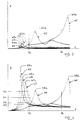
- Figure 2 is a graph illustrating the elasticity characteristic of a bearing support according to the invention.
- the abscissa represents the rotating force F causing the radial deformation of the bearing, and the ordinate the corresponding radial displacement D of the bearing.
- FIG. 3 is a graph representing the rotating force F exerted by the rotor on the bearing, as a function of the speed V of rotation of the rotor and of different types of bearing support.
- the rotating force F on the ordinate is expressed in deca-Newton (DaN) and the rotational speed V on the abscissa is expressed in revolutions per minute (rpm).
- FIG. 4 is a graph representing the consumption of the clearance of the rotor relative to the stator as a function of the speed of rotation V of said rotor and of the bearing supports already invoked in FIG. 4.
- the consumption of clearance D is on the ordinate, and the speed of rotation V on the abscissa is expressed in revolutions per minute (rpm) with the same scale as in FIG. 3.
- the turbine engine is of the so-called "double flow" type usually used on large subsonic transport aircraft.
- turboshaft engines are well known to those skilled in the art, and in order not to unnecessarily burden this description, only the components of this turbine engine necessary for a good understanding of the invention will be described.
- the rotor 1 comprises in its central part a shaft 2 rotating around the geometric axis of rotation 3, and in its peripheral part in particular a fan stage 4 integral with the shaft 2 , said fan stage 4 extending towards the front of the turbine engine by the air inlet cone 5.
- the stage of fan 4 comprises a rim 6 integral with the shaft 2 at its front part, as well as a plurality of vanes 7 known as of fan arranged radially at the periphery of the rim 6.
- the vertices 8 of the vanes 7 arrive in the vicinity of the inner wall 9 of a casing 10 surrounding the fan stage 4.
- the part 9a of the inner wall 9 located opposite the tops 8 of the blades 7 is lined with an abradable coating 11 whose inner wall 12 is planed by the vertices of the vanes 8 during the first rotations of the rotor 1, this wall 12 however remaining approximately in the extension of the interior wall 9 of the casing 10.
- the reduced clearance thus formed will be referenced between the tops 8 of the vanes 7 and the interior wall 12 of the abradable 11.
- the play between the vertices 8 of the vanes 7 and the inner wall 9a of the casing 10 will also be referenced E, the play E being during the normal operation of the turbine engine obscured by the abradable 11.
- the shaft 2 and consequently the rotor 1 are guided in rotation along the geometric axis 3 and positioned in translation by a ball bearing 15 secured to the structure 16 of the turbine engine by means of a bearing support 17.
- This bearing 15 is arranged just behind the fan stage 4.
- Shaft 2 is also guided at the rear of the turbine engine by a roller bearing 18 secured to the structure 16 of the turbine engine by means of a other bearing support 19.
- the bearing support 17 has a general shape of revolution around the geometric axis 3.
- This bearing support 17 comprises a first flexible element 20 composed of a flexible frustoconical wall 21 whose large base 21a is extended radially outwards by a flange 22 fixed to the structure 16 of the turbine engine by a plurality of bolts 23.
- the small base 21b of the flexible wall 21 is extended axially by a member 24 enclosing the bearing 15, by its outer ring and radially outwards by a thin and flexible flange 25.
- the flanges 22 and 25 in this example each have the shape of a flat washer of geometric axis 3, therefore arranged in planes perpendicular to the axis 3, said flanges 22 and 25 each being integral by their inner circumference respectively to the large base 21a and the small base 21b of the frustoconical wall 21.
- the bearing support 17 also comprises a second flexible element 26 composed of a flexible frustoconical wall 27 whose large base 27a is extended radially outwards by a flange 28 fixed to the structure 16 by the same bolts 23, the flange 28 pressing on the flange 22.
- the small base 27b of the flexible wall 27 is extended radially inwards by a second flange 29 which arrives against the flange 25 with reduced play.
- the flanges 28 and 29 in this example each have the shape of a flat washer of geometric axis 3, therefore arranged in planes perpendicular to the axis 3, said flange 28 being integral by its inner circumference with the large base 27a of the wall 27, while the flange 29 is integral by its circumference outside the small base 27b of the wall 27.
- the flanges 25 and 29 are made integral by frangible connecting elements 30, that is to say capable of breaking under the effect of a predetermined radial force F applied to the bearing 15.
- the frangible elements 30 can be for example bolts arranged parallel to the geometric axis 3, the section of which is weakened and calculated as a function of the force F which must cause it to shear.
- the operation of the bearing support 17 is as follows. In normal operation, the frangible connecting elements 30 are not broken and link the flanges 25 and 29 against each other, so that the bearing 15 is held simultaneously by the flexible walls 21 and 27 whose stiffnesses are added together and combine with the stiffness of the structure 16 of the turbine engine. This stiffness is high and just makes it possible to absorb the force F resulting from the low manufacturing unbalance so that the space e between the tops 8 of the blades 7 and the inner wall 12 of the abradable 11 is minimal, which reduces air leakage at best.
- the frangible connecting elements 30 break so that the flexible element 26 can no longer participate in maintaining the bearing 15, this remaining function however provided by the flexible element 20 alone.
- the bearing 15 is therefore held radially with a reduced stiffness which is that of the flexible element 20 combined with that of the structure 16 of the turbine engine.
- the amplitude D of the radial displacement of the shaft 2 increases, and the flange 25 moves relative to the flange 29 along a plane perpendicular to the geometric axis 3.
- the diameters of the large bases 21a and 27a can be close.
- the small base 27b will be given a diameter much greater than that of the small base 21b, and the connecting elements 30 will be brought closer to one or the other of the bases 21b or 27b.
- This wider flange 25 or 29 is more flexible axially, that is to say parallel to the geometric axis 3, which reduces the axial stresses imposed on the frangible connecting elements 30.
- the flange 25 will be located at the front of the flange 29.
- the frangible connections 30 have broken, the fan stage 4 continues to provide a significant thrust and tends to pull towards the front of the turbine engine the shaft 2 and the bearing 15, the flange 25 will move slightly forward due to the residual flexibility of the wall 21 in an axial direction.
- the flange 25 is not then in contact with the flange 29 will not rub against it when the rotor will move in a plane perpendicular to the geometric axis 3 under the effect of accidental unbalance.
- the radial displacement D under the effect of the accidental unbalance of the bearing 15 is accompanied by a substantially equivalent displacement of the trajectory of the apices 8 of the blades 7.
- the vertices 8 of the vanes 7 come planing the abradable 11 to a depth equal to the radial displacement D.
- a turbine engine rotor has several stages of blades 31 grouped into functional assemblies such as the low pressure compressor 32 rotating inside a casing 33, said compressor 32 being located at the rear of the fan stage 4, therefore closer to the rear bearing 18.
- the radial displacement of the fan stage 4 having an impact on the radial displacement of each of the other stages 31, the skilled person will likewise have sufficient clearance between the tops of the blades of these stages 31 and the inner wall of the casing 33 which surrounds them, this play being in the same way obscured by an abradable.
- the line segment 35 represents the radial displacement D of the bearing 15 as a function of the rotating force F during the normal operation of the turbine engine. Under the effect of the elastic deformation of the bearing support, this displacement is linear and remains at very low values, just sufficient to absorb the manufacturing unbalance of the rotor.
- the rotating force F reaches a predetermined threshold Fo corresponding to the minimum unbalance from which we want to change the operation of the bearing support 17 and the turbine engine, the frangible elements break, the bearing becomes more flexible and the displacement D as a function of F is represented by the half-line 36 whose slope D / F is much greater than that of the line segment 35.
- the values on the abscissa represent the rotational speeds of the rotor 1.
- the ordinate values represent the rotating force F in daN (decanewton) that the rotor 1 exerts on the structure 16 via the bearing 15 and the bearing support 17.
- the set of curves is given for an unbalance of 3 kg.m corresponding approximately to the rupture of the upper third of a fan blade.
- the curve 10 represents the rotating force F in the case of a conventional bearing support 17 with a reduced clearance E between the vertices 8 of the blades 7 and the inner wall 9a of the casing 10.
- the bearing support 17 and the structure 16 are elastically deformed, and the apices 8 of the blades 7 plan the abradable 11 and come into contact with the wall 9a.
- the casing 10 then provides additional guidance of the fan stage 4 in cooperation with the bearing 15.
- the radial stiffness of the guide is in these conditions increased and corresponds to the stiffness of the casing 10 increased by that of the bearing support 17 combined with that of the structure 16, which has the effect of displacing the proper mode 40a of the rotor 1 beyond the maximum speed V2.
- the curve 41 represents this same effort rotating with the same bearing support 17 and a clearance E sufficient for the tops 8 of the blades 7 not to rub against the inner wall 9a of the casing 10.
- the proper mode 41a is in this example located in the lower first third of flight range V1-V2.
- the rotating force F remains greater than 25.10 3 DaN in the flight envelope and reaches 100.10 3 DaN with the proper mode 41a which is located this time in the lower third of the flight envelope.
- the simple enlargement of the set E cannot therefore provide a solution to the problem posed.
- the curves 42, 43 and 44 represent for three different flexibility levels the rotating force F with a bearing support 17 according to the invention, the frangible connections 30 being broken, the clearance E being assumed to be large enough for the vertices 8 vanes 7 do not rub against the internal wall 9a of the casing 10.
- the displacement D is significant throughout the flight domain V1-V2 and passes through a maximum in the lower third of this flight domain.
- the game E a value at least equal to the displacement D given by the curves 47, 48, 49 at the speed V1, namely the game consumption D1, D2 and D3 respectively.
- the turbine engine rotating at speeds greater than V1
- the vertices 8 of the blades 7 will not touch the wall 9a of the casing 10, in accordance with the main effect sought.
- the curves 41 or 42 of the graphs in FIG. 3 show that the rotating force F and the radial displacement D decrease when the speed of rotation V increases.
- the pilot can still mount or maintain the turboshaft engine at full throttle V2 to pass over obstacles that appear before it.
- Another advantage of the invention is that the rotating force F and the clearance consumption D can be reduced to very low levels while maintaining the axial positioning of the rotor by means of a thrust bearing; for example with a ball, this positioning being done without dissipation of heat by friction, unlike the devices disclosed by the patents FR 2,463,853 AND US 4,527,910 mentioned above.
- the invention can therefore be used without additional cooling means on large turboshaft engines.
- the bearing support 17 used has, at least in its preferred embodiment, a general shape, a size and modes of connection with the bearing 15 and the structure 16 of the turbine engine neighbors of bearings of known types and usually used on turboshaft engines. Consequently, the invention is applicable without calling into question the usual structures of turbine engines.
- Another advantage finally is that the risk of interaction between the casing and the rotor is reduced since the clearance E is increased.
- the present invention cannot be limited to the embodiment which has just been given. Although its most important application is the prevention of a fan blade failure, it can also be applied to other causes of rotor unbalance, in particular a blade failure on a compressor or turbine stage , by adapting sets E and bearing supports, for example 19, in accordance with the invention.
- turboshaft engines and in particular the larger ones may include an additional bearing holding the shaft 2 and arranged further behind the bearing 15 towards the bearing 18, the shaft 2 being relaxed.
- additional bearing support resulting from such an arrangement will advantageously be configured in accordance with the invention.
- a bearing support can also comprise N> 2 elastic elements, N-1 of these elements each comprising frangible connections whose resistance is increasing, in order to guard against damage going up.
Landscapes
- Engineering & Computer Science (AREA)
- General Engineering & Computer Science (AREA)
- Mechanical Engineering (AREA)
- Structures Of Non-Positive Displacement Pumps (AREA)
- Supercharger (AREA)
Abstract
Description
- L'invention propose un procédé permettant de maintenir en fonctionnement dégradé un turbomoteur pour aéronef après apparition d'un balourd accidentel sur un rotor provoqué par exemple par une rupture d'aube de soufflante sous l'impact d'un corps étranger.
- L'invention propose aussi un dispositif consistant en un support de palier spécialement conçu pour mettre en oeuvre le procédé.
- Un balourd sur un rotor de turbomoteur pour aéronef en fonctionnement provoque un effort tournant centrifuge qui se transmet à la structure du turbomoteur par l'intermédiaire des paliers et supports de paliers, et du contact rotor-stator pour les très forts balourds, puis à la structure de l'avion. Il y a deux sortes de balourds : les balourds de fabrication et les balourds accidentels. Les balourds de fabrication sont ramenés à des valeurs faibles, bien que non négligeables, grâce au soins apportés à la fabrication des rotors. Les balourds accidentels proviennent principalement de ruptures d'aubes. Ces balourds peuvent être importants et provoquer un effort tournant qui peut prendre des valeurs très élevées nécessitant un arrêt immédiat du turbomoteur, sous peine de destruction des structures de turbomoteur et de l'avion. Une rupture d'aube se produit essentiellement à proximité du sol pendant les phases de décollage et d'atterrissage de l'avion, par la pénétration accidentelle de corps étrangers tels des oiseaux dans l'entrée d'air du turbomoteur. Un tel accident nécessitant l'arrêt immédiat du turbomoteur peut entrainer dans ces circonstances l'écrasement de l'avion. Un premier problème à résoudre est en conséquence de maintenir le turbomoteur en fonctionnement malgré le balourd provoqué par exemple par une rupture d'aube, au moins pendant une durée limitée et avec une poussée réduite, le temps de faire atterrir l'avion.
- Les turbomoteurs modernes sont généralement du type dit "à double flux" et comportent un premier étage d'aubes tournantes appelé "soufflante" qui assure notamment sur les turbomoteurs subsoniques l'essentiel de l'effort de propulsion. Ces aubes de soufflante sont très vulnérables, car elles sont placées tout à l'avant du turbomoteur car elles sont minces, de grande taille et tenues par une extrémité au moyen du rotor alors que l'autre extrémité à la périphérie du rotor est libre. Bien que la rupture se produise habituellement vers l'extrémité libre de l'aube, le balourd généré peut être important du fait de la grande taille de l'aube. A titre indicatif, sur les gros turbomoteurs à double flux, le balourd peut atteindre 3 à 4 kg.m produire, compte tenu de l'élasticité de la structure et des phénomènes de résonance qui en résultent, un effort tournant de l'ordre de 105DaN à 5000 tours par minute. Un second problème est donc de maintenir en fonctionnement le turbomoteur avec un balourd aussi important.
- Pour améliorer le rendement d'un turbomoteur en fonctionnement normal, il est nécessaire de réduire les fuites d'air entre les aubes tournantes et les parois intérieures du carter en regard desdites aubes tournantes. Pour cela, on agrandit le jeu entre les parois intérieures et les aubes, et on tapisse ces parois intérieures avec un matériau tendre appelé abradable dont l'épaisseur est suffisante pour interférer avec les aubes. En tournant, les aubes rabotent l'abradable et en ajustent l'épaisseur aux dimensions exactes du rotor, ce qui réduit les fuites à un minimum. Un troisième problème est donc de ne pas augmenter ces fuites pendant le fonctionnement normal du turbomoteur.
- Un rotor à aubes et notamment une soufflante présente inévitablement un balourd de fabrication qui est d'autant plus important que la soufflante est lourde et de grand diamètre. Pendant la rotation, ce balourd associé à l'élasticité naturelle de la structure du turbomoteur provoque un effort tournant radial et centrifuge avec des points de résonnance correspondant aux modes propres de l'ensemble rotor + structure, cet effort tournant provoquant une fatigue accélérée des paliers et de la structure du moteur. Pour remédier à cela, les paliers du rotor et plus particulièrement son palier avant sont habituellement tenus par un support de palier élastique qui a pour effet principal de réduire les vibrations et de réduire les efforts transmis à la structure. Le brevet EP 63 993 divulgue un tel palier comportant un élément élastique à débattement dans un plan radial, l'élément élastique étant en forme de tronc de cône ajouré formant cage d'écureuil, le débattement de cet élément élastique étant toutefois limité radialement par un élément rigide lui aussi en forme de tronc de cône.
- Un tel palier présente cependant l'inconvénient d'augmenter l'amplitude des vibrations radiales du rotor, ce qui provoque un rabotage supplémentaire des abradables générateur de fuites d'air. Dans la pratique, l'homme du métier doit en conséquence limiter l'élasticité d'un tel palier au strict nécessaire pour réduire les vibrations résultant du faible balourd de fabrication du rotor. Ce palier ne permet pas en conséquence de résoudre le problème posé par le balourd accidentel du rotor.
- On connait par le brevet FR 2 463 853, à priorité de la demande de brevet US 69,196 avec délivrance sous le numéro 4 289 360, un turbomoteur comportant un support de palier normalement rigide, mais qui peut être libéré par la rupture d'éléments de liaison sous l'effet du balourd important résultant de la rupture d'une aube. le rotor tournant dans un carter avec un jeu agrandi comblé par un abradable plus épais. Le rotor tend alors à tourner autour de son nouvel axe d'inertie ce qui réduit le balourd et l'effort exercé sur la structure du turbomoteur. Un tel dispositif ne peut toutefois fonctionner correctement qu'avec un amortissement efficace qui est dans ce brevet assuré par des segments mobiles les uns par rapport aux autres et séparés par des films d'huile. Ce dispositif n'est guère envisageable sur les gros turbomoteurs pour aéronefs, car ils nécessitent des moyens d'amortissement dont la masse et la taille seraient excessives, ainsi que des moyens de refroidissement importants pour préserver l'huile d'un échauffement excessif qui en provoquerait la carbonisation.
- On connait aussi une solution plus particulièrement adaptée à l'étage de soufflante consistant à équiper le turbomoteur d'un support de palier susceptible de se libérer aussi par rupture d'éléments de liaison sous l'effet du balourd important provoqué par la rupture d'une aube, la soufflante tournant dans le carter avec un jeu plus réduit comblé par de l'abradable. Après rupture d'une aube et la libération du palier, la soufflante tendant à tourner autour de son nouvel axe d'inertie rabote l'abradable et arrive en appui par le sommet des aubes contre le carter, ce carter guidant alors la rotation de la soufflante et assurant ainsi la fonction de palier. Une telle solution permet de faire tourner la soufflante pendant un temps très limité et d'obtenir ainsi du moteur une poussée même faible. Le carter étant rigide, cette solution déplace le mode propre vers les vitesses de rotation élevées, ce qui abaisse l'effort tournant aux basses vitesses, mais augmente ce même effort tournant aux vitesses élevées, cet effort pouvant atteindre par exemple 105DaN à 5000 tours par minutes. Cette solution présente ainsi quatre inconvénients :
- 1) L'effort tournant maximal se produit au moment le plus critique du trajet de l'avion, c'est à dire au décollage alors que les turbomoteurs tournent à leur vitesse maximale pour fournir une poussée maximale.
- 2) Une énergie importante est produite par le frottement des sommets des aubes contre le carter, cette énergie pouvant faire vibrer les aubes suivant une direction transversale à la pale et provoquer ainsi des ruptures supplémentaires desdites aubes et des risques d'incendie.
- 3) Le frottement à sec des sommets des aubes contre le carter n'est tolérable que pendant une durée très courte.
- 4) Le carter doit être renforcé pour assurer cette fonction de palier, ce qui en augmente la masse et le coût. On connait aussi par le brevet US 4 527 910 un support de palier comportant un élément élastique en cage d'écureuil dont le débattement est limité par une couronne fixe et l'énergie ainsi produite par un amortissement visqueux. La couronne fixe est elle-même susceptible d'être libérée par rupture de ses éléments de liaison, ce qui autorise un débattement plus important, l'énergie étant partiellement absorbée par un second amortissement visqueux. Comme cela a déjà été vu, une telle solution n'est guère envisageable sur les gros turbomoteurs pour aéronef, car elle nécessiterait des éléments d'amortissement prohibitifs en dimension et en masse.
- L'invention propose un procédé et un dispositif spécialement conçu pour mettre en oeuvre ce procédé et permettant de maintenir un turbomoteur pour aéronef en fonctionnement à une vitesse de rotation du rotor au moins égale à la vitesse de ralenti en vol V1, ceci après l'apparition d'un balourd accidentel sur ce rotor. L'invention s'applique à un turbomoteur dont le rotor est monté sur des paliers et comporte à sa périphérie des aubes qui se déplacent à l'intérieur d'un carter, le jeu radial E entre les sommets des aubes et la paroi intérieure du carter étant habituellement mais pas obligatoirement occulté par un revêtement abradable. Dans un tel turbomoteur, le mode propre du rotor est supérieur à V1 en fonctionnement normal.
- Selon l'invention, un tel résultat est obtenu de la façon suivante :
- 1) Maintenir le rotor par l'intermédiaire d'au moins un support de palier présentant au moins deux niveaux de raideur, soit un niveau de raideur normal correspondant à un mode propre du rotor supérieure à V1, et au moins un niveau de raideur faible correspondant à un mode propre du rotor inférieur à V1,
- 2) disposer un jeu E au moins égal à une valeur D correspondant au déplacement radial du rotor sous l'effet d'un balourd maximal préétabli, ledit rotor étant tenu par le support de palier avec un niveau de raideur faible, le rotor tournant à la vitesse V1,
- 3) passer du niveau de raideur normal du support de palier à un niveau de raideur faible après l'apparition d'un balourd préétabli minimal.
- Ainsi, le turbomoteur fonctionne dans ses conditions normales tant qu'un balourd accidentel n'est pas apparu sur le rotor. Après l'apparition du balourd, le passage du niveau de raideur normal à un niveau de raideur faible d'un support de palier conformément à l'invention entraîne l'abaissement du mode propre du rotor à une vitesse inférieure à V1, ce qui a pour effet d'abaisser aux vitesses supérieures à V1 l'effort tournant F transmis par le rotor à la structure du turbomoteur, et pour résultat de permettre le fonctionnement du turbomoteur à ces vitesses.
- Avantageusement aussi le support de palier sera celui maintenant l'étage de soufflante du turbomoteur, cet étage étant particulièrement exposé aux impacts de corps étrangers et par répercussion aux bris d'aubes.
- Avantageusement aussi le passage du niveau de raideur normal à un niveau de raideur faible s'effectue par la rupture d'éléments de liaison frangibles, sous l'effet d'un balourd minimal préétabli.
- L'invention propose aussi un support de palier permettant de mettre en oeuvre le présent procédé. Un tel support de palier comporte N>1 éléments élastiques agissant en parallèles et reliant chacun le palier à la structure du moteur, N-1 éléments élastiques effectuant cette liaison au moyen d'éléments de liaison frangibles c'est à dire susceptibles de se rompre sous l'effet de l'effort radial provoqué par un balourd dépassant un niveau minimum prédéterminé.
- Dans un mode de réalisation préféré, ces éléments élastiques sont concentriques en forme de fûts ou de parois minces cylindriques ou tronconiques et liés par leurs extrémités d'un côté à la structure du moteur et de l'autre côté au palier. Cette liaison est permanente d'un côté et frangible de l'autre pour N-1 éléments, ces éléments étant disposés axialement et étant sensibles à la rupture sous l'effet d'une contrainte de cisaillement et de traction dans un plan radial à l'axe du rotor.
- Le fonctionnement de la turbomachine est le suivant :
- 1) En marche normale, les éléments élastiques sont solidaires. Les raideurs des éléments élastiques s'additionnent de sorte que la raideur du palier est maximale et permet juste d'absorber le faible effort tournant produit par l'inévitable balourd de fabrication. Le rotor, fermement guidé en rotation par le palier, rabote l'abradable du carter lors de ses premières rotations après montage et produit dans cet abradable un passage juste suffisant, ce qui réduit au maximum les fuites d'air et maintient à un optimum le rendement de la turbomachine en fonctionnement normal.
- 2) Sous l'effet de l'effort tournant produit par un balourd accidentel, les éléments de liaison frangibles se rompent, l'élément élastique correspondant n'agit plus et le support de palier devient plus souple radialement. Cet assouplissement déplace vers les basses vitesses de rotation le mode propre du rotor avec deux conséquences importantes :
- l'effort tournant maximum est réduit dans le voisinage du mode propre,
- l'effort tournant aux vitesses élevées au-delà du mode propre du rotor devient faible, ce qui autorise au moins pendant un temps limité le fonctionnement dégradé de la turbomachine et le maintien d'une poussée, ceci dans le domaine de vol allant du régime de ralenti en vol V1 au régime de pleins gaz V2.
- L'homme du métier appelle "consommations de jeu" l'amplitude radiale D du déplacement du rotor par rapport à son axe d'origine, cette amplitude étant égale à l'épaisseur d'abradable raboté. Pendant le fonctionnement dégradé et à V<V1 les consommations de jeu du rotor par rapport au stator augmentent notamment avec la souplesse du support de palier et l'importance du balourd accidentel. De ce fait, l'homme du métier définira un jeu E suffisant entre les sommets des aubes et la paroi intérieure du carter pour que le rotor soit toujours guidé en rotation par le palier après la rupture des éléments frangibles et n'arrive pas ainsi au contact du carter, ceci au moins pour les vitesses de rotation normales du turbomoteur dans son domaine de vol et un degré de dommage préétabli, l'effet procuré par l'invention étant ainsi maintenu.
- La présente invention ne saurait être confondue avec le palier divulgué par le brevet EP 63 993. En effet, dans un tel palier il n'y a pas de liaison frangible et l'élément rigide entourant l'élément souple intervient lors du franchissement du mode propre ou en cas de balourd pour limiter l'excursion radiale de l'élément souple, avec pour conséquence un déplacement du mode propre vers les vitesses de rotation élévées et une augmentation correspondante de l'effort tournant résultant du balourd ce qui est à l'opposé de l'effet produit et du résultat obtenu avec la présente invention.
- La présente invention ne saurait non plus être confondue avec le palier divulgué par le brevet US 4 527 910 précité. En effet, un tel palier ne comporte qu'un élément souple qui reste actif en toute circonstance, les liaisons frangibles ne permettent d'agir que sur l'amortissement des vibrations. Un tel palier ne permet pas d'assouplir radialement le guidage en rotation de la soufflante et d'abaisser le mode propre de cette soufflante suite à l'apparition d'un balourd accidentel au contraire de la présente invention. De plus, les moyens d'amortissement visqueux ne permettent pas l'utilisation de ce palier sur les gros turbomoteurs.
- Un autre avantage de l'invention est le maintien en fonctionnement dégradé et sans moyens supplémentaires d'un positionnement axial rigoureux du palier tenu par un support de palier conforme à l'invention, après rupture de liaisons frangibles, ce maintien étant assuré au moins par l'élément élastique ne comportant pas lui-même de liaison frangible. Le maintien s'effectuant sans frottement, au contraire du dispositif divulgué par le brevet FR 2 463 853, un support de palier conforme à l'invention peut être utilisé en coopération avec un palier à effet de butée pour maintenir le positionnement axial de l'aube lui-même et reprendre la poussée axiale à laquelle cet arbre est soumis.
- La présente invention est en conséquence bien adaptée à une application à l'étage de soufflante des gros turbomoteurs, ledit étage de soufflante tourillonnant sur un gros palier à effet de butée et généralement à billes, cet étage de soufflante générant l'essentiel de la poussée du turbomoteur, ladite poussée étant transmise à la structure du turbomoteur par ledit palier et ledit support de palier, même en fonctionnement dégradé.
- Un autre avantage de l'invention est l'absence de dissipation thermique après rupture des liaisons frangibles, au contraire des dispositifs avec amortissement, ce qui évite de devoir disposer des moyens de refroidissement supplémentaires sur les gros turbomoteurs. Un autre avantage est la diminution du risque d'interaction rotor/stator du fait du jeu E augmenté, et du gain en diminution de masse qui en résulte.
- La présente invention présente aussi l'avantage, dans son mode de réalisation préféré, de mettre en oeuvre un support de palier simple, peu coûteux et ayant une forme générale, un encombrement et des moyens de liaison au palier et à la structure du turbomoteur très semblables aux supports de palier classiques habituellement utilisés sur les turbomoteurs. La présente invention peut en conséquence être appliquée à un turbomoteur sans remettre en cause sa structure.
- L'invention sera mieux comprise et les avantages qu'elle procure apparaitront plus clairement au vu de la description d'un exemple détaillé de réalisation, des résultats obtenus ainsi que des figures annexées.
- La figure 1 illustre un étage de soufflante de turbomoteur conforme à l'invention.
- La figure 2 est un graphique illustrant la caractéristique d'élasticité d'un support de palier conforme à l'invention. L'abscisse représente l'effort tournant F provoquant la déformation radiale du palier, et l'ordonnée le déplacement radial D correspondant du palier.
- La figure 3 est un graphique représentant l'effort tournant F exercé par le rotor sur le palier, en fonction de la vitesse V de rotation du rotor et de différents types de support de palier. L'effort tournant F en ordonné est exprimé en déca-Newton (DaN) et la vitesse de rotation V en abscisse est exprimée en tours par minute (tr/mn).
- La figure 4 est un graphique représentant la consommation du jeu du rotor par rapport au stator en fonction de la vitesse de rotation V dudit rotor et des supports de paliers déjà invoqués dans la figure 4. La consommation de jeu D est en ordonnée, et la vitesse de rotation V en abscisse est exprimée en tours par minute (tr/Mn) avec la même échelle qu'à la figure 3.
- Dans cet exemple de réalisation le turbomoteur est du type dit "à double flux" habituellement utilisé sur les gros avions de transport subsoniques. De tels turbomoteurs sont bien connus de l'homme du métier, et afin de ne pas alourdir inutilement cet exposé, on ne décrira que les seuls composants de ce turbomoteur nécessaires à la bonne compréhension de l'invention.
- On se reportera en premier lieu à la figure 1. Le rotor 1 comporte dans sa partie centrale un arbre 2 tournant autour de l'axe géométrique de rotation 3, et dans sa partie périphérique notamment un étage de soufflante 4 solidaire de l'arbre 2, ledit étage de soufflante 4 se prolongeant vers l'avant du turbomoteur par le cône d'entrée d'air 5. L'étage de soufflante 4 comporte une jante 6 solidaire de l'arbre 2 à sa partie avant, ainsi qu'une pluralité d'aubes 7 dites de soufflante disposées radialement à la périphérie de la jante 6. Les sommets 8 des aubes 7 arrivent au voisinage de la paroi intérieure 9 d'un carter 10 entourant l'étage de soufflante 4. La partie 9a de la paroi intérieure 9 située en regard des sommets 8 des aubes 7 est tapissée par un revêtement abradable 11 dont la paroi intérieure 12 est rabotée par les sommets des aubes 8 lors des premières rotations du rotor 1, cette paroi 12 restant toutefois approximativement dans le prolongement de la paroi intérieure 9 du carter 10. On référencera e le jeu réduit ainsi constitué entre les sommets 8 des aubes 7 et la paroi intérieure 12 de l'abradable 11. On référencera aussi E le jeu entre les sommets 8 des aubes 7 et la paroi intérieure 9a du carter 10, le jeu E étant pendant le fonctionnement normal du turbomoteur occulté par l'abradable 11.
- On comprend que du fait de la rotation du rotor 1, les aubes 7 en tournant selon l'axe géométrique 3 créent un flux d'air 13 d'avant en arrière entre d'une part le cône d'entrée d'air 5 prolongé par la périphérie 14 de la jante 6 et d'autre part la paroi intérieure 9 du carter 10, ce flux d'air générant la poussée produite par le turbomoteur. On comprend aussi que le jeu e génère des fuites de ce même flux d'air, ce jeu e devant en fonctionnement normal du turbomoteur être réduit afin de ne pas dégrader le rendement de l'étage de soufflante 4.
- L'arbre 2 et par répercussion le rotor 1 sont guidés en rotation selon l'axe géométrique 3 et positionnés en translation par un palier 15 à billes solidaire de la structure 16 du turbomoteur par l'intermédiaire d'un support de palier 17. Ce palier 15 est disposé juste à l'arrière de l'étage de soufflante 4. L'arbre 2 est aussi guidé à l'arrière du turbomoteur par un palier à rouleaux 18 solidaire de la structure 16 du turbomoteur par l'intermédiaire d'un autre support de palier 19.
- Le support de palier 17 a une forme générale de révolution autour de l'axe géométrique 3. Ce support de palier 17 comporte un premier élément flexible 20 composé d'une paroi flexible 21 tronconique dont la grande base 21a est prolongée radialement vers l'extérieur par une bride 22 fixée à la structure 16 du turbomoteur par une pluralité de boulons 23. La petite base 21b de la paroi flexible 21 se prolonge axialement par un organe 24 enserrant le palier 15, par sa bague externe et radialement vers l'extérieur par une bride mince et souple 25.
- Les brides 22 et 25 ont dans cet exemple chacune la forme d'une rondelle plate d'axe géométrique 3, donc disposées dans des plans perpendiculaires à l'axe 3, lesdites brides 22 et 25 étant solidaires chacune par leur circonférence intérieure respectivement à la grande base 21a et à la petite base 21b de la paroi tronconique 21.
- Le support de palier 17 comporte aussi un second élément flexible 26 composé d'une paroi flexible 27 tronconique dont la grande base 27a est prolongée radialement vers l'extérieur par une bride 28 fixée à la structure 16 par les mêmes boulons 23, la bride 28 appuyant sur la bride 22. La petite base 27b de la paroi flexible 27 se prolonge radialement vers l'intérieur par une seconde bride 29 qui arrive contre la bride 25 avec un jeu réduit.
- Les brides 28 et 29 ont dans cet exemple chacune la forme d'une rondelle plate d'axe géométrique 3, donc disposées dans des plans perpendiculaires à l'axe 3, ladite bride 28 étant solidaire par sa circonférence intérieure à la grande base 27a de la paroi 27, alors que la bride 29 est solidaire par sa circonférence extérieure à la petite base 27b de la paroi 27.
- Les brides 25 et 29 sont rendues solidaires par des éléments de liaison 30 frangibles, c'est à dire susceptibles de se rompre sous l'effet d'un effort radial F prédéterminé appliqué sur le palier 15. Les éléments frangibles 30 peuvent être par exemple des boulons disposés parallèlement à l'axe géométrique 3 dont la section est affaiblie et calculée en fonction de l'effort F qui doit en provoquer le cisaillement.
- Le fonctionnement du support de palier 17 est le suivant. En marche normale, les éléments de liaison frangibles 30 ne sont pas rompus et lient les brides 25 et 29 l'une contre l'autre, de sorte que le palier 15 est maintenu simultanément par l'intermédiaire les parois flexibles 21 et 27 dont les raideurs s'additionnent entre elles et se combinent avec la raideur de la structure 16 du turbomoteur. Cette raideur est élevée et permet juste d'absorber l'effort F résultant du faible balourd de fabrication de sorte que l'espace e entre les sommets 8 des aubes 7 et la paroi intérieure 12 de l'abradable 11 est minimal, ce qui réduit au mieux les fuites d'air.
- Lorsque l'effort F dépasse un minimum préétabli sous l'effet essentiellement de la rupture d'un morceau d'aube 7, les éléments de liaison frangibles 30 se rompent de sorte que l'élément flexible 26 ne peut plus participer au maintien du palier 15, cette fonction restant toutefois assure par l'élément flexible 20 seul. Le palier 15 est donc maintenu radialement avec une raideur réduite qui est celle de l'élément flexible 20 combiné à celle de la structure 16 du turbomoteur. L'amplitude D du déplacement radial de l'arbre 2 augmente, et la bride 25 se déplace par rapport à la bride 29 suivant un plan perpendiculaire à l'axe géométrique 3.
- Les diamètres des grandes bases 21a et 27a peuvent être voisins. Avantageusement, on donnera à la petite base 27b un diamètre très supérieur à celui de la petite base 21b, et on rapprochera les éléments de liaison 30 de l'une ou de l'autre des bases 21b ou 27b. Ceci permet d'augmenter la largeur radiale de l'une des brides 25 ou 29, tout en la liant au voisinage du bord. Cette bride 25 ou 29 plus large est plus souple axialement, c'est à dire parallèlement à l'axe géométrique 3, ce qui réduit les contraintes axiales imposées aux éléments de liaison frangibles 30.
- Avantageusement, la bride 25 sera située à l'avant de la bride 29. De ce fait, après la rupture des liaisons frangibles 30, l'étage de soufflante 4 continuant à assurer une poussée importante et tendant à tirer vers l'avant du turbomoteur l'arbre 2 et le palier 15, la bride 25 se déplacera légèrement vers l'avant du fait de la flexibilité résiduelle de la paroi 21 suivant une direction axiale. La bride 25 n'étant pas alors en contact avec la bride 29 ne frottera pas contre elle lorsque le rotor se déplacera dans un plan perpendiculaire à l'axe géométrique 3 sous l'effet du balourd accidentel. Ceci évite l'usure par friction l'une contre l'autre des faces en regard des brides 25 et 29 ainsi qu'un important dégagement de chaleur qui provoquerait un échauffement supplémentaire du palier 15 et de son support 17, un tel échauffement étant préjudiciable à la résistance mécanique de ces deux organes 15 et 17 qui restent très sollicités.
- Dans le cas où la bride 25 est placée à l'avant de la bride 29, et afin de permettre l'assemblage des éléments flexibles 20 et 26, on taillera dans les brides 25 et 29 tout le long de leurs circonférences une alternance de créneaux et d'évidements de forme complémentaires, les créneaux de chaque bride étant susceptibles de passer par les évidements de l'autre bride lorsque l'élément 27 est amené autour de l'élément 20 par un mouvement de translation d'avant en arrière suivant l'axe 3. Lorsque les brides 22 et 28 sont arrivées en contact, il suffit alors de faire pivoter l'élément 26 par rapport à l'élément 20 autour de l'axe 3 afin d'amener en regard les uns des autres les créneaux des brides 25 et 29, ainsi que les perçages par lesquels on fera passer les éléments de liaison 23 et 30.
- Le déplacement radial D sous l'effet du balourd accidentel du palier 15 s'accompagne d'un déplacement sensiblement équivalent de la trajectoire des sommets 8 des aubes 7. Sous l'effet de la rotation de l'étage de soufflante 4 combiné à ce déplacement radial D, les sommets 8 des aubes 7 viennent raboter l'abradable 11 sur une profondeur égale au déplacement radial D. L'homme du métier définira par ses méthodes de calcul et expérimentation habituelle un jeu E > D suffisant pour que les sommets 8 ne viennent pas au contact de la paroi intérieure 9a du carter 10, ceci pour un balourd maximal préétabli et une plage de vitesse de rotation de l'étage de soufflante 4 préétabli, en fonction de la raideur de l'élément flexible 20 restant seul actif, en fonction aussi des caractéristiques particulières du rotor 2 et de la structure 16 du turbomoteur.
- On comprend que l'homme du métier sera conduit à dimensionner le jeu E en fonction du degré maximal de dommage, c'est à dire du balourd maximal pour lequel il veut rendre possible le maintien du turbomoteur en fonctionnement.
- Un rotor de turbomoteur comporte plusieurs étages d'aubes 31 regroupés en ensembles fonctionnels tels le compresseur basse pression 32 tournant à l'intérieur d'un carter 33, ledit compresseur 32 étant situé à l'arrière de l'étage de soufflante 4, donc plus près du palier arrière 18. Le déplacement radial de l'étage de soufflante 4 ayant une répercussion sur le déplacement radial de chacun des autres étages 31, l'homme du métier disposera de la même manière un jeu suffisant entre les sommets des aubes de ces étages 31 et la paroi intérieure du carter 33 qui les entoure, ce jeu étant de la même manière occulté par un abradable.
- On se reportera maintenant au graphique de la figure 2. Le segment de droite 35 représente le déplacement radial D du palier 15 en fonction de l'effort tournant F pendant le fonctionnement normal du turbomoteur. Sous l'effet de la déformation élastique du support de palier, ce déplacement est linéaire et reste à des valeurs très faibles, juste suffisantes pour absorber le balourd de fabrication du rotor. Lorsque l'effort tournant F atteint un seuil préétabli Fo correspondant au balourd minimum à partir duquel on veut faire changer le fonctionnement du support de palier 17 et du turbomoteur, les éléments frangibles se rompent, le palier devient plus souple et le déplacement D en fonction de F est représenté par la demi-droite 36 dont la pente D/F est très supérieure à celle du segment de droite 35.
- On se reportera maintenant simultanément à la figure 3 et à la figure 1. Les valeurs en abscisse représentent les vitesses de rotation du rotor 1. On repérera la vitesse de ralenti en vol V1 = 2000 tr/mn (tours par minute) et la vitesse maximale correspondant au régime pleins gaz utilisé au décollage, V2 = 5000 tr/mn, le moteur étant utilisé dans la plage ainsi définie pendant le vol de l'avion. Les valeurs en ordonnée représentent l'effort tournant F en daN (décanewton) que le rotor 1 exerce sur la structure 16 par l'intermédiaire du palier 15 et du support de palier 17. L'ensemble des courbes est donné pour un balourd de 3 kg.m correspondant approximativement à la rupture du tiers supérieur d'une aube de soufflante.
- La courbe 10 représente l'effort tournant F dans le cas d'un support de palier 17 classique avec un jeu E réduit entre les sommets 8 des aubes 7 et la paroi intérieure 9a du carter 10. Sous l'effet de l'effort tournant F le support de palier 17 et la structure 16 se déforment élastiquement, et les sommets 8 des aubes 7 rabottent l'abradable 11 et arrivent au contact de la paroi 9a. Le carter 10 assure alors un guidage supplémentaire de l'étage de soufflante 4 en coopération avec le palier 15. La raideur radiale du guidage est dans ces conditions augmentée et correspond à la raideur du carter 10 augmentée de celle du support de palier 17 combinée à celle de la structure 16, ce qui a pour effet de déplacer le mode propre 40a du rotor 1 au-delà de la vitesse maximale V2. Malgré cela, l'effort F atteint 100.103DaN à 5000 tr/mn et reste supérieur à 25.103Dan au-dessus de 2000 tr/mn. De tels efforts sont difficiles à supporter par la structure 16 du turbomoteur ainsi que par la structure de l'avion, le pilote de l'avion devant en conséquence arrêter le moteur le plus rapidement possible.
- La courbe 41 représente ce même effort tournant avec le même support de palier 17 et un jeu E suffisant pour que les sommets 8 des aubes 7 ne viennent pas frotter contre la paroi intérieure 9a du carter 10. Le mode propre 41a est dans cet exemple situé dans le 1er tiers inférieur du domaine de vol V1-V2. L'effort tournant F reste supérieur à 25.103 DaN dans le domaine de vol et atteint 100.103 DaN avec le mode propre 41a qui est situé cette fois dans le tiers inférieur du domaine de vol. Le simple agrandissement du jeu E ne peut en conséquence apporter une solution au problème posé.
- Les courbes 42, 43 et 44 représentent pour trois niveaux de souplesse différents l'effort tournant F avec un support de palier 17 conforme à l'invention, les liaisons frangibles 30 étant rompues, le jeu E étant supposé suffisamment grand pour que les sommets 8 des aubes 7 ne viennent pas frotter contre la paroi intérieure 9a du carter 10.
- La souplesse du support de palier étant augmentée et allant croissante lorsque l'on passe de la courbe 42 à la courbe 43, et de la courbe 43 à la courbe 44, les modes propres correspondants 42a, 43a et 44a sont passés en-dessous de la vitesse de ralenti en vol V1. Le résultat est que l'effort tournant F est abaissé dans le domaine de vol V1-V2 et reste compris dans les fourchettes de 24 à 8 DaN dans le cas de la courbe 42, 7,8 à 4,4 DaN dans le cas de la courbe 43 et 3,3 à 2,2 DaN dans le cas de la courbe 44. L'effort tournant est ainsi abaissé dans des proportions importantes, notamment dans le cas de la courbe 44, et peut de ce fait être supporté dans de meilleures conditions par la structure du turbomoteur et de l'avion. Du fait que l'effort tournant F diminue dans le domaine de vol V1-V2 lorsque la vitesse de rotation V augmente, le fonctionnement du turbomoteur est encore amélioré aux régimes élevés, et notamment au régime de plein gaz V2.
- On se reportera maintenant au graphique de la figure 4. L'axe des abscisses est identique à celui du graphique de la figure 3, et l'axe des ordonnées représente maintenant le déplacement relatif D de l'étage de soufflante 4 par rapport au carter dans un plan perpendiculaire à l'axe géométrique 3. Les courbes 45, 46, 47, 48 et 49 représentent ce déplacement D dans les conditions respectivement des courbes 40 à 44 du graphique de la figure 3. Le déplacement D est évidemment maximal aux vitesses de rotation correspondant aux modes propres, de la soufflante, soient respectivement 45a, 46a, 47a, 48a et 49a.
- Dans le cas de la courbe 45, le mode propre 45a étant positionné au-delà du régime de plein gaz V2 le déplacement est important au régime de plein gaz et décroit avec la vitesse de rotation dans la plage V1-V2 d'utilisation du turbomoteur.
- Dans le cas de la courbe 46, le déplacement D est important dans tout le domaine de vol V1-V2 et passe par un maximum dans le tiers inférieur de ce domaine de vol.
- Dans le cas des figures 47, 48 et 49 les modes propres respectifs 47a, 48a et 49a étant positionnés en-dessous du régime de ralenti en vol V1, le déplacement D est plus important au régime de ralenti en vol V1 et décroit lorsque la vitesse de rotation augmente. Ces courbes montrent en conséquence que le fonctionnement du turbomoteur est amélioré aux régimes élevés et en particulier au plein gaz V2, cet avantage ayant déjà été mis en évidence avec le graphique de la figure 3.
- Avantageusement, l'homme du métier donnera au jeu E une valeur au moins égale au déplacement D donné par les courbes 47, 48, 49 à la vitesse V1 soient respectivement les consommations de jeu D1, D2 et D3. Ainsi, pendant la phase de vol ou d'atterrissage, le turbomoteur tournant à des vitesses supérieures à V1, les sommets 8 des aubes 7 ne toucheront pas la paroi 9a du carter 10, conformément à l'effet principal recherché.
- Il faut toutefois remarquer que lorsque le pilote arrêtera le turbomoteur endommagé, la vitesse de rotation V passera sur le mode propre 47a, 48a ou 49a et les sommets 8 des aubes 7 viendront alors frotter contre la paroi intérieure 9a du carter 10. Ce phénomène n'aura cependant pas de conséquence grave, car il se produit en dehors du domaine de vol V1-V2 pendant une durée très réduite avec une force d'appui faible et une dissipation possible d'énergie égale au plus à l'énergie cinétique restant dans le rotor en-dessous du régime de ralenti en vol V1. On remarquera aussi que les jeux D1, D2 ou D3 restent inférieurs au jeu D4 correspondant au mode propre 46a de la courbe 46, avec un rapport D3/D4 = 1/3 dans le cas de la courbe 49.
- On notera aussi que du fait de l'abaissement des jeux E à des valeurs D1, D2 ou D3, les courbes correspondantes 47, 48 et 49 ne représentent plus les déplacements réels du rotor qui sont limités approximativement à ces jeux D1, D2 OU D3. Il en de même pour les courbes 42, 43 et 44.
- Bien que l'abaissement du mode propre 42a, 43a ou 44a et 47a, 48a ou 49a permettent d'abaisser l'effort tournant F et le déplacement radial D, l'homme du métier maintiendra avantageusement ce mode propre à une valeur au moins égale à V1/4 et de préférence à V1/2, afin de donner à l'élément élastique 20 une raideur suffisante pour limiter le déplacement radial du rotor 1 sous l'effet d'une accélération radiale provenant par exemple d'un changement de direction de l'avion. Ceci permet d'empêcher les sommets 8 des aubes 7 d'arriver au contact de la paroi intérieure 9a du carter 10 au moins pour des accélérations inférieures à un seuil préétabli, et par conséquent d'augmenter la manoeuvrabilité de l'avion.
- Les courbes 41 ou 42 des graphiques de la figure 3 montrent que l'effort tournant F et le déplacement radial D diminuent lorsque la vitesse de rotation V augmente. Ainsi, lorsque l'avion évolue à proximité du sol avec un turbomoteur endommagé par exemple au moment du décollage, le pilote peut encore monter ou maintenir le turbomoteur au régime de pleins gaz V2 pour passer par dessus les obstacles qui se présenteraient devant lui.
- Un autre avantage de l'invention est que l'effort tournant F et la consommation de jeu D peuvent être réduits à des niveaux très bas tout en maintenant le positionnement axial du rotor par l'intermédiaire d'un palier à effet de butée ; par exemple à bille, ce positionnement se faisant sans dissipation de chaleur par frottement, au contraire des dispositifs divulgués par les brevets FR 2 463 853 ET US 4 527 910 précités. L'invention est donc utilisable sans moyens de refroidissement supplémentaires sur les gros turbomoteurs.
- Un autre avantage encore de l'invention est que le support de palier 17 mis en oeuvre a, au moins dans sa forme de réalisation préférée, une forme générale, un encombrement et des modes de liaison avec le palier 15 et la structure 16 du turbomoteur voisins des paliers de types connus et habituellement utilisés sur les turbomoteurs. En conséquence, l'invention est applicable sans remettre en cause les structures habituelles des turbomoteurs.
- Un autre avantage enfin est que le risque d'interaction entre le carter et le rotor est réduit puisque le jeu E est augmenté.
- La présente invention ne saurait être limitée à l'exemple de réalisation qui vient d'en être donné. Bien que son application la plus importante soit la prévention d'une rupture d'aube de soufflante, elle peut être appliquée aussi à d'autres causes de balourd des rotors, en particulier une rupture d'aube sur un étage de compresseur ou de turbine, par l'adaptation des jeux E et des supports de palier, par exemple 19, conformément à l'invention.
- Les turbomoteurs et notamment les plus gros peuvent comporter un palier supplémentaire maintenant l'arbre 2 et disposé plus à l'arrière du palier 15 vers le palier 18, l'arbre 2 étant assoupli. Dans ce cas, le support de palier supplémentaire résultant d'une telle disposition sera avantageusement configuré conformément à l'invention.
- Un support de palier peut aussi comporter N>2 éléments élastiques, N-1 de ces éléments comportant chacun des liaisons frangibles dont la résistance va en croissant, afin de se prémunir pour des dommages allant croissant.
Claims (6)
- Procédé permettant de maintenir en fonctionnement un turbomoteur pour aéronef après apparition d'un balourd accidentel sur un rotor, ledit maintien en fonctionnement s'effectuant à une vitesse de rotation au moins égale à la vitesse V1 de ralenti en vol du turbomoteur, ledit balourd restant inférieur à un maximum préétabli, ledit rotor (1) sujet au balourd étant monté sur des paliers (15, 18) reliés chacun à la structure (16) du turbomoteur par des supports de palier (17, 19) ledit rotor (1) comportant à sa périphérie (14) une pluralité d'aubes (7) se déplaçant à l'intérieur d'un carter (10) avec un jeu radial E entre les sommets (8) desdites aubes (7) et la paroi intérieure (9a) dudit carter (10), caractérisé en ce que :a) on maintient au moins un palier (15, 18) par l'intermédiaire d'un support de palier (17, 19) présentant au moins deux niveaux de raideur (35, 36), soit au niveau de raideur (35) "normal" correspondant a un mode propre au rotor (1) supérieur à la vitesse V1 de ralenti en vol du turbomoteur, et un niveau de raideur "faible" correspondant à un mode propre (42a, 43a, 44a, 47a, 48a, 49a) du rotor (1) inférieur à V1,b) on dispose un jeu E au moins égal au déplacement radial D du rotor (1) à la vitesse V1, sous l'effet du balourd maximal préétabli, le support de palier étant à un niveau de raideur faible,c) on fait passer le support de palier (17, 19) du niveau de raideur "normal" (35) à un niveau de raideur "faible" (36) après apparition d'un balourd au moins égal à un minimum préétabli.
- Procédé conforme à la revendication 1, caractérisé en ce que le support de palier (17, 19) est le support du palier (15) de l'étage de soufflante (4).
- Procédé conforme à la revendication 1 ou 2, caractérisé en ce que le passage du niveau de raideur "normal" (35) au niveau de raideur faible (36) se fait par rupture d'éléments de liaison frangibles (30) sous l'effet du balourd minimal préétabli.
- Procédé conforme à l'une quelconque des revendications 1 à 3, caractérisé en ce que le mode propre (42a, 43a, 44a, 47a, 48a, 49a) est maintenu à une valeur supérieure au quart du régime de ralenti en vol, soit V1/4 afin d'améliorer la manoeuvrabilité de l'avion.
- Dispositif pour mettre en oeuvre le procédé conforme à l'une quelconque des revendications 1 à 4, ledit dispositif consistant en un support de palier (17) caractérisé en ce qu'il comporte N>1 éléments élastiques (20, 26) en parallèle reliant chacun simultanément le palier (15, 18) à la structure (16) du turbomoteur, et en ce que N-1 éléments élastiques (26) effectuent cette liaison avec des éléments frangibles (30).
- Support de palier (17) conforme à la revendication 5, caractérisé en ce que les brides (25, 29) sont perpendiculaires à l'axe géométrique de rotation (3) du rotor (1) et maintenues en appui l'une contre l'autre par les liaisons frangibles (30) disposées parallèlement audit axe géométrique de rotation (3).
Applications Claiming Priority (2)
| Application Number | Priority Date | Filing Date | Title |
|---|---|---|---|
| FR9607328 | 1996-06-13 | ||
| FR9607328A FR2749883B1 (fr) | 1996-06-13 | 1996-06-13 | Procede et support de palier permettant de maintenir en fonctionnement un turbomoteur pour aeronef apres apparition d'un balourd accidentel sur un rotor |
Publications (2)
| Publication Number | Publication Date |
|---|---|
| EP0814236A1 true EP0814236A1 (fr) | 1997-12-29 |
| EP0814236B1 EP0814236B1 (fr) | 2002-03-13 |
Family
ID=9493009
Family Applications (1)
| Application Number | Title | Priority Date | Filing Date |
|---|---|---|---|
| EP97401324A Expired - Lifetime EP0814236B1 (fr) | 1996-06-13 | 1997-06-12 | Support de palier permettant de maintenir en fonctionnement un turbomoteur aprés apparition d'un balourd |
Country Status (6)
| Country | Link |
|---|---|
| US (1) | US5974782A (fr) |
| EP (1) | EP0814236B1 (fr) |
| JP (1) | JP3393037B2 (fr) |
| CA (1) | CA2206154C (fr) |
| DE (1) | DE69710949T2 (fr) |
| FR (1) | FR2749883B1 (fr) |
Cited By (8)
| Publication number | Priority date | Publication date | Assignee | Title |
|---|---|---|---|---|
| EP0874137A3 (fr) * | 1997-04-24 | 1999-12-29 | United Technologies Corporation | Support de palier pour un turboréacteur |
| US6428269B1 (en) | 2001-04-18 | 2002-08-06 | United Technologies Corporation | Turbine engine bearing support |
| EP1008726A3 (fr) * | 1998-12-09 | 2004-01-02 | General Electric Company | Système pour découpler une soufflante |
| EP1553324A1 (fr) * | 2004-01-12 | 2005-07-13 | Snecma Moteurs | Support de palier à double raideur |
| US7448808B2 (en) | 2003-06-20 | 2008-11-11 | Snecma | Arrangement of bearing supports for the rotating shaft of an aircraft engine and an aircraft engine fitted with such an arrangement |
| GB2454327A (en) * | 2007-10-30 | 2009-05-06 | Honeywell Int Inc | Sequential stiffness support for bearing assemblies |
| US8845277B2 (en) | 2010-05-24 | 2014-09-30 | United Technologies Corporation | Geared turbofan engine with integral gear and bearing supports |
| RU2578935C1 (ru) * | 2014-10-30 | 2016-03-27 | Открытое акционерное общество "Уфимское моторостроительное производственное объединение" ОАО "УМПО" | Упругая опора с регулируемой жесткостью для стендовых динамических испытаний роторов турбомашин |
Families Citing this family (40)
| Publication number | Priority date | Publication date | Assignee | Title |
|---|---|---|---|---|
| GB2326679B (en) * | 1997-06-25 | 2000-07-26 | Rolls Royce Plc | Ducted fan gas turbine engine |
| US6364603B1 (en) * | 1999-11-01 | 2002-04-02 | Robert P. Czachor | Fan case for turbofan engine having a fan decoupler |
| US6312215B1 (en) * | 2000-02-15 | 2001-11-06 | United Technologies Corporation | Turbine engine windmilling brake |
| US6439772B1 (en) | 2000-12-01 | 2002-08-27 | General Electric Company | Method and apparatus for supporting rotor assembly bearings |
| US6443698B1 (en) | 2001-01-26 | 2002-09-03 | General Electric Company | Method and apparatus for centering rotor assembly damper bearings |
| US6413046B1 (en) | 2001-01-26 | 2002-07-02 | General Electric Company | Method and apparatus for centering rotor assembly damper bearings |
| US6783319B2 (en) | 2001-09-07 | 2004-08-31 | General Electric Co. | Method and apparatus for supporting rotor assemblies during unbalances |
| FR2832191B1 (fr) * | 2001-11-14 | 2004-10-08 | Snecma Moteurs | Aube de soufflante a sommet fragilise |
| EP1314854A1 (fr) * | 2001-11-23 | 2003-05-28 | Techspace Aero S.A. | Dispositif découpleur destiné à équiper un moteur aéronautique |
| US7097412B2 (en) * | 2003-02-14 | 2006-08-29 | United Technologies Corporation | Turbine engine bearing support |
| US7097413B2 (en) * | 2004-05-12 | 2006-08-29 | United Technologies Corporation | Bearing support |
| FR2871517B1 (fr) * | 2004-06-11 | 2006-09-01 | Snecma Moteurs Sa | Turbomachine avec moyens de retenue axiale du rotor |
| US7384199B2 (en) * | 2004-08-27 | 2008-06-10 | General Electric Company | Apparatus for centering rotor assembly bearings |
| FR2888621B1 (fr) * | 2005-07-15 | 2007-10-05 | Snecma | Dispositif de retention d'un support de palier dans une turbomachine comportant un dispositif de decouplage |
| US7603844B2 (en) * | 2005-10-19 | 2009-10-20 | General Electric Company | Gas turbine engine assembly and methods of assembling same |
| US7841165B2 (en) * | 2006-10-31 | 2010-11-30 | General Electric Company | Gas turbine engine assembly and methods of assembling same |
| US7742881B2 (en) | 2007-08-02 | 2010-06-22 | General Electric Company | System and method for detection of rotor eccentricity baseline shift |
| US8262353B2 (en) * | 2007-11-30 | 2012-09-11 | General Electric Company | Decoupler system for rotor assemblies |
| FR2926603B1 (fr) * | 2008-01-23 | 2010-03-26 | Snecma | Guidage d'un arbre dans une turbomachine |
| US8702377B2 (en) | 2010-06-23 | 2014-04-22 | Honeywell International Inc. | Gas turbine engine rotor tip clearance and shaft dynamics system and method |
| GB201015437D0 (en) * | 2010-09-16 | 2010-10-27 | Rolls Royce Plc | Gas turbine engine bearing arrangement |
| US20120275921A1 (en) * | 2011-04-28 | 2012-11-01 | General Electric Company | Turbine engine and load reduction device thereof |
| US9080461B2 (en) | 2012-02-02 | 2015-07-14 | Pratt & Whitney Canada Corp. | Fan and boost joint |
| EP2886804B1 (fr) * | 2013-12-20 | 2017-08-16 | Safran Aero Boosters SA | Dispositif d'étanchéité pour un compresseur de turbomachine |
| US9777592B2 (en) | 2013-12-23 | 2017-10-03 | Pratt & Whitney Canada Corp. | Post FBO windmilling bumper |
| US9777596B2 (en) | 2013-12-23 | 2017-10-03 | Pratt & Whitney Canada Corp. | Double frangible bearing support |
| RU2541623C1 (ru) * | 2014-01-29 | 2015-02-20 | Открытое акционерное общество "Уфимское моторостроительное производственное объединение" ОАО "УМПО" | Упругая опора ротора турбомашины |
| US9909451B2 (en) | 2015-07-09 | 2018-03-06 | General Electric Company | Bearing assembly for supporting a rotor shaft of a gas turbine engine |
| CN107237655B (zh) * | 2016-03-28 | 2019-03-15 | 中国航发商用航空发动机有限责任公司 | 航空发动机及其风扇叶片飞脱载荷下熔断方法 |
| CN107780984B (zh) * | 2016-08-31 | 2019-09-20 | 中国航发商用航空发动机有限责任公司 | 可失效转子支承结构及航空发动机 |
| US10274017B2 (en) * | 2016-10-21 | 2019-04-30 | General Electric Company | Method and system for elastic bearing support |
| CN108071429B (zh) * | 2016-11-17 | 2019-11-12 | 中国航发商用航空发动机有限责任公司 | 可失效转子支承结构及航空发动机 |
| US10808573B1 (en) | 2019-03-29 | 2020-10-20 | Pratt & Whitney Canada Corp. | Bearing housing with flexible joint |
| US11420755B2 (en) | 2019-08-08 | 2022-08-23 | General Electric Company | Shape memory alloy isolator for a gas turbine engine |
| US11105223B2 (en) | 2019-08-08 | 2021-08-31 | General Electric Company | Shape memory alloy reinforced casing |
| US11274557B2 (en) | 2019-11-27 | 2022-03-15 | General Electric Company | Damper assemblies for rotating drum rotors of gas turbine engines |
| US11280219B2 (en) | 2019-11-27 | 2022-03-22 | General Electric Company | Rotor support structures for rotating drum rotors of gas turbine engines |
| US11828235B2 (en) | 2020-12-08 | 2023-11-28 | General Electric Company | Gearbox for a gas turbine engine utilizing shape memory alloy dampers |
| US11492926B2 (en) | 2020-12-17 | 2022-11-08 | Pratt & Whitney Canada Corp. | Bearing housing with slip joint |
| FR3129174B1 (fr) * | 2021-11-15 | 2025-02-21 | Safran Aircraft Engines | Module de turbomachine comprenant un dispositif d’amortissement et turbomachine correspondante |
Citations (7)
| Publication number | Priority date | Publication date | Assignee | Title |
|---|---|---|---|---|
| FR2115316A1 (fr) * | 1970-11-21 | 1972-07-07 | United Kingdom Government | |
| FR2181366A5 (fr) * | 1972-04-18 | 1973-11-30 | Rolls Royce | |
| GB1418907A (en) * | 1972-06-23 | 1975-12-24 | Rolls Royce | Bearing assemblies |
| FR2452034A1 (fr) * | 1979-03-17 | 1980-10-17 | Rolls Royce | Perfectionnement au montage d'ensembles rotors |
| FR2453273A1 (fr) * | 1979-04-07 | 1980-10-31 | Rolls Royce | Ensemble de rotor, notamment pour une turbomachine |
| GB2281105A (en) * | 1993-08-21 | 1995-02-22 | Westland Helicopters | Bearing assembly |
| US5433584A (en) * | 1994-05-05 | 1995-07-18 | Pratt & Whitney Canada, Inc. | Bearing support housing |
Family Cites Families (5)
| Publication number | Priority date | Publication date | Assignee | Title |
|---|---|---|---|---|
| US3529905A (en) * | 1966-12-12 | 1970-09-22 | Gen Motors Corp | Cellular metal and seal |
| US3836156A (en) * | 1971-07-19 | 1974-09-17 | United Aircraft Canada | Ablative seal |
| US4289360A (en) * | 1979-08-23 | 1981-09-15 | General Electric Company | Bearing damper system |
| FR2504980B1 (fr) * | 1981-04-29 | 1985-06-14 | Snecma | Montage de palier, en particulier pour turbomachines |
| US4527910A (en) * | 1984-04-05 | 1985-07-09 | The United States Of America As Represented By The Administrator Of The National Aeronautics And Space Administration | Dual clearance squeeze film damper |
-
1996
- 1996-06-13 FR FR9607328A patent/FR2749883B1/fr not_active Expired - Fee Related
-
1997
- 1997-05-13 CA CA002206154A patent/CA2206154C/fr not_active Expired - Fee Related
- 1997-06-12 US US08/873,452 patent/US5974782A/en not_active Expired - Lifetime
- 1997-06-12 EP EP97401324A patent/EP0814236B1/fr not_active Expired - Lifetime
- 1997-06-12 DE DE69710949T patent/DE69710949T2/de not_active Expired - Lifetime
- 1997-06-13 JP JP15656897A patent/JP3393037B2/ja not_active Expired - Lifetime
Patent Citations (7)
| Publication number | Priority date | Publication date | Assignee | Title |
|---|---|---|---|---|
| FR2115316A1 (fr) * | 1970-11-21 | 1972-07-07 | United Kingdom Government | |
| FR2181366A5 (fr) * | 1972-04-18 | 1973-11-30 | Rolls Royce | |
| GB1418907A (en) * | 1972-06-23 | 1975-12-24 | Rolls Royce | Bearing assemblies |
| FR2452034A1 (fr) * | 1979-03-17 | 1980-10-17 | Rolls Royce | Perfectionnement au montage d'ensembles rotors |
| FR2453273A1 (fr) * | 1979-04-07 | 1980-10-31 | Rolls Royce | Ensemble de rotor, notamment pour une turbomachine |
| GB2281105A (en) * | 1993-08-21 | 1995-02-22 | Westland Helicopters | Bearing assembly |
| US5433584A (en) * | 1994-05-05 | 1995-07-18 | Pratt & Whitney Canada, Inc. | Bearing support housing |
Cited By (14)
| Publication number | Priority date | Publication date | Assignee | Title |
|---|---|---|---|---|
| EP0874137A3 (fr) * | 1997-04-24 | 1999-12-29 | United Technologies Corporation | Support de palier pour un turboréacteur |
| EP1008726A3 (fr) * | 1998-12-09 | 2004-01-02 | General Electric Company | Système pour découpler une soufflante |
| US6428269B1 (en) | 2001-04-18 | 2002-08-06 | United Technologies Corporation | Turbine engine bearing support |
| US7448808B2 (en) | 2003-06-20 | 2008-11-11 | Snecma | Arrangement of bearing supports for the rotating shaft of an aircraft engine and an aircraft engine fitted with such an arrangement |
| US7524112B2 (en) | 2004-01-12 | 2009-04-28 | Snecma | Bearing support with double stiffener |
| FR2864995A1 (fr) * | 2004-01-12 | 2005-07-15 | Snecma Moteurs | Support de palier a double raideur |
| EP1553324A1 (fr) * | 2004-01-12 | 2005-07-13 | Snecma Moteurs | Support de palier à double raideur |
| RU2364762C2 (ru) * | 2004-01-12 | 2009-08-20 | Снекма | Опора подшипника с двойным элементом жесткости |
| GB2454327A (en) * | 2007-10-30 | 2009-05-06 | Honeywell Int Inc | Sequential stiffness support for bearing assemblies |
| GB2454327B (en) * | 2007-10-30 | 2009-11-04 | Honeywell Int Inc | Sequential stiffness support for bearing assemblies and method of fabrication |
| US8267650B2 (en) | 2007-10-30 | 2012-09-18 | Honeywell International Inc. | Sequential stiffness support for bearing assemblies and method of fabrication |
| US8845277B2 (en) | 2010-05-24 | 2014-09-30 | United Technologies Corporation | Geared turbofan engine with integral gear and bearing supports |
| US9638062B2 (en) | 2010-05-24 | 2017-05-02 | United Technologies Corporation | Geared turbofan engine with integral gear and bearing supports |
| RU2578935C1 (ru) * | 2014-10-30 | 2016-03-27 | Открытое акционерное общество "Уфимское моторостроительное производственное объединение" ОАО "УМПО" | Упругая опора с регулируемой жесткостью для стендовых динамических испытаний роторов турбомашин |
Also Published As
| Publication number | Publication date |
|---|---|
| FR2749883B1 (fr) | 1998-07-31 |
| FR2749883A1 (fr) | 1997-12-19 |
| EP0814236B1 (fr) | 2002-03-13 |
| US5974782A (en) | 1999-11-02 |
| DE69710949T2 (de) | 2002-10-17 |
| JP3393037B2 (ja) | 2003-04-07 |
| CA2206154C (fr) | 2004-12-14 |
| CA2206154A1 (fr) | 1997-12-13 |
| JPH1061494A (ja) | 1998-03-03 |
| DE69710949D1 (de) | 2002-04-18 |
Similar Documents
| Publication | Publication Date | Title |
|---|---|---|
| EP0814236B1 (fr) | Support de palier permettant de maintenir en fonctionnement un turbomoteur aprés apparition d'un balourd | |
| EP2088290B1 (fr) | Panneau de support d'abradable dans une turbomachine | |
| EP2083150B1 (fr) | Guidage d'un arbre dans une turbomachine | |
| EP2622181B1 (fr) | Moteur a turbine a gaz comprenant des moyens de retention axiale d'une soufflante dudit moteur | |
| EP1640564B1 (fr) | Dispositif de limitation de survitesse de turbine | |
| FR2826052A1 (fr) | Dispositif de secours au rallumage d'un turboreacteur en autorotation | |
| FR2645902A1 (fr) | Masselotte d'equilibrage sans boulons pour des rotors de turbine | |
| FR2931904A1 (fr) | Degagement d'aube de rotor de compresseur | |
| EP4062034B1 (fr) | Aube de soufflante rotative de turbomachine, soufflante et turbomachine munies de celle-ci | |
| WO2009144409A1 (fr) | Bride annulaire de fixation d'un element de rotor ou de stator | |
| EP1510657A1 (fr) | Dispositif abradable sur carter de soufflante d un moteur de turbine à gaz | |
| WO2015022474A1 (fr) | Rotor pour helice de turbomachine avec dispositif de mise en drapeau des pales de l'helice | |
| WO2014122403A1 (fr) | Roue aubagée de turbomachine | |
| FR3030614A1 (fr) | Ensemble de turbine haute pression de turbomachine | |
| EP3775500B1 (fr) | Arbre de turbine d'une turbomachine et procédé de protection contre une survitesse dudit arbre | |
| EP3589832B1 (fr) | Agencement d'entree de moteur d'aeronef comprenant un decoupleur mecanique | |
| FR3075864B1 (fr) | Turbomachine comportant une soufflante decouplable d'une turbine par l'intermediaire d'un accouplement curvic rappele elastiquement | |
| WO2012069773A1 (fr) | Dispositif de desaccouplement d'un support de palier | |
| EP3935265B1 (fr) | Rotor de turbomachine d'aéronef comprenant un dispositif d'amortissement | |
| EP4505048A1 (fr) | Turbomachine d'aeronef comprenant un support de roulement a conception amelioree | |
| FR2877994A1 (fr) | Support de palier, et moteur d'aeronef equipe d'un tel support de palier. | |
| FR2875850A1 (fr) | Carter de rotor de turbomachine pour la retention de corps projetes par le rotor en rotation et procede d'obtention | |
| FR3108659A1 (fr) | Rotor de turbine comprenant un dispositif de régulation du débit de fluide de refroidissement et turbomachine comprenant un tel rotor | |
| FR3063310A1 (fr) | Moteur d'aeronef comprenant un palier entre deux arbres concentriques | |
| FR3129174A1 (fr) | Module de turbomachine comprenant un dispositif d’amortissement et turbomachine correspondante |
Legal Events
| Date | Code | Title | Description |
|---|---|---|---|
| PUAI | Public reference made under article 153(3) epc to a published international application that has entered the european phase |
Free format text: ORIGINAL CODE: 0009012 |
|
| 17P | Request for examination filed |
Effective date: 19970626 |
|
| AK | Designated contracting states |
Kind code of ref document: A1 Designated state(s): DE FR GB |
|
| AKX | Designation fees paid |
Free format text: DE FR GB |
|
| RBV | Designated contracting states (corrected) |
Designated state(s): DE FR GB |
|
| 17Q | First examination report despatched |
Effective date: 20001016 |
|
| GRAG | Despatch of communication of intention to grant |
Free format text: ORIGINAL CODE: EPIDOS AGRA |
|
| GRAG | Despatch of communication of intention to grant |
Free format text: ORIGINAL CODE: EPIDOS AGRA |
|
| GRAH | Despatch of communication of intention to grant a patent |
Free format text: ORIGINAL CODE: EPIDOS IGRA |
|
| GRAH | Despatch of communication of intention to grant a patent |
Free format text: ORIGINAL CODE: EPIDOS IGRA |
|
| RAP1 | Party data changed (applicant data changed or rights of an application transferred) |
Owner name: SNECMA MOTEURS |
|
| REG | Reference to a national code |
Ref country code: GB Ref legal event code: IF02 |
|
| GRAA | (expected) grant |
Free format text: ORIGINAL CODE: 0009210 |
|
| AK | Designated contracting states |
Kind code of ref document: B1 Designated state(s): DE FR GB |
|
| REF | Corresponds to: |
Ref document number: 69710949 Country of ref document: DE Date of ref document: 20020418 |
|
| GBT | Gb: translation of ep patent filed (gb section 77(6)(a)/1977) |
Effective date: 20020520 |
|
| PLBE | No opposition filed within time limit |
Free format text: ORIGINAL CODE: 0009261 |
|
| STAA | Information on the status of an ep patent application or granted ep patent |
Free format text: STATUS: NO OPPOSITION FILED WITHIN TIME LIMIT |
|
| 26N | No opposition filed |
Effective date: 20021216 |
|
| REG | Reference to a national code |
Ref country code: FR Ref legal event code: CD |
|
| PGFP | Annual fee paid to national office [announced via postgrant information from national office to epo] |
Ref country code: DE Payment date: 20150521 Year of fee payment: 19 Ref country code: GB Payment date: 20150527 Year of fee payment: 19 |
|
| REG | Reference to a national code |
Ref country code: FR Ref legal event code: PLFP Year of fee payment: 20 |
|
| PGFP | Annual fee paid to national office [announced via postgrant information from national office to epo] |
Ref country code: FR Payment date: 20160616 Year of fee payment: 20 |
|
| REG | Reference to a national code |
Ref country code: DE Ref legal event code: R119 Ref document number: 69710949 Country of ref document: DE |
|
| GBPC | Gb: european patent ceased through non-payment of renewal fee |
Effective date: 20160612 |
|
| PG25 | Lapsed in a contracting state [announced via postgrant information from national office to epo] |
Ref country code: DE Free format text: LAPSE BECAUSE OF NON-PAYMENT OF DUE FEES Effective date: 20170103 |
|
| PG25 | Lapsed in a contracting state [announced via postgrant information from national office to epo] |
Ref country code: GB Free format text: LAPSE BECAUSE OF NON-PAYMENT OF DUE FEES Effective date: 20160612 |
|
| REG | Reference to a national code |
Ref country code: FR Ref legal event code: CD Owner name: SAFRAN AIRCRAFT ENGINES Effective date: 20170717 |