EP0814457A2 - Procédé de reconnaissance automatique d'un texte parlé - Google Patents
Procédé de reconnaissance automatique d'un texte parlé Download PDFInfo
- Publication number
- EP0814457A2 EP0814457A2 EP96114919A EP96114919A EP0814457A2 EP 0814457 A2 EP0814457 A2 EP 0814457A2 EP 96114919 A EP96114919 A EP 96114919A EP 96114919 A EP96114919 A EP 96114919A EP 0814457 A2 EP0814457 A2 EP 0814457A2
- Authority
- EP
- European Patent Office
- Prior art keywords
- language
- speech
- units
- stored
- unit
- Prior art date
- Legal status (The legal status is an assumption and is not a legal conclusion. Google has not performed a legal analysis and makes no representation as to the accuracy of the status listed.)
- Granted
Links
Images
Classifications
-
- G—PHYSICS
- G10—MUSICAL INSTRUMENTS; ACOUSTICS
- G10L—SPEECH ANALYSIS TECHNIQUES OR SPEECH SYNTHESIS; SPEECH RECOGNITION; SPEECH OR VOICE PROCESSING TECHNIQUES; SPEECH OR AUDIO CODING OR DECODING
- G10L15/00—Speech recognition
- G10L15/08—Speech classification or search
Definitions
- the invention relates to a method for the automatic recognition of a spoken text, in particular for use in an automatic speech translation method, wherein the spoken text is converted into electrical signal sequences by means of a microphone and these are fed to a computer in digitized form, where they are stored with digital signal sequences stored in a speech unit memory (Dictionary entries) are compared and assigned accordingly.
- An object of the present invention is to provide a method for the automatic recognition of a spoken text, by means of which an automatic recognition of a spoken text of significantly higher quality can be achieved.
- a digitized spoken text is divided into speech units by speech pause recognition, which correspond at least to parts of sentences and whole sentences, that these speech units in the spoken order essentially under consecutive identification numbers or Addresses are automatically saved that the language units so stored
- speech pause recognition correspond at least to parts of sentences and whole sentences
- these speech units in the spoken order essentially under consecutive identification numbers or Addresses are automatically saved that the language units so stored
- Each is analyzed with regard to its length and digital sequence and summarized in language unit groups, each of which must meet certain similarity requirements with regard to their bit sequences, such that key language terms with shorter bit sequences are assigned to at least one higher level, with certain similarity criteria again having to be met.
- Output memories are used to output written and / or spoken and / or mapped language units in the same or at least one other language.
- dictionary entries are generated automatically, so that dictionaries with a very large number of entries can be implemented automatically. With a very large number of entries, the error rate drops. Despite the very large possible number of entries, the comparison and search process takes place relatively quickly, since the automatic grouping according to the invention according to key terms and similarity requirements only ever have to be checked for part of the dictionary entries.
- a major advantage is that the dictionary entries represent parts of sentences and entire sentences as they actually exist and are spoken, so that a high translation quality can be achieved. This significantly reduces the risk of insoluble ambiguities in translation.
- the dictionary can be expanded at any time using the save mode. The method is particularly well suited for the fully automatic translation of all possible linguistic communications, such as speeches, discussions, conferences, telephone calls, etc., from any natural language (source language) into one or more other natural languages (target language).
- the identification numbers of the preceding and the following speech unit are additionally advantageously assigned to each stored speech unit. In this way, it can be checked in later comparison processes whether certain sequences of language units are common or have already occurred, so that such a stored sequence can represent an additional selection criterion if several equivalent selection options are available when a specific speech unit is recognized.
- a particular advantage of the method according to the invention is that immediately after entering a spoken text and storing its language units in a test mode, the same text is entered a second time in the recognition mode, the quality of the recognition then being based on the successively recognized identification numbers or other output recognition criteria is checked. Since the identification numbers are entered in a sequence, this sequence must be recognized again in the test mode, any deviation from the sequence meaning an error detection.
- a speech pause test mode is used to subdivide entered spoken texts into language units. Before a first storage mode, speech pauses occurring automatically are analyzed by this speech pause check mode, and at least short and long speech pauses are defined in terms of their temporal length, whereby only longer speech units between long speech pauses are taken into account in the storage mode and recognition mode, and only after unsuccessful analysis are those given by short ones Pauses in speech divided short language units are analyzed. The peculiarities of each language can be automatically taken into account through the automatic analysis of the pauses in speech that without an expensive calculation or determination of the usual pauses in speaking.
- the digitized speech units to be stored and analyzed are subjected to an automatic data reduction process.
- This data reduction takes place in particular step by step, it being checked after each reduction step in test mode whether a satisfactory detection is still possible. Then that reduction level is specified for all subsequent data reduction processes in which just satisfactory or good results are achieved. This automatically achieves the maximum possible data reduction.
- a further possibility for data reduction is that the digitized speech unit to be stored and the digitized to be analyzed is converted into a phonetic code, which is preferably the international phonetic alphabet.
- the information associated with a stored language unit is expediently stored in a separate memory area, and access is made possible via an address assigned to the respective language unit.
- the input mode can advantageously be carried out in different languages in order to automatically create dictionaries in these languages.
- a frequency dictionary is formed from the most frequently occurring speech units, which is accessed first when analyzing input speech units.
- This frequency dictionary can also be generated automatically and changed and expanded in constant learning mode.
- the stored language units of the frequency dictionary are preferably accommodated in a separate memory or storage area.
- the analyzed and recognized speech units can be output on the screen and / or a printer and / or via a sound reproduction device in the same form or translated into another language.
- Language units to be output at least one output memory are stored in at least one other language.
- the stored speech units are preferably provided with syntactic and / or semantic ciphers and / or with meaning information, which are stored in particular in a separate memory or memory area as assigned information. If a speech unit to be analyzed cannot be clearly assigned in the recognition mode, the assignment or the choice between several options is made on the basis of this assigned information. For checking or supplementing with information, the stored language units can also be called up by entering the assigned identification numbers. This can also advantageously be used if linguists assign addresses or other identifiers to the stored language units, for example in order to be able to access a dictionary of another language. Finally, each stored language unit is individually provided with an additional identifier, encryption or address, via which access to at least one output memory for the output of assigned language units in another language can be carried out.
- the additional identifier, encryption or address can be assigned to the language units one after the other by voice input be assigned so that the process can be carried out quickly and easily.
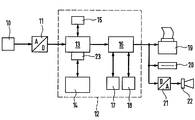
- a block diagram of a device for carrying out the method according to the invention is shown in the drawing and described in detail in the following description together with the method according to the invention.
- a microphone 10 or another conversion device for converting sound signals into electrical signals is connected via an analog-digital converter 11 to the speech input of a speech recognition computer or speech computer 12, which can be, for example, a PC.
- a speech recognition computer or speech computer 12 can be, for example, a PC.
- speech computer 12 a representation was chosen which emphasizes the functions and functional units required for speech recognition and speech translation, while in fact of course the usual structure exists, which essentially consists of a microprocessor, a read-only memory Contains memory, an input keyboard, a screen, and disk drives.
- the functional blocks shown are actually realized by functions of the microprocessor in connection with the other elements of the computer connected to them.
- the analog signal sequences supplied to the analog-digital converter 11, which correspond to the speech sequences entered into the microphone, are fed as a digital or binary signal to a speech recognition device 13.
- a speech recognition device 13 This is connected to a memory 14 with a large memory content, in which binary signal sequences are stored which correspond to words, parts of sentences and sentences.
- the speech recognition device 13 is assigned a speech pause recognition device 15 and a data reduction device 23.
- the speech pause recognition device 15 analyzes the signal pauses following the signal supplied to the speech recognition device 13 and classifies them into three classes with regard to their length in time.
- a simpler version can also be classified in only two classes or, in more complex versions, in an even larger number of classes.
- the very short signal pauses assigned to a first class separate the input signal sequence into sections that correspond to individual words, for example, while longer signal pauses are assigned to a second class in order to divide the signal sequence into longer sections that correspond to parts of sentences, for example.
- even longer signal pauses are assigned to a third class, which corresponds to a subdivision of the signal sequence into even longer sections, for example into whole sentences. It is assumed that, according to customary speaking habits, longer speech pauses are made between entire sentences, shorter speech pauses between parts of sentences, and shorter or no speech pauses between individual words.
- the pauses in speech are automatically analyzed and assigned to each language separately. For this purpose, larger spoken texts are first read in and digitized by the microphone. The pauses in speech are automatically recorded, automatically divided into the three classes and saved for the respective language. These stored classified speech pauses are then used in the following for the recognition of spoken texts.
- long and medium pauses are used to divide the spoken text into language units.
- a very long, normalized text is first stored, for example, on a CD disk is inserted, read and divided into speech units by recognizing the long and medium pauses in speech.
- These are then stored one after the other as dictionary entries in the memory 14 and successively provided with consecutive identification numbers or serial numbers which are and remain the sole determinants of the entry.
- the ID number of the preceding and the following entry is added to each entry. This is significant if later ambiguities arise when searching for language units during the analysis or if the dictionary entry found does not fit or makes no sense for semantic or other reasons.
- different similar language units are examined for which other language units are often before or after, so that this can be taken as a further selection criterion.
- the stored language units are automatically organized at the same time. Depending on their length and bit combination, they are combined in similarity groups or language unit groups that meet certain similarity requirements with regard to their bit sequences.
- Such basic bit sequences, according to which the similarity groups are structured, are referred to below as "nouns".
- These groups, organized by main words, are in turn grouped in a higher level by "keywords” in higher groups, the "key words” representing shorter bit sequences that occur in the main words according to certain similarity criteria.
- This organization can continue at even higher levels, so that when searching for language units later, not all dictionary entries need to be checked, but only those areas of the lower levels in which such key terms or nouns occur must be selected from higher levels. so that the choice of dictionary entries is limited, between which ultimately it must be decided which one best matches the one sought. Of course, overlaps can also occur.
- the entries in the basic dictionary that is, the stored language units, which are essentially words, expressions, parts of sentences and / or sentences, are stored in a preferred execution by individual input or automatically added grammatical identifiers and / or information. This gives these words or expressions their own identity. Furthermore, in a preferred embodiment, a number of syntactic and / or semantic ciphers are added, so that they can be classified into semantic categories, for example. This is known in principle from the prior art specified at the outset. Finally, context-oriented information about the meaning and meaningfulness of the language unit in question can be added.
- the respective content of one or more language units can be expressed in an "intermediate language", the correct meanings in the target languages being selected and brought into the appropriate form.
- Some of the identifiers and ciphers can be added automatically, but some of them have to be added individually by linguists.
- the stored speech units are called up one after the other and provided with these ciphers by keyboard input or spoken input. This additional information can be stored in a separate memory or memory area and is identified by the identification number or an assigned address if required reached.
- the language units to be stored and analyzed can be subjected to a data reduction.
- all information that is not absolutely necessary for the search such as accentuation, pitch, timbre, etc., is removed or saved separately so that it can only be accessed when necessary.
- the bit combinations to be stored are freed from this information and thereby greatly shortened.
- the test mode checks whether the text is still correctly recognized becomes. Then it is subjected to a further data reduction, the data reduction being continued in stages until a satisfactory recognition of the text is no longer possible. Then the data reduction level is selected and specified for future processes in which a good result has just been achieved. Language units are then generally stored with this data reduction level, the language units to be recognized or analyzed being of course likewise subjected to the same data reduction.
- the input speech units are converted into a phonetic code, which can be, for example, the international phonetic alphabet.
- a phonetic code which can be, for example, the international phonetic alphabet.
- the dictionary contains only entries of speech units converted into this phonetic code, wherein newly entered speech units to be recognized are also converted into this phonetic code.
- the language units to be saved and recognized are converted into hexadecimal expressions after the data reduction and saved or analyzed in this form.
- the representation as a phonetic code results in a particularly simple representation on the screen or the printer or in the speech output. The representation can then take place directly in phonetic characters or in a converted form.
- a frequency dictionary can also be created.
- the most frequently occurring language units are compiled in a frequency dictionary and stored in a separate memory or memory area.
- this frequency dictionary is first accessed, and only when this makes recognition impossible is the search in the basic dictionary already described carried out.
- an entered language unit cannot be analyzed by either the frequency dictionary or the general dictionary, it is checked whether the language unit to be recognized can be divided into sub-units by small pauses. These subunits are then searched for and analyzed in the frequency and general dictionary. If this is also unsuccessful, the subunits are examined for prepositions or postpositions, whereby accordingly, the start or end range of the respective subunit is compared with tables that contain the possible prepositions or postpositions. If a preposition or postposition is identified, it is separated and the rest of the area is searched in the dictionaries. In the absence of prepositions or postpositions, a corresponding procedure for articles, pronouns and auxiliary verbs can be carried out. If the language unit to be recognized does not contain any small pauses and therefore cannot be divided further, it is checked as a whole unit like a subunit in the manner described.
- a language unit If a language unit is definitely not found or recognized during text recognition, it is stored in a separate memory location and / or printed out. The next time the dictionary is updated or supplemented, this language unit will then be entered and defined.
- a translation device 16, to which two foreign language memories 17, 18 are assigned in the exemplary embodiment, is used to carry out translations of recognized language units into another language.
- Foreign language dictionaries consisting of language units are stored in these. It goes without saying here too possible to provide only one foreign language memory 17 if a translation should only be made into a foreign language. Likewise, a larger number of foreign language memories can also be provided if translations into a larger number of foreign languages are required.
- the foreign language dictionaries in the foreign language memories 17, 18 are formed in a manner corresponding to that which was the case with the general dictionary which is stored in the memory 14. For this purpose, the speech computer 12 can be switched to a corresponding foreign language storage mode.
- assignment ciphers must be assigned to the respective stored language units. This is done by linguists who call up the entries in the general dictionary one after the other and provide them with such ciphers, as has already been described. With the aid of these ciphers, the corresponding entries in one or more foreign dictionaries can be accessed via addresses using the "intermediate language" mentioned and the corresponding entry can be called up for output in the translation device 16.
- the output can then be printed on a printer 19 or screen, or the output signal sequence is fed to a storage medium and stored there, for example on a diskette of a diskette drive 20, on a recordable CD or the like.
- direct voice output can also take place in that the output signal sequence is fed to a loudspeaker 22 or headphones via a digital-to-analog converter 21.
- the different speech output options can be used simultaneously or alternatively, whereby simultaneous translation into several languages is also possible, for example. For this, the computer requires a correspondingly large number of output devices and output channels.
- voice recognition can also be used to output texts in the basic language, for example to automatically convert a spoken text into a written text.
- the general dictionary and any foreign dictionaries can be supplemented in the manner described.
- the frequency dictionary is updated automatically, that is, in the manner of a learning system, it always contains additional entries if their frequency exceeds existing entries. If a defined capacity of the frequency dictionary is reached, the least frequent entries are deleted.
- the saved dictionaries can also be supplemented in a certain way for special applications.
- the relevant technical terms can be added to the dictionary before a conference in the field of mechanical engineering.
- the speech computer can be informed that translations are in the field of mechanical engineering.
- those who have technical meanings in mechanical engineering can be preferred in the comparison and search process of stored language units. Search sequences can also be specified by which technical terms are preferred before the respective general meaning is taken into account.
- the information separated during data reduction e.g. accentuations, pitches, timbres and the like. can be used to refine the translations or to differentiate between ambiguities.
- additional information to which certain sound vibrations, timbre changes, unexpected changes in the speed of speech or the like. can be used to control the emotional state of the speaker to analyze, for example his state of arousal, his insecurity or security and the like.
- criteria can even be derived from the type of speech, whether the said is true, like a lie detector.
Landscapes
- Engineering & Computer Science (AREA)
- Computational Linguistics (AREA)
- Health & Medical Sciences (AREA)
- Audiology, Speech & Language Pathology (AREA)
- Human Computer Interaction (AREA)
- Physics & Mathematics (AREA)
- Acoustics & Sound (AREA)
- Multimedia (AREA)
- Machine Translation (AREA)
- Image Processing (AREA)
- Navigation (AREA)
Applications Claiming Priority (2)
| Application Number | Priority Date | Filing Date | Title |
|---|---|---|---|
| DE19624988A DE19624988A1 (de) | 1996-06-22 | 1996-06-22 | Verfahren zur automatischen Erkennung eines gesprochenen Textes |
| DE19624988 | 1996-06-22 |
Publications (3)
| Publication Number | Publication Date |
|---|---|
| EP0814457A2 true EP0814457A2 (fr) | 1997-12-29 |
| EP0814457A3 EP0814457A3 (fr) | 1998-10-21 |
| EP0814457B1 EP0814457B1 (fr) | 2002-04-10 |
Family
ID=7797698
Family Applications (1)
| Application Number | Title | Priority Date | Filing Date |
|---|---|---|---|
| EP96114919A Expired - Lifetime EP0814457B1 (fr) | 1996-06-22 | 1996-09-18 | Procédé de reconnaissance automatique d'un texte parlé |
Country Status (4)
| Country | Link |
|---|---|
| EP (1) | EP0814457B1 (fr) |
| AT (1) | ATE216118T1 (fr) |
| DE (2) | DE19624988A1 (fr) |
| ES (1) | ES2173232T3 (fr) |
Families Citing this family (10)
| Publication number | Priority date | Publication date | Assignee | Title |
|---|---|---|---|---|
| DE19907504C2 (de) * | 1999-02-22 | 2003-05-28 | Heiko Barske | Audiogerät zum sowie Verfahren zum Umwandeln von Eingabesprachinformation in Ausgabesprachinformation |
| EP1363271A1 (fr) | 2002-05-08 | 2003-11-19 | Sap Ag | Méthode et système pour le traitement et la mémorisation du signal de parole d'un dialogue |
| DE10220524B4 (de) | 2002-05-08 | 2006-08-10 | Sap Ag | Verfahren und System zur Verarbeitung von Sprachdaten und zur Erkennung einer Sprache |
| DE10304461B3 (de) * | 2003-02-04 | 2004-03-04 | Siemens Ag | Automatische Konfigurierung einer sprecherunabh ngigen Sprachwahl |
| DE10334400A1 (de) | 2003-07-28 | 2005-02-24 | Siemens Ag | Verfahren zur Spracherkennung und Kommunikationsgerät |
| DE102004055230B3 (de) | 2004-11-16 | 2006-07-20 | Siemens Ag | Verfahren zur Spracherkennung aus einem vorgebbaren Vokabular |
| JP4767754B2 (ja) | 2006-05-18 | 2011-09-07 | 富士通株式会社 | 音声認識装置および音声認識プログラム |
| DE102007003862A1 (de) | 2007-01-25 | 2009-02-05 | Anders, Klaus E., 26127 Oldenburg | Verfahren zur interkulturellen mehrsprachigen Kommunikation unter Einbeziehung einer Plansprache |
| US9839735B2 (en) | 2015-09-08 | 2017-12-12 | Fresenius Medical Care Holdings, Inc. | Voice interface for a dialysis machine |
| DE102015014527A1 (de) | 2015-11-11 | 2017-05-11 | Fresenius Medical Care Deutschland Gmbh | Medizintechnisches Gerät mit Bedienerunterstützung und Verfahren |
Family Cites Families (11)
| Publication number | Priority date | Publication date | Assignee | Title |
|---|---|---|---|---|
| US4706212A (en) * | 1971-08-31 | 1987-11-10 | Toma Peter P | Method using a programmed digital computer system for translation between natural languages |
| US4336421A (en) * | 1980-04-08 | 1982-06-22 | Threshold Technology, Inc. | Apparatus and method for recognizing spoken words |
| US4481593A (en) * | 1981-10-05 | 1984-11-06 | Exxon Corporation | Continuous speech recognition |
| US4870686A (en) * | 1987-10-19 | 1989-09-26 | Motorola, Inc. | Method for entering digit sequences by voice command |
| US4984177A (en) * | 1988-02-05 | 1991-01-08 | Advanced Products And Technologies, Inc. | Voice language translator |
| JPH02297195A (ja) * | 1989-03-02 | 1990-12-07 | Nec Corp | 形態素解析方式 |
| DE3930889A1 (de) * | 1989-09-15 | 1991-03-28 | Philips Patentverwaltung | Verfahren zur erkennung von n unterschiedlichen wortketten in einem sprachsignal |
| JP2989211B2 (ja) * | 1990-03-26 | 1999-12-13 | 株式会社リコー | 音声認識装置における辞書制御方式 |
| EP0472193A3 (en) * | 1990-08-23 | 1993-10-20 | Oki Electric Ind Co Ltd | Translation device based on voice recognition and voice synthesis |
| CA2051135C (fr) * | 1991-09-11 | 1996-05-07 | Kim D. Letkeman | Dictionnaire de langage comprime |
| DE4422545A1 (de) * | 1994-06-28 | 1996-01-04 | Sel Alcatel Ag | Start-/Endpunkt-Detektion zur Worterkennung |
-
1996
- 1996-06-22 DE DE19624988A patent/DE19624988A1/de not_active Withdrawn
- 1996-09-18 EP EP96114919A patent/EP0814457B1/fr not_active Expired - Lifetime
- 1996-09-18 ES ES96114919T patent/ES2173232T3/es not_active Expired - Lifetime
- 1996-09-18 DE DE59609067T patent/DE59609067D1/de not_active Expired - Fee Related
- 1996-09-18 AT AT96114919T patent/ATE216118T1/de not_active IP Right Cessation
Also Published As
| Publication number | Publication date |
|---|---|
| ES2173232T3 (es) | 2002-10-16 |
| DE19624988A1 (de) | 1998-01-02 |
| ATE216118T1 (de) | 2002-04-15 |
| EP0814457B1 (fr) | 2002-04-10 |
| DE59609067D1 (de) | 2002-05-16 |
| EP0814457A3 (fr) | 1998-10-21 |
Similar Documents
| Publication | Publication Date | Title |
|---|---|---|
| DE69330427T2 (de) | Spracherkennungssystem für sprachen mit zusammengesetzten wörtern | |
| EP1113420B1 (fr) | Procédé de reconnaissance de parole et de commande d'une unité de synthèse de parole ainsi que d'un moyen de communication | |
| DE69622565T2 (de) | Verfahren und vorrichtung zur dynamischen anpassung eines spracherkennungssystems mit grossem wortschatz und zur verwendung von einschränkungen aus einer datenbank in einem spracherkennungssystem mit grossem wortschatz | |
| DE69129163T2 (de) | Verfahren und Vorrichtung zur Texteingabe | |
| DE69413052T2 (de) | Sprachsynthese | |
| DE69618503T2 (de) | Spracherkennung für Tonsprachen | |
| DE69130747T2 (de) | Übersetzungsverfahren und -system zur Übertragung zwischen zwei Sprechern mit unterschiedlicher Sprache | |
| DE69712216T2 (de) | Verfahren und gerät zum übersetzen von einer sparche in eine andere | |
| DE60016722T2 (de) | Spracherkennung in zwei Durchgängen mit Restriktion des aktiven Vokabulars | |
| DE69519328T2 (de) | Verfahren und Anordnung für die Umwandlung von Sprache in Text | |
| DE69427525T2 (de) | Trainingsmethode für ein tts-system, sich daraus ergebendes gerät und methode zur bedienung des gerätes | |
| DE60222093T2 (de) | Verfahren, modul, vorrichtung und server zur spracherkennung | |
| DE3910467C2 (de) | Verfahren und Vorrichtung zur Erzeugung von Berichten | |
| DE10040214B4 (de) | Verfahren und System zur automatischen Erkennung einer Aktualisierung eines Sprachmodells in einem Spracherkennungssystem | |
| DE69420955T2 (de) | Umwandlung von text in signalformen | |
| EP0925578B1 (fr) | Systeme et procede de traitement de la parole | |
| EP1214703B1 (fr) | Procede d'apprentissage des graphemes d'apres des regles de phonemes pour la synthese vocale | |
| EP1273003B1 (fr) | Procede et dispositif de determination de marquages prosodiques | |
| DE602004006641T2 (de) | Audio-dialogsystem und sprachgesteuertes browsing-verfahren | |
| EP0814457B1 (fr) | Procédé de reconnaissance automatique d'un texte parlé | |
| EP1282897B1 (fr) | Procede pour produire une banque de donnees vocales pour un lexique cible pour l'apprentissage d'un systeme de reconnaissance vocale | |
| EP1182646A2 (fr) | Méthode de classification des phonèmes | |
| EP0285222A2 (fr) | Procédé pour la reconnaissance de la parole continue | |
| DE602005000308T2 (de) | Vorrichtung für sprachgesteuerte Anwendungen | |
| EP2034472B1 (fr) | Procédé de reconnaissance vocale et dispositif de reconnaissance vocale |
Legal Events
| Date | Code | Title | Description |
|---|---|---|---|
| PUAI | Public reference made under article 153(3) epc to a published international application that has entered the european phase |
Free format text: ORIGINAL CODE: 0009012 |
|
| AK | Designated contracting states |
Kind code of ref document: A2 Designated state(s): AT BE CH DE DK ES FI FR GB GR IE IT LI LU NL PT SE |
|
| PUAL | Search report despatched |
Free format text: ORIGINAL CODE: 0009013 |
|
| AK | Designated contracting states |
Kind code of ref document: A3 Designated state(s): AT BE CH DE DK ES FI FR GB GR IE IT LI LU NL PT SE |
|
| 17P | Request for examination filed |
Effective date: 19990305 |
|
| RIC1 | Information provided on ipc code assigned before grant |
Free format text: 7G 10L 15/08 A, 7G 06F 17/28 B |
|
| GRAG | Despatch of communication of intention to grant |
Free format text: ORIGINAL CODE: EPIDOS AGRA |
|
| 17Q | First examination report despatched |
Effective date: 20010814 |
|
| GRAG | Despatch of communication of intention to grant |
Free format text: ORIGINAL CODE: EPIDOS AGRA |
|
| GRAH | Despatch of communication of intention to grant a patent |
Free format text: ORIGINAL CODE: EPIDOS IGRA |
|
| REG | Reference to a national code |
Ref country code: GB Ref legal event code: IF02 |
|
| GRAH | Despatch of communication of intention to grant a patent |
Free format text: ORIGINAL CODE: EPIDOS IGRA |
|
| GRAA | (expected) grant |
Free format text: ORIGINAL CODE: 0009210 |
|
| AK | Designated contracting states |
Kind code of ref document: B1 Designated state(s): AT BE CH DE DK ES FI FR GB GR IE IT LI LU NL PT SE |
|
| PG25 | Lapsed in a contracting state [announced via postgrant information from national office to epo] |
Ref country code: NL Free format text: LAPSE BECAUSE OF FAILURE TO SUBMIT A TRANSLATION OF THE DESCRIPTION OR TO PAY THE FEE WITHIN THE PRESCRIBED TIME-LIMIT Effective date: 20020410 Ref country code: IT Free format text: LAPSE BECAUSE OF FAILURE TO SUBMIT A TRANSLATION OF THE DESCRIPTION OR TO PAY THE FEE WITHIN THE PRESCRIBED TIME-LIMIT;WARNING: LAPSES OF ITALIAN PATENTS WITH EFFECTIVE DATE BEFORE 2007 MAY HAVE OCCURRED AT ANY TIME BEFORE 2007. THE CORRECT EFFECTIVE DATE MAY BE DIFFERENT FROM THE ONE RECORDED. Effective date: 20020410 Ref country code: IE Free format text: LAPSE BECAUSE OF FAILURE TO SUBMIT A TRANSLATION OF THE DESCRIPTION OR TO PAY THE FEE WITHIN THE PRESCRIBED TIME-LIMIT Effective date: 20020410 Ref country code: GR Free format text: LAPSE BECAUSE OF FAILURE TO SUBMIT A TRANSLATION OF THE DESCRIPTION OR TO PAY THE FEE WITHIN THE PRESCRIBED TIME-LIMIT Effective date: 20020410 Ref country code: GB Free format text: LAPSE BECAUSE OF FAILURE TO SUBMIT A TRANSLATION OF THE DESCRIPTION OR TO PAY THE FEE WITHIN THE PRESCRIBED TIME-LIMIT Effective date: 20020410 Ref country code: FR Free format text: LAPSE BECAUSE OF FAILURE TO SUBMIT A TRANSLATION OF THE DESCRIPTION OR TO PAY THE FEE WITHIN THE PRESCRIBED TIME-LIMIT Effective date: 20020410 Ref country code: FI Free format text: LAPSE BECAUSE OF FAILURE TO SUBMIT A TRANSLATION OF THE DESCRIPTION OR TO PAY THE FEE WITHIN THE PRESCRIBED TIME-LIMIT Effective date: 20020410 |
|
| REF | Corresponds to: |
Ref document number: 216118 Country of ref document: AT Date of ref document: 20020415 Kind code of ref document: T |
|
| REG | Reference to a national code |
Ref country code: CH Ref legal event code: EP |
|
| REG | Reference to a national code |
Ref country code: IE Ref legal event code: FG4D Free format text: GERMAN |
|
| REF | Corresponds to: |
Ref document number: 59609067 Country of ref document: DE Date of ref document: 20020516 |
|
| REG | Reference to a national code |
Ref country code: CH Ref legal event code: NV Representative=s name: TROESCH SCHEIDEGGER WERNER AG |
|
| PG25 | Lapsed in a contracting state [announced via postgrant information from national office to epo] |
Ref country code: SE Free format text: LAPSE BECAUSE OF FAILURE TO SUBMIT A TRANSLATION OF THE DESCRIPTION OR TO PAY THE FEE WITHIN THE PRESCRIBED TIME-LIMIT Effective date: 20020710 Ref country code: PT Free format text: LAPSE BECAUSE OF FAILURE TO SUBMIT A TRANSLATION OF THE DESCRIPTION OR TO PAY THE FEE WITHIN THE PRESCRIBED TIME-LIMIT Effective date: 20020710 Ref country code: DK Free format text: LAPSE BECAUSE OF FAILURE TO SUBMIT A TRANSLATION OF THE DESCRIPTION OR TO PAY THE FEE WITHIN THE PRESCRIBED TIME-LIMIT Effective date: 20020710 |
|
| NLV1 | Nl: lapsed or annulled due to failure to fulfill the requirements of art. 29p and 29m of the patents act | ||
| PG25 | Lapsed in a contracting state [announced via postgrant information from national office to epo] |
Ref country code: LU Free format text: LAPSE BECAUSE OF NON-PAYMENT OF DUE FEES Effective date: 20020918 Ref country code: AT Free format text: LAPSE BECAUSE OF NON-PAYMENT OF DUE FEES Effective date: 20020918 |
|
| PG25 | Lapsed in a contracting state [announced via postgrant information from national office to epo] |
Ref country code: BE Free format text: LAPSE BECAUSE OF NON-PAYMENT OF DUE FEES Effective date: 20020930 |
|
| GBV | Gb: ep patent (uk) treated as always having been void in accordance with gb section 77(7)/1977 [no translation filed] |
Effective date: 20020410 |
|
| REG | Reference to a national code |
Ref country code: ES Ref legal event code: FG2A Ref document number: 2173232 Country of ref document: ES Kind code of ref document: T3 |
|
| REG | Reference to a national code |
Ref country code: IE Ref legal event code: FD4D Ref document number: 0814457E Country of ref document: IE |
|
| EN | Fr: translation not filed | ||
| PLBE | No opposition filed within time limit |
Free format text: ORIGINAL CODE: 0009261 |
|
| STAA | Information on the status of an ep patent application or granted ep patent |
Free format text: STATUS: NO OPPOSITION FILED WITHIN TIME LIMIT |
|
| BERE | Be: lapsed |
Owner name: *TOMA PETER Effective date: 20020930 |
|
| 26N | No opposition filed |
Effective date: 20030113 |
|
| PGFP | Annual fee paid to national office [announced via postgrant information from national office to epo] |
Ref country code: CH Payment date: 20031202 Year of fee payment: 8 |
|
| PG25 | Lapsed in a contracting state [announced via postgrant information from national office to epo] |
Ref country code: LI Free format text: LAPSE BECAUSE OF NON-PAYMENT OF DUE FEES Effective date: 20040930 Ref country code: CH Free format text: LAPSE BECAUSE OF NON-PAYMENT OF DUE FEES Effective date: 20040930 |
|
| PGFP | Annual fee paid to national office [announced via postgrant information from national office to epo] |
Ref country code: ES Payment date: 20050225 Year of fee payment: 9 Ref country code: DE Payment date: 20050225 Year of fee payment: 9 |
|
| REG | Reference to a national code |
Ref country code: CH Ref legal event code: PL |
|
| PG25 | Lapsed in a contracting state [announced via postgrant information from national office to epo] |
Ref country code: ES Free format text: LAPSE BECAUSE OF NON-PAYMENT OF DUE FEES Effective date: 20050919 |
|
| PG25 | Lapsed in a contracting state [announced via postgrant information from national office to epo] |
Ref country code: DE Free format text: LAPSE BECAUSE OF NON-PAYMENT OF DUE FEES Effective date: 20060401 |
|
| REG | Reference to a national code |
Ref country code: ES Ref legal event code: FD2A Effective date: 20050919 |