EP0814574A2 - Circuitrie pour la compensation de la télédiaphonie - Google Patents
Circuitrie pour la compensation de la télédiaphonie Download PDFInfo
- Publication number
- EP0814574A2 EP0814574A2 EP97109586A EP97109586A EP0814574A2 EP 0814574 A2 EP0814574 A2 EP 0814574A2 EP 97109586 A EP97109586 A EP 97109586A EP 97109586 A EP97109586 A EP 97109586A EP 0814574 A2 EP0814574 A2 EP 0814574A2
- Authority
- EP
- European Patent Office
- Prior art keywords
- filter
- arrangement according
- dfe
- crosstalk
- data
- Prior art date
- Legal status (The legal status is an assumption and is not a legal conclusion. Google has not performed a legal analysis and makes no representation as to the accuracy of the status listed.)
- Ceased
Links
- 230000004044 response Effects 0.000 claims abstract description 21
- 230000003044 adaptive effect Effects 0.000 claims abstract description 10
- RYGMFSIKBFXOCR-UHFFFAOYSA-N Copper Chemical compound [Cu] RYGMFSIKBFXOCR-UHFFFAOYSA-N 0.000 claims description 11
- 229910052802 copper Inorganic materials 0.000 claims description 11
- 239000010949 copper Substances 0.000 claims description 11
- 239000002243 precursor Substances 0.000 claims description 7
- 238000012546 transfer Methods 0.000 claims description 3
- 239000003365 glass fiber Substances 0.000 claims 1
- 230000005540 biological transmission Effects 0.000 description 31
- 238000004891 communication Methods 0.000 description 7
- 230000008030 elimination Effects 0.000 description 6
- 238000003379 elimination reaction Methods 0.000 description 6
- 239000000835 fiber Substances 0.000 description 6
- 238000000034 method Methods 0.000 description 5
- 238000000926 separation method Methods 0.000 description 5
- 238000011045 prefiltration Methods 0.000 description 3
- 238000011144 upstream manufacturing Methods 0.000 description 3
- 230000008901 benefit Effects 0.000 description 2
- 238000002592 echocardiography Methods 0.000 description 2
- 230000009467 reduction Effects 0.000 description 2
- 238000013459 approach Methods 0.000 description 1
- 230000008033 biological extinction Effects 0.000 description 1
- 230000003139 buffering effect Effects 0.000 description 1
- 230000001413 cellular effect Effects 0.000 description 1
- 230000008878 coupling Effects 0.000 description 1
- 238000010168 coupling process Methods 0.000 description 1
- 238000005859 coupling reaction Methods 0.000 description 1
- 230000003111 delayed effect Effects 0.000 description 1
- 230000001419 dependent effect Effects 0.000 description 1
- 238000011161 development Methods 0.000 description 1
- 230000018109 developmental process Effects 0.000 description 1
- 238000005516 engineering process Methods 0.000 description 1
- 230000008569 process Effects 0.000 description 1
- 238000012545 processing Methods 0.000 description 1
- 230000002123 temporal effect Effects 0.000 description 1
Images


Classifications
-
- H—ELECTRICITY
- H04—ELECTRIC COMMUNICATION TECHNIQUE
- H04B—TRANSMISSION
- H04B3/00—Line transmission systems
- H04B3/02—Details
- H04B3/32—Reducing cross-talk, e.g. by compensating
Definitions
- Hybrid fiber-optic / copper two-wire system architectures enable the provision of symmetrical or asymmetrical subscriber connections with data rates from 6.25 to 50 Mbit / s via existing copper twin-wire connection cables.
- the following interference occurs, for example, when transmitting over the copper twin wires: echoes, crosstalk, interference by amateur radio systems (Radio Frequency Interference (RFI)), pulse interference and white noise. Which of these faults dominates and thus becomes system-dependent depends on the transmission method selected.
- RFID Radio Frequency Interference
- TDM time division multiplexing
- FDM frequency division multiplexing
- a modulation method with low bandwidth efficiency (eg 4-QAM) is advantageous for the upper of the two transmission channels if there is no strict bandwidth limitation.
- the far-end crosstalk attenuation (FEXT) is increased due to the lower carrier frequency, the increase in a minimum signal-to-noise ratio (SNR) by approx. 6 dB leads to a relative increase in the FEXT -Noise level and a corresponding reduction in range.
- SNR signal-to-noise ratio
- the article proposes to combine several copper transmission systems of a multi-pair cable into a "vector transceiver", i.e. the individual transmitters / receivers are connected so that NEXT and FEXT can be compensated.
- the arrangement of a two-dimensional equalizer for FEXT compensation is shown in FIG. 3.
- the 2-D equalizer can also be used to eliminate interference from adjacent channels.
- the followers of a far-end crosstalk impulse response are eliminated with adaptive equalizers 2DE 21, ..., 2DE N1 according to the principle of a linear 2-dimensional equalizer (2DE N1).
- An equalizer with quantized feedback is used for intersymbol interference (ISI) elimination.
- the known filter circuit arrangement has the disadvantage that all connecting lines begin and end at a single point.
- the connection paths between the different subscriber terminals and, for example, a cable distributor are of different lengths.
- the system also has the disadvantage that no vector transceiver can be formed on the subscriber side, since the transmission systems are spatially distributed.
- the known system also has the disadvantage that the output signals of the multichannel prefilter MVF are overlaid with noise.
- the object of the invention is to provide a filter architecture to avoid distant crosstalk for a communication network with a hybrid fiber / copper twin-wire system.
- the circuit arrangement has the advantage that, regardless of the length of the respective connection paths, the far crosstalk is suppressed and the signal-to-noise ratio is significantly increased.
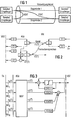
- Figure 1 shows the influence of crosstalk disorders which are divided into near crosstalk (NEXT) and long distance crosstalk (FEXT). These crosstalk disorders essentially arise from the coupling of transmission energy to other lines routed in the branch cable.
- NEXT near crosstalk
- FXT long distance crosstalk
- FIGS. 3, 4 and 5 only show the FEXT compensation for a channel rn (T).
- the same filter arrangements must be used for all other channels.
- FIG. 2 shows a section of a communication network KN.
- Cable distributors KVz and subscriber terminals Tn are connected by a data transmission channel Nkn.
- a Fork circuit G forms the connection unit between the transmission channel Nkn, send-Sn and receive direction En.
- the data between the communication terminals is transmitted using the frequency separation method.
- the upper frequency band is used for a transmission from the subscriber Tn to the exchange and the lower frequency band is used for data transmission from the exchange to the subscriber Tn.
- the maximum range for a symmetrical data transmission is given by the upper frequency band, which is initially limited by remote crosstalk FEXT.
- An increase in range, for example between KVz and Tn, can be achieved by FEXT compensation in a KVz cable splitter.
- the interference component caused by the system 1 is at the cable distributor KVz Distant crosstalk in the received signal r2 (T), with a remote crosstalk signal simulated from the received signal r1 (T). This extinction of the far crosstalk is achieved by an adaptive filter FK.
- FIG. 3 shows a two-dimensional equalizer for FEXT compensation, as is known from the prior art.
- reception signals r1 (T), ..., r4 (T) are fed to a multichannel pre-filter MVF and largely cleaned of the precursors of the channel impulse response.
- a 2-D equalizer is arranged after the multi-channel pre-filter MVF.
- the followers of a FEXT impulse response are simulated with an adaptive filter 2DE 21, 2DE N1 and eliminated according to the principle of a linear 2-dimensional equalizer.
- the intersymbol interference ISI pulse followers
- the distant crosstalk in the received signal r1 (T) caused by the transmission power of the systems 2 to N on the useful channel NK1 is reduced in that the distant crosstalk is reproduced in the individual channels by the data streams r2 (T) to rN (T) and before one Elimination of the pulse followers in the data stream r1 (T) is subtracted from this.
- FIGS. 4 and 5 show a section of a hybrid fiber twisted pair HFTP system with FEXT compensation.
- a frequency division multiplex method is used for data transmission.
- the circuit arrangement shown is arranged, for example, at a transfer point between a copper pair / fiber optic technology in a cable junction of the communication network KN.
- FEXT compensation increases the signal-to-noise ratio or the system reserve in the case of a remote crosstalk limitation.
- the noise superimposed on the data is eliminated by the decision maker Kn.
- the entire far-end crosstalk impulse response in the filter units FK21, ...., FKN1 of the respective data stream replicated.
- the FEXT disturbance approximated by the convolution of the received signals with the simulated FEXT impulse responses is added at a summation point S1 on the received signal of the useful channel Nkn, thus eliminating the FEXT disturbance.
- the useful signal r1 (T) is subsequently cleaned by the filter unit FF11 from the pulse precursors of the FEXT impulse response, and the comparator K1 eliminates the noise still superimposed on the useful signal r1 (T).
- the feedback of the noise-free data stream via the filter unit DEF 11 eliminates pulse followers in the data stream r1 (T).
- All filters FEXT compensators (FK), pulse precursor equalizers FF (feed forward), adaptive decision-feedback equalizers DFE) are designed as adaptive transversal filters (Finite Impulse Response Filters, FIR):
- the filter coefficients required for this are based on the least mean Square algorithm (LMS) or the sign LMS algorithm is automatically set so that the mean square of the residual error from inter-symbol interference ISI and inter-channel interference (far crosstalk) is minimized.
- LMS least mean Square algorithm
- the sign LMS algorithm is automatically set so that the mean square of the residual error from inter-symbol interference ISI and inter-channel interference (far crosstalk) is minimized.
- a hardware architecture for FF filters and the LMS algorithm are from K. Parhi, Concurrent Cellular VLSI Adaptive Filter Architectures , IEEE Transactions on Circuits and Systems, Vol. CAS-34, No. October 10, 1987.
- a similar structure can be used for the DFE filters.
- FIG. 5 shows a circuit arrangement for compensating long-distance crosstalk, which is also independent of the length of the copper pairs between the subscriber terminal Tn and the cable junction KVz.
- the two-dimensional decision feedback filter 2-D-DFE only the input signal of the feedforward filter (FF) is affected by noise, while the feedback filters DFE 11, ..., DFE NN are driven with an interference-free signal.
- This arrangement enables a very high gain in the signal / noise ratio to be achieved.
- the FEXT compensation based on the 2-D decision feedback equalizer DFE offers the advantage of a larger tolerance when setting the transmission power from the subscriber to the exchange (upstream transmission).
- the signals r 2 (T), r 3 (T), r N (T) are used as input signals for FEXT compensators and the signal-to-noise ratio SNR of the signals rN (T) is, for example, 20 dB, the maximum achievable compensation loss is limited to 20 dB, which leads to losses in comparison with a higher compensation loss leads in the signal / noise ratio SNR at the decision maker K1, ..., Kn.
- the circuit arrangement shown in FIG. 5 is particularly suitable for FEXT compensation, since the FEXT impulse response is delayed compared to the impulse response of the user channel, so that the majority of the impulse response is caused by the DFE filter and not by the impulse with noise.
- Precursor equalizer filter FF filter is compensated.
Landscapes
- Engineering & Computer Science (AREA)
- Computer Networks & Wireless Communication (AREA)
- Signal Processing (AREA)
- Cable Transmission Systems, Equalization Of Radio And Reduction Of Echo (AREA)
Applications Claiming Priority (2)
| Application Number | Priority Date | Filing Date | Title |
|---|---|---|---|
| DE1996124927 DE19624927C2 (de) | 1996-06-21 | 1996-06-21 | Schaltungsanordnung zur Fernnebensprechkompensation |
| DE19624927 | 1996-06-21 |
Publications (2)
| Publication Number | Publication Date |
|---|---|
| EP0814574A2 true EP0814574A2 (fr) | 1997-12-29 |
| EP0814574A3 EP0814574A3 (fr) | 2004-12-01 |
Family
ID=7797654
Family Applications (1)
| Application Number | Title | Priority Date | Filing Date |
|---|---|---|---|
| EP97109586A Ceased EP0814574A3 (fr) | 1996-06-21 | 1997-06-12 | Circuitrie pour la compensation de la télédiaphonie |
Country Status (2)
| Country | Link |
|---|---|
| EP (1) | EP0814574A3 (fr) |
| DE (1) | DE19624927C2 (fr) |
Cited By (5)
| Publication number | Priority date | Publication date | Assignee | Title |
|---|---|---|---|---|
| WO2000052845A1 (fr) * | 1999-03-05 | 2000-09-08 | The Board Of Trustrees, Leland Stanford Junior University | Detection iterative d'utilisateurs multiples |
| WO2001095517A3 (fr) * | 2000-06-07 | 2002-10-17 | Schlumberger Ca Ltd | Annulation de telediaphonie pour transmission de donnees sur modes de propagation multiples |
| EP1422834A1 (fr) * | 2002-11-25 | 2004-05-26 | Alcatel | Appareil de télécommunication pour la compensation de la diaphonie |
| EP1422835A1 (fr) * | 2002-11-25 | 2004-05-26 | Alcatel | Appareil de télécommunication pour la compensation de la diaphonie |
| US7027537B1 (en) | 1999-03-05 | 2006-04-11 | The Board Of Trustees Of The Leland Stanford Junior University | Iterative multi-user detection |
Families Citing this family (1)
| Publication number | Priority date | Publication date | Assignee | Title |
|---|---|---|---|---|
| WO1999046867A1 (fr) * | 1998-03-09 | 1999-09-16 | Broadcom Corporation | Emetteur recepteur ethernet a capacite de gigabits |
Family Cites Families (4)
| Publication number | Priority date | Publication date | Assignee | Title |
|---|---|---|---|---|
| US3660608A (en) * | 1968-11-29 | 1972-05-02 | Bunker Ramo | Means for reducing cross talk in multiplexed circuitry |
| DE3343584A1 (de) * | 1983-12-01 | 1985-06-13 | Siemens AG, 1000 Berlin und 8000 München | Verfahren und schaltungsanordnung zur kompensation von uebersprech- u./o. echosignalen |
| EP0360904B1 (fr) * | 1988-09-29 | 1994-08-24 | Siemens Aktiengesellschaft | Circuit d'égalisation de signaux numériques reçus sous forme analogique |
| DE4032067A1 (de) * | 1990-10-10 | 1992-04-16 | Standard Elektrik Lorenz Ag | Leitungseinrichtung zur kompensation von nebensprechen |
-
1996
- 1996-06-21 DE DE1996124927 patent/DE19624927C2/de not_active Expired - Fee Related
-
1997
- 1997-06-12 EP EP97109586A patent/EP0814574A3/fr not_active Ceased
Cited By (8)
| Publication number | Priority date | Publication date | Assignee | Title |
|---|---|---|---|---|
| WO2000052845A1 (fr) * | 1999-03-05 | 2000-09-08 | The Board Of Trustrees, Leland Stanford Junior University | Detection iterative d'utilisateurs multiples |
| US7027537B1 (en) | 1999-03-05 | 2006-04-11 | The Board Of Trustees Of The Leland Stanford Junior University | Iterative multi-user detection |
| WO2001095517A3 (fr) * | 2000-06-07 | 2002-10-17 | Schlumberger Ca Ltd | Annulation de telediaphonie pour transmission de donnees sur modes de propagation multiples |
| GB2382965A (en) * | 2000-06-07 | 2003-06-11 | Schlumberger Holdings | Far-end cross-talk cancellation for data transmission on multiple propogation modes |
| GB2382965B (en) * | 2000-06-07 | 2005-01-05 | Schlumberger Holdings | Far-end cross-talk cancellation for data transmission on multiple propogation modes |
| US6999517B1 (en) | 2000-06-07 | 2006-02-14 | Sehlumberger Technology Corporation | Method and apparatus for transmission of data on multiple propagation modes with far-end cross-talk cancellation |
| EP1422834A1 (fr) * | 2002-11-25 | 2004-05-26 | Alcatel | Appareil de télécommunication pour la compensation de la diaphonie |
| EP1422835A1 (fr) * | 2002-11-25 | 2004-05-26 | Alcatel | Appareil de télécommunication pour la compensation de la diaphonie |
Also Published As
| Publication number | Publication date |
|---|---|
| DE19624927C2 (de) | 1999-11-04 |
| DE19624927A1 (de) | 1998-01-08 |
| EP0814574A3 (fr) | 2004-12-01 |
Similar Documents
| Publication | Publication Date | Title |
|---|---|---|
| DE2740141C3 (de) | Gemeinsame adaptive Echounterdrückungs- und Entzerrervorrichtung für eine Zweidraht-Vollduplex-Datenübertragungsanordnung | |
| DE69416641T2 (de) | Diskretmerfachttonübertragung über schnelle, digitale Teilnehmerleitungen | |
| DE69429137T2 (de) | Unterdrückung von nahem Übersprechen | |
| DE69028356T2 (de) | Zweirichtungssender-Empfänger für ein Hochgeschwindigkeitsdatensystem | |
| DE68919250T2 (de) | Verfahren und Vorrichtung zur Breitband-Übertragung von digitalen Signalen zwischen einer Telefonvermittlungsanlage und den Endeinrichtungen. | |
| DE69925628T2 (de) | Fir-filterstruktur mit geringer latenzzeit, zur andwendung bei gigabit-ethernet | |
| DE2727242C3 (de) | Schaltungsanordnung für simultane Zweiwgdatenübertragung über Zweidrahtverbindungen | |
| DE19843145B4 (de) | Verfahren zur Sequenzerfassung und Sequenz-Ausgleicheinrichtung | |
| DE2740123A1 (de) | Echoausloeschanordnung fuer eine zweidraht-zweiweg-datenuebertragungsanlage | |
| DE69906548T2 (de) | DSL-Übertragungsystem mit Fernnebensprechkompensation | |
| EP0480323B1 (fr) | Dispositif de ligne pour compenser la diaphonie | |
| EP2522082B1 (fr) | Dispositif et procédé de compensation et d'identification de diaphonie | |
| EP1082845A1 (fr) | Regulation de niveau et filtrage adaptatif dans des recepteurs de systeme de planification de processus assistee par ordinateur | |
| EP0144067B1 (fr) | Procédé et circuit de compensation de signaux de diaphonie et/ou d'écho | |
| DE69803837T2 (de) | Kombinierter paralleler anpassbarer entzerrer/echounterdrücker | |
| DE69922176T2 (de) | Verbesserungen bei vdsl | |
| EP1118245B1 (fr) | Dispositif de terminaison de ligne pour une ligne de raccordement d'abonne | |
| DE3889810T2 (de) | Digitales Übertragungsverfahren mit Pseudo-Mehrstufen und bipolaren Kodierungstechniken. | |
| DE19624927C2 (de) | Schaltungsanordnung zur Fernnebensprechkompensation | |
| EP1415409B1 (fr) | Dispositif pour ameliorer les proprietes de transmission d'un faisceau de lignes de donnees electriques et systeme de transmission de donnees | |
| DE19624928C2 (de) | Verfahren zur Kompensation von Fernnebensprechen | |
| DE69815104T2 (de) | In einen digitalen und analogen teil unterteiltes vdsl-modem | |
| EP0387498B1 (fr) | Système de transmission numérique pour transmettre plusieurs signaux binaires sur une paire de conducteurs | |
| EP0663786B1 (fr) | Procédé de transmission de données numériques | |
| EP0963085A1 (fr) | Procédé de réglage des filtres adaptifs dans un système MAQ/CAP |
Legal Events
| Date | Code | Title | Description |
|---|---|---|---|
| PUAI | Public reference made under article 153(3) epc to a published international application that has entered the european phase |
Free format text: ORIGINAL CODE: 0009012 |
|
| AK | Designated contracting states |
Kind code of ref document: A2 Designated state(s): AT BE CH DE DK ES FI FR GB GR IE IT LI LU MC NL PT SE |
|
| PUAL | Search report despatched |
Free format text: ORIGINAL CODE: 0009013 |
|
| AK | Designated contracting states |
Kind code of ref document: A3 Designated state(s): AT BE CH DE DK ES FI FR GB GR IE IT LI LU MC NL PT SE |
|
| 17P | Request for examination filed |
Effective date: 20050531 |
|
| 17Q | First examination report despatched |
Effective date: 20050701 |
|
| AKX | Designation fees paid |
Designated state(s): FR GB IT NL |
|
| REG | Reference to a national code |
Ref country code: DE Ref legal event code: 8566 |
|
| RAP1 | Party data changed (applicant data changed or rights of an application transferred) |
Owner name: NOKIA SIEMENS NETWORKS GMBH & CO. KG |
|
| RAP3 | Party data changed (applicant data changed or rights of an application transferred) |
Owner name: NOKIA SIEMENS NETWORKS S.P.A. |
|
| RAP3 | Party data changed (applicant data changed or rights of an application transferred) |
Owner name: NOKIA SIEMENS NETWORKS GMBH & CO. KG |
|
| STAA | Information on the status of an ep patent application or granted ep patent |
Free format text: STATUS: THE APPLICATION HAS BEEN REFUSED |
|
| 18R | Application refused |
Effective date: 20111222 |