EP0814581B2 - CDMA Nachrichtenübertragungsverfahren und Gruppenspreizmodulator - Google Patents
CDMA Nachrichtenübertragungsverfahren und Gruppenspreizmodulator Download PDFInfo
- Publication number
- EP0814581B2 EP0814581B2 EP19970304088 EP97304088A EP0814581B2 EP 0814581 B2 EP0814581 B2 EP 0814581B2 EP 19970304088 EP19970304088 EP 19970304088 EP 97304088 A EP97304088 A EP 97304088A EP 0814581 B2 EP0814581 B2 EP 0814581B2
- Authority
- EP
- European Patent Office
- Prior art keywords
- spreading
- rate
- data
- sequence
- row vectors
- Prior art date
- Legal status (The legal status is an assumption and is not a legal conclusion. Google has not performed a legal analysis and makes no representation as to the accuracy of the status listed.)
- Expired - Lifetime
Links
Images








Classifications
-
- H—ELECTRICITY
- H04—ELECTRIC COMMUNICATION TECHNIQUE
- H04J—MULTIPLEX COMMUNICATION
- H04J13/00—Code division multiplex systems
- H04J13/10—Code generation
- H04J13/12—Generation of orthogonal codes
-
- H—ELECTRICITY
- H04—ELECTRIC COMMUNICATION TECHNIQUE
- H04B—TRANSMISSION
- H04B7/00—Radio transmission systems, i.e. using radiation field
- H04B7/24—Radio transmission systems, i.e. using radiation field for communication between two or more posts
- H04B7/26—Radio transmission systems, i.e. using radiation field for communication between two or more posts at least one of which is mobile
- H04B7/2628—Radio transmission systems, i.e. using radiation field for communication between two or more posts at least one of which is mobile using code-division multiple access [CDMA] or spread spectrum multiple access [SSMA]
- H04B7/264—Radio transmission systems, i.e. using radiation field for communication between two or more posts at least one of which is mobile using code-division multiple access [CDMA] or spread spectrum multiple access [SSMA] for data rate control
-
- H—ELECTRICITY
- H04—ELECTRIC COMMUNICATION TECHNIQUE
- H04B—TRANSMISSION
- H04B1/00—Details of transmission systems, not covered by a single one of groups H04B3/00 - H04B13/00; Details of transmission systems not characterised by the medium used for transmission
- H04B1/69—Spread spectrum techniques
- H04B1/707—Spread spectrum techniques using direct sequence modulation
-
- H—ELECTRICITY
- H04—ELECTRIC COMMUNICATION TECHNIQUE
- H04J—MULTIPLEX COMMUNICATION
- H04J13/00—Code division multiplex systems
- H04J13/0077—Multicode, e.g. multiple codes assigned to one user
-
- H—ELECTRICITY
- H04—ELECTRIC COMMUNICATION TECHNIQUE
- H04B—TRANSMISSION
- H04B2201/00—Indexing scheme relating to details of transmission systems not covered by a single group of H04B3/00 - H04B13/00
- H04B2201/69—Orthogonal indexing scheme relating to spread spectrum techniques in general
- H04B2201/707—Orthogonal indexing scheme relating to spread spectrum techniques in general relating to direct sequence modulation
- H04B2201/70703—Orthogonal indexing scheme relating to spread spectrum techniques in general relating to direct sequence modulation using multiple or variable rates
-
- H—ELECTRICITY
- H04—ELECTRIC COMMUNICATION TECHNIQUE
- H04J—MULTIPLEX COMMUNICATION
- H04J13/00—Code division multiplex systems
- H04J13/0007—Code type
- H04J13/004—Orthogonal
-
- H—ELECTRICITY
- H04—ELECTRIC COMMUNICATION TECHNIQUE
- H04J—MULTIPLEX COMMUNICATION
- H04J13/00—Code division multiplex systems
- H04J13/16—Code allocation
- H04J13/18—Allocation of orthogonal codes
Definitions
- the present invention relates to a CDMA (Code Division Multiple Access) communication method and a group spreading modulator applicable to the method.
- CDMA Code Division Multiple Access
- spreading sequences of the same length have been used in the CDMA communication system. Those spreading sequences are orthogonal to each other when multiple users communicate simultaneously through forward links (from a base station to mobile stations). This is because all the simultaneous users share the same radio band in the CDMA, and hence the interference between the users must be minimized.
- WO-A-95/03652 discloses a simultaneous multi-user communication method in which each user channel is assigned as a spreading code, a unique orthogonal Walsh sequence of a length determined by the channel data rate.
- each user channel is assigned as a spreading code, a unique orthogonal Walsh sequence of a length determined by the channel data rate.
- the digital symbol stream for each voice signal is multiplied by its assigned Walsh sequence.
- the length of the assigned Walsh sequence may change while a call is in progress to enhance efficiency.
- Another object of the present invention is to provide a group spreading modulator suitable for the spreading modulation using the spreading sequences thus generated.
- a CDMA communication method for spreading modulated transmitting data using a spreading sequence selected from one of the row vectors of 2 N x 2 N dimensional matrices, where N is an integer greater than zero, generated from a smaller dimensional matrix under a predetermined rule, each of said matrices including row vectors orthogonal to each other, wherein said transmitting data in said CDMA communication method includes a plurality of data with differential peak transmission rates, and wherein the method comprises the step of:
- Fig. 1 is a block diagram showing a transmitting end
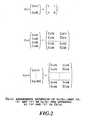
- Figs. 2 and 3 are schematic diagrams illustrating a generation and assignment rule of spreading sequences in accordance with an embodiment of the present invention.
- transmitted data of users are each modulated by data modulators 1 into narrowband modulated signals.
- the narrowband modulated signals each undergo spreading modulation into wideband signals using short period spreading sequences selected by a short period spreading sequence generator 2 in a manner as will be described later, followed by addition by an adder 3, and followed by spreading using a long period spreading sequence, thereby being output as a wideband spread signal.
- the long period spreading sequence having a period longer than that of the short period spreading sequences, is generated by a long period spreading sequence generator 4.
- a controller 5 controls the data modulators 1, short period spreading sequence generator 2 and long period spreading sequence generator 4.
- the spreading sequences are generated under a predetermined rule as illustrated in Fig. 2 which shows a comparative example.
- C 2n 's are defined as shown in Fig. 2.
- the row vectors of the matrices generated in this example become Walsh functions.
- the spreading sequence is selected and is used for different peak transmission rates in such a way that no sequences are used that are generated from the sequence to be selected and are lower in rank and correspond to.
- the spreading sequences of the entire simultaneous users can be made orthogonal at all transmission rate, as can be seen from the generation rule of the spreading sequences.
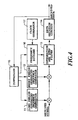
- Fig. 4 is a block diagram showing a receiving end in accordance with the invention.
- a received signal is despread using a long period spreading sequence selected by a long period spreading sequence generator 11, is further despread using a short period spreading sequence selected by a short period spreading sequence generator 12, passes through an integration and dump filter 13, and undergoes data decision by a data decision circuit 14 to be output as received data.
- a controller 15 supplies the long period spreading sequence generator 11 and short period spreading sequence generator 12 with data required for selecting the spreading sequences, provides a frequency divider 16 with the output of a clock generator 17, and supplies the integration and dump filter 13 with the integration and dump timing.
- a despreading method at the receiving end will now be described in the case where the spreading sequence for the data transmission rate with a peak of 2 Q times the lowest peak rate is selected from among the 2 Q row vectors in the maximum dimensional 2 N ⁇ 2 N matrix, which are generated from one of the row vectors in the 2 N-Q ⁇ 2 N-Q matrix.
- the transmitting end does not use C 16 (1) but selects C 64 (2), for example, from among the sequences ⁇ C 64 (1), C 64 (2), C 64 (3), C 64 (4) ⁇ in the maximum dimensional matrix, which include the sequence C 16 (1) as their sub-sequence. Accordingly, although the period of the sequence is 64 chips, the number of chips per bit of the transmitted data is 16. In this case, none of the ⁇ C 64 (1), C 64 (3), C 64 (4) ⁇ can be used for other users.
- the receiving end despreads using the spreading sequence C 64 (2), and decides the received data every 16 chip interval.
- Fig. 5 illustrates a radio transmitted data sequence of a base station and a mobile station.
- the transmitted data is divided at every fixed interval (one frame time), is converted into frame data with a rate of R bit/sec corresponding to the peak of the data transmission rate regardless of the current data transmission rate, and is multiplied by the spreading sequence (that is, being spread).
- R equals 2 Q times the lowest peak rate, where Q is any integer equal to or less than N.
- the transmission time ratio is referred to as a transmission time ratio. Adjusting the transmission time ratio in this way makes it possible for the radio transmission rate to be kept constant (at the peak rate R) even if the data transmission rate changes during the communication.
- the transmission time ratio C is at least 50%.
- the receiving end When despreading the received data using this sequence, the receiving end changes the decision period of the transmitted data in such a way that it decides the transmitted data at every 32 chip interval when the transmission rate falls below 1/2 of the peak, and every 64 chip interval when it falls below 1/4 of the peak.
- a configuration of a group spreading modulator will now be described which has one to one correspondence with the above-described spreading code generation method with a tree structure.
- Fig. 6 shows a basic modulator element with three inputs and a single output as the basic component of the group spreading modulator.
- the basic modulator element has its two input terminals 61 and 62 to which modulation signals are input, and its input terminal 63 to which a spreading signal is input, wherein one of the two modulation signals (that is, the signal fed to the terminal 62) is multiplied by the spreading signal by a multiplier 65.
- the modulation signal fed to the terminal 61 is added to the output of the multiplier 65 by an adder 64, and the resultant sum is output from an output terminal 66.
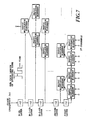
- Fig. 7 shows the group spreading modulator composed of hierarchically connected, N-layer basic modulator elements 60 as shown in Fig. 6.
- the number of channels is the N-th power of two.
- the primary layer of the group modulator as shown in Fig. 7 includes 2 (N-1) elements, and the number of the elements is halved as the layer rises each step.
- the spreading rectangular signals input to respective layers are a periodic square waveform signal, and their frequencies are doubled as the layer rises each step, such as the frequency of the primary layer is 1/2 N of the clock frequency fc, and that of the secondary layer is fc/2 (N-1) , where the clock frequency fc equals the chip rate.
- the frequency of the spreading signal input to the highest layer (N-th layer) is fc/2.
- Fig. 8 illustrates the relationships between the periodic rectangular signals of respective layers.
- the configuration of Fig. 7 can achieve the modulation when the data rate of the entire channels are equal.
- the ratio of the rate of the spreading sequence (chip rate fc) to the modulation rate of the narrowband modulation signal (symbol rate) is 2 N .
- Fig. 9 shows a configuration of a modulator that can implement multi-rate modulation using the spreading sequences of the tree structure as shown in Fig. 3.
- the modulator as shown in Fig. 9 has, besides the configuration as shown in Fig. 7, a structure that enables the narrowband modulation signals to be input directly to the input terminals of upper layers.
- each of the two inputs of the basic modulator element is provided with a switch for switching the inputs. For example, a modulation signal of a channel of twice the symbol rate can be directly input to one of the two inputs of the element at the secondary layer, which includes that channel.
- a modulation signal of a channel of four times the symbol rate can be directly input to one of the two input terminals of the element at the third layer, the one of the two input terminals including that channel
- a modulation signal of a channel of the 2P times the symbol rate can be directly input to one of the two input terminals of the element at the (p+1)-th layer, the one of the two input terminals including that channel.
- This modulation method has strict one-to-one correspondence with the generation rule of the spreading code sequences of the tree structure as shown in Fig. 3.
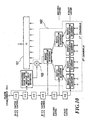
- Fig. 10 shows a group modulator constructed using a smaller number of basic modulator elements than that of Fig. 7.
- the basic modulator elements are hierarchically connected in R layers, where R is less than N, and the output of the topmost element is multiplied by an orthogonal code sequence with a period of 2 (N-R) chip intervals, thus constituting a group modulator unit.
- the outputs of the 2 (N-R) group modulator units are summed up.
- the elements are hierarchically connected in R layers (R ⁇ N) rather than connected in N layers as shown in Fig. 7, and the output of the topmost element is multiplied by an orthogonal spreading code sequence with the 2 (N-R) chip intervals by a multiplier 103.
- the total of 2 (N-R) thus constructed group modulator units 102 are used so that their outputs are summed up by the adder 101, thereby producing a spread signal obtained by the spread modulation of the 2 N channels.
- the configuration as shown in Fig. 10 can be altered to a modulator that can achieve the multi-rate modulation corresponding to the tree-structure as shown in Fig. 3.
- Fig. 11 shows another configuration of an 2 R channel group modulator corresponding to that enclosed by the broken lines in Fig. 10.
- the user data of 2 R channels are each input to data modulators 112 to obtain narrowband modulated signals.
- the 2 R data modulated signal outputs from the data modulators 112 are multiplied by spread sequences fed from a low rate orthogonal periodic spreading sequence generator 114 by multipliers 116, and combined by an adder 117. Subsequently, the output of the adder 117 is multiplied by a orthogonal spreading code sequence with a period of an 2 (N-R) chip interval as in Fig. 10.
- the spreading sequences to be multiplied by the modulated signal outputs will now be described below.
- the spread modulation as shown in Fig. 11 carries out multiplication by the orthogonal codes through two steps.
- the spreading codes generated by the low rate orthogonal periodic spreading sequence generator 114 are multiplied which constitute Walsh functions with a rate of a 1/2 (N-R) of the spread chip rate.
- the spreading sequences generated by the low rate orthogonal periodic spreading sequence generator 114 will be described with reference to Figs. 12 and 13.
- a matrix D 1 1, and two adjacent matrices have relationships as shown in this figure.
- the low rate orthogonal periodic spreading sequences are generated from the row vectors of the matrices related by equations in Fig. 12.
- the low rate orthogonal periodic spreading sequences are well-known Walsh functions.
- the orthogonal spreading code sequence with a period of the 2 (N-R) chip interval generated by the generator 115 is multiplied. It is obtained by successively generating greater dimensional matrices from lower dimensional matrices as described above in connection with Figs. 2 and 3, and by selecting one of the row vectors in the matrices. Or one of the components of a set of orthogonal sequences can be used (for example, orthogonal Gold sequences). Thus, the spreading sequences for the spreading modulation can be obtained.
- the spreading sequences obtained by means of the low rate orthogonal periodic signal generation have a hierarchical structure as shown in Fig. 3. It is also true that if a corresponding spreading code sequence in a lower layer in this hierarchical structure has already been assigned to a user, the spreading sequence of the layer that generates the corresponding spreading code sequence cannot be used.
- the low rate orthogonal periodic signal generation it is also possible for the low rate orthogonal periodic signal generation to carry out control in such a manner that vacancies are generated in the transmission time without changing the spreading sequence as described above in connection with Fig. 5, even if the lowest peak rate of the data transmission varies.
- the low rate orthogonal periodic signal generation may perform control such that the spreading sequence is reassigned when the data transmission rate reduces by 50% or more.
Landscapes
- Engineering & Computer Science (AREA)
- Computer Networks & Wireless Communication (AREA)
- Signal Processing (AREA)
- Mobile Radio Communication Systems (AREA)
Claims (4)
- CDMA-Kommunikationsverfahren zum Spreizen modulierter Übertragungsdaten unter Verwendung einer aus einem der Reihenvektoren von 2N x 2N-dimensionalen Matrizen ausgewählten Spreizsequenz, wobei N eine ganze Zahl größer als Null ist, die aus einer in der Dimension kleineren Matrix mit einer vorbestimmten Regel erzeugt werden, wobei die Matrizen jeweils zueinander orthogonale Reihenvektoren enthalten, wobei die Übertragungsdaten in dem CDMA-Kommunikationsverfahren eine Vielzahl von Daten mit unterschiedlichen Spitzenübertragungsraten enthalten, und wobei das Verfahren den Schritt umfasst:Einteilen der Übertragungsdaten in eine Vielzahl von Gruppen beruhend auf der Spitzenrate der Übertragungsraten,
gekennzeichnet durch die Schritte der Auswahl eines von 2Q Reihenvektoren in einer Matrix mit der maximalen Dimension 2N x 2N als Spreizsequenz bei Übertragungsdaten mit einer Spitzenrate von 2Q-mal der niedrigsten Spitzenrate, wobei die 2Q Reihenvektoren aus einem der Reihenvektoren in der 2N-Q x 2N-Q-Matrix erzeugt werden, wobei Q eine ganze Zahl größer als Null und kleiner oder gleich N ist, so dass die anderen 2Q-1 Reihenvektoren nicht ausgewählt werden, solange die Spreizsequenz verwendet wird. - CDMA-Kommunikationsverfahren nach Anspruch 1, ferner mit dem Schritt der Erzeugung von Lücken in einer Übertragungszeit entsprechend der Übertragungsrate, wenn die Datenübertragungsrate während Kommunikationen unter 2Q-mal der niedrigsten Spitzenrate fällt.
- CDMA-Kommunikationsverfahren nach Anspruch 1, ferner mit dem Schritt der Neuzuweisung der neu ausgewählten Spreizsequenz, wenn die Datenübertragungsrate in einen Bereich von 2P-1 bis 2P-mal der niedrigsten Spitzenrate während Kommunikationen fällt, wobei P eine ganze Zahl kleiner oder gleich Q ist.
- CDMA-Kommunikationsverfahren nach Anspruch 1, ferner mit dem Schritt der Erzeugung von Lücken in einer Übertragungszeit entsprechend der Übertragungsrate, wenn die Datenübertragungsrate in einem Bereich von 2P-1 bis 2P-mal der niedrigsten Spitzenrate liegt, wobei P eine ganze Zahl kleiner oder gleich Q ist.
Applications Claiming Priority (9)
| Application Number | Priority Date | Filing Date | Title |
|---|---|---|---|
| JP15850396 | 1996-06-19 | ||
| JP15850396 | 1996-06-19 | ||
| JP158503/96 | 1996-06-19 | ||
| JP29445/97 | 1997-02-13 | ||
| JP2944597 | 1997-02-13 | ||
| JP2944597 | 1997-02-13 | ||
| JP75751/97 | 1997-03-27 | ||
| JP07575197A JP3409628B2 (ja) | 1996-06-19 | 1997-03-27 | Cdma通信方法およびグループ拡散変調器 |
| JP7575197 | 1997-03-27 |
Publications (4)
| Publication Number | Publication Date |
|---|---|
| EP0814581A2 EP0814581A2 (de) | 1997-12-29 |
| EP0814581A3 EP0814581A3 (de) | 1999-10-27 |
| EP0814581B1 EP0814581B1 (de) | 2004-12-15 |
| EP0814581B2 true EP0814581B2 (de) | 2007-12-19 |
Family
ID=27286576
Family Applications (1)
| Application Number | Title | Priority Date | Filing Date |
|---|---|---|---|
| EP19970304088 Expired - Lifetime EP0814581B2 (de) | 1996-06-19 | 1997-06-11 | CDMA Nachrichtenübertragungsverfahren und Gruppenspreizmodulator |
Country Status (7)
| Country | Link |
|---|---|
| US (1) | US6084884A (de) |
| EP (1) | EP0814581B2 (de) |
| JP (1) | JP3409628B2 (de) |
| KR (1) | KR100254638B1 (de) |
| CN (2) | CN1123999C (de) |
| CA (1) | CA2208085C (de) |
| DE (1) | DE69731914T3 (de) |
Families Citing this family (43)
| Publication number | Priority date | Publication date | Assignee | Title |
|---|---|---|---|---|
| EP0878930B1 (de) * | 1996-11-07 | 2002-12-11 | Matsushita Electric Industrial Co., Ltd | Verfahren zur cdma codegenerierung und verfahren zur codeauswahl |
| US6510147B1 (en) * | 1997-07-15 | 2003-01-21 | Hughes Electronics Corporation | Method and apparatus for orthogonally overlaying variable chip rate spread spectrum signals |
| KR100269593B1 (ko) | 1997-12-02 | 2000-10-16 | 정선종 | 다중 채널을 위한 직교 복소 확산 방법 및 그 장치 |
| US6366588B1 (en) * | 1998-02-27 | 2002-04-02 | Lucent Technologies Inc. | Method and apparatus for achieving data rate variability in orthogonal spread spectrum communication systems |
| US6563808B1 (en) | 1998-03-04 | 2003-05-13 | Stanford Telecommunications, Inc. | Apparatus for incorporating multiple data rates in an orthogonal direct sequence code division multiple access (ODS-CDMA) communications system |
| JP2878265B1 (ja) | 1998-03-16 | 1999-04-05 | 三菱電機株式会社 | 符号割当装置並びにその方法 |
| KR100381012B1 (ko) | 1998-05-04 | 2003-08-19 | 한국전자통신연구원 | 부호분할 다중접속 방식에서 상향 공통 채널의 임의 접속 장치및 방법 |
| KR100413417B1 (ko) * | 1998-05-04 | 2004-02-14 | 엘지전자 주식회사 | 이동통신시스템에서 단말기의 호 접속 제어 방법. |
| FI981546A7 (fi) * | 1998-07-03 | 2000-01-04 | Nokia Corp | Tiedonsiirtomenetelmä ja matkapuhelinjärjestelmä |
| US6526091B1 (en) * | 1998-08-17 | 2003-02-25 | Telefonaktiebolaget Lm Ericsson | Communication methods and apparatus based on orthogonal hadamard-based sequences having selected correlation properties |
| KR100532328B1 (ko) * | 1998-08-29 | 2006-03-23 | 삼성전자주식회사 | 부호분할다중접속통신시스템의피.엔시퀀스식별장치 |
| US6667961B1 (en) | 1998-09-26 | 2003-12-23 | Samsung Electronics Co., Ltd. | Device and method for implementing handoff in mobile communication system |
| FR2784525B1 (fr) | 1998-10-12 | 2006-07-28 | Cit Alcatel | Procede d'allocation de codes orthogonaux dans un systeme de radiocommunications mobiles du type a acces multiple par repartition de codes utilisant des codes de longueur variable |
| US6163524A (en) * | 1998-10-19 | 2000-12-19 | Telefonaktiebolaget Lm Ericsson (Publ) | Code allocation in CDMA |
| US6339646B1 (en) * | 1998-11-03 | 2002-01-15 | Telefonaktiebolaget Lm Ericsson | Slotted mode code usage in a cellular communications system |
| KR100684920B1 (ko) * | 1999-02-13 | 2007-02-22 | 삼성전자주식회사 | 부호분할다중접속 통신시스템의 페이징 채널 할당장치 및 방법 |
| KR100526537B1 (ko) * | 1999-02-13 | 2005-11-08 | 삼성전자주식회사 | 가변 데이터레이트의 채널 구조를 가지는 부호분할다중접속 통신시스템의 직교부호 할당 방법 및 그에 따른 장치 |
| EP1035677A1 (de) * | 1999-03-10 | 2000-09-13 | Lucent Technologies Inc. | Zuteilung einer Kodebaum für CDMA systemen |
| US6400755B1 (en) * | 1999-04-23 | 2002-06-04 | Motorola, Inc. | Data transmission within a spread-spectrum communication system |
| GB2350267B (en) * | 1999-05-17 | 2003-09-24 | Fujitsu Ltd | Processing of codes in CDMA communications networks |
| US6707841B1 (en) | 1999-05-27 | 2004-03-16 | Canon Kabushiki Kaisha | Spreading code generator |
| GB2352944B (en) | 1999-05-31 | 2004-02-11 | Korea Electronics Telecomm | Apparatus and method for moduating data message by employing orthogonal variable spreading factor (OVSF) codes in mobile communication sytem |
| SE521462C2 (sv) | 1999-07-08 | 2003-11-04 | Ericsson Telefon Ab L M | Förfarande och anordning för sändning av information i ett telekommunikationssystem |
| DE69908125T2 (de) * | 1999-09-13 | 2003-12-04 | Mitsubishi Electric Information Technology Centre Europe B.V., Schiphol Rijk | Zuweisung von Spreizfolgen in einem MCCDMA-System |
| DE19946872A1 (de) * | 1999-09-30 | 2001-05-03 | Bosch Gmbh Robert | Datenübertragungsverfahren- und vorrichtung |
| KR100308848B1 (ko) * | 1999-10-22 | 2001-11-02 | 김대기 | 광대역 코드 분할 다중 접속 시스템에서 협대역 코드 분할 다중 접속 시스템으로의 핸드 오프 방법 |
| EP1100215A1 (de) * | 1999-11-09 | 2001-05-16 | TELEFONAKTIEBOLAGET L M ERICSSON (publ) | Verfahren, Vorrichtung und Rechnerprogramm zur Kodezuweisung für variable Datenraten in einem CDMA-system |
| US6532250B1 (en) * | 1999-12-21 | 2003-03-11 | Telefonaktiebolaget Lm Ericsson (Publ) | Methods and apparatus for spreading and despreading information signals in code division multiple access communications systems |
| IT1314346B1 (it) * | 1999-12-30 | 2002-12-09 | Telit Mobile Terminals Spa | Metodo e dispositivo per la generazione di codici ortogonali a fattore di spreading variabile o righe di matricidi hadamard per sistemi di |
| EP1117184A1 (de) * | 2000-01-17 | 2001-07-18 | Matsushita Electric Industrial Co., Ltd. | Verfahren und Vorrichtung für ein zellulares CDMA Mobilfunksystem |
| JP2001203668A (ja) * | 2000-01-18 | 2001-07-27 | Matsushita Electric Ind Co Ltd | 干渉信号除去装置および干渉信号除去方法 |
| DE10004873A1 (de) * | 2000-02-04 | 2001-08-23 | Infineon Technologies Ag | Verfahren und Vorrichtung zur Erzeugung von OVSF-Codeworten |
| US6574269B1 (en) * | 2000-11-21 | 2003-06-03 | Bbnt Solutions Llc | Asymmetric orthogonal codes for wireless system receivers with multiplication-free correlators |
| US6574268B1 (en) * | 2000-11-21 | 2003-06-03 | Bbnt Solutions Llc | Asymmetric orthogonal codes for optical communications |
| US7012886B2 (en) * | 2001-05-16 | 2006-03-14 | Lucent Technologies Inc. | Walsh code allocation/de-allocation system |
| JP3581357B2 (ja) * | 2002-05-22 | 2004-10-27 | 松下電器産業株式会社 | 通信端末装置及び拡散コード推定方法 |
| AU2002368040A1 (en) * | 2002-06-21 | 2004-01-06 | Telefonaktiebolaget Lm Ericsson (Publ) | Generation of orthogonal codes |
| CN1297077C (zh) | 2003-01-31 | 2007-01-24 | 株式会社Ntt都科摩 | 发送无线站、接收无线站、无线通信系统和无线通信方法 |
| EP1511205B1 (de) * | 2003-09-01 | 2007-12-12 | Mitsubishi Electric Information Technology Centre Europe B.V. | Verfahren zur dynamischen Zuweisung von Spreizfolgen an Benutzer eines MCCDMA Übertragungsnetzwerks |
| AU2005319950B2 (en) | 2004-12-23 | 2010-07-01 | Electronics And Telecommunications Research Institute | Apparatus for transmitting and receiving data to provide high-speed data comunication and method thereof |
| DK2068455T3 (da) | 2006-09-30 | 2011-08-29 | Huawei Tech Co Ltd | Sekvensfordelingsfremgangsmåde, sekvensbehandlingsfremgangsmåde og apparat i kommunikationssystem |
| ATE498249T1 (de) | 2007-03-07 | 2011-02-15 | Huawei Tech Co Ltd | Sequenzverteilung, verarbeitungsverfahren sowie entsprechende vorrichtung in einem kommunikationssystem |
| JP7717967B2 (ja) * | 2021-09-03 | 2025-08-04 | フラウンホーファー-ゲゼルシャフト・ツール・フェルデルング・デル・アンゲヴァンテン・フォルシュング・アインゲトラーゲネル・フェライン | 時間およびコード多重化パイロットシーケンスの送信 |
Family Cites Families (13)
| Publication number | Priority date | Publication date | Assignee | Title |
|---|---|---|---|---|
| US4511885A (en) * | 1983-11-28 | 1985-04-16 | The United States Of America As Represented By The Secretary Of The Army | Code compressor for multilevel interleaved multiplexed noise codes |
| US5103459B1 (en) * | 1990-06-25 | 1999-07-06 | Qualcomm Inc | System and method for generating signal waveforms in a cdma cellular telephone system |
| SG47496A1 (en) * | 1991-03-13 | 1998-04-17 | Motorola Inc | Method and apparatus for accommodating a variable number of communication channels in a spread spectrum communication system |
| IL104412A (en) * | 1992-01-16 | 1996-11-14 | Qualcomm Inc | Method and apparatus for the formatting of data for transmission |
| US5311176A (en) * | 1992-03-31 | 1994-05-10 | Motorola, Inc. | Method and apparatus for generating Walsh codes |
| MY112371A (en) * | 1993-07-20 | 2001-05-31 | Qualcomm Inc | System and method for orthogonal spread spectrum sequence generation in variable data rate systems |
| JPH0746248A (ja) * | 1993-07-30 | 1995-02-14 | Toshiba Corp | 無線通信システム |
| US5414728A (en) * | 1993-11-01 | 1995-05-09 | Qualcomm Incorporated | Method and apparatus for bifurcating signal transmission over in-phase and quadrature phase spread spectrum communication channels |
| US5406629A (en) * | 1993-12-20 | 1995-04-11 | Motorola, Inc. | Apparatus and method for digitally processing signals in a radio frequency communication system |
| CA2158269A1 (en) * | 1994-02-25 | 1995-08-31 | Michael Dale Kotzin | Method and apparatus for time division multiplexing the use of spreading codes in a communication system |
| US5515396A (en) * | 1994-02-25 | 1996-05-07 | Motorola, Inc. | Method and apparatus for selecting a spreading code in a spectrum spread communication system |
| US5764687A (en) * | 1995-06-20 | 1998-06-09 | Qualcomm Incorporated | Mobile demodulator architecture for a spread spectrum multiple access communication system |
| EP0878930B1 (de) | 1996-11-07 | 2002-12-11 | Matsushita Electric Industrial Co., Ltd | Verfahren zur cdma codegenerierung und verfahren zur codeauswahl |
-
1997
- 1997-03-27 JP JP07575197A patent/JP3409628B2/ja not_active Expired - Lifetime
- 1997-06-11 EP EP19970304088 patent/EP0814581B2/de not_active Expired - Lifetime
- 1997-06-11 DE DE1997631914 patent/DE69731914T3/de not_active Expired - Lifetime
- 1997-06-16 CA CA 2208085 patent/CA2208085C/en not_active Expired - Lifetime
- 1997-06-18 US US08/878,397 patent/US6084884A/en not_active Expired - Lifetime
- 1997-06-18 KR KR1019970025561A patent/KR100254638B1/ko not_active Expired - Lifetime
- 1997-06-19 CN CN97112775A patent/CN1123999C/zh not_active Expired - Lifetime
-
2002
- 2002-06-26 CN CNB021249504A patent/CN1180563C/zh not_active Expired - Lifetime
Also Published As
| Publication number | Publication date |
|---|---|
| CN1180563C (zh) | 2004-12-15 |
| CN1123999C (zh) | 2003-10-08 |
| EP0814581B1 (de) | 2004-12-15 |
| EP0814581A3 (de) | 1999-10-27 |
| DE69731914D1 (de) | 2005-01-20 |
| DE69731914T2 (de) | 2005-10-06 |
| CA2208085C (en) | 2005-03-15 |
| US6084884A (en) | 2000-07-04 |
| JP3409628B2 (ja) | 2003-05-26 |
| CA2208085A1 (en) | 1997-12-19 |
| EP0814581A2 (de) | 1997-12-29 |
| CN1394024A (zh) | 2003-01-29 |
| DE69731914T3 (de) | 2008-05-21 |
| KR19980079272A (ko) | 1998-11-25 |
| JPH10290211A (ja) | 1998-10-27 |
| CN1171675A (zh) | 1998-01-28 |
| KR100254638B1 (ko) | 2000-05-01 |
Similar Documents
| Publication | Publication Date | Title |
|---|---|---|
| EP0814581B2 (de) | CDMA Nachrichtenübertragungsverfahren und Gruppenspreizmodulator | |
| JP3888852B2 (ja) | 移動通信システムの準直交符号生成方法及び準直交符号を用いた帯域拡散装置 | |
| US6091760A (en) | Non-recursively generated orthogonal PN codes for variable rate CDMA | |
| US5583851A (en) | Mobile communication apparatus having multi-codes allocating function | |
| KR100254480B1 (ko) | 스펙트럼확산 통신시스템 | |
| USRE37420E1 (en) | Automobile on-board and/or portable telephone system | |
| US20050084112A1 (en) | Apparatus and method for generating scrambling code in UMTS mobile communication system | |
| US5943330A (en) | Data transmission method, transmitter, and receiver | |
| US5631922A (en) | Spread code generation device for spread spectrum communication | |
| US6574268B1 (en) | Asymmetric orthogonal codes for optical communications | |
| EP1010266A1 (de) | Verfahren zu spreizkodezuteilung | |
| EP1203461A1 (de) | Chip-synchroner cdma-multiplexer und verfahren resultierend in signalen konstanter hüllkurve | |
| WO2000074255A1 (en) | Improvements in or relating to mobile telecommunications systems | |
| US6678320B1 (en) | Efficient finite impulse response filter implementation for CDMA waveform generation | |
| USRE39954E1 (en) | Automobile on-board and/or portable telephone system | |
| KR100241328B1 (ko) | 코드분할다중접속방식의 무선가입자 망 시스템에서 기지국시퀀스 할당 방법 | |
| JPH0865264A (ja) | スペクトル拡散変調を用いたcdma方式の通信方法及び通信装置 | |
| US7310364B2 (en) | Multirate, constant envelope, constant bandwidth, modulation, channelization and detection system based on orthogonal bipolar spreading vectors | |
| KR100346218B1 (ko) | 부호분할다중접속 통신시스템의 채널 확산장치 및 방법 | |
| JP2003204287A (ja) | Cdma通信方法および拡散系列生成方法 | |
| CA2496605C (en) | Using orthogonal waveforms to enable multiple transmitters to share a single cdm channel | |
| HK1108982A1 (en) | Orthogonal complex spreading method for multichannel and apparatus thereof | |
| HK1108981B (en) | Orthogonal complex spreading method for multichannel and apparatus thereof | |
| HK1108982B (en) | Orthogonal complex spreading method for multichannel and apparatus thereof |
Legal Events
| Date | Code | Title | Description |
|---|---|---|---|
| PUAI | Public reference made under article 153(3) epc to a published international application that has entered the european phase |
Free format text: ORIGINAL CODE: 0009012 |
|
| AK | Designated contracting states |
Kind code of ref document: A2 Designated state(s): DE FR GB IT SE |
|
| AX | Request for extension of the european patent |
Free format text: AL;LT;LV;RO;SI |
|
| RIC1 | Information provided on ipc code assigned before grant |
Free format text: 6H 04J 11/00 A, 6H 04B 1/69 B, 6H 04B 7/26 B |
|
| PUAL | Search report despatched |
Free format text: ORIGINAL CODE: 0009013 |
|
| AK | Designated contracting states |
Kind code of ref document: A3 Designated state(s): AT BE CH DE DK ES FI FR GB GR IE IT LI LU MC NL PT SE |
|
| AX | Request for extension of the european patent |
Free format text: AL;LT;LV;RO;SI |
|
| REG | Reference to a national code |
Ref country code: SE Ref legal event code: RPEO |
|
| 17P | Request for examination filed |
Effective date: 20000420 |
|
| AKX | Designation fees paid |
Free format text: DE FR GB IT SE |
|
| RAP1 | Party data changed (applicant data changed or rights of an application transferred) |
Owner name: NTT DOCOMO, INC. |
|
| 17Q | First examination report despatched |
Effective date: 20030204 |
|
| GRAP | Despatch of communication of intention to grant a patent |
Free format text: ORIGINAL CODE: EPIDOSNIGR1 |
|
| GRAS | Grant fee paid |
Free format text: ORIGINAL CODE: EPIDOSNIGR3 |
|
| GRAA | (expected) grant |
Free format text: ORIGINAL CODE: 0009210 |
|
| AK | Designated contracting states |
Kind code of ref document: B1 Designated state(s): DE FR GB IT SE |
|
| REG | Reference to a national code |
Ref country code: GB Ref legal event code: FG4D |
|
| REF | Corresponds to: |
Ref document number: 69731914 Country of ref document: DE Date of ref document: 20050120 Kind code of ref document: P |
|
| REG | Reference to a national code |
Ref country code: SE Ref legal event code: TRGR |
|
| PLBI | Opposition filed |
Free format text: ORIGINAL CODE: 0009260 |
|
| PLAB | Opposition data, opponent's data or that of the opponent's representative modified |
Free format text: ORIGINAL CODE: 0009299OPPO |
|
| PLAX | Notice of opposition and request to file observation + time limit sent |
Free format text: ORIGINAL CODE: EPIDOSNOBS2 |
|
| 26 | Opposition filed |
Opponent name: QUALCOMM INCORPORATED Effective date: 20050915 |
|
| R26 | Opposition filed (corrected) |
Opponent name: QUALCOMM INCORPORATED Effective date: 20050915 |
|
| ET | Fr: translation filed | ||
| PLAF | Information modified related to communication of a notice of opposition and request to file observations + time limit |
Free format text: ORIGINAL CODE: EPIDOSCOBS2 |
|
| PLBB | Reply of patent proprietor to notice(s) of opposition received |
Free format text: ORIGINAL CODE: EPIDOSNOBS3 |
|
| PUAH | Patent maintained in amended form |
Free format text: ORIGINAL CODE: 0009272 |
|
| STAA | Information on the status of an ep patent application or granted ep patent |
Free format text: STATUS: PATENT MAINTAINED AS AMENDED |
|
| 27A | Patent maintained in amended form |
Effective date: 20071219 |
|
| AK | Designated contracting states |
Kind code of ref document: B2 Designated state(s): DE FR GB IT SE |
|
| ET3 | Fr: translation filed ** decision concerning opposition | ||
| REG | Reference to a national code |
Ref country code: FR Ref legal event code: PLFP Year of fee payment: 20 |
|
| PGFP | Annual fee paid to national office [announced via postgrant information from national office to epo] |
Ref country code: DE Payment date: 20160607 Year of fee payment: 20 Ref country code: GB Payment date: 20160608 Year of fee payment: 20 |
|
| PGFP | Annual fee paid to national office [announced via postgrant information from national office to epo] |
Ref country code: SE Payment date: 20160613 Year of fee payment: 20 Ref country code: FR Payment date: 20160516 Year of fee payment: 20 |
|
| PGFP | Annual fee paid to national office [announced via postgrant information from national office to epo] |
Ref country code: IT Payment date: 20160621 Year of fee payment: 20 |
|
| REG | Reference to a national code |
Ref country code: DE Ref legal event code: R071 Ref document number: 69731914 Country of ref document: DE |
|
| REG | Reference to a national code |
Ref country code: GB Ref legal event code: PE20 Expiry date: 20170610 |
|
| PG25 | Lapsed in a contracting state [announced via postgrant information from national office to epo] |
Ref country code: GB Free format text: LAPSE BECAUSE OF EXPIRATION OF PROTECTION Effective date: 20170610 |
|
| REG | Reference to a national code |
Ref country code: SE Ref legal event code: EUG |