EP0816511A1 - Verfahren zum Sieben von Substanzen - Google Patents
Verfahren zum Sieben von Substanzen Download PDFInfo
- Publication number
- EP0816511A1 EP0816511A1 EP96113625A EP96113625A EP0816511A1 EP 0816511 A1 EP0816511 A1 EP 0816511A1 EP 96113625 A EP96113625 A EP 96113625A EP 96113625 A EP96113625 A EP 96113625A EP 0816511 A1 EP0816511 A1 EP 0816511A1
- Authority
- EP
- European Patent Office
- Prior art keywords
- overexpressing
- specific
- substances
- targets
- target
- Prior art date
- Legal status (The legal status is an assumption and is not a legal conclusion. Google has not performed a legal analysis and makes no representation as to the accuracy of the status listed.)
- Granted
Links
Images
Classifications
-
- G—PHYSICS
- G01—MEASURING; TESTING
- G01N—INVESTIGATING OR ANALYSING MATERIALS BY DETERMINING THEIR CHEMICAL OR PHYSICAL PROPERTIES
- G01N33/00—Investigating or analysing materials by specific methods not covered by groups G01N1/00 - G01N31/00
- G01N33/48—Biological material, e.g. blood, urine; Haemocytometers
- G01N33/50—Chemical analysis of biological material, e.g. blood, urine; Testing involving biospecific ligand binding methods; Immunological testing
- G01N33/5005—Chemical analysis of biological material, e.g. blood, urine; Testing involving biospecific ligand binding methods; Immunological testing involving human or animal cells
- G01N33/5008—Chemical analysis of biological material, e.g. blood, urine; Testing involving biospecific ligand binding methods; Immunological testing involving human or animal cells for testing or evaluating the effect of chemical or biological compounds, e.g. drugs, cosmetics
-
- C—CHEMISTRY; METALLURGY
- C12—BIOCHEMISTRY; BEER; SPIRITS; WINE; VINEGAR; MICROBIOLOGY; ENZYMOLOGY; MUTATION OR GENETIC ENGINEERING
- C12Q—MEASURING OR TESTING PROCESSES INVOLVING ENZYMES, NUCLEIC ACIDS OR MICROORGANISMS; COMPOSITIONS OR TEST PAPERS THEREFOR; PROCESSES OF PREPARING SUCH COMPOSITIONS; CONDITION-RESPONSIVE CONTROL IN MICROBIOLOGICAL OR ENZYMOLOGICAL PROCESSES
- C12Q1/00—Measuring or testing processes involving enzymes, nucleic acids or microorganisms; Compositions therefor; Processes of preparing such compositions
- C12Q1/02—Measuring or testing processes involving enzymes, nucleic acids or microorganisms; Compositions therefor; Processes of preparing such compositions involving viable microorganisms
- C12Q1/025—Measuring or testing processes involving enzymes, nucleic acids or microorganisms; Compositions therefor; Processes of preparing such compositions involving viable microorganisms for testing or evaluating the effect of chemical or biological compounds, e.g. drugs, cosmetics
-
- G—PHYSICS
- G01—MEASURING; TESTING
- G01N—INVESTIGATING OR ANALYSING MATERIALS BY DETERMINING THEIR CHEMICAL OR PHYSICAL PROPERTIES
- G01N33/00—Investigating or analysing materials by specific methods not covered by groups G01N1/00 - G01N31/00
- G01N33/48—Biological material, e.g. blood, urine; Haemocytometers
- G01N33/50—Chemical analysis of biological material, e.g. blood, urine; Testing involving biospecific ligand binding methods; Immunological testing
- G01N33/5005—Chemical analysis of biological material, e.g. blood, urine; Testing involving biospecific ligand binding methods; Immunological testing involving human or animal cells
- G01N33/5008—Chemical analysis of biological material, e.g. blood, urine; Testing involving biospecific ligand binding methods; Immunological testing involving human or animal cells for testing or evaluating the effect of chemical or biological compounds, e.g. drugs, cosmetics
- G01N33/5044—Chemical analysis of biological material, e.g. blood, urine; Testing involving biospecific ligand binding methods; Immunological testing involving human or animal cells for testing or evaluating the effect of chemical or biological compounds, e.g. drugs, cosmetics involving specific cell types
- G01N33/5047—Cells of the immune system
- G01N33/505—Cells of the immune system involving T-cells
Definitions
- Genomic research will lead to a better understanding of the molecular basis of many diseases and thus provides the basis for more specific and more effective drugs.
- drug discovery programmes will profit from the availability of the rapidly growing arsenal of structurally identified genes.
- yeast represents the first eukaryotic organism whose genome is fully sequenced (press communication of German Federal Research Ministry, April 24, 1996).
- the conservation of basic structures and functions among eukaryotic organisms has already made yeast an important eukaryotic model organism from which extrapolations to higher eukaryotic cells (e.g. mammalian cells) are possible.
- Genomic research is likely to strengthen the role of yeast as a eukaryotic model organism.
- Yeast has important advantages over other eukaryotic model organisms. It is easy to work with experimentally (fast growth, easy handling) and the knowledge about its biology is highly advanced (excellent genetic system, extensive biochemical and physiological know how, advanced cell biology). It has long been used as a biotechnological work horse. Since thousands of years wine and bread are classical products of the metabolic properties of whole yeast cells whereas ethanol and other defined metabolites are traditional biotechnology products ever since yeast is consciously used as production system. Since the beginning of the Eighties yeast is extensively used as host for recombinant gene products. Several recombinant proteins have been developed for pharmaceutical uses (e.g. vaccines, insulin, hirudin, etc.) which have already reached the market or are in advanced phases of clinical development.
- pharmaceutical uses e.g. vaccines, insulin, hirudin, etc.
- yeast cells as models for medical uses. It has long been generally accepted that yeast is an ideal model organism for eukaryotic cell biology. Yeast has all the basic cellular structures and biochemical pathways of higher eukaryotes and shares the principal communication and signalling systems with mammalian cells. In many ways yeast cell biology fulfilled a pioneering role for understanding important eukaryotic cell functions such as biogenesis of organelles, cellular transport systems, signalling pathways, cell cycle, control of transcription, etc.
- yeast cells serve as a reference point. Since 1996, the entire genomic nucleotide sequence of S. cerevisiae , the first complete genome structure of a eukaryotic organism, is known.
- yeast cells provide ideal systems to study pathological functions and pathways and/or to model such pathways (Kirsch, Curr. Opin. Biotechnol. 4 (1993), 543).
- the utility of the models will lie primarily in areas of medical diseases which have their origin in the malfunctioning of cellular processes (cancer, viral diseases, immunmodulation, etc.). Developing drugs on the basis of these molecular targets will lead to a different quality of medication replacing symptomatic treatment with causative cure.
- S. cerevisiae with pathogenic fungi (e.g. Candida albicans ) makes model building with the view to find novel antifungal drugs an extremely worthwhile exercise. This is particularly evident in the light of the marked world-wide increase of the incidence of fungal infections and the concomitant appearance of resistance to conventional therapeutic drugs.
- pathogenic fungi e.g. Candida albicans
- the present invention offers a way capable of solving the need to detect the effect of substances on targets without a detailed knowledge of the individual targets.
- it offers a method suitable of identifying targets affected by drugs. More specifically, the invention consists of a method of screening substances which affect one or a multitude of targets or of identifying drug targets wherein drug targets designate molecular targets affected by drugs, comprising the steps of
- the method according to the invention is suitable to test for the biological effects of pure substances on specific targets, and likewise to identify molecular targets of specific substances having a known biological activity, especially drugs.
- the invention presents a general solution to the problem of finding biologically active compounds which inhibit essential cellular functions of the cell used.
- the basic principle behind the invention is the specific inhibition of one or a few defined molecular targets thereby affecting growth. This is practically achieved by placing in an ordered array pure cell cultures each if them being transformed with one or a few specific genes which are overexpressed (underexpressed). Overexpression is obtained by introducing these genes on a multi-copy plasmid vector. Since cells which produce large quantities of specific gene products are less sensitive to specific drugs this will result in a differential growth pattern. Underexpression is obtained by bringing a gene under the control of a weaker (less effective) promoter on a single-copy plasmid vector.
- the method according to the invention allows for the development of a multitarget detection system which is based entirely on the knowledge of available DNA-sequence data of the cell used. Because each possible target is overexpressed (underexpressed) individually and in a physically distinguishable manner, the biological effect of an isolated substance or substance mixture on a specific target can be detected and assigned directly and unambiguously.
- the gist of the invention resides in the reversal of the known principle of genetic transformation as it has first been developed for microorganisms and later been applied for other organisms.
- Most transformation systems make use of a growth inhibitory substance and include as a "detoxifying agent" the gene coding for the target (selection marker) in the transforming DNA.
- the inhibitor Upon overexpression of the target as a result of DNA uptake, the inhibitor is effectively diluted and the transformed cell is made resistant and can survive.
- the target is overexpressed in a specific cell line to identify an unknown drug.
- the known application of the phenomenon is to apply a known drug to a cell culture and to use the differential growth response of the cells towards this specific drug upon exposure to an increased gene dosage as a selection principle for transformation.
- the novel use is based on one or a multitude of cell lines, with each individual cell line overexpressing one specific target. This arrangement will allow for the search of bioactive compounds which differentially inhibit specific cell lines as a result of their specific target overexpression status.
- known or unknown substances can be evaluated with respect to their molecular target.
- An extension of this approach lies in the possibility to create more sensitive cells by underexpressing of the target, e.g. as a result of modification of its transcriptional control sequences.
- Cell lines suitable for performing the method according to the invention are in principle the cell lines of any eukaryotic organism, preferably a eukaryotic microorganism.
- the cell line is that of a eukaryotic microorganism, especially a genetically well defined eukaryotic microorganism such as yeast and other fungi, especially pathogenic fungi, e.g. more specifically Saccharomyces cerevisiae , Candida albicans, Aspergillus spec..
- yeast and other fungi especially pathogenic fungi, e.g. more specifically Saccharomyces cerevisiae , Candida albicans, Aspergillus spec.
- yeast cells which is composed of individual cell lines each overexpressing (underexpressing) one specific known target (e.g. T1). All cell lines which express the other targets (T2,T3,T4, etc.) serve as reference point for target T1. If target T1 is hit and if T1 represents a gene product whose presence is essential for growth, the cell line overexpressing (underexpressing) target T1 will show a reduced (increased) growth resistance compared to the other cell lines. As a consequence, the action of a bioactive compound with an inhibitory activity towards a specific target is indicated.
- the invention concerns a solid support containing in an ordered array a multitude of cell lines each overexpressing or, alternatively, underexpressing a specific target optionally together with one or more reference cell lines.
- a target can be any molecule which is enriched in a specific cell as a result of a transformation event.
- a target in the context of the present invention is, for example, a molecularly defined DNA segment, a gene, or a gene product which can interact with effector molecules and thus produce biological effects.
- the target is the direct gene product (protein, RNA), although the target can in principle also be a close functional and/or structural interaction partner.
- the target is a protein.
- the target is of eukaryotic origin. It can be of homologous or heterologous nature.
- the target is a molecular target essential for growth of the cell.
- each individual gene is cloned into a medium copy number vector (for S. cerevisiae this is preferably a 2 ⁇ vector) and transformed into a suitable host in a manner known in the art
- a medium copy number vector for S. cerevisiae this is preferably a 2 ⁇ vector
- Underexpression is achieved by bringing an individual gene under the control of a weaker promoter and cloning it into a single-copy plasmid vector, or weakening the respective promoter by mutagenesis (deleting or changing part of the promoter sequence).
- mutagenesis deleting or changing part of the promoter sequence.
- this is performed, for example, by replacing the promoter naturally linked to the gene in question to another, weaker promoter or promoter fragment applying conventional gene replacement or disruption techniques.
- specific genes may also be cloned under the control of a regulatable promoter thus providing specific conditions of gene overexpression or underexpression, respectively.
- Solid supports are commercially available microtiter dishes containing a defined number of wells, e.g. 96 wells. The cultures are preferably placed into the wells of such microtiter dishes, to produce a complete collection of strains.
- the solid support is ideally constructed in such a way to allow the preparation of replicas, e.g. by printing or pipetting.
- the solid supports will also contain control strains which are untransformed or transformed with the same vector without an additional gene insert.
- the array of strains containing the clones overexpressing (underexpressing) the individual genes together with at least one reference strain is treated with solutions, especially aqueous solutions, of pure substances or substance mixtures, where substances are high molecular or, preferably, low molecular weight compounds from natural sources or synthetic or semisynthetic products.
- Drugs are also comprised and may serve to identify the molecular targets affected thereby. After a growth period which allows differentiating growth inhibitory effects of the compounds growth yields are compared. If necessary, appropriate dilutions and incubation times have to be chosen to reach the sensitivity range. Those individual clones which are less (more) sensitive to compounds as compared to reference strains are identified as the hosts expressing the affected target.
- genes belonging to biological classes may be formed. For example genes which code for structural elements of the cell wall or which are involved in the control of cell wall synthesis may be overexpressed (Klis, Yeast 10 (1994), 851). These genes are of particular interest for the identification of antifungal drugs.
- Other classes of genes may involve structural components of the cell architecture, genes controlling morphogenesis of organelles, protein transport and protein secretion, cell cycle, signal transduction, etc.. According to an estimation based on a large number of gene disruptions the yeast genome contains approximately 1000 gene which are essential for growth even under conditions of rich nutrient supply ( essential genes ). Many of these genes are not assigned to any biological functions, however compounds which inhibit the products of these genes are of great interest. Having all essential genes overexpressed (or underexpressed) in one array is therefore of great value.
- the yeast ACC1 (FAS3) gene is contained on a 7.9 kb Sac l restriction fragment (Al-Feel et al., Proc. Acad. Sci. USA 89 (1992), 4534; Vahlensieck, Doctoral Thesis, University of Basle, 1993). This fragment is isolated from wild type yeast S288C using essentially the strategy described by Vahlensieck.
- the experimental protocols for the manipulation of DNA and plasmids and the growth of Escherichia coli cells are described (Sambrook et al., Molecular Cloning, Cold Spring Harbor Laboratory Press, 1989). Experimental protocols dealing with the manipulation of yeast DNA and plasmids as well as growth media and culture conditions are given in Sherman et al.
- E. coli strain HB101 is transformed with aliquots from the ligation mixture using the ampR gene as a selection marker. A collection of E. coli colonies is obtained consisting of individual clones with specific vector-insert combinations. For further processing, E.
- yeast colonies are washed from the transformation plates and plasmid DNA is isolated. This yields a mixture of pRS425 plasmids with different inserts of yeast DNA.
- the specific hybrid plasmid containing the ACC1 gene the mixture is transformed into yeast strain GRF18 using the LEU2 gene of the vector as selection marker.
- the transformed yeast cells are screened for their resistance against the polyketide fungicide soraphen A (Vahlensieck et al., Curr. Genet. 25 (1994), 95) by growing individual transformants in liquid culture broth using YPD medium with 1 ⁇ g/ml soraphen A.
- GRF18/TS As a control GRF18 is transformed with plasmid pRS425 without insert (empty vector). This strain is called GRF18/TS.
- Yeast strains GRF18/ACC1 and GRF18/TS are grown in YNB minimal medium supplemented with 20 ⁇ g/ml of L-histidine (YNB+his) to a density of 4x10 7 cells/ml.
- the cell suspensions are 20-fold diluted with fresh YNB+his medium.
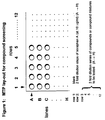
- 96-well MTP's (supplied by Greiner, Germany) are prepared which contain 10 ⁇ l of serially diluted compounds or compound mixtures per well as shown in figure 1. As a control one row only receives solvent (blank) and in one row a soraphen A (at 10 ⁇ g/ml) is serially diluted (standard).
- the incubation test is started by adding 100 ⁇ l aliquots of the 20-fold diluted cell suspension into the MTP wells.
- the MTP is incubated at 30°C for 1 - 2 days. At given intervals (6 to 10 hours) the MTP's are inspected by eye. Growth of the cells is compared between GRF18/T and GRF18/ACC1, blanks and soraphen A standards.
- cell growth can be assessed spectrophotometrically. If a compound or a compound mixture shows growth inhibitory activity for GRF18/TS but not or less for GRF18/ACC1 it is likely to include an inhibitor for acetyl-CoA carboxylase.
- the blanks and standards provide internal controls for cell growth and acetyl-CoA carboxylase inhibition.
- yeast 2 ⁇ vector YEp13 is used for this purpose.
- the test array is identical to the one described in example 1, except that canavanine, a known inhibitor of the arginine permease is used as a standard (Whelan et al., Genetics 91 (1979), 35).
- any yeast gene for which an essential function for growth is know is subcloned into yeast vector pRS425.
- Essential gene functions are determined using gene disruption techniques as described by Baudin et al. (see above).
- ORF's specific open reading frames
- Genes coding for essential functions are subcloned into the 2 ⁇ vector pRS425 using cloning techniques as described by Sambrook et al. (see above).
- Hybrid pRS245 vectors containing inserts coding for essential genes are transformed into yeast strain GRF18. As a result a collection of transformed GRF18 strains is created. These strains are grown in YNB+his medium as described in example 1, further processed as described, and arranged in rows of MTP's as described for individual transformants in examples 1 and 2.
- the ACC1 gene as described by Al-Feel et al. (Proc. Natl. Acad. Sci. USA 89 (1992), 4534) is taken to construct a GRF18 mutant strain which expresses the ACC1 gene from the S. cerevisiae CYC1 promoter. This is achieved by manipulating the ACC1 gene (7.9 kb Sacl restriction fragment) in such a way to insert the Smal-BamHl fragment comprising the CYC1 promoter of plasmid pLG6760-Z (Guarente, Methods in Enzymology Vol. 101 (1983), p.
Landscapes
- Health & Medical Sciences (AREA)
- Life Sciences & Earth Sciences (AREA)
- Engineering & Computer Science (AREA)
- Chemical & Material Sciences (AREA)
- Immunology (AREA)
- Biomedical Technology (AREA)
- Molecular Biology (AREA)
- Hematology (AREA)
- Bioinformatics & Cheminformatics (AREA)
- Urology & Nephrology (AREA)
- Cell Biology (AREA)
- Toxicology (AREA)
- Biotechnology (AREA)
- General Health & Medical Sciences (AREA)
- Microbiology (AREA)
- Organic Chemistry (AREA)
- Medicinal Chemistry (AREA)
- Physics & Mathematics (AREA)
- Analytical Chemistry (AREA)
- Biochemistry (AREA)
- Tropical Medicine & Parasitology (AREA)
- General Physics & Mathematics (AREA)
- Pathology (AREA)
- Proteomics, Peptides & Aminoacids (AREA)
- Food Science & Technology (AREA)
- Wood Science & Technology (AREA)
- Zoology (AREA)
- Biophysics (AREA)
- General Engineering & Computer Science (AREA)
- Genetics & Genomics (AREA)
- Measuring Or Testing Involving Enzymes Or Micro-Organisms (AREA)
- Micro-Organisms Or Cultivation Processes Thereof (AREA)
Priority Applications (1)
| Application Number | Priority Date | Filing Date | Title |
|---|---|---|---|
| EP96113625A EP0816511B2 (de) | 1996-06-27 | 1996-08-26 | Verfahren zum Durchsuchen von Substanzen |
Applications Claiming Priority (3)
| Application Number | Priority Date | Filing Date | Title |
|---|---|---|---|
| EP96110367 | 1996-06-27 | ||
| EP96110367 | 1996-06-27 | ||
| EP96113625A EP0816511B2 (de) | 1996-06-27 | 1996-08-26 | Verfahren zum Durchsuchen von Substanzen |
Publications (3)
| Publication Number | Publication Date |
|---|---|
| EP0816511A1 true EP0816511A1 (de) | 1998-01-07 |
| EP0816511B1 EP0816511B1 (de) | 2003-01-22 |
| EP0816511B2 EP0816511B2 (de) | 2006-06-14 |
Family
ID=26142032
Family Applications (1)
| Application Number | Title | Priority Date | Filing Date |
|---|---|---|---|
| EP96113625A Expired - Lifetime EP0816511B2 (de) | 1996-06-27 | 1996-08-26 | Verfahren zum Durchsuchen von Substanzen |
Country Status (1)
| Country | Link |
|---|---|
| EP (1) | EP0816511B2 (de) |
Cited By (26)
| Publication number | Priority date | Publication date | Assignee | Title |
|---|---|---|---|---|
| WO1998044135A3 (de) * | 1997-04-02 | 1998-12-17 | Hoechst Ag | Verfahren zum screening von antimykotisch wirkenden substanzen |
| US5965352A (en) * | 1998-05-08 | 1999-10-12 | Rosetta Inpharmatics, Inc. | Methods for identifying pathways of drug action |
| WO1999055907A3 (en) * | 1998-04-24 | 2000-03-16 | Hoechst Marion Roussel Inc | Method for screening antimycotic substances using essential genes from s. cerevisiae |
| EP0999284A1 (de) * | 1998-09-11 | 2000-05-10 | Hoechst Marion Roussel | Verfahren zum Screening auf Antimykotika unter Verwendung essentieller Gene aus C.albicans, sowie die Gene selbst |
| US6132969A (en) * | 1998-06-19 | 2000-10-17 | Rosetta Inpharmatics, Inc. | Methods for testing biological network models |
| US6165709A (en) * | 1997-02-28 | 2000-12-26 | Fred Hutchinson Cancer Research Center | Methods for drug target screening |
| WO2000039342A3 (en) * | 1998-12-31 | 2001-03-08 | Millennium Pharm Inc | Use of essential saccharomyces genes and polypeptides |
| US6203987B1 (en) | 1998-10-27 | 2001-03-20 | Rosetta Inpharmatics, Inc. | Methods for using co-regulated genesets to enhance detection and classification of gene expression patterns |
| US6222093B1 (en) | 1998-12-28 | 2001-04-24 | Rosetta Inpharmatics, Inc. | Methods for determining therapeutic index from gene expression profiles |
| US6228579B1 (en) | 1997-11-14 | 2001-05-08 | San Diego State University Foundation | Method for identifying microbial proliferation genes |
| US6370478B1 (en) | 1998-12-28 | 2002-04-09 | Rosetta Inpharmatics, Inc. | Methods for drug interaction prediction using biological response profiles |
| EP1184462A3 (de) * | 2000-09-01 | 2002-06-26 | SmithKline Beecham Corporation | Identifizierung von Zielen für antimikrobielle Verbindungen |
| US6468476B1 (en) | 1998-10-27 | 2002-10-22 | Rosetta Inpharmatics, Inc. | Methods for using-co-regulated genesets to enhance detection and classification of gene expression patterns |
| US6589738B1 (en) | 1999-11-09 | 2003-07-08 | Elitra Pharmaceuticals, Inc. | Genes essential for microbial proliferation and antisense thereto |
| WO2001079849A3 (en) * | 2000-04-17 | 2003-08-14 | Trans Tech Pharma | Protein expression system arrays and use in biological screening |
| WO2003100085A1 (en) * | 2002-05-23 | 2003-12-04 | Tenaxis Gmbh | Screening for compounds having an effect on cells using microtiter plates |
| WO2002016940A3 (en) * | 2000-08-23 | 2004-01-15 | Genome Therapeutics Corp | Genomics-assisted rapid identification of targets |
| WO2004011939A1 (en) * | 2002-07-30 | 2004-02-05 | Amersham Biosiciences Uk Limited | Perturbation effect recognition in a biological system |
| US6720139B1 (en) | 1999-01-27 | 2004-04-13 | Elitra Pharmaceuticals, Inc. | Genes identified as required for proliferation in Escherichia coli |
| US6783985B1 (en) | 2000-02-18 | 2004-08-31 | Elitra Pharmaceuticals Inc. | Gene disruption methodologies for drug target discovery |
| US6801859B1 (en) | 1998-12-23 | 2004-10-05 | Rosetta Inpharmatics Llc | Methods of characterizing drug activities using consensus profiles |
| WO2002014538A3 (en) * | 2000-08-17 | 2004-11-25 | Qualicon Inc | Rational panel design method for microbiological investigations |
| WO2004102201A1 (en) * | 2003-05-07 | 2004-11-25 | Novasite Pharmaceuticals, Inc. | Gain of function sorting for drug discovery and development |
| US6950752B1 (en) | 1998-10-27 | 2005-09-27 | Rosetta Inpharmatics Llc | Methods for removing artifact from biological profiles |
| EP1932921A1 (de) * | 2006-12-13 | 2008-06-18 | Novartis AG | Einfaches, auf Mutanten basierendes, differentielles Screening-Verfahren für ein spezifisches Ziel modulierende Zusammensetzungen |
| EP1836631A4 (de) * | 2004-11-22 | 2009-03-25 | Odyssey Thera Inc | Verwendung von netzwerkbiologie zur verbesserung der medikamentenentdeckung |
Citations (2)
| Publication number | Priority date | Publication date | Assignee | Title |
|---|---|---|---|---|
| EP0324258A1 (de) * | 1987-12-23 | 1989-07-19 | GeneBioMed, Inc. | Verfahren zum Nachweis von potentiellen Karzinogenen |
| EP0608722A1 (de) * | 1993-01-29 | 1994-08-03 | American Cyanamid Company | Biologische Prüfungen zur Feststellung von Herbiziden |
Family Cites Families (2)
| Publication number | Priority date | Publication date | Assignee | Title |
|---|---|---|---|---|
| US5266464A (en) † | 1988-02-10 | 1993-11-30 | Ict Pharmaceuticals, Inc. | Method of screening for protein inhibitors and activators |
| CA2172824A1 (en) † | 1993-10-25 | 1995-05-04 | Charles M. Moehle | Methods for screening for antimycotics |
-
1996
- 1996-08-26 EP EP96113625A patent/EP0816511B2/de not_active Expired - Lifetime
Patent Citations (2)
| Publication number | Priority date | Publication date | Assignee | Title |
|---|---|---|---|---|
| EP0324258A1 (de) * | 1987-12-23 | 1989-07-19 | GeneBioMed, Inc. | Verfahren zum Nachweis von potentiellen Karzinogenen |
| EP0608722A1 (de) * | 1993-01-29 | 1994-08-03 | American Cyanamid Company | Biologische Prüfungen zur Feststellung von Herbiziden |
Non-Patent Citations (2)
| Title |
|---|
| KIRSCH D R: "DEVELOPMENT OF IMPROVED CELL-BASED ASSAYS AND SCREENS IN SACCHAROMYCES THROUGH THE COMBINATION OF MOLECULAR AND CLASSICAL GENETICS", CURRENT OPINION IN BIOTECHNOLOGY, vol. 4, no. 4, 1 January 1993 (1993-01-01), pages 543 - 552, XP000196330 * |
| VAHLENSIECK H F ET AL: "IDENTIFICATION OF THE YEAST ACC1 GENE PRODUCT (ACETYL-COA CARBOXYLASE) AS THE TARGET OF THE POLYKETIDE FUNGICIDE SORAPHEN A", CURRENT GENETICS, vol. 25, no. 2, 1 February 1994 (1994-02-01), pages 95 - 100, XP000196332 * |
Cited By (37)
| Publication number | Priority date | Publication date | Assignee | Title |
|---|---|---|---|---|
| EP0981640A4 (de) * | 1997-02-28 | 2004-09-29 | Hutchinson Fred Cancer Res | Verfahren zur bestimmung der gezielten wirkung von medikamenten |
| US6461807B1 (en) | 1997-02-28 | 2002-10-08 | Fred Hutchinson Cancer Research Center | Methods for drug target screening |
| US7122312B1 (en) | 1997-02-28 | 2006-10-17 | Fred Hutchinson Cancer Research Center | Methods for drug target screening |
| US6165709A (en) * | 1997-02-28 | 2000-12-26 | Fred Hutchinson Cancer Research Center | Methods for drug target screening |
| US6537767B1 (en) | 1997-04-02 | 2003-03-25 | Aventis Pharma Deutschland Gmbh | Method for screening antimycotically active substances |
| WO1998044135A3 (de) * | 1997-04-02 | 1998-12-17 | Hoechst Ag | Verfahren zum screening von antimykotisch wirkenden substanzen |
| US6924101B2 (en) | 1997-11-14 | 2005-08-02 | San Diego State University Foundation | Methods for identifying anti-microbial agents |
| US6228579B1 (en) | 1997-11-14 | 2001-05-08 | San Diego State University Foundation | Method for identifying microbial proliferation genes |
| WO1999055907A3 (en) * | 1998-04-24 | 2000-03-16 | Hoechst Marion Roussel Inc | Method for screening antimycotic substances using essential genes from s. cerevisiae |
| AU759732B2 (en) * | 1998-04-24 | 2003-04-17 | Aventis Pharma S.A. | Method for screening antimycotic substances using essential genes from S. cerevisiae |
| US6859735B1 (en) | 1998-05-08 | 2005-02-22 | Rosetta Inpharmatics Llc | Computer systems for identifying pathways of drug action |
| US5965352A (en) * | 1998-05-08 | 1999-10-12 | Rosetta Inpharmatics, Inc. | Methods for identifying pathways of drug action |
| US6132969A (en) * | 1998-06-19 | 2000-10-17 | Rosetta Inpharmatics, Inc. | Methods for testing biological network models |
| WO2000015838A3 (en) * | 1998-09-11 | 2001-02-01 | Hoechst Marion Roussel Inc | Essential genes from c. albicans and a method for screening antimycotic substances using said genes |
| EP0999284A1 (de) * | 1998-09-11 | 2000-05-10 | Hoechst Marion Roussel | Verfahren zum Screening auf Antimykotika unter Verwendung essentieller Gene aus C.albicans, sowie die Gene selbst |
| US6468476B1 (en) | 1998-10-27 | 2002-10-22 | Rosetta Inpharmatics, Inc. | Methods for using-co-regulated genesets to enhance detection and classification of gene expression patterns |
| US6203987B1 (en) | 1998-10-27 | 2001-03-20 | Rosetta Inpharmatics, Inc. | Methods for using co-regulated genesets to enhance detection and classification of gene expression patterns |
| US6950752B1 (en) | 1998-10-27 | 2005-09-27 | Rosetta Inpharmatics Llc | Methods for removing artifact from biological profiles |
| US6801859B1 (en) | 1998-12-23 | 2004-10-05 | Rosetta Inpharmatics Llc | Methods of characterizing drug activities using consensus profiles |
| US8560243B2 (en) | 1998-12-28 | 2013-10-15 | Microsoft Corporation | Methods for determining therapeutic index from gene expression profiles |
| US6370478B1 (en) | 1998-12-28 | 2002-04-09 | Rosetta Inpharmatics, Inc. | Methods for drug interaction prediction using biological response profiles |
| US6222093B1 (en) | 1998-12-28 | 2001-04-24 | Rosetta Inpharmatics, Inc. | Methods for determining therapeutic index from gene expression profiles |
| US7254487B2 (en) | 1998-12-28 | 2007-08-07 | Rosetta Inpharmatics Llc | Methods for determining therapeutic index from gene expression profiles |
| WO2000039342A3 (en) * | 1998-12-31 | 2001-03-08 | Millennium Pharm Inc | Use of essential saccharomyces genes and polypeptides |
| US6720139B1 (en) | 1999-01-27 | 2004-04-13 | Elitra Pharmaceuticals, Inc. | Genes identified as required for proliferation in Escherichia coli |
| US6589738B1 (en) | 1999-11-09 | 2003-07-08 | Elitra Pharmaceuticals, Inc. | Genes essential for microbial proliferation and antisense thereto |
| US6783985B1 (en) | 2000-02-18 | 2004-08-31 | Elitra Pharmaceuticals Inc. | Gene disruption methodologies for drug target discovery |
| WO2001079849A3 (en) * | 2000-04-17 | 2003-08-14 | Trans Tech Pharma | Protein expression system arrays and use in biological screening |
| WO2002014538A3 (en) * | 2000-08-17 | 2004-11-25 | Qualicon Inc | Rational panel design method for microbiological investigations |
| WO2002016940A3 (en) * | 2000-08-23 | 2004-01-15 | Genome Therapeutics Corp | Genomics-assisted rapid identification of targets |
| EP1184462A3 (de) * | 2000-09-01 | 2002-06-26 | SmithKline Beecham Corporation | Identifizierung von Zielen für antimikrobielle Verbindungen |
| WO2003100085A1 (en) * | 2002-05-23 | 2003-12-04 | Tenaxis Gmbh | Screening for compounds having an effect on cells using microtiter plates |
| GB2406195A (en) * | 2002-07-30 | 2005-03-23 | Amersham Biosciences Uk Ltd | Perturbation effect recognition in a biological system |
| WO2004011939A1 (en) * | 2002-07-30 | 2004-02-05 | Amersham Biosiciences Uk Limited | Perturbation effect recognition in a biological system |
| WO2004102201A1 (en) * | 2003-05-07 | 2004-11-25 | Novasite Pharmaceuticals, Inc. | Gain of function sorting for drug discovery and development |
| EP1836631A4 (de) * | 2004-11-22 | 2009-03-25 | Odyssey Thera Inc | Verwendung von netzwerkbiologie zur verbesserung der medikamentenentdeckung |
| EP1932921A1 (de) * | 2006-12-13 | 2008-06-18 | Novartis AG | Einfaches, auf Mutanten basierendes, differentielles Screening-Verfahren für ein spezifisches Ziel modulierende Zusammensetzungen |
Also Published As
| Publication number | Publication date |
|---|---|
| EP0816511B1 (de) | 2003-01-22 |
| EP0816511B2 (de) | 2006-06-14 |
Similar Documents
| Publication | Publication Date | Title |
|---|---|---|
| EP0816511B1 (de) | Verfahren zum Durchsuchen von Substanzen | |
| Brookman et al. | Molecular genetics in Aspergillus fumigatus | |
| Forsburg et al. | Basic methods for fission yeast | |
| Berman et al. | Candida albicans: a molecular revolution built on lessons from budding yeast | |
| Botstein et al. | Yeast: an experimental organism for modern biology | |
| Kennison | Transcriptional activation of Drosphila homeotic genes form distant regulatory elements | |
| Jin et al. | Large-scale analysis of yeast filamentous growth by systematic gene disruption and overexpression | |
| DE69824757T2 (de) | Identifizierung und charakterisierung von interagierenden molekülen mittels automatisierter interagierender paarung | |
| Pan et al. | dSLAM analysis of genome-wide genetic interactions in Saccharomyces cerevisiae | |
| Fujita et al. | A fourth component of the fission yeast γ-tubulin complex, Alp16, is required for cytoplasmic microtubule integrity and becomes indispensable when γ-tubulin function is compromised | |
| CN110719956A (zh) | 用于改良真菌菌株的高通量基因组工程改造平台 | |
| Bezanilla et al. | Myosin-II tails confer unique functions in Schizosaccharomyces pombe: characterization of a novel myosin-II tail | |
| KR20200014836A (ko) | 고 처리량 트랜스포존 돌연변이유발 | |
| Fong et al. | Cell cycle regulator Cdc14 is expressed during sporulation but not hyphal growth in the fungus-like oomycete Phytophthora infestans. | |
| EP1242593B1 (de) | Funktionelle gen-array in hefezellen | |
| US9212359B2 (en) | Systems for induction of gene expression and protein depletion in yeast | |
| Suhandynata et al. | A method for sporulating budding yeast cells that allows for unbiased identification of kinase substrates using stable isotope labeling by amino acids in cell culture | |
| JP2003516716A (ja) | 酵母トランスクリプトームの特徴付け | |
| Ekwall et al. | Genetic analysis of Schizosaccharomyces pombe | |
| AU2021201313A1 (en) | Biocontainment/biocontrol system and methods | |
| DE69625897T2 (de) | Verfahren zum Durchsuchen von Substanzen | |
| Kroukamp et al. | Fluorescence-based biosensors for the detection of the unfolded protein response | |
| Serebriiskii et al. | The yeast two-hybrid system for detecting interacting proteins | |
| ES2530292B2 (es) | Construcción génica y métodos para detectar compuestos antifúngicos y antitumorales | |
| Buurman et al. | Regulation of both gene expression and protein stability provides genetically assisted target evaluation (GATE) for microbial target validation |
Legal Events
| Date | Code | Title | Description |
|---|---|---|---|
| PUAI | Public reference made under article 153(3) epc to a published international application that has entered the european phase |
Free format text: ORIGINAL CODE: 0009012 |
|
| 17P | Request for examination filed |
Effective date: 19970619 |
|
| AK | Designated contracting states |
Kind code of ref document: A1 Designated state(s): CH DE DK ES FR GB IT LI NL |
|
| RAP1 | Party data changed (applicant data changed or rights of an application transferred) |
Owner name: HINNEN, ALBERT, PROFESSOR DR. |
|
| RIN1 | Information on inventor provided before grant (corrected) |
Inventor name: HINNEN, ALBERT, PROFESSOR DR. |
|
| RAP1 | Party data changed (applicant data changed or rights of an application transferred) |
Owner name: CLONDIAG CHIP TECHNOLOGIES GMBH |
|
| RIN1 | Information on inventor provided before grant (corrected) |
Inventor name: HINNEN, ALBERT,PROFESSOR,DR |
|
| 17Q | First examination report despatched |
Effective date: 20000711 |
|
| GRAG | Despatch of communication of intention to grant |
Free format text: ORIGINAL CODE: EPIDOS AGRA |
|
| GRAG | Despatch of communication of intention to grant |
Free format text: ORIGINAL CODE: EPIDOS AGRA |
|
| GRAH | Despatch of communication of intention to grant a patent |
Free format text: ORIGINAL CODE: EPIDOS IGRA |
|
| GRAH | Despatch of communication of intention to grant a patent |
Free format text: ORIGINAL CODE: EPIDOS IGRA |
|
| GRAA | (expected) grant |
Free format text: ORIGINAL CODE: 0009210 |
|
| AK | Designated contracting states |
Kind code of ref document: B1 Designated state(s): CH DE DK ES FR GB IT LI NL |
|
| PG25 | Lapsed in a contracting state [announced via postgrant information from national office to epo] |
Ref country code: NL Free format text: LAPSE BECAUSE OF FAILURE TO SUBMIT A TRANSLATION OF THE DESCRIPTION OR TO PAY THE FEE WITHIN THE PRESCRIBED TIME-LIMIT Effective date: 20030122 Ref country code: IT Free format text: LAPSE BECAUSE OF FAILURE TO SUBMIT A TRANSLATION OF THE DESCRIPTION OR TO PAY THE FEE WITHIN THE PRESCRIBED TIME-LIMIT;WARNING: LAPSES OF ITALIAN PATENTS WITH EFFECTIVE DATE BEFORE 2007 MAY HAVE OCCURRED AT ANY TIME BEFORE 2007. THE CORRECT EFFECTIVE DATE MAY BE DIFFERENT FROM THE ONE RECORDED. Effective date: 20030122 |
|
| REG | Reference to a national code |
Ref country code: GB Ref legal event code: FG4D |
|
| REG | Reference to a national code |
Ref country code: CH Ref legal event code: EP |
|
| REF | Corresponds to: |
Ref document number: 69625897 Country of ref document: DE Date of ref document: 20030227 Kind code of ref document: P |
|
| PG25 | Lapsed in a contracting state [announced via postgrant information from national office to epo] |
Ref country code: DK Free format text: LAPSE BECAUSE OF FAILURE TO SUBMIT A TRANSLATION OF THE DESCRIPTION OR TO PAY THE FEE WITHIN THE PRESCRIBED TIME-LIMIT Effective date: 20030422 |
|
| REG | Reference to a national code |
Ref country code: CH Ref legal event code: NV Representative=s name: BOVARD AG PATENTANWAELTE |
|
| NLV1 | Nl: lapsed or annulled due to failure to fulfill the requirements of art. 29p and 29m of the patents act | ||
| PG25 | Lapsed in a contracting state [announced via postgrant information from national office to epo] |
Ref country code: ES Free format text: LAPSE BECAUSE OF FAILURE TO SUBMIT A TRANSLATION OF THE DESCRIPTION OR TO PAY THE FEE WITHIN THE PRESCRIBED TIME-LIMIT Effective date: 20030730 |
|
| ET | Fr: translation filed | ||
| PLBQ | Unpublished change to opponent data |
Free format text: ORIGINAL CODE: EPIDOS OPPO |
|
| PLBI | Opposition filed |
Free format text: ORIGINAL CODE: 0009260 |
|
| 26 | Opposition filed |
Opponent name: BAYER CROPSCIENCE AGLAW AND PATENTSPATENTS AND LIC Effective date: 20031018 |
|
| PLAX | Notice of opposition and request to file observation + time limit sent |
Free format text: ORIGINAL CODE: EPIDOSNOBS2 |
|
| PLBB | Reply of patent proprietor to notice(s) of opposition received |
Free format text: ORIGINAL CODE: EPIDOSNOBS3 |
|
| PUAH | Patent maintained in amended form |
Free format text: ORIGINAL CODE: 0009272 |
|
| STAA | Information on the status of an ep patent application or granted ep patent |
Free format text: STATUS: PATENT MAINTAINED AS AMENDED |
|
| 27A | Patent maintained in amended form |
Effective date: 20060614 |
|
| AK | Designated contracting states |
Kind code of ref document: B2 Designated state(s): CH DE DK ES FR GB IT LI NL |
|
| REG | Reference to a national code |
Ref country code: CH Ref legal event code: AEN Free format text: AUFRECHTERHALTUNG DES PATENTES IN GEAENDERTER FORM |
|
| REG | Reference to a national code |
Ref country code: ES Ref legal event code: FD2A Effective date: 20030827 |
|
| PGFP | Annual fee paid to national office [announced via postgrant information from national office to epo] |
Ref country code: CH Payment date: 20100812 Year of fee payment: 15 |
|
| PGFP | Annual fee paid to national office [announced via postgrant information from national office to epo] |
Ref country code: FR Payment date: 20100824 Year of fee payment: 15 Ref country code: DE Payment date: 20100818 Year of fee payment: 15 |
|
| PGFP | Annual fee paid to national office [announced via postgrant information from national office to epo] |
Ref country code: GB Payment date: 20100825 Year of fee payment: 15 |
|
| REG | Reference to a national code |
Ref country code: CH Ref legal event code: PFA Owner name: CLONDIAG CHIP TECHNOLOGIES GMBH Free format text: CLONDIAG CHIP TECHNOLOGIES GMBH#LOEBSTEDTER STRASSE 105#07743 JENA (DE) -TRANSFER TO- CLONDIAG CHIP TECHNOLOGIES GMBH#LOEBSTEDTER STRASSE 105#07743 JENA (DE) |
|
| REG | Reference to a national code |
Ref country code: CH Ref legal event code: PL |
|
| GBPC | Gb: european patent ceased through non-payment of renewal fee |
Effective date: 20110826 |
|
| PG25 | Lapsed in a contracting state [announced via postgrant information from national office to epo] |
Ref country code: LI Free format text: LAPSE BECAUSE OF NON-PAYMENT OF DUE FEES Effective date: 20110831 Ref country code: CH Free format text: LAPSE BECAUSE OF NON-PAYMENT OF DUE FEES Effective date: 20110831 |
|
| REG | Reference to a national code |
Ref country code: FR Ref legal event code: ST Effective date: 20120430 |
|
| REG | Reference to a national code |
Ref country code: DE Ref legal event code: R119 Ref document number: 69625897 Country of ref document: DE Effective date: 20120301 |
|
| PG25 | Lapsed in a contracting state [announced via postgrant information from national office to epo] |
Ref country code: GB Free format text: LAPSE BECAUSE OF NON-PAYMENT OF DUE FEES Effective date: 20110826 Ref country code: FR Free format text: LAPSE BECAUSE OF NON-PAYMENT OF DUE FEES Effective date: 20110831 |
|
| PG25 | Lapsed in a contracting state [announced via postgrant information from national office to epo] |
Ref country code: DE Free format text: LAPSE BECAUSE OF NON-PAYMENT OF DUE FEES Effective date: 20120301 |