EP0817015A2 - Monitorsystem für Fadensynchronisation in einem einzigen Prozess - Google Patents
Monitorsystem für Fadensynchronisation in einem einzigen Prozess Download PDFInfo
- Publication number
- EP0817015A2 EP0817015A2 EP19970110673 EP97110673A EP0817015A2 EP 0817015 A2 EP0817015 A2 EP 0817015A2 EP 19970110673 EP19970110673 EP 19970110673 EP 97110673 A EP97110673 A EP 97110673A EP 0817015 A2 EP0817015 A2 EP 0817015A2
- Authority
- EP
- European Patent Office
- Prior art keywords
- monitor
- class
- thread
- threads
- application
- Prior art date
- Legal status (The legal status is an assumption and is not a legal conclusion. Google has not performed a legal analysis and makes no representation as to the accuracy of the status listed.)
- Withdrawn
Links
Images

Classifications
-
- G—PHYSICS
- G06—COMPUTING OR CALCULATING; COUNTING
- G06F—ELECTRIC DIGITAL DATA PROCESSING
- G06F9/00—Arrangements for program control, e.g. control units
- G06F9/06—Arrangements for program control, e.g. control units using stored programs, i.e. using an internal store of processing equipment to receive or retain programs
- G06F9/46—Multiprogramming arrangements
- G06F9/48—Program initiating; Program switching, e.g. by interrupt
- G06F9/4806—Task transfer initiation or dispatching
- G06F9/4843—Task transfer initiation or dispatching by program, e.g. task dispatcher, supervisor, operating system
- G06F9/4881—Scheduling strategies for dispatcher, e.g. round robin, multi-level priority queues
-
- G—PHYSICS
- G06—COMPUTING OR CALCULATING; COUNTING
- G06F—ELECTRIC DIGITAL DATA PROCESSING
- G06F9/00—Arrangements for program control, e.g. control units
- G06F9/06—Arrangements for program control, e.g. control units using stored programs, i.e. using an internal store of processing equipment to receive or retain programs
- G06F9/46—Multiprogramming arrangements
- G06F9/52—Program synchronisation; Mutual exclusion, e.g. by means of semaphores
Definitions
- the present invention is generally directed to object oriented computer systems and processes. More specifically, the invention is directed to operating system structures for multi programming environments.
- object oriented programming systems and processes also referred to as "object oriented computing environments,” have been the subject of much investigation and interest.
- object oriented programming systems are composed of a large number of "objects.”
- An object is a data structure, also referred to as a "frame,” and a set of operations or functions, also referred to as “methods,” that can access that data structure.
- the frame may have "slots,” each of which contains an "attribute" of the data in the slot.
- the attribute may be a primitive (such as an integer or string) or an object reference which is a pointer to another object.
- Objects having identical data structures and common behavior can be grouped together into, and collectively identified as a "class.”
- Each defined class of objects will usually be manifested in a number of "instances".
- Each instance contains the particular data structure for a particular example of the object.
- the data is processed by requesting an object to perform one of its methods by sending the object a "message".
- the receiving object responds to the message by choosing the method that implements the message name, executing this method on the named instance, and returning control to the calling high level routine along with the results of the method.
- the relationships between classes, objects and instances are established during "build time” or generation of the object oriented computing environment, i.e., prior to "run time” or execution of the object oriented computing environment.
- inheritance relationships also exist between two or more classes such that a first class may be considered a "parent' of a second class and the second class may be considered a "child" of the first class.
- the first class is an ancestor of the second class and the second class is a descendant of the first class, such that the second class (i.e., the descendant) is said to inherit from the first class (i.e., the ancestor).
- the data structure of the child class includes all of the attributes of the parent class.
- Object oriented systems have heretofore recognized "versions" of objects.
- a version of an object is the same data as the object at a different point in time.
- An object which relates to a "work in progress” is a separate version of the same object data which relates to a completed and approved work.
- Many applications also require historical records of data as it existed at various points in time. Thus, different versions of an object are required.
- a primary aim of an operating system is to share a computer installation among many programs making unpredictable demands upon its resources.
- a primary task of the designer is, therefore, to design a resource allocation with scheduling algorithms for resources of various kinds (for example, main store, drum store, magnetic tape handlers, consoles).
- the programmer tries to construct separate schedulers for each class of resources. Each scheduler then consists of a certain amount of local administrative data, together with some procedures and functions which are called by programs wishing to acquire and release resources. Such a collection of associated data and procedures is known as a monitor.
- the present invention provides a means and method for synchronizing threads within a single process. To that end, the invention provides for application of a monitor concept within a process.
- the invention provides an object oriented computing system for executing threads on a computer platform, comprising:
- the invention provides that the basic monitor class has a private method that implicitly acquires the gate lock and a private method that implicitly releases the gate lock.
- the invention provides that the basic monitor class has public methods, and every public method must call routines that acquire and release the gate lock when entering and leaving a monitor of the basic monitor class, respectively.
- the invention provides that the application monitor class has private methods for threads to call to delay themselves on an internal synchronizing primitive and threads to block and unblock other threads under execution in a monitor of the basic monitor class.
- Object classes can be defined to be subclasses of other classes. Subclasses inherit all of the data characteristics and methods of the parent class. They can add additional data and methods and they can override or redefine any data elements or methods of the parent class.
- An object may be represented schematically, and generally is represented herein by a rectangle. The upper rectangle contains the data structure represented by a frame having slots, each of which contains an attribute of the data in the slot. The lower rectangle indicates the object's methods which encapsulate the frame and which are used to perform actions on the data encapsulated in the frame of the upper rectangle.
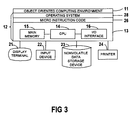
- the present invention is a method and system within an object oriented computing environment 11 operating on one or more computer platforms 12.
- computer platform 12 typically includes computer hardware units 13 such as a central processing unit (CPU) 14, a main memory 15 and an input/output (I/O) interface 16, and may include peripheral components such as a display terminal 21, an input device 22 such as a keyboard or a mouse, nonvolatile data storage devices 23 such as magnetic or optical disks, printers 24 and other peripheral devices.
- Computer platform 12 also typically includes microinstruction codes 26 and an operating system 28.
- object oriented computing environment 11 operates on computer platform 12. It will be understood by those having skill in the art that object oriented computing environment may operate across multiple computer platforms.
- Object oriented computing environment 11 is preferably written in the C++ computer programming language.
- the design and operation of computer platforms and object oriented computing environments including that of an object manager, are well known to those having skill in the art and are described, for example, in U.S. Patent No. 5,265,206 issued November 23, 1993 to Abraham, et al., entitled "A Messenger and Object Manager to Implement an Object Oriented Environment"; and U.S. Patent No.
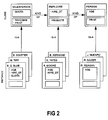
- FIG 2 is a reproduction of Figure 5 of U.S. Patent No. 5,313,629, the main components of an object oriented program (11, Figure 1) will be described.
- a detailed description of the design and operation of an object oriented program is provided in "Object Oriented Software Construction", by Bertrand Meyer, published by Prentice Hall in 1988, the disclosure of which is incorporated herein by reference.
- a typical object oriented computing environment 11 includes three primary components: a Messenger 51, and Object Management Table 52 and a Loaded Classes Table 53.
- the Messenger 51 controls communication between calling and called messages, Object Management Table 52 and Loaded Classes Table 53.
- Object Management Table 52 contains a list of pointers to all active object instances.
- the Loaded Classes Table 53 contains a list of pointers to all methods of active object classes.
- Methods A (block 54) of an object sends a message to method B (block 55) of an object.
- Method A sends a message to Method B by calling Messenger 51.
- the message contains (1) an object reference of the instance to receive the message, (2) the method the object instance is requested to perform on the data it encapsulates, and (3) any parameters needed by the receiving method.
- Messenger 51 obtains a pointer to the data frame 56 of the instance object specified by Method A, by searching Object Management Table 52 for the instance object. If the specified instance object cannot be found, Object Management Table 52 adds the instance object to the table and calls the instance to materialize its data from the database. Once in the instance table, Object Management Table 52 returns the pointer to the materialized instance object.
- Messenger 51 then obtains the address of Method B from the Loaded Classes Table 53. If the instance's class is not loaded, the Loaded Classes Table 53 will load it at this time to materialize its data. The Loaded Classes Table 53 searches for the specified method (Method B) and returns the address of the method to Messenger 51.
- the Messenger 51 then calls Method B, passing it a system data area and the parameters from the call made by Method A including the pointer.
- Method B accesses the data frame 56 using the pointer.
- Method B then returns control to the Messenger 51 which returns control to Method A.
- Figure 3 illustrates an example of an inheritance hierarchy to an object oriented computing platform.
- three object classes are illustrated for "salesperson”, “employee” and "person”, where a salesperson is a "kind of” employee, which is a "kind of” person.
- salesperson is a subclass of employee and employee is the superclass of salesperson.
- employee is the subclass of person and person is the superclass of employee.
- Each class shown includes three instances.
- B. Soutter, W. Tipp and B.G. Blue are salespersons.
- B. Abraham, K. Yates and R. Moore are employees.
- J. McEnroe, R. Nader and R. Reagan are persons. In other words, an instance is related to its class by an "is a" relation.
- Each subclass "inherits" the frames and methods of its superclass.
- a salesperson frame inherits age and hire date objects from the employee's superclass as well as promote methods from the employee superclass. Salesperson also includes a unique quota attribute and a pay commission method. Each instance can access all methods and frames of its superclass, so that, for example, B.G Blue can be promoted.
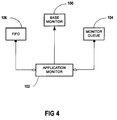
- an application monitor 102 can be constructed which inherits from a basic monitor class 100 and which contains an arbitrary number of condition queues.
- two class definitions allow for construction of any monitor system for controlling thread execution.
- the basic monitor class 100 (which is used for short-term thread scheduling) is defined such that every thread that belongs to a monitor from the monitor class 100 must first acquire a gate lock before proceeding. Upon termination of the thread, the gate lock must be released in order to allow the next thread to enter the monitor of the monitor class 100.
- the basic monitor class 100 offers private methods like "enter()” and “leave()” that implicitly acquire and release the gate lock. Every public method of the monitor class 100 must call "enter()" as a first statement before entering a monitor of the monitor class 100 and "leave()" as a last statement before returning therefrom.
- the short time scheduling of threads entering a monitor of the monitor class 100 is controlled by the gate lock.
- long term scheduling of threads waiting within the monitor of the class 100 is controlled by the organization of the internal synchronization blocking points, i.e., which thread is unblocked with a call to one of the "continue ...()" methods referred to below.
- an application monitor class 102 with a condition queue (for long-term scheduling) is defined such that this class 102 will allow a thread to stay within a monitor queue class 104 and wait for a condition to become true, while another thread may enter the application monitor of the class 102. At this time, there is still only one thread active in the monitor of the class 100. Additional private methods of this second application monitor of the class 102 are, for example, "delay()", “continue_ stay()" and “continue leave().”
- the monitor queue class 104 is designed to already contain important data for long term scheduling.
- the class 104 includes an urgent queue and a pointer to a blocking point for a thread that should be continued.
- the monitor class 100 does not provide routines to put threads in an appropriate event or condition queue (delay on event /condition nor awaken them (with a continue_ ..() call) by a user defined strategy (i.e., a long term strategy).
- the monitor queue class 104 basically provides a blocking point for a thread and methods that allow it to delay a thread or to continue a thread by awakening it, and then either keep itself in the monitor or to leave the monitor thereafter.
- a thread wants to wait within the application monitor of the class 102, it calls "delay()" to delay itself on an internal synchronization primitive. Before entering this blocking point, the gate lock will be released to allow another thread to enter the monitor of the class 100.
- a thread wants to leave the monitor of the class 102 and unblock a thread that is waiting within the application monitor of the class 102, it can call "continueleave()". If no thread is delayed in the application monitor of the class 102, then “continue leave()" will release the gate lock. A thread that calls “continue leave()” promises to leave the monitor of the class 100 immediately after completion of its processing because another thread will immediately become active in the monitor.
- the application monitor class 102 supports long term scheduling in the following way: threads that call delay() are queued in first-in-first-out (FIFO) strategy order in a strategic access memory 106, the thread that is called for delay() first will be unblocked first with the next continuance.
- FIFO first-in-first-out
- threads have been delayed by a call to "continuestay()" are queued with a higher priority than those that have been delayed by a call to "delay()". That is to say, if a thread is blocked by a call to "delay()" and a second thread is blocked by a call to "continue stay()", then, upon the next call to one of the "continue ...()" methods, the second thread will be unblocked first, even if the first thread has been blocked for a long time.
- monitors offer a defined long term scheduling while some synchronization primitives (for example, mutex, condition variable) provide an unspecified (and unpredictable) scheduling (that is, if several threads block on the same synchronization primitive, it is unpredictable which thread is unblocked next). Furthermore, all synchronization problems can be solved with these two basic monitor classes 100 and 102. For implementation purposes, only a single synchronization primitive or semaphore is needed.
Landscapes
- Engineering & Computer Science (AREA)
- Software Systems (AREA)
- Theoretical Computer Science (AREA)
- Physics & Mathematics (AREA)
- General Engineering & Computer Science (AREA)
- General Physics & Mathematics (AREA)
- Stored Programmes (AREA)
Applications Claiming Priority (2)
| Application Number | Priority Date | Filing Date | Title |
|---|---|---|---|
| US67534696A | 1996-07-03 | 1996-07-03 | |
| US675346 | 2000-09-29 |
Publications (1)
| Publication Number | Publication Date |
|---|---|
| EP0817015A2 true EP0817015A2 (de) | 1998-01-07 |
Family
ID=24710059
Family Applications (1)
| Application Number | Title | Priority Date | Filing Date |
|---|---|---|---|
| EP19970110673 Withdrawn EP0817015A2 (de) | 1996-07-03 | 1997-06-30 | Monitorsystem für Fadensynchronisation in einem einzigen Prozess |
Country Status (2)
| Country | Link |
|---|---|
| EP (1) | EP0817015A2 (de) |
| JP (1) | JPH10116202A (de) |
Cited By (4)
| Publication number | Priority date | Publication date | Assignee | Title |
|---|---|---|---|---|
| US6553406B1 (en) * | 2000-08-03 | 2003-04-22 | Prelude Systems, Inc. | Process thread system receiving request packet from server thread, initiating process thread in response to request packet, synchronizing thread process between clients-servers. |
| EP0854419A3 (de) * | 1997-01-16 | 2003-10-22 | International Business Machines Corporation | Zugriffsmodusobjekt |
| EP1008934A3 (de) * | 1998-12-08 | 2004-02-11 | Sun Microsystems, Inc. | Verfahren und Gerät zur Monitorimplementierung auf Benutzer- ebene |
| US9244738B2 (en) | 2013-10-24 | 2016-01-26 | International Business Machines Corporation | Conditional serialization to improve work effort |
Families Citing this family (1)
| Publication number | Priority date | Publication date | Assignee | Title |
|---|---|---|---|---|
| US11640281B2 (en) * | 2021-05-17 | 2023-05-02 | International Business Machines Corporation | Tool for introspection in object-oriented source code |
-
1997
- 1997-06-30 EP EP19970110673 patent/EP0817015A2/de not_active Withdrawn
- 1997-07-03 JP JP17827397A patent/JPH10116202A/ja not_active Withdrawn
Cited By (4)
| Publication number | Priority date | Publication date | Assignee | Title |
|---|---|---|---|---|
| EP0854419A3 (de) * | 1997-01-16 | 2003-10-22 | International Business Machines Corporation | Zugriffsmodusobjekt |
| EP1008934A3 (de) * | 1998-12-08 | 2004-02-11 | Sun Microsystems, Inc. | Verfahren und Gerät zur Monitorimplementierung auf Benutzer- ebene |
| US6553406B1 (en) * | 2000-08-03 | 2003-04-22 | Prelude Systems, Inc. | Process thread system receiving request packet from server thread, initiating process thread in response to request packet, synchronizing thread process between clients-servers. |
| US9244738B2 (en) | 2013-10-24 | 2016-01-26 | International Business Machines Corporation | Conditional serialization to improve work effort |
Also Published As
| Publication number | Publication date |
|---|---|
| JPH10116202A (ja) | 1998-05-06 |
Similar Documents
| Publication | Publication Date | Title |
|---|---|---|
| US6275871B1 (en) | Asynchronous transport optimizing observer-pattern-like system supporting several modes for an interface definition language-less communication subsystem | |
| US6012081A (en) | Service and event synchronous/asynchronous manager | |
| US6247025B1 (en) | Locking and unlocking mechanism for controlling concurrent access to objects | |
| EP0767938B1 (de) | Verfahren zum erzwingen einer hierarchischen anrufstruktur in asynchronen echtzeitsoftwareanwendungen | |
| US20030222912A1 (en) | System and method for managing dataflows | |
| US5896532A (en) | Objects with run-time classes and methods of making them | |
| EP0834808A1 (de) | Verfahren und Gerät zur Benutzerstufeunterstützung für das Synchronisieren mehrerer Ereignisse | |
| Krten | Getting started with QNX Neutrino 2: a guide for realtime programmers | |
| US6286025B1 (en) | Method and system of process identification by user defined process variables | |
| EP0817015A2 (de) | Monitorsystem für Fadensynchronisation in einem einzigen Prozess | |
| Caromel | Programming abstractions for concurrent programming | |
| EP0889396B1 (de) | Fädensynchronisierung durch selektive Objektverriegelung | |
| Schmidt | An OO encapsulation of lightweight OS concurrency mechanisms in the ACE toolkit | |
| Kim et al. | A database server for distributed real-time systems: Issues and experiences | |
| Nilsen | Real-Time Java (Draft 1.1) | |
| Bergmans et al. | An object-oriented model for extensible concurrent systems: the composition-filters approach | |
| EP4174647A1 (de) | Thread-zustandsübergänge | |
| Wegner | Granularity of modules in object-based concurrent systems | |
| Lortz et al. | MDARTS: A multiprocessor database architecture for hard real-time systems | |
| Giering III et al. | Using POSIX threads to implement Ada tasking: Description of work in progress | |
| Son et al. | RTDB: a real-time database manager for time-critical applications | |
| Ruddock et al. | Multithreading programs: guidelines for DCE applications | |
| Son et al. | Developing a database system for time-critical applications | |
| Wohlever et al. | Implementing Concurrency Control With Priority | |
| Schumacher et al. | How to avoid the inheritance anomaly in ada |
Legal Events
| Date | Code | Title | Description |
|---|---|---|---|
| PUAI | Public reference made under article 153(3) epc to a published international application that has entered the european phase |
Free format text: ORIGINAL CODE: 0009012 |
|
| AK | Designated contracting states |
Kind code of ref document: A2 Designated state(s): AT BE CH DE DK ES FI FR GB GR IE IT LU MC NL PT SE |
|
| STAA | Information on the status of an ep patent application or granted ep patent |
Free format text: STATUS: THE APPLICATION HAS BEEN WITHDRAWN |
|
| 18W | Application withdrawn |
Withdrawal date: 20020718 |