EP0817680B1 - Zentrifugiersystem zm intermittierenden sammeln von mononuklearen zellen - Google Patents
Zentrifugiersystem zm intermittierenden sammeln von mononuklearen zellen Download PDFInfo
- Publication number
- EP0817680B1 EP0817680B1 EP96911756A EP96911756A EP0817680B1 EP 0817680 B1 EP0817680 B1 EP 0817680B1 EP 96911756 A EP96911756 A EP 96911756A EP 96911756 A EP96911756 A EP 96911756A EP 0817680 B1 EP0817680 B1 EP 0817680B1
- Authority
- EP
- European Patent Office
- Prior art keywords
- component
- barrier
- liquid
- collect
- sparse
- Prior art date
- Legal status (The legal status is an assumption and is not a legal conclusion. Google has not performed a legal analysis and makes no representation as to the accuracy of the status listed.)
- Expired - Lifetime
Links
- 210000005087 mononuclear cell Anatomy 0.000 title claims abstract description 46
- 210000004369 blood Anatomy 0.000 claims abstract description 66
- 239000008280 blood Substances 0.000 claims abstract description 66
- 238000000034 method Methods 0.000 claims abstract description 59
- 230000004888 barrier function Effects 0.000 claims abstract description 48
- 210000003743 erythrocyte Anatomy 0.000 claims abstract description 38
- 238000000926 separation method Methods 0.000 claims abstract description 37
- 210000003714 granulocyte Anatomy 0.000 claims abstract description 9
- 239000007788 liquid Substances 0.000 claims description 38
- 230000008569 process Effects 0.000 claims description 27
- 210000000130 stem cell Anatomy 0.000 claims description 8
- 238000005192 partition Methods 0.000 claims description 5
- 238000012545 processing Methods 0.000 claims description 5
- 230000000694 effects Effects 0.000 claims description 3
- 210000002381 plasma Anatomy 0.000 abstract description 53
- 210000000265 leukocyte Anatomy 0.000 abstract description 42
- 238000003306 harvesting Methods 0.000 abstract description 10
- 239000012530 fluid Substances 0.000 abstract description 4
- 230000006872 improvement Effects 0.000 abstract description 3
- 239000000306 component Substances 0.000 description 43
- 210000001772 blood platelet Anatomy 0.000 description 10
- 239000003146 anticoagulant agent Substances 0.000 description 8
- 229940127219 anticoagulant drug Drugs 0.000 description 8
- 210000004027 cell Anatomy 0.000 description 7
- 230000006870 function Effects 0.000 description 7
- FAPWRFPIFSIZLT-UHFFFAOYSA-M Sodium chloride Chemical compound [Na+].[Cl-] FAPWRFPIFSIZLT-UHFFFAOYSA-M 0.000 description 5
- 239000012503 blood component Substances 0.000 description 5
- 238000005534 hematocrit Methods 0.000 description 5
- 210000001185 bone marrow Anatomy 0.000 description 4
- 230000008859 change Effects 0.000 description 4
- 238000012806 monitoring device Methods 0.000 description 3
- 238000001228 spectrum Methods 0.000 description 3
- 230000017531 blood circulation Effects 0.000 description 2
- 210000003850 cellular structure Anatomy 0.000 description 2
- 230000005574 cross-species transmission Effects 0.000 description 2
- 230000003247 decreasing effect Effects 0.000 description 2
- 238000010586 diagram Methods 0.000 description 2
- 201000010099 disease Diseases 0.000 description 2
- 208000037265 diseases, disorders, signs and symptoms Diseases 0.000 description 2
- 238000005516 engineering process Methods 0.000 description 2
- 210000004698 lymphocyte Anatomy 0.000 description 2
- 230000003287 optical effect Effects 0.000 description 2
- 239000002245 particle Substances 0.000 description 2
- 210000003462 vein Anatomy 0.000 description 2
- 206010066173 Allergic transfusion reaction Diseases 0.000 description 1
- 206010028980 Neoplasm Diseases 0.000 description 1
- 206010037660 Pyrexia Diseases 0.000 description 1
- 230000009471 action Effects 0.000 description 1
- 238000002617 apheresis Methods 0.000 description 1
- 238000010420 art technique Methods 0.000 description 1
- 230000015572 biosynthetic process Effects 0.000 description 1
- 239000010836 blood and blood product Substances 0.000 description 1
- 229940125691 blood product Drugs 0.000 description 1
- 201000011510 cancer Diseases 0.000 description 1
- 238000005119 centrifugation Methods 0.000 description 1
- 238000012864 cross contamination Methods 0.000 description 1
- 238000012258 culturing Methods 0.000 description 1
- 229940079593 drug Drugs 0.000 description 1
- 239000003814 drug Substances 0.000 description 1
- 239000001963 growth medium Substances 0.000 description 1
- 238000001802 infusion Methods 0.000 description 1
- 238000009630 liquid culture Methods 0.000 description 1
- 230000007246 mechanism Effects 0.000 description 1
- 239000000203 mixture Substances 0.000 description 1
- 238000012544 monitoring process Methods 0.000 description 1
- 210000001616 monocyte Anatomy 0.000 description 1
- 230000010355 oscillation Effects 0.000 description 1
- 239000002243 precursor Substances 0.000 description 1
- 230000009467 reduction Effects 0.000 description 1
- 239000007787 solid Substances 0.000 description 1
- 238000013517 stratification Methods 0.000 description 1
- 238000012360 testing method Methods 0.000 description 1
- 208000037918 transfusion-transmitted disease Diseases 0.000 description 1
- 238000011144 upstream manufacturing Methods 0.000 description 1
- 239000002699 waste material Substances 0.000 description 1
Images


Classifications
-
- B—PERFORMING OPERATIONS; TRANSPORTING
- B04—CENTRIFUGAL APPARATUS OR MACHINES FOR CARRYING-OUT PHYSICAL OR CHEMICAL PROCESSES
- B04B—CENTRIFUGES
- B04B5/00—Other centrifuges
- B04B5/04—Radial chamber apparatus for separating predominantly liquid mixtures, e.g. butyrometers
- B04B5/0442—Radial chamber apparatus for separating predominantly liquid mixtures, e.g. butyrometers with means for adding or withdrawing liquid substances during the centrifugation, e.g. continuous centrifugation
-
- B—PERFORMING OPERATIONS; TRANSPORTING
- B04—CENTRIFUGAL APPARATUS OR MACHINES FOR CARRYING-OUT PHYSICAL OR CHEMICAL PROCESSES
- B04B—CENTRIFUGES
- B04B5/00—Other centrifuges
- B04B5/04—Radial chamber apparatus for separating predominantly liquid mixtures, e.g. butyrometers
- B04B5/0442—Radial chamber apparatus for separating predominantly liquid mixtures, e.g. butyrometers with means for adding or withdrawing liquid substances during the centrifugation, e.g. continuous centrifugation
- B04B2005/045—Radial chamber apparatus for separating predominantly liquid mixtures, e.g. butyrometers with means for adding or withdrawing liquid substances during the centrifugation, e.g. continuous centrifugation having annular separation channels
Definitions
- This invention relates to a system for the centrifugal processing of liquids such as whole blood and, more particularly, to improvements in the collection of species which are sparse within the liquid such as the mononuclear cell component of whole blood.
- Centrifugation is a technique used to process whole blood in order to separate the blood into its various components.
- Apparatus for separating whole blood into at least two fractions is disclosed in U.S. Patent No. 3,655,123. Control of the amount of the fraction being withdrawn from the centrifuge can be achieved by varying the speed of the output pumps.
- the centrifugal apparatus can be fitted with a disposable plastic vessel through which the blood is circulated.
- the vessel is fitted into a centrifuge fixture that is driven by a motor.
- An exemplary vessel is a circumferential separation channel having several outlets positioned at different radial positions within the channel in order to remove blood components which have been separated by the centrifuge into stratified layers of differing density.
- Red blood cells (RBC) being the most dense of the components are stratified within the channel at the most radially outward location whereas the stratified layer of plasma is the most radially inward layer.
- a relatively thin layer called the buffy coat contains white blood cells and platelets and is located at an interface position between the red blood cell layer and the plasma layer. Within the buffy coat the platelets are stratified toward the plasma while the white blood cells are stratified toward the red blood cells. Depending on centrifuge speed, platelets may also be dispersed within the plasma.
- the disposable plastic vessel which is fitted into a rotating fixture within the centrifuge is connected to the blood source and to collection reservoirs through a disposable tubing set. In that manner, the centrifuge equipment itself is kept out of contact with blood and the disposable tubing set and separation channel are discarded after one procedure.
- the source of blood can be whole blood obtained directly from a donor or patient, or it can be previously donated bone marrow or blood.
- Blood components may be collected from a patient, stored and perhaps frozen, and reinfused into the patient days or even years later.
- the mononuclear cell component of white blood cells is sometimes collected, stored in the above manner, and reinfused into the patient for the treatment of diseases such as cancer.
- autologous blood reduces the risk of exposure to transfusion transmitted disease and febrile/allergic transfusion reactions.
- WBC white blood cells
- an apheresis system has been developed for harvesting them from the buffy coat.
- the mononuclear cell (MNC) component of WBCs are harvested including lymphocytes, monocytes, progenitor cells, and stem cells.
- Efficient equipment for collecting MNCS is described in US Patent No. 4,647,279.
- the collection of mononuclear cells is difficult since they make up only a small fraction of the total blood volume.
- the total volume of MNCs may be about 1.5 milliliters, that is about .03% of the total blood volume.
- a very thin MNC layer appears between the red blood cell and plasma layers.
- the thin MNC layer presents a challenge when attempting an MNC harvest.
- the equipment referred to above includes a barrier positioned in the channel upstream of the RBC port. MNCs are accumulated at the barrier with a WBC collection port placed in front of the barrier. The fraction collected through the WBC collection port is actually a mixture of WBCs, platelets, plasma and RBCs. In collection procedures, the color of the collected fraction may be monitored with blood inflow and plasma outflow rates adjusted, manually or automatically, to fine tune the interface of the MNC layer with the RBC layer so that the MNC layer corresponds in position to the WBC collection port.
- an operator is used to make very fine adjustments of the speed of the plasma pump in order to position the interface properly for collection of the MNC layer, that is, the mononuclear white blood cell component.
- the operator judges the position of the interface according to the color of the fluid leaving the collection channel, and adjustments are made to provide the desired color in the collect port.
- Fine control is provided over the speed of the plasma pump such that adjustments may be made on the order of one tenth milliliter per minute. Even though small changes are possible in the speed of the pump, it is not unusual for a change in plasma pump speed to over or under-correct, necessitating further change in pump speed.
- the interface positioning system manual or automatic, can be involved in a vibratory chasing of the correct interface position with the result of decreased efficiency and purity in collecting the MNC layer.
- a further problem is that after each change in pump speed the process requires a period of time for the change to take effect, that is, for the new interface position to become established. Attempts have been made to use optical monitoring equipment to judge the opacity of the collect volume and automatically adjust plasma pump speed.
- optical monitoring equipment to judge the opacity of the collect volume and automatically adjust plasma pump speed.
- such techniques designed to automate the system are also subject to oscillations around the control point and generally provide little improvement over the system when it is operated manually. Basically, all of these problems result from the fact that the target species is sparse and forms a very thin stratified layer which is difficult to harvest separately from other components.
- WBCs are comprised of mononuclear cells and polymorphonuclear cells (granulocytes).
- Granulocytes are normally a small sub-population of WBCs in healthy people but grow to a more significant sub-population when the body reacts to disease.
- the thin buffy coat layer is itself stratified into a still thinner layer of MNCs and, a thin layer of platelets. The granulocytes are found in the buffy coat tending more toward the RBC layer and are also found in significant populations within the RBC layer.
- a system for the centrifugal processing of a liquid for separating and collecting a sparse component of said liquid comprising:
- a method for the centrifugal processing of a liquid for separating a sparse component of the liquid comprising the steps of:
- the invention relates to the intermittent collection of species which are sparse within a liquid, such as mononuclear cells (MNCs)which form a thin stratified layer at the interface of red blood cells and plasma when whole blood is centrifuged.
- a barrier is placed within the centrifuge separation channel at a location to intercept the thin layer.
- a collect port is positioned directly in front of the barrier at a level corresponding to the position of the thin mononuclear cell layer.
- fluid is collected through the collect port in an intermittent fashion, thereby allowing a pool of MNC fluid to form in front of the barrier and surround the collect port before MNC collection begins.
- Collection is continued only long enough to remove most of the MNC pool. Collection then ceases for a period long enough to rebuild the pool. Collection begins again, and the intermittent process continues until the volume of whole blood to be processed has been completed.
- a process cycle volume is that amount of whole blood needed to build the desired MNC volume in front of the barrier.
- Process cycle volume is a function of the MNC count, the inlet flow rate, the separation factor, and the size of the barrier.
- Separation factor is a function of centrifuge speed, blood flow rate, and the geometry of the separation channel.
- the intermittent collection procedure of the invention is also useful in collecting granulocytes, it can be used to harvest platelets and, in general, is useful for harvesting any stratified sparse species within a centrifuged liquid where the layer to be harvested forms between more dense and less dense strata.
- FIG 1 is a block diagram of a centrifuge system for collecting blood components.
- a centrifuge system for collecting blood components.
- Blood source 10 may be a donor or a patient from whom whole blood is removed through a needle, usually positioned in one of the donor's or patient's arms. Alternatively, a catheter may be positioned in one of the large veins.
- the blood source 10 may also be previously collected whole blood or bone marrow made available to the system of Figure 1 from a reservoir. If blood or bone marrow has been previously collected, an anticoagulant (AC) solution will have already been added to the whole blood or marrow at the time it was collected and, consequently, additional anticoagulant solution may not be needed during the collection procedure.
- AC anticoagulant
- an AC source 11 is used to provide the required amount of anticoagulant solution to the whole blood. Entry of AC solution is preferably positioned in close proximity to the needle or catheter.
- an MNC collection procedure is described using whole blood as the source of MNCs. The description is also accurate when bone marrow is used.
- Whole blood is drawn from the source 10 through inlet line 12 by an inlet pump 13 and passed through line 14 into centrifugal apparatus 15.
- Red blood cells along with a reduced fraction of plasma, are collected and removed from the centrifuge through outlet line 16 and passed into return line 17 for return to the donor or patient.
- Plasma and platelets suspended therein are removed through outlet line 18 through a plasma pump 19 and may also be returned to the donor or patient over return line 17. Alternatively, if a portion of the plasma is to be collected, it may be directed into a plasma collect reservoir 20 by toggling valve 19'.
- White blood cells are removed from the centrifuge over outlet line 21 by the WBC collect pump 22.
- the outlet of collect pump 22 is connected to a collect reservoir 23 through valve 23'.
- a saline solution in reservoir 24 may be used and is provided by opening clamp 24' and through inlet pump 13 to the channel and to the various lines within the tubing set of the system prior to beginning the collection procedure. Saline solution may also be used at the end of the procedure to clear blood from the lines.
- a waste reservoir 25 is included for receiving the saline solution.
- the control system 26 controls the various components within the system such as valves, pumps, centrifuge, etc. Any suitable type of control technology may be used, but it is advantageous to use a microprocessor-based system through which system parameters may be easily changed through the flexibility offered by control programs.
- Fig. 2 illustrates such a system.
- Fig. 2 shows a microprocessor 200 connected to a read only memory (ROM) 201, a random access memory (RAM) 202, a control panel 203, a display device 204, and erasable programmable read only memory (PROM) 205.
- the control panel 203 may contain a keyboard or keypad for changing plasma pump speed or other system parameters. If desired, analog input control devices may be used on the panel together with analog to digital (ADC) converters.
- the display device 204 may be a monitor separate from the control panel, or it may be incorporated into the panel. The display device may be used to provide system information to an operator during operation of the system to enable manual adjustment of system parameters.
- ROM 201 contains initializing programs so that the microprocessor can check the availability of all control components and otherwise ready the control system for performing whatever operations are required of it.
- RAM 202 is a writable memory into which is placed the control programs for operating the system according to the particular procedure to be performed. RAM 202 provides for a rapid interchange of data with the microprocessor 200.
- the PROM 205 contains control programs. For example, if an MNC collection is to be performed, a control program for that procedure is contained within PROM 205. The control procedure may be transferred to RAM 202 or it may directly interface with processor 200.
- Input and output lines 206 from microprocessor 200 lead to control components for the various valves, monitoring devices and pumps within the system.
- COBE "SPECTRA" several microprocessor systems such as shown in Fig. 2 may be used and the control functions split among the different systems. By utilizing several microprocessors, redundancy is obtained to make the equipment more fail-safe.
- FIGS 3 and 4 are views of the circumferential separation channel used in the COBE "SPECTRA" to separate whole blood into its components for the collection of white blood cells.
- Separation channel 30 is a disposable element which is placed within the centrifuge apparatus 15.
- Inlet pump 13 supplies whole blood through inlet line 14 to an inlet chamber 31.
- Outlet chamber 32 is adjacent to the inlet chamber 31 but separated therefrom by a solid partition 33. As a consequence, the whole blood input into chamber 31 must flow around the entire circumference of the separation channel 30 before it reaches the outlet chamber 32.
- FIG 4 which shows a cross-sectional view of the inlet and outlet chambers, shows that the red blood cell collection line 16 is connected to a red blood cell port 37 which is positioned near the outer wall 29 of the outlet chamber 32 and therefore positioned in a manner to receive red blood cells.
- the plasma outlet line 18 is connected to plasma port 39 which is situated near the inner wall 28 of the outlet chamber 32. As a consequence, the lighter plasma is drawn through port 39 into the plasma outlet line 18.
- the white blood cell collection line 21 is connected to a white blood cell or MNC port 40 which is approximately halfway between the inner wall 28 and the outer wall 29.
- a control port 41 is also located about halfway between the inner and outer walls and is used to control the position of the interface between the red blood cells and the plasma, that is the interface where the white blood cells build up.
- the control port is connected to the red blood cell return line 16.
- inlet pump 13 supplies whole blood to the separation chamber and pump 22 draws the white blood cells from the chamber through line 21 to a collect reservoir 23 (shown in Fig. 1).
- the plasma pump 19 is connected to the plasma outlet line 18 and removes plasma from the separation chamber for returning the plasma to the blood source, usually a patient, or should it be desired to collect some of the plasma, it might be diverted into a plasma collect reservoir 20 as shown in Fig. 1. Note that there is no pump on the red blood cell outlet line 16.
- An important feature of the outlet collection chamber 32 is the dam or barrier 42 which is located in the mid-portion of the collection chamber and extends from one sidewall to the other.
- Red blood cells entering the collection chamber 32 can pass by the dam along the outer wall 29 through a passageway 43 as shown in Figure 4.
- Plasma can pass along the inner wall 28 past the dam through passageway 44.
- both red blood cells and plasma flow into section 45 of the outlet collection chamber.
- White blood cells due to their relative density float on top of the RBC layer, are trapped in front of the dam 42 and are thereby positioned at the WBC outlet port 40. In that fashion, white blood cells are properly positioned within the collection chamber to exit the chamber through outlet tube 21.
- Figure 5 is a diagrammatic illustration of the separation channel 30 showing the stratified layers of the blood and the various outlet ports associated with the collection chamber 32.
- Figure 5 shows the layer 53 comprised essentially of the more dense particles, the red blood cells.
- Plasma representing the lightest component of the blood is shown at 52 along the inner wall 35.
- An interface 50 is diagrammatically shown in Figure 5 representing the interface between red blood cells and plasma.
- a thin layer, the buffy coat 51 forms at the interface and contains mononuclear cells and platelets.
- the collect port 40 is positioned at the interface in order to collect the buffy coat.
- an interface control port 41 is included in the separation chamber. By maintaining the interface in the correct position, the collect port 40 is properly located to collect the buffy coat.
- the speed of the plasma pump 19 is established in accordance with the speed of the inlet pump 13 and blood hematocrit, that is the volume of plasma withdrawn through port 41 is a function of the volume of the whole blood introduced and its hematocrit.
- the speed of the plasma pump properly, enough plasma will be withdrawn from the collection chamber 32 to keep the interface at the correct position.
- the interface 50 should the interface 50 begin to move radially inwardly, a greater amount of the red cell component begins to flow through control port 41. Because the red cell component is more viscous than the plasma component, the increased red cell flow results in a reduced volume flowing through port 41.
- the technique of continuously collecting white blood cells through a system such as described above produces relatively high efficiency, that is, most of the white blood cells are collected.
- the purity of the collection is sometimes less than desired and the volume of the collected quantity is greater than needed. This occurs because of the difficulty in positioning and maintaining the position of the thin buffy coat layer exactly at collect port 40.
- the system is usually controlled to collect a relatively wide band of volume from the collect port 40, thereby collecting most of the white blood cells.
- a considerable amount of plasma, platelets and red blood cells are also collected together with the white blood cells.
- fine adjustments must be made to the speed of the plasma pump in order to position the interface properly for collection of the white blood cell component. These adjustments are made by visually inspecting the flow through the collect port. Should the flow become slightly more opaque, the operator may adjust the speed of the plasma pump to slightly increase the volume of plasma in the collect chamber. Problems associated with "chasing" the interface may result as mentioned above.
- FIG. 6 is a diagrammatic illustration of the collect chamber 32 showing the stratified components of the blood when the current invention is in operation. Note that the position of the interface 50 is maintained by control port 41 as previously described. A buffy coat 51 appears as a stratified layer at the interface due to the action of the centrifuge. In the invention, however, the white blood cell collect pump 22 is not started. As a result, an MNC layer builds up in front of the dam 42 to form a pool 49, thus providing a much thicker band of MNC component at collect port 40. In that fashion, when collect pump 22 is started, the thicker MNC layer provides a larger target which is less sensitive to drifting of the control mechanisms in the device.
- the collect pump 22 is stopped, once again allowing a buildup of MNC volume in front of dam 42. Periodically the MNC volume is harvested.
- the collected volume is smaller and the purity greater when compared to previous methods. Additionally, it is no longer necessary to monitor the presence of red blood cells in the collect line 21 nor is it necessary for the operator to make fine adjustments of the plasma pump speed in accordance with the presence of red blood cells in collect line 21.
- the speed of the plasma pump is established by the control system as a function of the input flow rate and hematocrit.
- the separation factor is also established which sets the speed of the centrifuge. It may be constant in many implementations.
- Another process parameter is the collect flow rate which also may be constant in many implementations.
- a process cycle volume is calculated in accordance with the process parameters described above.
- the process cycle volume is defined as that volume of whole blood needed to establish the volume of white cells which fill the space in front of the barrier in the channel without incurring spillover. Note that if the flow rate is high and the red blood cells and plasma are flowing around the barrier at a high rate, there might be some reduction in the volume of the white cells which can be collected in a pool behind the barrier before incurring spillover.
- the process cycle volume is a function of the MNC count, the separation factor and the geometry of the barrier.
- the process cycle volume is specific to specific equipment.
- the time period for running the collect pump must also be established. Again, this relates to the size of the barrier and the volumetric rate of the collect pump.
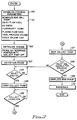
- the system of Figure 1 may be initialized as shown in step 102.
- Whole blood is introduced into the system and a period of time provided to remove any saline solution which might have been used to prime the system and to establish the interface position properly with the collect pump off.
- the run phase is entered at step 103.
- the previously calculated process cycle volume is introduced into the separation chamber as shown at step 104, thereby allowing a buildup of WBC volume behind the barrier.
- the collect pump is started as shown at step 105.
- the collect pump is run for the previously calculated period of time necessary to remove the pool of MNC from behind the barrier, at which time the collect pump is stopped at step 107.
- step 108 the total inlet volume since entering the run phase is compared to the total process volume to be processed. If the two are not equal, return is made to step 104 to introduce another process cycle volume. The process continues to intermittently collect the WBC pool behind the barrier until the total inlet volume equals the total volume to be processed. At that point, a branch is made to step 109 for completing the run phase and entering the rinseback phase 110.
- the collect pump may be operated for a short period of time to remove WBC volume from the collect line and move it into the collect reservoir.
- a saline solution is used to rinse the entire channel and tubing set. This procedure flushes whole blood out of the system and to the patient so that there is very little loss of blood to the patient during the procedure.
- the interface position was critical since the thickness of the white blood cell layer at the interface was so thin.
- the white blood cell volume is allowed to build up behind the barrier, thus providing a significant thickness to the white blood cell layer and making the exact interface position much less critical. As a consequence, there is no need to monitor the hematocrit content of the collect line either visually or through optical components.
- the MNC component of WBCs includes mature cells such as lymphocytes and also includes precursor cells such as progenitors and stem cells.
- Harvesting progenitors and/or stem cells as a separate species is the subject of International patent application WO93/12805, wherein methods are described for culturing such species in a liquid culture medium.
- the invention described herein may be of value in separating the progenitor cells and/or stem cells from the culture solution.
- An RBC pump might be utilized rather than an inlet pump.
- Monitoring devices may be used to discern build up of the MNC pool rather than relying on previously calculated process cycle volume values. Similarly, the period of collection may be varied through use of monitoring devices. Control over the process is illustrated as provided by a programmed microprocessor. Such control could also be provided by any number of known control technologies.
Landscapes
- External Artificial Organs (AREA)
- Medicines Containing Material From Animals Or Micro-Organisms (AREA)
- Centrifugal Separators (AREA)
Claims (16)
- System zur zentrifugalen Aufarbeitung einer Flüssigkeitkeit zum Abtrennen und Sammeln einer spärlich vorhandenen Komponente der Flüssigkeit, umfassend:Eine Einlaufleitung (14) zur Aufnahme der Flüssigkeit;einen Zentrifugierapparat (15) mit einem Ringabtrenngefäß, das an die Einlaufleitung (14) zur Abtrennung von Komponenten in aufgefächerten Schichten innerhalb des Gefäßes angeschlossen ist;eine Einlaufkammer (31) innerhalb des Gefäßes zur Aufnahme der Flüssigkeit aus der Einlaufleitung (14);eine Ablaufkammer (32) innerhalb des Gefäßes, aus der die abgetrennten Komponenten der Flüssigkeit entnommen werden;eine Trennwand (33) innerhalb des Gefäßes, die die Flüssigkeit zum Fließen in einer Richtung im Ring des Gefäßes aus der Einlaufkammer (31) zur Ablaufkammer (32) bringt;eine Barriere (42), die innerhalb der Ablaufkammer (32) angebracht ist, um eine gebildete Schicht aus dieser spärlich vorhandenen Komponente, wie an der Grenzfläche einer dichteren Komponente und einer weniger dichten Komponente entstanden, aufzufangen;eine Sammelöffnung (40), die vor der Barriere plaziert und so positioniert ist, daß sie im Gebrauch an der Grenzfläche die gebildete Schicht der spärlich vorhandenen Komponente absammelt;erste Kontrollvorrichtung für den Betrieb des Systems, um die Bildung eines Pools aus dieser spärlich vorhandenen Komponente vor der Barriere (43) zu ermöglichen;zweite Kontrollvorrichtung für den Betrieb des Systems, um zumindest einen Teil dieses Pools durch die Sammelöffnung (40) zu entnehmen;dritte Kontrollvorrichtung zur Bestimmung, wann dieser mindestens eine Teil des Pools entfernt werden soll und zur Alternierung der Kontrolle des Systems zwischen der ersten Kontrollvorrichtung und der zweiten Kontrollvorrichtung; undVorrichtung, die an die Sammelöffnung (40) mittels einer Sammelleitung (21) angeschlossen ist, wobei die Vorrichtung kontrollierbar an die erste Kontrollvorrichtung und die zweite Kontrollvorrichtung angeschlossen ist.
- System nach Anspruch 1, wobei die an die Sammelöffnung (40) mittels einer Sammelleitung (21) angeschlossene Vorrichtung außerdem eine Sammelpumpe (22) umfaßt.
- System nach Anspruch 1 oder 2, außerdem umfassend:Eine Einlaufpumpe (13), wobei die Einlaufkammer (31) zur Aufnahme der Flüssigkeit aus der Einlaufpumpe (13) angeschlossen ist;wobei das Ringabtrenngefäß außerdem einen Ringkanal (30) umfaßt, der an die Einlaufkammer (31) an einem ersten Ende und an die Ablaufkammer (32) an einem zweiten Ende angeschlossen ist, wodurch die Flüssigkeit durch das Abtrenngefäß aus der Einlaufkammer (31) zur Ablaufkammer (32) gepumpt wird und wodurch die Flüssigkeit durch den Betrieb des Zentrifugierapparates in verschiedene Schichten auseinandergezogen wird.
- System nach Anspruch 1, 2 oder 3, wobei die Ablaufkammer (32) außerdem die Barriere (42), die Sammelöffnung (40) und mindestens eine weitere Öffnung zur Entfernung von nicht durch die Sammelöffnung aufgefangener Flüssigkeit umfaßt.
- System nach Anspruch 1, 2, 3 oder 4, wobei die Ablaufkammer (32) außerdem eine Grenzflächen-Positionieröffnung (41) umfaßt, die hinter der Barriere (42) angebracht ist.
- System nach einem der vorangehenden Ansprüche, wobei ein Prozeßzyklusvolumen bestimmt wird als eine Funktion der Zählung der spärlich vorhandenen Komponente innerhalb der Flüssigkeit, des Trennfaktors des Systems und der Größe der Barriere, wobei das Prozeßzyklusvolumen jenes Volumen der Flüssigkeit zur Herstellung des Pools aus spärlich vorhandener Komponente ausmacht, welches den Raum vor der Barriere (42) ohne Überlaufen über die Barriere (42) ausfüllt, wobei der Trennfaktor eine Funktion der Zentrifugen-Drehzahl, der Einlauf-Fließgeschwindigkeit und der Geometrie des Abtrenngefäßes ist, unddritte Kontrollvorrichtung, die so betreibbar ist, daß ein erster Zeitraum erhalten wird, in dem die Bildung des Pools aus spärlich vorhandener Komponente vor der Barriere (42) möglich ist, wobei dieser erste Zeitraum eine Funktion des Prozeßzyklusvolumens und der volumetrischen Geschwindigkeit der Einlaufpumpe (13) ist.
- System nach Anspruch 6, wobei die dritte Kontrollvorrichtung außerdem so betreibbar ist, daß ein zweiter Zeitraum als eine Funktion des Volumens des Pools der spärlich vorhandenen Komponente und der volumetrischen Geschwindigkeit der Sammelpumpe erhalten wird.
- System nach einem der vorangehenden Ansprüche, wobei die Flüssigkeit Vollblut ist, worin die spärlich vorhandene Komponente im wesentlichen mononukleare Zellen ist und worin die dichtere Komponente im wesentlichen rote Blutkörperchen und die weniger dichte Komponente im wesentlichen Plasma sind.
- System nach einem der Ansprüche 1 bis 7, wobei die Flüssigkeit Vollblut ist, worin die spärlich vorhandene Komponente im wesentlichen Granulozyten ist und worin die dichtere Komponente im wesentlichen rote Blutkörperchen und die weniger dichte Komponente in wesentlichen mononukleare Zellen und/oder Plasma sind.
- System nach einem der Ansprüche 1 bis 7, wobei die spärlich vorhandene Komponente im wesentlichen Vorläuferzellen und/oder Stammzellen sind.
- Verfahren zur zentrifugalen Aufarbeitung einer Flüssigkeit zum Abtrennen einer spärlich vorhandenen Komponente der Flüssigkeit, umfassend die folgenden Schritte:Einspeisen der Flüssigkeit in eine Einlaufleitung (14) des Ringabtrenngefäßes eines Zentrifugierapparats (15), wobei das Gefäß eine Einlaufkammer (31) zur Aufnahme der Flüssigkeit aus der Einlaufleitung (14), eine Ablaufkammer (32), aus der abgetrennte Komponenten entnommen werden, und eine Trennwand (33) umfaßt, die eine innerhalb der Ablaufkammer (32) angebrachte Barriere (42) zum Auffangen einer gebildeten Schicht der spärlich vorhandenen Komponente, wie an der Grenzfläche einer dichteren Komponente und einer weniger dichten Komponente entstanden, bringt;kontinuierlicher Betrieb des Zentrifugierapparates (15), um die Auftrennung der Flüssigkeit in die gebildete Schicht der spärlich vorhandenen Komponente, der dichteren Komponente und der weniger dichten Komponente zu bewirken;Ansammeln der Schicht aus spärlich vorhandener Komponente zur Bildung eines Pools vor der Barriere (42);Maschinelle Bestimmung, wann zumindest ein Teil des angesammelten Pools der spärlich vorhandenen Komponente zu entfernen ist und Entfernen zumindest eines Teils der angesammelten spärlich vorhandenen Komponente durch eine Sammelöffnung (40), die vor der Barriere (42) plaziert und nahe der Grenzfläche innerhalb des Pools positioniert ist, nachdem sich ein Pool der spärlich vorhandenen Komponente angesammelt hat; undWiederholen der Schritte des Ansammelns und Entfernens, bis ein Endpunkt erreicht ist.
- Verfahren nach Anspruch 11, welches außerdem die folgenden Schritte umfaßt:Fließenlassen der dichteren Komponente über die Barriere (42) hinaus und Entfernen der dichteren Komponente durch eine erste Ablaßöffnung (37), die hinter der Barriere sitzt; undFließenlassen der weniger dichten Komponente über die Barriere hinaus und Entfernen der weniger dichten Komponente durch eine zweite Ablaßöffnung (41), die hinter der Barriere sitzt.
- Verfahren nach Anspruch 12, außerdem umfassend den Schritt des Festsetzens eines Prozeßzyklusvolumens als einer Funktion der Zählung der spärlich vorhandenen Komponente innerhalb der Flüssigkeit, des Abtrennfaktors des Systems und der Größe der Barriere, wobei das Prozeßzyklusvolumen jenes Volumen der Flüssigkeit ist, das zur Errichtung des Pools aus spärlich vorhandener Komponente erforderlich ist, welcher den Raum vor der Barriere ohne Überlaufen über die Barriere (42) ausfüllt, wobei der Abtrennfaktor eine Funktion der Zentrifugen-Drehzahl, der Einlauf-Fließgeschwindigkeit und der Geometrie des Abtrenngefäßes ist.
- Verfahren nach Anspruch 13, außerdem umfassend den Schritt des Festsetzens eines ersten Zeitraums, um die Bildung des Pools der spärlich vorhandenen Komponente vor der Barriere (42) zu ermöglichen, wobei der erste Zeitraum eine Funktion des Prozeßzyklusvolumens und der volumetrischen Fließgeschwindigkeit in der Einlaufleitung (14) ist.
- Verfahren nach Anspruch 14, welches außerdem den Schritt des Festsetzens eines zweiten Zeitraums als einer Funktion des Volumens des Pools der spärlich vorhandenen Komponente und der volumetrischen Fließgeschwindigkeit durch die Sammelöffnung (40) umfaßt.
- Verfahren nach einem der Ansprüche 11 bis 15, wobei die Flüssigkeit Vollblut ist, worin die spärlich vorhandene Komponente im wesentlichen mononukleare Zellen ist und worin die dichtere Komponente im wesentlichen rote Blutkörperchen und die weniger dichte Komponente im wesentlichen Plasma sind.
Applications Claiming Priority (3)
| Application Number | Priority Date | Filing Date | Title |
|---|---|---|---|
| US422597 | 1995-04-14 | ||
| US08/422,597 US5704888A (en) | 1995-04-14 | 1995-04-14 | Intermittent collection of mononuclear cells in a centrifuge apparatus |
| PCT/US1996/005144 WO1996032198A1 (en) | 1995-04-14 | 1996-04-12 | Centrifuged system for intermittent collection of mononuclear cells |
Publications (2)
| Publication Number | Publication Date |
|---|---|
| EP0817680A1 EP0817680A1 (de) | 1998-01-14 |
| EP0817680B1 true EP0817680B1 (de) | 1999-12-29 |
Family
ID=23675570
Family Applications (1)
| Application Number | Title | Priority Date | Filing Date |
|---|---|---|---|
| EP96911756A Expired - Lifetime EP0817680B1 (de) | 1995-04-14 | 1996-04-12 | Zentrifugiersystem zm intermittierenden sammeln von mononuklearen zellen |
Country Status (5)
| Country | Link |
|---|---|
| US (2) | US5704888A (de) |
| EP (1) | EP0817680B1 (de) |
| JP (1) | JP4580470B2 (de) |
| DE (1) | DE69605901T2 (de) |
| WO (1) | WO1996032198A1 (de) |
Cited By (6)
| Publication number | Priority date | Publication date | Assignee | Title |
|---|---|---|---|---|
| US8394342B2 (en) | 2008-07-21 | 2013-03-12 | Becton, Dickinson And Company | Density phase separation device |
| US8747781B2 (en) | 2008-07-21 | 2014-06-10 | Becton, Dickinson And Company | Density phase separation device |
| US8794452B2 (en) | 2009-05-15 | 2014-08-05 | Becton, Dickinson And Company | Density phase separation device |
| US9333445B2 (en) | 2008-07-21 | 2016-05-10 | Becton, Dickinson And Company | Density phase separation device |
| US9682373B2 (en) | 1999-12-03 | 2017-06-20 | Becton, Dickinson And Company | Device for separating components of a fluid sample |
| US9694359B2 (en) | 2014-11-13 | 2017-07-04 | Becton, Dickinson And Company | Mechanical separator for a biological fluid |
Families Citing this family (37)
| Publication number | Priority date | Publication date | Assignee | Title |
|---|---|---|---|---|
| US5573678A (en) * | 1987-01-30 | 1996-11-12 | Baxter International Inc. | Blood processing systems and methods for collecting mono nuclear cells |
| US5961842A (en) * | 1995-06-07 | 1999-10-05 | Baxter International Inc. | Systems and methods for collecting mononuclear cells employing control of packed red blood cell hematocrit |
| US5980760A (en) * | 1997-07-01 | 1999-11-09 | Baxter International Inc. | System and methods for harvesting mononuclear cells by recirculation of packed red blood cells |
| US6027441A (en) | 1997-07-01 | 2000-02-22 | Baxter International Inc. | Systems and methods providing a liquid-primed, single flow access chamber |
| US6027657A (en) * | 1997-07-01 | 2000-02-22 | Baxter International Inc. | Systems and methods for collecting diluted mononuclear cells |
| US6334842B1 (en) * | 1999-03-16 | 2002-01-01 | Gambro, Inc. | Centrifugal separation apparatus and method for separating fluid components |
| US6294094B1 (en) | 1999-09-03 | 2001-09-25 | Baxter International Inc. | Systems and methods for sensing red blood cell hematocrit |
| US6524231B1 (en) * | 1999-09-03 | 2003-02-25 | Baxter International Inc. | Blood separation chamber with constricted interior channel and recessed passage |
| US6284142B1 (en) * | 1999-09-03 | 2001-09-04 | Baxter International Inc. | Sensing systems and methods for differentiating between different cellular blood species during extracorporeal blood separation or processing |
| US7011761B2 (en) * | 1999-09-03 | 2006-03-14 | Baxter International Inc. | Red blood cell processing systems and methods which control red blood cell hematocrit |
| US6348156B1 (en) | 1999-09-03 | 2002-02-19 | Baxter International Inc. | Blood processing systems and methods with sensors to detect contamination due to presence of cellular components or dilution due to presence of plasma |
| US6354986B1 (en) | 2000-02-16 | 2002-03-12 | Gambro, Inc. | Reverse-flow chamber purging during centrifugal separation |
| WO2001066172A2 (en) * | 2000-03-09 | 2001-09-13 | Gambro, Inc. | Extracorporeal blood processing method and apparatus |
| WO2002062482A2 (en) * | 2000-11-02 | 2002-08-15 | Gambro, Inc. | Fluid separation devices, systems and methods |
| AU2002256086A1 (en) * | 2001-04-09 | 2002-10-21 | Medtronic, Inc. | Methods of isolating blood components using a centrifuge and uses thereof |
| US6579219B2 (en) * | 2001-04-09 | 2003-06-17 | Medtronic, Inc. | Centrifuge bag and methods of use |
| US6890291B2 (en) * | 2001-06-25 | 2005-05-10 | Mission Medical, Inc. | Integrated automatic blood collection and processing unit |
| US6878105B2 (en) * | 2001-08-16 | 2005-04-12 | Baxter International Inc. | Red blood cell processing systems and methods with deliberate under spill of red blood cells |
| US20030173274A1 (en) * | 2002-02-01 | 2003-09-18 | Frank Corbin | Blood component separation device, system, and method including filtration |
| DE10306534B4 (de) * | 2002-02-17 | 2012-04-12 | Schober Meditec Gmbh | Vorrichtung zur Steigerung der katalytischen Aktivität von Enzymen durch Emission von Induktions- und Licht- Signalen |
| US7279107B2 (en) | 2002-04-16 | 2007-10-09 | Gambro, Inc. | Blood component processing system, apparatus, and method |
| US7037428B1 (en) * | 2002-04-19 | 2006-05-02 | Mission Medical, Inc. | Integrated automatic blood processing unit |
| US7297272B2 (en) * | 2002-10-24 | 2007-11-20 | Fenwal, Inc. | Separation apparatus and method |
| US7354515B2 (en) | 2004-02-23 | 2008-04-08 | Millennium Medical Technologies, Inc. | Fluid concentrator |
| US7087177B2 (en) * | 2004-04-16 | 2006-08-08 | Baxter International Inc. | Methods for determining flow rates of biological fluids |
| US20060226086A1 (en) * | 2005-04-08 | 2006-10-12 | Robinson Thomas C | Centrifuge for blood processing systems |
| US8075468B2 (en) * | 2008-02-27 | 2011-12-13 | Fenwal, Inc. | Systems and methods for mid-processing calculation of blood composition |
| US8685258B2 (en) * | 2008-02-27 | 2014-04-01 | Fenwal, Inc. | Systems and methods for conveying multiple blood components to a recipient |
| US8870733B2 (en) * | 2010-11-19 | 2014-10-28 | Kensey Nash Corporation | Centrifuge |
| US9011684B2 (en) | 2011-03-07 | 2015-04-21 | Spinesmith Holdings, Llc | Fluid concentrator with removable cartridge |
| RU2622082C2 (ru) | 2011-11-14 | 2017-06-09 | Нестек С.А. | Анализы и способы выбора режима лечения пациента с депрессией |
| EP2664383A1 (de) * | 2012-05-15 | 2013-11-20 | Miltenyi Biotec GmbH | Zentrifugationskammer mit Deflektorabschirmungen |
| WO2014127122A1 (en) | 2013-02-18 | 2014-08-21 | Terumo Bct, Inc. | System for blood separation with a separation chamber having an internal gravity valve |
| US20150017714A1 (en) | 2013-07-02 | 2015-01-15 | Miltenyi Biotec Gmbh | Centrifugation chamber with gas permeable membrane layers for cell cultivation |
| EP2821144A1 (de) * | 2013-07-02 | 2015-01-07 | Miltenyi Biotec GmbH | Zentrifugierkammer mit gasdurchlässiger Membran für Zellkultur |
| ES2755741T3 (es) * | 2013-07-02 | 2020-04-23 | Miltenyi Biotec Bv & Co Kg | Cámara de centrifugación con capas de membranas permeables a los gases para cultivo celular |
| US9833557B2 (en) | 2014-12-19 | 2017-12-05 | Fenwal, Inc. | Systems and methods for determining free plasma hemoglobin |
Family Cites Families (43)
| Publication number | Priority date | Publication date | Assignee | Title |
|---|---|---|---|---|
| US1723212A (en) * | 1925-11-30 | 1929-08-06 | Fostoria Serum Company | Process of clarifying liquids |
| US3452924A (en) * | 1965-02-03 | 1969-07-01 | Sorvall Inc Ivan | System and method for washing blood and the like |
| US3655123A (en) * | 1966-08-08 | 1972-04-11 | Us Health Education & Welfare | Continuous flow blood separator |
| BE754683A (fr) * | 1969-08-11 | 1971-01-18 | Aga Ab | Recipient destine a contenir du sang |
| US3724747A (en) * | 1971-03-15 | 1973-04-03 | Aga Ab | Centrifuge apparatus with means for moving material |
| US3737096A (en) * | 1971-12-23 | 1973-06-05 | Ibm | Blood processing control apparatus |
| US4934995A (en) * | 1977-08-12 | 1990-06-19 | Baxter International Inc. | Blood component centrifuge having collapsible inner liner |
| US3858795A (en) * | 1973-02-08 | 1975-01-07 | Int Equipment Co | Method for washing blood cells |
| US4010894A (en) * | 1975-11-21 | 1977-03-08 | International Business Machines Corporation | Centrifuge fluid container |
| US4007871A (en) * | 1975-11-13 | 1977-02-15 | International Business Machines Corporation | Centrifuge fluid container |
| US4636193A (en) * | 1976-05-14 | 1987-01-13 | Baxter Travenol Laboratories, Inc. | Disposable centrifugal blood processing system |
| US4091989A (en) * | 1977-01-04 | 1978-05-30 | Schlutz Charles A | Continuous flow fractionation and separation device and method |
| US4120844A (en) * | 1977-03-09 | 1978-10-17 | Ford Motor Company | Molded calcium carbonate filled propylene resin composites |
| US4430072A (en) * | 1977-06-03 | 1984-02-07 | International Business Machines Corporation | Centrifuge assembly |
| US4120448A (en) * | 1977-06-08 | 1978-10-17 | Baxter Travenol Laboratories, Inc. | Centrifugal liquid processing apparatus with automatically positioned collection port |
| US4094461A (en) * | 1977-06-27 | 1978-06-13 | International Business Machines Corporation | Centrifuge collecting chamber |
| US4356958A (en) * | 1977-07-19 | 1982-11-02 | The United States Of America As Represented By The Secretary Of Health And Human Services | Blood cell separator |
| US5006103A (en) * | 1977-08-12 | 1991-04-09 | Baxter International Inc. | Disposable container for a centrifuge |
| US4387848A (en) * | 1977-10-03 | 1983-06-14 | International Business Machines Corporation | Centrifuge assembly |
| US4151844A (en) * | 1977-11-11 | 1979-05-01 | Baxter Travenol Laboratories, Inc. | Method and apparatus for separating whole blood into its components and for automatically collecting one component |
| US4386730A (en) * | 1978-07-21 | 1983-06-07 | International Business Machines Corporation | Centrifuge assembly |
| US4187979A (en) * | 1978-09-21 | 1980-02-12 | Baxter Travenol Laboratories, Inc. | Method and system for fractionating a quantity of blood into the components thereof |
| DE2948177A1 (de) * | 1979-11-30 | 1981-06-04 | Dr. Eduard Fresenius Chemisch-Pharmazeutische Industrie Kg Apparatebau Kg, 6380 Bad Homburg | Separator fuer eine ultrazentrifuge |
| US4316576A (en) * | 1980-11-06 | 1982-02-23 | Baxter Travenol Laboratories, Inc. | Method and chamber for separating granulocytes from whole blood |
| US4531932A (en) * | 1981-11-27 | 1985-07-30 | Dideco S.P.A. | Centrifugal plasmapheresis device |
| US4447221A (en) * | 1982-06-15 | 1984-05-08 | International Business Machines Corporation | Continuous flow centrifuge assembly |
| DE3301113C2 (de) * | 1983-01-14 | 1985-01-10 | Fresenius AG, 6380 Bad Homburg | Verfahren und Vorrichtung für das Separieren von Medien |
| US4807676A (en) * | 1985-02-26 | 1989-02-28 | Baxter International Inc. | Fluid transfer workstation |
| US4647279A (en) * | 1985-10-18 | 1987-03-03 | Cobe Laboratories, Inc. | Centrifugal separator |
| US4708712A (en) * | 1986-03-28 | 1987-11-24 | Cobe Laboratories, Inc. | Continuous-loop centrifugal separator |
| US4668214A (en) * | 1986-06-09 | 1987-05-26 | Electromedics, Inc. | Method of washing red blood cells |
| US5104526A (en) * | 1987-01-30 | 1992-04-14 | Baxter International Inc. | Centrifugation system having an interface detection system |
| US4940543A (en) * | 1987-01-30 | 1990-07-10 | Baxter International Inc. | Plasma collection set |
| US4838852A (en) * | 1987-03-27 | 1989-06-13 | Therakos, Inc. | Active specific immune suppression |
| US4850995A (en) * | 1987-08-19 | 1989-07-25 | Cobe Laboratories, Inc. | Centrifugal separation of blood |
| US5224921A (en) * | 1990-05-31 | 1993-07-06 | Baxter International Inc. | Small volume collection chamber |
| US5141486B1 (en) * | 1990-11-05 | 1996-01-30 | Cobe Lab | Washing cells |
| DE4129516C2 (de) * | 1991-09-06 | 2000-03-09 | Fresenius Ag | Verfahren und Vorrichtung zum Trennen von Blut in seine Bestandteile |
| DE4132965A1 (de) * | 1991-10-04 | 1993-04-08 | Fresenius Ag | Vorrichtung zur trennung von medien in deren bestandteile |
| WO1993012805A1 (en) * | 1992-01-02 | 1993-07-08 | Regents Of The University Of Michigan | Methods for regulatory lineages of human hematopoietic cells |
| CA2124807C (en) * | 1992-10-22 | 2004-02-10 | Richard I. Brown | Enhanced yield blood processing systems and methods establishing vortex flow conditions |
| WO1994025086A1 (en) * | 1993-04-27 | 1994-11-10 | Haemonetics Corporation | Apheresis apparatus and method |
| US5437598A (en) * | 1994-01-21 | 1995-08-01 | Cobe Laboratories, Inc. | Automation of plasma sequestration |
-
1995
- 1995-04-14 US US08/422,597 patent/US5704888A/en not_active Expired - Lifetime
-
1996
- 1996-04-12 WO PCT/US1996/005144 patent/WO1996032198A1/en not_active Ceased
- 1996-04-12 EP EP96911756A patent/EP0817680B1/de not_active Expired - Lifetime
- 1996-04-12 JP JP53124696A patent/JP4580470B2/ja not_active Expired - Fee Related
- 1996-04-12 DE DE69605901T patent/DE69605901T2/de not_active Expired - Lifetime
-
1997
- 1997-06-09 US US08/871,207 patent/US5879280A/en not_active Expired - Lifetime
Cited By (25)
| Publication number | Priority date | Publication date | Assignee | Title |
|---|---|---|---|---|
| US9682373B2 (en) | 1999-12-03 | 2017-06-20 | Becton, Dickinson And Company | Device for separating components of a fluid sample |
| US8747781B2 (en) | 2008-07-21 | 2014-06-10 | Becton, Dickinson And Company | Density phase separation device |
| US9933344B2 (en) | 2008-07-21 | 2018-04-03 | Becton, Dickinson And Company | Density phase separation device |
| US8394342B2 (en) | 2008-07-21 | 2013-03-12 | Becton, Dickinson And Company | Density phase separation device |
| US9714890B2 (en) | 2008-07-21 | 2017-07-25 | Becton, Dickinson And Company | Density phase separation device |
| US9333445B2 (en) | 2008-07-21 | 2016-05-10 | Becton, Dickinson And Company | Density phase separation device |
| US9339741B2 (en) | 2008-07-21 | 2016-05-17 | Becton, Dickinson And Company | Density phase separation device |
| US9802189B2 (en) | 2009-05-15 | 2017-10-31 | Becton, Dickinson And Company | Density phase separation device |
| US8794452B2 (en) | 2009-05-15 | 2014-08-05 | Becton, Dickinson And Company | Density phase separation device |
| US12090476B2 (en) | 2009-05-15 | 2024-09-17 | Becton, Dickinson And Company | Density phase separation device |
| US9079123B2 (en) | 2009-05-15 | 2015-07-14 | Becton, Dickinson And Company | Density phase separation device |
| US9731290B2 (en) | 2009-05-15 | 2017-08-15 | Becton, Dickinson And Company | Density phase separation device |
| US8998000B2 (en) | 2009-05-15 | 2015-04-07 | Becton, Dickinson And Company | Density phase separation device |
| US9919309B2 (en) | 2009-05-15 | 2018-03-20 | Becton, Dickinson And Company | Density phase separation device |
| US9919307B2 (en) | 2009-05-15 | 2018-03-20 | Becton, Dickinson And Company | Density phase separation device |
| US9919308B2 (en) | 2009-05-15 | 2018-03-20 | Becton, Dickinson And Company | Density phase separation device |
| US9364828B2 (en) | 2009-05-15 | 2016-06-14 | Becton, Dickinson And Company | Density phase separation device |
| US10343157B2 (en) | 2009-05-15 | 2019-07-09 | Becton, Dickinson And Company | Density phase separation device |
| US10376879B2 (en) | 2009-05-15 | 2019-08-13 | Becton, Dickinson And Company | Density phase separation device |
| US10413898B2 (en) | 2009-05-15 | 2019-09-17 | Becton, Dickinson And Company | Density phase separation device |
| US10456782B2 (en) | 2009-05-15 | 2019-10-29 | Becton, Dickinson And Company | Density phase separation device |
| US10807088B2 (en) | 2009-05-15 | 2020-10-20 | Becton, Dickinson And Company | Density phase separation device |
| US11351535B2 (en) | 2009-05-15 | 2022-06-07 | Becton, Dickinson And Company | Density phase separation device |
| US11786895B2 (en) | 2009-05-15 | 2023-10-17 | Becton, Dickinson And Company | Density phase separation device |
| US9694359B2 (en) | 2014-11-13 | 2017-07-04 | Becton, Dickinson And Company | Mechanical separator for a biological fluid |
Also Published As
| Publication number | Publication date |
|---|---|
| JPH11503664A (ja) | 1999-03-30 |
| JP4580470B2 (ja) | 2010-11-10 |
| US5879280A (en) | 1999-03-09 |
| DE69605901D1 (de) | 2000-02-03 |
| EP0817680A1 (de) | 1998-01-14 |
| US5704888A (en) | 1998-01-06 |
| DE69605901T2 (de) | 2000-05-04 |
| WO1996032198A1 (en) | 1996-10-17 |
Similar Documents
| Publication | Publication Date | Title |
|---|---|---|
| EP0817680B1 (de) | Zentrifugiersystem zm intermittierenden sammeln von mononuklearen zellen | |
| US5704889A (en) | Spillover collection of sparse components such as mononuclear cells in a centrifuge apparatus | |
| EP1854545B1 (de) | Vorrichtung zur zentrifugalen Trennung von Flüssigkeitsbestandteilen | |
| JP3712182B2 (ja) | 中間密度成分血液製品を増大した収量で得るための方法 | |
| JP3027795B2 (ja) | 自動化された血漿隔離のための装置と方法 | |
| CA2259472C (en) | Tubing set, apparatus, and method for separation of fluid components | |
| JP2002159569A (ja) | 血小板採取装置 | |
| JP2014131750A (ja) | 3−ラインアフェレーシスシステム及び方法 | |
| JP2009226210A (ja) | アフェレーシス装置 | |
| JP2007532248A (ja) | 生物学的流体の流量を決定するためのシステムおよび方法 | |
| JP2000102603A (ja) | 遠心ボウル | |
| CA2215984C (en) | Spillover collection of sparse components such as mononuclear cells | |
| AU691110C (en) | Centrifugal system for spillover collection of sparse components such as mononuclear cells | |
| JP4256725B2 (ja) | 血液成分採取装置 | |
| JP2003093499A (ja) | 血小板採取装置 | |
| EP4129359B1 (de) | Systeme und verfahren zum abtrennen von blutplättchen und zum rückführen von mononukleären zellen | |
| JP3021334B2 (ja) | 遠心ボウル | |
| JP4762503B2 (ja) | アフェレーシス装置 | |
| EP4194025B1 (de) | Systeme und verfahren zur einstellung der rotationsgeschwindigkeit einer durchflusszentrifuge | |
| US12390573B2 (en) | System and methods for automatic dilution of whole blood to increase plasma clarity | |
| JP2009207521A (ja) | アフェレーシス装置 |
Legal Events
| Date | Code | Title | Description |
|---|---|---|---|
| PUAI | Public reference made under article 153(3) epc to a published international application that has entered the european phase |
Free format text: ORIGINAL CODE: 0009012 |
|
| 17P | Request for examination filed |
Effective date: 19971106 |
|
| AK | Designated contracting states |
Kind code of ref document: A1 Designated state(s): BE DE DK ES FR GB IT NL SE |
|
| 17Q | First examination report despatched |
Effective date: 19980505 |
|
| GRAG | Despatch of communication of intention to grant |
Free format text: ORIGINAL CODE: EPIDOS AGRA |
|
| GRAG | Despatch of communication of intention to grant |
Free format text: ORIGINAL CODE: EPIDOS AGRA |
|
| GRAH | Despatch of communication of intention to grant a patent |
Free format text: ORIGINAL CODE: EPIDOS IGRA |
|
| GRAH | Despatch of communication of intention to grant a patent |
Free format text: ORIGINAL CODE: EPIDOS IGRA |
|
| GRAA | (expected) grant |
Free format text: ORIGINAL CODE: 0009210 |
|
| AK | Designated contracting states |
Kind code of ref document: B1 Designated state(s): BE DE DK ES FR GB IT NL SE |
|
| PG25 | Lapsed in a contracting state [announced via postgrant information from national office to epo] |
Ref country code: SE Free format text: THE PATENT HAS BEEN ANNULLED BY A DECISION OF A NATIONAL AUTHORITY Effective date: 19991229 Ref country code: NL Free format text: LAPSE BECAUSE OF FAILURE TO SUBMIT A TRANSLATION OF THE DESCRIPTION OR TO PAY THE FEE WITHIN THE PRESCRIBED TIME-LIMIT Effective date: 19991229 Ref country code: ES Free format text: THE PATENT HAS BEEN ANNULLED BY A DECISION OF A NATIONAL AUTHORITY Effective date: 19991229 Ref country code: BE Free format text: LAPSE BECAUSE OF FAILURE TO SUBMIT A TRANSLATION OF THE DESCRIPTION OR TO PAY THE FEE WITHIN THE PRESCRIBED TIME-LIMIT Effective date: 19991229 |
|
| ITF | It: translation for a ep patent filed | ||
| REF | Corresponds to: |
Ref document number: 69605901 Country of ref document: DE Date of ref document: 20000203 |
|
| PG25 | Lapsed in a contracting state [announced via postgrant information from national office to epo] |
Ref country code: DK Free format text: LAPSE BECAUSE OF FAILURE TO SUBMIT A TRANSLATION OF THE DESCRIPTION OR TO PAY THE FEE WITHIN THE PRESCRIBED TIME-LIMIT Effective date: 20000329 |
|
| ET | Fr: translation filed | ||
| NLV1 | Nl: lapsed or annulled due to failure to fulfill the requirements of art. 29p and 29m of the patents act | ||
| PLBE | No opposition filed within time limit |
Free format text: ORIGINAL CODE: 0009261 |
|
| STAA | Information on the status of an ep patent application or granted ep patent |
Free format text: STATUS: NO OPPOSITION FILED WITHIN TIME LIMIT |
|
| 26N | No opposition filed | ||
| REG | Reference to a national code |
Ref country code: FR Ref legal event code: CD Ref country code: FR Ref legal event code: CA |
|
| REG | Reference to a national code |
Ref country code: GB Ref legal event code: IF02 |
|
| REG | Reference to a national code |
Ref country code: GB Ref legal event code: 732E |
|
| REG | Reference to a national code |
Ref country code: GB Ref legal event code: 732E |
|
| REG | Reference to a national code |
Ref country code: FR Ref legal event code: TP |
|
| REG | Reference to a national code |
Ref country code: FR Ref legal event code: CD |
|
| PGFP | Annual fee paid to national office [announced via postgrant information from national office to epo] |
Ref country code: IT Payment date: 20090418 Year of fee payment: 14 |
|
| PG25 | Lapsed in a contracting state [announced via postgrant information from national office to epo] |
Ref country code: IT Free format text: LAPSE BECAUSE OF NON-PAYMENT OF DUE FEES Effective date: 20100412 |
|
| PGFP | Annual fee paid to national office [announced via postgrant information from national office to epo] |
Ref country code: GB Payment date: 20110328 Year of fee payment: 16 |
|
| REG | Reference to a national code |
Ref country code: DE Ref legal event code: R082 Ref document number: 69605901 Country of ref document: DE Representative=s name: SCHWABE SANDMAIR MARX, DE |
|
| REG | Reference to a national code |
Ref country code: DE Ref legal event code: R082 Ref document number: 69605901 Country of ref document: DE Representative=s name: SCHWABE SANDMAIR MARX, DE Effective date: 20120704 Ref country code: DE Ref legal event code: R081 Ref document number: 69605901 Country of ref document: DE Owner name: TERUMO BCT, INC., LAKEWOOD, US Free format text: FORMER OWNER: CARIDIANBCT, INC., LAKEWOOD, COL., US Effective date: 20120704 |
|
| REG | Reference to a national code |
Ref country code: FR Ref legal event code: CD Owner name: TERUMO BCT INC., US Effective date: 20120801 |
|
| GBPC | Gb: european patent ceased through non-payment of renewal fee |
Effective date: 20120412 |
|
| PG25 | Lapsed in a contracting state [announced via postgrant information from national office to epo] |
Ref country code: GB Free format text: LAPSE BECAUSE OF NON-PAYMENT OF DUE FEES Effective date: 20120412 |
|
| PGFP | Annual fee paid to national office [announced via postgrant information from national office to epo] |
Ref country code: DE Payment date: 20130430 Year of fee payment: 18 |
|
| PGFP | Annual fee paid to national office [announced via postgrant information from national office to epo] |
Ref country code: FR Payment date: 20130417 Year of fee payment: 18 |
|
| REG | Reference to a national code |
Ref country code: DE Ref legal event code: R119 Ref document number: 69605901 Country of ref document: DE |
|
| REG | Reference to a national code |
Ref country code: DE Ref legal event code: R119 Ref document number: 69605901 Country of ref document: DE Effective date: 20141101 |
|
| REG | Reference to a national code |
Ref country code: FR Ref legal event code: ST Effective date: 20141231 |
|
| PG25 | Lapsed in a contracting state [announced via postgrant information from national office to epo] |
Ref country code: DE Free format text: LAPSE BECAUSE OF NON-PAYMENT OF DUE FEES Effective date: 20141101 |
|
| PG25 | Lapsed in a contracting state [announced via postgrant information from national office to epo] |
Ref country code: FR Free format text: LAPSE BECAUSE OF NON-PAYMENT OF DUE FEES Effective date: 20140430 |