EP0818703A2 - Panneau d'affichage à cristal liquide à relation optimisée entre les paramètres du cristal liquide et l'épaisseur de la plaque de revêtement - Google Patents
Panneau d'affichage à cristal liquide à relation optimisée entre les paramètres du cristal liquide et l'épaisseur de la plaque de revêtement Download PDFInfo
- Publication number
- EP0818703A2 EP0818703A2 EP97305004A EP97305004A EP0818703A2 EP 0818703 A2 EP0818703 A2 EP 0818703A2 EP 97305004 A EP97305004 A EP 97305004A EP 97305004 A EP97305004 A EP 97305004A EP 0818703 A2 EP0818703 A2 EP 0818703A2
- Authority
- EP
- European Patent Office
- Prior art keywords
- liquid crystal
- cover sheet
- crystal material
- display panel
- dielectric constant
- Prior art date
- Legal status (The legal status is an assumption and is not a legal conclusion. Google has not performed a legal analysis and makes no representation as to the accuracy of the status listed.)
- Withdrawn
Links
Images

Classifications
-
- G—PHYSICS
- G02—OPTICS
- G02F—OPTICAL DEVICES OR ARRANGEMENTS FOR THE CONTROL OF LIGHT BY MODIFICATION OF THE OPTICAL PROPERTIES OF THE MEDIA OF THE ELEMENTS INVOLVED THEREIN; NON-LINEAR OPTICS; FREQUENCY-CHANGING OF LIGHT; OPTICAL LOGIC ELEMENTS; OPTICAL ANALOGUE/DIGITAL CONVERTERS
- G02F1/00—Devices or arrangements for the control of the intensity, colour, phase, polarisation or direction of light arriving from an independent light source, e.g. switching, gating or modulating; Non-linear optics
- G02F1/01—Devices or arrangements for the control of the intensity, colour, phase, polarisation or direction of light arriving from an independent light source, e.g. switching, gating or modulating; Non-linear optics for the control of the intensity, phase, polarisation or colour
- G02F1/13—Devices or arrangements for the control of the intensity, colour, phase, polarisation or direction of light arriving from an independent light source, e.g. switching, gating or modulating; Non-linear optics for the control of the intensity, phase, polarisation or colour based on liquid crystals, e.g. single liquid crystal display cells
- G02F1/133—Constructional arrangements; Operation of liquid crystal cells; Circuit arrangements
- G02F1/1333—Constructional arrangements; Manufacturing methods
- G02F1/13334—Plasma addressed liquid crystal cells [PALC]
-
- G—PHYSICS
- G02—OPTICS
- G02F—OPTICAL DEVICES OR ARRANGEMENTS FOR THE CONTROL OF LIGHT BY MODIFICATION OF THE OPTICAL PROPERTIES OF THE MEDIA OF THE ELEMENTS INVOLVED THEREIN; NON-LINEAR OPTICS; FREQUENCY-CHANGING OF LIGHT; OPTICAL LOGIC ELEMENTS; OPTICAL ANALOGUE/DIGITAL CONVERTERS
- G02F1/00—Devices or arrangements for the control of the intensity, colour, phase, polarisation or direction of light arriving from an independent light source, e.g. switching, gating or modulating; Non-linear optics
- G02F1/01—Devices or arrangements for the control of the intensity, colour, phase, polarisation or direction of light arriving from an independent light source, e.g. switching, gating or modulating; Non-linear optics for the control of the intensity, phase, polarisation or colour
- G02F1/13—Devices or arrangements for the control of the intensity, colour, phase, polarisation or direction of light arriving from an independent light source, e.g. switching, gating or modulating; Non-linear optics for the control of the intensity, phase, polarisation or colour based on liquid crystals, e.g. single liquid crystal display cells
- G02F1/133—Constructional arrangements; Operation of liquid crystal cells; Circuit arrangements
- G02F1/1333—Constructional arrangements; Manufacturing methods
- G02F1/1335—Structural association of cells with optical devices, e.g. polarisers or reflectors
- G02F1/13363—Birefringent elements, e.g. for optical compensation
-
- G—PHYSICS
- G09—EDUCATION; CRYPTOGRAPHY; DISPLAY; ADVERTISING; SEALS
- G09G—ARRANGEMENTS OR CIRCUITS FOR CONTROL OF INDICATING DEVICES USING STATIC MEANS TO PRESENT VARIABLE INFORMATION
- G09G3/00—Control arrangements or circuits, of interest only in connection with visual indicators other than cathode-ray tubes
- G09G3/20—Control arrangements or circuits, of interest only in connection with visual indicators other than cathode-ray tubes for presentation of an assembly of a number of characters, e.g. a page, by composing the assembly by combination of individual elements arranged in a matrix no fixed position being assigned to or needed to be assigned to the individual characters or partial characters
- G09G3/34—Control arrangements or circuits, of interest only in connection with visual indicators other than cathode-ray tubes for presentation of an assembly of a number of characters, e.g. a page, by composing the assembly by combination of individual elements arranged in a matrix no fixed position being assigned to or needed to be assigned to the individual characters or partial characters by control of light from an independent source
- G09G3/36—Control arrangements or circuits, of interest only in connection with visual indicators other than cathode-ray tubes for presentation of an assembly of a number of characters, e.g. a page, by composing the assembly by combination of individual elements arranged in a matrix no fixed position being assigned to or needed to be assigned to the individual characters or partial characters by control of light from an independent source using liquid crystals
- G09G3/3611—Control of matrices with row and column drivers
- G09G3/3648—Control of matrices with row and column drivers using an active matrix
- G09G3/3662—Control of matrices with row and column drivers using an active matrix using plasma-addressed liquid crystal displays
-
- H—ELECTRICITY
- H01—ELECTRIC ELEMENTS
- H01J—ELECTRIC DISCHARGE TUBES OR DISCHARGE LAMPS
- H01J17/00—Gas-filled discharge tubes with solid cathode
- H01J17/38—Cold-cathode tubes
- H01J17/48—Cold-cathode tubes with more than one cathode or anode, e.g. sequence-discharge tube, counting tube, dekatron
- H01J17/485—Plasma addressed liquid crystal displays [PALC]
Definitions
- This invention relates to a plasma addressed liquid crystal display panel with an optimized relationship between liquid crystal parameters and cover sheet thickness.
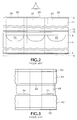
- U.S. Patent 5,077,553 discloses apparatus for addressing data storage elements. A practical implementation of the apparatus shown in U.S. Patent 5,077,553 is illustrated schematically in FIG. 2 of the accompanying drawings.
- the display panel shown in FIG. 2 comprises, in sequence from below, a polarizer 2, a channel substrate 4, a cover sheet 6 (commonly known as a microsheet), a layer 10 of twisted nematic (TN) liquid crystal material, an array of parallel transparent data drive electrodes (only one of which, designated 12, can be seen in the view shown in FIG. 2), an upper substrate 14 carrying the data drive electrodes, and an upper polarizer 16.
- the channel substrate 2 is typically made of glass and is formed with multiple parallel channels 20 in its upper main face.
- the channels 20 are filled with an ionizable gas, such as helium.
- a ground electrode and a strobe electrode (not shown) are provided in each of the channels 20.
- the channels 20 are orthogonal to the data drive electrodes and the region where a data drive electrode crosses a channel (when viewed perpendicularly to the panel) forms a discrete panel element 26.
- Each panel element can be considered to include elements of the layer 10 and the upper and lower polarizers 2 and 16.
- the panel elements include color filters (not shown) between the layer 10 and the upper substrate 14.
- the region of the upper surface of the display panel that bounds the panel element constitutes a single pixel 28 of the display panel.
- the upper polarizer passes light received from the volume element of liquid crystal material and the pixel is illuminated, whereas if a pixel is on, the upper polarizer blocks light received from the volume element of liquid crystal material and the pixel is not illuminated.
- Black surround material (not shown) is provided between adjacent panel elements in order to absorb stray light and preserve maximum contrast between a pixel that is on and a pixel that is off.
- the simple twisted nematic (TN) liquid crystal display panel that is shown in FIG. 3 comprises lower and upper substrates 40, 42 having respective arrays of electrodes 44, 46 thereon, with the two arrays of electrodes being oriented perpendicular to each other as rows and columns respectively, and a layer 48 of TN liquid crystal material between the two substrates.
- a rectangular matrix of pixels is defined by the crossing areas of the row and column electrodes.
- An extended light source (not shown) is provided beneath the panel, and in the event that a pixel is off (no potential difference between the row and column electrodes), the upper polarizer passes light received from the volume element of liquid crystal material and the pixel is illuminated, whereas if a pixel is on, the upper polarizer blocks light received from the volume element of liquid crystal material and the pixel is not illuminated.
- V 90 is the voltage that must be applied between a row electrode and a column electrode of a simple TN cell of the kind shown in FIG. 3 to switch the pixel at the crossing of the row and column electrodes from the off state to 90 percent transmissive in a normally black mode.
- the voltages V 50 and V 10 are the voltages that must be applied in order to turn the cell from the off state to 50 percent transmissive and 10 percent transmissive, respectively, in a normally black mode.
- Typical values for the V 10 , V 50 and V 90 are 1.5 volts, 2.0 volts and 3.1 volts. The dynamic range of the voltage required to operate the simple TN cell is therefore only about 2 volts.
- the physical mechanism whereby a panel element of the PALC display panel shown in FIG. 2 switches between the off and on states is the same as that for the panel element of the simple TN liquid crystal display panel shown in FIG. 3.
- the plasma functions as the row electrode, and therefore the potential difference between the row electrode and the column electrode is distributed between the cover sheet and the layer of liquid crystal material. Consequently, the dynamic range between the voltage V th (the maximum voltage at which a panel element of a PALC display panel passes substantially all of the light) and the voltage V on (the minimum voltage at which the panel element blocks substantially all of the light) is substantially higher than the corresponding voltage for a simple TN cell.
- V dynamic between V th and V on is 30 volts or more. It would be desirable if the value of V dynamic could be reduced to below 25 volts, and preferably as low as 18 volts, because this would give benefits in reduced cross talk between data drive electrodes, reduced power consumption, and reduced cost of circuits for driving the data drive electrodes.
- the literature regarding PALC display panels does not indicate a relationship between V dynamic and quantified or quantifiable features of the panel such as to allow one to design a PALC display panel so that V dynamic will have a desired value.
- TN liquid crystal materials are able to exercise a small degree of control over the perpendicular and parallel dielectric constants of the material without affecting the optical properties of the PALC display panel, and the thickness and the dielectric constant of the cover sheet can be varied without affecting the optical properties of the display panel.
- the thickness of the liquid crystal layer affects the optical properties of the panel as well as the electrical properties.
- the contrast ratio of a TN liquid crystal display panel depends on viewing angle.
- One of the practical applications of the TNLC display panel is in the monitor of a laptop computer. It is generally agreed that the monitor of a laptop computer should be able to provide a contrast ratio of 10:1 over a range of angles from 45° to the left of normal, 45° to the right of normal, 30° up from normal and 10° down from normal.
- the resulting polyhedron defines a desired viewing solid.
- Practical application of a PALC display panel overlap to some extent those of a TNLC display panel, and accordingly the viewing solid requirements for a PALC display panel are, in some cases, similar to those for a TNLC display panel.
- a plasma addressed liquid crystal display panel comprising a channel substrate, a cover sheet, a layer of twisted nematic liquid crystal material, an upper substrate, and an array of electrodes on the lower surface of the upper substrate, and wherein [2.43 ( V 90 - V 50 ) + V 50 ] [1+ d TD d LC . ⁇
- V x is the voltage that will turn a simple TN liquid crystal cell from the off state to X% transmissive in a normally black mode
- d TD is the thickness of the cover sheet
- d LC is the thickness of the liquid crystal layer
- ⁇ TD is the dielectric constant of the cover sheet
- ⁇ ⁇ is the perpendicular dielectric constant of the liquid crystal material
- is the parallel dielectric constant of the liquid crystal material
- d LC ⁇ n LC is in the range from about 0.4 to 0.5, where ⁇ n LC is the difference in refractive indices for the liquid crystal material.
- a method of operating a plasma addressed liquid crystal display panel that comprises a channel substrate, a cover sheet, a layer of twisted nematic liquid crystal material, an upper substrate, and an array of electrodes on the lower surface of the upper substrate, said method comprising driving the data drive electrodes with a voltage having a dynamic range that is less than about 25 volts and is given by [2.43 ( V 90 - V 50 ) + V 50 ] [1+ d TD d LC . ⁇
- V x is the voltage that will turn a simple TN liquid crystal cell from the off state to X% transmissive in a normally black mode
- d TD is the thickness of the cover sheet
- d LC is the thickness of the liquid crystal layer
- ⁇ TD is the dielectric constant of the cover sheet
- ⁇ ⁇ is the perpendicular dielectric constant of the liquid crystal material
- is the parallel dielectric constant of the liquid crystal material
- d LC ⁇ n LC is in the range from about 0.4 to 0.5, where ⁇ n LC is the difference in refractive indices for the liquid crystal material.
- FIG. 1 illustrates a PALC color display panel in which color filter material is provided on the lower surface of the upper substrate 14 before the data drive electrodes 12 are deposited.
- each panel element 26 includes a color filter 30 between the data drive electrode and the upper substrate 14.
- FIG. 1 also illustrates black surround material 34 between adjacent color filters.
- the layer 10 of TN liquid crystal material is bounded by the cover sheet 6 and the data drive electrode 12.
- the sequence of components from the channel 20 to the upper substrate 14 consists of the cover sheet 6, the layer 10, the data drive electrode 12 and the color filter 30, in that order.
- V dynamic [2.43 ( V 90 - V 50 ) + V 50 ] [1+ d TD d LC . ⁇
- d TD is the thickness of the cover sheet
- d LC is the thickness ofthe liquid crystal layer
- ⁇ TD is the dielectric constant of the cover sheet
- ⁇ ⁇ is the perpendicular dielectric constant ofthe liquid crystal material
- is the parallel dielectric constant of the liquid crystal material.
- d LC ⁇ n LC depends on the desired viewing solid and on the pre-tilt of the alignment layer with respect to the lower surface of the upper substrate. Generally, one will initially set d LC ⁇ n LC to about 0.45 and iteratively adjust the value of d LC until the desired viewing solid is obtained.
- Equation 1 For a given TN liquid crystal material for which the values of V x are known, Equation 1 can be simplified.
- ⁇ n LC is from about 0.04 to 0.16 and for a given liquid crystal material, the specific value of ⁇ n LC will set a range of values of d LC in accordance with Equation 2.
- can then be selected to return the desired value of V dynamic . If it should be found for a particular selection of values that the viewing solid is not acceptable, d LC can be changed but d TD can be adjusted to keep R constant.
- Equation 1 provides a rational and quantitative basis for predicting the effect on V dynamic of a change in thickness of the cover sheet. For example, when reasonable values of the variable other than d TD are used, Equation 1 shows that by reducing the cover sheet thickness from 30 ⁇ m to 5 ⁇ m, V dynamic can be reduced by at least 50 percent. It also allows one to determine what other parameters would need to be changed, and to what extent, in order to provide an effect equivalent to a given change in the thickness of the cover sheet.
Landscapes
- Physics & Mathematics (AREA)
- Nonlinear Science (AREA)
- Engineering & Computer Science (AREA)
- Chemical & Material Sciences (AREA)
- Crystallography & Structural Chemistry (AREA)
- General Physics & Mathematics (AREA)
- Plasma & Fusion (AREA)
- Mathematical Physics (AREA)
- Optics & Photonics (AREA)
- Liquid Crystal (AREA)
- Computer Hardware Design (AREA)
- Theoretical Computer Science (AREA)
- Liquid Crystal Display Device Control (AREA)
- Devices For Indicating Variable Information By Combining Individual Elements (AREA)
Applications Claiming Priority (2)
| Application Number | Priority Date | Filing Date | Title |
|---|---|---|---|
| US2167796P | 1996-07-12 | 1996-07-12 | |
| US21677P | 1996-07-12 |
Publications (2)
| Publication Number | Publication Date |
|---|---|
| EP0818703A2 true EP0818703A2 (fr) | 1998-01-14 |
| EP0818703A3 EP0818703A3 (fr) | 1998-02-11 |
Family
ID=21805537
Family Applications (1)
| Application Number | Title | Priority Date | Filing Date |
|---|---|---|---|
| EP97305004A Withdrawn EP0818703A3 (fr) | 1996-07-12 | 1997-07-08 | Panneau d'affichage à cristal liquide à relation optimisée entre les paramètres du cristal liquide et l'épaisseur de la plaque de revêtement |
Country Status (5)
| Country | Link |
|---|---|
| US (1) | US5903325A (fr) |
| EP (1) | EP0818703A3 (fr) |
| JP (1) | JPH1090661A (fr) |
| KR (1) | KR980010500A (fr) |
| CN (1) | CN1195154A (fr) |
Families Citing this family (3)
| Publication number | Priority date | Publication date | Assignee | Title |
|---|---|---|---|---|
| JP3519310B2 (ja) * | 1998-06-12 | 2004-04-12 | シャープ株式会社 | 液晶表示装置 |
| US6849935B2 (en) | 2002-05-10 | 2005-02-01 | Sarnoff Corporation | Low-cost circuit board materials and processes for area array electrical interconnections over a large area between a device and the circuit board |
| USRE41914E1 (en) | 2002-05-10 | 2010-11-09 | Ponnusamy Palanisamy | Thermal management in electronic displays |
Family Cites Families (5)
| Publication number | Priority date | Publication date | Assignee | Title |
|---|---|---|---|---|
| JP3208895B2 (ja) * | 1993-01-25 | 2001-09-17 | ソニー株式会社 | プラズマアドレス液晶表示装置 |
| JP2847666B2 (ja) * | 1993-03-04 | 1999-01-20 | テクトロニクス・インコーポレイテッド | 電気光学表示方法 |
| US5805122A (en) * | 1994-12-16 | 1998-09-08 | Philips Electronics North America Corporation | Voltage driving waveforms for plasma addressed liquid crystal displays |
| US5835167A (en) * | 1994-12-21 | 1998-11-10 | Philips Electronics North America | Plasma addressed liquid crystal display with reduced column voltages |
| GB9705703D0 (en) * | 1996-05-17 | 1997-05-07 | Philips Electronics Nv | Active matrix liquid crystal display device |
-
1997
- 1997-07-08 EP EP97305004A patent/EP0818703A3/fr not_active Withdrawn
- 1997-07-09 JP JP9183887A patent/JPH1090661A/ja active Pending
- 1997-07-09 KR KR1019970031634A patent/KR980010500A/ko not_active Withdrawn
- 1997-07-11 CN CN97117818A patent/CN1195154A/zh active Pending
- 1997-07-11 US US08/893,650 patent/US5903325A/en not_active Expired - Fee Related
Also Published As
| Publication number | Publication date |
|---|---|
| JPH1090661A (ja) | 1998-04-10 |
| EP0818703A3 (fr) | 1998-02-11 |
| US5903325A (en) | 1999-05-11 |
| CN1195154A (zh) | 1998-10-07 |
| KR980010500A (ko) | 1998-04-30 |
Similar Documents
| Publication | Publication Date | Title |
|---|---|---|
| US6433849B1 (en) | High reflectivity bistable liquid crystal display | |
| US5396351A (en) | Polarizing fiber-optic faceplate of stacked adhered glass elements in a liquid crystal display | |
| KR100307942B1 (ko) | 액정표시장치 | |
| GB2455061A (en) | Liquid Crystal Device with three sets of electrodes for controlling tilt and azimuth angles | |
| JPH05249457A (ja) | 液晶表示装置 | |
| JPH06160878A (ja) | 液晶表示装置 | |
| US20030128312A1 (en) | Liquid crystal display | |
| US20030053020A1 (en) | Liquid crystal display device | |
| JPH0143956B2 (fr) | ||
| EP0614168A1 (fr) | Structure d'adressage électro-optique ayant une sensibilité réduite à la diaphonie | |
| US6052161A (en) | Liquid crystal display apparatus | |
| US20020145698A1 (en) | Liquid crystal display apparatus and method for producing same | |
| EP2322982A1 (fr) | Dispositif d'affichage à cristaux liquides à alignement vertical | |
| US5903325A (en) | Plasma addressed liquid crystal display panel with optimized relationship between liquid crystal parameters and cover sheet thickness | |
| US6404412B1 (en) | Plasma-addressed color display | |
| US7369197B2 (en) | Polarizer, panel for a liquid crystal display, and liquid crystal display, including a scattering layer | |
| US6233028B1 (en) | Plasma-addressed liquid crystal display with reduced column voltages | |
| EP0800105A2 (fr) | Dispositif d'affichage à cristal liquide adressé par plasma comprenant un polariseur interne | |
| JP3656827B2 (ja) | 液晶表示装置 | |
| RU2027204C1 (ru) | Жидкокристаллический экран | |
| US6400345B1 (en) | Method of operating a plasma addressed liquid crystal (PALC) panel | |
| JPH06222341A (ja) | プラズマアドレス液晶表示装置 | |
| JP2519712B2 (ja) | 液晶表示装置 | |
| JP3322070B2 (ja) | 液晶表示装置 | |
| Kahn et al. | Multiplexing Limits of Twisted Nematic Liquid Crystal Displays and Implications for the Future of High Information Content LCDs |
Legal Events
| Date | Code | Title | Description |
|---|---|---|---|
| PUAI | Public reference made under article 153(3) epc to a published international application that has entered the european phase |
Free format text: ORIGINAL CODE: 0009012 |
|
| PUAL | Search report despatched |
Free format text: ORIGINAL CODE: 0009013 |
|
| AK | Designated contracting states |
Kind code of ref document: A2 Designated state(s): DE FR GB NL |
|
| AK | Designated contracting states |
Kind code of ref document: A3 Designated state(s): AT BE CH DE DK ES FI FR GB GR IE IT LI LU MC NL PT SE |
|
| 17P | Request for examination filed |
Effective date: 19980807 |
|
| AKX | Designation fees paid |
Free format text: DE FR GB NL |
|
| RBV | Designated contracting states (corrected) |
Designated state(s): DE FR GB NL |
|
| 17Q | First examination report despatched |
Effective date: 20011130 |
|
| STAA | Information on the status of an ep patent application or granted ep patent |
Free format text: STATUS: THE APPLICATION IS DEEMED TO BE WITHDRAWN |
|
| 18D | Application deemed to be withdrawn |
Effective date: 20020411 |